
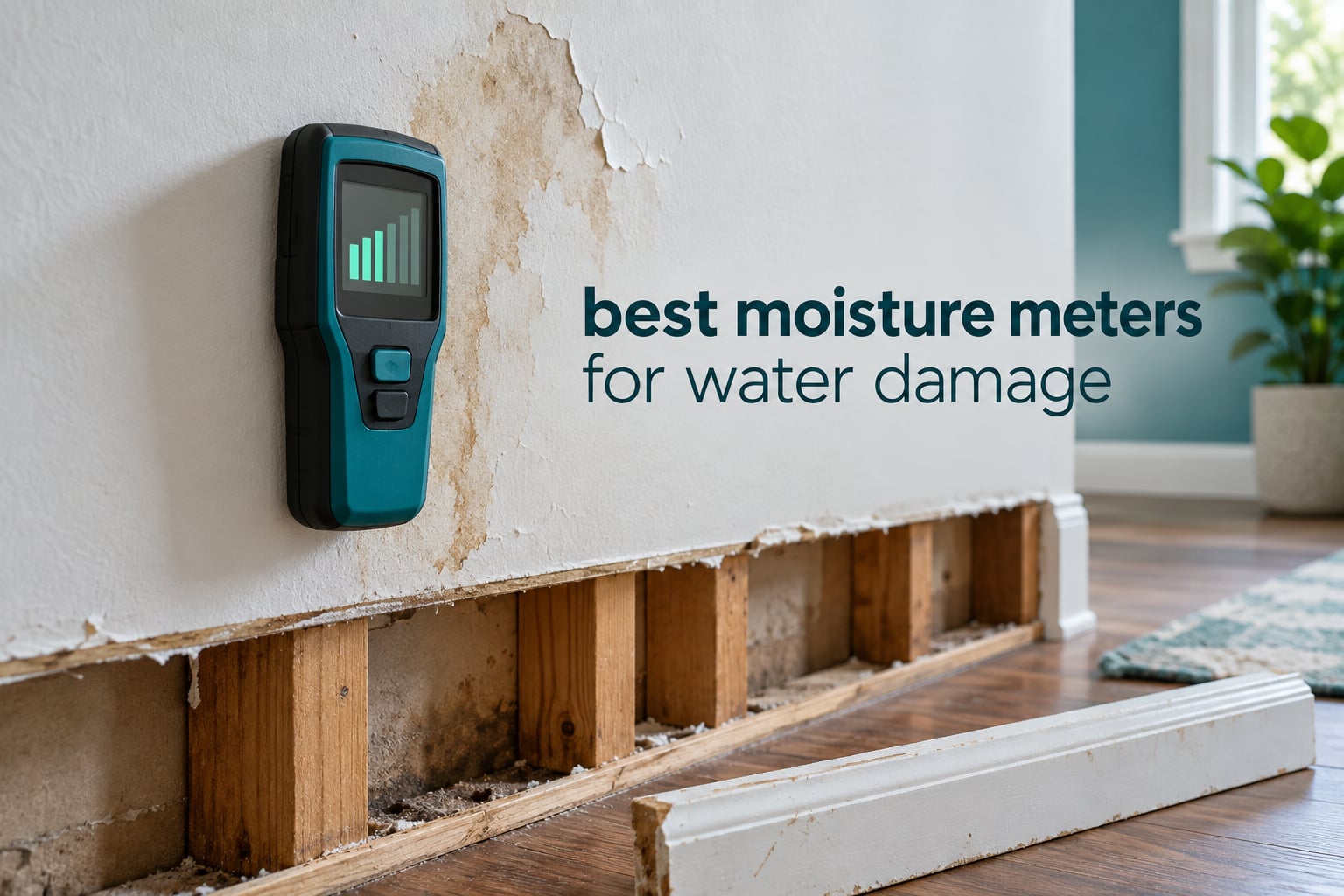
Water damage hides. A stain on a ceiling can be three weeks old, a soft spot under hardwood can be soaking an OSB subfloor, and a musty smell in a closet is often a failed water heater fitting rather than a mold colony you can see. The best moisture meters for water damage give you a number where your eyes give you nothing, and they let you prove drying progress to an adjuster, a flooring installer, or a tenant.
This roundup covers 12 handheld moisture meters for homeowners, home inspectors, property managers, and restoration technicians. We compared meter type, sensing depth, wood and building-material ranges, calibration approach, and the failure modes owners actually report in the field. Every reading threshold quoted here comes from restoration guidance rather than guesswork.
If you only read one section, read our whole-house water filtration picks later; for now, the short answer is below.
Table of Contents
What Is the Best Moisture Meter for Detecting Water Damage?
The best moisture meters for water damage are combination pin and pinless meters, because a pinless scan maps the wet area quickly without marking surfaces, and the pin gives you a depth-specific number you can document. If you only want one tool, buy a combination model. If you insist on a single-function meter, buy pinless for scanning and rent a pin meter for verification.
A pin meter pushes two probes into the material and measures electrical resistance, which rises as the material dries. A pinless meter emits a radio-frequency signal and measures how water changes the returned signal, giving you a relative reading across a shallow sensing volume. A moisture meter cannot find the leak source, cannot confirm mold, and cannot see into an empty wall cavity where there is no material to carry a signal.
Top 3 Picks for Water Damage Investigation in 2026
The three picks below cover the situations we see most often: a first-stage screen of an unknown stain, a fast non-destructive sweep of finished walls, and a single-tool answer for owners who check both lumber and drywall.
General Tools MMD4E
- Pin-type
- 5-50% wood range
- 1.5-33% building materials
- Backlit 0.3 inch display
- Holding and audible tone
Klein Tools ET140
- Pinless to 3/4 inch
- Nine LED bars
- Softwood and hardwood modes
- Hold and auto power off

Best Moisture Meters for Water Damage (October 2026)
The table below maps each meter to the job it is actually good at. Note the two columns that matter most for water damage: whether the meter reads a number you can log, and how deep it senses.
| Product | Specifications | Action |
|---|---|---|
| General Tools MMD4E |
|
Check Latest Price |
| Klein Tools ET140 |
|
Check Latest Price |
| RDINSCOS MT35P |
|
Check Latest Price |
 TOPTES TS-630 TOPTES TS-630 |
|
Check Latest Price |
 Proster PST199-P Proster PST199-P |
|
Check Latest Price |
 LASELION MS04 LASELION MS04 |
|
Check Latest Price |
 Mecurate WMM Mecurate WMM |
|
Check Latest Price |
 Kiprim WM01 Kiprim WM01 |
|
Check Latest Price |
 Povlen MT510 Povlen MT510 |
|
Check Latest Price |
 LASELION MS03 LASELION MS03 |
|
Check Latest Price |
 Protimeter Mini Protimeter Mini |
|
Check Latest Price |
 American Mutt Tools TH102-101 American Mutt Tools TH102-101 |
|
Check Latest Price |
1. General Tools MMD4E – Best Overall for First-Stage Screening
General Tools MMD4E Moisture Meter for Wood, Walls & Water Leak Detection
Pin-type meter
Wood 5-50%
Building materials 1.5-33%
Backlit 0.3 inch digits
9V alkaline
Pros
- Broadest measurement range in the group
- Large backlit digits readable in crawlspaces
- Hold button and audible completion tone
- Cap doubles as a calibration check
- Replacement pins widely available
Cons
- Leaves two pin holes in every surface measured
- Repeated readings on the same spot can disagree
- Paper manual no longer included
- Some units fail to read on a ceiling
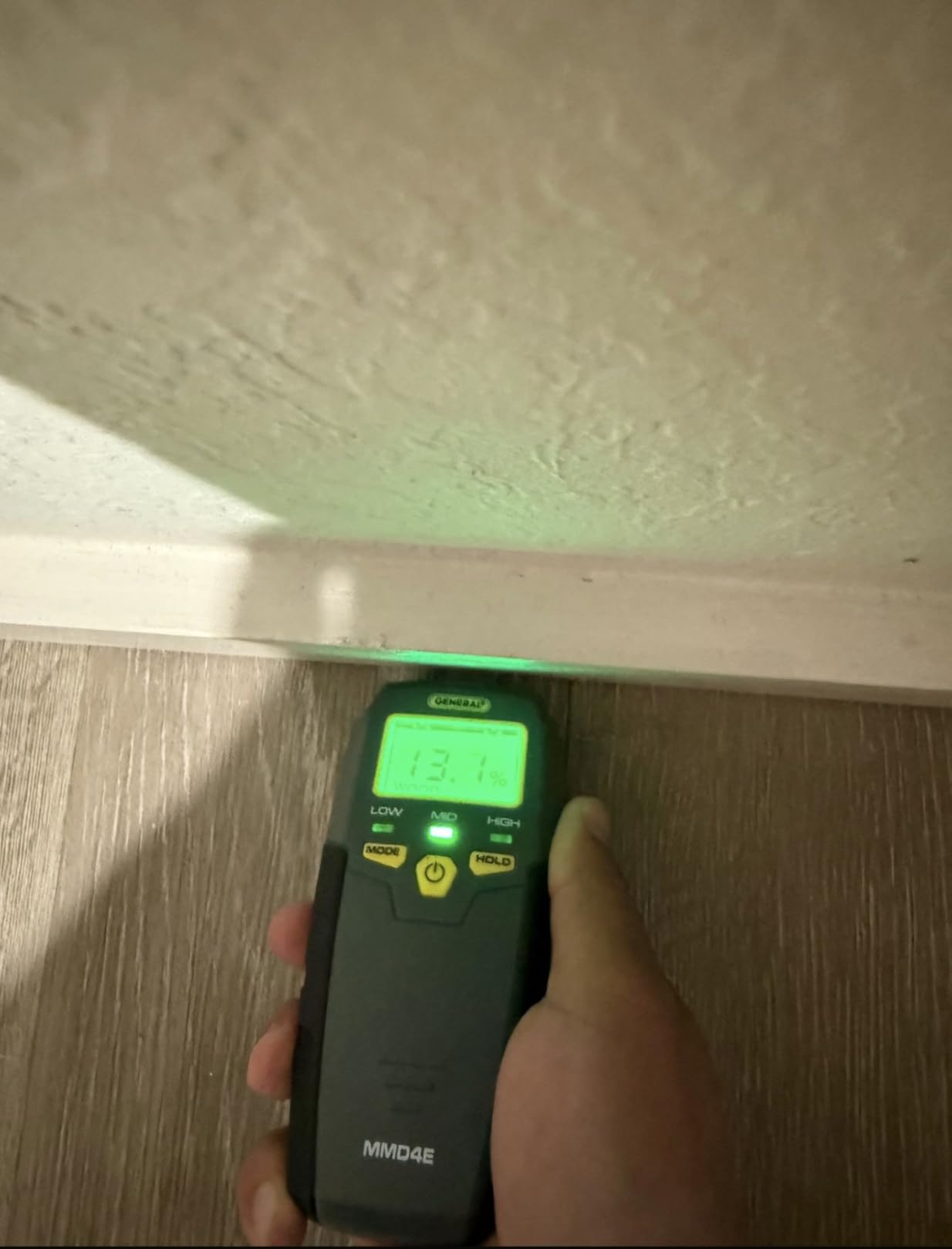
The MMD4E is the meter I hand to anyone who asks me to look at an unexplained stain first. It has been the top-ranked moisture meter in its category for years, and the reason is the range: 5% to 50% for wood and 1.5% to 33% for building materials. That second range is what matters for water damage, because it covers drywall and plaster rather than stopping at the lumber scale.
In practice the three-button layout gets out of the way. You press the pins into the suspect area, wait for the tone, and read the backlit digits with the colored tone bar telling you low, medium, or high. The hold function lets you keep a number on screen while you write it down, which matters when you are logging a moisture map of a whole wall.
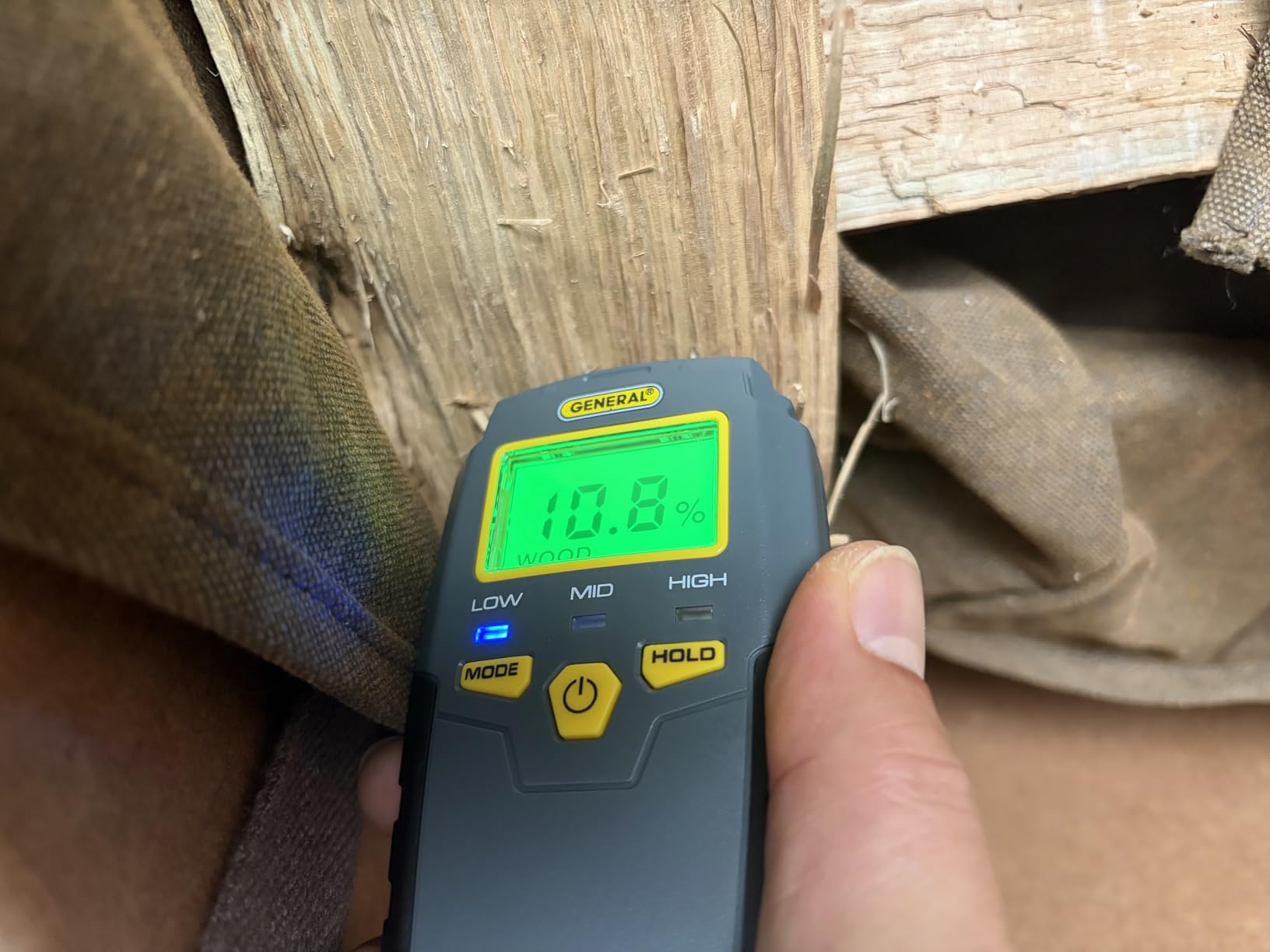
What you give up for that range is non-destructive scanning. Every measurement leaves two pin holes, and on a painted wall or a finished ceiling that means spackle, sanding, and a repaint. Owners also point out that repeated probes into the same damp area can return different numbers, so it is a screening instrument rather than a court-of-last-resort tool.
The practical rule I use: scan wide with a pinless meter first, then confirm with this one. Owners have told me the same story in reverse, describing cases where a pin reading of 3% to 7% on a sound subfloor sat a few inches from a warped patch that read far higher. The meter is not wrong; the material is behaving differently because it is delaminated.
When to reach for the MMD4E
Use it when you need a number in a wide material range and the surface can take a pin hole: framing, subfloor edges behind removed baseboard, a water heater closet, or the drywall that is already going to be cut out. It is also the meter to buy if you want one device that handles wood and building materials without switching models.
The 8mm stainless steel pins, the protective cap that doubles as a calibration check, and a one-year warranty keep it in the everyday toolkit. Customer service has also been reported as sending replacement pins free of charge, which is a small thing that matters when you are on your third set.
When to pick something else
Skip it on finished surfaces you care about. Two small holes in a visible ceiling is a repair, not a measurement, and no amount of care gets rid of the dimples. It is also the wrong tool for mapping the boundary of a wet area, because pin probing at twelve points along a wall is slow and leaves a dotted line of holes.
And if the suspected moisture sits in an insulated cavity, the 8mm pins stop short of what you need. A standard 5/8 inch drywall probe reaches the face of the backer, not the wet insulation behind it.
2. Klein Tools ET140 – Best Pinless Value for Finished Walls
Klein Tools ET140 Pinless Moisture Meter for Non-Destructive Moisture Detection in Drywall, Wood, and Masonry; Detects up to 3/4-Inch Below Surface
Pinless EMF scanning
3/4 inch sensing depth
Seven ounces
Reverse-contrast LCD with nine LED bars
2m drop protection
Pros
- No holes in drywall or finished wood
- Repeatable readings map a moisture boundary
- Display readable in poor light
- Hold and auto power off
- Well regarded by tradespeople for leak tracing
Cons
- Hardwood mode can read several points low
- Flat sensor struggles in corners
- Weak results on rough concrete
- No carrying case included
The ET140 is the meter that comes out when the wall in question has a fresh paint job. It scans electromagnetically to a stated 3/4 inch depth and leaves no mark at all, and it is calibrated for drywall, masonry, hardwood, and softwood, which covers most residential water damage investigation.
Its repeatability is the real selling point. Because the same meter gives the same number on the same spot, you can sweep a wall, find the highest-reading zone, then re-scan a week later and see that number fall. That before-and-after pair is what convinces a tenant or an adjuster that drying equipment is working, and it is why plumbers and homeowners keep buying it.
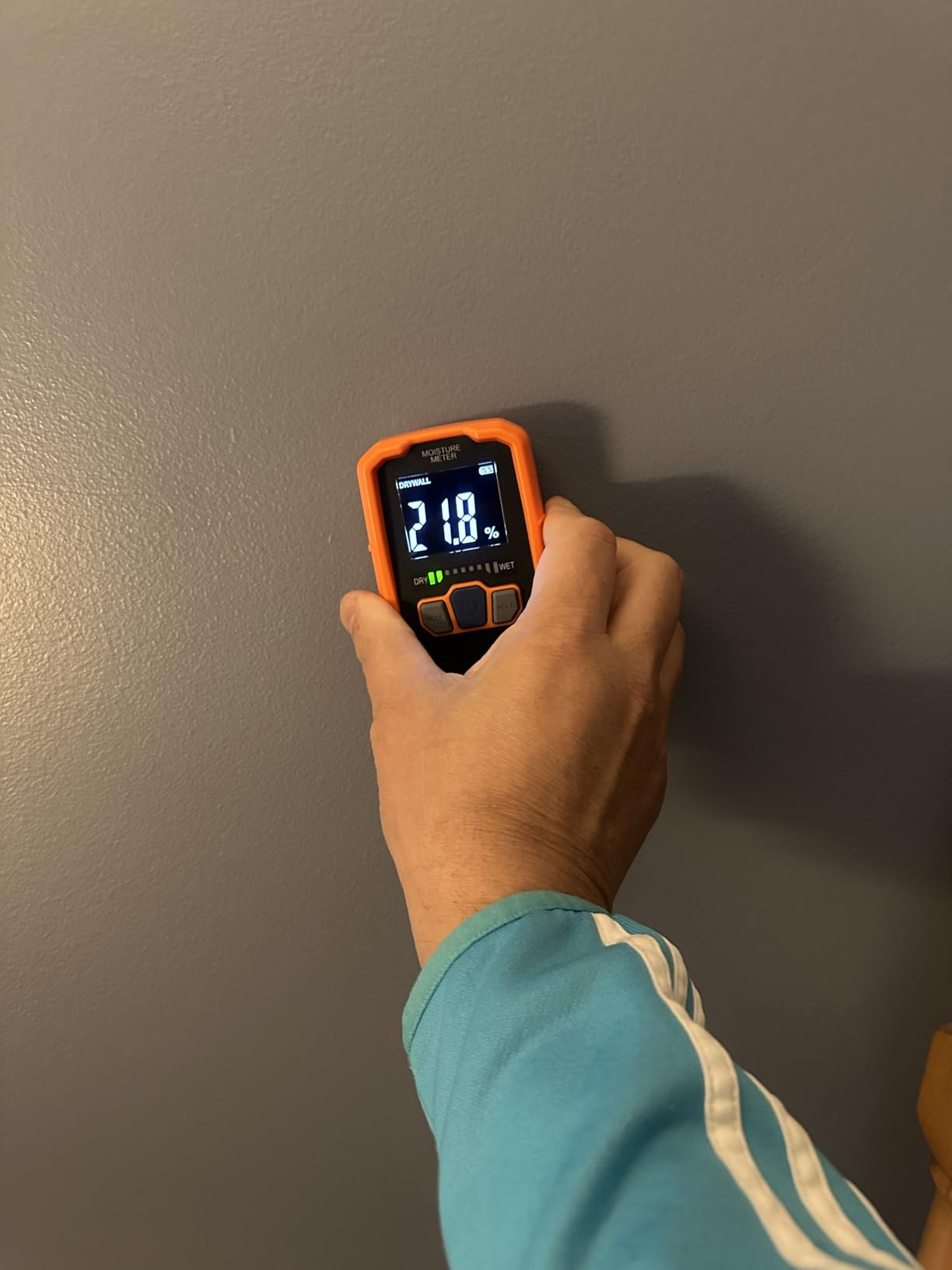
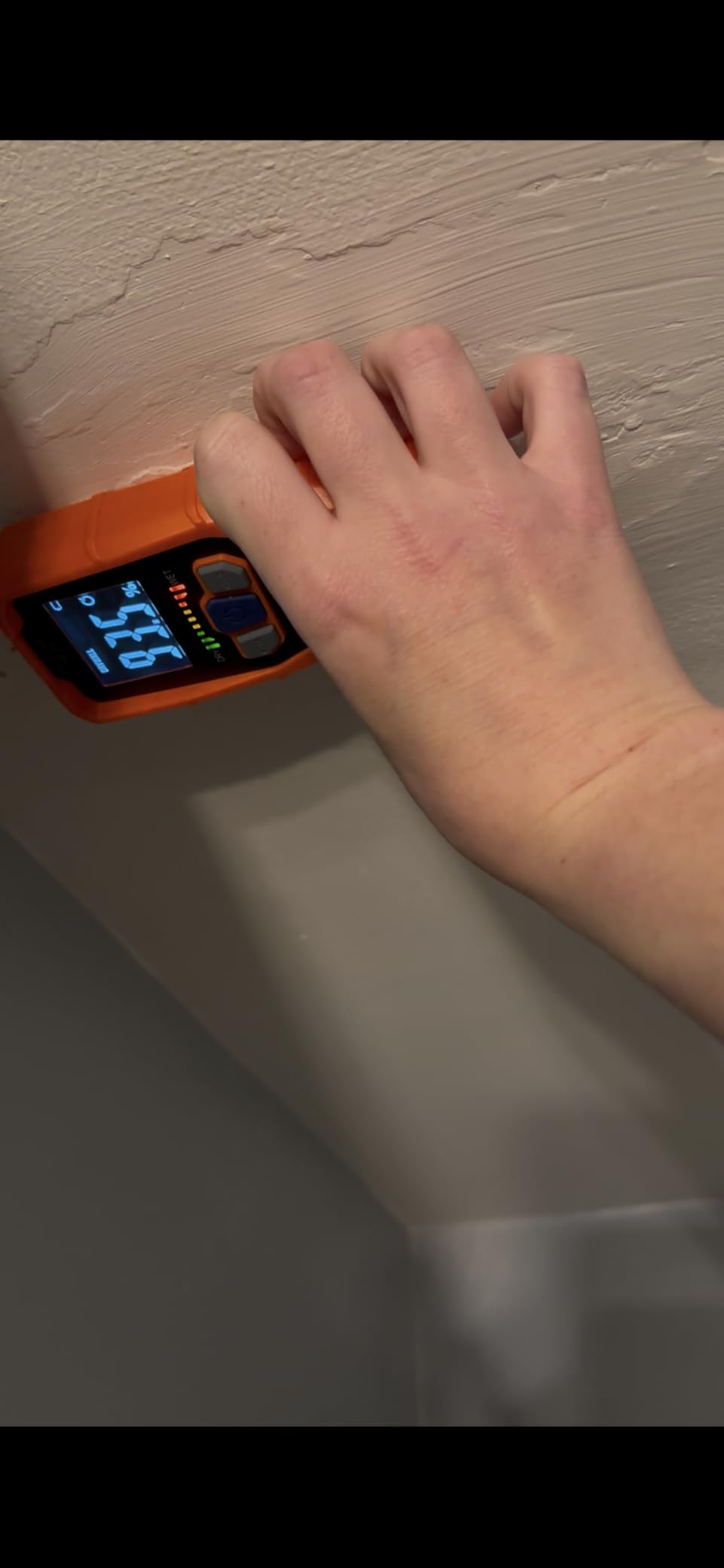
Limits show up in specific places. The sensor is flat, so inside a wall-to-ceiling corner the field is truncated and the reading often slams to a maximum rather than climbing gradually. Rough concrete and textured masonry give weak results compared with smooth surfaces. On hardwood, owners report the reading landing several points below what a reference pin meter shows.
None of that matters for a first pass. Cross-check any surprising number with a pin meter before you cut a hole, and you avoid both false alarms and unnecessary demolition.
What makes this the value pick
Seven ounces, a 3/4 inch sensing depth, a reverse-contrast display with nine moisture bars, and 2 metre drop protection is a lot of meter for the money. The hold function lets you freeze a reading while you mark the spot, and auto power off means it survives being left in a truck all afternoon.
It also operates across a 30% to 70% relative humidity band, which covers most indoor basements and conditioned rooms without complaint. For a rental portfolio or a house you are turning over, that combination of price and repeatable scanning is the sweet spot.
Where it falls short
Corners, rough masonry, and the low-density surfaces that matter most in drywall are the weak spots. If your concern is a leak behind a shower enclosure, a pin meter that reaches the framing is the safer bet.
Reaching softwood mode also takes cycling through the material options, which is mildly annoying when you are moving quickly. And the meter ships without a case, so it lives loose in a tool bag until you buy one.
3. RDINSCOS MT35P – Best Two-in-One for Leaks and Lumber
Pinless & Pin-Type Moisture Meter for Wood, Drywall & Concrete
Detachable pin probe and rear pinless plate
Color LCD
Button-based material selection
14.4 ounces
Type-C cable and bag included
Pros
- Genuine two functions in one body
- Buttons instead of scrolling menus
- Color LCD is easy to read at a glance
- Track roof leak repair from wet back to dry
- Popular for campers and firewood
Cons
- Concrete readings stayed high after a basement dried
- Masonry accuracy trails wood performance
- Modest review base for a newer listing
The MT35P solves a specific problem: owners who want a pin meter for accuracy and a pinless meter for surfaces, but only want to carry one thing. The pin probe detaches and stores in the body, and the rear plate scans surfaces when the probe is out.
Owners like the button-based material selection. Instead of scrolling through a menu, you press a button for the surface you are testing, which matters when you are moving room to room with the meter in one hand and a flashlight in the other. The color LCD gives a quick visual read on how wet the area is.
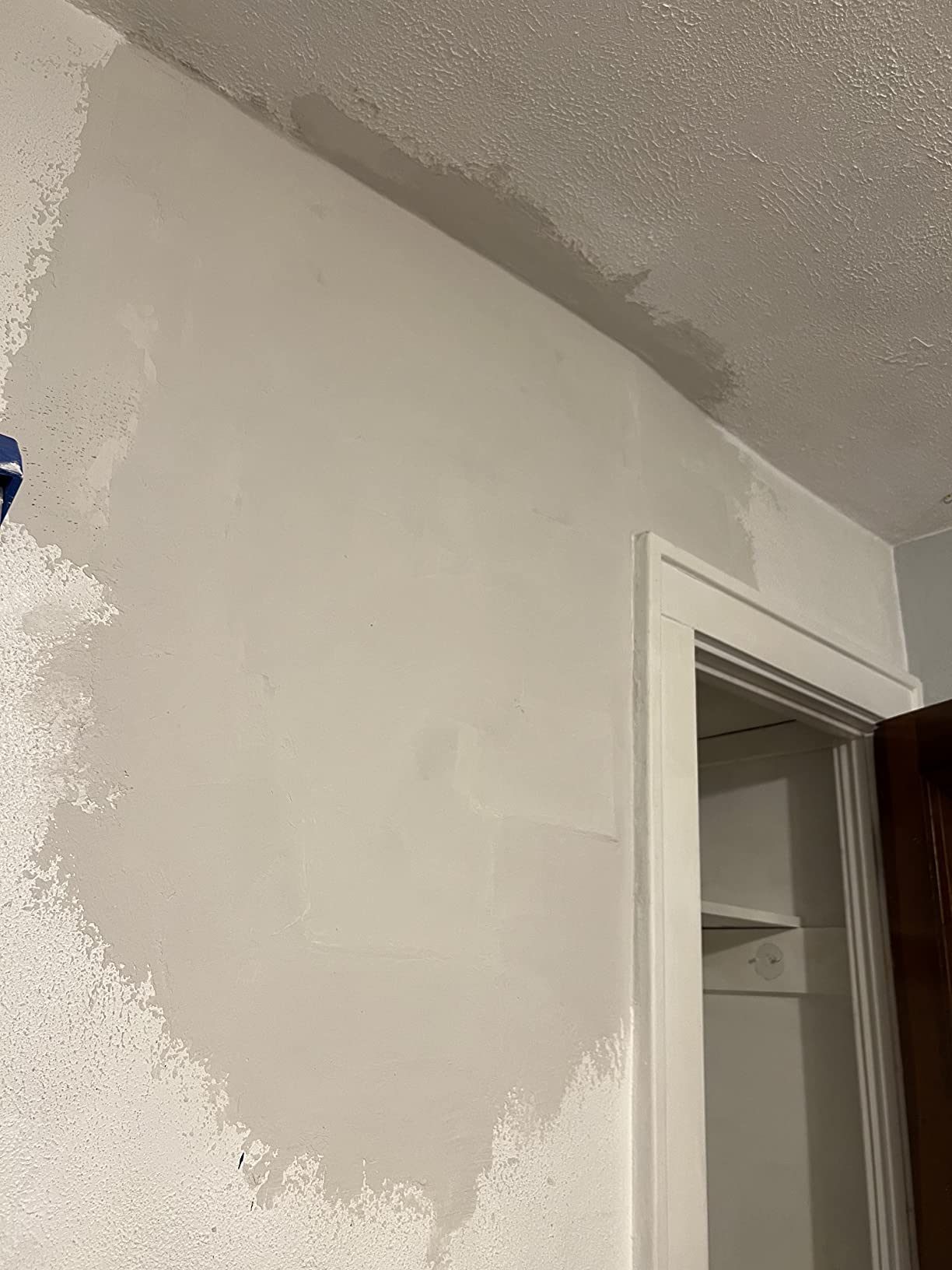
The consistent complaint is concrete. Multiple reviewers report the meter continuing to flag a basement as damp long after it had dried, and the masonry mode trails its solid wood performance. If your suspect area is a poured concrete wall or slab, do not lean on this meter alone.
For wood framing, subfloor, drywall, plaster, and camper or RV use, the feedback is close to unanimous praise. Several users tracked a roof leak from readings around 20% back toward zero after the repair, which is exactly the documentation a restoration file needs.
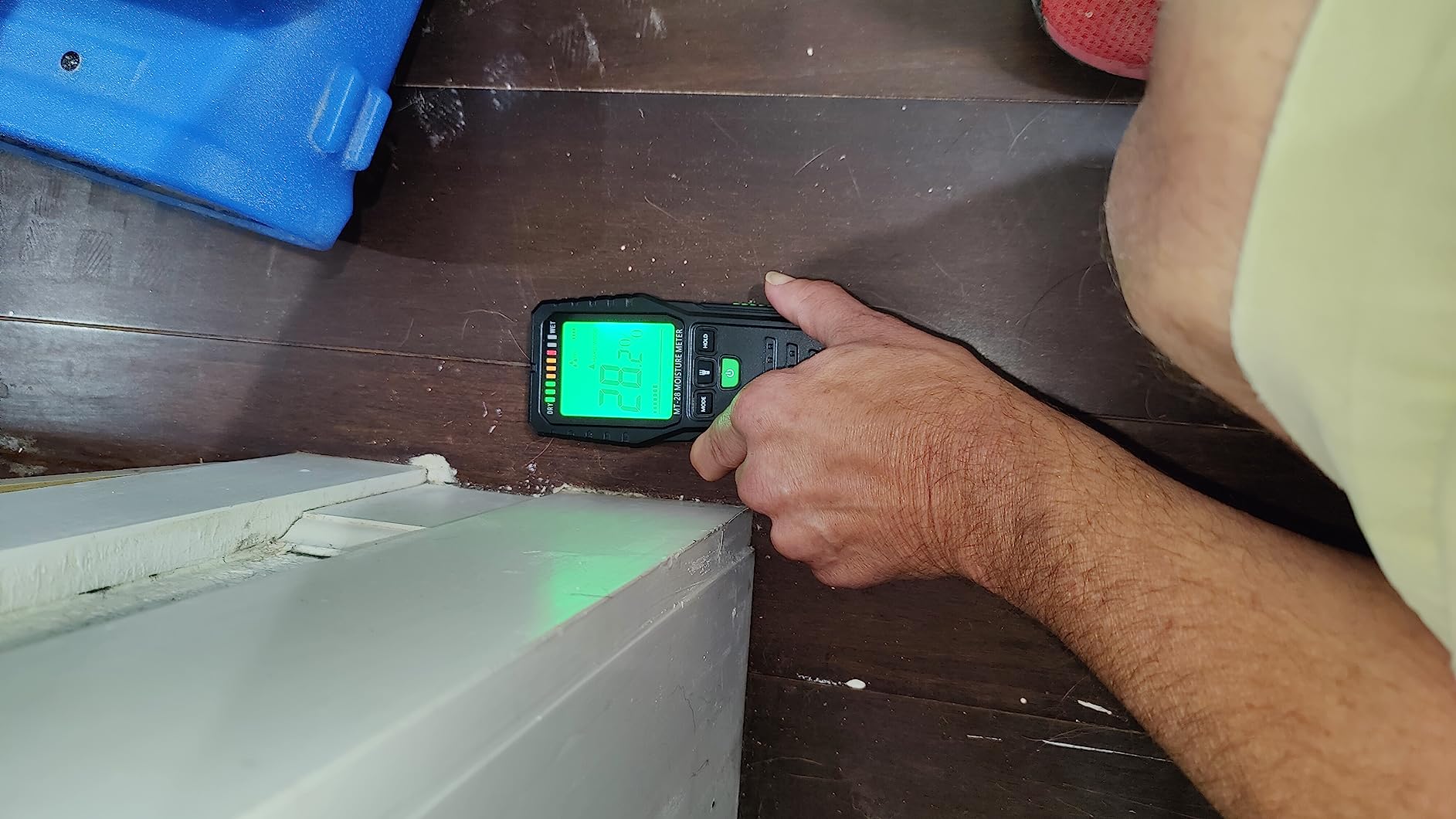
Why it earns a spot in this roundup
One device covering scanning and probing halves the number of tools in the bag and removes the excuse for not verifying a pinless reading. It weighs 14.4 ounces, ships with a Type-C cable and a carry bag, and the package is compact enough for a technician’s belt pouch.
It is a recent listing, so the review pool is smaller than the incumbents. That cuts both ways: less long-term data, but the design is newer and the two-in-one layout is the sort of thing that tends to improve as the format matures.
Who should skip it
Skip it if your work is concrete or masonry. The consistent over-reading there is not a small calibration gap; it is the wrong tool for the material, and it will keep you chasing a leak that is already gone.
It is also not the choice for a professional documenting a job for an insurer, where the color LED and button interface are less useful than a hard percentage and a data log.
4. TOPTES TS-630 – Best for Firewood and Lumber
Wood Moisture Meter, TopTes Digital Moisture Meter TS-630, Handheld Humidity Tester with 2.25-inch LCD Display, Tricolor Backlight, Check The Dampness Level on Firewood/Drywall – Orange
Pin-type meter
0.0-57% across seven scales
2.25 inch tricolor LCD
148 grams
Three-year warranty
Pros
- Tricolor backlight sorts dry and wet logs at a glance
- Seven calibration scales
- Bar graph with data hold and max/min
- Spare pins and mini wrench in the box
- Pocket-friendly with carry pouch
Cons
- Indoor dry lumber displays Lo instead of a number
- Will not find a leak unless the surface is literally wet
- Pushes in firmly and marks the surface
- Manual has many non-English pages
The TS-630 is a lumber meter that happens to be good at drywall. Seven calibration scales spanning 0.0% to 57% give it real resolution on wood, and the 2.25 inch tricolor backlight is the fastest way I have found to sort a pile of firewood: green, orange, red.
It comes with three AAA batteries, a carry pouch, a spare pin set, and a mini wrench for changing the probes. That is a more complete box than most meters in this price range, and a three-year warranty is longer than most competitors offer.
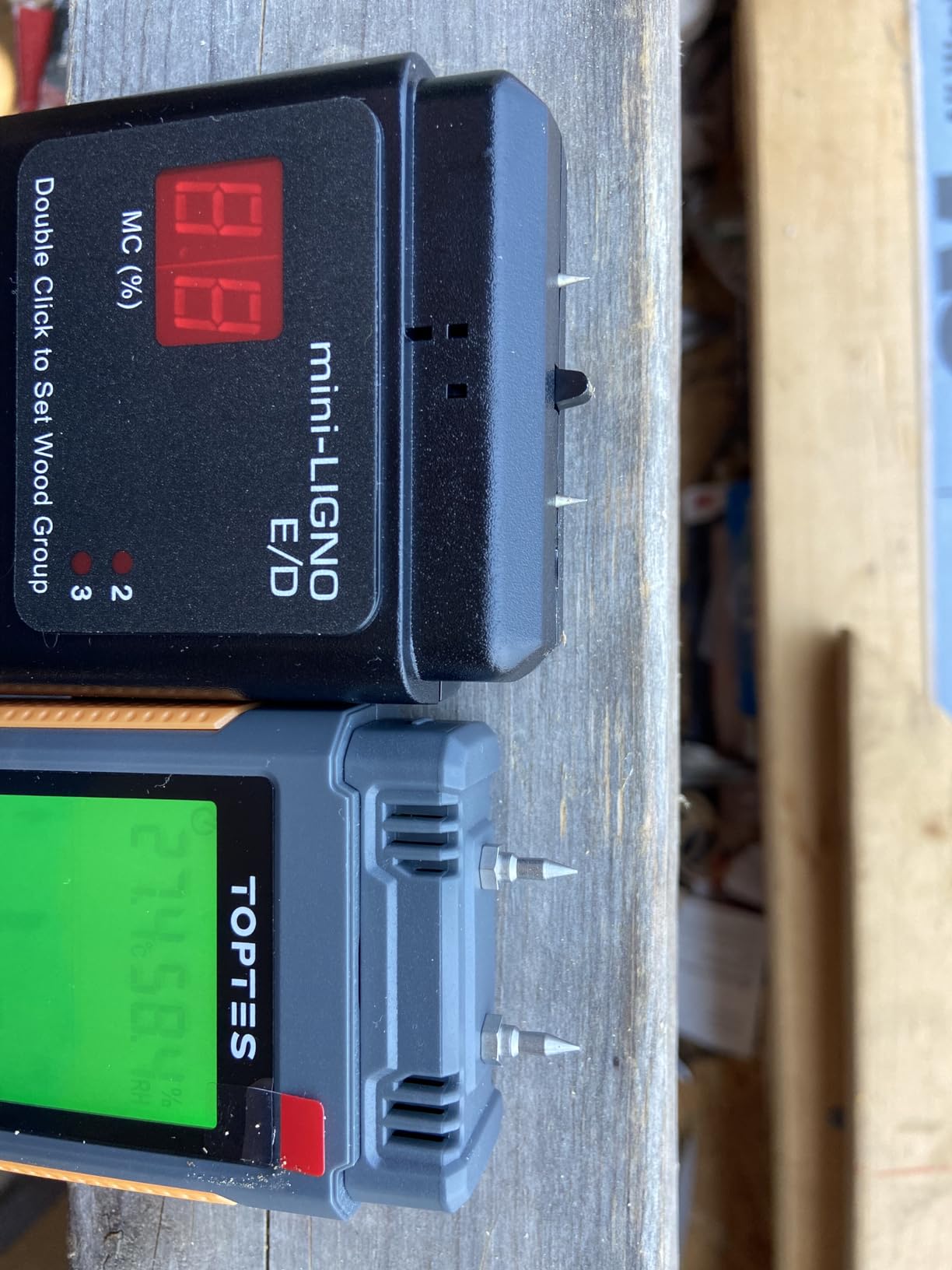
Here is the trap for water damage work. The floor of its range means anything properly dry indoors reads Lo rather than a number, so acclimated flooring and healthy drywall all look identical to a piece that is not being measured at all. That is fine for a woodpile and useless for tracing a leak that has already dried at the surface.
One owner checked it against a professional damp survey and got matching results, which tells me the internal measurement is sound. The limitation is the range, not the accuracy.
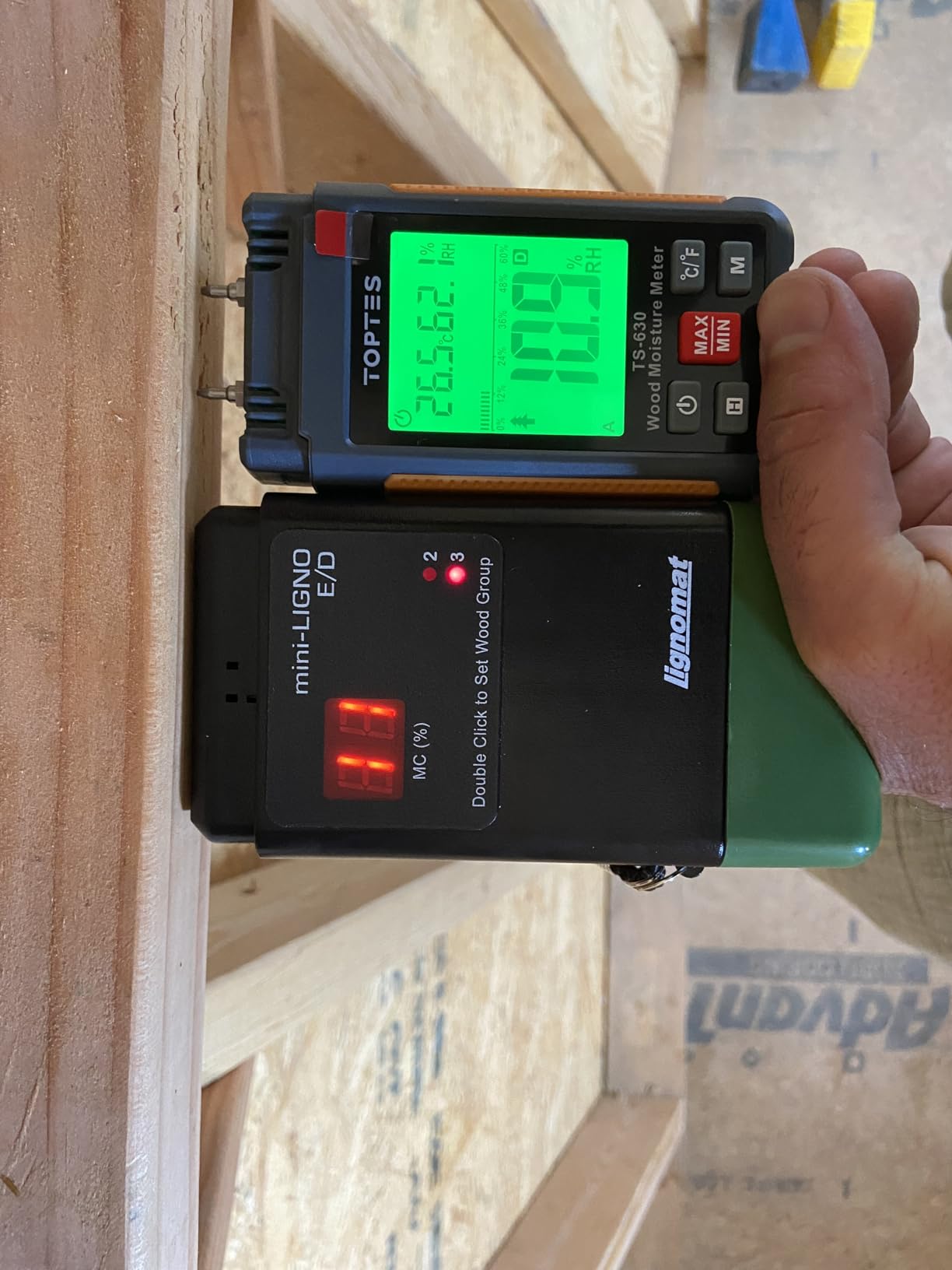
Where it fits in a water damage toolkit
Buy it if you burn wood, run a stove, or do flooring work. The bar graph, data hold, and max/min functions make logging a stack of boards straightforward, and the auto shutoff at ten minutes protects the batteries in a truck.
It also works as a second opinion for framing lumber pulled from a wet wall. The question you care about there is not the surface reading; it is whether the stud is above the threshold for drying, and the TS-630 has the resolution to tell you.
Where it does not fit
It will not detect a leak unless the surface is genuinely wet, and a dried-out water line leaves nothing for it to find. It also leaves two small dents in every surface it measures, which is the same objection as any pin meter but harder to excuse when the range is not ideal for the surface anyway.
Skip it for finished architectural work, and expect to hunt through the manual, since a large share of it is not in English.
5. Proster PST199-P – Best Entry-Level Pinless Leak Tracer
Proster Pinless Moisture Meter 3/4″ Depth Color Alarm Non-Destructive
Pinless detection
3/4 inch (19 mm) depth
Walls 5-70% and wood 5-75%
Three-color LED bar with audible alarm
Storage bag included
Pros
- No pinholes anywhere
- Finds the source of leaks behind work surfaces
- Tri-color bar and audible alarm speed up sweeps
- Large backlit reverse-contrast display
- Best value among capable pinless meters
Cons
- Readings less dependable than a professional pin meter
- Better confirmed with a reference pin meter
- Treat outputs as directional rather than absolute
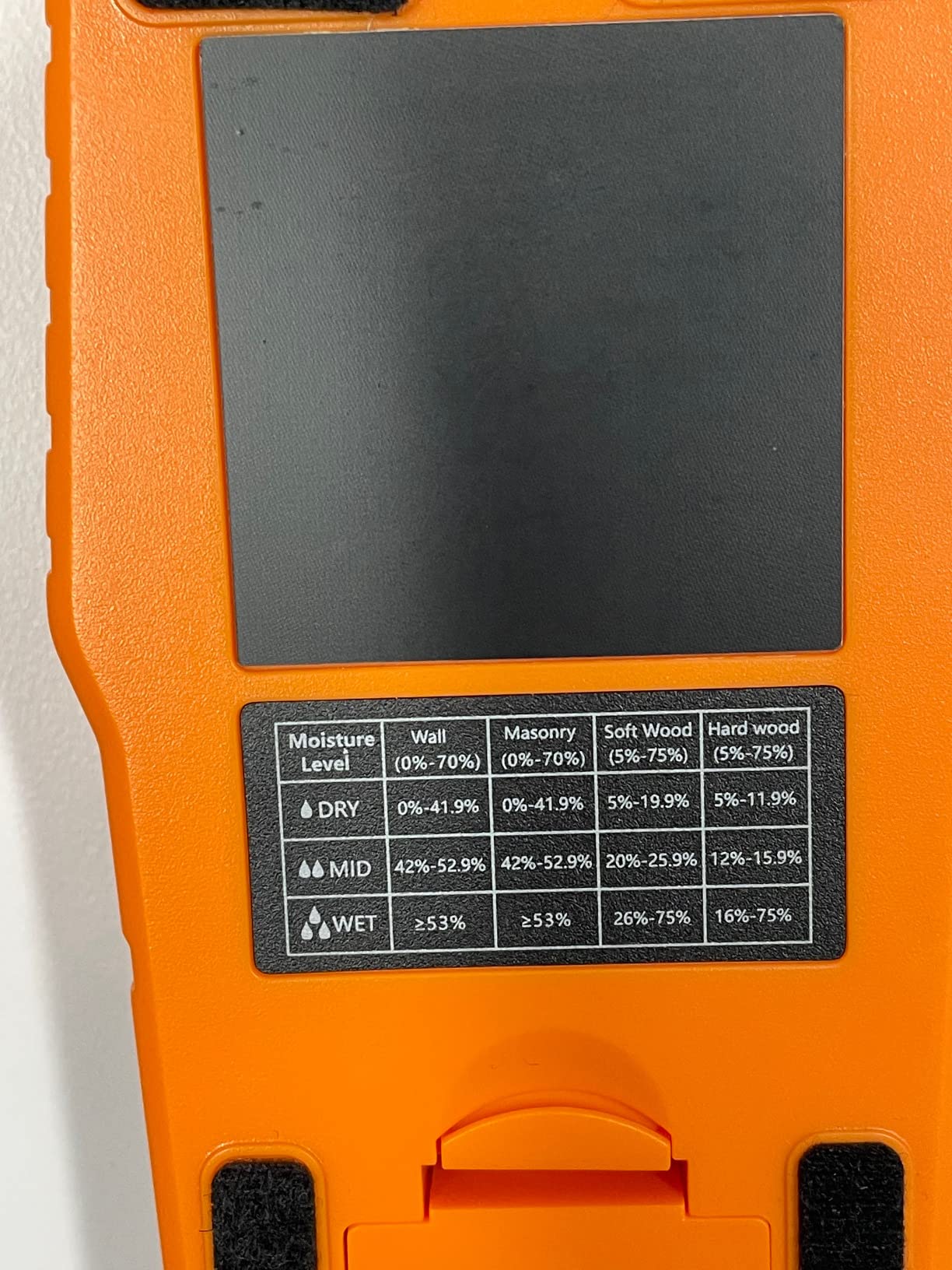
The Proster is the cheapest tool here that still behaves like a real instrument rather than a toy. It scans to 3/4 inch (19 mm), covers 5% to 70% for walls and masonry and 5% to 75% for soft and hard wood, and it works across a wide temperature band from 32 to 104 degrees Fahrenheit.
The three-color LED bar graph plus an audible alarm that rises in pitch with moisture is what makes it fast. You do not have to look at the screen to know you are over a wet zone; you hear it. That makes it the right meter for sweeping behind a washing machine or a water heater where you cannot keep your eyes on the display.
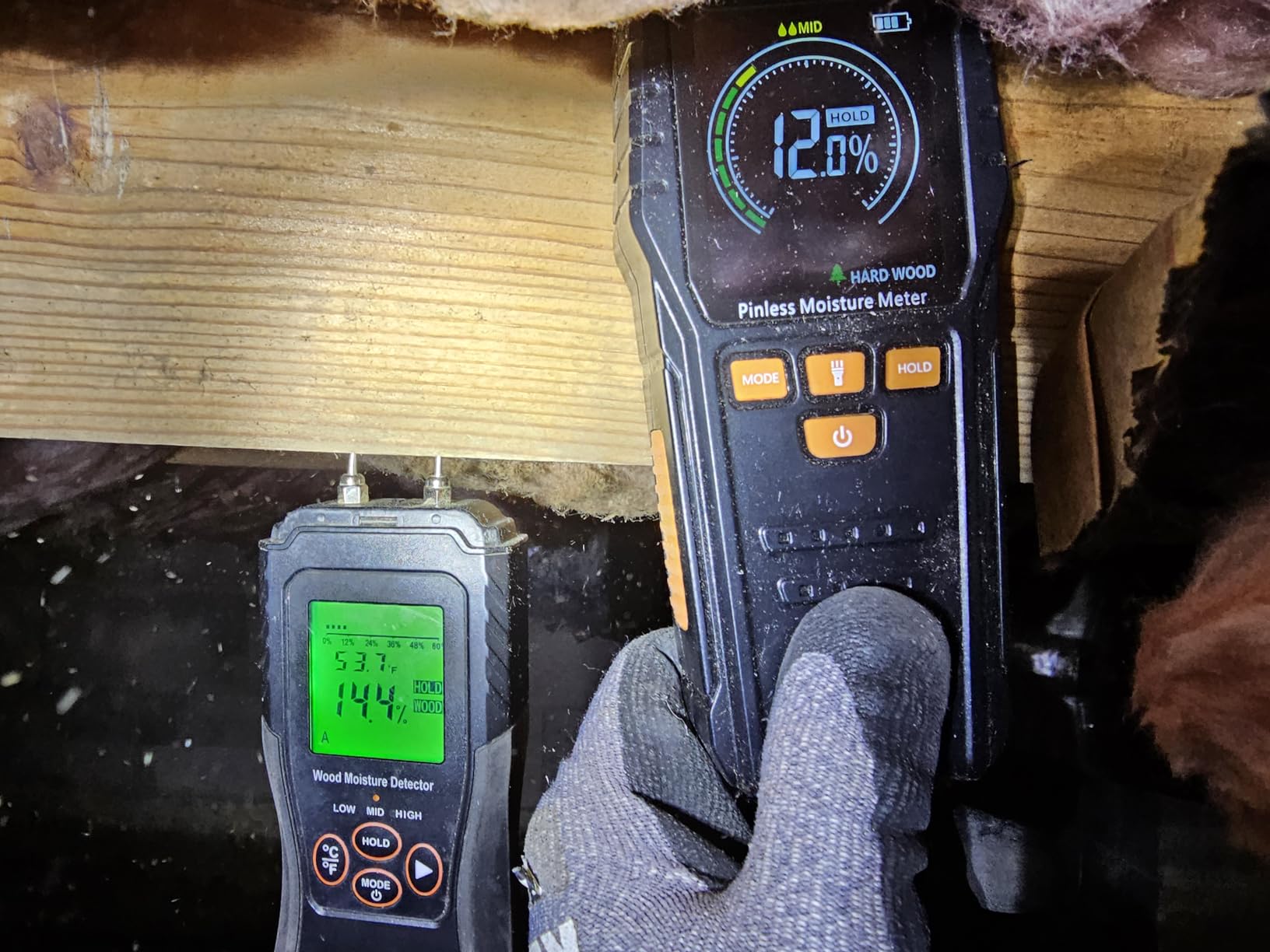
Be clear about what the output means. Like all pinless meters at this level, the reading is a relative figure, not a calibrated moisture content percentage. Compare it against a known-dry area of the same material on the same wall, and the comparison is meaningful. Treat the number as a percentage and you will chase ghosts.
Owners with a professional meter report they need a reference to confirm true accuracy in some materials. That is the right way to use it: as a screener that finds the boundary, backed by a pin meter for the number you log.
Why it beats the cheaper options
Out-of-range and low-battery alarms, a hold button, auto power off, and an included storage bag are the details that separate this from the no-name crowd. It weighs 270 grams, which is heavy for a pocket but stable in the hand when you are pressing it flat against a wall.
For a landlord with a dozen rental units, it is the fastest way to triage: sweep every suspect wall, flag the loud spots, and only then decide where a technician goes.
When to choose another model
Do not use it as the sole instrument on a job where a number matters, such as verifying a drying goal before closing up a wall. A pin meter is the right tool for that, and the readings here are explicitly described by owners as screening-level.
It is also blind to very thin or low-density surfaces the same way other pinless meters are. If the wall is bare drywall with nothing behind it, the sensing volume has little solid material to read.
6. LASELION MS04 – Best for Corners and Dark Crawlspaces
LASELION MS04 Pinless Moisture Meter with Ball Probe for Non-Destructive Area Scans Ideal for Wood Walls and Construction Materials Customizable Humidity Alarms Built-in Flashlight
Ball probe for corner and area scans
5-40 mm measuring depth
Customizable MID and WET alarms
Built-in flashlight
Carrying case and three AAA included
Pros
- Ball probe reaches corners a flat sensor cannot
- Completely non-destructive on finished surfaces
- You set your own alarm thresholds
- Flashlight makes crawlspaces and dark cabinets workable
- One owner cut the drywall open and moisture stopped exactly at the reading
Cons
- Absolute accuracy is unproven so readings are directional
- Some users recalibrate after switching on
- Very sensitive to ambient humidity
The MS04 solves the flaw that shows up in almost every other pinless meter: corners. A ball probe is a sphere on the end of the sensor, so it can sit flat against the junction of two walls or roll along a baseboard where a flat plate can only touch at an angle and give you a wrong answer.
The second feature I would not give up is the built-in flashlight. Crawlspaces, under-sink cabinets, and behind a removed vanity are where leaks actually hide, and all three are places where a headlamp is one more thing to drop in a dark closet.
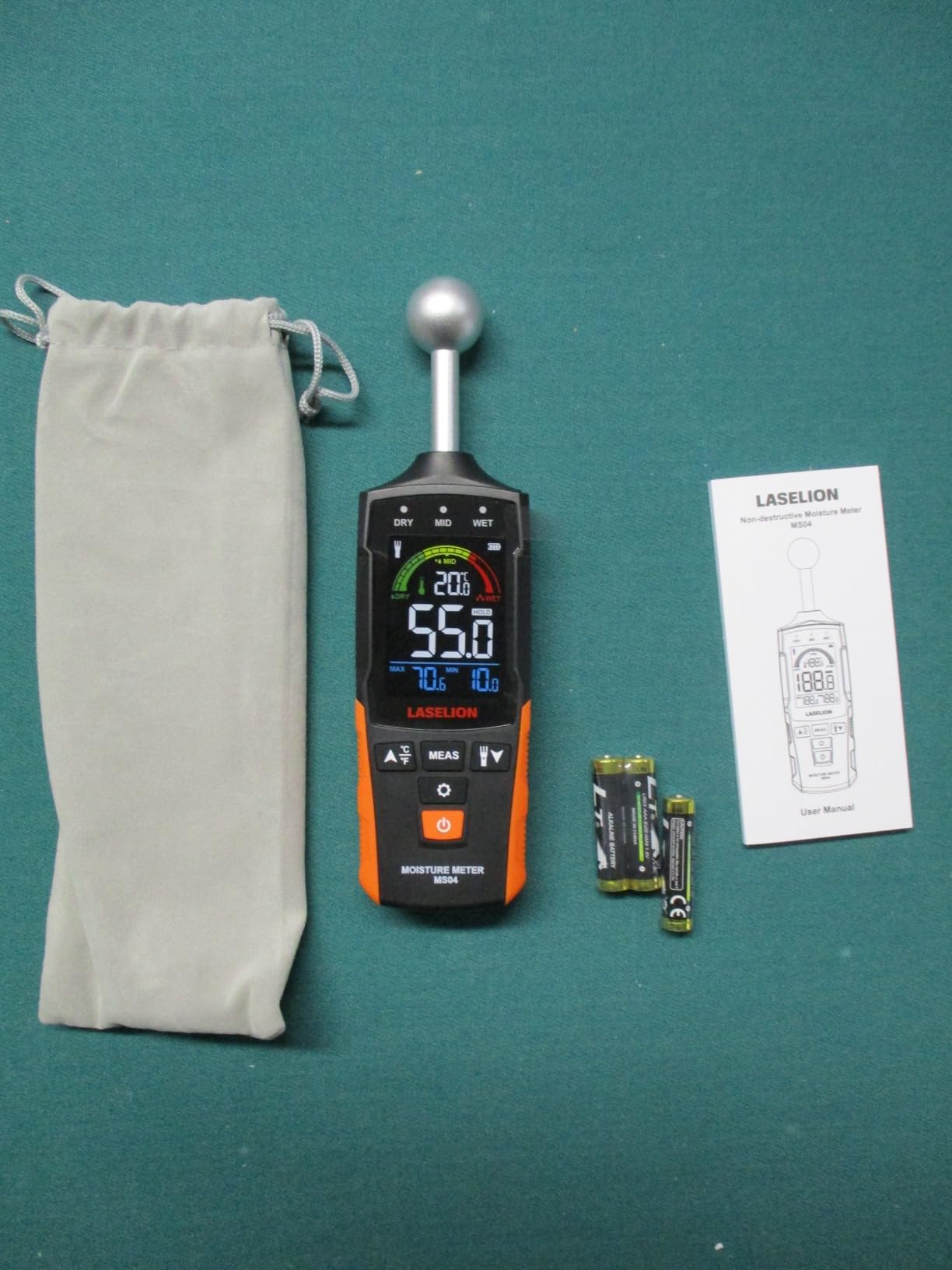
The customizable MID and WET alarm thresholds are more useful than they sound. You decide what counts as marginal and what counts as dangerous for your material, and the meter tells you which one you are looking at. A restoration contractor can set conservative limits once and use them on every wall for the rest of the day.
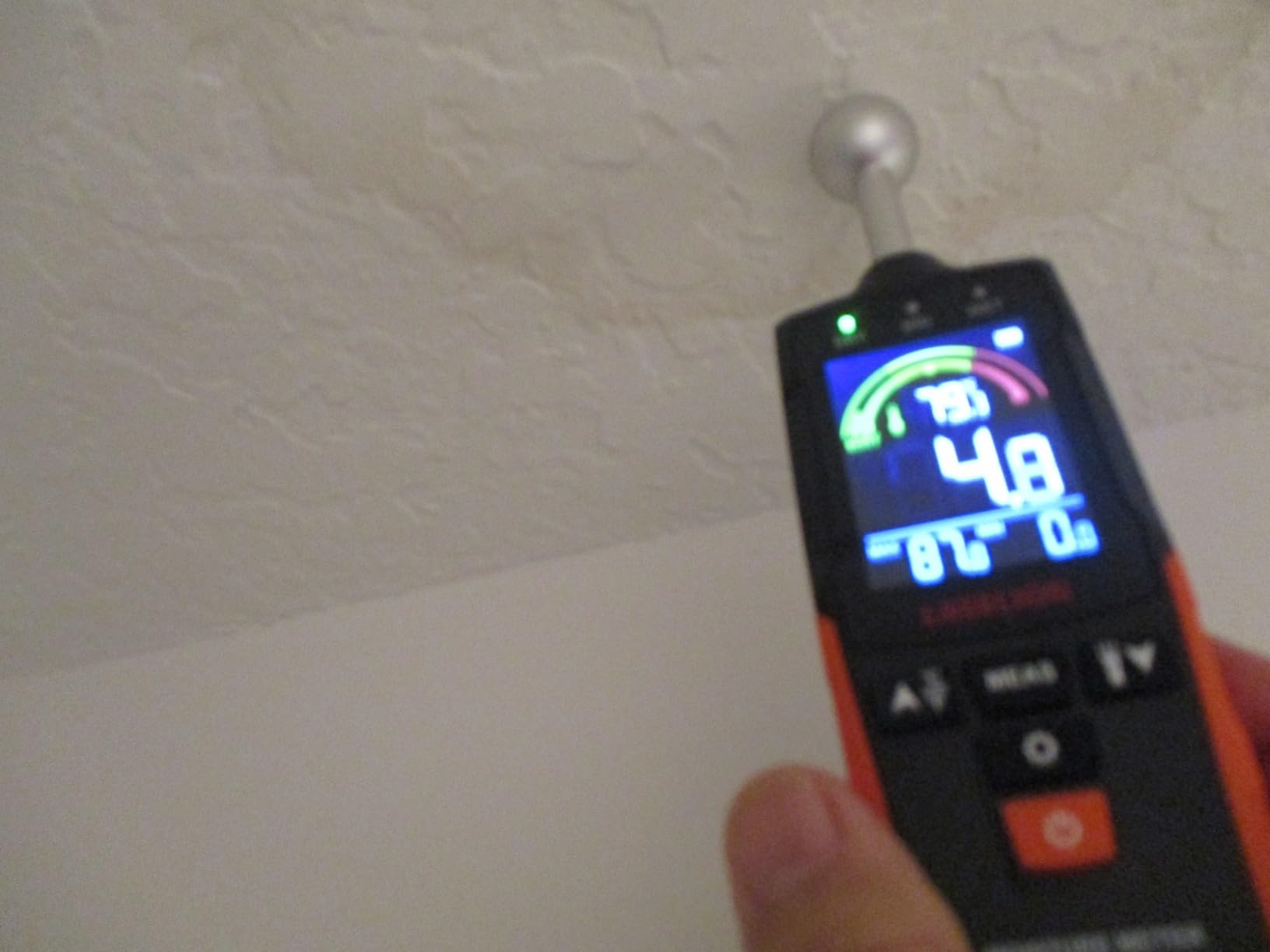
One owner story is worth repeating because it is the whole argument for a meter like this: they cut out the drywall at a flagged area and found the moisture boundary stopped exactly where the meter said it would. That is what a screening instrument is supposed to deliver.
Where this meter earns its place
It is 229 grams, fits in one hand, and the screen stays readable in direct sunlight, which matters for a ceiling in a sunlit room. The carrying case is included along with three AAA batteries, so there is nothing to buy after the fact.
For real estate inspections, rental turnovers, and cabinetry, the combination of a probe that fits awkward geometry and a light that works in the dark is a genuinely better tool than a cheaper flat-sensor model.
What to keep in mind
Owners describe the readings as directional. A woodworker comparing new lumber against kiln-dried stock got repeatable results but deducted a star because the absolute accuracy is not established. Some users also find it needs recalibrating after switching it on.
Being sensitive to ambient humidity is a double-edged trait: it detects small changes well, but a damp basement can push the whole wall up. Take a dry reference reading on the same surface first.
7. Mecurate WMM – Best for Confirming Drywall Readings
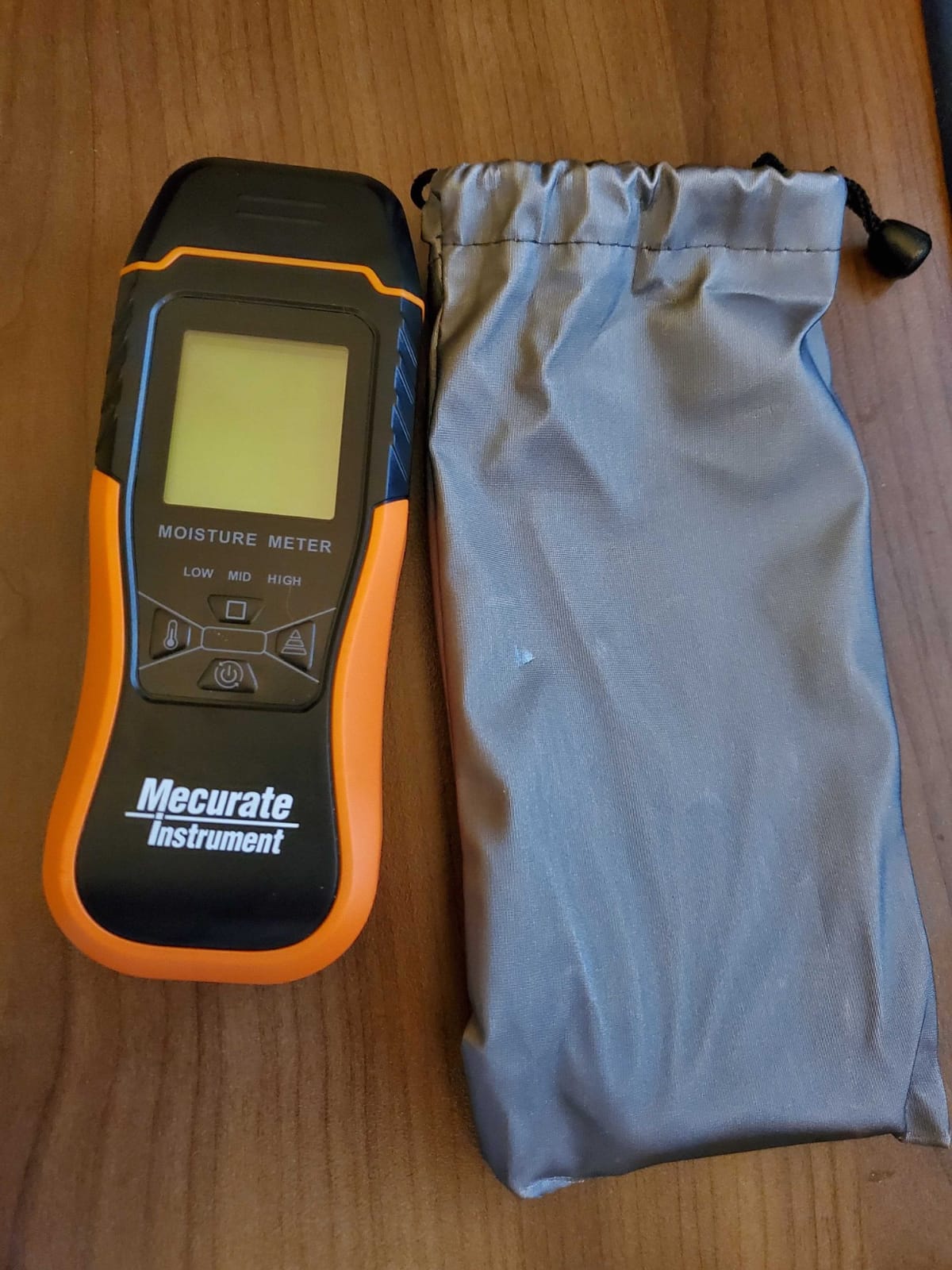
Mecurate Digital Pin Type Wood Moisture Meter with 3 Colored Indicators, Moisture Detector 2 Mode 8 Calibration Large Backlit for Wood, Wall, Firewall (Orange)
Pin-type meter
Wood 6-60% and building material 1.5-33%
Eight wood scales at 0.1% resolution
Self-test on protective cap
Ambient temperature display
Pros
- Highest average rating in the group at 4.6 stars
- 0.1% resolution with eight wood scales
- Self-test calibration without external wood
- Three colored indicators and on-screen icons
- Integrated ambient temperature readout
Cons
- Batteries were dead on arrival for at least one buyer
- Pin measurement leaves two holes per sample
- Not calibrated for concrete-specific readings
The Mecurate is the one I trust when the question is a specific number rather than a trend. It resolves to 0.1% across eight wood calibration scales and two material modes, with wood running 6% to 60% and building materials 1.5% to 33%. That resolution is what lets you say dry instead of nearly dry.
Owners in restoration and painting describe using it to work out how long drywall and framing have been exposed, and several report it agreeing with the equipment professional response teams bring. A long-term owner says it has outlasted several more expensive meters they owned.
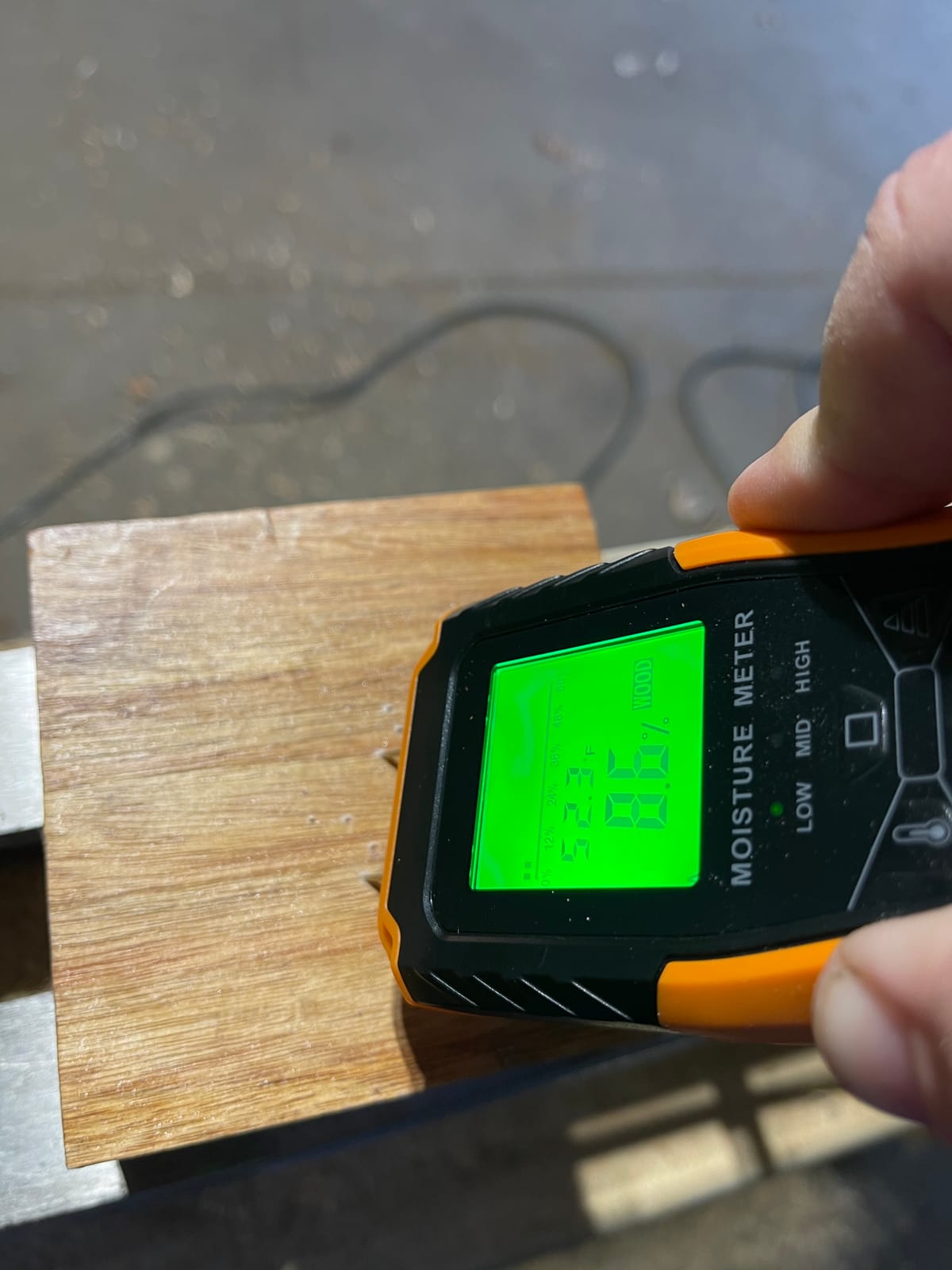
The self-test feature on the protective cap is the detail I appreciate most. You can verify the instrument is functioning before you trust it on a real job, which directly answers the complaint that shows up most often in owner discussions: a cheap meter reading a flat zero on obviously wet material. Knowing the meter works is half the battle.
Three colored indicators and on-screen icons make the low, medium, and high call fast, and the ambient temperature readout is genuinely useful in a cold crawlspace where readings shift with conditions.
Why professionals reach for a pin meter at all
Depth specificity is the reason. A pinless scan averages a shallow volume, so a wet layer behind a dry surface reads moderate. Pins let you drive into the material and ask what is happening at a defined depth, which is the number you need to decide whether a wall is ready to close.
For that reason this meter pairs well with a pinless model. Scan to find the boundary, probe to quantify it, and record both in the same log so the map and the number agree.
What to watch out for
It leaves two holes in every surface it measures, and it is not calibrated for concrete-specific readings, so do not use it on a slab or a poured wall. One buyer received dead batteries in the box, which is a packaging complaint rather than a design flaw, but check the cells before you leave the house.
It also weighs 0.21 kilograms, noticeably heavier than the pinless meters, which matters on a ladder.
8. Kiprim WM01 – Best for Tight Spaces and RVs
Kiprim WM01 Non-Destructive Pinless Moisture Tester for Wood, Floors, Walls
Pinless non-destructive testing
Four modes including masonry
40 mm detection depth
Under 4 ounces
9V battery and carry pouch included
Pros
- Lightest pinless meter in the group at under 4 ounces
- Four modes covering softwood hardwood wall and masonry
- Data hold plus audible wet alert with mute
- One owner matched readings against an industrial meter
- Durable over a year of occasional checks
Cons
- Manufacturer does not recommend it for drywall or low-density materials
- One report of a false high on a clearly dry spot
- Accuracy depends on avoiding metal pipes and wiring behind the surface
- Positioned as a household tool rather than a professional instrument
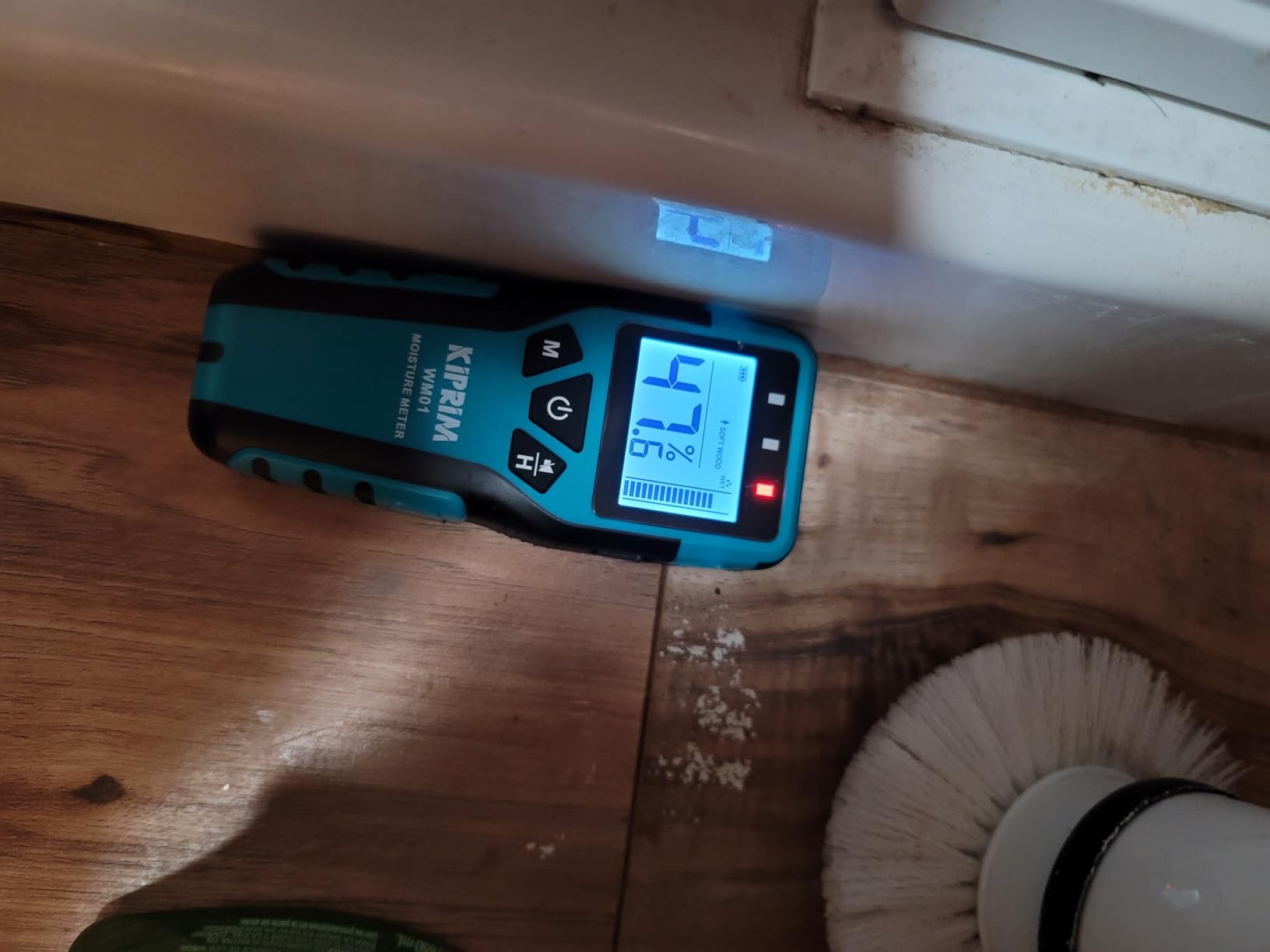
The WM01 weighs less than four ounces and does one thing: non-destructive scanning to 40 mm across four material modes. For a boat, an RV, or a crawlspace where you are working one-handed in a confined space, that is exactly the tool you want and nothing more.
Owners use it as a first-pass screen, most often to locate the source of a wall stain and to monitor a flooded room until it dried. One UK buyer compared it against a plumber’s industrial meter and reported identical results on a burst-pipe flood.
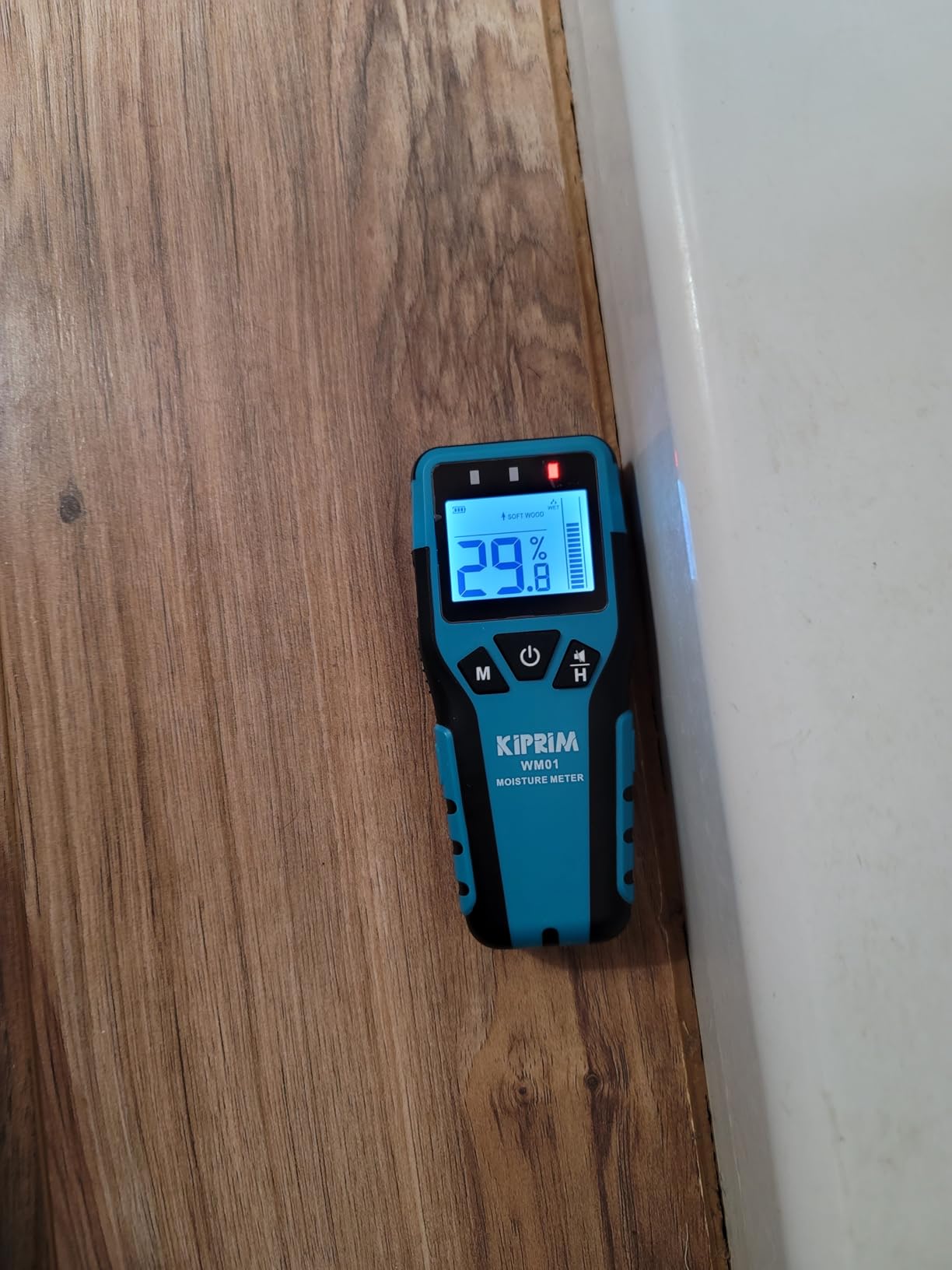
The caveat is printed by the manufacturer and worth repeating: the pinless sensing is not recommended for drywall and other low-density materials. That rules out the single most common residential surface in a water damage investigation, so this is a wood and masonry screener, not a drywall tool.
There is also a report of a false high reading on a clearly dry spot. Readings are affected by what sits behind the surface, and metal pipes, wiring, and fasteners behind a wall will skew any electromagnetic scan.
When it makes sense
It is the cheapest non-destructive option in the roundup, and that matters when you just need to know which side of a wall is wettest. The audible wet alert with a mute option is helpful in a space where a beeper would be annoying, and the one-key data hold freezes a reading while you mark the spot.
For post-rain checks in a garage or basement with wood framing, or for firewood and lumber in an RV, it does a credible job.
When it does not
Do not buy it to investigate drywall. You will get inconsistent results on exactly the surface you most need to trust, and the manufacturer says so. It is also explicitly positioned as a household tool, which is fair but relevant if you intend to log readings for an insurance claim.
If you need a defensible number, you need a pin meter or a professional-grade instrument, not this one.
9. Povlen MT510 – Best Color Display for Wall Sweeps
Pinless Moisture Meter, Digital Wood Moisture Meter for Lumber & Drywall
Pinless high-frequency sensing
Four modes
Color LCD with analog bar
Plus or minus 4 percent stated accuracy
5.6 ounces
Pros
- Color LCD with an analog bar is easy to read mid-sweep
- Audible and flashing alert above your threshold
- Four modes cover softwood hardwood wall and masonry
- No marks on high-end wood or drywall
- Light and slim at 5.6 ounces
Cons
- Stated accuracy of plus or minus 4 percent is loose
- Softwood mode needs manual density grade adjustment
- No pin option for depth-specific readings
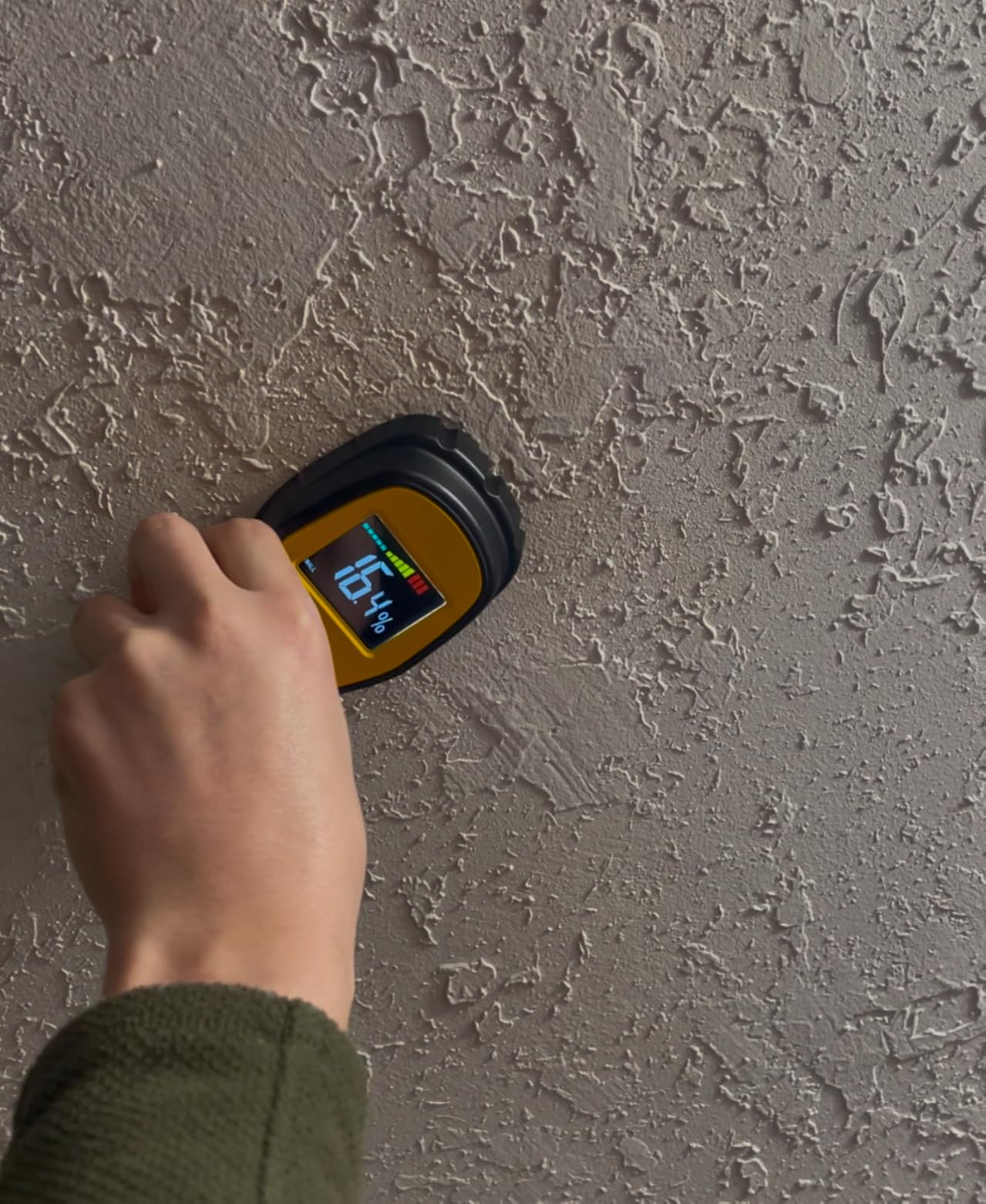
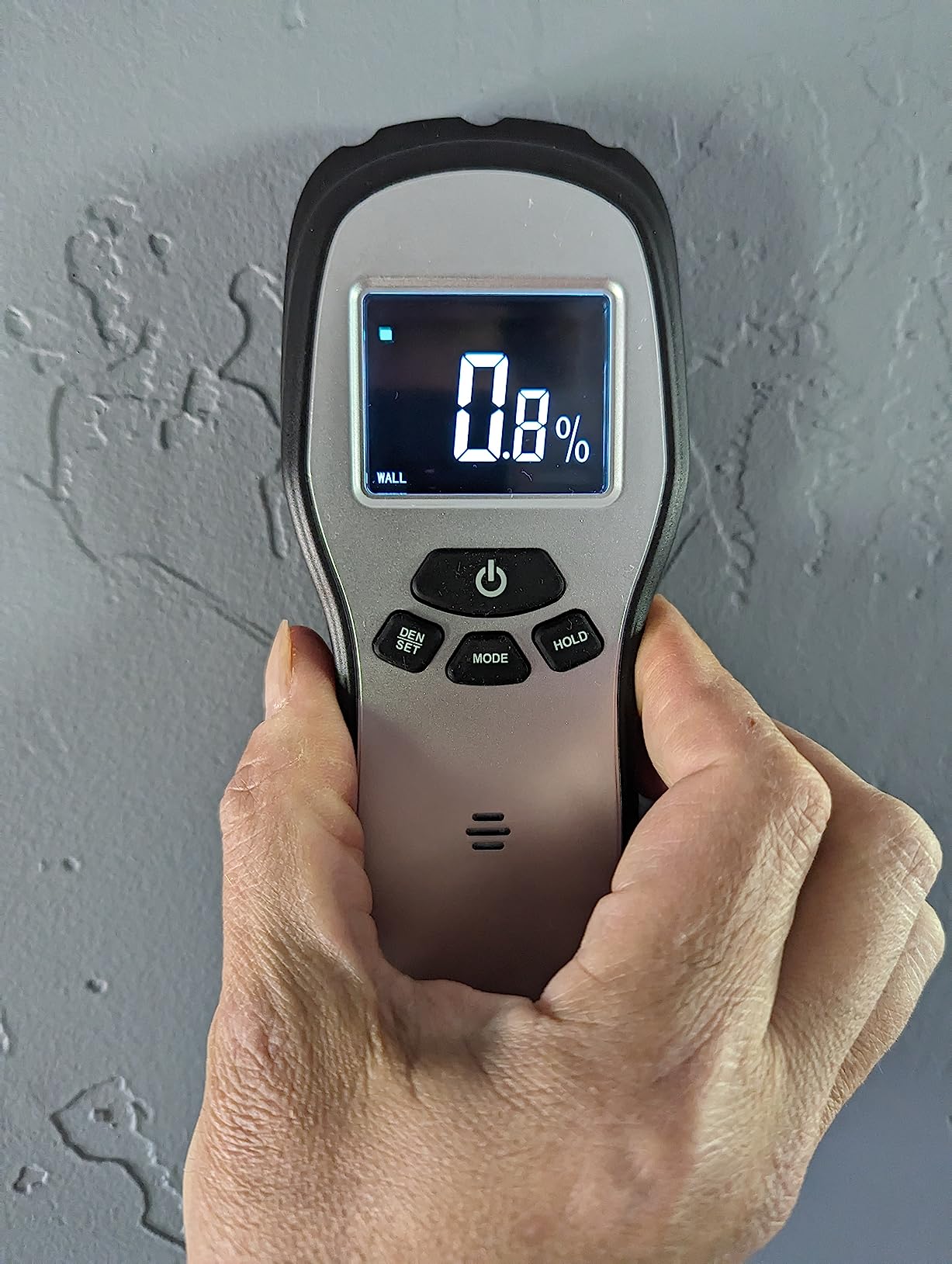
The MT510 is built around a display you can read at arm’s length. The color LCD carries an analog bar, so during a wall sweep you can watch the bar climb rather than squinting at digits. The audible alert with a red flash above your set threshold means you can keep your eyes on the wall, not the screen.
Four dedicated modes cover softwood, hardwood, wall, and masonry, and the high-frequency sensing leaves no pinholes on finished wood or drywall. It weighs 5.6 ounces, measures 6.81 inches long, and ships with three AAA batteries.
Two things to know before you rely on it. The stated accuracy of plus or minus 4 percent is looser than meters with proper calibration scales, so treat small differences as noise. And softwood mode requires you to adjust the density grade manually for different species, which owners find tedious.
It works on wood, concrete, cement, paper, and drywall, so it covers the common residential materials even though the absolute precision is modest.
Best used for
Homeowners and inspectors who want to spot a leak before mold has a chance to establish, without marking anything. The analog bar plus audible threshold makes a slow, systematic sweep of a large wall practical, which is exactly the task where a pin meter is worst.
The hold function records a reading so you can note it, and auto power off with a low battery indicator means it will not die mid-survey.
Where its limits show
Without a pin option there is no way to take a depth-specific reading or confirm a surprising result. For a disputed claim or a drying-goal decision, that is a real gap.
At plus or minus 4 percent, do not use it to distinguish 8% from 11% drywall. Use it to find the wet zone, then confirm with something sharper.
10. LASELION MS03 – Best Starter Combination Meter
LASELION 2-in-1 Pin & Pinless Moisture Meter MS03 – Accurate Moisture Detection for Wood, Concrete, Drywall, and More – LCD Display with Hold Function, Flashlight, and Auto Power Off
Pin and pinless dual modes
Wood 0-75% and building materials 0-25%
Plus or minus 4 percent RH
Built-in flashlight
Ambient temperature display
Pros
- Both pin and pinless modes in one body at a low price
- Pinless mode protects furniture and antique wood
- Built-in flashlight for dark cabinets and crawlspaces
- Manual pinless calibration and temperature display
- Auto power off after two minutes
Cons
- One owner had the pinless sensor lock onto a fixed reading and could not recalibrate it
- Reports of units breaking after a single drop
- Sensor cover is a tight fit and hard to remove
- Touching the sensor during a reading skews results
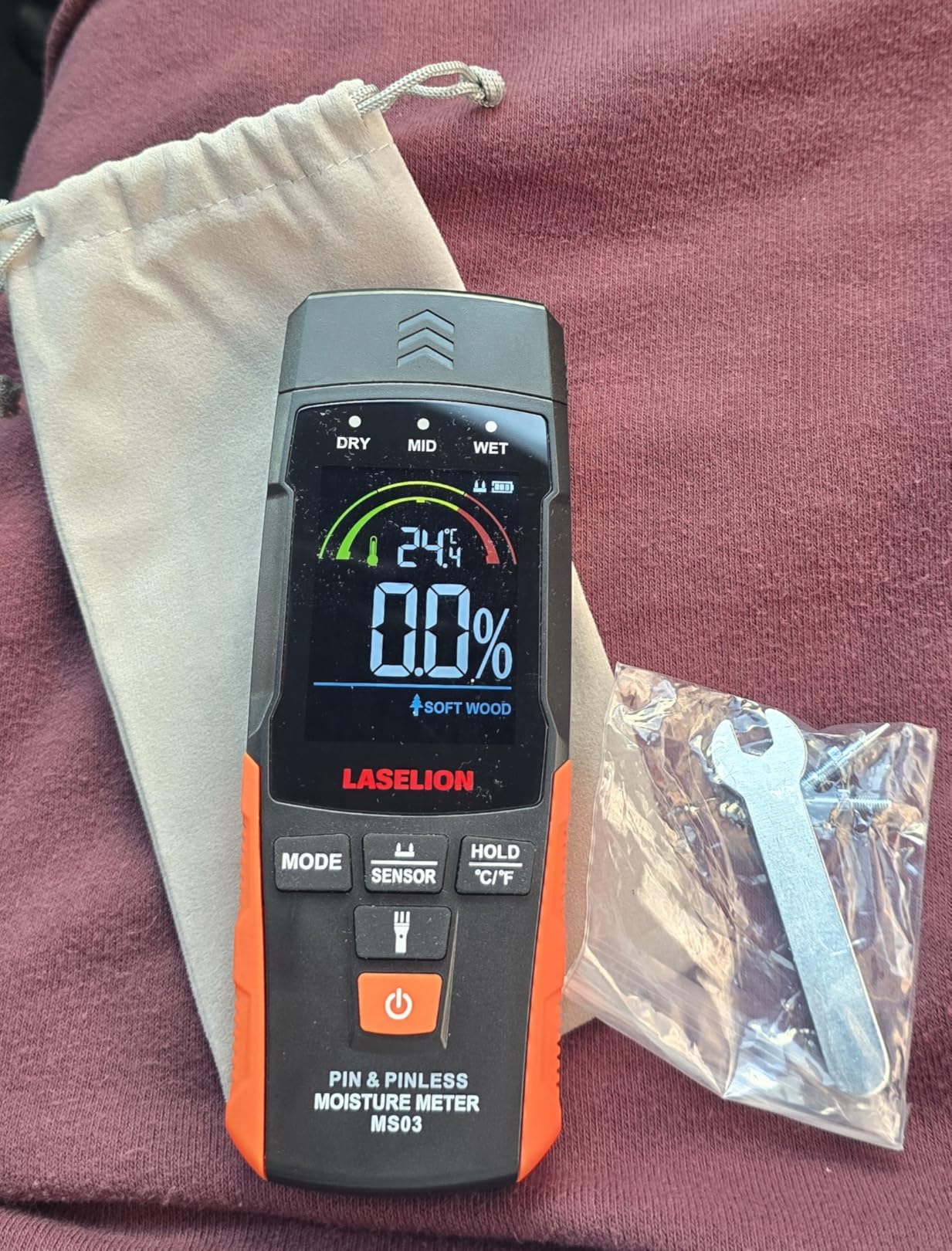
The MS03 does something the pricier combination meters do: it gives you a detachable pin probe and a pinless mode in one body without costing much. Ranges run 0% to 75% for wood and 0% to 25% for building materials, with a stated accuracy of plus or minus 4 percent RH.
The pinless mode is the reason to like it. Antique furniture, finished trim, and a hardwood floor you just refinished are exactly the surfaces you refuse to puncture, and switching modes means you can scan first and only probe when you have found something worth probing.
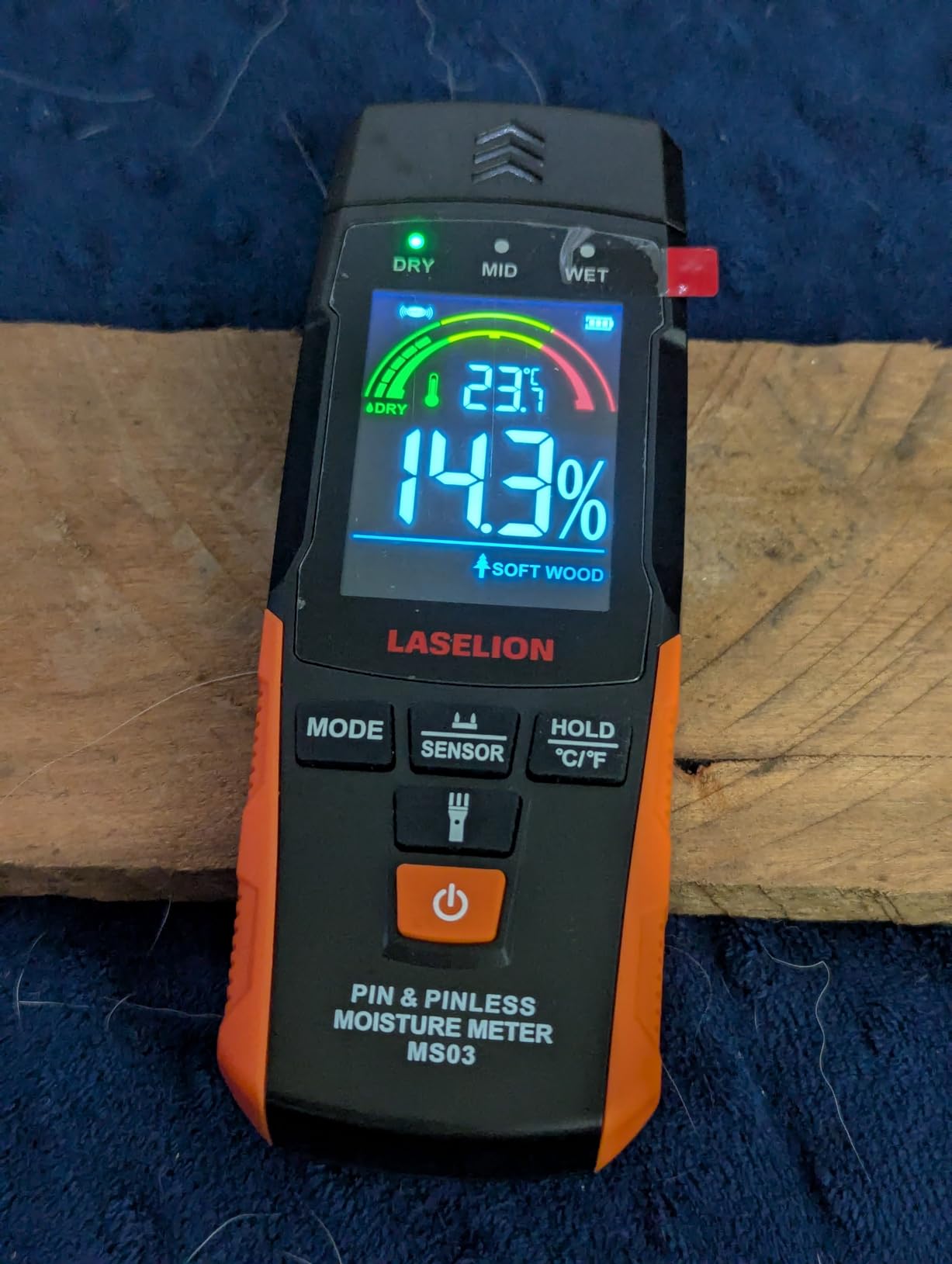
This is the lowest-rated product in the set, and the reason is durability rather than accuracy. One detailed account describes the pinless sensor locking onto a constant reading in open air that calibration could not recover from, with no reachable support to help. Other owners report units breaking after a single drop.
One recurring user error is worth repeating: touching the sensor during a measurement skews the result. Grip the body, not the sensing surface, and wait for the reading to settle.
What it does well
It works on wood, drywall, plaster, concrete, and cardboard, so it covers the surfaces a household actually has. The flashlight, ambient temperature display, and manual pinless calibration round out a feature list that would cost more elsewhere.
Auto power off after two minutes of inactivity is a sensible safeguard for a tool that gets left on a workbench mid-task.
Why we rank it where we do
For a first-time owner who wants both modes and does not need a defensible number, the capability is there. The durability complaints and the calibration failure reports are the reason it does not sit higher, and the accuracy spec is loose enough that I would not document a drying goal with it.
If the sensor behaves oddly, there may be no help when you need it. Buy it knowing you may replace it.
11. Protimeter Mini – Best for Restoration Professionals
Protimeter Mini General Purpose Moisture Meter
Precision pin meter with built-in probes
Color-coded LED dry borderline damp
Extension pin probe included
Calibration device included
0.41 kilograms
Pros
- Reference instrument professionals check cheaper meters against
- Unambiguous color-coded LED readout
- Extension probe reaches awkward positions
- Calibration device verifies the instrument works
- Compact body with no learning curve
Cons
- Costs far more than every other meter here
- Pin-based so it leaves holes in finished surfaces
- Small reviewer base means less user feedback
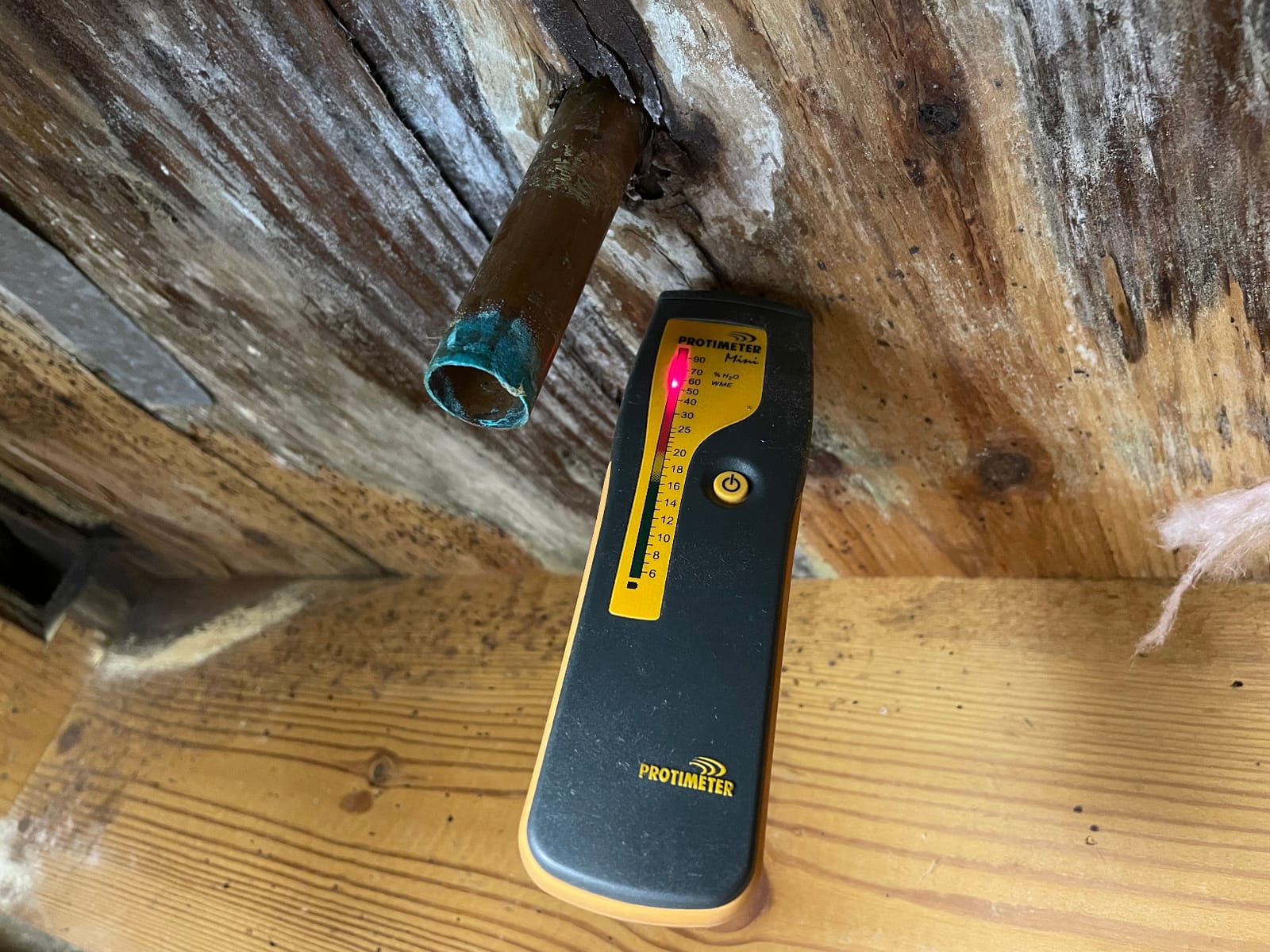
The Protimeter Mini is the instrument restoration professionals use to check whether the cheap meter in the van is telling the truth. It is a precision pin meter with built-in probes, and it shares the highest rating in this group at 4.6 stars from a much smaller, more knowledgeable reviewer base.
Its color-coded LED readout is the reason it stays in service: green for dry, yellow for borderline, red for damp. No interpretation, no percentage debate, no learning curve. You point the probes, you read a color, and you write it on the drying log.
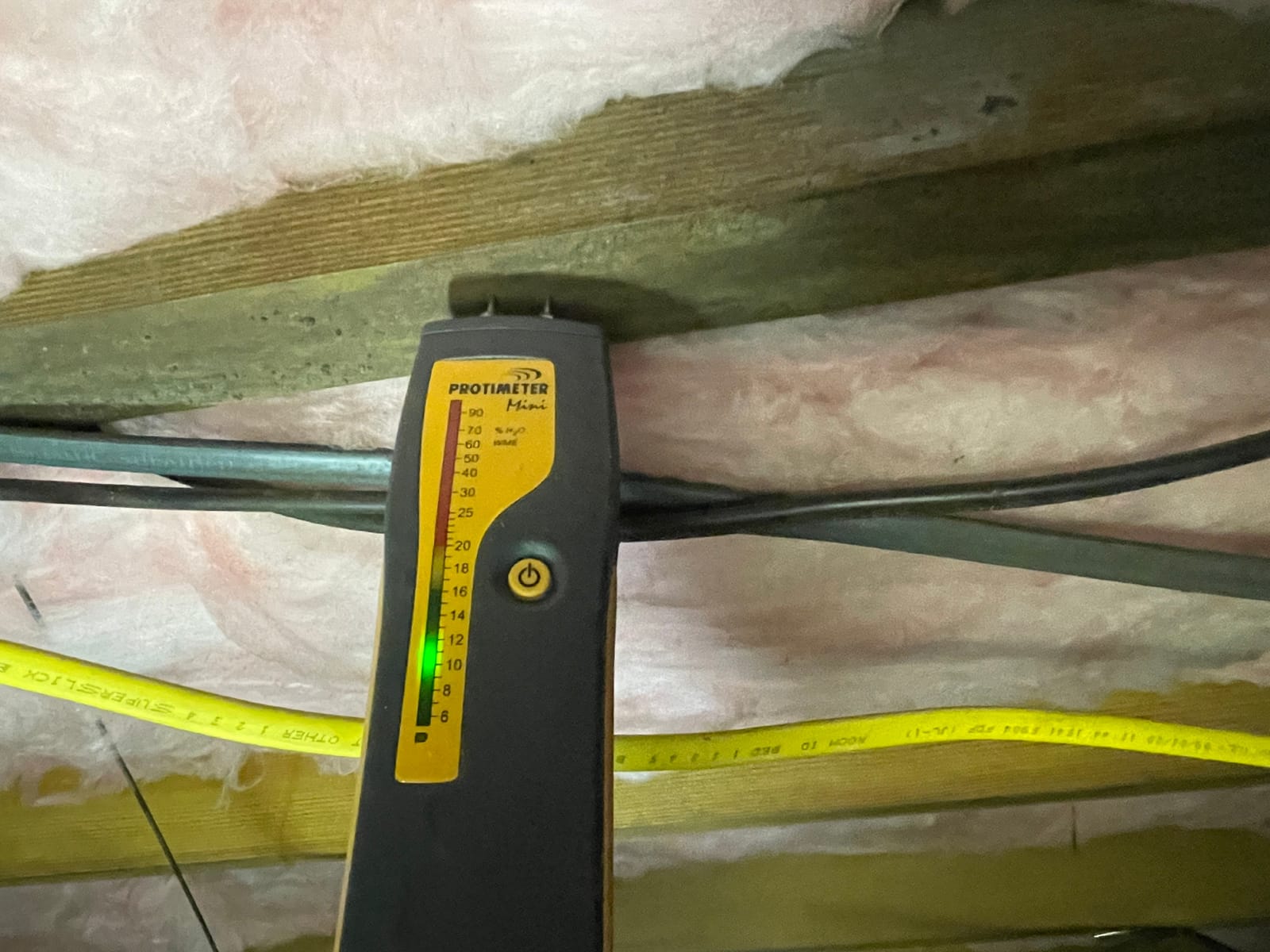
The extension pin probe reaches positions the built-in probes cannot, which is how you get into the gap behind a vanity or under a bathtub without contorting your wrist. The included calibration device lets you confirm the instrument is functioning before a job, and temperature accuracy is stated at plus or minus 0.1 degrees Celsius, which matters for tracking drying over days.
It operates from 0% to 90% relative humidity, so it works in a soaked basement as well as a conditioned room.
Why professionals pay for it
A restoration job is documented. When a drying goal is challenged, the number has to be defensible, and a color-coded reading from a recognized industry instrument is far easier to defend than a percentage from a consumer meter with a loose accuracy spec.
Owners consistently describe it as the reference instrument against which cheaper meters are checked. If your work involves callbacks, drying goals, or insurance documentation, that reference quality is the whole point of the price.
When it is the wrong buy
It is a pin meter, so it leaves holes in finished surfaces, and it is by far the most expensive option here. A homeowner with one stain in a basement has no reason to buy it.
The reviewer base is also small, which cuts both ways: strong professional signal, but less long-term user feedback than the budget options have accumulated.
12. American Mutt Tools TH102-101 – Best for Deep Pinless Scans
Mutt Tools Moisture Meter for Drywall Walls Pinless Wood Detector
Pinless scanning to 2 inches
Plus or minus 4 percent precision
Audible threshold alert
Drywall carpet concrete and marine use
Three-year warranty
Pros
- Longest stated scan depth in the group at 2 inches
- Works on drywall concrete carpet and marine surfaces
- Audible alert when moisture exceeds safe thresholds
- Light at 6.7 ounces with a slim body
- Three-year manufacturer warranty
Cons
- Stated plus or minus 4 percent precision is loose
- No pin probe so readings cannot be confirmed at depth
- Smaller review base than most options here
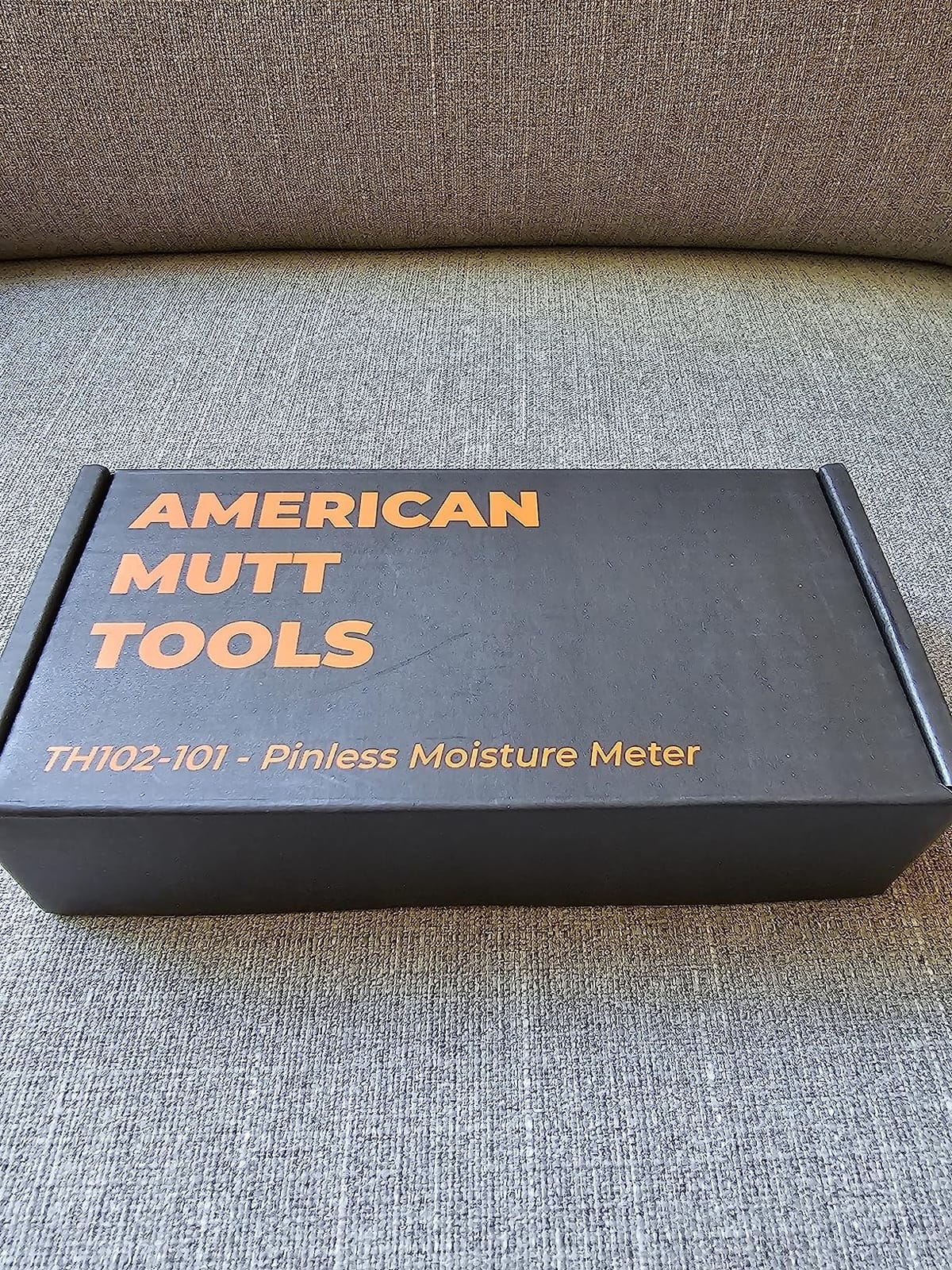
This meter claims a 2 inch pinless scan depth, deeper than anything else in this roundup, and that claim is the reason to consider it. A deeper sensing volume can pick up moisture in a subfloor or under a floor covering that a shallow scan misses entirely.
Its application list is unusually broad: drywall, plaster, painted surfaces, concrete, carpet, and marine work, plus firewood and lumber. For a boat owner or a property manager with carpeted rental units, one meter covering all of that is efficient.
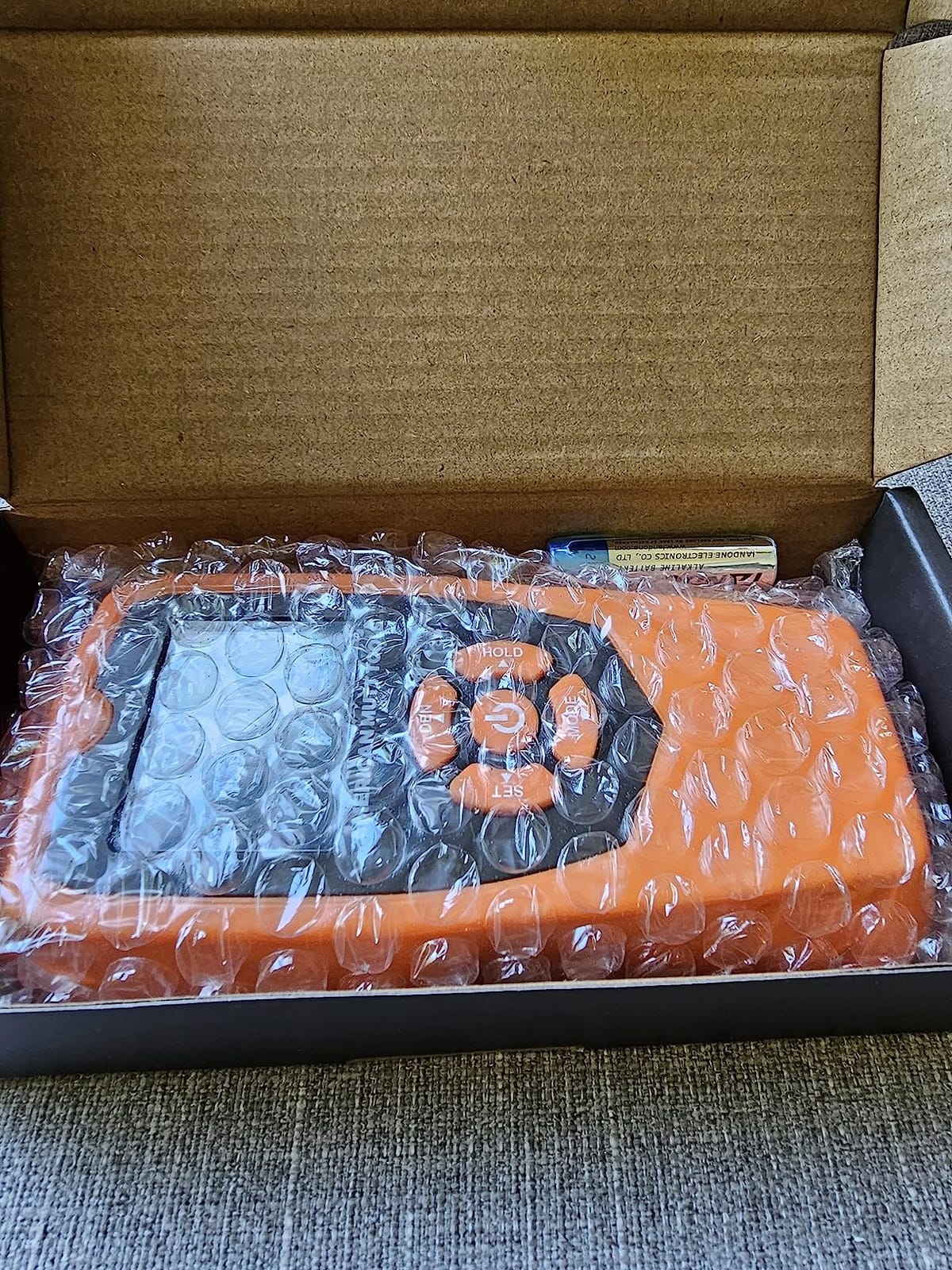
Owners value the 2 inch depth and the audible alert for quick sweeps, and the warranty runs three years. But the stated precision of plus or minus 4 percent is the same loose figure as the other budget pinless meters, and there is no pin probe to confirm anything.
That combination means it is a locator, not a measuring instrument. Use it to find the wet zone, then switch to a pin meter for the number you document.
Where a deeper scan genuinely helps
Carpet over pad, thick floor coverings, and laminated subfloor assemblies all hide moisture in layers a 3/4 inch sensor will not reach. A deeper reading is more useful there than a more precise shallow one, because the question in those assemblies is not how wet the surface feels but whether water is trapped underneath.
The audible alert above safe thresholds is well suited to a quick pass along a baseboard or around a bulkhead, where you want to know where to stop and look.
Where to stop short
Do not use it to close out a job. With plus or minus 4 percent precision and no pin option, it cannot confirm a drying goal, and the review base of roughly three hundred owners is thin by the standards of the long-running models.
It is a good second scanner for a technician who already owns a pin meter, and a weak primary tool on its own.
Pin vs Pinless Meters: Which One Finds Water Damage?
A pin meter is more accurate and more specific; a pinless meter is faster and non-destructive. Restoration work needs both, and that is why combination meters keep improving.
Pin meters push two probes into the material and measure electrical resistance. Water conducts better than dry material, so a wet spot returns a lower resistance and the meter converts that to a reading. Because the depth is defined by pin length, you know exactly how deep you measured. The cost is a hole in every surface, and the reading is only valid at that depth.
Pinless meters emit a radio-frequency signal and measure how moisture alters the returned signal, producing a relative figure over a shallow sensing volume. Nothing is punctured, so you can scan a whole wall in seconds, but the number means nothing without a reference. It is also a volume average, so a thin wet layer behind a dry surface under-reads.
Combination meters give you a detachable pin probe and a pinless plate in one body. The scan finds the boundary; the pin quantifies it. For most homeowners and inspectors, this is the format that makes sense in 2026, because it removes the excuse for never verifying a surprising reading.
Owners running comparisons land in the same place: a pinless meter is trusted for mapping, a pin meter is trusted for the number, and a flat-zero reading from a budget pinless scanner on obviously wet subfloor is a meter failure, not a dry board. Take a known-dry reading on the same material first, then measure the suspect area and compare.
How to Read a Moisture Meter for Water Damage
Most confusion comes from treating a relative number as a percentage. A pinless meter reading 280 is not 280 percent moisture; it is a position on a manufacturer-specific scale whose maximum may be 99, 300, or 999 depending on the model. Only meters that report a real moisture content percentage in a calibrated material mode are giving you a number you can compare against a standard.
Wood moisture equivalent is the bridge. A wood moisture equivalent figure converts a reading in a building material into the equivalent percentage in wood, which lets you apply the familiar wood thresholds to drywall and plaster even though the sensor never touched wood.
Two quick notes before you rely on any reading. Take a dry reference from a known-good area of the same material on the same wall, because density and thickness change the response. And warping distorts everything: an owner with a long-running sink leak found sound subfloor reading in the low single digits a few inches from a rippled, water-damaged patch that read dramatically higher. The material is no longer behaving like the reference material.
How to Choose a Moisture Meter for Water Damage
Choose by surface, not by brand prestige. Most residential water damage lands on three materials: drywall, wood framing, and concrete or masonry. A meter that reads two of those three well will serve you better than a premium instrument calibrated for the third.
Drywall and plaster. These are low-density, non-conductive materials that frustrate every pinless meter. Manufacturers of budget pinless models say so plainly. If drywall is your primary concern, buy a pin meter with a building-material mode, or accept that pinless results there are directional.
Wood framing and subfloor. Every meter here handles wood, and this is where pin meters are most accurate because wood is a consistent, calibratable material. Look for multiple wood scales if you check different species.
Concrete, brick, and masonry. Here accuracy claims get slippery. Several owners report budget meters continuing to flag a dried basement as damp, so treat masonry readings as a trigger for further investigation rather than a verdict.
Sensing depth. Consumer pinless meters usually quote 3/4 inch; a deeper 2 inch claim gives you more reach into thick assemblies. Either way, none of these meters see into an empty wall cavity.
Calibration and verification. A built-in self-test or an included calibration device is worth more than a long feature list, because it tells you whether the instrument is functioning before you act on it.
Documentation. If readings will go into an insurance file, you need data hold, max and min memory, and ideally a defensible display. Color bars and audible alarms are for finding; numbers are for proving.
On brands, the pattern owner reports describe is consistent: consumer brands like General Tools, Klein, and the widely sold generic meters are trusted for screening, while the professional instruments that restoration technicians carry are treated as the reference against which the cheap ones are checked. If your work involves callbacks or drying goals, follow the professionals. If you are checking a stain once, screening quality is enough.
How to Use a Moisture Meter on a Water Damage Investigation
Work in a fixed order and the readings become comparable across the whole job. The sequence is scan, reference, verify, document, repeat, and the order matters more than the meter you chose.
Scan first. Sweep the suspect area and a 3 foot radius around it with a pinless meter. You are mapping the boundary, not collecting data, so move fast and note the high zones.
Take a reference. On the same material, same wall, take a reading from a known-dry area. This is the number every later reading is compared against, and skipping it is the single most common reason a meter appears to be nonsense.
Verify with pins. At the highest-reading zone, probe. Drive the pins to a consistent depth and note the depth alongside the number, because a reading at 1/2 inch and a reading at 1 inch are different facts.
Document. Log the location, the depth, the material, the meter, and the date. For insurance purposes, pair the log with photographs of the same spot. If you want more on documenting a claim and the rest of the plumbing picture, our water softener guide covers how hard water interacts with the rest of the system.
Repeat on a schedule. Drying is a curve, not a switch. Re-run the same reference and the same verification points on a fixed interval so the trend is visible, and use the same meter each time.
Know the thresholds. Wood generally needs to reach 15% to 20% or lower before flooring is installed over it. Drywall sits far lower, around 1% to 2%, because it has almost no tolerance for moisture. Mold risk climbs sharply above 20% in wood, and colonies can establish within 24 to 48 hours of material staying wet, which is why speed matters as much as accuracy.
Two safety rules. Never probe near wiring, plumbing, or an energized fixture, and tell people where you left probe holes. A small hole filled with paint is a repair; a hole driven into a live circuit is an emergency.
What a Moisture Meter Cannot Tell You
A moisture meter tells you how much water is in the material in front of it. It does not tell you where the water came from, whether mold is present, or what is happening inside an empty space, and pretending otherwise is the fastest way to lose an argument with an adjuster.
It cannot find the source. A wet patch at the end of a wall is equally consistent with a supply line, a drain line, a roof failure, and condensation. The meter narrows the search; it does not conclude it.
It cannot confirm or rule out mold. Mold is an organism, not a moisture level. A dry reading means conditions are less favorable, not that no colony exists, and a high reading does not tell you what grew. Send samples to a lab if the answer matters.
It cannot see into an empty cavity. Pinless sensing needs material to return a signal from, and pins need something to push into. Behind a stud bay with no insulation, a meter will read low no matter how wet it is. Pull a hole or use a different method for that space.
It is not fooled by nothing. Surface contamination, condensation films, metal fasteners, pipes and wiring behind the wall, changes in material density, and temperature all shift the result. A meter tells you where to look next, and a human still has to look.
Frequently Asked Questions
What is the best moisture meter for detecting water damage?
A combination pin and pinless meter is the best choice for most people, because the pinless scan maps the wet area without marking surfaces and the pin gives you a depth-specific number you can document. If you can only buy one tool, buy the combination model and add a pin meter later for verification. Pin meters are more accurate; pinless meters are faster and non-destructive.
Are pin or pinless moisture meters more accurate?
Pin meters are more accurate because they define the depth they measure and read an actual moisture content value in a calibrated material mode. Pinless meters are faster and leave no holes, but they return a relative figure over a shallow volume, so the number only means something compared against a known-dry reading on the same material. Scan with pinless, then verify with pins.
Is 15% moisture in drywall considered bad?
Yes. Drywall tolerates far less moisture than wood, and 15% in drywall is well past the point where a wall is dry. A practical drying target for drywall is around 1% to 2%. The 15% to 20% figure people cite usually applies to wood, where it is the level below which flooring can be safely installed.
Can a moisture meter detect water behind drywall?
It can indicate elevated moisture behind a surface, but not reliably on drywall alone. Drywall is a low-density material that weakens the signal, and many manufacturers state that pinless sensing is not recommended for it. A pin meter driven into the material gives a better answer, and if the cavity is empty behind the drywall, no meter will see the water at all.
Can a moisture meter detect mold?
No. A moisture meter measures water content, not biological growth. What it can do is tell you whether conditions favor mold, which matters because mold colonies can establish within 24 to 48 hours of material staying wet and risk climbs sharply above 20% in wood. Confirming or ruling out mold requires visual inspection and, where it matters, laboratory sampling.
What can throw off a moisture meter?
Several things distort a reading. Surface contamination and condensation films raise results, while metal fasteners, pipes, and wiring behind a scanned surface can skew them. Changes in material density and thickness matter too, which is why you should take a reference reading on a known-dry area of the same material first. Warped or delaminated material, temperature, and touching the sensor during a measurement all shift the number.
Final Verdict: Which Moisture Meter for Water Damage Should You Buy?
The best moisture meters for water damage depend on one question: do you need a number you can defend, or a boundary you can find? For finding, a pinless model like the Klein Tools ET140 is the value pick, and it leaves finished walls untouched. For defending, the General Tools MMD4E gives you the widest range with a building-material scale and the largest owner base of any meter here, which is why it takes our editor’s choice.
Owners doing both should carry a combination meter such as the RDINSCOS MT35P, though owners report it over-reads concrete. Professionals documenting drying goals belong on the Protimeter Mini, and anyone working in tight, dark spaces will like the LASELION MS04 ball probe and flashlight.
Whatever you buy, use it the same way every time: pinless scan, dry reference, pin verification, written log, repeated on a schedule. That workflow is worth more than any single feature, and it is what turns a gadget into evidence. Our under-sink filtration picks cover the other half of protecting a home when something goes wrong.