
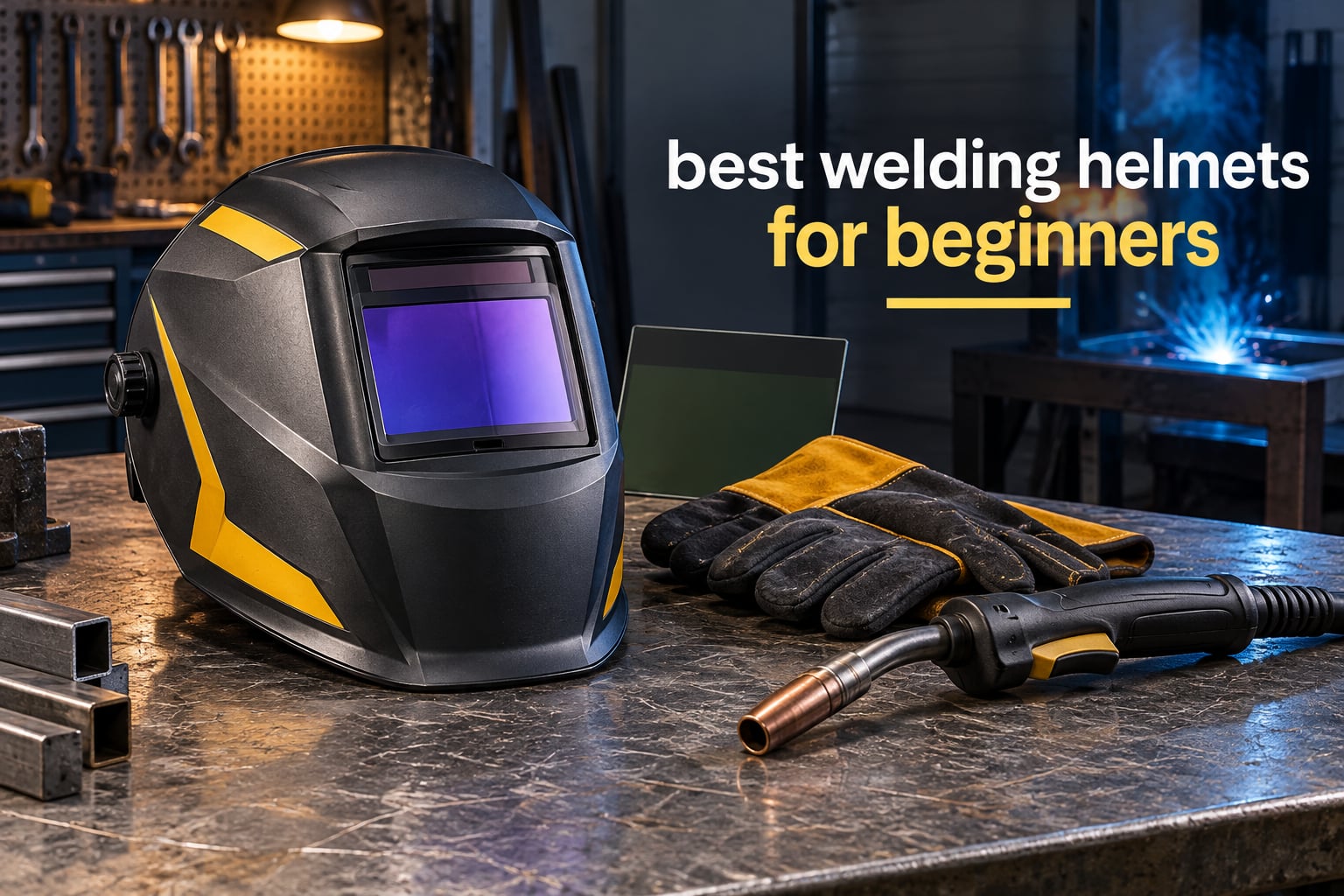
Short answer: the best welding helmet for a beginner is an auto-darkening model with a variable shade range of 9 to 13, two to four arc sensors, switching speed of 1/25,000 second or faster, true color optics, and a shell under about 1.5 pounds. Those five thresholds decide whether a helmet is genuinely useful on your first bead or just another thing to fight with.
Below is a straight spec comparison of ten auto-darkening welding helmets, followed by a per-helmet breakdown of what each one is actually good at. I ordered them the way I would hand them out: a first helmet, a first upgrade, and a first serious machine. If you have not bought a welder yet, start with our beginner MIG welder guide first, because the process you pick changes which shade range you need.
How these were selected: every helmet below was checked against published manufacturer specifications (shade range, sensor count, switching speed, viewing area, power source, certification) and cross-read against the customer review record for that exact model. Where reviews and spec sheets disagree, I say so. I have not welded with all ten for a full season, and I will not pretend otherwise. What I can do is separate the specs you will feel on your first ten hours from the marketing language that will not.
One warning before we start. Arc light causes arc eye and permanent retinal damage, and no helmet on this list is a place to economize. A budget helmet here is a reasonable first purchase, not a compromise on eye protection. Every model listed carries ANSI Z87.1 or an equivalent certification, and every one has a shade range that covers MIG and stick work.
Table of Contents
Top 3 Picks for the Best Welding Helmets for Beginners in 2026

YESWELDER LYG-L600A
- True color 1/1/1/1
- Shade 3/7-13
- 2 sensors at 1/30000s
- Solar plus replaceable battery
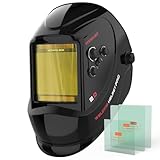
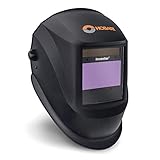
The LYG-L600A takes the top slot on the strength of its review volume and a spec set that hits every beginner threshold at the lowest tier. The LYG-M800H is the pick if your biggest problem is not seeing your work, because the viewing area jump is immediate. The Hobart 770890 is here for the person who wants a name-brand hood with plain analog knobs and no setup ritual.
All 10 Best Welding Helmets at a Glance in 2026
| Product | Specifications | Action |
|---|---|---|
| YESWELDER LYG-L600A |
|
Check Latest Price |
| YESWELDER LYG-M800H |
|
Check Latest Price |
 YESWELDER LYG-Q800D YESWELDER LYG-Q800D |
|
Check Latest Price |
 TOOLIOM Solar Helmet TOOLIOM Solar Helmet |
|
Check Latest Price |
 TRQWH Helmet with LED TRQWH Helmet with LED |
|
Check Latest Price |
 TRQWH KTS-JD03 Wide View TRQWH KTS-JD03 Wide View |
|
Check Latest Price |
| Hobart 770890 |
|
Check Latest Price |
 Miller Classic Series Miller Classic Series |
|
Check Latest Price |
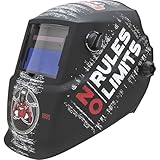 Lincoln Electric K4983-1 Lincoln Electric K4983-1 |
|
Check Latest Price |
 Jackson 47100 Jackson 47100 |
|
Check Latest Price |
Read the table as a filter, not a verdict. The two numbers that matter most to a beginner are arc sensor count and the darkest shade the lens reaches. Everything else on this list is a preference.
Which Welding Process Are You Starting With?
Before any product talk, one fork. MIG is the most forgiving first process, and almost every helmet here handles it. Stick and flux-core are equally forgiving and usually run at higher amperage, so they light up the lens faster. TIG is the one that punishes a cheap lens.
Here is the specific failure mode. Low-amperage TIG puts out a thin, flickering arc that some auto-darkening lenses read as ambient light rather than a welding arc. The lens stays light, you get flashed, and you learn to hate your machine. If TIG is on your list, buy a helmet with four arc sensors and a shade range that reaches 13, and set the sensitivity control to its higher setting before you strike an arc.
Plasma cutting and grinding are the other two modes worth checking. A dedicated grind button on the outside of the shell saves you from flipping the helmet or swapping lenses, and it is a small convenience that becomes a habit fast.
My default recommendation for an uncertain beginner: pick a helmet that covers shade 3 through 13 across weld, cut and grind modes, and you will never have to think about this again until you outgrow it.
1. YESWELDER LYG-L600A: Best Welding Helmet for Beginners Overall
YESWELDER Auto Darkening Welding Helmet 1/1/1/1 True Color, LYG-L600A
Weight: 16 oz
True color 1/1/1/1
Shade 3/7-13
2 sensors at 1/30000s
Pros
- True color 1/1/1/1 clarity makes bead and work area easy to read
- 1/30000s response with external shade knob
- Comfortable adjustable headgear that leaves room for a respirator
- Box includes spare lenses and a spare battery
- Solar panel plus replaceable CR2450 battery
Cons
- Viewing area is smaller than panoramic styles
- Shell and headgear feel lighter duty than professional hoods
- Included button battery sometimes arrives dead
This is the helmet I hand to people who have never welded. At 16 ounces it is the lightest of the ten, and on a first afternoon of overhead and out-of-position work that difference is not subtle. Your neck notices weight long before your skill does.
The 1/1/1/1 true color rating describes how closely the lens reproduces what is actually in front of you across the visible spectrum, and it is the single spec most likely to change how quickly you learn. Reviewers consistently point to being able to see the puddle and the joint clearly, and beginners report a visible improvement in bead quality once they stop squinting through a dark green window.
Two arc sensors is not a premium count, and on a four-sensor helmet it shows. The L600A is built for MIG, stick and arc work with a shade 3 light state and shade 7 to 13 dark range, which is the correct coverage for a garage. If you plan to do serious low-amperage TIG, look at the four-sensor models further down instead.
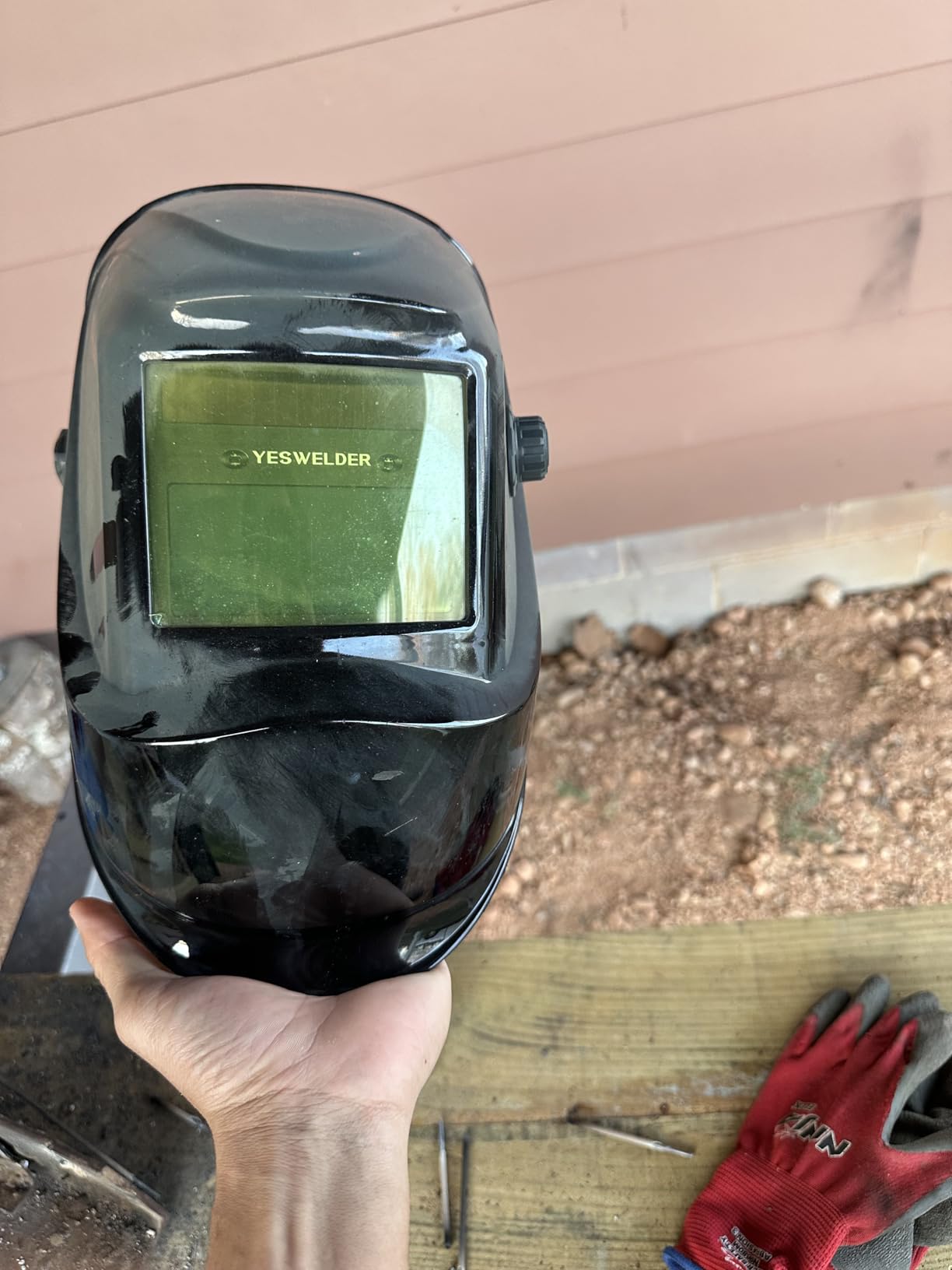
What I like most is the completeness of the box. You get a CR2450 battery, an inner replacement lens, two outer replacement lenses, a storage bag and a manual. The replaceable outer lens matters more than it sounds: the outer lens is the sacrificial layer that spatter pits, and once it is clouded the helmet feels unusable even though the filter is fine.
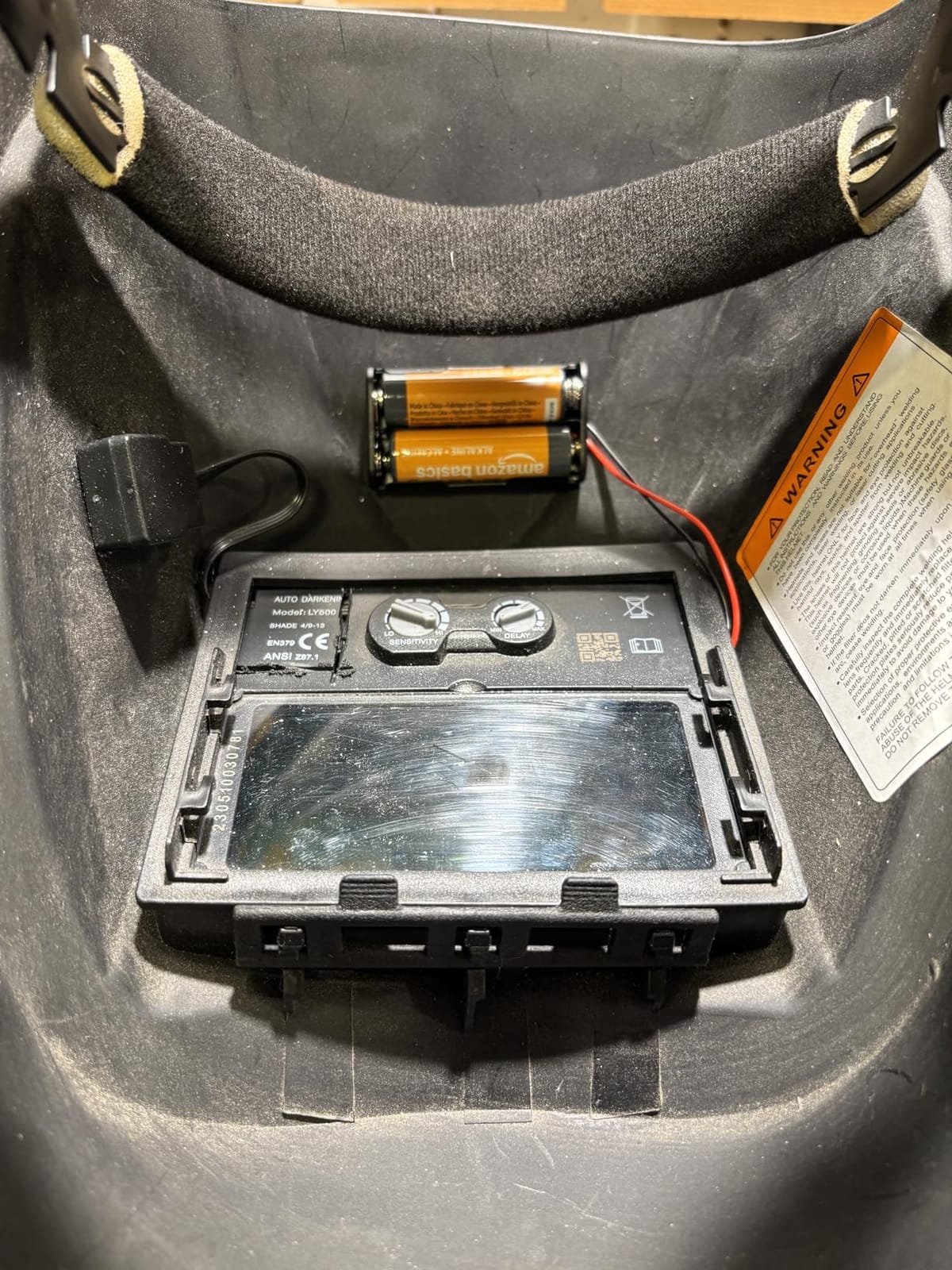
The solar panel with a replaceable CR2450 backup is the right power design. A dead-battery helmet is a paperweight, and this one cannot become one. Reviewers have reported the same unit working for years of intermittent home-shop use, which is a durability claim I cannot test myself but which matches the review volume behind it.
One setup note that matters: the included button cell sometimes arrives flat, and some buyers install it backwards. The lens staying stubbornly light on first strike is almost always that battery, not a defect. Check the polarity before you start doubting the helmet.
When the LYG-L600A is the right call
Choose this if your first projects are MIG and stick on mild steel in a home garage, if you want the lightest shell on the list, or if you are buying one helmet for a teenager who is still growing and keeps outgrowing headgear. The adjustable headgear is a genuine advantage there, and reviewers note it leaves room to wear a respirator underneath when welding indoors.
The included spares matter for a shared-shop situation. Two outer lenses and a battery in the box means the first helmet in a class of students does not become a communal parts problem.
When the LYG-L600A is the wrong call
Skip it if TIG is the process you plan to learn first. Two sensors and a small viewing area are workable for MIG but leave you repositioning your head constantly on a narrow bead, and low-amperage TIG is exactly the case where an extra pair of sensors earns its keep.
It is also the wrong pick for a full-time fabricator buying one helmet for the next decade. The shell and headgear feel lighter duty than professional hoods, and while the lenses are replaceable, the frame is not the kind of thing you buy twice.
2. YESWELDER LYG-M800H: Best Auto Darkening Welding Helmet for Seeing Your Work
YESWELDER Auto Darkening Welding Helmet, Large View, LYG-M800H
4 arc sensors
Large 3.93 inch view
Shade 3/5-9/9-13
Cheater lens ready
Pros
- Large viewing area with 1/1/1/1 true color clarity
- Four arc sensors detect low-amperage TIG work reliably
- All controls sit on the outside so adjustments work with gloves on
- Reinforced hinge and secure fit
- Beginners report immediate improvement in bead quality
Cons
- Tension knobs that hold the helmet flipped up feel flimsy
- Thin plastic shell next to professional hoods
- Battery compartment and lens removal are awkward to grip
If one spec decides your purchase, it is viewing area. The M800H gives you a 3.93 inch by 3.66 inch window, which is dramatically more usable than a narrow letterbox, and it is the change reviewers most often describe as the reason their welding improved. You stop leaning around the helmet to find the joint.
Four arc sensors at 1/30,000 second response is the safer configuration if TIG is anywhere in your future. Two sensors can be fooled by a thin arc; four give the electronics more to work with, and the delay and sensitivity controls let you tune the threshold rather than fight it.
The shade coverage is the most complete in the budget group: shade 3 light state, 5 to 9 for cutting and lighter work, and 9 to 13 for welding. That maps almost exactly onto the shade numbers a beginner will need, so you are not guessing which mode to select.
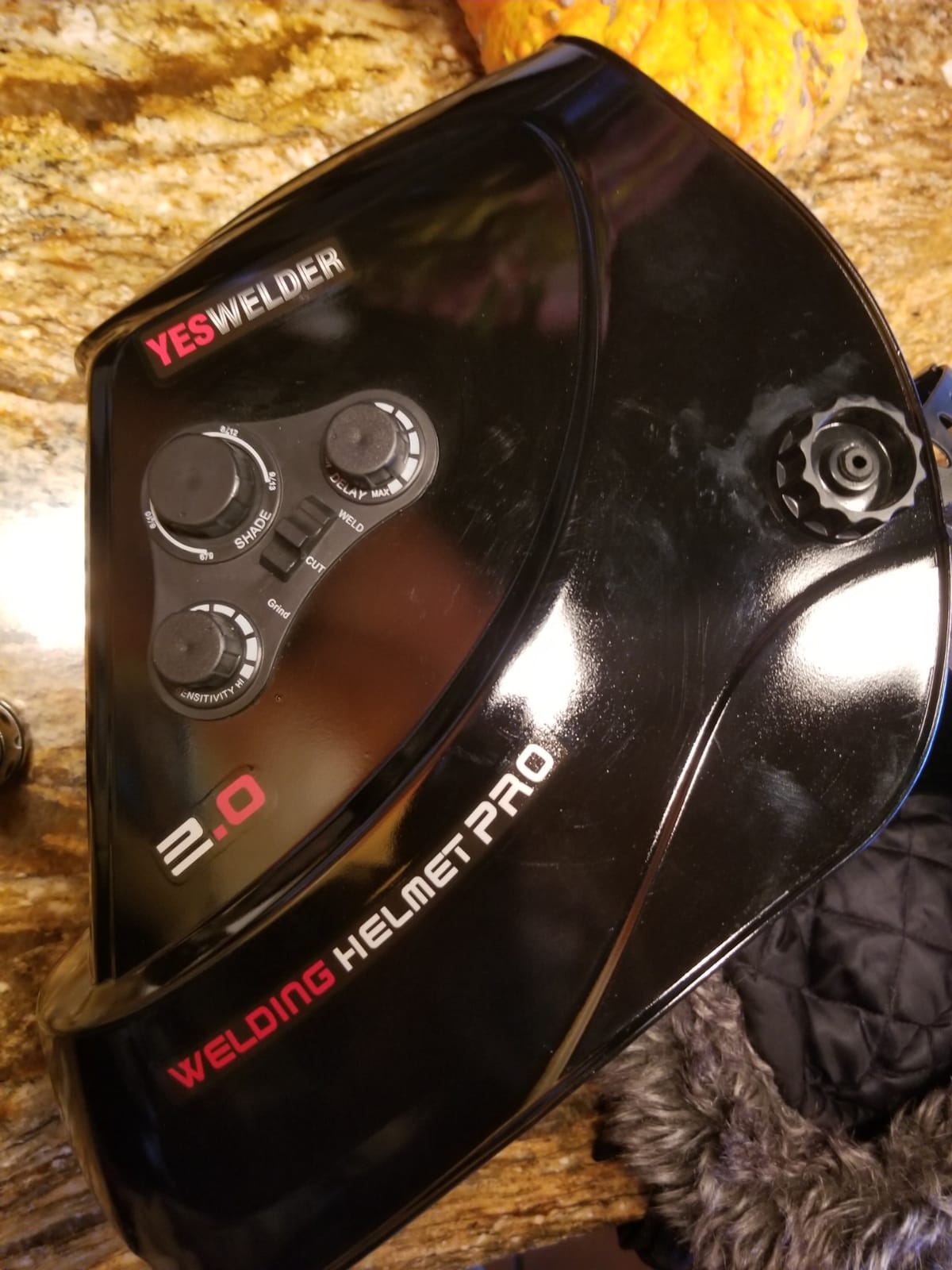
All three controls sit on the shell exterior. Sensitivity, delay and shade are adjustable with a gloved hand, which sounds trivial until you are mid-project with one glove on and do not want to flip the helmet up to find out why the lens is not darkening.
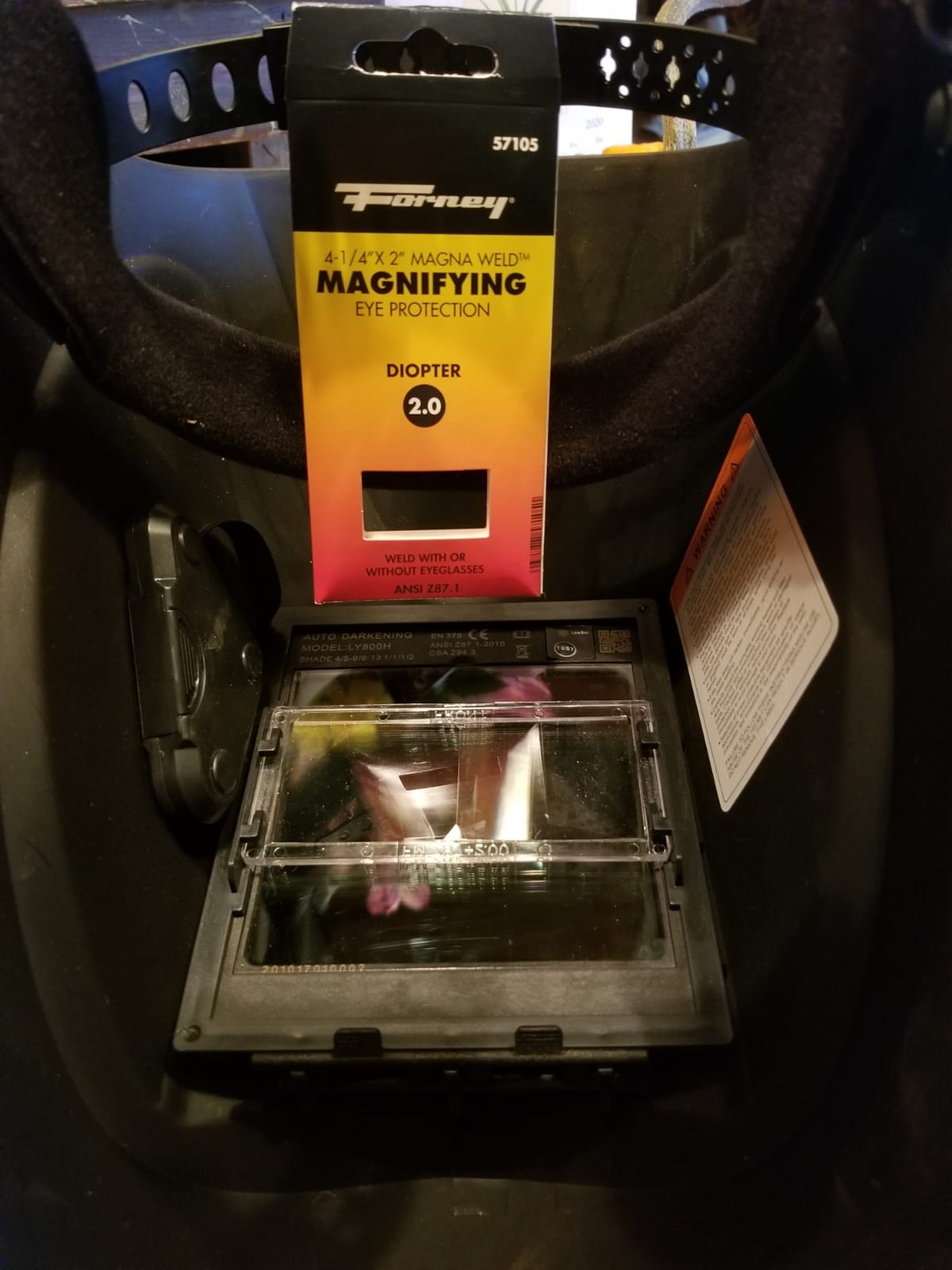
Cheater lens compatibility is another quiet win. If you ever move to thin-gauge TIG or root passes, a magnifier in the front frame is the difference between guessing at wire placement and seeing it. The filter is designed to accept one, which is not universal at this level.
The light-state shade of 3 also means you can wear the helmet down between welds instead of flipping it up and back down dozens of times an hour. Small thing, and it keeps the headgear ratchet from working overtime.
Who should buy the LYG-M800H
Buy it if you have spent time on a small-window helmet and found yourself repositioning constantly, or if your first project list includes tubing, stainless or anything where you need to see the joint on both sides of the arc. The wide true color window is the single most useful thing on this list for learning.
It is also a strong choice for a trade school student who will keep the same helmet after the course ends. The lens and battery are both replaceable, and the wide view transfers directly to fabrication work.
Who should skip the LYG-M800H
The most repeated complaint is the tension hardware that holds the helmet in the raised position. If you flip the helmet up often, especially with a hard hat over it, that knob is going to irritate you, and you will adjust it mid-session more than you would like.
It is also not the lightest option here, and on very long sessions the difference in neck fatigue accumulates. The shell is thin plastic compared with a professional hood, so treat it as a first serious helmet rather than a lifetime one.
3. YESWELDER LYG-Q800D: Best Helmet for Peripheral Awareness
YESWELDER Auto Darkening Welding Helmet with LED, 180° View, LYG-Q800D
180 degree side view
4 arc sensors
Shade 3/5-9/9-13
Solar plus battery
Pros
- Panoramic view with a fixed side window for peripheral awareness
- 1/1/1/1 true color optics reduce green tint and eye strain
- Four arc sensors with adjustable sensitivity and delay
- Blue light blocking outer lens for long sessions
- Solar panel plus replaceable CR2450 battery
Cons
- Side view window stays a fixed DIN 5 and does not darken
- Heavier shell than lighter entry models
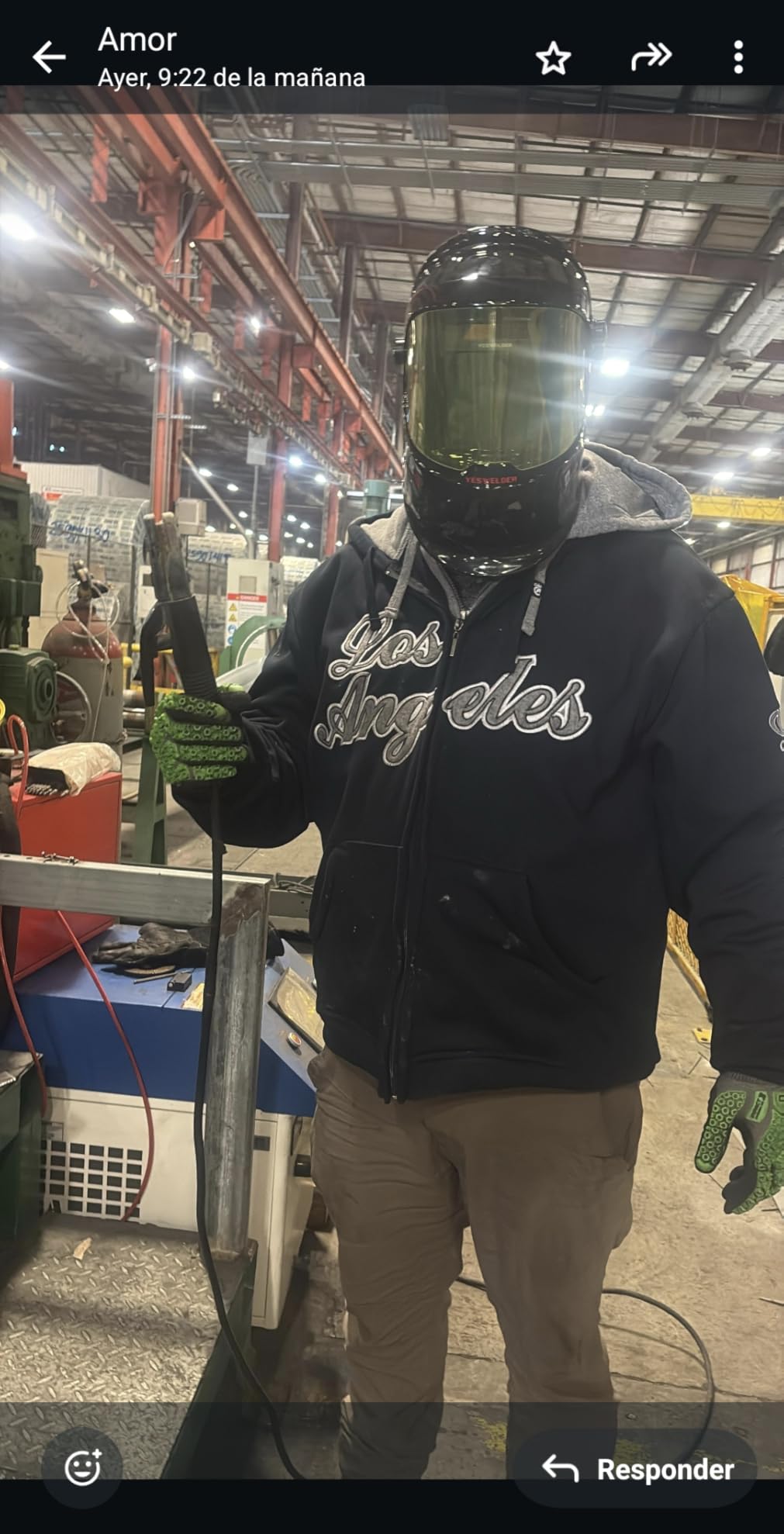
The Q800D solves one specific problem better than anything else in this roundup: you can see past the arc without turning your head. The main lens covers 3.94 inch by 3.23 inch, and flanking windows add a fixed DIN 5 side view, giving you roughly a 180 degree field. On a workpiece with a tube behind the arc, that is the difference between welding blind and welding with a reference.
Everything else is a capable budget package. Four arc sensors, 1/30,000 second switching, a shade 3/5-9/9-13 range across TIG, MIG, MMA, cut and grind, and adjustable sensitivity and delay. True color optics at 1/1/1/1 with a blue light blocking outer lens reduce the eye strain that builds over a long afternoon.
Power is solar with a replaceable CR2450 backup, and the box includes three replacement lenses. That is generous, and spare lenses are consumables you will eventually need.
The honest limitation is that the side windows do not auto-darken. They sit at a light DIN 5 tint, which is comfortable in a lit shop and useful for setup work, but they do not protect you if something arcs in that direction. Treat them as a situational-awareness aid, not a second filter.
At 2.2 pounds this is one of the heavier shells here, and reviewers flag the weight relative to lighter entry models. Over a short Saturday session you will not notice it. Over a full shift in a hot shop, you will.
Fit is handled by pivot-style headgear in thicker polypropylene, with a reinforced build that feels more solid in the hand than the entry-tier shells. It is not a light shell, but it is not a flimsy one either.

When the panoramic view matters
Pick this helmet if you weld around existing structure, do repair work where something is always behind the arc, or work in tight bays where a 180 degree field is the difference between a clean pass and grinding out slag. Fabricators and repair hobbyists get the most out of it.
It is also a good teaching helmet. A student who can see the joint, the torch and the surrounding geometry at once learns positioning faster than one working through a narrow window.
When to choose something lighter instead
Choose a lighter model if your sessions are long and out-of-position, or if heat is an issue. Two pounds on the head adds up in a hot shop, and the 1.14 pound shells elsewhere in this list handle that better without giving up much field of view.
If your work is entirely indoors with controlled lighting, the side windows matter less than weight, and you would be paying for a feature you do not use.
4. TOOLIOM Solar Helmet: Most Versatile for Neck Comfort
TOOLIOM Auto Darkening Solar Powered Welding Helmet for TIG MIG ARC
Weight: 1.14 lb
Shade 3.5/9-13
External grind knob
Solar plus replaceable battery
Pros
- Very light shell that reduces neck fatigue in out-of-position work
- Dependable auto-darkening across years of home shop use
- External grind mode knob switches without removing the helmet
- True color lens with blue light blocking
- Replaceable battery with a low-battery indicator
Cons
- Arc reaction is slower than premium helmets
- Thin plastic shell
- Small viewing area
At 1.14 pounds this is the second-lightest shell here, and it is the one I would pick for overhead work, boat building, ductwork and anything where your head is above your hands for an hour. Comfort is a safety feature when you are new, because a sore neck ends the session early.
The shade range of 3.5 to 13 covers MIG, TIG, MMA and plasma cutting, and the grind mode is on an external knob so you can switch without lifting the helmet. The blue light blocking outer lens and a breathable sweatband headgear are sensible touches for long sessions.
Solar powered with a replaceable battery and a low-battery indicator. The indicator is a small thing that saves a wasted afternoon: you know the lens is starved before you strike an arc rather than after.
One specification is worth reading twice: a 1/25,000 second response. That clears the 1/25,000 threshold I use as my beginner baseline, and the viewing area is the same 3.64 inch by 1.67 inch letterbox as the entry-level Yeswelder, with 1/1/1/1 true color clarity. You are buying comfort and power handling here, not field of view.
Reviewers highlight the lightweight comfort, dependable auto-darkening and durability over multi-year home-shop use. The consistent criticism is arc reaction speed, which some describe as slower than premium helmets and unsuited to tight-space welding where you need an instant transition.
That is a real trade. If you are doing long, open, well-lit work, the light shell wins. If you are doing short beads in a confined corner, the fast-switching models are a better fit for your head movement.
Why this one earns the budget slot
It covers every process a beginner is likely to try, it will not strand you with a dead battery, and the shell weight is the kind you can wear for a full day without noticing. For a student, a hobbyist or anyone welding overhead, that combination matters more than sensor count.
It is also a sensible second helmet. A lightweight solar unit in the truck and a larger-view helmet at the bench is a setup a lot of working hobbyists end up with anyway.
Where it falls short
The small viewing area is the limiting factor. On anything narrow, you will move your head more than you would like, and combined with the slower arc reaction it is the wrong helmet for detailed work in confined spaces.
Some reviewers also find the plastic shell slightly flimsy, which is a common thread across every budget helmet regardless of brand. Treat the frame as consumable-adjacent and budget for a lens replacement rather than a helmet replacement.
5. TRQWH Helmet with LED: Best Budget Helmet for Dark Repairs
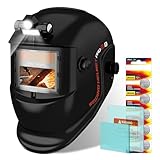
TRQWH Welding Helmet with Light True Color Auto Darkening Welding Helmets for Men Solar Powered Welding Hood with 2 Arc Sensor Wide Shade 4/9-13 for TIG MIG ARC Cool Welder Mask
2 arc sensors
Shade 4 light state
USB rechargeable LED
ANSI Z87.1 and EN 379
Pros
- True color optics at the lowest tier of this roundup
- Rechargeable top LED is genuinely useful in dim shops and dark repairs
- Two arc sensors switch quickly and never failed to protect the wearer
- Solar cells plus spare lithium batteries included
- Thickened sweat padding at forehead and ears
Cons
- Helmet will not stay locked in the raised position
- Included lamp is low quality and short-lived
- Thin replacement lenses wear quickly
- Solar cell can be obstructed
The feature that separates this one is the top LED. It is USB rechargeable, it sits above the lens, and it turns a dark crawlspace repair or a night-time project from guesswork into work. No other helmet in the budget group offers a mounted work light.
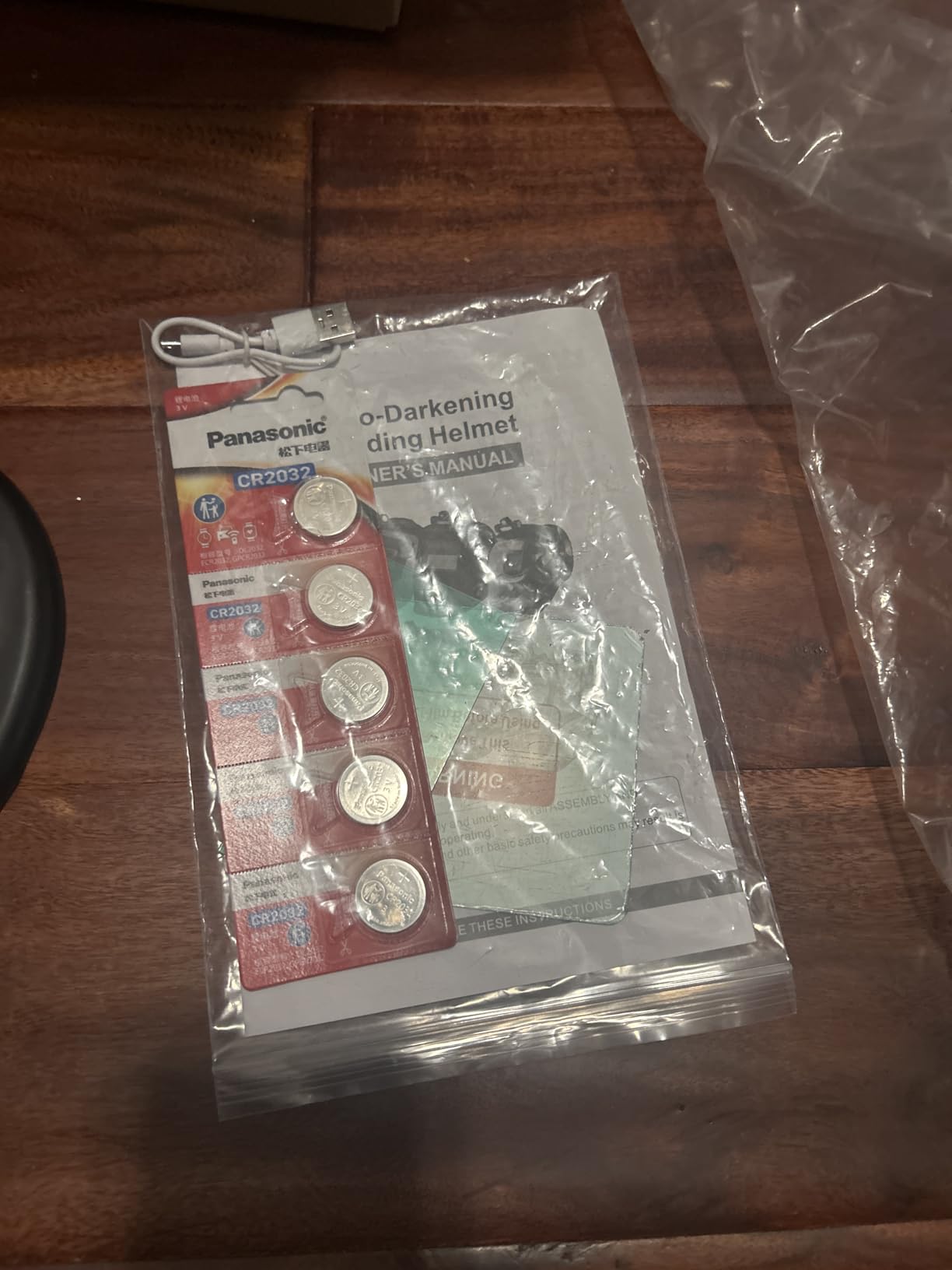
Optically you get 1/1/1/2 true color clarity, a DIN 4 light state and a DIN 9 to 13 dark range, with delay and sensitivity knobs on the side. Two arc sensors switch in 1/20,000 second, which clears the beginner threshold. Solar cells back the unit up with two replaceable CR2032 lithium cells included in the box.
Certification is listed as ANSI Z87.1, EN 379 CE and CSA Z94.3, which is a broader standards claim than most of the budget field makes. That matters if you work outside the US or need to document compliance for a shop.
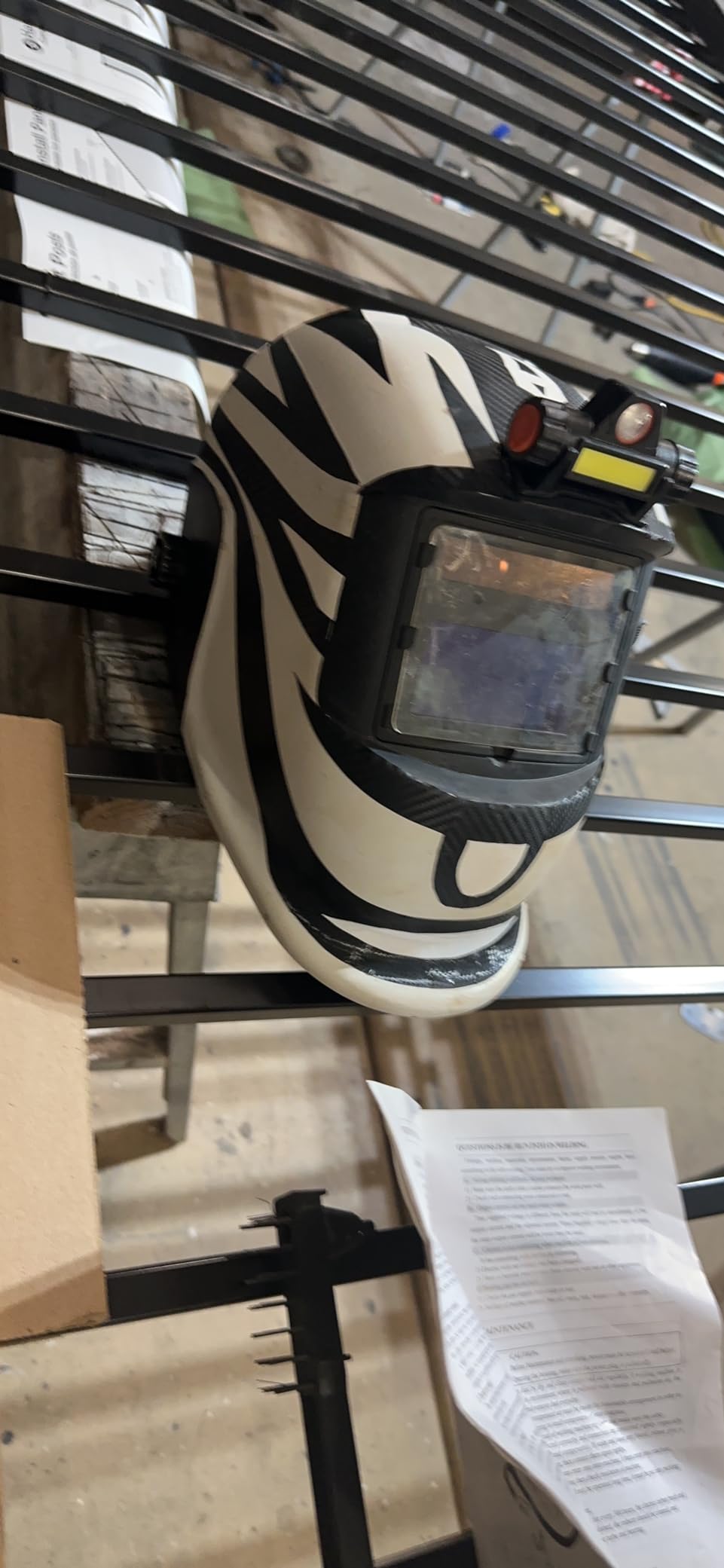
The headgear is where the complaints concentrate. Reviewers report that the helmet will not stay locked in the raised position, which means it drifts down on its own during a task where you are working with both hands. For a helmet that otherwise costs almost nothing, that is an irritating failure rather than a dealbreaker.
There is also a note about the solar cell: if it is obstructed, detection can suffer. Keep the top of the shell clear. If you are welding inverted or in a confined fixture, the battery backup is carrying more of the load than the panel is, so keep spare cells on hand.
The included lamp is of average to poor quality and the batteries do not last long, but the rechargeable cell is user-replaceable in the normal sense that you can top it up over USB. It is a convenience feature, not a premium light.
When the LED changes the job
Buy this if you do a lot of work away from good lighting: automotive repair, plumbing work in basements, outdoor structural work after dark, or farm and equipment maintenance. The lamp is the reason to choose it over another helmet in the same tier.
It is also a good first helmet for someone who is not yet sure they will stick with welding, because it is the least commitment of the auto-darkening options here while still covering MIG, stick, flux-core, DC and AC TIG, plasma cutting and grinding.
When to spend a little more instead
If you value durability, look elsewhere in the budget tier. Thin replacement lenses wear quickly in professional shop conditions, and a scratched outer lens undermines the optics you paid for. If you are welding daily rather than occasionally, lens longevity is worth more to you than a built-in lamp.
The raised-position lock is also a real problem if you work with a hard hat, a service truck, or anything where you need the helmet out of the way for setup and it needs to stay out of the way.
6. TRQWH KTS-JD03: Best Helmet for External Controls and Wide View
TRQWH Welding Hood Auto Darkening Welding Helmet with Light True Color
1/20000s switching
External grind button
Delay 0.2s to 1.0s
Dual power
Pros
- Wide true color viewing area that shows detail for TIG and fabrication
- External grind button plus delay and sensitivity knobs
- Bright rechargeable top LED for dim environments
- Thickened sponge forehead padding
- Easy to assemble and holds up to being dropped
Cons
- Head strap loosens during use
- Brittle plastic shell that can crack if knocked
- Included battery and lamp are average quality
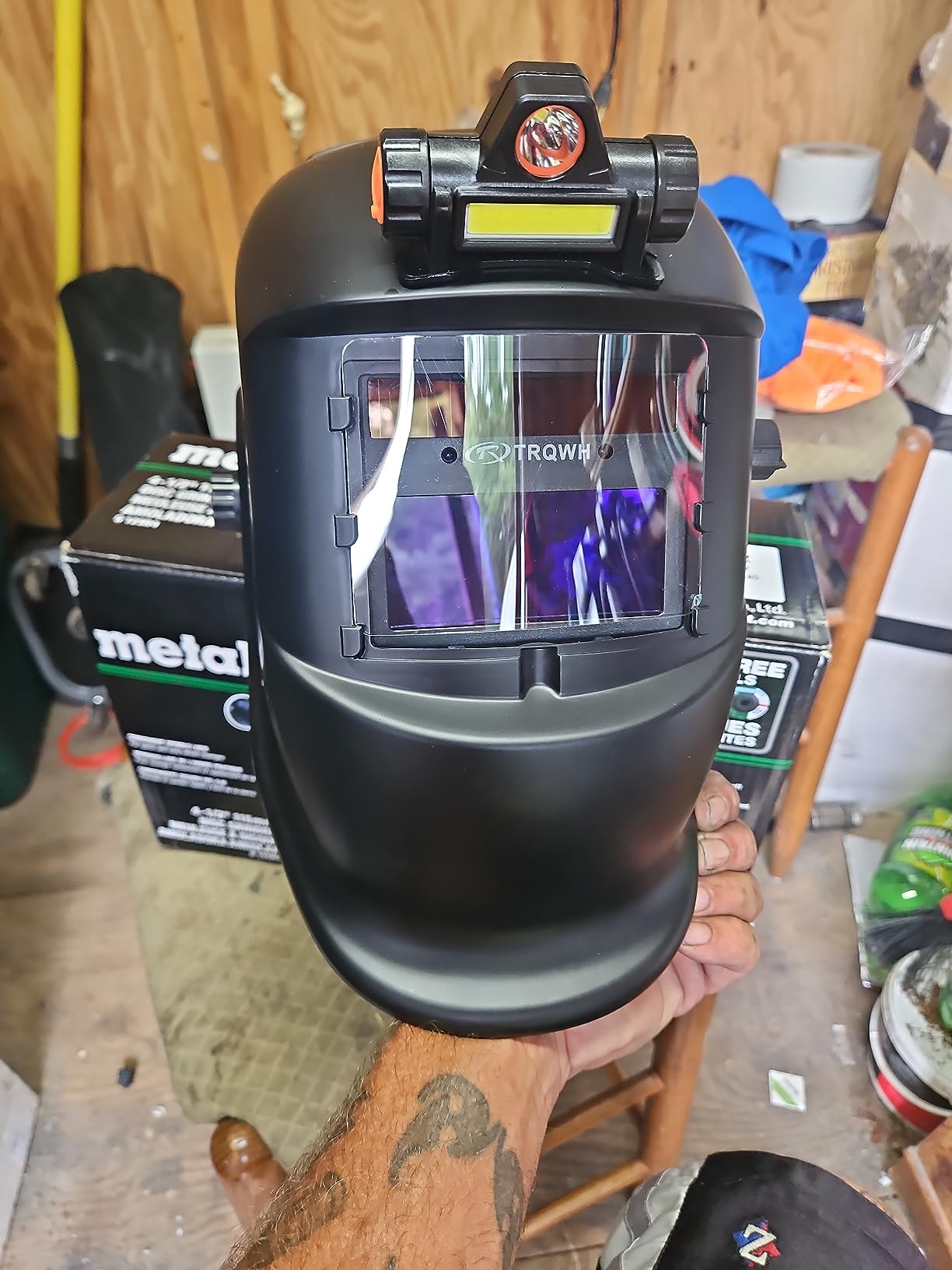
This is the more considered of the two TRQWH helmets, and it is the one to choose if you want adjustability from the outside. The grind button, delay knob and sensitivity knob are all reachable without lifting the helmet, and the delay range is specified at 0.2 to 1.0 second, which is wide enough to handle both fast stick work and long MIG passes.
The lens uses double liquid crystal layers and switches in 1/20,000 second, blocking 99 percent of harmful light. The light state is DIN 4 and the wide true color view at 1/1/1/2 clarity is the point of this model: it is designed to let you see fine detail rather than just locate the puddle.
Power is dual, solar plus a replaceable lithium battery, and it is rated for plasma cutting, grinding, TIG, MIG and stick. The same rechargeable top LED appears here, and reviewers describe it as bright enough to be useful in dim environments.
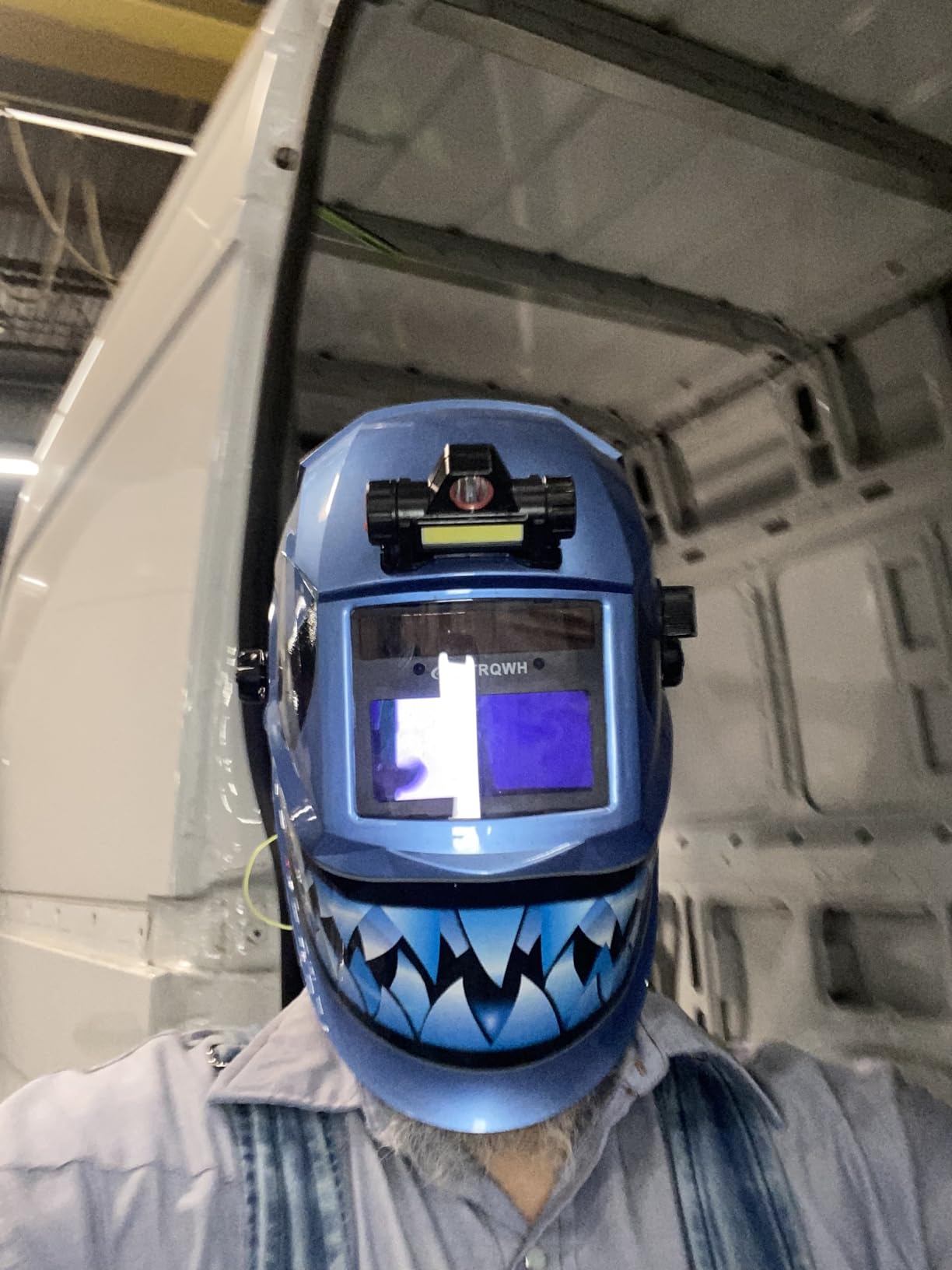
Reviewers report daily use for five months or more without problems, and several mention that it is easy to assemble out of the box and survives being dropped. That is a reasonable durability signal for the price band, and it is a different kind of build story than the flimsy budget shells.
Two things work against it. The head strap tends to loosen during use, which is the single most common headgear complaint across this entire list and across owner forums generally. And the shell is described as brittle, so it can crack if knocked rather than flexing. Store it somewhere it will not get kicked.
Warranty is listed at 30 days. That is the shortest in this roundup, and it is worth factoring in if you are buying for a student or expecting to keep it for years. Budget helmets in general carry short or unclear warranty terms, and that is a legitimate quality signal.
Who this wide-view helmet suits
Choose it if you are moving from stick and MIG into fabrication or TIG work and want the widest usable view you can get without leaving the budget tier. The external controls mean you will not be flipping the helmet up to adjust anything mid-task.
The double liquid crystal lens construction and the specified delay range also make it a reasonable choice for someone who wants fine control over how the lens reacts rather than a single preset.
Who should pass on it
Pass if you are buying a permanent fixture for a workshop, a classroom, or a household with more than one user. A 30 day warranty on a brittle shell is not a combination I would build a long-term plan around.
Pass if you weld with a hard hat or in an environment where the helmet gets knocked around, for the reasons above. For repeated impact and long ownership, one of the name-brand shells with a multi-year warranty is the safer purchase.
7. Hobart 770890: Best Helmet for Simple Analog Controls
Hobart 770890 Auto-Darkening Welding Helmet, Large, Black
9.3 inch widescreen view
4 arc sensors
Analog knobs
Two year warranty
Pros
- PureColor lens with a large 9.3 inch widescreen viewing area
- Four independent arc sensors for dependable detection
- Weld to grind switching without changing helmets
- Plain analog shade sensitivity and delay knobs
- Backed by a limited two year warranty
Cons
- Replacement lens kit must be sourced separately
- Warranty is two years rather than three
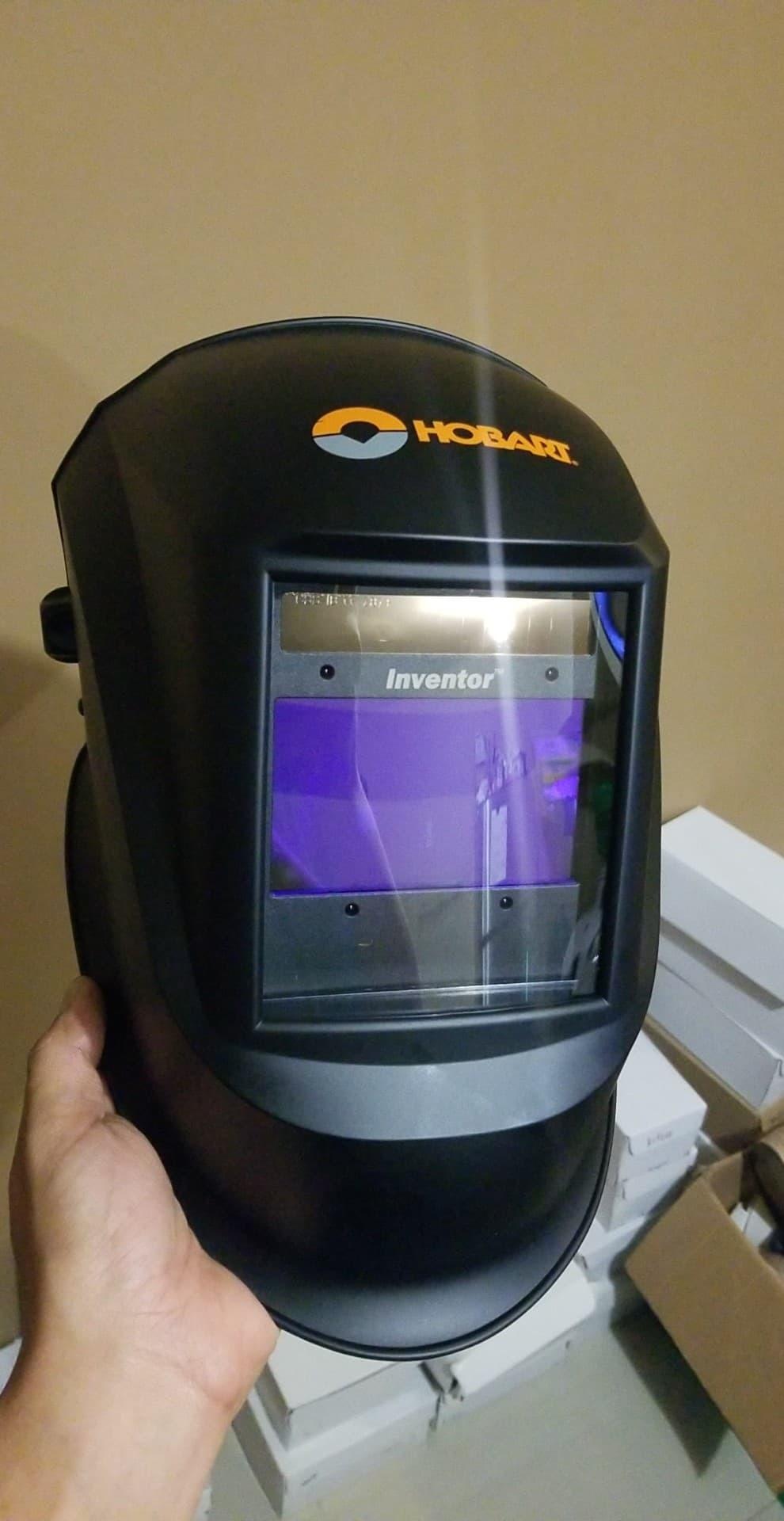
The Hobart is the first helmet on this list that feels like a tool rather than an accessory, and the reason is the control scheme. Three analog knobs for shade, sensitivity and delay. No menu, no mode cycling, no button press to reach the setting you want. You can set it once and forget about it.
Optics are Hobart’s PureColor technology across a 9.3 inch widescreen viewing area, which is the largest window among the well-reviewed name-brand options here. Four independent arc sensors handle detection, and the shell is polyamide nylon rather than thin plastic, with auto-on and auto-off power control at arc strike.
Weld to grind mode switching happens without changing helmets, so you can go from a pass to cleanup without breaking your setup rhythm. It is a small feature that a working welder will use every session.
Reviewers point to accurate color, the wide viewing area, reliable arc sensing and straightforward controls as the reasons this works as a first professional-grade hood. The 4.7 rating across roughly 880 reviews comes with one of the highest shares of five-star ratings of the name-brand models in this list, which usually means low-return disappointment rather than excitement in the reviews.
The practical drawback is consumable sourcing. The protective lens kit for this model has to be bought separately, and while that is normal for a professional hood, it is worth confirming the replacement lens is readily available in your region before you commit. A helmet you cannot get a lens for is a bad long-term purchase.
Two year warranty coverage is solid but not the longest available. A couple of reviewers note the sensor configuration does not always feel as decisive as four-sensor rivals across every setup, which is a fair criticism given the premium this helmet occupies.
When analog beats digital
Buy the 770890 if you are the kind of person who sets a tool once and expects it to stay set. There is nothing to learn and nothing to press. For a beginner welding on evenings and weekends, that predictability is worth a lot.
It is also a strong choice if you have gone through a digital helmet and found yourself changing settings constantly. The large viewing area and accurate color also suit anyone doing layout work, checking fit-up, or judging surface finish rather than only depositing metal.
What you give up
You give up the ability to set exact shade values for different tasks. Analog controls move through a range rather than selecting a number, so on low-amperage work you will be tuning by feel instead of dialing in a value. If you plan to do fine TIG, that is a real limitation.
Lens replacement cost and availability is the other thing to weigh. Budget accordingly, and confirm the kit is easy to get where you are before you buy.
8. Miller Classic Series: Best Helmet for Warranty Backing and Low-Amp Work
Miller Classic Series Welding Helmet, ClearLight™, Shade 8-13, Black
6 square inch view
Shade 8-13 weld
1/23000s switching
Three year warranty
Pros
- ClearLight lens technology with high definition accurate color
- Digital shade delay and sensitivity controls with ratchet headgear
- Works down to five amps for thin material and fine TIG
- ANSI Z87.1+ CSA and CE certified
- Three year warranty included
Cons
- Only two arc sensors for the money
- Shade range starts at 8 so very light work can look dark
- Six square inch view is the smallest here
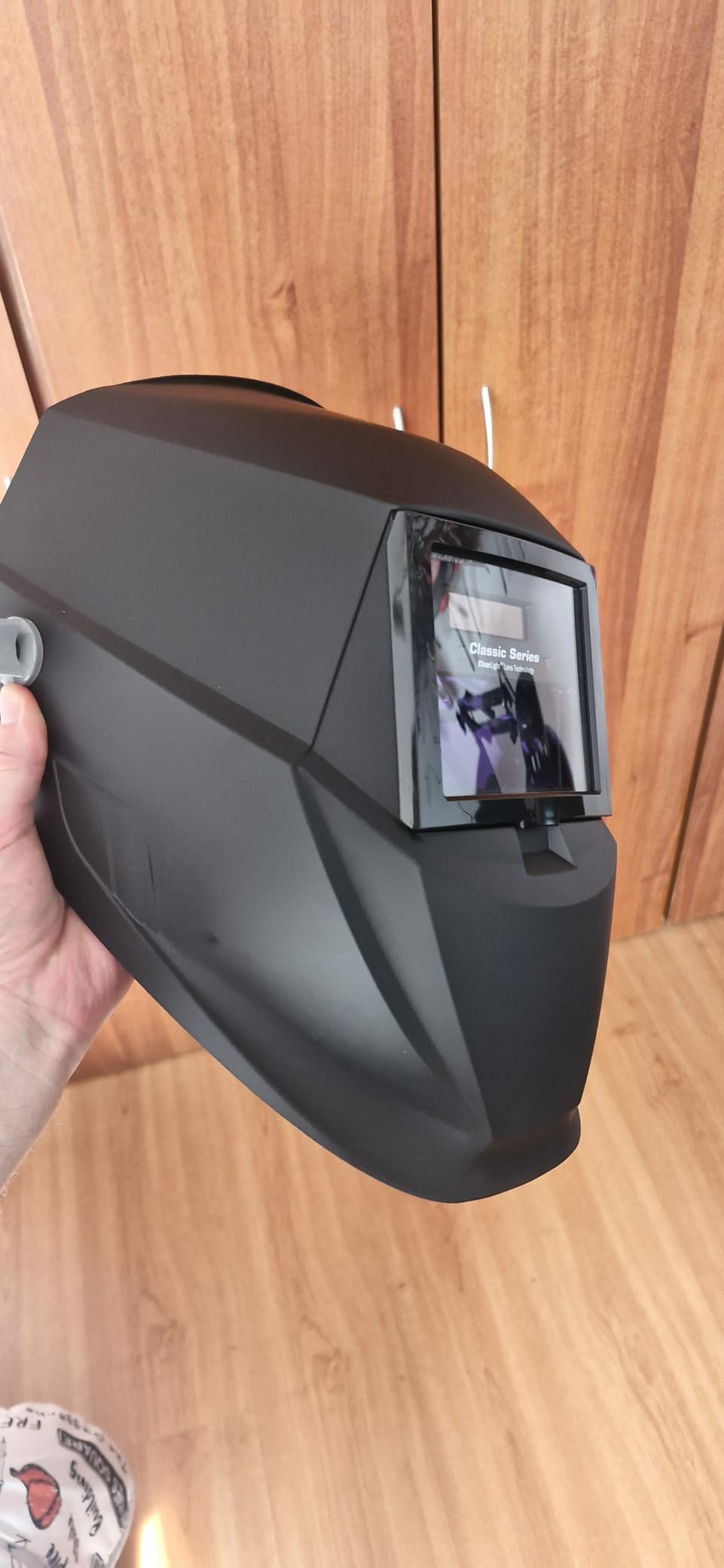
The Miller Classic is the warranty pick, and that is not a throwaway criterion. It carries a three year warranty, which is the longest listed in this roundup, and it is certified to ANSI Z87.1+, CSA and CE. If you keep the same helmet for years, that coverage is a real asset.
The ClearLight lens across a 6 square inch viewing area is the trade. Miller describes it as high-definition, and reviewers consistently praise the accurate color optics. The window itself is the smallest here, so you will be turning your head more than you would with a widescreen model. Accurate color inside a small window is still better than a green window in a large one, but it is a compromise.
Digital controls for shade, delay and sensitivity sit on the shell, and the ratchet headgear holds position. A 3.0 light state lets you keep the hood down between welds, which is the same productivity habit the Hobart offers.
The specification that should decide your process is the five amp rating. Miller lists this helmet as suitable for welding at five amps or below, which makes it unusually capable on thin material and root-pass work for its class. If you are doing stainless or 16 gauge, that low-end capability is genuinely useful.
Two arc sensors is the main complaint, and at this price many buyers expect four. The practical effect shows up on TIG, where a thin arc can fail to trigger the lens. For MIG, stick and flux-core at normal amperage, two sensors are fine and the faster 1/23,000 second switching keeps up.
The other limitation is the shade floor. Weld shades start at 8, so very light welding can look darker than you want. If you plan on a lot of thin-gauge or TIG work at the light end, step up a shade rather than accepting a dark view.
Why the warranty matters here
Long warranty length is the clearest available proxy for build quality, and it is the number I would use most when comparing two helmets at similar spec levels. Three years tells you the manufacturer expects the electronics and shell to survive normal use, which is not the assumption being made by a 30 day term.
For a student or a buyer who expects to weld for a decade, that is worth more than an extra pair of arc sensors you may never need. It also means the Miller stays on your list after you outgrow the beginner stage.
When a different Miller or another brand fits better
Look elsewhere if TIG is your primary process. Two sensors and a shade floor of 8 is the wrong pairing for a beginner learning TIG on thin material, even with the low-amp rating working in your favor.
Look elsewhere if you work on wide joints or need peripheral awareness. Six square inches is a small window by the standards of everything else on this list, and no amount of lens quality compensates for repositioning your head constantly.
9. Lincoln Electric K4983-1: Best Helmet for Hard Hat Work and Solar Reliability
Lincoln Electric No Rules No Limits Welding Helmet K4983-1, Auto Darkening, Lightweight Weld Headgear, Shade 7-13, Grind Mode, Use for Stick, TIG, Pulsed TIG, MIG, Pulsed MIG, Flux Core, Gouging
Weight: 17.5 oz
Shade 7-13
Solar with AAA backup
Hard hat compatible
Pros
- Lightweight nylon shell with an oversized absorbent sweatband
- Solar powered with battery backup so it works without arc light
- Ratcheting headgear gives a secure fit
- Includes two extra impact resistant lenses
- Covers stick TIG MIG pulsed flux core and gouging
Cons
- No sensitivity or delay adjustment
- No digital controls for fine tuning
- Small review base compared with the other models
The Lincoln is the lightest construction-focused helmet here at 17.5 ounces, in a nylon shell with an oversized absorbent sweatband. For long sessions, that sweatband is not a luxury. It is the difference between a helmet you keep wearing in hour four and one you push back up on your head.
Power is solar with battery backup, and two AAA batteries are included. The backup matters more than it sounds: a solar-only design that never sees arc light will not respond, and owners on budget shells frequently report a helmet that simply stopped darkening. This one has a floor under it.
The shade range runs 7 to 13 plus a separate grind mode shade, and the process list is broad: stick, TIG, pulsed TIG, MIG, pulsed MIG, flux core and gouging. It is TIG rated from 5 amps upward, so low-amp work is within range on paper.
Ratcheting headgear is the detail that sets it apart for site work. A ratchet locks at a setting and stays there, which is the answer to the single most common owner frustration in this category: headgear that drifts and has to be readjusted mid-task. It is also listed as hard hat compatible, which narrows your options considerably if you work on a construction site.
Two extra inside and outside impact resistant lenses are in the box, and the 4.33 inch by 3.54 inch viewing area is a middle ground. Wider than the letterbox entry models, narrower than the widescreen professional hoods.
What you give up is control. There are no digital controls and no sensitivity or delay adjustment, so the lens behaves the way it behaves. For a beginner on a fixed set of tasks, that is a reasonable simplification. For someone who wants to tune the reaction to a specific process, it is a limit.
Who should buy the Lincoln
Buy it if you work under a hard hat, weld outdoors, or do any job where the helmet gets knocked and the headgear has to survive. The ratchet plus the nylon shell is the most robust combination in this roundup for that environment.
It is also a strong value pick for a school or workshop buying for a student who will weld hard and treat the gear roughly. Solar plus AAA backup means it is very unlikely to die on you, and spare lenses are included.
What to weigh before buying
The review base here is the smallest in the roundup, which means less long-term evidence. You are trusting the build and the brand rather than a large body of owner reports, and that is a fair trade if you value the headgear.
If you want to tune sensitivity or delay, look at one of the models with external controls. Once you have welded for a few months and start noticing the lens reacting badly on a specific process, the ability to adjust will start to matter more than the weight.
10. Jackson 47100: Best Helmet for Headgear Adjustment and Light Weight
Jackson Safety Premium Graphic Welding Hood with Digital ADF – Ultra Lightweight Auto Darkening Welding Helmet – ANSI Z87.1 (Multiple Styles)
Weight: 1.26 lb
9.3 sq inch view
4 arc sensors
Shades 3 to 10
Pros
- Very light ergonomic shell that reduces neck fatigue
- True 1/1/1/1 clarity across a 9.3 square inch viewing area
- Four arc sensors for responsive blockage-resistant detection
- Patented Speed Dial ratcheting headgear with easy grip knob
- Extended front shell for neck protection
Cons
- No shade adjustment
- lens is fixed at shade 3/10
- Replacement lenses are difficult to source
- Headband can feel wrong on smaller head sizes
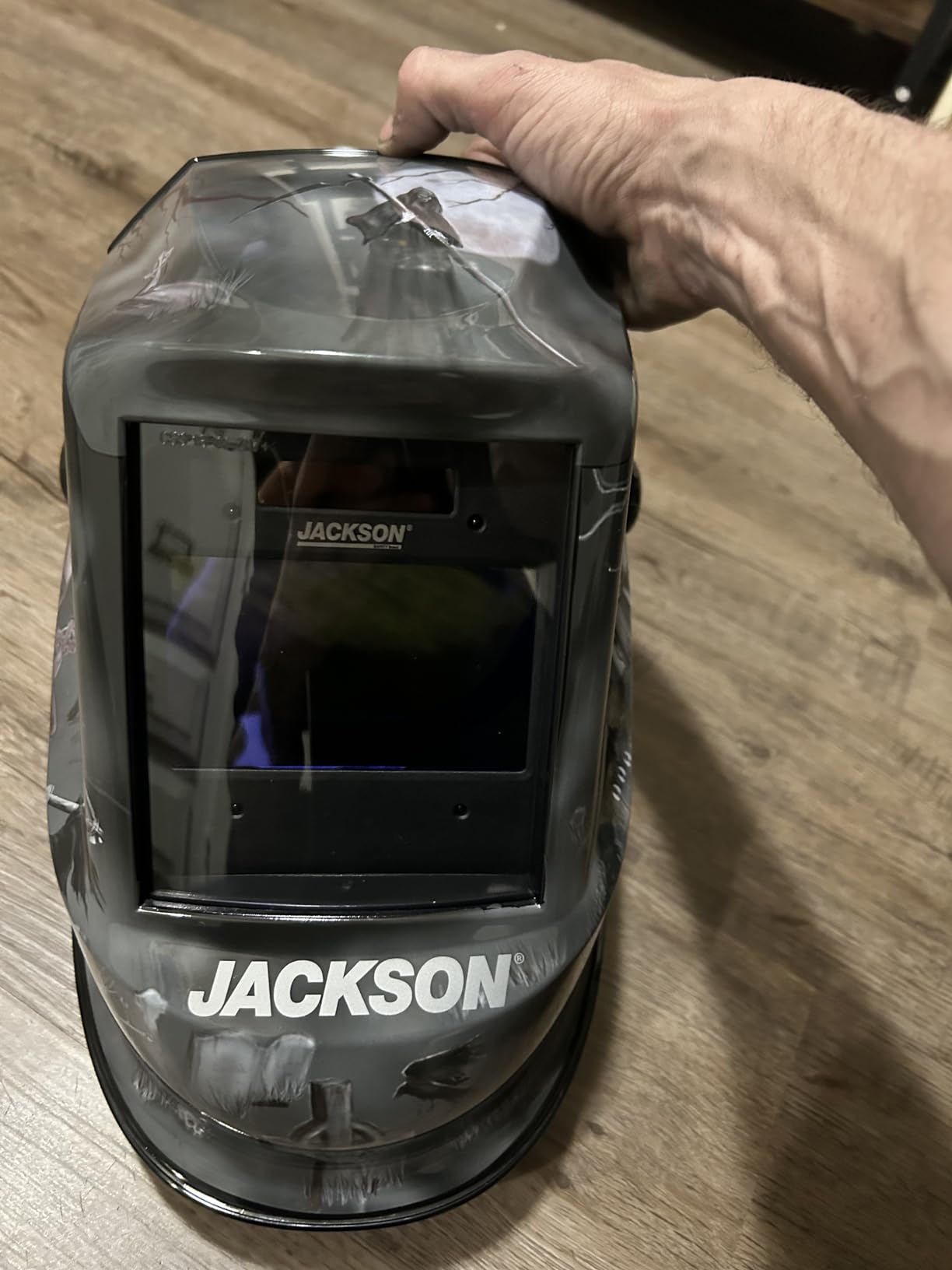
Headgear is the most common reason welding helmets get returned, and the Jackson is built around solving it. The patented 370 Speed Dial ratcheting headgear with an Easy Grip-Easy Turn knob lets you set tension with a gloved hand and lock it. The shell is 1.26 pounds and described as ergonomically balanced, with an extended front shell for neck protection.
Optically you get true 1/1/1/1 clarity across a 9.3 square inch viewing area, and four arc sensors with 1/25,000 second reaction speed. That sensor count and that switching figure put it in line with the beginner thresholds, and four sensors give better detection on low-amperage work than two.
Certification covers ANSI Z87.1+, CAN/CSA Z94.3 and CE, with a two year warranty. Solar powered with a CR2032 replaceable battery.
Here is the catch, and it is a significant one: there is no shade adjustment. The lens is fixed at the shade 3/10 setting the listing describes, with a shade 3/10 polycarbonate filter included. Reviewers note that several buyers expected adjustable shade and were not, which tells you this model attracts the wrong expectations.
For a beginner doing MIG and stick within a fixed amperage window, a fixed setting is workable. For anyone who moves between processes or amperages, the inability to change shade is a real limitation, and the other helmets here solve it for a similar outlay.
Replacement lenses are also difficult to source according to multiple buyers. That is the total cost of ownership problem: a scratched or pitted filter with no available replacement turns a good helmet into a wall ornament. Confirm the lens is available in your region before you buy, and keep a spare on hand.
A few users also report the headband feeling off on smaller head sizes, which is a common issue across the category. Measure first.
Where the Speed Dial headgear wins
This is the helmet to consider if you have previously fought headgear that would not lock, or if you are buying for a head shape that sits outside the middle of the range. An adjustable ratchet with a large grip knob is more forgiving than a small friction strap, and it is the best-adjusted option in this roundup.
The 9.3 square inch viewing area and four sensors also make it a solid choice for a beginner who wants a wide window without stepping up to a professional price band. The neck-extended front shell is a nice touch for anyone who has felt heat on their neck.
When to choose a different model
Choose something with shade adjustment if you plan to move between MIG, stick and TIG, or if you weld a wide range of material thickness. A fixed lens forces you to pick a setting and live with it, and that is a compromise that grows more annoying the more you weld.
Verify replacement lens availability before committing. That single check will save you more than any spec on this list, and it applies to every model here.
Welding Helmet Buying Guide: What to Look For
Here is the checklist I use, in priority order. If a helmet fails the first four, walk away no matter what the marketing says.
Variable shade range covering 9 to 13. Shade 9 handles MIG and most stick work. Shade 13 is what low-amperage TIG and some flux-core work need. A lens that tops out below 13 will fail you the day you try TIG, and no adjustment will rescue it.
At least two arc sensors, four preferred. Sensors are what detect the arc and trigger the darkening. Two is adequate for MIG and stick. Four is meaningfully better for TIG, because a thin arc is easier to miss and stray light is less likely to cause a false trigger.
Switching speed of 1/25,000 second or faster. Below roughly 1/25,000 second the transition is visible as a flash. Faster than that and the transition is invisible. Published figures across this roundup range from 1/20,000 to 1/30,000 second, and the difference in practice is small. Buy for 1/25,000 or better, then stop worrying about it.
Shell weight under 1.5 pounds for long or overhead work. Weight is the spec you feel most. Above roughly 2.5 pounds, long sessions start producing neck pain, and beginners lose practice time to discomfort rather than to learning.
Viewing area matched to your work. Entry models commonly use a letterbox window around 3.6 inch by 1.7 inch. Large-view and widescreen models run near 9.3 square inches. Wider helps on narrow joints and tube work.
True color optics if you have never welded. 1/1/1/1 clarity means the lens reproduces color accurately across the visible spectrum, so the puddle, the spatter and the finished bead look like what they actually are. Beginners learn faster when they can see the result of a heat input mistake.
External controls for shade, delay and sensitivity. Delay controls how long the lens stays dark after the arc stops. Sensitivity controls how easily it triggers. Both are worth having externally rather than behind a menu.
Power source that cannot strand you. Solar plus a replaceable battery is the ideal combination. Solar alone fails if the cell is shaded. Battery alone dies and the helmet becomes a paperweight. The cheap button cell is the last resort, and it is the one that fails in a truck in the middle of winter.
Warranty length and certification. Look for ANSI Z87.1 in the US, EN 379 in Europe, and CSA Z94.3 in Canada. Warranty length is the clearest quality signal available: three years means the manufacturer expects the electronics to last, and 30 days means very little.
True color versus standard green tint
Standard welding lenses are green because a green filter gives better contrast at the wavelengths where the arc is brightest, which helped you see the weld edge on early electrodes. Modern liquid crystal layers push that further, and 1/1/1/1 and 1/1/1/2 ratings describe how evenly the lens transmits across red, green, blue and the fourth band.
For a beginner, true color is the better default. Judging whether a bead is oxidised, spotting a crack forming, or checking paint and prep before you start all benefit from accurate color. There is a persistent minority preference for the green tint among experienced pipefitters who argue the contrast is sharper on stainless, and that is a legitimate opinion rather than a myth. For your first months of welding, take the true color.
Fixed shade versus auto-darkening
A fixed-shade helmet has a filter set to one darkness and is cheaper with no electronics to fail. For a beginner who will only ever MIG at one material thickness, it genuinely works. The moment you want to do a short bead, grind the same joint, or try a second process, auto-darkening becomes far more pleasant.
Since the auto-darkening options in this roundup now sit in the same price neighborhood, and the community consensus is that the sub-budget tier is where quality collapses, I would start auto-darkening unless you have a specific reason not to.
Cheater lens and grind mode
A cheater lens is a magnifier that clips into the filter frame. It is close to essential for root passes on thin material and for TIG, where you are looking at a very small joint. Cheaper helmets increasingly include a frame that accepts one, and the YESWELDER LYG-M800H is explicit about compatibility. Check before you buy if you plan fine work.
Grind mode is a lighter shade setting for finishing work, reached with an external button or knob. It saves you lifting the helmet and swapping lenses between the pass and cleanup, and several models here include it.
Is a Premium Welding Helmet Really That Much Better?
This is the question that comes up most often, and the honest answer is that a premium helmet is a better tool without being a different category of protection. Every certified auto-darkening lens blocks the harmful arc light. The step up is in build quality, control, field of view, optics and support, not in whether your eyes get protected.
What the entry tier buys you: a lighter or cheaper shell, a narrow viewing window, no or limited adjustment, and shorter warranty support. That is a completely serviceable first helmet, and for someone welding a few hours a month in a garage it is a rational purchase.
What the middle tier adds: a large viewing area, four arc sensors, true color optics with a proper light state, external controls, replaceable lenses and a warranty measured in years. If you are welding weekly, this is where the money is well spent.
What the premium tier adds: a more accurate and more even lens, better-balanced headgear that holds position under a hard hat, faster and more reliable sensor detection, and parts availability. It is a comfort and durability purchase, not a safety purchase.
The community view is worth hearing in full because it is not unanimous. Long-tenured welders on forums repeatedly endorse the big professional brands, and the practical rule they offer is straightforward: buy the best name-brand helmet you can afford in your range. At the same time there is an active and vocal camp that says a well-reviewed mid-range helmet works fine and that buying premium is money better spent elsewhere. Both are defensible. The beginner-specific risk is going too cheap, not going premium.
How to Fit Your Welding Helmet Properly
Fit is the number one complaint in owner discussions and the number one return reason, and it costs nothing to get right.
Measure your head circumference. Wrap a soft tape measure around the fullest part of your head, just above your ears and across the back, keeping it level. Note the number and compare it to the headgear range the manufacturer lists. If the listing says one size only, treat that as a warning.
Set the harness before you weld, not during. Most helmets have a top adjustment for crown height and a rear or side knob for circumference. Set both, then tighten the front knob until the helmet is snug with no pressure points.
Test the raised position. Wear the helmet the way you will wear it and confirm it locks when flipped up. If it drifts down, the ratchet or the tension knob is the culprit. This is the most common failure in the budget tier and the easiest thing to check before you rely on it.
Check respirator clearance if welding indoors. Many close-fitting shells will not accept a respirator underneath, and discovering that after you have bought the helmet means buying a second one. If you will be welding indoors, confirm the shell has room before you order.
On respirators, one more note that gets overlooked. Galvanized and coated steel produce zinc and other fume that requires local extraction, and a respirator is the last line of defense rather than the first. Ventilation comes first, and a helmet is never a substitute for it.
When to Upgrade From a Budget Helmet
Most beginners should buy once in the middle of the range and stop thinking about it. Upgrading earlier than that leaves money on the table; upgrading later than that costs you practice time. Three thresholds tell you it is time.
You have moved from occasional to regular welding. If you are putting in several hours a week, the difference in headgear stability and lens clarity starts to matter because you are actually reading the weld rather than surviving the arc.
You are learning TIG. Low-amperage TIG demands four sensors and a full shade 9 to 13 range. This is the clearest single reason to move up, and it is also the most safety-relevant upgrade in this article.
Your current lens is scratched and cannot be replaced. If the replacement filter is unavailable, the helmet is finished regardless of how good the frame is. Check lens availability before you buy anything, and prefer a helmet with external replaceable lenses so a scratch never obsoletes the whole unit.
Do not upgrade because a professional you work with has one. The gap between the best budget helmet here and the best premium one is measured in comfort and convenience, not in protection. Buy for the process you have now, and revisit when one of the three thresholds above is met.
Frequently Asked Questions
What should I look for in a welding helmet?
Look for a variable shade range of 9 to 13, at least two arc sensors with four preferred for TIG, switching speed of 1/25,000 second or faster, a shell under about 1.5 pounds, true color optics, a viewing area matched to your work, solar power with a replaceable battery backup, external shade delay and sensitivity controls, ANSI Z87.1 or EN 379 certification, and a warranty measured in years rather than weeks.
What is the best welding helmet on a tight budget?
The YESWELDER LYG-L600A is the strongest first purchase in the budget tier, with true color 1/1/1/1 optics, a 16 ounce shell, a shade 3 and 7 to 13 range, two arc sensors switching in 1/30,000 second, and solar power with a replaceable battery. If weight is your main concern, the TOOLIOM at 1.14 pounds is the lighter and more comfortable option for overhead work.
What is the best welding helmet for the money as a beginner?
The YESWELDER LYG-M800H is the best value for a beginner who is learning quickly. It gives you a 3.93 inch by 3.66 inch viewing area with 1/1/1/1 true color clarity, four arc sensors at 1/30,000 second, a full shade 3, 5 to 9 and 9 to 13 range, cheater lens compatibility, and controls reachable with gloves on. That is the point where a step up from the cheapest option pays for itself.
Can beginners do TIG with an auto-darkening welding helmet?
Yes, but only with the right lens. Low-amperage TIG produces a thin flickering arc that a two-sensor lens can fail to detect, leaving the lens light and flashing your eyes. Choose a helmet with four arc sensors, a shade range that reaches 13, and external sensitivity control set to the higher setting. The Hobart 770890, the YESWELDER LYG-M800H and the YESWELDER LYG-Q800D all have four sensors.
Is a premium welding helmet much better than a cheap one?
Not in terms of protection. Every certified auto-darkening helmet on this list blocks the harmful arc light, so the step up is comfort, control and durability rather than safety. What you gain with a premium or mid-range model is a wider viewing area, more sensors, better optics, controls that stay put, replaceable lenses and a warranty measured in years. What you give up with a budget model is weight, field of view, adjustment and support.
How do I fit a welding helmet properly?
Measure your head circumference with a soft tape just above the ears and across the back, then set the crown height and circumference adjustment before you weld. Tighten the front knob until the helmet is snug with no pressure points, and confirm the helmet stays locked when flipped up. If you will weld indoors, check that the shell has clearance for a respirator before you order.
Final Verdict: The Best Welding Helmets for Beginners in 2026
If you buy one, buy the YESWELDER LYG-L600A. It is the lightest shell in this roundup at 16 ounces, it has true color 1/1/1/1 optics, a shade 3 and 7 to 13 range covering MIG and stick, two arc sensors switching in 1/30,000 second, solar power with a replaceable battery, and it comes with spare lenses and a spare battery in the box. Nothing else at this level gives you that combination of lightness, optics and consumables.
If you learn fast and want to see your work, step up to the YESWELDER LYG-M800H for the large viewing area and four sensors. If you are welding under a hard hat, the Lincoln Electric K4983-1 gives you ratcheting headgear that actually holds. If you want analog simplicity and a widescreen view, the Hobart 770890 is the one. If warranty length is your priority, the Miller Classic Series carries three years.
The rest of this list is genuinely usable, and the difference between the cheapest and the most expensive helmet here is comfort and control, not eye safety. Buy the one that fits your process, measure your head before you order, confirm the replacement lens is easy to get, and get back to the arc. Once the machine is picked, our beginner MIG welder comparison is the logical next step.
Last updated in 2026. Ratings and review counts reflect the published customer record for each model at the time of writing, and all ten helmets are certified to ANSI Z87.1 or an equivalent standard.