
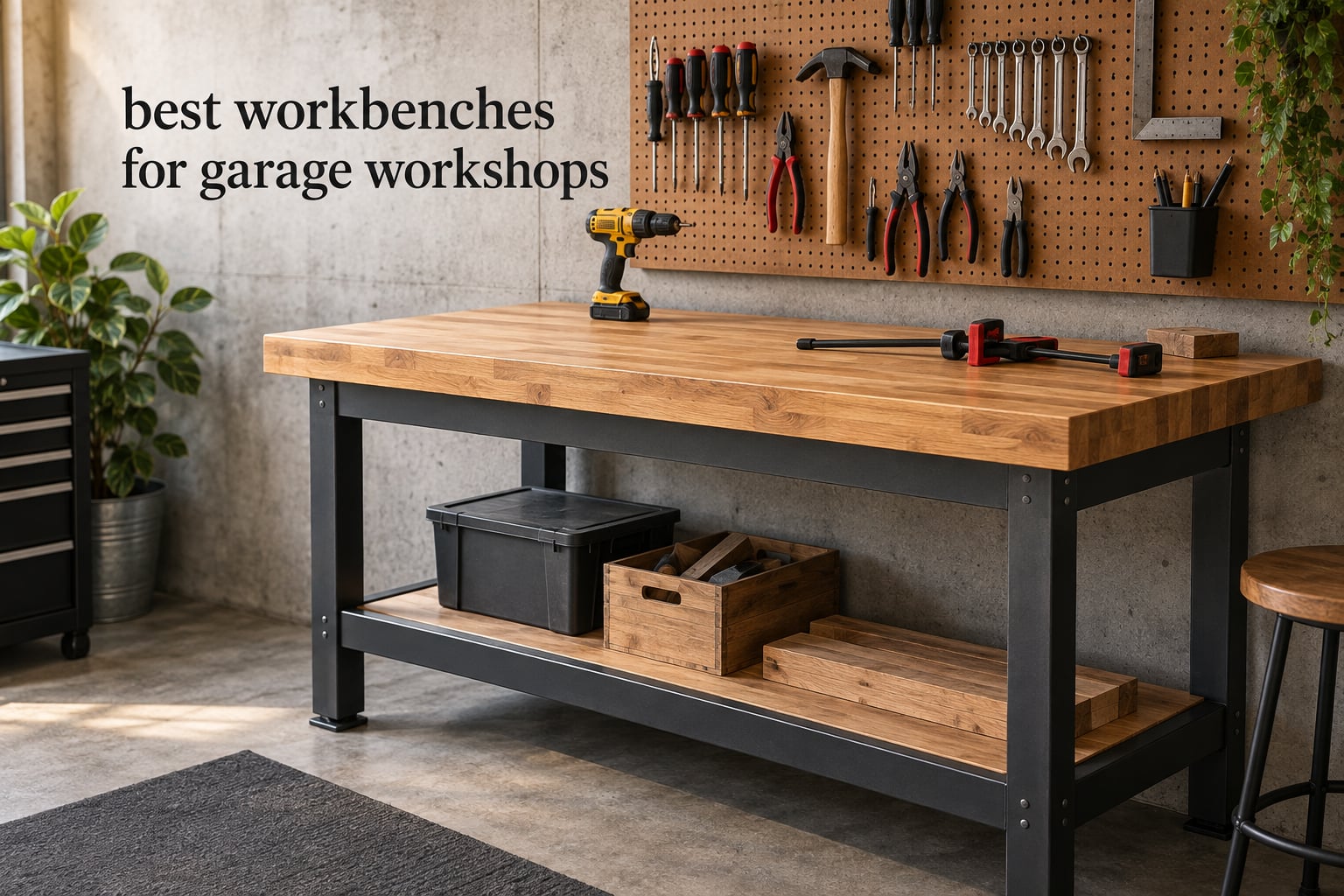
The workbench is the one piece of equipment that decides what you can actually finish in a garage. Everything else in the shop is a tool you reach for; the bench is the flat, rigid surface everything else gets built on. Picking badly is expensive in a quiet way: a top that dents when you clamp a cabinet, a frame that racks when you plane a door, a footprint so deep the car has to move outside every time you want to work.
That is why searching for the best workbenches for garage workshops is mostly a question of fit rather than of brand. Before any spec sheet matters, you need to know how much wall run you have, how close the garage door track sits to that wall, how wide your vehicle is, and what kind of load you plan to put down. Get those four answers and half the catalog eliminates itself.
We worked through the full field for this roundup: ten benches spanning fixed steel frames, folding tables, rolling carts and clamp-style boxes, checked against capacity ratings, top thickness, height range, storage and the real complaints in their reviews. The picks below cover every common garage setup, from a one-car hobby bay to a two-car shop where the vehicle still has to fit. If you are also planning the rest of the space, our garage storage system guide covers the shelving that sits next to a bench.
Table of Contents
Best Workbenches for Garage Workshops (October 2026)

The three above cover a wide range of real garage jobs. The WORX Pegasus wins on volume of owners and stiffness for its weight, the Keter wins on a 1000 lb rating from a table you close up in ten seconds, and the BORA Centipede wins the moment a full sheet of plywood or a machine has to go on the surface.
All 10 Garage Workbenches Compared in 2026
| Product | Specifications | Action |
|---|---|---|
| WORX Portable Folding Workbench WX051 |
|
Check Latest Price |
 Keter Heavy-Duty Folding Workbench Keter Heavy-Duty Folding Workbench |
|
Check Latest Price |
| BORA Centipede Folding Work Table 4×8 ft |
|
Check Latest Price |
 WEN WB4723T Workbench with Power and Light WEN WB4723T Workbench with Power and Light |
|
Check Latest Price |
 Seville Classics UltraGraphite Wood Top Workbench Seville Classics UltraGraphite Wood Top Workbench |
|
Check Latest Price |
 CAMMOO 48 in Adjustable Workbench CAMMOO 48 in Adjustable Workbench |
|
Check Latest Price |
 WORKPRO 48 in Adjustable Workbench WORKPRO 48 in Adjustable Workbench |
|
Check Latest Price |
 VEVOR Adjustable Workbench 48 x 20 in VEVOR Adjustable Workbench 48 x 20 in |
|
Check Latest Price |
 PONY Portable Folding Work Table PONY Portable Folding Work Table |
|
Check Latest Price |
 BLACK+DECKER Workmate 825 Deluxe BLACK+DECKER Workmate 825 Deluxe |
|
Check Latest Price |
1. WORX Pegasus WX051 Folding Workbench – Best Overall Garage Workbench
WORX Portable Folding Workbench, 2-in-1 Pegasus Table & Sawhorse, WX051
Alloy steel frame
31 x 25 in top
Fixed 32 in height
300 lb as table, 1000 lb as sawhorse
Pros
- Folds flat and carries at about 30 lbs
- Opens in seconds with no tools
- Rigid sawhorse-style legs
- Includes two 24-inch quick clamps and four clamp dogs
- Recessed trays and a measuring guide molded into the top
Cons
- Bundled bar clamps clamp only lightly
- Fixed 32-inch height cannot be adjusted
- Lower shelf is thin and lightly rated
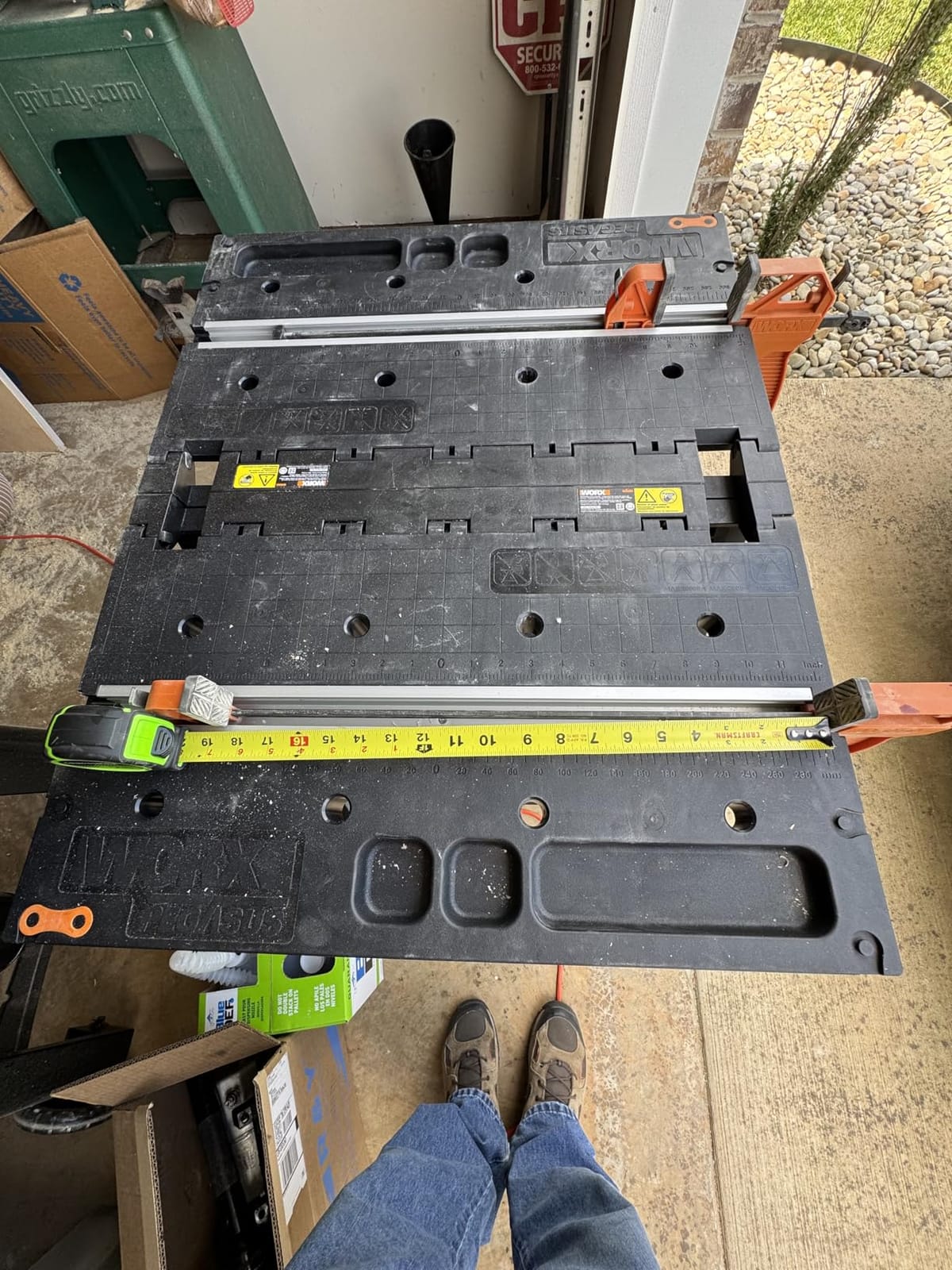
The Pegasus is the bench most garage owners have already met without knowing its name. It is the folding table you pull out when a door slab needs support or a clamp needs somewhere to live, and it pairs a 4.8 star rating with by far the largest review count in this roundup. Across more than 14k ratings, that is not a marketing artifact; it is a table that simply does not break.
What makes it work is the leg geometry. It deploys on a sawhorse-style base rather than folding legs, so the load path runs down four splayed legs instead of a pair of flat panels. Owners working a full sheet of plywood on it report no wobble under load, and the alloy steel frame is the reason. I carried it up a flight of stairs in one arm at roughly 30 lbs, which matters if your garage is not on the ground floor.
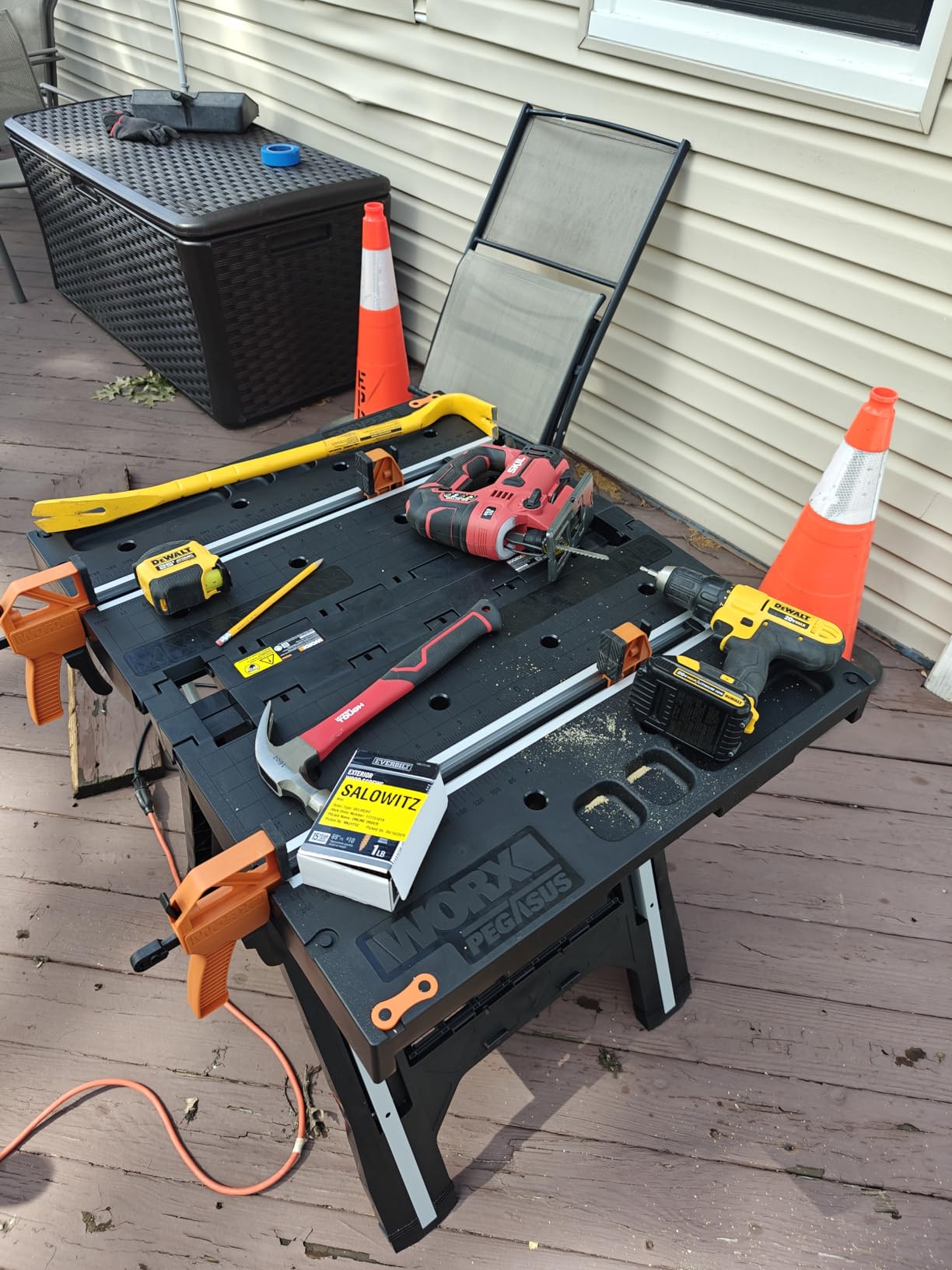
The accessory package is the quiet differentiator. Two 24-inch quick clamps and four clamp dogs come in the box, and the dogs store on the top itself, so the clamping setup travels with the table. Reviewers note the dogs are the part they reach for daily, particularly for holding a workpiece while a saw makes a pass.
The molded ABS top has recessed trays along the edges and an embossed measuring guide, so screws, washers and hex keys have a home instead of migrating into the sawdust. It also links to other WORX tables, which is how you build a larger surface for a weekend project without buying a second heavy bench.
What it handles well
Assembly glue-ups, panel glue-ups, trim and molding cuts, and general clamping where you need a stable platform for an hour rather than a day. It is the bench I would put in a one-car garage where the work is project-based and the floor has to be clear by Sunday evening.
It also serves as a sawhorse rated to 1000 lb, which is where that 300 lb table number stops being the whole story. A pair of them straddles a 4 x 8 sheet comfortably.
Where it falls short
The bundled bar clamps are the weak link. They develop modest clamping force, so for glue-ups where you need real squeeze you will want to add a proper parallel clamp. The hollow underside also means a vertical hold-down needs a scrap block under the workpiece.
And the 32-inch height is fixed. If you are six foot four and want the surface higher for planing, this is not the table. The PONY folding table later in this roundup adjusts from 25 to 35 inches for exactly that reason.
2. Keter Heavy-Duty Folding Workbench – Budget Pick Garage Workbench
Keter Heavy-Duty Folding Workbench with 1,000 Pound Capacity
Polypropylene on aluminum legs
33.46 x 21.65 in
Fixed 29.75 in height
1000 lb capacity
Pros
- Opens in about 30 seconds with no assembly
- Folds to a few inches thick
- 1000 lb rating on tubular aluminum legs
- Built-in 12-inch quick clamps stow on the lower shelf
- Handles on multiple sides for stairs and doorways
Cons
- Fixed 29.75 in height runs short for taller users
- Included bar clamps are stiff and rough
- Vibrates under an orbital sander
- Short 1-year warranty
The Keter has been the default folding bench in a lot of garages for years, and the reason is simple setup. Two release tabs and it is a bench. That is genuinely useful at the end of a long day when the alternative is twenty minutes of folding a steel frame, and it folds down to a package roughly the footprint of a folding chair.
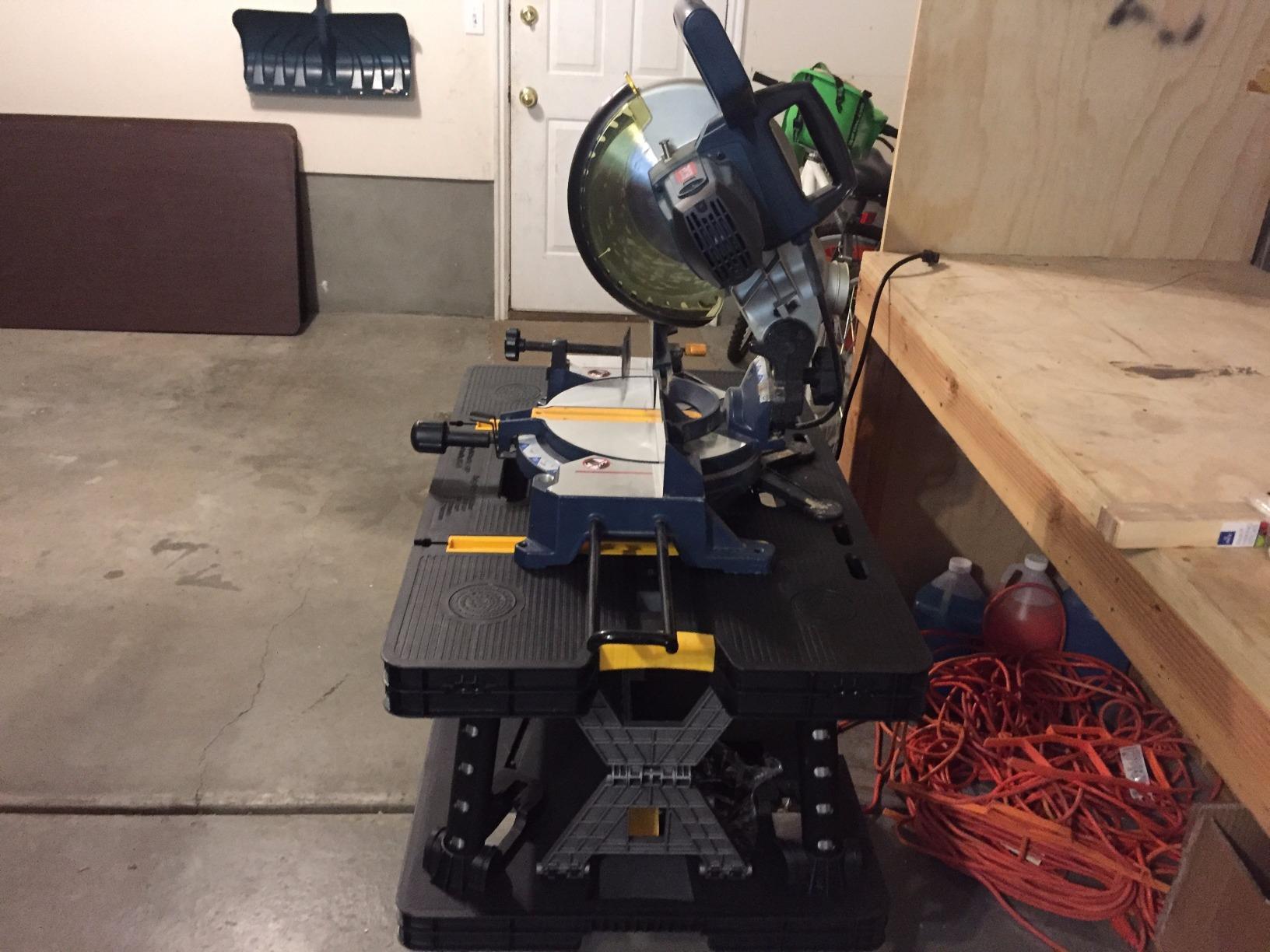
It also punches above its material class. The top is weather-resistant polypropylene on a tubular aluminum frame with three interlocked support sections, and it carries a 1000 lb rating. Reviewers report standing on it without concern, which is not advice, but it tells you how little the frame flexes.
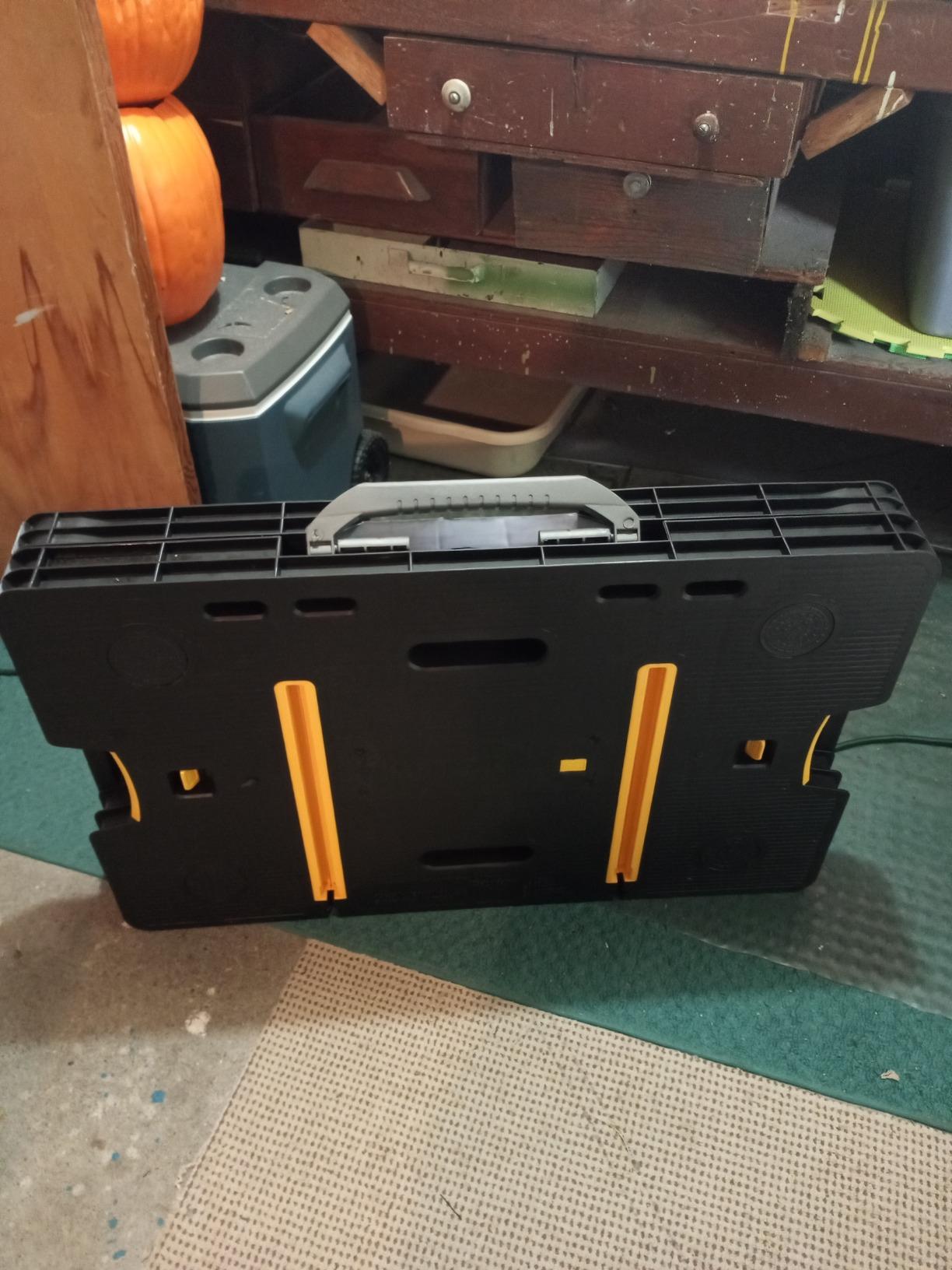
The two 12-inch quick clamps built into the sides work horizontally or vertically, which is unusual for a folding table and saves buying a pair separately. They stow in fitted slots on the lower shelf rather than rattling around loose.
Because the frame is aluminum and the top is polymer, the whole thing shrugs off a damp garage and can live outside. Owners use it on decks and driveways, and several report units surviving years of that treatment. It is one of the few benches here that is not a strictly indoor tool.
What it handles well
General repair, automotive maintenance, assembly and staging work, and anything you need a flat platform for without committing floor space to it. The carry handles on multiple sides make it easy to move up a staircase, which is a real problem for heavier benches in basements and upstairs shops.
It is also the pick for anyone who works in a rental or a shared space where a permanent bench is not an option. You can close it up and put it in a closet between sessions.
Where it falls short
The 29.75-inch height is a couple of inches below the standard bench height, and taller users feel it. There is no adjustment, so if you need 32 or 35 inches you should look at the adjustable models further down.
Reviewers also flag vibration under an orbital sander unless the workpiece is cushioned, and the included bar clamps get the most complaints of any accessory in this roundup: stiff release, rough sliding, and dents in the bar. Budget for a better clamp if clamping is central to your work.
3. BORA Centipede CK15S – Best for Full-Size Sheet Goods and Heavy Machines
BORA Centipede Folding Work Table 4×8 ft Portable Workbench for Garage
Alloy steel frame
4 x 8 ft surface
30 in work height
6000 lb load capacity
Pros
- 6000 lb rating handles machinery and full sheet goods
- 4 x 8 ft surface
- sets up and packs away with no assembly
- Rotating P-Tops protect the workpiece and saw blades
- Collapses to a 38 x 10 x 15 in carry bag
- Includes 4 quick clamps and 2x4 brackets
Cons
- Ships as a bare frame with no tabletop included
- Fixed 30 in height favors saw-stand use
- Four separate legs mean a larger footprint
- Far too large for small garages
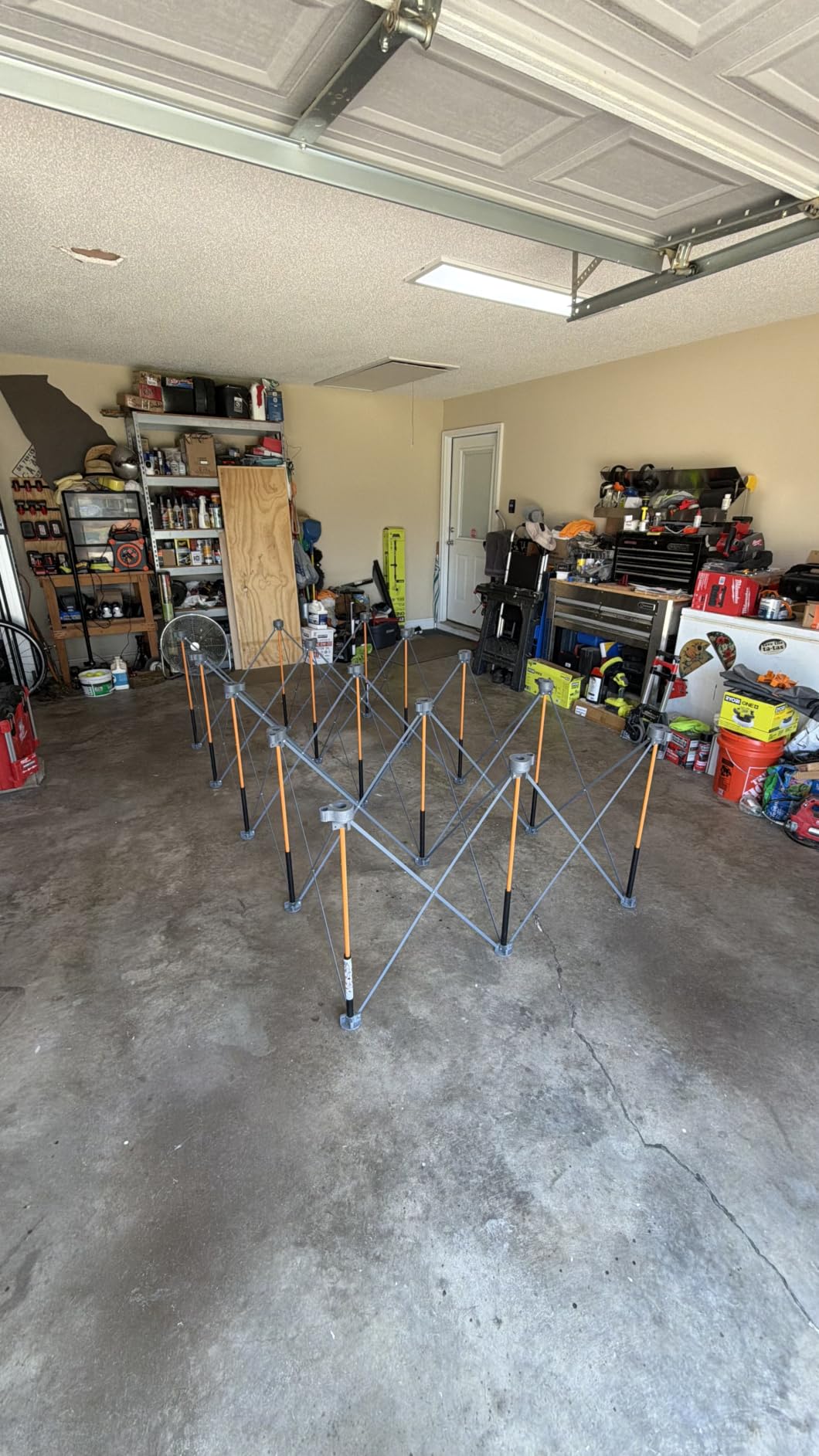
The Centipede is not a workbench in the bench sense; it is a portable platform rated to 6000 lbs, and that changes what you can do in a garage. Nobody is planing a dovetail on it. What you are doing is breaking down sheet goods, supporting a chop saw or a table saw on site, and giving a machine a base that will not walk across the floor.
At 4 x 8 feet it holds a full sheet of plywood flat with room to spare. Reviewers overwhelmingly treat it as a saw stand and project table, and they rate the surface area and fold-down speed as the two reasons it earns its place in a crowded garage.
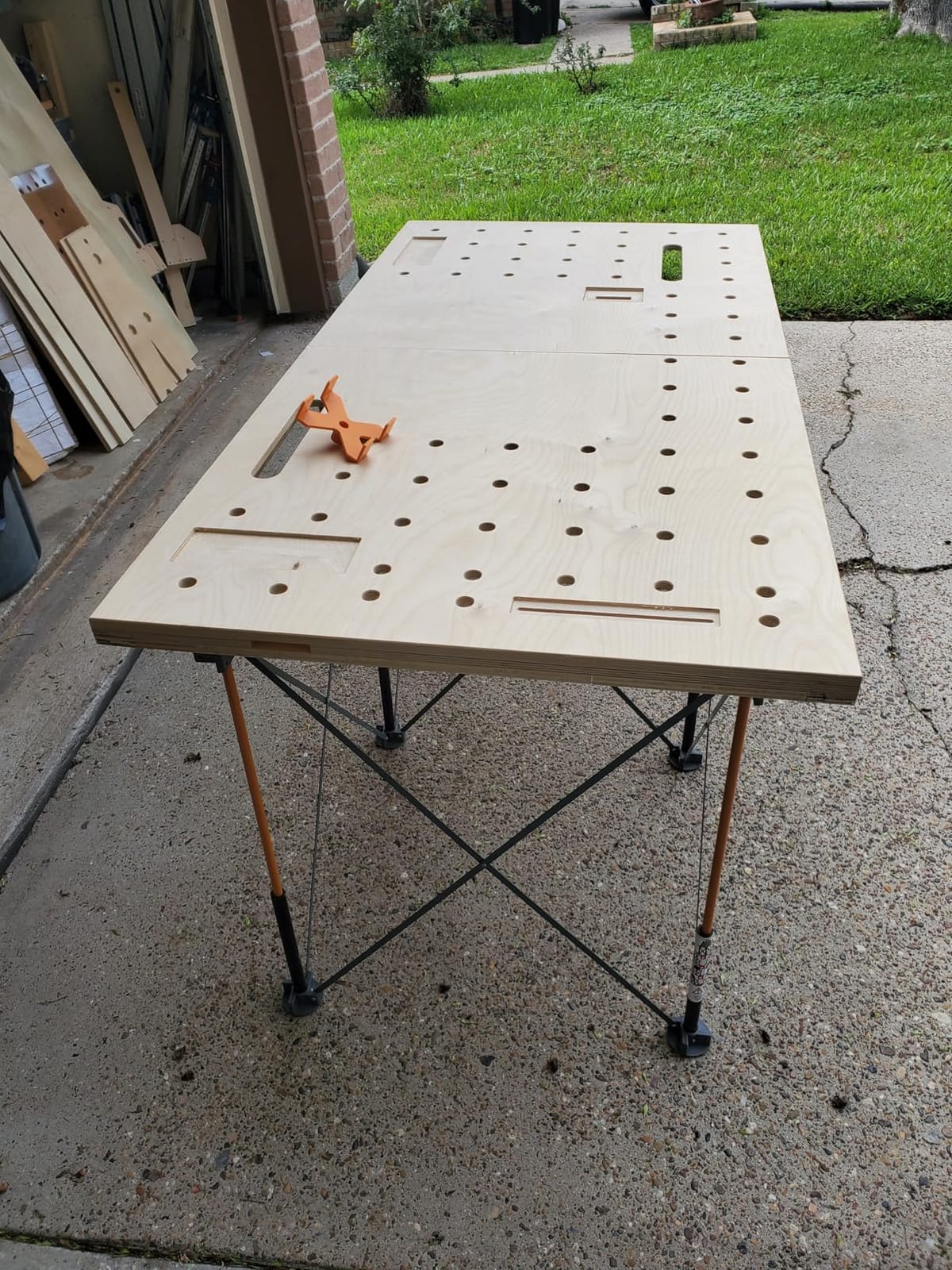
The rotating P-Tops at each leg contact point are the detail that comes up most in reviews. They rotate to match whatever the legs are braced against, so they spread load rather than pinching it, and they keep a saw blade from hitting a hard corner when you slide material through.
It also pairs with scrap plywood. Clamp a sheet onto the frame with the four included quick clamps and you have an instant large work surface, or add the optional tabletops for a finished one. The whole thing collapses to a 38 x 10 x 15 inch carry bag, so it is a tool you take to a job site and bring home.
What it handles well
Full 4 x 8 sheet material, machine bases, site assembly where no fixed bench exists, and any job where the surface needs to be large more than it needs to be precise. It also works as a pair of sawhorse-rated supports at 6000 lb.
For someone who builds rather than repairs, it earns its space by replacing a stack of sawhorses and a pile of offcuts.
Where it falls short
It arrives as a bare frame. The top is not included, so budget for plywood or the optional tabletops before you have a work surface, and understand that plywood clamped to a steel frame is not a precision bench.
The 30-inch height suits saw-stand work more than fine bench work, and at 4 x 8 feet it will not fit a small garage unless you fold it away every time. Four separate legs also mean more parts to track when you move it. If your garage is tight, this is the wrong pick and the folding options above are better fits.
4. WEN WB4723T – Best for Built-In Power, Light and Storage
WEN WB4723T 48-Inch Workbench with Power Outlets and Light, Black
48 x 25 in enamel top
220 lb capacity
Two drawers, shelves, pegboard
3 outlets and overhead light
Pros
- Most storage in one 48-inch frame
- Three 13-amp outlets plus an overhead work light
- Thick enamel top can be drilled for a vise
- Solid once every bolt is tightened
- Arrives flat-packed with spare fasteners
Cons
- Assembly runs four to five hours
- Vague instructions and sometimes missing handles
- Only 220 lb rated so no hammering
- Dim overhead light and short back panel
The WEN is the storage answer in this roundup, and it is the only one that puts power and lighting in the same frame. Three 13-amp outlets and an overhead fluorescent light are built into the uprights, so a drill charger, a soldering iron and a radio all have a home without a power strip draped across your work surface.
Storage is where it separates itself. Two drawers, an upper shelf, a lower shelf and a pegboard in one 48-inch frame is more organization per unit of floor space than an open steel frame offers. Owners finishing the build describe it as a garage command center rather than a bench.
The enamel-coated top is thick and non-marring, and because it is metal-backed you can drill it and mount a vise. Several buyers do exactly that, which is the practical answer to buying a bench that is not sold with one.
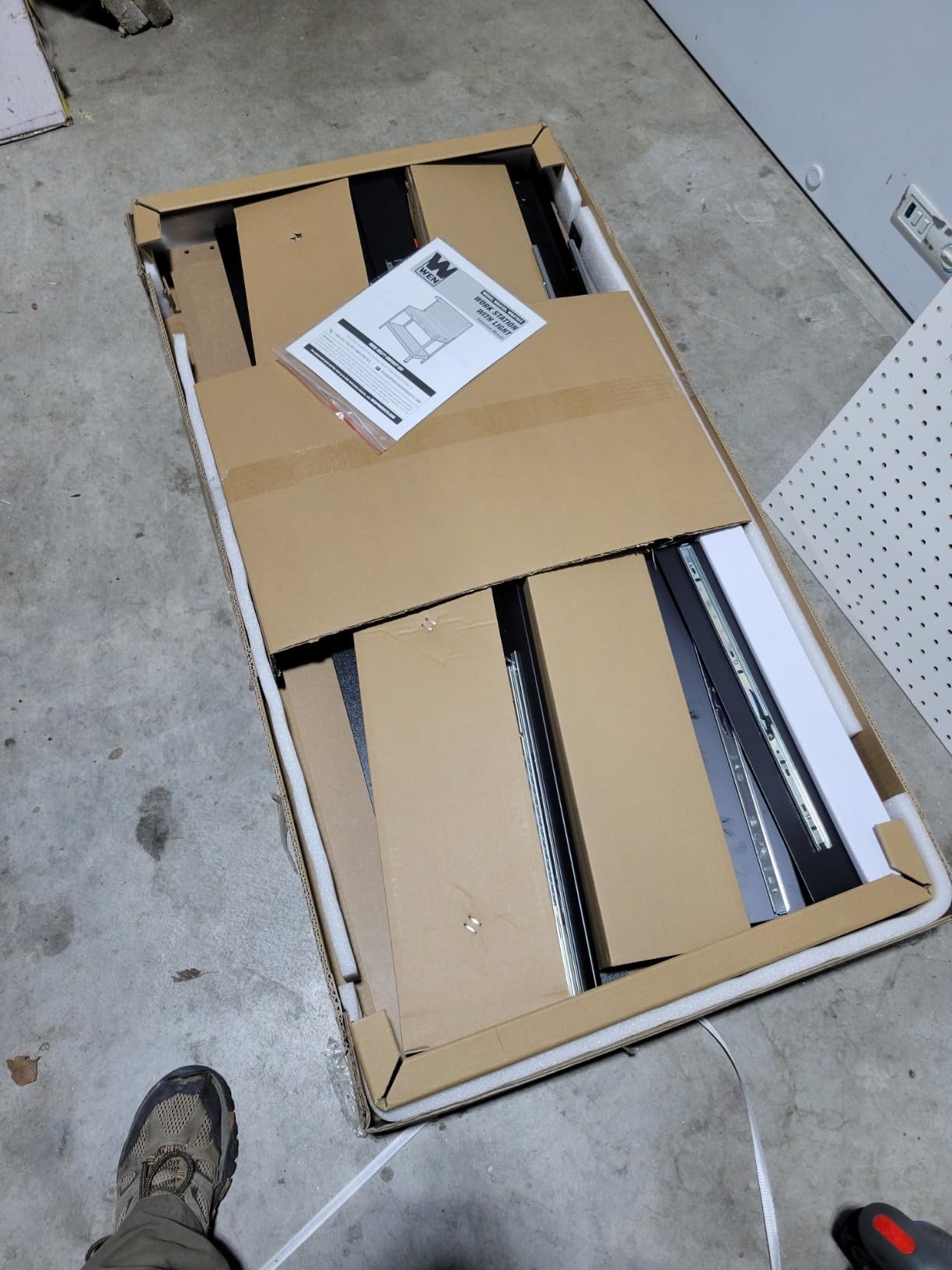
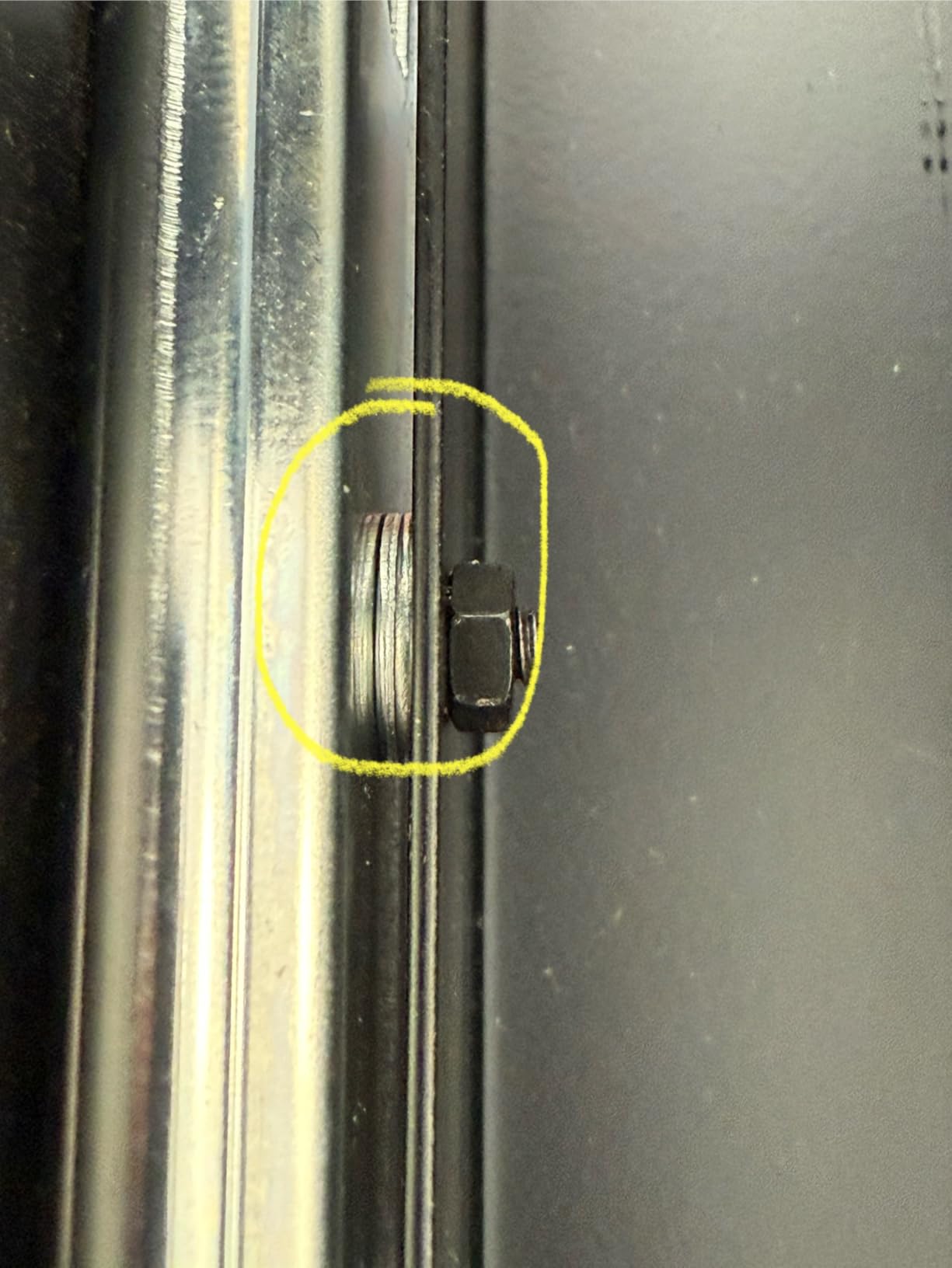
Here is the honest part. This is the lowest-rated bench in the roundup at 4.1 stars, and the reason is almost entirely assembly. Buyers report four to five hours with roughly a hundred screw, washer and nut sets, and instructions that are easy to misread. There are also reports of missing drawer handles and warped shelf boards on arrival.
What it handles well
Electronics repair, tool organization, hobby assembly, and any garage where the nearest outlet is across the room. It also works as a standing desk in a workshop, since the 48-inch top is at standing height.
It suits light assembly and storage duty, not heavy work. Nothing on this bench should be hammered on.
Where it falls short
The 220 lb rating is a real limit. That is the lightest structural rating in this roundup, and it is why the frame is fine for tools and parts and wrong for an engine, a vice under load, or impact work. Its one-star rate is around 9 percent, the highest here by a clear margin.
The pegboard is thinner than ideal and stretches under a heavy cordless drill, and the overhead light is dim enough that most owners add their own. Budget four to six hours for the build, and check the box on arrival for missing hardware.
5. Seville Classics UltraGraphite – Best Solid Wood Top for Woodworking
Seville Classics UltraGraphite Wood Top Workbench on Wheels with Sliding Organizer Drawer Table, 48″, Graphite
1 in solid wood top
500 lb powder-coated frame
24 x 48 in surface
37 in height on casters
Pros
- One-inch solid wood top in scratch-resistant polyurethane
- Exceptionally rigid frame with no side-to-side movement
- Sliding steel organizer drawer with two dividers
- Four 3-inch casters with two locking
- Extra fasteners and precisely aligned receivers
Cons
- Fixed 37 in height is tall for shorter users
- At 83.6 lbs it needs two people to move
- Assembly runs about an hour
- Wood top marks easily without a cover
Most garage workbench tops are trying to be something they are not: laminate pretending to be wood, particleboard pretending to be a surface. This one is a genuine one-inch solid wood slab under polyurethane, and for anyone doing hand-tool work or cutting on the surface, that changes how the bench feels under a plane.
It also carries a 4.8 star rating from its owners. They describe the frame as furniture-grade, with tight screw fits and aligned threaded receivers, and specifically call out that there is no side-to-side movement even with a coffee cup on top. That rigidity is what a large solid top needs in order to stay flat.
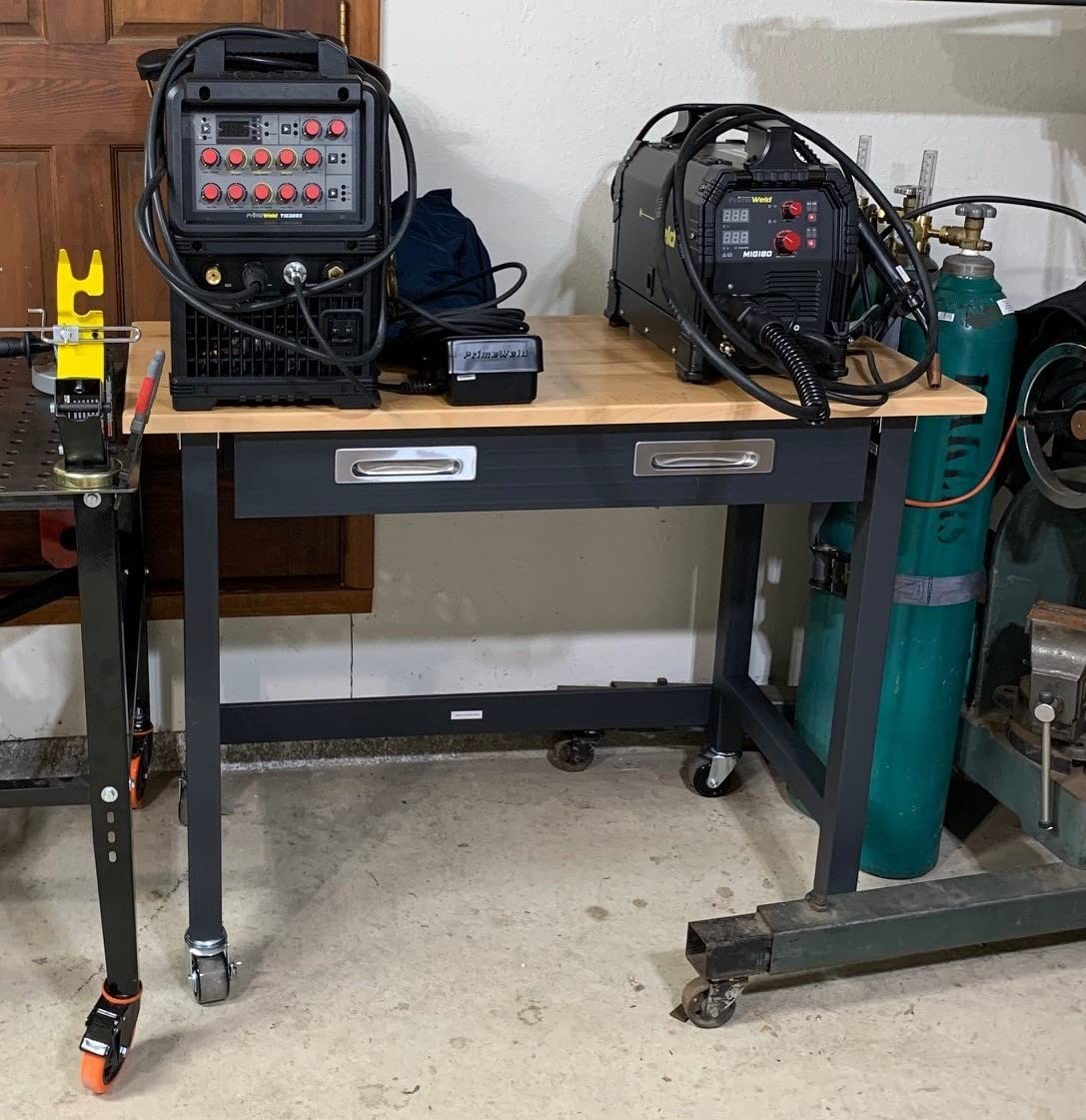
The sliding organizer drawer runs under the top on steel rails, with two adjustable dividers and a non-slip liner. It moves out to reach fasteners and slides back under so it is not in the way of a workpiece overhanging the front edge. It is the detail that gets singled out most among the storage features on the fixed benches here.
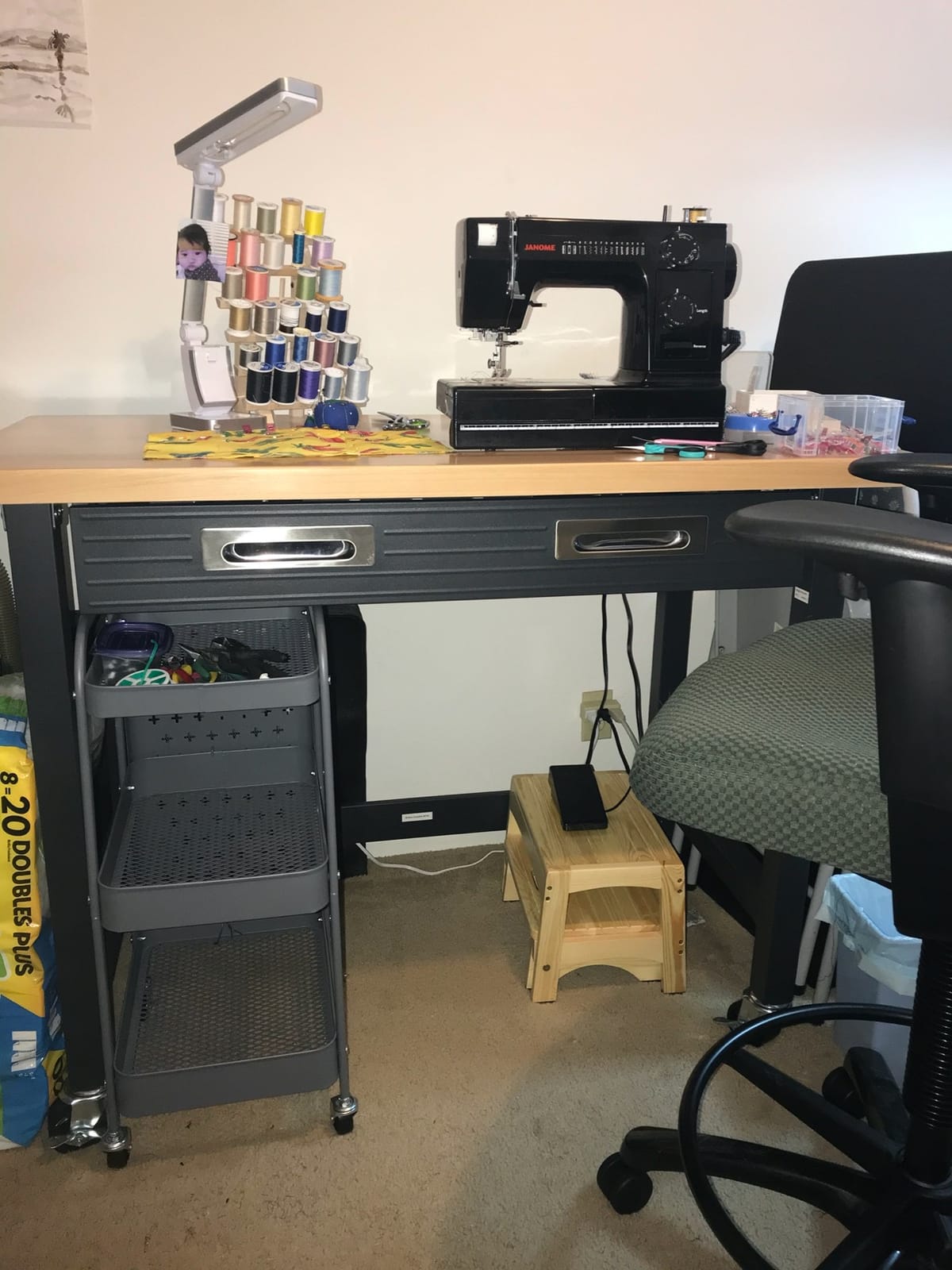
Four three-inch casters make the whole bench mobile, and two of them lock, which is the detail that decides whether a rolling bench is usable. Two locked casters on a rigid frame is stable enough to work on; unlocked casters are not. Owners also note the bench doubles as a desk, which is a fair use of a furniture-grade top.
What it handles well
Hand-plane work, chisel and mallet work, marking out, glue-ups and any finish work where a flat, stable, repairable wood surface matters. Because solid wood can be planed and sanded back, a scarred top is a maintenance item rather than a replacement.
It is the pick for anyone who wants a bench that looks intentional in the garage rather than purely industrial.
Where it falls short
The 37-inch working height is tall. If you are average height or shorter and do seated work, you will need a stool, and that is a real ergonomic cost for a bench you use every day.
At 83.6 lbs it is a two-person move, so plan where it goes before it arrives. Assembly runs about an hour and the printed instructions omit details, so budget extra time. The wood is attractive but marks easily, and many owners add a sacrificial cover. And at 24 inches deep it is a deeper footprint than a narrow garage can absorb.
6. CAMMOO 48 Inch Adjustable Workbench – Best for Electronics, Soldering and Crafts
CAMMOO 48″ Adjustable Workbench, 2000LBS Max Load, Pegboard & Power Strip
Rubberwood top on carbon steel
2000 lb capacity
28.5 to 39 in height
Pegboards and ETL power strip
Pros
- Six tool-free height settings from 28.5 to 39 in
- Pegboards on both sides with six hooks
- ETL certified strip with 4 AC outlets and 2 USB ports
- 360-degree glides that level on uneven floors
- Finish is good enough for a craft room
- Tabletop replacements handled quickly
Cons
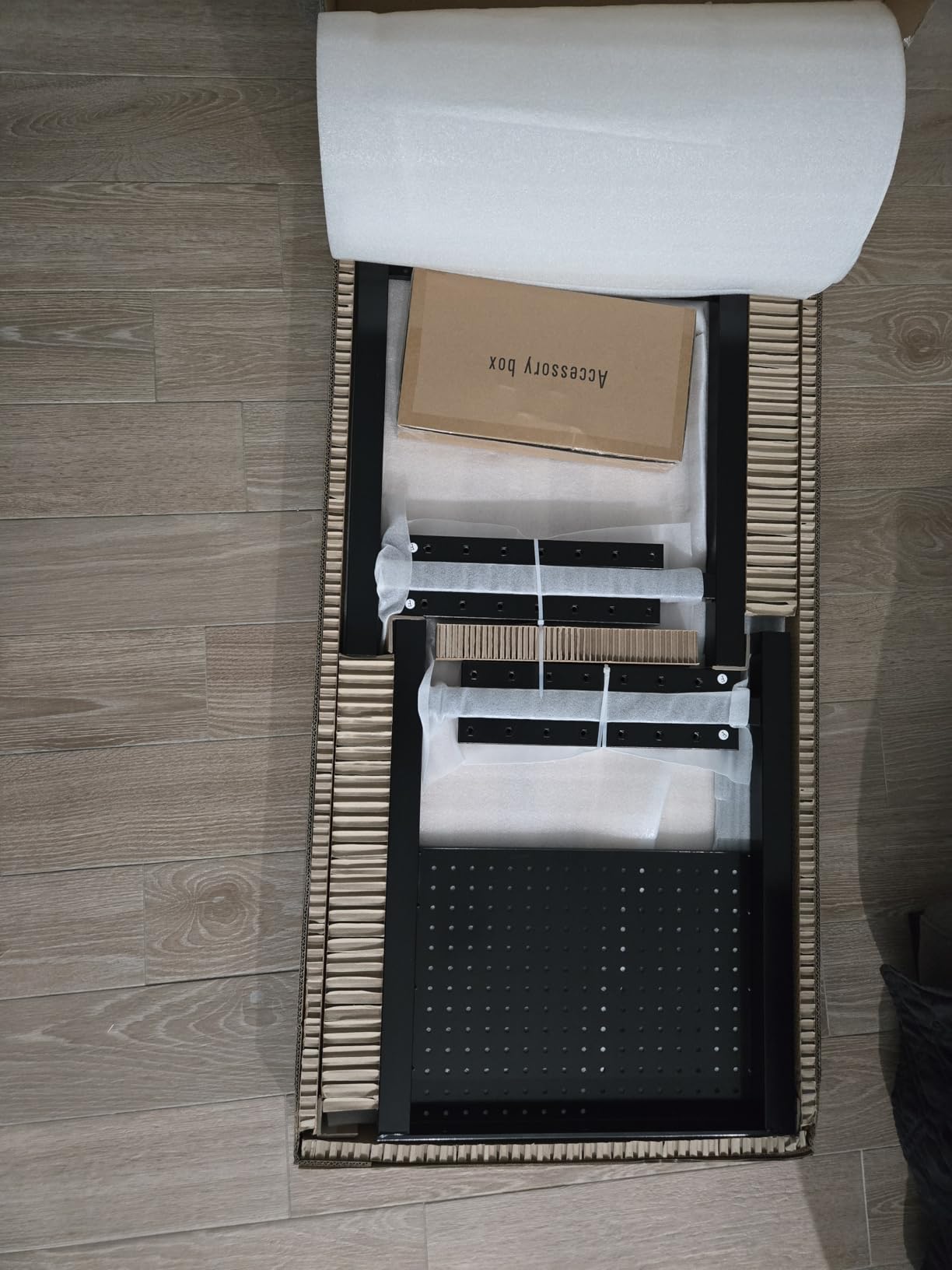
- No lower cross beam so some add one for rigidity
- A power screwdriver is effectively required
- At 52.7 lbs it is hard to reposition
- Pegboard is on the sides
- not a full back panel
The CAMMOO combines the two things a mixed-use garage bench has to do: hold a heavy load and sit at a comfortable height. Six tool-free height settings run from 28.5 to 39 inches, which covers seated electronics work at the low end and standing assembly at the top without owning two benches.
The height knobs rotate through 360 degrees, so the bench can be leveled on an uneven garage slab rather than rocking. Owners working 3D printers and soldering setups specifically call this out, because a wobbling bench is what makes a fine task frustrating.
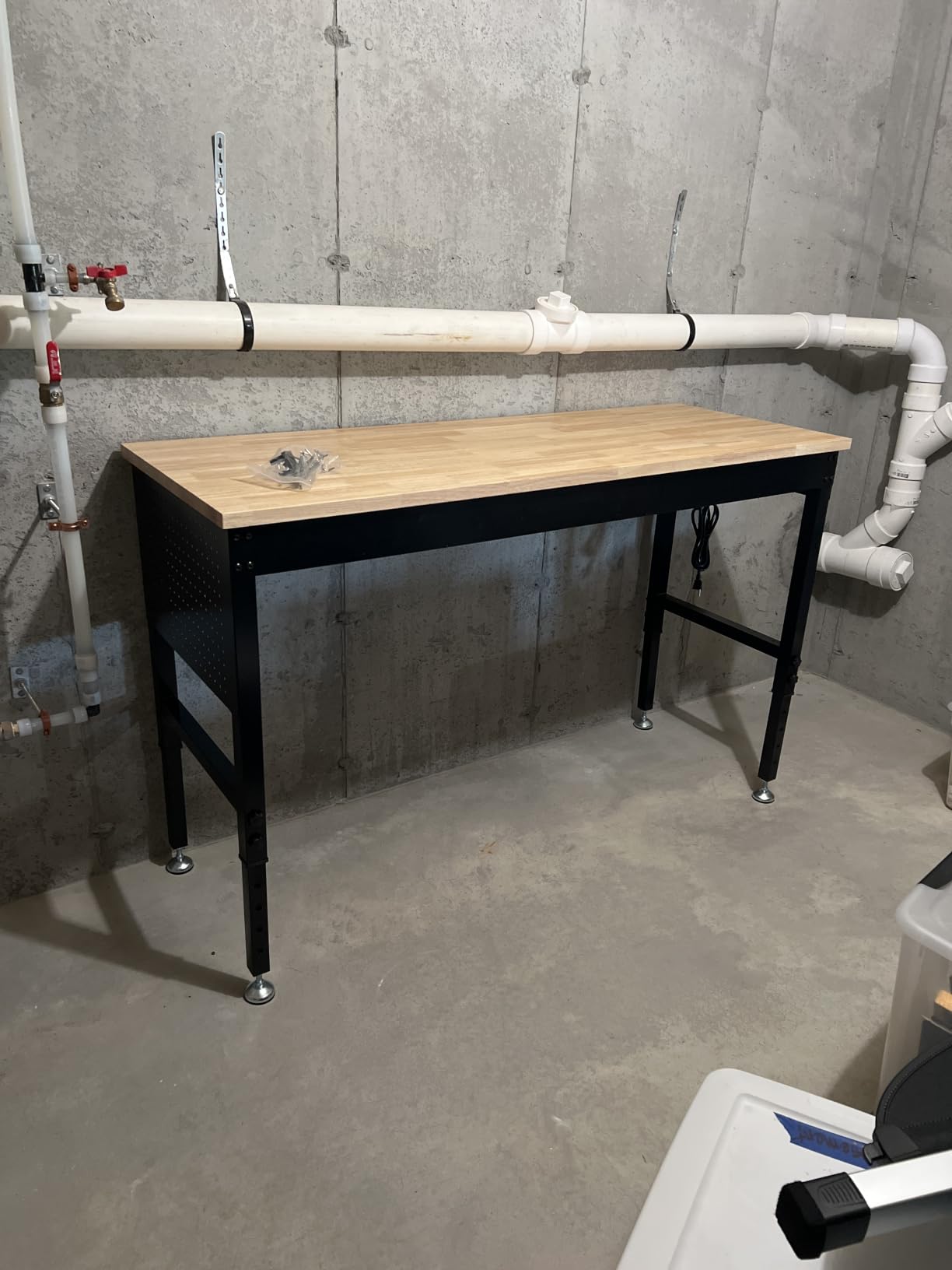
The pegboards on both sides plus six included hooks give you somewhere to put tools that the top cannot hold, and the ETL certified power strip provides four AC outlets, two USB ports, a switch and a 6.5 foot cord. For electronics work that means the soldering iron, the bench supply and the multimeter all live on the bench rather than on a separate cart.
The rubberwood top is attractive enough that several owners use the bench in a craft room or office. That matters because a bench you are willing to look at gets used more often than one hidden in the corner.
What it handles well
Soldering and electronics repair, 3D printing, model assembly, and light woodworking tasks in a workshop where the same bench is used seated for some jobs and standing for others. The six-position adjustment is the reason it works for a mixed workload instead of forcing one compromise height on every task.
At 2000 lb rated it also handles a machine on the top, and the tool-free adjustment means one person can change setup in seconds.
Where it falls short
There is no lower cross beam, so some owners fabricate one to add rigidity under load. A power screwdriver is effectively required; the included small screwdriver will not drive the wood screws in a reasonable time.
At 52.7 lbs it is a one-person move that you will feel. Pegboard is on the sides only, so if you want a full back wall of hanging tools this is not it. And a few buyers report warped or split rubberwood tops on arrival, though the replacement service is prompt when that happens.
7. WORKPRO 48 Inch Adjustable Workbench – Best Rubber Wood Top with Built-In Power
WORKPRO 48″ Adjustable Workbench, Rubber Wood Top, 2000 LBS Capacity
1-3/16 in rubber wood top
2000 lb on 1.3mm steel
31.5 to 39.375 in height
Fixed-leg steel frame
Pros
- 2000 lb rating on 1.3mm steel
- FSC-certified 1-3/16 in rubber wood top that resists marking
- Five height positions from 31.5 to 39.375 in
- Frame tested for six months at full rating
- Assembles in about 10 minutes
Cons
- Maximum height of 39.375 in is low for standing users
- Fixed-leg design cannot be rolled or moved
- No drawers or shelving at all
The WORKPRO is the one bench here that does three things in a single frame: a thick FSC-certified rubber wood top, a 2000 lb steel rating, and a build that stays rigid under load. Reviewers rate it at 4.6 stars across more than 1600 ratings, and the recurring theme is that each of those features works rather than being decorative.
Five height positions run from 31.5 to 39.375 inches, so you can sit at a low setting for a bench-top project and stand at a higher one for assembly. The adjustment is tool-free, which is the difference between changing height and not bothering to.

The top is 1-3/16 inches of solid rubber wood, and at that thickness it shrugs off marking and clamp pressure in a way thinner tops do not. The frame is 1.3mm steel rated to 2000 lb, tested over six months according to the manufacturer.
The FSC certification matters for anyone who cares where the timber came from, and at 1-3/16 inches this is one of the thickest tops in the roundup. It takes a bench plane, a hand plane and a pair of clamps without any give at the edges, which is what separates it from the veneer-covered tops in the same price bracket.

What it handles well
General garage and workshop work where you need a thick wooden top and a serious load rating. It suits weekend renovators and hobbyists who move between sitting and standing within a single project.
Assembly takes about ten minutes with the included instructions and video guide, so the bench is usable the same afternoon it arrives.
Where it falls short
The maximum height of 39.375 inches is not much for a tall user who wants to plane standing up, and the range tops out low for a shop that wants an elevated work position. If you need more than about 39 inches, look at the taller fixed designs or a stand-alone adjustable-height frame.
There is no storage at all. No drawers, no shelf, no pegboard, so every tool and every box of fasteners has to live somewhere else. And the legs are fixed, so the bench is not going to be rolled aside when you need the floor. Plan its wall position before you build it into the layout.
8. VEVOR Adjustable Workbench 48 x 20 Inch – Best Value
VEVOR Adjustable Workbench, 48 x 20-inch Heavy Duty Work Bench with 28.5-38.3 Inches Height Adjustment, 2000 lbs Capacity Garage Workbench with Power Outlets, Suitable for Office, Garage, Workshop
48 x 20 in surface
2000 lb capacity
11 heights 28.5 to 38.3 in
Power panel with 4 AC and 2 USB
Pros
- 2000 lb rating in a simple steel frame
- 11 height positions in 2-inch increments
- One-inch solid wood top
- Four adjustable rubber feet level it on uneven floors
- Power panel with 4 AC outlets and 2 USB ports
- Predrilled holes line up cleanly on the 2000 lb version
Cons
- Fasteners loosen with repeated moving
- No wrench supplied for the enclosed nuts
- Top thickness varies by size
- Some versions have no overhang so tables cannot be pushed flush
- Top scratches fairly easily
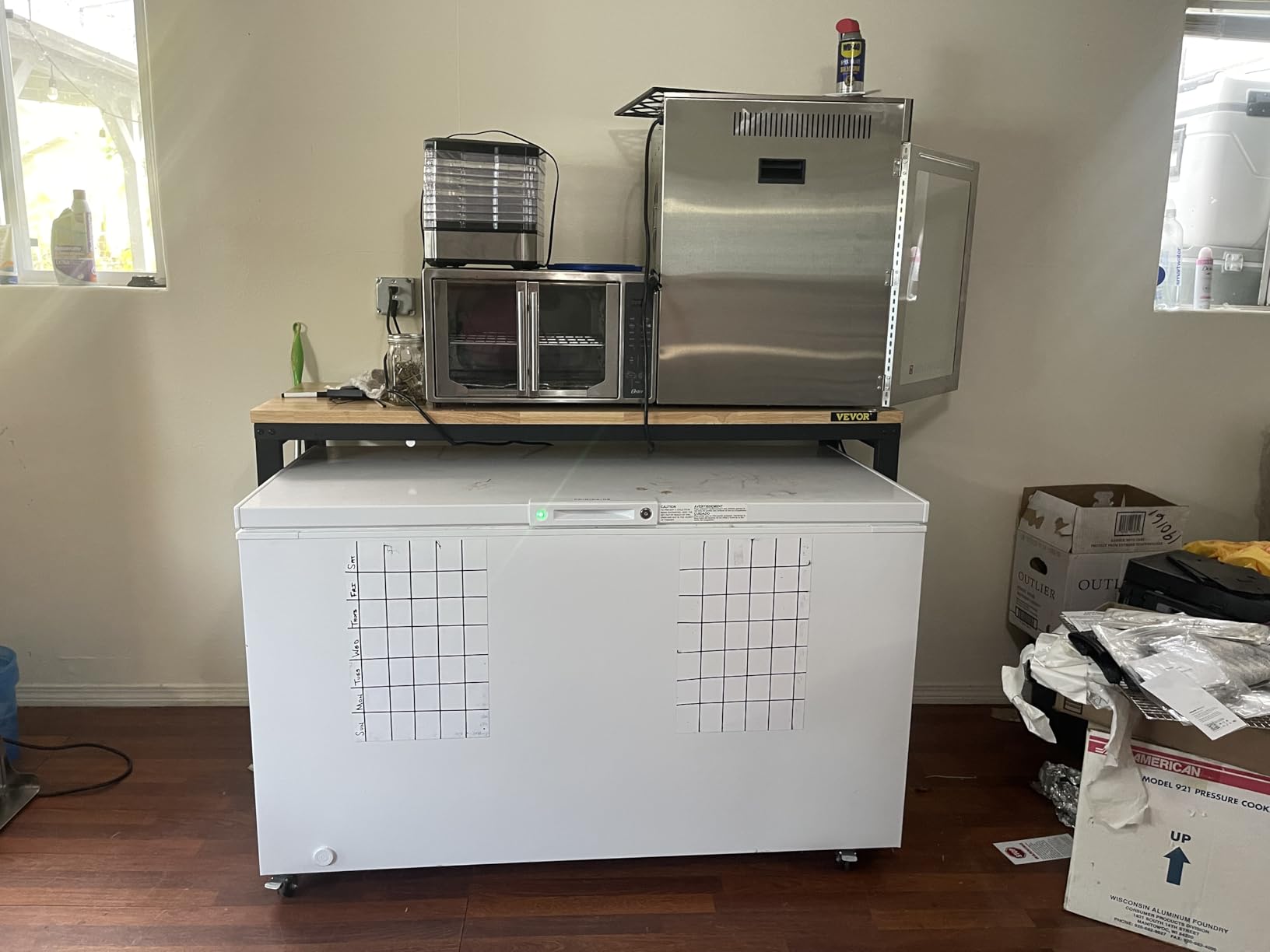
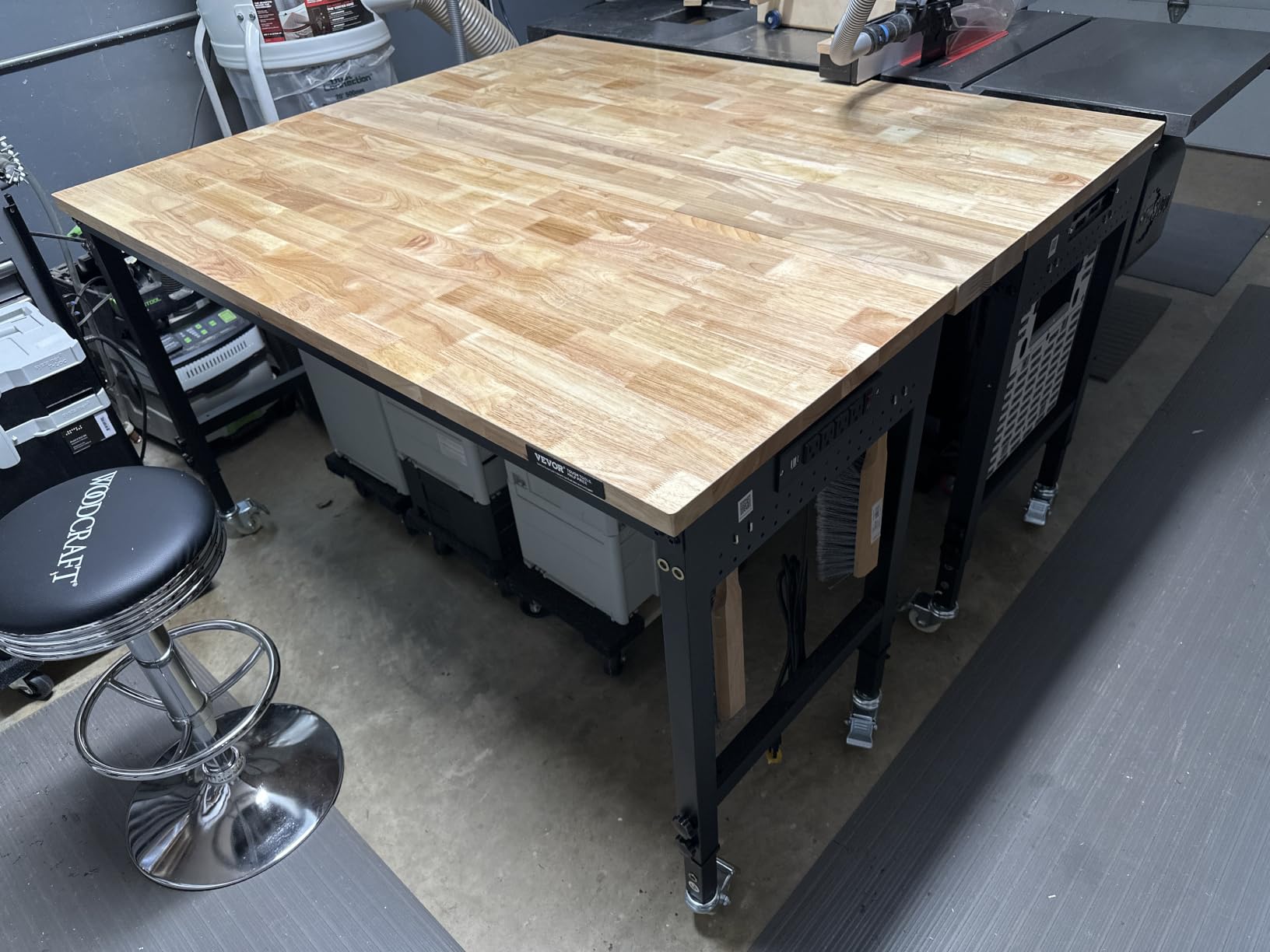
The VEVOR is the entry-level pick. You get a 2000 lb rating, a one-inch wood top, eleven height positions and a power panel in one simple steel frame, and it lands well below the premium fixed benches in this roundup. For a first garage bench or a rental space, that combination is hard to argue with.
Eleven height settings in two-inch increments from 28.5 to 38.3 inches give the finest adjustment range of any adjustable bench here. Four adjustable rubber feet handle the uneven-floor problem that makes cheap benches rock.
One thing to understand before you buy: this page also carries reviews for a lighter 1500 lb version sold under the same listing, and buyers note that many of the negative comments belong to that other model. The 2000 lb version has accurate predrilled holes and parts that fit together properly.
On a 48 x 20 inch surface you get a long narrow top, which is the dimension that actually suits a garage wall behind a workbench. The power panel carries four AC outlets, two USB ports and a 9.8 foot cord, so it reaches an outlet without an extension cable.
What it handles well
Budget-constrained garages, first workbenches, students and tinkerers, and anyone who wants a lot of height positions for the money. The fine adjustment is genuinely useful for tasks like assembly or model work where an inch matters.
It also works as a second bench so you are not stuck at one height all day, which is a common pairing in a two-bench garage.
Where it falls short
Fasteners loosen with repeated moving, so it wants a periodic retightening, and no wrench is supplied for the enclosed nuts. Top thickness varies between sizes, so the 48 x 20 inch model can arrive thinner than the listing implies.
Some versions have no overhang, which means you cannot push two tables flush together to make a larger surface. The top also scratches fairly easily and units arrive with scuffs and occasional splinters. It holds its rating at 4.4 stars with about 640 ratings, which is the lowest volume of the picks we recommend here.
9. PONY Portable Folding Work Table – Best Adjustable Height Sawhorse
Pony Portable Folding Work Table, Workbench & Sawhorse
Aluminum frame
500 lb as table, 1000 lb as sawhorse
25 to 35 in height
Four clamps and four bench dogs
Pros
- Beefier aluminum frame than plastic rivals
- Six height positions from 25 to 35 in
- Each leg adjusts independently for uneven ground
- Best accessory package here with 12-inch and 6-inch clamps plus dogs
- Numerous dog holes allow vertical clamping almost anywhere
- Lower shelf stows the large clamps
Cons
- Heavier than plastic folding tables
- Legs do not always extend evenly on the first pull
- Height markings appear on only some legs
- Saw guide groove does not run the full width
- Only reaches 35 in
The PONY is the answer when you want the folding-table convenience without accepting the plastic frame. It rates 4.8 stars across more than 1800 ratings, and the thing reviewers mention most is that it feels sturdier than the plastic competition, particularly at the bottom shelf and when clamped hard.
It is also the most adjustable portable table here. Six positions from 25 to 35 inches cover a much wider working range than a fixed 32-inch table, and each leg adjusts independently, so it can be leveled on uneven ground or a sloped driveway where most portable tables rock.
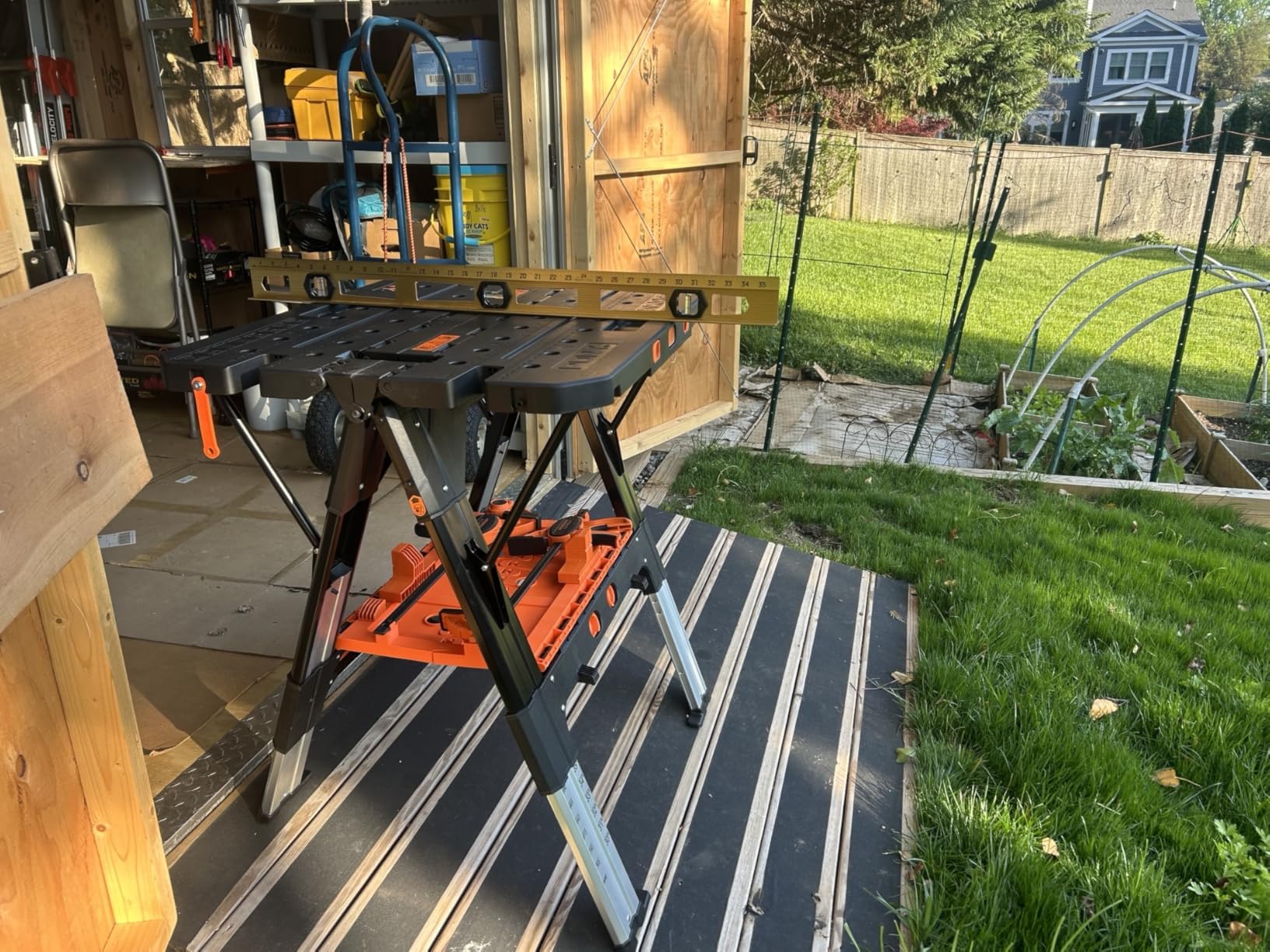
The accessory package is the best in the roundup: two 12-inch and two 6-inch bar clamps, four bench dogs and two safety straps. Those are proper clamps rather than the light ones that come with plastic tables, and the dog holes are spread across the top so you can clamp vertically nearly anywhere instead of in one fixed spot.
Owners report multiple units surviving years of regular outdoor use, which the aluminum frame explains. It folds flat for storage and multiple tables can be linked together for a longer run.
What it handles well
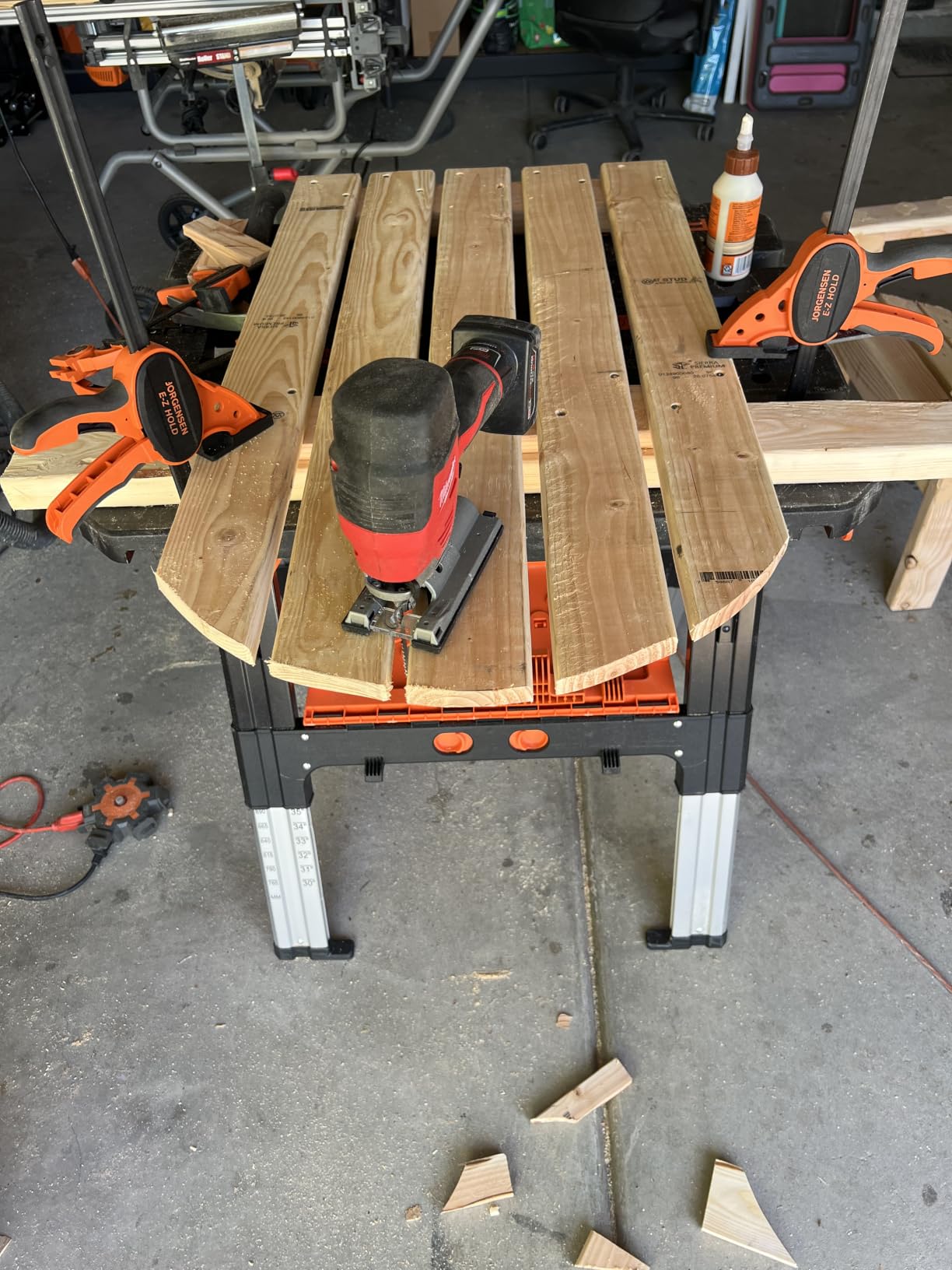
Assembly work, site builds, outdoor projects, and anywhere you need a portable platform with a real height range. The wide adjustment makes it useful for tall users who find a 32-inch table too low, and for shorter users working seated.
As a sawhorse it is rated to 1000 lb, so a pair will hold a full sheet while you break it down.
Where it falls short
It is heavier than the plastic folding tables, and that is the direct trade-off for the stronger frame. The legs also do not always extend fully or evenly on the first pull, sometimes needing a manual nudge, and height markings appear on only some legs, which makes it easy to set them unevenly if you are not paying attention.
The saw guide groove is short and does not run the full width of the table, so it will not guide a cut the full length of a board. And at a 35-inch maximum, very tall users will still want more range.
10. BLACK+DECKER Workmate 825 Deluxe – Best for Versatile Clamping and Built-In Vice
BLACK+DECKER Workmate 825 Deluxe Dual-Height Workbench, WM825-XJ
Bench, sawhorse and vice in one
250 kg load rating
Two heights 620 and 800 mm
Folds to 200 mm deep
Pros
- Unique 2-in-1 bench
- sawhorse and vice design
- One-handed clamp system adjustable together or independently
- Two working heights of 800mm and 620mm
- Three vice jaw positions for wide or awkward work
- Steel construction rated to 250 kg
- Folds to a 200 mm deep package
Cons
- Instructions widely criticized and sometimes absent
- Thinner steel and deck than earlier Workmate models
- The rotating small board sits loose and not flush
- Plastic retaining parts are wobbly
- No built-in storage shelf
The Workmate is the odd one out in this roundup, and the reason is that the vice is built into the frame. There is no separate clamp to buy and no vise to mount. The jaws are part of the bench, which makes it a genuinely different tool from everything else here.
The one-handed clamp system is the feature people remember. You can drive both clamp arms together or work them independently, and there are three jaw positions for normal, wide and vertically oriented work. Two working heights, 800 mm and 620 mm, cover standing and seated use from the same unit.
It rates 250 kg, roughly 550 lbs, which is a substantial rating for a bench that folds to 200 mm deep. It folds to a package about 200 mm deep, so it stores against a wall in a way the fixed benches here cannot.
With more than 4500 ratings at 4.2 stars, the ratings split in a distinctive way. Owners who had older Workmate models are the most vocal, and their complaint is consistent: the steel and the wooden deck are both thinner than on the versions they remember. Build quality has drifted, and the 4.2 reflects that honestly.
What it handles well
Assembly glue-ups, joinery, drilling and routing where a built-in vice is worth more than a large top. It is compact, portable, and it does not need wall space or a permanent floor position.
For anyone who clamps constantly, having the clamping hardware permanently attached removes the single biggest friction point in small-project work.
Where it falls short
Instructions are the dominant complaint. They are widely criticized as confusing and are sometimes missing entirely, with buyers falling back on video walkthroughs. Budget time to figure the unit out.
Thinner steel and a thinner deck than previous models means less long-term life than the design suggests, and the rotating small board sits loose rather than laying flush with the main surface. Plastic retaining parts wobble, the supplied wrench does not stay in its storage holes, and there is no built-in storage shelf at all. Buy it for the built-in vice, not for the storage.
How We Picked the Best Workbenches for Garage Workshops
Every bench here was assessed against the same five criteria, chosen because they are what actually determines whether a bench survives a garage rather than what looks good in a product photo.
Load rating against realistic load, not the printed number. Frame rigidity, judged by how owners describe wobble and racking. Height range against the tasks the bench is expected to handle. Surface material against the kind of impact it will take. And storage, because a bench that cannot hold its own tools becomes a shelf covered in clutter.
We also weighted review volume heavily, because a 4.8 from 14,000 owners tells you something a 4.8 from 300 does not. The WORX Pegasus and Keter rank where they do largely on that basis.
How to Choose the Right Size for Your Garage
Depth is the number that decides whether a bench works, and it is the one most people get wrong. A 24-inch deep bench gives you room to clamp a workpiece with the overhang hanging off the front, which is what the overhang is for. Anything deeper than about 20 inches and a single-car garage starts to feel crowded.
Before you order, measure four things. The clear wall run between the garage door track and whatever is at the far end. The depth from that wall to the driver’s door of your vehicle with the door fully open. The width of the largest sheet material you intend to cut, since that sets your minimum surface length. And the location of the studs if you are anchoring anything to the wall.
Forum users screen on this hard, and the pattern is consistent: many are working to a maximum depth of 20 inches and a maximum length of 80 inches because of exactly these constraints. Buy against that number, not against the largest bench in the catalog.
Height is the second decision. Around 32 to 34 inches suits standing work and general garage use. If you do seated work like electronics, soldering or model building, you want the low end of the range to reach roughly 28 inches. If you are tall and want to stand at the bench, you need closer to 38 to 40 inches. Fixed-height tables lock you into one of those; adjustable tables cover both.
Workbench Type Matchups for Real Garage Layouts
The layout that comes up most in garage forums is one fixed heavy bench plus two movable ones. The fixed bench is your heavy station, the movable ones handle assembly and staging, and the car stays where it is. It is the most-cited professional arrangement and it works because each bench has one job.
For a two-car garage, an L-shaped layout against the back and side walls works well. A common sizing pattern is about 24 inches deep along the rear wall and about 18 inches on the return wall, which keeps the vehicle door arc clear.
Folding benches buy back floor space, but plan for the clutter problem. Forum users report consistently that whatever is on a folding bench tends to stay out, and the space it was supposed to reclaim slowly disappears. If you will not clear the surface when you close it, a wall-mounted option that stores vertically is a better use of the same idea.
For anyone building out the rest of the space, our garage cabinet picks and storage system guide cover what goes around the bench, and a shop vacuum is what keeps the floor under it usable.
Wood vs Steel vs Laminate: Which Top Fits Your Work
Solid wood and rubber wood tops suit woodworking, where you need a surface that can be planed, scraped and repaired. A solid top can be sanded back to flat when it gets marked, and a soft species like rubber wood absorbs dings instead of chipping. Forum builders consistently choose plywood and poplar for the same reason: it can be fixed.
Steel and coated metal tops suit metalwork, welding and automotive work, where sparks, heat and oil are the concern. They do not absorb moisture or chemicals and they will not take a chisel bite. The tradeoff is that they ring under a mallet and offer nothing to clamp a cabinet against.
Laminate and particleboard are the compromise. They are cheap, they wipe clean and they are fine for electronics, crafts and general assembly. They are the wrong choice for a hammering garage, which is exactly why particleboard and MDF show up so often on forum deal-breaker lists. If you do a lot of impact work, spend the money on a solid top or an extra rubber mat.
Rated Load Capacity vs What You Will Actually Load
A rated capacity is measured as a static, evenly distributed load. It assumes the weight sits on the top and stays there. It does not assume a radial arm saw swinging out, a lathe running, or someone leaning on the edge while pulling a clamp tight.
The practical rule from experienced garage owners is to use 50 to 60 percent of the rating for real work. A bench rated at 2000 lb is a solid working bench at 1000 to 1200 lb of dynamic load. Ratings are also frequently shared across the whole top, so a heavy concentration in one corner is outside the conditions the number was measured under.
Test any new bench before you trust it. Press down hard on both front corners, rack the frame side to side, and lean your full body weight on one edge. Then load it gradually to about half its rating and step back. If it moves, rocks or twists at that load, it is not the bench for the job, regardless of what the box says.
Building a Bench vs Buying One
Build your own if you want a specific footprint, a top material that is not otherwise available, or an integrated layout with drawers and a pegboard built into the wall behind it. A bench built from 3/4-inch plywood on 2×4 framing is repeatedly described in forums as fully sufficient for woodworking, and it will fit a strange garage dimension that nothing off the shelf fits.
Buy if you want it delivered, want a tested capacity figure, or want it this weekend. Building one takes a weekend plus material cost, and you still have to solve the anchoring and storage problems yourself. The honest comparison is not money against money; it is a weekend of your time against a bench that is already rated and already has casters that lock.
The middle path is the BORA Centipede approach: buy the rated steel frame and clamp a sheet of plywood to it. You get a tested 6000 lb frame and a top you can replace when it gets wrecked.
Where to Buy and Which Brands Hold Up
Brands cluster into three rough tiers, and the tier matters less than the type. The budget folding tables from Keter and BORA give you the highest capacity per dollar and are the most widely reviewed in this roundup. The mid tier, which is where WORKPRO, VEVOR and CAMMOO sit, is where most garages should shop: 2000 lb ratings, solid wood tops and built-in power strips at a fraction of the premium cost.
The premium tier buys you furniture-grade finish, thicker hardwood and hardware that feels like it will outlast the bench. Buyers who move to that tier are usually doing it for drawers and storage, or because the bench doubles as a desk.
Retailers overlap heavily and stock moves, so the practical advice is to compare the capacity, top thickness and height range rather than the badge. A brand name is worth less than knowing whether the bench is rated 220 lb or 2000 lb, and most of the disappointment people report online comes from reading a capacity number and not checking whether the top material can take impact. People also ask whether a brand is worth a premium, and the answer is that a name cannot tell you whether the frame is welded steel or bolt-together, which is the spec that decides how long it lasts.
Frequently Asked Questions
Is it cheaper to buy or build a workbench?
Not in the first year. A DIY bench built from 3/4-inch plywood and 2×4 framing needs a full weekend plus material cost, and you still have to solve anchoring and storage yourself. Buying gets you a tested capacity rating, delivered to the door, with casters and hardware already fitted. Building only wins when you need a footprint that nothing off the shelf offers.
What is the best heavy-duty work bench for a garage?
The WORKPRO 48-inch adjustable bench is the strongest all-round answer, rated to 2000 lb on a 1.3mm steel frame with a 1-3/16 inch solid rubber wood top and five height settings. If your load is a machine or full sheet goods rather than tools, the BORA Centipede rates 6000 lb on a 4 x 8 foot surface.
What is a good size workbench for a garage?
A 48-inch long surface with about 20 inches of depth is the most workable size in a typical one-car garage, because it leaves room to open a vehicle door. Go deeper only if you have the wall run for it. For height, 32 to 34 inches suits standing work, and you want the low end near 28 inches if you do seated work like electronics.
What is the best material to use for a workshop bench?
Solid wood or rubber wood for woodworking, since it can be planed and sanded back. Coated steel for welding, metalwork and automotive work, where heat and sparks are the concern. Laminate or particleboard is fine for electronics and general assembly but is the wrong surface for a hammering garage. A 1-inch solid top is the usual minimum for real work.
How much weight should a workbench hold?
Use 50 to 60 percent of the rated capacity for real working loads, because ratings assume a static load spread evenly across the top. A bench rated at 2000 lb is comfortable at 1000 to 1200 lb of dynamic work. Load it gradually, press each front corner, and rack the frame side to side before you trust it with a heavy job.
Which Garage Workbench Should You Buy?
For most people, the WORX Pegasus is the right first answer. It pairs a 4.8 star rating with far more owner feedback than anything else here, it opens in seconds, and at roughly 30 lbs one person can move it. If you need a permanent 2000 lb steel bench with a solid rubber wood top, the WORKPRO fills that role.
Buy the Keter when floor space is the constraint and you want a 1000 lb surface that disappears into a closet. Buy the BORA Centipede when sheet goods and machines are the work. Buy the Seville Classics when a solid wood top and locking casters matter more than moving it alone.
Whichever you pick, measure the depth against your vehicle before you order, and treat the printed capacity as a static number rather than a working limit. That one habit will prevent most of the disappointment we found in the reviews. If you are still working out the rest of the garage, start with our home shop workbench roundup for smaller spaces.