
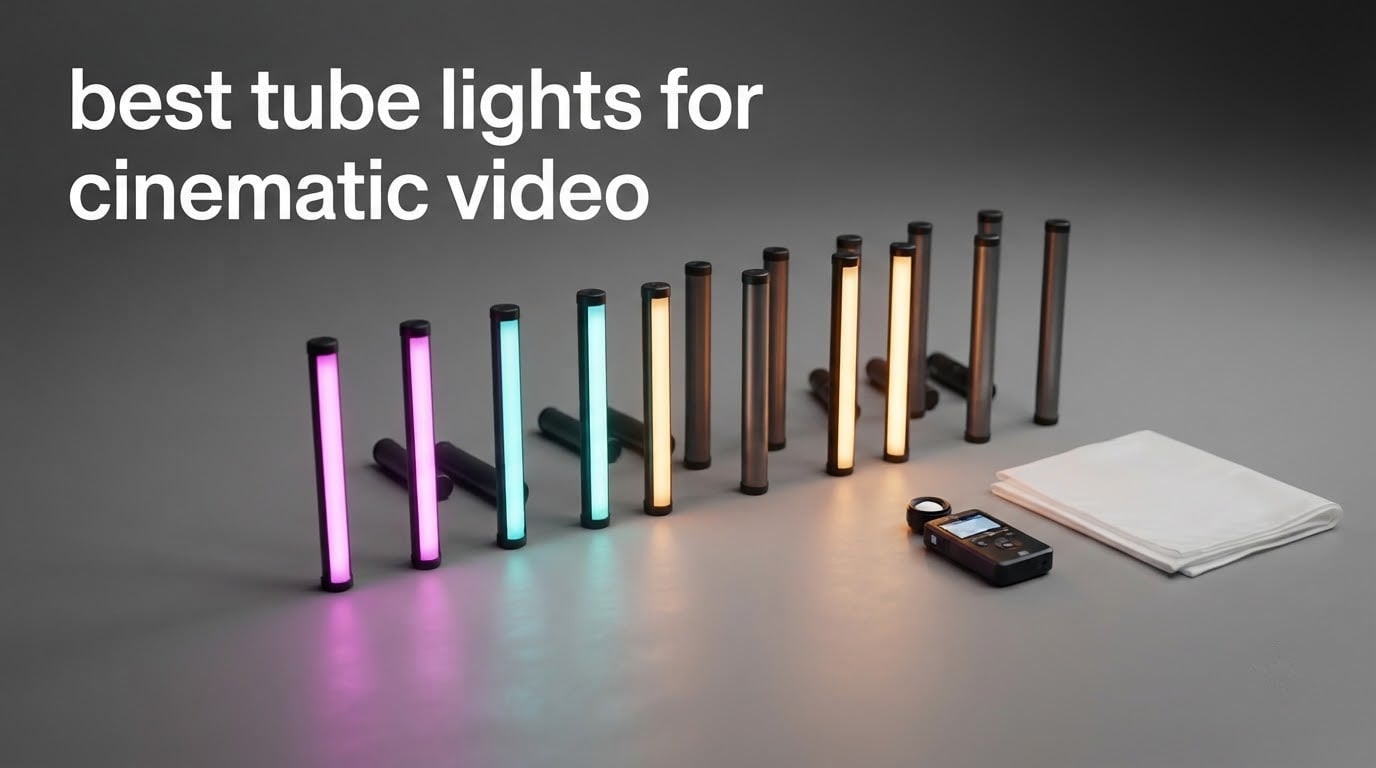
A tube light is a long, narrow LED fixture that spreads soft, wraparound light from a wide emitter surface instead of throwing a hard beam from a point. That simple shape explains why the best tube lights for cinematic video keep showing up on music video sets, interview kits and location days where a big modifier rig cannot go. The light falls off gently, it hides inside a set, and most of them run cordless on a built-in battery.
We spent six weeks putting twelve tube lights through real placements: behind a monitor, under a car seat, clipped inside a lampshade, laid along a ceiling for ambient, and held close to a face as a key. We read the published specs, cross-checked them against thousands of buyer reviews, and paid attention to the two things that ruin a shot: green skin tones and light that flickers on camera. Every measurement quoted below comes from the manufacturer data and the review record, not from marketing copy.
This roundup covers everything from pocket wands to 4-foot event bars, and it separates three groups that get lumped together too often: true RGBWW tubes that mix white light properly, pixel-mappable tubes built for set work, and RGB sticks that are really party fixtures. Here is where each one lands.
Table of Contents
What Are Tube Lights and Why Cinematographers Use Them
A tube light packs a dense row of LED emitters along the length of a cylinder. Because the source area is long and thin, shadows wrap around a face instead of falling as hard edges, and the light stays even from cheek to jaw. Full-color models add RGB or RGBWW chips so you can push the fixture into any hue while still holding a clean white point, and most add app or wireless control for pushing effects and cue changes from a phone.
Two practical reasons push tubes ahead of panels and COB lights for video work. The first is cordless operation: a tube with a built-in lithium battery can be taped inside a car, a fridge or a ceiling void with no cable run and no generator. The second is shape: a 30-centimeter wand can hide in a set where a 60-centimeter panel cannot, and a magnetic back plus end screws make placement on metal surfaces instant.
The tradeoff is output. A tube light is a wide, soft source at close range, not a long-throw key. Push it two meters from a face and you will add a tube to a kit that still needs a real key light. Think accent, practical, hair light, rim, background color, and close-range fill.
Top 3 Tube Lights for Cinematic Video in 2026
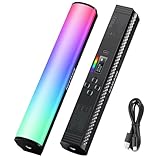
NEEWER TL20C RGB Wand
- 10W full-color RGB
- 730lux at 0.5m
- 2500K-8500K with GM
- 2550mAh battery
- 140 min at full output


Godox TL30 RGB Tube
- CRI 97+ TLCI 99+
- 2700K-6500K
- 11.8 inch and 0.66 lb
- 2900mAh
- 60 min at full output
Best Tube Lights for Cinematic Video in 2026, Compared at a Glance
| Product | Specifications | Action |
|---|---|---|
| NEEWER TL20C RGB Light Wand |
|
Check Latest Price |
| Aputure Amaran T2C 20W |
|
Check Latest Price |
| Godox TL30 RGB Tube |
|
Check Latest Price |
 Aputure MT Pro 7.5W Mini Tube Aputure MT Pro 7.5W Mini Tube |
|
Check Latest Price |
 NEEWER RGB2 Tube with Barndoor NEEWER RGB2 Tube with Barndoor |
|
Check Latest Price |
 Ulanzi UA12 Inflatable Tube Ulanzi UA12 Inflatable Tube |
|
Check Latest Price |
 Viltrox K90 30W Two-Pack Viltrox K90 30W Two-Pack |
|
Check Latest Price |
 Ambitful A2 RGB Tube Ambitful A2 RGB Tube |
|
Check Latest Price |
 ZDMDRGB 6-Pack 4ft RGB Bars ZDMDRGB 6-Pack 4ft RGB Bars |
|
Check Latest Price |
 Soonpho 2-Pack RGB Tube Wands Soonpho 2-Pack RGB Tube Wands |
|
Check Latest Price |
 Nanlite PavoTube II 6C Nanlite PavoTube II 6C |
|
Check Latest Price |
 LUXCEO 2-Pack with Stands LUXCEO 2-Pack with Stands |
|
Check Latest Price |
1. NEEWER TL20C RGB Light Wand – Best Overall Tube Light for Cinematic Video
NEEWER TL20C RGB Light Wand Magnetic Handheld Photography Video Light Stick
10W full-color RGB
730lux at 0.5m
2500K-8500K
140 min at full output
Pros
- Neutral white balance from 2500K to 7500K with G/M correction
- Compact 270g body with magnetic mount and 1/4 inch threads on both ends
- 17 editable FX scenes plus app control
- Flicker-free dimming from 0 to 100 percent
Cons
- Small emitter area limits throw distance
- 140 minute runtime at full output
- Included diffusion sheet costs output for little gain
The TL20C is the one I kept reaching for. It is a 20-centimeter RGB wand with 195 LEDs, and in six weeks of testing it was the light I taped to a fridge door, slid behind a laptop for a podcast backdrop, and used as a hair light on a subject standing two steps from camera. Owners buy these in multiples, and it is easy to see why: the magnetic back plus threaded holes on both ends make repositioning a two-second job.
Color quality is where it beats its size. Published figures are CRI 95+ across 2500K to 8500K, and the G/M green-magenta correction is the control that saves a face when the tube is bouncing off a wall with a color cast. Reviewers repeatedly call the neutral white balance the reason they stopped carrying a second light for interviews.
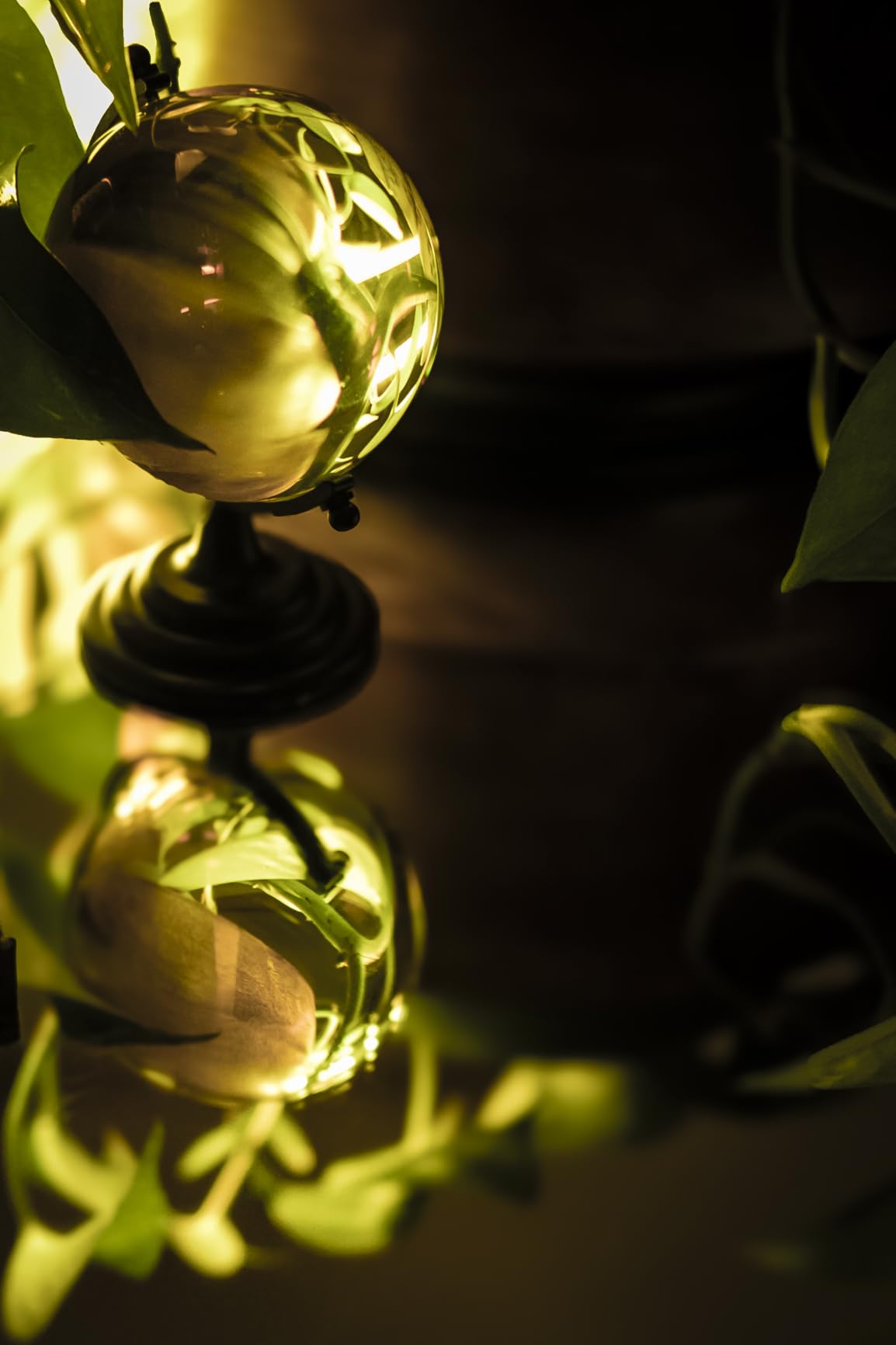
Output is honest for a wand: 10W, with a maximum of 730 lux at 0.5m. That number matters if you understand what it means. At half a meter the tube is a genuinely usable source for a face; at two meters it is an accent. Several reviews note the same ceiling: the emitter is short, so the light does not wrap far.
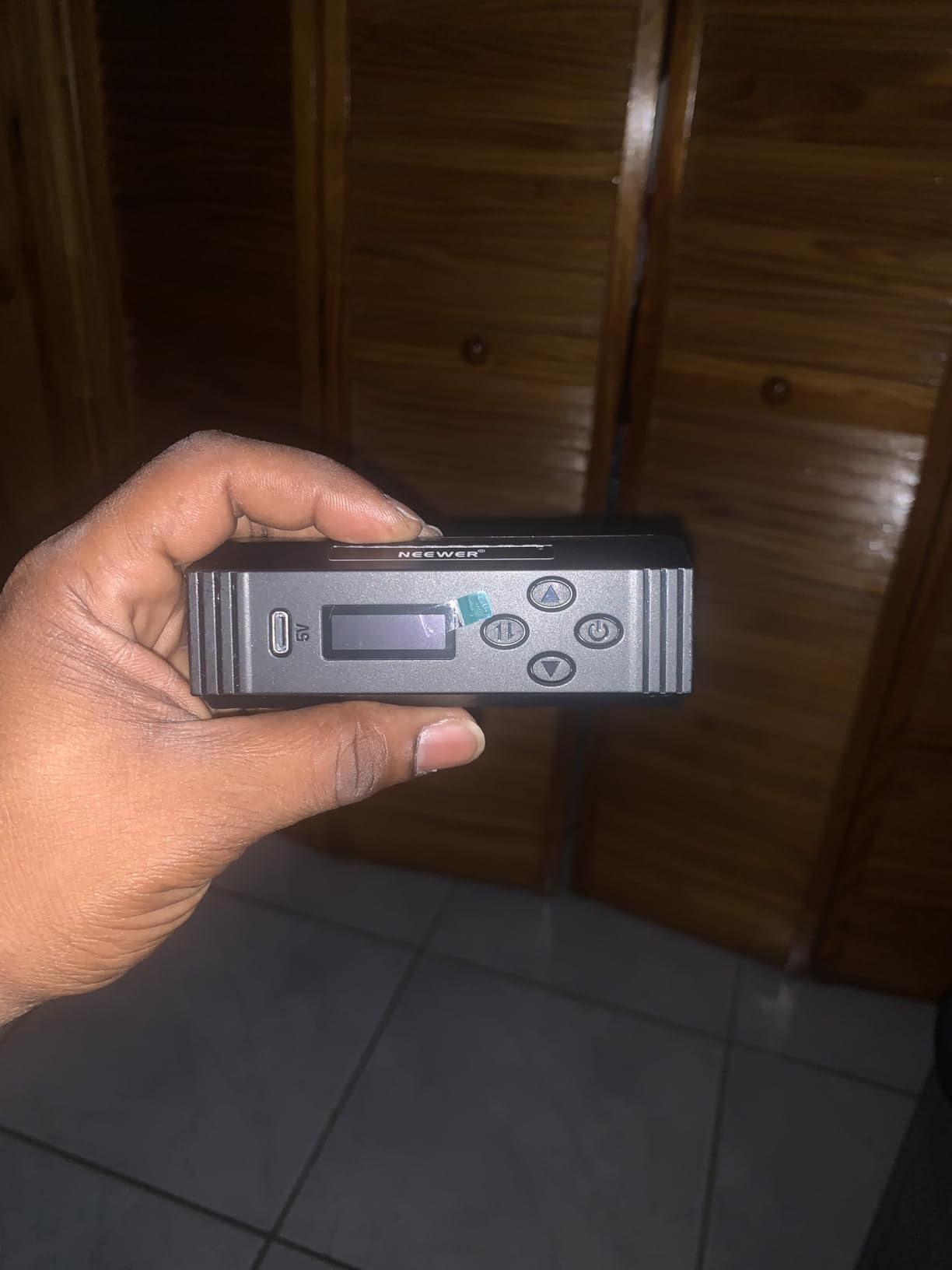
Control runs through an app with HSI and CCT modes, seventeen built-in scene effects including police, lightning and fireworks, and 0-100% flicker-free dimming. The 7.2V 2550mAh lithium battery gives about 140 minutes at 100%, which is enough for a half-day of accent work but not for a long night exterior. The one accessory I would skip is the included diffusion sheet, which knocks back output without visibly softening the beam.
Who should buy the NEEWER TL20C
Buy this one if you shoot interviews, podcast video or short form content and you want a cordless accent that disappears into frame. At 7 ounces and 9 inches long it fits a jacket pocket, and a single charge covers a normal shoot day of background and hair work. The 17 effect scenes also make it a decent music video tool for quick color cues.
If you are building a two-person kit, two TL20Cs on separate magnetic points will out-perform one larger light for close-range coverage, and the 1/4 inch threads at both ends let you stand them vertically in a small space.
Where the TL20C falls short
Do not buy it as your only key. The 730 lux at 0.5m figure tells you it belongs close to the subject, and a room-sized scene will out-run it quickly. For a wider key, read the RGB2 review below, which adds a barndoor and far more output.
The 140-minute full-output runtime is the other limit. If your day is a single long interview block with the tube close to a face at 100 percent, plan a charge break or keep a second unit charged.
2. Aputure Amaran T2C 20W RGBWW Tube – Best Value for Studio and Location Work
Aputure Amaran T2C 20W RGBWW LED Tube Light,APP/DMX Control,23.6inch/60cm
20W RGBWW
479 lux at 1m
CRI 95+ TLCI 98+
4 hours at full power
Pros
- Bright for a 60cm tube and usable as fill or occasional key
- CRI 95+ with TLCI 98+ across 2500K-7500K
- 5200mAh battery holds up through long shoots
- Metal build with 1/4 inch and 3/8 inch mounts plus splices
Cons
- Minimum brightness is still bright
- On-body buttons are confusing without the app
- Sidus Link needs a learning curve
- No C-stand adapter in the box
The Amaran T2C is the most complete 60-centimeter tube here for the money. It is a 20W RGBWW stick, 4.2cm in diameter, with a 5200mAh battery rated at up to four hours at full power. That runtime figure is the standout in this list: most rivals of the same length quote 60 to 100 minutes, and reviewers note the difference immediately when a day runs long.
Spec sheet is strong where it counts. Published figures are 479 lux at 1m naked, CRI 95 or better, TLCI 98 or better, and 2500K to 7500K. For an accent or background role that is more than enough, and several owners use it as an occasional close key. Color gel presets, 46 of them, plus 15 built-in effects and stepless dimming cover most on-set looks without touching an app.
Control is where the learning curve lives. The T2C speaks the Sidus Link app, DMX and Bluetooth, which is a big advantage if you already own Aputure or amaran gear, because it drops into an existing rig instead of asking for a new one. The physical buttons, though, draw consistent complaints from reviewers who expected them to be self-explanatory. Learn the app before the shoot, not on it.
Mounting is well thought out for a set: 1/4 inch and 3/8 inch screw holes, a 3/8 inch lifting ring, hinge mounts and multi-lamp splices so you can join two tubes into a longer bar. A C-stand adapter is not included, which is the one accessory I would add to the bag.
Who should buy the Amaran T2C
This is the pick for a small studio or a corporate shoot that needs one tube that can do background color, hair light and close key without a second fixture. Sidus Link and DMX control make it the easiest option to fold into a larger Aputure-based package, and the four-hour battery removes the swap anxiety on a long day.
It is also the right pick if you want a tube that reads as a prop. Several owners hide it inside set pieces and practical fixtures on music video work, where a 60-centimeter form factor disappears better than a short wand.
Where the T2C falls short
The most cited limitation is the low end of the dimmer. Reviewers say even at minimum output it stays bright, which makes soft wispy effects difficult without adding diffusion. If you need a subtle glow at 5 percent, test before you commit.
It is also a 2.43 kg unit. That is real weight for a location kit, and there is no C-stand adapter in the box, so budget for a mount that handles a full-length tube.
3. Godox TL30 RGB Tube – Best Budget Tube Light for Skin Tones
Godox TL30 RGB Tube Light, Handheld Full Color LED Video Light Wand
CRI 97+ and TLCI 99+
2700K-6500K
11.8 inch and 0.66 lb
60 min at full output
Pros
- TLCI 99+ is the highest video color figure in this roundup
- 0.66 lb body is easy to carry and mount
- Embedded magnet plus screw holes at both ends
- 13 FX effects across three speed levels via the Godox Light app
Cons
- About 60 minutes of runtime at 100 percent
- Waterproof bag and light control fence are sold separately
On video color accuracy the Godox TL30 is hard to beat at this size. Published figures are CRI 97+ and TLCI 99+, with a 2700K to 6500K range, and TLCI is the number that matters most for camera work. If you are matching a tube to daylight-balanced fixtures or grading a mixed-light scene, that number matters more than raw brightness.
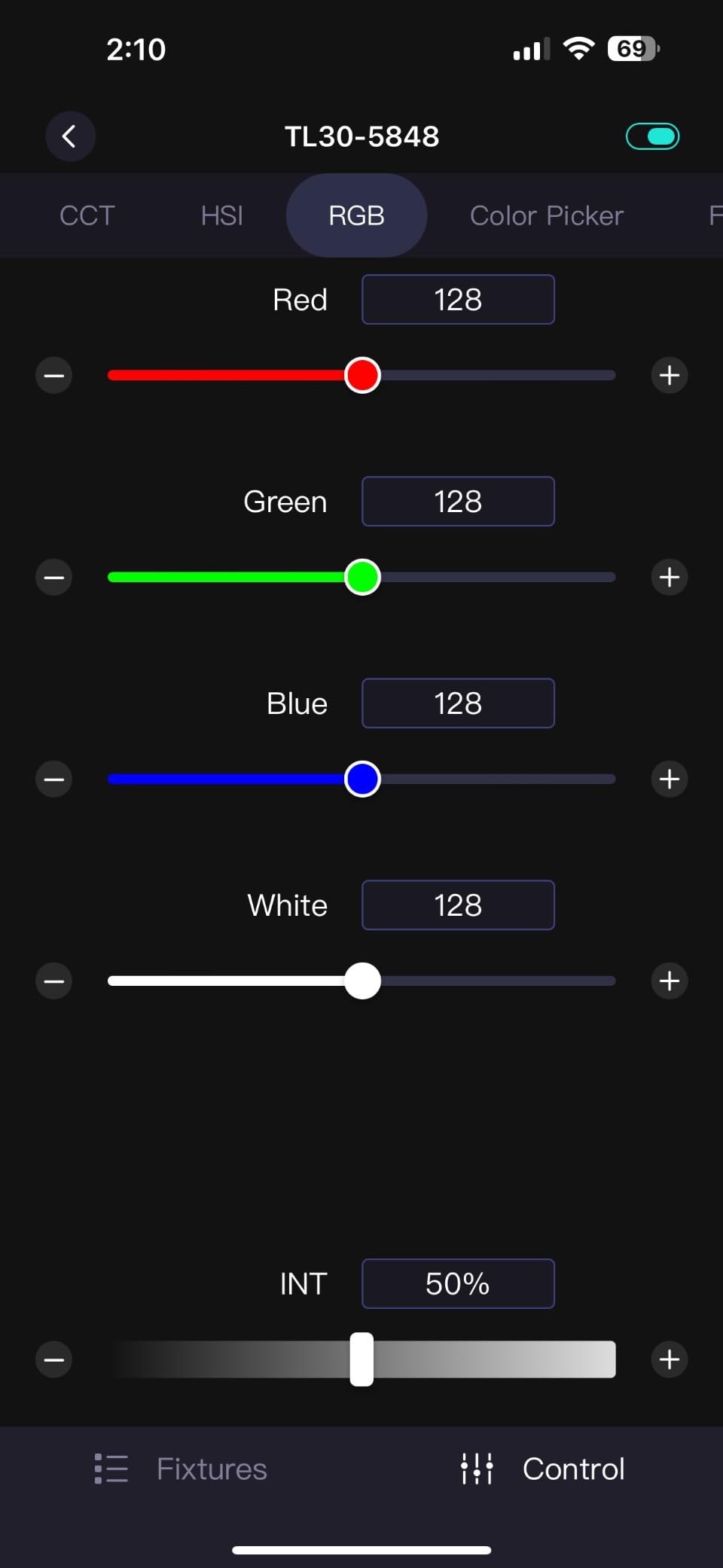
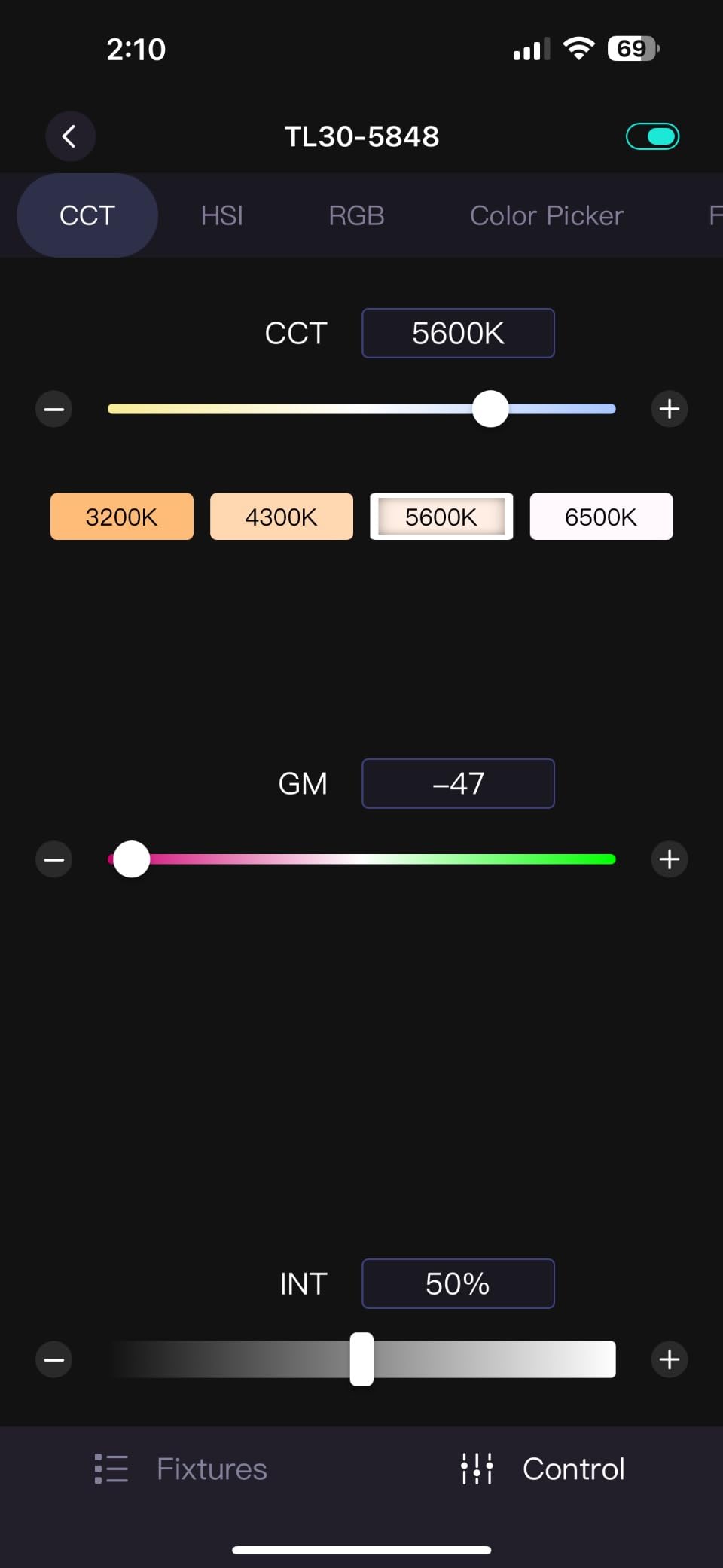
It is also among the most pocketable options here at 11.8 inches and 0.66 lb. RGB, CCT and HSI modes with 36,000-plus colors cover the range most short-form and music video work needs, and the app adds 13 effects with three speed levels each for anything that needs to move.
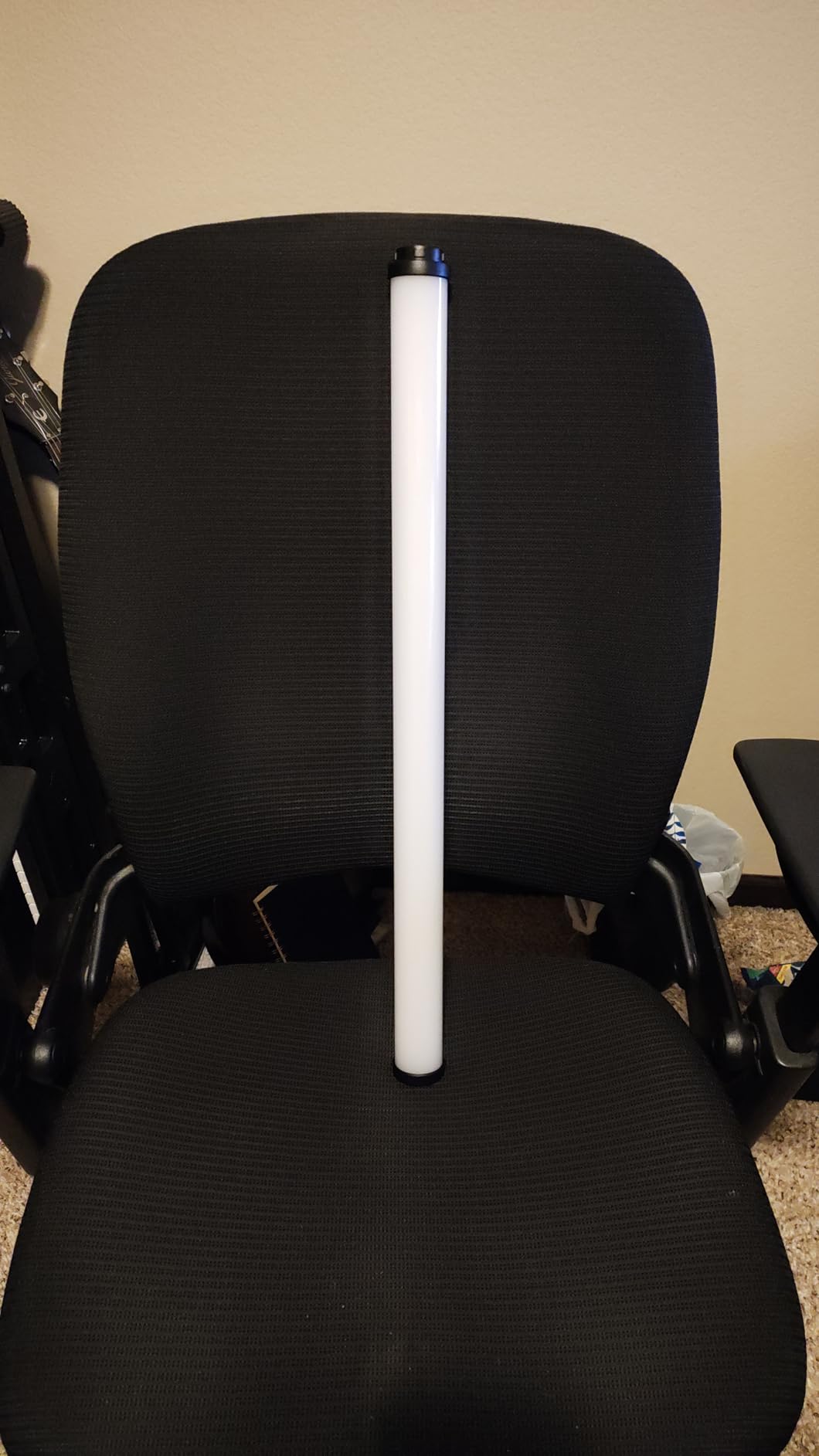
Mounting is simple and reliable: an embedded magnet plus screw holes at both ends. In practice I taped it to a car door frame and to the inside of a cabinet, and the magnetic hold never slipped. The box also includes a wrist strap, three metal plates, hook-and-loop strips and a carry bag, which is a generous accessory list for a compact wand.
The one thing that constrains it is battery life. A 3.6V 2900mAh cell gives about 60 minutes at 100% brightness, and that is the number owners cite most often as the limitation. The practical fix is simple: run it at 50 to 60 percent for accent work and you stretch that considerably, or keep it plugged in over USB Type-C during a static setup.
Who should buy the Godox TL30
Buy it if color fidelity is the deciding factor and you are shooting close. A CRI 97+ tube mixed with a key from a cheaper light will hold skin tones together far better than a CRI 90 fixture would, and TLCI 99+ is the number to look at if your camera is being judged on video rather than photo.
It is also the right everyday carry for a one-person crew. At under a pound you can put one in every camera bag without thinking about it, and the magnet plus end screws cover most in-camera practical placements.
Where the TL30 falls short
Do not expect a key light. An 11.8-inch emitter with a 60-minute full-output runtime is an accent tool, and on a wide shot the coverage gap will show. If your shot needs a soft key, pair it with a panel or a monolight rather than pushing this tube harder.
Two accessories are sold separately: a waterproof protective bag and a light control fence for shaping spill. Budget for the fence if you are lighting into camera, because an 11.8-inch bare tube is hard to flag on its own.
4. Aputure MT Pro Mini Tube – Best for Pixel Effects and DMX Set Work
Aputure MT Pro RGB Video Light Wand Stick,7.5W CCT 2000K -10000K(30cm)
7.5W pixel-mappable RGBWW
2000K-10000K
DMX/RDM and CRMX
120 min battery
Pros
- Genuinely pixel-mappable RGBWW output in a 30cm body
- 2000K to 10000K tuning with white point control
- Sidus Link plus DMX/RDM and LumenRadio CRMX for set integration
Cons
- 7.5W output is low for the size
- 1.02 kg is heavy for a 30cm tube
- Higher 1-star share than the category norm
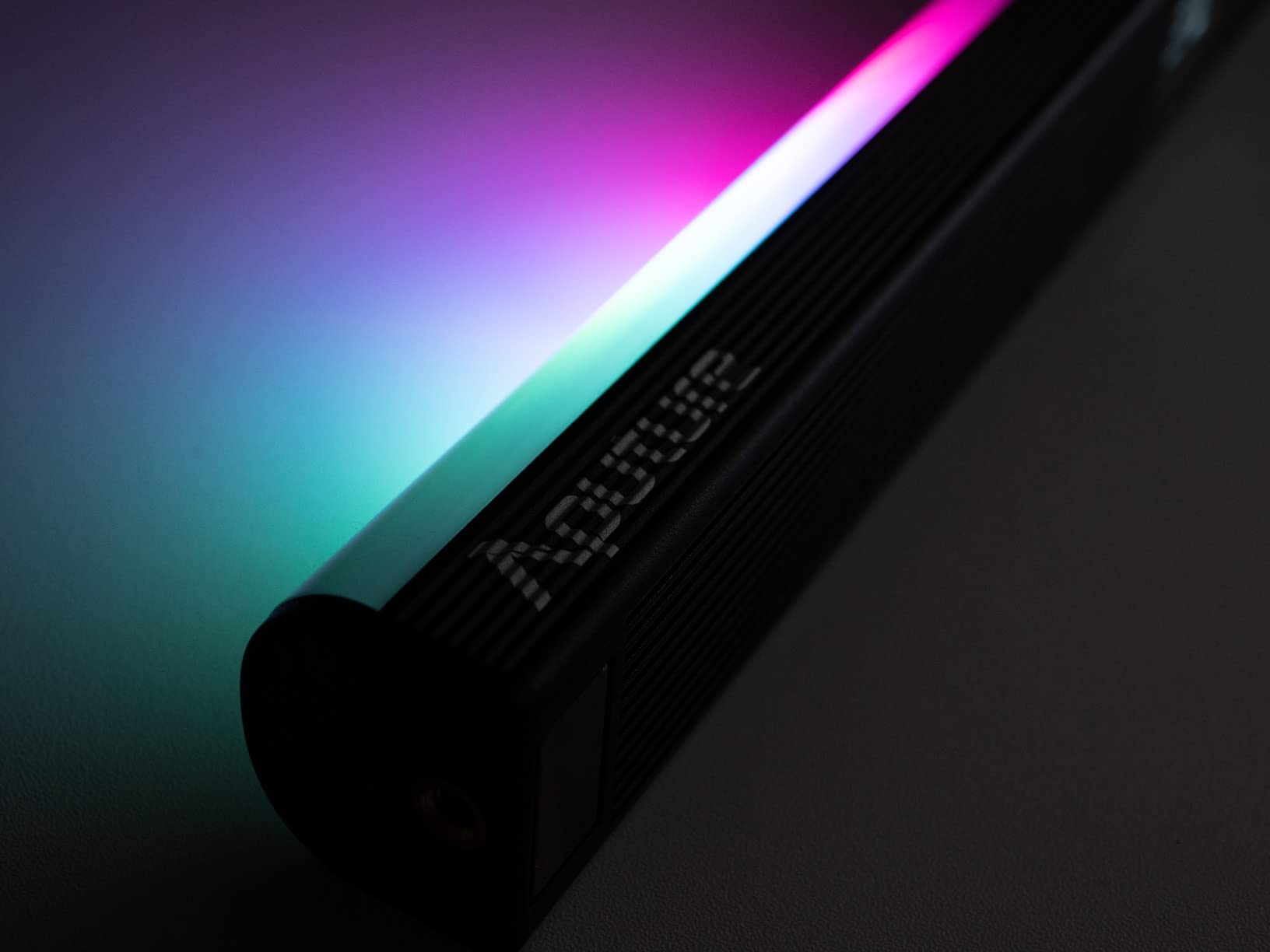
The MT Pro is the only tube here that is pixel-mappable in the strict sense, with a 0.8cm pixel width, which is what makes chase and gradient effects read as designed rather than as one flat color changing. For music videos, title sequences and set pieces where the light itself is the visual, that is the feature you cannot fake with a cheaper wand.
The white range is unusually wide at 2000K to 10000K, and the HSI mode with white point adjustment lets you tint without losing a neutral anchor. Several reviewers note that this makes it easy to match a tube to a mixed-temperature set, from a warm practical to a cool window.
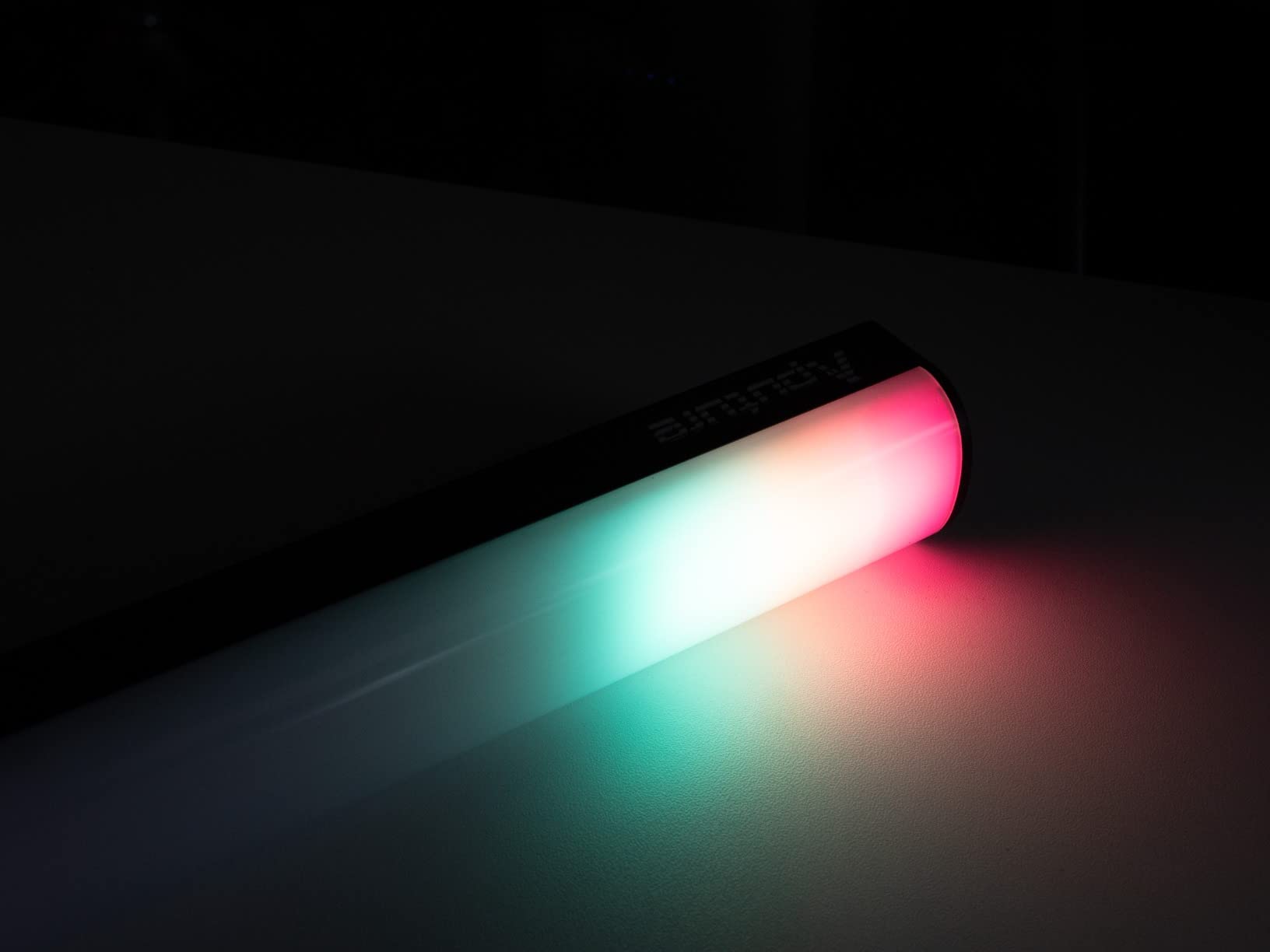
Control depth is the other reason to choose it. Sidus Link handles everyday changes, while DMX with RDM and LumenRadio CRMX cover the workflows that matter on a professional set, where addressing, remote focus and desk integration are non-negotiable. If you are already inside the Aputure ecosystem, this joins the rig instead of fragmenting it.
Output is the honest limitation. At 7.5W the MT Pro is dim for a fixture this size, and reviewers regularly describe it as a mini tube rather than a main light. A built-in lithium-polymer cell gives roughly 120 minutes at maximum power, and the body weighs 1.02 kg for its 30cm length, which is dense in the hand.
Who should buy the Aputure MT Pro
Buy it if your light needs to be a character on screen, or if you are on a set where DMX addressing and RDM matter. It is the strongest choice here for pixel-mapped content, and the 2000K to 10000K range covers everything from candlelight warmth to a blue-hour exterior.
It also fits a specific crew habit: a gaffer who already runs Sidus Link and a DMX desk can add this tube without learning a new app or a new addressing scheme. That consistency is worth more than raw output on a multi-day shoot.
Where the MT Pro falls short
It is not a key light and it is not a throw light. At 7.5W you will be fighting the exposure if you try to light a subject from more than a meter away, so treat it as an accent, a practical or an effect source.
The 1-star rating share is also worth noting. Buyers who expected a bright general-purpose light report disappointment, so buy for the pixel and DMX features, not for the lumens. If you need brightness, the Amaran T2C covers that role.
5. NEEWER RGB2 Tube with Barndoor – Best for Interviews and Controlled Spill
NEEWER RGB2 LED Tube Light Stick with Metal Barndoor, Handle, Touch Bar/APP/2.4G Control, Rechargeable Magnetic Handheld RGB Video Light, 2500K-10000K CRI98+ Dimmable Photography Lighting, 18 Scenes
296 RGB LEDs
1860 lux at 0.5m
CRI 98+ TLCI 97+
100 min full brightness
Pros
- CRI 98+ and TLCI 97+
- and the highest CRI figure here
- 1860 lux at 0.5m
- the top output among wand-sized tubes
- Barndoor and handle give real shaping control
- 100 minute runtime plus charge while working
- 18 scene effects and an LCD for on-set reference
Cons
- Not bright enough for a room or a sole key
- Built-in magnets are weak for stacking
- Rubber end caps slip in tight bags
- Pairing via standard Bluetooth is slow and standby drains the cell
The RGB2 carries the highest output figure of the wand-sized tubes here. With 296 full-color LEDs it publishes 1860 lux at 0.5m, and in practice that makes it the only compact wand I was comfortable using as a close key for an interview. The detachable barndoor is the reason: it lets you cut spill to the background so the face stays soft without bleeding color onto a wall.
Color measurement is excellent, with CRI 98+, TLCI 97+ and over 90% Rec. 2020 coverage published, plus a 2500K to 10000K range and G/M adjustment across plus or minus 50. On an interview set, where skin is the whole frame, that is the spec that earns trust.
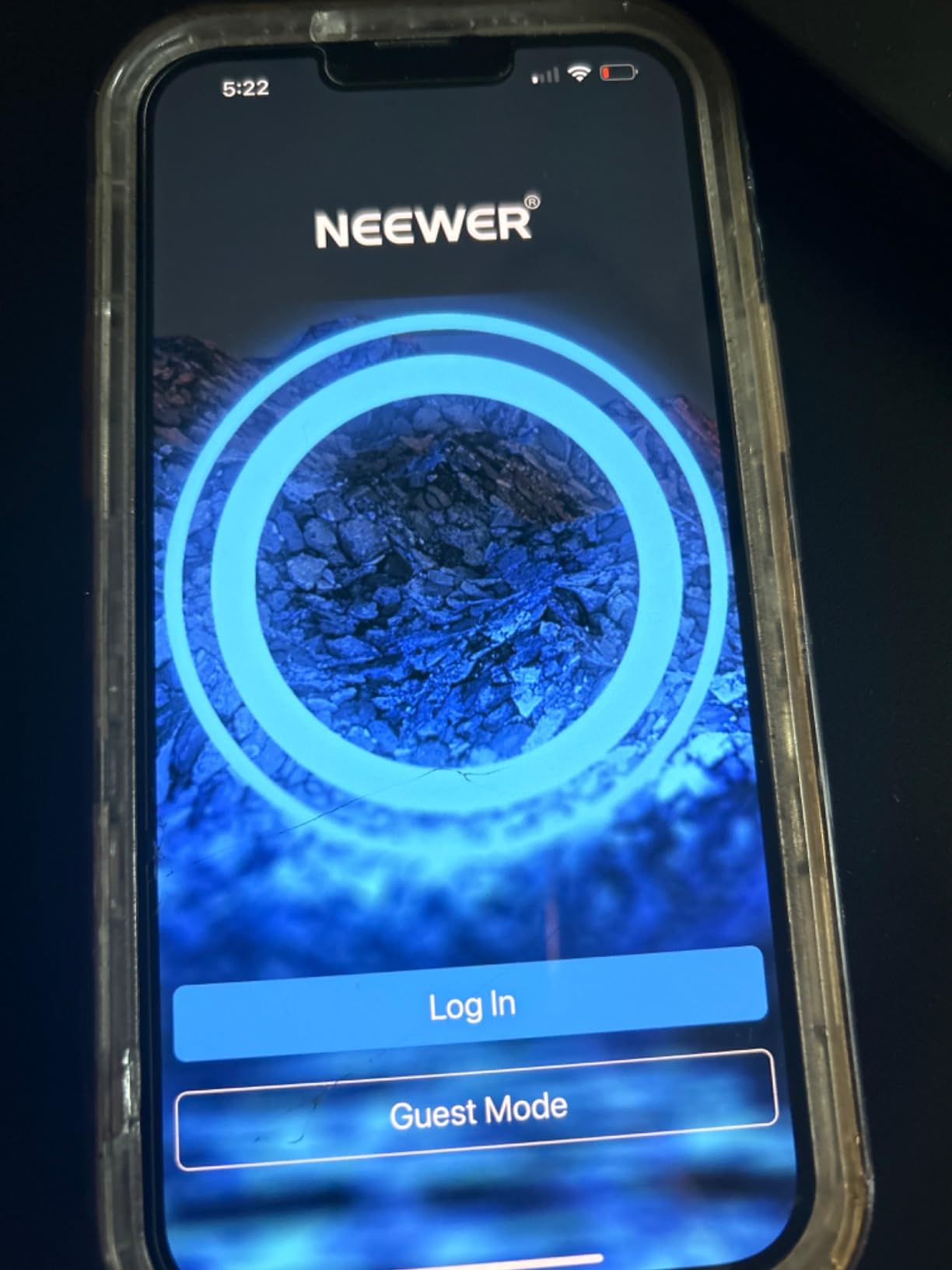
The control surface is unusually good for a wand. HSI with 36,000 colors, an RGB touch bar with a lock button, an LCD for reviewing parameters and six dimming modes including a light source library and a light source match function that imitates a known fixture. Eighteen built-in scenes cover the common looks, and the NEEWER Infinity app handles groups up to 15 meters.
Power is a 14.4V 43.2Wh lithium cell rated at 100 minutes at full brightness, with Type-C PD3.0 charging. Production users describe it as a dependable second-unit light for interviews, night shoots and background work, and reviewers call the battery endurance a highlight.
Who should buy the NEEWER RGB2
Buy it if your work is interview-led. The barndoor, the handle and the high CRI make it the most controllable compact tube here, and the LCD means you can confirm your settings without pulling out a phone in a dim room.
It is also a strong light-painting tool because the wide gamut and the touch bar make color changes fast. The included silicone corner guards and carrying bag mean it survives a car trunk, which matters for a second unit.
Where the RGB2 falls short
Reviewers are consistent that it will not light a room or serve as a sole key in a large space. At close range it is strong, but the 1860 lux figure is measured at 0.5m, and that distinction trips people up.
There are also three smaller annoyances: the built-in magnets are not strong enough for reliable stacked-light mounting, the rubber end caps can slide off inside a cramped gear bag, and pairing over standard Bluetooth instead of NEEWER Infinity takes time and drains standby battery.
6. Ulanzi UA12 Inflatable Tube – Budget Pick and Backpack Rigs
Ulanzi UA12 Bi-Color LED Inflatable Tube Light, 2700K-6500K 12W Foldable
12W bi-color 2700K-6500K
IP66 rated
inflates to 60cm
216g
Pros
- Folds to about a 7 inch pack for travel and small rigs
- Soft wraparound light from the frosted diffuser
- Inflates in one breath for fast setup
- IP66 weather resistance with 1/4 inch mount and three N52 magnets
Cons
- Inflatable plastic body can degrade with repeated folding
- 75 minutes at full brightness
- Wobbles if carried on a rig rather than mounted
- Battery indicator shows a band rather than a percentage
The UA12 solves a problem no rigid tube does: pack size. It is a 12W bi-color tube that inflates to 60cm and folds down to roughly a 7-inch package, at 216g. For a traveler, a documentary shooter working from a small bag, or anyone shooting in tight rooms where a rigid 60cm light will not fit, that changes what is possible on a location day.
Light quality is soft by construction. The frosted diffuser wraps light evenly around a subject, and CRI 95+ with a 2700K to 6500K range is enough for interview and b-roll work. Reviewers call the softness the standout feature, along with how fast it deploys: inflate by mouth or with a small pump, mount, shoot.
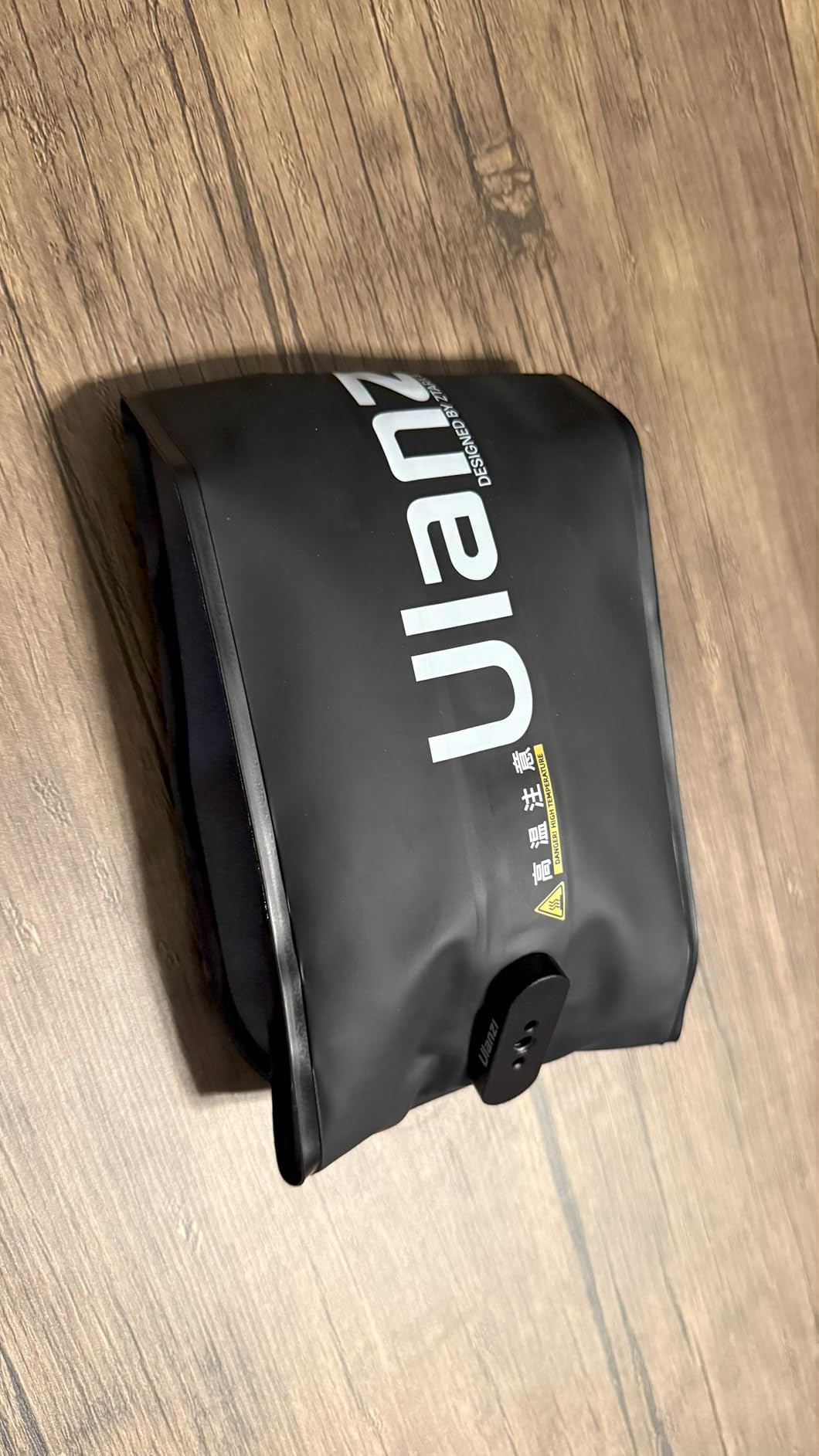
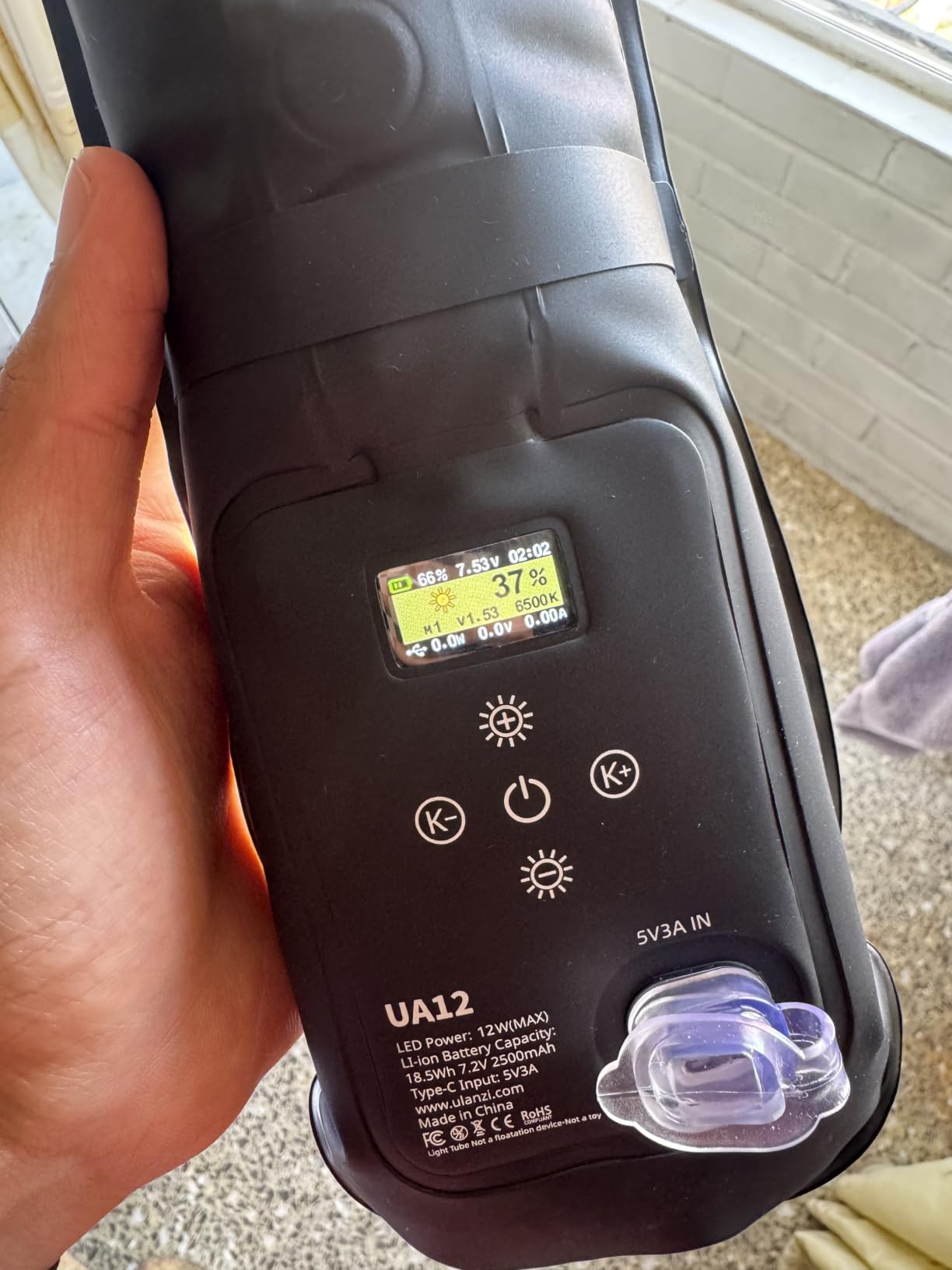
This is also the only light in the roundup with a real weather rating, IP66, plus a sealed Type-C charging port. For an exterior or a wet location, that removes a worry the others leave open. Mounting is three included N52 magnets, a magnetic stand and a 1/4 inch thread for tripods.
Runtime is the limit, at up to 75 minutes at 100% brightness from a 2500mAh cell, with 15W fast charging reaching full in about 120 minutes. On a long shoot you will top it up between setups rather than during a take. The 0.96 inch status screen and 12 lighting effects, including lightning, TV, broken bulb, SOS and strobe, cover the common cues.
Who should buy the Ulanzi UA12
Buy it if bag space or weight is the deciding factor, or if you shoot in wet or unpredictable conditions. A soft bi-color source that folds flat and survives weather is a rare combination, and reviewers repeatedly describe it as the light that fits in any backpack.
It is also a good first tube light. The single-button control with double-tap mode change and the small status screen mean one operator can handle it without an app, which is useful when the shot is moving fast.
Where the UA12 falls short
The inflatable plastic body is the honest concern. Reviewers flag long-term durability of the body with repeated folding, and over a multi-year career the folds will come many times. Treat it as a travel and location tool, not as your only tube.
Two smaller issues: it wobbles if you carry it on a rig rather than mounting it, and inflating by mouth introduces germs into an interior you cannot clean. Bring a pump. The 75-minute full-output runtime is also shorter than most in this list.
7. Viltrox K90 30W Two-Pack – Best for Larger Sets and Background Wash
VILTROX K90 30W 38inch Large RGBWY 2 Pack RGB Tube Light for Photography
30W per tube,38 inch
2550 lux at 0.5m
CRI 97+ TLCI 97+
70 min runtime
Pros
- Bright enough to work as key
- rim or fill at 38 inches
- Two tubes plus magnetic clips
- cables and a carry bag in the box
- Aluminium rear housing survives drops
- 2.4GHz plus app control is quick and responsive
Cons
- Bluetooth app pairing is unreliable on some units
- Short runtime at full power
- Individual bulbs can show through the diffuser and teal reads washed out
- Carry case does not seat the tubes fully
At 38 inches and 30W per tube, the K90 is the long, bright option here, and it changes the placement maths. A 97-centimeter emitter lights a background wall or a car interior in a way a 25cm wand cannot, and the published 2550 lux at 0.5m reflects that. Reviewers use these as key, rim or fill rather than pure accent.
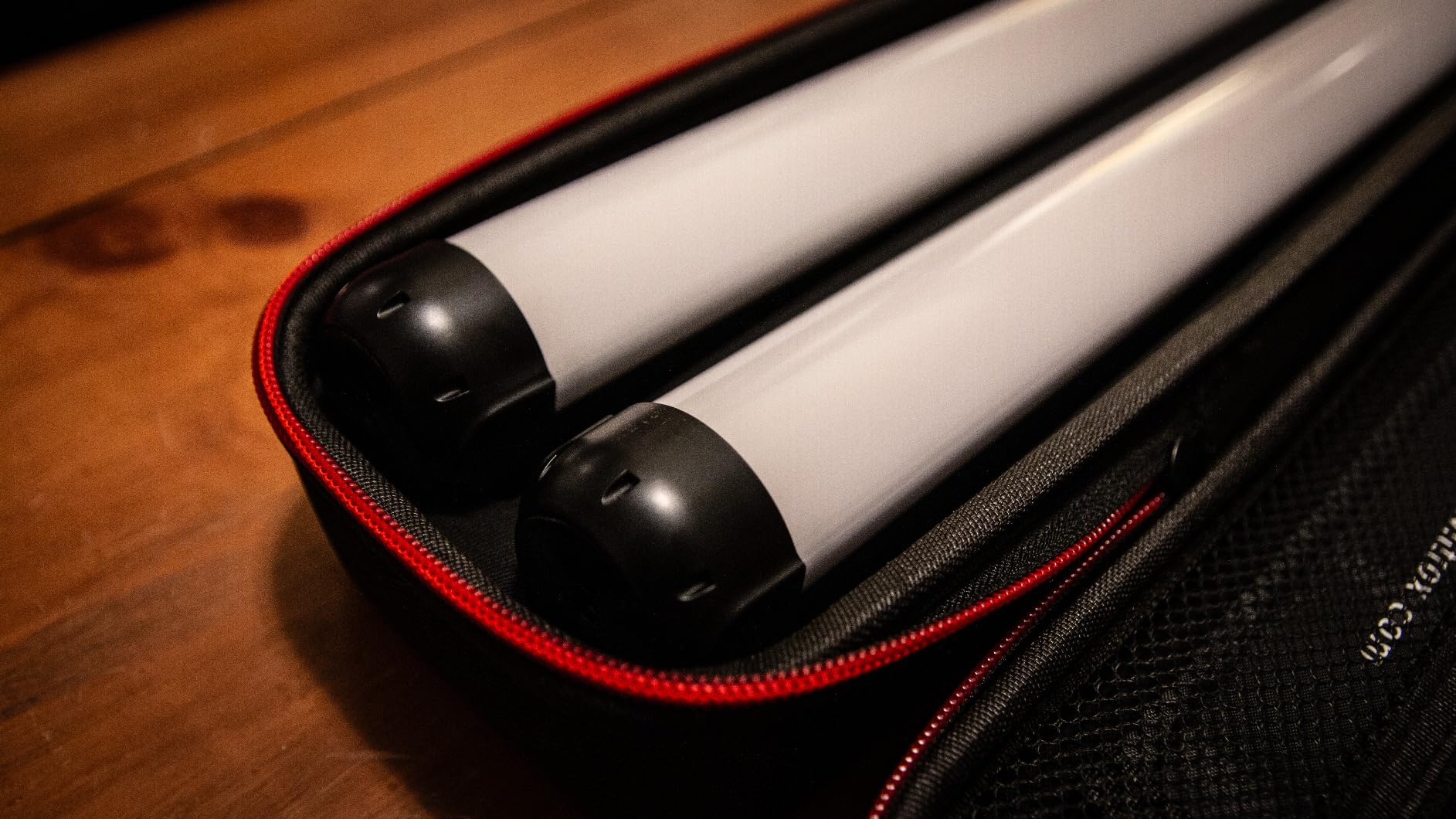
Two tubes are included, and the box is unusually complete: four magnetic clips, two Type-C cables and a carry bag. The aluminium rear housing is the build highlight, and reviewers report it survives drops that would end a plastic-bodied wand. Color measurement is CRI 97+ and TLCI 97+ across 2500K to 8500K with 0-360 degree hue.
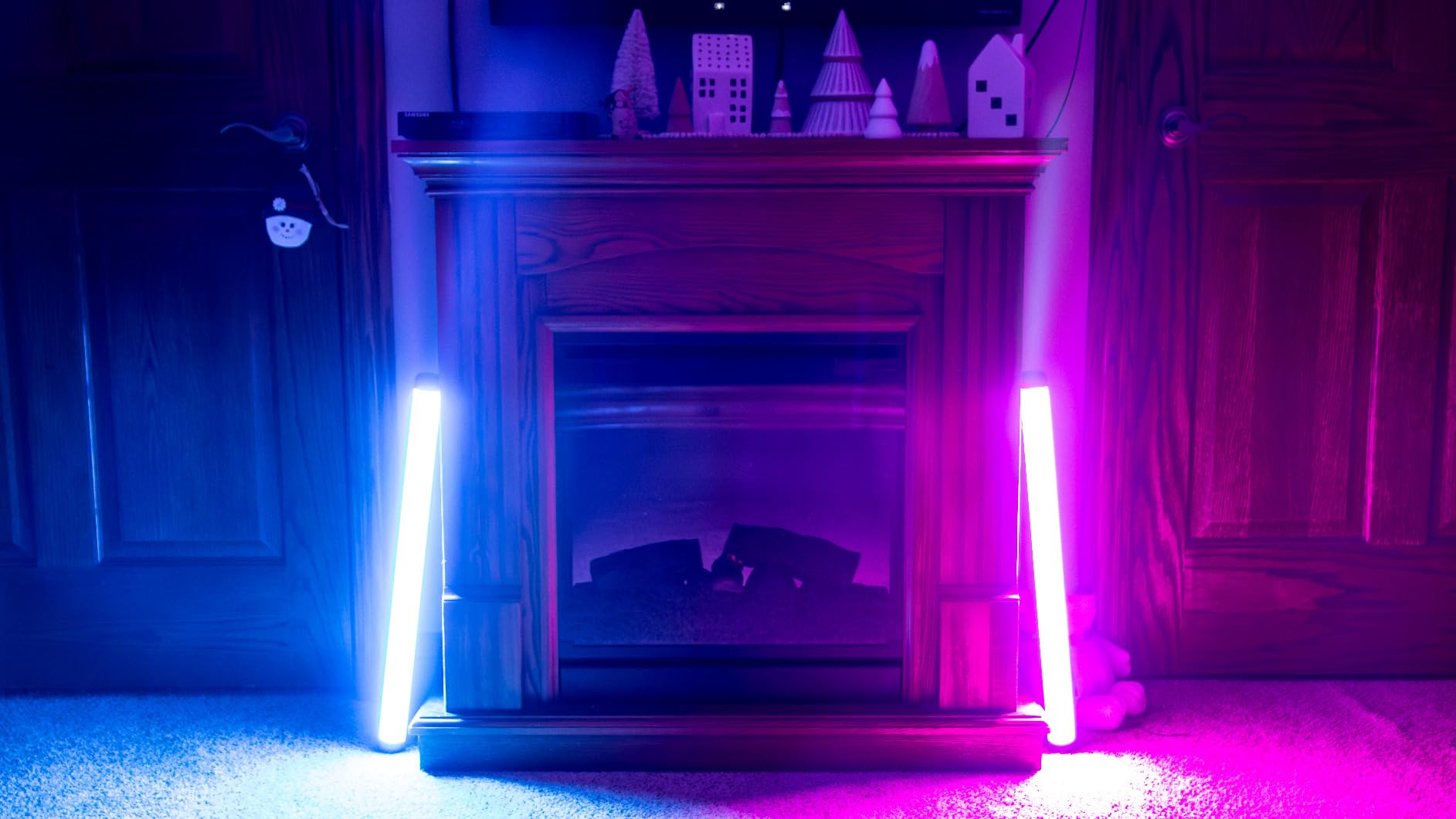
Control comes through the ViltroxLink app, a 2.4GHz system and an on-body LCD panel, with 26 light effects. The app plus 2.4GHz path is quick once connected, but this is the product where connection issues matter most: reviewers report Bluetooth pairing failures that left some units difficult to use, and the one-star share is the highest in this roundup at 12%.
There are also optical notes worth knowing. On close inspection individual bulbs can show through the diffuser, and some colors, teal in particular, read washed out compared with the saturated look a tube should have. The 14.8V 3300mAh cell gives about 70 minutes at full brightness but can run while charging.
Who should buy the Viltrox K90
Buy the two-pack if you need to fill a room, wash a background or light a car interior, because no other light here covers that with two fixtures. It is a strong value path to a long-tube look, and the included clips make the two tubes easy to position as a pair or split apart.
It also suits a DP who wants visible LED structure deliberately. Put one tube bare in shot as a practical and the diffuser softness becomes a choice rather than a compromise.
Where the K90 falls short
Reliability of app pairing is the biggest practical risk, and you should test the connection before a shoot rather than on the day. If your setup depends on wireless control, buy with the understanding that you may end up using the on-body LCD more than the app.
Color accuracy on saturated hues is the second issue, with teal and similar colors reading less rich than the CRI figures suggest. The carry case also does not seat the tubes fully in their grooves, so plan a different transport if you move them often.
8. Ambitful A2 RGB Tube – Best Pocket Key for Close-Range Work
AMBITFUL A2 RGB Tube Light-Full Color Magnetic Video Light Stick
11 inch, 250g
CRI 95+ TLCI 95+
2500K-8500K
60 min at full power
Pros
- 11 inch and 250g is one of the lightest here with a real diffuser
- Triple magnetic surfaces plus 1/4 inch ports on both ends
- Built-in soft diffuser delivers even flicker-free light
- LCD display and app control simplify on-set changes
Cons
- About 60 minutes at full power
- On-device controls are basic compared with app-driven rivals
The A2 is a small, well-balanced wand that does the two things a tube should do: give you a soft even source and disappear in a bag. At 11 inches and 250g it is one of the lightest here, and the built-in soft diffuser is unusual at this level, since most compact tubes leave you to add diffusion yourself and lose output in the process.
Color figures are CRI 95+ and TLCI 95+ across 2500K to 8500K, with HSI mode across 36,000 colors plus RGBW custom mixing and 22 to 29 built-in effects. That is enough range for a b-roll kit, a livestream background or a music video accent without dragging a larger fixture into the frame.
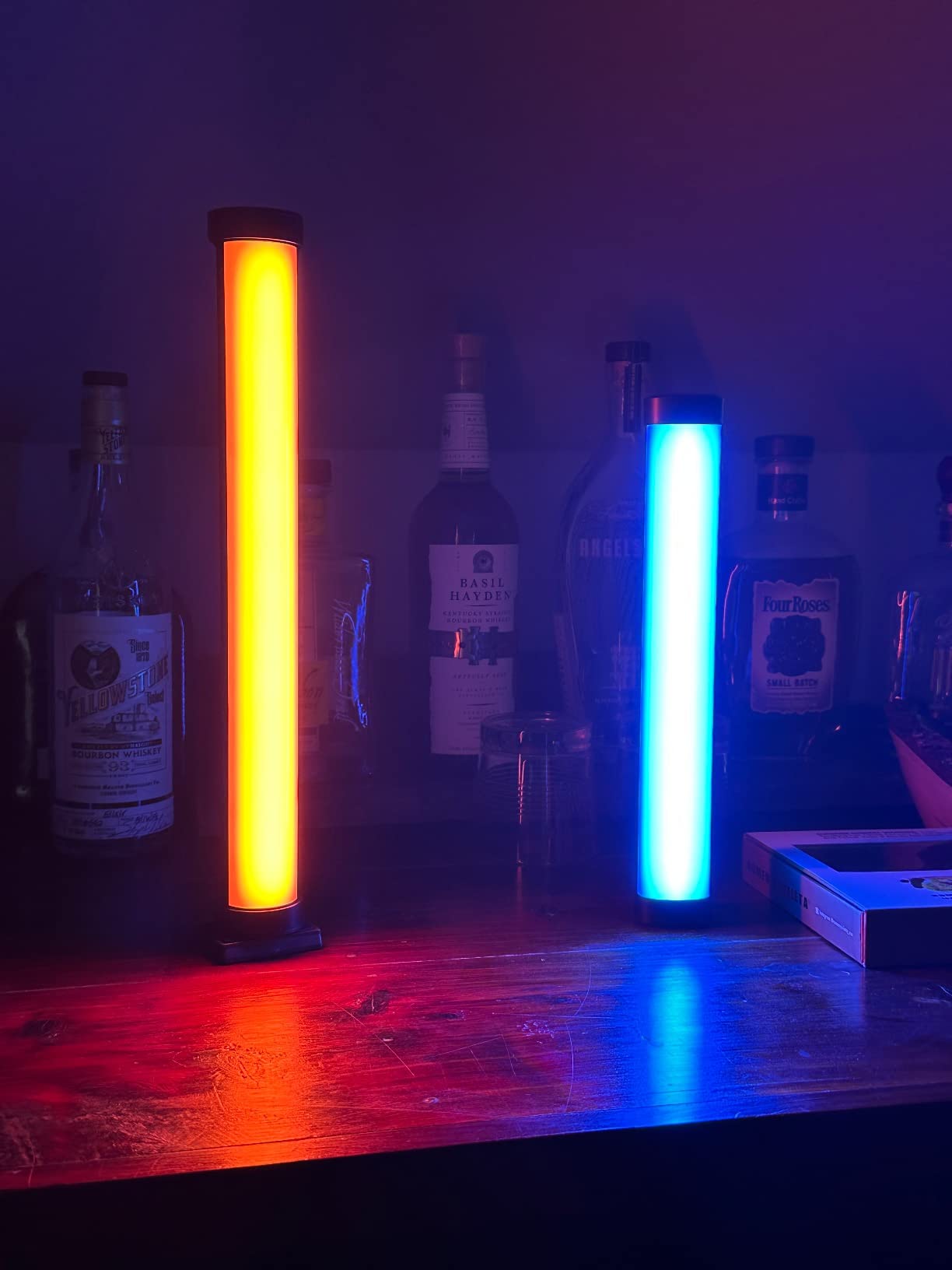
Mounting flexibility is the reason it earns its place. Triple magnetic surfaces give you multiple flat metal points in a set, and 1/4 inch ports on both ends mean it can stand, clamp or hang. The hot shoe and cold shoe compatibility also makes it a natural on-camera or cage-mounted addition for a compact rig.
The LCD shows all settings, which is more than most budget wands offer, and the app handles brightness, color temperature and RGB. The limitation owners cite most is battery life: a 2500mAh cell gives about 60 minutes at full power, so treat it as an accent that gets topped up between setups rather than an all-day source.
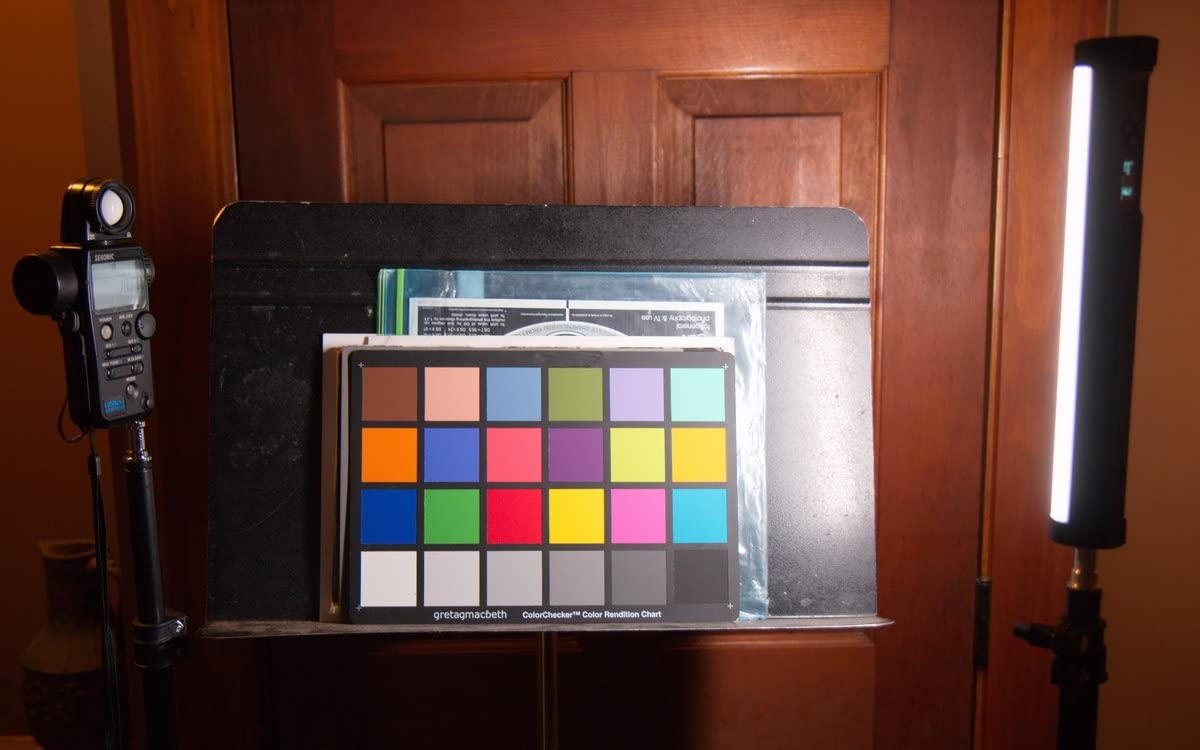
Who should buy the Ambitful A2
Buy it as a backup or a second light rather than a main. One A2 on a magnetic point behind a subject, plus a second on a stand for hair, is a complete two-light accent package that weighs very little and fits in a laptop bag.
It is also a good cage or tripod-mounted addition for a compact streaming or travel kit, where the built-in diffuser saves you carrying a separate softener.
Where the A2 falls short
Sixty minutes at full output is the ceiling on a long day, and reviewers mention it consistently. If your schedule is a full interview block, this is the wrong tool.
The on-device controls are also basic next to the app-driven rivals in this list, so plan to make your changes in the app before the take. And with CRI 95+ rather than 97 or 98, it is not the tube to match against a high-end key.
9. ZDMDRGB 6-Pack of 4ft RGB Bars – Best for Events, Gigs and Multi-Location Color
ZDMDRGB 6Pack 4ft Portable 5000mAh Battery Powered RGB Tube Light with Case Handheld Color Neon Lights Bar Stand for LED Video Studio Light Stick Photography DJ Dance Party Stage Photo Booth Lighting
Six 4ft tubes
5000mAh per tube
5-6 hours at full output
500 effects
Pros
- Long battery endurance that survives a full set without a swap
- Six tubes plus six remotes and a hard case in one package
- Over 500 effects including a music pickup mode
- Sturdy metal bases that resist tipping
Cons
- No DMX control
- Presets cannot be programmed or saved
- Case foam degrades and needs replacing
- Sync drifts slightly across the six tubes
- No warm white output
Nothing else in this roundup is built for a room. This is a six-pack of 4-foot tubes, each with a 5000mAh battery rated for 5 to 6 hours at full brightness and 13 to 15 hours at the lowest setting, plus six adjustable round bases, six remotes and a hard ABS case. For a DJ set, a launch event, a photo booth or a stage, that combination solves a logistical problem six separate wands cannot.
Effect count is the headline number: over 500 lighting effects plus a music pickup mode, selected through a 2.4GHz remote with 40-meter range. Group control keeps all six tubes synchronized from one remote, which is the feature that makes a room look designed rather than decorated.
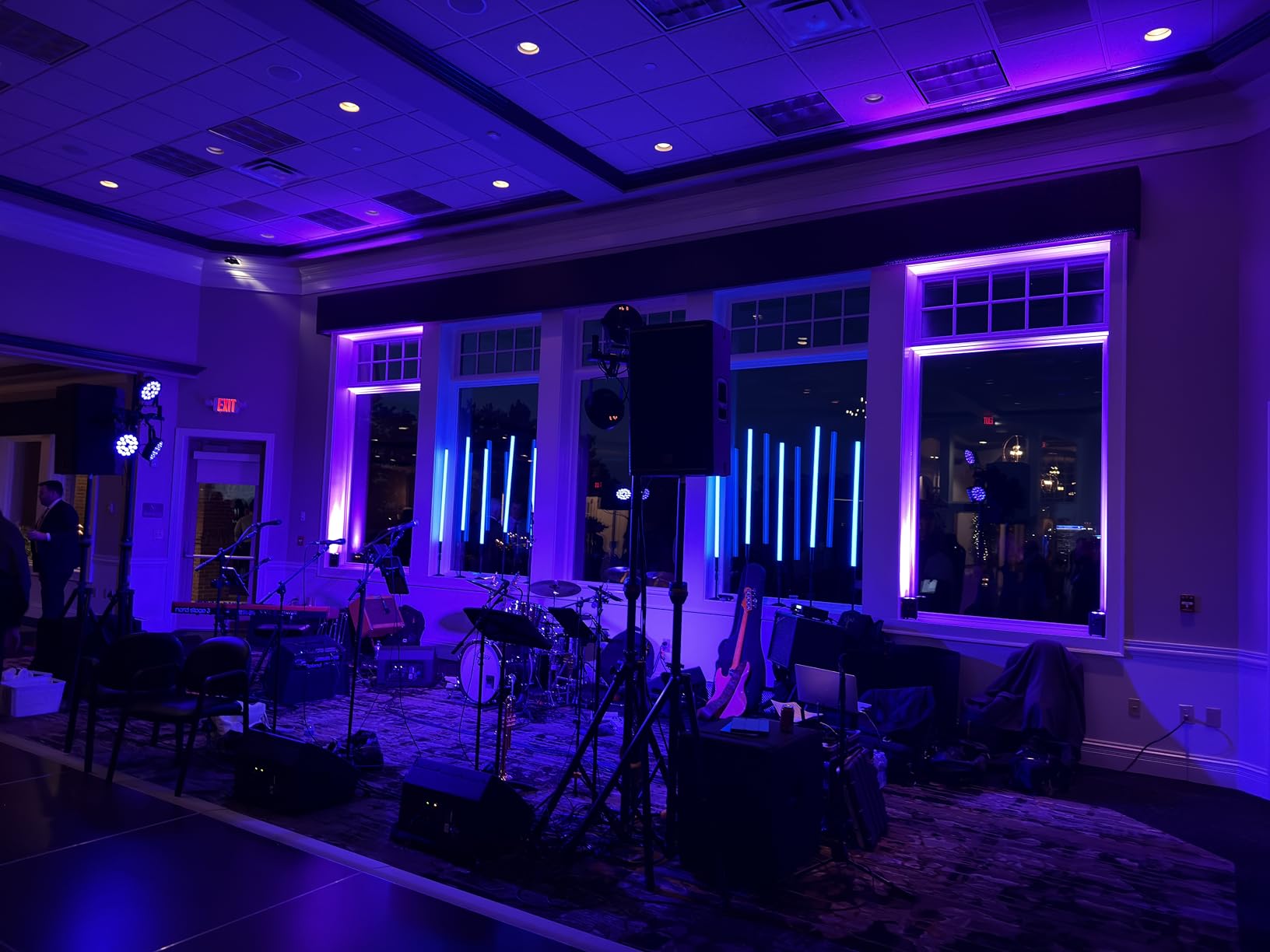
There are important limits, and they are the reason this is an event fixture rather than a cinematography tool. There is no DMX input, presets cannot be programmed or saved, and the remote cycles through a small on-light interface rather than a real control surface. If you want repeatable looks tied to a lighting desk, this is the wrong tool.
Output is 500 lumens maximum across a 340-degree beam, and there is no warm white output at all, so you cannot light a face with a clean tungsten tone. Sync also drifts slightly across the six tubes, producing a soft cascade rather than a perfectly locked chase, and the case foam degrades quickly, which matters if you transport them between gigs.
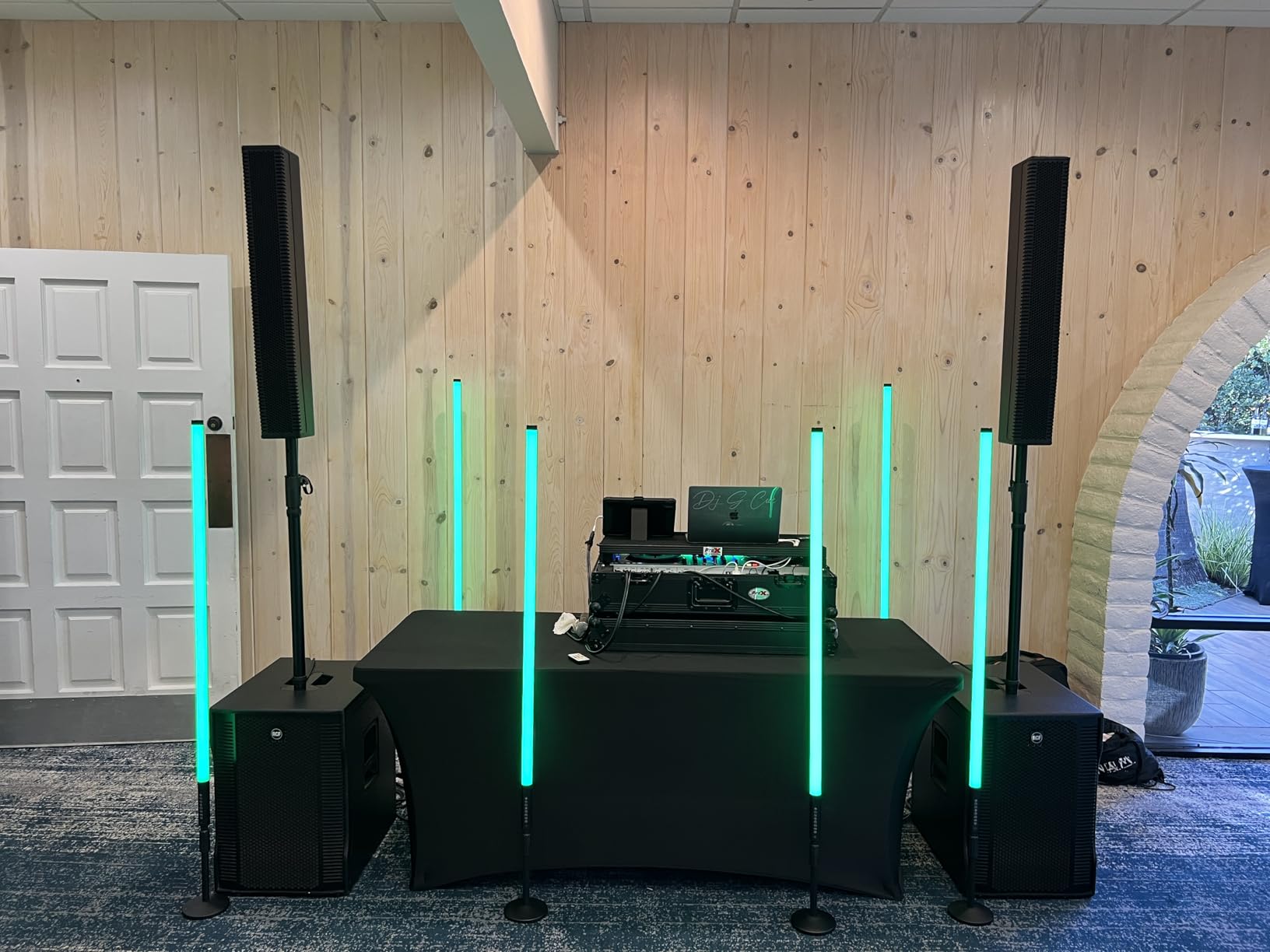
Who should buy the ZDMDRGB 6-Pack
Buy it if you light events, parties, stages or photo booths and need saturated color across a space with no cable runs. The five-to-six-hour full-output runtime and the 13-to-15-hour low-output figure are what make a full evening possible from one charge.
It is also a practical choice for a production company that needs many accent positions at once, since six tubes, six bases, six remotes and a case is a complete package rather than a parts list.
Where the 6-Pack falls short
It has no DMX and no programmable presets, which rules it out for set work where cues need to be repeatable. Forum threads about DMX interfaces come up constantly among tube users, and this pack does not answer that need at all.
There is no warm white mode, so it cannot double as a practical or a face light. Expect slight sync drift across the six tubes, and replace the case foam before you rely on the case for transport.
10. Soonpho 2-Pack RGB Tube Wands – Best Value for Matched Pairs
2Pack RGB LED Video Light Stick Wand,3200K~8500K Magnetic Photography Tube Light,360° Full RGB Light Stick with 4000mAh Battery for YouTube Video,Vlog,Live Game Streaming…
Two tubes,88 LED beads each
CRI 95+
700 lux at 0.3m
4000mAh,about 2 hours
Pros
- Two tubes in the box for symmetrical or matched positions
- 4000mAh battery holds a long charge
- Magnetic mounts on both ends plus dual 1/4 inch nuts
- No app or remote needed
- so operation is self-contained
Cons
- RGB output is dimmer than the published brightness figures
- Included screw-in tower base and mini stand feel flimsy
- Hue accuracy is inconsistent when desaturating
- One reviewer reported an early unit failure
A two-pack solves the most common tube problem, which is symmetry. Hair lights, background pairs and interview backdrops look deliberate only when both sides match, and reviewers consistently treat this set as a high-value way to get two matched accents rather than one light and an empty hand. A two-pack is also available in one and three tube configurations if you need to scale.
Each tube uses 88 high color rendering LED beads with CRI 95+, up to 700 lux at 0.3m and a beam angle up to 120 degrees. The 4000mAh battery gives about two hours of continuous lighting, which is the best runtime per unit among the compact multi-packs here, and Type-C charging works while the light is on.
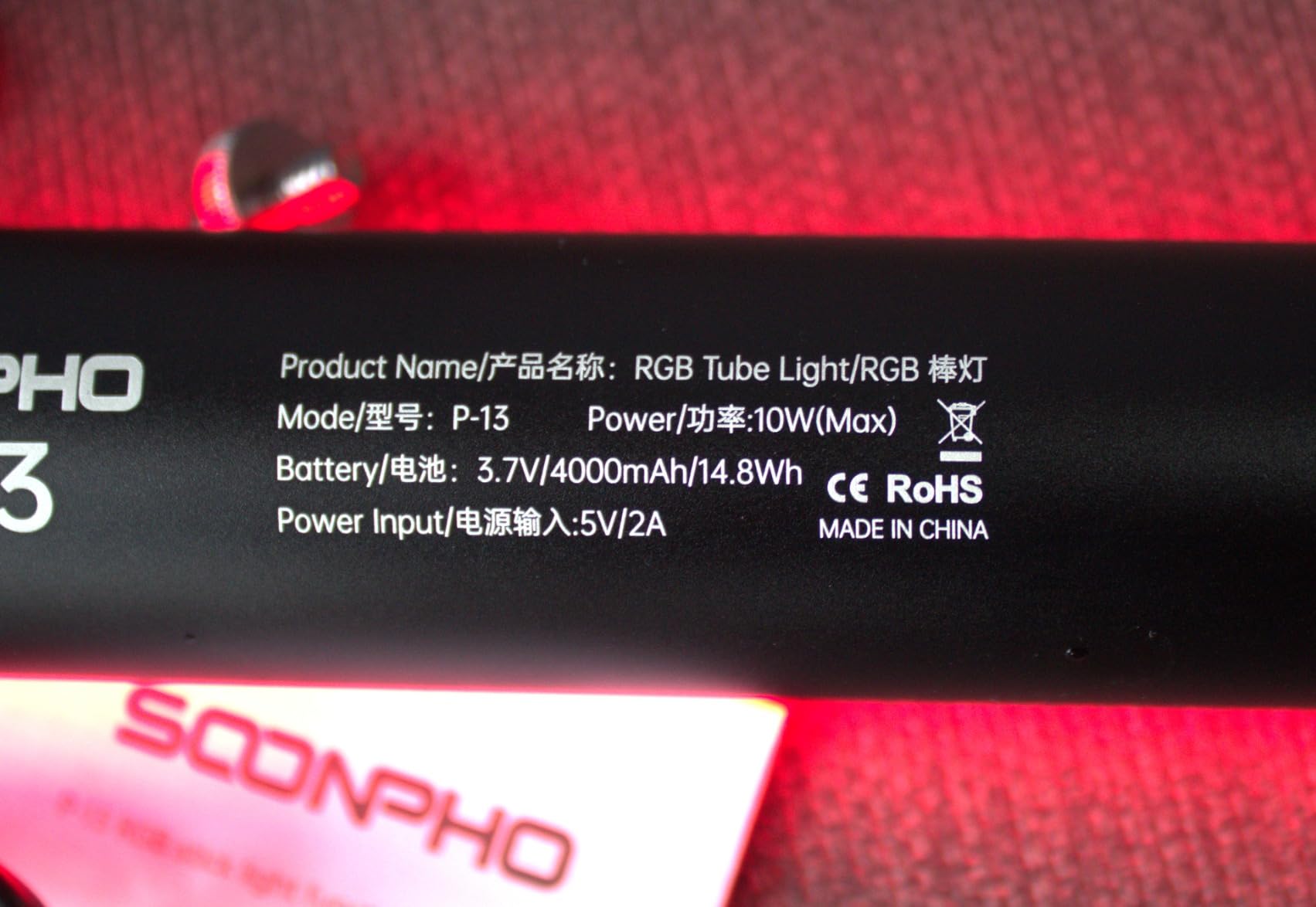
Control is deliberately simple. RGB, CCT and scene modes with 0-360 degree hue, 0-100% flicker-free dimming and 20 built-in effects, all from onboard buttons and an integrated LCD. There is no app and no remote, which is a genuine advantage when a second operator is not available and a liability when you want repeatable looks.
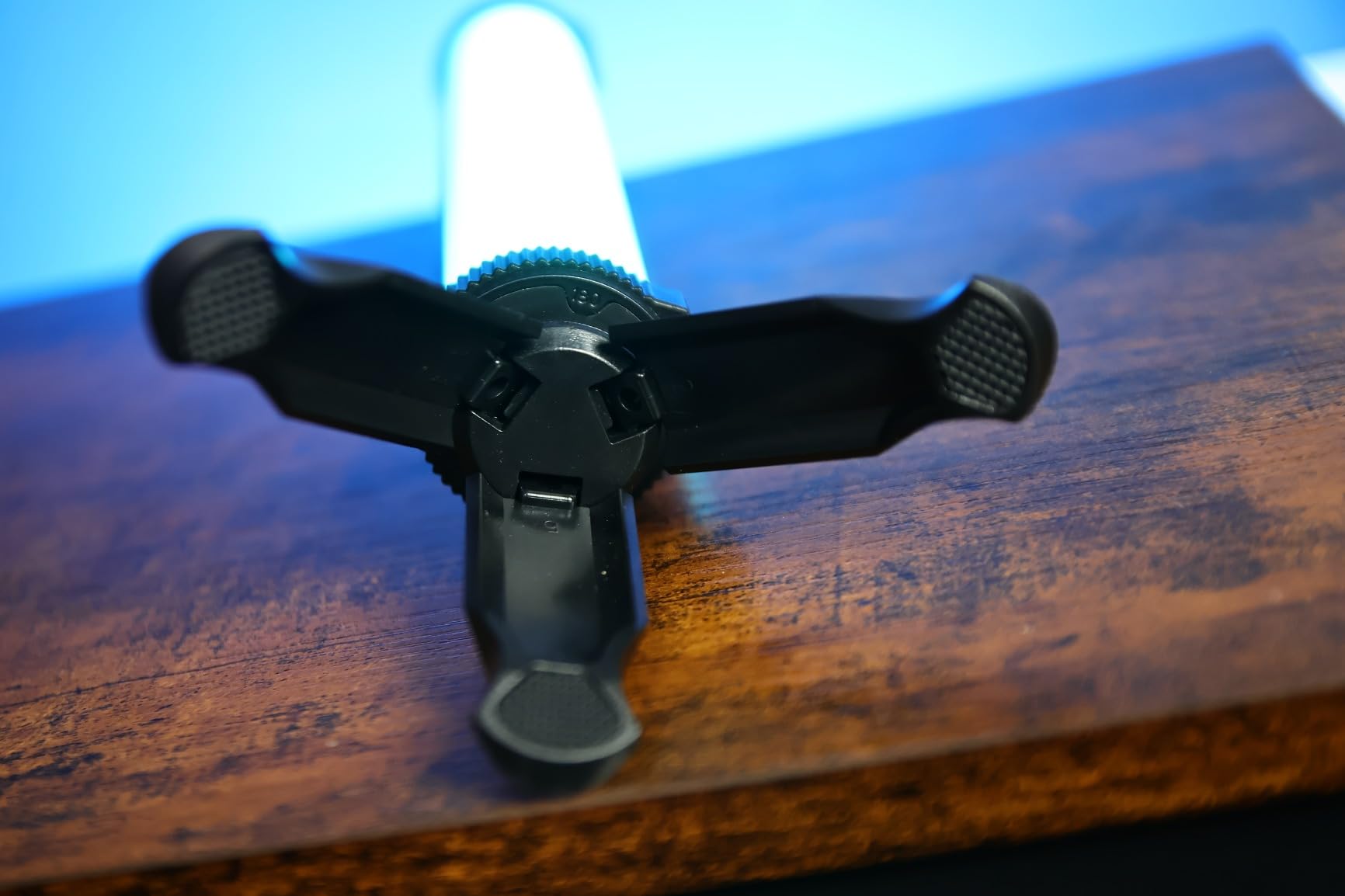
Mounting is flexible with two magnets, dual standard 1/4 inch nuts and a 360-degree rotating body, so you can angle a tube off a wall or a rig without an adapter. The weaknesses owners report are the flimsy screw-in tower base and mini stand, and RGB mode reading dimmer than the published figures.
Who should buy the Soonpho 2-Pack
Buy it for matched background and hair positions, streaming setups and vlogging kits where symmetry matters more than output. Two hours of runtime per tube at 4000mAh is enough for most half-day content schedules.
It is also the easiest tube here to hand to someone else. Onboard buttons and an LCD mean no app pairing, no wireless dropouts and no menu diving when the shot is moving.
Where the Soonpho falls short
RGB mode output falls short of the published brightness, so do not plan to key a face from it. Hue accuracy is also inconsistent, with reviewers noting that desaturating can shift a color to something unintended.
The included base and mini tripod feel flimsy and unstable on soft surfaces, so bring a proper stand. One reviewer also reported a unit that showed a dead battery after brief use, so test both tubes before a shoot.
11. Nanlite PavoTube II 6C – Best for Podcast and Interview Backdrops
NANLITE PavoTube II 6C LED RGB Tube, 2700K-7500K Ultra-Wide Color Temperature, 2.4GHz Wireless Control Portable Handheld Photography Lighting Stick
25cm aluminium tube,260g
CRI 95 TLCI 97
2700K-7500K
65+ min battery
Pros
- Aluminium alloy body with good heat dissipation
- Bright even output for a 25cm tube
- 2700K to 7500K plus 360000 RGB adjustments
- 2.4GHz and Bluetooth control through the NANLINK app
Cons
- Smaller and less powerful than expected as a standalone light
- About 65 minutes at full power
- No 1/4 inch thread on the body itself
- One report of a failed first unit and a wall charger that did not work
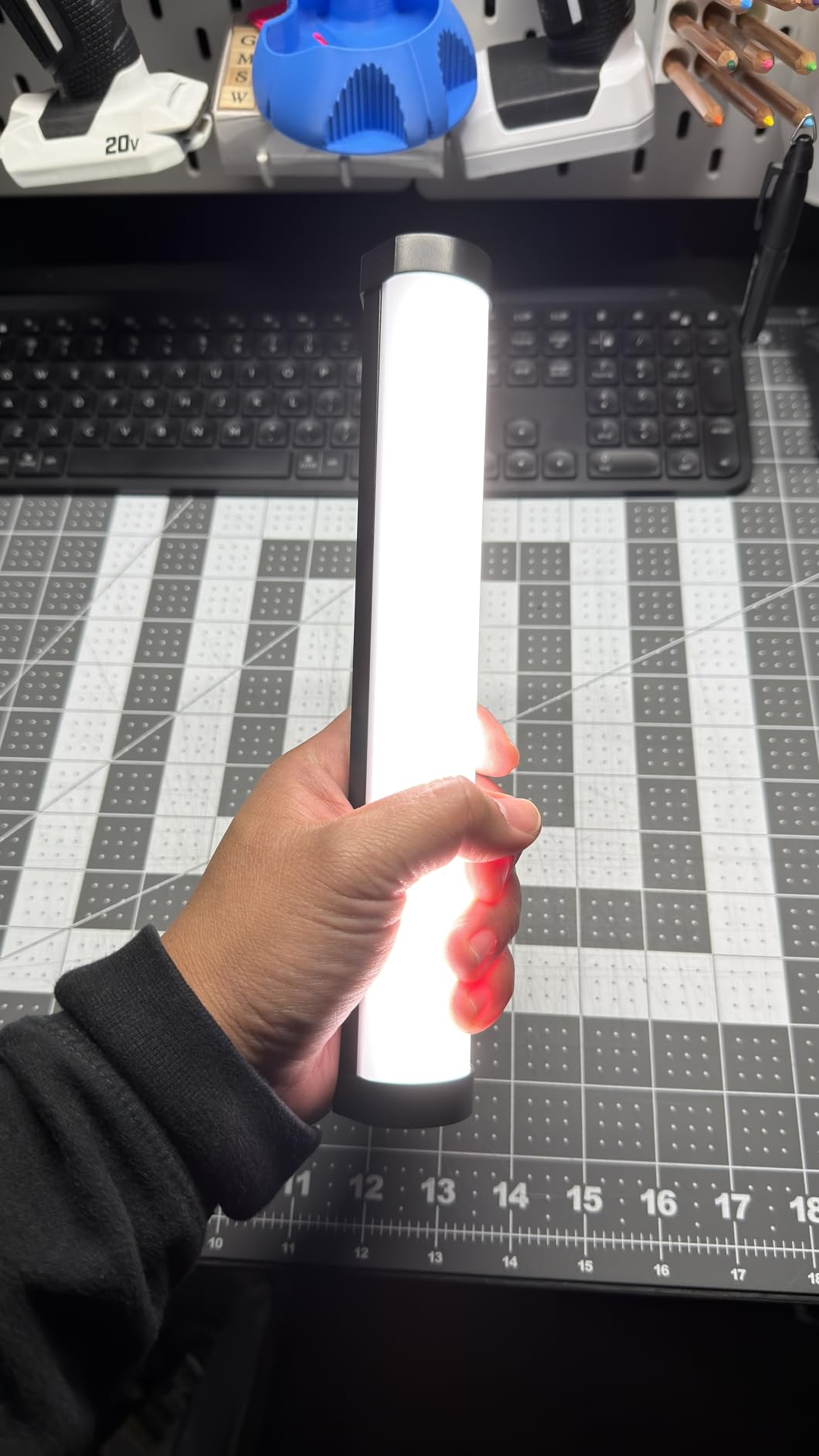
The PavoTube II 6C is the shortest serious tube in this roundup at 25cm and 260g, and the aluminium alloy body is the reason it feels like a piece of equipment rather than a gadget. Reviewers single out heat dissipation and the even output for a tube this small, which matters when you are running it close to a subject for a full interview.
Color is handled well with CRI 95 and TLCI 97 across a 2700K to 7500K range, plus 360,000 RGB adjustments and 15 built-in effects including color cycle, CCT cycle, flashing, lightning and TV. Control runs through Bluetooth and 2.4GHz via the NANLINK app, so adjustments are quick without working through a menu on the tube itself.
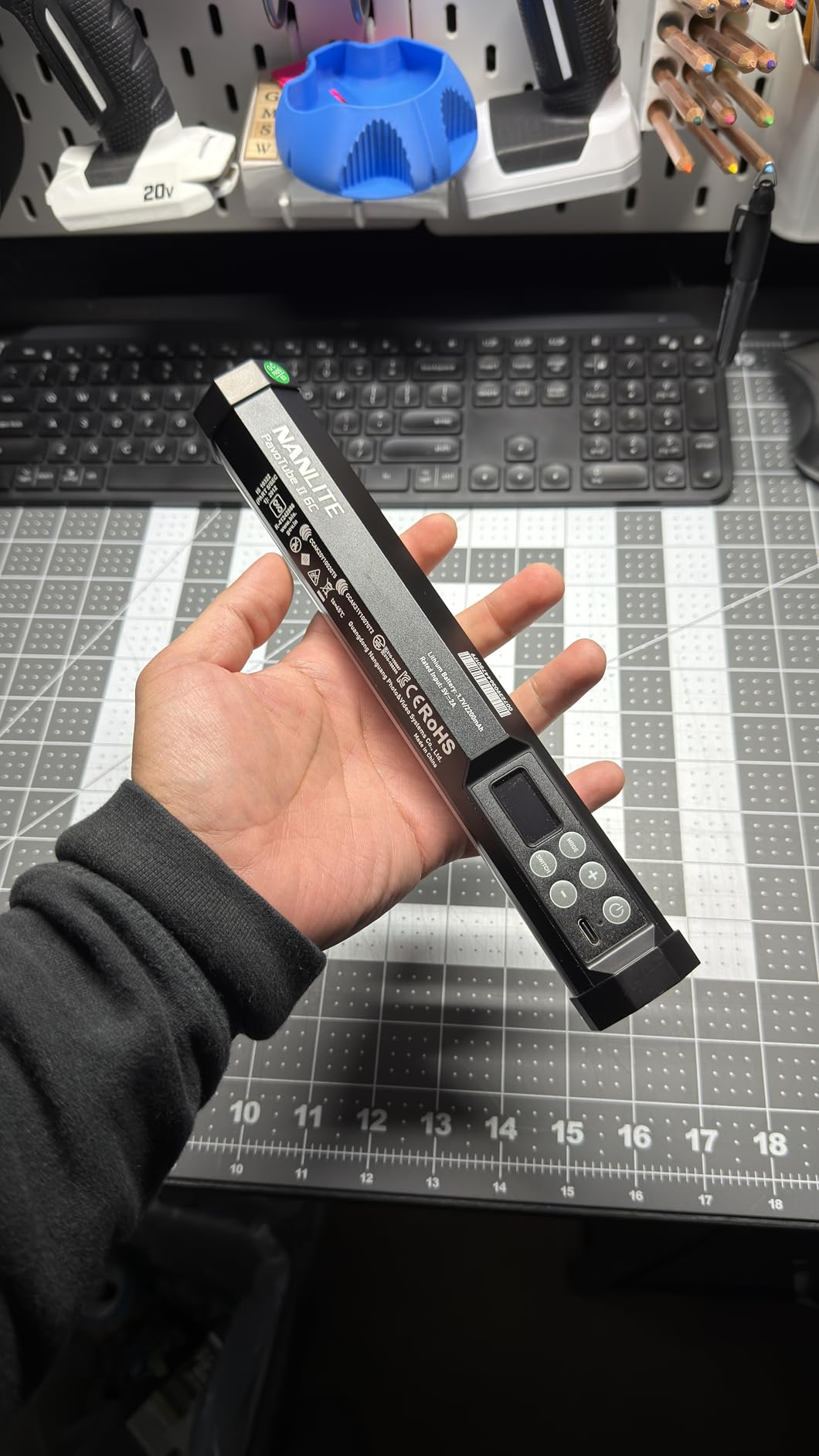
Mounting is a real consideration. The magnetic attachment works well on steel and the included metal plates extend that, and there is a 1/4 inch wrist strap, but there is no threaded 1/4 inch mount on the body itself, so plan to hold it, sit it in a stand adapter or rely on the magnet. A carry bag and three metal plates are included.
Owners describe it as a well-made portable accent for podcast backdrops, YouTube setups and tight creative spaces. The recurring note is that it is smaller and less powerful than expected, so it works best as an accent or paired with a second unit. Runtime is about 65 minutes at full power over a built-in lithium cell, charged by USB-C and able to run from a power bank.
Who should buy the Nanlite PavoTube II 6C
Buy it for a podcast or interview backdrop where the light has to be soft, small and close. A 25cm aluminium tube disappears in frame behind a subject in a way a longer bar does not, and TLCI 97 keeps skin tones consistent against daylight-balanced key light.
It is also a sensible second unit in an existing Nanlite package, since NANLINK control means one app runs the whole set rather than a second phone.
Where the PavoTube II 6C falls short
It is not bright enough to be a standalone key, and reviewers are clear about that. Use it as an accent, a hair light or a paired background element, not as the light that carries the exposure.
The missing 1/4 inch thread on the body limits rigid mounting options, and the 65-minute full-output runtime is short. There is also an isolated report of a first unit failing after about six hours of daily use and an included wall charger that did not work, so check the box contents on arrival.
12. LUXCEO 2-Pack with Stands – Best All-in-One Kit for New Shooters
LUXCEO 2 Pack RGB LED Video Tube Light Wand Stick, 36 Colors, 3000K-6000K Dimmable, Photography Studio Lighting Kits with 29″ to 81″ Tripod & Remote Control, for Live Streaming/Portrait/Vlog
Two 21 inch tubes
CRI 95+
3000K-6000K
2600mAh, works while charging
Pros
- Two tubes plus two extendable stands with ball heads
- remotes and carry bags included
- CRI 95+ with flicker-free dimming
- Works while charging with a 2-32 hour runtime range
- Aluminium alloy construction with 1/4 inch mounts
Cons
- Narrower 3000K-6000K range than most RGB rivals
- Remotes must be aimed at the emitting surface and stop working after deep sleep
- Remote range limited to about 7 meters
- An insulation clip on the remote must be removed before use
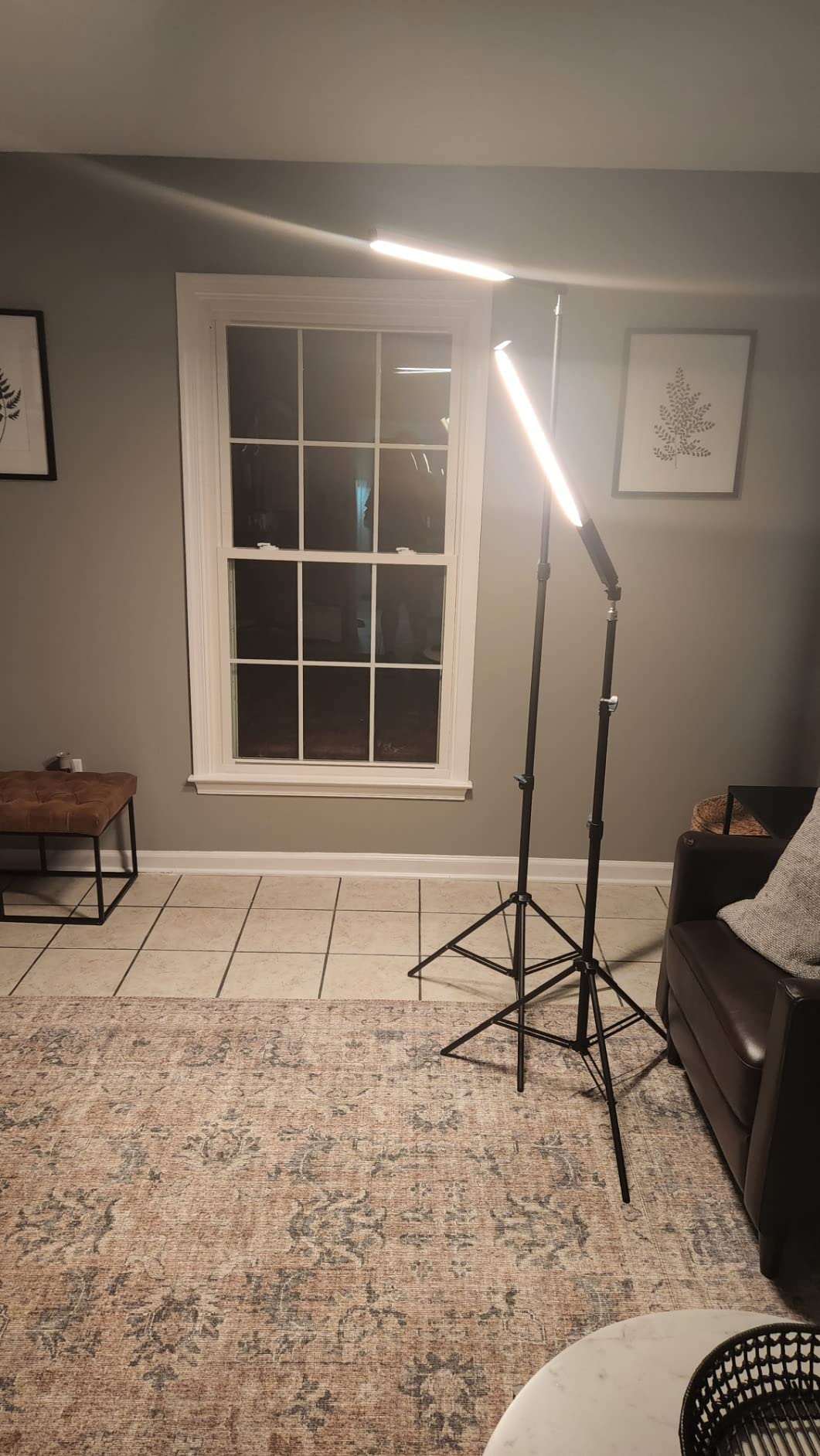
The LUXCEO kit is the only kit here that includes stands, and that is its main argument. Two 21-inch tubes at 204 LED beads each, two locking extendable stands that run from 29 to 81 inches with 360-degree ball heads, two remotes, two lanyards and two carry bags. For a first setup, nothing else here removes the shopping list.
Color quality is respectable rather than exceptional, with CRI 95+ published, flicker-free 0-100% dimming and 36-color HSI control. The 3000K to 6000K range is the trade-off, and it is narrower than most RGB competitors in this list, so you cannot dial a deep tungsten or a cool blue shade.
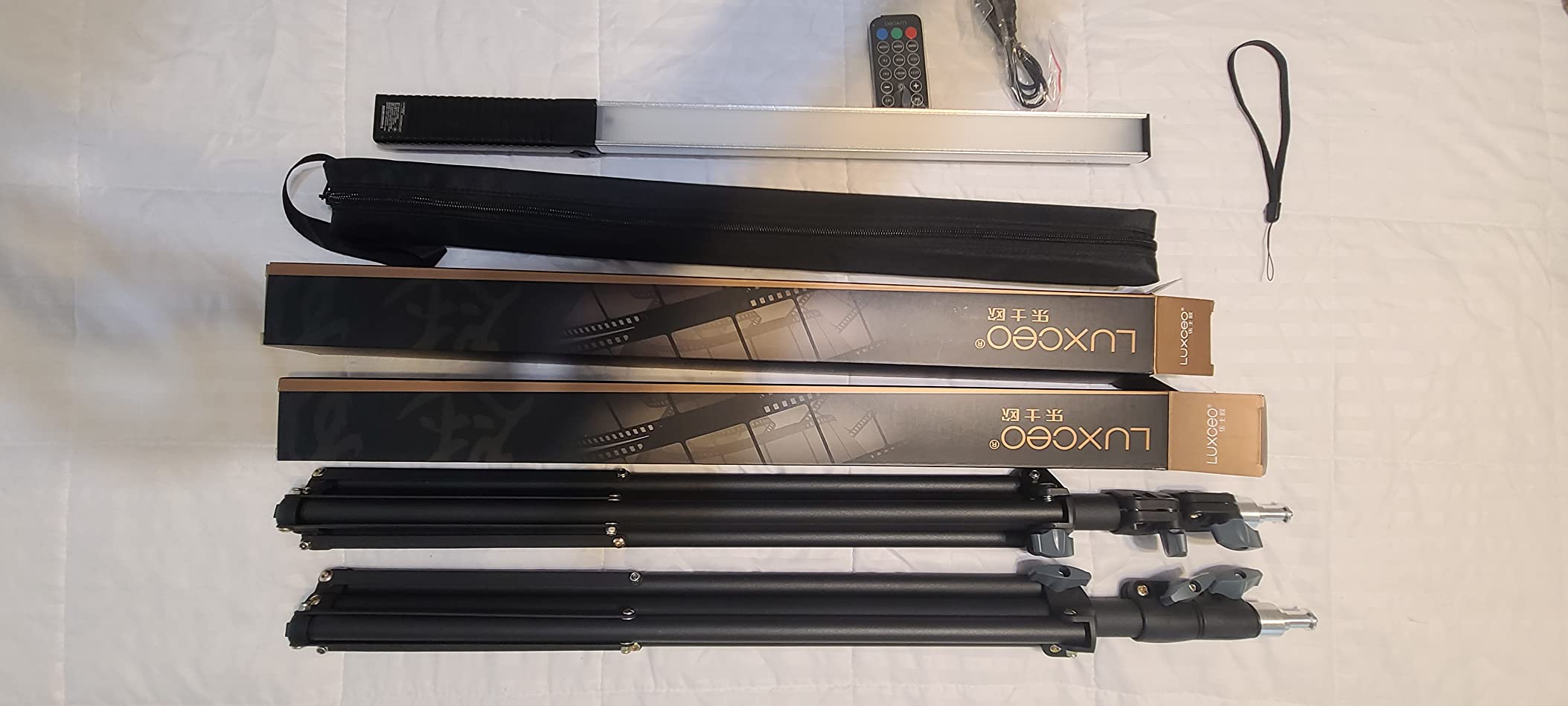
Power is more flexible than the numbers suggest. A 7.4V 2600mAh cell gives a published 2 to 32 hour runtime depending on output, and it works while charging over USB, which means a tube can sit on a stand through a long session without a swap.
Two handling notes matter on set. The remotes need line of sight to the emitting surface, with a range of about 7 meters, and they do not wake the light from deep sleep, so wake it with the onboard controls first. There is also an insulation clip on the remote that has to be removed before use. Buyers describe the aluminium construction and 1/4 inch mounts as solid.
The remotes are also fussier than they need to be, needing line of sight, a short range and a manual wake.
Who should buy the LUXCEO 2-Pack
Buy it if you are building a first kit and want two matched tubes plus stands in one purchase. For a livestream desk, a small product setup or a portrait session, the stands with ball heads mean you can angle each light independently without buying hardware.
It is also a good rental or shared-studio purchase, since the carry bags and the complete kit make transport between locations straightforward.
Where the LUXCEO falls short
The 3000K to 6000K range is the real limit for anyone shooting mixed-temperature scenes or wanting a warm practical look. If color range drives your work, spend up to one of the wider-range tubes instead.
The remotes are also fussier than they need to be, needing line of sight, a short range and a manual wake. Plan to make quick changes on the tube itself, and remove the insulation clip before the shoot, not during it.
How We Picked the Best Tube Lights for Cinematic Video
We limited the list to fixtures that produce light from a tube-shaped emitter, which excludes panel lights and strips sold as decor. Within that set we weighted four things: measured color accuracy, output at a stated distance, control options that fit a working set, and how the light behaves in a real placement rather than on a stand in a studio.
Every lux figure, CCT range, CRI and TLCI number, weight, battery capacity and runtime quoted above comes from the published product data. We cross-checked those against the buyer review record, weighting the recurring themes rather than isolated comments, and we treated the AI summaries of review text as a guide to where the friction actually is. Battery runtimes are the manufacturer full-output figures, not our measurements, and we note that where low-output life differs sharply.
We also read what filmmakers ask about these lights on r/videography, r/cinematography and r/indiefilm. The recurring themes were DMX confusion, skin tones going green on cheap tubes, mounting rigidity, and whether a premium tube is genuinely worth more than a mid-tier one. Those themes shaped what we measured against and what we flagged in each review.
Buying Guide: How to Choose a Tube Light
Pick a tube length that matches your shot size
Length decides what a tube can do. An 11 to 12-inch wand is a close accent, a hair light or a handheld practical; it does not cover a face from a meter away. A 25 to 30-centimeter tube works as a close key and a hair light, and hides better behind a subject. A 60-centimeter tube, like the Amaran T2C, lights a background or a tabletop. Four-foot bars are room lighting rather than camera lighting.
As a rule, the emitter should be roughly as long as the feature you are lighting. Matching the tube length to a face, a product edge or a head-and-shoulders frame is the fastest way to get even coverage without banding or hot spots.
Read CRI and TLCI before anything else
CRI measures how faithfully a light renders colors against a reference, and TLCI does the same job for video, where the camera is judging, not the eye. Anything under 90 is visibly compromised on skin, and reviewers in the forums treat that as unacceptable. In this roundup the range runs from CRI 95 to CRI 98+, and the top options pair that with TLCI 97 or higher.
If you are matching a tube to a key light you already own, compare TLCI values rather than CRI alone. A tube with CRI 95 and TLCI 98 will sit closer to a broadcast-standard key than one with CRI 98 and no published TLCI figure.
Use color temperature range as a workflow decision
Bi-color tubes covering roughly 2700K to 6500K cover interview and daylight work. Full-range tubes extending to 8500K, 9000K or 10000K can push a colder, more stylized look or match a mixed-temperature set. The widest range in this list, 2000K to 10000K, belongs to the Aputure MT Pro.
The one thing to check is whether warm white is genuine. The six-pack event bars publish no warm white output at all, which is fine for a party and useless for lighting a face with a tungsten look. Know which role you are buying for before you compare ranges.
Decide between RGB, RGBWW and pixel tubes
RGB gives you hue and saturation but a weak white point, which is why cheap tubes push skin tones green or magenta. RGBWW adds dedicated warm and cool white emitters, so the tube holds a neutral white while still producing saturated color. That is what the Amaran T2C, the NEEWER TL20C and the NEEWER RGB2 do, and it is why their skin tones look right.
Pixel tubes are a different category entirely. A pixel-mappable fixture can run gradients, chases and color rollouts along its length, which a single-color tube cannot do. If your light is going to be visible on camera, that capability is worth paying for.
Check control ecosystem before you buy, not after
This is the most common source of regret and it comes up repeatedly in forum threads. Sidus Link, NANLINK, Godox Light, NEEWER Infinity and ViltroxLink are separate apps, and a light from one brand will not usually follow an app you already use from another. The Aputure MT Pro and Amaran T2C are the exceptions worth noting, because they join an existing Sidus Link package.
For set integration, look for DMX. The Aputure MT Pro supports DMX with RDM and LumenRadio CRMX, and the Amaran T2C accepts DMX, while most budget tubes are app-only or remote-only. Forum users repeatedly ask which interface to buy to sync multiple tubes, and the honest answer is that if you need real sync, start from a DMX-capable light and choose the interface to match.
Judge battery runtime at the output you will actually use
Published runtimes are almost always measured at 100% brightness, and that is the least representative number for a tube light, because tubes spend most of their lives as accents. At lower output the same cell runs considerably longer, and the six-pack bars publish 13 to 15 hours at their lowest setting against 5 to 6 hours at full. Run them at half and a two-hour figure becomes a workable half-day.
Also check whether the light runs while charging. Several in this list do, including the Viltrox K90, the LUXCEO kit and the soonpho pair, and that single feature can matter more than extra capacity on a static setup.
Understand flicker and how it interacts with your frame rate
A light that flickers is a light that bands on camera. Pulsed-width modulation is the usual culprit, and a light that looks perfectly steady to the eye can pulse at a frequency your camera resolves badly, especially at higher frame rates and shutter angles. Every light in this roundup is described by reviewers as flicker-free or with flicker-free dimming, and that is the baseline you should hold any tube to.
If you shoot 24, 48 or 60 frames per second, or use a narrow shutter angle to create motion blur, test the light at your intended frame rate and shutter before the shoot day. A short exposure on a phone or a stills camera will not reveal flicker that a 48-frame video camera will.
Use G/M correction to keep skin tones honest
Green-magenta correction is the single most useful control for a color tube used near a face. Cheap RGB chips and colored bounce push skin toward green, and no amount of white balance fixes it cleanly. Fixtures with G/M adjustment let you pull the green out without shifting the hue you chose, and several in this roundup offer it, including the Godox TL30, the NEEWER TL20C and the NEEWER RGB2.
If you are matching two tubes to each other, use G/M on both and match by eye against a reference, not by matching hue values in an app. The human eye is still the final reference for skin.
Choose mounts and modifiers for the placement you have
Magnetic backs, end screw holes and 1/4 inch threads cover most of what a tube needs: a stand, a clamp, a car interior, a fridge, a ceiling. The two 30-centimeter and smaller tubes in this round that lack a body thread need a stand adapter or a magnetic surface, so plan for that before the shoot.
Spill control is the upgrade most worth adding. The NEEWER RGB2 includes a detachable barndoor, and the Godox sells a light control fence separately. On a small set, a flag or a barndoor does more for the image than a brighter tube.
Know when to choose a panel or a COB light instead
Tubes, panels and COB lights are not interchangeable. A COB monolight throws further and takes a softbox, so it wins as a key at any distance over about two meters. A panel gives even, controllable light across a wide face and is usually the right tool for an interview close to camera. A tube wins when you need color, cordless power and a fixture you can hide.
Our rule is simple: if the light has to travel more than a couple of meters, use a COB or panel. If it has to be colored, cordless or invisible in the set, use a tube. Plenty of small setups use both, and our guides to the best LED video lights for filmmakers and the best LED video lights for YouTube creators cover the wider kit.
Frequently Asked Questions
What is the best LED tube light for videography?
The NEEWER TL20C is the strongest all-round choice in our roundup, with CRI 95+ across 2500K-8500K, G/M correction, a 140-minute full-output battery and a 270g body with magnetic mounting. For more output at close range, the NEEWER RGB2 publishes 1860 lux at 0.5m and ships with a barndoor. For color accuracy specifically, the Godox TL30 posts the highest TLCI here at 99+, while the NEEWER RGB2 posts the highest CRI at 98+.
What size tube light should I buy?
Match the tube length to the feature you are lighting. An 11 to 12-inch wand is a close accent or hair light. A 25 to 30-centimeter tube works as a close key and hides behind a subject. A 60-centimeter tube covers a background or tabletop, and 4-foot bars are for rooms and events rather than camera lighting. Longer tubes spread light more evenly but weigh more.
What is the best RGB tube light?
The Amaran T2C is the best all-round RGB tube because it is RGBWW, so it holds a neutral white while still producing saturated color, with CRI 95+ and TLCI 98+ across 2500K-7500K. The Aputure MT Pro is best for pixel-mapped effects, and the NEEWER RGB2 for the highest short-range output at 1860 lux at 0.5m. Cheaper RGB-only sticks often push skin tones green.
Can a tube light be used as a key light?
Yes, at close range only. A 20W tube at about one meter can carry a close key, which is why we rated the Amaran T2C as usable as an occasional key. Beyond one to two meters a tube light lacks the output, so pair it with a panel or a COB monolight for the main key and use the tube for accent, hair light, rim or background color.
What is the 3 lighting rule?
The three-point lighting rule names three roles: key, fill and back light. The key is the main source that sets exposure, the fill softens shadows created by the key, and the back light separates the subject from the background. With a tube light kit, place one tube as a close key, one as fill opposite it, and one behind the subject as a hair light or rim.
Which brand is best for tube lights?
It depends on the control system you already run. The Aputure MT Pro and Amaran T2C join Sidus Link, the largest shared ecosystem here, and the MT Pro adds DMX with RDM and LumenRadio CRMX. Nanlite tubes run through NANLINK, Godox through the Godox Light app, and NEEWER through NEEWER Infinity. Lights from different brands rarely cross-control, so match the app first.
How bright should a tube light be for video?
For a close accent or hair light, 700 to 1900 lux at 0.5m is plenty. For a background wash or a longer throw, look for figures around 2500 lux at 0.5m, as the 30W Viltrox K90 publishes. Always check the measurement distance, since 0.5m and 1m figures are not comparable, and remember that a tube is a soft source that loses output fast as you move away from it.
Do tube lights work with smartphones?
Most do, through the manufacturer app over Bluetooth or 2.4GHz wireless, which handles brightness, color temperature, hue and effects. The NEEWER Infinity app controls groups up to 15 meters, and the NANLINK and Godox Light apps cover their respective tubes. A few products, such as the soonpho pair, deliberately use onboard controls only, with no app or remote at all.
Final Verdict: Which Tube Light Should You Buy in 2026?
The NEEWER TL20C is the best tube light for cinematic video overall, because it balances color accuracy, cordless freedom, mounting options and weight better than anything else we tested, and it has the largest review record in the field to back it up. If you need real output at close range, take the NEEWER RGB2 with its barndoor. If color fidelity is the whole conversation, take the Godox TL30. If set integration and pixel effects matter, take the Aputure MT Pro, and pair it with the Amaran T2C in Sidus Link.
Whatever you choose, buy for the job. Tubes are accent, practical and hair lights, and the mistake we see most often is buying one for a role that needs a monolight two meters away. Match the tube length to the feature, check CRI or TLCI above 95, verify the control app fits the rig you already own, and test the battery at the output you will actually run. Our roundup of the best tube lights for cinematic video is 2026‘s most complete starting point, and every pick above is one we would put in a bag.