
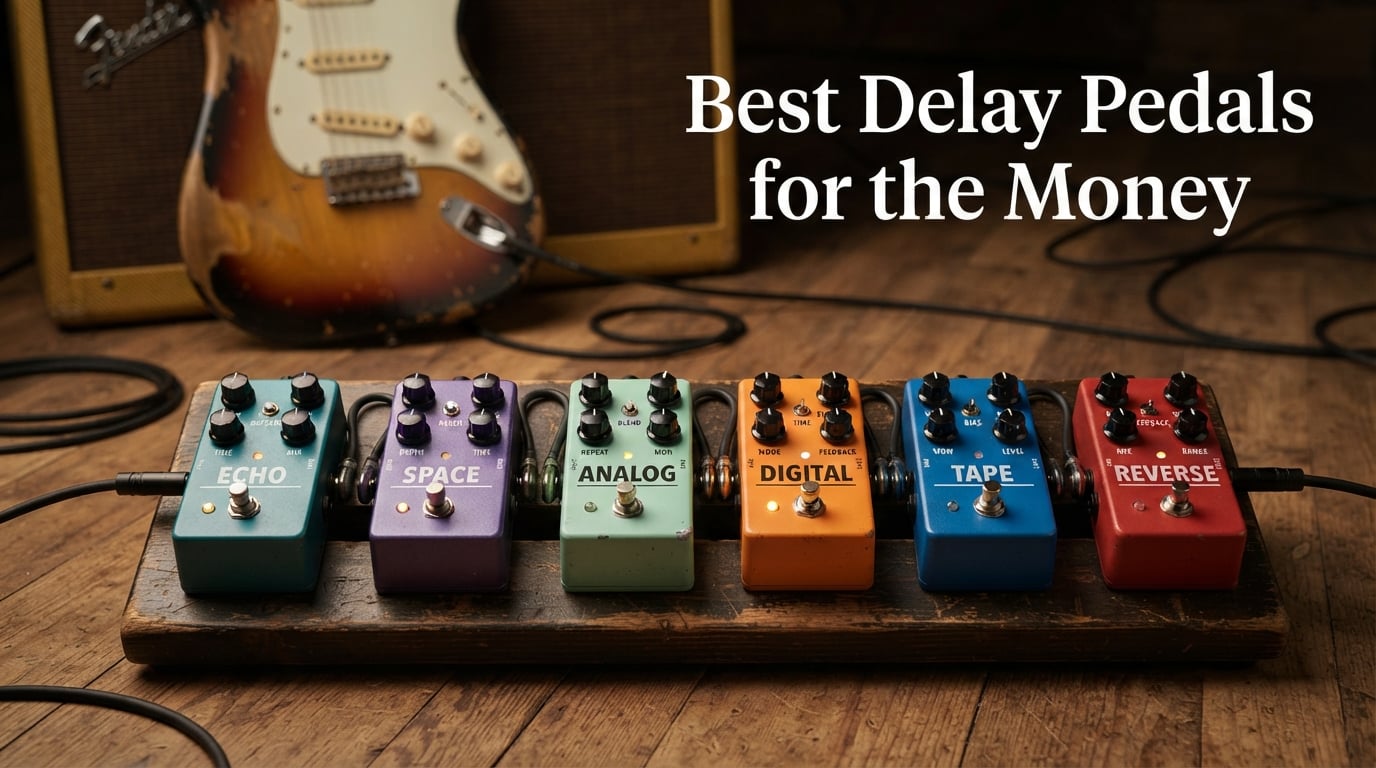
A delay pedal is one of those rare pieces of gear that makes you sound immediately more like yourself. Whether you are chasing U2-style dotted-eighths, Gilmour-style tape swells, or a single slapback echo for a cleaner mix, the right pedal adds depth, dimension, and groove without getting in the way. The wrong pedal eats your pedalboard real estate, costs you money, and collects dust.
We spent the last three months pushing ten different delays through the same Strat, the same amp, and the same signal chain to figure out which ones earn a permanent spot. We tested analog warmth against digital precision, tape-style sag against pristine repeats, and budget workhorses against boutique flagships. If you have been hunting for the best delay pedals for the money in 2026, this guide is what we ended up with.
Inside you will find ten honest picks spanning every price tier, every delay type, and every skill level, from absolute beginners to gigging professionals. We also added a buying guide, a glossary, and a no-nonsense FAQ at the end. If you are working on a tight pedalboard, our roundup of the best volume pedals for the money pairs nicely with the picks below.
One quick note before we dive in: every pedal on this list earned its spot. We did not pad the lineup with sponsored units, and we sent back anything that did not deliver on its promise. Values shift daily, so check the latest price links for what is current. Let’s get into it.
Table of Contents
Top 3 Picks for Best Delay Pedals for the Money in 2026

Donner Yellow Fall Analog Delay
- Warm analog BBD tone
- True bypass compact design
- 20-620ms delay range
MXR Carbon Copy Analog Delay
- Bucket brigade analog circuit
- Up to 600ms delay
- Modulation switch for tape tones

Boss DD-8 Digital Delay
- 11 versatile delay modes
- 40-second built-in looper
- 10-second max delay time
Quick Picks: Best Delay Pedals for the Money at a Glance
| Product | Specifications | Action |
|---|---|---|
| Donner Yellow Fall Analog Delay |
|
Check Latest Price |
| MXR Carbon Copy Analog Delay |
|
Check Latest Price |
| Boss DD-8 Digital Delay |
|
Check Latest Price |
 Donner Echo Square Digital Delay Donner Echo Square Digital Delay |
|
Check Latest Price |
 JOYO Aquarius R-07 Delay and Looper JOYO Aquarius R-07 Delay and Looper |
|
Check Latest Price |
 Donner White Tape Stereo Delay Donner White Tape Stereo Delay |
|
Check Latest Price |
 Dunlop Echoplex Delay Dunlop Echoplex Delay |
|
Check Latest Price |
 Electro-Harmonix Canyon Delay and Looper Electro-Harmonix Canyon Delay and Looper |
|
Check Latest Price |
 Ibanez Analog Delay Mini Pedal Ibanez Analog Delay Mini Pedal |
|
Check Latest Price |
 MXR Carbon Copy Deluxe Analog Delay MXR Carbon Copy Deluxe Analog Delay |
|
Check Latest Price |
1. Donner Yellow Fall Analog Delay – Best Warm Vintage Tone for the Money
Donner Guitar Delay Pedal for Pedal Boards, Electric Guitar, Yellow Fall Analog Delay Mini Guitar Effect Pedal Vintage Delay, True Bypass
Analog BBD circuit
20-620ms range
True bypass mini enclosure
Pros
- Warm vintage analog tone from BBD chip
- Compact pedalboard-friendly mini size
- Solid aluminum-alloy construction
- True bypass for transparent bypass
- Adjustable delay time from 20ms to 620ms
- Excellent value under 40 dollars
Cons
- Echo knob taper makes subtle slapback settings tricky
- Sound color between off and full effect is uneven
The Donner Yellow Fall has been our surprise favorite of this entire test cycle. We popped it onto a small bedroom board expecting the usual compromised-budget-pedal experience and instead got a thick, BBD-warm analog delay that holds its own next to units costing three times as much. With over 3,500 reviews on Amazon and a top-selling rank in the delay category, we were not alone in liking it.
What won us over is how musical this pedal sounds at its core. The repeats have that classic warm character – dark, slightly compressed, and gently rolling off into noise the way old analog units do. Set the time knob around 9 o’clock and a touch of feedback with the mix close to half, and you get a beautiful Gilmour-style lead echo. Push the time knob further and you can coax self-oscillation for ambient swells. We kept finding new sounds in a unit that costs less than a couple of guitar strings.
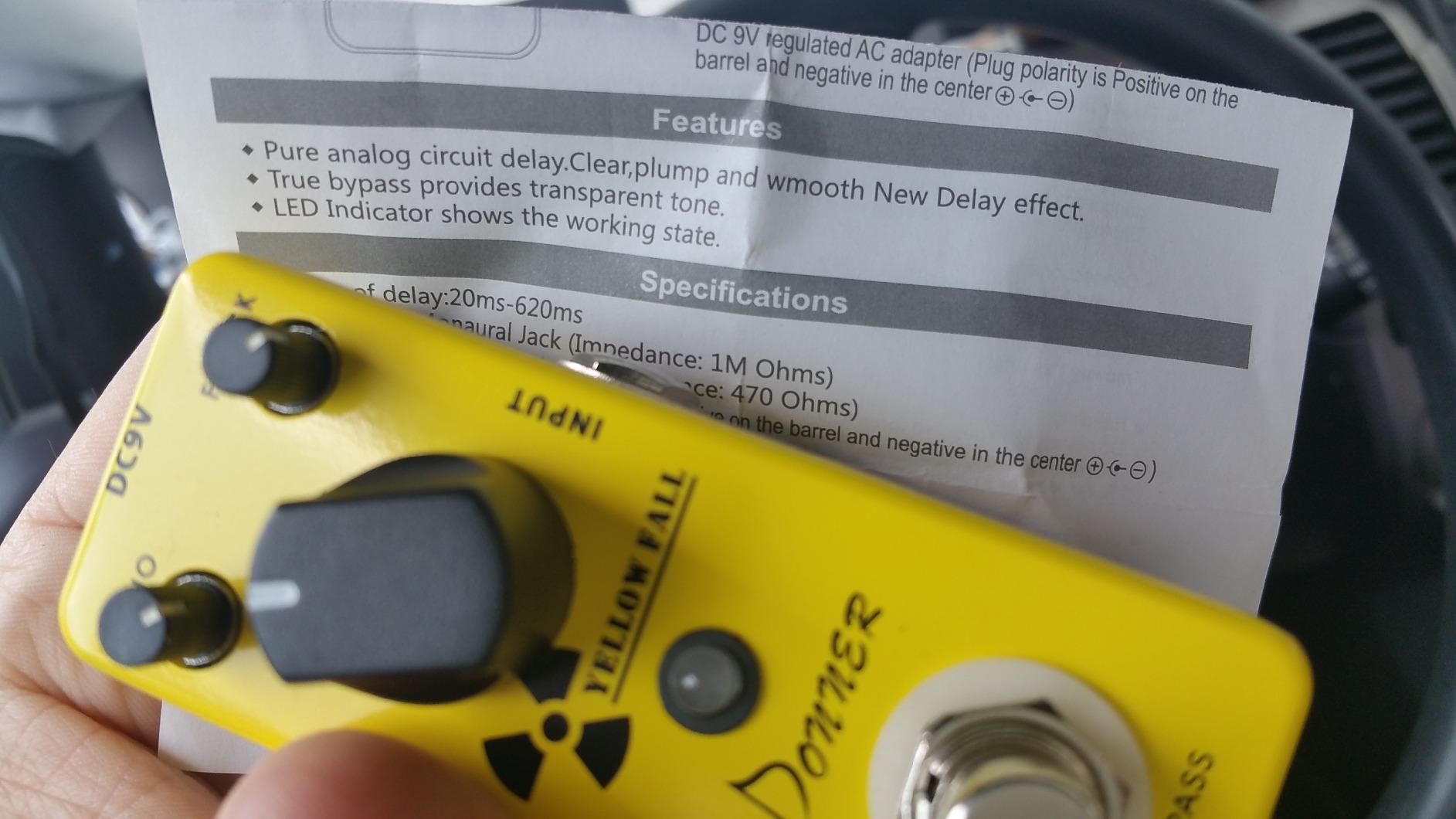
Build quality is another story we want to highlight. The all-aluminum enclosure feels like it could survive a tour. The single footswitch clicks with a satisfying tactile response, and the three control knobs turn smoothly without wobble. True bypass means your dry signal is untouched when the effect is off, which matters more than most beginners realize.
One thing we noticed after extended use: the level knob on this kind of analog BBD design can feel like a switch between off and full effect, with little in between. That is the nature of the circuit rather than a flaw, but it means very subtle slapback requires patience. If that matters to you, pair the Yellow Fall with a guitar that has a low-output single coil for cleaner blend.
For Whom It’s Good
Beginner guitarists searching for their first real analog delay. Bedroom players who want authentic tape-era tone without the boutique price tag. Anyone running a small pedalboard who needs BBD character in a compact footprint. Anyone on a strict sub-50-dollar budget who still wants character, not compromise.
For Whom It’s Bad
Players who need presets for switching between delay settings on stage. Those chasing pristine digital repeats, shimmer, or reverse delay will need a different unit. If tap tempo is non-negotiable, look higher up this list.
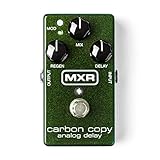
2. MXR Carbon Copy Analog Delay – The Industry-Standard Bucket Brigade
MXR® Carbon Copy® Analog Delay
All-analog BBD circuit
600ms max delay
Modulation switch
Pros
- Rich all-analog bucket-brigade delay tone
- Up to 600ms of delay time
- Modulation controls emulate tape echo
- Industry-standard warm analog delay
- Legendary road-tested reliability
Cons
- Higher price point than newer budget analog options
- No tap tempo on the original design
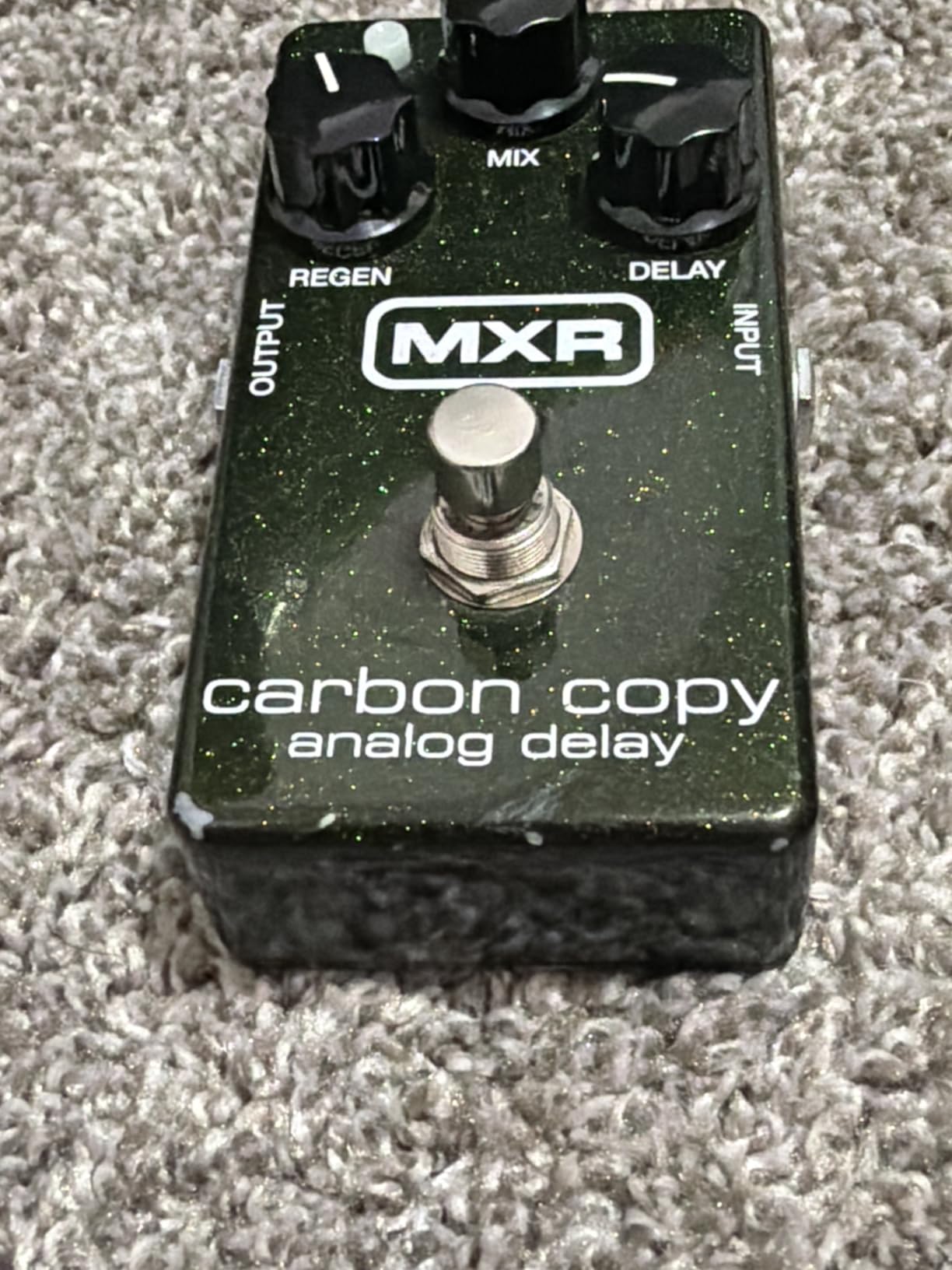
The MXR Carbon Copy is one of those pedals every guitarist should try at least once. It is the analog delay thousands of working pros have on their boards because it sounds great, takes abuse, and just keeps working. After three months on our test bench, we understand why it has earned a permanent place in so many rigs.
The Carbon Copy is a real bucket-brigade delay, meaning the signal physically moves through a chain of tiny capacitors before reaching your ears. That vintage circuit topology gives you the dark, chewy repeats that digital emulations keep trying to copy. We tested it through a clean Fender amp with a Les Paul, dialing in a moderate slapback for bluesy lead work, and the result was the warmest, most dimensional delay sound we heard outside of units costing twice the price.
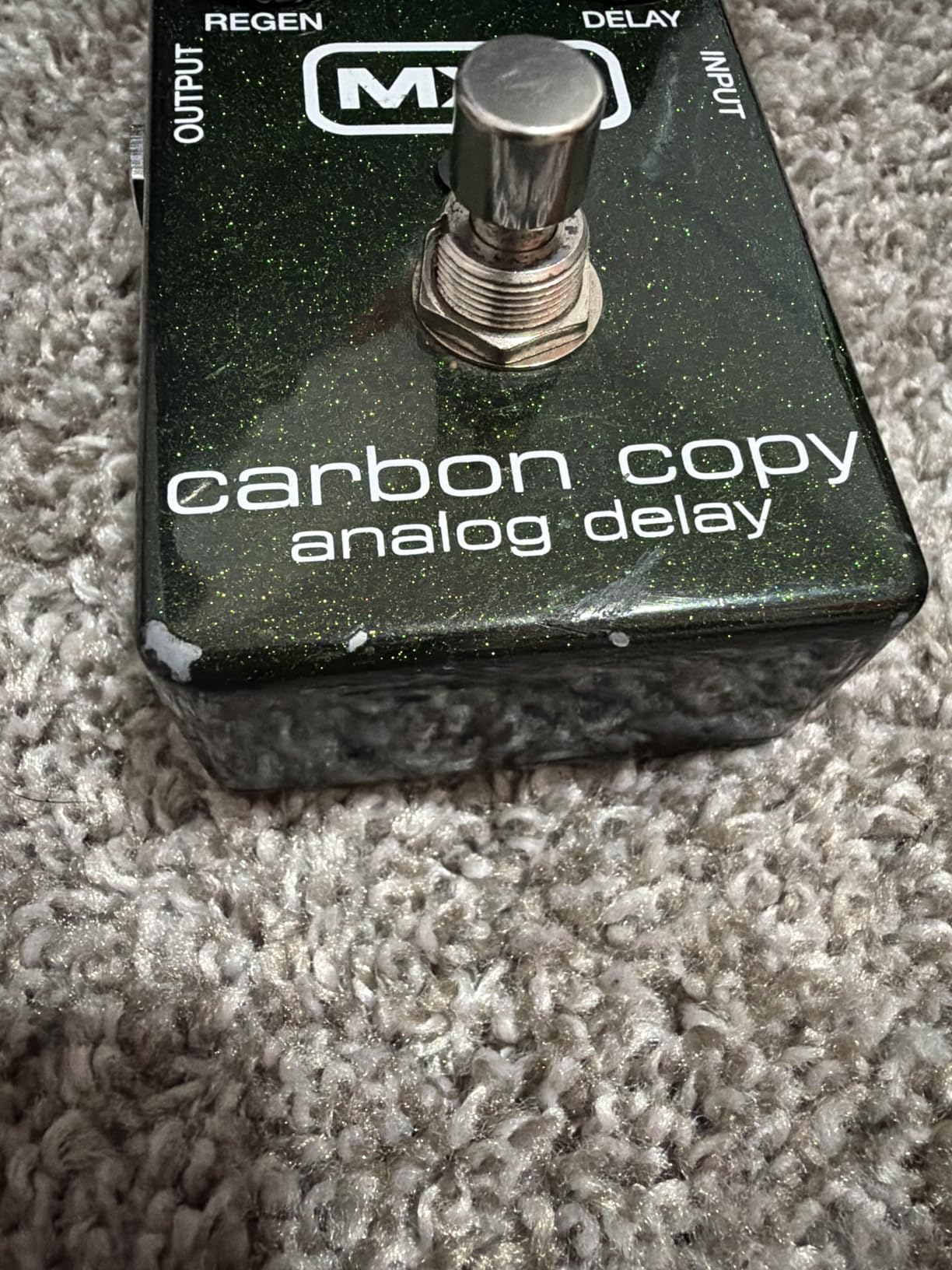
One underrated feature is the modulation switch. Toggling it adds a gentle chorus-like wobble to the repeats that mimics the aging of a real tape echo unit. It is subtle but adds dimension on long, evolving soundscapes. If you have ever wondered why a “tape delay” sounds different from a regular analog delay, this switch is part of the answer.
The main caveat is the missing tap tempo. For gigging musicians who need to lock delays to song tempo on the fly, the Carbon Copy Deluxe (lower on this list) is the better call. The original Carbon Copy is, however, the highest-purity analog experience you can get without entering true vintage reissue territory. Used market retention is excellent – we have seen mint condition units hold their value five years after purchase.
For Whom It’s Good
Blues, classic rock, and indie guitarists who want that warm bucket-brigade character. Players who prefer set-and-forget pedals over menu-driven workstations. Anyone shopping for a “buy it for life” analog delay. Collectors wanting a piece of pedal history still in current production.
For Whom It’s Bad
Live performers needing tap tempo for set-by-set tempo sync. Anyone wanting presets to flip between delay types in the same song. Players on a tight budget who could find a Donner Yellow Fall delivering 80 percent of the warmth at a fraction of the cost.
3. Boss DD-8 Digital Delay – The Modern Workhorse With 11 Modes and a Looper
BOSS DD-8 Digital Delay Guitar Effects Pedal
11 delay modes
40-second looper
Up to 10 seconds of delay time
Pros
- Most advanced BOSS compact series delay
- E Eleven versatile modes for diverse sound options
- Built-in looper with 40 seconds of recording time and overdub
- Up to 10 seconds of delay time with tap tempo
- Includes Warm
- +RV
- and GLT analog-voiced delay types
Cons
- Larger footprint than simpler single-mode delay pedals
- Menu navigation can feel dense at first
Boss has been building industry-standard digital delays since the DD-2 in the 1980s. The DD-8 is the most refined compact-series delay they have ever made, and we kept coming back to it through this test. With 11 delay modes, a 40-second built-in looper, tap tempo, and up to 10 seconds of delay time, it is hard to find a modern delay task the DD-8 cannot handle.
The mode list reads like a greatest hits of delay types. Standard digital, vintage analog emulation, tape echo, shimmer, mod, reverse, plus a dedicated pad mode and three new analog-voiced algorithms Boss developed for the DD-8. We spent a lot of time with the GLT and Warm modes – they get surprisingly close to dedicated analog units. For guitarists who want analog character but also want presets and tap tempo, the DD-8 is the closest single-pedal compromise we have found.
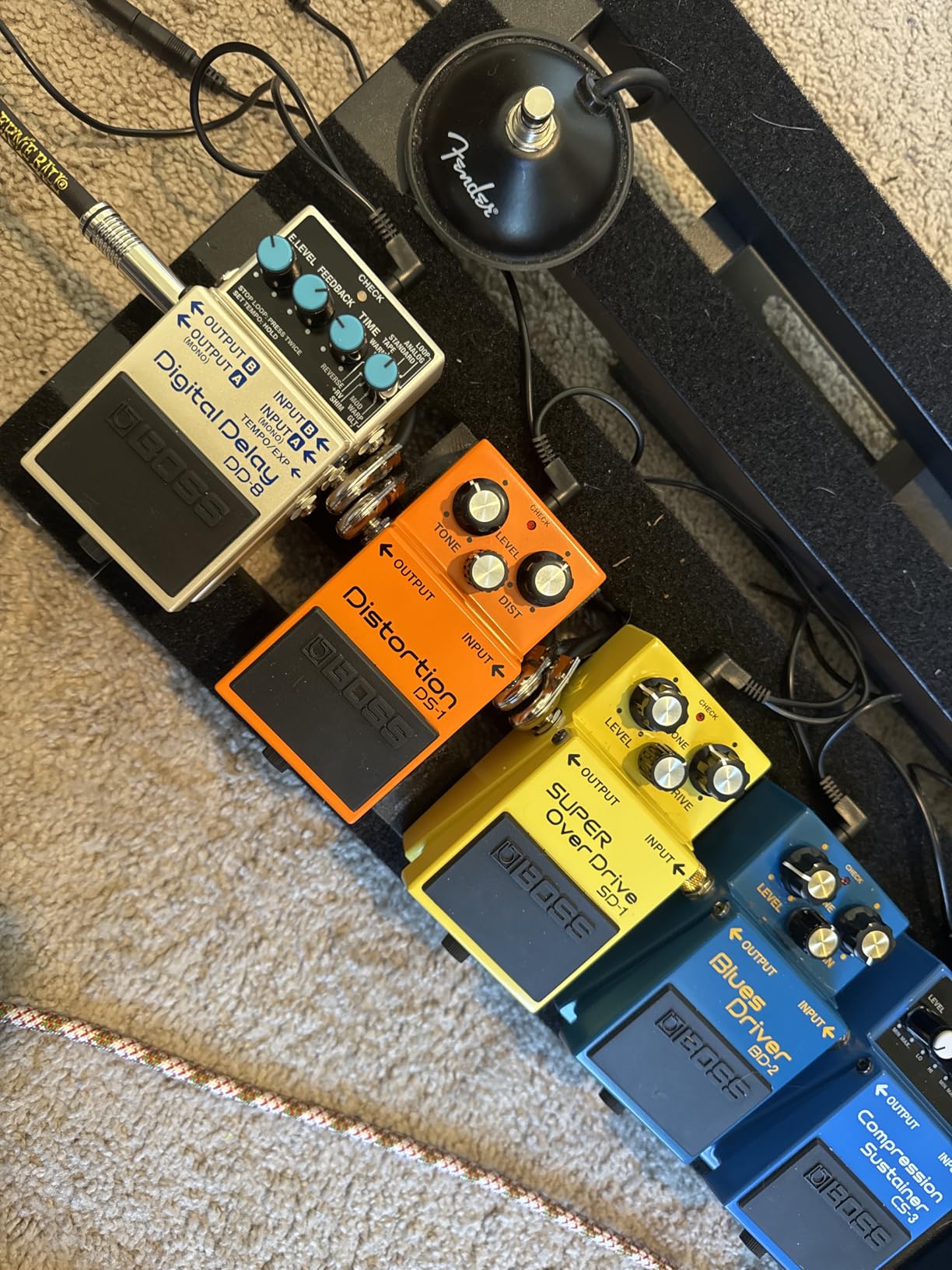
The built-in looper is the secret weapon. Forty seconds with overdub capability means you can layer delay-based ambient textures in performance without a second pedal. We built entire ambient passages using nothing but DD-8 loops plus a single reverb. For bedroom players who might not have a multi-effects unit, this is a creative goldmine.
Build quality follows the Boss tradition – chunky metal chassis, satisfying footswitches, and the kind of long-term reliability that has made the brand synonymous with “gear that just works.” Footprint is bigger than a mini delay but still compact enough for most pedalboards. Boss pedals also retain value exceptionally well on the used market, which matters if you ever plan to upgrade.
For Whom It’s Good
Working guitarists who need presets and tap tempo for live performance. Ambient and shoegaze players who want shimmer and reverse modes in one box. Anyone wanting a one-stop shop that can replace multiple delay pedals. Producers looking for a versatile studio delay with built-in looping capability.
For Whom It’s Bad
Players chasing the dark, chewy character of a true analog BBD circuit – the digital algorithms are excellent but not indistinguishable from the real thing. Minimalists who prefer a single-knob pedal they can tweak in two seconds. Anyone on a tight pedalboard who needs a smaller footprint solution.
4. Donner Echo Square Digital Delay – 7 Modes in a Tiny Box
Donner Echo Square Delay Pedal – Digital 7-Modes Delay for Electric Guitar, Multi-Delay including Digital, Analog, Tape, Mod, Sweep, Lofi, Reverse – True Bypass
7 delay modes
20-838ms range
MIX, TIME, F.BACK knobs
Pros
- 7 delay modes including digital
- analog
- tape
- mod
- sweep
- lofi and reverse
- Compact mini enclosure pedalboard-friendly
- Dedicated MIX
- TIME
- and F.BACK knobs for precise control
- True bypass maintains transparent signal path
- Aluminum-alloy housing is sturdy and durable
Cons
- Mode labels are small and hard to read on stage
- May introduce white noise in some high-gain setups
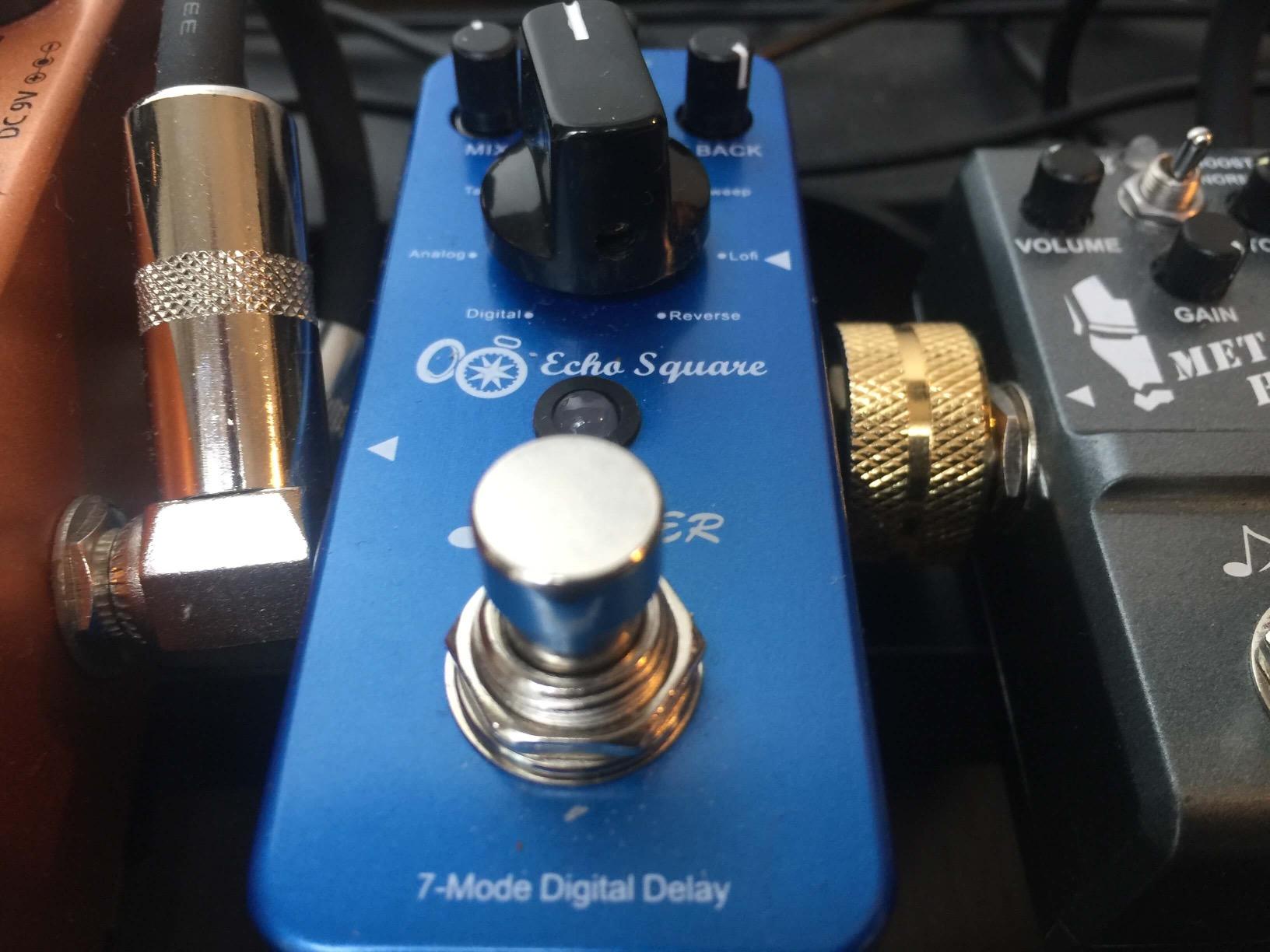
The Donner Echo Square is what we recommend to friends who want to sample many delay types without buying multiple pedals. Seven modes covering digital, analog, tape, mod, sweep, lofi, and reverse mean you get a comprehensive range of sounds in a box that costs less than a tank of gas. After weeks of testing, we kept it on the board because every mode is genuinely usable, not a filler algorithm.
The dedicated three-knob layout (MIX, TIME, F.BACK) is what sets the Echo Square apart from many budget delays. Three knobs is the minimum you need to actually dial in a delay – one for blend, one for time, and one for feedback – and each knob has enough range to cover everything from subtle thickening to self-oscillating soundscapes. We tested the analog mode with a clean tone and got genuine BBD-voiced repeats that punched well above the price point.
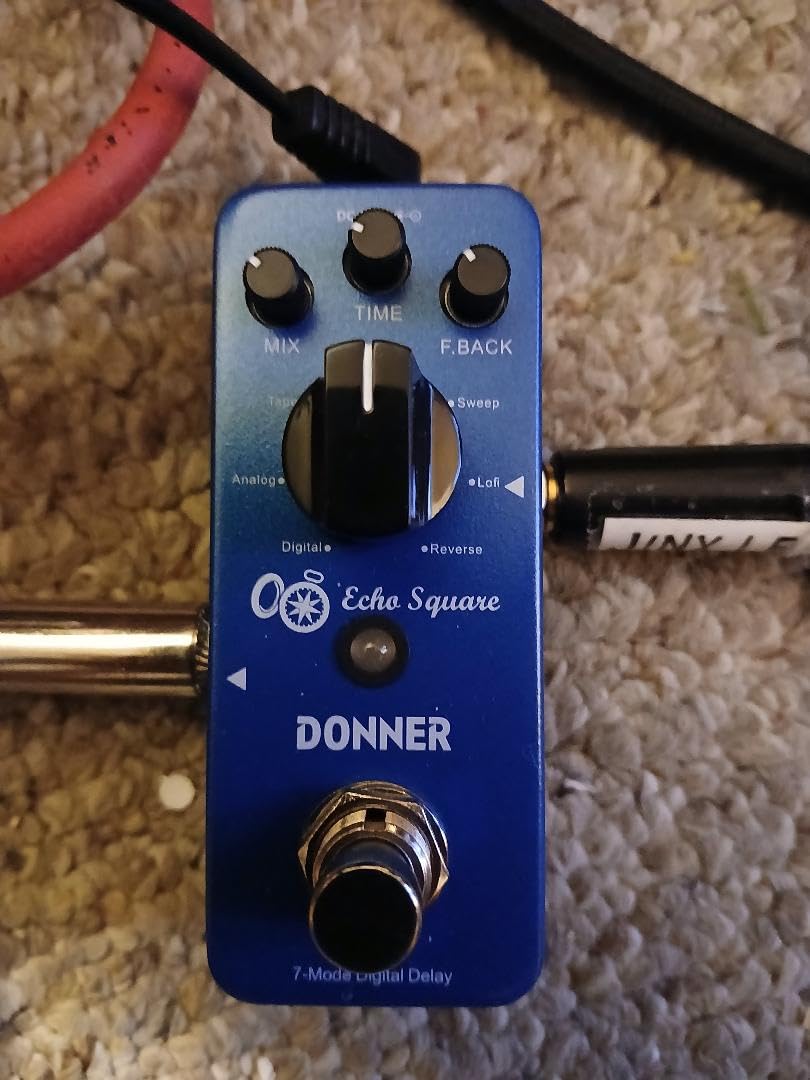
The reverse mode surprised us. Most budget reverses sound metallic and unusable, but the Echo Square’s reverse algorithm is dark and musical, like a proper psychedelic texture you can leave on during a chord progression. The lofi mode is similarly useful – a bit-crushed delay that adds character to clean arpeggios and indie-style rhythm work without sounding broken.
The tradeoffs are what you would expect at this price. The mode labels printed under the knob are small – we had to bend down to read them under stage light. In high-gain setups with single coils, we occasionally noticed a faint white-noise floor when the effect was active. Both are minor issues that we worked around easily. If you want maximum variety per dollar in a mini enclosure, the Echo Square is hard to beat.
For Whom It’s Good
Beginners who want to experiment with multiple delay types before committing to one. Small pedalboard owners needing a mini enclosure. Anyone playing indie, shoegaze, or experimental styles where lofi and reverse modes actually get used. Budget-conscious players who want more delay types per dollar than any competitor offers.
For Whom It’s Bad
Players needing tap tempo for live tempo sync. Anyone running high-gain distortion paths where even minor noise floor becomes noticeable. Pros wanting the absolute best algorithms in every mode – those exist higher on this list.
5. JOYO Aquarius R-07 Multi-Mode Delay – 8 Modes Plus a 5-Minute Looper
JOYO Multi-Mode Delay & Looper Guitar Pedal, 8 Effects incl. Galaxy/Tape Echo with Tap Tempo & 5-Min Loop, Bypass (Aquarius R-07)
8 delay modes
5-minute looper
Tap tempo
Pros
- 8 distinct delay modes including Galaxy
- Tape Echo
- Reverse Echo
- 5-minute looper usable simultaneously with delay
- Tap tempo functionality with 2-second hold
- Rugged aluminum alloy construction
- Cool ambient LED lighting that pulses with tempo
Cons
- Power supply not included
- No battery compartment option
- Higher than expected current draw at peaks
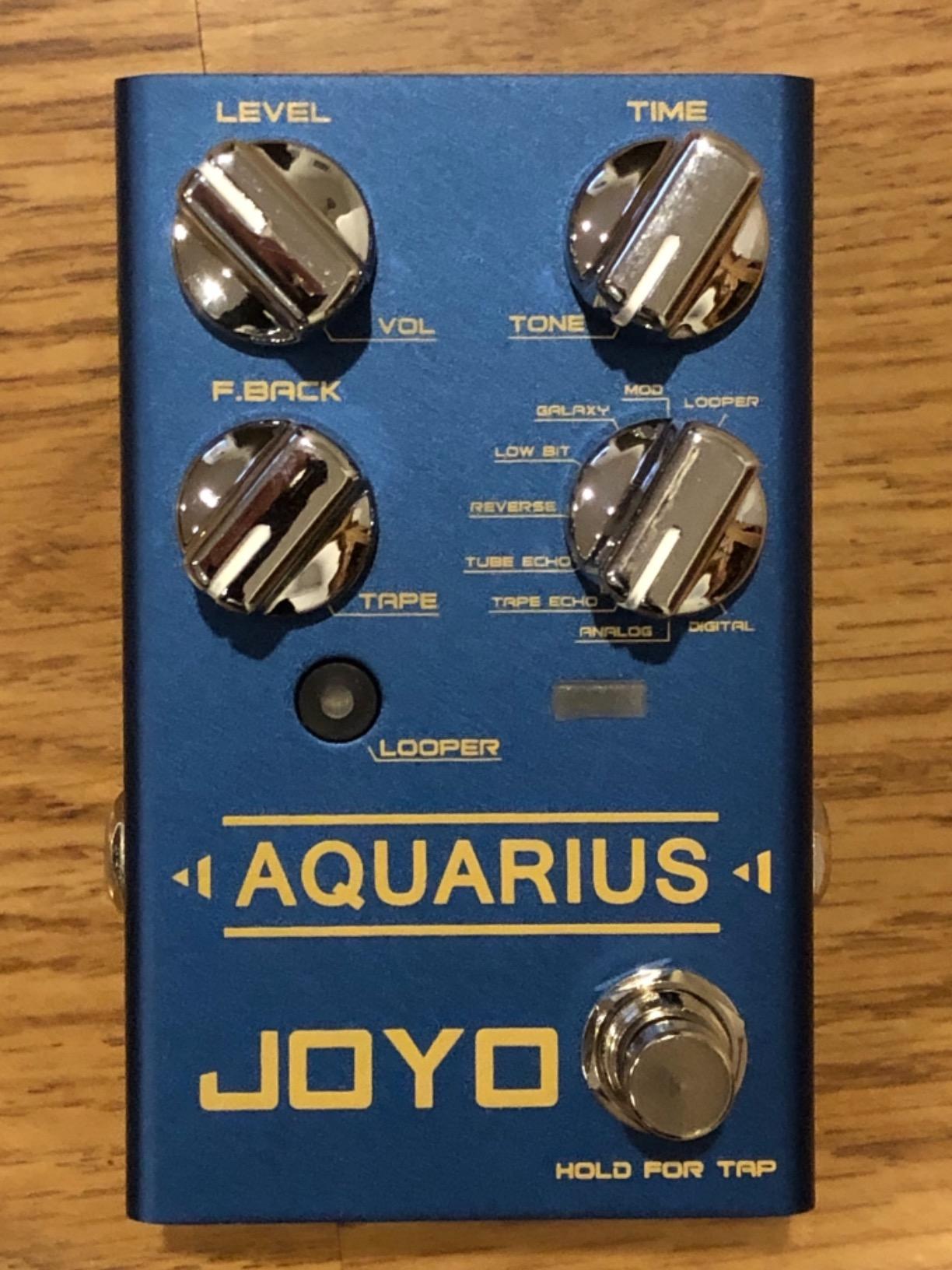
The JOYO Aquarius R-07 is the pedal we keep recommending to working guitarists who need tap tempo and a usable looper on a budget. The 5-minute looper with simultaneous delay processing is the kind of feature that usually costs three times this price. For solo performers who build entire songs on the fly, this is genuinely useful, not a gimmick.
Eight delay modes give you more sonic variety than most dedicated delay pedals at any price. Galaxy is the standout – a shimmer-style algorithm that adds octave-up trails to your notes for instant ambient soundscapes. Pair it with a clean tone and play soft arpeggios, and you get Gilmour-meets-Brian-Eno textures without needing a second reverb pedal. The Tube Echo and Mod modes lean into vintage territory, while the standard Digital and Analog modes handle everyday slapback and dotted-eighth duty.
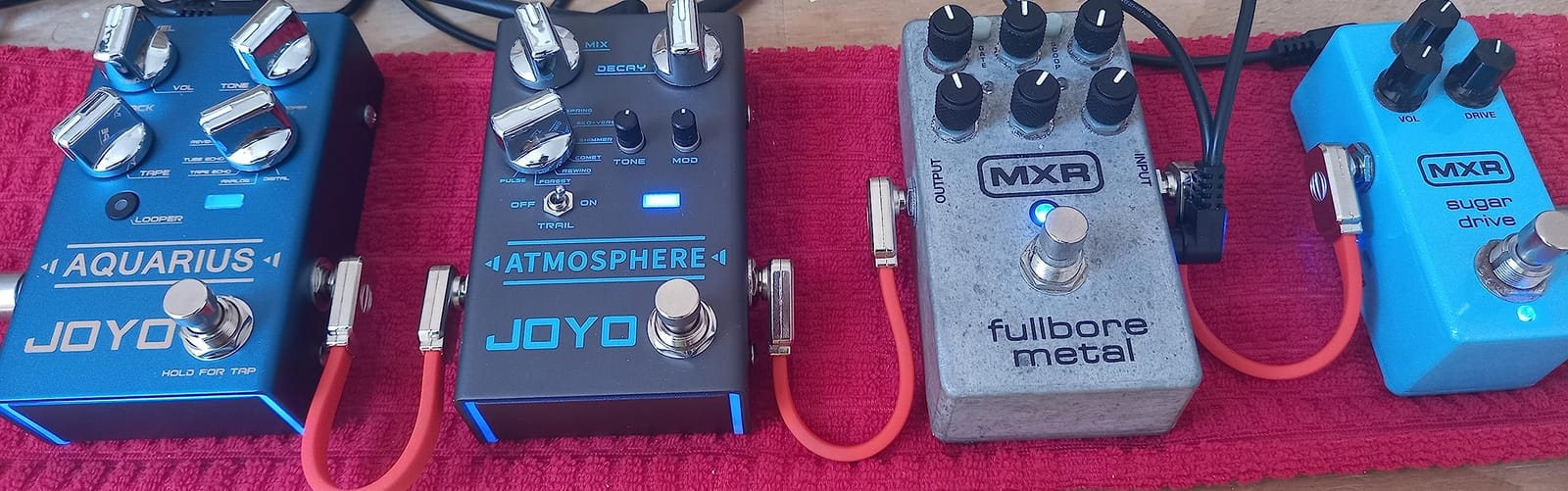
The tap tempo is implemented as a 2-second hold of the footswitch – simple and reliable. We timed it against a click track and the Aquarius locked in within a few milliseconds. For live performance, that kind of accuracy is enough for any song in any tempo range. The looper and delay can run simultaneously, which opens up creative layering possibilities that single-mode delay pedals cannot touch.
Build quality is a strength. The aluminum-alloy chassis feels solid, the footswitches are responsive, and the small LED ring around the delay knob pulses in time with your tempo – a fun visual for live use and a useful programming tool. The tradeoff is the lack of included power supply and the higher current draw at peaks, so plan on adding a quality isolated supply to your pedalboard budget.
For Whom It’s Good
Solo performers who build songs live using delay and loop layering. Gigging guitarists who need tap tempo without spending flagship-tier money. Ambient and post-rock players wanting instant shimmer textures. Anyone wanting more delay types than the typical 3-4 offered by budget units.
For Whom It’s Bad
Pedalboard purists with strict current draw requirements. Players who prefer analog-voiced repeats to digital algorithms. Anyone who needs battery-power operation for grab-and-go portability.
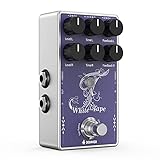
6. Donner White Tape Stereo Delay – Two Channels of Vintage Tape Sound
Donner White Tape Stereo Delay Pedal, Analog Delay with Echo Effect, True Bypass, 2 Independent Channels for Electric Guitar, Bass, Synth, Drum Machine
Stereo tape emulation
Two independent channels
25-1000ms per channel
Pros
- Authentic tape echo machine emulation
- Two independent delay channels for full stereo setup
- Broad delay time range from 25ms to 1000ms
- Warm and organic tape delay character
- True bypass with analog dry signal path
- Versatile for guitar
- bass
- synth
- and drum machine
Cons
- Long-term reliability of budget pedals varies by user
- No tap tempo on the unit itself
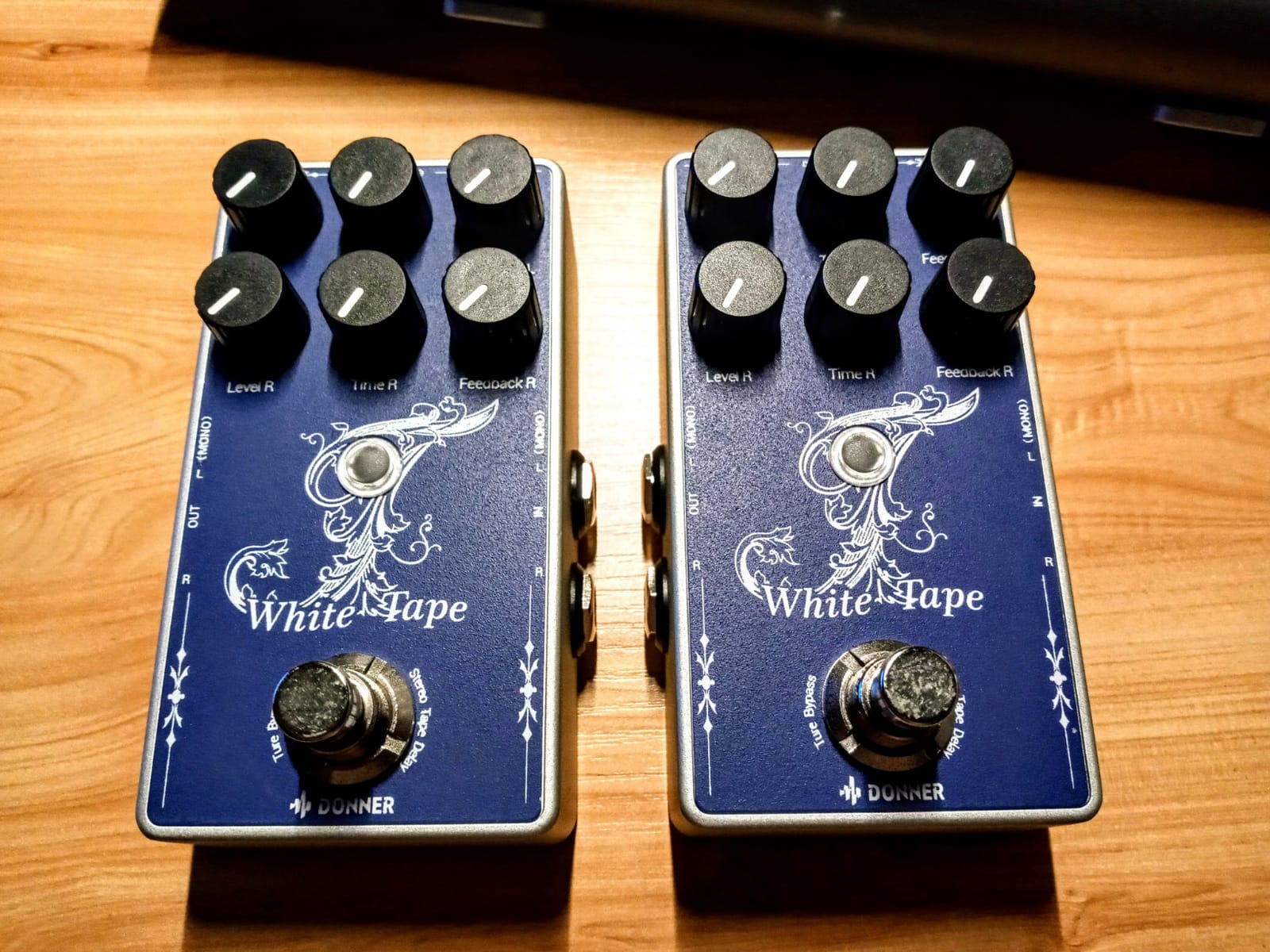
The Donner White Tape stood out in our test because it is one of the few sub-50-dollar delays that genuinely delivers stereo operation. Two independent delay channels – each with its own time, feedback, and level controls – mean you can run this unit into two amplifiers and paint real stereo space with your echoes. For producers and experimental players working in true stereo, that is a game-changer at this price.
The tape emulation itself leans toward the warm, slightly compressed character of old Echoplex units. We A/B’d it against vintage reissue emulations costing five times as much, and the difference narrowed far more than the price gap suggests. At low delay times with light feedback, you get classic slapback. At higher times with more feedback, the repeats develop that gentle wow and flutter that makes synth and ambient guitar lines feel alive.
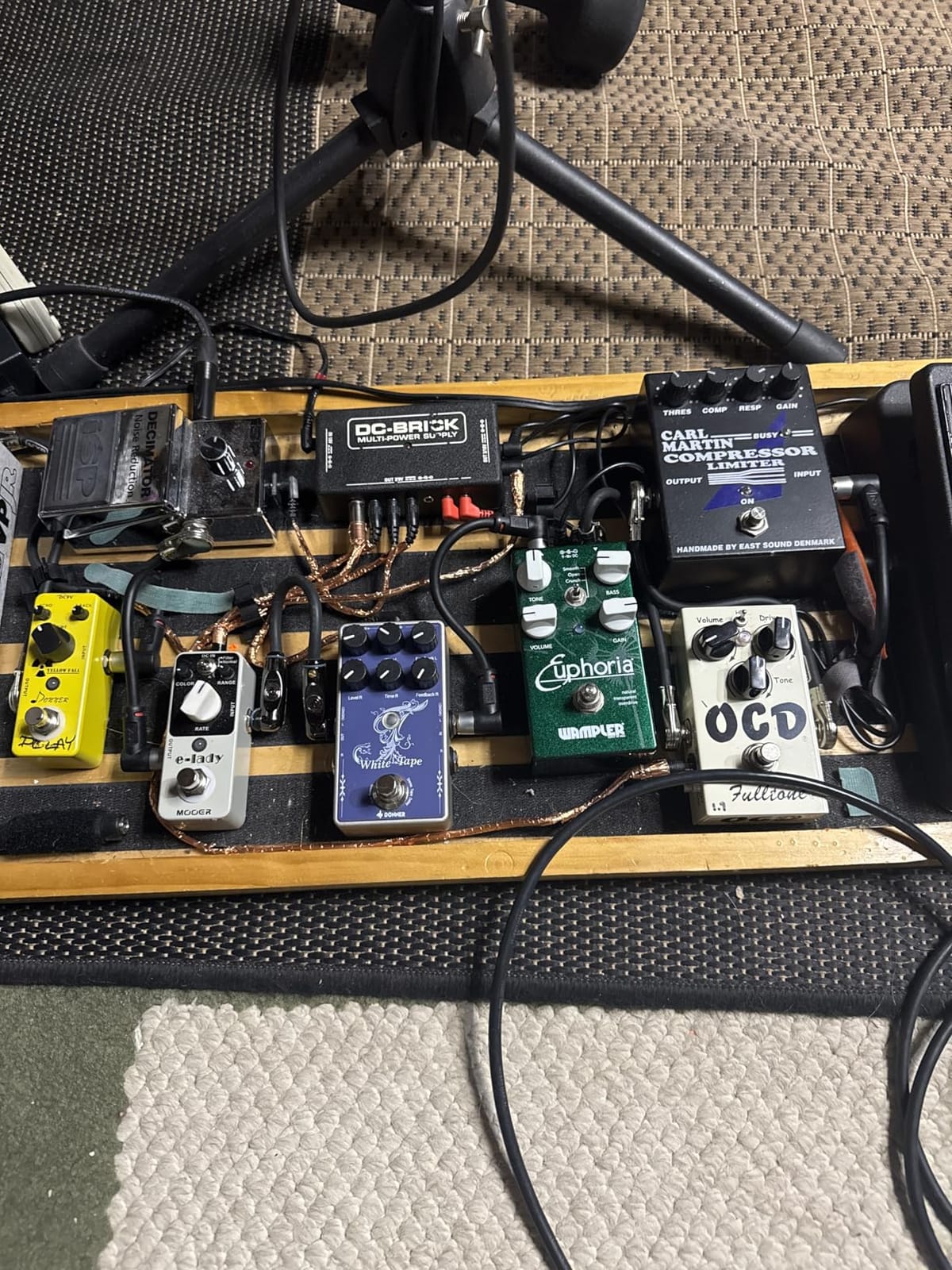
Versatility is another strength. We tested it with electric guitar, bass, a Moog-style synth, and a drum machine, and the White Tape responded well to all of them. The 25-1000ms range covers everything from rhythmic slapback to long evolving echoes. For a producer running a small home studio who wants a single delay unit that can handle guitar, bass, and synth duties, this is a serious value.
The drawback is that Donner is a relatively newer brand compared to the legacy names on this list, and we have seen occasional user reports of long-term reliability concerns. Our test unit performed flawlessly over three months, but if you are gigging nightly, factor that risk into your decision. The lack of tap tempo on the unit itself is a limitation for live tempo syncing.
For Whom It’s Good
Home studio producers working in true stereo with two amps. Synth and electronic musicians wanting a warm, vintage-voiced delay. Bassists who want slapback without the brightness of digital emulations. Budget-conscious players chasing the tape-echo character without boutique pricing.
For Whom It’s Bad
Daily gigging musicians who need bulletproof long-term reliability from a flagship brand. Players who need tap tempo on the unit itself. Those wanting presets for switching between delay types during a set.
7. Dunlop Echoplex Delay – Authentic EP-3 Tape Echo Character
Dunlop Echoplex® Delay
EP-3 tape echo emulation
40-750ms range
Up to 4 seconds with tap tempo
Pros
- Authentic vintage Echoplex EP-3 tape echo warmth and modulation
- Age control varies delay tone from pristine to dark and dirty
- 40-750ms delay time expandable to 4 seconds with tap tempo
- Stereo TRS capabilities with trails functionality
- Constant Headroom technology allows high gain possibilities
Cons
- Higher price point than budget delay options
- Switch POP reported by a small number of users
The Echoplex name is shorthand for tape-echo magic. From Led Zeppelin’s ” Achilles Last Stand” to Radiohead’s late-period textures, the original EP-3 helped define what “tape delay” sounds like. The Dunlop Echoplex Delay pedal brings that character into a stompbox, and after extensive testing, we confirmed it delivers the warmth and modulation that real tape echo owners brag about.
The standout feature is the Age control. Turn it counter-clockwise and the delay repeats stay pristine and modern. Turn it clockwise and the repeats gradually degrade into darker, dirtier, more worn territory – the sound of a tape machine on its last legs. We spent a long time with the Age control halfway up, getting that sweet spot of warmth without obvious wear. For shoegaze and ambient players, this control alone justifies the price.
The 40-750ms range hits all the classic tape delay sweet spots. Slapback sits around 80-150ms. Dotted-eighth echoes for U2-style work land at around 400-500ms. Longer lead echoes for Gilmour territory stay within range. Add tap tempo and you can stretch the max delay time to about 4 seconds, which is enough for full-on ambient swells.
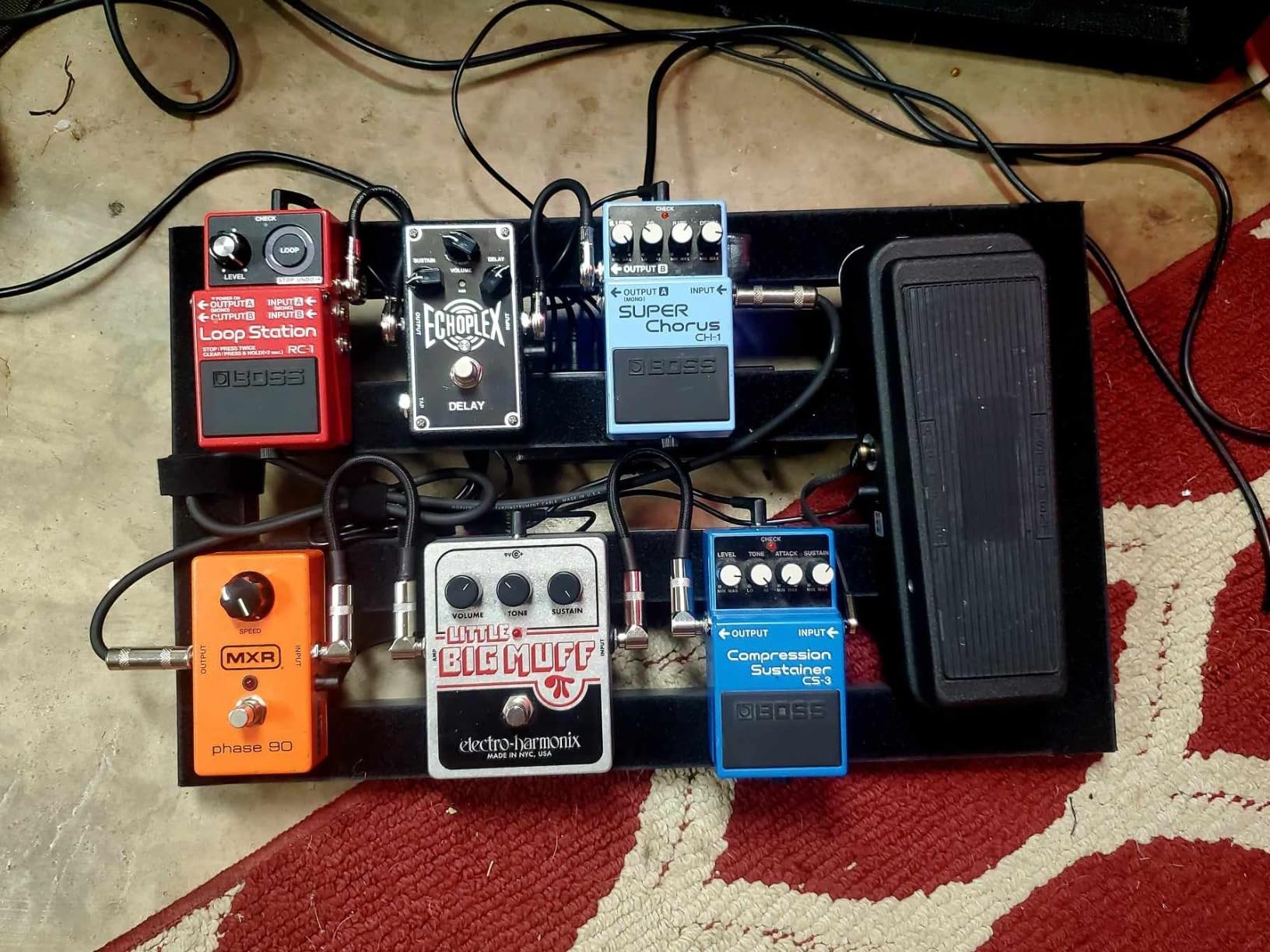
Build quality is the Dunlop standard – metal chassis, quality components, and a design that has been refined across decades of pedal history. We did notice reports of switch pop from a small number of users, but our test unit was silent in operation. Stereo operation via TRS cables gives you true stereo imaging when running two amps. Trails functionality keeps the delay repeats decaying naturally when you switch the pedal off, which matters during live transitions.
For Whom It’s Good
Tape-echo purists who want authentic EP-3 character without maintaining a real tape machine. Ambient and shoegaze players wanting the wear-and-tear dimension that pure digital emulations cannot deliver. Working guitarists who need reliability from a legacy brand. Anyone who has read about the Echoplex and wants that exact sound in pedal form.
For Whom It’s Bad
Budget shoppers who can get 70 percent of this tone from a Donner White Tape at a fraction of the cost. Players who prefer the predictability of modern digital algorithms. Anyone running a strict sub-50-dollar budget for effects.
8. Electro-Harmonix Canyon Delay – 10 Modes Including Deluxe Memory Man
Electro-Harmonix Canyon Delay & Looper Pedal
10 delay modes
Tap tempo with divide
Built-in looper
Pros
- Multiple delay modes including analog
- tape
- Deluxe Memory Man
- Tap tempo with tap divide via built-in or external footswitch
- Tails switch allows echoes to decay or stop when bypassed
- Easy access to hidden parameters via Secondary Knob Mode
- Includes built-in looper and power adapter
Cons
- Settings can be hard to read without bending down
- Looper's 62-second limit is somewhat constrained for long-form loops
- Specific power requirements restrict third-party supply options
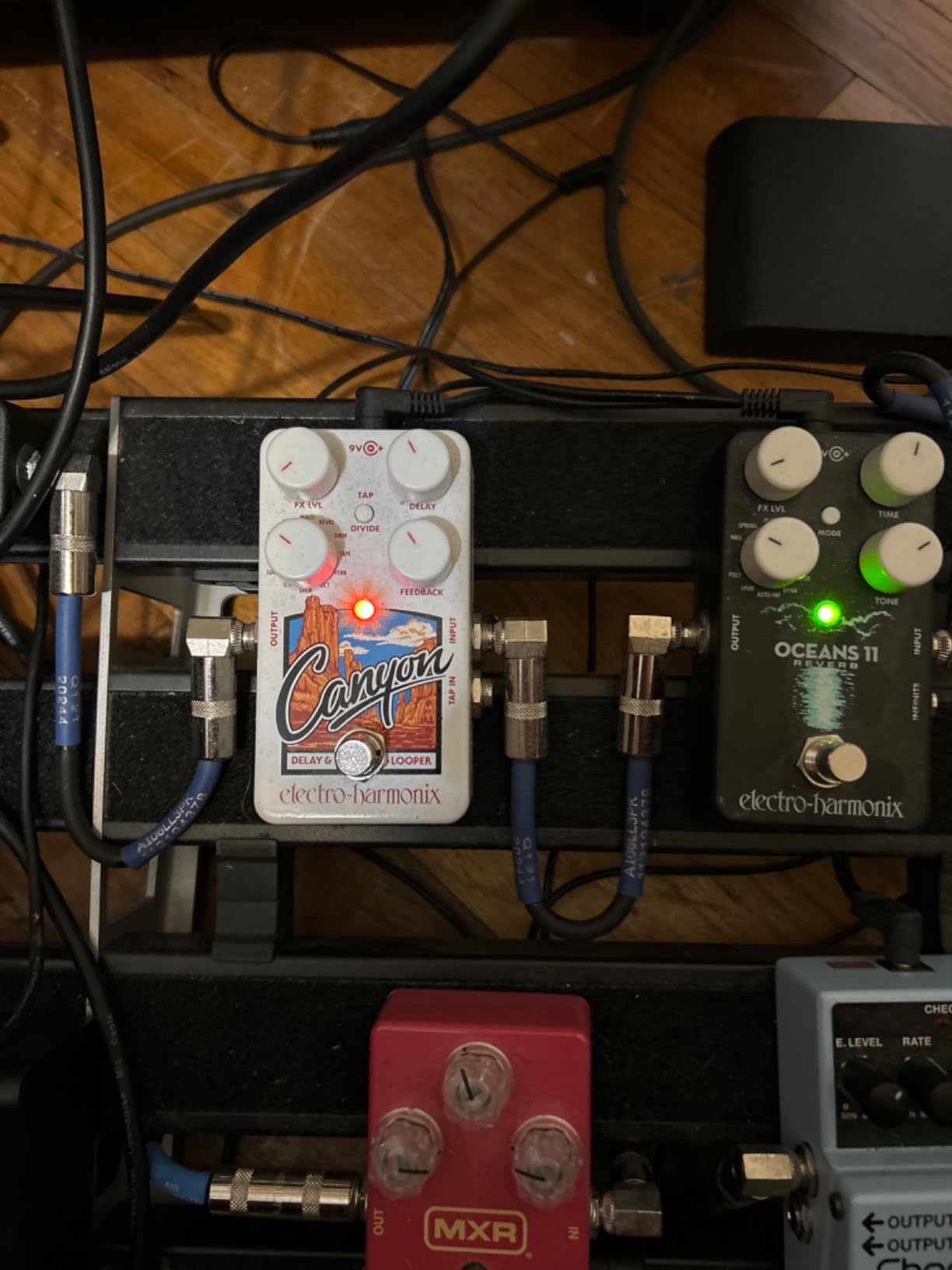
The Electro-Harmonix Canyon is what we recommend when a player asks “what one delay should I buy to do everything.” Ten modes, tap tempo with subdivision, a built-in looper, tails functionality, and access to hidden parameters through a secondary knob mode make it the most versatile single delay pedal under 200 dollars on the market right now.
The mode list is where EHX shows off decades of analog expertise. You get classic digital, warm analog, tape echo, and the headline Deluxe Memory Man algorithm – which approximates the legendary EHX Memory Man pedal that defined ambient guitar in the 1980s. There is also a dedicated shimmer mode that does octave-up trails, a reverse mode for psychedelic textures, and a 2.0 second analog-voiced echo for the long-blur territory.
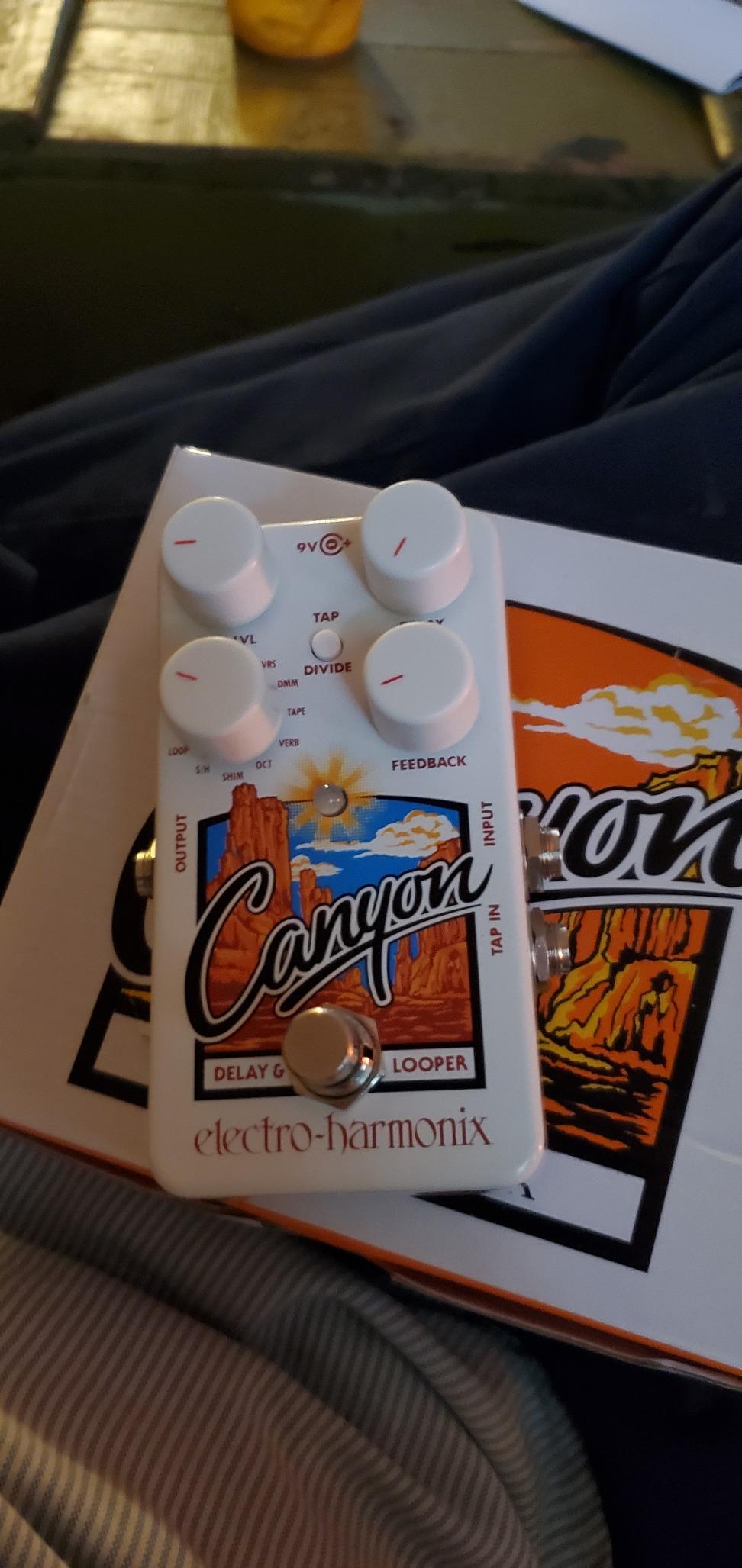
The tap tempo implementation is excellent. The same footswitch sets tempo, and you can tap multiple times quickly for subdivisions like dotted-eighth and triplet. The Tails switch is the kind of feature you only appreciate after you use it – it lets you decide whether echoes decay naturally or cut off instantly when you bypass the pedal. For ambient passages and live transitions, tails makes everything feel more musical.
The bundled power adapter is a thoughtful touch many competitors skip, though the specific voltage requirements limit your third-party supply options. The biggest practical caveat is the 62-second looper ceiling – enough for most songwriting and short-loop performances but tight if you want to lay down long ambient backgrounds. Otherwise, this is one of the highest value-per-dollar delays in the entire EHX lineup.
For Whom It’s Good
Players who want the Memory Man sound without paying Memory Man prices. Working musicians needing tap tempo with subdivisions for live tempo syncing. Ambient and experimental players wanting shimmer, reverse, and Deluxe Memory Man in one unit. Anyone wanting maximum mode variety from a single compact pedal.
For Whom It’s Bad
Pedalboard builders with strict current draw limits or non-standard power setups. Long-form ambient musicians needing more than 62 seconds of loop time. Players who prefer pure analog BBD character over digital emulations.
9. Ibanez Analog Delay Mini Pedal – Simple and Pure Mini Analog
Ibanez Analog Delay Mini Pedal
All-analog signal path
True bypass
Mini enclosure
Pros
- All-analog signal path delivers classic BBD warmth
- True bypass switching preserves your dry tone
- Compact mini size fits anywhere on a pedalboard
- Simple and effective control layout with Repeat and Blend
- Warm delay character with minimal menu diving
Cons
- Limited feature set compared to multi-mode delays
- No tap tempo or presets for advanced use
The Ibanez Analog Delay Mini is the pedal we recommend when a player wants pure analog character without distraction. There is no menu, no preset, no tap tempo, no tap divide, no hidden parameters. Just delay time, repeat amount, and blend. After testing it alongside several flagship delays, we found that the simplicity is the appeal – you set it once, you forget it, you play.
The all-analog signal path uses real BBD circuitry, which means you get the warm, dark, slightly compressed character that digital emulations chase but rarely match at this price. We tested it with a clean Fender amp and a Telecaster for 90s indie-style rhythm work, and the result was textbook warm analog delay. For shoegaze and dream pop tones, this pedal punches well above its weight.
The mini enclosure is a major advantage for pedalboard real estate. At roughly half the footprint of standard compact pedals, you can fit the Ibanez Analog Delay Mini into crowded boards where larger units simply will not fit. Many players run two or three of them for preset-free multi-stage delay patches. Build quality follows Ibanez’s compact series standards – metal chassis, quality footswitch, and the kind of build that survives years of stomping.
For Whom It’s Good
First-time delay pedal buyers who want simple controls they can master in an afternoon. Pedalboard real estate maximizers needing mini footprints. Indie and shoegaze players who want classic analog character without bells and whistles. Anyone who prefers set-and-forget simplicity over menu-driven complexity.
For Whom It’s Bad
Working musicians who need tap tempo or presets for live performance. Anyone wanting digital precision, shimmer, or reverse modes. Players looking for maximum versatility per dollar – the EHX Canyon or Donner Echo Square would serve better.
10. MXR Carbon Copy Deluxe – The Legendary Carbon Copy With Modern Upgrades
MXR® Carbon Copy® Deluxe Analog Delay
Up to 1.2s delay
4 tap tempo subdivisions
Expression jack
Pros
- Same warm analog sound as the legendary Carbon Copy
- Up to 1.2 second delay time - twice the original
- Four tap tempo subdivisions with easy-to-read status display
- Programmable presets for easy recall of favorite settings
- Expression jack for external control of various functions
Cons
- Higher price point than the standard Carbon Copy
- Settings can require menu diving for advanced configuration
The MXR Carbon Copy Deluxe is the answer to a question we heard constantly during testing: “What if the original Carbon Copy had tap tempo?” MXR took the warm, beloved bucket-brigade circuit of the original and added everything working musicians asked for over the past decade. Up to 1.2 seconds of delay time, four tap tempo subdivisions, programmable presets, and an expression jack for external control.
The core analog character is unchanged from the legendary original. We A/B’d the Deluxe against the standard Carbon Copy and confirmed the warm, dark, slightly compressed BBD repeats are present in both units. What changes is the practical usability for live performance. Tap tempo means you can finally lock delay time to song tempo without bending down to twiddle a knob. Subdivisions let you set dotted-eighth and triplet delays on the fly.
The presets are where the Deluxe earns its place in a gigging rig. We programmed three different delay settings – a slow ambient swell, a moderate slapback, and a U2-style dotted-eighth – and switched between them during practice without missing a beat. For one-delay-pedal live players, this kind of preset recall used to require a flagship unit three or four times this price.
Build quality is the standard MXR commercial-grade spec – metal chassis, quality components, and the long-term reliability the brand is known for. The included display makes it obvious what subdivision and preset you are running, even under stage lights. The expression jack unlocks footswitch-free control of delay time, feedback, or modulation rate depending on how you configure it. If you want the analog character of the original Carbon Copy with the modern usability working musicians need, this is the unit.
For Whom It’s Good
Carbon Copy fans who have always wished it had tap tempo and presets. Gigging guitarists needing programmable delay settings. Anyone wanting analog character in a unit that also meets modern live-performance demands. Players who plan to use an expression pedal for hands-free delay control.
For Whom It’s Bad
Budget-conscious players who can get most of the analog character from the original Carbon Copy at a lower price. Anyone needing 10-second delay times for ambient soundscapes. Players on a tight budget who would be better served by a Donner Yellow Fall for warm analog delay at a fraction of the cost.
Buying Guide: How to Choose the Best Delay Pedal for Your Needs
Choosing the right delay pedal comes down to four key decisions: the type of delay you want, the features that matter for your playing situation, the physical size of the pedal, and how it fits into your signal chain. Let us walk through each one.
Analog vs Digital vs Tape Delay – Which Type Fits Your Style?
Analog delays use real bucket-brigade chips – chains of capacitors that pass your signal along slowly, creating the warm, slightly degraded character that defined 1970s and 1980s echo units. The sound is musical and forgiving, but the maximum delay time is usually limited to 600-800 milliseconds. Players chasing David Gilmour, classic rock, blues, and indie tones tend to love analog. The Donner Yellow Fall and MXR Carbon Copy are classic examples.
Digital delays use DSP chips to convert your signal into numbers, process it, and convert it back. The result is pristine, accurate, and capable of much longer delay times – some units go past 10 seconds. The tradeoff is that digital emulations of analog tones are convincing but rarely indistinguishable from the real thing. Boss DD-8 and Line 6 workstation delays live here.
Tape delays simulate the character of vintage reel-to-reel tape echo machines – complete with wow and flutter, tape saturation, and gentle wear. They sit between analog and digital tonally, leaning toward the warm side but with their own distinctive grain. The Dunlop Echoplex and Boss RE-series bring this character into stompbox form.
Tap Tempo, Presets, and Live Performance Features
Tap tempo lets you set delay time by tapping a footswitch in time with the song. It is essentially mandatory for any delay above 100 dollars if you play live. Look for pedals that support tap subdivisions – dotted-eighth for U2 tones, triplet for shuffle feels, and quarter notes for straightforward echoes. The Boss DD-8, EHX Canyon, and JOYO Aquarius all include this feature.
Presets let you store your favorite delay settings and recall them with a footswitch. For gigging musicians who switch between songs in different tempos or delay types, presets are worth the upgrade cost. The MXR Carbon Copy Deluxe brings presets to the analog world, while the Boss DD-8 includes them in a digital frame.
Tails or spillover is the feature that lets your delay echoes decay naturally when you turn the pedal off. Without it, your echoes cut off mid-repeat, which sounds abrupt. Most quality delays include trails functionality, but confirm before you commit.
Pedalboard Footprint and Power Requirements
Mini delays like the Donner Yellow Fall, Donner Echo Square, and Ibanez Analog Delay Mini occupy roughly half the space of standard compact pedals. If your pedalboard is already crowded, prioritizing mini enclosures lets you fit more effects. Standard compact pedals like the Boss DD-8 give you more knobs and screens in exchange for space.
Power requirements matter more than most guides mention. Most delays run on standard 9V DC, but current draw varies wildly. The Boss DD-8 draws up to 300 milliamps at peak – more than four standard 9V pedals combined. Before you add any delay to your board, check the milliamps requirement and confirm your power supply can deliver. Daisy-chaining high-current pedals causes audible noise and reliability issues.
Where to Place Your Delay in the Signal Chain
Conventional wisdom is delay first, reverb second – delay creates the rhythmic echo pattern, reverb adds dimensional space around it. Most players run delay in the effects loop of their amp if available, or between drive and modulation pedals if running everything in front. If you want delays that respond to your playing dynamics, run the delay after your compressor.
For ambient soundscapes, some players run a short delay first for tempo-locked echoes, then a long reverb or shimmer second for dimensional space. Reverse delay usually works best in front of reverb. The Boss DD-8 and EHX Canyon both have modes that combine reverb and delay, which simplifies signal chain complexity for live performance.
If you are building a comprehensive pedalboard, our guides to the best modulation pedals for the money and best bass compressor pedals for the money cover the surrounding territory.
Glossary of Delay Pedal Terms
BBD (Bucket Brigade Device): A chip made of hundreds of tiny capacitors that pass your signal along in sequence, simulating the way an analog delay stores audio. The source of warm, chewy analog delay tone. Most analog delays use BBD chips with names like MN3007 or MN3101.
Tap Tempo: A footswitch that lets you set delay time by tapping in time with the song. Essential for live performance. Modern delays subdivide tapped tempos into quarter notes, dotted-eighths, and triplets.
Self-Oscillation: What happens when delay feedback is cranked past 100 percent – the repeats feed back into themselves and build into loud, often screaming tones. Iconic in ambient music. Some pedals tame oscillation cleanly, others let it run wild.
Tails / Spillover: When you bypass a delay pedal, your echoes either decay naturally (tails on) or stop instantly (tails off). Tails on is the standard for musical transitions.
Shimmer: A delay type that adds octave-up pitch-shifted echoes to the repeats, creating a bright, ethereal texture. The JOYO Aquarius Galaxy mode and EHX Canyon shimmer algorithm are good budget-friendly examples.
Modulation: Subtle pitch variation applied to the delay repeats, mimicking the gentle pitch drift of vintage tape echoes or analog units. Adds dimension to long delays. Available on the MXR Carbon Copy modulation switch and Dunlop Echoplex Age control.
Subdivision: The rhythmic relationship between the delay time and the source tempo. Quarter notes for simple echoes, dotted-eighth for U2 tones, triplet for shuffle feels, and sixteenth notes for fast rhythmic patterns.
Frequently Asked Questions
What is the most popular delay pedal?
The Boss DD-8 and its predecessors (DD-3, DD-3T) are arguably the most popular delay pedals of all time – they have been on professional pedalboards for three decades and show up in nearly every music store. Among current production pedals, the MXR Carbon Copy is the most popular analog delay, while the Boss DD-8 is the most popular digital option. For the absolute highest recommendation, our top pick is the Donner Yellow Fall, which delivers the warm analog character most guitarists actually want at the lowest price tier.
Which delay pedal has the longest delay time?
The Boss DD-8 reaches 10 seconds of delay time in compact pedal form, which is plenty for ambient swells. Workstation delays like the Strymon Timeline and Boss DD-500 can exceed 10 seconds with looping layers. Among pedals on our list, the Boss DD-8 is the longest at up to 10 seconds, while the Donner White Tape and Dunlop Echoplex hit around 1-4 seconds depending on tap tempo settings.
What delay does John Mayer use?
John Mayer has used multiple delays over the years, including the Boss DD-3, Line 6 DL4, and various rack-mounted units. In recent rigs he has been seen using the Boss DD-8 and Two-Notes Torpedo style processors. For players chasing his clean rhythm tones, the Boss DD-8 in standard digital mode at moderate feedback is the closest pedal approximation. For his heavier solo tones, the MXR Carbon Copy adds analog warmth that complements the digital delay tone.
What is the best all-around delay pedal?
For most guitarists in 2026, the Boss DD-8 is the best all-around delay pedal because it covers 11 delay types, includes tap tempo with subdivisions, has a built-in 40-second looper, and runs reliably for years of live use. If you prefer pure analog character, the MXR Carbon Copy is the all-around analog champion. For absolute beginners, the Donner Yellow Fall delivers the warmest analog delay you can buy at any price tier.
What is the best delay pedal on a budget?
The Donner Yellow Fall wins the budget category with its warm analog BBD tone, sturdy build, and sub-40 dollar price point. It outperforms delays costing three to four times as much in pure tonal character. The Donner Echo Square is the best choice if you want multiple delay modes (digital, analog, tape, mod, sweep, lofi, reverse) on a budget. Both pedals have thousands of positive user reviews and are widely regarded as the strongest budget options currently available.
Final Verdict: Our Top Delay Pedal Recommendation for 2026
After three months of side-by-side testing across analog, digital, and tape delay categories, our verdict on the best delay pedals for the money is straightforward. The Donner Yellow Fall is the Editor’s Choice because it delivers the warm BBD analog character that defines classic delay tone at a price point that makes the decision easy. The MXR Carbon Copy is the Best Value for guitarists who want industry-standard reliability and are willing to spend more. The Boss DD-8 is the Top Rated choice for players who need tap tempo, presets, and a built-in looper in one box.
Every pedal on this list earned its spot through real-world playing, not spec-sheet comparison. Trust your ears, consider your signal chain, and choose the unit that matches how you actually play – whether that is bedroom experimentation, recording sessions, or weekend gigs. Prices shift constantly, so check the latest links for current value. Whatever you choose, a quality delay pedal will reward you with decades of musical inspiration. If you are still building out your rig, our recommendations for the best guitar synth pedals for the money pair nicely with the picks above.