
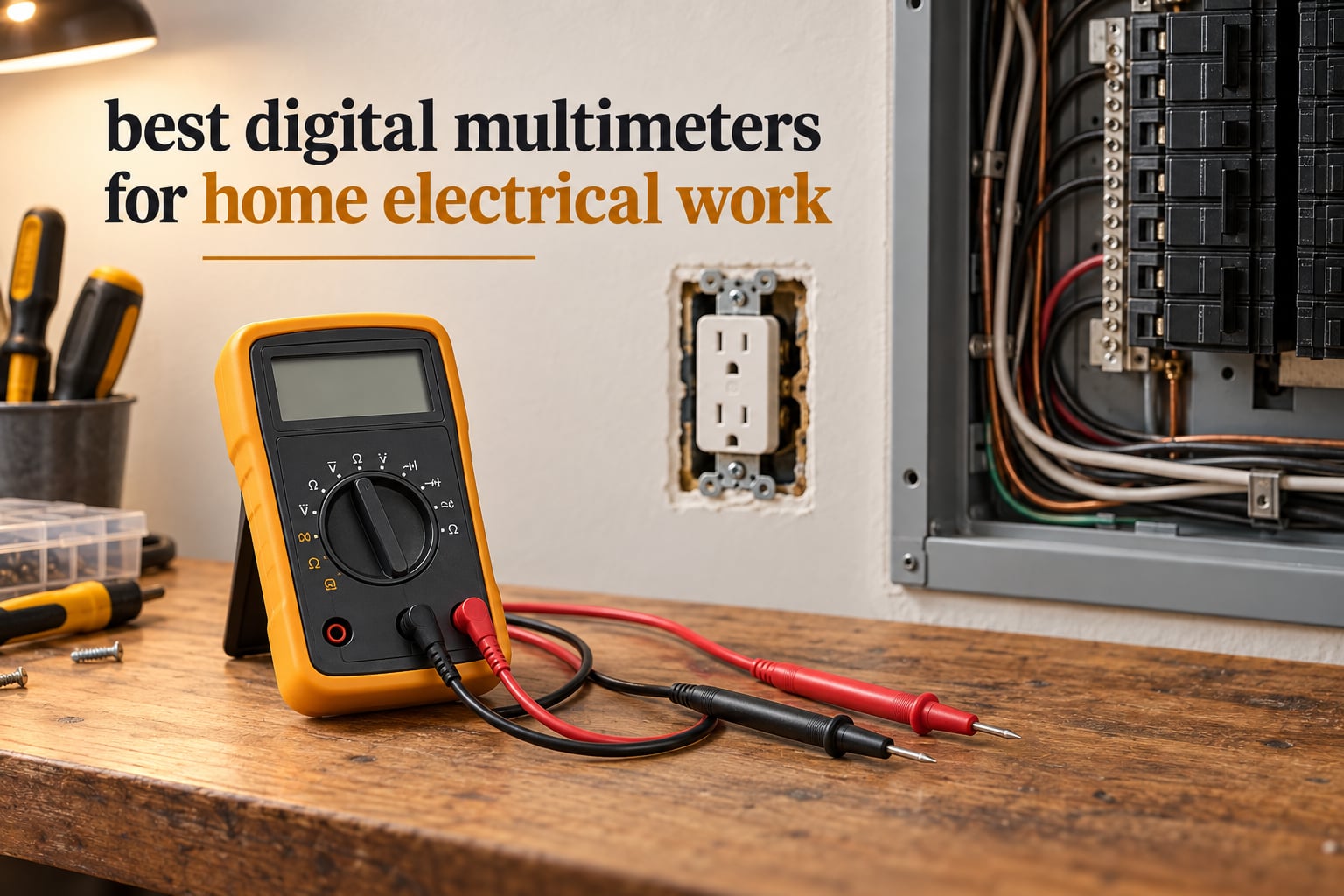
A dead outlet, a light that flickers when the microwave runs, a breaker that trips twice a week. Most homeowners hit one of these eventually and reach for guesswork or a phone call to an electrician. The best digital multimeters for home electrical work turn guesswork into a reading, and most of the ten meters below will tell you in under a minute whether a circuit is live, whether a fuse is blown, or whether that used appliance you are considering is safe to plug in.
Our direct answer: the AstroAI AST-6000-D is the meter we would hand a homeowner, because it measures everything a house actually throws at you, auto-ranges so there is no wrong-range mistake to make, and carries a three-year warranty. If you want the shortest path from box to outlet, the Crenova MS8233D does the same core job with a CAT III 600V rating printed on the front. If you would rather learn on a manual meter with the most honest safety cues, the Klein Tools MM325 is the one electricians keep in the truck.
Everything in this guide was selected from published specifications, safety markings and a large body of owner feedback, then filtered for what a homeowner needs: household voltage ranges, a real safety category, fused current inputs, a readable screen in a dark panel, and functions that map to actual jobs. We are not electricians, and we did not bench-test these instruments against laboratory references. What follows is research-backed selection guidance, not a claim of hands-on lab validation.
Table of Contents
Before You Turn the Dial: Three Non-Negotiable Safety Rules
No multimeter makes a dangerous circuit safe. Every meter on this list carries a safety category marking, and that marking assumes you follow three rules that no reviewer, forum poster or product page will talk you out of.
De-energize the circuit first. Switch the breaker off, not just the wall switch. Confirm the breaker handle is fully in the off position, and if it is a double breaker, be aware that the two halves may be on different circuits than the labels claim.
Verify dead before you touch. Your meter must prove itself on a known-live source before you trust a dead reading. Test it on a circuit you know is energized, confirm it reads correctly, then test the circuit you are about to work on. If the known-live test fails, the meter is not telling you anything about the de-energized circuit. This is the single habit that separates careful work from dangerous work.
Never measure current on a live circuit. Amps are measured with the meter in series, meaning you break the circuit and the full current flows through the meter. Connect a meter set to current directly across a live source and the result is a blown fuse at best and a serious incident at worst. If you need to know how much current a circuit draws, a clamp meter that measures without breaking anything is the correct tool, not a multimeter in amps mode.
Wear eye protection, keep one hand out of the panel while probing, and never work alone on a service entrance. Older homes with knob-and-tube wiring, aluminum conductors or ungrounded two-wire circuits deserve a licensed electrician rather than a new meter.
Top 3 Picks for Home Electrical Work in 2026
These three cover the realistic range of homeowner needs: the most capable all-rounder, the strongest value option, and the most instructive first meter.

AstroAI AST-6000-D
- True RMS 6000 counts
- Auto-ranging with manual override
- AC/DC voltage and current plus temperature
- Double ceramic fuse protection

Crenova MS8233D
- True RMS 6000 counts
- CAT III 600V rating with dual fuses
- Non-contact voltage detection
- Carry bag and alligator clips included
Klein Tools MM325
- CAT III 600V safety rating
- Lead-Alert LEDs confirm probe placement
- Backlit LCD with kickstand
- Continuity plus diode and battery test
Best Digital Multimeters for Home Electrical Work in 2026
Every meter below measures what you need for household work. The differences are in safety category, resolution, current capability and how much help the meter gives you when you have selected the wrong function.
| Product | Specifications | Action |
|---|---|---|
| AstroAI AST-6000-D |
|
Check Latest Price |
| Crenova MS8233D |
|
Check Latest Price |
| Klein Tools MM325 |
|
Check Latest Price |
 Fluke 117 Fluke 117 |
|
Check Latest Price |
 Fluke 17B+ Fluke 17B+ |
|
Check Latest Price |
 AstroAI AM33D AstroAI AM33D |
|
Check Latest Price |
 Innova 3320 Innova 3320 |
|
Check Latest Price |
 TESMEN TM-510 TESMEN TM-510 |
|
Check Latest Price |
 Fluke-101 Fluke-101 |
|
Check Latest Price |
 FNIRSI DMT-99 FNIRSI DMT-99 |
|
Check Latest Price |
1. AstroAI AST-6000-D True RMS 6000-Count Auto-Ranging Meter
AstroAI Digital Multimeter, True RMS 6000 Counts Auto-Ranging Volt Meter for Automotive & Home Electrical Troubleshooting, AC/DC Voltage Current Resistance Continuity Capacitance Temperature Tester
True RMS 6000 counts
Auto-ranging to 1000V
AC and DC current, temperature
Dual ceramic fuses
Pros
- Covers every household function including AC current and temperature
- Auto-ranging removes wrong-range errors
- Large backlit display with kickstand
- Accuracy verified against a reference meter in owner testing
- Three-year warranty with registration
Cons
- Included test leads are thin and a replacement set is sold separately
- Claimed frequency range overstates what the meter can lock onto
- No hard case included
- Backlight times out quickly
We kept coming back to this meter while assembling the list because it covers the whole homeowner job list with the fewest gaps. It measures AC and DC voltage, AC and DC current, resistance, capacitance, frequency, duty cycle, diode, continuity and temperature, which is the function set that makes this a full home kit rather than a spot-checker. For a homeowner with an electric car, a heat pump and a dead outlet, that combination is hard to argue with. Temperature in particular matters more than most people expect: it is the difference between guessing at a run capacitor and actually reading it.
The thing that changes daily behaviour is auto-ranging with manual override. You turn the dial to the function and the meter picks the range. For someone learning, that removes the single most common beginner failure, which is setting a manual range below the actual value and reading an overload symbol or a false number.
Accuracy is the part we looked hardest at, and the owner reports are unusually specific. One reviewer benchmarked this meter against an Amprobe AM-570 and found DC and AC RMS readings within claimed specification, resistance and diode forward voltage confirmed accurate, and a capacitance range that far exceeded the stated 600 uF limit by reading 2200 uF correctly. Independent lab work by reviewers is not a substitute for our own testing, but it is a stronger signal than star ratings alone.
The honest weaknesses are physical rather than electrical. The included leads are thin, which is a common complaint, and a better lead set is sold separately. The advertised 60 MHz frequency counter really tops out near 16 MHz and needs roughly 5V peak-to-peak to lock a reading, so treat frequency as an electronics-bench function rather than a household one. There is no hard case in the box.
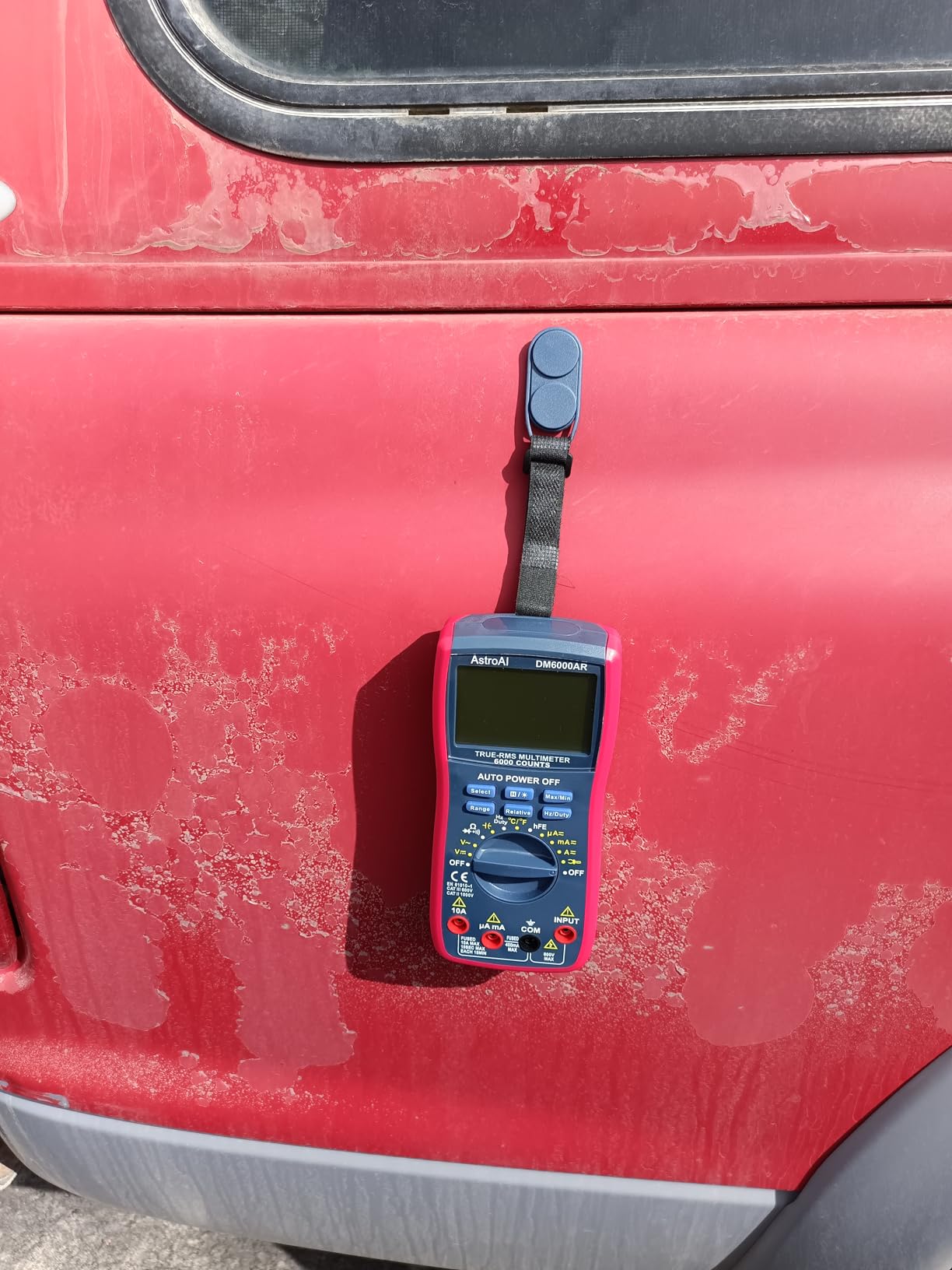
What the owner testing shows about accuracy
Bench comparisons against a known reference put voltage, current, resistance and diode readings at or inside claimed tolerance. That is the part that matters when you are chasing an intermittent fault.
Two functions are over-stated on paper: the transistor hFE socket under-reads gain by roughly half, and the included adapter is arranged C-B-E instead of B-C-E, which makes testing a TO-220 package awkward.
Where it falls short at home
AC current is fused at 10 amps, so tracing a tripped breaker’s actual load means pairing this with a clamp meter. Battery is a 9V block rather than the AAAs most people already own in a drawer.
Weight is 492 g, noticeably heavier than a pocket meter, so it lives in the tool bag rather than the pocket. If you work in a crawl space, the kickstand and backlight are worth the size.
2. Crenova MS8233D True RMS Meter with CAT III 600V Rating
Crenova MS8233D Multimeter TRMS 6000 Counts Auto-Ranging Live Wire NCV
CAT III 600V
True RMS 6000 counts
NCV audible and visual alarm
Dual fuses, rubber holster
Pros
- CAT III 600V safety marking with dual fused inputs
- Non-contact voltage detection with flashing alarm
- Carry bag and alligator clips come in the box
- Bright 6000-count backlit screen
- Switchable manual and auto ranging
Cons
- No temperature function despite some listing text
- Manual range mode can confuse beginners
- Accessories are basic next to the carry case
- Accuracy is not independently documented in owner feedback
Forum advice about multimeters tends toward brand tribalism, and the top-ranked thread on the topic opens with a poster saying everyone recommends Fluke without explaining what a homeowner needs. This is the meter that answers that question directly: it prints a CAT III 600V safety category, which is the rating that actually matters for a residential panel, and it comes with a carry bag and alligator clips that competing meters leave out.
Non-contact voltage detection beeps faster as the detected voltage rises, with a flashing light alongside. That is a genuinely useful addition at an outlet box where you want to know which conductor is live before you touch it. Remember the standing caveat about these sensors: they are noisy and over-sensitive, and shielded or bundled conductors can produce false positives, so confirm with the probes before you work.
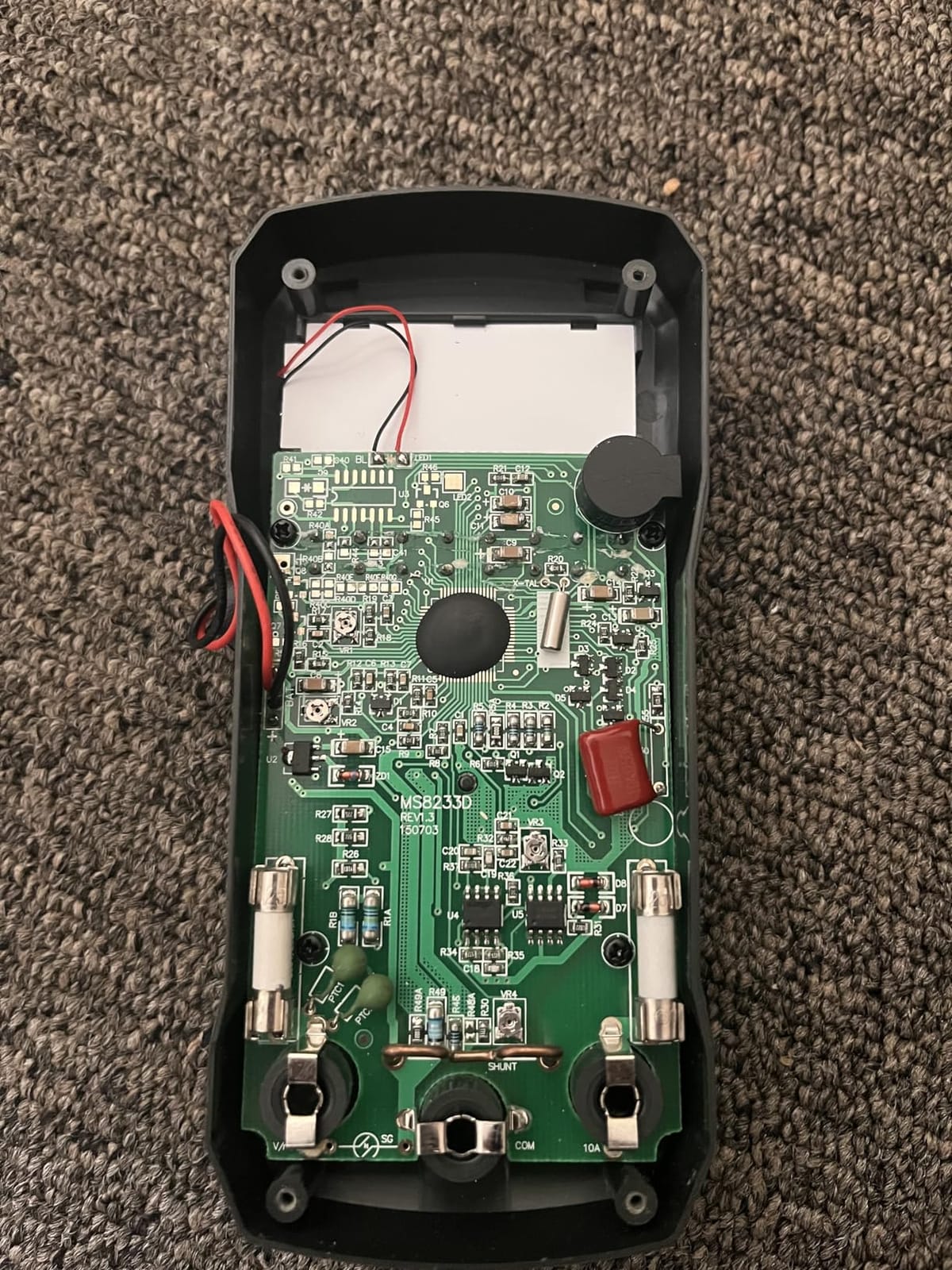
The function list is broad for the tier: AC and DC voltage, AC and DC current, resistance, capacitance, frequency, duty cycle, continuity and diode. A manual and auto range switch gives control for both quick checks and careful work, and the display samples three times per second, which makes the readings feel more responsive than on meters that refresh less often.
Two built-in fuses and an insulated rubber holster round out the safety story, and it runs on two AAAs, a battery most drawers already contain. What it does not do is measure temperature, even though some listing text suggests it can. Treat that as a firm no when you are shopping for a furnace, ice maker or heat pump diagnostic.
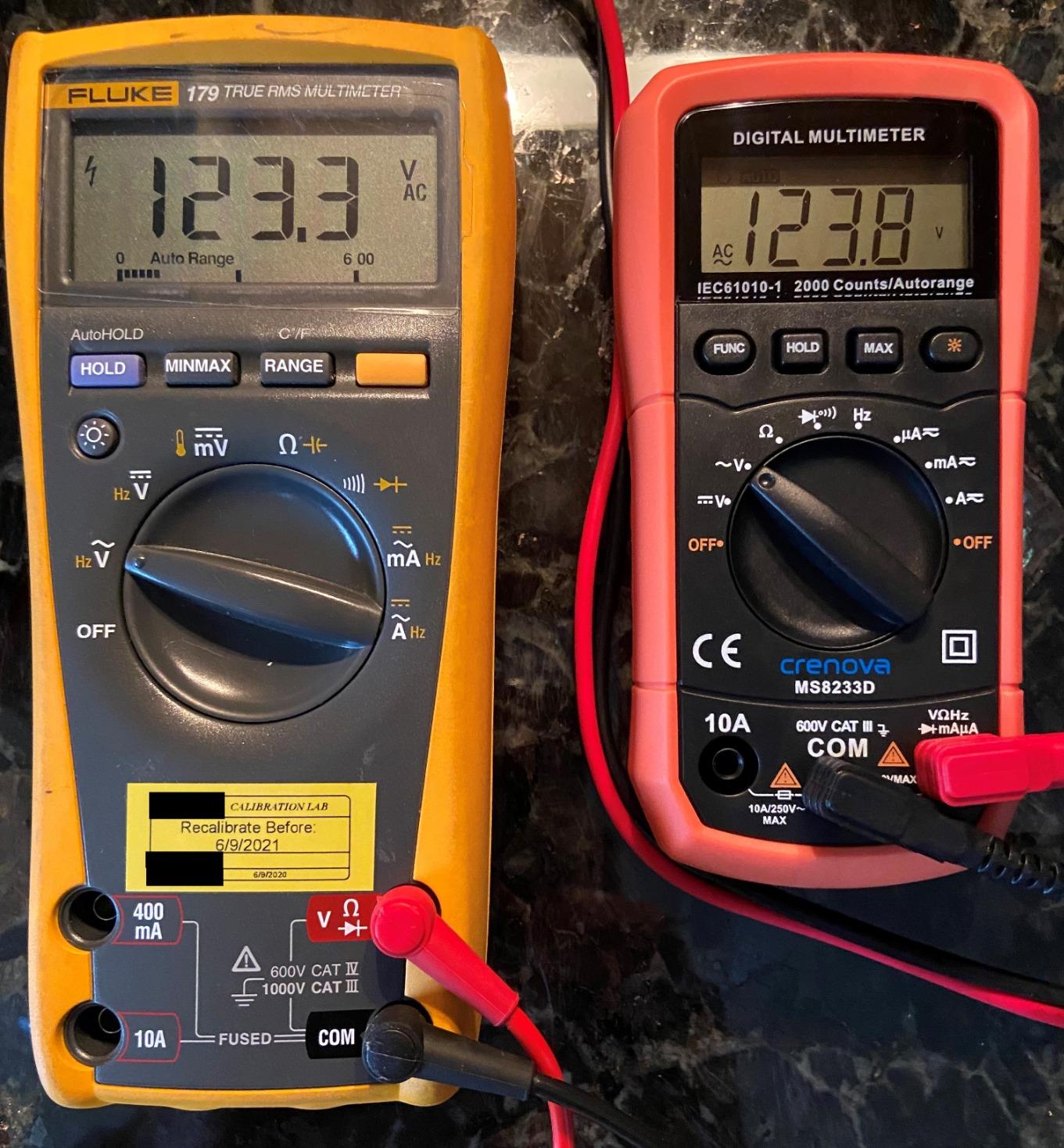
Why the CAT III rating matters more than the brand
CAT III 600V is the safety category for a residential panel and permanently installed equipment. A meter rated only CAT II is intended for plug-in loads and outlets, and it is one step below what panel work requires.
This meter prints CAT III 600V, uses two fuses and comes with a rubber holster, so the safety story is legible on the front of the instrument rather than buried in a manual.
Where it falls short for a beginner
The manual ranging mode has to be set deliberately, and owners new to the meter report that the toggle needs attention while learning. Leave it in auto until the manual behavior makes sense to you.
Accuracy claims are not independently documented in the customer feedback, so if measurement certainty is your priority, read the next few sections before choosing.
3. Klein Tools MM325 Manual-Ranging CAT III 600V Meter
Klein Tools MM325 Multimeter, Digital Manual-Ranging 600V AC/DC Voltage Tester, Tests Batteries, Current, Resistance, Diodes, and Continuity
CAT III 600V rating
600V AC/DC, 10A DC, 2 megohm
Lead-Alert placement LEDs
Backlit LCD
Pros
- Lead-Alert LEDs are a real safety improvement
- 85 percent of reviews are five star
- CAT III 600V without reaching for a premium brand
- Kickstand and lead holders for hands-free work
- Battery test mode beyond the basic feature set
Cons
- Manual ranging must be selected before each measurement
- No True RMS so non-linear loads read less reliably
- Resistance tops out at 2 megohm
- Magnetic hanger is an optional accessory
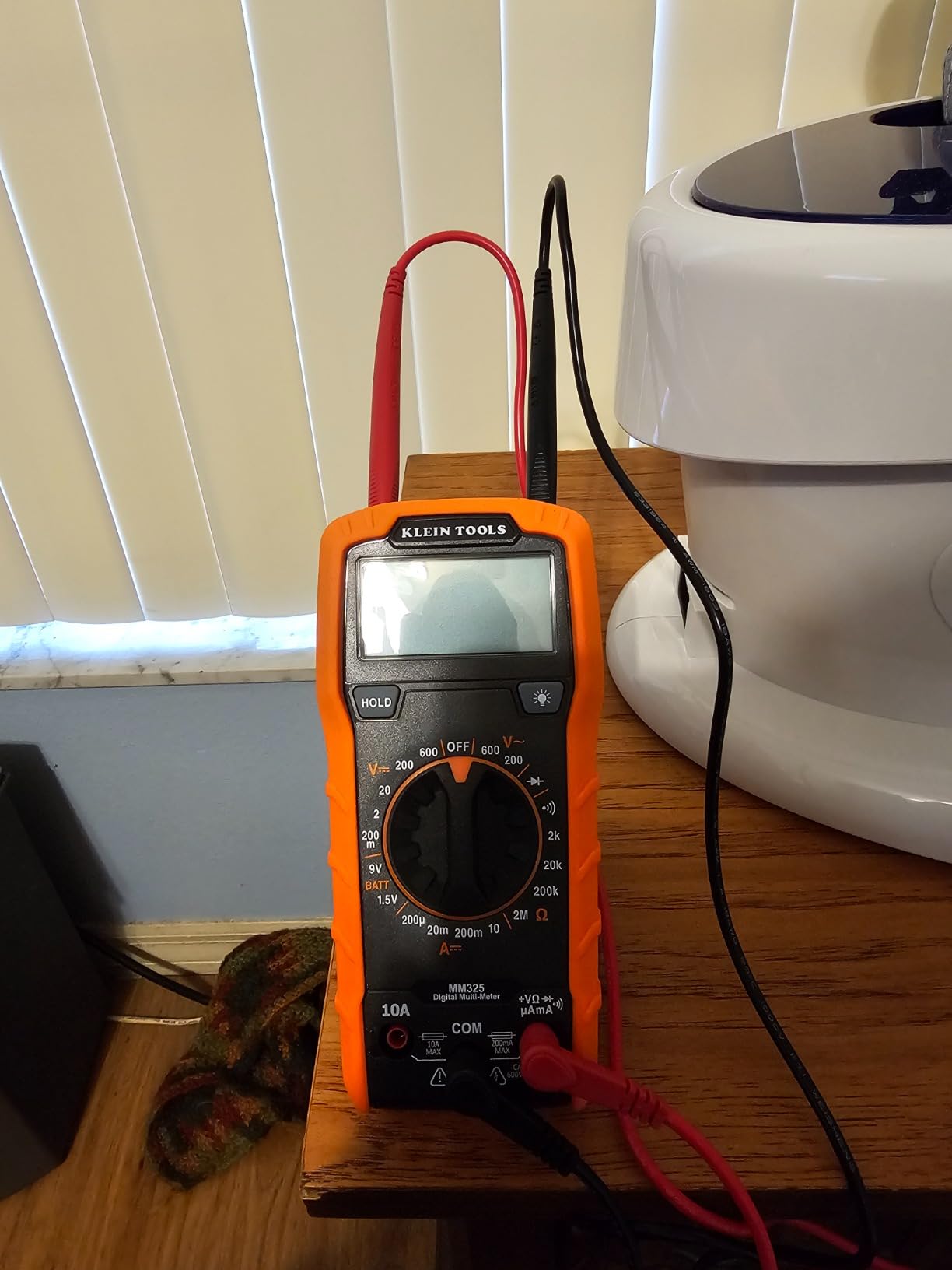
There is a reason the Klein Tools name comes up so often in trade forums as the accepted alternative to Fluke. The MM325 is the meter electricians and HVAC technicians reach for when they want a CAT III 600V instrument with a backlit display and lead-placement safety without reaching for a premium brand. The 85 percent five-star share in owner reviews reflects people who use it professionally.
Lead-Alert is the feature that convinced us to put it in a beginner’s guide. When the test leads are seated in the wrong jacks, protection LEDs illuminate to confirm placement. On a manual meter, jack misplacement is a real error mode, and a meter that tells you about it is teaching you something instead of hiding the mistake.
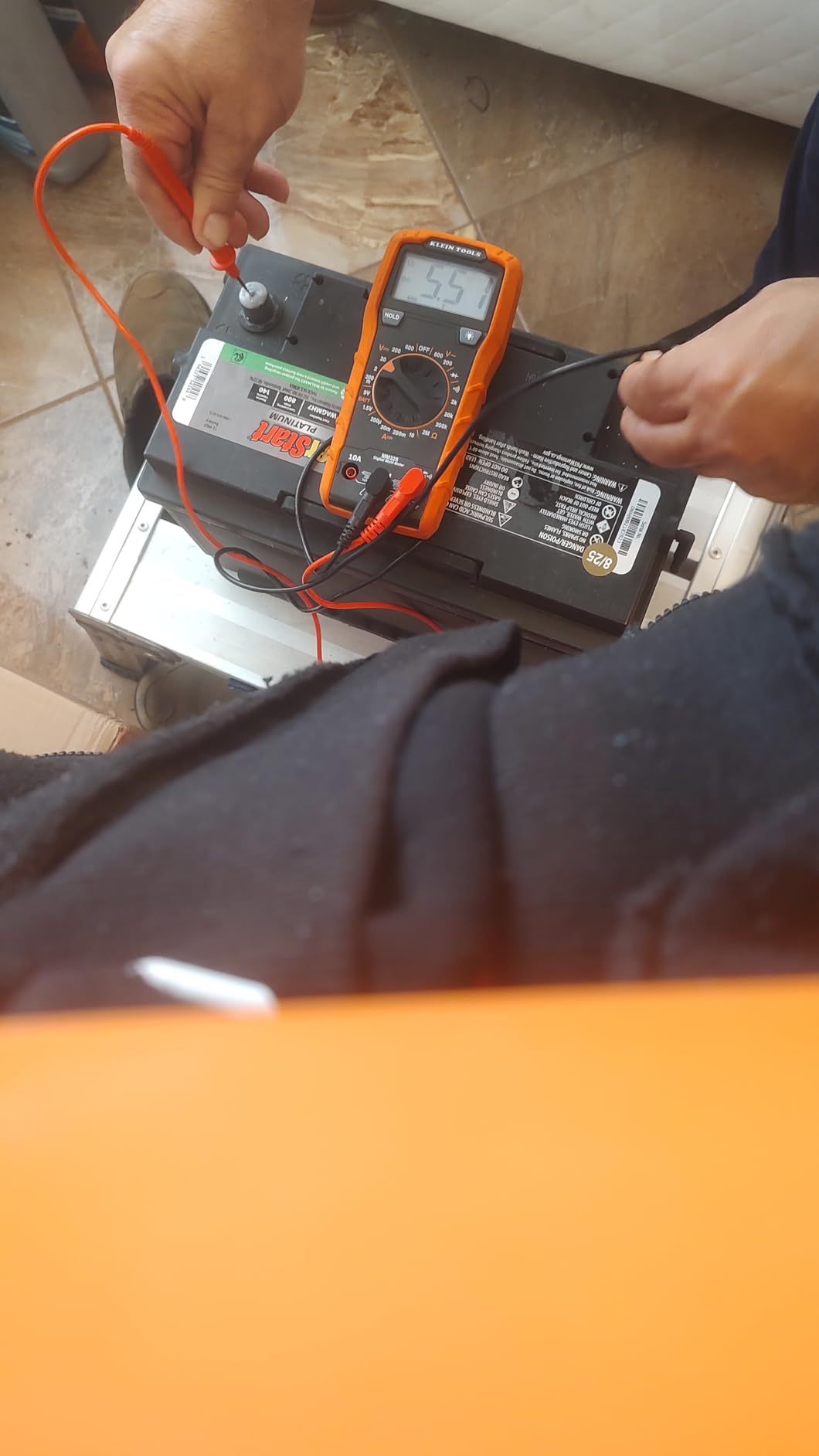
Measurement range covers 600V AC and DC, 10 amps DC current and 2 megohm of resistance, plus continuity, diode and battery test. The battery test mode is a small thing that earns its place: it checks charge state of a cell without you needing a second tool. A backlit LCD, a kickstand and test lead holders make it practical to set down on a floor or a panel door.
The tradeoffs are real. It is manual-ranging, so you select the range before each measurement, and it has no True RMS, which means readings on dimmers, LED drivers and other non-linear loads are less dependable than a true RMS meter would give you. For straight household AC voltage on a resistive circuit, that limitation rarely surfaces.
What to check before you buy
Manual ranging is the feature people notice first and the one they learn fastest. Auto-ranging meters are easier, but a manual meter forces you to understand what a range is, which transfers to every meter you own later.
Confirm the resistance range fits your work. At 2 megohm it handles household wiring faults but not high-value resistors, so electronics work is out of scope.
Where it fits and where it does not
It suits a homeowner replacing a GFCI outlet, a switch or a ceiling fan, and it handles automotive checks alongside household circuits. The optional magnetic hanger is not in the box, so buy it separately if you want hands-free panel work.
Skip it if you plan to work on dimmers, variable frequency drives or modern LED lighting and need trustworthy numbers, since it does not measure True RMS.
4. Fluke 117 True RMS Meter with VoltAlert and Low Impedance Mode
Fluke 117 Digital Multimeter, Non-Contact AC Voltage Detection, Measures Resistance/Continuity/Frequency/Capacitance/Min Max Average, Automatic AC/DC Selection, Low Impedance Mode
VoltAlert NCV detection
AutoVolt AC/DC select
Low impedance mode
True RMS min/max/avg
Pros
- Tied for the highest owner rating here
- with 90 percent five-star reviews
- Low impedance mode separates ghost voltage from real voltage
- AutoVolt removes the AC and DC switch position error
- Capacitance covers motor and heat pump run capacitors
- Three-year warranty and long battery life
Cons
- Current limited to 10 amps with no milliamp range
- No integrated current clamp
- Not compatible with the inexpensive i400 clamp
- No temperature measurement
- Included probes feel cheap and tangle easily
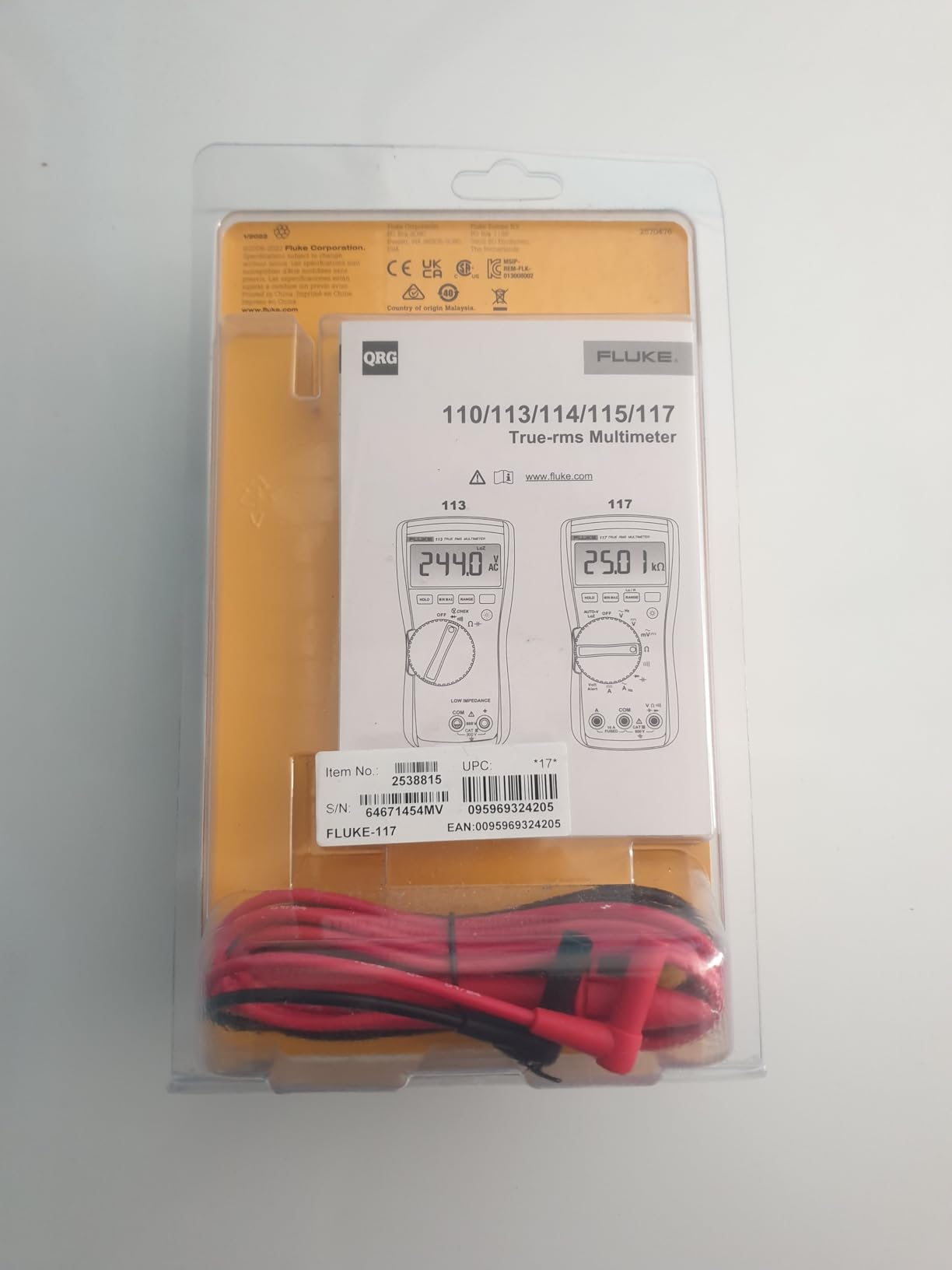
The Fluke 117 is the answer to the question forum users keep asking, which is whether the Fluke premium matters for household work. Owners justify the premium tier by comparison with cheaper meters that produce readings they cannot trust, and they have a specific reason: the low impedance mode. Most meters will show a phantom voltage in an open circuit because a small amount of current bleeds through the load. Low impedance mode suppresses that, so a reading means something.
That same function doubles as a rough GFCI test, which is a homeowner problem rather than a trade problem. AutoVolt is the other quiet hero: it senses AC or DC automatically, so there is no switch position to get wrong, and a display with a large white LED backlight makes an unlit panel or a dark crawl space workable.
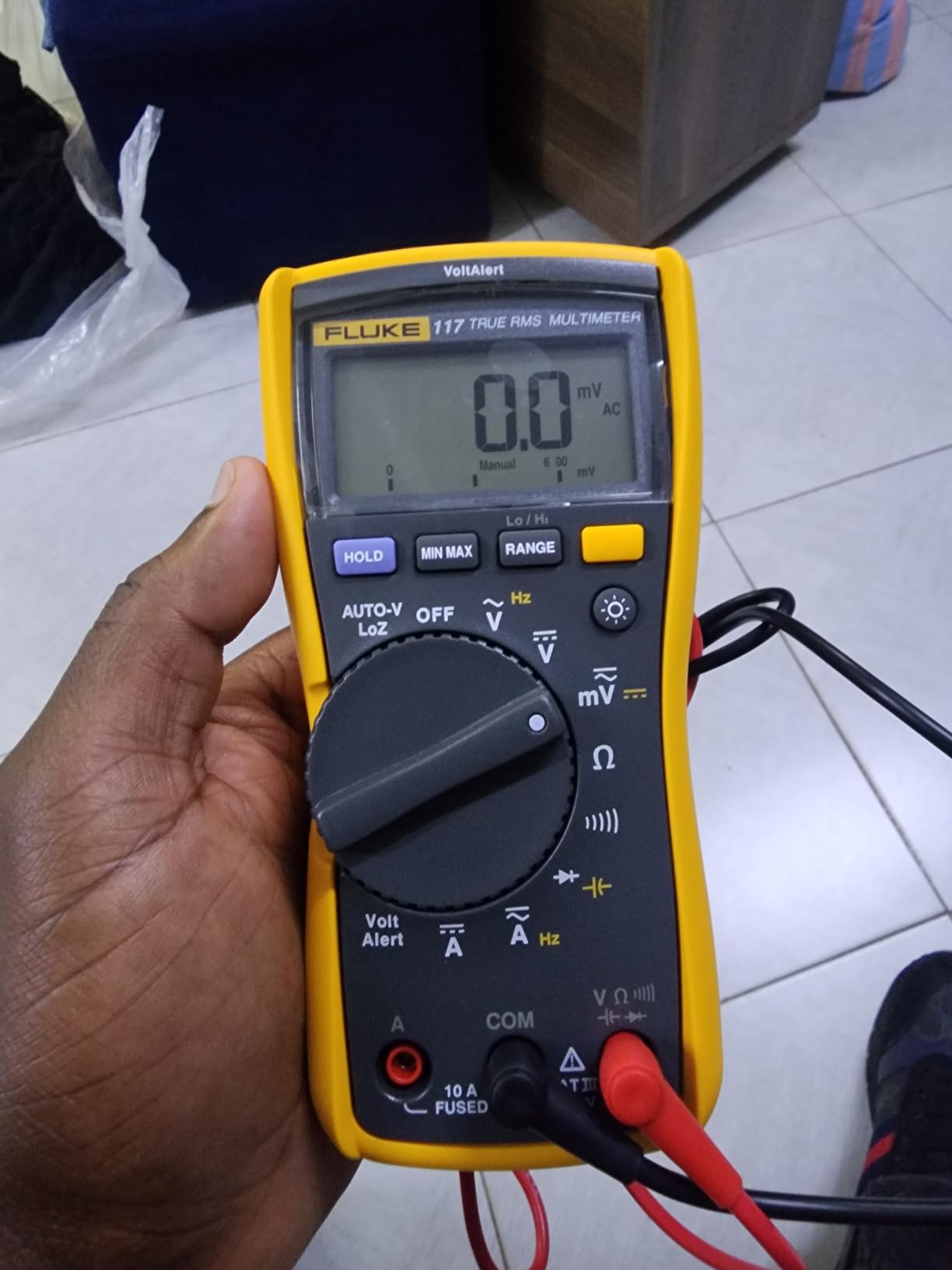
True RMS means the reading holds up on non-linear and modern electronic loads, which increasingly includes LED lighting, variable speed fans and appliance electronics in your own home. Beyond that, it handles resistance, continuity, frequency, capacitance and min, max and average recording. The capacitance range is what lets you test a run capacitor on a heat pump or an air handler rather than replacing parts until one works.
The weakness owners raise most is current measurement depth. It tops out at 10 amps, has no microamp or milliamp range and carries no integrated clamp, so a technician working on a boiler or a modern appliance often ends up owning a second meter. It is also not compatible with the inexpensive i400 current clamp; the i410 is the compatible one and sits well above this meter’s own tier.
When low impedance mode earns its cost
Ghost voltage is the reason a cheap meter tells you a de-energized circuit is live. Entering the low impedance range loads the circuit enough to collapse the phantom reading, so a near-zero result is trustworthy.
Owners report that the same function acts as a rough GFCI check, which is a job most homeowners would otherwise pay for.
Where it falls short at home
There is no temperature probe, so HVAC diagnostics are out of reach without another instrument. Current measurement is shallow for a meter marketed to electricians, and the clamp input requires a costly accessory.
Some owners report no battery change over two years, which is a real cost saving, but the 689 g weight and the absent case mean it lives in a bag rather than a pocket.
5. Fluke 17B+ Meter with Temperature Probe and 1000V Range
Fluke 17B+ Digital Multimeter, for Electrical Applications, Measures AC/DC Voltage 1000V, Current Measurements to 10A, Resistance, Continuity, Diode, Capacitance, Frequency, and Temperature Testing
AC/DC voltage to 1000V
Current to 10 amps
Temperature to 400 C with probe
CAT III 600V
Pros
- Owners report 10.01V from a 10.005V lab reference
- Large display numerals suit fine probe work
- Sturdy leads that are easy to swap
- Temperature probe included in the box
- Long ownership history reported by owners
Cons
- No current clamp and no microamp or milliamp ranges
- No non-contact voltage detection
- Protective case sold separately
- Batteries are not the type most households already keep on hand
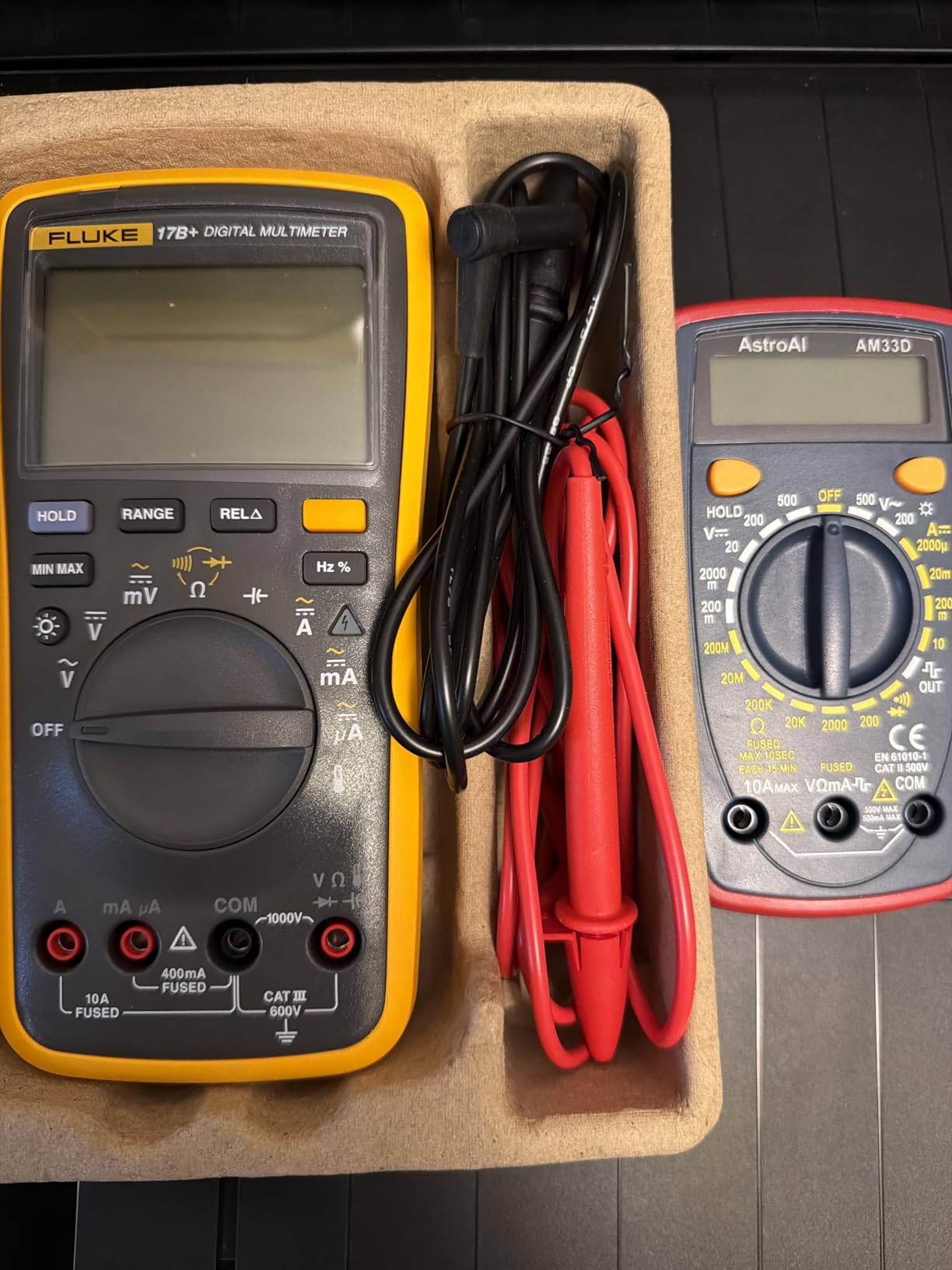
This is the Fluke that gets recommended when someone asks for one meter that covers the house and the car. It measures AC and DC voltage to 1000V, current to 10 amps, resistance, continuity, capacitance, frequency and diode, and it includes a type K thermocouple for temperature readings up to 400 degrees C. That combination, on one instrument, is hard to argue with.
Owners benchmarking it report numbers that justify the brand. One measured 10.01V from a 10.005V laboratory reference, and resistance readings cross-checked against a high-end meter were near identical. Another found results close enough to a professional reference to use for bench comparison work, which is more than most household meters can claim.
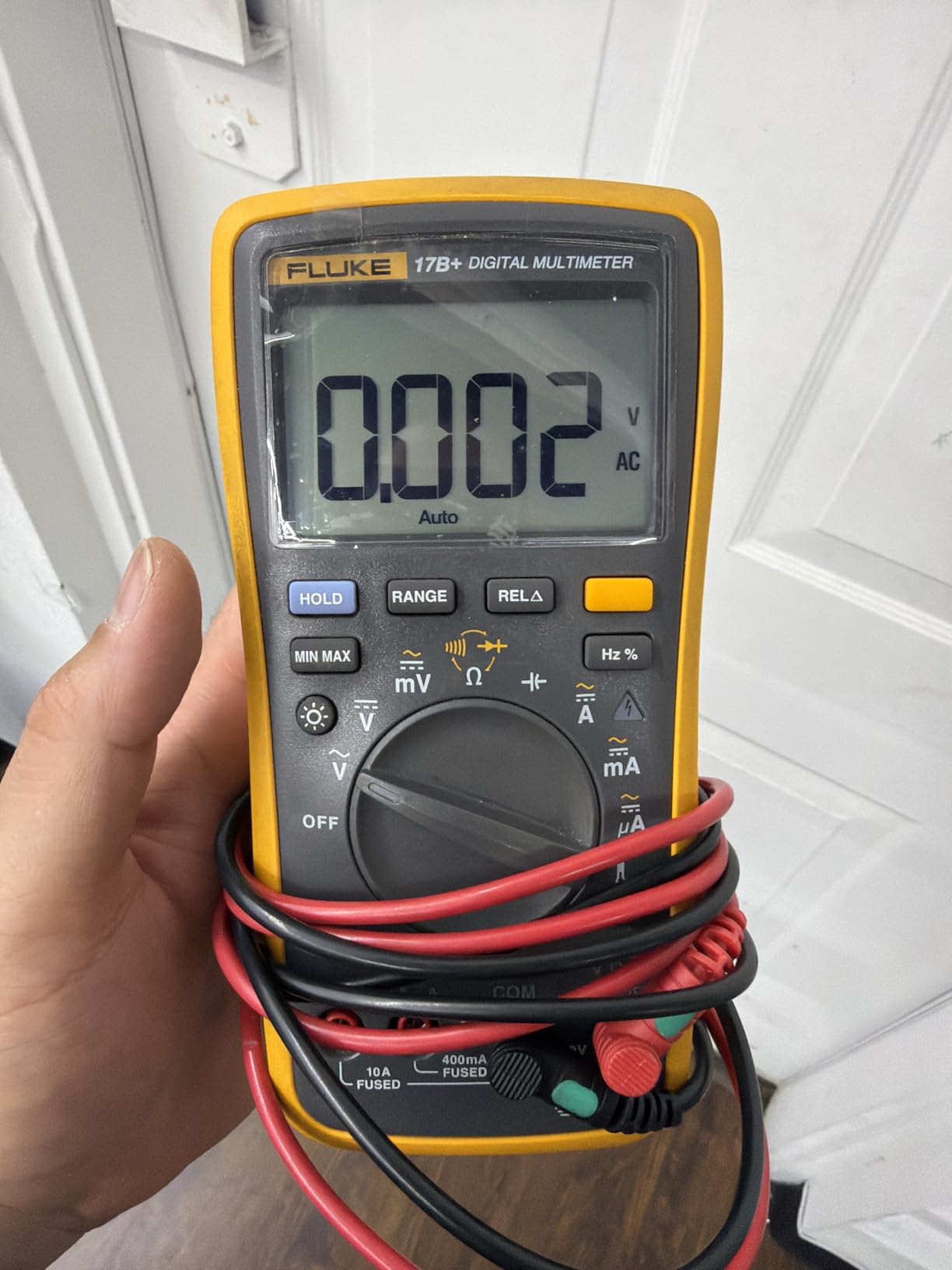
Where the 17B+ is a clear step past the 117 is resolution and range. The 1000V ceiling covers service-level work and high-voltage accessories, the big display numerals stay readable while you probe a crowded board, and the included leads are sturdy and simple to replace, which matters because leads wear out before meters do.
Against that, it is manual-ranging, so a beginner has the same wrong-range risk the Klein carries. There is no non-contact voltage detection, no current clamp input and no microamp or milliamp range, so it will not replace a clamp meter or a milliamp-capable meter for boiler work. The protective case is sold separately, which owners consistently recommend buying.
What the temperature probe actually adds
Checking HVAC components, oven elements and heating elements needs a thermocouple, and the 17B+ comes with a type K assembly rated to 400 degrees C. Only one other meter in this list measures temperature, and its probe specification is vaguer.
Because the probe is included, there is nothing extra to find before you start, which is why it suits a homeowner moving from household work into appliance diagnostics.
Where it falls short for a first meter
Manual ranging is the first hurdle, and it is harder to ignore without AutoVolt telling you which mode you are in. For a first-time buyer who will measure voltage constantly, that is a real cost in mistakes.
No non-contact detection means you identify a hot conductor by probing it rather than by scanning, and the battery type is not one most households already keep on hand.
6. AstroAI AM33D 2000-Count Backlit Meter
AstroAI Digital Multimeter Tester 2000 Counts with DC AC Voltmeter and Ohm Volt Amp Meter; Measures Voltage, Current, Resistance, Continuity and Diode, Blue
1999-count LCD
AC/DC voltage and DC current
Continuity and diode test
Double-fuse protection
Pros
- Enormous owner base reflecting broad household and automotive use
- Backlit screen readable in dim spaces
- Double-fuse anti-burn protection and silicone cover
- Data hold and continuity buzzer aid wiring faults
- Handles outlets
- fuses
- vehicle batteries and auto circuits
Cons
- 1999-count display is the coarsest resolution here
- No AC current measurement
- Cannot read AC voltage below 100 mV
- No temperature
- capacitance or frequency
- No auto-ranging at all
Nothing else here has an owner base on this scale, and that volume is itself information. It is the default low-cost meter for household electrical troubleshooting, and the consistent themes in the reviews are value, backlighting and ease of use. If you want to know whether a fuse is blown, whether a cord has a break, or whether a 12V battery is holding a charge, it does the job.
The double-fuse anti-burn protection with a silicone cover is the safety story. For a meter this simple, having two fuses and a physical barrier over the input jacks is a reasonable margin, and the low battery indicator stops you chasing phantom readings on a dying 9V cell.
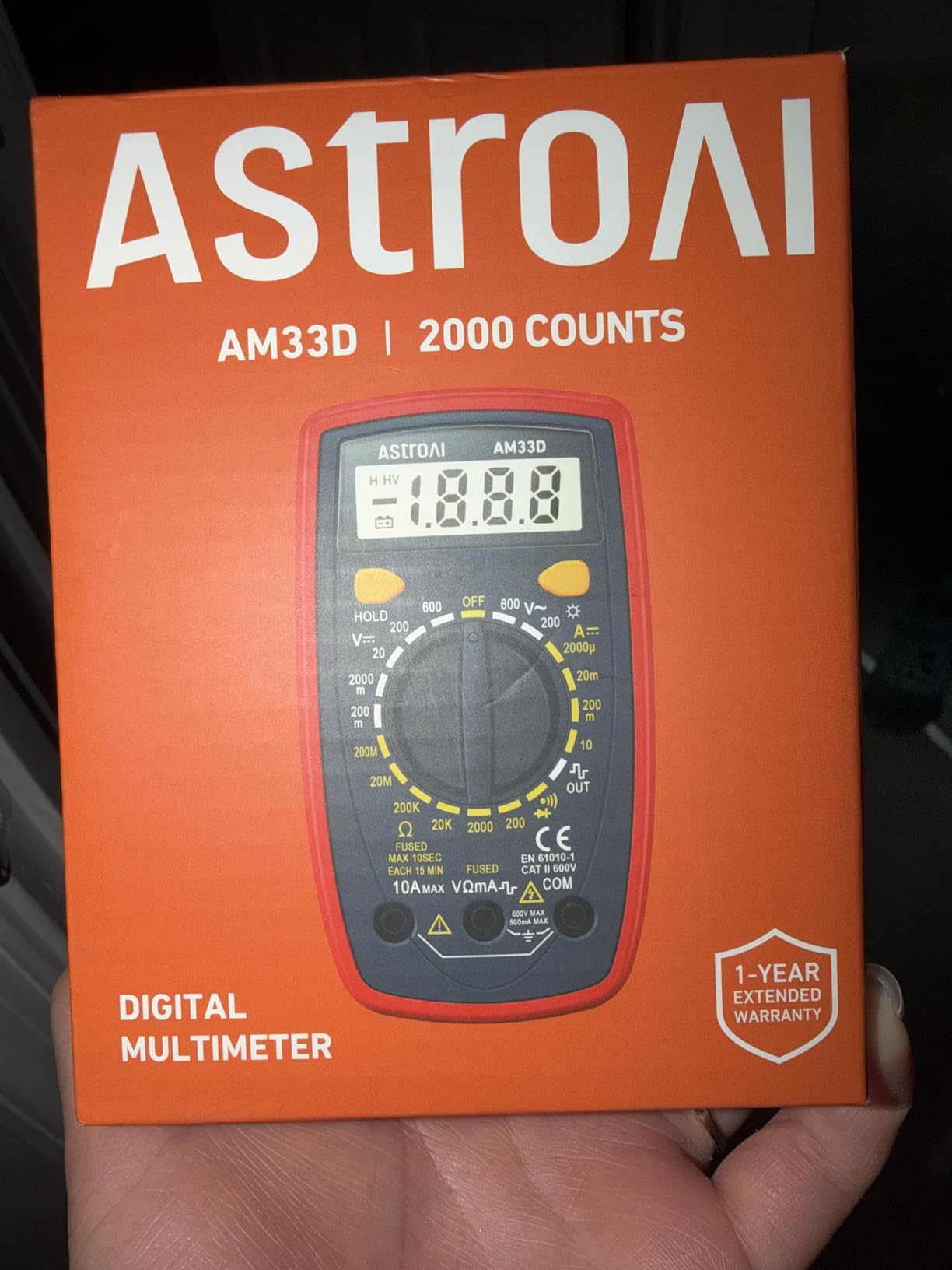
The 2000-count display is the resolution limitation that defines this meter. It reads up to 1999, so small differences between two similar readings do not show, and a 100 mV floor on AC voltage means it cannot register the small signals some electronics work needs. Those are real ceilings, not stylistic complaints.
There is no auto-ranging, so the rotary switch must be set to the correct range by hand, and there is no AC current measurement at all. For a homeowner whose jobs are outlets, switches, fixtures, fuses and car batteries, that combination of limits is acceptable. For anyone chasing dimmer and LED driver behaviour, it is not.
What it does well for the money
Continuity with an audible buzzer plus data hold makes tracing a wiring fault faster, because you can clip or hold a reading rather than watching a number. That is a bigger everyday win than most spec sheets credit.
The maximum operating voltage is 500V, which covers household circuits, and the 0.6 inch backlit LCD is legible in an unlit basement.
Where the manual range will bite you
Set the range below the actual value and you get an overload symbol or a meaningless number. That is the single most common beginner complaint in general, and this meter gives you no help avoiding it. The 500V ceiling is also below the 600V the panel-capable meters here carry.
7. Innova 3320 Auto-Ranging Meter with Battery Load Testing
INNOVA 3320 Auto-Ranging Digital Multimeter, Red & Black
Auto-ranging on all functions
Load-test battery positions
10 MegOhm input impedance
UL certified
Pros
- Owner benchmarking against two Flukes found near-identical readings
- Auto-ranging speed compares well against a professional reference
- Load-test battery check is truer than a voltage-only test
- Color-coded LEDs show charge state at a glance
- 10 MegOhm input protects vehicle ECUs
Cons
- AC current limited to 200 mA
- AC voltage below about 50V drifts from reference readings
- No display backlight
- No data hold
- No case or lead storage
- Occasional internal fuse failure disables the battery test
The battery positions are why this meter is on the list, and the way it does them is unusual. Dedicated dial positions for 1.5V, 6V, 9V and 12V cells put the cell under a 10 mA load and report with color-coded LEDs, which is a far truer health check than measuring resting voltage alone.
The accuracy story is documented in owner testing rather than marketing. One reviewer compared it against a Fluke 179 and a Fluke 87-V and found near-identical readings across DC volts, AC volts, DC current and resistance, with auto-ranging acquiring a voltage reading in under a second. Another owner has kept three of them working for more than six years, which says something about longevity.
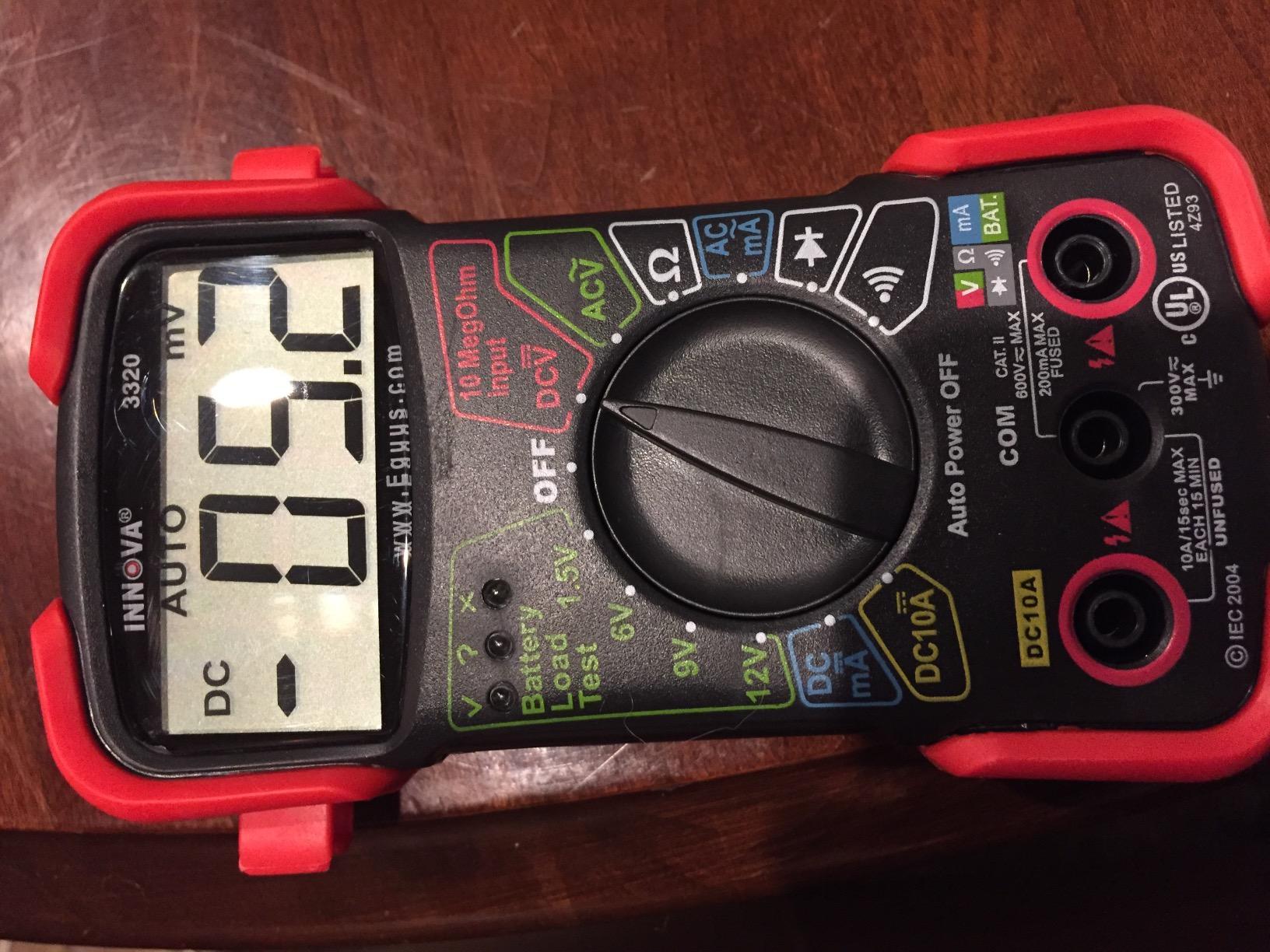
The 10 MegOhm input impedance is the detail that matters for vehicles. It will not disturb an ECU the way a lower impedance meter can, so the same instrument works on a car battery, a charging system and a household circuit without a second tool.
The compromises are noticeable in a dark panel. There is no display backlight, and there is no data hold, so you write readings down immediately or lose them. AC current is limited to 200 mA, which rules out most AC current work, and AC voltage below roughly 50V drifts from reference readings. A minority of owners report an internal fuse failure that disables the battery test, so keep a spare in the drawer.
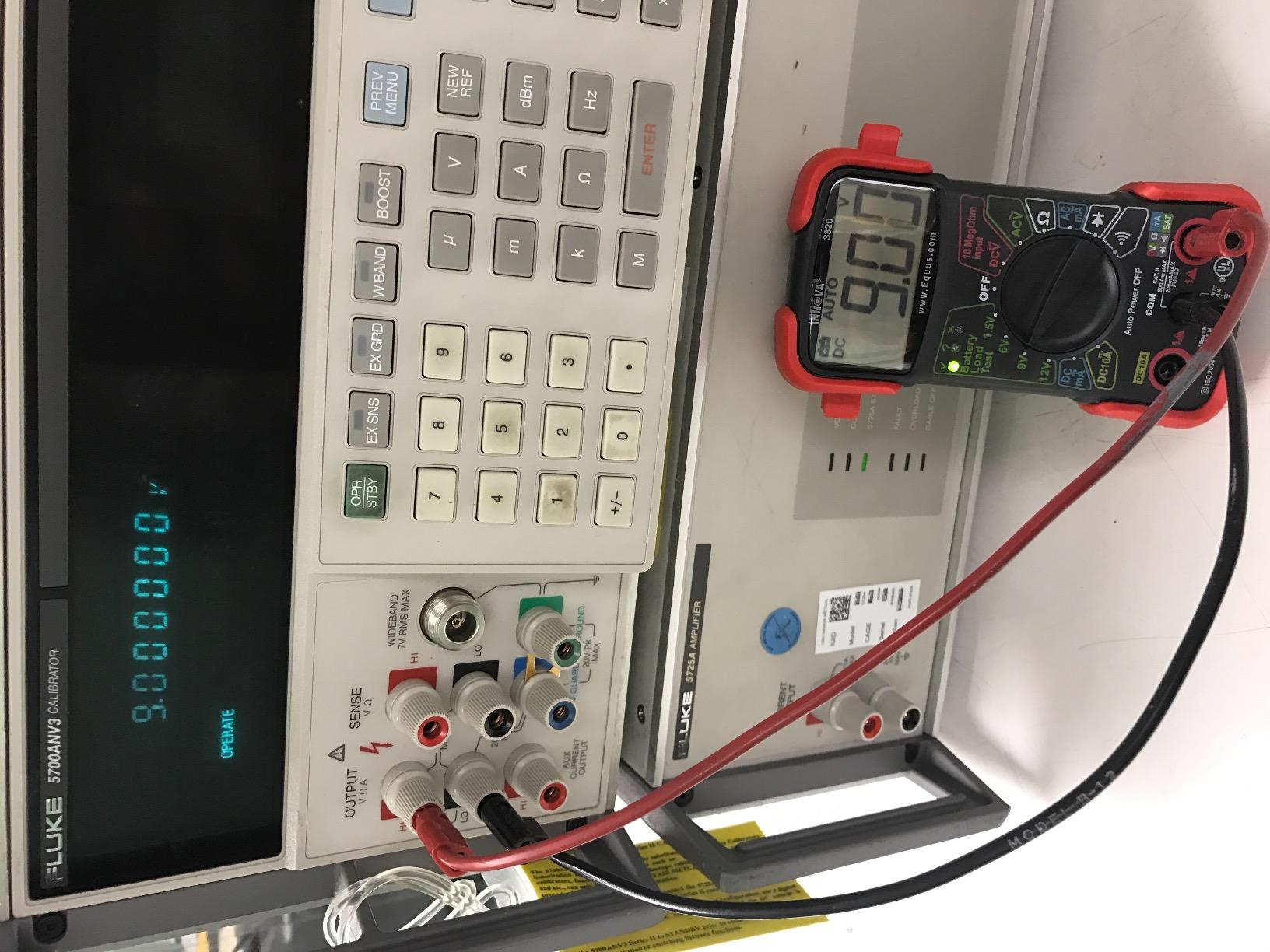
Why load testing beats a voltage reading
A resting voltage reading flatters a weak battery. Putting the cell under a small load and watching it hold up is closer to what happens when you turn the key, and this meter does that with a fixed position per cell size.
Color-coded LEDs remove the interpretation step, which is exactly what a beginner needs when deciding whether the battery or the alternator is at fault.
Where it falls short
No backlight is a real problem in a basement, a garage with the lights off or an unlit panel, and no data hold means you cannot freeze a transient reading. The rotary switch can also feel loose over time.
If you plan to work on anything requiring meaningful AC current, the 200 mA ceiling rules this meter out of that job.
8. TESMEN TM-510 Smart Auto-Mode Meter with Flashlight
TM-510 Digital Multimeter, 4000 Counts, Smart Measurement, Auto-Ranging Voltmeter; Voltage Tester with Non-Contact Voltage Function, Measures AC/DC Voltage, Resistance, Continuity – Green
Smart auto mode picks range
NCV with audible alarm
4000-count backlit screen
CAT II 600V
Pros
- Smart mode removes both mode and range selection
- Non-contact voltage alarm finds a live AC conductor
- Built-in flashlight works in crawl spaces and panels
- Storage bag included
- Internal overload protection plus a silicone cover
Cons
- Does not measure current at all
- No temperature
- capacitance or frequency
- 4000-count resolution is modest
- CAT II 600V is one step below CAT III 600V
- Smart auto mode cannot be switched to manual range
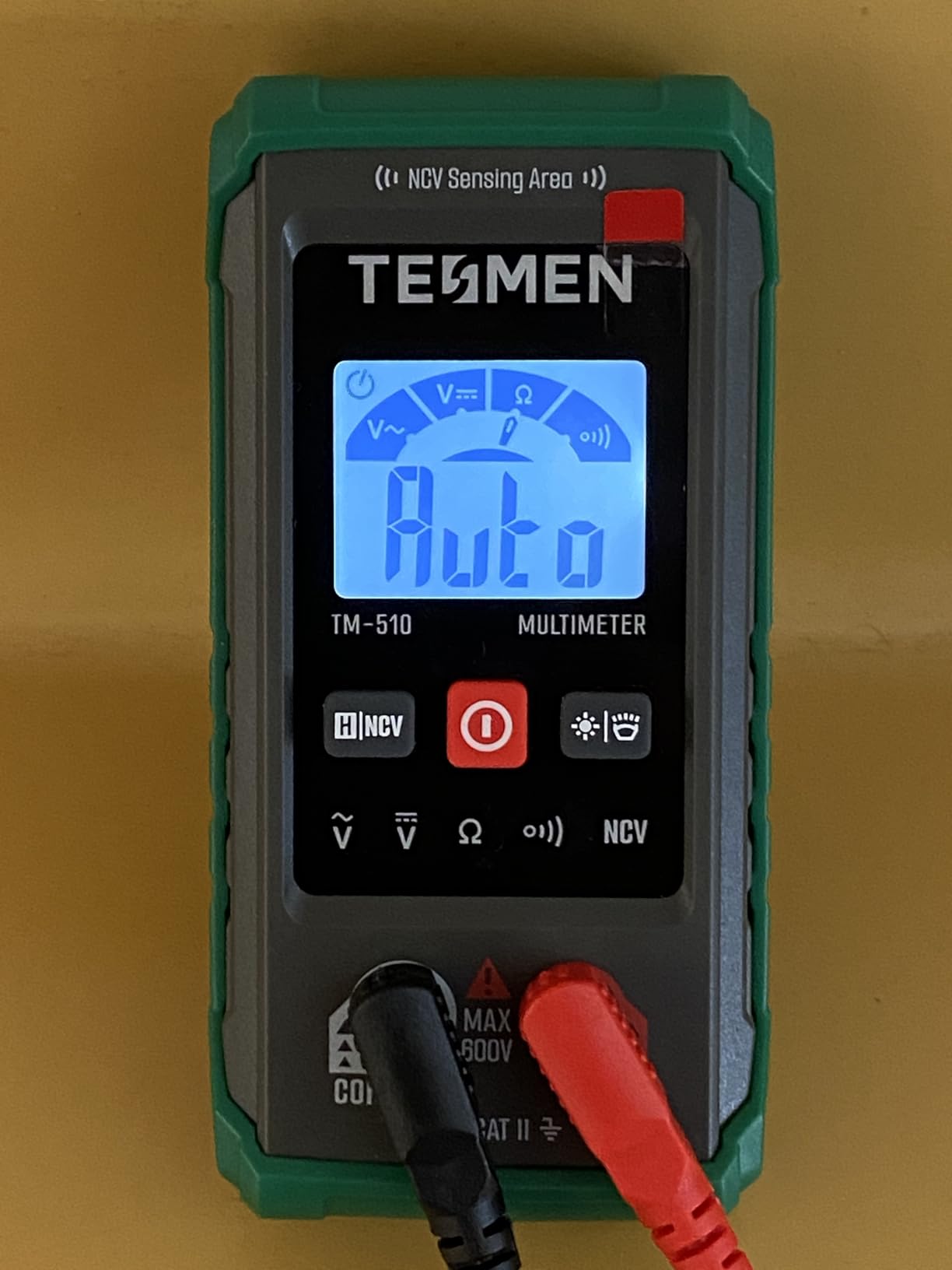
This meter answers a beginner problem better than most others in the group. Smart auto mode identifies AC or DC voltage, resistance and continuity and picks the range without you touching the dial, so a wrong-range error is not a mistake you can make here. It is one of the few budget meters where the learning curve is nearly flat.
The flashlight built into the screen is the detail we did not expect to care about and now recommend. A backlit display helps you read a number; a flashlight helps you find the wire in the first place, which in a dark crawl space or behind a vanity is the harder problem. The storage bag also comes in the box.
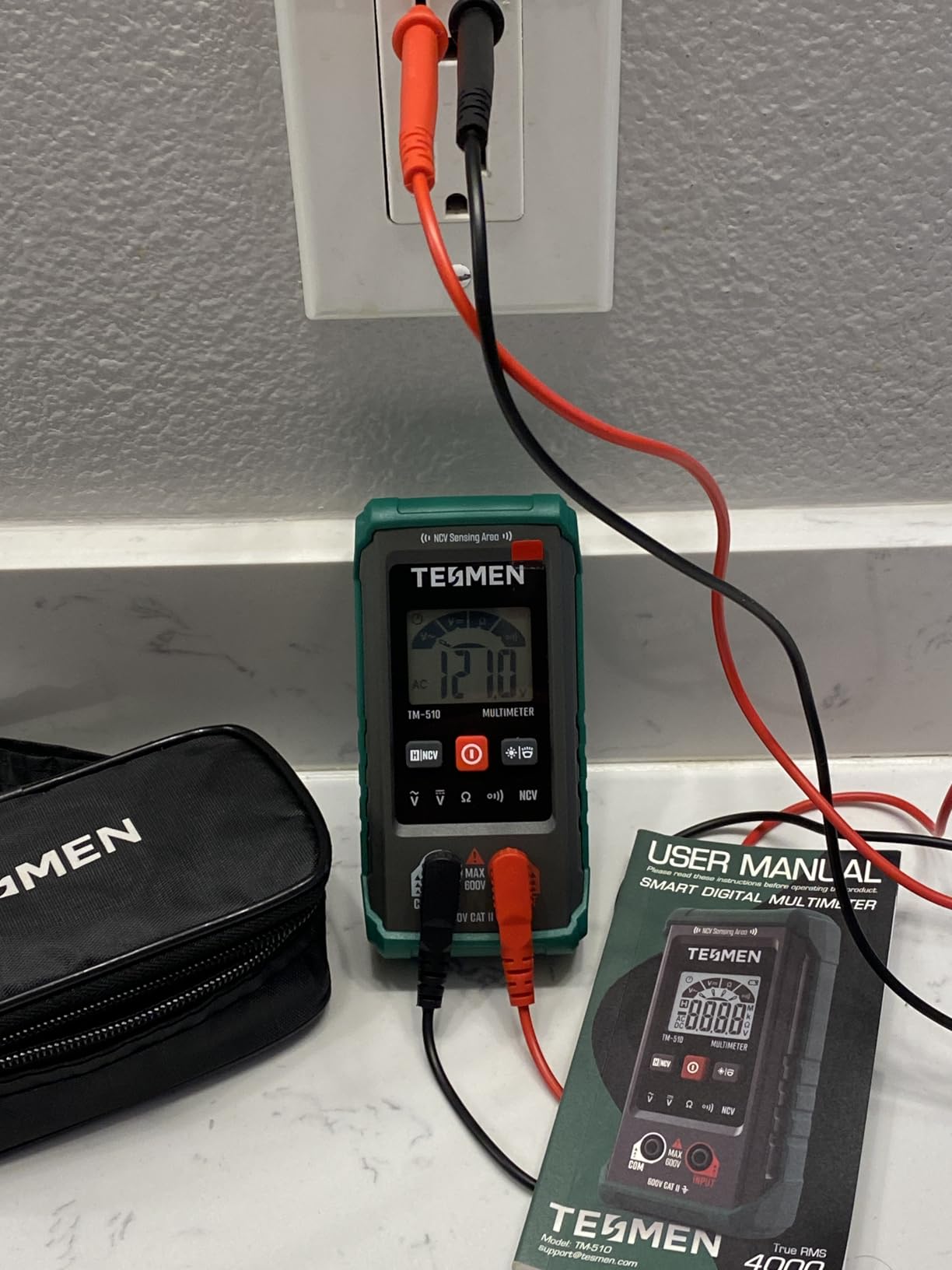
Non-contact voltage detection with a visual and audible alarm lets you identify a live AC conductor before touching it. In auto mode the meter drops to resistance measurement when a battery under test falls below 0.8V, which is a neat piece of behaviour for anyone testing cells and small power sources.
Now the honest part. It does not measure current at all, so any amp diagnosis needs a different tool. It is rated CAT II 600V, which is the plug-in load category, one step below the CAT III 600V needed for panel work. And because auto mode cannot be overridden, you lose the ability to force a range when you want to watch a value closely.
When a flashlight matters more than a feature list
Most electrical work happens where there is no light: a garage ceiling, a basement panel, a closet with an outlet, an attic junction box. A screen backlight only helps once you are already looking at the right spot.
Owners consistently mention the flashlight and the alarm as the reasons this meter feels easier than its specification sheet suggests.
Where the safety rating stops you
CAT II 600V is fine for appliances and receptacle loads but is not the category for opening a residential panel. For panel work, pick a meter marked CAT III 600V.
No current measurement plus a fixed auto mode means this is a voltage and continuity tool, not a diagnostic one. Confirm that matches your actual job list before buying.
9. Fluke-101 Compact 0.5 Percent Accuracy Meter
FLUKE-101 Digital Multimeter
0.5 percent DC accuracy
CAT III 600 V rating
Continuity and diode test
160 g pocket size
Pros
- 0.5 percent DC accuracy in a very small body
- Genuinely pocketable at 160 g
- CAT III 600 V for household circuits
- Diode and continuity cover most homeowner fault finding
- Entry point to a well-supported brand
Cons
- No current measurement at all
- No non-contact voltage detection
- No temperature
- frequency or capacitance
- One-year warranty is shorter than the 3 years on the Fluke 117
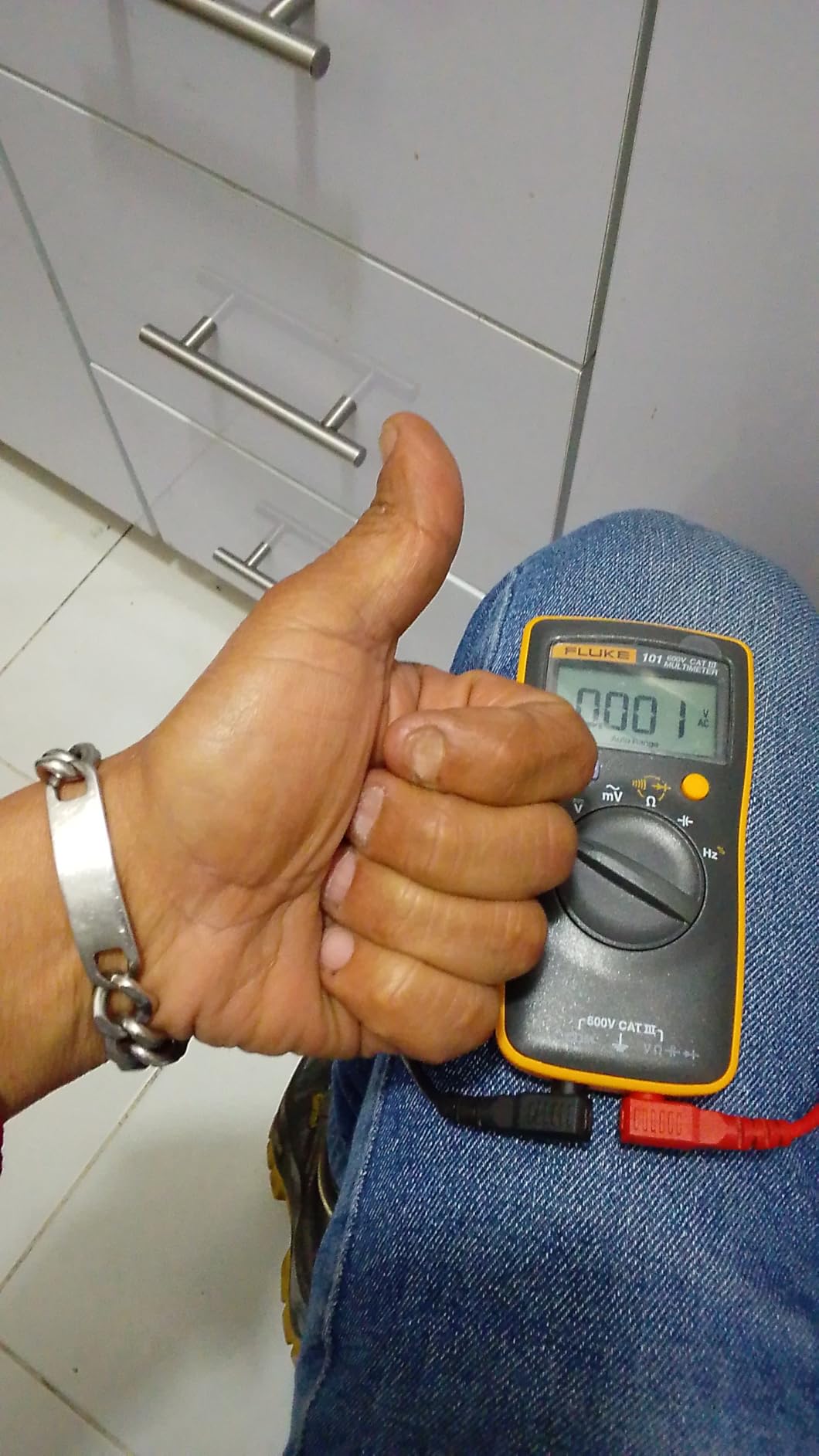
The Fluke-101 exists because the full-size Flukes here weigh 689 g and 470 g, and that matters when you are on a ladder or working overhead in a closet. At 160 g and just over five inches long, it is a genuinely pocketable instrument rather than a small handheld, and the 0.5 percent basic DC accuracy is the figure knowledgeable buyers ask about.
That accuracy tolerance is the quiet differentiator. Forum users who know what they are talking about consistently look for 0.5 percent DC accuracy rather than 1 percent, and the difference shows up when you are chasing a slow voltage drop across a long run of wiring. A CAT III 600 V rating makes it legitimate for household circuits.
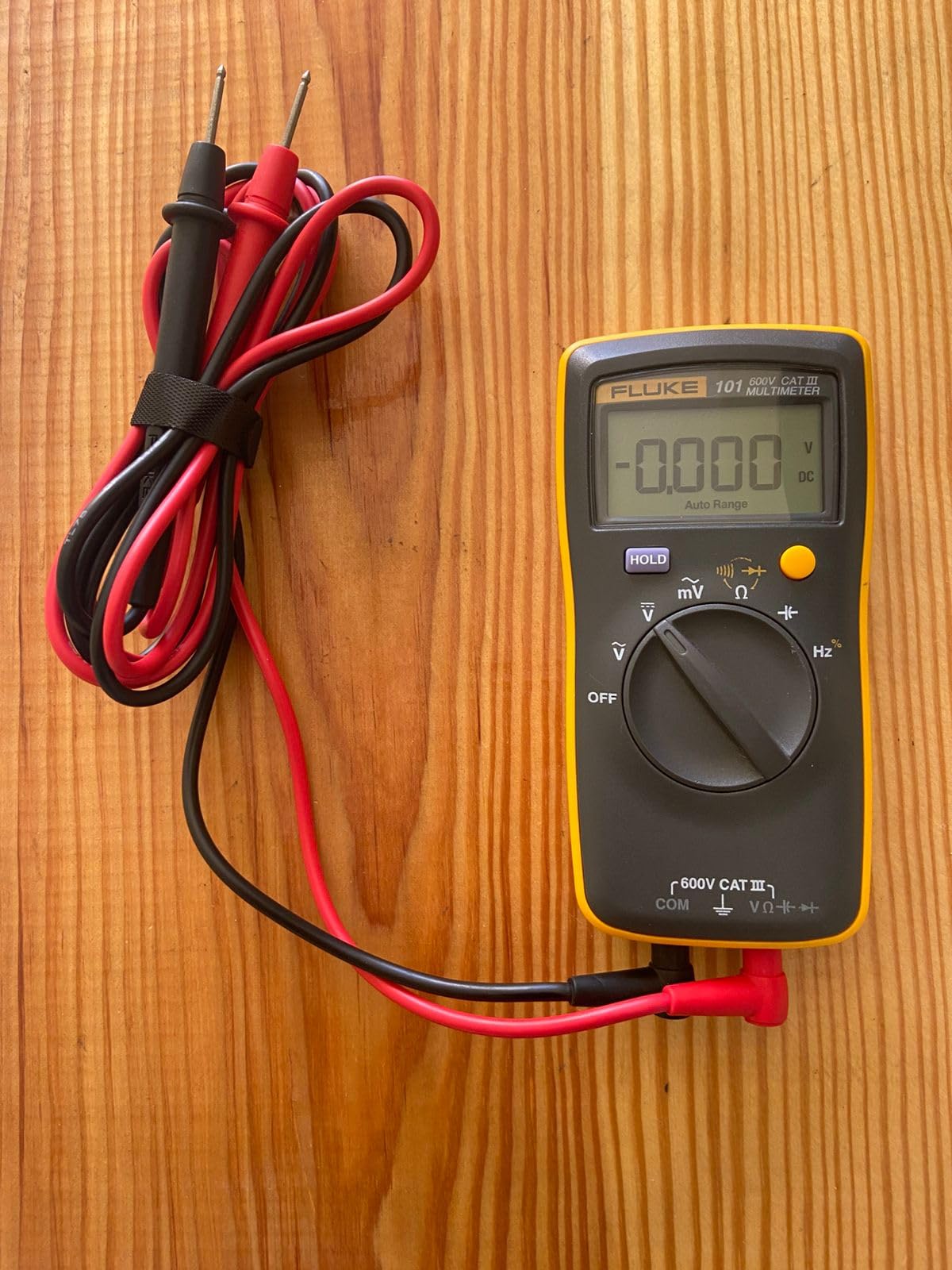
What it drops is the point. No current measurement, no non-contact voltage detection, and no temperature, frequency or capacitance. That is a very short function list, and it means the Fluke-101 is a voltage and continuity tool. For finding a dead outlet, checking a switch, tracing a break in a cord or confirming a de-energized circuit, that is enough.
The warranty is one year, against three years on the Fluke 117, and buyers describe the controls as basic. Both are fair descriptions of a meter whose job is to be small, dependable and accurate rather than capable. The included TL75 test leads and two AAAs mean you can start using it right away.
When 0.5 percent accuracy changes the answer
Accuracy tolerance only matters when the difference between two readings is the difference between a fault and no fault. Measuring a small voltage drop across a run of old wiring is exactly that situation.
If you mostly check that a circuit is live or dead, a 1 percent meter is fine. If you diagnose, 0.5 percent is worth having.
Where the short function list ends
No current measurement rules out anything involving amps, and no non-contact detection means you find a live conductor by probing. The one-year warranty is a year shorter than the three years on the Fluke 117.
Choose it for portability and accuracy. If you want one meter for everything, this is not it.
10. FNIRSI DMT-99 9999-Count True RMS Meter with Color Display
FNIRSI DMT-99 Digital Multimeter 9999 Counts TRMS, Rechargeable Volt Meter
9999-count True RMS
Color TFT display
1500mAh rechargeable battery
Waveform and threshold alarm
Pros
- 9999 counts
- a step above the 6000-count meters here
- Color TFT screen with adjustable brightness
- Rechargeable battery removes routine replacements
- Waveform graphing and threshold alarms are premium features
- Fine-pitch leads suit small circuit boards
- Dual ceramic fuses with anti-burn protection
Cons
- One of the two smallest review bases here
- at just over 1300 ratings
- A screen and internal battery are less rugged than a sealed meter
- Screen-on battery life is shorter than an alkaline meter
- Graphing adds complexity for basic voltage checks
This is the odd one out, and it is included because a specific homeowner problem points straight at it. Intermittent faults, flickering caused by a switching supply, a circuit that trips only under load: these are hard to catch with a numeric display because the event is over before you read the number. The DMT-99 plots real-time ripple as a waveform and offers a monitoring mode that triggers an automatic alarm at a threshold you set, so you can set the meter and walk away.
On paper it also scores well where it counts. At 9999 counts it resolves finer detail than the 6000-count meters in this group, it measures true RMS on AC and DC, and the auto mode identifies AC or DC voltage, resistance and continuity without a dial decision. The 1500mAh rechargeable cell with Type-C charging means you will not hunt for a spare battery in a dark garage at midnight.
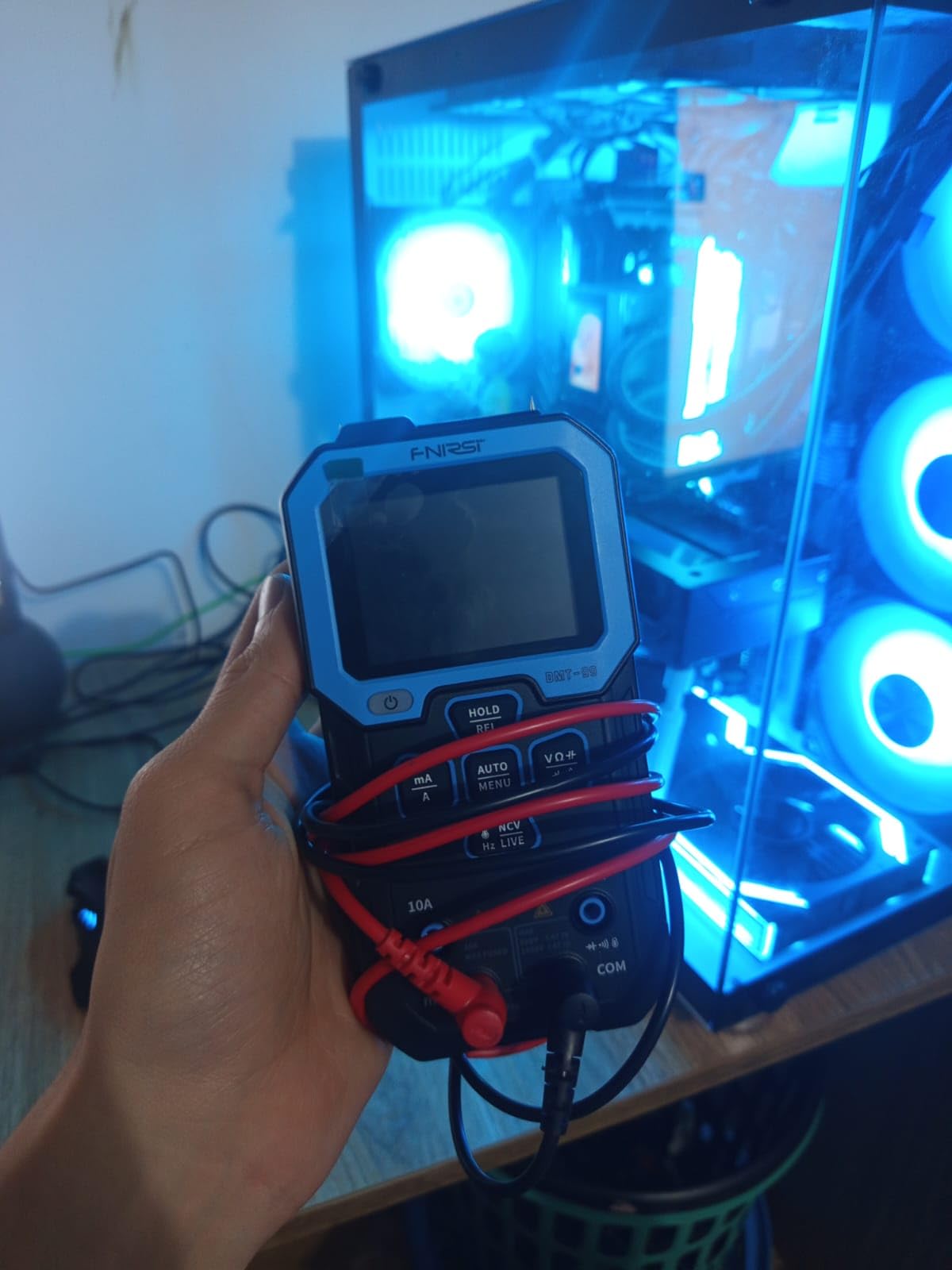
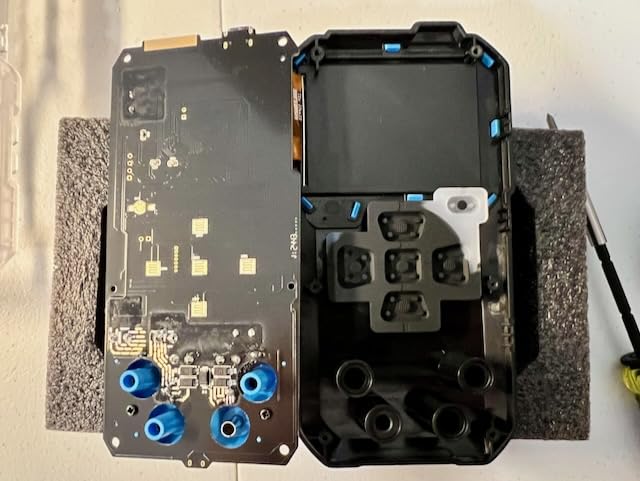
The 2.4 inch HD TFT color screen with adjustable brightness is easy to read in a bright basement and easy on the eyes in a dim one. Ultra-fine test leads suit SMD work and crowded boards, dual ceramic fuses and anti-burn circuitry make it reasonable around automotive work, and a back kickstand plus integrated storage slots keep it tidy on a bench.
The review base here is among the smallest in the group at just over 1300 ratings, so long-term durability is less well documented than for the established Fluke and AstroAI models. A glass screen and an internal lithium battery take more punishment less gracefully than a sealed handheld, and screen-on battery life is shorter than an alkaline meter’s.
What threshold monitoring actually catches
You set a limit and the meter alarms when the value crosses it. For an intermittent fault that happens while you are in another room, that is the difference between catching it and never catching it.
The waveform view shows ripple as a graph, so a distorted supply that reads a plausible number is still visible as a distorted shape.
Where it falls short
A graphing meter is more than a household voltage check needs, and beginners often find the extra features distracting. The smaller review pool means fewer multi-year ownership reports.
There is no temperature probe and no carrying case, and the rechargeable cell is the one part most likely to be hard to source if it ever fails.
How to Use a Digital Multimeter Safely on a Household Circuit
This is the sequence we would follow for a dead outlet. It is deliberately boring, because the boring steps are the ones that keep you safe.
Step 1. Identify the circuit and switch it off. Turn off every breaker until the outlet goes dead, then confirm which one it was by restoring power one at a time. Label the breaker with tape so the next person, including you in a month, knows what it controls.
Step 2. Prove the meter works. Set the dial to AC voltage, restore power, and test the meter on a known-live source such as a functioning receptacle. Confirm the reading matches the expected range. A meter that reads zero on a circuit you know is energized is telling you nothing about your work.
Step 3. De-energize again and test the target. Switch the breaker off, confirm the indicator, then test each conductor at the outlet: hot to neutral, hot to ground, neutral to ground. All three should read zero volts. Anything other than zero means stop and find out why before touching a conductor.
Step 4. Test the removed device. Unplug the appliance, set the dial to continuity, and check the cord from plug to device. A beep means an unbroken path. A cord with a break in it will pass a visual check and fail here, which is the entire point of owning the tool.
Step 5. Restore and retest. Turn the breaker back on and confirm normal operation. If the breaker trips again immediately, leave it off and look for a short or an overload. A breaker that trips repeatedly is telling you something specific, and forcing it back on is not a repair.
To find a break in buried wiring, de-energize the run, disconnect both ends, and read continuity end to end with the same probe pair. A beep on a section that should be silent locates the fault without opening the wall. For an intermittent fault, set up monitoring rather than sitting with a meter waiting for a reading to change.
Where a multimeter is the wrong tool entirely: a receptacle tester instantly confirms wiring polarity and GFCI function, a clamp meter measures current without breaking the circuit, and a non-contact voltage detector is a screening tool rather than a proving tool. Many homeowners buy a cheap receptacle tester and believe it replaces a meter. It does not, and owning both is the practical answer.
What to Look for in a Digital Multimeter for Home Use
The six features that actually matter
Ignore the function count. Six items decide whether a meter is right for a house:
CAT III 600V safety rating
True RMS on AC voltage
Auto-ranging across all functions
Fused current inputs
Non-contact voltage detection
Backlit display
Everything else on the spec sheet, from duty cycle to hFE transistor gain, matters only if you also work on electronics.
CAT ratings decoded for a homeowner panel
The CAT rating states how much energy the meter is built to survive if it is misused at a given voltage, and it is the number that determines whether a meter is appropriate, not the brand. CAT II covers plug-in loads and receptacle work. CAT III covers the residential panel and permanently installed equipment such as a fixed lighting circuit, and CAT III 600V is what you want for a house. CAT IV is the service entrance outside the meter.
A meter rated CAT II 600V is legitimate for appliances and outlets but one step below panel work, and the TESMEN TM-510 is the clearest example in this list of a capable meter that still does not meet the panel category.
True RMS vs averaged RMS in plain English
Household AC is a sine wave, but anything that switches power in a modern home does not produce a clean one. LED drivers, dimmers, variable speed fans, microwaves and most electronics produce chopped or distorted waveforms.
An averaged meter measures the shape of the wave and assumes it was a sine, so it under-reads those loads, sometimes by a wide margin. A true RMS meter measures the actual root mean square of the waveform and returns a number you can trust. For straight resistive loads on old wiring, averaged readings are usually fine, which is why the difference is invisible until you work on anything switched-mode.
Auto-ranging vs manual ranging
A manual-ranging meter makes you pick the range before measuring, and picking one below the actual value gives you an overload symbol or a misleading number. That single behaviour is the most common beginner complaint in general, and it is why most of the meters we recommend higher in this list auto-range.
Manual ranging has one genuine advantage: it teaches you what ranges mean, and that knowledge transfers to any meter. It is a fair trade for someone who will always use a meter, and a poor one for a homeowner who will measure voltage twice a year.
Multimeter vs receptacle tester vs clamp meter
These three are complementary, and confusion between them is the most common question in homeowner forums.
A receptacle tester is a plug-in device that instantly confirms polarity, grounding and GFCI function. It is fast, forgiving and ideal for checking an outlet, and it cannot tell you a voltage value or find a break in buried wiring. A multimeter measures actual values and finds continuity faults, but takes longer and requires the circuit to be handled properly. A clamp meter measures current through a conductor without opening the circuit, which is the only safe way to find what is drawing amps on a running circuit.
For a homeowner, the sensible order is a receptacle tester first because it is cheap and covers outlet faults, a multimeter second because it is the general-purpose tool, and a clamp meter third when you need to know what a live circuit is drawing. Where you keep the meter matters too: a bench or sturdy shelf near the panel beats a loose drawer, and our workbench guide for home shops covers storage for a small tool area.
What not to buy for home electrical work
Four categories are easy to avoid. An analog needle meter cannot resolve the small voltage differences that identify a wiring fault, and modern cheap equivalents exist for everything it does. A meter with no printed CAT rating is unrated regardless of what the listing claims, because the rating is the manufacturer’s safety claim and it needs to be on the instrument. A manual-ranging meter with no safety category printed on it is a false economy for a beginner, because the wrong-range mistakes will cost you time.
And avoid judging a meter by its star rating alone. Review volume and documented accuracy benchmarking tell you far more, which is the reason we leaned on owner comparisons against reference instruments throughout this guide.
One more habit worth naming, since it comes up constantly in homeowner forums: decide what you actually need before you shop, because the difference between a CAT II and a CAT III rating is invisible in a listing photo and decisive in a panel. A meter that matches the work you will actually do is easier to learn and easier to trust than a more capable one you will not reach for.
Frequently Asked Questions
What multimeter should I buy for home use?
For most homeowners, an auto-ranging meter with a CAT III 600V safety rating covers everything a house throws at you. Our pick is the AstroAI AST-6000-D, which adds true RMS, AC and DC current, temperature and a three-year warranty. If you want the shortest path to a first tool, the Crenova MS8233D offers the same core measurements with a CAT III 600V marking and a carry bag.
Which digital multimeter is considered the best quality?
Fluke is the most widely trusted name in the category, and the Fluke 117 ties for the highest owner rating in our group at 4.8 across more than 5000 reviews. Its low impedance mode suppresses ghost voltage, AutoVolt removes the AC and DC switch error, and a three-year warranty backs it. Quality does not require Fluke, though: several budget meters in this list match reference instruments in owner benchmarking.
Is Klein or Fluke better?
Fluke tends to lead on accuracy documentation, feature set and low impedance mode, while Klein Tools usually costs less and adds safety cues such as the MM325 Lead-Alert LEDs that confirm correct lead placement. For a homeowner replacing a switch or GFCI outlet, the Klein MM325 at CAT III 600V handles the work. For panel diagnostics and non-linear loads, the Fluke 117 is the stronger tool.
What is the best multimeter for a beginner?
The Crenova MS8233D and the TESMEN TM-510 are the two easiest first meters here. Both auto-range, both include non-contact voltage detection, and both have backlit displays. The TM-510 is simpler still because its smart mode removes every dial decision, though it is rated CAT II 600V rather than CAT III 600V. Choose the Crenova if you will ever open a panel.
Is a True RMS multimeter better?
A true RMS meter is better on anything that switches power, including LED lighting, dimmers, variable speed fans and appliance electronics, because it measures the real waveform instead of assuming a clean sine wave. On a simple resistive household circuit, both averaged and true RMS meters usually agree. True RMS matters more each year as more loads in a home become electronic.
Do I need a clamp meter too?
Only for specific jobs. A clamp meter measures current through a conductor without breaking the circuit, which makes it the only safe way to find what a running circuit is drawing and the only correct way to measure amps on a live circuit. For finding dead outlets, checking switches and testing cords, a multimeter alone is sufficient. Many electricians carry both.
The Best Digital Multimeter for Your Home in 2026
The best digital multimeters for home electrical work all share four things: a CAT III 600V safety marking, fused current inputs, an auto-ranging display and a backlight for dark panels. Buy within that frame and the rest is preference.
Our pick is the AstroAI AST-6000-D, because it measures everything a house and a car throw at you, including temperature, and it auto-ranges so mistakes are hard to make. The Crenova MS8233D is the value route with the same CAT III rating, and the Klein Tools MM325 is the one to buy if you want a meter that teaches you what ranges are. If you work on panels, the Fluke 117 earns its premium through low impedance mode and true RMS accuracy.
Whichever you choose, buy it before the breaker trips at 9pm, learn the verify-dead sequence, and keep the leads in good condition. A meter in your hand with a proven battery is worth more than any meter in a listing.