
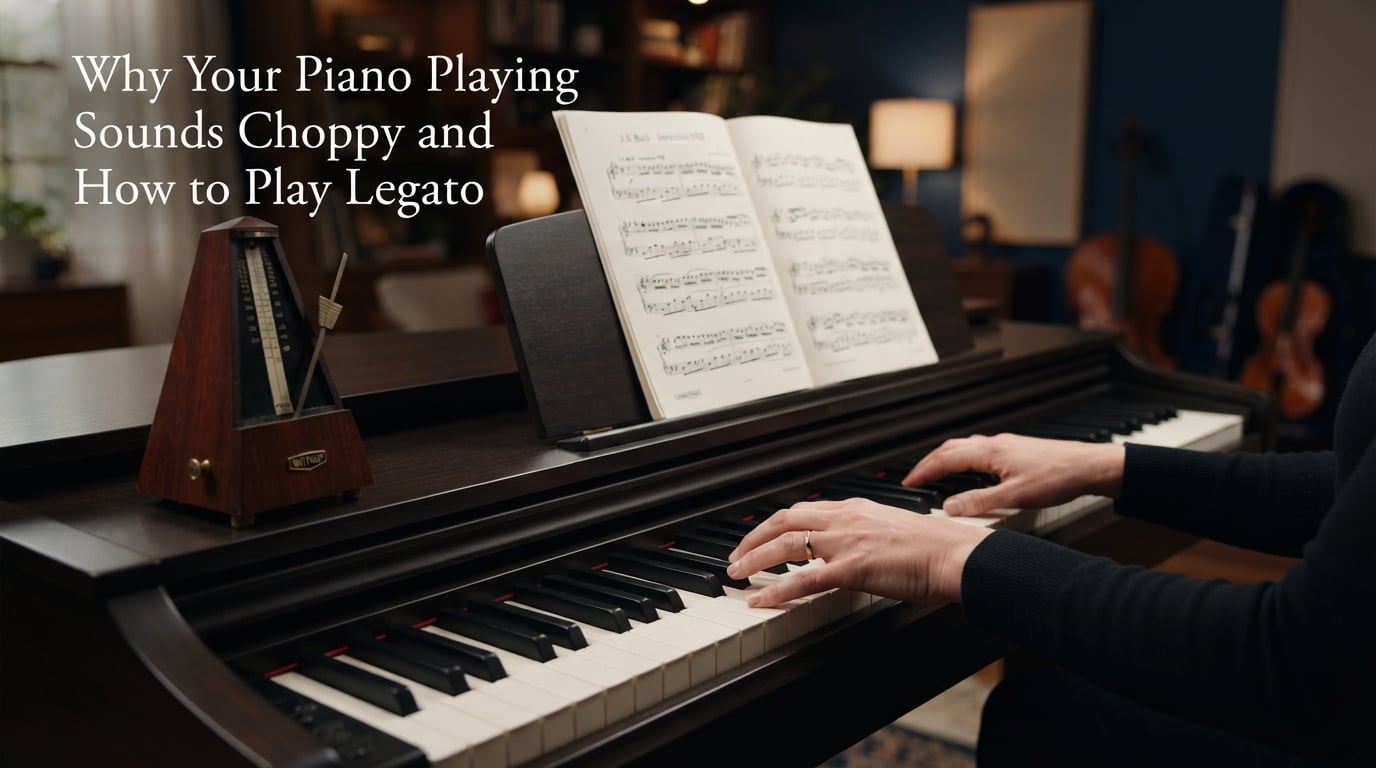
If your notes sound like separate taps instead of one musical idea, you are not alone. Choppy piano playing is one of the most common beginner frustrations, and a better piano legato technique gives you a practical way to change it.
The encouraging part is that smooth piano playing is not mainly about pressing harder, moving faster, or holding down the pedal. It comes from the order in which your fingers arrive and leave, plus a relaxed transfer of arm weight between notes.
This guide explains why a piano sounds disconnected, what legato actually asks your hands to do, and how to build the skill in short practice sessions. Work through the exercises slowly enough to hear every join; speed can wait.
Table of Contents
Your piano playing sounds choppy when notes, timing, or tone do not connect.
Choppiness usually has more than one cause. A tiny silence between notes, an uneven beat, or a sudden change in tone can all make a line feel broken even when you played the correct pitches.
Listen for the exact kind of break before trying to fix it. That diagnosis stops you from treating every problem as a lack of finger strength.
Gaps between keys make a melody sound detached.
The most direct cause is releasing one key before the next key has begun to sound. On a piano, a note begins when its key goes down, so the outgoing finger needs to stay in contact until the incoming finger has played.
In a slow scale, put down the next finger first and then let the previous finger rise. The overlap is brief, but it removes the audible hole that creates a choppy piano sound.
Uneven pulse makes connected notes feel jerky.
A phrase can have no literal gaps and still feel choppy when some notes rush and others drag. Forum players frequently describe this as a jerky feeling, and a metronome can reveal it clearly.
Set a beat that feels almost too easy and give each note the same amount of time. The metronome supports a steady pulse, but it cannot make the fingers connect for you; you still need to listen for the join.
Uneven tone breaks the singing line.
A loud note followed by a thin, weak note reads as a bump in the line. This often happens when one finger pokes at the key while the next finger has no supported arm weight.
Do not try to make every note equally loud in every piece. Instead, aim for tone matching: neighboring notes should belong to the same sound unless the music asks for an accent or a change of shape.
Tension makes release timing unreliable.
A clenched hand often lifts fingers early, freezes the wrist, and makes the player jab downward at each key. Trying harder can make the problem worse because the hand loses the small adjustments that legato needs.
Check your thumb, jaw, shoulder, and wrist when a passage becomes bumpy. If any of them are locked, pause, let the arm hang for a moment, and restart at a slower pace.
Quick self-check: Play five neighboring white keys with one hand, very slowly. If you hear a click-like gap, feel a finger spring upward before the next key goes down, or notice the beat wobble, you have found a specific issue to work on.
Legato means smooth or connected in Italian, created by a linked touch.
Legato means smooth or connected in Italian. In piano playing, it is a touch in which each new note begins as the preceding note is released, producing the impression of one continuous, singing line.
A piano cannot keep its original sound growing after the hammer strikes the string, so legato is partly an illusion shaped by timing, matching tone, and musical phrasing. The goal is not a blurred wash of sound; it is a clean connection that lets a melody breathe.
Legato and staccato piano playing are opposites of touch. Staccato deliberately separates notes, while legato makes the separation as small and unnoticeable as the instrument and the music allow.
True finger legato comes before pedal support.
Pressing the sustain pedal can hide gaps for a moment, but it does not teach piano finger connection. If the pedal comes up, an unconnected hand will still sound detached.
Build the connected touch with dry pedal first. Once the fingers make a smooth connection, pedal can extend the resonance without covering up a release problem.
A relaxed hand feels supported rather than glued in place.
Legato does not mean holding every finger down with force. It feels more like passing a small amount of support from one fingertip to the next while the wrist stays free enough to follow the hand.
Think of walking across stepping stones: one foot is secure before the other leaves. Your fingers do the same job on the keys, while your arm supplies a calm, moving base.
How to play legato on piano?: overlap, transfer weight, and release late.
Use this sequence with a five-note pattern such as C–D–E–F–G. Play one hand at a time first, because hands-separate practice makes it easier to hear the connection and notice tension.
Step 1: Prepare the next finger before the note is due.
Keep the hand close to the keyboard and let the next finger hover over its key. You are not pressing it yet; you are simply removing the scramble that leads to a late, poked note.
Use the keyboard geography to guide the hand rather than looking down for every note. A quiet, prepared movement gives your ear time to judge the sound instead of chasing it after the fact.
Step 2: Put down the new key while the old key is still down.
Play C with your thumb and keep it depressed. As your index finger plays D, leave C down for a fraction of a moment, then allow the thumb to release.
At a slow tempo you may notice two notes sounding together very briefly. That is useful practice overlap, not the final goal of a blurred chord; as your control improves, the connection becomes clean and nearly invisible.
Step 3: Move arm weight toward the finger that is playing.
After the new key is down, allow the arm to settle slightly toward that finger. This arm weight transfer helps the arriving note speak with the same supported tone as the note before it.
The movement is small and sideways, not a dramatic sway from the shoulder. A flexible wrist can travel with the hand, while a rigid wrist leaves each finger to strike alone.
Step 4: Release the previous key only after the transfer is complete.
Release timing is the heart of legato finger technique piano players need. Let the old finger come up because the new finger is already carrying the line, not because the old finger has finished its assigned beat on paper.
When the notes are not adjacent, a full physical overlap may be impossible. In that case, keep the motion economical, arrive as late as the music permits, match the tone of the new note, and avoid an accented landing.
Step 5: Shape a short phrase instead of counting isolated notes.
Play a group of four or five notes as one direction: perhaps gently forward to the middle note and away afterward. This gives the line a breathing phrase and helps you stop treating every key as a separate target.
Sing the notes quietly before playing them if that helps. If you cannot imagine where the phrase goes, the hands tend to produce a row of equally detached events.
Step 6: Listen after every small attempt and make one change.
Play the pattern once, then ask whether the break came from a gap, an uneven beat, or mismatched tone. Change only one variable on the next attempt, such as keeping the outgoing finger down a little longer.
This is more useful than repeating a passage ten times with the same result. A phone recording is especially helpful because a gap you overlook while concentrating on the keys often stands out on playback.
Warning: Do not force the fingers to stay down so long that the sound turns muddy. Legato is a precise handoff, not an instruction to pile every note on top of the last one.
The pedal supports legato after your fingers make the connection.
Sustain pedal adds resonance, but it is not a substitute for a connected touch. If you press it continuously through changing harmonies, old notes linger and the result can sound smeared rather than smooth.
First play the passage without pedal and hear whether the melody remains connected. Then add pedal in a way that follows the harmony, changing it cleanly while the new harmony is sounding.
Clean pedal changes preserve clarity.
For a basic change, play the new harmony, lift the pedal, and press it again almost immediately. This leaves very little silence while clearing the old resonance.
The exact timing changes with the piece, acoustic, and harmony. Your ear is the judge: if notes clash, change earlier; if a gap appears, change later or improve the finger connection.
Wide leaps need a convincing connection rather than literal overlap.
No hand can hold one key and physically overlap every distant leap. Here, smooth piano playing depends on an unhurried move, a prepared landing, matching the tone, and pedal only when the harmony permits it.
Do not rush a leap to avoid a gap. A calm arrival with a well-shaped sound feels more connected than a frantic jump that lands loudly.
These common mistakes make legato feel harder than it is.
Most legato problems are coordination problems, not a verdict on your hands. Fixing a single habit at a time gives the nervous system a clear task.
Poking at every key creates separate attacks.
When the fingertip snaps down from high above the key, each note has a hard edge. Keep the fingers near the surface and use a controlled descent instead.
Try playing so quietly that you can still hear every pitch. A softer dynamic exposes whether your connection is real without letting force disguise it.
Lifting fingers high creates gaps.
High finger lifts can look active, but they add unnecessary travel and make the next note late. Leave the departing finger on its key until the new one has sounded, then release it naturally.
For five-finger patterns, video from the side can show a lift you do not feel. The aim is not flat fingers; it is economical movement.
Rushing easy notes disrupts the pulse.
Players often speed up on familiar notes and hesitate before unfamiliar ones. That unevenness is a frequent reason a phrase sounds choppy even when the fingers overlap.
Use a metronome at a speed where you can make every transfer without panic. If one note consistently arrives early, count the subdivisions out loud for a few repetitions.
Locking the wrist turns fingers into isolated hammers.
A fixed wrist blocks the small lateral motion needed for finger transfer and arm weight. Let the wrist remain level and responsive rather than dipping sharply at every note.
If you feel forearm strain, stop and shake out the hand. Return with fewer notes and less effort; tension relief is part of the technique, not a break from it.
Using pedal to conceal weak joins delays progress.
Pedal can make a first attempt sound prettier, which is tempting. Practice dry first so your ears can identify the real release timing, then add pedal as a separate musical decision.
These piano legato exercises for beginners build smooth connection safely.
Practice each exercise at a pace that lets you notice the order of events: new key down, weight transferred, old key released. For many beginners, this will feel slower than expected, and that is appropriate.
Exercise 1: Connect two neighboring notes.
Choose C and D with fingers 1 and 2. Hold C, play D while C remains down, transfer the hand slightly toward finger 2, then lift finger 1.
Repeat in both directions and with every neighboring pair in a comfortable five-note position. Listen for an even join and matching tone rather than trying to complete many repetitions.
Exercise 2: Play five-note patterns with a held landing.
Play C–D–E–F–G up and back, using a normal fingering that feels comfortable for your hand. Pause briefly on G, release the hand, and begin again rather than looping until tension builds.
Start without pedal. When it sounds connected, vary the dynamic from soft to moderate while keeping the same fingertip control and relaxed hand.
Exercise 3: Use two-note slurs to feel the handoff.
Play the first note of each pair with a gentle arrival, then let the second note receive the moving weight before the first finger releases. The second note should not be punched; it should feel like the continuation of the same small motion.
Try pairs moving up, then down. This exercise makes the difference between an active transfer and a pair of separate taps easy to hear.
Exercise 4: Turn a scale into a listening exercise.
Scales are useful because the repeated neighboring-note pattern exposes gaps. Play one octave hands separately, slowly enough that every fingertip can overlap the next without the wrist stiffening.
At the thumb crossing, reduce the motion instead of twisting or rushing. Prepare the thumb under the hand early, then let it arrive with a tone that matches the preceding finger.
Exercise 5: Add a metronome only after the movement works.
Choose a pulse at which you can hear and control every transfer. Play four even notes per click only if that subdivision remains loose; otherwise use one note per click.
Increase tempo in small steps only after several clean, relaxed repetitions. A faster speed is not progress if the gaps, bumps, or tension return.
A five-minute routine makes the skill repeatable.
Spend one minute releasing the shoulders, jaw, and wrists, then play two-note connections very slowly.
Spend one minute on five-note patterns in the right hand, listening for gaps.
Spend one minute on the same patterns in the left hand, keeping the melody-like tone controlled.
Spend one minute on a slow scale with special attention at thumb crossings.
Spend one minute on two measures from a piece, dry pedal first, then record one attempt.
A short routine done regularly teaches more than a long session that ends in a tense hand. As the movement becomes familiar, put the same listening process into simple melodies and then into the passages that currently sound disconnected.
You can tell your piano playing is smoother by listening and checking how it feels.
A connected passage has no obvious holes between intended legato notes, a stable pulse, and a tone that does not jump unexpectedly from finger to finger. It should also feel calm: the hand moves across the keyboard instead of repeatedly bracing and striking.
Record eight to sixteen notes, then listen without watching your hands. Mark the first place that sounds bumpy and identify whether it is a timing gap, a loud accent, a rushed beat, or excess pedal.
One focused correction produces clearer progress than endless repeats.
Return to the exact two or three notes around the issue. Slow them down, restore the overlap and transfer, then place them back into the phrase.
Keep a simple note of which passage improved and what changed. That feedback loop reflects advice shared often by experienced players: recordings reveal details that are hard to catch during real-time playing.
FAQs
Why does my piano playing sound choppy?
Piano playing sounds choppy when notes have audible gaps, the beat is uneven, neighboring notes have mismatched tone, or tension makes fingers release and arrive unpredictably. Diagnose which issue you hear, then practise the smallest affected group of notes slowly.
Is legato always smooth?
Legato aims for a smooth, connected line, but it does not mean every note is identical or blurred together. The music can still have accents, phrasing, and changing dynamics while the intended notes remain connected.
Can a piano play legato?
Yes. A piano creates legato through precise finger overlap, release timing, tone matching, and often carefully timed pedal, even though each struck piano string naturally begins to decay.
How slow is slow practice?
Slow practice is slow enough for you to prepare the next finger, press it before releasing the previous key, transfer weight without stiffness, and hear the result. If any part feels rushed or unclear, reduce the tempo.
How do I relieve tension when playing piano?
Pause when the hand, wrist, forearm, shoulders, or jaw lock; release them, reduce the number of notes, and restart at a calmer tempo. A flexible wrist and small arm-weight transfer are more helpful than pressing harder.
Your piano playing becomes less choppy when each note hands the line to the next.
The path to legato is simple to describe and takes patient listening to learn: prepare the next finger, play it before releasing the old one, move support toward it, and keep the hand free. Pedal can enrich that result, but your fingers create the connection.
For better piano legato technique in 2026, choose one five-note pattern or two measures of music today and record a slow attempt. Find one break, correct it with a calm handoff, and let that small improvement guide the next session.