
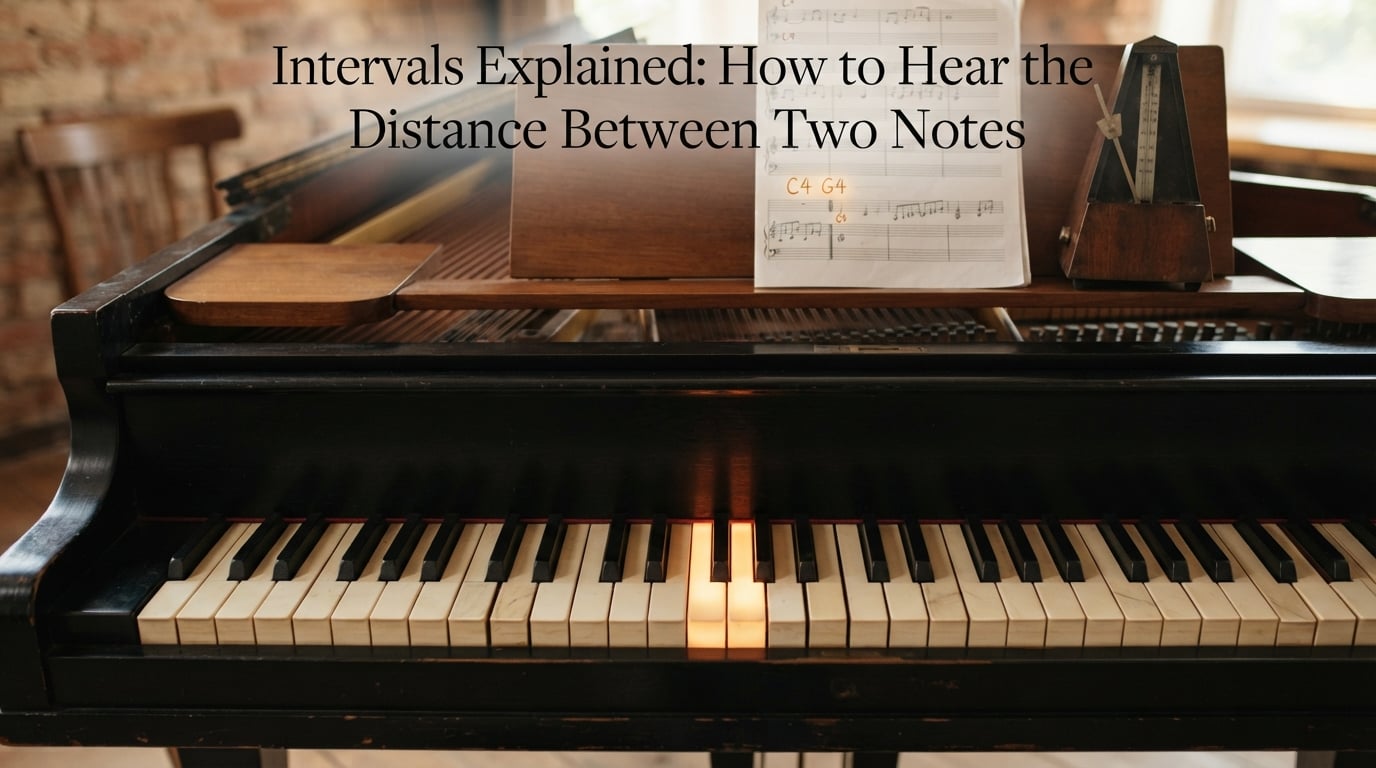
When I first sat down at a piano and tried to play a song by ear, I froze. I could hear the melody in my head but could not translate that sound into my fingers. The missing piece was musical intervals. Once I learned to recognize the distance between two notes, everything changed.
An interval is the measured distance between two pitches. It is the most basic building block of melody, harmony, and ear training. If you want to play by ear, sight sing, improvise, or transcribe music, you need to hear intervals confidently.
In this guide, I will walk you through every interval you will encounter, how to measure them, and the practical methods our team has used to train hundreds of beginners. You will leave with a complete reference, a list of memorable songs, and a practice routine you can start tonight.
Table of Contents
What Is a Musical Interval?
An interval is the pitch distance between two notes. When you move from one note to another on a piano, guitar, or voice, that movement is an interval. The word also describes two notes played at the same time.
Every interval has two parts. The number tells you how many staff or scale steps fit between the notes. The quality describes the character of the sound, such as major, minor, or perfect.
For example, moving from C up to E covers three scale steps, so it is called a 3rd. Adding the major quality makes it a major third. Counting the steps is straightforward, but choosing the quality is where most beginners get tripped up.
Counting Interval Numbers
Counting is simple. Start at 1 on the lower note and count upward through every note until you reach the higher one. C to D is a 2nd because you counted two letters: C and D. C to G is a 5th because you counted five letters: C, D, E, F, G.
Notice that you count every letter, even if one of them is a sharp or flat. C to F sharp is still a 4th because the count goes C, D, E, F.
Why This Matters for Musicians
I think of intervals as the alphabet of music. Once you can recognize each one by sound, you can decode any melody you hear. You stop guessing note by note and start hearing whole phrases.
Players who train intervals report an easier time with chord recognition, sight singing, and improvisation. You are no longer memorizing songs. You are recognizing patterns.
Measuring Distance: Semitones and Whole Steps
The distance between two notes is measured in semitones, also called half steps. A semitone is the smallest distance between two notes on a piano keyboard. Every black key to white key pair and every adjacent white key pair counts as one semitone.
Two semitones equal one whole step, also called a whole tone. The white keys E to F and B to C are the only natural half steps on a piano. Everything else is a whole step.
From one note to the same note an octave higher is exactly 12 semitones. That is the reference standard for every interval name you will learn.
The Role of Semitones in Naming
Two intervals with the same number, like a major third and a minor third, are separated by exactly one semitone. Knowing this shortcut saves you from memorizing a long list of notes. You only need to memorize the major intervals and remember that lowering them by a semitone changes the quality.
For instance, a major third is four semitones. A minor third is three semitones. Drop one semitone and the quality flips. This rule works for every major interval in the table below.
The 12 Intervals in Music: Complete Reference
There are exactly 12 intervals inside one octave, counting from unison to the octave itself. Here is the complete reference you can bookmark.
| Number | Name | Semitones | Character |
|---|---|---|---|
| 1 | Unison | 0 | Same note, no movement |
| 2 | Minor 2nd | 1 | Dissonant, tense |
| 2 | Major 2nd | 2 | Familiar, stepwise |
| 3 | Minor 3rd | 3 | Sad, mellow |
| 3 | Major 3rd | 4 | Bright, happy |
| 4 | Perfect 4th | 5 | Open, resolved |
| 4 | Tritone | 6 | Unsettling, classic horror |
| 5 | Perfect 5th | 7 | Strong, hollow |
| 6 | Minor 6th | 8 | Dark, longing |
| 6 | Major 6th | 9 | Sweet, nostalgic |
| 7 | Minor 7th | 10 | Bitter, jazzy |
| 7 | Major 7th | 11 | Dreamy, yearning |
| 8 | Octave | 12 | Full, complete |
Notice that not every number has both a major and minor version. The unison, 4th, 5th, and octave are perfect intervals. The 2nd, 3rd, 6th, and 7th are major or minor. The tritone sits alone in the middle as an augmented 4th or diminished 5th.
Perfect, Major, and Minor Intervals Explained
Perfect intervals sound stable and open. They are called perfect because they form the foundation of almost every melody and chord. The perfect 4th, perfect 5th, and octave all sound hollow and resonant when played alone.
Major intervals sound bright and cheerful. A major 3rd is the first chord tone you hear in songs like “Oh When the Saints.” A major 6th feels warm and uplifting.
Minor intervals sound darker or more tense. A minor 3rd starts countless blues and rock riffs. A minor 6th and minor 7th add emotional weight that you hear constantly in film scores.
How to Tell Major from Minor
The trick is the half step. A major 3rd is four semitones. A minor 3rd is three. When you hear the smaller version, it sounds slightly more compressed or melancholy. When you hear the bigger version, it sounds brighter.
Sing a major 3rd, then drop the top note by one piano key. Sing it again. That is the minor 3rd. This is the difference between “When the Saints” and “Greensleeves.” Same starting note, different emotional color.
Melodic vs Harmonic Intervals
A melodic interval plays one note after the other. You hear a melody line going up or down. This is the easiest starting point for ear training because your ear has time to register each note.
A harmonic interval plays both notes at the same time. You hear a chord or a double-stop. This is harder for beginners because the brain must process two pitches at once.
Most ear training apps start with melodic intervals and add harmonic intervals later. I recommend the same progression. Once melodic recognition feels easy, the harmonic versions come much faster because you already know the sound of each interval in isolation.
Ascending and Descending
Ascending intervals move up. Descending intervals move down. The same interval sounds different in each direction, especially as the gap grows.
An ascending perfect 5th feels uplifting. A descending perfect 5th feels resolving, like a sigh. Train both directions separately for the fastest progress.
Reference Songs: The Fastest Way to Learn Intervals
The reference song method links each interval to the first two notes of a song you already know. Once the link is set, you hear that song in your head whenever the interval plays. It is the fastest path from hearing an interval to naming it.
Here are the songs I and our students use most often.
Classic Reference Songs
- Minor 2nd: The Jaws theme (the da-dum)
- Major 2nd: Happy Birthday (first two notes)
- Minor 3rd: Greensleeves (first two notes)
- Major 3rd: Oh When the Saints (first two notes)
- Perfect 4th: Here Comes the Bride
- Tritone: The Simpsons theme opening
- Perfect 5th: Twinkle Twinkle Little Star
- Minor 6th: The Entertainer by Scott Joplin
- Major 6th: My Bonnie Lies Over the Ocean
- Minor 7th: Somewhere from West Side Story (main theme)
- Major 7th: Take On Me by A-ha (chorus opening)
- Octave: Somewhere Over the Rainbow (first two notes)
Pick a song you genuinely like. The stronger your emotional connection, the easier it sticks. Pick different songs for ascending and descending so you do not confuse direction with the interval itself.
Limits of the Reference Song Method
Reference songs work great for the first 6 to 8 intervals. After that, you can run into trouble because most melodies start with the same basic intervals. Beginners sometimes confuse a major 6th with a minor 7th if both reference songs are vague.
Pair reference songs with actual ear training practice using apps or a keyboard. Sing each interval you hear. Do not rely on memorization alone. Songs are the on-ramp. Real training is the highway.
Why Singing Intervals Speeds Up Learning
Singing the interval back forces your brain to produce the sound, not just recognize it. This active engagement builds a stronger mental model than passive listening. We have watched students progress twice as fast when they add singing to their daily routine.
Here is a simple exercise. Have someone play a note on a piano, then play a second note. Sing the first note, then sing the second note as accurately as you can. Do not worry about being perfect. Your voice does not need to match pitch exactly. You are training the gap.
If you cannot tell where the second note sits, try sliding your voice up or down until it locks in. The muscle memory builds quickly. After a few weeks, you will recognize intervals before you consciously sing them.
Pair Singing with Solfa
Solfa syllables like Do, Re, Mi, Fa, Sol, La, Ti, Do give you a vocabulary for singing intervals. A major 3rd is Do to Mi. A perfect 5th is Do to Sol. Many music teachers recommend solfa because it links the interval directly to its function in the major scale.
You do not need to master all of movable Do to benefit. Just learning the syllable pairs for the 12 intervals is enough to strengthen your singing practice.
A Realistic Practice Routine for Interval Recognition
Most adults can build reliable interval recognition in 3 to 6 months with daily practice. Children often need longer because pitch perception develops gradually. Forum users on r/musictheory and r/eartraining frequently report 1 to 2 years for confident mastery, but practical fluency arrives much sooner.
Here is the 15-minute routine I recommend to every beginner.
Step 1: Warm Up With Reference Songs (3 Minutes)
Pick three intervals from your reference list. Sing their songs twice each. Make sure your voice matches the starting pitch. This primes your ear for the sounds you will train next.
Step 2: Active Listening With an App (7 Minutes)
Use an ear training app that plays intervals in random order. Functional Ear Trainer and Teoria are popular free choices. Start with melodic intervals in one direction only.
Do not worry about your score in the first week. Focus on hearing each interval before you label it. The label comes after the recognition, not before.
Step 3: Keyboard Practice (5 Minutes)
Pick a starting note on a piano. Play each interval up and down from that note, naming each one aloud. Then play an interval and try to name it before checking. The keyboard gives you instant feedback.
Practice in multiple keys, not just C. Beginners often master intervals in C major and struggle in other keys. Rotate your starting note each day.
Common Beginner Mistakes to Avoid
Do not cram a 2-hour session once a week. Daily short sessions build stronger neural pathways. Do not skip the singing step. It feels silly at first but it works.
Do not get discouraged by slow progress in week one. The first weeks feel like nothing is sticking. By week three, you will suddenly start hearing intervals everywhere. That is the breakthrough moment.
Why Intervals Matter: Real-World Applications
Once you can recognize intervals, every other ear training skill becomes easier. Playing songs by ear, transcribing recordings, and improvising all rely on interval recognition under the hood.
Playing Songs by Ear
Instead of guessing one note at a time, you hear the gaps between notes. You can identify the melody shape and reproduce it on your instrument. This is how our team transcribes songs in a fraction of the time it used to take.
Improvisation and Composition
When you know which intervals sound bright, dark, or tense, you can choose them deliberately. A minor 6th followed by a major 6th creates emotional lift. A tritone creates suspense. Intervals are the colors on your palette.
Chord Recognition
Chords are stacks of thirds. If you recognize major and minor thirds quickly, you can identify chord qualities almost on contact. This skill transfers directly to jazz, pop, and classical harmony.
Sight Singing
Sight singing asks you to sing notes you have never heard before. Intervals are how you measure the distance between those notes on the page. Strong interval recognition makes sight singing feel like reading sentences instead of decoding letters.
Frequently Asked Questions About Musical Intervals
What is the gap between two notes called?
The gap between two notes is called an interval. It describes the pitch distance from one note to another and is measured in semitones and named by scale steps.
How do you measure the distance between notes?
You measure the distance between notes by counting semitones (half steps) from the lower note to the higher note. One octave equals exactly 12 semitones. The interval name combines that semitone count with a quality like major, minor, or perfect.
How do you tell the interval between two notes?
Tell the interval between two notes in four steps. Step 1: Count the scale steps from the lower note to the higher note to get the interval number. Step 2: Count the semitones between them. Step 3: Match the number and semitone count to a quality like major, minor, or perfect. Step 4: Verify with a reference song or by singing both notes.
How do you hear different intervals?
You hear different intervals by linking each one to a familiar song and training your ear with daily listening practice. Use melodic intervals first, then add harmonic intervals. Singing the intervals back to yourself strengthens recognition faster than passive listening.
How long does it take to recognize musical intervals?
Most adults reach reliable recognition in 3 to 6 months with 15 minutes of daily practice. Confident mastery across all keys typically takes 1 to 2 years. Progress feels slow in the first weeks but accelerates rapidly after the initial breakthrough.
Start Hearing Intervals Today
Musical intervals are the building blocks of every melody and chord you have ever loved. Learning to hear the distance between two notes unlocks playing by ear, transcription, improvisation, and sight singing. You stop guessing and start recognizing patterns.
Pick three reference songs from the list above. Sing them today. Tomorrow, add a 15-minute ear training session. In a few weeks, you will hear intervals in every song on the radio. That is when music really starts to feel like a language you speak.