
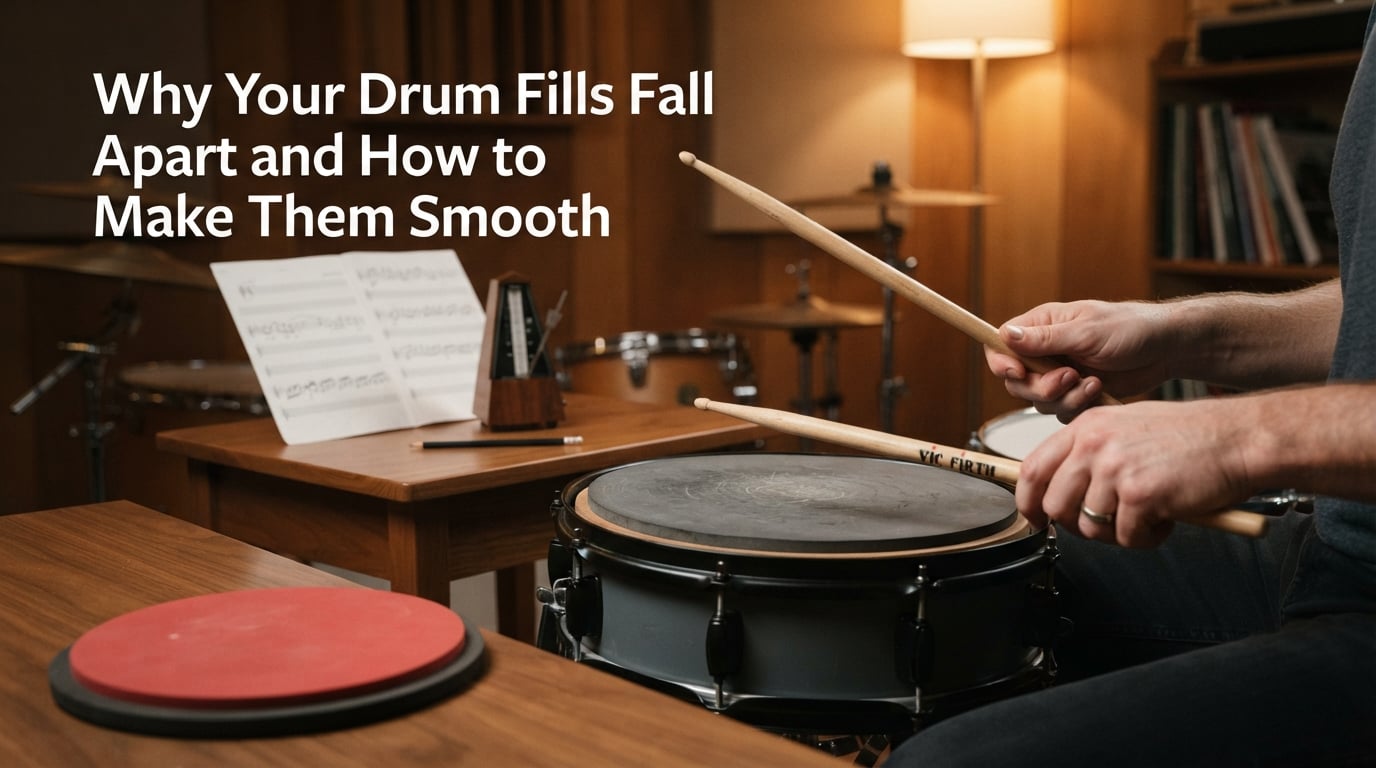
I have watched hundreds of students sit down at a kit and watch their drum fills fall apart halfway through. The first few notes land fine, then the spacing tightens, the arms tense up, and the whole thing sounds like a squirrel on a snare. If that sounds like you, the problem is not talent. The problem is a handful of fixable habits that show up in almost every beginner and intermediate drummer I teach.
In this guide I will walk you through exactly why your drum fills fall apart and how to make them smooth. You will get a clear definition, the five most common causes I see in my studio, and a three-step fix you can start using tonight. Whether you have been drumming for six months or six years, the principles below will tighten up your fills fast.
Table of Contents
What Is a Drum Fill? (And Why It Matters)
A drum fill is a short rhythmic passage that the drummer plays to break away from the main groove, usually at a transition like a verse into a chorus. Drummers build drum fills from the snare drum, toms, bass drum, and cymbals to add variety and signal movement in a song. A good fill feels like a musical statement, while a sloppy one sounds like a stumble.
I tell my students that fills are the punctuation marks of drumming. They lead the listener from one section to the next and add personality that the main groove alone cannot deliver. When your fills are clean, the whole band sounds tighter. When they fall apart, every transition feels bumpy.
Why Your Drum Fills Fall Apart: 5 Common Causes
After years of teaching, I can usually diagnose a fill problem within the first ten seconds. Here are the five reasons drum fills fall apart the most often, and they show up in roughly this order of frequency.
1. Uneven Spacing Between Notes
The number one cause is uneven spacing between hits. Drummers play the first couple of notes at a steady pace, then start rushing or dragging as they reach further across the kit. The fill stops feeling like rhythm and starts feeling like a panic. Slow it down, keep every gap between notes identical, then add speed back once the spacing is even.
2. Losing the Downbeat (the 1)
Losing the downbeat is the issue I hear most often in online forums. You finish your fill, look up, and have no idea where beat 1 of the groove landed. The fix is to subdivide the fill under a metronome. Every fill has a count, and counting out loud while you practice locks your place in the bar.
3. Tension in Hands, Wrists, and Shoulders
Tension sneaks in when we are nervous or pushing for speed. Wrists lock up, shoulders climb toward the ears, and the stick stops bouncing. Smooth drum fills require relaxed hands. Before you play a single fill, shake out your arms, bounce the sticks on a pad, and check in with your grip.
4. Practicing Too Fast Too Soon
Most players learn fills by watching fast drummers on YouTube and trying to copy the tempo on day one. Speed masks timing problems, so what looks impressive on the video is sloppy at home. Practicing at 50 percent tempo with a click for a week will make your fills cleaner than a month of full-speed guessing.
5. Fills Feel Disconnected From the Groove
A fill should sound like a continuation of the groove, not an interruption. If your fills sound like they belong to a different song, you are probably ignoring the bass drum and snare work that ties the kit together. Adding the bass drum to your fill keeps the time signature alive even when the hands are moving.
The 3-Step Fix for Smooth Drum Fills
Once you know what is breaking, the fix is simple. Run through these three steps every time you sit down to work on fills, and your hands will start to relax.
Step 1: Pick One Fill and Set a Metronome to 60 BPM
Pick a single fill you want to clean up, just four or eight notes long. Set your metronome to 60 BPM and play the fill as written, on every beat or every half beat. At this speed, every mistake is obvious. You will hear rushed notes, weak strokes, and timing drift before they happen.
Step 2: Lock the Spacing With a Subdivision
Count sixteenth notes out loud while you play. One-e-and-a, two-e-and-a. Every gap between notes should match. If the gap shrinks, slow the metronome down another 10 BPM. Spacing is more important than speed, and this step is where most of the magic happens.
Step 3: Add Speed Only When the Fill Is Bulletproof
Once the fill is even at 60 BPM for three days in a row, bump the metronome up 5 BPM. Repeat the spacing check. Never trade cleanliness for tempo. If the fill falls apart, drop the tempo back down. This slow ladder is how pros build fast, clean fills without burning out.
Orchestration: How to Move Around the Kit Smoothly
Orchestration is how you arrange notes across the drums in a fill. The most common beginner mistake is jumping across the kit in an order that feels awkward. Practice your fill left to right, then right to left, until both directions feel natural. This trains your hands to reach the same target from different angles.
Linear fills, where only one limb hits at a time, are a great place to start. They sound clean and they expose spacing problems immediately. Unison strokes, where two limbs hit together, sound huge but need even dynamics from both hands. Alternate between the two styles during practice so you build a balanced vocabulary.
Timing and Even Spacing: The Secret Most Drummers Miss
Even spacing is the single biggest difference between an amateur fill and a pro fill. Two players can hit the same drums in the same order, but the one with even spacing will sound twice as good. Treat the fill like a melody with equal rhythm between every note.
To build this habit, practice with a subdivision click. The metronome clicks on every quarter note, and you play eighths or sixteenths inside that grid. Your fills lock into the beat without you having to think about it. Count out loud as you play, especially during fills with more than four notes.
How to Transition Back to the Groove?
The end of the fill is where most drummers lose the band. You finish the last tom hit, then scramble to find beat 1 again. The fix is to plan the last two notes of the fill so they lead directly into the groove. Land on the bass drum or the snare on beat 1, and the transition will feel seamless.
I tell my students to practice the final two beats of every fill as a separate exercise. Loop just those two beats against the groove. After a few minutes, the landing spot becomes muscle memory, and you stop overthinking it mid-song.
Practice Tips and Common Mistakes to Avoid
Here are a few rules I share with every student working on smooth drum fills. They are simple, but skipping any of them is what makes fills fall apart in the first place.
Always warm up first. A five-minute pad routine loosens your wrists and primes your timing. Cold hands lead to tight fills.
Use the 80/20 rule. Roughly 80 percent of your fill vocabulary will come from about 20 percent of rudiments. Master paradiddles, flams, and singles, and most of your fills are already covered.
Practice with songs. Play-along tracks put your fills in context. A fill that sounds great in the practice room can fall apart in a real song, so test everything against music you love.
Record yourself. Your ears lie to you while you play. A quick phone recording reveals timing and dynamics issues that you cannot hear in the moment. Listen back and adjust.
Do not copy fills note for note. Listen for inspiration, then build your own. Copying locks you into someone else’s hands and limits your growth as a drummer.
FAQs
How to improve drum fills?
To improve drum fills, pick one short fill, set a metronome to 60 BPM, and practice it with even spacing between every note. Lock the timing at slow tempos for several days, then add 5 BPM at a time. Always practice with a click and count subdivisions out loud so you do not lose the downbeat.
Why do my drum fills feel rushed?
Drum fills feel rushed because the spacing between notes shrinks as tension builds in your hands and arms. Most players speed up as they move across the kit because they are not subdividing the beat. Slow the fill down, bounce the sticks on a pad to release tension, then rebuild the tempo gradually.
How do I stop losing the 1 when playing fills?
You lose the 1 because you stop counting during the fill. Practice every fill while counting sixteenth notes out loud, and run it under a metronome so the downbeat is always anchored. Once the count becomes automatic, the 1 will land without you thinking about it.
How to make drums sound fatter?
To make drums sound fatter, focus on tuning, head selection, and how you strike the drum. Tune the toms low and even, choose coated or two-ply heads for warmth, and hit the center of the drum rather than the edge. In a mix, add a touch of compression and a low shelf boost around 100 Hz to round out the tone.
Final Thoughts on Smooth Drum Fills in 2026
Smooth drum fills are not a mystery. They are the result of slow, deliberate practice, even spacing between notes, and a relaxed grip that lets the sticks do the work. I have watched students go from stumbling fills to studio-ready transitions in a few weeks using the three-step fix above. The trick is patience, not talent.
Pick one fill from your favorite song, set the metronome to 60 BPM, and spend ten minutes on it tonight. Then come back tomorrow and do it again. Within a month, your drum fills will sound smoother than they ever have, and the rest of the band will notice right away. That is the real win.