
I still remember the moment my piano teacher asked me a question I could not answer. “Why are there exactly 12 notes?” she said. “Why not 13, or 8, or 20?” I sat at the keyboard for a long time, looking at the white keys and black keys, and realized I had been playing music for years without understanding this basic truth about Western music.
The short answer is that Western music uses 12 notes because stacking 12 perfect fifths comes remarkably close to 7 complete octaves. This mathematical coincidence lets musicians build chords, transpose melodies, and move between keys without breaking the harmonic relationships our ears expect. In this guide, I will walk you through the physics, the history, and the music theory behind why there are 12 notes in Western music, and what makes that number so special.
By the end, you will understand the chromatic scale, the role of the octave, why equal temperament exists, and how composers from Bach to modern microtonalists have worked within or pushed against this 12-note system. You will also see why this number is not arbitrary, and why no other number has managed to replace it in over 2,000 years of Western music theory.
Table of Contents
What Are the 12 Notes Used in Western Music?
The 12 notes in Western music form what we call the chromatic scale, a set of 12 pitches within each octave. Each note is separated by a semitone, which is the smallest interval used in standard Western tuning. The word “chromatic” comes from the Greek chroma, meaning color, because these 12 pitches add color and shading between the main notes of a song.
Here are the 12 notes in order, starting from C:
- C
- C-sharp / D-flat
- D
- D-sharp / E-flat
- E
- F
- F-sharp / G-flat
- G
- G-sharp / A-flat
- A
- A-sharp / B-flat
- B
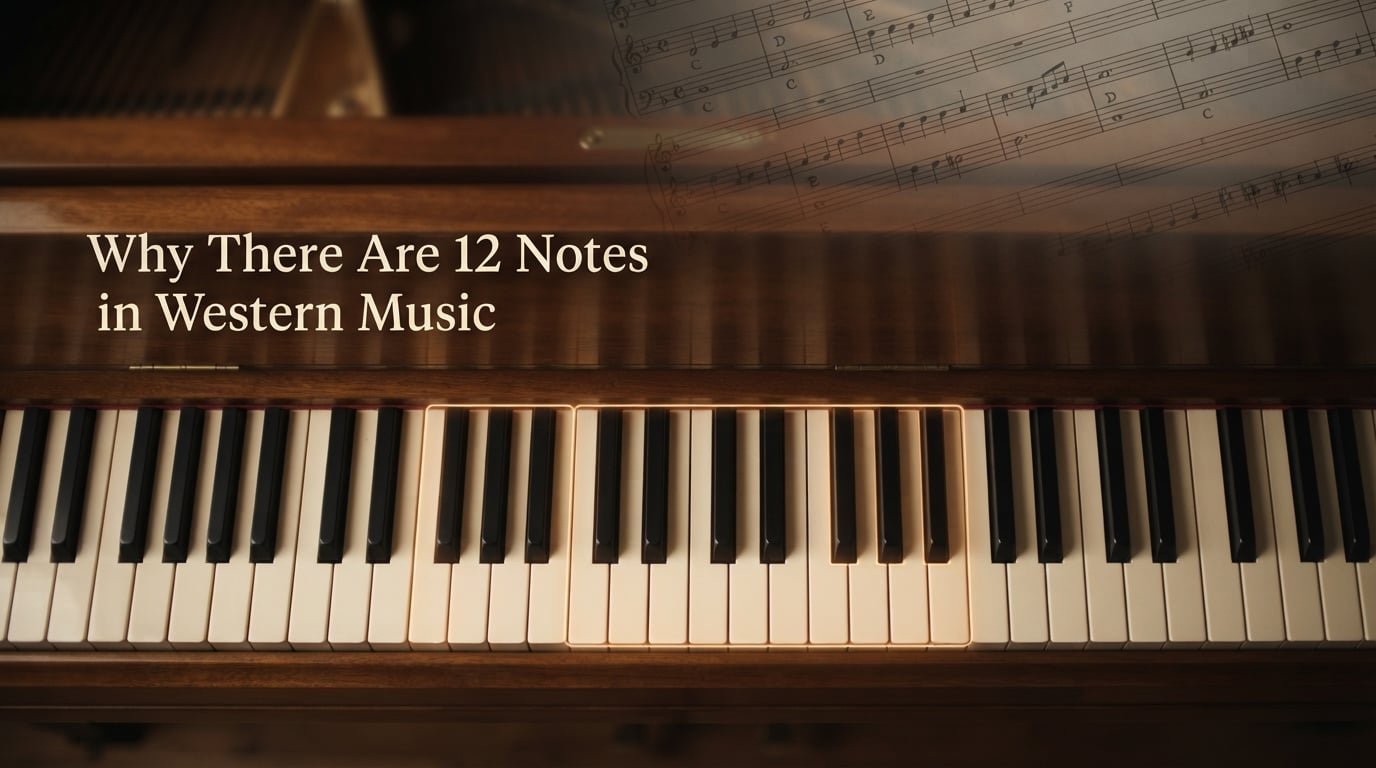
Notice that each “sharp” note has the same pitch as a “flat” note from a different letter name. This is why enharmonic spellings exist, and it is part of what makes the 12-note system flexible. On a piano, these 12 notes repeat in every octave, so you see 7 white keys (C, D, E, F, G, A, B) and 5 black keys (the sharps and flats) inside each octave.
The major scale that most pop songs, hymns, and classical melodies use is built by selecting 7 of these 12 notes. The remaining 5 notes serve as chromatic passing tones, modulations, or accidentals that color the music. A piece in C major uses C, D, E, F, G, A, and B, while the sharps and flats (C-sharp, D-sharp, F-sharp, G-sharp, A-sharp) sit just outside the main scale, ready to borrow when the composer needs a darker or more colorful sound.
So when someone asks “what are the 12 notes in Western music,” the answer is simply: the chromatic scale, repeated across octaves, covering every pitch between one C and the next C above it. Every melody, every chord, and every song you have ever heard in the Western tradition draws from these 12 building blocks.
The Octave and the Intervals Between Notes
An octave is the interval between one note and another note at exactly double the frequency. If middle C vibrates at about 261.6 Hz, the C an octave above vibrates at about 523.2 Hz, and the C below vibrates at about 130.8 Hz. Our brains perceive all three of these pitches as the “same note,” just higher or lower. This happens because the two waveforms share the same fundamental harmonic structure, even though they are at different speeds.
This property is called octave equivalence, and it is the foundation of the entire 12-note system. Almost every musical culture on Earth divides pitches into octaves because the human ear hears this 2:1 frequency ratio as a kind of “home base.” When a singer reaches the high note at the climax of a song, they are almost always landing on an octave of the starting note. The octave is the most consonant interval in music, more stable and unifying than any other.
The reason octaves feel so natural lies in the harmonic series. When you play a single note, say a low C, the string also produces quieter higher frequencies called overtones. These overtones occur at ratios of 2:1, 3:1, 4:1, 5:1, and so on above the fundamental. The 2:1 overtone is the C an octave above. So when you play two Cs an octave apart, you are essentially reinforcing the second harmonic that the lower note was already producing.
Inside the octave, the 12 notes are arranged by intervals. The most important intervals in Western music are:
- Perfect octave (P8) – 2:1 frequency ratio, 12 semitones
- Perfect fifth (P5) – 3:2 frequency ratio, 7 semitones
- Perfect fourth (P4) – 4:3 frequency ratio, 5 semitones
- Major third (M3) – 5:4 frequency ratio, 4 semitones
- Minor third (m3) – 6:5 frequency ratio, 3 semitones
- Whole tone – 9:8 frequency ratio, 2 semitones
- Semitone – 16:15 frequency ratio (in just intonation), 1 semitone
The perfect fifth is the workhorse of Western harmony. When you stack perfect fifths on top of each other (C, G, D, A, E, B, F-sharp, and so on), each new note falls almost exactly where the previous notes left off. After 12 stacked fifths, you have traveled so far that you land back within a single semitone of where 7 stacked octaves would put you. This near-match is what makes 12 a magic number for dividing the octave.
That is why the interval structure inside the octave is not arbitrary. The semitones, whole tones, thirds, fourths, and fifths all line up because of the way simple ratios interact. Western music organizes the 12 notes around these ratios, and the music that results feels balanced because it follows the natural patterns our ears evolved to recognize.
Why 12 Notes Specifically and Not 13 or 11?
Western music uses 12 notes because 12 is the smallest number of equal divisions of the octave that lets you approximate the perfect fifth closely enough to sound in tune. With only 11 notes, the perfect fifth would be noticeably flat. With 13 notes, you would get extra notes that nobody had a strong reason to use. Twelve sits in the sweet spot between simplicity and harmonic accuracy.
Here is the math behind it. The frequency ratio of a perfect fifth is 3:2, which equals 1.5. If you stack 12 perfect fifths, you get 1.5 raised to the 12th power, which equals about 129.746. Meanwhile, 7 stacked octaves equal 2 to the 7th power, which is exactly 128. The difference between 129.746 and 128 is small enough to be inaudible to most listeners, especially after the small adjustments that equal temperament applies.
That is the famous “12 fifths almost equal 7 octaves” fact you will see in music theory forums. It is not a coincidence. It is the reason the modern chromatic scale has 12 pitches. The closeness of that match, within about 1.36 percent, is what allows a single 12-note system to approximate both fifths and octaves simultaneously.
Other numbers do not work nearly as well:
- 11 notes – The perfect fifth would be too far off (1.5^11 = about 86.5, while 2^6 = 64 and 2^7 = 128). The interval would sound noticeably out of tune to trained ears.
- 13 notes – You would have one extra note per octave, but no historical or acoustic reason to add it. The extra pitch would not align with any consonant interval.
- 19 notes – This is an actual system used in some microtonal music. The perfect third (5:4) is approximated better in 19-tone equal temperament, but the fifth becomes less accurate.
- 31 notes – Used in some experimental music. 31-tone equal temperament approximates several just intonation ratios well, but the system is harder to play on standard instruments.
So 12 is not the only possible number, but it is the smallest number that gives acceptable approximations of the most important intervals (octave, fifth, fourth, and major third) using equal divisions of the octave. It is the simplest answer that still sounds good, which is exactly the kind of practical compromise musicians and instrument builders have always gravitated toward.
Equal temperament, the tuning system that divides the octave into 12 equal semitones, was developed during the Renaissance and Baroque periods. It became popular because it lets musicians play in any key without retuning. Before equal temperament, keyboards had to be tuned for specific keys, which is why early harpsichord music often stays in a limited set of keys. Composers like Bach, Handel, and Couperin were working in an era when this flexibility was just becoming available, and the music they wrote shows off the new freedom.
Consonant and Dissonant Intervals: What Sounds Pleasing?
Consonant intervals are the ones that sound stable and pleasing. Dissonant intervals sound tense, unstable, or harsh. The 12-note system is built around the consonant intervals, and most melodies and harmonies are designed to land on consonances at important moments, then move through dissonance to create forward motion before resolving.
The consonant intervals are those with the simplest frequency ratios:
- Perfect octave (2:1) – The most consonant interval, sounds like the “same note”
- Perfect fifth (3:2) – The most stable harmony after the octave, the backbone of most Western chords
- Perfect fourth (4:3) – Very stable, often treated like an inverted fifth
- Major third (5:4) and minor third (6:5) – Pleasant triadic intervals that define major and minor chords
- Major sixth (5:3) and minor sixth (8:5) – Inversions of the thirds, used in melodic lines
The reason these intervals sound consonant is that their frequencies align in simple ways. When you play a perfect fifth, the sound waves of the two notes line up every 2 cycles of one note and 3 cycles of the other. The waveforms reinforce each other rather than fighting each other. Our brains read this alignment as stability. The simpler the ratio, the more the waveforms lock together, and the more consonant the interval feels.
The dissonant intervals have more complex ratios. A minor second (16:15 in just intonation) sounds tense because the waveforms clash almost constantly. A tritone (45:32) was historically called “diabolus in musica” (the devil in music) because of its unsettling sound, although modern composers have learned to use it as a powerful expressive tool rather than something to avoid.
Inside the 12-note system, composers use dissonance to create tension and consonance to resolve it. A typical pop song or symphony alternates between these two states, and the 12-note chromatic scale gives composers exactly enough pitches to build that tension-and-release cycle without confusion. A major chord has a clear, stable sound because its three notes (root, major third, perfect fifth) all share consonant ratios. A diminished chord, with its stacked minor thirds, sounds unstable because the ratios are tighter and more complex.
A Brief History of the 12-Note System
The 12-note system did not appear overnight. It is the result of about 2,500 years of music theory, instrument design, and acoustic experimentation. The story unfolded across Greece, the Islamic world, medieval Europe, and the Renaissance before reaching the tuning system we use today.
The story usually starts with Pythagoras in ancient Greece, around 500 BCE. Pythagoras (or his students) discovered that simple string length ratios produced pleasing intervals. A string stopped at half its length sounded an octave higher. A string at two-thirds of its length sounded a perfect fifth higher. These ratios (2:1, 3:2, 4:3) became the foundation of Western music theory, and the Pythagorean tuning system used stacked perfect fifths to fill out the notes of the scale.
From there, the Greeks built tuning systems called just intonation, which used these pure ratios for the most important intervals. Just intonation sounds beautiful in the key it is designed for, but it has a major drawback: it does not transpose cleanly. If you tune a keyboard in just intonation for C major, the moment you try to play in D major, the thirds and fifths go out of tune. This is sometimes called the “wolf fifth” problem, because a sour interval howls like a wolf in the background.
By the Middle Ages, theorists had developed several tuning compromises, including meantone temperament, which favored pure thirds at the expense of slightly impure fifths. These systems worked well for music that stayed in a few closely related keys, and much Renaissance choral music was written with these tuning systems in mind.
This problem is the one that equal temperament solves. By slightly detuning every interval from its pure ratio, equal temperament allows every key to sound acceptable. Each semitone is exactly the same width (about 1.05946 times the previous frequency), so a melody sounds the same whether you start on C, F-sharp, or any other note.
Equal temperament was first described in writing by Chinese music theorist Zhu Zaiyu in 1580, and independently by Flemish mathematician Simon Stevin around the same time. By the time Bach wrote The Well-Tempered Clavier in 1722, equal temperament was becoming standard across Europe. Bach’s two books of preludes and fugues, covering all 24 major and minor keys, were partly a demonstration that equal temperament made every key usable. Before equal temperament, composers avoided certain keys because they sounded terrible. After it, every key became fair game.
Music Beyond 12 Notes: Microtonal Systems
Western music is not the only tuning system in the world, and 12 notes is not the only option. Indian classical music uses 22 shrutis per octave, allowing for ornaments and pitch bends that the Western 12-note system cannot capture. Arabic and Turkish music use quarter tones, which are notes halfway between the standard 12. Gamelan music from Indonesia uses entirely different scales tuned to the instruments built for each ensemble, often with intervals that sound strange to Western ears but feel perfectly natural to listeners raised on that tradition.
Microtonal music is the practice of using more than 12 notes per octave. Composers like Harry Partch, Ben Johnston, and La Monte Young have explored these systems throughout the 20th and 21st centuries. Modern software synthesizers can also produce microtonal scales, and some contemporary pop and electronic artists have begun experimenting with them. Indian-influenced music, gamelan-inspired ambient, and modern jazz fusion all touch on microtonal ideas without always using the word.
The reason the 12-note system won out in the West is partly practical. Piano, guitar, fretted instruments, and other common instruments are built around 12 equal divisions. Once those instruments became widespread, the tuning system got baked into music theory, music education, and music technology. Retraining thousands of years of built instruments would be a massive undertaking.
But the underlying acoustic reality is more flexible. The ear can perceive many more than 12 pitches per octave, and many cultures have built rich musical traditions using different divisions. Western music settled on 12 because it is the smallest practical number that approximates the most important consonant intervals well enough for everyday music-making, and because instruments built on this system spread worldwide through colonization, trade, and cultural exchange.
Frequently Asked Questions
What are the 12 notes in Western music?
The 12 notes are C, C-sharp/D-flat, D, D-sharp/E-flat, E, F, F-sharp/G-flat, G, G-sharp/A-flat, A, A-sharp/B-flat, and B. Together they form the chromatic scale, which repeats across every octave.
How many notes are used in Western music?
Western music uses 12 notes per octave. These 12 notes repeat in higher and lower octaves, giving musicians access to every pitch in the standard tuning system.
Who invented the 12 notes?
The 12-note system evolved over centuries. Pythagoras and Greek theorists discovered the basic ratios around 500 BCE, and equal temperament (which divides the octave into 12 equal semitones) was developed in the late 16th century by Zhu Zaiyu and Simon Stevin.
What does 12 notes mean?
12 notes means the octave is divided into 12 equal semitones, producing the chromatic scale. This gives every interval a consistent width and lets musicians play in any key without retuning.
Why is the octave divided into 12 and not 13 or 11?
The octave is divided into 12 because 12 stacked perfect fifths almost exactly equal 7 stacked octaves. With 11 notes the fifth would sound flat, and with 13 there is no acoustic reason to add an extra pitch.
Final Thoughts on Why There Are 12 Notes in Western Music
So why are there 12 notes in Western music? Because 12 is the smallest number that lets musicians divide the octave into equal semitones while still preserving the consonant intervals our ears expect. The math (12 fifths equaling almost 7 octaves), the history (Pythagoras to Bach to modern microtonalists), and the practical needs of instruments all converge on the same answer. Twelve is not a magic number handed down from above, but it is the most elegant compromise a 2,500-year search has turned up.
Now that you understand why there are 12 notes in Western music, try listening to a familiar song and counting the pitches. Most melodies use only 7 of the 12 notes, and the rest are saved for color and surprise. The next time you sit down at a piano or pick up a guitar, you will know that every key you press is part of a system refined over thousands of years, balancing acoustic physics with the limits of human hearing and the needs of musicians across every style and era.