
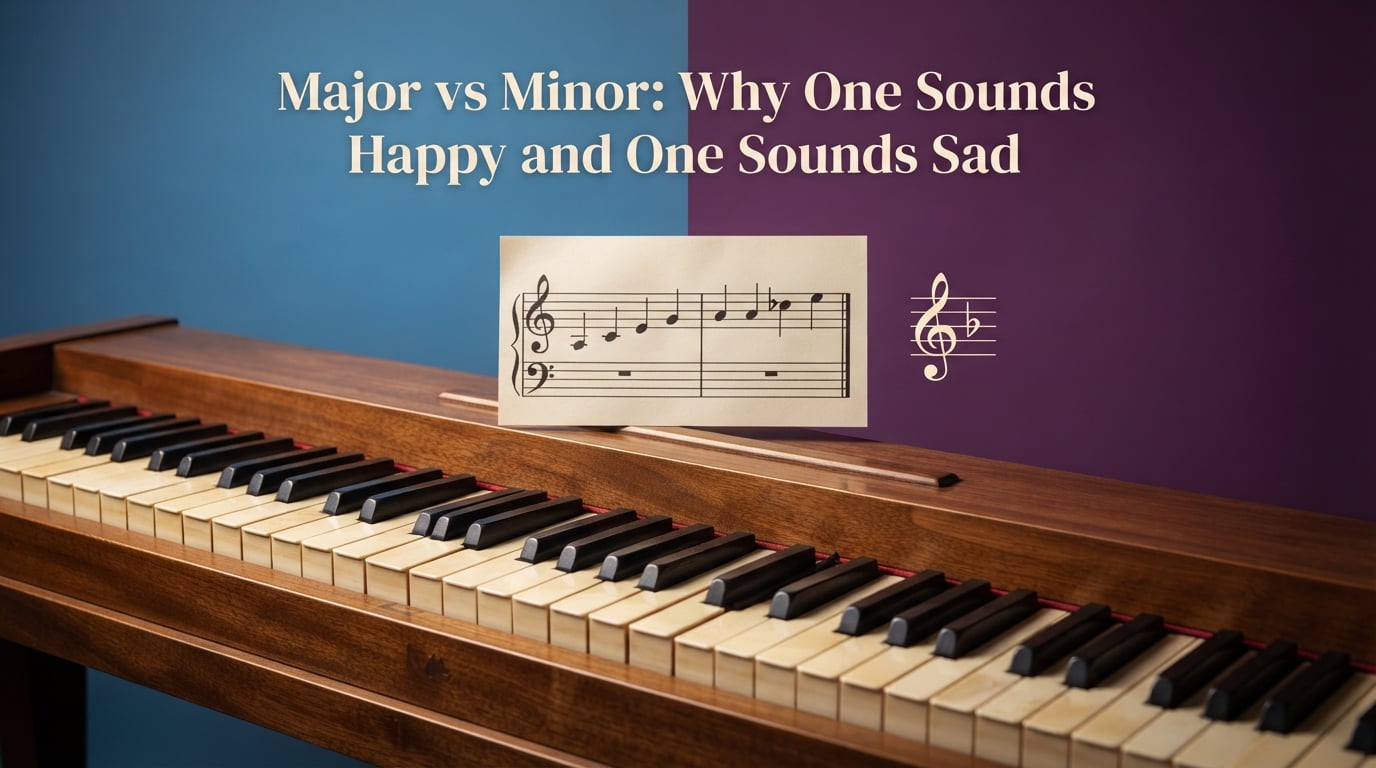
Major vs minor sounds happy sad because Western listeners often connect a major third and a major key with brightness, and a minor third and a minor key with darkness. That association is useful as a first listening clue, but it is not a rule that assigns an emotion to every song.
A slow major-key ballad can feel lonely, while a quick minor-key dance track can feel joyful. Tempo, rhythm, melody, lyrics, vocal delivery, arrangement, production, and a listener’s own memories all help decide the musical mood.
This guide explains what major and minor actually describe, why the happy/sad shorthand became common, and how to hear the details that make a song feel uplifting, melancholic, tense, peaceful, or something harder to name. Updated for 2026, it is meant for curious listeners as much as for musicians learning music theory.
Table of Contents
Major vs Minor: Why One Sounds Happy and One Sounds Sad Depends on More Than Key
Major and minor are objective sound qualities in intervals, chords, scales, and keys; happy and sad are subjective responses to music. A major sound often reads as brighter and a minor sound often reads as darker when heard alone, yet neither quality contains a built-in emotional instruction.
The simple answer is that one small interval change strongly changes a familiar musical color, and repeated exposure teaches many listeners to attach feelings to those colors. Once a piece adds a pulse, a melody, words, a singer, instruments, and a situation, the key is only one part of the message.
Quick answer: Major does not mean happy, and minor does not mean sad. Major and minor describe musical relationships, while mood comes from those relationships working with tempo, rhythm, register, melody, performance, lyrics, production, and cultural association.
That distinction explains a common listening surprise: two songs can share a major key and produce completely different emotional reactions. It also gives writers more control, because choosing a minor chord progression does not lock a new song into melancholy.
Major and minor are measurable qualities in intervals, chords, scales, and keys
Major and minor can describe several connected things, so the vocabulary can feel slippery at first. The cleanest place to start is an interval, which is the distance between two notes.
A major third is four semitones above a root, while a minor third is three
Play C and E together and you hear a major third: E is four semitones above C. Play C and E-flat together and you hear a minor third: E-flat is three semitones above C.
That one-semitone shift changes the sound immediately. Many listeners describe the major third as open, bright, or settled and the minor third as dark, inward, or plaintive, but those are descriptions of a tendency rather than a fixed translation.
A major chord and a minor chord differ mainly at the third
A basic triad uses a root, a third, and a fifth. C–E–G is a C major chord because its middle note is the major third E; C–E-flat–G is a C minor chord because its middle note is the minor third E-flat.
Both are familiar, relatively consonant chord types, so the distinction is not simply “pleasant” versus “unpleasant.” The contrast comes from their interval shape and from the musical conventions listeners have heard around that shape.
A major scale and a minor scale organize notes around a home note
A scale is a collection of notes ordered from a tonic, or home note, up to its octave. The major scale is commonly linked with the Ionian mode, while the natural minor scale is commonly linked with the Aeolian mode.
A key gives a piece a tonal home and a pool of notes and chords that tend to support it. A major key therefore does not mean every chord is major, and a minor key does not mean every chord is minor.
Try it at a keyboard: Hold C and G, then alternate E and E-flat between them. You are hearing the major-versus-minor contrast at its most direct, before tempo or lyrics can steer your reaction.
Melody matters here too. A melody may emphasize notes that make its home key feel stable, or it may hover on notes that feel unresolved, even when the chord underneath is a simple major chord.
The happy-major and sad-minor rule is a shortcut, not a law
The major-equals-happy, minor-equals-sad formula survives because it often works in a stripped-down example. A major triad played clearly in a middle register may feel brighter than the matching minor triad, and a minor triad may feel more shadowed by comparison.
The problem begins when that useful first impression becomes a claim about whole songs. “Happy” and “sad” are much too broad for the range of emotion in music: a minor passage can be determined, sensual, threatening, playful, reflective, or ecstatic, while a major passage can be tender, nostalgic, grieving, ironic, or triumphant.
Music-theory discussions repeatedly point out this oversimplification because listeners hear complete performances, not isolated flashcards. If a song feels sad in a major key, the song is not breaking music theory; it is showing that musical mood comes from several layers at once.
Tempo, rhythm, melody, lyrics, delivery, and production shape musical mood alongside key
Key color matters, but a complete arrangement gives the ear far more evidence about emotion in music. When you want to understand why a track feels the way it does, listen for these factors before treating major or minor as the full explanation.
Tempo changes energy and expectation. Faster motion often feels active or buoyant, while a slower tempo can leave more room for weight, reflection, or grief. Either choice can appear in a major key or a minor key.
Rhythm changes physical feeling. A steady dance groove can make a minor chord progression feel communal and energized, while sparse rhythm or long pauses can make a major chord progression feel exposed. Accents, syncopation, and how often the beat arrives all matter.
Melody directs attention. Rising phrases can suggest reach or release, and falling phrases can suggest settling or sighing, though their effect depends on phrasing and harmony. A melody that lingers on tense notes may sound unsettled even over a major chord.
Chord progression creates motion. One major chord does not describe a whole song any more than one word describes a paragraph. Repetition, harmonic rhythm, departures from the tonic, and delayed resolution can make a bright chord progression feel restless or a dark one feel driving.
Lyrics and vocal delivery frame what the listener hears. A major melody paired with words about loss will rarely register as uncomplicated happiness. A breathy vocal, a rough vocal, a whispered line, or a forceful delivery can also change the emotional reading of the same notes.
Register, timbre, and production change the color. High, light instruments and a full, clear arrangement can suggest lift, while low register, sparse space, distortion, reverb, or a close vocal can suggest intimacy, heaviness, distance, or tension. These choices do not replace harmony; they tell the harmony how to speak.
Context can be just as strong as sound. A chord progression connected to a film scene, a personal memory, a religious setting, or a live crowd may trigger an emotional response that the notes alone cannot predict.
Writing tip: To make a minor song feel happy, pair its minor scale or minor chord progression with a lively tempo, rhythmic momentum, an energetic melody, and bright performance choices. To make a major song feel sadder, slow the pace, leave space in the arrangement, use a vulnerable lyric and delivery, and let phrases fall or remain unresolved.
Cultural learning shapes the association between major and minor and emotion
The bright-major and dark-minor association is partly learned through repeated listening. In much Western popular music, film scoring, classroom teaching, and advertising, major harmony is often placed beside celebratory or hopeful scenes, while minor harmony often accompanies loss, danger, or introspection.
That repeated pairing gives the interval colors emotional baggage. It does not mean a major third carries happiness in the same way a word carries a dictionary definition, and it does not mean every listener will react in the same way.
Musical traditions outside the usual Western major/minor system organize pitch and expression through other materials and conventions. For that reason, it is safer to say that many Western-trained or Western-media listeners often hear major as brighter and minor as darker than to call either response universal.
Personal association adds another layer. A song heard during a difficult moment may feel painful even if its chord progression is among the brightest possible, while a minor-key song tied to a celebration may bring warmth every time it returns.
Sad songs can use major keys and happy songs can use minor keys because the rest of the arrangement speaks too
Counterexamples are not trivia; they are the quickest way to hear why the shortcut is incomplete. The key gives a starting color, while the song’s pacing, melody, words, performance, and situation shape the larger emotional result.
“Hey There Delilah” shows how a D major song can still feel sad
Music-theory listeners often point to “Hey There Delilah” as a sad-feeling song in D major. Its emotional pull is not cancelled by the major key because the song’s lyrical point of view, restrained pace, and intimate delivery lead the listener toward longing and distance.
The lesson is not that D major is secretly sad. The lesson is that a major key can support tenderness or ache when the melody, words, and performance direct the ear there.
“Someone Like You” shows how a major-key setting can carry heartbreak
Adele’s “Someone Like You” is another supplied example of a sad song in a major-key setting. The song’s subject, vocal delivery, and piano-centered presentation give the harmony a role inside a story of loss rather than a simple happy label.
When someone asks why some major songs sound sad, this is the practical answer: major harmony can feel clear or open while every other element communicates separation, regret, or memory. The listener receives all of those signals together.
“Happy” shows how an F minor song can feel joyful
Pharrell Williams’s “Happy” is commonly cited in music-theory discussions because it is in F minor but projects joy. Its rhythmic drive, tempo, repetitive celebratory message, and buoyant performance give the minor setting an energetic, social feeling.
That does not make minor harmony irrelevant. The minor color may add bite or character to the groove, but the song demonstrates why a minor key cannot be reduced to sadness.
Listening warning: Do not judge a song’s key from its emotional label alone. If a track feels cheerful, it may still be minor; if it feels devastating, it may still be major.
Modes add shades between the familiar major and minor labels
Modes are scale patterns that share some notes with major or minor while shifting the tonal center or changing characteristic intervals. They give musicians more descriptive options than the two broad labels alone.
Ionian and Aeolian supply the familiar major and natural-minor reference points
Ionian is the mode most people mean when they say major scale, and Aeolian is the mode most people mean when they say natural minor scale. They are useful reference sounds, not emotional prisons.
Dorian can make minor harmony feel more mobile or hopeful
Dorian has a minor-third quality but differs from natural minor in an important scale degree. In practice, musicians often hear it as a minor color with more lift or forward motion than Aeolian, which makes it a helpful answer to the question of how a minor setting can avoid sounding conventionally sad.
Mixolydian can make major harmony feel relaxed or rootsy
Mixolydian has a major-third quality with a flat seventh, a feature common in many folk, rock, and blues-flavored sounds. Its color can feel less polished or more grounded than straight Ionian without becoming minor.
Mode names are not emotion labels either. They are a way to notice which notes create a particular shade, so you can describe what you hear with more precision than happy or sad.
Listeners can identify the likely source of a song’s mood with a short listening pass
You do not need perfect pitch or advanced theory to listen beyond the major/minor shortcut. Repeat a short section of a song and separate the clues one by one.
Find the pulse. Ask whether the tempo feels fast, slow, heavy, loose, urgent, or danceable. Notice whether the rhythm keeps pushing forward or leaves silence around the notes.
Listen for the home chord. The chord that feels like arrival may help you hear a major or minor center, but treat this as one observation rather than the verdict. If you play an instrument, compare the third above that root: a major third or a minor third may make the color easier to hear.
Follow the melody shape. Does the melody rise, fall, leap, repeat, or hang on a note that wants to move? Notice whether the singer delivers it with confidence, restraint, strain, softness, or excitement.
Read the words and sound of the instruments together. Lyrics can reverse the first impression from harmony, and timbre can sharpen it. A bright acoustic guitar, a deep bass, a close vocal, or a wide wash of reverb each changes the emotional frame.
Name more than one feeling. Instead of deciding “happy” or “sad,” try a pair such as bright and wistful, dark and energized, calm and lonely, or tense and hopeful. This habit makes your listening more accurate and makes your own writing choices easier to hear.
I find this method more useful than trying to memorize a mood chart. It teaches your ear to notice the actual decisions in a recording, including the decisions that make a familiar major or minor color feel unexpected.
FAQs
Why does major sound happy and minor sound sad?
Many Western listeners hear major intervals and major keys as brighter and minor intervals and minor keys as darker, partly because of their different third intervals and partly because repeated cultural pairings teach those associations. The effect is a tendency, not a rule: tempo, rhythm, melody, lyrics, performance, production, and context can change the emotional result.
Is C major happy or sad?
C major is neither inherently happy nor sad. Its major-scale color may sound bright or open in isolation, but a piece in C major can feel joyful, gentle, nostalgic, tense, or sad depending on its melody, chord progression, tempo, lyrics, delivery, and arrangement.
Why do some major songs sound sad?
Major songs can sound sad because harmony is only one mood signal. Slow tempo, falling or unresolved melody, lyrics about loss, a restrained vocal, sparse arrangement, low register, and personal or cultural association can all make a major-key song feel mournful or wistful.
Why do minors sound sad?
Minor sounds are often described as sad because a minor third and minor-key harmony have a darker color than their major counterparts for many listeners. That color has been repeatedly paired with reflective or painful scenes in Western music, but minor can also sound energetic, playful, sensual, determined, or joyful.
Major versus minor is a starting color, while the full song creates the feeling
Major vs Minor: Why One Sounds Happy and One Sounds Sad has a simple answer and an important correction. The major third and minor third give familiar musical colors, but no chord, scale, or key can tell the whole emotional story by itself.
On your next listen, identify the likely key color, then notice the tempo, rhythm, melody, words, delivery, and arrangement around it. That wider hearing is the point: major and minor become more interesting when they stop being a two-word mood chart.
Use the happy/sad shorthand as a first guess, not a final judgment. Your ears will soon catch the richer combinations that make music feel human.