
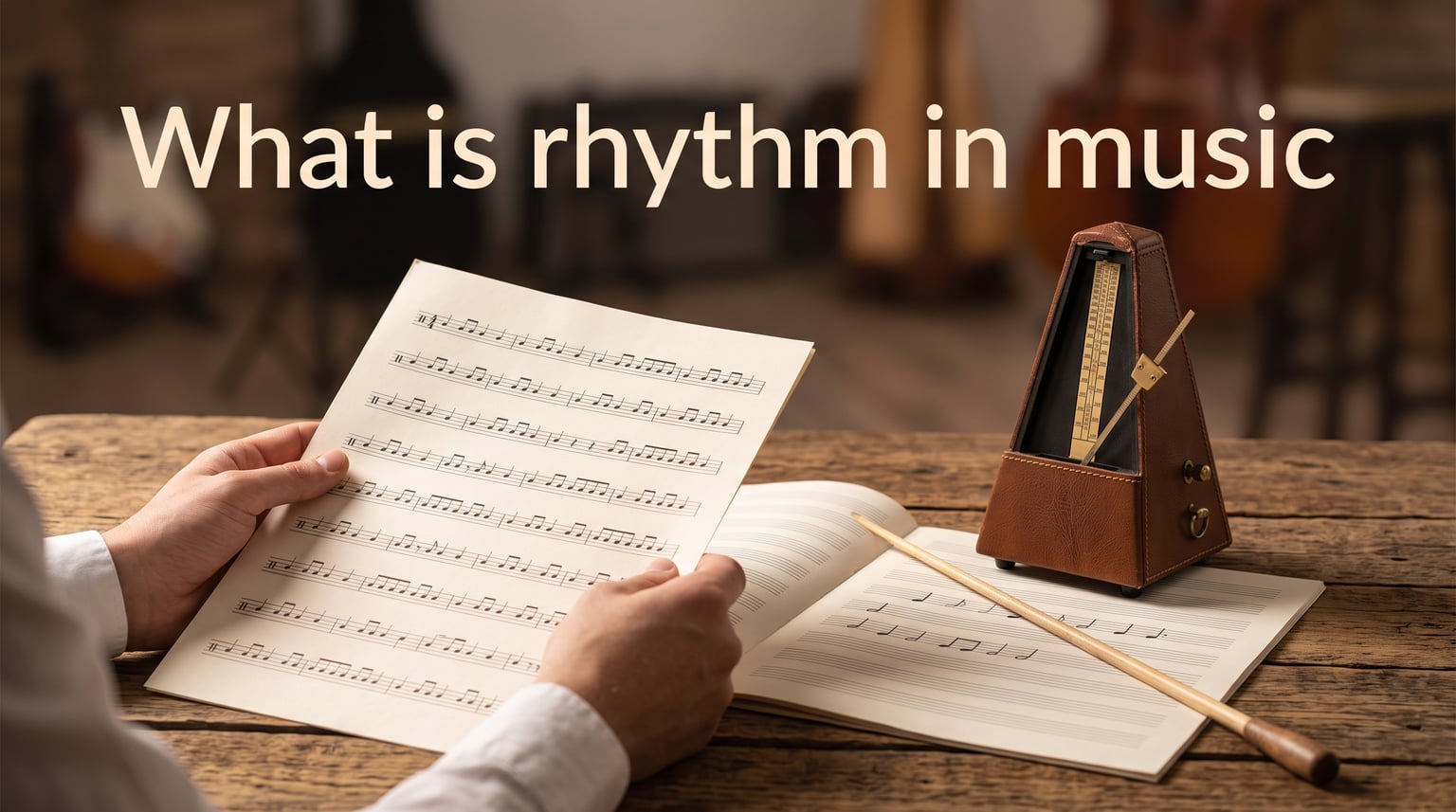
Rhythm is the organization of sounds and silences in time, creating patterns of duration within a regular underlying pulse or beat. When most people ask what is rhythm in music, they are really asking how time gets shaped into something you can feel, tap your foot to, and move with. In this guide, we break down the elements that build rhythm, the different types you will hear across genres, and practical ways to train your own sense of timing.
Think of rhythm as the heartbeat of a song. Melody gives you the tune, harmony gives you the color, but rhythm is what makes your head nod before you even realize it. Our team has spent years studying music theory and performing live, and we have found that once you understand rhythm, everything else in music starts to click into place.
You will learn the difference between beat, tempo, and meter. We will cover note values, rests, time signatures, and syncopation. We will also share concrete examples from songs you already know, plus simple exercises to help you develop a stronger internal clock. Whether you are a complete beginner, a parent explaining music to a child, or a self-taught musician looking to fill theory gaps, this guide is written for you.
Table of Contents
What Is Rhythm in Music? The Definition Explained
If you want a one-sentence answer to the question what is rhythm in music, here it is: rhythm is the patterned arrangement of sound and silence over time. Every time a note starts, every time a note stops, and every gap of quiet in between is part of the rhythm. It is not just the drum beat or the catchy groove. It is the entire timing structure that holds a piece of music together.
Rhythm works by organizing three things: when a sound begins, how long it lasts, and when it ends. Imagine clapping along to a song. The moments you clap and the moments you wait are both rhythm. Silence is just as musical as sound, and rests, the written notation for silence, carry as much rhythmic weight as the notes themselves.
Many people confuse rhythm with beat. Here is the distinction: the beat is the steady pulse you tap your foot to, while rhythm is the actual pattern of long and short sounds that happens on top of that pulse. A beat is regular and predictable. Rhythm is creative, varied, and expressive. You can have a steady beat with a wildly complex rhythm layered over it.
This is why a song can feel exciting, laid-back, tense, or joyful largely through rhythm alone. Before we added words to music, before we built chords and scales, humans were organizing sound in time. Rhythm is likely the oldest and most universal element of music across every culture on earth.
The Core Elements of Rhythm
To really understand how rhythm works, you need to know its building blocks. Five elements form the foundation: beat, tempo, meter, note values, and rests. Each one controls a different aspect of musical time, and together they create the patterns we call rhythm.
Beat and Pulse
The beat is the steady, repeating pulse that runs underneath a piece of music. It is the most basic unit of musical time, the thing you naturally tap, clap, or nod along to. When someone says a song has a good beat, they mean the pulse feels clear and satisfying.
Pulse and beat are often used interchangeably, but pulse carries a slightly deeper meaning. Think of it like a heartbeat: constant, alive, and felt more than heard. Every song has a pulse even when the instruments go silent for a moment. That invisible steadiness is what keeps musicians together and listeners locked in.
Some beats feel stronger than others. In most popular music, the first beat of each group gets an accent, a natural stress that makes it stand out. These strong and weak beats create the foundation for meter, which we will cover shortly.
Tempo and BPM
Tempo is the speed of the beat. It tells you whether the pulse moves fast or slow, and it shapes the entire mood of a song. A slow tempo at around 60 beats per minute can feel calm and reflective. A fast tempo at 140 beats per minute feels energetic and urgent.
Musicians measure tempo in BPM, or beats per minute. A tempo of 120 BPM means 120 beats pass every minute, which works out to two beats per second. That is the sweet spot for a lot of pop and dance music because it matches the natural pace of walking and a comfortable heart rate.
Italian terms still appear in sheet music to describe tempo in a more expressive way. Largo means slow and broad, around 40 to 60 BPM. Allegro means fast and lively, around 120 to 168 BPM. Presto means very fast, often above 168 BPM. These terms give performers room to interpret the feel of a piece rather than locking into an exact number.
Tempo can also shift within a song. A ritardando gradually slows things down, while an accelerando speeds them up. Rubato is an expressive style where the performer pushes and pulls the tempo freely for emotional effect, then settles back into the steady beat.
Meter and Time Signatures
Meter is the way beats are grouped into repeating patterns. Most Western music groups beats into sets of two, three, or four, with the first beat of each group receiving the strongest accent. These grouped beats are called measures or bars, and the grouping pattern is what we call the meter.
A time signature is the notation that tells you the meter. It looks like a fraction at the start of sheet music, such as 4/4 or 3/4. The top number tells you how many beats are in each measure. The bottom number tells you which note value gets one beat. In 4/4 time, there are four beats per measure and the quarter note gets the beat. In 3/4 time, there are three beats per measure.
Here is a quick comparison of the three most common time signatures:
4/4 time is the most widely used meter in popular music. It has four beats per measure with a strong-weak-medium-weak accent pattern. Think of almost any pop, rock, or hip-hop song and you are likely hearing 4/4.
3/4 time has three beats per measure with a strong-weak-weak feel. This is the classic waltz meter, and it gives music a gentle, spinning quality.
6/8 time is a compound meter with six eighth notes per measure, typically felt as two groups of three. It has a rolling, lilting quality that you hear in Irish jigs and many ballads.
Meter matters because it shapes how you count, how you move, and how you anticipate what comes next. Simple time signatures like 4/4 divide beats into twos, while compound time signatures like 6/8 divide beats into threes. Asymmetrical meters like 5/4 or 7/8 are less common but create fascinating, off-kilter grooves in jazz and progressive rock.
Note Values and Duration
Note values tell you how long each sound lasts relative to the beat. They are the vocabulary of rhythm, and every rhythm pattern is built from a combination of them. Here are the most common note values from longest to shortest.
A whole note lasts four beats in 4/4 time, filling an entire measure. A half note lasts two beats. A quarter note lasts one beat and is the most common rhythmic building block. An eighth note lasts half a beat, and a sixteenth note lasts a quarter of a beat.
You can also add a dot to a note, which increases its duration by half again. A dotted half note, for example, lasts three beats instead of two. Ties connect two notes of the same pitch so their durations add together, letting a sound stretch across a bar line.
When you combine different note values within a steady beat, you create rhythm patterns. A measure might contain a quarter note, two eighth notes, and another quarter note. That simple combination already gives you a distinct rhythmic feel. Multiply that across an entire song and you get the groove.
Rests and Silence
Rests are the written symbols for silence, and they are just as important as notes. Every note value has a matching rest: whole rest, half rest, quarter rest, eighth rest, and so on. A quarter rest lasts one beat of silence, just as a quarter note lasts one beat of sound.
Silence is not empty space in music. It is an active ingredient that creates tension, contrast, and groove. Think about the pause before a big drum fill, or the split-second gap between a snare hit and a bass drop. Those silences are what make the sounds around them hit harder.
Reggae and funk rely heavily on rests to create their signature bounce. The gaps between notes are what make the rhythm feel syncopated and alive. Without silence, music becomes a flat wall of sound. With it, rhythm breathes.
The 4 Types of Rhythm in Music
When people ask about the types of rhythm in music, most music educators group them into four broad categories. Each type describes a different relationship between the written beat and the actual placement of sounds. Understanding these four will help you recognize patterns in any song you hear.
1. Straight Rhythm
Straight rhythm places notes exactly on the beat or on even subdivisions of it. Eighth notes divide equally, sixteenth notes divide equally, and everything lands predictably. This is the default feel for most pop, rock, electronic, and classical music.
Straight rhythm feels steady, driving, and clean. It is easy to dance to and easy to notate. When you tap your foot at a constant speed and clap on the beat, you are experiencing straight rhythm.
2. Syncopated Rhythm
Syncopation happens when accents fall on the off-beats or the weak parts of the beat instead of the strong ones. Instead of stressing beat one, a syncopated rhythm might stress the and of beat two. This creates surprise, tension, and a sense of forward push.
Syncopation is the secret ingredient in funk, jazz, reggae, hip-hop, and Latin music. It is what makes you want to move. We cover syncopation in more detail in the examples section, but the key idea is that rhythm gets interesting when it works against your expectations.
3. Swing Rhythm
Swing rhythm alters the even spacing of eighth notes so that the first note of each pair is longer than the second. Instead of a straight one-two, one-two pattern, you get a long-short, long-short feel. The exact ratio varies, but a common swing feel makes the first note about twice as long as the second.
Swing is the defining characteristic of jazz, blues, and shuffle grooves. It cannot be captured perfectly in standard notation, which is why sheet music often just writes the word swing at the top and lets the performer interpret it. Swing is felt more than counted.
4. Compound and Polyrhythmic Rhythm
Compound rhythm refers to meters where each beat divides into three rather than two, such as 6/8 or 9/8 time. The music has a rolling, triplet-based feel that is common in Irish music, certain African traditions, and plenty of pop ballads.
Polyrhythm goes a step further by layering two or more contrasting rhythms at the same time. A classic example is playing three notes against two beats, known as a three-against-two polyrhythm or hemiola. This creates a rich, interlocking texture that is central to West African drumming and heavily influenced jazz and Latin music.
Examples of Rhythm in Popular Music
Theory makes more sense when you can hear it. Let us look at how rhythm shows up in songs you probably already know, so the concepts stop feeling abstract.
For a clear example of 4/4 straight rhythm, listen to almost any modern pop hit. The kick drum lands on beats one and three, the snare hits on beats two and four, and everything feels locked into a grid. This backbeat pattern, where the snare accents the weak beats, is the foundation of rock and pop drumming.
For syncopation, listen to funk and reggae. The guitar often plays short chords on the off-beats, the and of each beat, while the bass and drums hold down the pulse. That tension between the steady pulse and the off-beat accents is what creates the groove that makes funk feel so danceable.
For swing rhythm, put on any classic jazz recording from the swing era or a blues shuffle. Notice how the eighth notes have that long-short, bouncing quality. The rhythm section breathes and pushes rather than marching in a straight line.
For 3/4 meter, listen to a waltz. Count one-two-three, one-two-three, and you will feel the natural emphasis on beat one followed by two lighter beats. It gives the music a spinning, circular motion.
For 6/8 compound meter, listen to an Irish jig or songs like House of the Rising Sun. The beats group into two sets of three, creating a rolling feel that is distinct from the square pulse of 4/4.
Even clapping games and nursery rhymes are full of rhythm. Pat-a-Cake, for example, teaches young children steady beat and pattern repetition before they ever learn a single note name. Rhythm is something we understand in our bodies long before we understand it on paper.
Why Rhythm Matters in Music
If you strip melody and harmony away from a song, you are left with rhythm. If you strip rhythm away, you are left with pitch content that has no shape, no motion, and no direction. Rhythm is the framework that allows everything else to function.
Rhythm creates the feel of music. A slow tempo with long note values can sound mournful or meditative. A fast tempo with tight syncopation can sound joyful and electric. The same melody played with different rhythmic treatment sounds like a completely different piece of music. Try singing Happy Birthday in a slow swing feel and you will hear how much rhythm changes meaning.
Rhythm also connects directly to emotion and the body. Studies in music psychology show that steady tempos around 120 BPM can elevate heart rate and mood. Syncopated grooves activate the brain’s reward centers because they set up expectations and then playfully violate them. This is why a great groove literally feels good.
For musicians, rhythm is often considered the single most important skill to develop. Forum discussions among players and teachers consistently point out that students can learn notes and scales quickly, but without solid timing, everything falls apart in performance. Good rhythm is what separates a solo that lands from one that feels awkward and rushed.
In ensemble playing, rhythm is what keeps a band together. If the drummer, bassist, and singer are not sharing the same internal pulse, the performance collapses no matter how talented each individual is. Rhythm is the shared language of musical collaboration.
How to Develop Your Sense of Rhythm?
One of the biggest gaps in existing rhythm guides is practical advice. Knowing the definitions is not the same as feeling the beat in your body. Here are proven ways to build your internal clock, whether you are a beginner or an experienced player looking to tighten up.
Practice with a metronome. A metronome is a device or app that clicks a steady beat at a set BPM. Start by simply clapping along on every click. Then try clapping on every other click, or on the off-beats. This trains you to feel where the beat is even when you are not playing on it.
Count out loud. Say one-two-three-four, one-and-two-and-three-and-four-and as you clap or play. Counting forces your brain to organize time into subdivisions. It feels awkward at first, but it is one of the fastest ways to internalize rhythm patterns.
Tap your foot or nod your head. Your body is a built-in rhythm machine. Physical movement locks you into the pulse in a way that thinking alone cannot. Many professional musicians tap their foot constantly while practicing and performing.
Listen actively to different genres. Pay attention to where the strong beats fall, where the drummer accents, and where the bass creates groove. Try counting along with songs in 4/4, then challenge yourself with 3/4 or 6/8 tracks. Active listening trains your ear to recognize patterns.
Record yourself. Play or clap a rhythm along with a metronome, then listen back. You will immediately hear where you rushed or dragged. Self-recording is uncomfortable but incredibly revealing for timing issues you cannot feel in the moment.
Start simple and build gradually. Master quarter notes at a slow tempo before jumping into complex syncopation at high speed. Rhythm skills compound over time, and rushing the foundations leads to the sloppy timing that frustrates so many self-taught musicians.
FAQs
What best defines rhythm?
Rhythm is the organization of sounds and silences in time. It is the patterned arrangement of when notes start, how long they last, and when they stop, all within the framework of a steady underlying beat or pulse.
What are the 4 types of rhythm?
The four main types of rhythm in music are straight rhythm, where notes fall evenly on the beat; syncopated rhythm, where accents fall on off-beats; swing rhythm, where eighth notes have a long-short feel; and compound or polyrhythmic rhythm, where beats divide into threes or layer contrasting patterns simultaneously.
What is an example of a rhythm?
A simple rhythm example is clapping a pattern of one long clap followed by two short claps, repeated over a steady beat. In popular music, the snare drum hitting on beats two and four while the kick drum hits on beats one and three is one of the most recognizable rhythm patterns in rock and pop.
How do you explain rhythm to a child?
Tell a child that rhythm is the pattern of sound and silence in music, like the way their heart beats steady and fast or the way they clap along to a favorite song. Have them tap their knee at a steady speed, then mix in some faster and slower taps. That mix of long, short, fast, and slow taps is rhythm.
Conclusion
Understanding what is rhythm in music comes down to one idea: rhythm is how time becomes musical. It is the organization of sound and silence, built from beat, tempo, meter, note values, and rests, and expressed through patterns like straight, syncopated, swing, and compound rhythm.
Once you can hear these elements in the songs around you, music opens up in a new way. You stop just listening and start feeling the architecture underneath every groove. Start with a metronome, count out loud, and tap your foot. Your sense of rhythm is a muscle, and like any muscle, it grows with consistent, patient practice.