
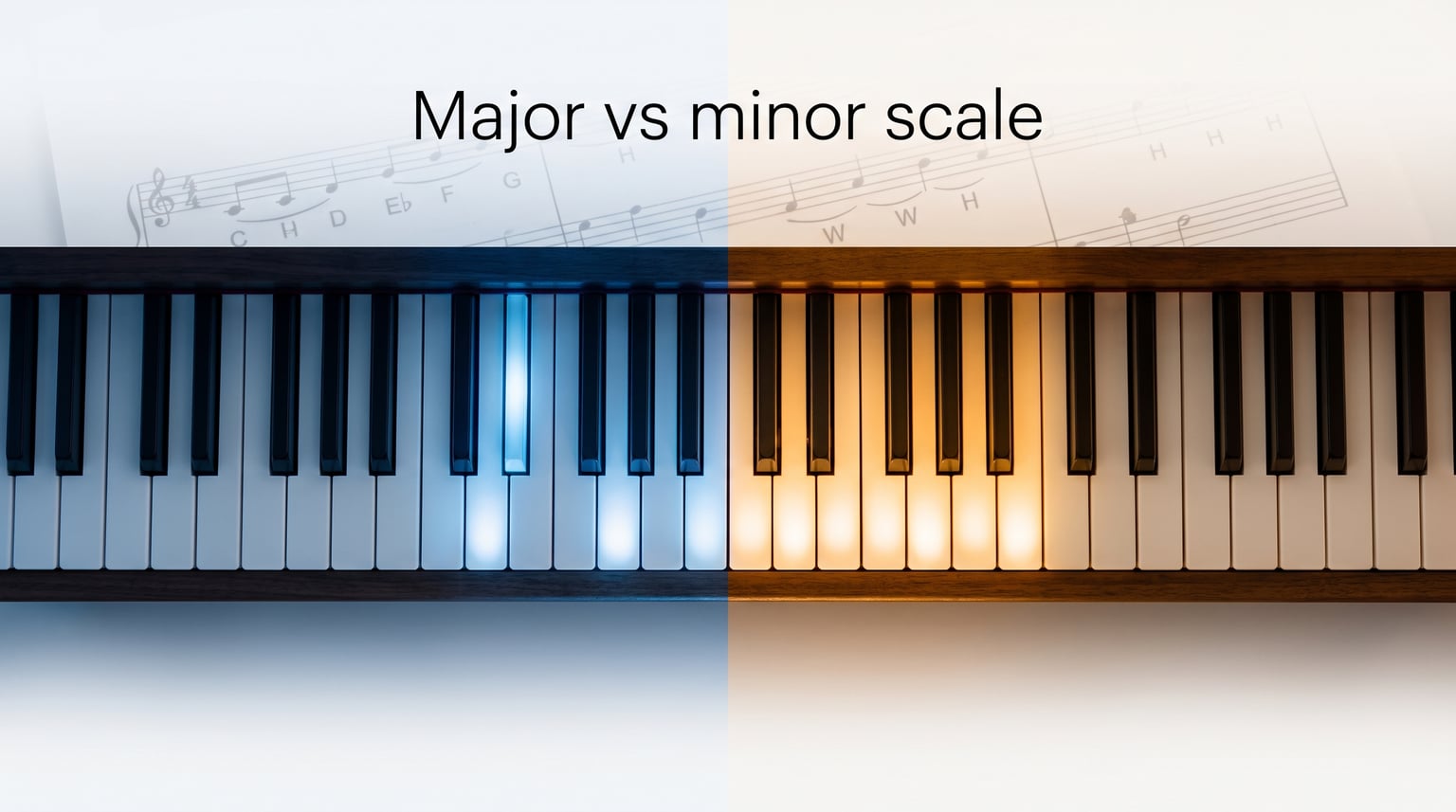
The fastest way to understand the major vs minor scale difference comes down to one single note: the third. In a major scale, the third note sits 4 half steps above the root, giving the scale a bright, lifted quality. In a minor scale, that third drops to just 3 half steps above the root, and the entire emotional color shifts to something darker and more serious.
Both scales use seven notes arranged across an octave. Both follow a strict pattern of whole steps and half steps. The difference is which pattern they follow — and that one change affects every chord, every melody, and every emotion a piece of music communicates.
I’ve spent years working through music theory with other players, and this is the concept that unlocks everything else: chord progressions, improvisation, songwriting. Once you understand why major and minor sound so different, you stop guessing and start making intentional choices. This guide walks through the formulas, the interval logic, the emotional characteristics, the relative minor relationship, and all three types of minor scales.
Table of Contents
Understanding Whole Steps and Half Steps
Before comparing major and minor scales, you need to know the two ingredients that build them: whole steps and half steps.
A half step is the smallest interval in Western music — the distance from one note to the very next note, with nothing in between. On a piano keyboard, moving from C to C# is one half step. On a guitar fretboard, moving up one fret is one half step.
A whole step equals two half steps stacked together. From C to D is a whole step — you pass through C# to get there, but you don’t stop on it.
Every scale is built by arranging whole steps and half steps in a specific sequence. Change the sequence, and you change the scale completely. Major and minor scales cover the same total distance (an octave, or 12 half steps) but arrange those intervals in different orders — and that rearrangement is the source of the entire emotional difference between them.
These two intervals are simple to find on any instrument. Once you can reliably identify a whole step and a half step from any starting note, you can build any scale from scratch using nothing but the formula.
Major vs Minor Scale: The Core Difference
Major vs minor scale: the defining difference is the third scale degree, called the mediant.
In a major scale, the third note sits 4 half steps above the tonic (the root note). Theorists call this a major third — a sound that feels stable and bright. In a natural minor scale, the third note sits only 3 half steps above the tonic. This is a minor third, also called a flatted third — a sound that carries more tension and introspection.
Compare C major against C natural minor to hear the difference directly:
C Major: C – D – E – F – G – A – B – C
C Minor (Natural): C – D – E♭ – F – G – A♭ – B♭ – C
Three notes change between the two scales. E becomes E♭, A becomes A♭, and B becomes B♭. The most important of these three is the E to E♭ shift — the third dropping by a single half step. That one note change transforms the emotional character of the entire scale.
You’ll often hear guitar and bass players refer to this as the “flatted third.” Jazz musicians talk about the “minor third.” Same interval, different vocabulary. No matter what you call it, recognizing when the third is major (4 half steps) versus minor (3 half steps) is the fastest way to identify the tonality of any piece of music.
This is also why two songs can share the same chord shapes on a guitar but sound completely different — if one uses the major third and the other uses the flatted third, the emotional result is miles apart even when everything else stays the same.
The Scale Formulas Step by Step
Each scale follows a repeatable formula using whole steps (W) and half steps (H). Memorize these two patterns and you can build any major or natural minor scale starting on any of the 12 notes in Western music.
Major Scale Formula: W – W – H – W – W – W – H
Natural Minor Scale Formula: W – H – W – W – H – W – W
Let’s apply the major formula starting on C:
C to D: whole step (W)
D to E: whole step (W)
E to F: half step (H)
F to G: whole step (W)
G to A: whole step (W)
A to B: whole step (W)
B to C: half step (H)
Result: C – D – E – F – G – A – B – C. That is C major.
Now apply the minor formula starting on A:
A to B: whole step (W)
B to C: half step (H)
C to D: whole step (W)
D to E: whole step (W)
E to F: half step (H)
F to G: whole step (W)
G to A: whole step (W)
Result: A – B – C – D – E – F – G – A. That is A natural minor.
Notice that C major and A natural minor produce the exact same seven notes. This is not a coincidence — it points to the relative key relationship, which I’ll break down in its own section below.
The formula approach is far more reliable than memorizing every scale by rote. You don’t need 12 separate major scale shapes and 12 separate minor scale shapes stored in memory. Learn the W-W-H-W-W-W-H pattern, apply it to any starting note, and you immediately have the correct major scale for that key. The same logic applies to natural minor with the W-H-W-W-H-W-W pattern.
Start on G for G major: G – A – B – C – D – E – F# – G. Start on E for E natural minor: E – F# – G – A – B – C – D – E. The formula never changes — only the starting note does.
Why the Third Interval Is Everything?
Most explanations of major vs minor stop at “major sounds happy, minor sounds sad.” But the reason behind that emotional quality is more specific — and more interesting — than a simple mood label.
The third interval creates a fundamentally different acoustic relationship between the root note and the third scale degree. A major third (4 half steps, frequency ratio close to 5:4) aligns closely with the natural overtone series that any vibrating string or air column produces. Our auditory system perceives this alignment as stable and consonant.
A minor third (3 half steps, frequency ratio closer to 6:5) sits further from those natural overtones. The result is a subtle but unmistakable tension — something slightly unresolved in the sound. Our brains, trained by exposure to Western music across a lifetime, read that tension as melancholic or searching.
StudyBass puts it plainly: “Major-type scales and chords contain major 3rds. Minor-type scales and chords have minor 3rds (flatted 3rds).” That single interval distinction cascades through every chord built on the scale.
When you build a triad — a three-note chord using the root, third, and fifth — on a major scale’s root note, you get a major third at the bottom, which produces a major chord. Build the same triad on a minor scale’s root, and the minor third at the bottom produces a minor chord. The third is the swing vote for the entire tonal system. Change it, and everything else shifts with it.
The Emotional Character of Major and Minor
Major scales generally sound bright, cheerful, and forward-moving. Think of “Happy Birthday,” “Here Comes the Sun,” or “Don’t Stop Believin’.” There’s a sense of resolution and lift built into major tonality that makes it the natural home for music expressing optimism, celebration, or energy.
Minor scales lean dark, serious, and emotionally weighty. “Nothing Else Matters” by Metallica, Beethoven’s “Für Elise,” and Led Zeppelin’s “Stairway to Heaven” all use minor tonality to create that inward, searching quality. The flatted third anchors the sound somewhere heavier and more reflective.
These are tendencies, not rules. Tempo, rhythm, and arrangement all shape how a listener experiences a key. A fast, driving minor-key song — like AC/DC’s “Highway to Hell” — sounds intense and powerful rather than sad. A slow, sparse ballad in a major key can carry genuine grief or longing. Context always modifies the emotional signal the scale provides.
The association also varies across musical cultures. Many traditions outside Western music use scales that sit entirely outside the major/minor framework. Within Western popular music, classical, jazz, and funk, though, the major equals bright and minor equals dark pattern is one of the most consistent and reliable you’ll find.
Players on Reddit’s r/musictheory regularly note that they can feel the difference between major and minor before they understand it theoretically — which tells us the association runs deep in how humans process sound, not just in academic theory.
The Relative Minor Relationship
Every major key has a relative minor — a minor key that uses exactly the same set of notes and the same key signature, but treats a different note as home.
To find the relative minor of any major scale, go to the 6th degree of that scale. For C major (C – D – E – F – G – A – B), the 6th degree is A. So A minor is the relative minor of C major — they share the same seven notes and neither has any sharps or flats.
For G major (G – A – B – C – D – E – F#), the 6th degree is E. E minor is the relative minor of G major — both keys use one sharp (F#).
Here are all 12 relative pairs:
C major → A minor (no sharps or flats)
G major → E minor (1 sharp: F#)
D major → B minor (2 sharps: F#, C#)
A major → F# minor (3 sharps)
E major → C# minor (4 sharps)
B major → G# minor (5 sharps)
F major → D minor (1 flat: B♭)
B♭ major → G minor (2 flats)
E♭ major → C minor (3 flats)
A♭ major → F minor (4 flats)
D♭ major → B♭ minor (5 flats)
G♭ major → E♭ minor (6 flats)
The reason they share notes but sound completely different comes down to tonal gravity. Whichever note the music treats as “home” — the note it keeps resolving to, ends phrases on, and returns to most often — becomes the tonal center. C major keeps pulling back to C. A minor keeps pulling back to A. Same seven notes, entirely different feeling.
This is the most common source of confusion for beginners, and it generates constant discussion on forums like Reddit’s r/musictheory and r/explainlikeimfive. People ask: “If C major and A minor are the same notes, why do they sound different?” The answer is always the same: it’s about which note the music treats as home base. The gravity of that tonal center shapes everything the listener hears.
Another practical use of this relationship: if you’re writing in C major and want to introduce a moment of darkness or tension, you can shift the tonal center toward A and borrow the minor quality without changing a single note on the page.
The Three Types of Minor Scales
Unlike the major scale, which has one standard form, the minor scale comes in three distinct variations. Each has its own formula and its own musical personality.
Natural Minor
The natural minor scale follows the formula W – H – W – W – H – W – W. This is the basic form of the minor scale, equivalent to the Aeolian mode. A natural minor runs: A – B – C – D – E – F – G – A.
Natural minor is the default in popular music, rock, folk, and most non-classical contexts. When someone says “the minor scale” without further specification, they almost always mean natural minor.
Harmonic Minor
The harmonic minor scale raises the 7th degree by a half step compared to natural minor. A harmonic minor: A – B – C – D – E – F – G# – A.
That raised 7th (G# instead of G in A minor) creates a strong leading tone that pulls powerfully back to the tonic on resolution. The interval between the 6th degree (F) and the raised 7th (G#) spans an augmented second — a distinctive, slightly exotic interval you’ll hear frequently in classical compositions, flamenco guitar, and Middle Eastern music styles.
Harmonic minor is useful any time you want a V chord with a major quality in a minor key. In A minor, the V chord built on E would normally be E minor (using natural minor’s G natural). The harmonic minor’s G# turns that V chord into E major, giving it a stronger pull toward resolution.
Melodic Minor
The melodic minor scale raises both the 6th and 7th degrees when ascending, then reverts to natural minor when descending. A melodic minor ascending: A – B – C – D – E – F# – G# – A. Descending: A – G – F – E – D – C – B – A.
The ascending alteration smooths out the awkward augmented second that harmonic minor creates between the 6th and raised 7th. By raising both, the melodic line flows more naturally. Classical voice leading training emphasizes this ascending/descending distinction carefully.
In jazz, the ascending melodic minor form is often used in both directions — it’s called the “jazz minor scale” in that context. Which variation you choose directly affects which chords are available and the overall color of your melody or improvisation.
How Major and Minor Scales Build Different Chords?
The scale you’re working in determines which chords naturally appear in that key — a process called harmonizing the scale. When you build a triad (root, third, fifth) on each of the scale’s seven degrees, you get a set of chords that all belong together.
Harmonizing a major scale always produces this pattern of chord qualities:
Degree I: major
Degree II: minor
Degree III: minor
Degree IV: major
Degree V: major
Degree VI: minor
Degree VII: diminished
Harmonizing a natural minor scale shifts the pattern:
Degree I: minor
Degree II: diminished
Degree III: major
Degree IV: minor
Degree V: minor
Degree VI: major
Degree VII: major
These built-in patterns explain why major keys tend to produce chord progressions that feel stable and grounded — the I chord at home base is major, which sounds naturally resolved. Minor keys feel more complex and emotionally layered because the I chord is already minor, carrying inherent tension even at rest.
In practical terms: the I – IV – V progression in C major uses C major, F major, and G major chords — three bright, consonant sounds. The i – iv – v in A minor uses A minor, D minor, and E minor — three chords that carry tension and searching quality even in a simple three-chord progression.
How to Tell If a Song Is in a Major or Minor Scale?
Training your ear to identify major vs minor is one of the most practical skills in music. Here’s a reliable process to follow when listening to any piece.
First, find the tonic — the note that feels like home. The song will return to it repeatedly, end phrases on it, and often conclude on it. Hum along with the song until you locate the note that makes you feel like you’ve arrived somewhere. That’s the root.
Second, listen for the third above that tonic. Does the melody or the harmony frequently land on a note that sounds bright and settled? That’s the major third sitting 4 half steps above the root. Does it land somewhere that feels slightly tense or searching? That’s the minor third, 3 half steps up.
Third, trust your gut reaction to the mood. Major almost always lifts; minor almost always pulls inward. Your instinctive emotional response to a song is usually pointing toward the correct answer before your theoretical knowledge catches up with it.
For a more technical approach, look at the key signature on sheet music or in your DAW’s key setting. The number of sharps or flats tells you which relative pair you’re in. Then listen to see whether the music gravitates toward the major key or the relative minor of that signature. The note the song treats as “home” gives you the answer.
Using Major and Minor in Songwriting
Once you internalize the difference between major and minor, the practical question becomes: when do you choose one over the other?
Start with the emotional target of your song. If you want energy, optimism, or a sense of resolution and arrival, major is your natural starting point. If you want tension, melancholy, introspection, or that bittersweet quality where emotion stays unresolved, minor gives you the right palette.
Many of the most compelling songs borrow between both. Modal interchange — using chords borrowed from the parallel minor or major — is one of the most powerful tools in songwriting. Artists like The Beatles and Radiohead regularly pulled minor-key chords into major-key progressions to add emotional weight at critical moments. A single borrowed minor IV chord in a major-key song can stop a listener cold in the best possible way.
Don’t think of major as inherently positive and minor as inherently negative. Think of them as two different textures that serve different musical purposes. The best songs often shift between major and minor — sometimes within the same progression — to create contrast, movement, and surprise.
A practical exercise: sit at your instrument and play a simple I – IV – V – I progression in C major. Then play the same progression in C minor. Listen carefully to the weight difference between the two. Then try combining them — start in C minor, shift briefly to E♭ major (the relative major’s III chord), and return. That kind of movement between the two tonalities is at the heart of how great music works.
As you build your ear in 2026, spend time listening back and forth between C major and A minor — same notes, different home. That side-by-side comparison teaches the major vs minor scale difference faster than any amount of reading alone.
FAQs
How do you know if a song is in a major or minor scale?
Listen for the tonal center — the note the song keeps returning to and resolving on. Then notice the third above that note. If the third lands 4 half steps up and sounds bright and settled, you’re in major. If it lands 3 half steps up and sounds tense or searching, you’re in minor. Your emotional reaction is also reliable: major generally lifts, minor generally pulls inward.
How do you figure out major and minor scales?
Use the interval formulas. Major scale: W – W – H – W – W – W – H. Natural minor scale: W – H – W – W – H – W – W. Start on any note, apply the formula step by step (each W is a whole step, each H is a half step), and you build the correct scale for that key. The same formula works for all 12 starting notes.
Is major or minor happier?
Major is happier. Major scales use a major third (4 half steps above the root) that creates a bright, stable, resolved sound. Minor scales use a flatted third (3 half steps above the root) that produces a darker, more introspective quality. Tempo and arrangement can shift this perception, but in general, major equals bright and minor equals dark in Western music.
Why is C major the same as A minor?
C major and A minor share the same seven notes and the same key signature — neither has sharps or flats. They are called relative keys. The difference is which note each scale treats as home: C major always resolves to C, while A minor resolves to A. The same collection of notes produces a completely different emotional quality depending on which note the music uses as its tonal center.
Understanding Major vs Minor Scale: The Short Version
The major vs minor scale distinction comes down to one interval: the third. Major uses a major third (4 half steps above the root) — bright and resolved. Minor uses a flatted third (3 half steps above the root) — darker and more tense.
The formulas give you the tools to build either scale from any starting note: W-W-H-W-W-W-H for major, W-H-W-W-H-W-W for natural minor. The relative minor relationship connects every major key to a minor key with identical notes. The three types of minor — natural, harmonic, and melodic — give you different textures and harmonic options as your playing develops.
Take those tools to your instrument right now. Play C major, then move to A minor. Notice how the same notes shift the gravity of the music entirely. That shift is the major vs minor scale difference in its most direct form — and once you hear it clearly, you’ll start hearing it in every song you’ve ever known.