
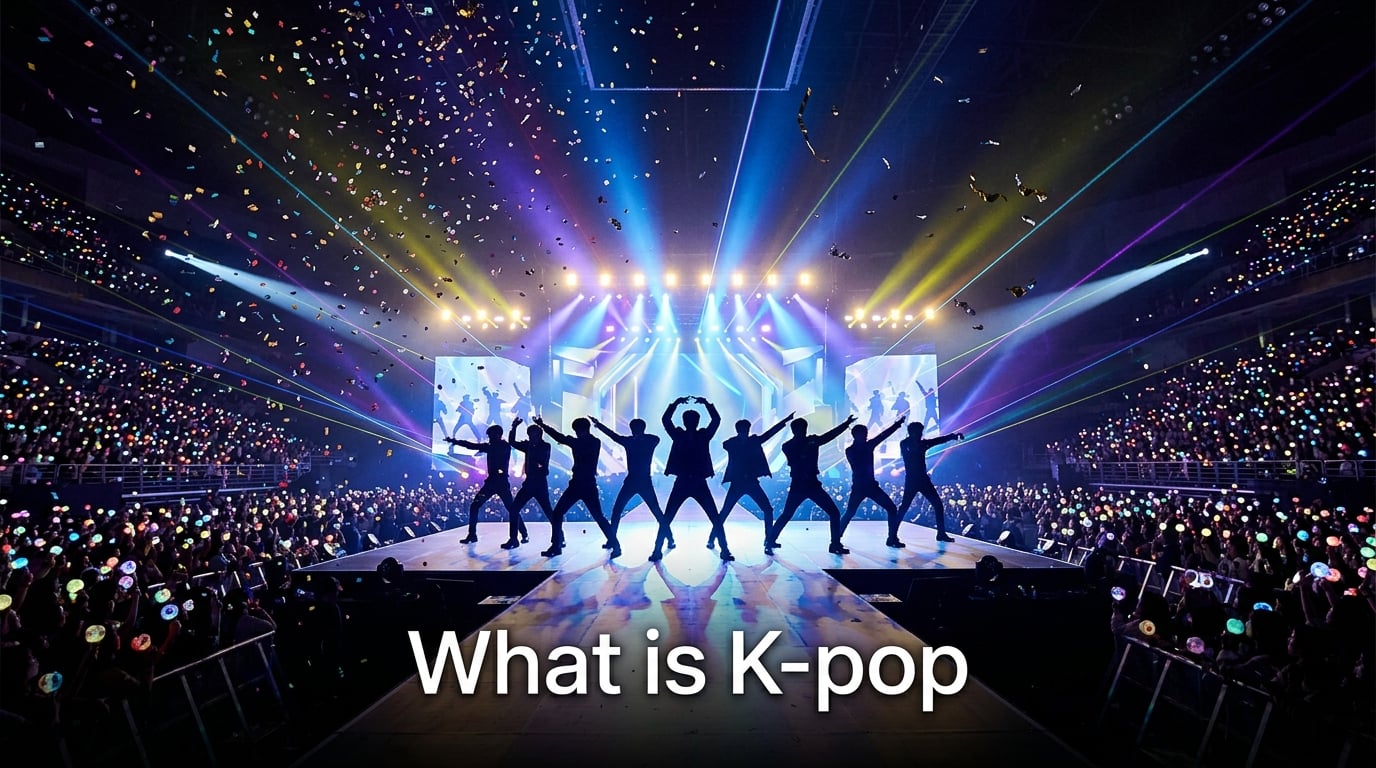
If you have scrolled through social media in 2026 and seen synchronized choreography, color-coordinated lightsticks, or lyrics you cannot understand, you have already brushed against K-pop. So, what is K-pop exactly? In short, K-pop (short for Korean popular music) is a music genre and entertainment industry originating in South Korea that blends pop, hip-hop, R&B, electronic, and dance music into highly produced performances by trained artist groups.
I have followed the genre since 2010, watched it break into Western charts, and saw fandoms evolve from niche forums to global streaming armies. In this guide, I will walk you through the definition, history, idol training system, entertainment companies, fandom culture, and global impact that turned a regional sound into a worldwide phenomenon.
Table of Contents
What Is K-pop? A Direct Definition
K-pop is a genre of popular music that originated in South Korea in the early 1990s and is characterized by a mix of catchy melodies, group choreography, high-budget visuals, and a tight production system managed by entertainment companies. While the term literally means “Korean pop,” in practice it describes a specific style of music, performance, and industry built around trained idol groups.
The Core Characteristics of K-pop Music
K-pop songs typically fuse several Western genres at once. A single track can layer a hooky pop chorus over an EDM drop, a hip-hop verse, and an R&B bridge. The result is a hybrid sound that travels well across language barriers.
Beyond the audio, K-pop productions invest heavily in visual storytelling. Music videos are treated like short films with multiple concept changes, custom wardrobe, and cinematic locations. Live performances add synchronized dance routines that are rehearsed to the millisecond.
Here are the elements that most sources agree define the genre:
- Group-based idol acts (boy groups and girl groups) with assigned roles
- Multi-language releases (Korean, English, Japanese, Mandarin, Spanish)
- Highly polished choreography performed in unison
- Distinct concepts that change with each comeback
- A training pipeline controlled by entertainment companies
K-pop vs Korean Music: Clearing Up the Confusion
Not every Korean artist is K-pop. Korea has a thriving indie scene, ballad singers, traditional trot performers, and hip-hop crews that operate outside the idol system. In Korea, “idols” specifically refers to artists trained by entertainment companies to perform choreographed pop music.
I find this distinction matters most when newcomers assume every Korean song is K-pop. If a Korean rock band or trot singer tops the charts, the genre label often shifts. Reddit’s r/kpopthoughts community has argued this point for years, and most agree that K-pop is defined more by industry structure than by language or origin alone.
The Origins and History of K-pop
K-pop as we know it began on April 11, 1992, when Seo Taiji and Boys performed on a Korean talent show and finished last. Their fusion of rap, rock, and new jack swing did not match the ballads judges expected, but the album went on to sell over 1.6 million copies. That mismatch between mainstream expectation and youth taste is the moment historians point to as K-pop’s origin.
From Underground Innovation to Industry Standard
Lee Soo-man, a music executive watching the same broadcast, recognized the commercial potential and launched SM Entertainment in 1995. Around the same time, Yang Hyun-suk (later YG Entertainment) debuted as a member of Seo Taiji and Boys, and Park Jin-young (later JYP Entertainment) trained artists in the U.S. before returning to Korea.
The three labels formed the “big three” that still dominate the genre. Through the late 1990s and early 2000s, they refined the trainee-to-debut pipeline and developed the concept of the idol group as a packaged product: music, visuals, fashion, and personality sold together.
The Generations of K-pop
Fans organize K-pop history into numbered generations. While the exact cutoffs are debated, the common framework looks like this:
- 1st generation (late 1990s to early 2000s): H.O.T., S.E.S., BoA, g.o.d
- 2nd generation (mid-2000s to early 2010s): TVXQ, BIGBANG, Girls’ Generation, Wonder Girls
- 3rd generation (mid-2010s): BTS, EXO, BLACKPINK, TWICE, Red Velvet
- 4th generation (late 2010s to mid-2020s): Stray Kids, ATEEZ, ITZY, TXT, aespa
- 5th generation (mid-2020s onward): NewJeans, BABYMONSTER, ILLIT, RIIZE
Each generation builds on the previous one while pushing a new sound or concept. The 3rd generation broke the English-language barrier on charts. The 4th leaned into self-produced music. The 5th, which we are seeing in 2026, is experimenting with minimalist concepts and genre-blending singles.
The K-pop Idol System and Training Process
K-pop idols are artists who undergo years of intensive training in singing, dancing, rap, media skills, and foreign languages before they ever release a song. The training system is what separates K-pop from most Western pop development paths.
Inside the Trainee System
Aspiring idols typically audition between ages 11 and 18, though older trainees are common. Those accepted into a company like SM, YG, JYP, or HYBE enter a trainee period that can last anywhere from six months to seven years.
Trainees take daily classes in vocal technique, dance, and rap, plus language lessons (usually English, Japanese, and Mandarin). They also receive media training on how to handle interviews, fan meetings, and variety shows. Monthly evaluations determine who continues, who debuts, and who is cut from the program.
Our team has spoken to former trainees who described 12-hour rehearsal days, strict weight and skincare monitoring, and curfews that border on boarding school discipline. It is a high-pressure path with no guarantee of debut.
Roles Inside a K-pop Group
Once a group is formed, members are usually assigned specific roles that shape their performance and visibility:
- Main vocalist: leads the chorus and carries the hardest vocal lines
- Lead vocalist: supports harmonies and bridges
- Main dancer: anchors the choreography center
- Lead dancer: performs highlight moves
- Main rapper: writes and performs rap sections
- Visual: leads photo and video shoots as the face of the group
- Maknae: the youngest member, a meaningful cultural role in Korean groups
- Leader: speaks for the group, often the oldest or most experienced
Some idols also write, produce, or choreograph their own work. Groups like SEVENTEEN, Stray Kids, and BTS built fan trust partly because they self-produce much of their music, a point that comes up often in r/kpop discussions.
Major K-pop Entertainment Companies
Four entertainment companies (often called the “Big 4”) dominate the global K-pop landscape, each with its own house style and roster of artists.
The Big 4 in 2026
- SM Entertainment (founded 1995): Known for polished vocals, elaborate concepts, and experimental sounds. Home to aespa, EXO, Red Velvet, and NCT.
- YG Entertainment (founded 1996): Hip-hop roots, edgier image, strong solo artists. Home to BLACKPINK, BABYMONSTER, and former acts like BIGBANG and 2NE1.
- JYP Entertainment (founded 1997): Focus on performer-friendly choreography and personality-driven marketing. Home to TWICE, Stray Kids, ITZY, and NMIXX.
- HYBE (founded 2005 as Big Hit, rebranded 2021): BTS’s home company, built around the “artist-and-creator” model. Also manages SEVENTEEN, TXT, LE SSERAFAM, and ENHYPEN.
Outside the Big 4, smaller companies like Starship (IVE), Cube, RBW (MAMAMOO), and ADOR (NewJeans) have launched successful groups of their own. The mid-tier scene is where many 5th-generation groups emerged.
Global Impact: Hallyu and the Korean Wave
Hallyu, often translated as the Korean Wave, refers to the global spread of South Korean culture, including music, film, TV dramas, fashion, beauty, and food. K-pop is the most visible arm of this movement, but it sits inside a much larger cultural export strategy that began in the late 1990s and accelerated after 2012.
How K-pop Went Global
Three shifts turned K-pop into a worldwide phenomenon. First, YouTube made music videos instantly accessible in every country, letting groups like BIGBANG and Wonder Girls build fan bases without a U.S. label deal. Second, social media platforms like Twitter and Weverse created direct lines between idols and international fans, bypassing traditional media gatekeepers. Third, the 2017 BTS breakthrough on the Billboard Social 50 and their later #1 albums proved K-pop could compete in the world’s largest music market.
In 2026, K-pop tours regularly sell out arenas in Los Angeles, London, Paris, Tokyo, and São Paulo. Album pre-orders routinely cross one million units. Streaming numbers for groups like NewJeans and Stray Kids rival those of Western pop stars on Spotify and Apple Music.
The Economic and Cultural Reach
South Korea’s Ministry of Culture reported that K-pop exports contributed billions of dollars to the national economy in recent years. Beyond revenue, K-pop influences fashion (oversized streetwear, school uniform concepts), beauty standards, and even how fans organize online. Fandoms coordinate voting, streaming, and charity drives with the precision of small marketing agencies, and that is something we will dig into next.
K-pop Fandom Culture Explained
K-pop fandoms are organized communities of fans who actively promote and support their chosen artists through coordinated campaigns, content creation, and financial investment. They function less like casual music audiences and more like fan-owned movements.
Common Fandom Terms and Tools
If you are new to K-pop, these terms will come up fast:
- Bias: your favorite member of a group
- Bias wrecker: a runner-up who keeps threatening your bias
- Fanchant: pre-written lyrics fans shout at specific moments during songs
- Comeback: a new album or single release
- Lightstick: an official, Bluetooth-connected glow stick unique to each group
- All-kill: when a song tops every major Korean music chart at once
- Daesang: a grand prize, the highest award at Korean music shows
- Fan meeting / fansign: small in-person events where idols interact with fans
Fans also run streaming parties, mass-buy album campaigns, and birthday advertising projects (placing idol ads on subway platforms, billboards, and even in Times Square). For newcomers, this level of organization can feel overwhelming, but most fandoms welcome curious fans with starter guides and Discord servers.
Notable K-pop Groups and Artists
While no list is complete, these names give you a strong starting lineup if you are exploring K-pop in 2026.
Groups Every New Listener Should Know
- BTS: The group that broke K-pop into the U.S. mainstream, known for self-written lyrics and social themes
- BLACKPINK: A four-member girl group with massive global brand deals and festival headlining slots
- TWICE: A nine-member girl group with a string of chart-topping Korean and Japanese singles
- EXO: A six-member group with one of the most loyal fandoms in the industry
- SEVENTEEN: A 13-member self-producing group with one of the most demanding choreographies in K-pop
- Stray Kids: A four-unit boy group that writes and produces nearly all of their own music
- NewJeans: A five-member girl group credited with shaping the 5th-generation sound
- aespa: A four-member girl group with an AI-metaverse concept tied to their universe story
Solo Artists Worth Exploring
- IU: Singer, actress, and one of Korea’s most respected solo vocalists
- PSY: The “Gangnam Style” artist who gave K-pop its first global viral hit in 2012
- Taeyeon: Lead vocalist of Girls’ Generation and a prolific solo artist
- Agust D (Suga of BTS): A rapper-producer whose solo work rivals his group output
- Jungkook: BTS member whose solo debut album GOLDEN topped charts worldwide
Frequently Asked Questions About K-pop
What is the real meaning of K-pop?
K-pop stands for Korean popular music. It refers to a music genre and entertainment industry originating in South Korea, built around trained idol groups who release pop, hip-hop, Ru0026amp;B, and electronic music with synchronized choreography.
How did K-pop originate?
K-pop originated on April 11, 1992, when Seo Taiji and Boys performed a fusion of rap, rock, and new jack swing on a Korean talent show. Their album sold over 1.6 million copies and inspired the idol training system that defines the modern industry.
How are K-pop idols trained?
K-pop idols audition between ages 11 and 18 and enter a trainee period lasting six months to seven years. During that time they take daily lessons in vocals, dance, rap, foreign languages, and media skills, and they must pass monthly evaluations before being considered for debut.
What are some popular K-pop groups?
BTS, BLACKPINK, EXO, TWICE, SEVENTEEN, Stray Kids, NewJeans, and aespa are among the most popular K-pop groups globally. Each represents a different generation or style within the genre.
Who is considered the most famous K-pop artist?
BTS is widely considered the most famous K-pop act, with multiple Billboard #1 albums, sold-out stadium tours, and a 2017 appearance at the United Nations General Assembly. Members like Jungkook and Jimin also hold individual global followings.
What is Hallyu and how does it relate to K-pop?
Hallyu, or the Korean Wave, is the global spread of South Korean culture including K-pop, K-dramas, film, fashion, and food. K-pop is the most visible part of Hallyu and has helped drive the wider cultural export of Korea since the late 1990s.
Conclusion: Where to Go From Here
What is K-pop? At its core, it is Korean popular music shaped by a training pipeline, an entertainment company system, and a global fandom culture that took root in 1992 and exploded worldwide in the 2010s. It is more than a sound. It is a complete production model built around choreography, concept, and community.
If you are new, start with one group whose music or visuals catch your eye. Watch a live performance, read a fan guide, and join a streaming playlist. K-pop rewards curiosity, and 2026 is a great time to jump in.