
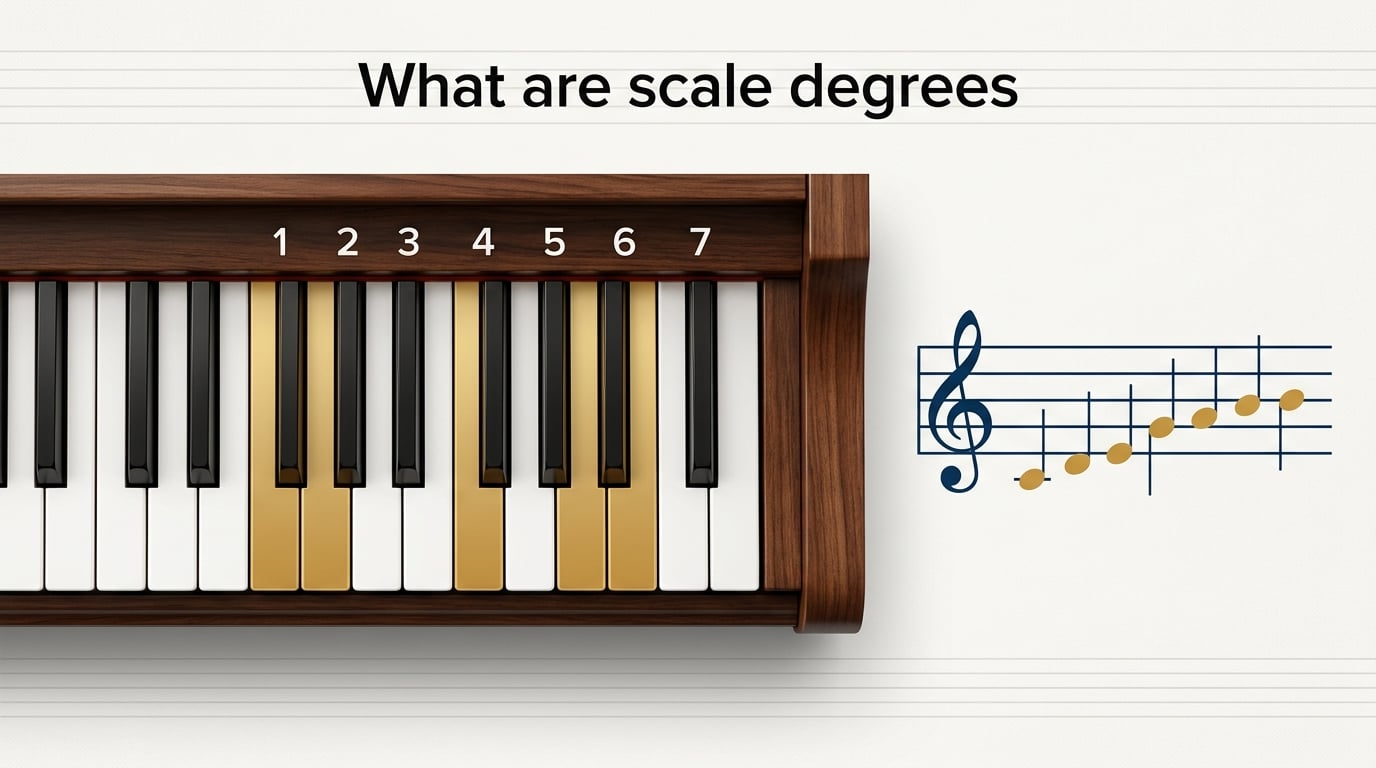
If you have ever wondered why musicians call the first note of a scale the “tonic” or what makes the fifth note so powerful, you are in the right place. Scale degrees are the numbered positions that every note holds inside a scale, and they give every melody, chord, and song a kind of musical address system.
I have taught music theory for years, and the moment a student truly gets scale degrees is the moment everything else starts to click. In this guide, I will walk you through every scale degree by name and number, explain why they are called what they are, and show you how to use them in real music.
Table of Contents
What are scale degrees?
Scale degrees are numbers (1 through 7) assigned to each note of a scale based on its position relative to the tonic, which is the starting and ending note. Each scale degree also has a traditional name that describes its function and where it sits in the scale.
Think of a scale as a ladder. The bottom rung is 1, the top rung is 7, and every rung has a job. Once you know the name of each rung, you can talk about any melody or chord without naming specific notes.
What are the 7 scale degrees?
The 7 scale degrees are tonic (1), supertonic (2), mediant (3), subdominant (4), dominant (5), submediant (6), and leading tone or subtonic (7). Each name tells you something about where that note lives in the scale and how it behaves in music.
Here is the complete list with the C major scale as our example (C, D, E, F, G, A, B, C):
1 – Tonic: C – the home note, do
2 – Supertonic: D – one step above tonic
3 – Mediant: E – in the middle
4 – Subdominant: F – below the dominant
5 – Dominant: G – the next-most-important note
6 – Submediant: A – below the mediant
7 – Leading tone: B – pulls strongly to tonic (in major scales)
1st degree – The tonic
The tonic is scale degree 1 and the home base of the entire scale. It is the note the music wants to return to, the note that gives a piece its key, and the note solfege students call “do.”
Every melody and chord progression eventually feels like it needs to land back on the tonic. That gravitational pull is what makes the tonic feel stable and final. If you have ever felt a song “resolve,” you felt the tonic doing its job.
2nd degree – The supertonic
The supertonic is scale degree 2, sitting one whole step above the tonic. The “super” prefix comes from Latin and simply means “above,” telling you this note lives above the tonic in the scale.
The supertonic often acts as a launching pad. In jazz and classical music, the supertonic chord (ii chord) frequently moves toward the dominant, which then resolves to the tonic. It is a connector, not a destination.
3rd degree – The mediant
The mediant is scale degree 3, and its name comes from the Latin word “medius,” meaning middle. It sits halfway between the tonic and the dominant, and that middle position is exactly what defines it.
The mediant is the note that decides whether a scale sounds major or minor. A major third above the tonic gives you a happy, bright sound. A minor third above the tonic gives you a sadder, darker feel. That is why musicians often call the mediant the “color” note of the scale.
4th degree – The subdominant
The subdominant is scale degree 4, and the “sub” prefix means “below.” It is called subdominant because it sits a perfect fifth below the dominant, almost like a mirror image of the dominant note.
The subdominant creates a feeling of gentle movement away from home. The IV chord (built on scale degree 4) is the classic “lift” chord you hear in thousands of pop songs right before the chorus. It is the second most important chord after the dominant.
5th degree – The dominant
The dominant is scale degree 5, and it gets its powerful name because it dominates the harmonic activity around it. The dominant note is the second most important note in any scale after the tonic itself.
Why is the dominant so important? Because it creates strong tension that wants to resolve back to the tonic. The interval between scale degree 7 and scale degree 1 in a major scale is only a half step, and that tiny distance produces the strongest pull in music. When you hear a V chord resolving to I, you are hearing the dominant doing its main job.
6th degree – The submediant
The submediant is scale degree 6, named because it sits a third below the tonic, mirroring the mediant’s position a third above. The “sub” prefix again means “below.”
The submediant chord (vi) is the relative minor of any major key. In C major, scale degree 6 is A, and the A minor chord shares two notes with the C major chord. This is why sad-sounding chords often appear naturally in happy-sounding songs.
7th degree – The leading tone or subtonic
The 7th scale degree has two possible names depending on the scale. In a major scale, it is called the leading tone. In a natural minor scale, it is called the subtonic.
The difference comes down to distance. In a major scale, the 7th degree is a half step (semitone) below the tonic, which gives it an intense pull toward home. In a natural minor scale, the 7th degree is a whole step below the tonic, so the pull is gentler and we use the more neutral name “subtonic.”
The leading tone is one of the strongest scale degrees because of that half-step pull. Harmonic and melodic minor scales raise the 7th to create a leading tone for dramatic resolutions.
Major vs minor: the 7th degree difference
The biggest difference between major and minor scales happens at scale degree 7. In a major scale, the 7th degree is a half step below the tonic and is called the leading tone. In a natural minor scale, the 7th degree is a whole step below the tonic and is called the subtonic.
Compare these two scales side by side in A:
A major: A, B, C#, D, E, F#, G#, A (G# is the leading tone, one half step below A)
A natural minor: A, B, C, D, E, F, G, A (G is the subtonic, one whole step below A)
This single change is why major keys feel bright and resolved while natural minor feels softer and less final. When you want the strong resolution of a leading tone in a minor key, you raise the 7th to create the harmonic or melodic minor scale.
How scale degrees relate to solfege?
Solfege is the singable naming system that pairs directly with scale degrees. The syllables do, re, mi, fa, sol, la, and ti correspond to scale degrees 1 through 7 in order. If you learned “Do-Re-Mi” from The Sound of Music, you were already learning scale degrees.
Solfege is more than a memorization trick. Because the syllables stay the same in every key, singing in solfege trains your ear to hear scale degrees instead of specific notes. Moveable-do solfege treats “do” as whatever tonic is in play, which is the same trick scale degree numbers let you do.
Here is how each solfege syllable maps to scale degrees in C major:
Do = 1 (tonic, C)
Re = 2 (supertonic, D)
Mi = 3 (mediant, E)
Fa = 4 (subdominant, F)
Sol = 5 (dominant, G)
La = 6 (submediant, A)
Ti = 7 (leading tone, B)
Scale degrees and chord building
Scale degrees form the foundation of every chord you play. A triad is built by stacking two notes a third apart on top of any scale degree, and Roman numerals give each chord a label that works in any key.
Capital Roman numerals (I, IV, V) stand for major chords, and lowercase Roman numerals (ii, iii, vi) stand for minor chords. The vii degree is a diminished chord in major keys.
Using C major as an example:
I (tonic triad): C, E, G
ii (supertonic triad): D, F, A
iii (mediant triad): E, G, B
IV (subdominant triad): F, A, C
V (dominant triad): G, B, D
vi (submediant triad): A, C, E
vii° (leading tone triad): B, D, F
This is why a song in C major and a song in G major can share the exact same I-IV-V-I progression. The specific notes change, but the relationships between scale degrees stay identical. That is the real power of scale degrees.
Practical example: transposing with scale degrees
Transposition is moving a piece of music to a different key, and scale degrees make it almost mechanical. Once you know your scale degrees, you can play any melody in any key without rewriting it note by note.
Let’s transpose “Happy Birthday.” The first phrase in C major goes C, C, D, C, F, E. If we want the same melody in G major, we just shift every note up a perfect fifth (or down a perfect fourth):
Original (C major): 1, 1, 2, 1, 4, 3 = C, C, D, C, F, E
Transposed (G major): 1, 1, 2, 1, 4, 3 = G, G, A, G, C, B
The scale degrees stay the same. Only the tonic changes. That is why professional musicians, composers, and arrangers rely on scale degrees every single day.
Tips for learning scale degrees by ear
Learning to recognize scale degrees by sound is a skill that will serve you for a lifetime. Here is what has worked for me and for the students I have coached.
First, sing the major scale up and down every day using solfege. Pick any starting pitch, then sing do-re-mi-fa-sol-la-ti-do over and over. This builds muscle memory for the sound of each scale degree.
Second, practice with familiar songs. Hum “Twinkle Twinkle Little Star” and try to identify the scale degrees of each note. Songs you already know are easier because your brain already remembers the contour.
Third, use a drone. Set up a sustained tonic note and play or sing each scale degree against it. The contrast between tension (4 and 7) and stability (1, 3, 5) becomes much clearer with a drone underneath.
Fourth, remember that scale degrees are about function, not fixed pitches. Once you stop thinking “I need to play F” and start thinking “I need the 4th degree,” every key becomes accessible.
Frequently asked questions
What are the 7 scale degrees?
The 7 scale degrees are tonic (1), supertonic (2), mediant (3), subdominant (4), dominant (5), submediant (6), and leading tone or subtonic (7). In a major scale, the 7th degree is a half step below the tonic and is called the leading tone. In a natural minor scale, the 7th degree is a whole step below the tonic and is called the subtonic.
What is the strongest scale degree?
The tonic (1) is the strongest scale degree because it serves as the home base and the point of resolution. The leading tone (7) is the next strongest in terms of harmonic pull, with its intense half-step tension demanding resolution up to the tonic. The dominant (5) is also very powerful because chords built on it create the strongest motion back to the tonic.
What is scale degree 3 called?
Scale degree 3 is called the mediant, a name that comes from the Latin word medius meaning middle. It sits halfway between the tonic and the dominant. The mediant is the note that determines whether a scale sounds major (major 3rd above tonic) or minor (minor 3rd above tonic), which is why it is often called the color note of the scale.
What scale degree is 6?
Scale degree 6 is called the submediant. The sub prefix means below, and it sits a third below the tonic, mirroring the mediant’s position a third above the tonic. The chord built on scale degree 6 (vi) is the relative minor of the tonic and shares two notes with the I chord.
How do scale degrees differ from intervals?
Scale degrees identify the position of a single note within a scale, while intervals measure the distance between any two notes. A scale degree is always 1, 2, 3, 4, 5, 6, or 7. An interval can be any size, from a half step to an octave or beyond. Scale degrees describe where you are in a scale; intervals describe the gap between two notes.
Final thoughts on scale degrees
Scale degrees are the skeleton key of music theory. Once you know them, you can read, write, transpose, and analyze music in any key without confusion. The 7 names, tonic, supertonic, mediant, subdominant, dominant, submediant, and leading tone or subtonic, give every note in a scale a clear identity and function.
Pick one of the scale degrees and try singing it today. Start with the tonic and dominant, then add the mediant and leading tone. Within a week of practice, scale degrees will start to feel less like vocabulary and more like a second language you speak fluently in 2026.