
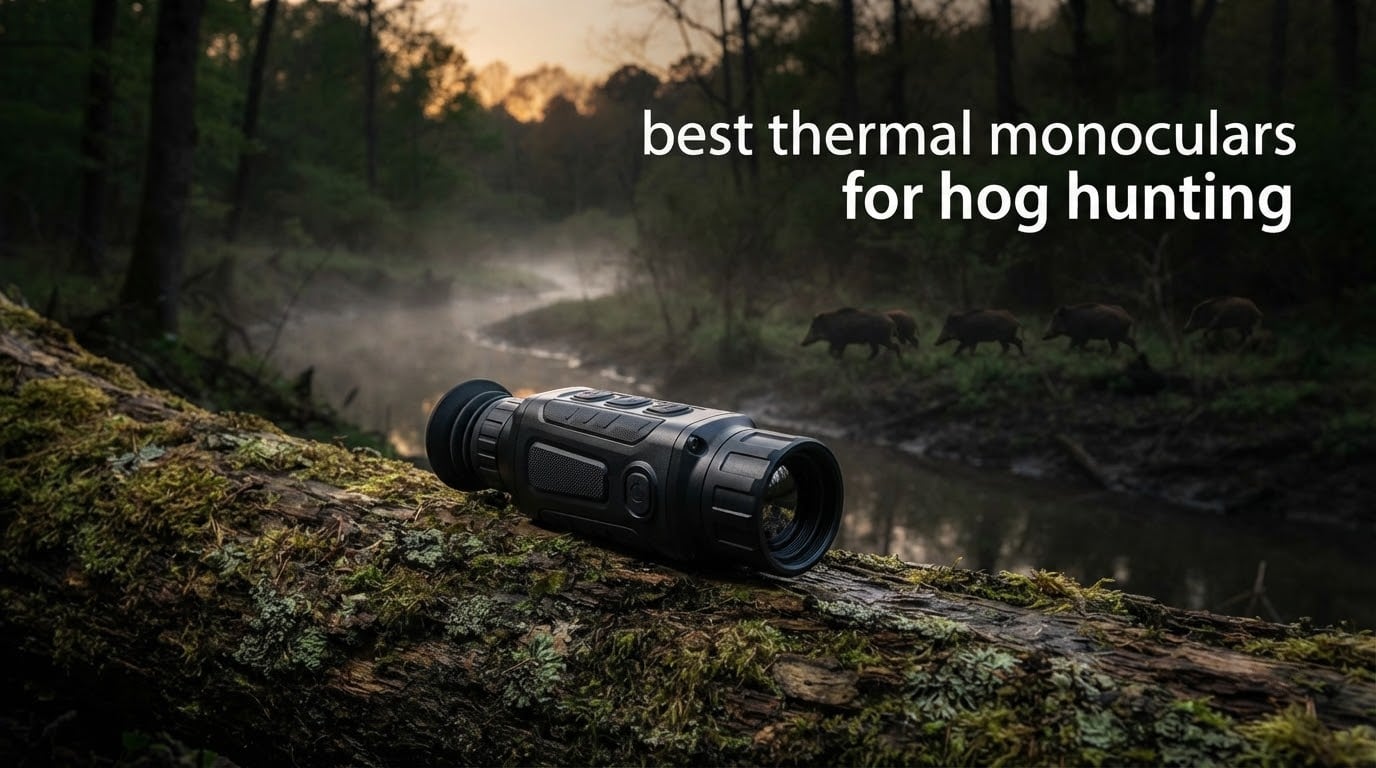
Most hog hunters who go thermal end up buying two things, and the one they did not expect to love is the small handheld scanner. Swinging a mounted thermal scope across a creek bottom to find a sounder tires your shoulder and rattles your aim every time you lower it. A dedicated handheld keeps the rifle still and your eyes free.
That is the lens we used to sort this roundup of the best thermal monoculars for hog hunting. We pulled ten devices that cover the whole realistic range: pocket-size 256×192 scanners for creek bottoms, 384×288 units that handle open country, and one 640×512 body for hunters who want to see a sounder long before it commits. Last updated for 2026.
A few things shaped every pick below. We care far more about identification range than the detection number printed on the box, because detection means “something warm is there” and identification means “that is a hog and not a deer.”
We care about refresh rate, because a running hog at 25Hz turns into a smear. And we care about weight, because you will hold this thing for four hours.
One honest note before we start: several of the units in this roundup are cheap enough that the manufacturer detection ranges printed on the box are wildly optimistic. We use those numbers only when we label them as manufacturer claims, and we tell you what reviewers actually report seeing.
Table of Contents
Top 3 Picks for Hog Hunting in 2026


AGM Rattler V2
- 256x192 12um sensor
- 2.5x base with wide field of view
- Dual batteries for 11.5 hours
- Shot-activated recording
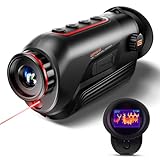
GOYOJO G210
- 256x192 with 12um detector
- Replaceable cell for 6+ hours
- 16GB onboard storage
- 6 color palettes
The TS004 leads because it wastes the least. It is the lightest body here, it runs all night on one charge, and its 50Hz refresh keeps a moving hog solid instead of ghosting.
The AGM Rattler V2 holds the highest average rating in the group at 4.6, though it is a mounted scope rather than a handheld, so treat it as the other half of a two-device kit. The GOYOJO G210 is the pick when the hunt runs long and you want spare cells rather than a wall charger.
Best Thermal Monoculars for Hog Hunting (October 2026)
| Product | Specifications | Action |
|---|---|---|
| TOPDON TS004 |
|
Check Latest Price |
| AGM Rattler V2 |
|
Check Latest Price |
| GOYOJO G210 |
|
Check Latest Price |
 RIX Pocket K2 RIX Pocket K2 |
|
Check Latest Price |
 Teslong TTS260 Teslong TTS260 |
|
Check Latest Price |
 ATN OTS XLT ATN OTS XLT |
|
Check Latest Price |
 Pulsar Axion Compact Pulsar Axion Compact |
|
Check Latest Price |
| RIX Pocket K3 |
|
Check Latest Price |
 ATN BlazeSeeker-210 ATN BlazeSeeker-210 |
|
Check Latest Price |
 MiLESEEY T-Recon Scout MiLESEEY T-Recon Scout |
|
Check Latest Price |
Two things jump out. Six of the ten bodies here run a 256×192 sensor, which is a close-range and creek-bottom tool, not an open-field one. And only three of the ten break into 384×288 or better, which is where genuine open-country capability starts.
How We Ranked These Monoculars
We weighted six criteria, in this order, and they come straight from how hog hunters actually work rather than from spec sheets.
Identification range, not detection range. Detection is the point at which a warm shape appears. Recognition is when you know it is an animal. Identification is when you can tell hog from deer from coyote. You need identification to shoot responsibly, and that number is always a fraction of the box figure.
Refresh rate. Sounders do not stand still. Anything at 25Hz smears a running hog, and 50Hz or 60Hz keeps the shape readable.
Field of view against magnification. A wider field helps you find and hold a group of hogs. More magnification helps you sort out body detail on one animal. Hogs need the first more than the second.
Thermal sensitivity. Under 25mK is where images hold up in humid nights, creek fog, and warm weather. A 384×288 sensor below 25mK will beat a 640×512 sensor above 40mK in exactly the conditions where hogs are hardest.
Endurance and carry weight. A four-hour sit with a device in your hand adds up. Runtime of eight hours or more, or a swappable cell, matters as much as any other spec.
Simplicity in the dark. Controls you can find with a gloved thumb win. So do simple palettes, a physical record button, and a tripod thread for resting the body on a rail or a truck bed.
We also read the negative reviews closely, because in this category the complaint pattern tells you more than the praise does.
1. TOPDON TS004 Thermal Monocular – Our Best Overall Pick for Hogs
TOPDON TS004 Thermal Imaging Monocular, 13mm 50Hz Night Vision
256x192 at 50Hz
13mm lens,13.5 deg FOV
5000mAh, up to 11 hours
IP67, 70 g
Pros
- Lightest body in the roundup at 70 g
- 50Hz refresh keeps running hogs solid
- Over 10 hours per charge for all-night sits
- IP67 sealed and rated to survive 2 meter drops
- TopInfrared app for live view
- stills and video
Cons
- Digital-only zoom grainies at high magnification
- Species detail drops off past roughly 150 yards
- No file transfer to Mac and iOS will not mount it as a drive
The TS004 is the unit I keep reaching for when a hunt turns into a long sit. At 70 grams it disappears in a jacket pocket, and by the fourth hour of holding a feeder or working a creek edge, that number matters more than any pixel count.
Its 256×192 sensor runs at 50Hz, which is the single most useful spec on this device. A sounder moving through brush at 50Hz still reads as animals. On a 25Hz unit the same hogs smear into pale streaks and you lose count.
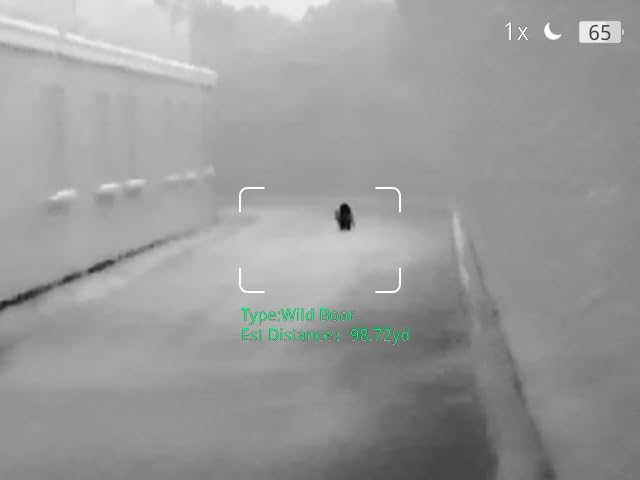
The 13mm objective and 13.5 degree field of view give you a wide, forgiving scan pattern. That is exactly what you want for a sounder spread across a buckwheat field. The manufacturer claims detection up to 410 meters, and while that is a lab number, reviewers consistently report picking up heat signatures at a few hundred yards.
The 5000mAh internal pack runs over 10 hours per charge, which comfortably covers a full night without a spare battery. The TopInfrared app handles live view, stills, and video with audio, so documenting a control removal is easy.
Where it falls short is honest to state. Zoom is digital only, so pushing past 4x produces a grainy, blocky image. And identification of species drops off around 150 yards in typical conditions. If your hogs consistently present beyond 200 yards, this is the wrong tool.
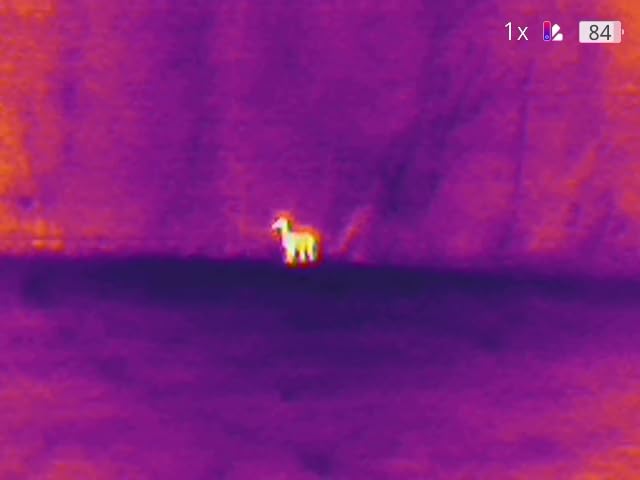
What 150 yards actually looks like through the TS004
Inside 100 yards you will pick out a sow and her number of feet if she pauses. Out at 150 you will see a body shape and a head-down posture that reads as a hog. Past that, the pixels stop holding edges and you are guessing.
Dense summer foliage is the other real-world limiter. Reviewers note the image degrades badly when vegetation is still thick and warm from the day, because the sensor loses contrast against a background of warm leaves.
Where the TS004 is the wrong choice
If you hunt open country and expect shots at 300 yards or more, look at the Pulsar Axion Compact or the MiLESEEY body instead. A 256×192 sensor cannot be talked past its limits with post-processing.
Also skip it if your workflow lives on a laptop. There is no clean path for moving files to a Mac, and iOS will not mount the device as a drive. If you are a Windows user or you never leave the phone app, it is a non-issue.
2. AGM Rattler V2 Thermal Scope – The Highest Rated Body in the Group
AGM Global Vision Rattler V2 19-256 Thermal Scope High-Sensitivity Sensor
256x192 with 12um pixels
2.5x base, 9.3 deg FOV
Dual batteries, 11.5 hours
6.34 oz, IP67
Pros
- Highest average rating here at 4.6 across 284 reviews
- 9.3 degree field of view is excellent for tracking hogs in brush
- Dual rechargeable batteries for long nights
- Shot-activated recording with onboard audio
- IP67 rated and rated from -22F to 131F
Cons
- This listing is a mounted riflescope
- not a handheld monocular
- Entry-level 256x192 sensor limits fine detail at distance
Let me be straight about this one: the Rattler V2 is a thermal riflescope. It mounts on a Picatinny rail and it needs a rifle to use. It sits in this roundup because the fastest way to build a hog kit is a handheld scanner for the search and a scope for the shot, and this is one of the better-rated scopes to fill the second role.
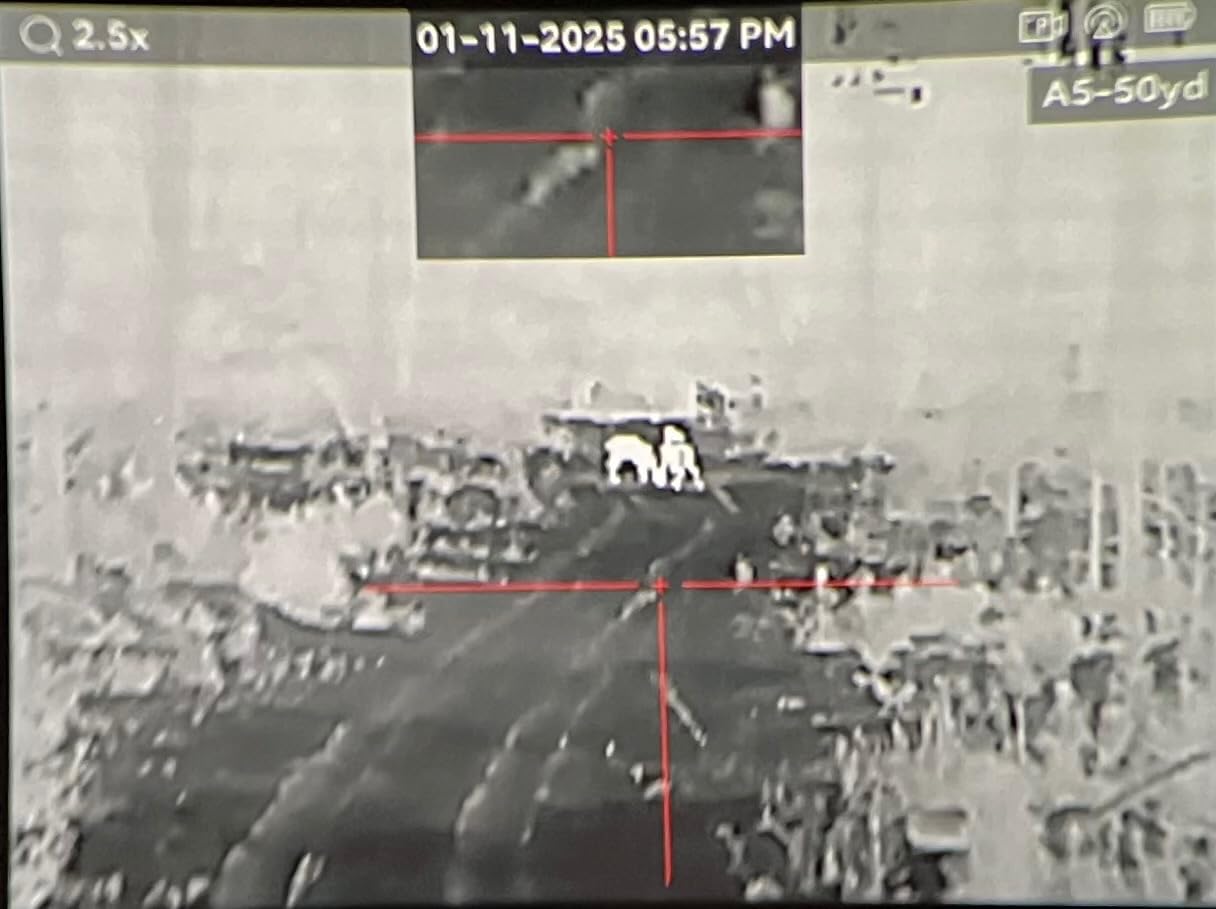
At 4.6 across 284 reviews with 74 percent five-star ratings, it is the highest average rating in the entire group. That consistency comes from the field of view: 9.3 degrees is genuinely wide for a mounted thermal, and it lets you reacquire a moving hog without leaving the eyepiece.
Its 256×192 sensor with 12um pixel size pairs with 2.5x base magnification and up to 8x digital zoom. On a rifle, moving a sow from 100 to 150 yards without a jump in the image is the whole game, and that base magnification does it.
The dual rechargeable batteries give up to 11.5 hours, and shot-activated recording with onboard audio means you are not fumbling with a button when the shot happens. Ten reticle styles, four color options, and a stadiametric rangefinder round out a scope that does more than most buyers expect at this level.
How this pairs with a handheld for hog work
Hunters on the hunting forums describe exactly this setup: a handheld for the scan, a mounted thermal for the shot. On r/ThermalHunting one user runs a 384-class unit on the rifle and pops it off to use as a monocular, noting that 200 yards or less is comfortable range.
That combination works because the scope does the precision work and the handheld does the searching. It also means your rifle stays shouldered and settled rather than being swept around at half-mast.
Where the Rattler V2 disappoints
The 256×192 sensor is entry-level. It will not hold fine detail on a hog at 250 yards, and no amount of digital zoom changes that. It also carries no laser rangefinder beyond the stadiametric type, so your holdover is a guess rather than a number.
If you hunt exclusively on foot with a handheld, this is the wrong purchase. Pair it with one of the monoculars below rather than choosing it instead.
3. GOYOJO G210 Thermal Monocular – Best for Long Nights on Swappable Cells
GOYOJO G210 Thermal Monocular, 256×192 Thermal Imaging Monoscope Camera for Adults, 10mm Focal Lens Vision Goggles Thermal Scopes for Night Hunting Camping
256x192 with 12um detector
10mm lens, 17.5 deg FOV
Replaceable cell, 6+ hours
16GB onboard, IP65
Pros
- Replaceable battery keeps the hunt going without a charger
- 6 color palettes including Iron Red and Black Hot
- 800x600 eyepiece with wide diopter for glasses
- 16GB built-in storage plus Wi-Fi sharing
- Compact enough for a jacket pocket
Cons
- 25Hz refresh trails the 50Hz units on moving hogs
- Reported battery failure and brightness that resets on power cycle
- No microphone so video has no audio
The G210 is the pick for anyone whose hunt runs past dawn or who sits on a stand two nights in a row. Its replaceable battery is the reason. When the cell dies at 2am you swap it, and the hunt continues.
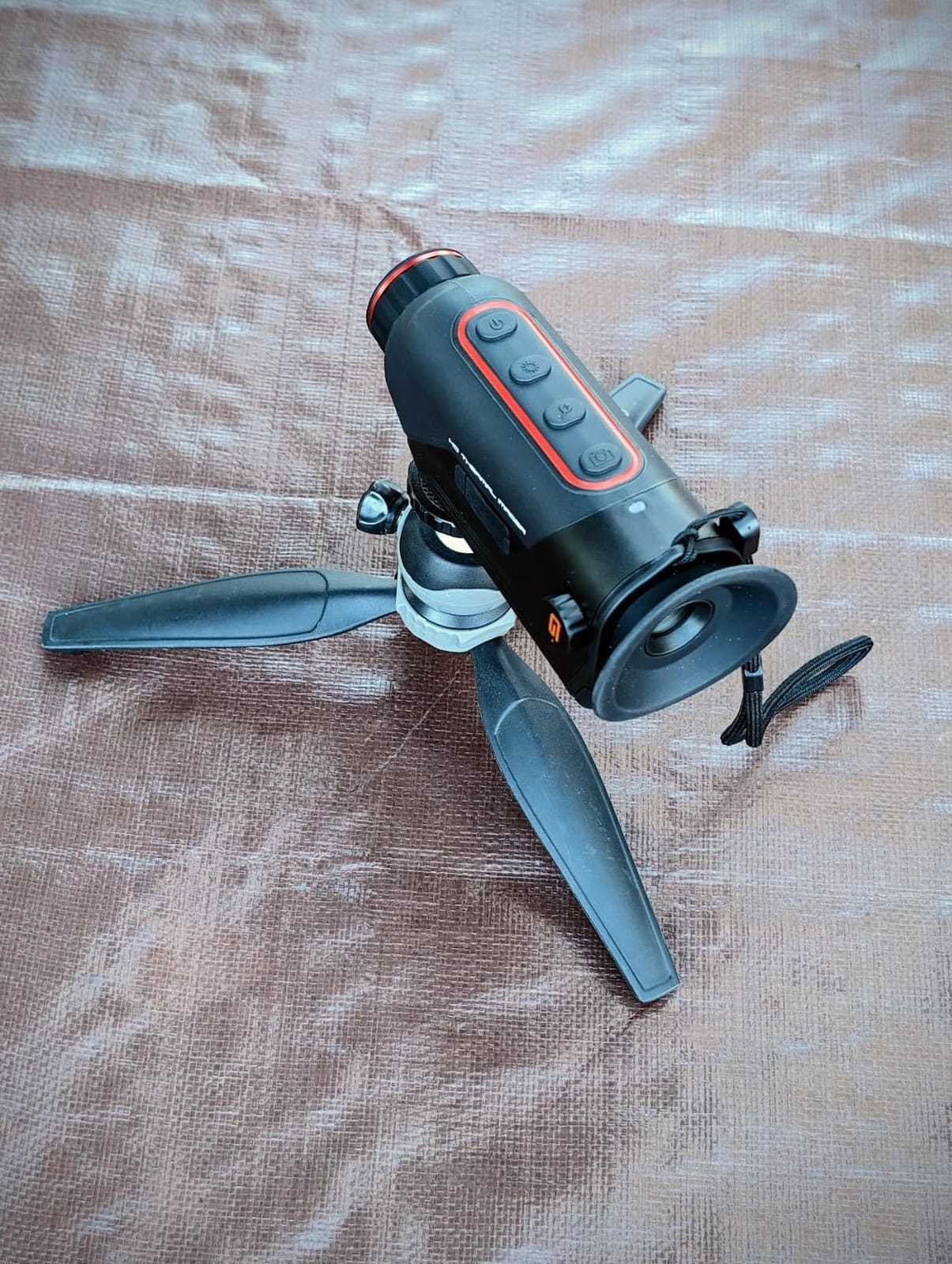
At 10mm with a 17.5 degree field of view, this is a wide, close-range instrument. That is the right shape for creek bottoms, oak flats, and thick brush where hogs are inside 150 yards and you are looking for a shoulder, not a signature.
The 800×600 eyepiece with a wide diopter adjustment is a genuinely nice touch for a budget-tier body. If you wear glasses, a tight diopter range is a deal breaker, and this one does not have that problem.
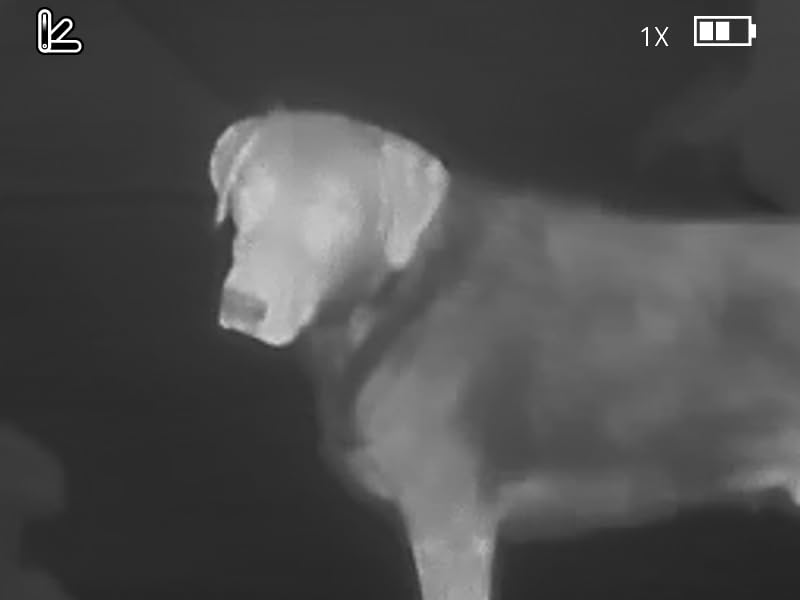
Six color palettes give you more than the usual white hot and black hot. Reviewers favor Iron Red and Black Hot for identification. A solid red silhouette against a grey background separates the body outline from surrounding brush far better than a blown-out white blob.
Sixteen gigabytes of internal storage means photos and video live on the device, and the Wi-Fi app shares live view to a phone. One buyer praises the integrated laser dot as a useful way to confirm an aim point on an animal already down.
What the 17.5 degree field of view gets you
Field of view is a tracking tool, not a spotting tool. At 17.5 degrees, a sow running across your face stays inside the frame long enough to count her piglets. Narrow it and you spend the whole sequence re-finding the same animal.
The tradeoff is straightforward: a wide field usually means a fast lens, and less magnification on demand. The 4x zoom is there, but it is digital, so treat it as a way to confirm what you already found rather than a way to find something new.
Where the G210 will frustrate you
The 25Hz refresh is the biggest limitation. Running hogs blur, and a scattering sounder at speed can look like a smudge rather than a group. For creek-bottom work at close range it is acceptable. For chasing hogs across open ground it is not.
There is also an isolated report of a supplied battery that died early and would not recharge, plus brightness settings that do not survive a power cycle. Neither is widespread, but both are the kind of annoyance that shows up at 3am. If you buy this, buy two extra cells the day it arrives.
4. RIX Pocket K2 Thermal Monocular – Best Close-Range Value in a Tiny Body
RIX Pocket K2 Portable Thermal Monocular for Hunting, 256×192 (50Hz), Wi-Fi, Handheld Night Vision Monocular
256x192 12um, NETD under 25mK
9mm lens, 19.4 deg FOV
50Hz with image stabilization
200 g, IP67
Pros
- NETD under 25mK at this price tier is rare
- 50Hz plus electronic stabilization steadies moving animals
- Body is 200 g and 4.9 inches long
- Integrated sliding lens cover cannot be lost
- IP67 sealed for fog and rain
Cons
- Fixed focus frustrates some users
- On-device menu controls are fiddly in gloves
- One report of intermittent power-on and charging failure
The Pocket K2 is one of the most compact devices here, and the reason it does not feel like a toy is the sensor sensitivity. A NETD under 25mK on a 256×192 core means the image holds contrast on nights when a 35mK unit washes out, and humid creek-bottom nights are exactly the nights you need to be out.
It is also among the widest handhelds in the roundup at 19.4 degrees, with a 9mm lens. Wide means you find hogs faster and hold a sounder on screen without chasing it. At 200 grams and 4.9 inches long, it goes in a chest pocket and stays there between sits.
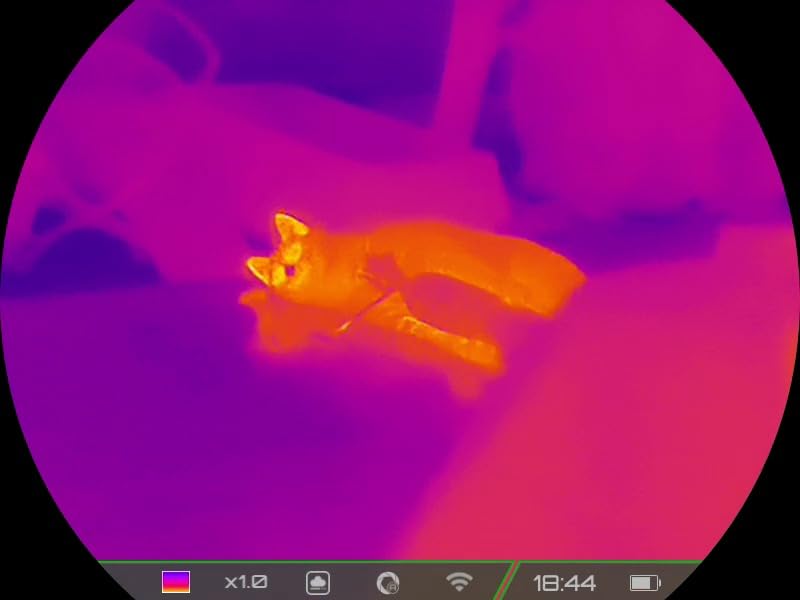
Reviewers repeatedly describe it as a high-value scanner covering roughly 150 to 200 yards of reliable identification. That is a real, usable number for feeder-over and timber-edge work, and it is well short of the marketing figures most budget bodies print.
The 800×600 OLED display is sharp, the 50Hz refresh plus electronic image stabilization keeps a walking hog readable, and the integrated sliding lens cover solves a small problem that costs a lot of hunters an hour of searching grass in the dark.
One long technical review on this device praises the sensor behavior, app latency, and battery draw in real terms, which is a better signal than a marketing sheet. Buyers comparing it against phone thermal dongles generally find it far more capable.
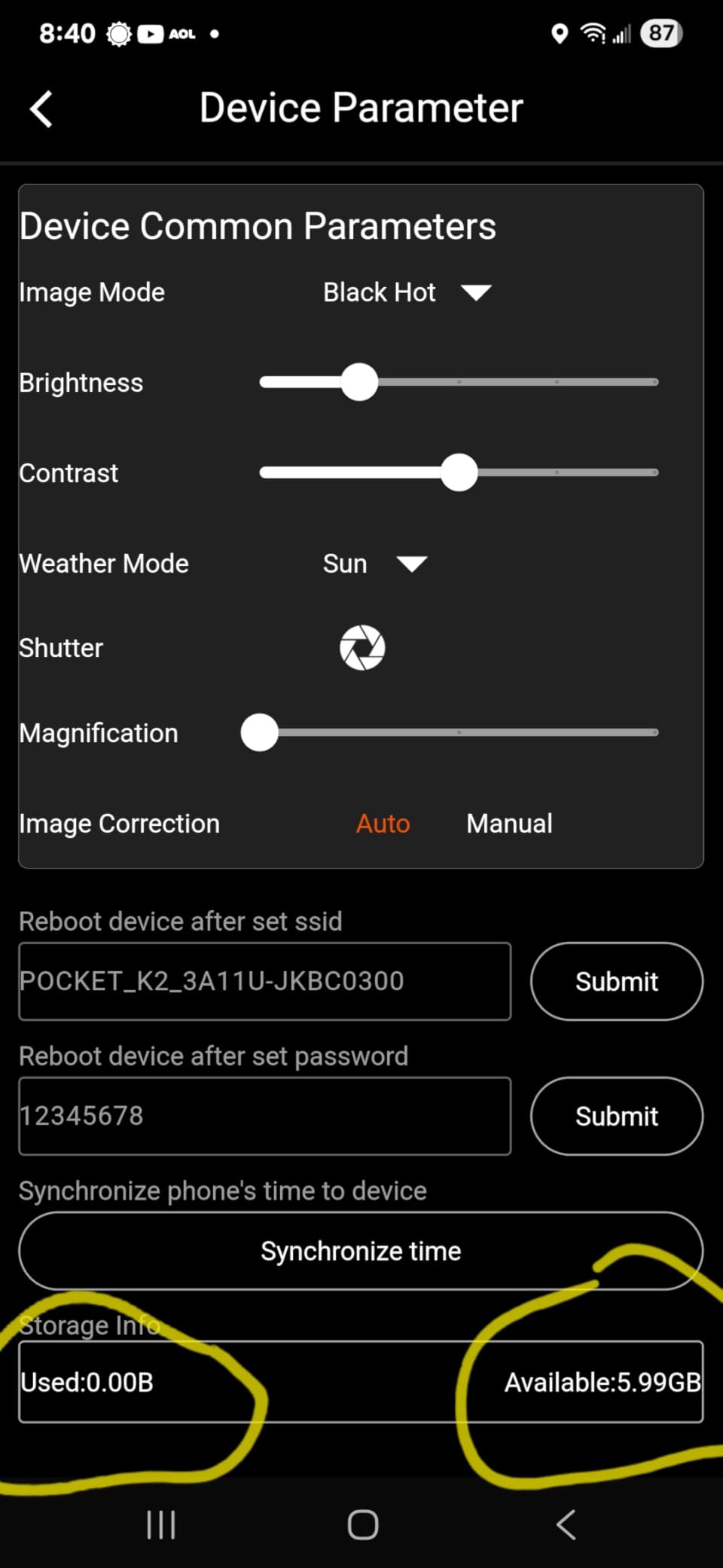
Why NETD beats raw resolution at this tier
Think of NETD as the floor of what the sensor can separate. Under 25mK means a 20-degree difference in body heat against a 40-degree background is clearly visible. Above 35mK, the same scene turns to mush on a warm night.
That is why a 256×192 body with sub-25mK sensitivity can outperform a higher-resolution body with a worse figure in fog and humidity. Resolution tells you how much detail exists in the image. Sensitivity tells you whether there is an image at all.
Where the Pocket K2 falls short
Focus is fixed and the adjustment is described as difficult for some users, so if you have one eye significantly stronger than the other, the lack of fine focus control will bother you. The on-device menus are also fiddly, which is a real problem with gloves on.
Beyond a couple hundred yards the 256×192 resolution stops identifying small animals. This is a 150-yard tool, and treating it as a 400-yard tool is the single most common complaint in budget thermal circles.
5. Teslong TTS260 Thermal Monocular – Big Eyepiece, Modest Recognition Range
Teslong TTS260 Thermal Monocular 256 x 192, Super Resolution 512 x 384
256x192, super resolution to 512x384
12mm lens, 15 deg FOV
Up to 8 hours, 32GB onboard
0.32 inch 800x600 OLED
Pros
- Super resolution sharpens 256x192 for easier target recognition
- Large 800x600 OLED eyepiece fills the view
- 32GB internal storage plus USB-C and HDMI output
- Adjustable diopter and brightness work for different users
- Touch buttons are easy to hit in the field
Cons
- Recognition distance of about 55 yards is the weak point
- Fixed focus with no fine focus ring
- 4.2 average across 188 reviews is mid-pack in this group
The TTS260 wins on the viewfinder. A 0.32-inch 800×600 OLED eyepiece with a rectangular field of view gives a much more open, immersive picture than the round tubes on most budget monoculars, and after a couple of hours of scanning that difference is genuinely tiring to give up.
Its super resolution mode pushes the 256×192 sensor up to 512×384 for display, which does not create detail that is not there but does make edges easier to separate from background brush. For a hunter trying to decide if a shape is a hog or a deer, that smoothing helps more than the pixel count suggests.
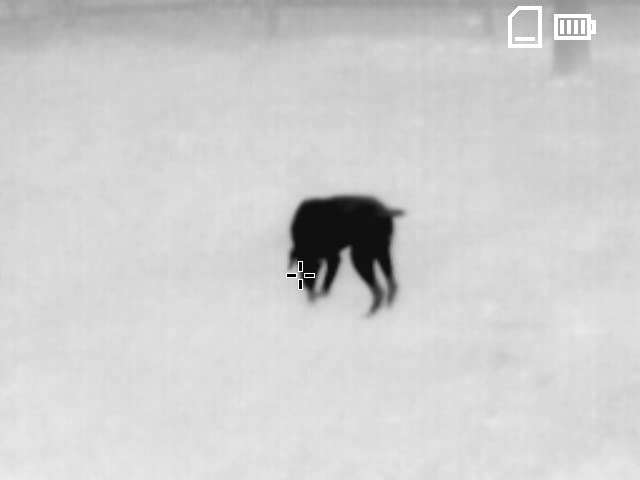
Storage is where this device separates itself from the pack. Thirty-two gigabytes of internal memory, USB-C, and Mini HDMI output mean you can review and offload footage without an app, which matters if you are documenting a season of hog removals for a landowner.
Eight color modes with hotspot tracking let you lock onto the warmest point in a group, and an adjustable diopter plus brightness control make it usable for different users on the same hunt. Battery life of up to 8 hours covers most nights, and the -4F to 122F operating range handles cold weather.
The touch buttons are easier to operate than the tiny joysticks on competing bodies. That sounds minor until you are wearing gloves and trying to change palettes without taking your eye off the timber.
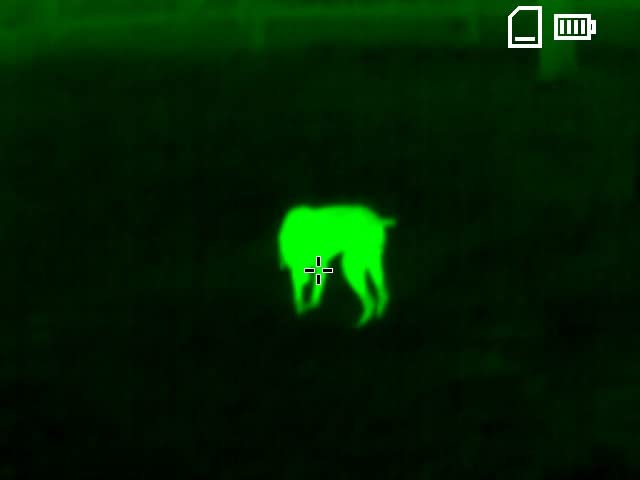
Read the 218 yard and 55 yard numbers together
This is the clearest example on our list of why detection and recognition are different claims. The manufacturer lists detection up to 218 yards. The same specification sheet lists recognition at about 55 yards. The first number is a hot blob, the second is a body you can name.
Plan your identification distances off the second number. At 55 yards you know the species. Between 55 and 218 you know something is out there, which is useful for moving toward it but not for deciding to shoot.
Where the TTS260 is the wrong buy
Fixed focus with no fine focus ring is the practical limit. If you plan to use this for anything beyond casual wildlife viewing at moderate ranges, the lack of focus control becomes frustrating quickly.
At 4.2 across 188 reviews it sits mid-pack in this roundup, and about 10 percent of reviews are one star. If your hog work happens past 100 yards, look at a 384×288 body instead. We cover our broader optic picks in the rifle scope roundup if you are building out the shooting side of the kit too.
6. ATN OTS XLT Thermal Monocular – Widest Field of View in the Roundup
ATN OTS-XLT Compact Lightweight Thermal Viewer, 2-8x
25mm lens, 22.5 deg FOV
2-8x magnification
10+ hour battery
0.8 lb listed, 2 year warranty
Pros
- 22.5 degree field of view is the widest of the handhelds here
- 25mm objective gathers real light in low contrast
- Simple intuitive controls usable in the dark
- 10+ hour battery that holds up over 30 charge cycles
- Useful for blood trailing after a night shot
Cons
- Image looks fuzzy without a strong heat gradient
- Digital zoom pixelates badly past 4x
- Struggles in fog
- snow and near-freezing conditions
The OTS XLT wins one race outright: field of view. At 22.5 degrees with a 25mm objective, it is the widest instrument in the roundup, and for tracking a scattering sounder across a wide treeline that is not a small advantage.
A 25mm objective is a meaningful jump from the 9mm, 10mm, and 12mm lenses on the budget bodies. Bigger glass gathers more infrared energy, which is what lets the image hold together when the temperature contrast between a hog and the background is thin, such as on a warm, still night shortly after dark.
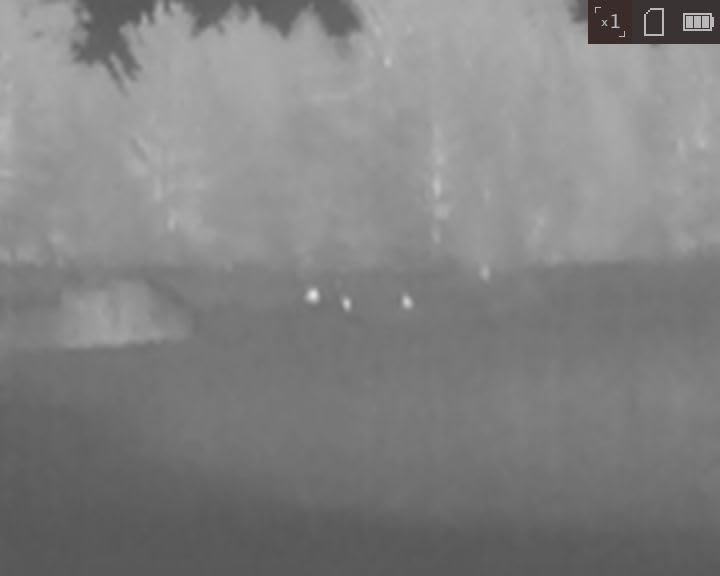
Controls are simple and intuitive, which is worth more than it sounds. After midnight, with a hog at the edge of the treeline, you want one button for zoom and one for palette. The 10-plus hour battery is documented as holding up over 30 charge cycles, which is unusual detail to see in reviews.
Reviewers also point out its usefulness for blood trailing after a dark shot. A wounded hog leaves a heat signature you can follow out of a thicket, and a wide, long-running body is better suited to that task than a pocket unit.
Video and photo capture are built in, and a smart rangefinder is included, so you get range data without carrying a separate LRF.
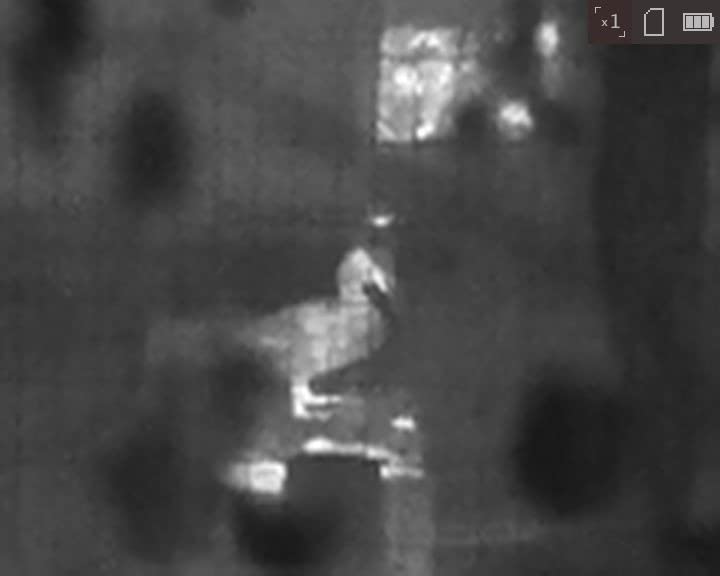
When the widest view beats more magnification
Magnification tells you how much of the image fills the eyepiece. Field of view tells you how much world is in the eyepiece. Hogs arrive in groups, and a group that is partially off screen is a group you have to re-find at 3x, which is slow and often fails.
For scanning work, 22.5 degrees lets you hold a whole sounder in one look. Then you zoom. The 2-8x range covers the transition, though the digital end pixelates hard past 4x.
Where the OTS XLT disappoints
Cold weather is the documented weak point. Reviewers report the image going to a white screen in fog, in bright snow, and near or below freezing temperatures. If your hog season opens in January in a northern climate, that is not a minor issue.
There are also multiple reports of battery capacity loss over time and frustration reaching ATN customer service, plus a 2 year manufacturer warranty that is one of the shorter terms in this list. The 4.0 average across 157 reviews reflects that split.
The item weight is listed inconsistently at 0.8 pounds in the specifications and 2 pounds in the technical details. Plan on the larger figure for comfort purposes.
7. Pulsar Axion Compact Thermal Monocular – Best Value in 384×288
Pulsar Axion XQ19 Compact Thermal Monocular, 384×288 Sensor
384x288 with 17um pixels
NETD under 18mK
19mm f/1.0, 1.5-6x
8.8 ounces, IPX7
Pros
- 384x288 sensor with NETD under 18mK at this price tier
- 640x400 AMOLED display is far larger than competing entry models
- Bright f/1.0 lens performs in fog
- dusk and brush
- Removable APS3 battery with five year warranty
- 8.8 ounces for a body with a 19mm lens
Cons
- Menu system is more complicated than rivals
- One owner received a battery that would not hold a charge
- Small review base at only 40 ratings
This is the one that changes the tier structure of the list. Everything above it runs a 256×192 sensor, which is a close-range tool. The Axion Compact steps up to 384×288 with 17um pixels and a NETD under 18mK, and it does so in an 8.8 ounce body.
That combination is why it is the value pick. A 384×288 core at sub-20mK sensitivity is the sensor class most hog hunters consider the sweet spot, and it is what lets you identify a sow at 250 yards rather than detect a blob at 250 yards.
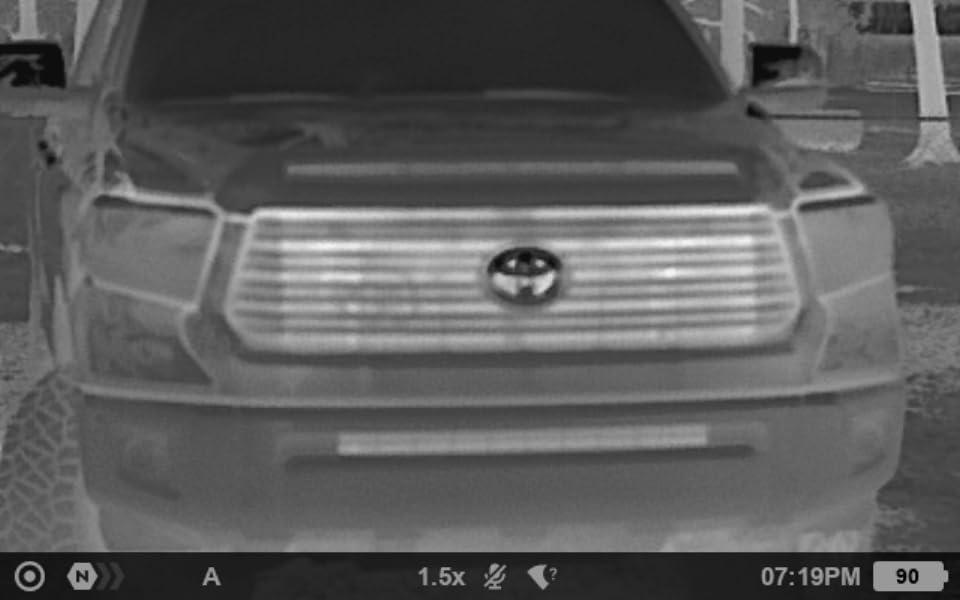
The 19mm f/1.0 lens is unusually bright for the size. A fast f-number gathers infrared energy efficiently, which is exactly what you want in creek fog, on damp nights, and in the first hour after sunset when the ground is warmer than the sky.
The 640×400 AMOLED display is the detail most owners mention first, because it is dramatically larger than what competing entry models offer and comparable to units costing far more. At 1.5-6x with a 19.5 degree field of view, you get both a wide scan and usable magnification in one body.
Recording, an app for saving and viewing clips, a removable APS3 battery, and a five year limited warranty round out a package that feels more serious than the price tier suggests. Owners describe it as feeling like a premium tool.
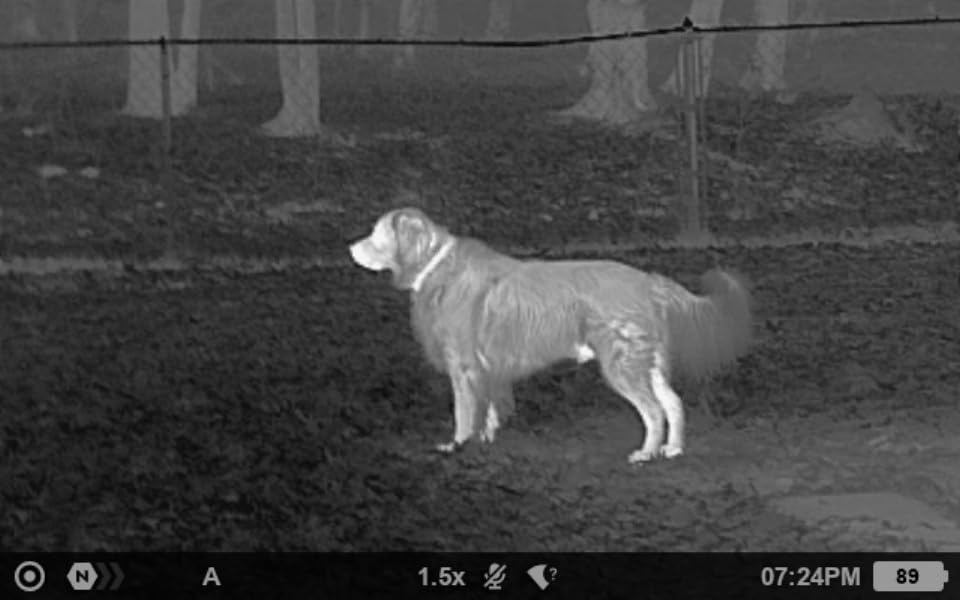
What a 384×288 sensor changes at 300 yards
On a 256×192 body at 300 yards you are looking at a heat blob with no shoulders, no head, no leg definition. That is a detection, not an identification, and it is not enough to shoot on.
With 384×288 and sub-20mK sensitivity, the same animal at 300 yards shows a body outline and a head-down posture that reads as a hog. The jump is not a small upgrade. It is the difference between scanning and shooting.
Where the Axion Compact disappoints
The menu system is more complicated than rivals. Changing a color palette means working through menus rather than tapping a dedicated button, and if you are wearing gloves in the dark, that is a real friction point. The review base is also thin at 40 ratings, so treat the 4.4 average as encouraging rather than proven.
One owner received a battery that would not hold a charge. Buy a spare APS3 before you leave for the field. Note also that the waterproofing is IPX7 rather than the IP67 rating carried by most of the budget bodies here, so keep it out of sustained heavy rain.
8. RIX Pocket K3 Thermal Monocular – Lightest 384×288 for Moving Hogs
RIX Pocket K3 Thermal Monocular for Hunting, 384×288 Night Vision Monocular
384x288 at 50Hz
15mm lens, 2x base
800x600 OLED
7.52 ounces, 1/4-20 tripod
Pros
- 384x288 with 50Hz refresh cuts motion blur on moving hogs
- Only 7.52 ounces
- 800x600 OLED gives high contrast in dark scenes
- Electronic image stabilization steadies handheld scanning
- Replaceable battery
- 8GB storage
- five year warranty
Cons
- 2x base magnification is low so distance forces digital zoom
- Manufacturer 853 yard detection figure needs favorable contrast
- Review history limited at 113 ratings
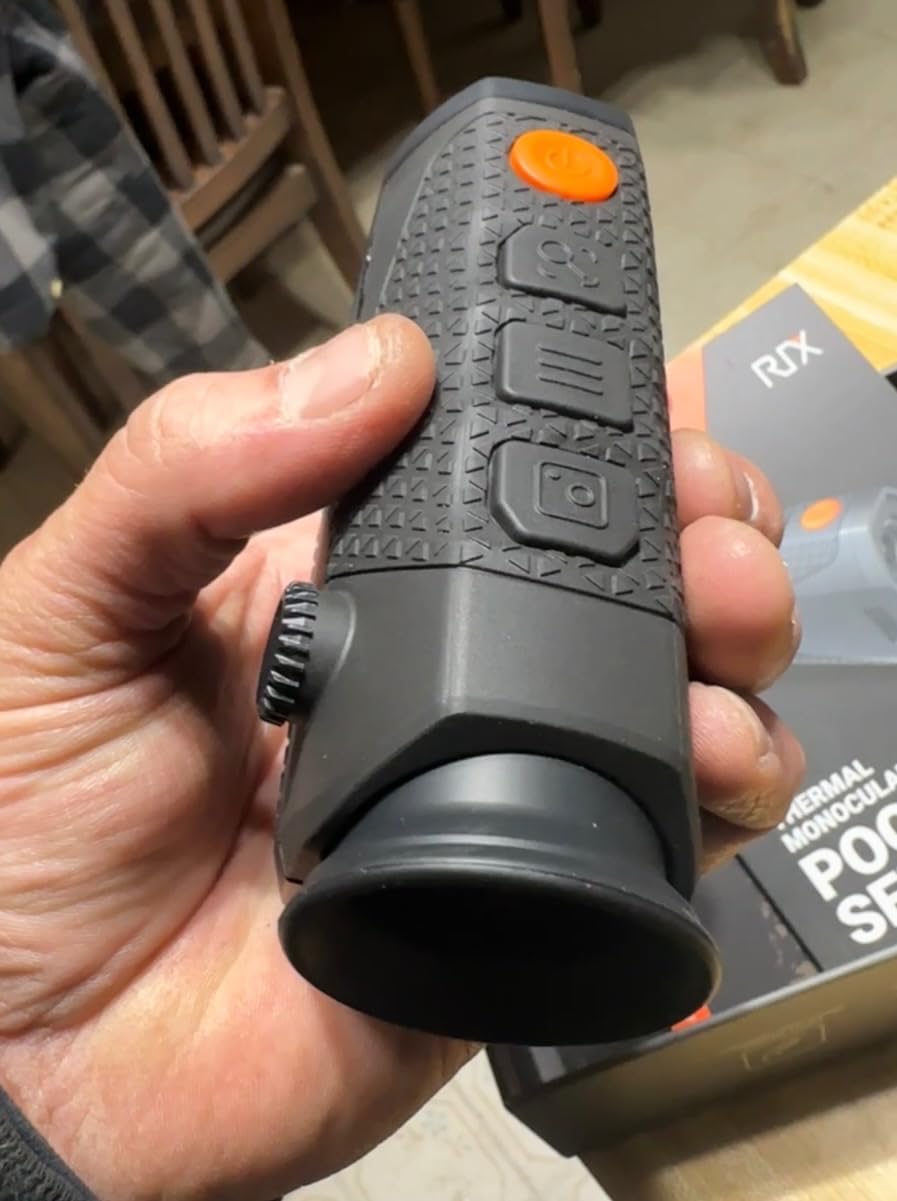
The Pocket K3 is the lightest 384×288 body in the roundup at 7.52 ounces, and it does not get there by giving up sensor class. A 384×288 core running at 50Hz in something under half a pound is the combination most likely to stay in your hand through a whole night.
That 50Hz refresh is the headline. Buyers specifically call out how it reduces motion blur on moving hogs, and with electronic image stabilization steadying the handheld image, a walking sow stays a walking sow instead of becoming a pale smear.
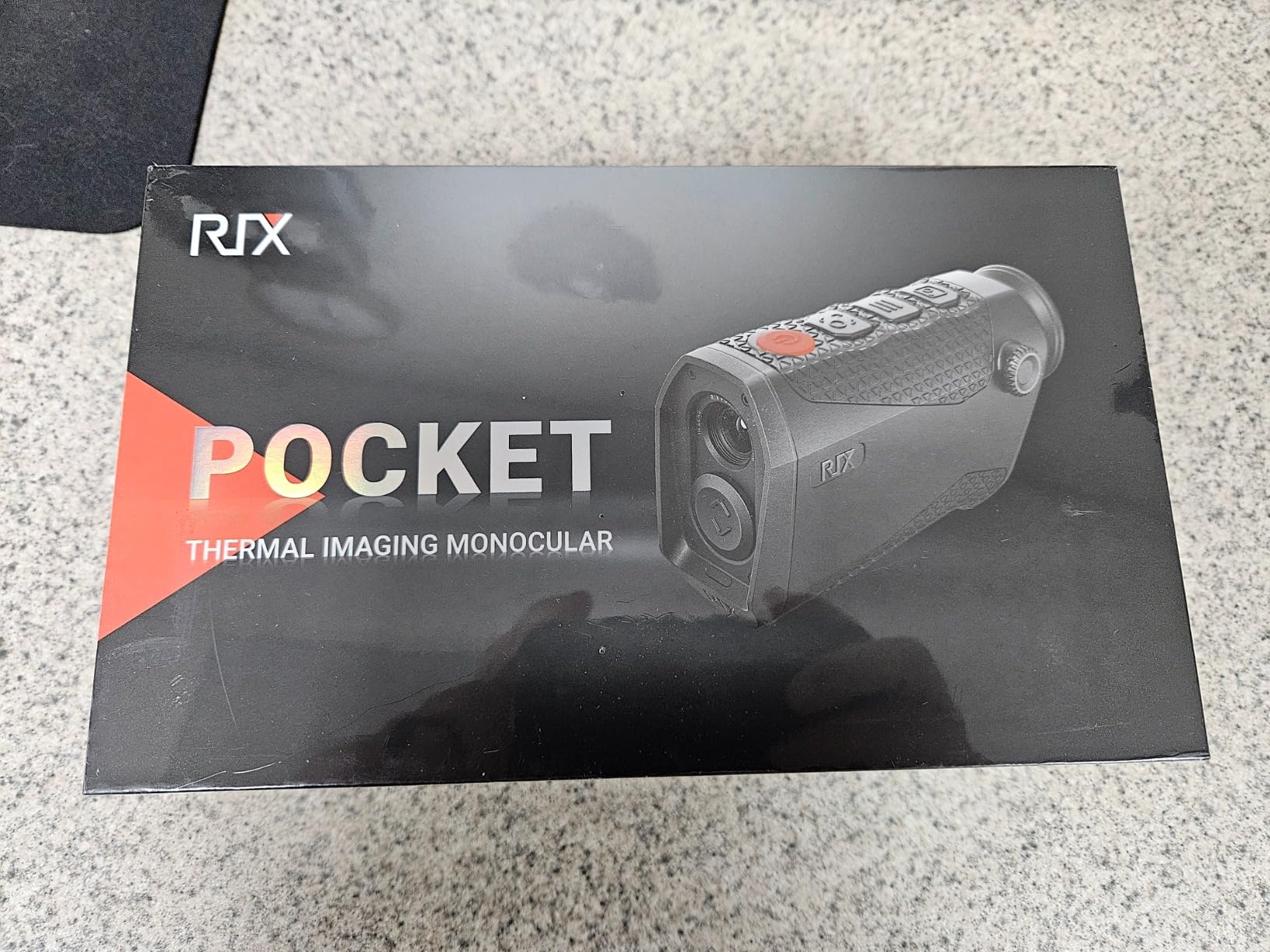
The 800×600 OLED display gives high contrast in dark scenes, which matters more than resolution on a night where the only light is moonlight. A 1/4-20 tripod interface lets you rest the body on a rail, a truck bed rail, or a mounted adapter during long waits.
Replaceable battery, 8GB of internal storage, Wi-Fi remote viewing and transfer, IP67 sealing, and a five year manufacturer warranty give this body the feature set of devices costing considerably more. A lanyard and carrying case are included.
Buyers position it as a clear step up from the Pocket K2, with the improvements being sensor class, refresh rate, and display quality rather than form factor.
Why refresh rate matters more than most buyers think
A thermal sensor samples the world a fixed number of times per second. At 25Hz, a hog moving across your field changes position between samples, so the frame you see is a blend of two locations. That is motion blur, and it is worst on the exact target you most want to follow.
At 50Hz the sampling interval halves and a running hog holds its outline. This is the spec that separates a scanning toy from a hunting tool, and it is why we weight it heavily in this roundup.
Where the Pocket K3 falls short
The 2x base magnification is the compromise that pays for everything else. At distance, a hog is small in the frame, so you push digital zoom and accept the pixelation. If most of your shots are beyond 200 yards, a body with 3x or 4x base will serve you better.
Also treat the 853-yard detection figure carefully. That number depends on favorable temperature contrast and a large object, and real-world identification at that distance is a completely different story. At 113 ratings the review history is still short.
9. ATN BlazeSeeker-210 Thermal Monocular – A Lightweight Scanner to Pair With a Scope
ATN BlazeSeeker-210 Thermal Imaging Monocular 256×192; 1.5-12x 12 Micron <35 NETD 50 Hz
256x192 with 12um pixels
NETD under 35mK
7mm and 10mm lens options
1.5-12x, 9.6 ounces
Pros
- Compact and light at 9.6 ounces for handheld scanning
- Works well as a companion to a mounted thermal scope so the rifle stays still
- Five color palettes and 1.5-12x zoom range
- Photo and video recording to MicroSD up to 256GB
- 1/4 inch tripod thread for stable mounting
Cons
- 256x192 image quality trails 384 units noticeably
- One owner called it unusable past about 20 yards and returned it
- Reports of batteries that would not hold a charge
The BlazeSeeker-210 exists to solve one problem cheaply: you already own a mounted thermal scope, you love it, and you do not want to swing the rifle around to scan. Adding a light handheld that stays in your pocket fixes that for very little money.
At 9.6 ounces with a 1.5-12x zoom range, five color palettes, and a 1/4-inch tripod thread, the feature list is longer than the sensor justifies. The 256×192 core with 12um pixels and a NETD under 35mK is a close-range sensor, and that sensitivity figure sits well behind the sub-25mK pocket units on this list.
Ranchers and night hunters like it as a cheap companion to a thermal scope, and one owner reports identifying deer, pigs, and coyotes at around 120 yards. That is a realistic figure for this sensor class. Another owner considered it unusable beyond about 20 yards and returned it, which is the other end of the same spectrum.
Recording to a MicroSD card up to 256GB and built-in Wi-Fi with an app give you documentation options, and auto focus is convenient when you are working a feeder in the dark. The negative reviews cluster around insufficient range for open country, batteries that would not hold a charge, and difficulty getting warranty service.
Is a budget 256×192 monocular a mistake?
Not as a scanner. As an identification tool at range, yes. The forum consensus among hog hunters is consistent: 256×192 units frustrate buyers who expected open-field capability and who end up with a close-range-only tool.
Buy this one if your hogs are inside 150 yards, or if you want a dedicated spotter to pair with a scope that handles the long work. If you expect to identify hogs at 300 yards, spend up and get a 384×288 body such as the Pulsar Axion Compact or the RIX Pocket K3.
Where the BlazeSeeker-210 disappoints
Image quality on a 256×192 sensor is visibly behind 384 units, particularly on small animals at the edge of detection. At 4.1 across 85 ratings it has one of the smaller feedback bases in the roundup, which means fewer owners have surfaced the long-term problems that show up after a season or two.
If you are starting from nothing and can stretch, a 384×288 handheld will outlast this one and save you the upgrade later. If your budget is genuinely fixed, this does the job it is designed for.
10. MiLESEEY T-Recon Scout 640×512 – Best for Long-Range Detection
MiLESEEY Thermal Monocular T-Recon Scout, 640×512 (50 Hz) TNV60 Aircraft Mg-Al Alloy Thermal Monocular, Handheld Thermal Imaging, Night Vision Imager, OLED Display with 8X Digital Zoom
640x512 at 50Hz
25mm f/1.0 germanium
Up to 18 hours, 4800mAh
1.54 lb, magnesium-aluminium
Pros
- 640x512 at 50Hz is the highest raw resolution in the roundup
- Germanium f/1.0 lens supports a claimed 1500 yard detection range
- 18 hours of runtime from a 4800mAh pack
- Magnesium-aluminium chassis feels far more rugged than plastic
- Modular design accepts an external screen and laser rangefinder
Cons
- One of the heavier bodies here at 1.54 pounds
- Thin review base at 58 ratings
- No LRF in the box despite the modular add-on capability
The T-Recon Scout is the only body here with a 640×512 sensor, and that is the entire argument for it. Everything else on this list tops out at 384×288. If you hunt genuinely open country and want to pick up a sounder at distance, this is the only unit in the group with the raw resolution to attempt it.
Running at 50Hz on an 800×600 OLED display, it also avoids the ghosting problem that makes running hogs unreadable on cheaper bodies. The 25mm f/1.0 germanium lens is a fast, serious optic, and the manufacturer claims detection out to 1500 yards for a six-foot object.
Endurance is exceptional. A 4800mAh lithium pack runs up to 18 hours, which means a two-night stand or a long drive-and-walk hunt without a battery in your pocket. Sixteen gigabytes of internal storage holds a full hunt of photos, and adjustable brightness across six levels helps on both dark and moonlit nights.
The magnesium-aluminium alloy housing feels more rugged than the plastic bodies in this price bracket, and the modular design accepts add-ons like an external screen and a laser rangefinder. That modularity is worth noting: the rangefinder is a platform capability here rather than something in the box.
Enhanced target tracking and five color palettes are included, along with 8x digital zoom at native resolution.
How to think about that 1500 yard claim
Be skeptical, and be consistent about skepticism. Manufacturer detection ranges are measured against large, uniformly warm objects under favorable conditions. A hog at 1500 yards is a few pixels of low-contrast difference against a background, and what you will realistically get is a spot, not a shape.
With 640×512 you are working with about three times the pixels of a 384×288 body and more than six times a 256×192. That buys you genuine identification capability in the 300 to 500 yard band, which is where the real value sits. Anything beyond that is a bonus, not a promise.
Where the T-Recon Scout disappoints
At 1.54 pounds it is one of the heavier bodies in the roundup, and that is a real cost over a four-hour handheld scan. If you are walking creek bottoms all night, you will notice it by hour three.
At 58 ratings, the feedback base is small, and the brand carries no visible long service history in these reviews.
Why a Monocular and Not Just a Thermal Scope?
Because scanning and shooting are different physical tasks, and one device rarely does both well. Swinging a mounted scope to find a sounder means carrying the rifle at half-mast, at an angle that fatigues your shoulder and shifts the barrel off target every time you drop it. Hunters on the hunting forums say this plainly: swinging a rifle around to scan gets old fast, and the handheld is the direct fix.
The workflow that works looks like this. You walk or sit with the monocular in your hands at low magnification, sweeping wide. When a heat signature appears, you confirm the species, note the direction of travel, and estimate a stand position. Only then do you bring the rifle up and use the mounted thermal for the shot.
On the Sniper’s Hide hog threads, the recurring view is that the scanner is the piece of gear used most during a hog hunt. One poster put it plainly: they would sell another optic and buy a thermal scope and scanner, because the scanner is what gets used.
A second benefit is follow-up. After a shot, the mounted scope is on the animal you just hit, not on the rest of the sounder. The handheld follows the group, and the scope does the recovery. For blood trailing after a dark shot, a wide-field handheld is a better tool than a magnified scope.
The counter-argument is duplication. Having a laser rangefinder on both devices feels wasteful, and there is an ongoing debate about whether the rangefinder should live on the spotter or the shooting optic. The practical answer is that if your scope lacks one, the handheld’s range function is what gets you started on a holdover. If your scope has one, ignore the monocular’s. You can compare your scope options in our best rifle scopes roundup.
One more practical point: a handheld can be mounted on a tripod, rested on a truck bed rail, or held out to a mirror or over a feeder without disturbing anything. That flexibility is why the two-device approach keeps winning in the forums.
The Specs That Actually Matter for Hogs
Sensor resolution sets your ceiling, and thermal sensitivity sets your floor. Resolution determines how much detail exists in the image. NETD, or noise equivalent temperature difference, determines whether there is an image at all on a marginal night. Under 25mK is excellent, 25 to 40mK is workable, 40 to 60mK is average, and above 60mK you are fighting the sensor.
The practical hierarchy for hog work runs like this. A 256×192 sensor identifies reliably inside 100 to 150 yards and detects well beyond that. A 384×288 sensor is the sweet spot for 200 to 300 yard timber and creek work. A 640×512 body is what you want for 400 to 500 yard open country. If your hunting is mostly inside 150 yards, do not spend money you will not feel on resolution.
Refresh rate is the spec buyers ignore and regret. At 25Hz, moving hogs blur. At 50Hz and 60Hz, they stay readable. Two of the ten bodies here run at 25Hz, and both show up repeatedly in reviews as frustrating on moving animals.
Objective lens size decides how the image performs in bad conditions. A 25mm lens gathers far more infrared light than a 9mm or 10mm lens, which is why the OTS XLT holds together on warm nights where smaller-lens bodies go flat. Wide lenses suit dense timber and creek bottoms, mid lenses suit general work to 300 yards, and long lenses suit open country.
Field of view is a tracking tool. For finding and holding a sounder, 17 to 22 degrees beats raw magnification every time. You can always zoom in after you find something. You cannot zoom out on an animal that is off screen.
Thermal versus night vision for hogs. Night vision amplifies available light, so it fails in true darkness, in heavy brush, and on moonless overcast nights. Thermal reads heat, so it works in complete darkness and sees through light brush. Night vision wins on close-range detail and on reading a blood trail in the grass, and it spooks hogs less at distance than a bright light. For night hog work, thermal is the tool. The question about whether thermal or infrared is better comes down to the same point: infrared illuminators require light in the scene, and thermal does not.
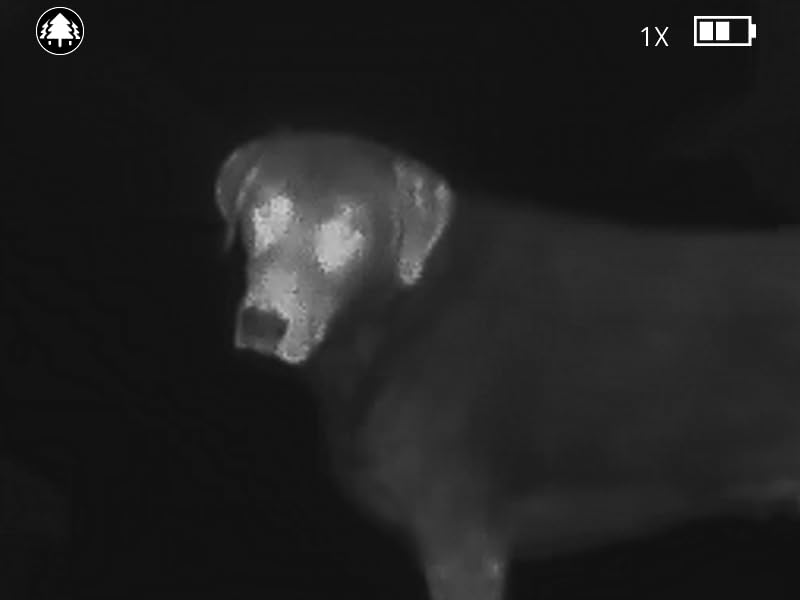
Palettes matter more than buyers expect. White hot is the default and blows out on close animals. Black hot keeps the animal dark against a bright background, which works well in brush. Iron-style palettes separate the body outline from foliage far better than either. Most units here offer five to eight options; spend the ten seconds in the field cycling through them.
Battery logistics for an all-night sit. Look for eight hours or more of runtime, or a swappable cell. Cold weather derates capacity, so a body that runs ten hours in September may not run eight in January. Spare cells in a jacket pocket cost far less than a dead device at midnight.
What to skip. Skip 160×120 bodies marketed as hunting-ready; they are observation curiosities. Skip digital zoom figures above 4x on a 256×192 sensor, because they interpolate pixels rather than adding detail. And skip any listing where the only range figure quoted is a detection number with no identification number alongside it. You can document patterns on feeders and fence lines that the hogs are working with a trail camera and match that to what your thermal shows you, which is a good way to learn identification range on your own ground before the season.
Finally, check your state rules before you buy. Light source and artificial light restrictions for hog control vary by state, and some properties have their own restrictions. Confirm what is legal where you hunt.
Frequently Asked Questions
What is the best thermal optic for hog hunting?
For a handheld, the TOPDON TS004 is the strongest all-round choice: a 256×192 sensor at 50Hz in a 70 gram body with over 10 hours of runtime. For the shooting side of the job, the AGM Rattler V2 is a mounted thermal scope with a wide 9.3 degree field of view and a 4.6 average rating. Most hog hunters use both, scanning handheld and shooting through a scope.
Is night vision or thermal better for hog hunting?
Thermal is better for hogs. Hogs are nocturnal, and night vision needs light in the scene, so it fails on moonless overcast nights and in heavy brush. Thermal reads body heat and works in complete darkness and through light cover. Night vision still wins for close-range detail and for reading a blood trail in grass, so some hunters carry both.
What sensor resolution do I need for hog hunting?
A 256×192 sensor is enough when your hogs are inside 150 yards, and it covers most creek-bottom and feeder work. Move to 384×288 for 200 to 300 yard timber and creek situations, which is the sweet spot most hog hunters land on. You need 640×512 for reliable identification in open country at 400 to 500 yards. Thermal sensitivity matters as much as pixels: under 25mK is excellent.
How far can a thermal monocular actually see a hog?
Detection figures on the box are lab numbers and are usually far longer than reality. A 256×192 monocular typically detects a hog well beyond 200 yards but only identifies it reliably inside 100 to 150. A 384×288 unit identifies around 250 to 300 yards in good conditions. A 640×512 body pushes dependable identification to 400 to 500 yards. Always plan your shot off the identification range, not the detection range.
Do I need a laser rangefinder on a thermal monocular for hogs?
Not on the handheld if your rifle scope already has one, since that is the optic you shoot through. If your scope lacks a rangefinder, a monocular with a built-in LRF gives you the range to start a holdover before you bring the rifle up. Hunters debate this constantly, and most settle on keeping the rangefinder on whichever device they use for the shot.
How do I tell a hog from a deer with a thermal monocular?
Watch the shape and the posture. A foraging hog holds its head low, nearly at ground level, and has a long low back with a big shoulder and a small rear. A deer raises its head often, has a taller and narrower body, and moves with its head up scanning. Confirm before you shoot, and never take a shot at a species you have not identified, because a mistaken call is the most common serious error in night hog work.
Final Verdict: Which Thermal Monocular Should You Buy?
For most hog hunters, the answer is the TOPDON TS004. It is the lightest body here, it refreshes at 50Hz so moving hogs stay readable, and it runs past 10 hours on a charge. Buy it for creek bottoms, feeder watches, and any hunt where hogs present inside 150 yards.
If you hunt open timber and expect shots at 250 to 300 yards, spend up to a 384×288 body. The Pulsar Axion Compact pairs a 384×288 sensor with NETD under 18mK in 8.8 ounces, and the RIX Pocket K3 is the lighter option with a 50Hz refresh and stabilization built for moving animals.
If you hunt genuinely open country at 400 yards or more, the MiLESEEY T-Recon Scout is the only body in this roundup with the resolution to attempt it, and it is also the only one rated for an 18-hour night. If you want the widest possible scan, the ATN OTS XLT covers 22.5 degrees, provided you are not hunting in deep cold.
And if you already own a mounted thermal, the GOYOJO G210 is a straightforward way to add a swappable-cell handheld so you can stop swinging the rifle. Whichever you choose, plan your distances off identification range rather than the number on the box, and check your state light rules before the season opens.