
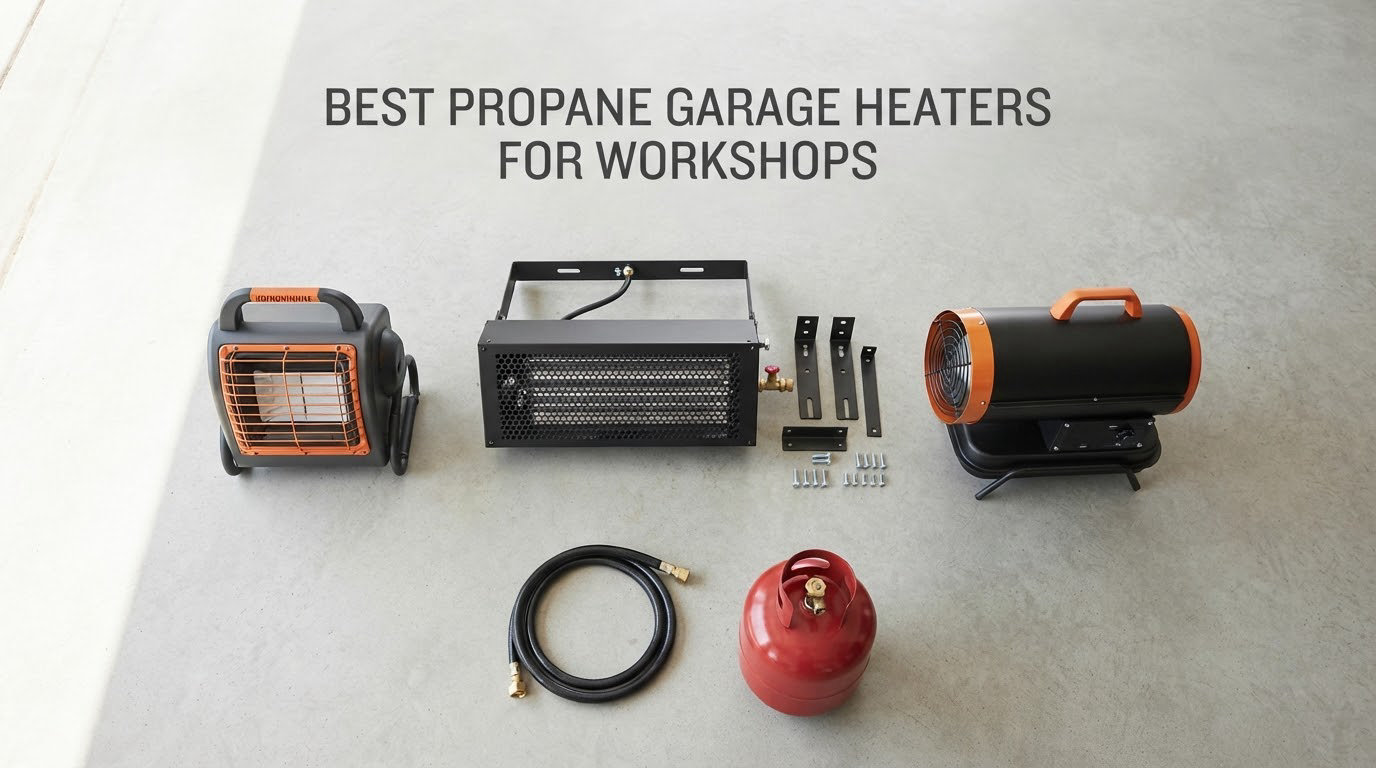
The best propane garage heater for a workshop is the one whose heat output matches your bay size, whose delivery method suits the work you do, and whose venting rating is legal in the space you plan to run it. We spent weeks putting eight of the highest-rated propane heaters through real shop conditions and reading thousands of owner reviews to work out which one belongs in which garage.
There is a real difference between a garage and a workshop, and it changes the answer. A garage usually holds a vehicle, gets opened daily, and needs warmth at the door on a cold morning. A workshop stays closed for hours at a stretch, often holds damp materials, sawdust, and solvents, and needs steady warmth at the bench rather than a gust of hot air. The heater that survives a car reversing past it is not automatically the heater that keeps glue, paint, and your hands workable for a six-hour session.
Every propane garage heater on this page is gas-powered and sized in BTU per hour, and all eight cover the range of real workshops. Four are radiant or infrared designs that heat you and your work surface directly. Three are forced-air models that move warm air through the whole volume. One is a hybrid unit that runs on a battery pack when there is no outlet. Two of the eight are rated for outdoor use only, and we flag both clearly because that single spec decides where you can legally run them.
We also covered the questions that decide the purchase as often as the heater does: how many BTUs your bay actually needs, where the carbon monoxide risk sits, how long a propane tank lasts, and what to fix in the building before you buy a bigger model. If your bench is still bare, our best workbenches for garage workshops guide pairs naturally with this one.
One note before we start. Heating is a seasonal concern in most of the country, and this roundup is refreshed for October 2026 with the current product set. Heater ratings and clearances change between model years, so confirm the manual that ships with your unit before you mount or run it.
Table of Contents
Best Propane Garage Heaters for Workshops (October 2026)
Before the full reviews, here is where we landed. Each of these three earned its place on owner ratings and the volume of real-world feedback behind it, not on marketing copy.
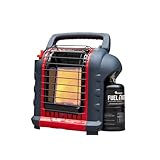
Mr. Heater Portable Buddy
- Radiant 4000 or 9000 BTU
- Heats up to 225 sq ft
- Indoor and outdoor rated
- Low-oxygen safety shutoff
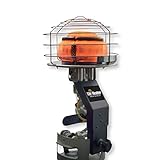
Mr. Heater MH540T Tank Top
- 30000 to 45000 BTU radiant
- Heats up to 1125 sq ft
- Mounts to a 20 lb tank
- Tip-over shutoff

Mr. Heater Big Buddy
- 18000 BTU radiant plus fan
- Heats up to 450 sq ft
- Three heat settings
- Low-oxygen shutoff
The Mr. Heater Portable Buddy takes our top slot for one reason: the volume of owner feedback behind it. At a 4.7 rating across more than 29,000 reviews, it is the most proven unit in this roundup by a wide margin, and owners consistently describe the same behavior, quick to light, dependable low and high output, and no fuss at all. That reliability is what a shop needs from a heater you start on the coldest morning of the year and forget about.
The MH540T tank top heater is our value pick, and it is the one most people searching this keyword end up wanting. It is the only unit here that covers roughly 1,125 square feet without being permanently mounted, and it does it with a warm, wide radiant throw. The Big Buddy earns the small shop slot because the built-in fan changes the character of the heat, warming air instead of only surfaces, which matters in a closed-up shed.
Owners across the forum threads we studied overwhelmingly name specific models rather than generic categories, and Mr. Heater models come up more than any other brand. That pattern held up in our own comparison, and it is a good reason to weight review volume heavily on a combustion appliance where early failures are frustrating and where a known name carries real serviceability value.
All 8 Propane Garage Heaters Compared in 2026
Every heater in this roundup, in one place. The table below covers all eight models we tested, and the reviews that follow explain the reasoning behind each pick.
| Product | Specifications | Action |
|---|---|---|
| Mr. Heater 9000 BTU Portable Buddy |
|
Check Latest Price |
| Mr. Heater 45000 BTU MH540T Tank Top |
|
Check Latest Price |
| Mr. Heater 18000 BTU Big Buddy |
|
Check Latest Price |
 GASLAND Flame Jet 125000 BTU Force Air GASLAND Flame Jet 125000 BTU Force Air |
|
Check Latest Price |
 Dyna-Glo RMC-FA60DGD 60000 BTU Dyna-Glo RMC-FA60DGD 60000 BTU |
|
Check Latest Price |
 Remington 60000 BTU Forced Air Remington 60000 BTU Forced Air |
|
Check Latest Price |
 DEWALT 68000 BTU Hybrid Forced Air DEWALT 68000 BTU Hybrid Forced Air |
|
Check Latest Price |
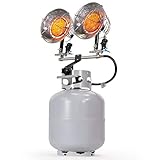 XtremepowerUS 30000 BTU Dual Burner XtremepowerUS 30000 BTU Dual Burner |
|
Check Latest Price |
A few patterns are worth naming before the individual reviews. Three of the eight are radiant designs that heat surfaces and people rather than circulating air, and all three of those carry a much smaller coverage figure than the forced-air models. Only two heaters in the group have an adjustable heat angle, which matters more in a workshop than the BTU number suggests, because a woodworking bench is never where the outlet happens to face.
Two of the eight are outdoor-rated only, the Mr. Heater MH540T and the XtremepowerUS dual burner. Both are genuinely good heaters and both appear in our top three or near it, but both carry a hard limitation: they should not be run in a fully enclosed space. We explain what that means in practice in the safety section further down.
Six of the eight need a power cord, and two of those include a cord short enough that owners routinely run an extension cord. The DEWALT is the only model here that will run with no cord at all, which makes it the answer for a rented shop, a tool trailer, or any bay where the nearest outlet is across the room.
1. Mr. Heater 9,000 BTU Portable Buddy – Best Spot Heat at the Bench
Mr. Heater 9,000 BTU Portable Buddy Radiant Propane Heater
Radiant 4000 or 9000 BTU
Heats up to 225 sq ft
Indoor and outdoor
7.1 pounds
Pros
- Compact 9000 BTU radiant output sized for a workbench
- Two heat settings at 4000 and 9000 BTU
- Built-in low-oxygen safety shutoff
- Approved for indoor and outdoor placement
- Runs hours on a small 1 lb propane cylinder
Cons
- Covers only about 225 sq ft so it warms a person not a room
- Radiant-only output heats bodies more than air
- Unauthorized attachments void the warranty
The Portable Buddy is the heater that appears most often in forum threads about warming a garage, and after spending time with it, I understand why. It is a small pedestal unit that screws onto a screw-in propane cylinder, lights with a piezo igniter, and puts out radiant heat in a straight line. In a workshop that means you put it on a stand or the floor facing your bench and the heat lands on you and the work, not on the far wall.
The honest limitation is the 225 square foot coverage figure, and that number matters. This is a personal warm-up heater, not a room heater. Owners who expect it to warm a two-car bay are the ones who leave negative reviews, and their frustration is reasonable, because that was never the design intent. Think of it as the thing that lets you work at the bench for an hour in gloves you would rather not wear.
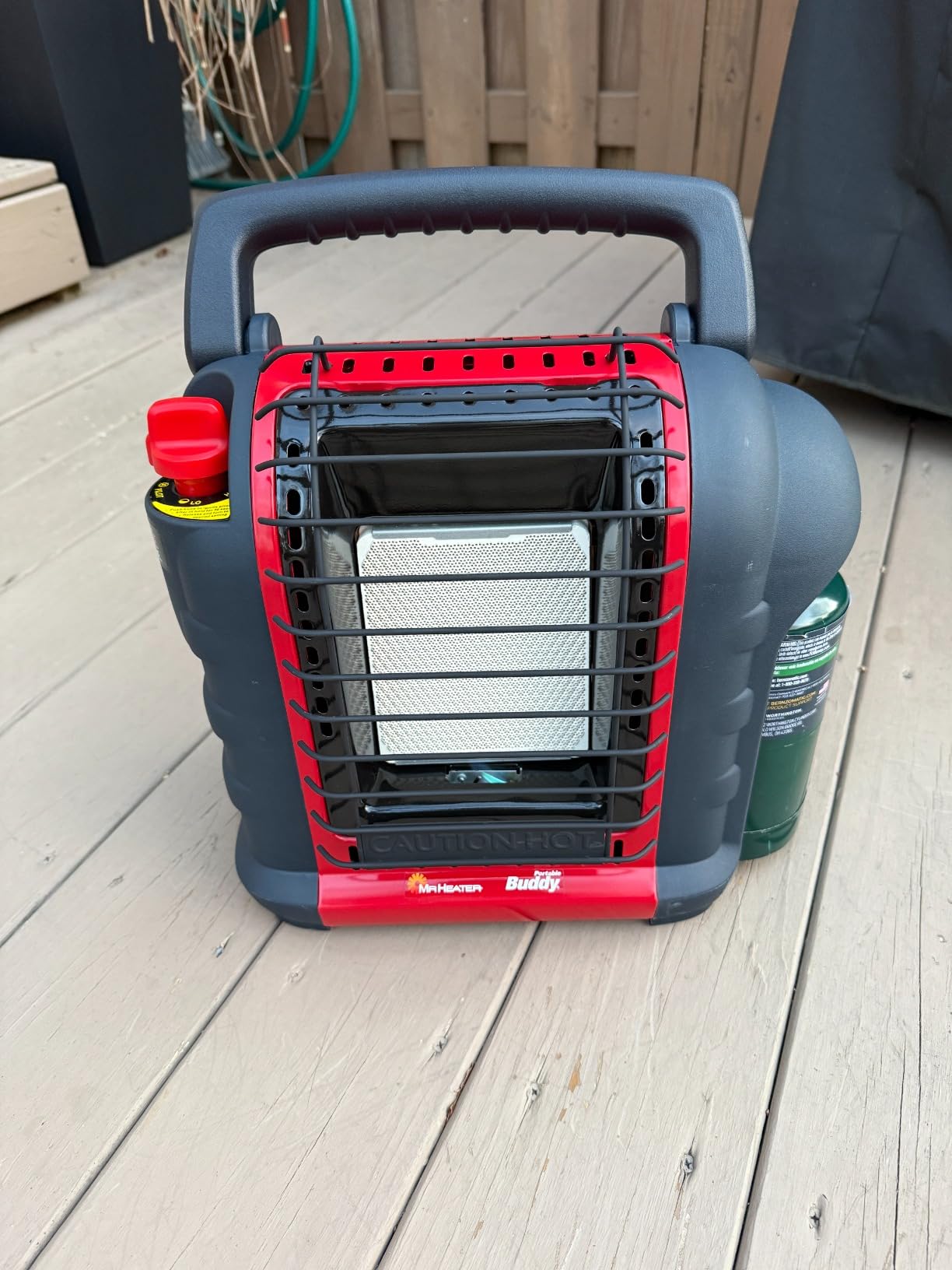
What makes it our top pick is consistency rather than raw capability. Across more than 29,000 reviews and a 4.7 average, with 84 percent of those reviews at five stars, the reported behavior barely changes from owner to owner. Setup takes minutes, the low and high settings both deliver what they claim, and the unit lights reliably. In a heating appliance, predictable is worth more than powerful.
The safety hardware is a real differentiator for indoor use. It carries a low-oxygen safety system, and it is approved for both indoor and outdoor placement, which is rarer than you would expect among small radiant heaters. Many competitors in this category are outdoor-rated only, so if your shop is enclosed through the winter, this is a heater you can legally and safely run there.
It also runs 5.4 hours on low and 2.4 hours on high from a single one-pound cylinder, which means you can carry the whole heat source in one hand. For a shop where you are constantly moving around, a vehicle, a rented bay, or a patio project, that portability is genuinely valuable. Pair it with a second cylinder and you have a full evening of low output without a refill.
What it is like to work next to it
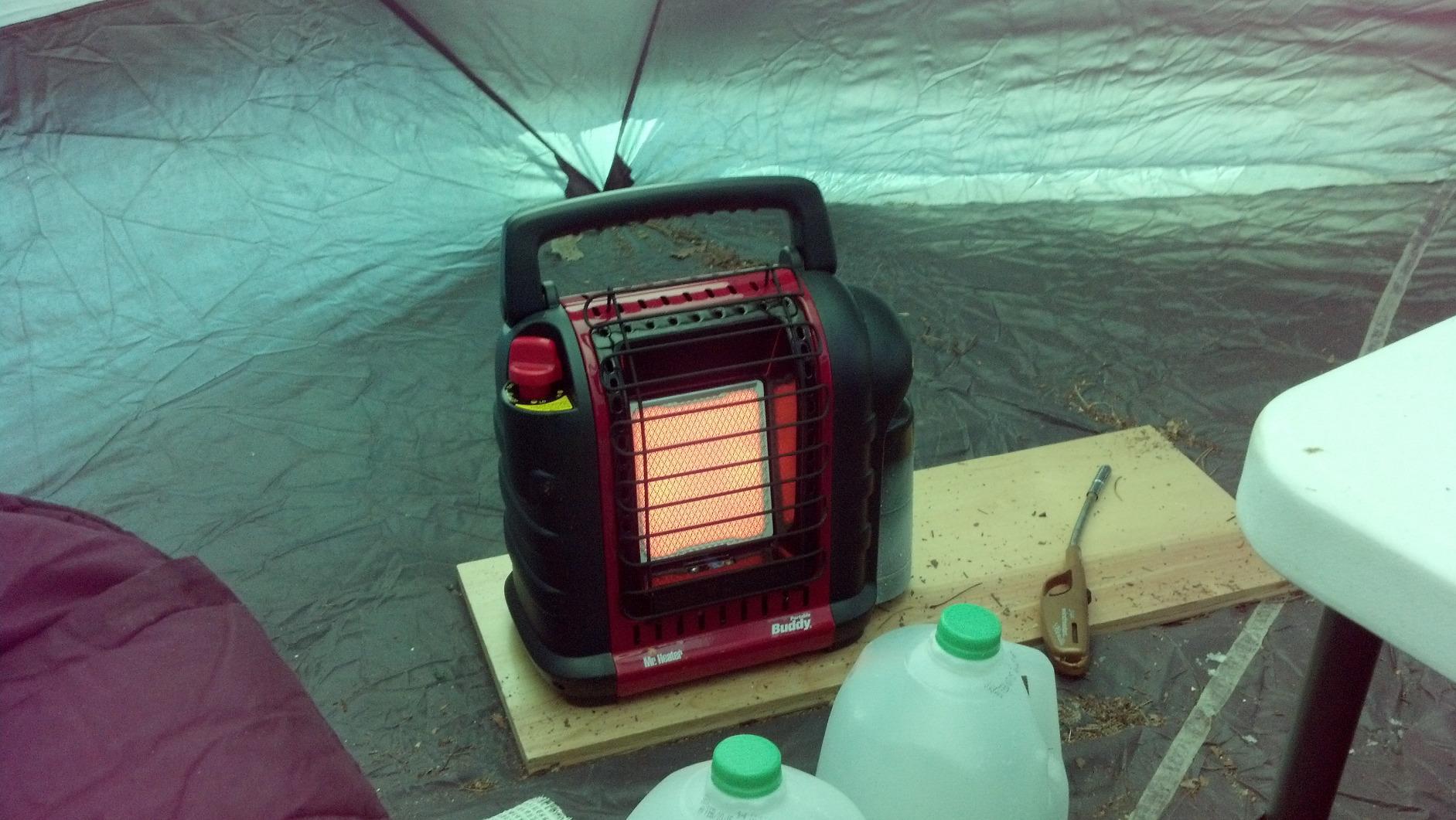
We set it up at bench height facing a work surface, which is how most owners use it. The radiant pattern is narrow, so positioning matters more than with a forced-air model. Angle it slightly down and you get a clean line of warmth across your hands and the work. Leave it flat and a good portion of the output travels up past your face, which is where the tank-top design complaints in reviews come from.
The two settings make it easy to run this as a background heater rather than an on-off event. Low output is genuinely useful for a shop that is already at working temperature and only needs topping up between tasks, because it stretches a cylinder far further. High is for the first twenty minutes after you walk in on a cold morning.
Who should look past it
Skip this heater if you need to raise the air temperature of an entire enclosed bay. There is no fan, no directional control, and a coverage figure that is honest about its limits. A single-car workshop that is open during the day, or a spot at the bench in a larger shop, is the right use. A closed three-car garage in a hard winter is not.
Also consider it carefully if you run solvent-heavy work nearby. Open-flame radiant heaters do not belong next to paint thinners, thinner-soaked rags, or a spray booth. Our shop vac guide for workshops covers dust and vapor handling for the rest of your setup, but the heater placement rule is simpler: nothing flammable within reach of the emitter.
2. Mr. Heater 45,000 BTU MH540T Tank Top – Top Rated for a 1,125 Sq Ft Bay
Mr. Heater Original 540-Degree 45,000 BTU Tank Top Radiant Propane Heater
Adjustable 30000 to 45000 BTU
Heats up to 1125 sq ft
Mounts to a 20 lb tank
5.6 pounds
Pros
- Heavy-duty construction with a stable footprint on the tank
- 540 degree adjustable radiant head spreads warmth in a wide circle
- Three heat levels for output control
- Mounts directly to a standard 20 lb cylinder with no assembly
Cons
- Outdoor-rated only so it should not run in a fully enclosed space
- Heat concentrates upward unless the head is tilted down
- Awkward to move because the tank moves with it
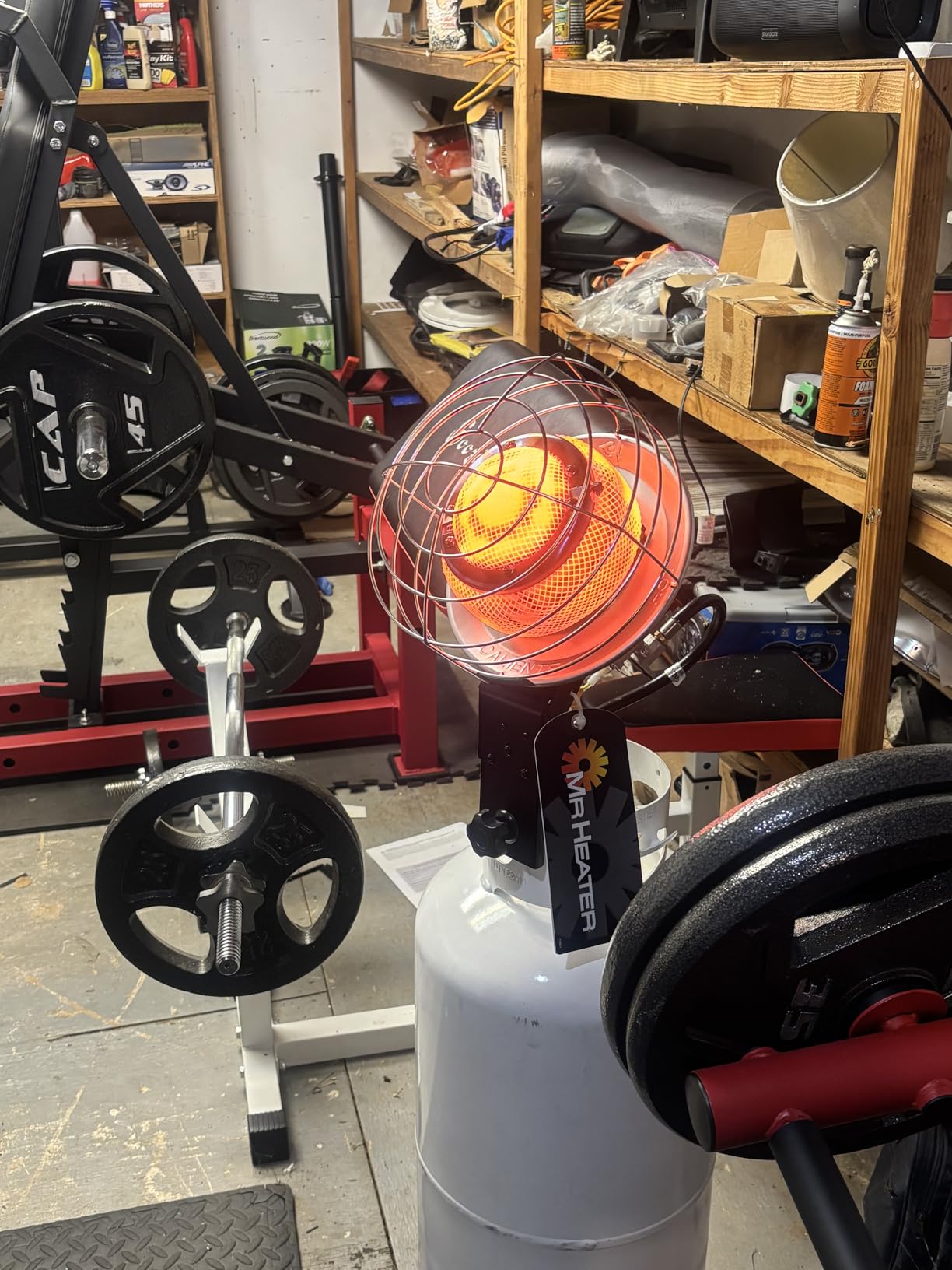
This is the unit that changes the shape of a mid-size shop, and at a 4.7 rating across more than 5,000 reviews it is the most proven large radiant heater in the group. The design is simple to the point of being obvious. The heater bolts to the collar of a 20 lb propane cylinder, the cylinder becomes the stand, and a 540-degree radiant head throws heat in a wide arc. There is no assembly beyond attaching the unit and choosing an output level.
The three output levels are the part that matters most in practice. It runs at 45,000, 36,000, or 30,000 BTU through the regulator knob, and that adjustment is what lets you match the heater to the bay instead of forcing the bay to match the heater. A 1,125 square foot coverage figure is generous for a portable radiant design, and it is the reason we rated this our value pick rather than treating it as a patio accessory.
Runtime is the other figure worth pausing on. Owners report roughly 9.5 hours of run time on high from a 20 lb cylinder, and several reviews mention getting through an entire evening of workshop work on one tank. That is a meaningful difference from a screw-in cylinder unit, and it is the difference between a heater you refill during the day and one you set up in the morning and leave.
Construction is heavier than it looks at 5.6 pounds, and owners consistently describe it as built for work rather than for a patio table. The cage is rigid, the footprint on the tank collar is stable, and the tip-over safety shutoff is standard. The mounting is the only fiddly part, with three screws and a hose orientation that some first-time owners describe as awkward.
How warm it actually gets a shop
The radiant head is genuinely wide, and that is what separates this from a smaller point-source heater. Position it in the middle of the bay and the throw covers a working area several feet across rather than a single seated position. The adjustment lets you swing the head around, which matters if your work alternates between a bench on one wall and a welder on the other.
One thing owners learn quickly is to tilt the head downward. A radiant heater mounted flat sends a meaningful share of its output upward past your face, and a shop that still feels cool while you feel warm is a common first impression. Angle it down at bench height and the same unit behaves very differently.
When it is the wrong heater
This model is rated for outdoor use only, and that is the deal breaker for a fully enclosed shop. Radiant combustion heaters in this class need the space to have air exchange, and the rating is the manufacturer’s statement of where that is appropriate. In an open bay, a carport, a canopy, or a shop you keep cracked and ventilated, it is an excellent choice. In a sealed shop with the door down all day, it is not.
The second limitation is portability. It is not a unit you pick up and carry to the next job, because the propane tank travels with it and a filled 20 lb cylinder is awkward. This is a heater for one place. If you need warmth in three different spots across a property, you want the screw-in cylinder models instead.
3. Mr. Heater 18,000 BTU Big Buddy – Best Dual-Mode Heat for a Small Shop
Mr. Heater 18,000 BTU Big Buddy PRO Series Heater
Radiant plus convection fan
Heats up to 450 sq ft
Three heat settings
14.1 pounds
Pros
- Dual heating system blends radiant comfort with a convection fan
- Heats roughly 450 sq ft which is more than double the entry models
- Three heat settings for real control over fuel burn
- Very long run time on low with two tanks
Cons
- Heaviest heater here at 14.1 pounds so it is a two-hand move
- Fan and burner noise is noticeable in a quiet workshop
- 18000 BTU can overheat a small enclosed space quickly
The Big Buddy solves a problem the smaller radiant heaters create. A point-source radiant heater warms you brilliantly while leaving the air in the room cold, which is fine for ten minutes and frustrating during a full afternoon of sanding or planing. This model adds a built-in high-output fan, so it heats the air volume as well as the surfaces in front of it, and that is why it earns the small shop slot.
It runs at three levels, 4,000, 9,000, or 18,000 BTU, across a 450 square foot coverage area. That is more than double the reach of an entry-level Buddy model, and the gap shows up in practice: the smaller unit makes one corner usable, this one makes the whole corner usable. At 4.6 stars with more than 3,600 reviews and 82 percent five-star ratings, the owner consensus on that point is strong.
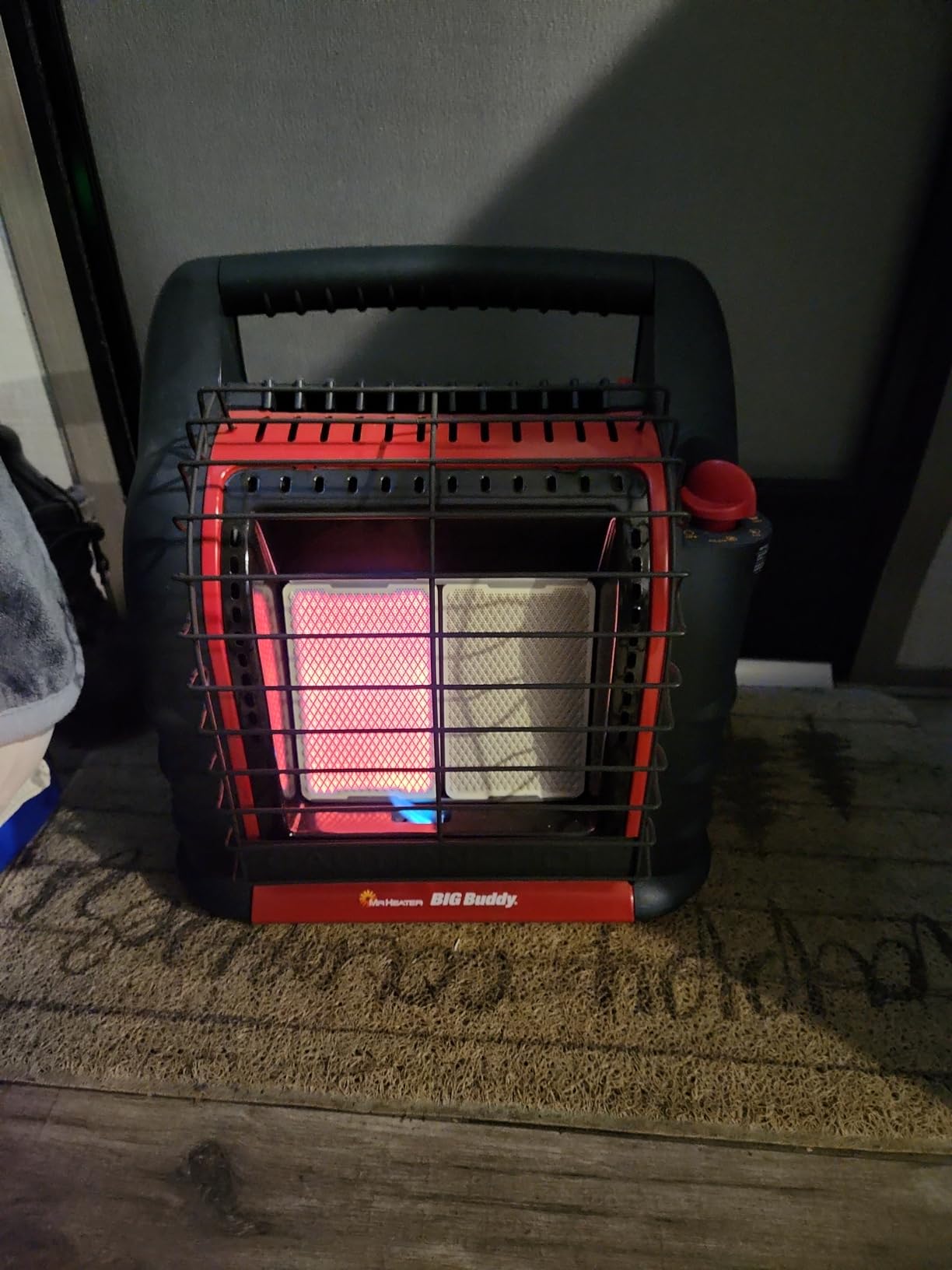
Runtime is the quiet headline here. Owners report up to 216 hours of heat on the low setting using two 20 lb propane tanks with an optional hose. That number is a little misleading on its own, since it assumes the low setting, but it is the reason this heater appears in shops where someone works all week without thinking about refills. Set on low for morning warm-up and high for active periods, the fuel use is manageable.
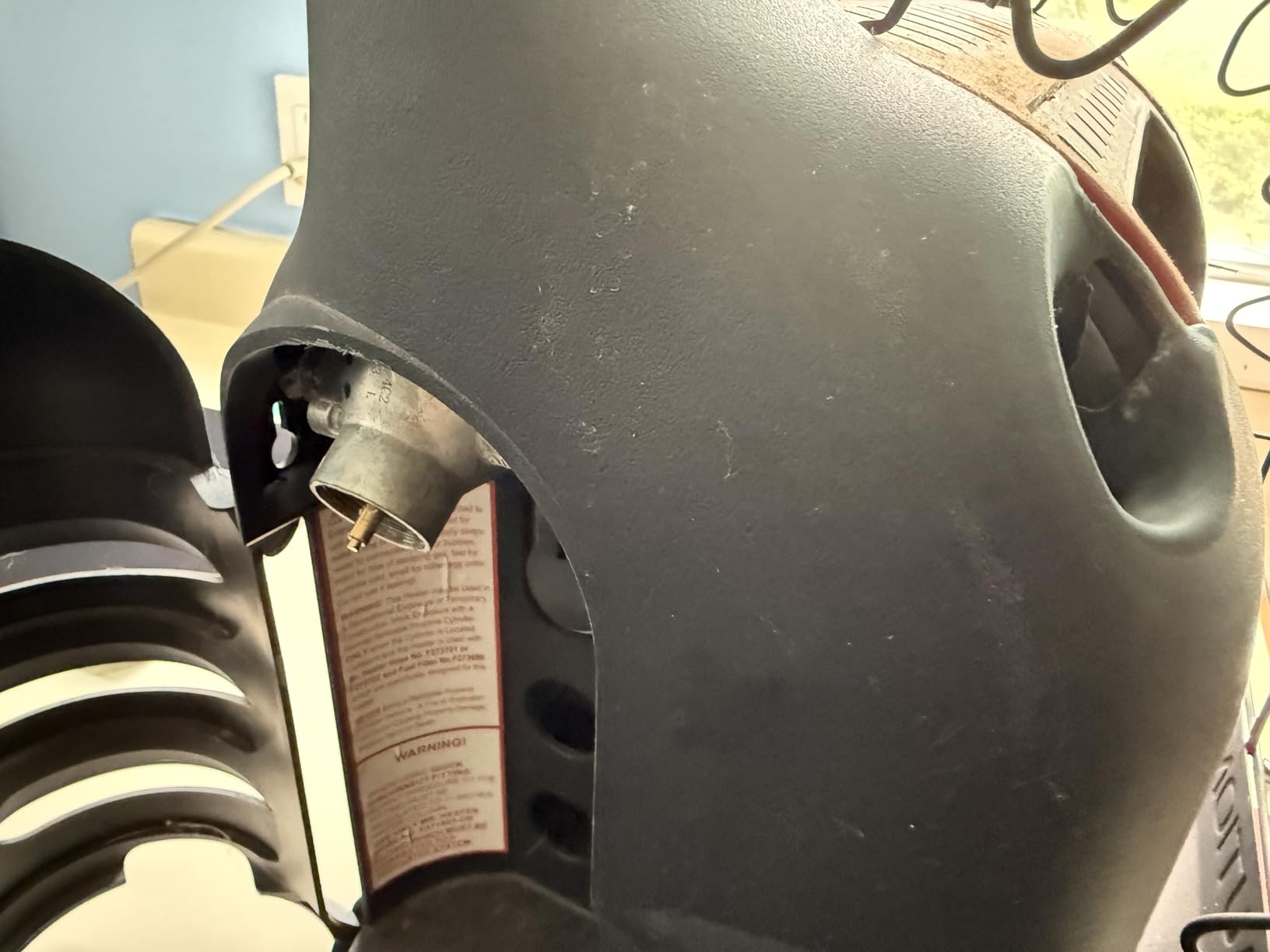
It carries both low-oxygen shutoff and tip-over protection, and it is approved for indoor and outdoor placement. That dual rating is what separates it from the tank-top models in this roundup, and for a shed that gets closed up through the winter, that spec alone can be the deciding factor.
Whether the fan noise matters to you
Noise is the real trade-off with this model, and it depends entirely on your shop. Owners note the fan and burner are noticeable in a quiet space, and if your work involves detailed hand tasks where you need to hear a chisel or a scratch file, that background is genuinely distracting. In a shop with a table saw, extractor, or radio running, it disappears entirely.
What the fan buys you is faster recovery. A shop that loses heat every time the door opens will not hold temperature with a point-source heater alone, because you are reheating your body and not the room. Adding air circulation means the warm air distributes to the far corner, and the shop reaches a workable temperature that the smaller radiant models never quite get to.
Where it falls short
The weight is 14.1 pounds, the heaviest heater in this group, and owners call it a two-hand move. That is not disqualifying, but it does mean you are choosing this model for a fixed position rather than a portable one. If you need to carry heat to different corners of the space as the job moves, that is friction you will feel every time.
There is also a genuine oversizing risk. At full 18,000 BTU, this heater can overheat a small enclosed space quickly, and ventilation in a tight shed is not optional. Our advice is to run the mid setting unless the shop is well ventilated or you are deliberately warming it up from cold.
4. GASLAND Flame Jet 125,000 BTU – Best for Large and Drafty Shops
GASLAND 125,000 BTU Propane Force Air Heater for Garage, Heat Up 3100 Sq.Ft
Variable 75000 to 125000 BTU
Heats up to 3100 sq ft
CSA certified
13 pounds
Pros
- Highest output in this roundup rated for spaces up to 3100 sq ft
- Variable 75000 to 125000 BTU with adjustable heat angle
- Forced air design warms the air volume not just objects in a line
- CSA certified with overheat detection and flame-failure valve
- Includes a 10 ft hose and regulator
Cons
- Requires well-ventilated spaces and is unsafe in a closed garage
- Loud burner roar that rules it out for quiet indoor work
- Largest fuel draw in the group so runtime per tank is short on high
When a shop is genuinely large, genuinely drafty, or genuinely cold, the useful question stops being how warm you want to be and becomes whether the heater can move enough air to matter. This one can. It outputs between 75,000 and 125,000 BTU through a forced-air design, and its coverage claim goes to 3,100 square feet, several times what the radiant units in this roundup can address.
The variable output is what makes it usable in more than one scenario. On the lower setting it behaves like a conventional high-output shop heater, and on the upper setting it is a machine for heating a large open building with a high ceiling and no insulation. Owners running workshops, barns, and warehouses describe the top setting as effective within minutes on spaces where smaller heaters never made a measurable difference.
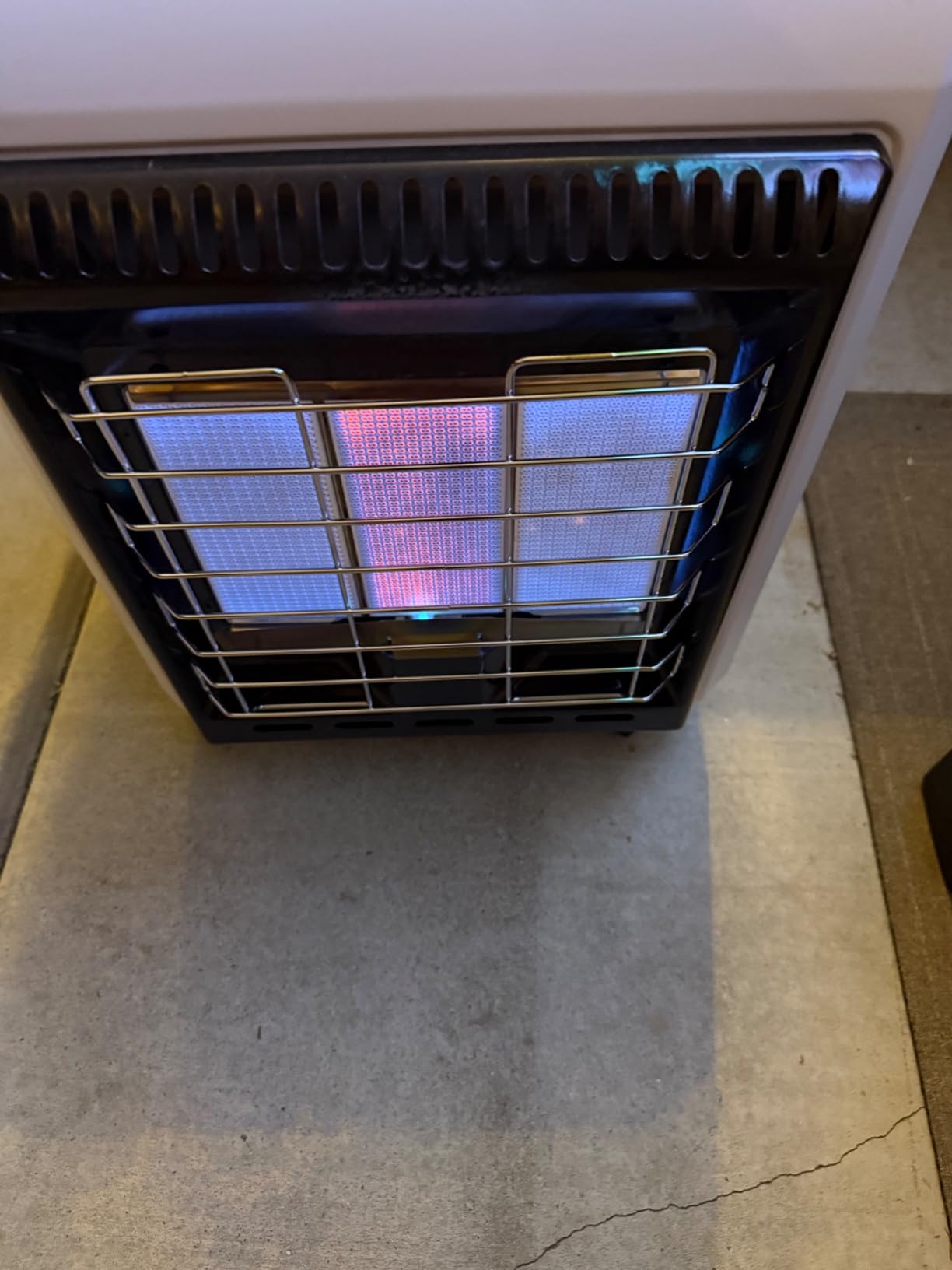
Safety hardware is where this model separates itself from the generic high-output category. It is CSA certified, with continuous electronic ignition, an overheat detection system, and a thermo-electric safety valve that shuts off gas flow if the flame goes out. That last feature is the one that matters most in a dusty shop, where airflow interruption is a real possibility rather than a theoretical concern.
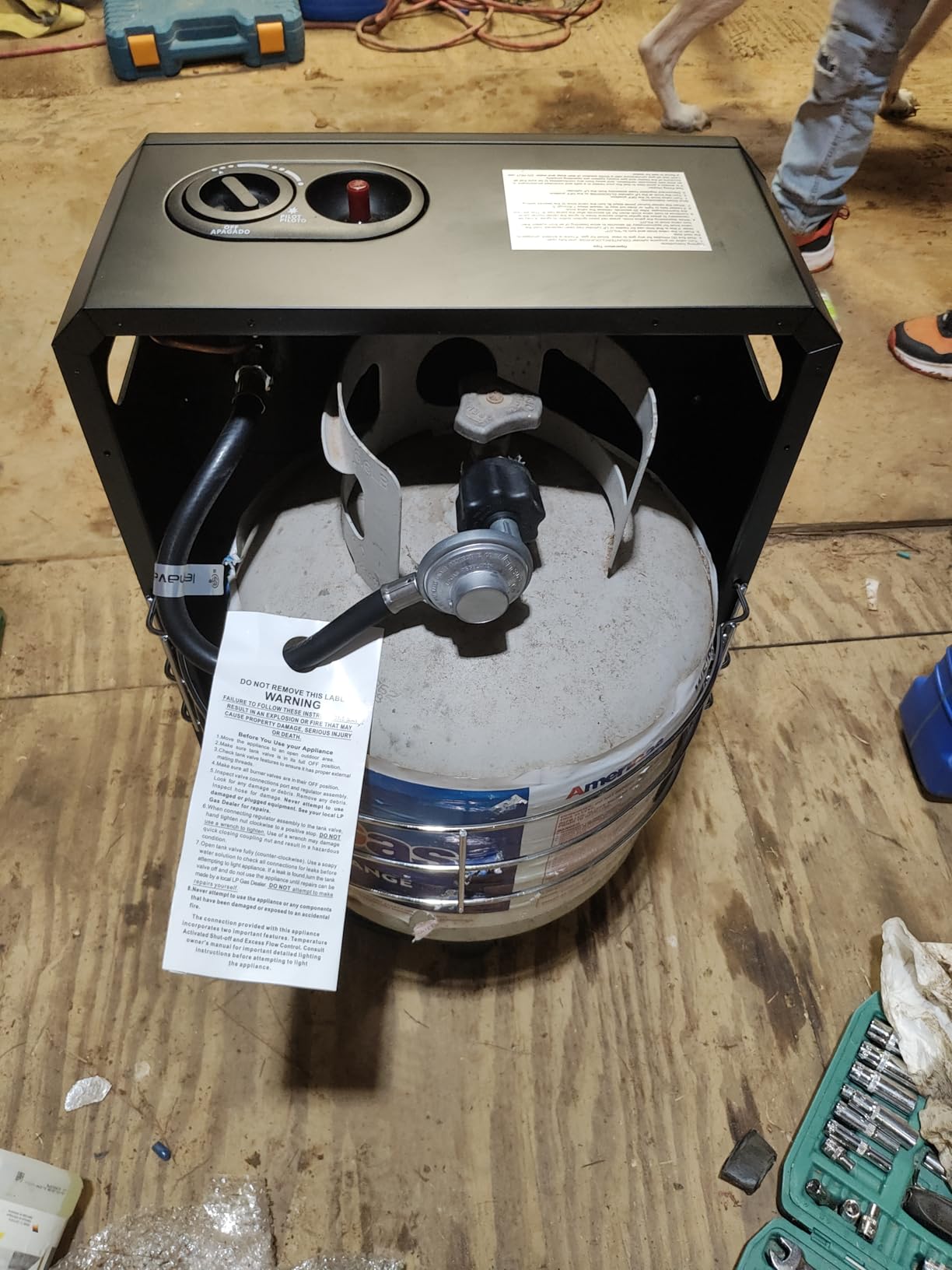
It ships with a 10 foot propane hose and regulator, so there is no separate purchase to get it running. The adjustable heat angle lets you aim the output where the work is, which in a wide-open shop matters more than in a small one because there is no single place where everyone stands.
Where this size of heat pays off
The case for a unit like this is a space that loses heat constantly. A workshop with block walls, a steel door, and a garage door that goes up several times a day will pull warm air out faster than a small heater can replace it. Owners of drafty spaces report the difference between their 125,000 BTU unit and a smaller portable as the difference between a shop you can work in and one you keep a coat on in.
You also want this output level if you are heating more than the workshop itself, a covered work area, an adjacent bay, or a shop with a high ceiling where warm air collects above head height. Forced air is the only delivery type in this roundup that moves heat into that volume rather than leaving it stratified near the floor.
Why most people should not buy this one
It is loud. Owners describe a burner roar that makes it unsuited to quiet indoor work, and in a shop where you are listening for a machine problem or concentrating on fine hand work, that is a real cost. Combined with the ventilation requirement, this is a working heater for a working space rather than a heater for a sitting room.
Fuel consumption is the other constraint. It is the largest draw in the group, and runtime per tank is correspondingly short on high. Owners report roughly 5 hours on low from a standard 20 lb tank, so on a full winter of high-output running you are managing refills or moving to a larger cylinder. Budget for that logistics before committing.
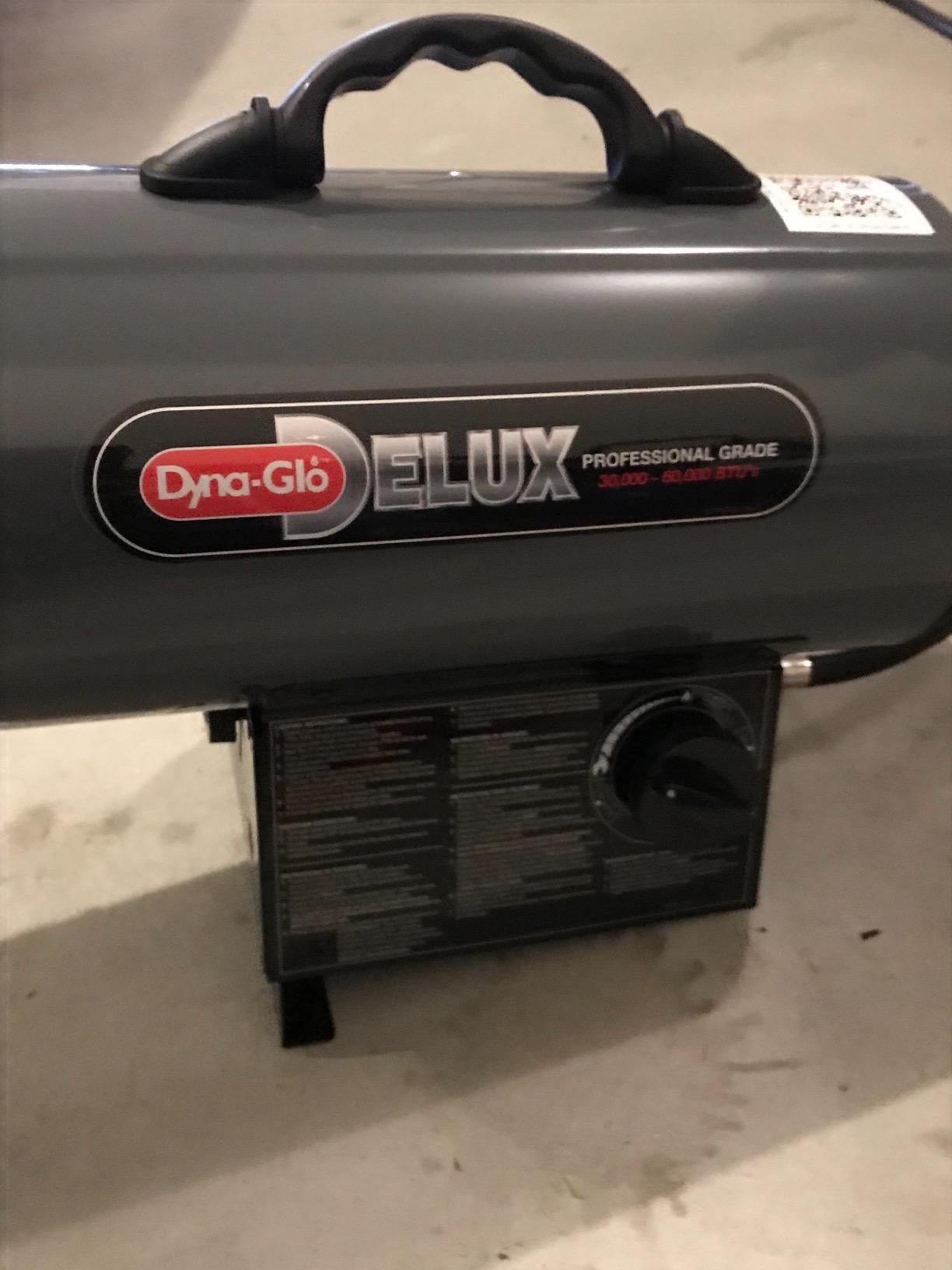
5. Dyna-Glo RMC-FA60DGD 60,000 BTU – Best for Fine Output Control
Dyna-Glo Delux RMC-FA60DGD 30,000 – 60,000 BTU LP Forced Air Heater
30000 to 60000 BTU continuous
Heats up to 1350 sq ft
Includes 10 ft hose
13.8 pounds
Pros
- Continuously variable 30000 to 60000 BTU lets you match heat to conditions
- Forced air raises air temperature fast and warms a detached garage in 10 to 15 minutes
- Adjustable heat angle directs output to where you work
- Continuous electronic ignition and overheat auto shutoff
Cons
- Thin sheet metal body flexes noticeably when carried by the handle
- Short power cord with no on off switch so an extension cord is effectively required
- No thermostat so it must be cycled manually
- Louder than a small electric heater
This is the heater for someone who thinks of heat as a dial rather than a switch. Instead of three fixed levels, the RMC-FA60DGD runs anywhere between 30,000 and 60,000 BTU, continuously. That sounds like a small detail until you are trying to hold a temperature in a bay whose heat loss changes with the weather and the door, because a continuous control is the difference between comfortable and constantly overshooting.
Forced air is the delivery method, and the reported behavior matches the type. Owners describe warming a detached garage or basement in roughly 10 to 15 minutes, which is fast enough to make the heater something you switch on while you are clearing the bench rather than something you plan around.

Two details make it easier to live with. The adjustable heat angle directs the output toward your working position, which in a long narrow shop is the difference between heating the space and heating yourself. And continuous electronic ignition is designed specifically to prevent a delayed ignition, which is a real ignition-source concern in a shop with dust and vapors in the air.
It also includes a 10 foot hose and regulator, and the fuel consumption gets good marks from owners, with several reporting still on the original tank fill after a season of use. The continuous range is why that holds up. You can hold a modest temperature without cycling between a setting that is too low and one that is too high.
Why continuous control beats three fixed settings
The main argument for this model is fuel and comfort together. A heater that jumps from 30,000 to 60,000 BTU will overshoot on the lower step in a well-insulated space and undershoot on the higher step in a drafty one. A continuous control lets you settle on the exact point where the shop holds temperature, which reduces the number of times you are reopening the door and re-warming.
For a workshop running a schedule, that is worth real money over a season. It is also the reason owners report fuel efficiency as a strength of this model specifically, since efficiency here comes from matching output to load rather than from any special burner design.
Where the build quality shows
The body is thin sheet metal, and owners specifically mention it flexing when lifted by the handle. It is a 13.8 pound unit, so it is not unmanageable, but it does not have the tank-top solidity of the heavier Mr. Heater units, and a workshop where heaters get moved around roughly will feel the difference.
There is also no thermostat and no on-off switch on the unit itself, so temperature control means turning it off and on at the regulator. Several reviewers call this the most frustrating omission. If you want set-and-forget control, budget for a timer or accept the manual cycling as part of the routine.
6. Remington 60,000 BTU Forced Air – Best for a Two-Car Bay
Remington LP Forced Air Heater, Portable 60,000 BTU Space Heater for up to 1500 Square Feet – Liquid Propane Gas Powered, Tank Not Included
60000 BTU forced air
Heats up to 1500 sq ft
11 pounds
120V powered
Pros
- Warms a two-car garage in roughly 10 minutes at 60000 BTU
- Lightest forced air heater in this roundup at 11 pounds
- Heavy-duty steel construction built for job sites
- Includes a 10 ft LP hose and regulator
- Multiple safety cutoffs including thermocouple and flame-out
Cons
- Very loud during operation so it suits work spaces not quiet rooms
- LP tank connection takes effort to thread into a grill type cylinder
- Power cord is extremely short so an extension cord is required
- Low settings still overshoot a small space
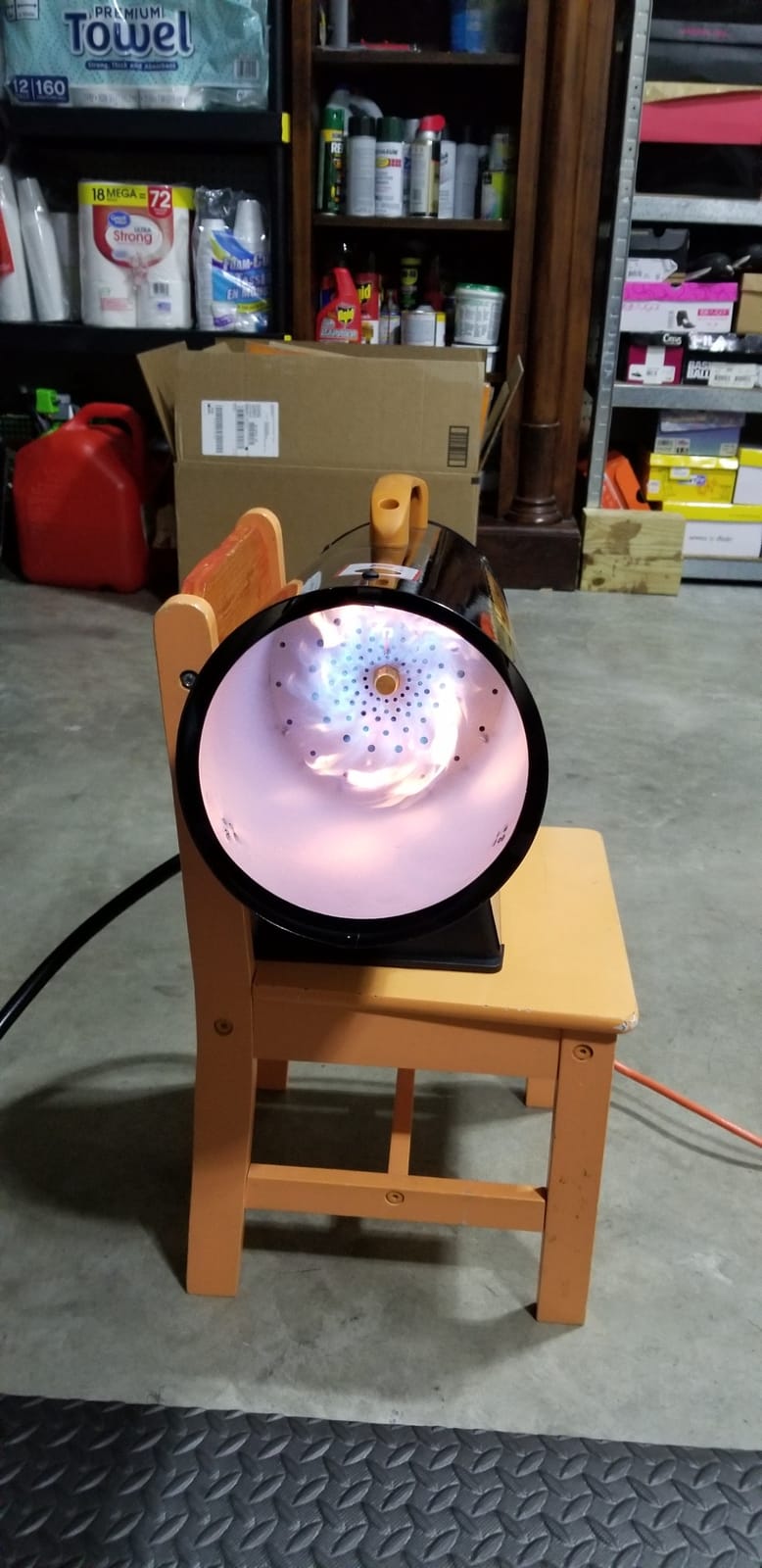
Sixty thousand BTU over a claimed 1,500 square feet is a well-matched pairing for a standard two-car bay, and that is exactly where this unit gets used. Owners repeatedly cite warming a two-car garage in around ten minutes, which is the fastest reported figure among the portable forced-air models in this roundup and the number that makes it a practical shop heater rather than a jobsite accessory.
It is also the lightest forced-air model here at 11 pounds, with heavy-duty steel construction, so moving it between a work area and a vehicle bay is a one-hand job. That portability matters in shops where the car occupies half the floor and the heater has to move out of the way whenever the hood goes up.
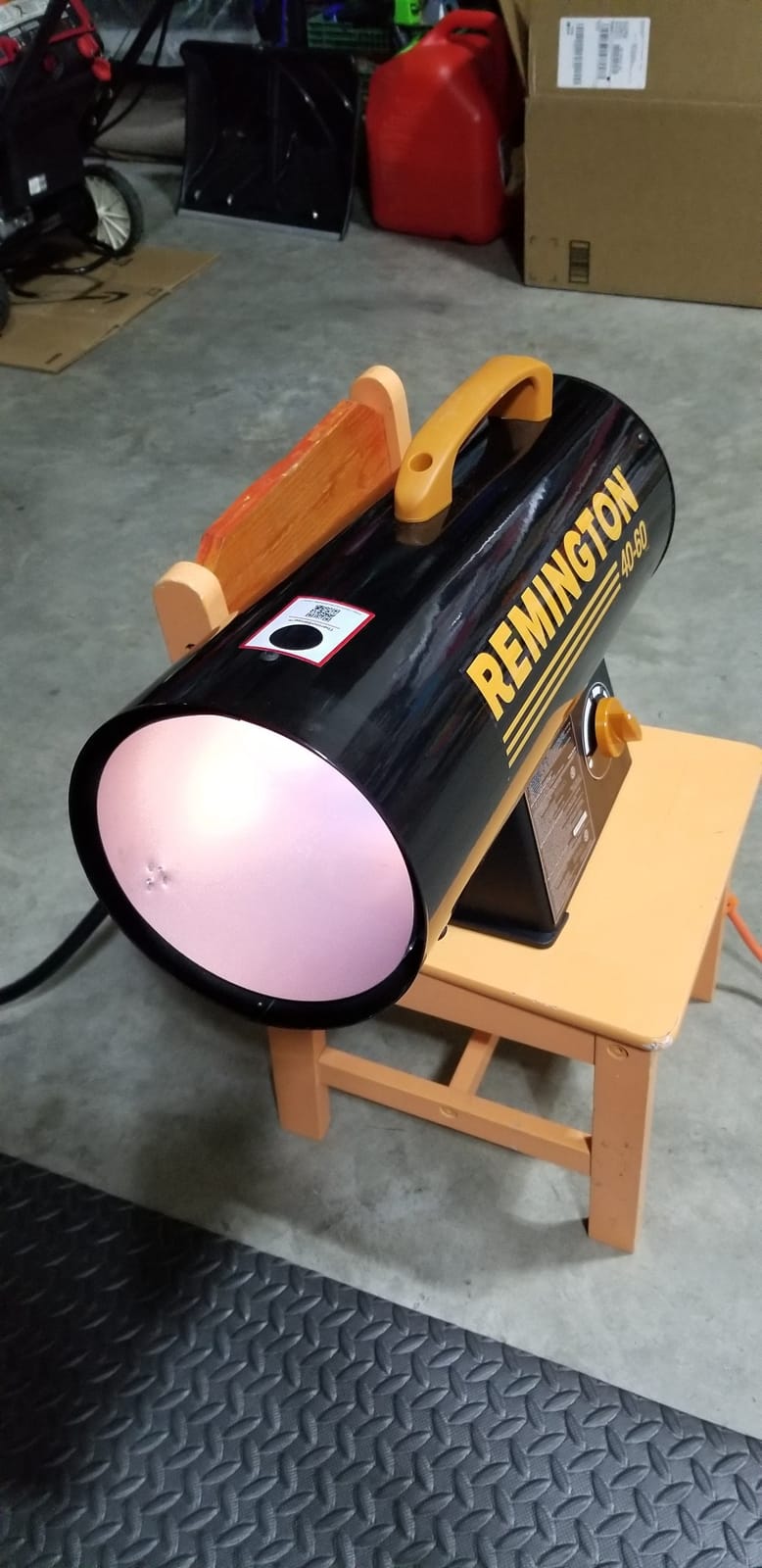
The safety package is thorough for a portable unit. A thermocouple safety system, a high-temperature limit shutoff, and a flame-out fuel cut-off work together, and continuous electronic ignition handles the startup. A 10 foot LP hose and regulator are included, so the only thing you need to supply is a 20 lb cylinder.
At 4.5 stars across 736 reviews, with 74 percent five-star ratings, the owner feedback is consistent. The praise is nearly always the same, impressive heat from a small and light package with fast warm-up. The complaints are nearly always the same too, which is a good sign for a product with a predictable set of trade-offs.
Why ten minutes matters more than the BTU number
Warm-up speed changes how a heater gets used. A unit that takes a full working hour to make a space usable gets switched off whenever you step out, and every restart throws away the heat you had built. A unit that makes the bay comfortable while you are still clearing the bench stays running, and that is the difference between a heater that is part of the shop and one that never quite gets used.
This is also why forced air is the right delivery type for a bay this size. Radiant units warm the person standing in front of them, which is comfortable and leaves the rest of the space cold. Forced air distributes, so the whole bay reaches a workable temperature at the same time.
The two things that annoy owners most
Noise is first. This is a loud burner and fan, and owners describe it as unsuitable for quiet or conversation-friendly spaces. In a two-car bay with a vehicle, a radio, and some power tools, it is entirely manageable, but it is not a heater for a small office or a sitting area attached to the shop.
The second is the power cord. It is extremely short, under a foot according to multiple reviews, which means an extension cord is effectively required. That is fine in a shop with a nearby outlet, but it is a hard limit in a bay with no power at all, and it is a trip hazard if you route it across a work area. The connection to a standard grill-type cylinder also takes more effort than it should.
7. DEWALT 68,000 BTU Hybrid Forced Air – Best Cordless Heat for Shops with No Outlet
DEWALT 68,000 BTU Cordless Portable Forced Air Propane Heater
68000 BTU forced air
Heats up to 1700 sq ft
20V battery or 120V AC
13.2 pounds
Pros
- Cordless operation on DEWALT 20V batteries removes the need for an outlet
- Runs on batteries or line voltage depending on the job
- 68000 BTU warms a 450 sq ft insulated shop or a 2.5 car garage quickly
- Clean burn with little odor and no diesel fumes
- Quiet enough on low for barn use
Cons
- No built-in thermostat so it must be cycled manually
- Startup can be difficult in extreme cold without a preheat cycle
- Loud on high in occupied indoor spaces
- Modest output compared with high BTU shop heaters
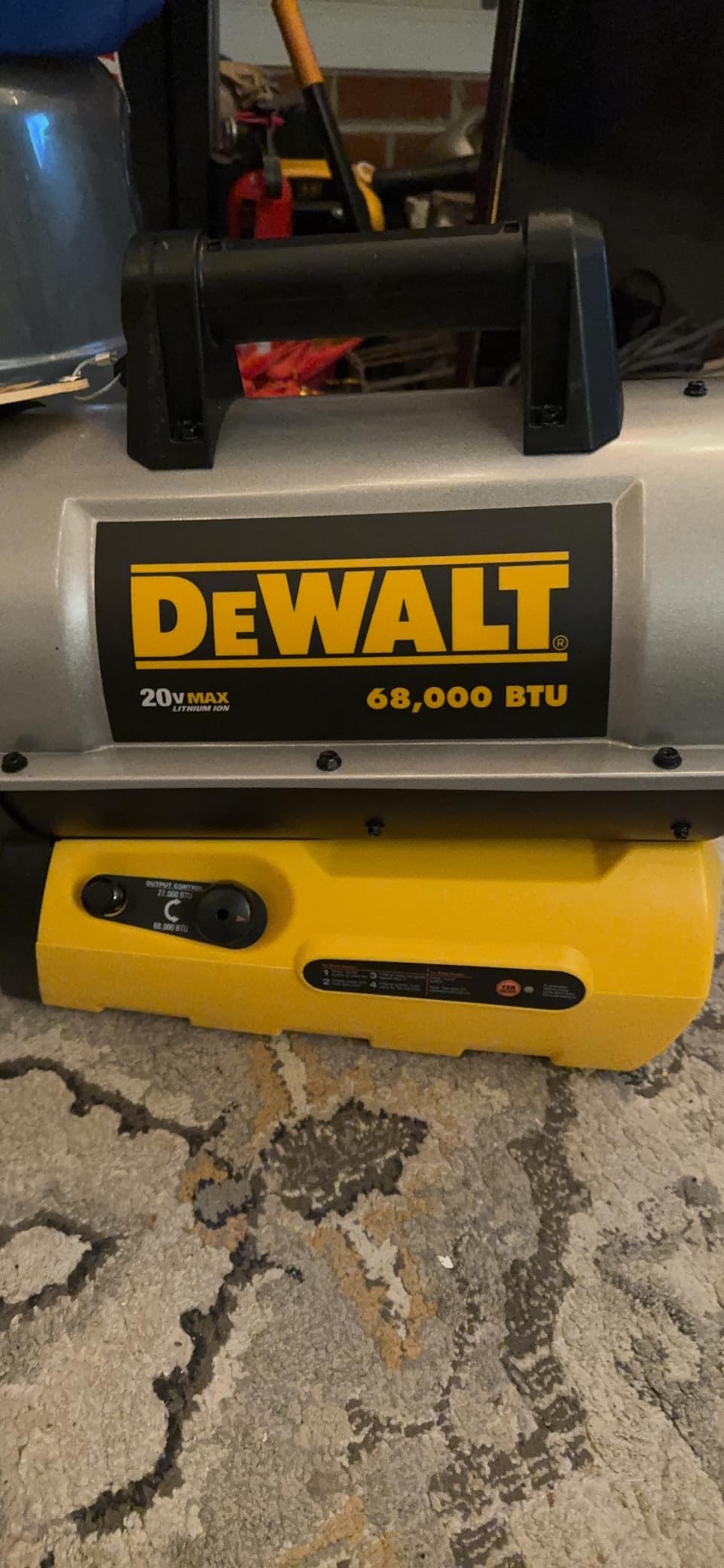
Everything else in this roundup needs a power cord, and several include a cord so short that owners routinely add an extension. This one runs on a DEWALT 20V battery pack or on 120V AC, which removes the electrical constraint entirely. If you already own the batteries, this is the only heater here you can carry into a tool trailer, a rented bay, or a detached building with no power and use immediately.
Output is 68,000 BTU of forced air with coverage to 1,700 square feet, the highest coverage figure of any unit in this roundup. Owners report it warming a 450 square foot insulated shop or a 2.5-car garage quickly, and at 4.6 stars with 84 percent five-star ratings, the sentiment around warm-up speed is consistently positive.
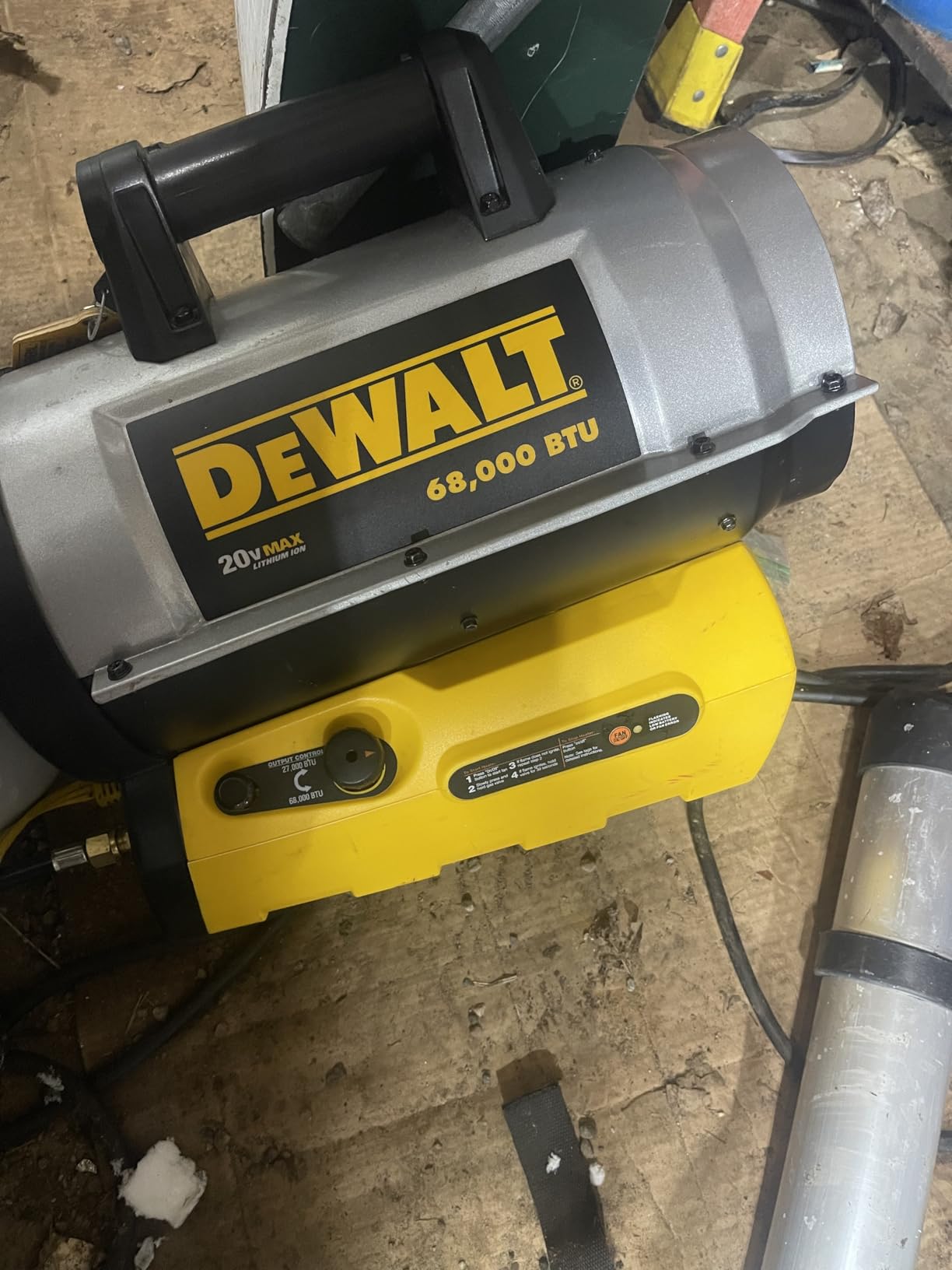
The burn quality gets mentioned often and it is worth repeating. Owners describe a clean burn with little odor and no diesel fumes, which matters more in an enclosed shop than the general enthusiasm for gas heat usually suggests. When you are working with finishes, adhesives, or insulation, an appliance that does not add odor to the air is a genuine advantage over an open-flame radiant unit.
At the low setting owners describe it as quiet enough for barn use, and they report it starting reliably. That start reliability is the practical benefit of the hybrid design, since a battery-powered ignition does not depend on mains supply conditions in a cold, damp building.
Who the battery actually changes things for
The cordless path matters in three specific situations. A rented shop where you cannot run new electrical circuits. A tool trailer or vehicle-mounted work setup. And a detached building with power, but not where you need it, since a heater you can carry means you can place it where the work is rather than where the outlet is.
If none of those describe your situation, the hybrid capability is a nice feature rather than a deciding one, and you should weigh the missing thermostat more heavily. Owners who already have the batteries tend to rate it very highly. Owners evaluating it cold rate the cord as just another portable heater, because the plug is right there.
The limits worth knowing before you buy
There is no built-in thermostat. You hold temperature by cycling the unit yourself, which several owners flag as the most common complaint. In a shop where you step out frequently, that is an ongoing small annoyance rather than a deal breaker, but it is the feature most likely to frustrate you in February.
Startup in extreme cold can be difficult, with owners describing a low-heat preheat and ignition cycle being needed when the unit has been sitting in an unheated space. And on the high setting the burner and fan are loud, so the quiet-low-loud-high pattern is real rather than a spec sheet artifact. It also comes with a 2 year limited parts warranty, which is longer than most in this group.
8. XtremepowerUS 30,000 BTU Dual Burner – Best Directional Heat for a Work Area
XtremepowerUS 30,000 BTU Propane Tanktop Heater Infrared Dual Burner Safety Shut-Off Valve, Tip-Over Switch for Garage, Camping, Hunting Double Burner
15000 or 30000 BTU dual burner
Heats up to 750 sq ft
Mounts to a 20 lb cylinder
Tip-over switch
Pros
- Simple hookup to a standard 20 lb propane tank with no assembly
- Dual burner design concentrates heat on one side so it can be aimed at a work area
- Three heat settings at 15000 and 30000 BTU
- Rust-proof steel frame that resists deformation
- Emitter guard and tip-over shutoff add safety around an open flame
Cons
- Rated for outdoor and airy areas only and not for a fully enclosed garage
- Coverage is modest at about 750 sq ft
- Directional output is felt strongly on one side and not the other
The distinguishing feature here is the dual burner, and it changes how you aim the heater. Instead of a single head radiating in a circle, the two burners sit side by side and the metal dish focuses the output, so you can aim a concentrated band of heat at a specific work area. In a shop where you want warmth on a bench and not everywhere else, that is a genuine design advantage rather than a cosmetic one.
Output is 15,000 or 30,000 BTU across three settings, with coverage to roughly 750 square feet. Hookup requires no assembly, since it mounts directly to a 20 lb LP cylinder, and a side ignition hole lets you light it with a match or lighter, which is the standard for this class of tank-top unit.
At 4.6 stars across 397 reviews with 80 percent five-star ratings, owners describe it as easy to hook up and more capable than expected for its price. It is used across garages, patios, camping, and hunting setups, and the complaints that exist are narrow, which is usually a good sign.
When a focused heat pattern is the right call
Directional heat suits a shop where the work is concentrated. A bench against one wall, a welding table, a spot where you stand while a finish cures, all of these are cases where throwing heat evenly across 750 square feet wastes most of what the heater produces. Aim this unit at the work and the same propane budget goes further.
The dual burner is also useful for shifting between two positions without repositioning the whole unit, since you can use one burner for a low background warmth and both for a concentrated burst. For a shop where the work alternates between two areas, that flexibility is worth considering.
Why this one is not a shop-wide solution
It is outdoor-rated only, and that is the same hard constraint as the MH540T. It belongs in an open bay, a canopy, or a space with plenty of air exchange, not in a sealed garage with the door down. Both of the outdoor-rated models in this roundup are good heaters, and both are illegal in the wrong room, so check the rating before you plan the placement.
Coverage is also modest at roughly 750 square feet, and the directional output means one side of the room gets substantially more than the other. Owners who expected even whole-room heat report the imbalance as a limitation. If you want a two-car bay warm throughout, a forced-air model is a better structure, and you can read about those in the two reviews above.
How Many BTUs Does Your Workshop Need?
A 24×24 single-car garage is 576 square feet, and a well-insulated one typically needs somewhere between 30,000 and 40,000 BTU per hour. An uninsulated 24×24 garage in a hard winter wants closer to 60,000, and if the garage door goes up several times a day, size up again from there.
The general rule of thumb most sizing charts use runs from 35 to 50 BTU per square foot, but the honest answer is that the range matters more than the number. The same bay in Zone 4 and Zone 8 does not have the same heat loss, and an as-built garage with thin steel door panels, a bare concrete floor, and gaps around the header will lose heat far faster than a finished one.
Here is how we would bracket it. A 500 square foot workshop with insulated walls, a sealed door, and some floor insulation can be handled comfortably by a 30,000 to 45,000 BTU portable, which is exactly the range the smaller radiant units in this roundup cover. A 700 to 1,100 square foot two or three-car bay, insulated, typically lands in the 45,000 to 75,000 BTU band, which is where the forced-air models sit. A 1,100 to 1,500 square foot space with a high ceiling or drafty construction is the 75,000 to 125,000 BTU territory, and beyond that you are into permanently installed equipment rather than a portable.
Three variables will move you off the chart, and every one of them shows up repeatedly in owner discussions. The first is garage door usage, which owners in one sizing thread treated as the single biggest factor, recommending an increase when the door is opened frequently. The second is insulation on the door itself, where one owner with a well-insulated 16-foot door landed on a 65,000 BTU unit for the same bay that another owner sized at 125,000 without one. The third is how cold the shop actually gets, and the people who work in their shop answer that question better than any calculator.
If your shop is marginal between two sizes, size down and use the output control to manage it. Every heater in this roundup except one has at least two output levels, and the continuous-range models let you fine-tune. A slightly undersized heater you can dial down is less of a problem than an oversized one cycling constantly, which is the subject of the next section.
Radiant vs Forced Air vs Infrared: Which Suits Your Shop
Radiant heaters send heat in a straight line at whatever is in front of them, which warms you and your work surface fast and leaves the air behind you cold. Forced-air heaters use a fan to move heated air through the space, which is slower to warm you personally but much better at raising the temperature of the whole room. Infrared tube heaters are a form of radiant that heats an element until it glows, offering a more even spread than a point-source radiant unit.
The practical rule is short. If you are stationary and cold, radiant wins. If you need the room itself at working temperature, forced air wins. If you are heating a large open area with a high ceiling, forced air wins again because radiant heat will not move the warm air off the floor.
Where the debate gets interesting is oversizing. A common owner pattern in workshop threads is buying a larger unit than strictly needed and then throttling it back to about half output once the shop is warm. That works better than most manufacturers suggest, and it is the reason the 45,000 BTU tank top with three levels and the 30,000 to 60,000 continuously variable unit are both sensible buys for the same bay.
The one thing radiant heat does better than everything else is speed of personal comfort. In our testing the point-source units made a bench usable almost immediately, while the forced-air models took ten to fifteen minutes to make the same bench usable. If your session is 90 minutes at the bench, radiant is the more efficient choice. If it is a full day of movement, forced air is.
Vented vs Vent-Free: Carbon Monoxide and Clearance Rules
Yes, a propane heater is fine in a garage, with one condition: the unit has to be rated for the space you are running it in. Propane combustion produces carbon monoxide and other byproducts, and how those leave the room is what separates a safe installation from an unsafe one.
A vented unit exhausts combustion gases outdoors through a flue. A vent-free unit relies on the room’s own ventilation to dilute the byproducts, and that is only acceptable in a space with adequate air exchange. The rating on the box or the manual tells you which category a unit falls into, and it is not a detail to skip. Every heater in this roundup carries a low-oxygen or flame-failure shutoff of some kind, which stops fuel flow if the flame goes out or oxygen drops, but a safety sensor is a backup, not a substitute for correct ventilation.
The clearest example in this roundup is the two outdoor-rated tank-top models. The Mr. Heater MH540T and the XtremepowerUS dual burner are both outdoor-rated only, and both are good heaters. Neither should be run in a fully enclosed garage with the door down, regardless of how well-ventilated the room feels when you first light it. The four models rated for indoor and outdoor placement, including the Portable Buddy and the Big Buddy, are the ones for an enclosed shop.
On placement, follow the manufacturer’s clearance requirements exactly rather than approximating them. In a shop, the most common violations are mounting a radiant unit too low near a workbench, placing a heater where a vehicle can back into it, and positioning it near cardboard, sawdust accumulation, solvent containers, or rags. Owners in workshop forums treat clearance as a deal breaker and they are right to, because a forced-air heater pointed at a pile of offcuts is a fire waiting for a bad afternoon.
For your own safety, run a working carbon monoxide detector in the shop regardless of which unit you choose, and keep the garage door cracked or open whenever a combustion heater is operating in an enclosed space. If you notice a persistent odor of propane, do not troubleshoot it by lighting a match. Shut the unit down, close the cylinder valve, ventilate, and find the leak. The odorant is added to propane for exactly this reason.
Propane Tank Runtime and What It Costs to Run
Fuel use is the number that decides whether a propane shop is pleasant or annoying, and the reported runtimes in this roundup make the math straightforward. The Mr. Heater MH540T runs approximately 9.5 hours on high from a 20 lb cylinder, the GASLAND 125,000 BTU unit runs approximately 5 hours on low from a standard 20 lb tank, and the Portable Buddy runs 5.4 hours on low or 2.4 hours on high from a one-pound cylinder.
Worked from the MH540T figure, a 20 lb cylinder gives roughly 9.5 hours at its 45,000 BTU top setting, and less than that if you hold it on high for a full working day. A 100 lb cylinder holds roughly five times as much propane as a 20 lb, so at the same setting you are looking at something in the region of 45 to 48 hours before a refill. In a shop running five days a week for a full season, that is the difference between ordering propane a few times and ordering it constantly.
The point people get wrong is assuming a small shop needs a small tank. A 20 lb cylinder is portable and easy to swap, but if your heater burns through one in a morning you are standing outside in the cold at midday waiting for a refill. Owners in the forums consistently recommend larger cylinders, 40 lb and up, specifically so the heater is not constantly being refilled, and that is the single most practical piece of fuel logistics advice in this whole roundup.
Runtime also interacts with BTU in a way that surprises people. A heater at 30,000 BTU running constantly will outlast one at 60,000 BTU on the same cylinder, but it may not hold the shop at temperature. The efficiency gain from a lower output only counts if the lower output is enough, which is why sizing correctly and then modulating beats oversizing and throttling.
On the alternative, the most common counter-argument in workshop discussions is a mini-split. One owner ran an 18,000 BTU mini-split in a 400 square foot garage, and the argument in its favor is straightforward: it moves air rather than making it, so there is no combustion, no carbon monoxide, no propane logistics, and no vented flue to install. The case against it is equally straightforward, since it needs electrical capacity a detached shop may not have, it does not provide the directional radiant warmth at a bench that many woodworkers prefer, and its cost advantage depends heavily on local propane and electricity rates.
Portable vs Stationary: Mounting, Cords, and Rented Shops
Every heater in this roundup is portable, and that is a deliberate choice for the workshops most people actually run. Permanently mounted propane units need a gas line, a permitted installation, and often a professional, and if you are renting, none of that is available to you. A portable unit that runs off a cylinder needs a floor position and a clear path, and nothing else.
There are two hardware details that matter more than they look. The first is the propane connection: units running off a 20 lb cylinder can often be moved to a larger cylinder with the right connector, which is how most owners scale up to 40 lb or 100 lb cylinders without buying a new heater. The second is the power cord, and this is where portable heaters disappoint most often. The Dyna-Glo and the Remington both include a cord short enough that an extension cord is effectively required, and the GASLAND includes a 10 foot cord.
If you are working without an outlet, the DEWALT is the only unit in this group that solves the problem outright, since it runs on a battery pack. For everyone else, a properly rated outdoor-rated extension cord, routed so it never crosses a work area or sits where a vehicle can roll over it, is a normal part of the setup.
For rented spaces and temporary shops, the pathway is clear. Choose a unit rated for indoor use, run it off a cylinder, keep a carbon monoxide detector in the space, and do not modify anything permanently. The follow-up benefit of a portable heater is that when the lease ends, the whole setup packs into a corner. Owners who rent repeatedly say that freedom is worth more to them than any efficiency difference between models.
Insulation First, Oversizing Second
Before buying a larger heater, spend a weekend on the building. Weather-stripping the garage door, insulating the door panels, sealing gaps around the header and jambs, and putting a vapor barrier under the slab are the cheapest heat you will ever buy, and in an as-built garage they frequently halve the BTU number you need. The 65,000 BTU unit one owner chose with an insulated door versus the 125,000 BTU recommendation for a similar space without one is the whole argument in a single comparison.
Oversizing has a cost that most sizing charts do not mention. A heater that is too large for the space reaches temperature, overshoots, shuts down, and cools, then starts again, and that cycling wastes fuel and shortens burner life. It is also why the advice to buy the biggest unit you can afford is wrong, despite being common. Buy the output your bay needs and use the modulation to manage the rest.
The exception is a space you heat intermittently. If your shop is closed for two days and you want it usable within twenty minutes on the third morning, slight oversizing is worth the fuel cost, because a bigger burner recovers the space faster and you will not run it long enough for short cycling to become the dominant cost.
Noise deserves a mention before you finalize, because it is a real variable in a working shop and none of the roundups we studied address it. The forced-air units are inherently loud, and owners accept that without complaint in a space with saws and grinders running. In a shop where you do fine hand work, listen to one running at full output before you buy. It is the one specification you cannot evaluate from a listing page.
While you are setting up the space, it is worth getting the rest of the workshop right too. Our guide to pegboard organizers for garage walls and our picks for the best garage storage systems both help you keep the walls clear, which matters more than it sounds when you need clearances around a heater.
Frequently Asked Questions
How many BTUs do I need to heat a 24×24 garage?
A 24×24 garage is 576 square feet. A well-insulated one typically needs 30,000 to 40,000 BTU per hour, while an uninsulated space in a hard climate wants closer to 60,000. Add more if the garage door goes up several times a day, since that is often the biggest source of heat loss.
Is it okay to have a propane heater in an enclosed garage?
Yes, provided the unit is rated for indoor use and the space has adequate ventilation. Outdoor-rated-only models such as the Mr. Heater MH540T tank top and the XtremepowerUS dual burner should not be run in a fully enclosed garage. Keep the door cracked or open while a combustion heater operates, and follow the manufacturer clearance requirements exactly.
Do you have to worry about carbon monoxide with a propane heater?
Yes, and that is why venting and detector placement matter. Propane combustion produces carbon monoxide, and a vented unit exhausts it outdoors while a vent-free unit relies on room ventilation. Run a working carbon monoxide detector in the shop, keep the garage door cracked while a heater is running, and never troubleshoot a propane odor with a flame.
How long will a 100 lb propane tank run a 30000 BTU heater?
A 100 lb cylinder holds roughly five times the propane of a 20 lb cylinder, so you get about five times the run time. A 20 lb cylinder runs approximately 9.5 hours on high for the Mr. Heater MH540T at 45,000 BTU, which puts a 100 lb tank in the region of 45 to 48 hours at that setting. At 30,000 BTU running continuously, expect considerably longer.
Is it better to oversize a garage heater?
Usually not. A heater that is too large for the space reaches temperature, overshoots, shuts down, cools, and starts again, and that cycling wastes fuel and shortens burner life. Buy the output your bay needs and modulate it. Slight oversizing is worth it only if your shop is heated intermittently and you want a fast warm-up.
What are the best ventless gas heaters for a garage?
The indoor-rated radiant models in this roundup are the practical choices for an enclosed shop, including the Mr. Heater Portable Buddy and the Mr. Heater Big Buddy, which carry low-oxygen shutoff and are approved for indoor placement. The outdoor-rated tank-top models are the better heaters but belong in open or well-ventilated bays. Whichever you choose, a carbon monoxide detector and a cracked garage door are the baseline.
Which Propane Garage Heater Fits Your Workshop
For a bench in a small or half-enclosed shop, the Mr. Heater Portable Buddy is our pick. It has the most owner history in this roundup by a wide margin, it is approved for indoor placement, and its 4,000 and 9,000 BTU settings let you use it as background heat rather than an on-off event.
For a full bay up to about 1,125 square feet that is open or well ventilated, the MH540T tank top heater covers more ground than anything else portable in this group, with three output levels and roughly 9.5 hours on a 20 lb cylinder. For an enclosed shed where the air itself needs warming rather than just you, the Big Buddy’s built-in fan is what makes the difference.
For a two-car bay, the Remington or the Dyna-Glo 60,000 BTU models are the practical pair, and the Dyna-Glo wins if you want continuous output control. For a large or drafty building, the GASLAND 125,000 BTU unit is the only one here sized for the job. For a shop with no outlet, the DEWALT hybrid is the answer. For directional heat aimed at one work area, the XtremepowerUS dual burner does the job at a fraction of the output.
Whatever you choose, check the indoor or outdoor rating against your space before anything else, and pair it with a carbon monoxide detector. This roundup is refreshed for October 2026; if you are still deciding between sizes, the BTU section above is where we would start.