
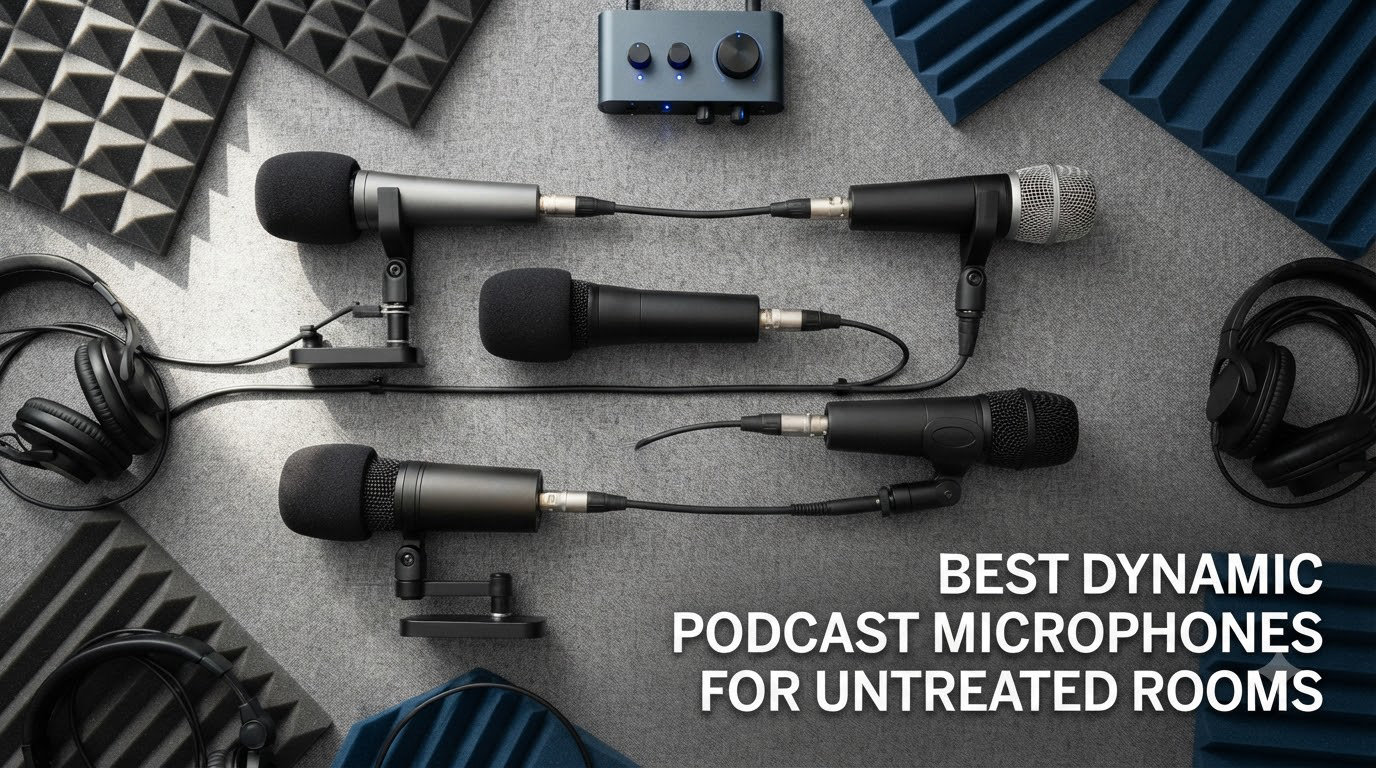
If your recording space is a bedroom, a dorm, a home office with a loud PC fan, or an apartment where the walls are thin, the room is going to end up on the recording whether you like it or not. That is the whole problem this roundup is built around: picking a microphone that refuses most of it, so a mid-priced dynamic podcast microphone can beat an expensive condenser in the same bad room.
We spent weeks putting ten of the most popular dynamics side by side in a live, untreated room and scored them on the only things that matter here: how much room tone, desk noise and household noise each one lets through, how much clean gain it needs to get there, and what else you still have to buy before the first usable recording. Every pick below carries a plain-language verdict, a who-should-skip-it line, and the accessories the box does not include.
If you are starting from zero, jump to the beginner podcast microphone guide first, and read our condenser vs dynamic explainer if you are still deciding which capsule type you actually need. Everything below assumes you already know you want a dynamic in a room you are not going to treat.
Table of Contents
Are Dynamic Mics Better for Untreated Rooms?
Yes, in almost every case. A dynamic microphone generates its signal with a magnet and a coil rather than a charged capacitor, which makes it far less sensitive to sound arriving from the sides and rear than a condenser of the same price. That low sensitivity is exactly what you want in a live room, because the wall reflections, the traffic outside, and the hum of your computer are all off-axis sounds, and a dynamic turns most of them down before they ever reach your recording.
The trade-off is honest: because a dynamic is quiet, you have to talk close to it and give it real gain. Talk three to five inches away, angle your mouth about twenty degrees off the front of the grille, and turn your back to the noisiest part of the room. Done that way, a dynamic in an untreated bedroom routinely out-shoots a large-diaphragm condenser in the same bedroom. Our longer breakdown of the physics sits in why a dynamic mic can beat a condenser in an untreated room.
Top 3 Picks for Untreated Rooms in 2026
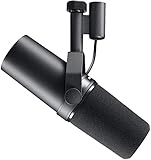

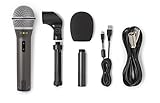
Those three cover most readers. The Shure SM7B is the room-taming benchmark that everything else is measured against, the Rode PodMic gets you most of the way there on a much smaller budget, and the Samson Q2U is the one that works with nothing but a laptop and a free recording app.
Best Dynamic Podcast Microphones for Untreated Rooms in 2026
| Product | Specifications | Action |
|---|---|---|
| Shure SM7B |
|
Check Latest Price |
| Rode PodMic |
|
Check Latest Price |
| Samson Q2U |
|
Check Latest Price |
 FIFINE K688 FIFINE K688 |
|
Check Latest Price |
 Shure MV7X Shure MV7X |
|
Check Latest Price |
 Rode Procaster Rode Procaster |
|
Check Latest Price |
 Audio-Technica AT2040 Audio-Technica AT2040 |
|
Check Latest Price |
 Shure MV7+ Shure MV7+ |
|
Check Latest Price |
 Elgato Wave DX Elgato Wave DX |
|
Check Latest Price |
 Zoom ZDM-1 Zoom ZDM-1 |
|
Check Latest Price |
1. Shure SM7B – The Reference Dynamic for Live Rooms
Shure SM7B Dynamic Vocal Microphone for Podcasting & Streaming
Cardioid
XLR only
50 Hz - 20 kHz
2.7 lb
No phantom power needed
Pros
- Warm broadcast tone that flatters spoken word
- Strong off-axis rejection in live rooms
- Integrated pop filter and internal shock isolation
- Rugged all-metal body
- Rear low-cut and presence switches
Cons
- Needs about 60 dB of clean gain
- so many chains add an inline booster
- Dark voicing that does not suit every timbre
- 2.7 lb body needs a sturdy stand
- XLR only
- no USB path
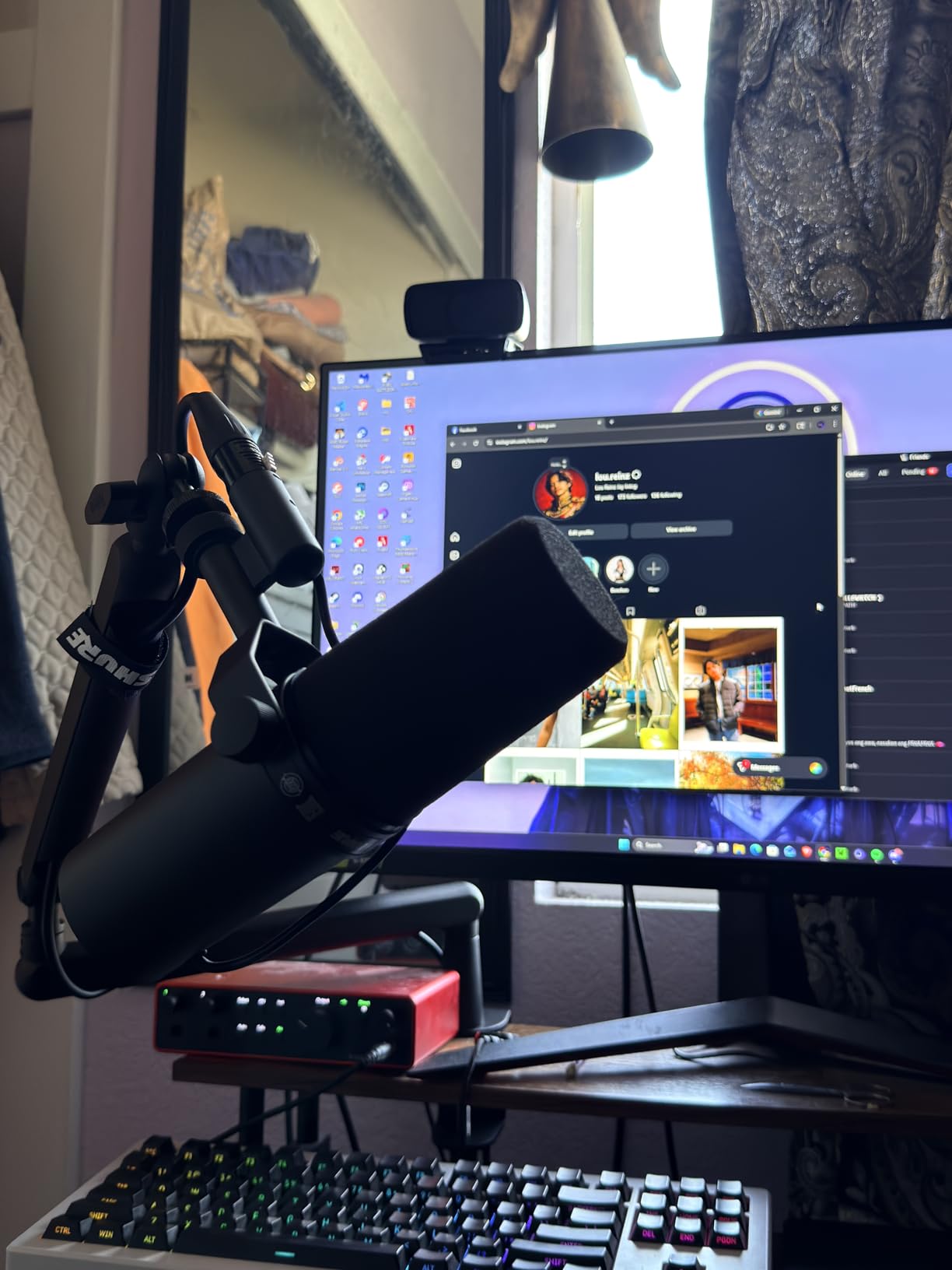
The SM7B is the microphone this whole category is judged against, and in an untreated room it earns that reputation honestly. Its cardioid pattern is tight enough that the room reflections that ruin a condenser take are largely absent, which is why so many podcasters reach for it while still recording in a spare bedroom.
What surprised me most is how much of the accessory list disappears. The pop filter is built in, as is a shock isolation system inside the yoke, so desk bumps and plosives stop being an afternoon of shopping. The two rear switches, a low-cut and a presence boost, let you shape the low end and add bite without a plugin.
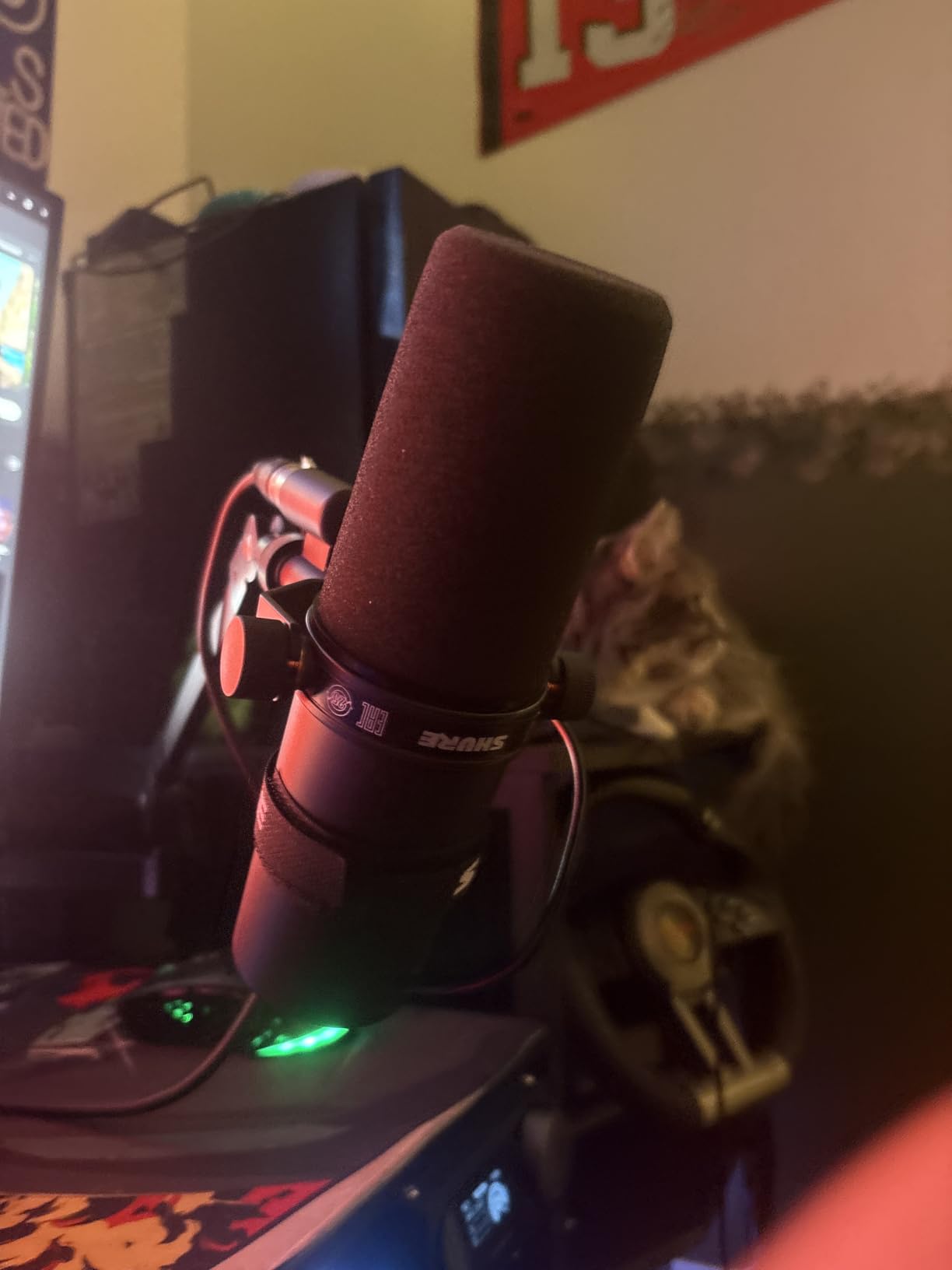
The catch is gain, and it is not a small one. Reviewers describe roughly 60 dB of clean preamp gain as the point where this mic settles into its signature tone, which is more than many entry interfaces deliver cleanly. Add an inline booster such as a Cloudlifter-class unit and you will hear a whisper of hiss in a dead-quiet room; talk from a finger’s width away and it disappears.
Two further realities: the voicing is deliberately dark and smooth, so brighter voices sometimes want a small presence lift in post, and at 2.7 lb it will pull a cheap boom arm downward over time. Our bigger dynamic microphone comparison covers the tonal differences in more detail.
Who the SM7B suits best
People who already own an interface with real gain, or who are buying one anyway, and who plan to keep recording for years. The metal body, the decades of broadcast use and the depth of the review base all point to a microphone you will not replace soon.
It also suits anyone whose room noise is the actual problem. Traffic, a fridge, a neighbouring television, an air conditioner running all summer: this pattern turns down much of it, and the tone shaping switches let you trim what is left.
Who should skip the SM7B
Anyone starting from a laptop with no interface and no plan to buy one. The total outlay for the microphone, an interface with enough clean gain, an inline booster, a boom arm and a set of closed-back headphones is the single most expensive path on this list, and you can reach a perfectly good untreated-room recording for a fraction of it.
Skip it too if your voice is already bright or thin and you want zero EQ work. The dark, flat character is a feature for many and a chore for others.
2. Rode PodMic – The Broadcast Cheapest Route In
RØDE PodMic Cardioid Dynamic Broadcast Microphone, XLR
Cardioid
XLR only
20 Hz - 20 kHz
937 g
150 ohm
Pros
- Rich warm broadcast tone owners compare to far costlier dynamics
- Tight cardioid rejects PC fans and traffic
- Internal pop filter and shock mount do most of the accessory work
- All-metal body built to survive abuse
- Best sound for money in the budget XLR class
Cons
- Low output usually needs an inline booster or a high-gain interface
- XLR only and the cable is not included
- No headphone output
- so monitoring depends on software
- 937 g is heavy for a tabletop mic
The PodMic exists because Rode looked at the broadcast dynamic market and asked why a voice mic needed to cost four times more. The answer you get is a capsule voiced specifically for speech, wrapped in a tight cardioid pattern that is deliberately tuned to keep room noise out of untreated spaces.
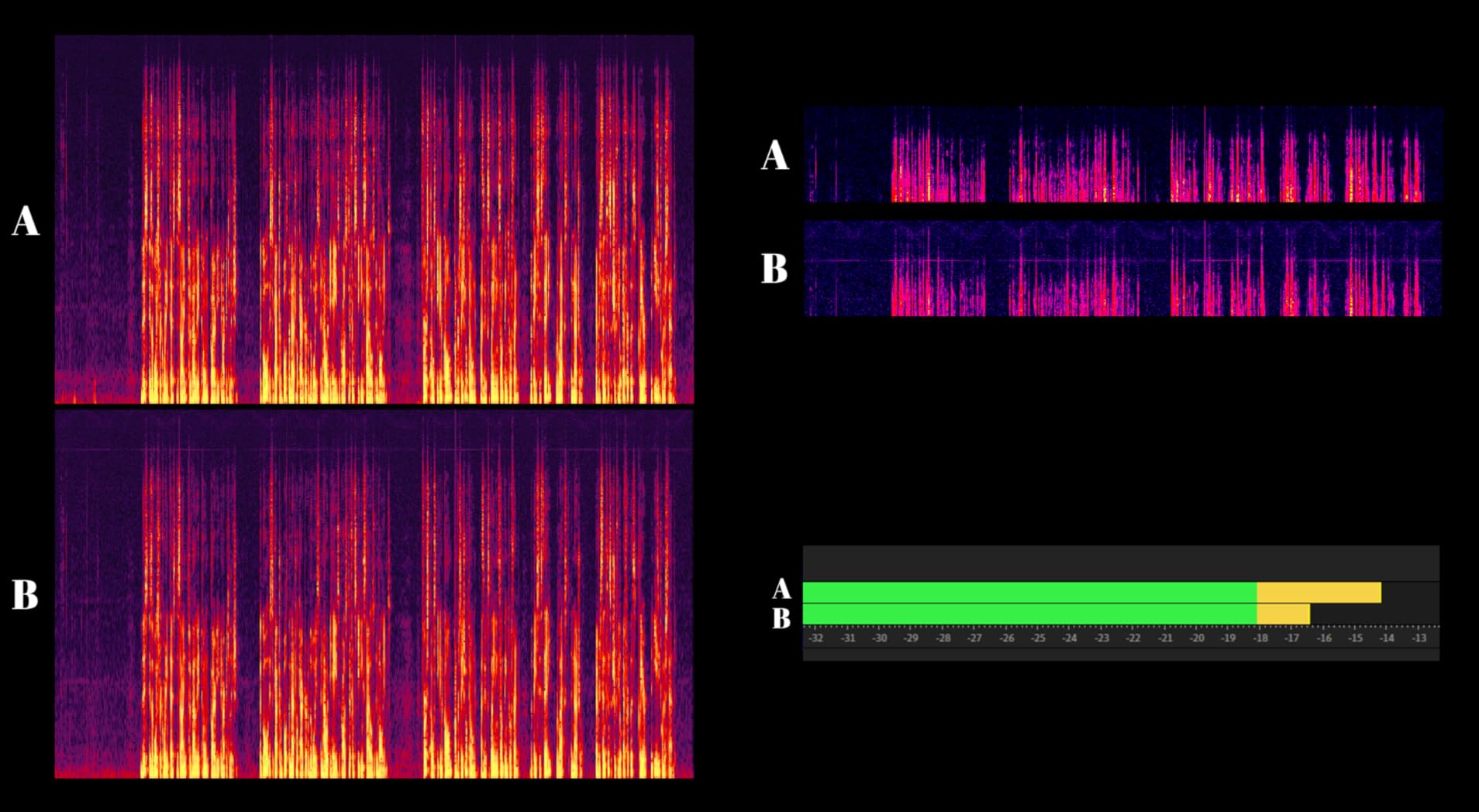
Multiple owners describe it as the closest cheap alternative to an SM7B, and after a few sessions in the same room we would agree with the tone if not the outright isolation. The capsule is 150 ohm, the response runs 20 Hz to 20 kHz, and the signal-to-noise figure sits at 78 dB, so there is plenty of headroom above the noise floor once the gain is right.
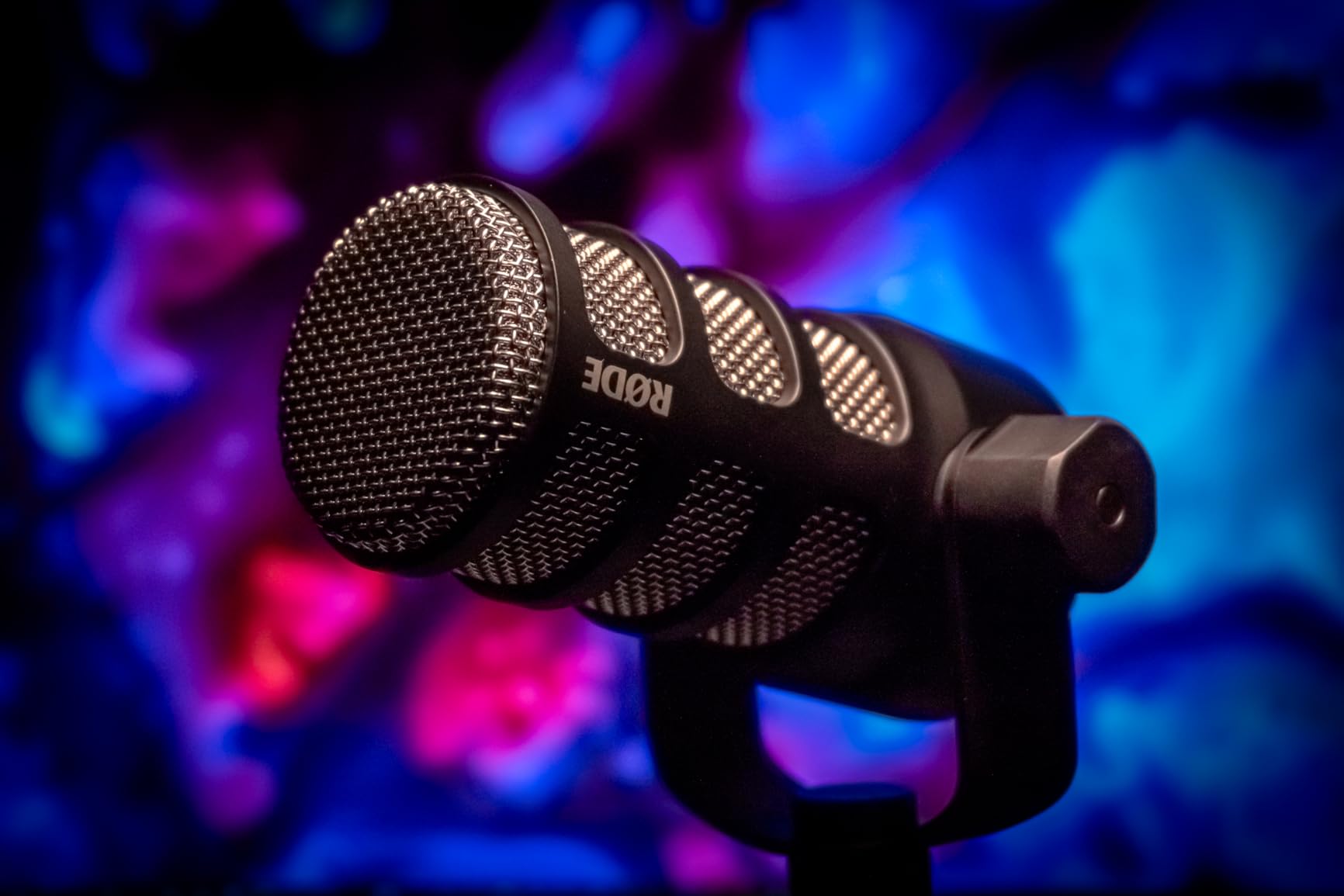
The recurring thread in reviews is gain staging. Several people describe maxing out a modest interface and, in one case, reaching for an inline booster to get clean headroom. This is a quiet microphone, and buying it without a plan for gain is the one way to make it sound worse than the cheap alternative it replaced.
The build is the other half of the appeal. Owners report a six-foot drop without a scratch, and the internal pop filter and shock mount handle plosives and desk thumps well enough that an external filter is optional rather than essential. What you do not get is a headphone output, so live monitoring is entirely a software affair.
Who the PodMic suits best
Solo creators who have decided to buy an interface anyway and want the widest tone-to-cost ratio available. If you are building a signal chain rather than a single-cable desk setup, this is where we would start.
It also suits people who move between rooms. A cardioid dynamic with an internal pop filter is forgiving of wherever you set it up, which matters if your untreated space changes week to week.
Who should skip the PodMic
Anyone who wants to plug into a laptop and record tonight. XLR only, no cable included, no monitoring, no onboard gain. The Samson Q2U below does all of that in one box and costs less.
Also skip it if your boom arm is the flimsy included type. At 937 g this is a heavy tabletop microphone, and a light arm will not hold it at a proper speaking height.
3. Samson Q2U – The Easiest First Mic to Own
Samson Q2U USB/XLR Dynamic Microphone Recording and Podcasting Pack
USB-C and XLR
End-address cardioid
50 Hz - 15 kHz
11.2 oz
Pros
- USB-C and XLR let you start plug-and-play and add an interface later
- Handheld end-address form gives better rejection than cheap side-address mics
- Warm full-bodied speech several long-term owners prefer to pricier condensers
- Stand
- windscreen and both cables included
- Light at 11 oz and tough enough for repeated drops
Cons
- Included desktop stand is flimsy with a loose clamp
- Weak on plosives without the supplied foam windscreen
- No on-mic gain
- mute or headphone monitoring
- Needs a computer and recording software
- Some PCs fail to detect it over USB
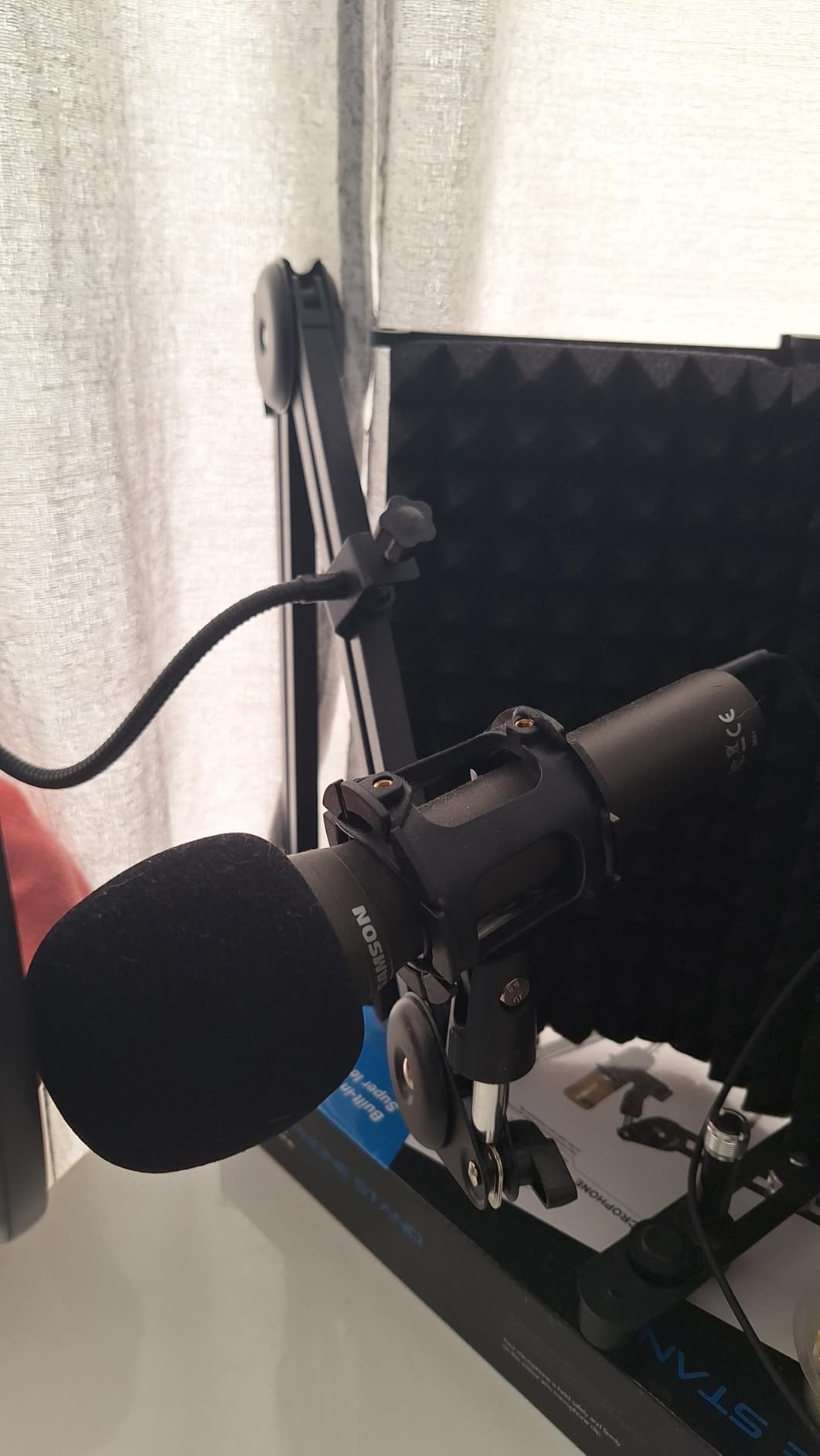
The Q2U remains the answer to a very common first question: can I start a podcast this week with money I have already spent? It ships with a USB-C cable, an XLR cable, a desktop stand, a tripod extension, a mic clip and a windscreen, and it runs straight off a laptop with no drivers.
The handheld end-address design is not just a look. Speaking into the end of a cardioid capsule, close and centred, gives noticeably better rejection of keyboard and mouse noise than the side-address budget condensers it replaced, and one radio professional among the reviews calls it the strongest budget USB performer for speech.
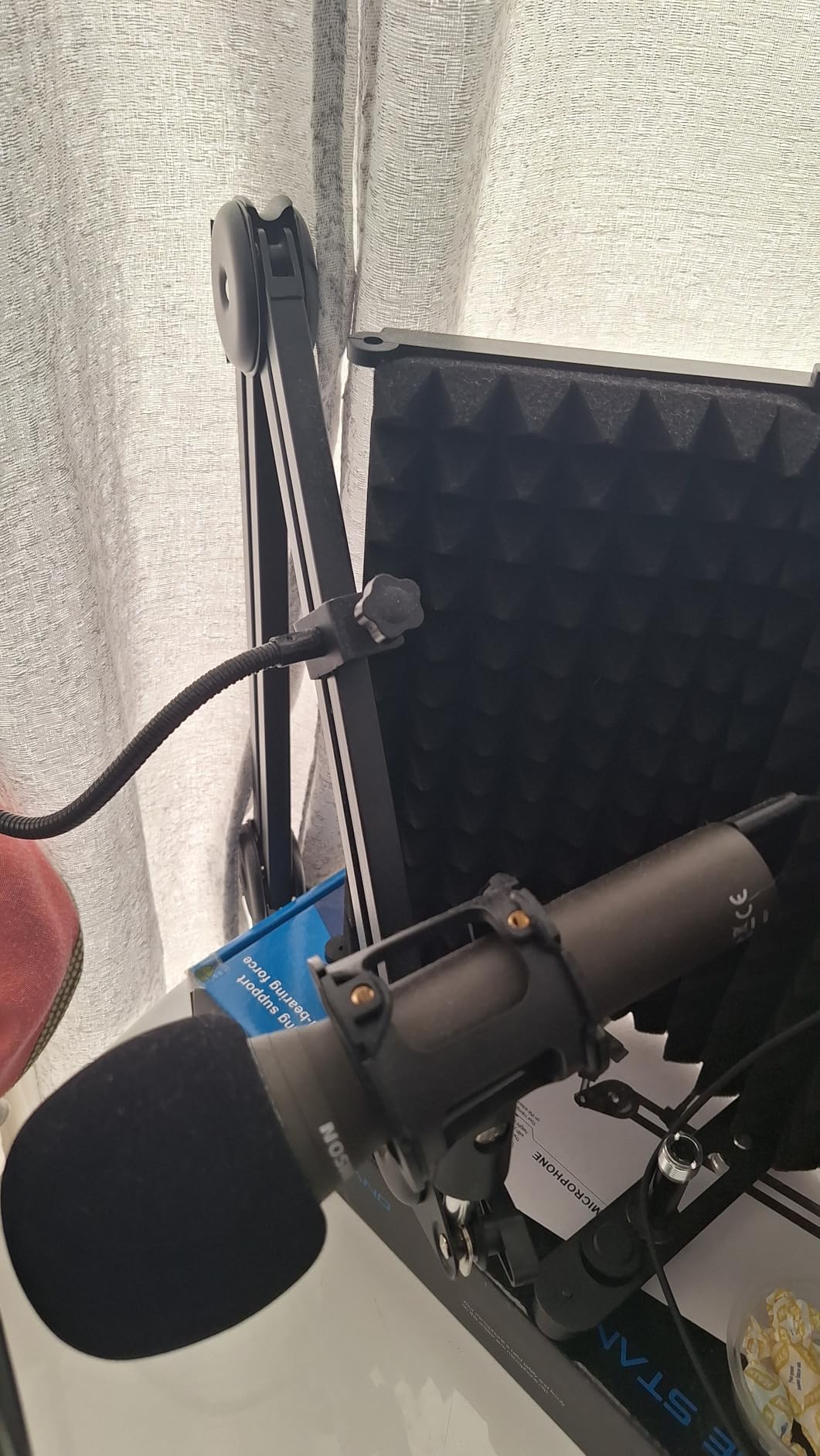
Owners who stay with it for years tend to prefer the sound to their old condenser, describing it as warm, clear and full-bodied. The pattern will not pick up an off-axis conversation, which is a limitation in a two-person room but a genuine advantage for a solo creator in a shared apartment.
The two complaints that never go away are accessory quality and form factor. The tripod stand is flimsy with a loose clamp, and because the mic is handheld-shape you have to stay close and centred to keep a consistent level. Pop filtering also depends on the supplied foam windscreen, and a lot of owners add a proper filter.
Who the Q2U suits best
First-time podcasters, students in dorms, and anyone who wants a working chain in a single purchase. It is also a good second mic for a two-person show where both speakers sit in the same untreated room and keep their distance.
Pair it with an external pop filter and a proper desk arm later, and it keeps improving. Those two upgrades are cheap and fix most of what people complain about.
Who should skip the Q2U
Anyone who wants the highest possible rejection per dollar and already owns an interface. A dedicated cardioid or super cardioid broadcast mic with a real shock mount will stay closer to your voice and let the room fall further away.
Skip it if you need to move around while you talk, or if you record anything louder than speech. The 50 Hz to 15 kHz range is a voice-first window, not a flexible one.
4. FIFINE K688 – On-Mic Controls Without the Interface
FIFINE AmpliTank K688 Dynamic Microphone, XLR/USB Podcast Recording PC Mic
USB and XLR
Cardioid
50 Hz - 16 kHz
130 dB max SPL
0.51 kg
Pros
- Dual USB and XLR lets you start on a laptop and move to an interface later
- Tap-to-mute
- rear gain knob and 3.5 mm headphone monitoring on the body
- Cardioid pattern keeps PC fans and room noise out
- Metal body and included shock mount
- Works on Windows and Mac with no drivers
Cons
- XLR cable
- mic stand and boom arm all sold separately
- Gain must be set carefully or room noise returns
- Bundled mini tripod is flimsy
- Isolated reports of the tap-to-mute spring loosening
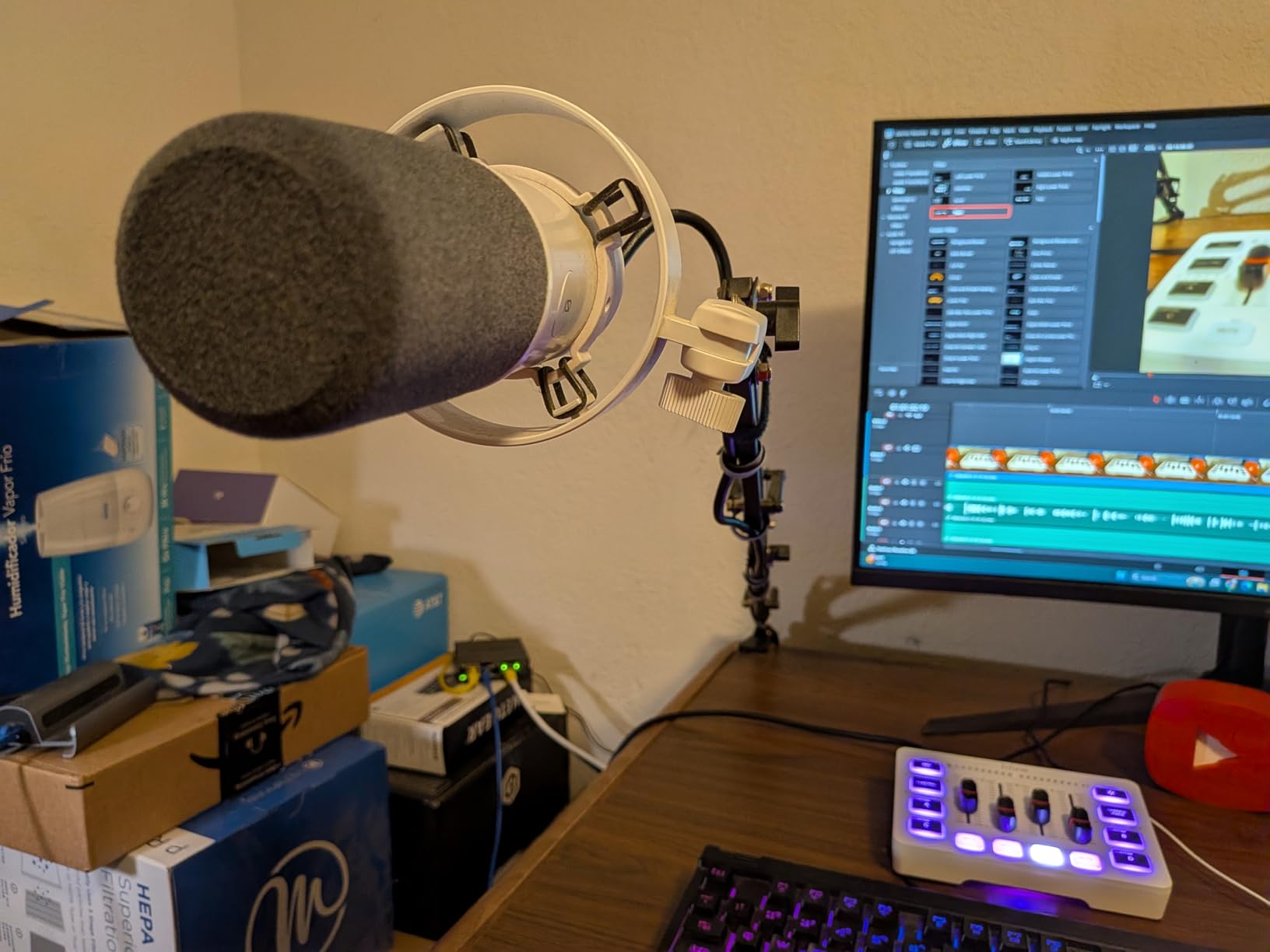
Few budget microphones give you this much hardware on the body. The K688 has a front-panel tap-to-mute, a rear gain knob on the USB path, and 3.5 mm real-time headphone monitoring with its own volume control, which together remove most of the reasons people buy an interface before they are ready.
The capsule is a metal-body dynamic with a cardioid pattern and a 130 dB maximum SPL rating. Reviewers repeatedly frame it as the step up from an entry condenser such as the Blue Yeti, and multiple owners specifically praise how it handles PC fans in untreated rooms, which is the exact scenario this roundup is about.
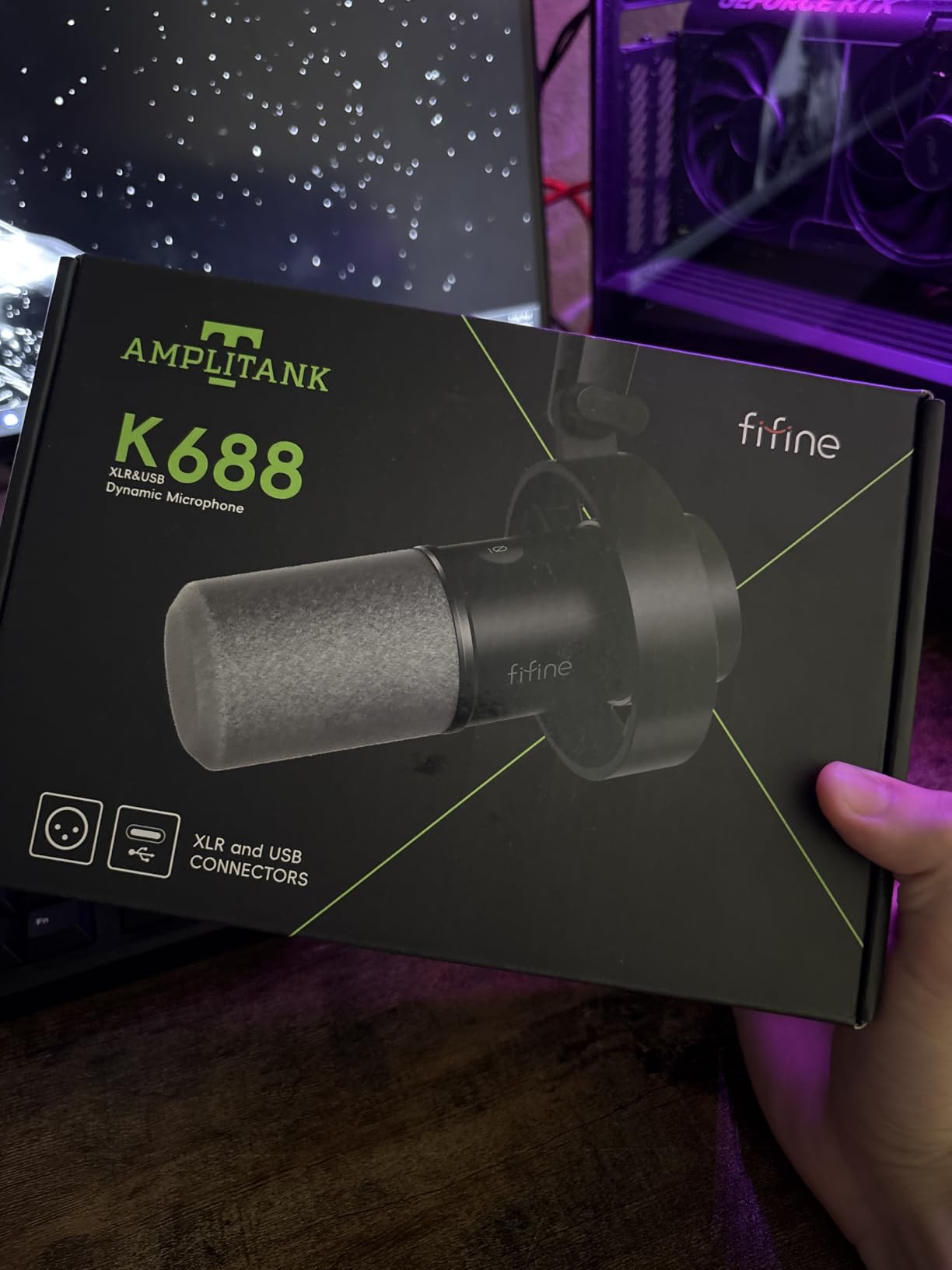
Set the gain knob properly and the cardioid pattern does its job. The instruction in the manual is to talk close, and that matters here more than usual: pushing the gain up to chase a quiet voice lets room noise straight back in, which is the most common complaint in the reviews.
The accessory situation is the weak point. No XLR cable, no mic stand and no boom arm in the box, and the mini tripod that some bundles include is flimsy. Our advice is to budget for a proper arm immediately, because staying close is what makes this microphone work.
Who the K688 suits best
Streamers and podcasters who want live monitoring, a hardware mute and a gain control without buying a mixer. It is also the natural bridge product: start over USB, and move to the XLR output when you add an interface, with no second microphone.
It suits a home office with visible PC fans, because owners report the cardioid pattern keeps that constant hiss out of the recording.
Who should skip the K688
Anyone who wants the flattest, most neutral capture. A dynamic voice mic with 50 Hz to 16 kHz range and an 80 dB signal-to-noise figure is built for speech clarity, not for recording instruments or singing.
Long-term buyers should note the isolated report of the tap-to-mute spring loosening over time, and budget for a stand, since none is included.
5. Shure MV7X – The Interface Path Done Properly
Shure MV7X XLR Dynamic Podcast & Recording Microphone – Black
Cardioid
XLR only
50 Hz - 16 kHz
508 g
72 dB SNR
Pros
- Shure voice isolation keeps PC fans
- room tone and co-host bleed out
- Clean full-sounding recordings needing little post-processing
- All-metal build with yoke mount and 3/8 inch adapter
- Owners report sound close to an SM7B for far less
- Compact body suits small rooms and on-camera work
Cons
- XLR only
- needs an interface and a separate XLR cable
- Requires a good amount of gain and some owners still boost in post
- No USB output
- gain control or headphone monitoring
- Not a dual-output option for two-PC recording
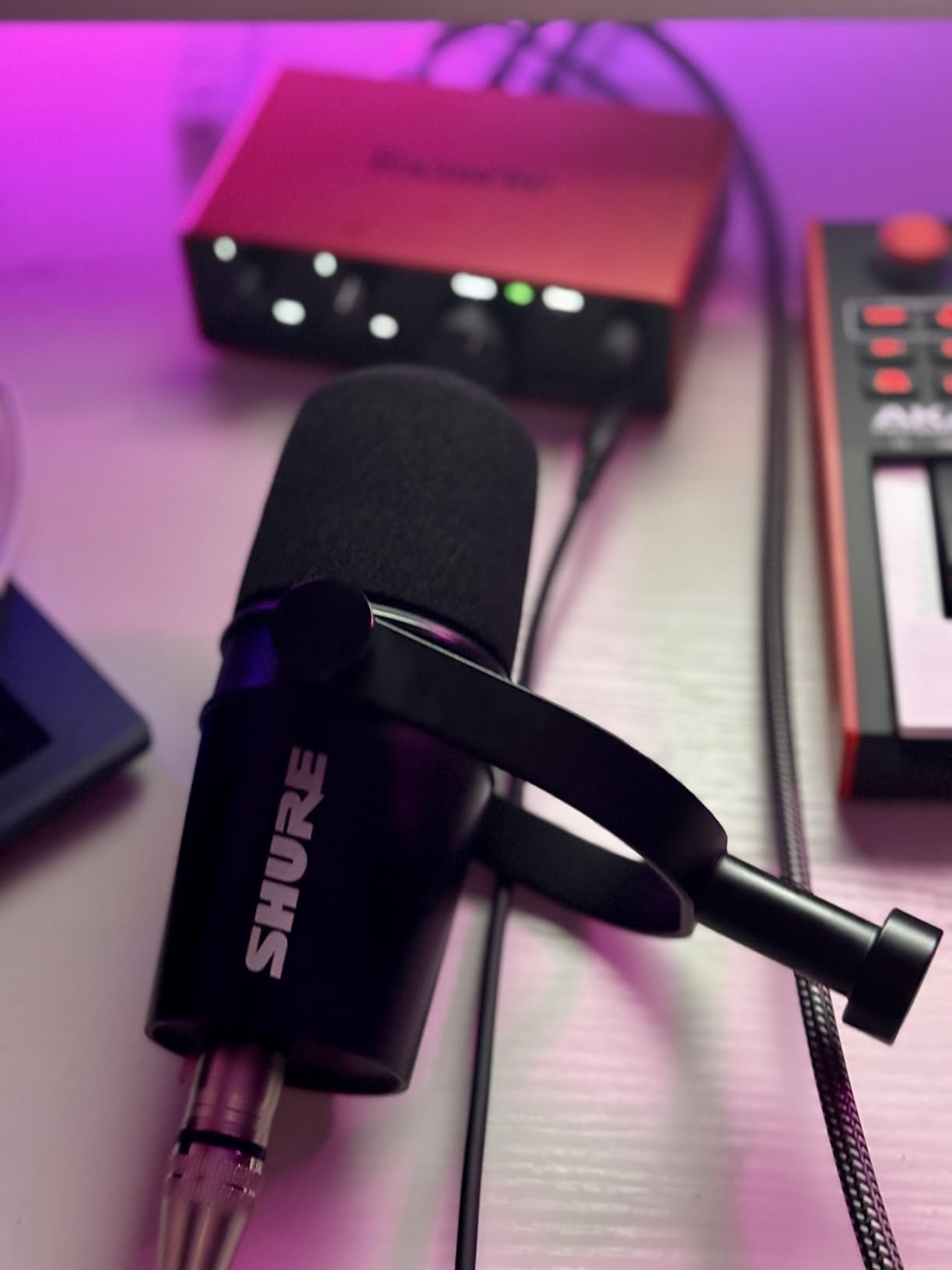
The MV7X is the Shure answer for people who are sure they will buy an interface but have not bought one yet. It strips the USB path and the app, keeps the voice-isolation technology, and leaves you with a clean XLR microphone that behaves like a professional broadcast tool.
That isolation technology is the reason several podcasters report a dramatic improvement over an SM58 and over condensers in shared untreated rooms. One owner notes being barely able to hear five running fans while speaking; that is the whole argument for a dynamic in a bad room, expressed as a measurable outcome rather than a vibe.

At 508 g it is light enough for almost any boom arm, and the included thread adapter fits the stands most people already own. The yoke mount is adjustable, and the capsule sits on an internal shock mount, so desk bumps are handled without a separate suspension.
Two caveats repeat. The XLR cable is not included, and the mic genuinely needs a good amount of clean gain, with some owners still applying level boosting in post. One owner upgraded to the dual-output MV7+ specifically to record two machines at once, which tells you the limits of the single-output design.
Who the MV7X suits best
Anyone building a permanent setup around a two-channel interface, especially a two-person show in the same room where each mic needs to hold its own. The cardioid pattern and the compact footprint make it easy to give both speakers a close position.
It also suits creators who want one microphone to move between a treated studio later. Nothing about the XLR chain has to be replaced when the room improves.
Who should skip the MV7X
Beginners without an interface. There is no way in without extra hardware, and a more expensive microphone is not a beginner-friendly purchase on its own.
Skip it if you want to hear yourself while speaking without software. There is no headphone output here, so live monitoring depends on your interface or your recording app.
6. Rode Procaster – Broadcast Weighting With Easy Gain
RØDE Microphones Procaster Broadcast Dynamic Vocal Microphone
Cardioid
XLR
75 Hz - 18 kHz
1500 ohm
1.1 lb
Pros
- High-output capsule delivers a rich broadcast voice without heavy gain
- Internal pop filter and shock mount remove most accessory spending
- Proven broadcast voicing suited to podcast
- radio and voice-over
- Substantial metal build at 1.1 lb
- Includes stand mount
- thread adaptor and carry pouch
Cons
- XLR only
- so an interface or mixer is required
- No USB path for direct computer recording
- Narrower response than newer rivals
- with less top end above 18 kHz
- No onboard gain
- mute or headphone monitoring
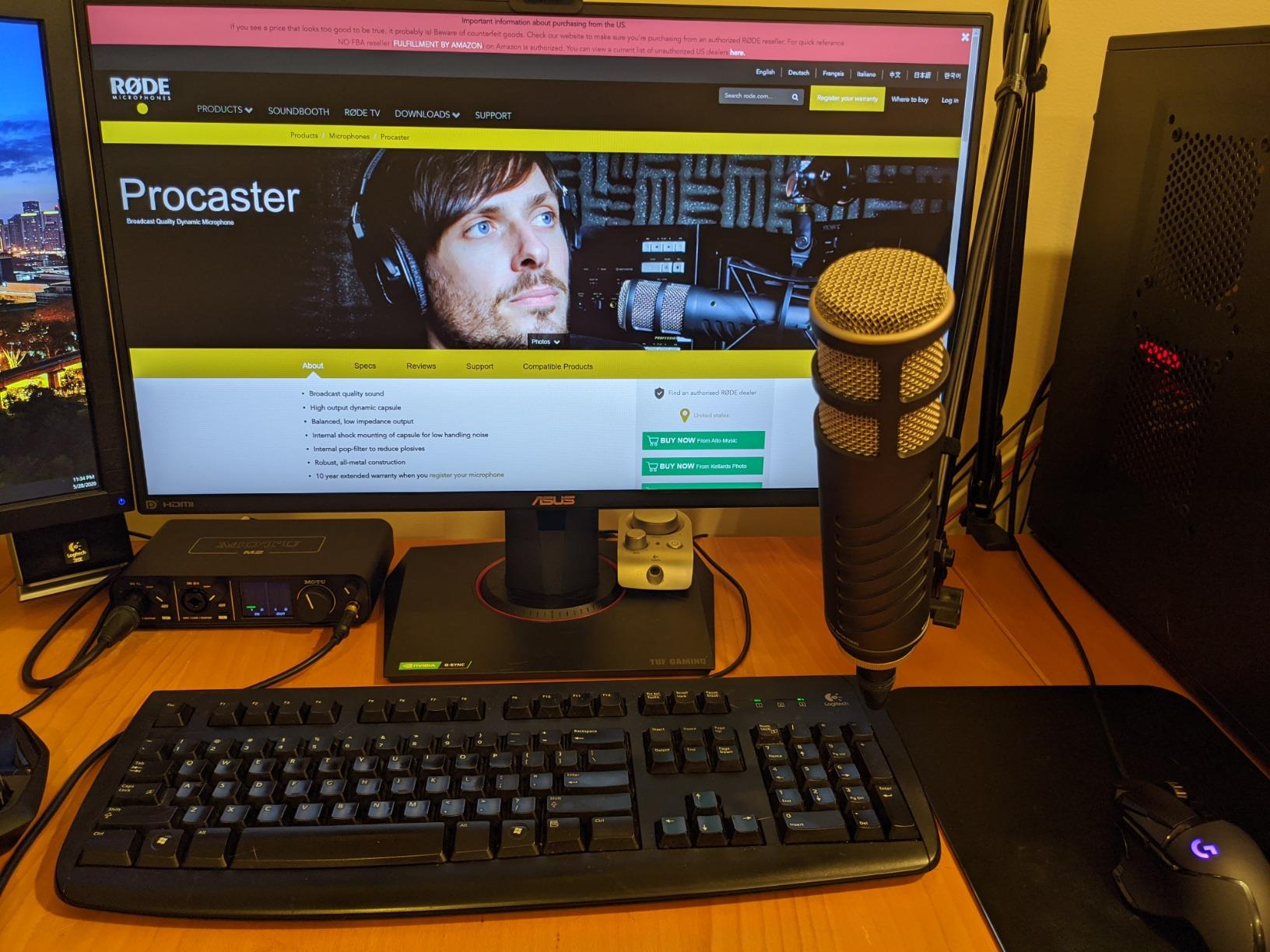
The Procaster solves the problem that pushes people toward inline boosters. Its capsule is a high-output design with a balanced low-impedance output, so it drives easily on a modest interface while still rejecting room noise the way a broadcast dynamic should.
It is also, quietly, the oldest voice-first dynamic in this list. A 4.8 average across a long-lived review base reflects the fact that it has been a radio and voice-over workhorse for years, and reviewers consistently describe it as a broadcast standard for spoken word rather than a compromise.
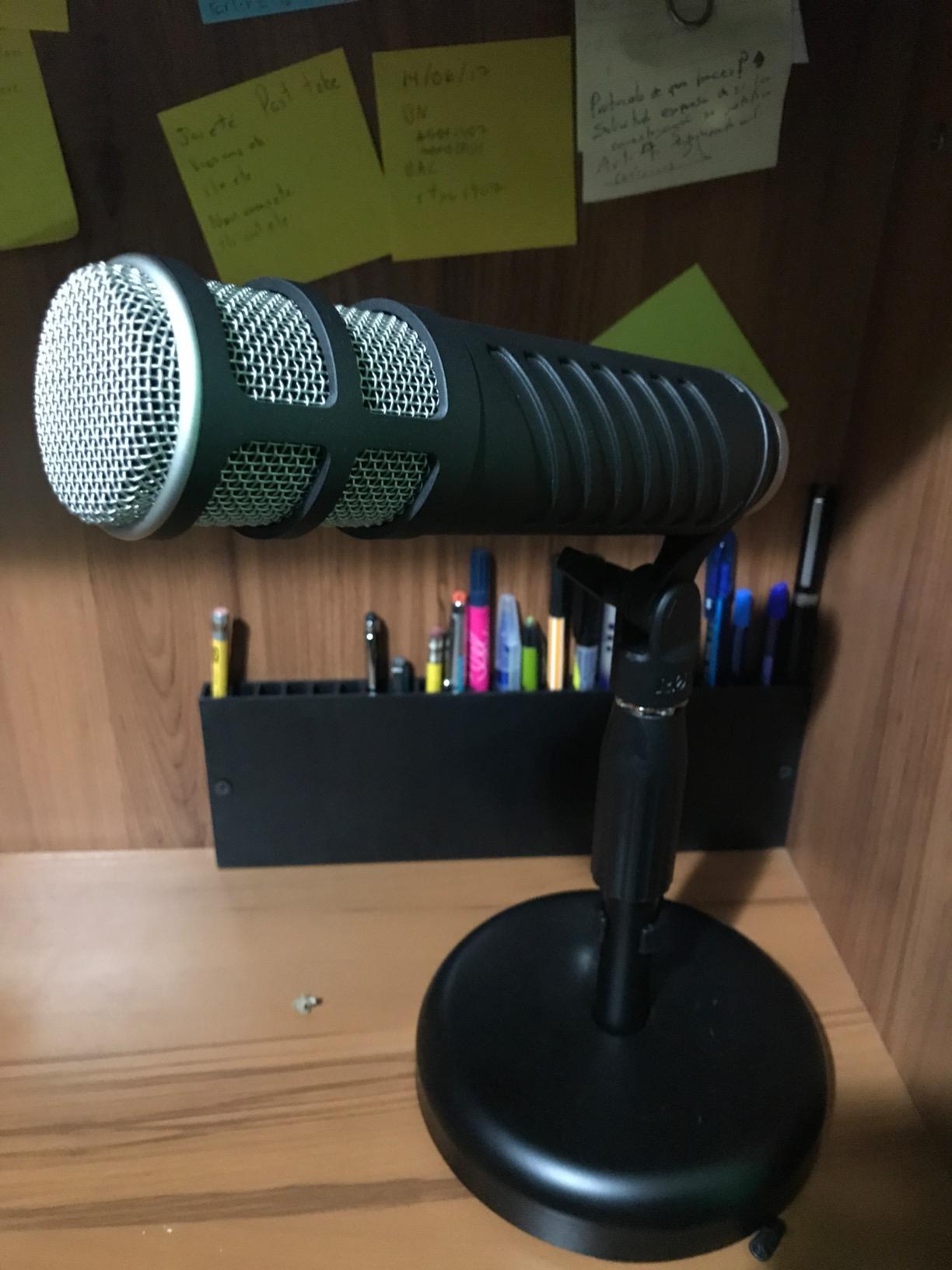
The internal pop filter and internal shock mounting are repeatedly singled out as the features that eliminate the usual accessory spend. In practice that means you can get close, speak plosives, and knock the desk without buying a filter or a suspension first.
The response runs 75 Hz to 18 kHz with a 1500 ohm output, which is narrower at both ends than the newer competition. That is not a flaw for speech, but it means less top end above 18 kHz if you are comparing voices directly. There is also no USB option, so a computer-only setup is out.
Who the Procaster suits best
Voice-over artists, radio producers, and anyone who wants broadcast weighting with a gain structure that does not punish a modest interface. The 1.1 lb weight sits on a desk arm comfortably.
It is a strong second microphone for a two-person show because two matched units tone-match without any effort, and a pouch is included for each.
Who should skip the Procaster
Anyone who records a co-host with a wide range of vocal character and wants modern sparkle. The narrower top end will read as slightly dull next to the AT2040 or the MV7X on bright voices.
Also skip it for a laptop-only workflow. XLR only, no monitoring, no onboard controls.
7. Audio-Technica AT2040 – The Tightest Pattern on the List
Audio-Technica AT2040 Hypercardioid Dynamic Podcast Microphone
Hypercardioid
XLR
Up to 15 kHz
2.2 lb
76 dB SNR
Pros
- Hypercardioid pattern rejects so well it can be spoken to nearly 90 degrees off-axis
- Large-diaphragm capsule with a bright
- assertive broadcast tone
- Integrated shock mount and multistage windscreen handle thumps and plosives
- Solid all-metal build that still looks good on camera
- Built-in 80 Hz high-pass rejects rumble and table bumps
Cons
- Needs substantial clean gain and gets mistaken for a quiet mic
- No pad or low-cut switch for very loud sources
- XLR only and the cable is not included
- Heavy at 2.2 lb
- Some midrange EQ is typically needed
If your problem is specifically the room, the AT2040 is the interesting pick. Its hypercardioid pattern has a much tighter null than the cardioids on most of this list, which is why one owner reports near-total rejection even when speaking to it at ninety degrees, and another found it better than four competing cardioid microphones at isolating a voice from acoustic guitar in the same room.
The trade is tone and weight. A large-diaphragm dynamic gives a bright, detailed and assertively broadcast character that needs a small amount of midrange work for the smoothest podcast voice, and at 2.2 lb it is one of the heavier bodies here, so your arm has to be up to the job.
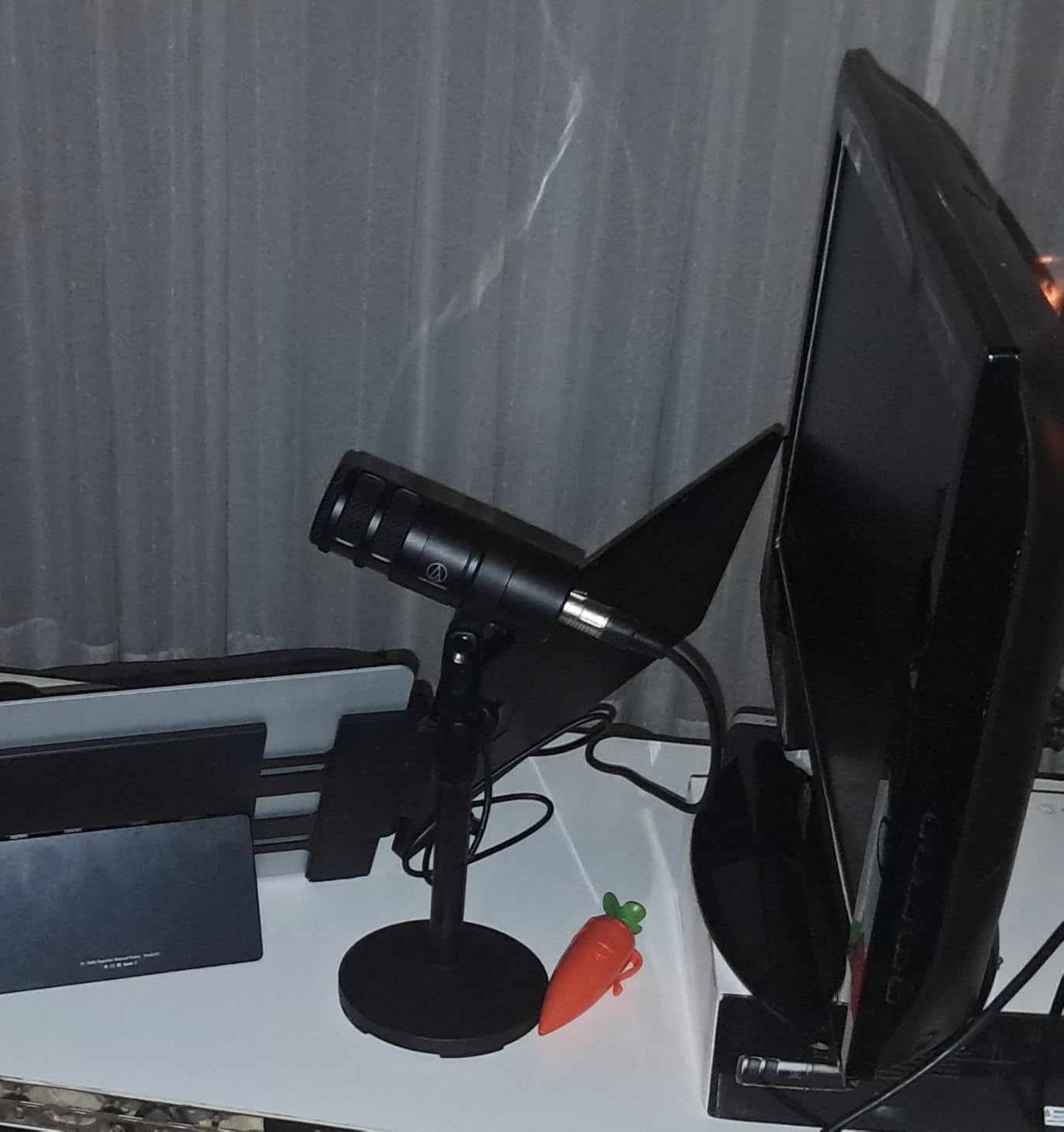
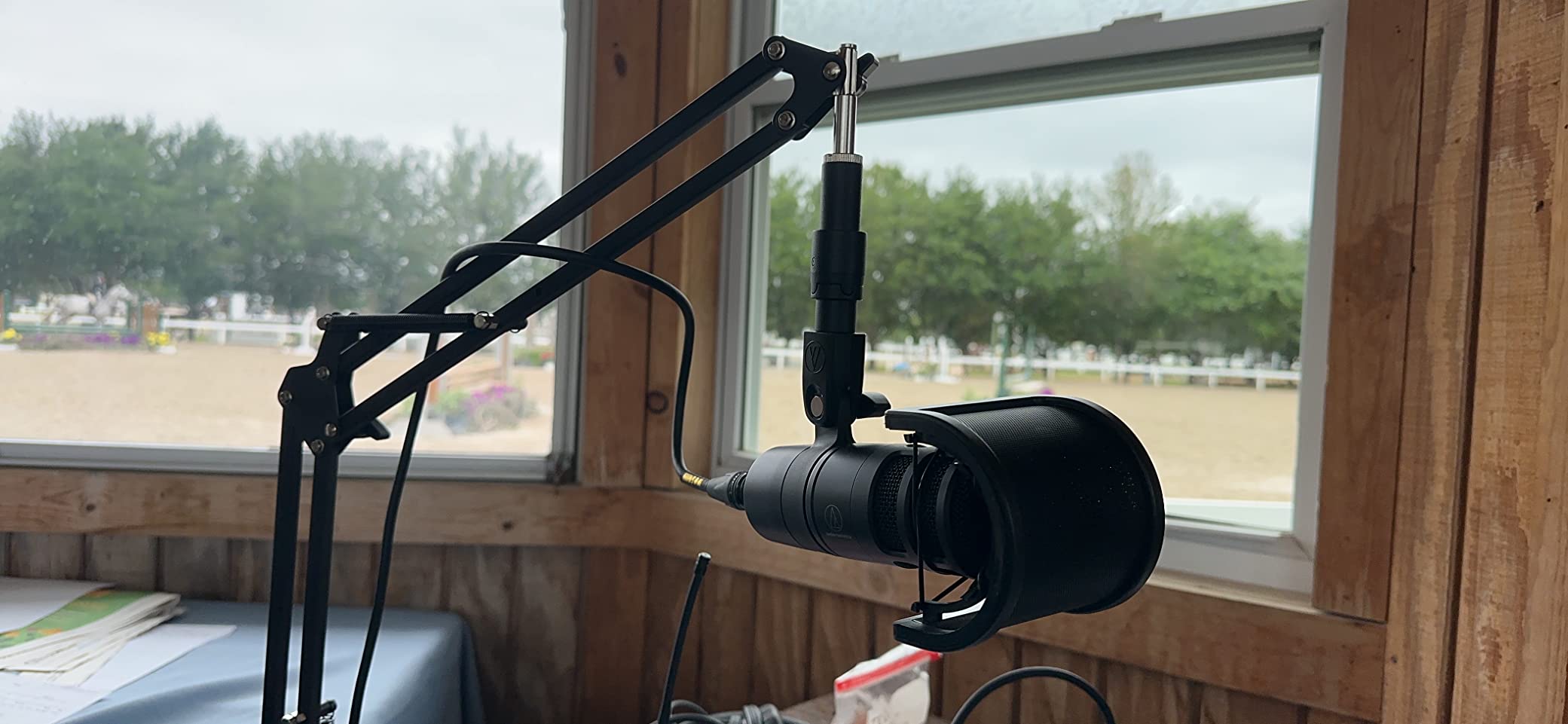
Useful extras are built in. A multistage foam mesh windscreen handles pop filtering internally, an integrated shock mount kills noise transmitted through stands and booms, and a built-in 80 Hz high-pass takes care of desk thumps and footstep rumble, which in an untreated room is a real and often overlooked noise source.
The main warning is gain. Buyers regularly mistake it for a quiet microphone and under-power it, and there is no pad or external low-cut switch if you ever need to handle something genuinely loud. The pivoting stand mount and thread adapter are included; the cable is not.
Who the AT2040 suits best
People whose room has one specific loud offender: a refrigerator, a wall shared with a neighbour, a gaming PC, a television in the next room. A tighter pattern solves exactly the problem a cardioid only partly solves.
It also suits on-camera creators, since the all-metal body is praised for surviving heavy use while still looking right in frame, and the bright voicing needs very little presence correction.
Who should skip the AT2040
Anyone who is very sensitive to room tone behind the voice. A hypercardioid can sound slightly close and forward because the pattern hugs the axis, and if you find that fatiguing, a cardioid will feel more natural.
Skip it for cheap boom arms and for beginners without a gain-capable interface. It needs more clean gain than almost anything else in this roundup.
8. Shure MV7+ – Two Outputs and Software Cleanup
Shure MV7+ USB-C & XLR Podcast Dynamic Microphone – Black
USB-C and XLR
Cardioid
50 Hz - 16 kHz
1.9 lb
Simultaneous output
Pros
- USB-C and XLR run at the same time for dual-PC and interface workflows
- Auto level and real-time denoising keep levels steady in live rooms
- Customisable LED touch panel looks polished on camera
- Clear professional sound users rate above mics costing far more
- Lighter and easier to handle than some broadcast rivals
Cons
- XLR cable not included
- so interface users must buy one
- Picks up more speaker bleed and stray room sound than a pure dynamic
- Feature set depends on the MOTIV app
- Heavier at 1.9 lb than the XLR-only MV7X
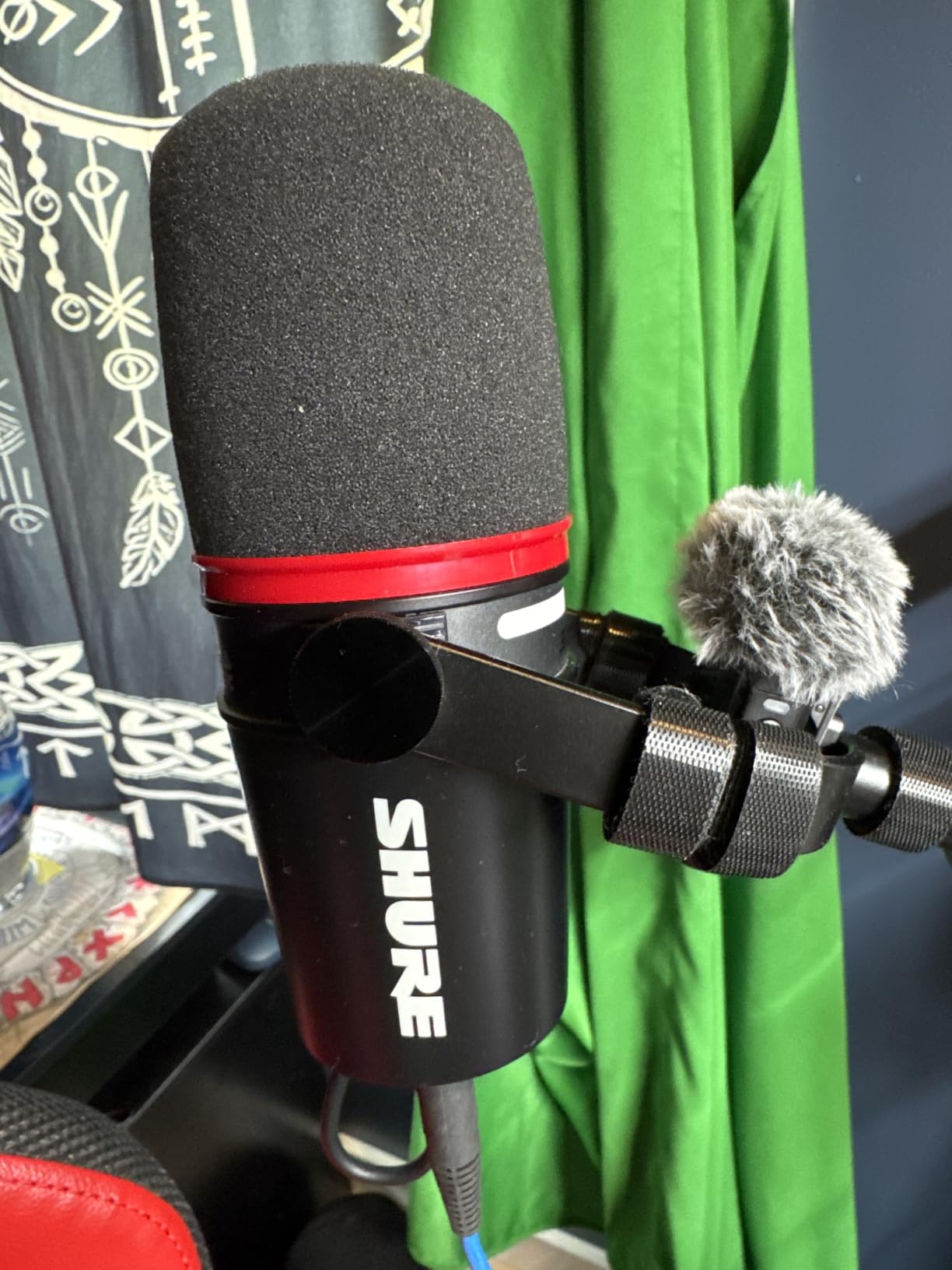
The MV7+ is the only microphone here that can feed two machines at the same time. USB-C and XLR run simultaneously, which is the deciding feature for streamers with a gaming PC and a streaming PC, and for anyone who wants to feed a console or interface while still capturing a direct USB backup.
Its software layer is aimed squarely at the untreated-room problem. Auto Level adjusts gain based on distance and volume, real-time denoising reduces background noise during recording, and there are built-in reverb effects in Plate, Hall and Studio modes for voice-over work. Owners commonly pair it with a RODEcaster for finer manual control.
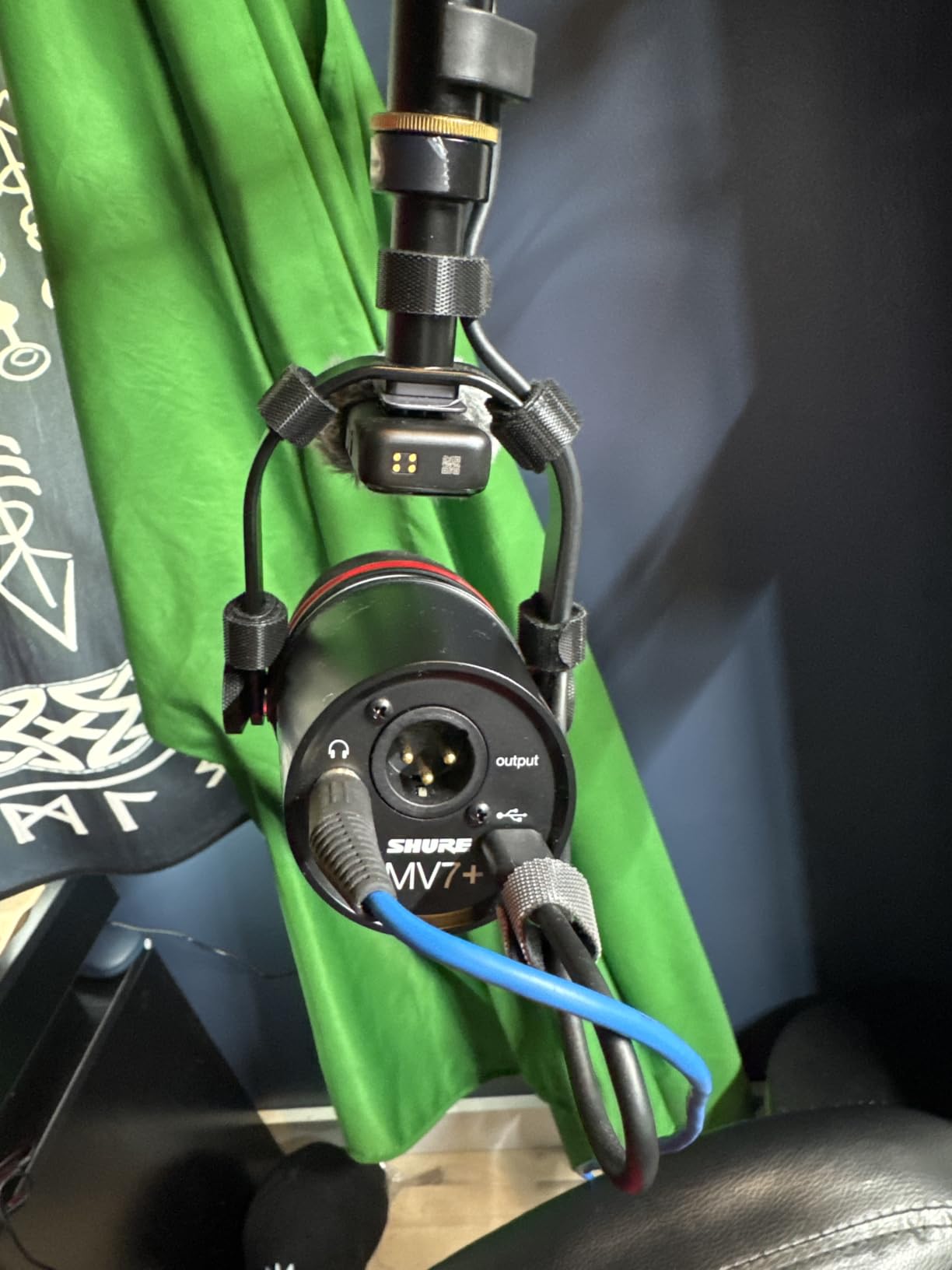
The full-colour LED touch panel is a favourite among on-camera creators, and the metal body is lighter and easier to handle than several broadcast rivals despite the 1.9 lb figure. Sound quality is described as clear and professional by owners who compare it against microphones costing considerably more.
The honest criticism comes from monitor-speaker users, who find it picks up more bleed and stray room sound than a pure dynamic would, and lean on software cleanup instead. If your untreated room noise is a desk fan or a computer rather than a loudspeaker, the denoise handles it well; if it is wall reflections, close mic technique still matters more than any setting.
Who the MV7+ suits best
Streamers running a two-PC setup, video callers who want a mic that looks good on camera, and anyone who wants software cleanup as a safety net in a room they cannot control.
It also suits people who want to leave the door open to an interface later. The XLR output is a real professional output, not a token one, and many owners use both at once.
Who should skip the MV7+
Anyone who wants the most natural untreated-room capture with no processing at all. It is a dynamic with a generous front end, not a studio instrument, and the MOTIV app adds a setup layer some people resent.
Interface users should also note that the XLR cable is not included, which is an easy line item to forget when planning the total cost.
9. Elgato Wave DX – Small Body, Serious Speech Capture
Elgato Wave DX Dynamic XLR Microphone, Cardioid Pattern
Cardioid
XLR
50 Hz - 15 kHz
407 g
600 ohm
Pros
- Clear
- accurate speech that owners compare favourably against an SM7B
- Cardioid pattern with a forgiving off-axis acceptance angle
- Runs on any XLR interface without a dedicated booster
- Compact 407 g body keeps desk space clear and light on budget arms
- Metal build with swivel mount and thread adaptors included
Cons
- XLR cable is not included
- No on-mic controls at all
- Some users still add an inline booster
- Best through an interface rather than a bare entry-level preamp
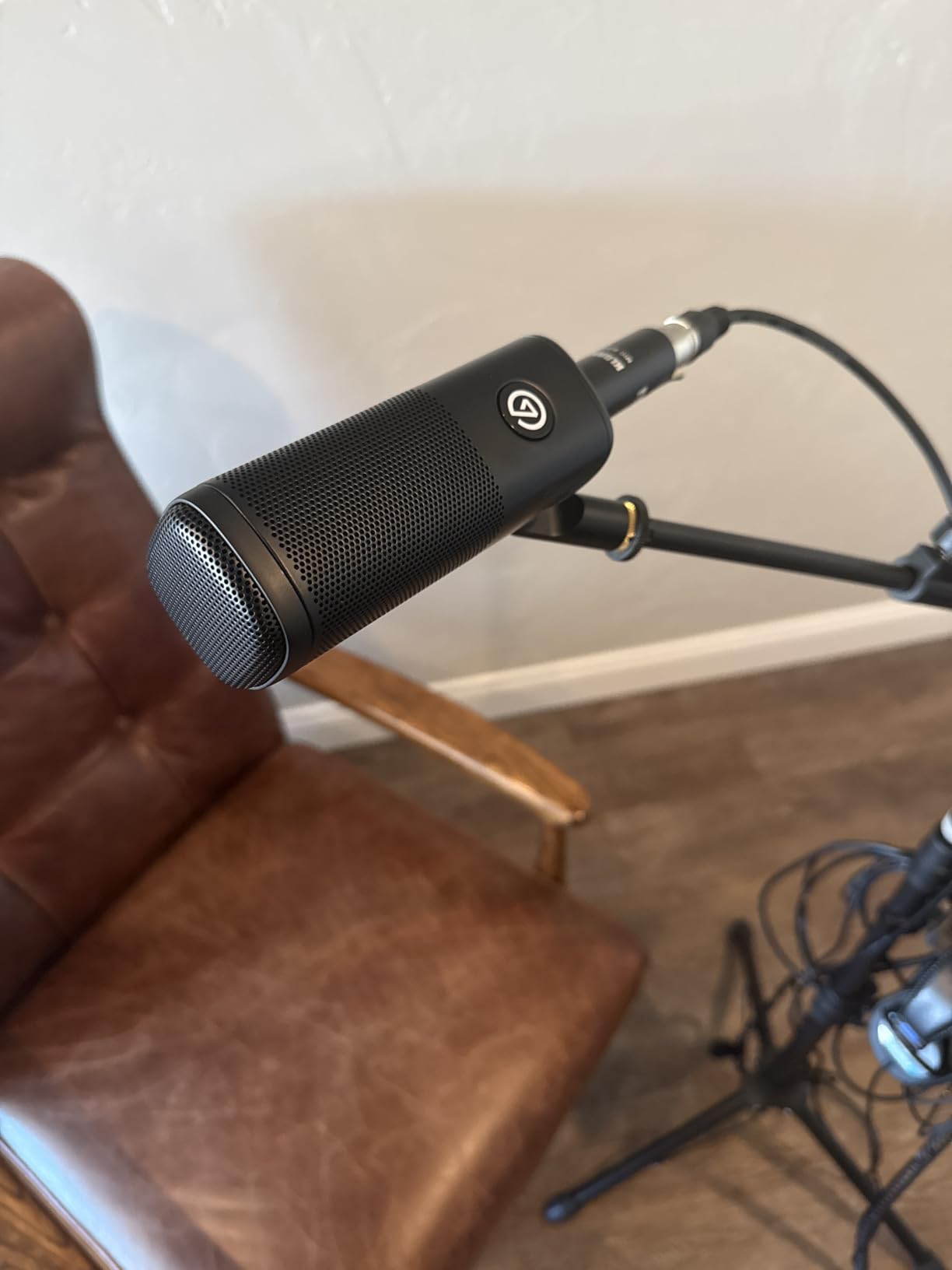
The Wave DX is the most interesting price-to-performance story in the roundup. Two separate owners report struggling to distinguish it from an SM7B in blind comparison, and its 600 ohm impedance means it works on any XLR preamp or interface without a dedicated signal booster, which solves the gain problem that dogs the SM7B and the PodMic.
Users also report that it silences a loud clicky keyboard and a nearby television completely when they are not speaking. That is a cardioid dynamic working exactly as intended in an untreated room, and it is the single behaviour you should test before buying anything.
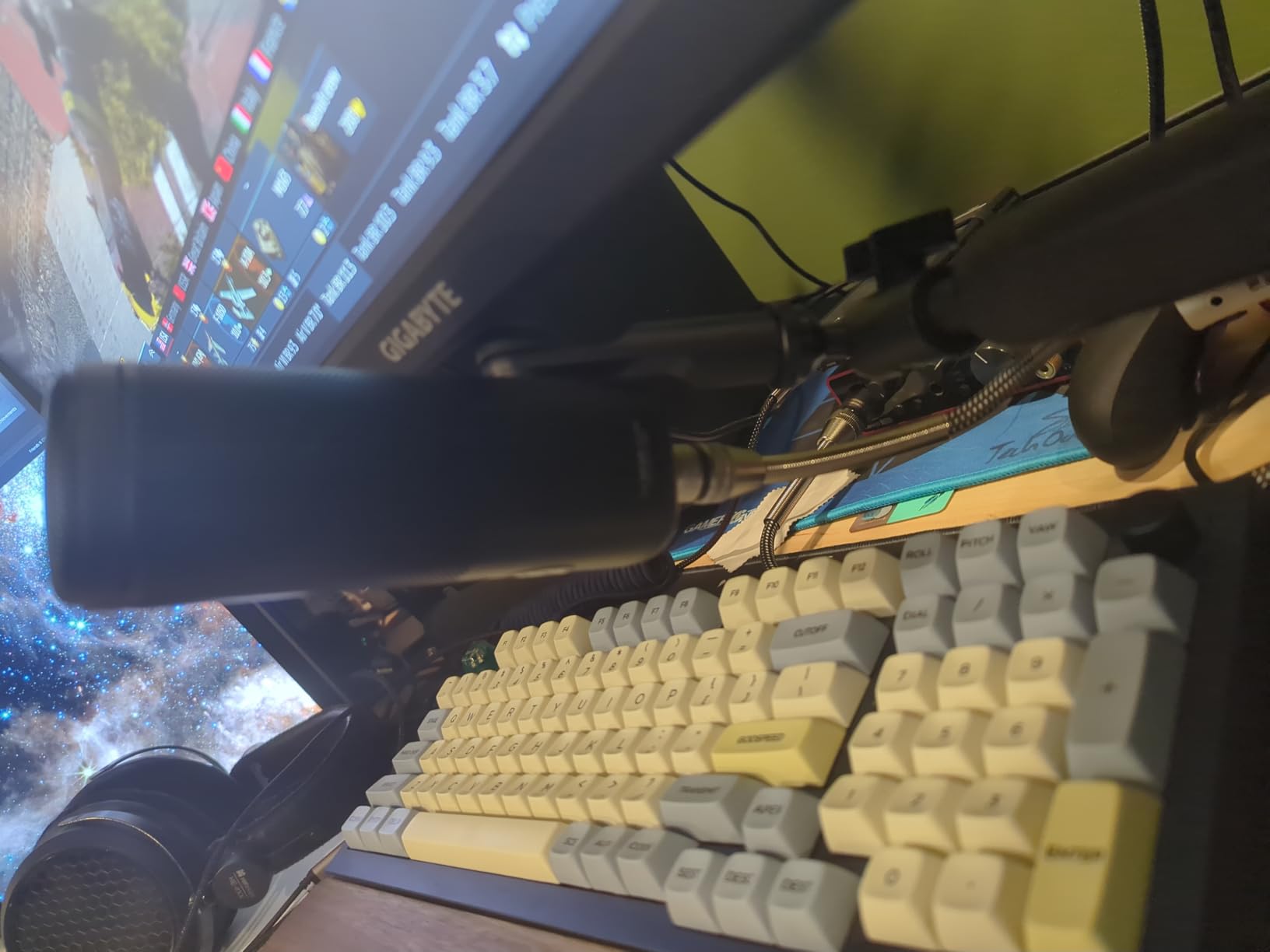
Physically it is the friendliest microphone here. At 407 g it stays out of the way of monitors and puts almost no strain on a budget boom arm, and the mono swivel mount includes 3/8 inch and 1/4 inch adaptors so you can position it without jamming the cable.
What it does not have is any control. There is no on-mic gain, no mute and no headphone output, so the gain lives in the interface, and one reviewer makes the point explicitly: you are buying a microphone, not a piece of hardware with a front panel.
Who the Wave DX suits best
Creators on a small desk with a tight budget arm and an existing interface. The low weight and 600 ohm impedance make it the least fussy microphone in this roundup once you already have a preamp.
It is also a strong option for a two-person show where both speakers need to sit close in the same room, because the compact body is easy to place.
Who should skip the Wave DX
Anyone who wants a single-cable setup or a laptop-only workflow. No USB, no monitoring, no controls, and the cable is not in the box.
Also skip it if you sing or record loud sources. The 50 Hz to 15 kHz window and the absence of a pad make this a voice tool, and the roster of our professional podcast microphone picks is a better fit for that.
10. Zoom ZDM-1 – Super Cardioid for a Tight Budget
Zoom ZDM-1 Dynamic Microphone for Podcasts, Voice-Overs, Vocals, and More, High SPL Capability, Sturdy Metal Body, and Large Diaphragm
Super cardioid
XLR
78 dB SNR
454 g
High SPL handling
Pros
- Super cardioid pattern gives focused pickup and strong off-axis isolation
- Large-diaphragm dynamic produces smooth broadcast-style vocal quality
- High SPL handling keeps the signal clean on loud sources
- Internal shock mount removes bump and handling noise
- All-metal body and grille at a light 454 g
Cons
- XLR only
- needing an interface
- mixer and a separate cable
- No onboard gain
- mute or headphone monitoring
- Fewer finishing features than newer USB and XLR hybrids
- Smaller installed review base than the Shure and Rode entries
The ZDM-1 combines the two traits an untreated room rewards: a super cardioid pattern for isolation, and a large diaphragm for a smooth, broadcast-style vocal. At 454 g it is one of the lighter bodies here, and the all-metal body and grille are described as durable for daily handling.
High SPL capability is the specification that separates it from the pure speech mics above. If you also record a loud instrument or a voice that gets animated, the headroom means you are not fighting the microphone, which is a different problem from fighting the room.
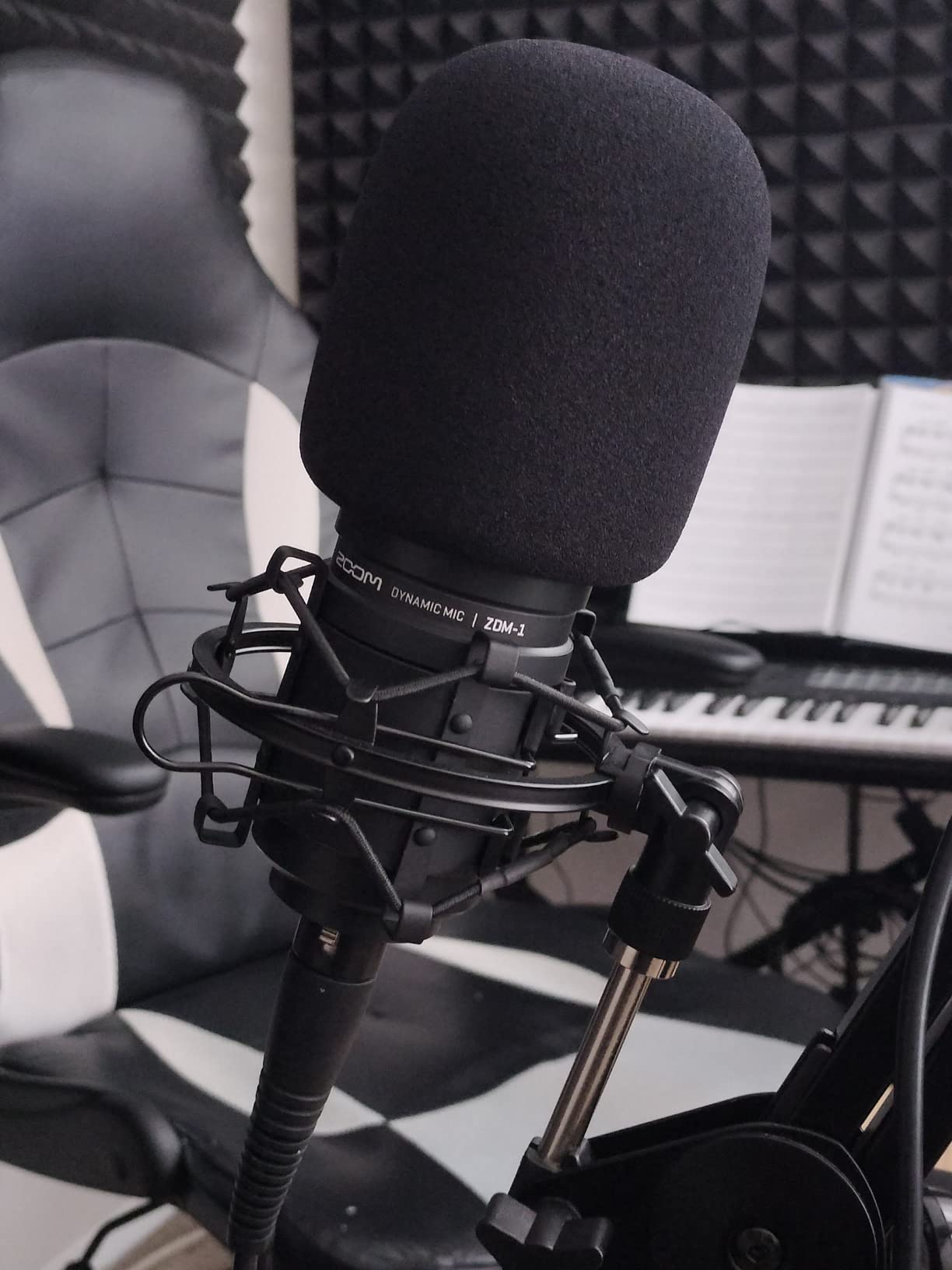
The internal shock mount isolates the capsule from bumps and handling noise, so a desk-mounted setup does not need a separate suspension to sound clean. The reception is consistently positive and centred on isolation and build, which are the two things that matter in a live room.
The limitation is simply that it is a straightforward XLR microphone. There is no USB path, no monitoring and no onboard gain control, so it needs an interface or a mixer and a separate cable, and it offers none of the finishing features that newer hybrids add.

Who the ZDM-1 suits best
Anyone who needs one microphone to handle both a quiet voice and a loud source, and who already has an interface. A super cardioid pattern plus high SPL capability is an unusual pairing at this level.
It also suits a two-person show on a budget, since two identical units tone-match without any effort and stay isolated from each other in the same untreated room.
Who should skip the ZDM-1
First-time buyers, because there is no shortcut from a microphone in the box to a finished recording. You still need a preamp, a cable, a pop filter and somewhere to mount it.
Its installed review base is also the smallest in this roundup, which matters less for a straightforward dynamic than it would for a software-driven model, but it is worth knowing if you like to read long-term owner reports before buying.
USB vs XLR vs Hybrid: What the Full Chain Costs
The microphone is rarely the whole price of a good recording. An XLR-only dynamic such as the SM7B, the PodMic, the Procaster, the AT2040, the MV7X or the ZDM-1 needs an interface with an XLR input, and that interface has to deliver real clean gain or the hiss will be audible in a quiet room. A USB microphone or a hybrid gives you the preamp inside the microphone body, which is why the Q2U, the K688 and the MV7+ feel like complete products on day one.
Budget for the rest of the chain either way: a stable boom arm to hold the mic at mouth height, a pop filter if the microphone does not have an internal one, and closed-back headphones so you can monitor without the speakers leaking back into the capsule. Our professional podcast microphone roundup goes deeper on the hardware side of this.
Where to Put Your Mic in an Untreated Room
Placement beats equipment in an untreated space, and the changes are free. The single highest-impact move, and the one owners report most often, is bringing the microphone from roughly twelve inches away down to about three, a finger’s width from the corner of your mouth.
Get close: three to five inches, just off the corner of the mouth rather than dead centre, so plosives pass at an angle.
Angle off-axis by roughly twenty degrees so the back of the capsule faces the noisiest wall or window in the room.
Turn your back to the noise. Room rejection only helps if the unwanted sound is behind the microphone, not behind you.
Use a boom arm, not a short desk stand. A mic at desk level picks up the desk, the keyboard and the chair.
Add a pop filter if the microphone has no internal one, and check the windscreen is seated properly.
Record ten seconds of silence in the room and listen back. That is your noise floor, and it tells you how much cleanup you will need.
One common misconception worth clearing up: the 3 to 1 rule is a mixing rule about microphone distance relative to the loudest source, not a podcast technique. For a solo voice recording the useful heuristic is simply the finger width.
What Actually Cuts Room Reverb (and What Does Not)
Thin foam panels do almost nothing to the low-mid reflections that make an untreated bedroom sound like a bathroom. Foam works in the high frequencies, and vocal echo lives mostly below 500 Hz, which is why people hang foam panels and hear the same reverb afterwards.
What does work without drilling holes is placement and absorption of the right kind. Record in a closet full of clothes, put the microphone in a room corner where two hard surfaces meet, or drape a heavy blanket over the desk behind the microphone. Moving your position to a soft-surfaced part of the room and turning your back to a bare wall will beat any inexpensive panel on the market.
One more thing that helps more than people expect: gain staging. Turn the gain down until your loudest syllable peaks, then keep a consistent distance so the level stays even, because a quiet recording turned up afterwards amplifies room noise with it.
Nuisance Noise: Matching the Mic to the Sound You Hate
The right pick depends on which noise is ruining your recordings. A constant low hum such as a PC fan, air conditioning or a fridge is best handled by a close-mic’d cardioid dynamic that keeps your voice loud relative to the noise floor, and every microphone on this list can do that with correct technique.
Sharp, intermittent sounds need a pattern with a tighter null. Keyboard clacks, a television in the next room and a neighbour’s voice are the cases where the hyper cardioid of the AT2040 or the super cardioid of the ZDM-1 pull ahead of a plain cardioid.
Traffic and thin-wall noise are frequency-dependent rather than directional, so no microphone removes them entirely. In that situation, the combination that works is a dynamic with real off-axis rejection, a close position, your back to the window, and some absorption behind the microphone.
Frequently Asked Questions
Are dynamic mics better for untreated rooms?
Yes. A dynamic microphone uses a magnet and coil rather than a charged capacitor, so it is far less sensitive to sound arriving from the sides and rear. Wall reflections, traffic and household noise are all off-axis sounds, and a dynamic turns most of them down before they reach your recording. The trade-off is that it needs a lot of gain and close-mic technique to sound its best.
What is the best vocal mic for an untreated room?
For a setup you can buy as one product, the Shure MV7+ handles live rooms with its auto level and real-time denoising. For a laptop-only start, the Samson Q2U works immediately over USB-C. If you already own an interface with clean gain, the Shure SM7B is the reference for room rejection.
What is the best dynamic microphone for podcasting?
The Shure SM7B is the best dynamic microphone for podcasting in an untreated room, with a tight cardioid pattern, an integrated pop filter and rear EQ switches. It needs roughly 60 dB of clean gain, so budget for an interface with real headroom and possibly an inline booster. Cheaper alternatives in this roundup reach most of the way there.
Where to put a mic in an untreated room?
Put it three to five inches from the corner of your mouth, angle it about twenty degrees off-axis so the back of the capsule faces the noisiest wall, and turn your own back to the noise. Mount it on a boom arm rather than a desk stand, add a pop filter if the mic has no internal one, and record ten seconds of silence to hear your actual noise floor.
Do I need an audio interface for a dynamic podcast mic?
You need one for any XLR-only microphone, such as the Shure SM7B, Rode PodMic, Shure MV7X, Rode Procaster, Audio-Technica AT2040, Elgato Wave DX or Zoom ZDM-1, and you should check its clean gain before buying. A USB model like the Samson Q2U, FIFINE K688 or Shure MV7+ works directly on a laptop with no interface.
How close should I hold a dynamic podcast mic?
About three to five inches, roughly a finger’s width, from the corner of your mouth rather than directly in front of it. Closer placement raises the signal well above the room noise, and speaking past the front of the capsule at a slight angle lets plosives pass without hitting the grille.
Do cheap foam panels reduce room echo?
Not much, if the problem is vocal echo. Thin foam panels mainly absorb high frequencies, while the low-mid reflections that make a bedroom sound boxy sit below 500 Hz. A closet full of clothes, a room corner, a heavy blanket behind the mic, and a close off-axis microphone position all do more for the same money.
The Verdict for Untreated Rooms in 2026
The best dynamic podcast microphone for an untreated room in 2026 is the Shure SM7B if you have the interface and the gain to drive it, the Rode PodMic if you want that sound with a much smaller outlay, and the Samson Q2U if you want to record tonight with a laptop and nothing else. Add the Shure MV7+ if you want a single microphone that also handles a second machine and software cleanup in a live room.
Whatever you choose, the room will not be fixed by the microphone alone. Get the mic close, angle it off-axis, turn your back to the noise, and the rest of your gear list matters far less than it looks like it should.