
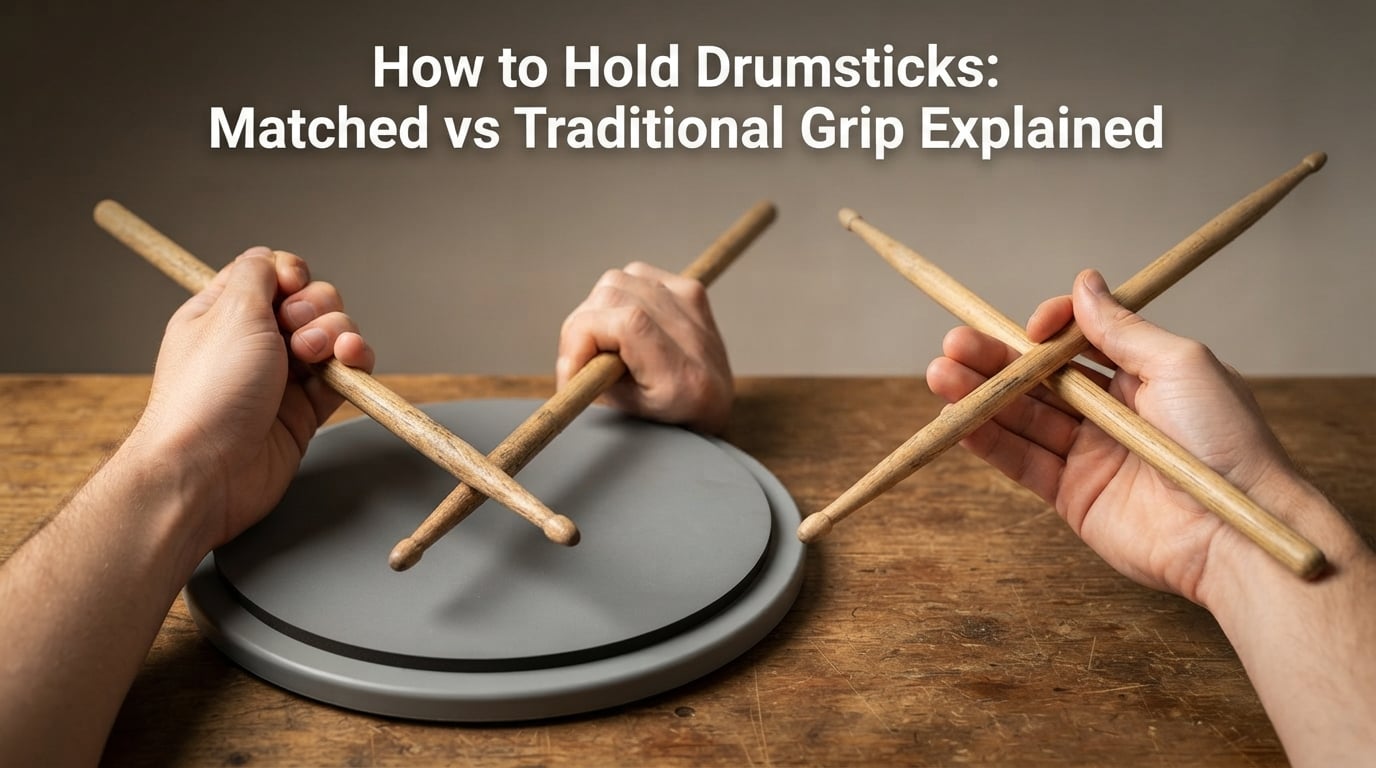
Learning how to hold drumsticks correctly is the single most important skill any new drummer can build. Your grip shapes every beat you play, every fill you throw in, and even how long your wrists last through a 90-minute set. I spent my first six months gripping sticks like a broom handle before a teacher sat me down and showed me the difference between matched grip and traditional grip. That lesson changed everything.
In this guide, our team walks you through both grips, breaks down the three main matched grip variations (German, French, and American), and gives you step-by-step instructions you can practice tonight. We also cover which grip beginners should start with, common mistakes to avoid, and what pro drummers actually use on stage. By the end, you will know exactly which drumstick grip fits your goals and how to build a relaxed, fast, pain-free stroke.
Table of Contents
What Is Traditional Grip and Where Did It Come From?
Traditional grip is the older of the two main drumstick grips. It is a drumstick holding technique where the left hand holds the stick in an underhand position while the right hand plays normally above it. The asymmetry looks unusual at first, but it has survived more than 150 years because it lets drummers play soft, nuanced passages with incredible finesse.
The Marching Band Origins of Traditional Grip
Traditional grip dates back to the Civil War era in the United States. Military drummers carried a single snare drum slung at their side on a sling, tilted at an angle. From that body position, reaching under the drum with the left hand was the only natural way to play. Drummers adapted by laying the stick across the left palm and letting the wrist pivot from underneath.
When drum kits evolved in the early 1900s, the over-the-top matched grip became more practical. But traditional grip held on in jazz, classical, rudimental, and pipe band drumming. Even today you will see it at drum corps competitions, in big band gigs, and on every Buddy Rich tribute show. It is not an outdated relic. It is a specialized tool that gives players a unique sound and visual flair.
What Is Matched Grip and Why Is It So Popular
Matched grip is a drumstick holding technique where both hands hold the sticks identically. The palms face the same direction, the fulcrum sits in the same place on each hand, and your arms mirror each other as they play. This symmetry is the reason matched grip became the dominant style for modern drum kit playing.
Most rock, pop, metal, and fusion drummers default to matched grip because the mirrored setup makes it easier to coordinate fills, blast beats, and rudiments across the whole kit. The market reflects this too: most drum education books and online lessons in 2026 are built around matched grip fundamentals.
Three Main Matched Grip Variations Explained
Even within matched grip there are three flavors. Each one tilts the stick at a different angle, which changes how your wrist and fingers work.
German grip (overhand grip): Both palms point straight down at the drumhead. This is the most powerful matched grip, perfect for heavy rock, marching snare, and any time you need maximum force behind a stroke. The trade-off is speed: your wrist has further to travel.
French grip (underhand grip): Both palms face each other, palms in, like you are holding a pair of drumsticks vertically. This is the fastest and most finger-driven matched grip, favored by jazz fusion players, latin drummers, and anyone working on fast singles, doubles, and paradiddles.
American grip (hybrid or traditional-style matched grip): Palms sit at a 45-degree angle, the most ergonomic middle ground. Most drummers end up here naturally because it balances power and finesse without locking you into either extreme.
How to Hold Drumsticks with Matched Grip Step by Step
If you are starting fresh, this is the easiest path into matched grip. Sit behind a practice pad and follow these five steps exactly.
Find the fulcrum. Lay the stick across your open palm. Pinch it between the tip of your thumb and the side of your index finger at the natural balance point, usually about one-third of the way up from the butt end. This pinch is your fulcrum.
Place the stick on your ring finger. Let the stick rest on the middle knuckle of your ring finger. Your index and middle fingers sit on top of the stick, lightly resting.
Wrap your fingers loosely. Curl the ring and pinky fingers under the stick. Do not squeeze. Think of holding a bird, not crushing a walnut.
Relax your wrist. Let your wrist drop so it can hinge up and down freely. A stiff wrist kills speed and causes injury.
Test the bounce. Drop the stick onto the pad from about an inch up. If it rebounds cleanly without your fingers squeezing, your grip is correct. Repeat with the other hand and lock in the symmetry.
Practice this five-minute setup for two weeks before trying any songs. I made the mistake of jumping straight into grooves and developed bad habits that took months to undo.
How to Hold Drumsticks with Traditional Grip Step by Step?
Traditional grip is mostly about the left hand. Your right hand uses the same matched grip position from the previous section. The left hand is what trips people up.
Cradle the stick in your palm. Open your left hand, palm up. Lay the stick diagonally across your open palm, resting in the natural groove between your thumb and index finger.
Find the pivot point. Roll the stick back so the back end rests on your ring finger (or the space between ring and pinky). This pivot is what lets the stick bounce freely.
Close your thumb on top. Press the pad of your left thumb down on top of the stick. Your index and middle fingers stay curled above, controlling the stick from above.
Match your right hand. Use the standard matched grip from the previous section on your right hand. The right hand stays vertical or slightly angled.
Practice pivots, not power. Drop the stick onto a pad and let the back of the stick ride your ring finger as it bounces. The motion comes from your wrist turning, not your arm lifting.
The forum users over at r/drums consistently say traditional grip feels awkward for the first 30 days, then suddenly clicks. Give yourself that window before you decide it does not work for you.
Matched Grip vs Traditional Grip: Key Differences Compared
Both grips have a place at the kit. Here is how they stack up across the categories drummers care about most.
Symmetry: Matched grip keeps both hands perfectly mirrored. Traditional grip is intentionally asymmetric, which can be harder to coordinate for some players.
Power: Matched grip (especially German) generates more raw force. Traditional grip produces softer, more articulate strokes.
Speed and finesse: Traditional grip shines on ghost notes, brushes work, and jazz phrasing. Matched grip wins for speed-driven genres like metal and fusion.
Learning curve: Matched grip is easier to teach and learn. Traditional grip takes longer to develop but rewards patience with unique expressive control.
Genre fit: Matched grip is the default for rock, pop, metal, and most modern styles. Traditional grip dominates jazz, classical, rudimental, marching, and pipe band drumming.
Injury risk: Both are safe when played relaxed. Matched grip puts more stress on the wrist over long sessions. Traditional grip can aggravate the left forearm if you over-squeeze.
Which Grip Should Beginners Start With
Start with matched grip. Every drum teacher I have worked with, and the consensus on the r/drums subreddit, agrees: matched grip is the right first drumstick grip for beginners. The mirrored hand position makes it easier to coordinate both limbs, easier to read notation, and easier to transition between drums around the kit.
Once you are comfortable with matched grip (give it 6 to 12 months), start experimenting with traditional grip as a second skill. Most pro drummers today can play both. Having both options in your back pocket makes you a more versatile session player and a better all-around musician.
Famous Drummers and the Grip They Made Famous
Looking at the pros is one of the fastest ways to see how each grip is used in the real world. Here are a few examples worth studying.
Traditional grip legends: Buddy Rich, Tony Williams, Elvin Jones, and Phil Collins (in his Genesis era) all built their sound on traditional grip. Tony Williams especially used the underhand pivot to play some of the most fluid jazz phrasing ever recorded.
Matched grip powerhouses: Neil Peart (Rush), Dave Grohl (Foo Fighters), Thomas Lang, and Steve Gadd almost exclusively used matched grip. Gadd’s funk and fusion work, in particular, shows off how much finesse matched grip can deliver when the technique is dialed in.
Common Mistakes to Avoid When Holding Drumsticks
Most beginners fall into the same handful of grip traps. Watch out for these.
Death-gripping the stick. Squeezing kills bounce and tires your hand fast. The stick should be held just firmly enough to control it.
Locked wrist. A stiff wrist locks out your speed and risks tendonitis. Let your wrist hinge, do not freeze it.
Wrong fulcrum placement. Holding too close to the butt makes the stick heavy at the tip. Holding too far up reduces control. Stay at the balance point.
Skipping the practice pad. Hopping straight to the kit feels exciting but it builds bad habits. Ten minutes a day on a pad builds more progress than an hour on the kit with poor technique.
FAQs
How do you hold drumsticks correctly with matched grip?
Pinch the stick between thumb and index finger at the fulcrum point (about one-third up from the butt). Rest the stick on the middle knuckle of your ring finger, curl your remaining fingers loosely around it, and keep your wrist relaxed. Drop the stick onto a practice pad and let it bounce freely. If you have to squeeze to stop it, your grip is too tight.
How do you hold drumsticks with traditional grip?
Lay the stick diagonally across your open left palm, palm facing up. Roll the back end of the stick so it rests on your ring finger, then press your thumb down on top of the stick. Your index and middle fingers control from above. Let the stick pivot on your ring finger as you play, using wrist rotation rather than arm lifting.
Why don’t drummers use traditional grip anymore?
Traditional grip is still common in jazz, classical, rudimental, and marching percussion. However, most modern rock, pop, metal, and fusion drummers use matched grip because it is symmetrical, easier to coordinate around a full drum kit, and produces more power for louder genres. It is less about disappearing and more about specialization.
Did Neil Peart use traditional grip?
No. Neil Peart of Rush was a matched grip player throughout his career. He used variations of matched grip (closer to American and German styles) to play his powerful, intricate progressive rock parts. Peart is one of the most famous matched grip drummers in history.
Is traditional grip better than matched grip?
Neither grip is objectively better. Each has strengths. Traditional grip offers unique finesse and is preferred in jazz and rudimental styles. Matched grip offers more power and symmetry, making it the standard for modern drum kit playing. Most professionals recommend learning matched grip first and adding traditional grip as a second skill.
What grip do professional drummers use?
Most professional drummers use matched grip, especially in rock, pop, metal, and fusion settings. Jazz, classical, marching, and orchestral drummers are more likely to use traditional grip. Many top session drummers, such as Steve Gadd and Vinnie Colaiuta, are comfortable in both grips and switch depending on the gig.
Final Thoughts on How to Hold Drumsticks the Right Way
Learning how to hold drumsticks is less about choosing one grip forever and more about understanding what each grip gives you. Matched grip is the practical default for almost every modern drummer, with German, French, and American variations letting you dial in power, speed, or balance depending on the gig. Traditional grip is a specialized second skill worth the patience it takes to learn, especially if jazz, marching, or rudimental drumming is on your radar.
Pick a grip, set up at your practice pad for ten minutes tonight, and focus on relaxation rather than force. The rebound does the work for you when your hand is loose. Bookmark this guide for the day you decide to add traditional grip to your toolkit, and check out our related drum technique articles as you build out your skills in 2026.