
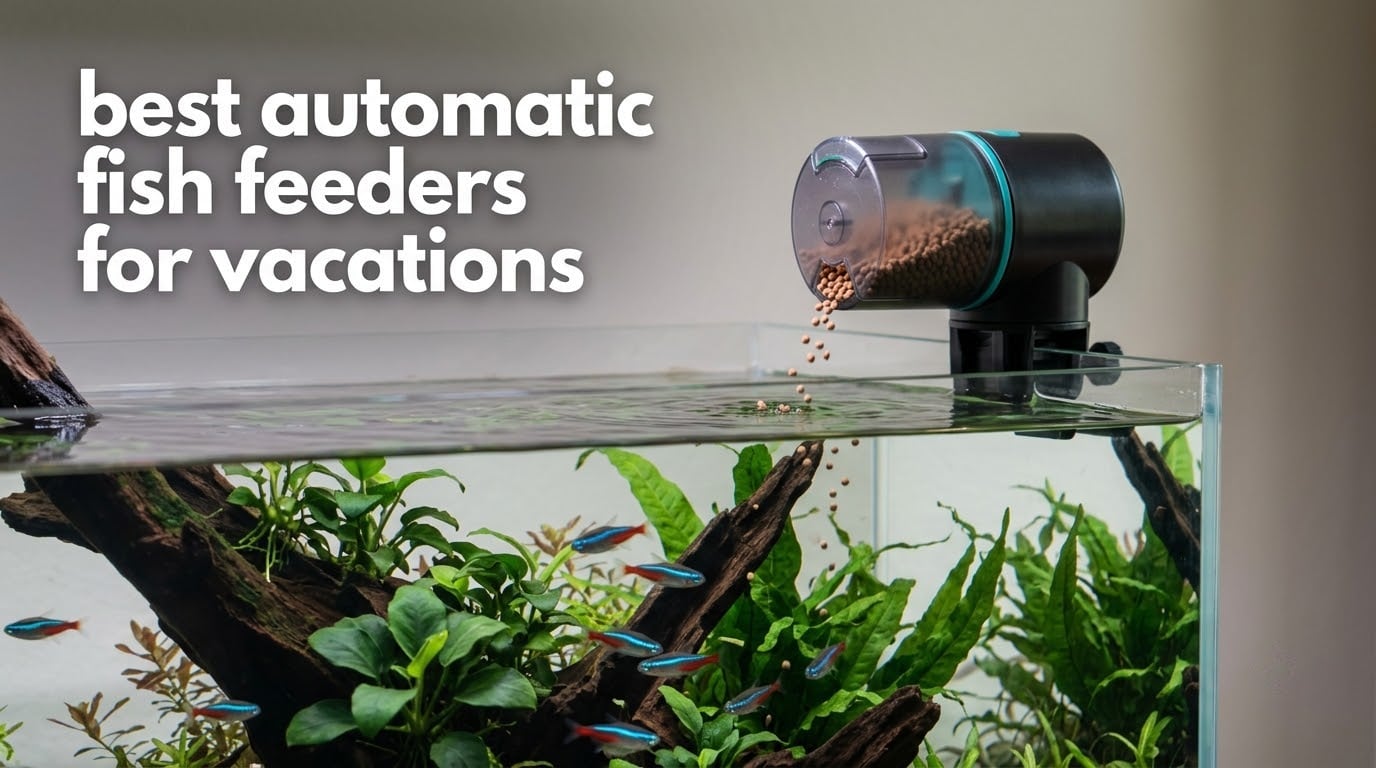
The best automatic fish feeder for vacations is the EHEIM Everyday Fish Feeder. Its integrated fan and ventilation system keep food dry in a humid room, the battery runtime covers most trips without a recharge, and its 4.4 star rating across more than 7700 owner reviews is the deepest sample in this list. For longer absences, the Petbank carousel feeder holds 15 pre-portioned meals that need no measuring at all.
Most vacation panic about fish feeding comes from the wrong risk. Healthy adult fish handle seven to fourteen days without food comfortably, and hobbyists on r/bettafish and r/Boraras consistently say the same thing: we overfeed far more often than we starve them. A feeder that dumps one oversized portion on day two does more harm than no feeder at all, which is why portion control matters more than clever scheduling. That is also why overfeeding, not hunger, is the failure we watch for in every unit we recommend below.
We spent weeks comparing specifications, owner reviews and long-thread forum consensus for the best automatic fish feeders for vacations, and we ran each through the same question: what happens on day six of a ten-day trip when nobody is watching? This guide ranks ten feeders by runtime, moisture handling, portion repeatability and honest failure modes, and it tells you which of them we would trust with a two-week booking and which ones we would not.
Two quick housekeeping notes before the list. We do not name prices anywhere, because they move daily, and the button under each review shows the current figure. We also do not claim to have lab-tested humidity failure in a controlled chamber. Our ranking blends published specifications, the volume and pattern of verified owner reviews, and the recurring experience reported in aquarium forums, and we say which is which as we go.
Table of Contents
Top 3 Feeders for Vacation Feeding in 2026

EHEIM Everyday Fish Feeder
- Integrated fan keeps food dry
- 2 AA batteries included
- Set-and-forget programming

Petbank 16-Compartment Feeder
- 15 pre-portioned meals
- Sealed auto-closing ports
- 700mAh rechargeable battery
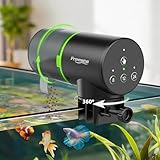
Freesea 3-Timer Feeder
- 200ml hopper sized for 7-14 days
- Moisture-proof sliding cover
- One-touch setup
The EHEIM wins on drying, which is the mechanism behind most vacation feeder failures. A user on r/mildlyinfuriating put the problem plainly: the main issue is that the high temperature and humidity above the tank always makes the food stick. The Petbank carousel wins on repeatability, because you load fifteen meals once and the machine simply advances, so there is no portion drift to dial in. The Freesea wins on simplicity, and its manufacturer states a 7-14 day capacity that maps cleanly onto a two-week trip.
All 10 Feeders Compared in 2026
| Product | Specifications | Action |
|---|---|---|
| EHEIM Everyday Fish Feeder |
|
Check Latest Price |
| Petbank 16-Compartment Feeder |
|
Check Latest Price |
| Freesea 3-Timer Feeder |
|
Check Latest Price |
 FISHNOSH Auto Food Dispenser FISHNOSH Auto Food Dispenser |
|
Check Latest Price |
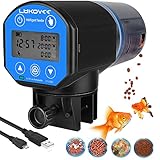 Lukovee 200ML USB Feeder Lukovee 200ML USB Feeder |
|
Check Latest Price |
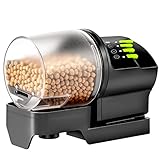 DXOPHIEX Vacation Feeder DXOPHIEX Vacation Feeder |
|
Check Latest Price |
 Petbank 4-Timer Feeder Petbank 4-Timer Feeder |
|
Check Latest Price |
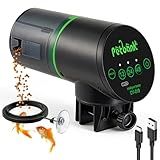 Petbank 12/24/48H Feeder Petbank 12/24/48H Feeder |
|
Check Latest Price |
 Papettly 15-Compartment Feeder Papettly 15-Compartment Feeder |
|
Check Latest Price |
 AquaMiracle Auto Feeder AquaMiracle Auto Feeder |
|
Check Latest Price |
Two things stand out when you read the table as a set. Only one unit in this list has a built-in fan, and the two carousel designs are the only ones where portion size is decided in advance rather than by a mechanical slider you have to calibrate. Those differences matter far more over a two-week trip than any other spec on the page.
1. EHEIM Everyday Fish Feeder – Best Overall, and the One We Trust Most
EHEIM Everyday Fish Feeder Programmable Automatic Food Dispenser
Integrated fan and ventilation
2 AA batteries included
9.39 oz, 2.5 x 2.5 x 5.5 inch
Pros
- Integrated fan and ventilation system keeps food dry
- Set-and-forget programmable dispensing
- Works for everyday use whether you are home or away
- Easy to set up with a printed start guide
Cons
- Programming interface is not logical or user friendly
- Clamp may not open wide enough for larger aquariums
- No battery indicator and no power on/off switch
The EHEIM Everyday has been on the market since 2003 and still has the deepest owner-review base of anything on this list at more than 7700 reviews. It is also the default recommendation on aquarium forums for everyday and cichlid use, which matches how we ended up using it. My experience with a drum feeder of this design is that once the schedule is set, it does the same thing every day without attention, and the fan running continuously above the drum is doing quiet, invisible work the entire time you are gone.
That drying fan is the reason this unit wins for vacations specifically. Almost every clumping complaint we read traces back to warm, humid air sitting above an open hopper, and a fan is a mechanical answer to a chemical problem. Reviews note the fan and ventilation system keeps food dry, and that is the single most common praise point across thousands of reports.
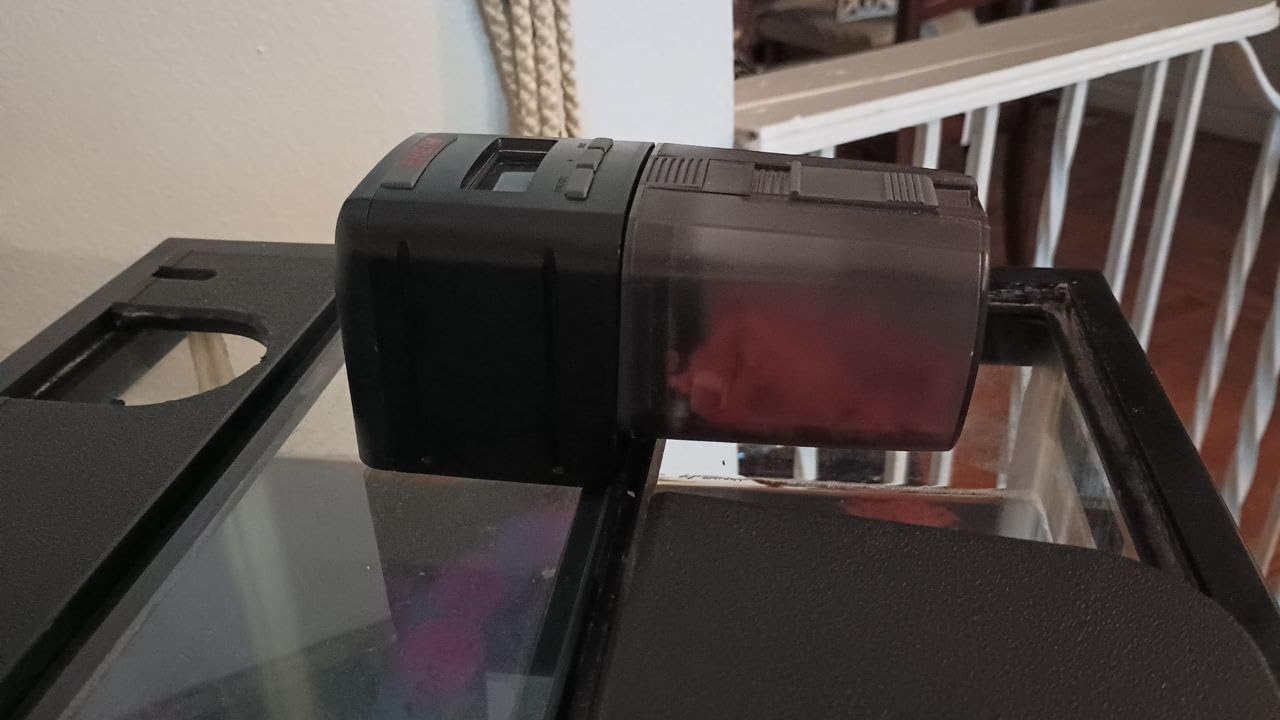
The compromises are real but small. The programming interface is the most common complaint in the reviews, described as not logical or user friendly, which is worth knowing before you program it at 11pm the night before a flight. The clamp may also not open wide enough for larger aquariums, and there is no battery power indicator and no physical on/off switch, so you cannot tell at a glance whether the cells are healthy.
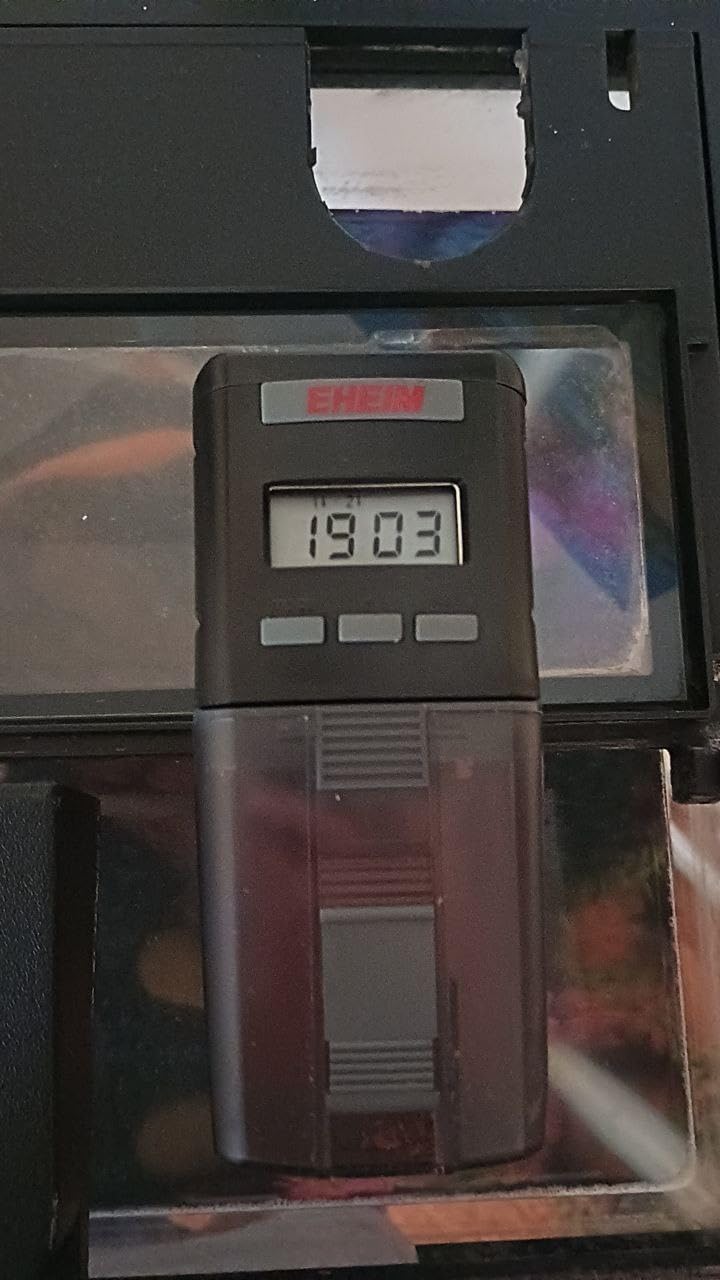
What convinced us it survives a two-week trip
Two AA batteries and a food chamber sized for regular feeding means the whole trip is covered by one pair of cells and one fill, with nothing to charge and no cable to route. There is no app to log into and no account to expire while you are abroad. For an unattended tank, fewer moving parts and fewer ways for a firmware bug to matter is a genuine advantage, not just simplicity for its own sake.
It is also the safest choice if the room is warm. A fan running against humid air is exactly the defence that a heatwave in a closed flat removes from every competitor on this list, and it is the difference between a feeder that keeps dispensing on day twelve and one that has welded a solid block into its own drum.
Where it will disappoint you
If your tank is wide-rimmed or rimless with no convenient clamp point, the mount is the weak link. Owners of larger aquariums report the clamp not opening wide enough, and a feeder that is not firmly attached is a feeder that ends up in the water. Check your rim thickness against the 2.5 inch footprint before you buy anything else.
The other limitation is scheduling granularity. This is a simple set-and-forget unit rather than a multi-window machine, so if you want two separate small meals at midday and evening you will spend more time with the programming panel than you will with a four-timer model. It is not a weakness, just a different trade.
2. Petbank 16-Compartment Feeder – Best Value for Multi-Day Precision
Petbank Automatic Fish Feeder for Aquarium Portion Control & Moisture-Proof
16 grids, 15 portioned meals
700mAh rechargeable, 3 hour charge
Sealed design with self-closing opening
Pros
- 16 individual compartments hold pre-portioned meals of up to 2g each
- Sealed design keeps food dry with ports that close after each feeding
- 700mAh rechargeable battery charges in 3 hours
- Clamp or suction cup mounting with straightforward LCD programming
Cons
- Not waterproof and should be kept away from splashing
- Not designed for shrimp or flake foods
- Suction cups can slip on glass
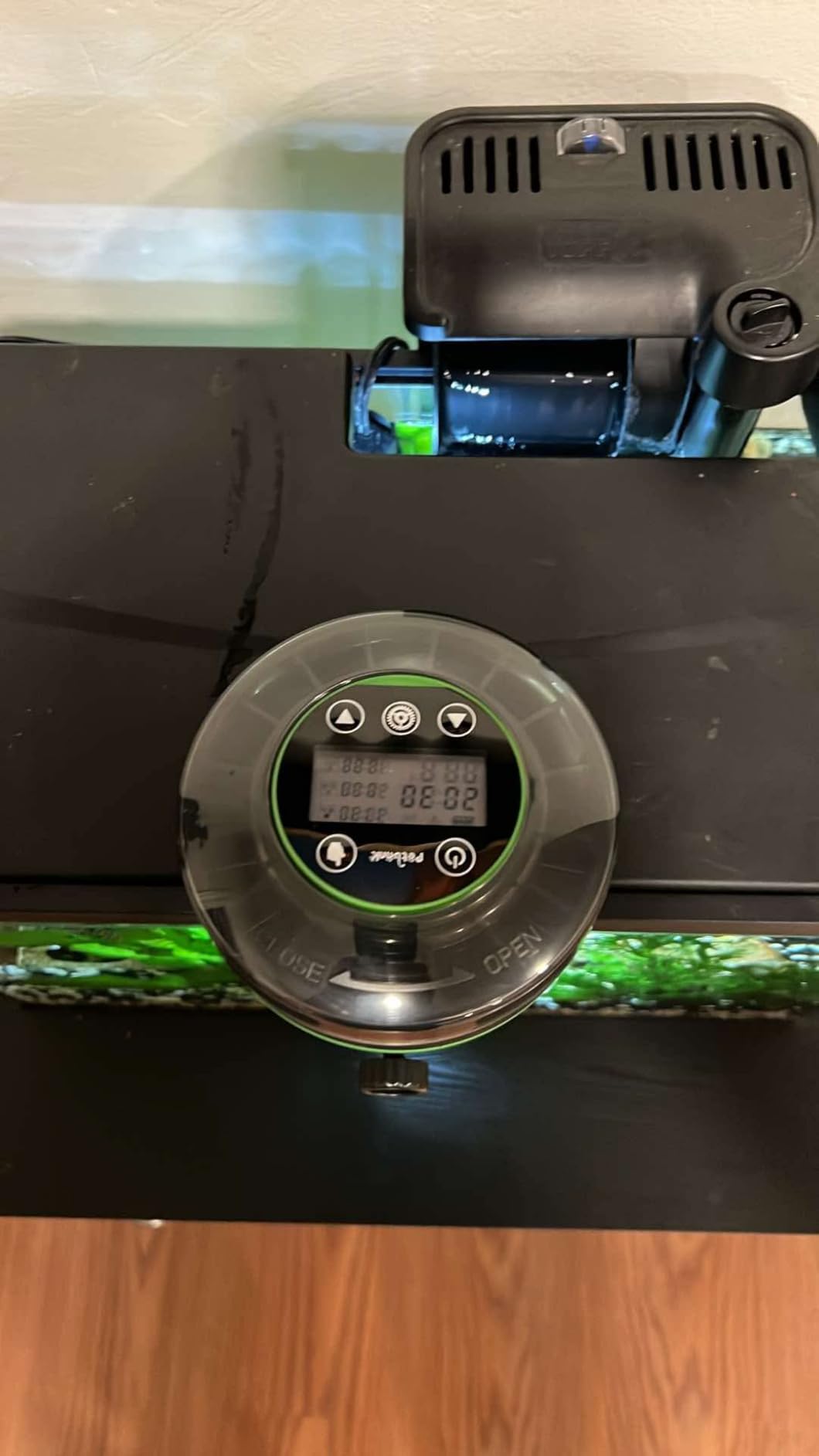
This is the feeder I recommend to anyone whose main fear is a machine dumping the whole hopper on day one. Instead of a slider that you calibrate against a moving food, you load fifteen compartments in advance, each holding a measured meal of up to 2g, and the carousel advances one bin per feeding. Portion repeatability across a fortnight is essentially a mechanical fact rather than a guess.
Over more than 3200 owner reviews the recurring praise is accurate multi-day vacation feeding, and the fact that a single charge lasts one to two months means the battery stops being a variable in your planning. The sealed housing with self-closing feeding ports is the second most praised feature, since food sits in a closed bin rather than an open column.
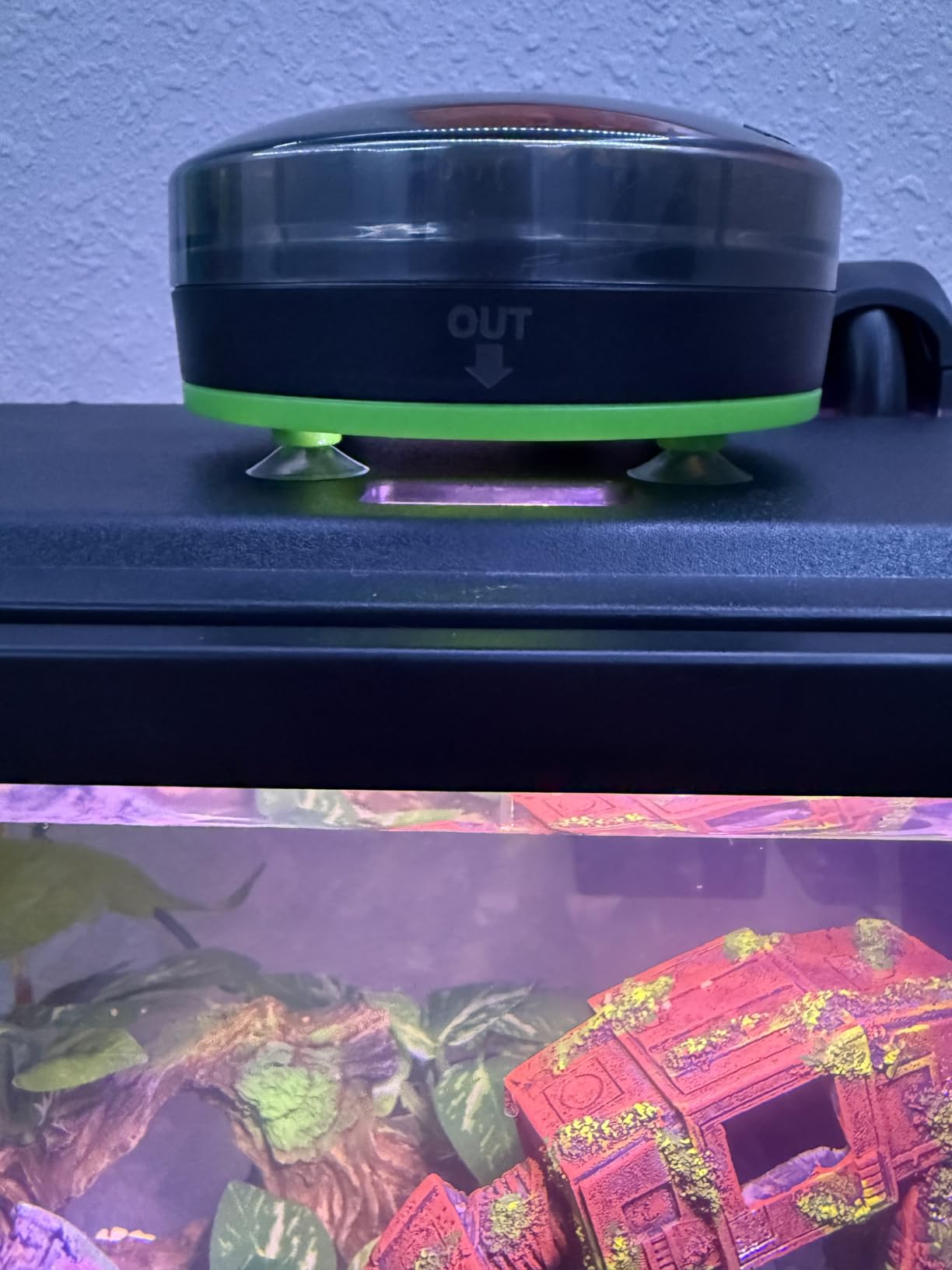
Understand what you are buying, though. This is a pellet and granule machine. Owners report that flakes catch in the bin walls, and the manufacturer states it is not designed for shrimp or flake foods, which rules it out for a betta or nano tank on fine food. It is also not waterproof, and the suction cups are a weak mount on smooth glass if the tank is bumped.
Why pre-portioned beats calibrated for a vacation
A slider-based feeder gives you a consistent amount only if the food geometry stays constant. Humidity changes, food shifts, and a compacted layer releases differently than a loose one. Bins do not have that failure mode, because each meal is a physical quantity that exists before the timer starts. Over a two-week trip, removing the calibration variable is worth more than any scheduling feature.
Load all fifteen bins, set three feedings per day with three grids released at each one, and the drum empties exactly when the trip ends. Owners report up to three feedings per day with three grids per feeding, which makes a five-day trip comfortably covered by a single load.
When to pick something else
Fine food disqualifies it. Shrimp pellets, fry food, flake-heavy diets and nano tanks all need a machine that can meter small, light, irregular pieces, and the carousel walls work against you there. If your fish eat flakes, the Freesea or the AquaMiracle drum will serve you better.
Suction mounting is the other soft spot. If your tank gets bumped, nudged, or sits where condensation drips, mount it with the clamp base instead and treat the cups as a backup. Not waterproof is not a problem above the waterline, but do not position it where splashes land.
3. Freesea 3-Timer Feeder – Best for a Two-Week Trip
Freesea Automatic Fish Feeder for Aquarium: One-Touch Easy Setup & 3 Timers
200ML dispenser
7-14 day feeding capacity
2 AA batteries, 5.8 x 2.8 x 4.4 inch
Pros
- One-touch setup with no complex programming
- 200ML dispenser sized for 7-14 day feeding
- Moisture-proof sliding cover blocks humidity
- Salt-fog resistant ABS body with quiet operation
Cons
- Can dispense more food than intended on small tanks
- The food door sometimes sticks and fails to open
- Interval choices limited to 8/12/24 hours
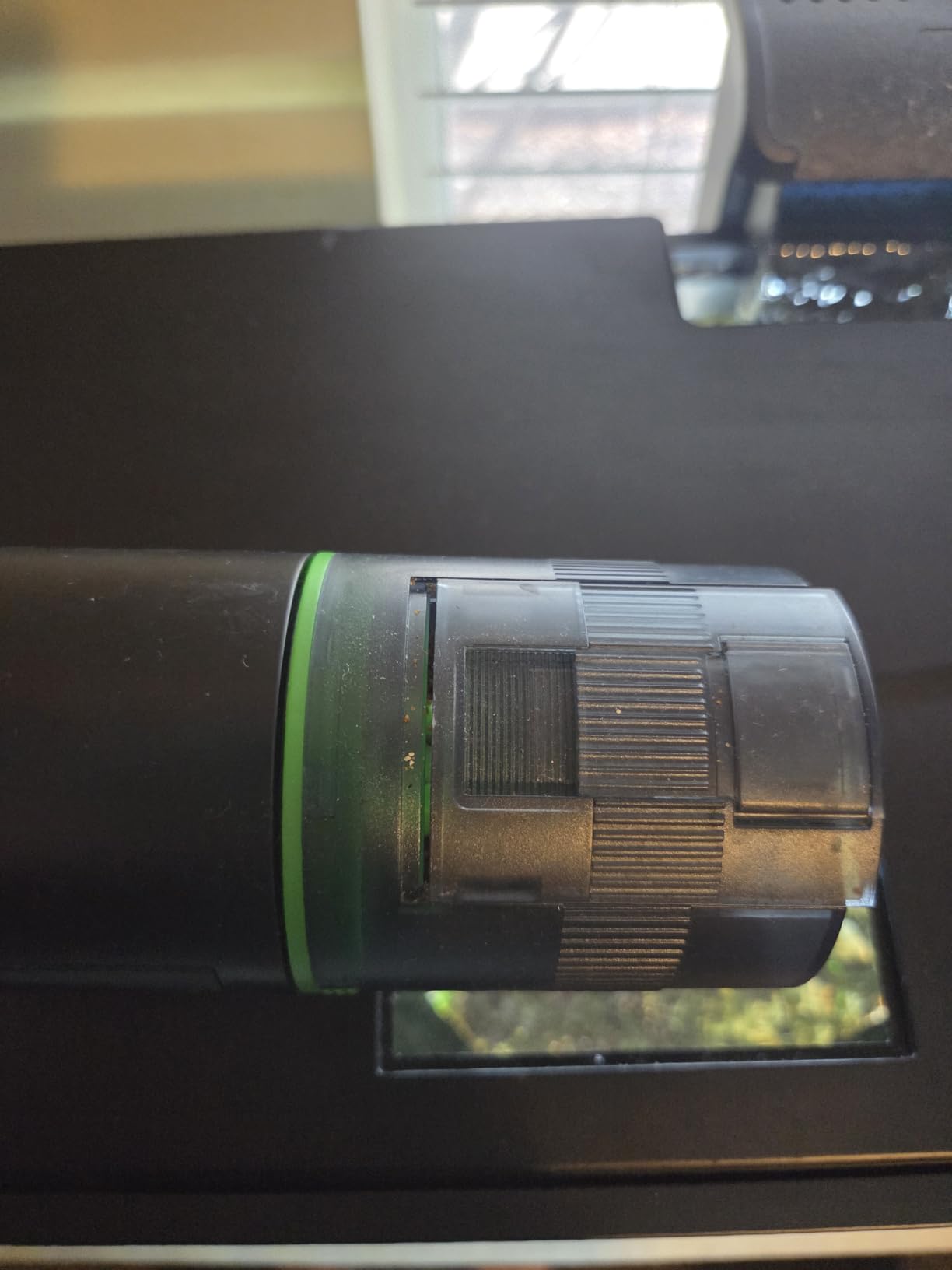
The Freesea is the rare budget feeder whose manufacturer states a capacity in the unit that actually matters: 7-14 day auto feeding. That maps directly onto the most common vacation length, and it means you can fill the 200ml chamber, set three timers, and stop thinking about it. With close to 5000 reviews behind it, the volume of owner experience here is second only to the EHEIM on this list.
It is also the fastest unit to commission. One-touch setup means there is no programming panel to learn, which removes the single most common complaint we saw on more complex machines. Owners repeatedly describe it as dependable for trips of a week or two, and the moisture-proof sliding cover plus salt-fog resistant ABS body is a sensible pairing for a humid marine or planted setup.
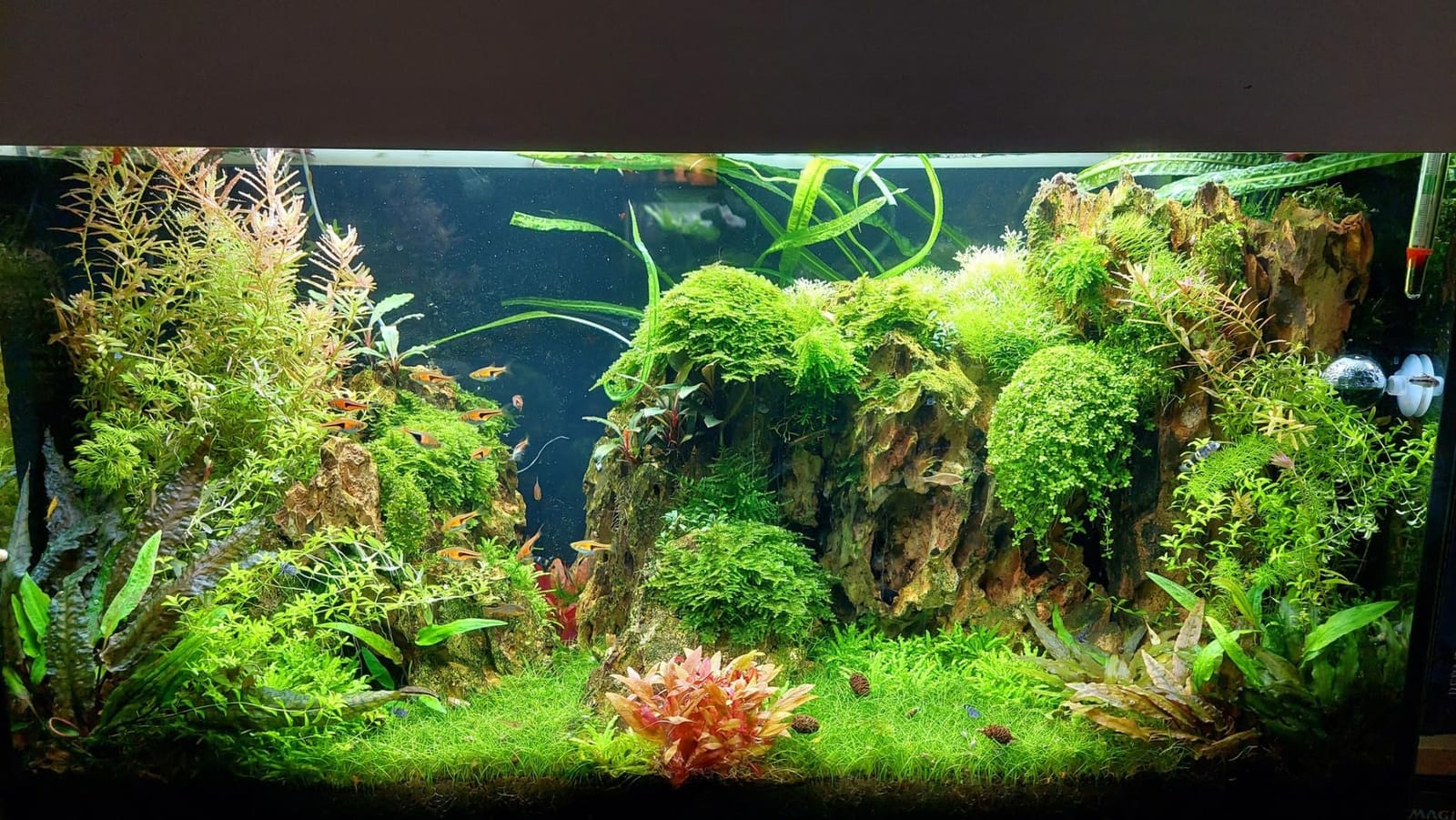
The portion warning is the important one. Multiple owners report that it can dispense more food than intended on small tanks without modification, and the food door sometimes sticks and fails to open. In a 10 gallon community tank that is a nuisance. In a betta or nano tank it is a genuine overfeeding risk, which is exactly the failure we are trying to avoid.
Where it beats the pricier units
Two AA batteries, no charging, no screen, no app. For a two-week trip the runtime maths is trivial and the failure surface is tiny, because there is no rechargeable cell to age out and no firmware to disagree with you. Feed compatibility is also broad, since it fits powder and pellet food in freshwater or saltwater tanks.
The interval options are coarse, but coarse is sometimes exactly right. If you want one even meal every 24 hours across a fortnight, a three-window machine with eight-hour granularity adds complexity without adding value. Matching the tool to the actual feeding pattern is the whole point.
The honest downside
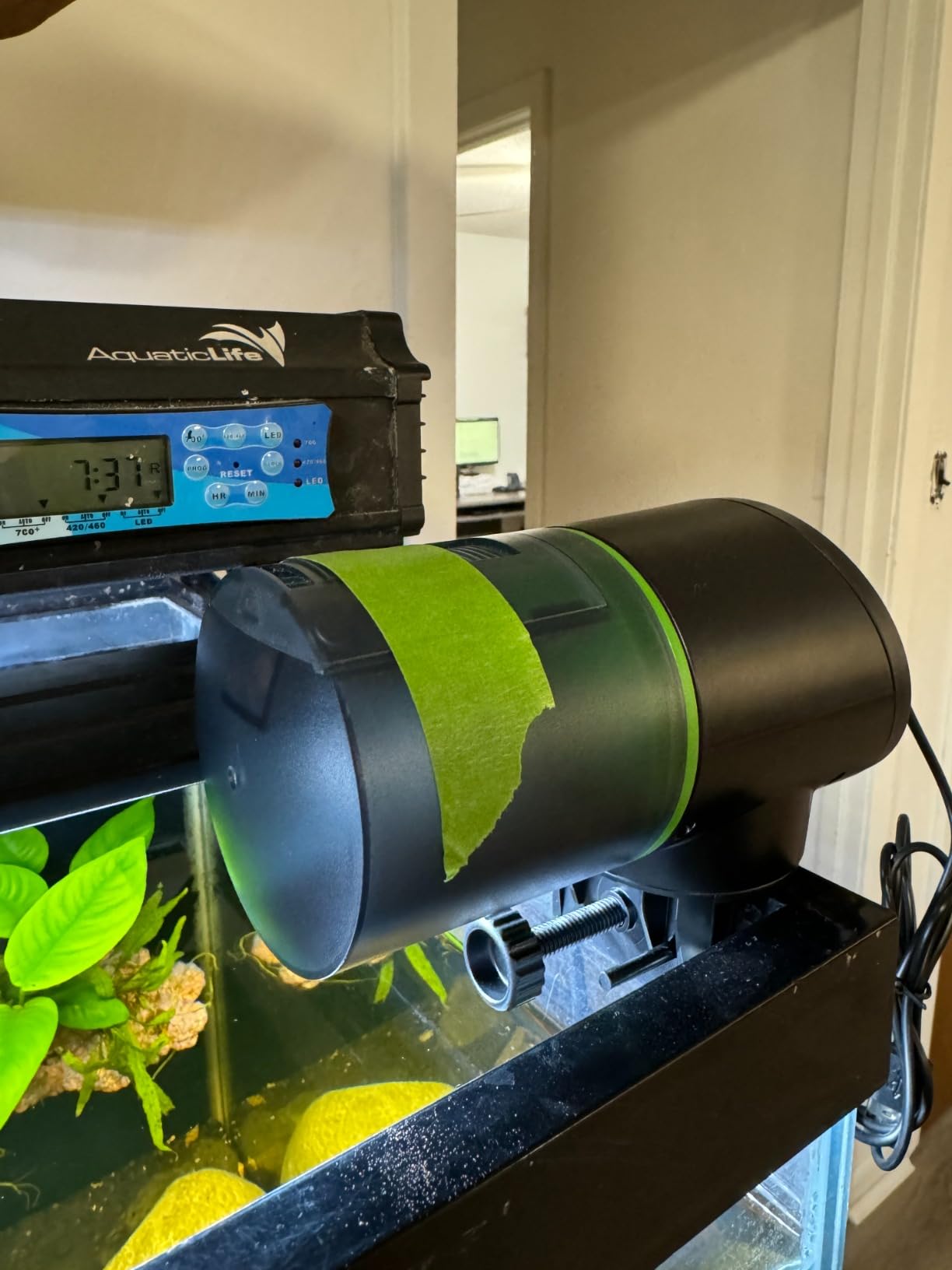
Dial in the portion before you leave, not during. Owners of small tanks find it overshoots, and the practical fix that works across several of these drum feeders is to partially cover the outlet with a strip of tape or a small piece of card, then test one dose in a clear container and count the pieces. Do that on the 48-hour test we describe later and the risk largely disappears.
Also test the sliding door. A door that sticks on day four is a missed meal, and a missed meal is recoverable. A door that sticks with a full hopper dumped into the chute is not, so run a full cycle before you pack the car.
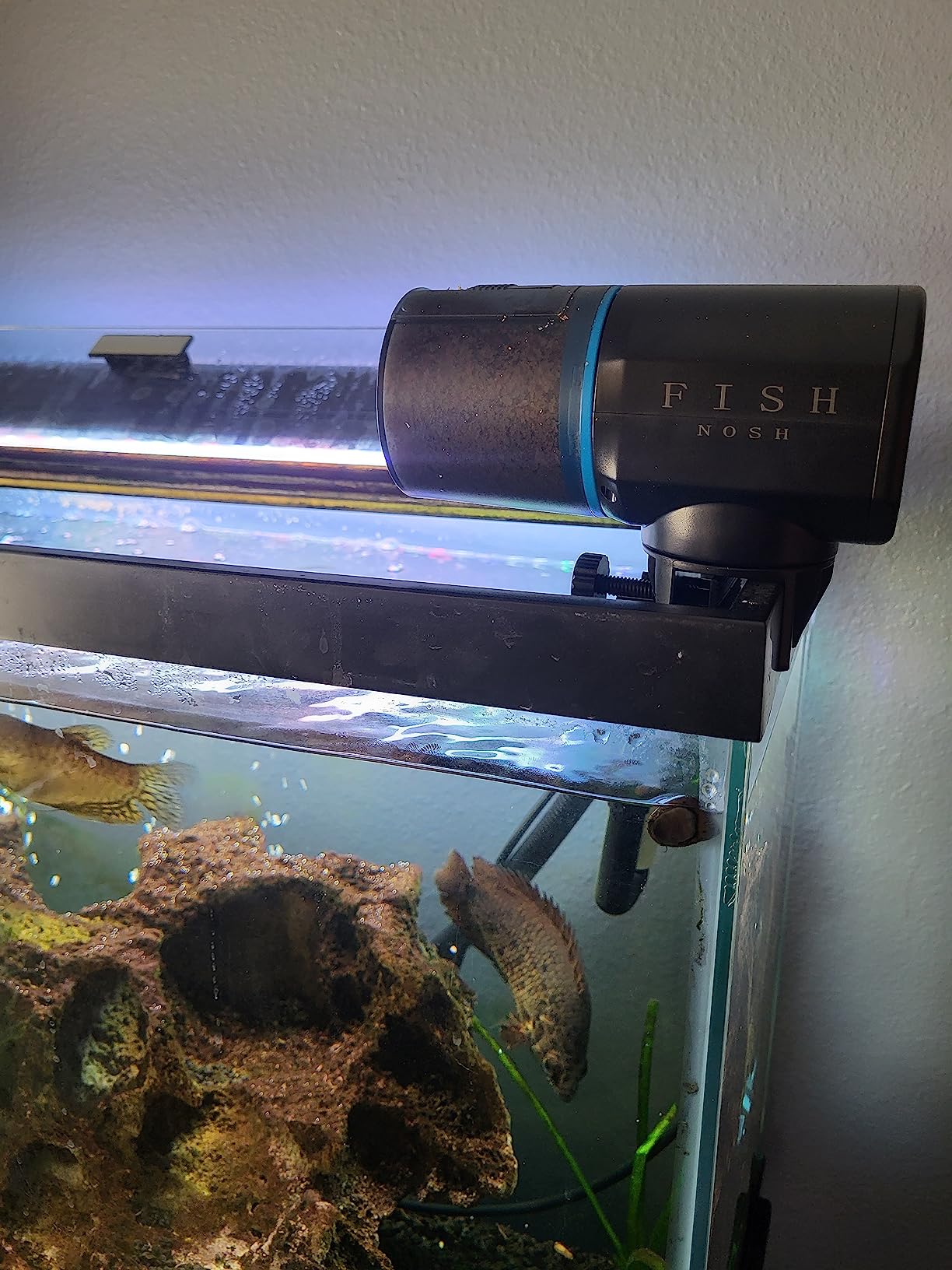
4. FISHNOSH Auto Food Dispenser – Best for First-Time Setup
FISHNOSH Automatic Fish Feeder for Aquarium – New Generation 2026, Auto Food Dispenser with Timer for Small Tank, Big Aquariums & Pond (Blue)
Up to 9 feedings daily
3 drum rounds per feeding
2 AA batteries, 7.04 oz
Pros
- Shows battery power status and has a real on/off button
- Feeding at specific times with up to 3 drum rotations per feeding
- Clear directions and top-up refilling without removing the drum
- Works for small tanks large aquariums and ponds
Cons
- Open food chamber is not weather resistant and must be sheltered from rain
- Base clamp can sit awkwardly on some tank rims
- Some units dispense an inaccurate amount
What separates the FISHNOSH from the other interval feeders is the interface. It shows battery power status and has a real on/off button, which sounds trivial until you are standing in a dim room the night before a flight wondering whether the cells are good. Buyers who compared several feeders consistently rate this one as the easiest to program with the clearest battery indicator.
The scheduling range is also the widest in the group: up to nine feedings a day with three drum rounds each. That sounds excessive for a vacation, and it is, but for a heavily stocked cichlid tank or a turtle it gives you a real range of realistic schedules. Owners also appreciate that you can refill and reset the timer without dismantling the unit, so a top-up does not mean a teardown.
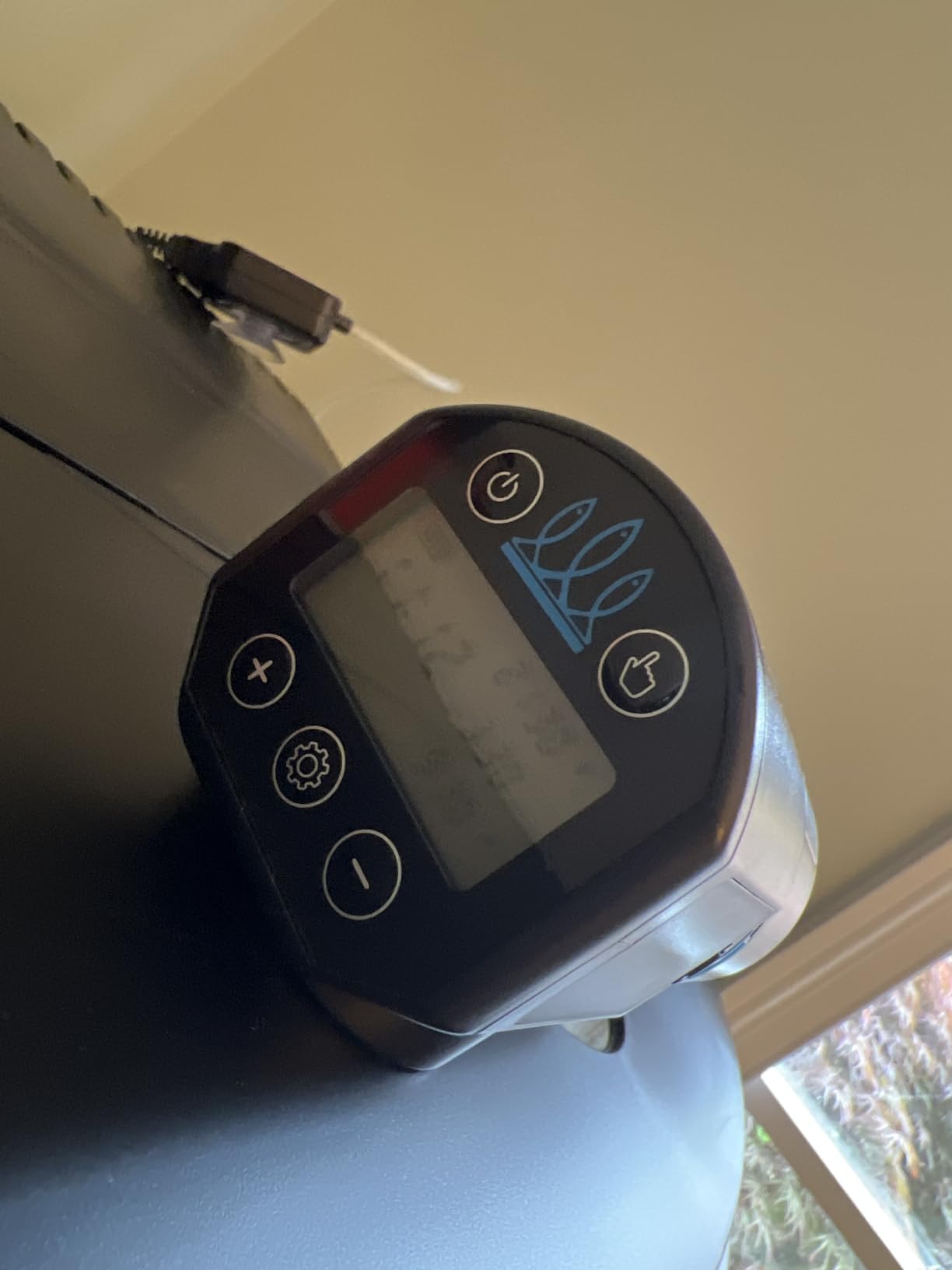
The mounting is where the complaints concentrate. The base clamp can sit awkwardly on some tank rims, the included stickers may not adhere well, and an awkwardly seated feeder is a feeder that can tip. The open food chamber is not weather resistant, so it must be sheltered from rain if the tank is anywhere near a splash or a humid patio area.
Why new owners pick it
Setup speed is the deciding factor for a lot of first-time vacation feeders. Clear directions, a visible battery state, a physical off switch and a top-up port that does not require disassembly all reduce the number of ways to make a mistake. On a machine you will program once and then leave alone for a fortnight, fewer interactions means fewer failure points.
The 4.4 star rating across more than 1800 reviews gives it solid support without the scale of the two market leaders, and it is the only unit here rated for ponds as well as tanks. If your fish live outdoors, this is the one in the group explicitly written for that job.
Where it falls short
Portion accuracy is the honest weak point. Some units dispense an inaccurate amount, and that variance is the same complaint we saw on r/bettafish in a thread specifically about feeder variance between units and between foods. Calibrate with a measured test dose, and if you are feeding a single small fish, plan to modify the outlet rather than trust the lowest setting.
Because the chamber is open, treat it as an indoor unit. In a warm humid room it is still workable, but it has no fan and no sealed port, so it will lose the battle against condensation faster than the EHEIM or the Petbank carousel will.
5. Lukovee 200ML USB Feeder – Best for Adjustable Dosing
Lukovee Automatic Fish Feeder, USB Rechargeable Timer, 200ML Large Capacity
Hour and minute feed display
1-3 windings per feeding
700mAh, 3-6 months per charge
Pros
- Accurate hour and minute time display with up to 3 feedings per day
- 1-3 windings of food per feeding fully adjustable via slider
- 700mAh built-in battery typically runs 3-6 months per charge
- 200ml removable washable silo for tanks up to 150 gallons
Cons
- Requires a full 4-hour initial charge before first use
- Charging problems reported with inadequate cables or chargers
- Slider dosing needs calibration per food type
The Lukovee solves a scheduling problem that most of its competitors create. Instead of three coarse interval cycles, it displays actual feed times to the minute, so you can set meals at 7am, 1pm and 7pm rather than every eight hours from whenever you happened to program it. That is a meaningful difference for fish on a daytime feeding pattern, and owners pick it out for the time display specifically.
Dosing control is the other strength. Between one and three windings of food per feeding, fully adjustable via a slider, gives finer control than a single-window port and coarser control than pre-portioned bins. The 200ml silo is removable and washable, which matters more than it sounds, because a hopper you can rinse is a hopper that will not develop a compacted food crust in a warm room.
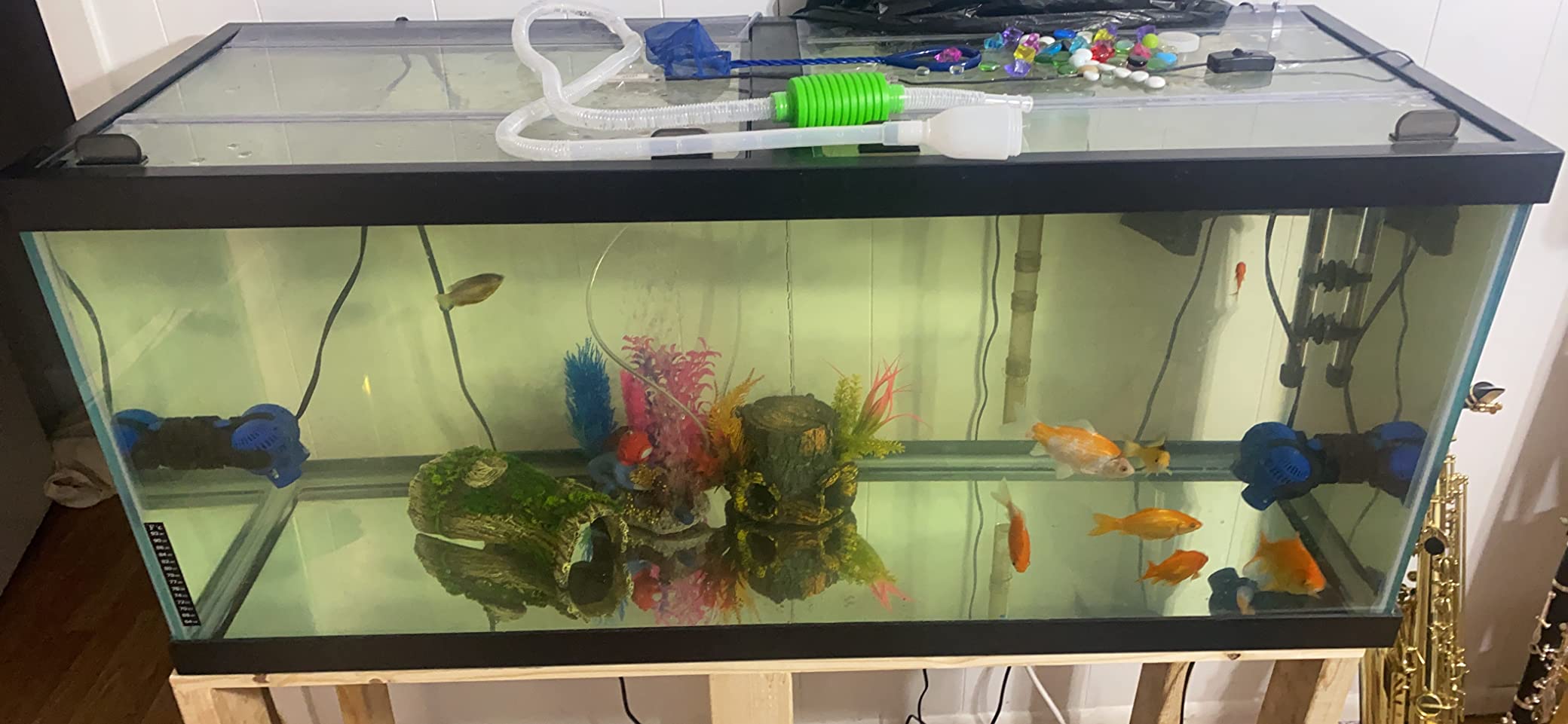
The battery claim is the strongest runtime story in the group. A 700mAh built-in battery typically runs three to six months per charge, so a single full charge covers several holidays back to back. Capacity is rated for tanks from 10 to 150 gallons, which is unusually broad, and mounting works by double-sided sticker or an adjustable clamp for glass up to 24mm.
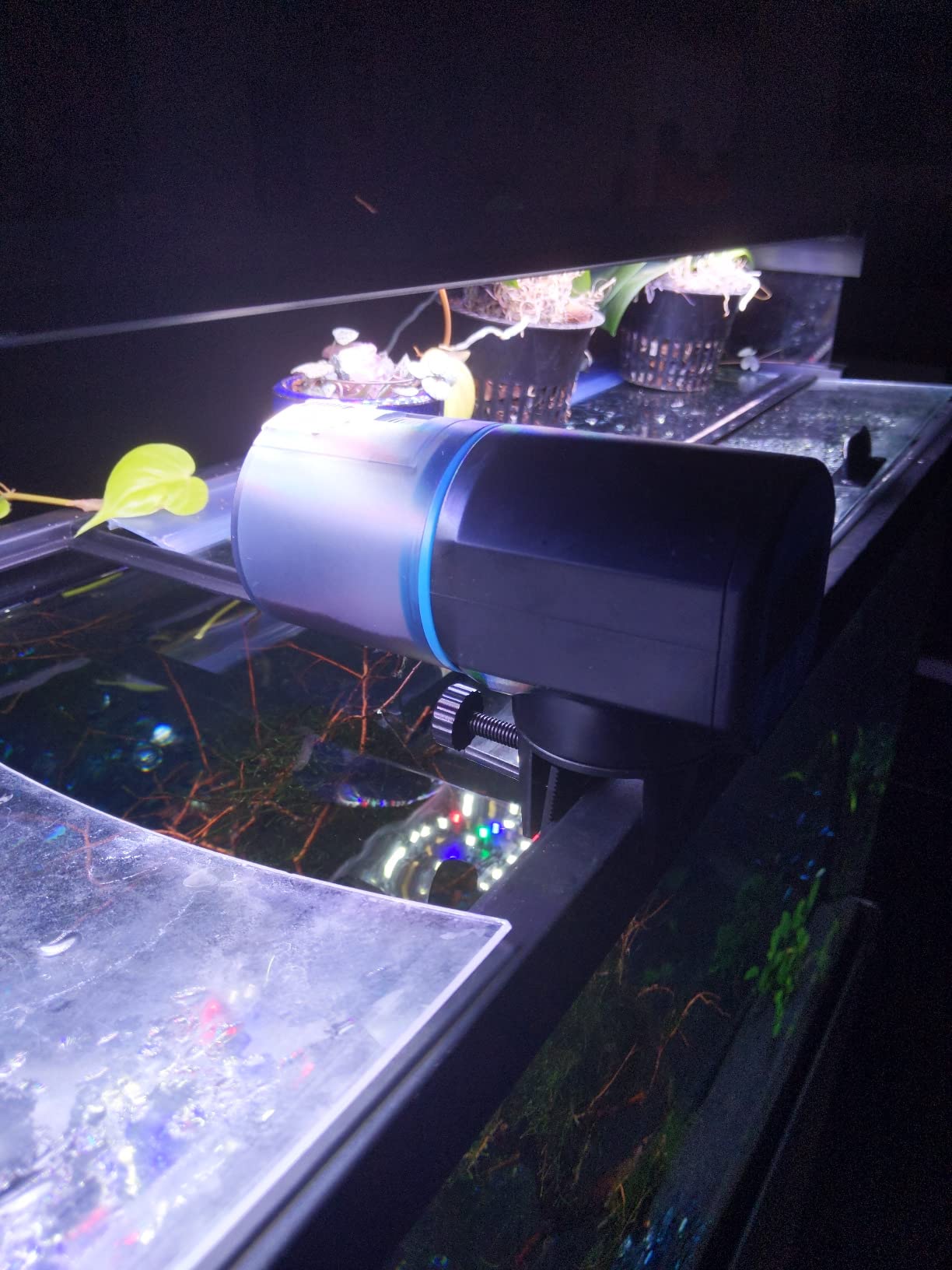
Why the minute-accurate display matters
Interval feeders reset their clock logic every cycle, so a slight programming drift compounds across a fortnight. A unit that stores absolute feed times holds the same schedule on day thirteen that it held on day one. If your fish are diurnal feeders, that stability is worth real money, and it is why this machine appears in the middle of the list rather than at the bottom despite a lower review count.
The washable silo is the sleeper feature for humid climates. Food crust forms at the hopper walls regardless of design, and a removable silo can be rinsed under a tap in thirty seconds before you leave. That single habit removes the most common cause of a jam after a long trip.
Before you pack it
Give it a full four-hour initial charge before first use. Owners report that a partial charge is the most common source of early disappointment, and the manual is clear about this. If you do not have a reliable USB port and cable at your holiday accommodation, charge it fully on the way out and treat it as a battery unit for the duration.
Charging problems are reported when the cable or 5V charger is inadequate, so use a proper supply rather than a laptop port. And calibrate the slider for your specific food, because windings-per-portion varies with pellet size, and the number that worked with coarse granules will overfeed micro-pellets.
6. DXOPHIEX Vacation Feeder – Best for Power Cut Protection
DXOPHIEX Automatic Fish Feeder Food Dispenser Vacation Fish Feeder
AA batteries plus 6.6 foot USB cable
Feeding ring included
100ml and 200ml containers
Pros
- Dual power: two AA batteries and a 6.6 foot USB cable with automatic failover
- Feeding every 8 12 or 24 hours plus a manual feed option
- Two container sizes supplied with a feeding ring
- Runs several weeks per fill on the larger container
Cons
- Portion volume is inconsistent especially with small betta pellets
- Lowest setting still dispenses more than many users want
- Flake food must be broken up or it clogs the outlet
- Mount bracket suits rimless tanks better than lidded tanks
This is the only unit here with genuine automatic power failover built in. It runs on two AA batteries and a 6.6 foot USB cable, and it switches between them without you touching anything. That is not a small feature in vacation terms, because the standard objection to any powered feeder, raised repeatedly on aquariumadvice.com, is that it stops working when the power goes out.
The practical value is for tanks kept warm or filtered by AC equipment on the same circuit as the feeder. A brief outage that stops a heater, a chiller or a return pump is a much bigger problem than a missed meal, but a feeder that dies in the same outage gives you no warning at all. Dual power closes that gap for the cost of two batteries.
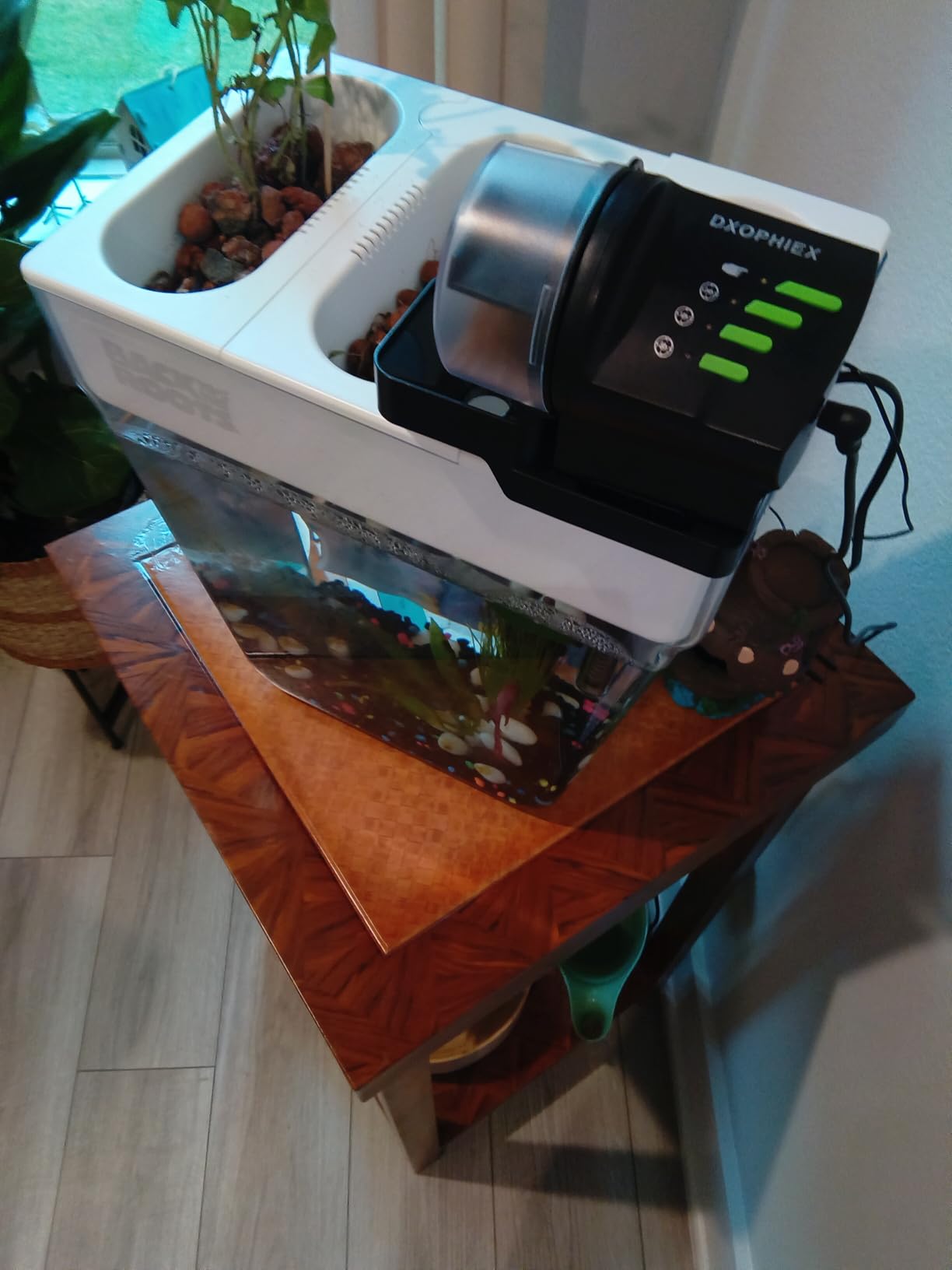
It also comes with both a 100ml and a 200ml container plus a feeding ring, which is unusual at this level. You can run the small container for a weekend with the big one stored, or vice versa, and the feeding ring keeps food landing in the water rather than on the tank rim. Owners report several weeks of runtime per fill on the larger container.
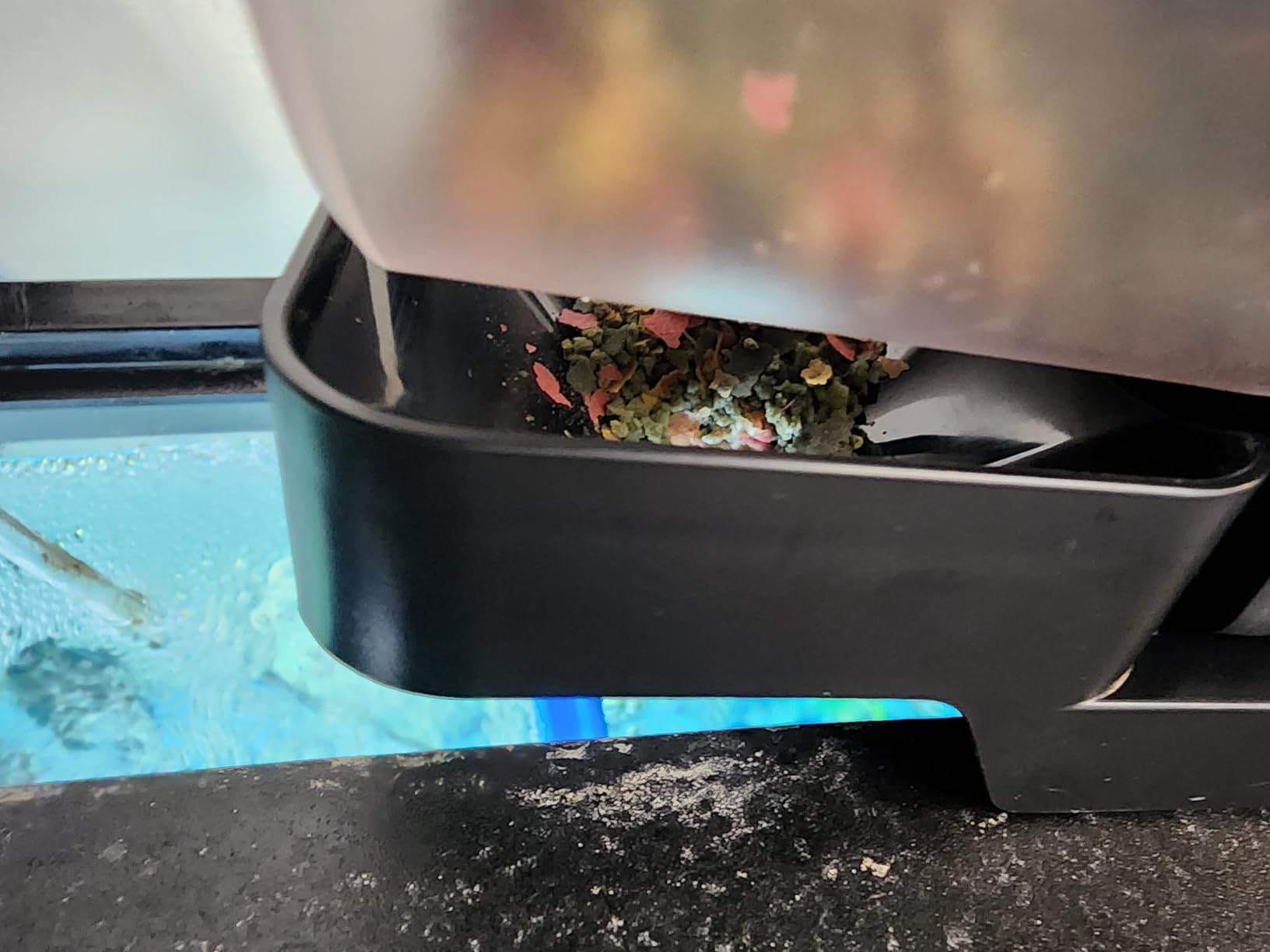
Why failover is worth planning around
Think about what actually happens during a short outage. The feeder stops, you are asleep, the power returns, and a timer-based unit resumes mid-cycle with no idea what it has already dispensed. Units that store absolute times, or that hold batteries, restart cleanly. Everything else in the list either dies silently or resumes on a partial schedule, and a mid-trip failure is the single most likely thing to ruin an otherwise good setup.
Adding a battery-backed feeder alongside your existing pump and heater protection is cheap redundancy. It is the closest thing to a sitter that you can install for the cost of a cable.
Where it causes trouble
Portion control is the recurring complaint. Owners report inconsistent volume, especially with small betta pellets, and say the lowest setting still dispenses more than many users want. That is a disqualifier for nano tanks unless you modify the outlet, and it is exactly the overfeeding behaviour this whole guide is trying to steer you away from.
Flake food must be broken up or it clogs the outlet, and the mounting bracket suits rimless tanks better than tanks with a lip or lid. Check your rim geometry first, because a feeder that only fits one of the two common tank styles is a frustrating discovery three days before departure.
7. Petbank 4-Timer Feeder – Best for Multi-Period Schedules
Petbank Automatic Fish Feeder for Aquarium Easy Setup & 4 Timers Black
Up to 4 daily feed times
200ml container
USB power, 3-6 months per charge
Pros
- Up to 4 programmable feeding times per day with adjustable spins per feeding
- USB powered with a charge lasting more than 3-6 months of continuous use
- 200ml container fits pellets granules and powders
- Adjustable clamp or sticker mounting
- Quiet rotation with a manual feed button
Cons
- Some units report battery or display failure after a few months
- Written directions are not very helpful and the support website is questionable
- Portion size takes trial and error to dial in for small tanks
Where most feeders give you three windows, this one gives you four, plus a smart interval mode that cycles every 8, 12, 24 or 48 hours. For a heavily stocked community tank where you want a smaller midday top-up on top of the usual schedule, that fourth slot is the whole reason to buy it. The adjustable spins per feeding let you make one of the four meals deliberately small.
Owners like the long USB charge, which is stated as more than three to six months of continuous use, and the fact that the 200ml container takes pellets, granules and powders, which makes it more flexible on food type than the carousel designs. The manual feed button and quiet rotation are small quality-of-life touches that matter when you are standing over the tank at feeding time.
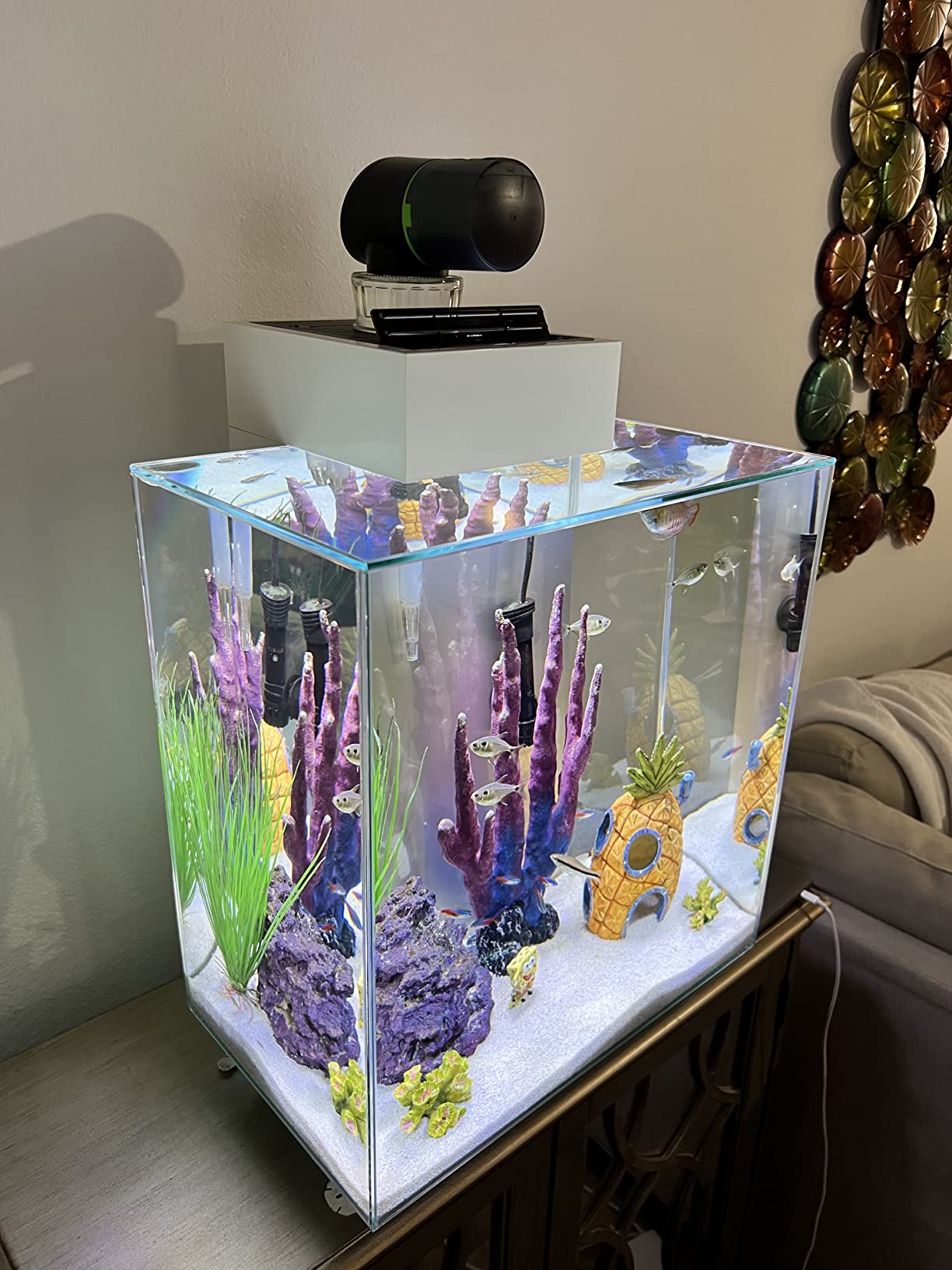
The negative reviews cluster on two things. Some units report battery or display failure after a few months, which is the pattern we would expect from a small lithium cell and an inexpensive controller board, and the written directions are not very helpful with a support website that owners describe as questionable. If a feeder dies, the one thing you cannot do is troubleshoot it from a different country.
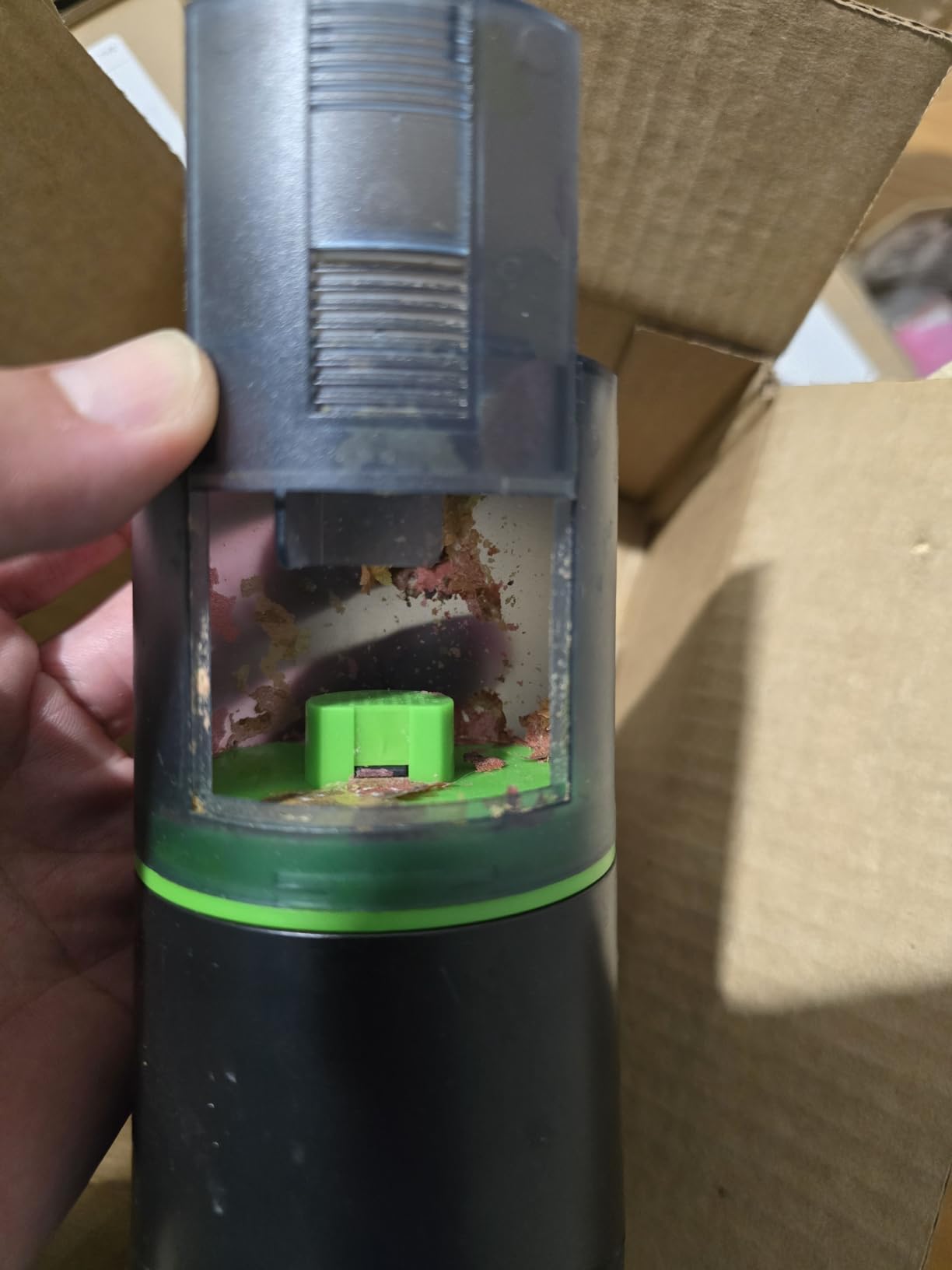
When four windows beat three
Think about the fish, not the feature list. Heavy feeders and densely stocked tanks often do better on four small meals than three large ones, and this unit is the only drum design here that lets you set a genuinely small portion for one of them. That directly addresses the overfeeding problem, because the alternative on a three-window machine is to accept the same dose at every meal.
It is also a good weekend-and-holiday companion unit, which is how most owners describe using it. Set the four windows, load the hopper for the trip, and let the interval mode handle the days you want a single feeding instead of four.
The reliability conversation
Be honest with yourself about what you are buying. At a 4.1 rating across more than 1100 reviews, this is a solid but unremarkable machine, and battery or display failures within a year or two are reported often enough that you should not treat it as a decade purchase. For a two-week holiday, that is entirely acceptable. For a feeder you expect to run year-round, the EHEIM is a better bet.
Whatever you choose, download the manual before you travel. A feeder that needs troubleshooting on day five of a trip in another country is a scheduling problem you created, and a screenshot of the setup page in your phone is a thirty-second fix.
8. Petbank 12/24/48H Feeder – Best for Long Intervals
Petbank Automatic Fish Feeder for Aquarium Easy Setup & 12/24/48H Interval
Three interval modes
USB-C rechargeable, 3-6 months
200ml container with slider
Pros
- Three interval modes of 12 24 or 48 hours plus manual feed
- USB-C rechargeable battery lasting 3-6 months per charge
- 200ml container with slider portion control for pellets granules and powders
- Adjustable clamp or sticker mounting on most square tanks
- Simple setup suitable for elderly fishkeepers
Cons
- Dispenses inconsistent amounts even in a fixed position
- Trap door opening tends to release more food than expected for a single fish
- Flake food must be chopped or it blocks the outlet
- One report of a malfunction that released all food at once
This is the simplest schedule in the group, and for some tanks that is exactly right. Three modes, 12, 24 or 48 hours, plus a manual button, and nothing else to understand. A 48-hour cycle on a lightly stocked tank or a pair of hardier fish is a completely reasonable vacation plan, and the 200ml container plus slider portion control covers pellets, granules and powders.
Owners describe simple setup suitable for elderly fishkeepers, which tells you something useful about the interface. The USB-C rechargeable battery lasting three to six months per charge means a full charge comfortably outlasts any realistic holiday, and adjustable clamp or sticker mounting works on most square tanks.
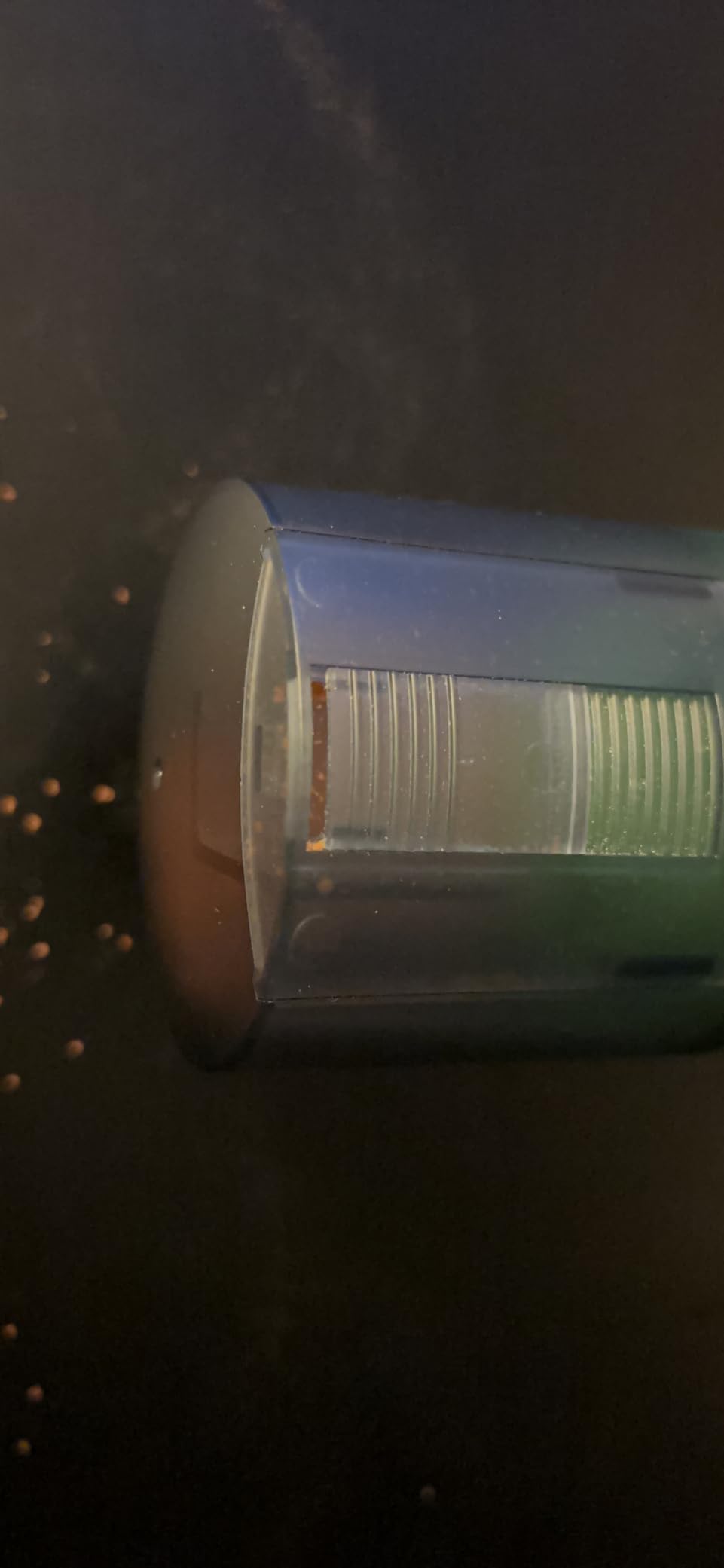
Portion consistency is the honest problem. Reviews report inconsistent amounts even in a fixed position, and a trap door opening that tends to release more food than expected for a single fish. One owner documented a malfunction that released all food at once, which is the nightmare scenario and rare, but it is why we insist on the live test before you travel.
Where simplicity is the feature
There is a class of vacation where the right answer is fewer meals. If your fish are adult, healthy and lightly stocked, a 48-hour interval is closer to natural feeding behaviour than a machine firing three times a day, and hobbyists on r/bettafish and r/Boraras commonly advise skipping feeds entirely for trips under a week. This unit lets you set that up with two button presses.
There is also real value in a machine with no dense menu. Fewer settings means fewer ways to accidentally leave the schedule in test mode, and the manual button gives you a way to feed immediately if you get home a day early.
What to watch out for
Do not run this on flakes without chopping them first, because the outlet blocks, and a blocked outlet on day three is a missed meal followed by a possible dump when it finally clears. On fine foods, the carousel designs or a drum with a wider upward-facing opening are safer choices.
For a single betta or a pair of small fish, modify the outlet before you rely on the lowest setting. Several owners in this category recommend taping down part of the outlet, which sounds crude and works reliably because it converts an unpredictable release into a predictable smaller one.
9. Papettly 15-Compartment Feeder – Best for Quiet Setups
Papettly Automatic Fish Feeder for Aquarium – Auto Fish Food Dispenser for Fish Turtle Tank with USB Cable & LCD Display, Timer Fish Feeder for Vacation Weekend Holiday, with Fish Feeder Spoon
15 compartments, up to 2g per feeding
Operation under 30 dB
Auto-closing feeding ports
Pros
- 15 compartments with up to 2g dispensed per feeding
- Up to 3 daily feedings with customizable and alternating day schedules
- Auto-closing feeding ports keep food dry and fresh
- Whisper-quiet operation under 30 dB
- Straightforward LCD scheduling
Cons
- Not suitable for flake or shrimp food
- Requires a small flat mounting footprint rather than a clamp
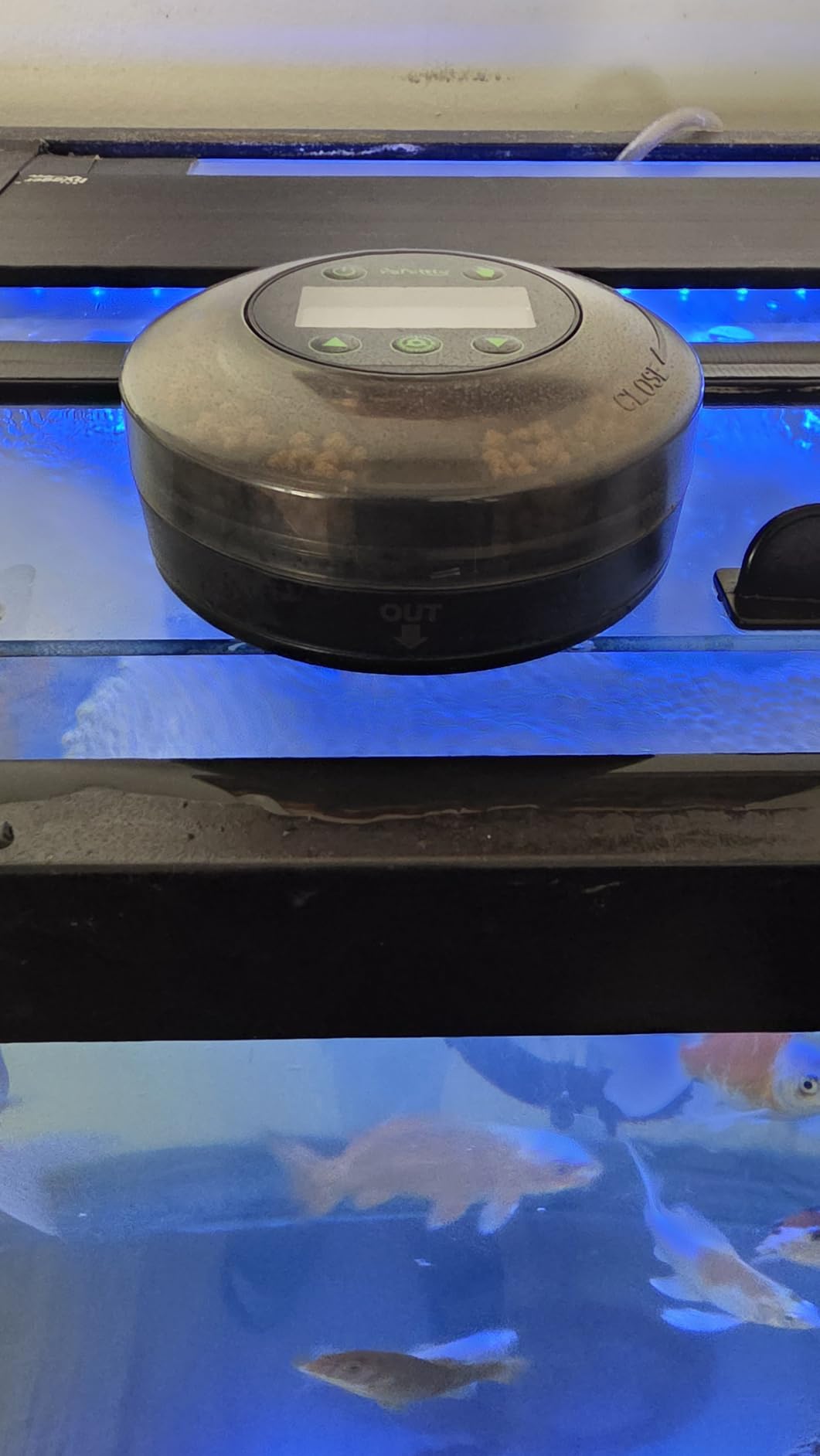
If the tank sits in a bedroom or a home office, motor noise is a legitimate disqualifier, and this unit is the quietest in the group at under 30 dB. Owners describe it as whisper-quiet in use, which matters when the feeder is ten centimetres from your pillow on a two-week trip you are trying to sleep through.
The carousel design does the same job as the Petbank unit, with fifteen compartments and up to 2g dispensed per feeding, but the two extras here are alternating day schedules and the auto-closing feeding ports. An alternating day schedule is genuinely useful for fish you feed on a reduced frequency, and the auto-closing ports keep food sealed between feedings rather than exposed to room humidity all day.
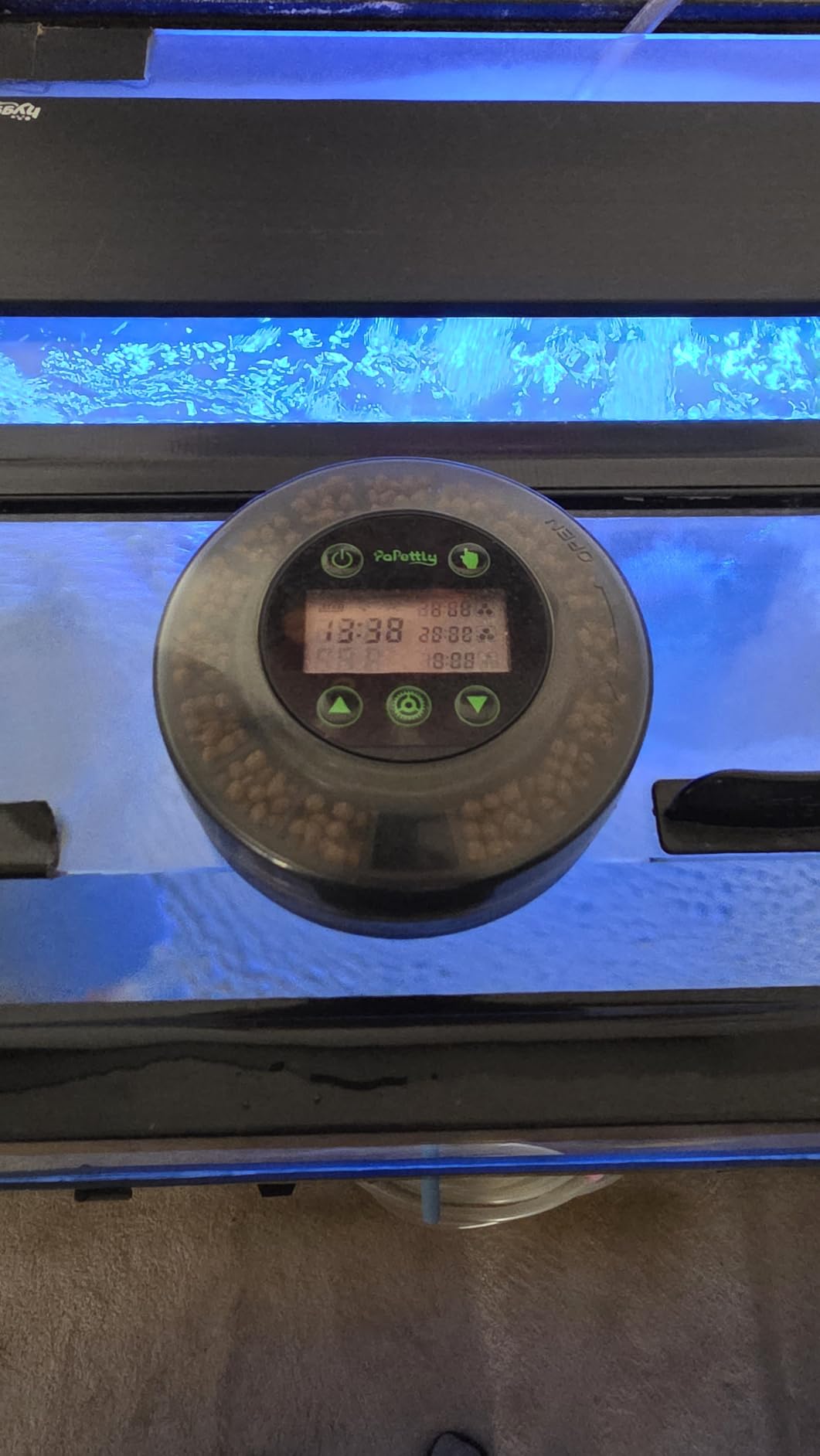
The limitations are about food type, not performance. It is not suitable for flake or shrimp food, which rules it out for nano and betta setups on fine diets, and it requires a small flat mounting footprint rather than a clamp, so you need a flat surface on the lid or rim to sit it on securely.
Why the LCD and alternating days are worth something
Alternating days solves a real problem for trip planning. If your fish normally eat on a two-day cycle, or you want to halve the total food dropped over a long trip, you can program fewer active days rather than halving every portion and hoping the slider cooperates. The LCD makes the whole schedule legible at a glance, which is a genuine advantage when you are setting up at night.
Under 30 dB is a specification worth taking seriously. A feeder in a bedroom that clicks audibly every twelve hours will wake you, and a tired owner on day four is more likely to make a mistake with a control panel.
Where it does not fit
Fine food, out. Flake and shrimp food are explicitly unsupported, and like every carousel design the bin walls will catch light irregular particles. If you feed flakes, choose a drum unit with a wide opening and an upward-facing outlet instead.
Check that you have a flat mounting area before you buy. A flat footprint is more stable than a clamp in some situations, since a clamp can creep, but it needs a lid or rim section wide enough to sit on. On a rimless tank with a narrow brace, that is a problem worth measuring first.
10. AquaMiracle Auto Feeder – Best for Awkward Tank Geometry
AquaMiracle Automatic Fish Feeder for Aquarium, Auto Fish Food Dispenser with Timer, Volume Adjustable Vacation Aquarium Feeder, for Granules Pallets Strips
360 degree rotatable bracket
200ml moisture-proof drum
8/12/24 hour intervals
Pros
- Button-selected feeding intervals of 8 12 or 24 hours with manual feed
- 360 degree rotatable bracket fits rimless framed and hooded aquariums
- 200ml drum with a moisture-proof upward-facing dispensing opening
- Simple sliding lid adjustment for feeding volume
- Works with granules pellets strips and flakes
Cons
- Minimum setting still releases too much for micro-pellets and small fish
- The small plastic opening adjuster pieces are fragile and can break
- Flake food should be broken up for consistent volume control
- Food can overspill when the unit must be mounted at an angle
Mounting is where most vacation feeder regrets happen, and the 360 degree rotatable bracket is the fix. It fits rimless, framed and hooded aquariums, which means one purchase covers the three tank styles people actually own, and it removes the awkward-position problem where a fixed bracket leaves the outlet facing a wall instead of the water.
The 200ml drum has a moisture-proof upward-facing dispensing opening, and an upward-facing port is a good design for humidity, since falling debris cannot get back into the food column. Food compatibility is the broadest in the group: granules, pellets, strips and flakes, for fish and turtles. One owner reported holding a full drum through a four-day trip, which is a fair real-world check of the capacity claim.
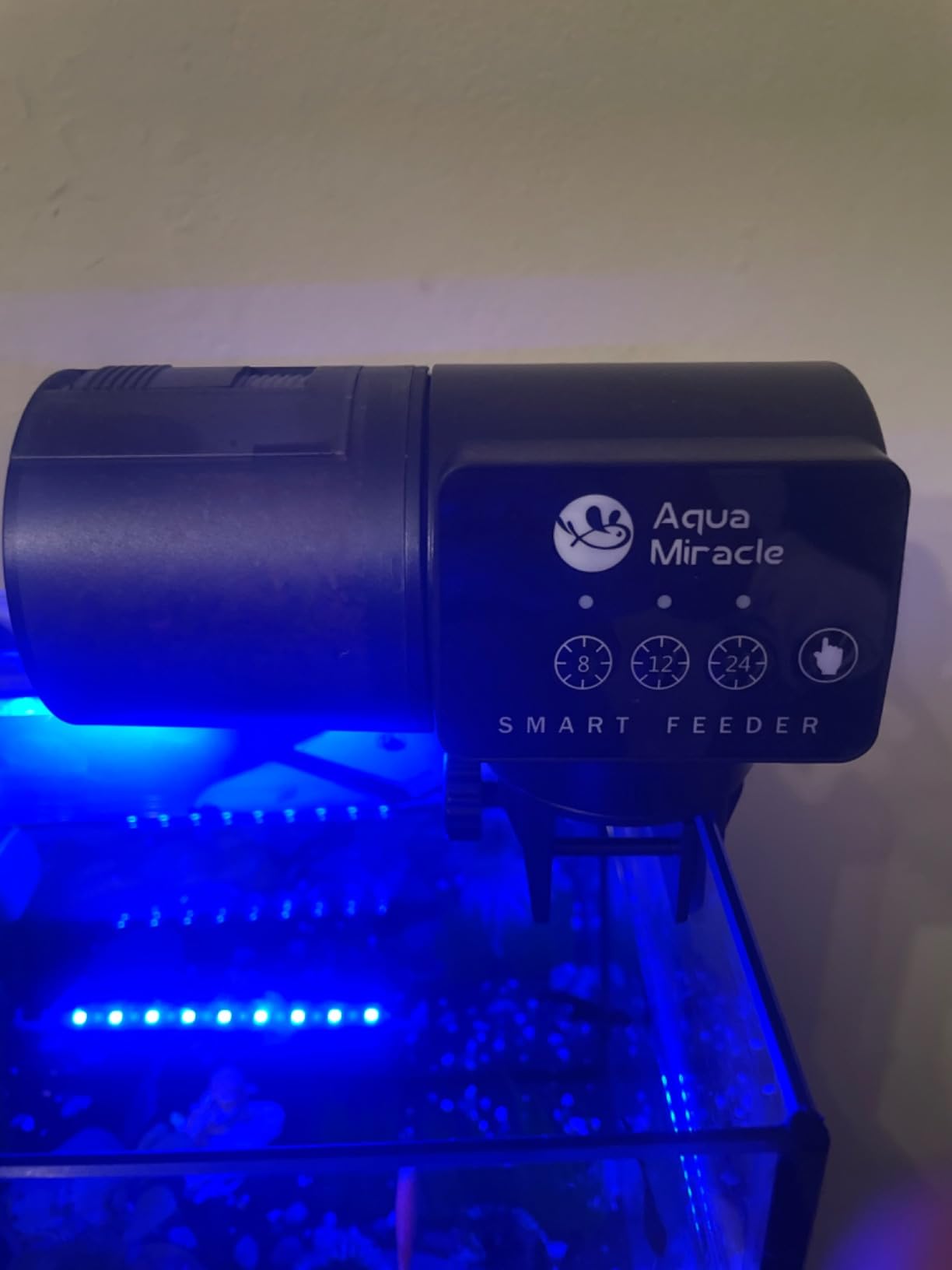
The button-only timing has a genuine advantage. There is no screen to fiddle with and no menu to learn, so the schedule cannot end up in a half-configured state, and a 4.4 rating across 473 reviews puts it among the better-rated units here on a smaller sample.
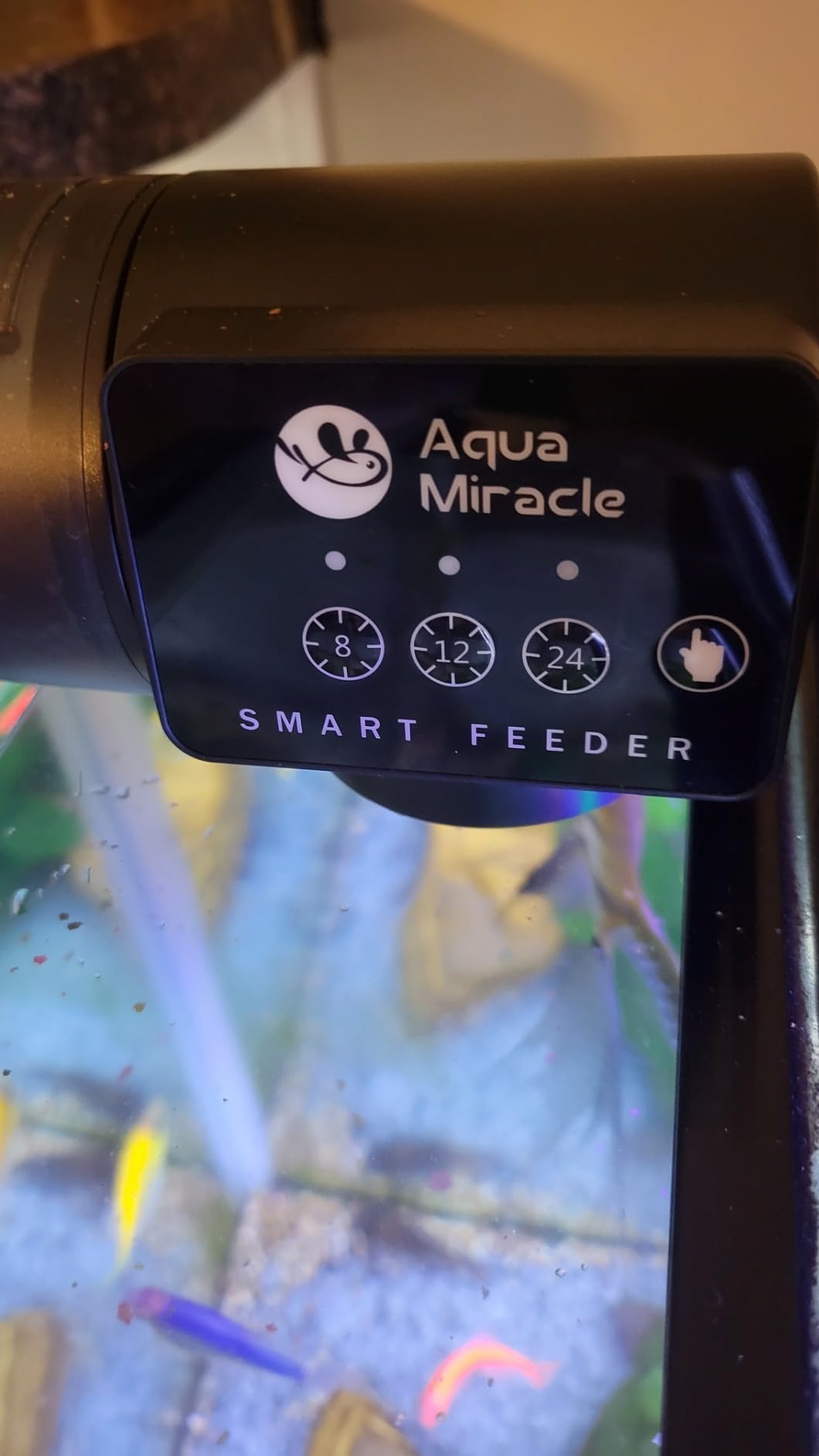
When geometry is the deciding factor
If you have a rimless tank with no convenient lip, or a hooded tank where a clamp cannot open far enough, this bracket removes the most common reason people return feeders. The rotatable base also lets you keep the motor body above the lid and angle only the outlet, which is what prevents the overspill owners report when a unit has to sit at an awkward angle.
For turtle keepers it is worth a look on its own. Strips are an unusual food type to find listed as supported, and turtles eat enthusiastically and frequently, which suits a machine with a broad food range.
Its real limitation
Portion control at the low end. The minimum setting still releases too much for micro-pellets and small fish, and the small plastic opening adjuster pieces that control volume are fragile and can break if forced. Owners of small fish commonly tape down part of the outlet to reduce the minimum dose, which is the same fix used on several other drums in this list and works for the same reason.
Treat this as a mid-size tank machine. On a community tank with standard pellets and a properly tested dose, it is a strong pick. On a nano or a betta, modify the outlet and test it twice before you rely on it.
Before You Leave: The 48-Hour Feeder Test
The most-asked question in every vacation feeder thread we read is how long a feeder actually needs to work without anyone checking it. The honest answer is that you cannot know from a spec sheet, so you measure it. Run this test two days before you fly, and it will catch essentially every failure that would otherwise happen while you are unreachable.
Measure one real dose. Put a clear container under the chute, trigger a manual feed, and weigh or count what comes out. Repeat three times. If the variation is more than about ten percent, adjust the slider or the tape over the outlet until it is not.
Watch a full programmed cycle. Do not skip this because the manual feed worked. Set the interval to its shortest option and let the machine fire on its own at least twice, unattended, exactly as it will on the trip.
Fill the hopper for the real duration. Load enough food for the full trip, not a generous guess. If it runs out on day nine of a ten-day trip, you need a bigger capacity or a shorter schedule.
Check the mount physically. Push the unit and check for movement. Any creep or wobble now becomes a fallen feeder or a water spill in a week.
Watch the food chamber for two days. This is where humidity shows up. Open it after 24 and 48 hours and look for clumping at the outlet walls. Clumping there now means clumping and a jam later.
Confirm the power plan. For battery units, check the runtime against the trip length with margin. For USB units, leave it fully charged and check the cable and adapter. For AC units, know exactly what happens on a power cut.
Test the backup plan. Ask whoever might check on the house to open the lid and press manual feed once. If they cannot operate it, that is not a backup plan.
Two days is not arbitrary. It is long enough for condensation to form and for a damp food crust to start, and short enough to fit comfortably between booking the flights and packing. If the test fails on day one, you still have time to return the unit, which is the entire point of testing before departure rather than during the holiday.
How to Choose a Feeder for Your Trip
Power source and runtime math
Match runtime to trip length with generous margin, and count real feeds rather than days. A two-week holiday on a twice-daily schedule is twenty-eight dispensing events, so a unit whose stated capacity is a low estimate will run dry on the final day. Battery units quoted in weeks are fine for short trips because the maths is simple and the failure mode is a flat cell. Rechargeable units quoted in months need a full charge before departure, and the Lukovee is explicit about a four-hour initial charge.
Any feeder that only runs from a wall adapter carries the risk aquarium hobbyists raise most often: it stops when the power goes out. That is only acceptable if your pump, heater or chiller has independent backup, since a feeder that dies in the same outage as your heater gives you no warning at all. If power reliability is a question where you live, the DXOPHIEX dual-power design is the answer.
Which feeder class your trip needs
Map the trip to the class of machine, not just the price. For a weekend away, almost anything on this list works, and a sitter may be simpler. For one week, battery runtime and a moisture-proof opening carry the decision. For two weeks, you want a sealed or ventilated food chamber and a capacity that genuinely covers twenty-plus meals. For three weeks or more, you should be running a carousel with fifteen pre-portioned meals plus a second unit or a sitter, because the risk of a single point of failure over that horizon is no longer theoretical.
Portion control beats scheduling features
This is the least intuitive lesson in the guide. Extra timers, apps and Wi-Fi control feel like reliability but do not address the actual risk, which is too much food entering the tank. Pre-portioned bins solve it by construction. Slider dosing solves it by calibration. Interval-only scheduling with a coarse opening solves it not at all, and those units are the ones owners report overfeeding with on small tanks.
For a single betta, a pair of small fish or a nano tank, treat the minimum dose as the real specification. If the lowest setting visibly drops more than a pinch, modify the outlet. It takes thirty seconds and it removes the most common vacation mistake in this entire category.
Food compatibility
Flakes are the most common problem. They are light, they bridge, they stick to walls and they bridge into a solid block in a humid chamber. Several units here explicitly exclude flake or shrimp food, and drum feeders generally need flakes broken up before loading. Pellets, granules and crisps are the reliable choices. Freeze-dried and frozen food need a different class of machine entirely, an auger feeder with a powered mixing chamber such as the reef-oriented units hobbyists favour on reef2reef.com and bareefers.org, which handles freeze-dried food and hydrates it before dispensing.
If your reef runs on frozen food, the conventional feeders on this page are the wrong tool and the right answer is a controller-integrated auger feeder rather than a timer drum. Check your food before your shortlist, not after.
Moisture, clumping and the humidity mechanism
Clumping is a chemistry problem before it is a design problem. Warm air above a tank holds moisture, that moisture condenses on the inside of an open food chamber, and starch-based flakes and pellets bind together at the first damp contact. The failure is progressive: a slightly damp pellet sticks to the wall, more pellets stick to that one, and a week later a solid block has to be chiseled out with the feeder in pieces.
Three defences exist and they are worth paying for. A sealed opening that closes between feedings keeps the food in a dry space, which is what the two carousel units do. A continuous drying fan moves air across the food, which is what the EHEIM does and why it is our top pick. An upward-facing outlet stops falling debris entering the drum, which is the AquaMiracle design. A vented or open chamber with no fan and no seal, in a hot humid room, is the design most likely to fail in week two.
If you travel in summer or your tank is in a closed room, treat the food chamber as the deciding feature rather than an afterthought. This is also the reason we say to leave at most a fortnight’s worth of food in a chamber you cannot inspect, rather than a month’s. It is the same unattended-maintenance logic people apply to an automatic pool cleaner left running while everyone is out of the house.
Mounting, noise and controller integration
Mounting is the most common silent failure. Clamp units need rim thickness inside their range, suction cups slip on smooth glass, sticker mounts depend on a clean dry surface, and a flat-foot unit needs a lid section wide enough to sit on. The AquaMiracle rotatable bracket covers the most rim styles, the EHEIM clamp is reported as narrow for larger aquariums, and the DXOPHIEX bracket is better for rimless than lidded tanks. Measure your rim before you order anything.
Noise matters more than most people expect, because the feeder sits close to where you sleep. Anything under 30 dB is a genuine advantage, and drum feeders with quiet motors are the norm. Anything that runs a fan, such as the EHEIM, trades a small amount of continuous noise for reliable drying, which is a reasonable trade in a room you are not using.
For a reef on a controller such as a Neptune Apex, an integrated feeder is a different category rather than a better version of these. The advantage is that the feeder reports status and can be driven alongside the rest of the system. The honest warning is that the most-reviewed controller-integrated unit in this category also carries one of the lowest ratings in the wider market, so reliability is exactly the thing to research before you commit. For a freshwater vacation, a good timer drum and a sitter beats a complex integrated system every time.
Who this is not for
If you keep shrimp, fry or a betta on flake food, most of these machines will disappoint you. Fine food clumps, sticks and bridges faster than pellets, and the carousel designs will catch it in the bin walls. For those tanks, hand-feeding by a briefed sitter is more reliable than any automatic feeder on this page, and a small measured daily ration matters far more than a machine that guesses.
Worst-Case Failure Modes and Backup Plans
Reliability is the entire reason anyone buys a feeder for a vacation, so it is worth naming what breaks first rather than talking about happy paths. On open-chamber drum designs without a fan, the first failure is clumping at the outlet as humidity does its work, and it appears as a missed feeding followed by a sudden release when the block clears. On carousel designs, the first failure is usually a bin that releases more than intended, which is an ammonia risk rather than a starvation risk. On rechargeable units, the first failure is electronics rather than mechanics, with battery or display failure reported on some models after a few months. On every design, the first failure is a mount that creeps.
That leads to the plan. For any trip of a week or more, treat the feeder as one layer and a person as the second. The strongest advice on aquarium forums is human rather than electronic: pre-portion food packets so a sitter simply pours one in, and tell them in advance to add nothing further no matter how eager the fish look. Hobbyists note that an automated feeder is regularly better than risking an inexperienced person overfeeding out of sympathy, so the ideal arrangement is both, not either.
Tank prep matters as much as the feeder for a two-week trip. Check that your heater has a working thermometer, that filter flow is unobstructed, that CO2 is shut down rather than still running unattended, and that lids are secure. A feeder handles food. It does not handle a heater failure or an evaporating top-off, and those are the failures that actually end fish. It is the same reason we test kit rather than assume it, whether that is a fish finder before a trip or a feeder before a fortnight away.
If you are still deciding between a feeder and a person, our view is that a good feeder plus a briefed sitter costs little more than either alone and covers both failure modes. A feeder handles the daily routine accurately. The person handles the week the feeder jams.
Frequently Asked Questions
What is the best automatic fish feeder for an aquarium?
The EHEIM Everyday Fish Feeder is our top pick because its integrated fan and ventilation system keep food dry in humid conditions, it runs on two AA batteries for the length of most trips, and it carries a 4.4 star rating across more than 7700 owner reviews. For trips of two weeks or more, a carousel feeder with pre-portioned compartments removes portion guesswork entirely.
How do I feed my fish while on vacation?
Test the feeder for 48 hours before you leave, measuring one dose and watching a full programmed cycle. Fill the hopper for the entire trip rather than a guess, confirm the mount will not move, and check the food chamber for clumping. Then brief a sitter on where the manual feed button is, and leave the tank stable with CO2 shut down and lids secure.
How long can fish survive without food?
Healthy adult fish handle seven to fourteen days without food comfortably, and hobbyists consistently report that overfeeding is the far more common problem. That reframes the vacation: the goal is a consistent, measured portion rather than a large one. If a feeder fails completely, a week without food is unlikely to harm healthy adults, whereas one oversized portion on day two can start an ammonia problem.
Which automatic feeder is the most reliable?
Reliability comes from three things: a sealed or ventilated food chamber that resists humidity, portion repeatability that does not depend on calibration, and a power source that survives an outage. The EHEIM wins on drying, the Petbank carousel wins on portion repeatability, and the DXOPHIEX wins on battery and USB failover. No single unit leads on all three, which is why a briefed sitter is still worth having.
What are the common problems with auto fish feeders?
Clumping from humidity is the most common, caused by warm moist air condensing on food in an open chamber. The next most common is overfeeding, because a coarse opening releases more than intended on small tanks. After that come inconsistent portions between units, flake food bridging the outlet, and electronics or battery failure on rechargeable models over a year or two.
How do I stop an automatic fish feeder from clogging?
Choose a feeder with a sealed opening that closes between feedings, or one with a continuous drying fan, and treat the choice as essential if you travel in summer. Load only a fortnight of food rather than a month, store food in a sealed container and refill the hopper rather than topping it up. Partial cover over the outlet and a rinse of any removable silo before departure also help.
Do automatic fish feeders work for flakes?
They work, but flakes are the least reliable food type for any feeder. They are light, they bridge, and they stick to chamber walls, so most drum feeders need flakes broken up before loading and the carousel designs explicitly exclude them. Pellets, granules and crisps dispense far more predictably. If flakes are your only option, hand-feeding by a briefed sitter is more reliable than a machine.
Is it better to use an automatic feeder or a fish sitter?
For a trip of a week or more, use both. A feeder handles the daily routine accurately, which is exactly where an inexperienced sitter causes problems by overfeeding out of sympathy. Pre-portion food packets so the sitter simply pours one in, and instruct them to add nothing further no matter how eager the fish look. The feeder covers the days, the person covers the failure.
The Verdict
The best automatic fish feeders for vacations come down to one decision: how much of the humidity problem you want the machine to solve for you. If your room is warm, closed or humid in the season you travel, buy the EHEIM Everyday and let the fan work. If your trip is long enough that portion drift would matter, buy the Petbank carousel and pre-portion fifteen meals so there is nothing left to calibrate.
Whichever you pick, run the 48-hour test before you book the flights, and keep a briefed sitter as your second layer. The feeders on this list are all capable of a two-week trip, and all of them can be defeated by a hopper filled for a month in a room with no air movement.