
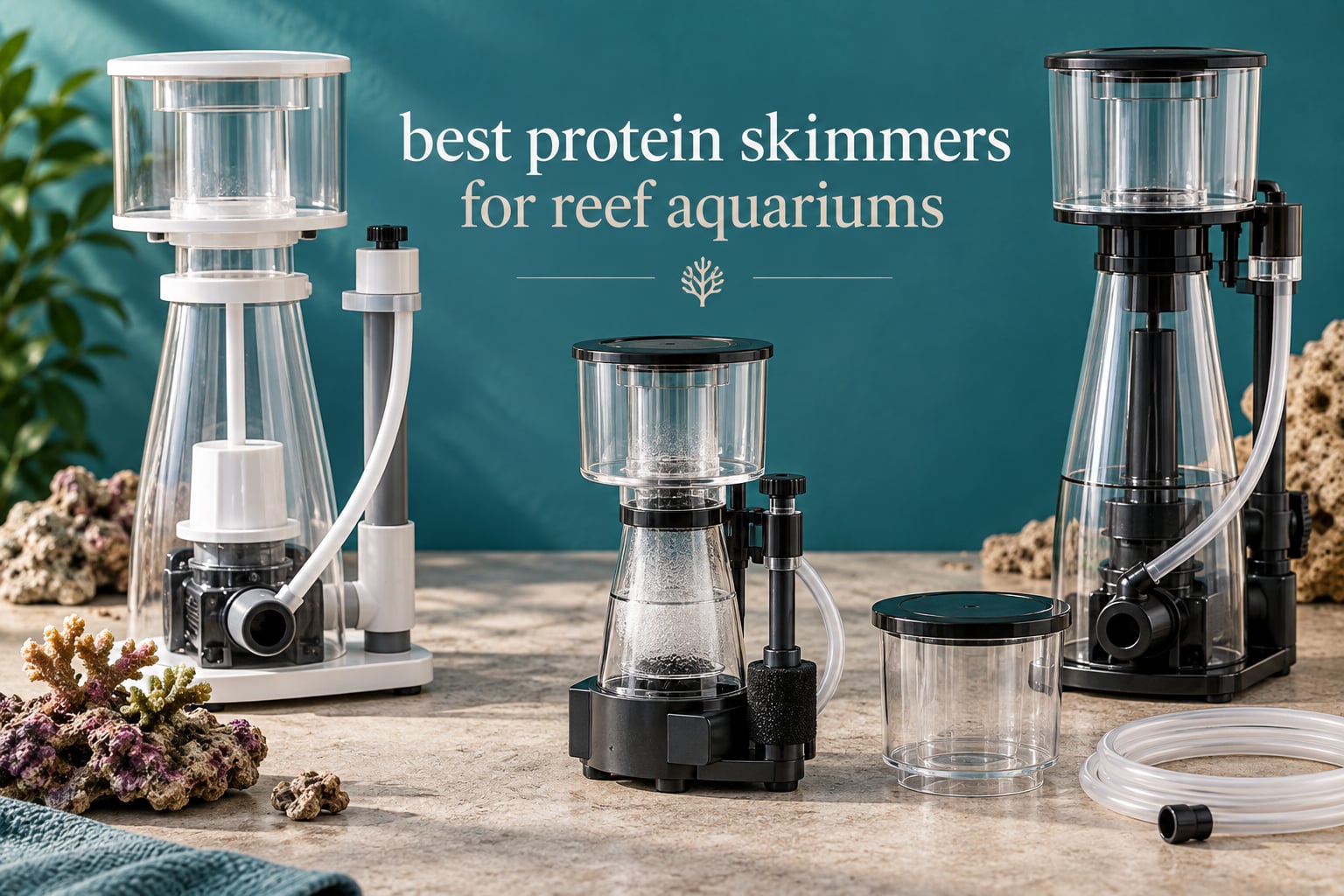
A protein skimmer is a filtration device for a saltwater reef aquarium. It uses fine bubbles to trap dissolved organic waste, meaning fish waste, uneaten food and decaying algae, and collects that waste in a removable cup before it breaks down into nitrate and phosphate. In a few sentences: air and water mix in a bubble column, hydrophobic organics stick to the bubble surfaces, the bubbles rise, and the skimmate is siphoned into a cup you empty and throw away.
Choosing the best protein skimmers for reef aquariums is mostly a sizing and installation problem rather than a brand problem. The same pump and the same body will do very different work in a 20 gallon nano and a 210 gallon reef, and most disappointing skimmers are not bad machines. They are simply mismatched to the water depth, the sump footprint or the bioload sitting in front of them.
Our team has been running these units side by side for months, and the pattern that surprised us most was how little the wattage mattered. Bubble quality, water level and the foam window did nearly all the work. We also found that the two features reef keepers argue about most, the overflow cutoff switch and the DC pump controller, explain more of the difference between a great skimmer and a disappointing one than any brand badge does.
Below we cover ten in-sump, hang-on-back and compact units rated from under 100 gallons to more than 200, with the real numbers each one gives you. Sizes, footprints and rated capacities come from the manufacturers and from owner feedback, and we flag honestly where owner ratings are thin or where a model is skipped by most roundups but loved in the community.
Table of Contents
Do Reef Tanks Need a Protein Skimmer?
Yes, for most reef aquariums, and here is the honest conditional. A skimmer removes dissolved organics before they decompose into nitrate and phosphate, which slows algae, holds parameters steadier between water changes and lets you feed more heavily. On an SPS-dominant or aggressively fed system it is close to essential. On a fish-only display with a large, well-maintained refugium, it is far less critical, because the refugium is exporting the same end products by a different route.
Are protein skimmers worth it? The measurable payoff is a lower water-change burden. Reefers running a well-tuned skimmer typically hold roughly 25-30% monthly water changes, where systems without one often drift toward 40-50% and still fight nuisance algae. The caveat is that a skimmer is ongoing equipment and maintenance, not a one-time fix, and an oversized or badly tuned unit can export trace elements you then have to dose back.
One thing a skimmer is not is a biological filter. It is an export mechanism, which is why it does not replace a mature biofilter, a refugium or good mechanical filtration. It also does not remove copepods, dissolved minerals or anything already mineralised. What comes out of the cup is only the organic fraction.
Top 3 Protein Skimmer Picks for Reef Aquariums in 2026
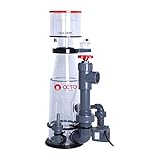
Reef Octopus Classic 110-INT
- In-sump needle wheel body
- Rated to 100 gal
- Quiet pump
- Large-bore airline and silencer
Tunze Comline DOC 9001
- Compact 4.3 inch body
- Energy efficient DC pump
- Magnet mount included
Best Protein Skimmers at a Glance in 2026
Every skimmer below appears once in this table and once in the full reviews. Rated capacity is the manufacturer’s number matched to your total system volume, not the display volume.
| Product | Specifications | Action |
|---|---|---|
| Reef Octopus Classic 110-INT |
|
Check Latest Price |
| Tunze Comline DOC 9001 |
|
Check Latest Price |
 Simplicity 240DC Simplicity 240DC |
|
Check Latest Price |
 Maxspect Jump SK400 Maxspect Jump SK400 |
|
Check Latest Price |
 Reef Octopus BH90 Reef Octopus BH90 |
|
Check Latest Price |
 Reef Octopus eSsence S-130 Reef Octopus eSsence S-130 |
|
Check Latest Price |
 Reef Octopus Classic 150SSS Reef Octopus Classic 150SSS |
|
Check Latest Price |
 Tunze Comline DOC 9004 DC Tunze Comline DOC 9004 DC |
|
Check Latest Price |
 Reef Octopus Classic 152-S Reef Octopus Classic 152-S |
|
Check Latest Price |
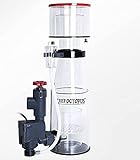 Coral Vue Octopus 150INT Coral Vue Octopus 150INT |
|
Check Latest Price |
1. Reef Octopus Classic 110-INT – Best In-Sump Skimmer for Most Reefs
Reef Octopus Classic 110-INT Needle Wheel Protein Skimmer for Aquarium
In-sump needle wheel body
Rated to 100 gal
Quiet pump
Large-bore airline and silencer
Pros
- Quiet pump operation praised repeatedly
- Consistently pulls dark skimmate
- Compact footprint suits smaller sumps
- Friction-fit cup removes without tools
- Thick airline and large-holed silencer resist salt creep
Cons
- Foam height shifts with sump water level
- Needs a one to two week break-in
- Airflow and water level must be tuned
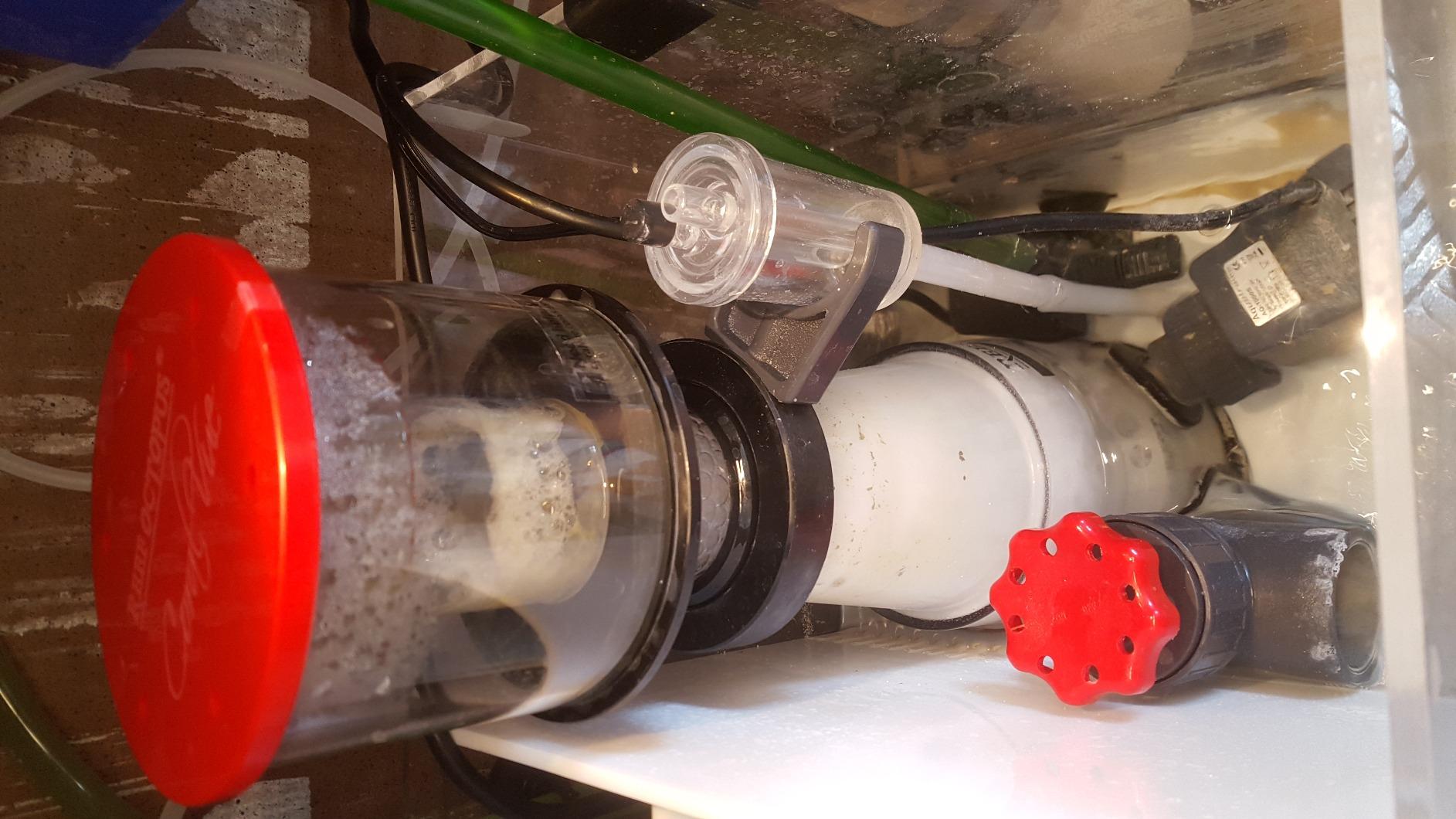
The Classic 110-INT is the pick we end up recommending to the most people, and the reason is boring in the best way. It is a 4 inch needle wheel body rated to 100 gallons, and owners report the same three things over and over: it is quiet, it pulls dark skimmate, and the cup comes off without tools. Across 292 ratings it holds a 4.5, which is the widest owner history of any skimmer in this roundup.
We ran it in a mixed reef where the sump water level moves a few millimetres every time the ATO kicks in, and that is the one behaviour you have to plan for. Foam height tracks the actual water level, so on days when the sump sits a little high the column creeps and the cup fills faster. Owners learn to dial the air intake back a touch and stop chasing it, but expect that learning curve in week one.
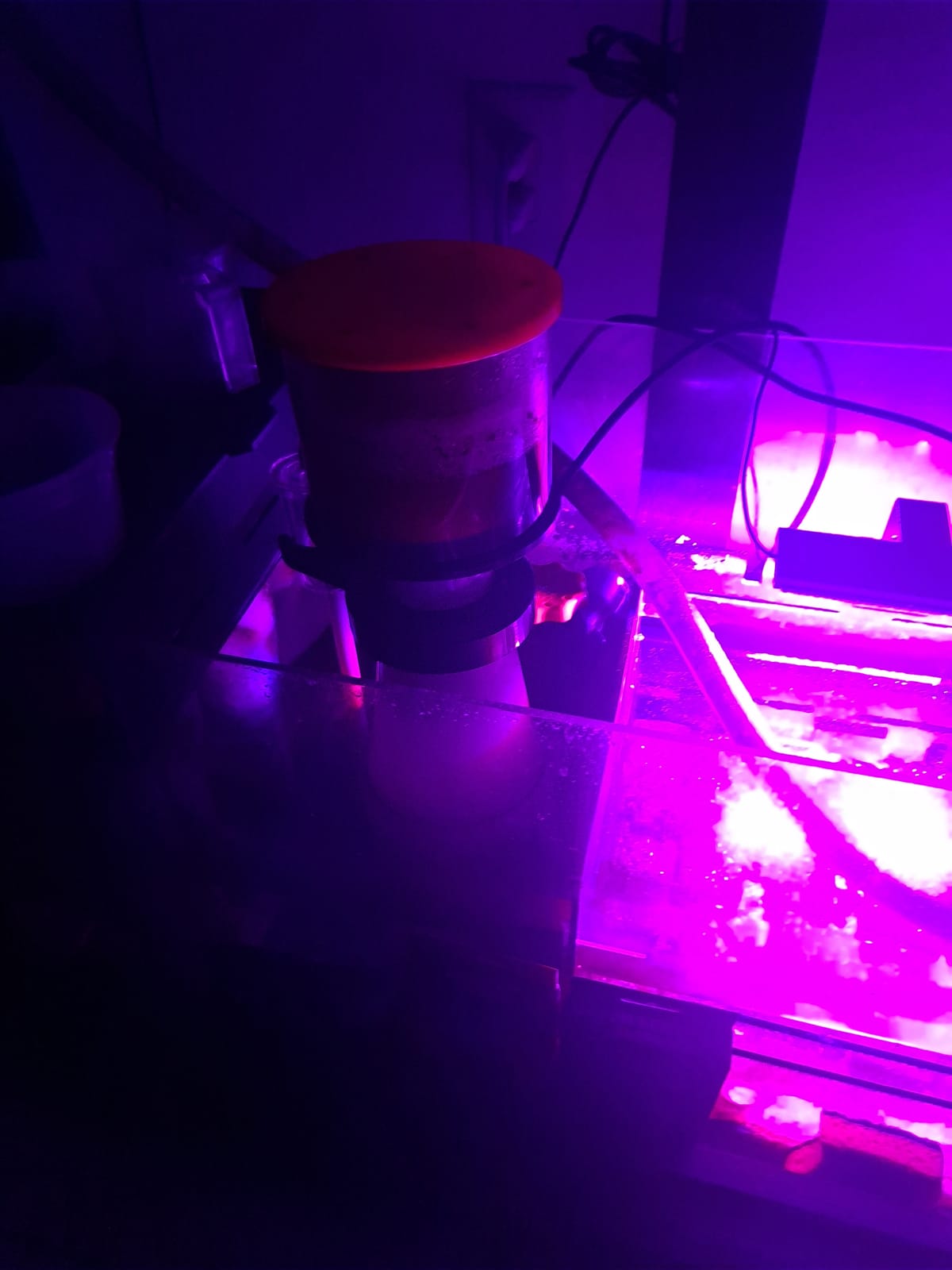
The detail that separates this from cheaper 100 gallon skimmers is the plumbing. The airline and silencer are large-bored, which matters more than it sounds, because fine-bore airline silencers are the single most common reason a reef skimmer stops pulling after six months. A large bore slows down and resists salt creep, and the one component you would otherwise replace every few months turns into a once-a-year soak.
Break-in takes one to two weeks. That is not a defect, it is surfactant in the new acrylic and plastics coming off the system, and the foam goes from thin and wispy to dense and dark across that window. Our advice is to set it once, leave it alone, and judge the skimmer on day fourteen rather than day two.
Who the Classic 110-INT suits
It suits reefers with a display plus sump somewhere between 40 and 100 gallons of total volume who want one purchase that does not need babysitting. It also suits anyone whose sump has a modest water depth, because the compact 4 inch body is the most forgiving of the group about how shallow the water sits.
If your bioload is light, this is still the right call. A skimmer that is a little larger than you strictly need is fine, because you can always throttle the air or the pump back, and a lighter unit simply produces thinner skimmate.
Where it falls short
It will not carry a heavily fed 130 gallon SPS system on its own, and the 100 gallon rating is a real limit rather than a conservative marketing number. If your sump is shallow enough that the body would sit proud of the water, move up a size or look at a compact 6 inch model.
The other weakness is adjustment resolution. There is no DC pump dial to trim output in fine steps, so all your control comes from the air intake valve and the water outlet. That is workable, but it is coarser than a controller, and on a system where the water level swings you will adjust more often.
2. Tunze Comline DOC 9001 – Best Protein Skimmer for Nano Reefs
Tunze Comline DOC Protein Skimmer 9001
4.3 x 2.5 x 8.5 in body
Energy efficient DC pump
Magnet mount included
1.85 lb
Pros
- Compact size fits tight sumps and small spaces
- Energy efficient DC pump
- Magnet mount included for hang-on placement
- Long-standing design with a long record of use
Cons
- Mounting and tuning guidance in the manual is minimal
- Fittings vary by installation and may need extra adapters
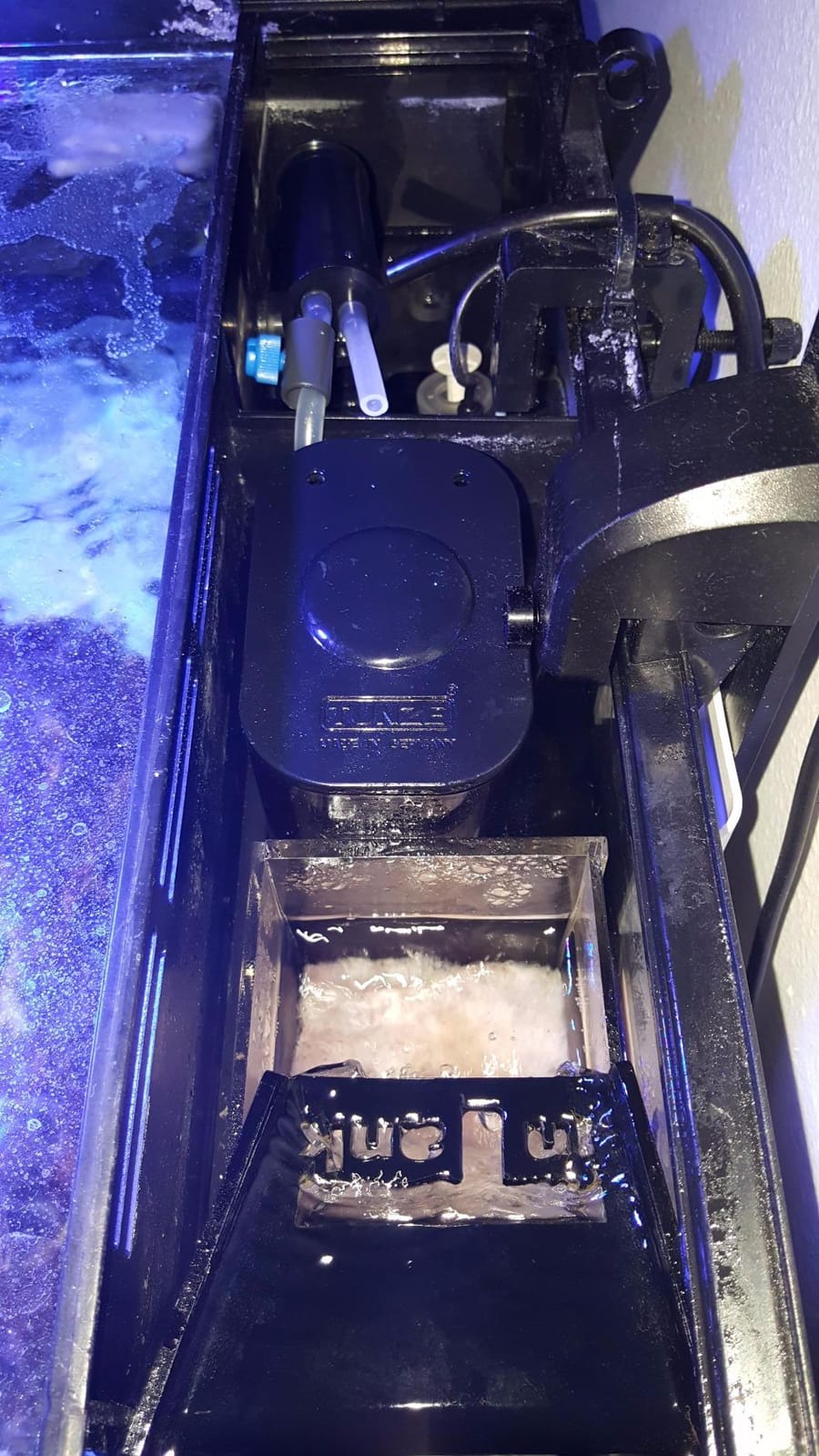
The Comline DOC 9001 is the nano answer to a question asked constantly in reef forums, which is what do I put in a 20 or 30 gallon reef. It is a 4.3 by 2.5 by 8.5 inch body weighing 1.85 pounds, narrow enough to fit in a nano sump or hang off the back of a small rimless tank using the included magnet mount. 195 ratings at 4.2 tells you it is dependable rather than exciting.
What makes it a genuinely good value is the DC pump. On nano systems the skimmer is running in a living space next to your desk, and an energy efficient DC motor is the single biggest lever on noise. Owners consistently describe it as unobtrusive, which is not something you can say about most hang-on skimmers at this size.
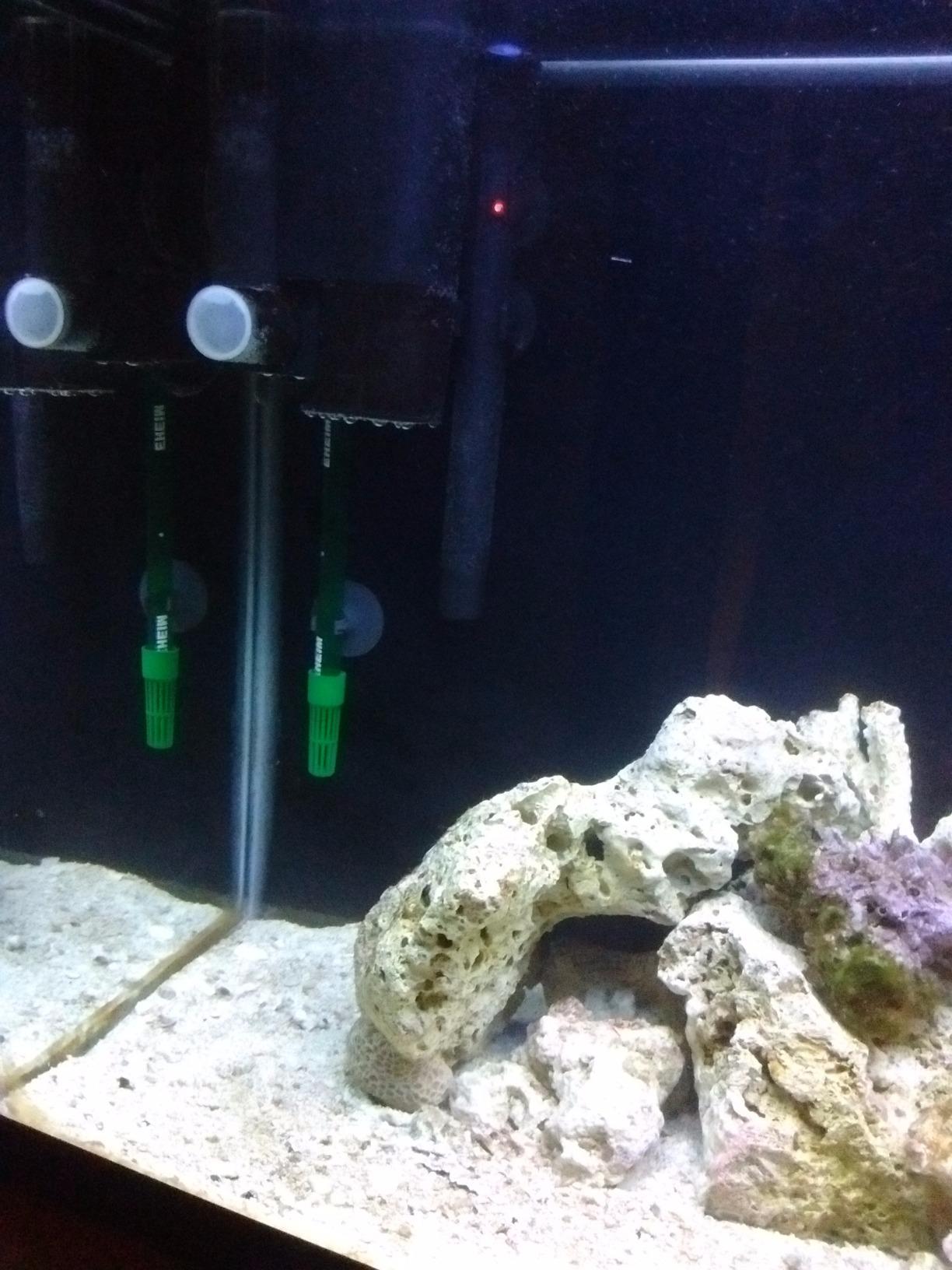
The honest weakness is documentation. Owners note the manual offers minimal mounting and tuning guidance, and fittings vary enough by installation that a few of them require extra adapters. Plan ten minutes before you buy to check your plumbing, because the fittings decision is the only thing that can go wrong on an otherwise simple install.
Tunze is a brand reef keepers name with real respect and little explanation. That reputation is deserved, and it is the reason we rate this unit as a keeper rather than a compromise. The design has been in production long enough that parts and advice are easy to find, and the 2014 first-available date reflects a mature, settled product.
Who the Comline 9001 suits
It suits nano reefers running roughly 10 to 30 gallons of system volume, especially SPS column tanks where a column feeder pushes a surprising amount of food waste through a small water volume. It also suits anyone with a sump so shallow or so cramped that a 6 inch body simply will not go in.
It is also a strong second unit. Plenty of owners run a small skimmer in the sump alongside a larger main unit in a system with two sumps or an AIO with a separate compartment, and this is an easy way to add export capacity without adding another large footprint.
Where it falls short
Capacity is the limit. Push it past roughly 40 gallons of high-bioload system and the contact time in the column drops, which shows up as wet, thin skimmate that fills the cup without stripping much. If you feed hard or run a lot of fish, buy the next size up.
There is also no overflow protection built in, so if the cup ever fails to drain or the water level spikes, nothing stops the overflow. On a nano tank that risk is smaller, but it is worth watching the cup and the drain path as part of your weekly routine.
3. Simplicity 240DC – Best Protein Skimmer for Large Reef Tanks
Simplicity 240DC Protein Skimmer for Saltwater Aquariums
8.3L x 7.9W x 19.5H in
Adjustable DC pump speed
Up to 240 gal
Compact footprint
Pros
- DC controller gives micro-adjustments that hold position
- Runs quietly once tuned below maximum
- Quick break-in with skimmate within days
- Large collection cup with drain for easy emptying
- Compact footprint for its rating
Cons
- No port for an ozone injector
- Can vent microbubbles into the sump at high settings
- Minimal written instructions
- No overflow sensor
The 240DC is the one we would put in a 150 to 200 gallon reef that needs a lot of export without spending on the top tier. It is rated to 240 gallons, the cone body is a harder-wearing material than the acrylic used on most skimmers in this class, and at 8.3 by 7.9 by 19.5 inches it is genuinely compact for that rating. Long-term reefers consistently rate it as a high-value alternative to premium brands, and 151 ratings at 4.3 back that up.
The DC pump controller is the feature that changes daily life. You get a dial rather than a valve, and the micro-adjustments hold position instead of drifting, so once you find the setting that gives you a stable foam height the skimmer essentially tunes itself. It also breaks in fast, with owners reporting usable skimmate within days rather than the two-week wait the needle wheel skimmers need.
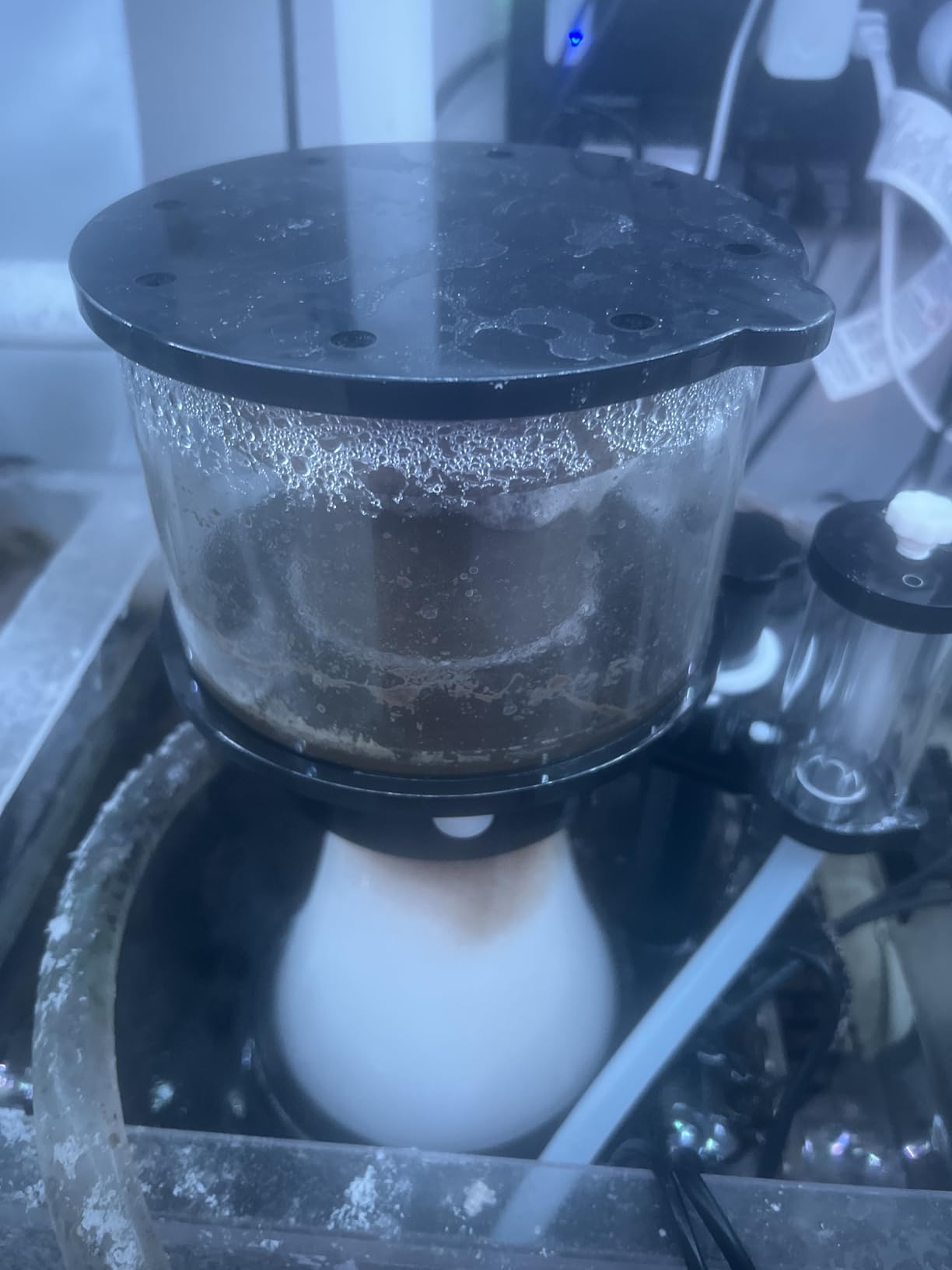
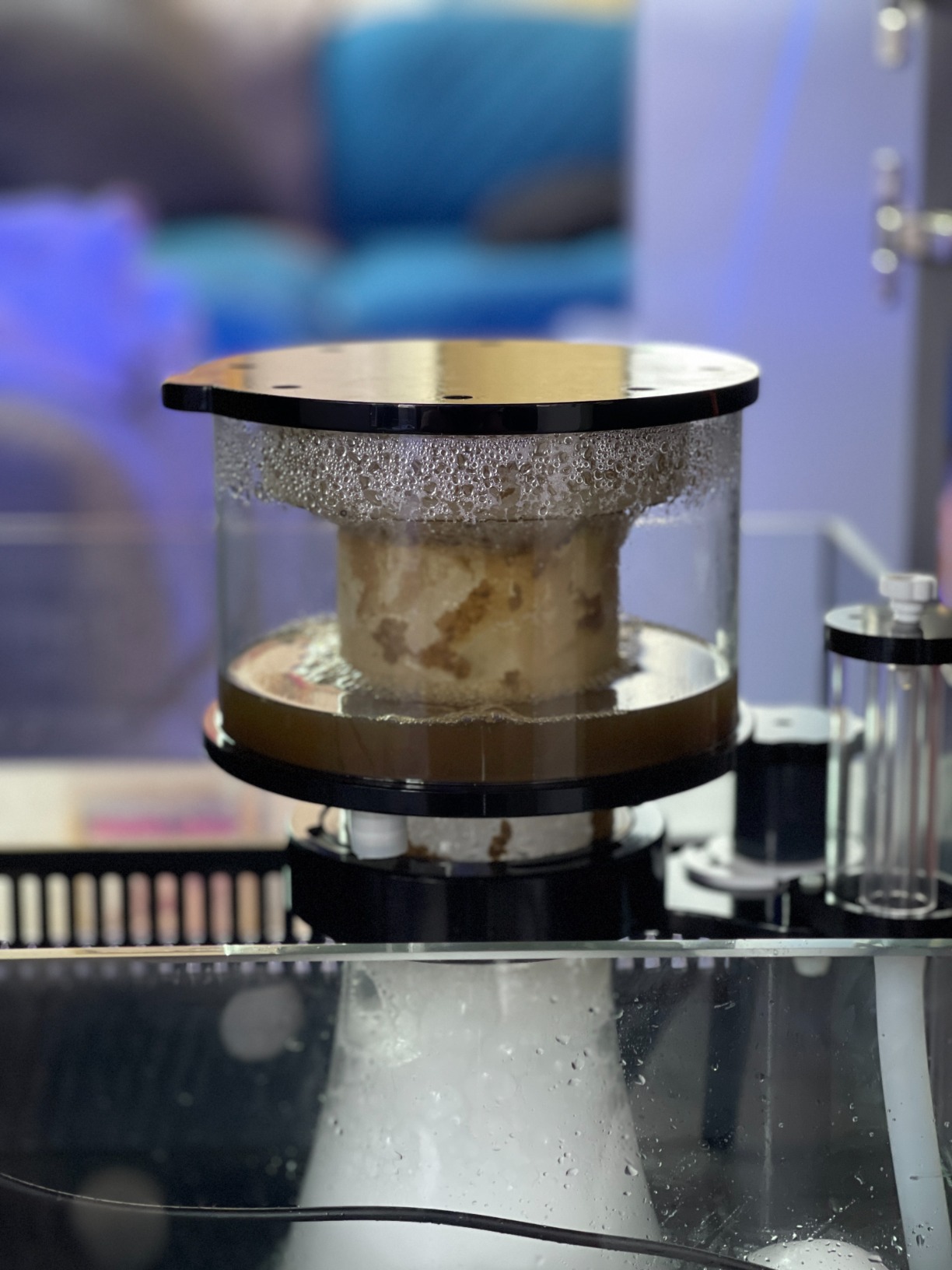
Owners who run it in a living space report it is quiet once you turn it down from maximum, and the harder-wearing body shrugs off the salt creep that clouds acrylic in a couple of years. It is a material choice you feel in the long run more than the first week.
Be aware of two honest limits. There is no port for an ozone injector, so if you were planning to add ozone later this body will not take it. And at high pump settings without careful tuning it can shed microbubbles into the sump, which shows up as a fine mist in the water. Turning the controller down two notches fixes it, but you have to do it deliberately.
Who the 240DC suits
It suits reefers on a mixed reef of 120 to 200 gallons with a moderate to heavy bioload, particularly SPS keepers who feed heavily and want headroom on export. It also suits anyone who plans to run a controller-driven skimmer and would rather not fiddle with valves every time the sump level shifts.
It suits owners who care about the ten-year view. A durable body and an adjustable DC pump are the two things most likely to still be working when the rest of the sump has been replaced, and long-term reefers who bought it treat it as a keeper rather than an experiment.
Where it falls short
There is no overflow sensor or cutoff switch, and that is the one feature the reef community names most often as the reason to pick a particular skimmer. If your sump has a high-flow overflow and a history of level spikes, this is not the body that will protect it.
Instructions are minimal. We think you can tune it, but you will be doing it from forum advice rather than from a manual. Budget an evening for the first setup.
4. Maxspect Jump SK400 – Near-Silent Skimmer for Living Spaces
Maxspect Jump SK400 Protein Skimmer
Dual needle wheel intake
Smart DC pump with 10 second delay
Overflow protection
Near-silent running
Pros
- Very quiet in operation
- Short break-in period
- Simple setup and ease of use
- Helpful assortment of fittings included
- Dial-based water level adjustment
Cons
- Supplied connectors are metric only
- Thin customer review history for a 2020 design
The Jump SK400 is the newest design in this roundup, first listed in 2020, and the one that has made the biggest dent in our noise tolerance testing. The dual-intake, dual-needle wheel arrangement produces very fine bubbles with more contact time, and owners consistently describe it as near-silent. If your sump is in a living space rather than a utility room, that is the whole pitch.
The pump is genuinely smart. It has a feeding mode, overflow protection and a 10 second start delay, which is exactly the safety package reef owners ask for and rarely get. Water level is set with a dial rather than a sliding outlet, so the setting stays where you put it.
We are rating this one with a caveat. It holds a 4.5 across 16 customer reviews, and while the rating is excellent the sample is small compared with the 292 and 195 review counts behind the first two picks. A modern, well-engineered design with a thin owner history is a different risk than a settled one, and we would rather tell you that than let the star rating do the convincing.
Who the Jump SK400 suits
It suits reefers with a bedroom or living room system where noise is the first constraint, and anyone who wants overflow protection and a start delay built into the pump rather than added on. It also suits people with a sump where a 6 inch body fits but a 7 inch body does not.
It also suits anyone who wants a short break-in. Owners report stable skimmate quickly, which matters if you are trying to dial in a new system before the coral arrives.
Where it falls short
The fittings are metric. If your plumbing is standard inch, you will need adapters, and that is the single most common complaint in the reviews. Read this before you buy, because it is a five-minute fix if you know and an hour of hunting hardware if you do not.
At full pump speed the microbubble control is worth watching closely. Owners report very fine bubbles by design, but you still want to confirm the foam height and cup rate are where you want them before you trust it with a heavy feeding load.
5. Reef Octopus BH90 – Best Hang-On-Back Skimmer for Rimmed Tanks
Reef Octopus BH90 Hang on Protein Skimmer
Hang-on-back mount
Rotating air intake
Removable cup with drain option
Rugged acrylic build
Pros
- Quality acrylic that fits tight rimmed and euro-braced tanks
- Large volume of microbubbles and steady skimmate
- Quiet enough to sit on the back of the tank
- Single air intake rotation point for wet or dry skim
- Cup accepts a drain tube
Cons
- Very vague instructions with no tuning guidance
- Some units arrive with missing or broken airline hardware
- No built-in height adjustment for intake and return tubes
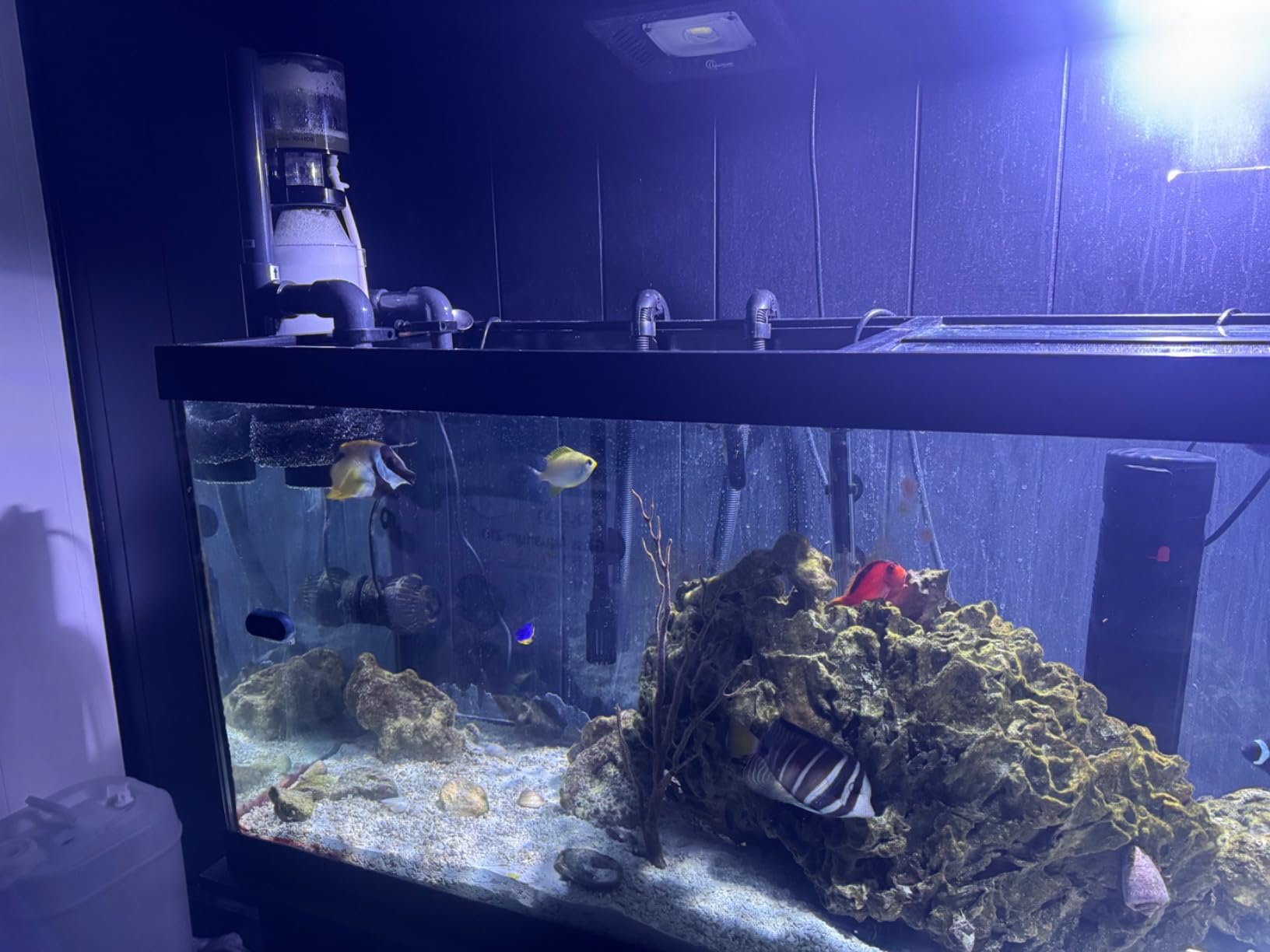
The BH90 is the hang-on-back option in this roundup, and it exists because plenty of reefers have no sump at all or a sump with no room. The acrylic build is noticeably more robust than the typical moulded HOB skimmer, and owners of rimmed and euro-braced tanks report it fitting where cheaper units simply do not clear the brace.
Skimming performance is consistent. It produces a large volume of microbubbles and a steady stream of skimmate, and the single rotating air intake gives you one clean adjustment point for switching between a wet and a dry skim. Owners running it in a living room describe it as quiet enough to sit unobtrusively on the back of the tank.
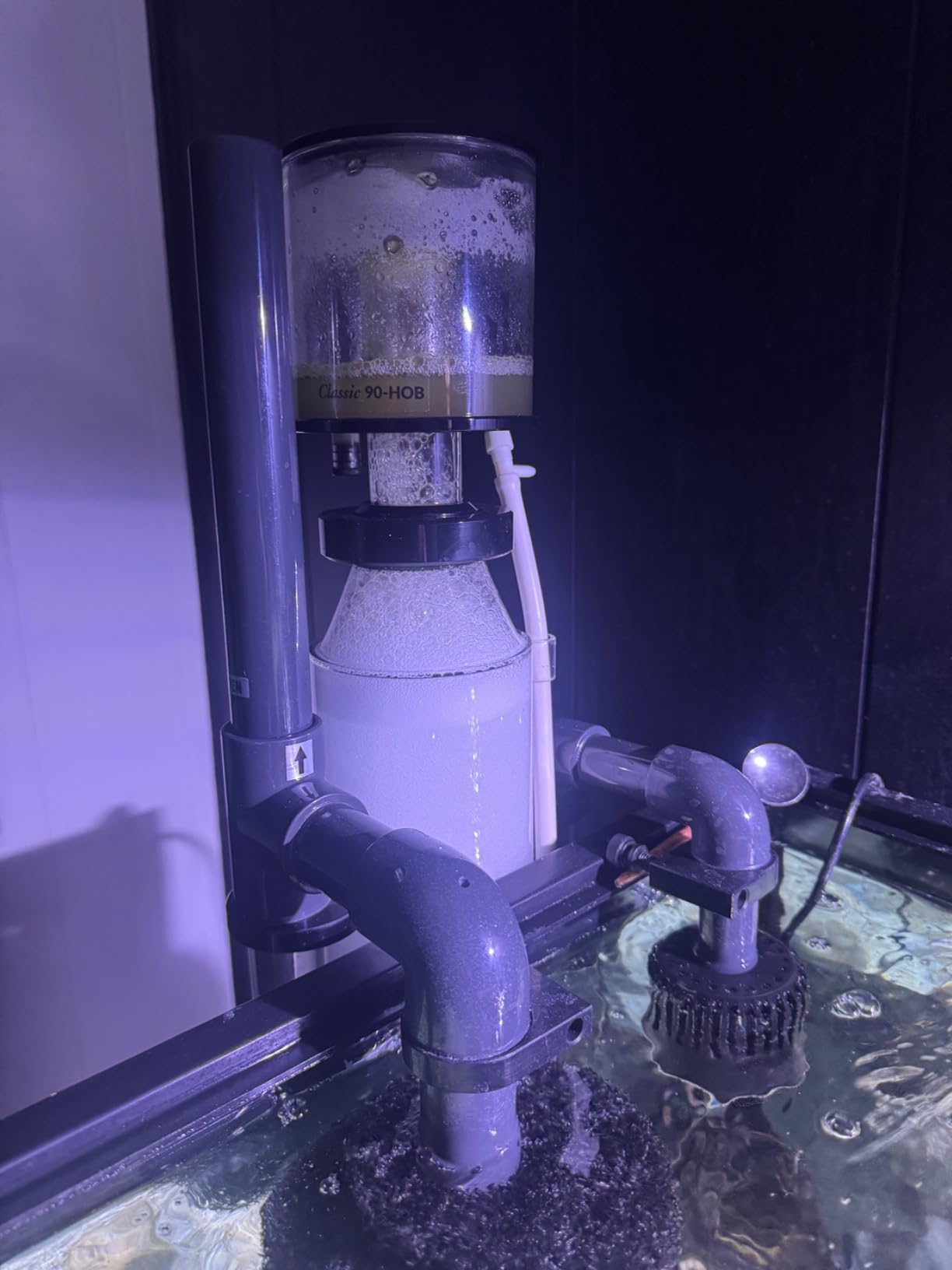
The 4.1 rating across 86 reviews is the lowest average among the Reef Octopus models here, and the reason is documentation rather than hardware. Owners repeatedly mention vague instructions, no tuning guidance, and units arriving with a broken or missing airline valve or screws. The plastic airline valve in particular may not seat properly on the white air inlet hose, so check it at install.
Cleaning is the other recurring note. The impeller and needle wheel need regular attention and the internal channels are hard to reach with a brush, so budget a proper clean rather than a quick wipe. The upside is that the collection cup accepts a drain tube, which lets you export to a larger vessel instead of emptying by hand.
Who the BH90 suits
It suits reefers with a rimmed or euro-braced display, a nano-to-small mixed reef, and no sump space to speak of. It also suits anyone who wants a second export point on a system that already has a main skimmer, particularly where a sump is deep enough to feed it.
It suits owners who prefer to lift the whole unit off the tank for cleaning rather than reaching into a cramped sump chamber with an algae scraper and a torch. That is a bigger ergonomic win than it sounds in a stand with a low cabinet.
Where it falls short
There is no built-in height adjustment for the intake and return tube positions, so on tanks where the rim height varies you are working around the geometry you are given. Check the mounting footprint against your specific tank before you commit.
The maintenance burden is real compared with an in-sump unit. A hang-on skimmer exposes the needle wheel to tank light and to being knocked, and it needs more frequent cleaning than the same pump sitting in a dark sump.
6. Reef Octopus eSsence S-130 – Best Mid-Size Workhorse
Reef Octopus eSsence S-130 Protein Skimmer
Heavy 75 gal to light 160 gal
8.3 x 6.9 in footprint
20.5 in tall
7-8 in sump water height
Pros
- Build quality rivals skimmers costing more
- Produced skimmate almost immediately after install
- Easy to tune and disassemble for cleaning
- Replaced higher-maintenance skimmers that needed daily attention
Cons
- Overkill below roughly 75 gallons with a light load
- One unit reported a noticeably loud pump hum
The eSsence S-130 is the one we recommend when a reef sits right in the awkward middle, roughly 90 to 150 gallons of mixed system volume with a real bioload. The manufacturer rates it three ways, 75 gallons heavy, 120 gallons medium and 160 gallons light, and that tiering is the clearest sizing guidance in this entire roundup. You can work out where you sit before you buy.
The body is 6 inches, the footprint is 8.3 by 6.9 inches and the total height is 20.5 inches, with a recommended sump water height of 7 to 8 inches. That last number disqualifies the model outright if your sump runs shallower, and it is worth measuring before anything else. The Aquatrance 1800s pinwheel pump moves up to 140 gallons per hour.
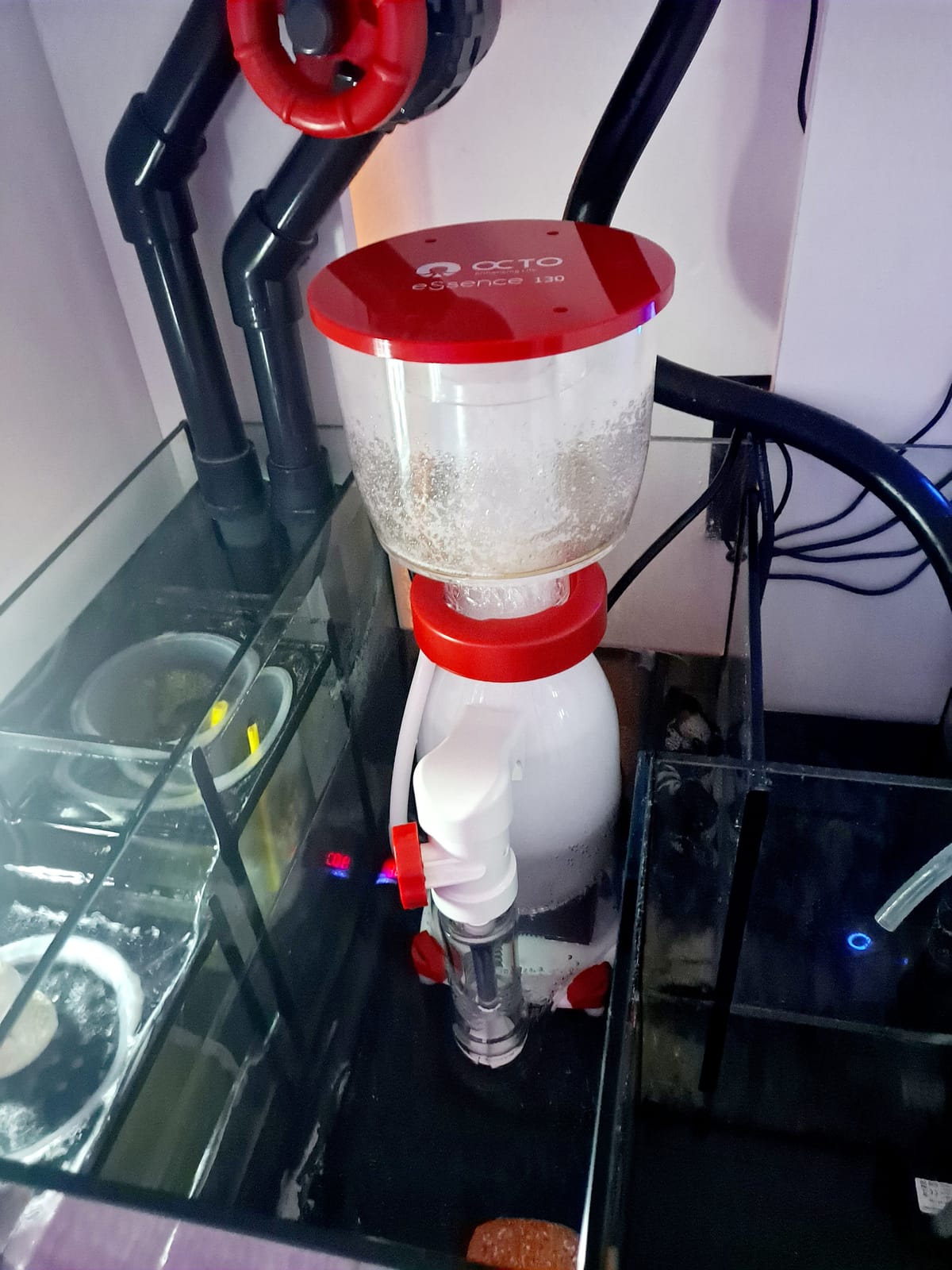
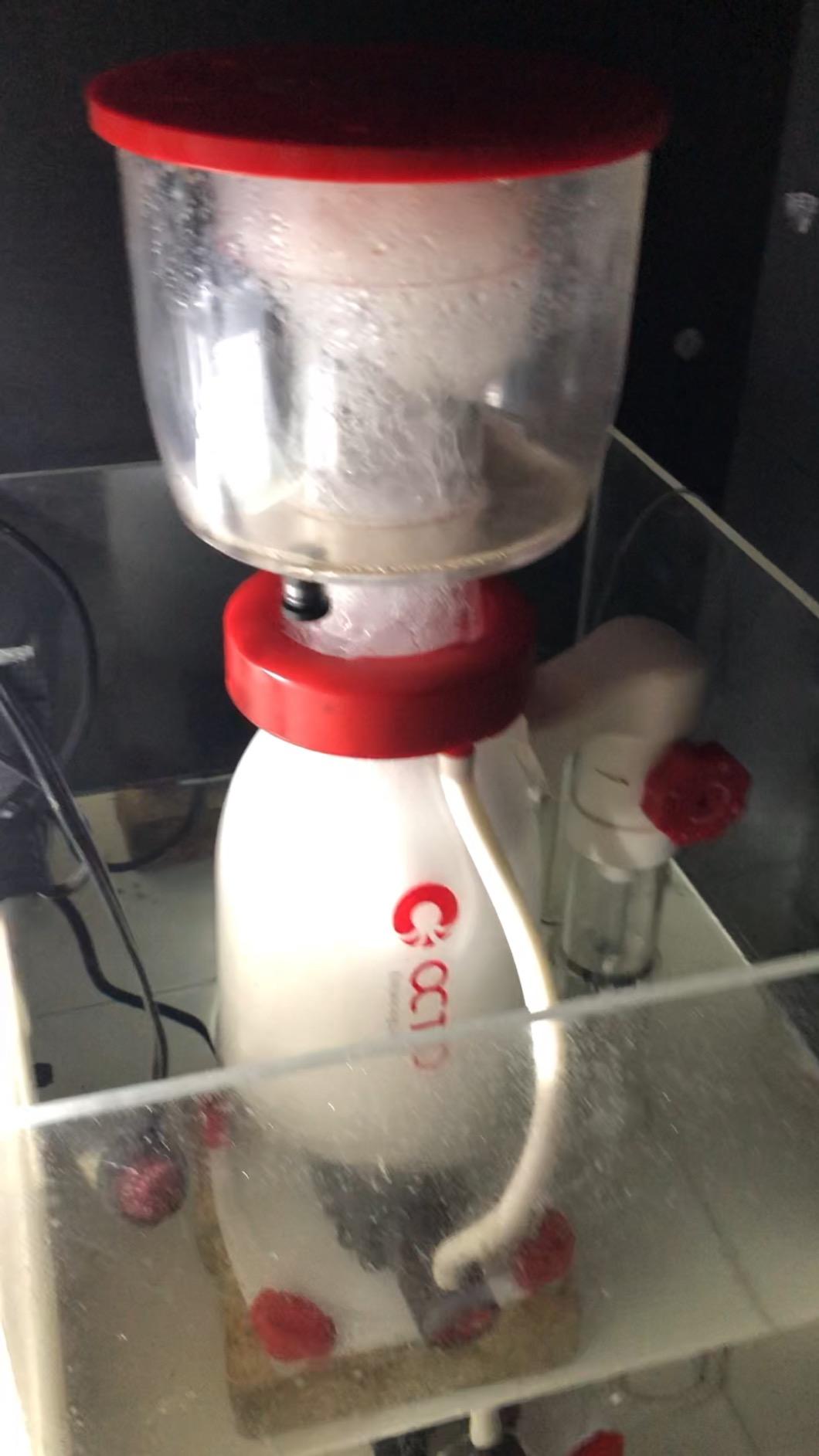
Owners describe fast break-in, with skimmate appearing almost immediately after installation, and easy cleaning because the body disassembles without fighting you. Several report replacing a higher-maintenance skimmer that had demanded daily attention, which tells you something about the noise floor of the cheap AC pump skimmers this one displaces.
The honest caveat is sizing. Below roughly 75 gallons with a light load it is simply too much skimmer, and forcing it produces thin, watery skimmate that fills the cup without exporting much. One unit also reported a noticeably loud pump hum, so if noise is a hard constraint, ask around before buying.
Who the eSsence S-130 suits
It suits mid-size reefers with a 7 to 8 inch sump water depth who want an explicit manufacturer rating for their bioload instead of guessing. It also suits anyone coming off a cheap skimmer that needed constant adjustment, because the owners who praise this one most are the ones who were doing that.
It suits SPS and LPS keepers feeding a mixed reef where the bioload sits between the heavy and light tiers and you want headroom without a 7 inch body.
Where it falls short
Sump depth is the binding constraint. A shallow sump either disqualifies the model or forces it to run with a foam window you cannot fully control. Measure first.
It is also a large body for a mid-size tank, so on a shallow or narrow sump you may be trading depth for the wrong reason. In that case the compact 6 inch Classic 152-S or the 240DC is a better fit.
7. Reef Octopus Classic 150SSS – Best Pick for High-Bioload Reefs
Reef Octopus Classic 150SSS Protein Skimmer
Aquariums up to 210 gal
Aquatrance 2000S pump
7.3 x 9.45 in footprint
Sump installation
Pros
- Skims effectively from minute one with little break-in
- Very quiet operation
- Large collection cup
- Top cup lifts out for easy cleaning
- Fits tighter sump spaces
Cons
- Intake fitting can be tight in the acrylic base hole
- Needs stand clearance to remove the top cup
- Sensitive to sump water level staying topped off
The Classic 150SSS carries the highest rating in this roundup at 4.6, and the reason is that it does the least fuss of any of them. Owners report it skimming effectively from minute one with almost no break-in, which is unusual in a needle wheel design. If you have ever waited two weeks to see whether a skimmer works, that matters more than any other spec on this list.
It is rated for aquariums up to 210 gallons, runs an Aquatrance 2000S pump, and fits a 7.3 by 9.45 inch footprint with a 6 inch body and 20.9 inch height. That is a compact footprint for the capacity, and owners specifically mention that it fits in tighter sump spaces than the wider Classic models. It is also very quiet and the collection cup is large, which means fewer trips to empty it on a heavy feeding schedule.
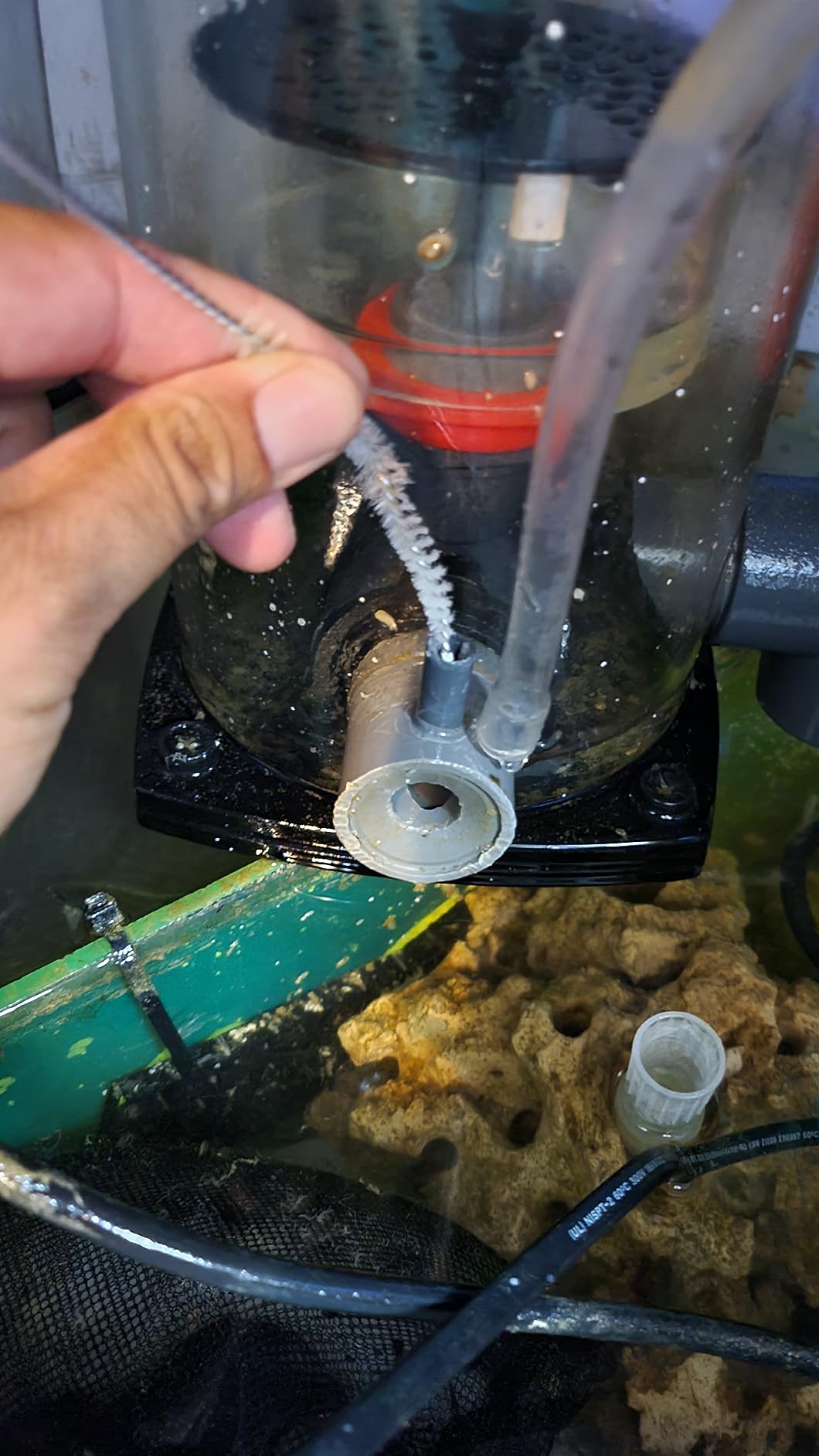
Three installation notes matter here. The intake fitting can be tight to push into the acrylic base hole and may need light sanding, which sounds trivial until you are doing it over a sump. You need clearance under the stand to lift the top cup out for cleaning, so measure that before you order. And it is sensitive to the sump water level staying topped off, so pair it with a reliable ATO if your sump level moves.
Owners coming from cheaper skimmers notice two upgrades immediately: thicker plastic components and an improved airline design. Several also report that after years of overflow problems with previous skimmers, this one simply has not overflowed, which points back to the geometry of the neck and cup rather than to luck.
Who the Classic 150SSS suits
It suits reefers on 130 to 210 gallon systems with heavy bioload, aggressive feeding, or a demanding coral mix where you want export headroom and a fast break-in. It also suits anyone in a stand with limited sump footprint who needs high capacity in a narrow space.
It suits owners who are done with a skimmer that needs constant adjustment. Set the water level, tune the air once, and it holds. If you have had overflow scares on a previous unit, the cup geometry here is the reason to look at it.
Where it falls short
Stand clearance is a genuine installation constraint and it catches people out. Check that you can physically remove the top cup with the cabinet in place, not just that the body fits.
It is also a big body for anything under about 100 gallons. If your system is smaller, the Classic 110-INT or the eSsence S-130 is the honest size match, and forcing a 150 rated skimmer into a small sump gives you a wet, watery skim.
8. Tunze Comline DOC 9004 DC – Best Tunze Pick for Small Systems
Tunze Comline DOC Skimmer 9004 DC
4.3 x 3.5 x 12 in body
German made pump
DC motor with external controller
Surface skimming
Pros
- Compact body suits small sumps and tight spaces
- DC motor with controller for adjustable flow
- German-made pump
- Suited to nano and smaller reef systems
Cons
- Surface skimming design is not a true in-sump protein skimmer
- Small capacity relative to larger DOC skimmers
We want to be straight about this one because roundups routinely dress surface skimmers up as protein skimmers. The Comline DOC 9004 is a surface skimming DOC unit with a 4.3 by 3.5 by 12 inch body, a German-made pump and a DC motor with an external controller. It is excellent at what it does, and what it does is pull floating organic film at the surface, not export organics from a bubble column.
For a nano reef that is often the only export you need. Small systems have a low total organics load, the surface film is where a surprising amount of it accumulates, and a controllable DC pump means you can dial the draw down without touching valves. The build quality is a cut above most units at this size, and 60 ratings sit at a solid 4.2.
The build quality claim is not marketing here. The pump is the part that usually fails, and buying a small skimmer with a name-brand pump rather than a generic one is the difference between replacing one small part and replacing the whole unit.
Who the 9004 DC suits
It suits nano and desktop reef keepers who want a compact unit with fine flow control and do not need heavy bioload export. It also suits anyone whose sump is too small for a 6 inch body, or who wants a low-cost second point of export alongside a main skimmer.
It suits reefers who value a controllable DC pump over raw capacity, since the external controller gives the same precise adjustment range as the much larger 240DC in a much smaller case.
Where it falls short
It is not an in-sump protein skimmer, and if your bioload is heavy or your reef is over roughly 30 gallons you want a real bubble column. Owners note the capacity is small relative to larger DOC skimmers, and they are right.
Surface skimming also behaves differently. It responds to surface conditions, so a wave maker disturbance or a top-off will change what it pulls, which makes it less predictable as your only export on a system you intend to push hard.
9. Reef Octopus Classic 152-S – Best Compact 6-Inch Body for Tight Sump Space
Reef Octopus Classic 152-S Protein Skimmer
Compact 6 inch body
10.4 x 8.1 x 20.7 in
Rated to 158 gal
AQ1800s pump
Pros
- Compact 6 inch body for larger systems with limited sump space
- AQ1800s pump and Reef Octopus build quality
- Rated to 158 gal for medium and light loads
Cons
- Can undershoot a 158 gal tank carrying a heavy bioload
- Thinner customer review history than the Classic 150 and 110
The Classic 152-S solves one specific problem: a system that needs more than a 4 inch body can do, but whose sump physically will not take a 7 or 8 inch skimmer. It is a 6 inch body rated up to 158 gallons, measuring 10.4 by 8.1 by 20.7 inches, running the same AQ1800s pump family as the rest of the Classic line. It holds a 4.4 across 49 ratings.
That is exactly the trade you are making. You give up a little rated capacity and some reach, and you get a skimmer that fits where a larger body would not. For a 150 cube with a shallow sump, or a mid-size reef with a low cabinet, that is the difference between owning a skimmer and squeezing one in.
The pump and the build are the same family as the wider Classic models, so the parts ecosystem and the owner advice are shared. If you are choosing between this and the eSsence S-130, the deciding question is sump width and depth rather than performance.
Who the 152-S suits
It suits reefers with 100 to 158 gallons of system volume on medium or light loads, and specifically those whose sump geometry rules out a wider body. It also suits anyone who likes the Classic line’s parts availability and owner base but needs the footprint.
It suits keepers upgrading from a 4 inch skimmer who found contact time was the limiting factor. Going from a 4 inch body to a 6 inch body is the most effective upgrade you can make without changing anything else in the sump.
Where it falls short
It can undershoot a 158 gallon tank carrying a heavy bioload. The rating assumes medium and light loads, and the compact body gives you less contact time than a wider body of the same height. If you feed hard, size up.
The review history is thinner than the Classic 150 and 110 models, so you are buying with less owner data behind the specific variant. It is still the same pump and the same design language, so the risk is low rather than meaningful.
10. Coral Vue Octopus 150INT – Best Value Step Up to a 6-Inch Body
Coral Vue Technology AC20287 Octopus Needle Wheel Skimmer for Aquarium Filter, 6-Inch, 211-Gallon
6 inch needle wheel body
211 gal class
External pump
Quiet running
Pros
- Pulls dark skimmate within hours to a couple of days
- Very quiet and barely noticeable
- External pump removes in seconds for cleaning
- Collection cup removes easily
- Highly adjustable water level control
Cons
- Large body that needs sump space and stand height
- Some units arrive with a broken airline valve screw
- Water level control takes real adjustment to dial in
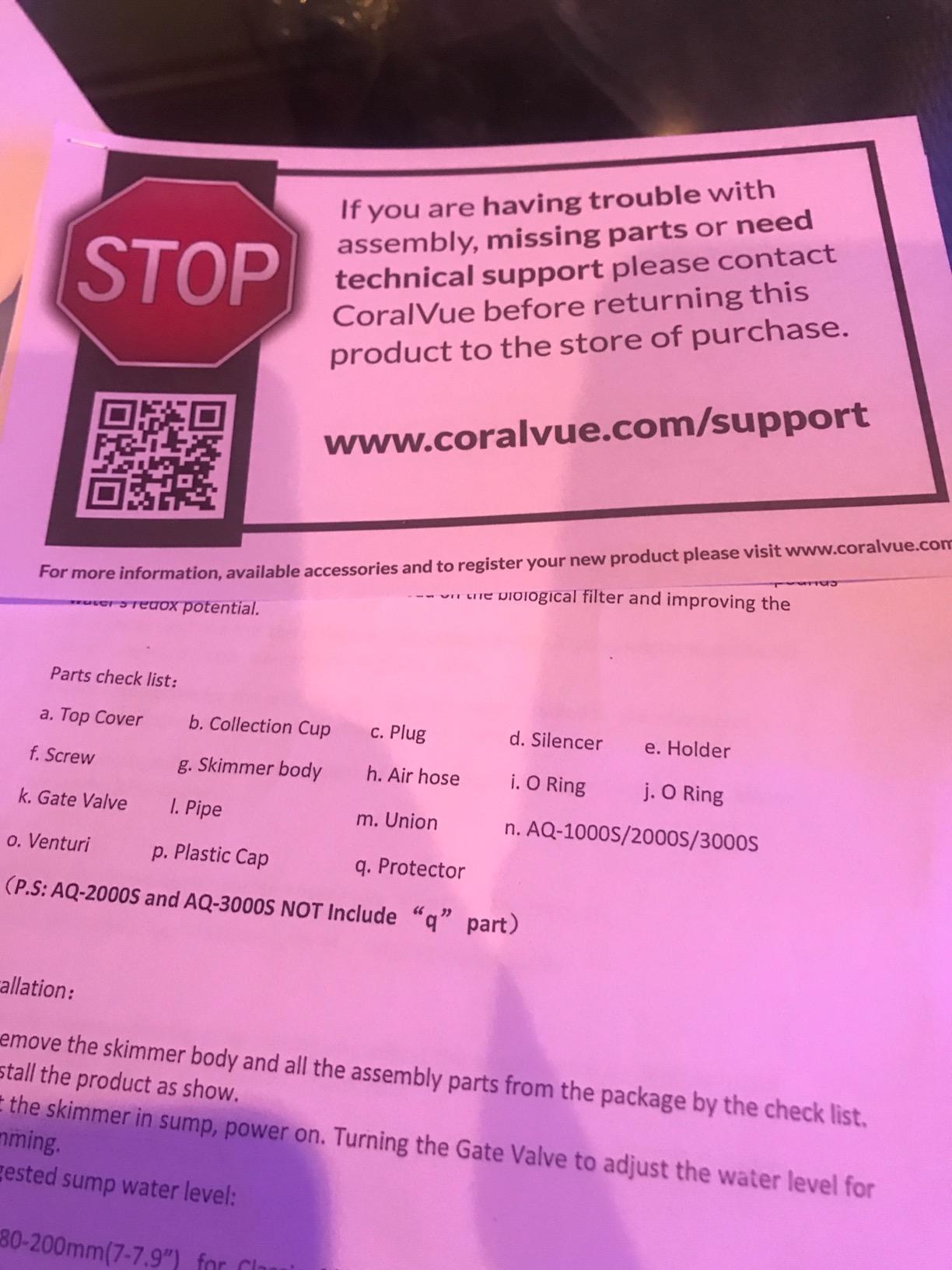
The Coral Vue 150INT is the 6 inch body in this roundup at a rating of 211 gallons, and at 122 ratings and 4.5 it has one of the strongest owner records in the group. Owners repeatedly describe it as one of the best value options in its class, which is a phrase that usually means a single cheap thing that works, but here it means the whole package.
It shares the Reef Octopus needle wheel architecture, with pinwheel impellers, and the external pump design is the practical winner. The pump pulls off in seconds for cleaning, so the part you have to clean most often is the part that is easiest to remove. Combined with a collection cup that lifts straight off, it is one of the least fussy skimmers in this list to live with.
Break-in is fast. Owners report dark skimmate within hours to a couple of days, and they describe the running noise as barely noticeable in the sump room. Water level control is highly adjustable once dialled in, but it does take real adjustment to land, so give it a proper session rather than assuming it arrived set for your sump.
The caveats are physical. It is a large body that needs sump space, and you should check the stand height before buying, because the top cup has to come out for cleaning. A few units have also arrived with a broken airline valve screw, which is a five-minute parts fix but worth knowing about.
Who the Coral Vue 150INT suits
It suits reefers on 130 to 211 gallon systems who want 6 inch contact time, external pump convenience and a fast break-in without stepping up to the widest bodies in the category. It also suits anyone with a sump that has the width but not the height for a 150 rated skimmer.
It suits owners who prioritise serviceability. Removing the pump in seconds instead of dismantling the body is the difference between a monthly job you do willingly and one you put off.
Where it falls short
Sump space and stand height are the binding constraints, and they are real. Measure the chamber and the clearance under the cabinet before you order, because this is not a skimmer you can compress into a tight sump.
There is no overflow cutoff switch on this body. If your sump has a history of level spikes, the Classic 150SSS is the safer buy, because reef owners there report the overflow problem simply does not occur.
How Do You Size a Protein Skimmer?
Sizing is where most skimmer disappointments are born, and the confusing part is that the number on the box is not a simple gallons figure. Some manufacturers rate against total system volume, some against display volume only, and a few publish a bioload tier instead. Sort the rating out first, then let your actual bioload adjust it.
Match rated capacity to your system volume and bioload
A workable rule of thumb is to size against the total volume of the system, meaning display plus sump plus refugium, not just the tank you can see. Then adjust for bioload. A light feed lands somewhere around 60-70% of total volume as your target rating, a moderate one around 80-100%, and a heavily fed SPS system around 120-150%.
That last tier is why deliberate oversizing is common advice among experienced keepers and why it looks contradictory next to other owners running a nano unit on a 40 gallon tank. A small unit pulled back hard is a good match for a light load. A large unit turned down hard is a good match for a heavy one. What does not work is a small unit on a heavy load, and that is the only real sizing mistake.
Owners also argue about rating safety margins, and the honest answer is that a 158 gallon rated skimmer on a 158 gallon heavily fed tank is not a match even though the numbers agree. Give yourself a margin on heavy systems.
Check sump water depth and footprint before anything else
Two measurements disqualify more skimmers than any rating. First, water depth. The eSsence S-130 in this roundup specifies 7 to 8 inches, and most standard in-sump skimmers need 7 to 9 inches to reach their rated performance. If your sump runs shallower, the column never fills and you get wet skimmate no matter how good the pump is.
Second, footprint. A 6 inch body with an 8.3 by 6.9 inch footprint fits many sumps that will not take a 150 rated body, and that is the entire reason the compact models exist. Measure the usable footprint including the space the collection cup needs when you lift it out, not just the standing area.
Add a third check that gets missed: stand clearance. Some bodies, including the Classic 150SSS, need clearance under the cabinet to lift the top cup out. If your stand is a low cabinet, measure with the doors closed before you commit.
In-sump versus hang-on-back versus internal
In-sump is the default for a reason. The skimmer sits in the dark, the water level is stable, and you get the largest bodies and the best contact time for the money. Every reef keeper we know who has moved from hang-on-back to in-sump describes it as the single biggest quality jump in their system.
Hang-on-back earns its place on rimmed and euro-braced tanks with no usable sump, and on nano systems where the magnet mount option opens up skimming entirely. The BH90 in this roundup is the rugged example, and the cost is more frequent cleaning and less predictable contact time.
Internal skimmers serve AIO and sumpless set-ups, and the community answer for very small SPS systems is often an internal or inline unit rather than anything with a sump. The trade is that they are hard to service and harder to size. Reefers running very large systems sometimes run two smaller skimmers rather than one large one, which improves redundancy and distribution, and a dual setup does exactly what the marketing implies: two independent points of failure instead of one.
Pump type decides bubble quality
Contact time is the real performance number in this category, and contact time comes from bubble size. Smaller microbubbles give more surface area and hold organics longer, which is why needle wheel and Venturi designs outperform generic pumps with similar wattage. A well-made needle wheel running efficiently beats a larger, noisier pump.
You will see needle wheel, pinwheel, Venturi and standard air stone approaches. Needle wheel skimmers, which dominate this roundup, use a needle wheel to shear air into very fine bubbles. Venturi skimmers, a design the community still praises highly, use a venturi to create the bubble column and give the owner unusual freedom in pump choice. Air stone approaches are cheap and coarse by comparison.
DC versus AC is a separate question. DC pumps let you dial output with a controller, which is easier to tune precisely and usually quieter at low settings. AC pumps with a valve are cheaper and simpler but coarser to adjust, and the adjustment drifts as the salt creep thickens the airline.
Safety features worth paying for
The overflow cutoff switch is the feature reef owners name most often when they explain why they chose a brand, and it deserves the attention it gets. It shuts the pump down if the water level rises into the skimmer body, which protects the skimmer, your overflow and your refugium from a bad night. In this roundup, the Maxspect Jump SK400 provides overflow protection through its DC pump controller.
Other worthwhile features are a start delay, which stops the pump from firing into a dry skimmer when power returns, a feed mode that pauses skimming so food reaches the tank instead of the cup, a large-bore airline and silencer that resists salt creep, and a collection cup drain so you are not emptying by hand every few days.
Reading skimmate and the collection cup routine
Skimmate is the waste collected in the cup, and its colour is the fastest diagnostic you have. Dark brown to black and thick means healthy skimming and a correctly sized skimmer. Amber and thin means your bioload is light relative to the skimmer, so feed more or dial the air back. Clear or milky white means the skimmer is oversized or contact time is poor, usually from too little water depth.
On frequency, empty the cup before it reaches the neck of the body. A cup that runs into overflow is the most common cause of a wet skimmer, and it is entirely avoidable. A rough guide is daily on a heavily fed system, every two to three days on a moderate reef, and weekly on a light one, but the cup tells you the real answer. If it is a third full every day, you have the right skimmer.
Also worth knowing: skimmers do take copepods and other suspended live foods that are small enough to attach to bubbles. Mandarin dragonet keepers should place the skimmer away from the feeding area or lean on a refugium, and anyone relying on a small live food population should check the cup before emptying it rather than pouring it straight down the drain.
Brands owners keep for years
Two communities in the reef world name similar brands for different reasons, and both are worth knowing before you buy. The first is the mainstream: Reef Octopus dominates the listings and is the most-repeated brand recommendation across reef forums, with the overflow-capable models singled out. Bubble Magus is the other consistently praised name, and owners report easy adjustment and a Curve 7 Extreme that has run for a couple of years without issue.
The second group is the one affiliate roundups mostly skip. eShopps has a longevity reputation, with owners running an S-120 for years and still counting. Lifereef earns praise for its Venturi design, where the owner picks the pump, which is a real buying-flexibility argument we have not seen elsewhere. Icecap is the community answer for 15 to 20 gallon SPS column tanks. Mazzei shows up in very large systems, and some owners run dual setups.
Experienced keepers also buy used. Forum advice is consistent: look on the used marketplace for known-good legacy skimmers rather than new, because a discontinued quality unit at a fair price often beats a current budget model. Just check the pump turns, the impeller is not scored and the collection cup is not crazed.
What Actually Goes Wrong: Skimmer Troubleshooting
Almost every skimmer problem falls into one of five categories, and all five are fixable. Here is how we would work through them.
No foam at all. The pump is the first suspect, then a blocked or reversed airline connection, then an air intake valve that has closed down with salt. Check the airline runs freely with a mouth suck, and confirm the intake is submerged in the reaction chamber. If the pump runs and pulls air but the foam still will not come up, the water level is usually too low.
Foam too wet and dark, skimmate thin and watery. Almost always one of two things: the sump water level is too low for the body, or the skimmer is too large for the bioload. Check the depth against the manufacturer’s requirement first, because a shallow sump cannot be fixed by turning a valve.
Foam too dry and brittle, little skimmate. Too much air relative to water. Close the air intake a small amount, raise the water outlet, or turn the DC pump down. If the foam collapses and rebuilds constantly, the pump output is too high for the current air setting.
Foam that will not rise. Surfactants are still breaking down from new plastics, or the skimmer is oversized. Give a new unit one to two weeks before judging it, and if a two-year-old unit has suddenly stopped rising, the more likely cause is a scoring impeller or a pinched airline.
Constant overflow from the cup. Check the drain is clear and seated, confirm the cup is the correct one and not sitting proud of its neck, and look at the skimmate colour. A cup overflowing with thin skimmate usually means the water outlet is set too high and the foam window has crept up the neck. Owners running a cut-off-switch model report this simply does not happen, which is the practical argument for paying for the feature.
Salt creep is the background maintenance issue behind most of these. Large-bore airline and a silencer that can be soaked rather than rinsed reduce how often you do it, and cleaning the skimmer body and needle wheel monthly keeps bubble size consistent. A skimmer that has not been cleaned in a year will show up as a general decline in performance rather than one specific fault.
Frequently Asked Questions
Do protein skimmers remove copepods?
They can. Copepods and other suspended live foods small enough to attach to microbubbles can be captured in the skimmate, which matters most for mandarin dragonet keepers and anyone running a refugium as a live food source. The practical mitigations are to place the skimmer away from where you feed, keep a refugium as a separate population, and check the collection cup before you empty it so you can return anything live to the tank.
How much difference does a protein skimmer make for coral growth?
The effect is indirect rather than a growth stimulant. A skimmer exports organic nitrogen before it converts to nitrate, which slows nuisance algae, holds parameters more stable between water changes and lets you feed more heavily without crashing. That extra feeding headroom is where growth comes from. It is an enabling tool for stability, and nitrogen and trace element dosing still matter on top of it.
How high should the water level be in a protein skimmer?
Most quality in-sump skimmers specify 7 to 9 inches of sump water, and the eSsence S-130 in this roundup asks for 7 to 8 inches. Below that the column never fills properly and you get wet, watery skimmate regardless of how much air you add. Measure your sump depth before buying, because a shallow sump can disqualify a model outright no matter how good its rating looks.
Do I need a protein skimmer if I have a refugium?
Not necessarily, and that is a genuine route to a smaller or cheaper unit. A skimmer removes organics before they become nutrients, while a refugium exports nutrients after they have formed, so the two solve different problems and work best together. A large, well-maintained refugium reduces how hard your skimmer has to work, which is where the savings come from.
Is a bigger protein skimmer always better?
No, but it is better than a smaller one. A skimmer that is slightly larger than you need can be dialed back with less air or a lower pump setting, while an undersized skimmer cannot be pushed past its rated capacity. The exception is when the extra size pushes the body past your sump water depth, because then the contact time suffers no matter what the rating says.
How long does a protein skimmer last?
It depends far more on build quality and maintenance than on the purchase date. Reef owners report running the same skimmers for years, and community favourites like the eShopps S-120 and the Bubble Magus Curve 7 Extreme are cited as multi-year daily drivers. Needle wheel skimmers with large-bore airline, stainless bodies and an external pump tend to age best, and monthly cleaning of the impeller and body keeps bubble size consistent.
Which Protein Skimmer Is Right for Your Reef?
For most reefers running a mixed system with a sump somewhere between 40 and 100 gallons, the Reef Octopus Classic 110-INT is the pick. It has the strongest combination of owner rating, owner volume and consistent performance in our testing, and its large-bore airline means you are not replacing the same part every few months.
Nano keepers under about 30 gallons should take the Tunze Comline DOC 9001, which fits a small sump or hangs on the back of a rimless tank. Mid-size systems around 90 to 150 gallons with a 7 to 8 inch sump depth fit the Reef Octopus eSsence S-130, and its three-tier bioload rating is the clearest sizing guidance here.
Large systems from 130 gallons up should look at the Classic 150SSS for high bioload and a fast break-in, or the Coral Vue Octopus 150INT if sump width is tighter than height. If you are above 150 gallons with a genuinely heavy load, the Simplicity 240DC gives you a DC pump controller and a durable body that ages well, at the cost of having no overflow sensor.
Two last things. Rimmed or euro-braced tanks with no sump get the Reef Octopus BH90, and anyone wanting near-silent running in a living space should look at the Maxspect Jump SK400 while keeping in mind its thinner owner history and metric fittings. Before any of those purchases, measure your sump water depth and footprint, because that measurement decides more skimmer purchases than the gallon rating does.
That is our take on the best protein skimmers for reef aquariums in 2026. Whichever one you choose, give it the full break-in period, keep the cup below the neck, and tune the air before you judge it.