
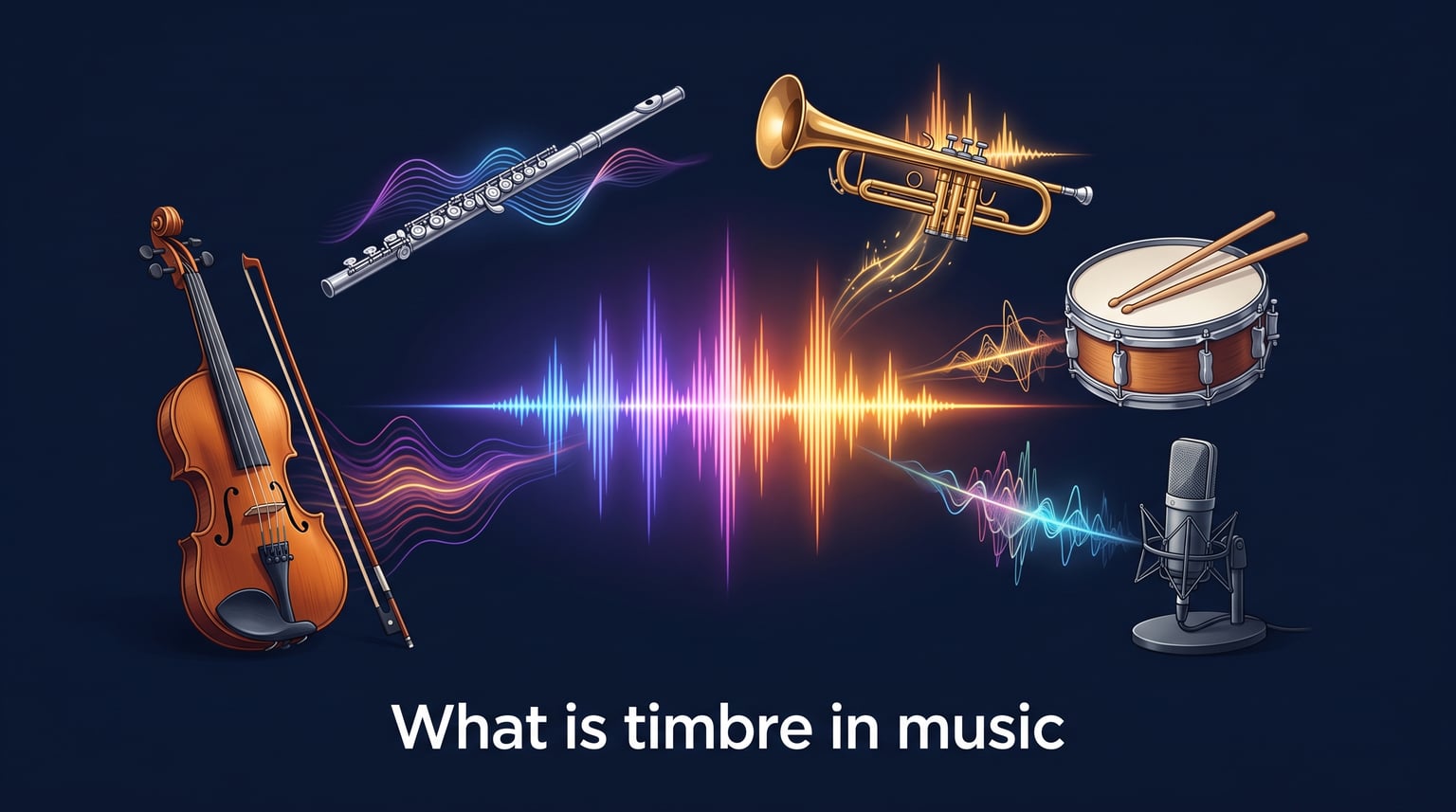
Play the same middle C on a piano, a guitar, and a flute, and you will hear three completely different sounds. Same note, same pitch, same volume. Yet your ears instantly tell you which instrument is which. That difference is timbre, and it is one of the most fascinating concepts in all of music.
If you have ever wondered what is timbre in music, you are asking the right question. Timbre (pronounced TAM-ber) is the reason a trumpet sounds thrilling while a cello sounds melancholy. It is the reason you can recognize your favorite singer’s voice from a single word.
Without timbre, every instrument and every voice would sound exactly the same. In this guide, I will break down timbre from every angle. We will cover the definition, the science behind it, how it differs from pitch and volume, and how to describe what you hear.
Table of Contents
What Is Timbre in Music? The Definition
Timbre (pronounced TAM-ber, with the emphasis on the first syllable) is the unique quality or “color” of a sound that makes one instrument or voice sound different from another. Even when two sounds share the exact same pitch and loudness, their timbre is what tells them apart. Musicians also call it tone color, tone quality, or simply sound quality.
Think of timbre as the personality of a sound. A note played on a violin has a singing, vibrant character. That same note on a saxophone feels smooth and reedy.
The pitch is identical, but the sonic texture is completely different. That texture is timbre at work. The word itself comes from an old French term meaning “bell” or “drum.”
Over centuries, it evolved to describe the distinctive flavor of any sound. Today, psychoacoustics researchers study timbre as a core dimension of hearing, alongside pitch and loudness. It is how your brain identifies whether a sound came from a guitar, a voice, or a synthesizer.
Here is a simple way to remember it. If pitch is the highness or lowness of a note, and volume is how loud or soft it is, timbre is everything else. It is the rich layer of detail that gives each sound its fingerprint.
How Timbre Differs from Pitch and Volume?
Many people confuse timbre with pitch or volume, and that confusion is completely understandable. All three describe aspects of sound, but they measure very different things. Let me break them down one at a time.
Pitch: How High or Low a Note Sounds
Pitch refers to the fundamental frequency of a sound, measured in Hertz (Hz). A high pitch like a piccolo produces fast sound waves. A low pitch like a bass drum produces slow ones.
When you sing “do re mi fa sol,” you are changing pitch. Two instruments can play the exact same pitch and still sound totally different. A violin and a trumpet both playing A above middle C (440 Hz) produce the same note.
But the violin sounds bright and stringy while the trumpet sounds bold and brassy. That difference is timbre, not pitch.
Volume: How Loud or Soft a Sound Is
Volume, or loudness, describes the amplitude of a sound wave. A whisper has low volume. A fire engine siren has high volume.
You can play a guitar gently or strum it hard, changing the volume without changing the pitch. Again, volume alone does not determine timbre. You can play a flute softly or loudly, and it still sounds like a flute.
The characteristic airy, breathy quality remains. That is because timbre comes from a completely different set of acoustic properties.
Timbre: The Quality or Color of the Sound
Timbre is the catch-all term for everything that makes a sound unique beyond pitch and volume. It includes the harmonic content, the attack and decay, the resonance, and the overall texture.
If pitch is the note and volume is the force, timbre is the voice. This is why a recording of your mother speaking is instantly recognizable, even over a crackly phone line. Her pitch and volume change constantly, but her timbre stays consistent.
Your brain has learned the unique frequency fingerprint of her voice, and that is what you recognize.
The Science Behind Timbre: Harmonics, Overtones, and Waveforms
To really understand what creates timbre, we need to look at the physics of sound. Do not worry, I will keep this practical and clear. No advanced math required.
Fundamental Frequency and Overtones
Every musical note starts with a fundamental frequency. This is the lowest and loudest frequency in the sound, and it is what determines the pitch.
When a violinist plays an A at 440 Hz, that 440 Hz wave is the fundamental. But instruments do not produce just one clean frequency. They produce a whole stack of additional frequencies called overtones or harmonics.
These are mathematical multiples of the fundamental. So our 440 Hz A also produces waves at 880 Hz, 1320 Hz, 1760 Hz, and so on. The magic is in the mix. Different instruments emphasize different harmonics at different strengths.
A flute keeps its harmonics relatively quiet and smooth, giving it a pure, clean sound. A trumpet pushes those harmonics loud and bright, giving it that piercing brass character. The specific recipe of harmonics is what gives each instrument its signature timbre.
Waveforms: The Shape of Sound
If you could see a sound wave on a screen, you would notice it has a shape. That shape directly determines the timbre.
Here are the four basic waveforms you will encounter in music and synthesis:
Sine wave: A smooth, rolling curve that produces the purest possible tone. Think of a tuning fork or a softly blown bottle. It has almost no harmonics, so it sounds clean and simple.
Square wave: A blocky, on-off pattern that sounds buzzy and hollow. Early video game music used square waves heavily. They are rich in odd harmonics.
Sawtooth wave: A jagged, ramping shape that sounds bright, aggressive, and full. Synthesizers use sawtooth waves for brass and string sounds because they contain both odd and even harmonics.
Triangle wave: A pointed shape between sine and square. It sounds softer than a square wave but richer than a sine wave. Think of it as a gentle cousin to both.
Real instruments produce complex waveforms that combine all of these shapes and more. A guitar string does not produce a clean sine wave.
It produces a messy, beautiful combination of frequencies that shifts moment by moment. That complexity is what makes acoustic instruments sound so alive compared to basic synthesized tones.
The Envelope: Attack, Decay, Sustain, and Release
Harmonics are only half the story. The other major factor in timbre is the envelope, which describes how a sound changes over time.
Audio engineers break this into four stages, often called ADSR:
Attack: How quickly the sound reaches its peak when it starts. A piano has a fast, sharp attack. A violin bowing a note has a slow, gradual attack.
Decay: How the sound drops from that initial peak. A plucked guitar string decays quickly at first, then levels off.
Sustain: The level the sound holds at while the note continues. A sustained organ note stays steady, while a drum has almost no sustain at all.
Release: How the sound fades after the note stops. A cymbal has a long release that lingers. A marimba note disappears almost instantly.
These four stages shape timbre as much as harmonics do. This is why a piano and a harp, which both use vibrating strings, sound so different.
The piano’s felt hammers create a punchy attack, while the harp’s plucked strings have a gentler, rounder beginning.
Timbre Across Different Instrument Families
Every instrument family has its own characteristic timbre range. Let me walk through the major groups so you can hear the differences in your mind.
Strings: Bright, Warm, and Singing
String instruments like the violin, viola, cello, and double bass produce sound through vibrating strings amplified by a wooden body. Their timbre tends to be rich in harmonics, giving them a singing, expressive quality.
A violin sounds bright and piercing in its upper register but warm and mellow down low. The cello offers a deep, resonant tone that many people describe as the closest instrument to the human voice.
Guitars belong to the string family too. An acoustic guitar has a woody, open timbre. An electric guitar through a clean amp sounds glassy and clear.
Crank up the distortion, and the timbre transforms into something gritty, sustained, and aggressive. Same instrument, totally different tone color.
Woodwinds: Reedy, Airy, and Mellow
Woodwinds include the flute, clarinet, oboe, bassoon, and saxophone. Despite the name, not all use wooden reeds, but they all produce sound through vibrating air columns.
The flute has an airy, breathy timbre that floats above an orchestra. The clarinet offers a smooth, woody warmth. The oboe has a penetrating, reedy quality that cuts through ensembles.
The bassoon adds a dark, comical richness in its low range. The saxophone, technically a woodwind because of its reed, has a timbre that blends brass brightness with reedy complexity.
This is why it works so well in jazz, where players bend and shape the tone endlessly.
Brass: Bold, Brassy, and Powerful
Brass instruments like the trumpet, trombone, French horn, and tuba produce sound through vibrating lips against a mouthpiece. Their timbre is bold, resonant, and full of upper harmonics.
A trumpet played loud sounds brilliant and thrilling. The same trumpet played softly with a mute takes on a nasal, intimate quality. The French horn has a rounder, more mellow timbre than the trumpet.
The trombone adds a vocal, sliding quality thanks to its slide mechanism. The tuba anchors the low end with a deep, rumbling warmth.
Percussion: From Crisp to Booming
Percussion instruments cover the widest timbre range of any family. A snare drum has a crisp, sharp, noisy timbre. A bass drum offers a deep, thunderous boom.
A cymbal produces a complex wash of shimmering high frequencies. A marimba creates a warm, woody ring. A triangle adds a pure, bright ping.
Tuned percussion like xylophones, marimbas, and timpani produce definite pitches with distinctive timbres. Untuned percussion like cymbals, shakers, and tambourines focus purely on tone color without a clear pitch.
Both types shape the overall sound of any ensemble.
Vocals: The Most Expressive Timbre of All
The human voice produces the most flexible and expressive timbre in music. Your vocal folds vibrate like strings, and your throat, mouth, and nasal cavities act as a resonating chamber.
By changing the shape of your mouth and the tension in your throat, you can produce an enormous range of tone colors. A classical soprano has a bright, ringing timbre. A jazz singer might aim for a smoky, breathy quality.
A rock vocalist pushes toward a raspy, distorted edge. Country singers often use a nasal twang. Every vocal style is really a timbre choice, and every singer’s natural instrument has its own inherent tone color that makes them recognizable.
Words to Describe Timbre in Music
One of the hardest parts of understanding timbre is finding the right words to describe it. Musicians and sound engineers have developed a rich vocabulary for tone color over the years.
Here are the most common timbre descriptors, grouped in pairs so you can hear the contrast:
Bright vs. Dark: Bright sounds have lots of high frequencies. Dark sounds emphasize the lows. A trumpet is bright. A bass clarinet is dark.
Warm vs. Cold: Warm timbres feel full and inviting. Cold ones feel thin and clinical. A cello is warm. A cheap synthesizer preset might sound cold.
Harsh vs. Smooth: Harsh sounds are aggressive and grating. Smooth sounds are gentle and flowing. A distorted electric guitar is harsh. A flute is smooth.
Breathy vs. Piercing: Breathy timbres include the sound of air, like a softly blown flute. Piercing sounds cut through everything, like a high trumpet note.
Nasal vs. Open: Nasal sounds seem to come through the nose, like an oboe or a muted trumpet. Open sounds feel wide and free, like an unforced vocal.
Mellow vs. Edgy: Mellow timbres are relaxed and soft. Edgy ones push forward and grab attention.
Metallic vs. Woody: Metallic sounds ring like bells or cymbals. Woody sounds have the organic resonance of acoustic instruments like guitars and marimbas.
Reedy vs. Brassy: Reedy describes woodwinds like clarinets and oboes. Brassy describes horns like trumpets and trombones.
The best way to build your vocabulary is to listen actively. Pick a song, close your eyes, and try to describe each instrument using two or three of these words.
Over time, describing timbre becomes second nature.
How Musicians Control and Shape Timbre?
Timbre is not fixed. Musicians and producers constantly shape and modify it, both in performance and in the studio. Here are the main ways tone color gets controlled.
Acoustic musicians change timbre through technique. A violinist shifts between bowing near the bridge for a bright, harsh sound and bowing over the fingerboard for a softer, fluffier tone.
A guitarist picks near the bridge for clarity or strums over the soundhole for warmth. A singer adjusts their throat and mouth shape to move between chest voice, head voice, and falsetto, each with its own timbre.
Instrument design also shapes timbre. The wood chosen for a guitar top, the metal used in a saxophone, the thickness of a drumhead, and the shape of a violin body all affect the harmonic profile.
This is why two violins built from the same template can sound noticeably different. In the studio, producers manipulate timbre using equalization (EQ), compression, reverb, and effects.
EQ lets you boost or cut specific frequency ranges, making a vocal brighter or a bass warmer. Distortion pedals add harmonic content that thickens guitar tone. Reverb creates a sense of space that changes how we perceive the sound’s color.
Electronic musicians work with timbre from the ground up. Synthesizers let you build tones by combining waveforms, adjusting envelopes, and routing signals through filters.
This is why electronic music offers such a vast palette of sounds, from warm analog pads to piercing digital leads. Every knob twist is a timbre decision.
Why Timbre Matters in Music?
Timbre does more than make instruments identifiable. It carries the emotional weight of music. A composer choosing between an oboe and a clarinet for a melody is making a timbre decision that changes how the listener feels.
Bright, piercing timbres tend to feel energetic and exciting. That is why trumpets and cymbals dominate fanfares and celebrations. Dark, warm timbres feel intimate and melancholy, which is why cellos and bass clarinets show up in sad, reflective passages.
Nasal timbres can sound humorous or tense. Smooth timbres feel calm and soothing. Timbre also defines musical genres.
The distorted guitar and snare-heavy drum timbre of rock sounds nothing like the clean Rhodes piano and brushed drums of jazz. The booming 808 bass of trap music has a completely different tone color than the upright bass of bluegrass.
When you recognize a genre instantly, you are often responding to timbre cues before you even process the melody. In modern production, timbre can matter more than melody or harmony.
A great pop song with generic instrumentation falls flat. The same chord progression with a distinctive synth patch and a unique vocal tone becomes a hit. Producers know this, which is why they obsess over tone color in every layer of a track.
How to Develop Your Ear for Timbre?
Anyone can learn to hear and describe timbre more clearly. It just takes practice and attention. Here are some exercises I recommend.
Start with instrument identification. Listen to orchestral music and try to name each instrument as it enters. When you hear a new sound, ask yourself whether it is bright or dark, smooth or harsh, reedy or brassy.
Over time, your brain builds a library of timbre references. Try the same note exercise. Find recordings of different instruments playing middle C, then compare them side by side.
Notice how the flute sounds thin and airy while the trumpet sounds bold and metallic. Pay attention to the attack, the sustain, and how the note fades. This trains your ear to focus on timbre instead of pitch.
For vocalists, record yourself singing the same phrase in different styles. Try it breathy, then full and powerful, then nasal, then whispery.
Listen back and describe what you hear. This builds both your awareness and your control of your own timbre. If you produce music, experiment with EQ on a single instrument.
Boost the highs and notice how the timbre gets brighter. Cut the lows and hear it thin out. This hands-on approach teaches you how frequency balance shapes tone color.
FAQs
What is an example of a timbre?
A clear example of timbre is the difference between a piano and a guitar playing the same note. Both produce middle C at the same pitch, but the piano sounds bright and percussive while the guitar sounds warm and stringy. That difference in tone quality is timbre.
What is the difference between tone and timbre?
Tone and timbre are closely related and often used interchangeably, but timbre is the broader term. Timbre refers to the overall quality or color of a sound, while tone can mean a specific pitch or a general quality of sound. In practice, when musicians say a sound has a warm tone, they are describing its timbre.
What is the difference between pitch and timbre?
Pitch is how high or low a note sounds, determined by the fundamental frequency. Timbre is the quality or color of that sound, determined by the harmonics and envelope. Two instruments can play the same pitch but have completely different timbres, which is how you tell a violin from a flute.
How to explain timbre to kids?
Tell kids that timbre is the special voice of each instrument. A piano and a flute can sing the same song, but they sound different because each has its own unique voice. Just like you can recognize your mom or dad by how they sound, you can recognize instruments by their timbre.
Conclusion: Why Understanding Timbre Changes How You Hear Music
Timbre is the hidden dimension of music that most people feel but never name. Once you understand what is timbre in music, every song opens up in a new way.
You start hearing the brightness of a trumpet, the warmth of a cello, the breathiness of a flute, and the unique voice of every singer you love. Whether you are a performer shaping your own sound, a producer crafting a mix, or a listener who simply wants to appreciate music more deeply, timbre is the key.
Pay attention to tone color the next time you press play. You may be surprised by how much you were missing.