
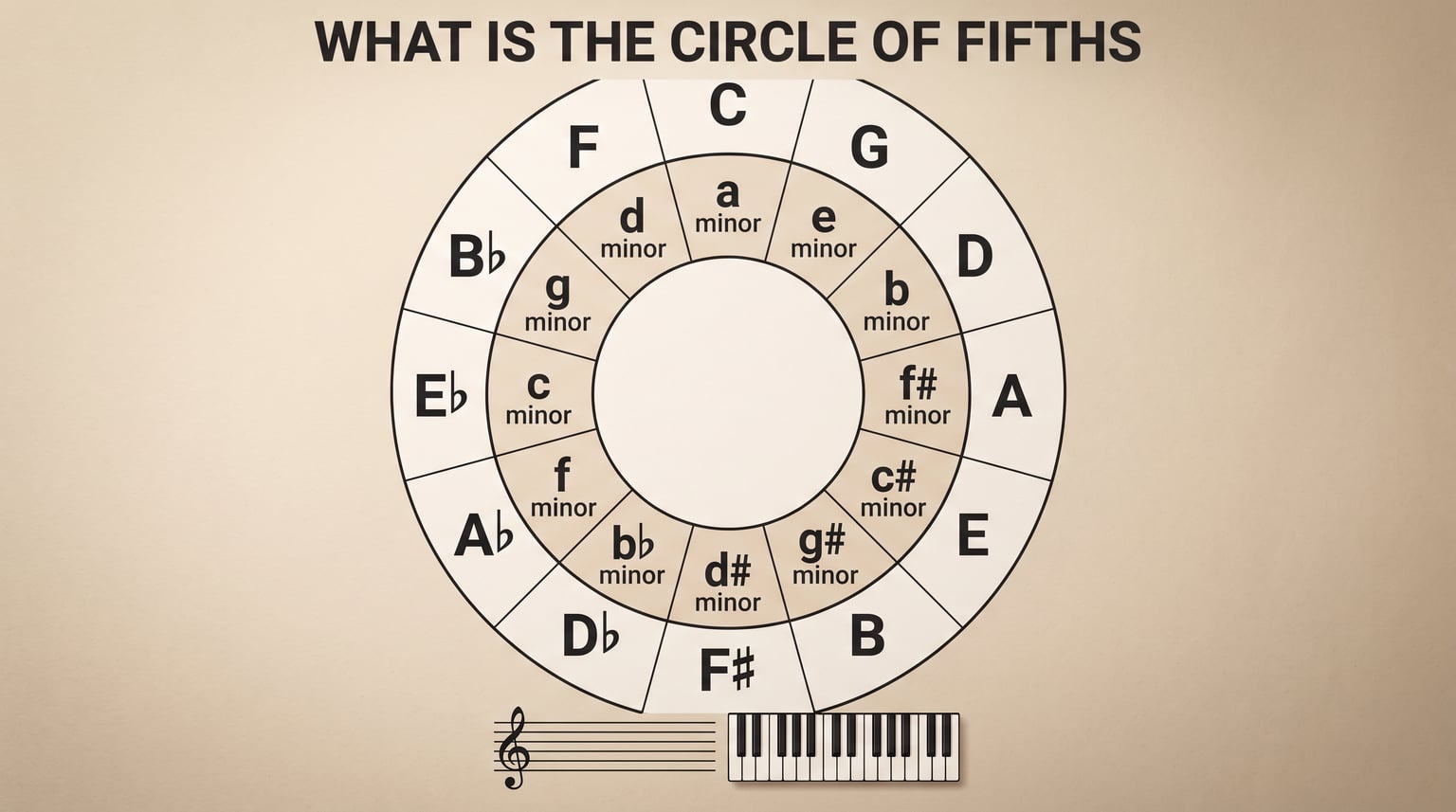
The circle of fifths is a visual diagram that shows how the 12 major and 12 minor keys in Western music relate to each other, arranged so each key sits a perfect fifth away from its neighbors. I remember staring at one of these charts in my first year of guitar lessons and feeling completely lost — until a teacher drew it on a napkin and suddenly every key signature made sense. In this guide I’ll walk you through what the circle of fifths is, how to read it, and the practical ways musicians actually use it on piano, guitar, and in songwriting. By the end you’ll have a clear mental model plus memory tricks that make the circle stick.
Table of Contents
What Is the Circle of Fifths, Exactly?
The circle of fifths is a circular diagram that arranges all 12 pitch classes of the chromatic scale in order of ascending perfect fifths. Think of it as a clock face where each hour represents a different musical key instead of a number. It was first described in the 17th century and is now the standard way music theory textbooks organize the 24 major and minor keys.
The earliest printed version appeared in Nikolay Diletsky’s 1679 grammar of music, though Pythagoras had explored the perfect fifth interval centuries earlier. Johann David Heinichen popularized a similar layout in 1728, and the modern circular diagram has been a teaching staple ever since. Understanding this history is helpful because it explains why the circle is built around the perfect fifth rather than the perfect fourth — fifths were considered the strongest harmonic relationship in Renaissance and Baroque theory.
At the top of the circle sits C major, the only key with no sharps or flats in its key signature. Move one step clockwise and you land on G major, which has one sharp (F#). Move one more step and you reach D major with two sharps, then A major with three, and so on.
Going counterclockwise from C takes you to F major with one flat (Bb), then Bb major with two, then Eb major, and onward. The cool part is that both directions eventually wrap around and meet again at the enharmonic equivalents — like F# major and Gb major, which sound the same but are written differently.
A perfect fifth is the musical interval between a note and the next note seven half steps higher. From C up to G is a perfect fifth. From G up to D is another perfect fifth — that’s why each step around the circle is a fifth.
How Keys Are Organized on the Circle
The circle of fifths has two clear rules for direction. Move clockwise and you’re adding one sharp to your key signature. Move counterclockwise and you’re adding one flat.
This is the trick that makes the whole diagram useful — you can read any key’s key signature just by counting how many steps it sits from C. Once you know the direction rule, the rest is pattern recognition.
The order in which sharps appear in key signatures is F, C, G, D, A, E, B. That means G major has F#, D major has F# and C#, A major has F#, C#, and G#, and so on. The last sharp added (B in this sequence) is always a half step below the tonic of the key.
The order of flats is the exact reverse: B, E, A, D, G, C, F. F major has Bb, Bb major has Bb and Eb, Eb major has Bb, Eb, and Ab, and so on. The second-to-last flat you add is always the name of the key itself — that’s the easiest memory trick for flats.
Here is a quick reference for major key signatures reading clockwise around the circle starting from C at the top:
- C major — 0 sharps or flats
- G major — 1 sharp (F#)
- D major — 2 sharps (F#, C#)
- A major — 3 sharps (F#, C#, G#)
- E major — 4 sharps (F#, C#, G#, D#)
- B major — 5 sharps (F#, C#, G#, D#, A#)
- F# major — 6 sharps (F#, C#, G#, D#, A#, E#)
- C# / Db major — 7 sharps or 5 flats
- Ab major — 4 flats (Bb, Eb, Ab, Db)
- Eb major — 3 flats (Bb, Eb, Ab)
- Bb major — 2 flats (Bb, Eb)
- F major — 1 flat (Bb)
You’ll notice the bottom of the circle contains enharmonic equivalents — keys like F# major and Gb major, or C# major and Db major. They’re spelled differently but sound identical on a piano. Composers pick one spelling or the other based on the surrounding key signatures and the way they want the music to look on the page.
Major Keys and Relative Minor Keys
The outer ring of the circle shows the 12 major keys, and the inner ring shows the 12 relative minor keys. A relative minor shares the same key signature as its major counterpart, but the tonal center is a minor third lower. The circle makes this relationship visual — each minor key sits just inside its relative major.
The most common example is C major and A minor. Both have zero sharps or flats, but A minor feels moodier and darker while C major feels bright and stable. Other familiar pairs include G major with E minor, D major with B minor, and F major with D minor.
You can find any relative minor by counting down a minor third (three half steps) from the major tonic. Or you can just look at the inner ring of the circle directly. This is how songwriters decide which chords to borrow when they want to add emotional depth to a song in a major key.
If you’ve ever wondered why a song “goes to the minor” briefly — that’s the relative minor at work. Switching from C major to A minor for a few bars creates that bittersweet feel because the ears expect C major but get a related key instead. The circle of fifths shows you instantly which minor keys share which key signatures and how to slip between them smoothly.
Practical Applications for Musicians
The circle of fifths is far more than a textbook diagram. I use it constantly when figuring out chord progressions, modulating between keys, or transposing a song for a singer’s range. Here are the practical applications that actually come up in real music making.
Building Chord Progressions
The most important chord relationships in popular music are I, IV, V, and vi. The circle of fifths shows exactly how these chords connect. In C major, the I chord is C, the IV chord is F (one step counterclockwise), and the V chord is G (one step clockwise).
The vi chord is Am, the relative minor sitting just inside the circle. A classic progression like C-G-Am-F moves around the circle by fifths between C and G, then dips inside to the relative minor, then steps counterclockwise to F. This is the backbone of countless pop, folk, and worship songs.
Modulating Between Keys
Modulation is the art of changing keys mid-song, and the circle of fifths tells you which key changes will sound smoothest. Adjacent keys on the circle share seven out of seven notes, so a modulation from C to G (one step clockwise) is barely noticeable and works well for subtle shifts.
For dramatic key changes, jump across the circle. A song in C major moving to Eb major (a third away) sounds like a sudden emotional shift — that’s why movie soundtracks use these distant modulations for climactic moments. The circle is the visual map that tells you how far apart your keys are.
Using the Circle on Piano
On a piano keyboard, the circle of fifths follows a very simple pattern. Starting at any C, the note seven white keys to the right is the next key clockwise on the circle. So C-G-D-A-E-B-F# all live on white keys except F#, which has a black key.
Going left (counterclockwise) from C by fifths gives you F, Bb, Eb, Ab — many of which require black keys. Try playing the circle on a keyboard: start at middle C and play C-E-G-C, then jump to G and play G-B-D-G, then D, then A.
Each chord you play is a I chord of the next key in the circle. This exercise trains your ears to recognize how each key sounds while teaching you the physical layout of the keyboard.
Applying It to Guitar
Guitarists benefit from the circle of fifths more than they realize. Open chord shapes follow the circle almost perfectly. The open chords G, D, A, E, and B form a chain of fifths — moving from G to D is one step clockwise on the circle, D to A is another step.
That’s why these chords sound so natural when played in sequence on a guitar. For barre chords, the circle helps you understand why a barre chord shape can be moved up or down the fretboard to play in any key.
The root of a major barre chord is on the sixth string, and moving up four frets (a perfect fifth) gets you to the next key’s barre chord position. The circle of fifths is literally the geometry of the fretboard. Once you see this, transposing songs up or down for a singer’s range becomes a matter of sliding the same shape along the neck.
Real Song Examples
Many hit songs use the circle of fifths without anyone realizing it. “Let It Be” by The Beatles moves between C, G, Am, and F — exactly the four chords that sit within one segment of the circle. “Someone Like You” by Adele pivots around the A major and F# minor area of the circle.
Jazz standards routinely modulate through several keys per song, and the smartest modulations always travel along the circle. If you analyze a song you love and notice the chords seem to march in a particular direction, you’re probably watching the circle of fifths in action.
Tips, Mnemonics, and Common Mistakes
The fastest way to memorize the circle of fifths is to use a sentence for the order of sharps and another for the order of flats. The classic mnemonic for sharps is “Father Charles Goes Down And Ends Battle” — that gives you F, C, G, D, A, E, B in order. For flats, reverse it: “Battle Ends And Down Goes Charles’ Father” gives you B, E, A, D, G, C, F.
Another trick is to memorize just the first four and let the pattern finish itself. Once you know G, D, A, E in the sharp direction, you can predict B and F# because the pattern continues by fifths. The same applies to flats starting from F, Bb, Eb, Ab.
Common mistakes beginners make include confusing the direction of sharps versus flats, mixing up major and minor keys when reading the inner ring, and forgetting that the bottom of the circle contains enharmonic spellings. Take a few minutes each day to draw the circle from memory and recite the key signatures — within two weeks it’ll feel automatic.
Frequently Asked Questions
What is the circle of fifths?
The circle of fifths is a circular diagram that arranges the 12 major and 12 minor musical keys so each key is a perfect fifth apart from the next. The outer ring holds the major keys and the inner ring holds their relative minors. It is the standard way musicians visualize key signatures and key relationships.
What is the trick for the circle of fifths?
The trick is to remember that moving clockwise adds one sharp to the key signature and moving counterclockwise adds one flat. From C major at the top, every step clockwise adds a sharp in the order F, C, G, D, A, E, B. Every step counterclockwise adds a flat in the reverse order B, E, A, D, G, C, F.
Did Bach use the circle of fifths?
Bach and other Baroque composers did not draw the circle as we know it today, but they used the principle heavily in their compositions. Bach’s Well-Tempered Clavier cycles through all 24 major and minor keys and many of the key relationships follow the perfect fifth pattern.
Is it worth memorizing the circle of fifths?
Yes. Memorizing the circle of fifths makes it faster to identify key signatures, build chord progressions, and modulate between keys. Even a rough mental image saves time when transposing songs, writing harmonies, or learning new pieces by ear.
What is the easiest way to learn the circle of fifths?
Start by drawing the circle from memory starting at C major at the top. Add the sharps clockwise using the Father Charles Goes Down And Ends Battle mnemonic. Then add the relative minor on the inner ring three half steps below each major key. Practice drawing it daily for two weeks.
How does the circle of fifths work for chord progressions?
The circle shows which chords are closely related. The I and V chords are adjacent clockwise, the I and IV chords are adjacent counterclockwise, and the vi chord is the relative minor on the inner ring. Many popular progressions move around the circle by fifths because those chords share many notes and sound smooth together.
Key Takeaways
The circle of fifths is the single most useful diagram in music theory. It shows the relationships between all 24 major and minor keys, gives you key signatures at a glance, and reveals which chords naturally flow into each other. Spend a few minutes each day drawing it from memory and reciting the order of sharps and flats.
Once the circle clicks, you’ll start spotting it everywhere — in chord progressions, song modulations, and even the geometry of a guitar fretboard. Print a blank circle and fill it in by hand; the act of drawing reinforces the pattern faster than just reading about it. Visit our site for more music theory guides updated for 2026.