
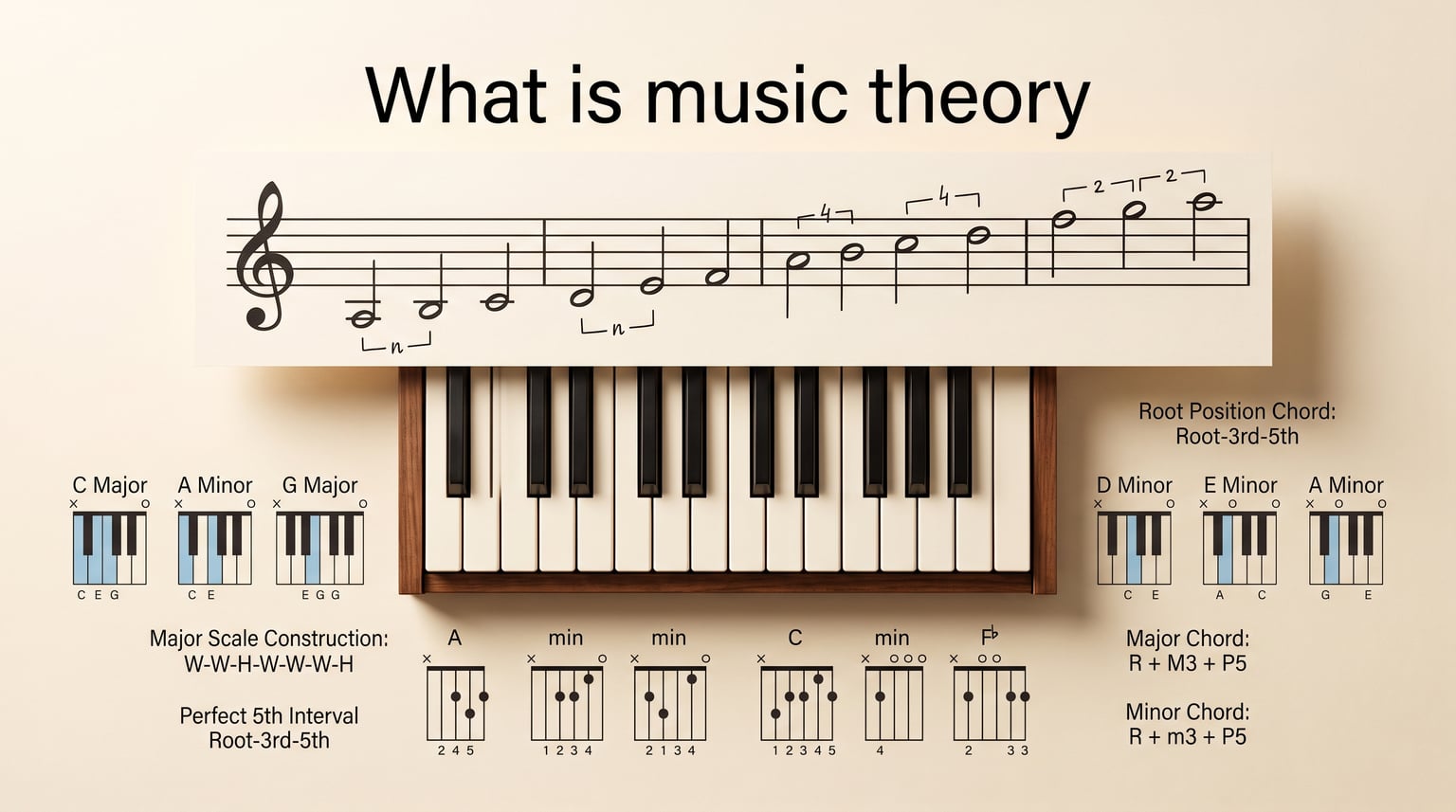
Music theory is the study of how music works. It is the language, grammar, and underlying system that musicians use to describe pitch, rhythm, harmony, melody, and form. Whether you play guitar, piano, drums, or produce tracks in a DAW, music theory gives you a shared vocabulary to understand why certain notes sound good together and how songs are built.
I remember being terrified of music theory when I first picked up a guitar. It looked like math, and I wanted to play, not study. Looking back, I now realize music theory is one of the most practical tools a musician can learn. In this guide, I’ll walk you through what music theory actually is, the core elements it covers, and how to start learning it without the overwhelm.
By the end, you’ll understand the four building blocks of music theory, common myths debunked by real musicians, and a simple path forward whether you are a complete beginner or an intermediate player looking to fill in the gaps. This guide is updated for 2026.
Table of Contents
What Is Music Theory? A Simple Definition
Music theory is the systematic study of the practices and possibilities of music. It explains the rules, patterns, and relationships between notes, rhythms, and chords so we can describe, create, and communicate musical ideas. Think of it as the grammar and syntax of the musical language.
At its heart, music theory covers four core elements that show up in nearly every musical tradition:
- Notes and scales – the building blocks of pitch, organized into patterns called scales
- Rhythm and meter – how notes are organized in time, including beats and time signatures
- Melody and form – the tune you hum and the structure that holds a song together
- Chords and harmony – how multiple notes blend to support the melody
These four pillars are the foundation of every genre from classical to hip-hop, jazz to EDM. Once you understand them, you can read sheet music, communicate with other musicians, and write your own songs with confidence.
The Core Elements of Music Theory Explained
The phrase “music theory basics” can feel intimidating because it spans centuries of writing. Strip away the academic jargon and you’re left with a handful of practical concepts that explain almost everything you hear.
Notes, Pitches, and the Musical Alphabet
Western music theory starts with just seven letter names: A, B, C, D, E, F, G. After G, the pattern repeats with A again at a higher pitch.
That repeating cycle of seven notes is called an octave. Sharps and flats add five accidentals (sharps raise a note by a half step, flats lower it), giving us 12 unique pitches inside every octave.
Each pitch also has a frequency. For example, A4 (the A above middle C) vibrates at 440 Hz, which is the standard tuning reference for orchestras and bands worldwide.
Scales and Key Signatures
A scale is a sequence of notes arranged in ascending or descending order. The major scale and the minor scale are the two most common scales in popular music.
The major scale uses this pattern of whole and half steps: whole-whole-half-whole-whole-whole-half. The C major scale spells out C, D, E, F, G, A, B, C with no sharps or flats.
A key signature tells you which notes are sharp or flat throughout a piece. There are 12 major keys and 12 minor keys, one for each starting pitch. The circle of fifths is the tool that connects all of them in a single diagram.
Intervals: The Distance Between Notes
The distance between any two notes is called an interval. Intervals are named by counting letter names and qualified by quality (major, minor, perfect, augmented, diminished).
Common intervals you will hear constantly in music include:
- Unison – same note played together (0 steps)
- Third – two notes that form a basic chord tone
- Fifth – the foundation of most chord shapes and power chords
- Octave – the same note name, eight steps apart
Understanding intervals is what makes ear training possible. Once you know how a fifth sounds, you can recognize it in any song.
Rhythm, Meter, and Time Signatures
Rhythm is the placement of sounds and silences in time. Meter groups those rhythms into repeating patterns of beats, and the time signature tells you how many beats are in each group.
Most pop, rock, and hip-hop use 4/4 time, meaning four beats per measure. Waltzes use 3/4 time, while odd meters like 5/4 or 7/8 drive progressive rock and jazz fusion.
Each beat can be divided into smaller notes. A quarter note gets one beat, an eighth note gets half a beat, and a sixteenth note gets a quarter of a beat. Tempo, measured in BPM (beats per minute), controls how fast those notes move.
Melody and Musical Form
Melody is the sequence of notes you remember from a song, often the part sung by a vocalist or played as a solo. Strong melodies tend to use notes from a scale, move mostly by step (small intervals), and feature memorable leaps at the climax.
Musical form is how a piece is organized. Common forms include:
- Verse-chorus – the backbone of pop music
- AABA – 32-bar jazz standard structure
- Sonata form – classical three-part exposition-development-recap
- Through-composed – no repeating sections, common in folk and prog
Understanding form helps you predict where a song is going, which makes learning songs by ear much easier.
Chords and Harmony
A chord is three or more notes played together. The most common chord types are major (happy sound), minor (sad sound), diminished (tense), and augmented (unsettling).
A chord progression is a series of chords played in order. The I-IV-V-I progression in C major uses C, F, G, and C. The I-V-vi-IV progression (C-G-Am-F) powers countless pop hits from “Let It Be” to “No Woman No Cry.”
Harmony is how chords interact over time. The circle of fifths helps explain why certain chord progressions feel resolved while others feel like they need to keep moving.
Does Music Theory Kill Creativity? Breaking the Myth
This is one of the most common beginner fears. I asked myself the same question when I was 16, and the answer from the music community is clear: music theory does not kill creativity, it expands it.
The myth comes from a few real situations. Sometimes students get bogged down in rules without ever playing. Sometimes theory is taught like math homework instead of like a hands-on skill. And sometimes players worry that knowing the “right” notes will stop them from experimenting.
Forums like Reddit’s r/musictheory and r/Guitar consistently push back on this fear with one insight: having more options never makes you less creative. Knowing theory is like knowing a larger vocabulary. You can still invent new sentences, but now you have more words to play with.
Look at Jimi Hendrix. He didn’t sit in a classroom studying Roman numeral analysis, but he absorbed the same patterns through listening and practice. He knew the theory, he just learned it informally. The same is true for The Beatles, Prince, and modern producers making hits in Ableton.
Reddit user u/the-theory-newbie put it well: “I thought theory would box me in. Six months in, I realized my favorite improvisations were already following theory rules I just hadn’t named yet.”
The truth is that every musician uses theory, even if they call it “feel” or “playing by ear.” Theory just gives names to what your ear already detects.
Why Learn Music Theory? Practical Benefits
Understanding music theory pays off in concrete ways, whether you want to play in a band, write songs, produce beats, or just enjoy music more deeply. Here are the benefits I have seen firsthand over years of playing and teaching.
Better Communication with Other Musicians
Saying “play a D minor seventh” is faster and clearer than humming the chord. Theory gives musicians a shared language so you can rehearse, jam, and collaborate without friction.
Faster Learning of New Songs
Once you know the major scale patterns, you can play in any key. Once you recognize common chord progressions, you can guess a song’s chords after one listen. Theory turns hours of trial and error into minutes of pattern recognition.
Stronger Songwriting and Composition
Theory reveals why certain melodies stick. It shows the relationship between tension and release, the building blocks of every memorable chorus. You don’t need theory to write good songs, but it gives you a deeper toolkit when you get stuck.
Improved Improvisation
Soloing over a chord progression becomes intuitive once you know which scales fit each chord. Jazz players, blues guitarists, and prog rock keyboardists all rely on theory to navigate fast harmonic changes on the fly.
Deeper Appreciation of the Music You Love
Knowing theory is like reading lyrics versus studying poetry. The song stays enjoyable, but now you can notice the chord changes, key modulations, and rhythmic tricks the songwriter used to hook you.
How to Start Learning Music Theory: A Step-by-Step Guide
If all of this sounds like a lot, don’t worry. Music theory for beginners can be picked up in small, practical steps. Here is the exact sequence I recommend to anyone starting from zero.
Step 1: Learn the musical alphabet. Memorize A through G. Practice identifying notes on a piano keyboard, guitar fretboard, or sheet music staff. Spend a week just getting comfortable with the names.
Step 2: Understand whole steps and half steps. The chromatic scale has 12 half steps per octave. Whole steps equal two half steps. This is the foundation of every scale and every chord.
Step 3: Build the C major scale. Since it has no sharps or flats, C major is the easiest scale to learn first. Play it ascending and descending on your instrument, then sing it.
Step 4: Add the major chord. A major chord is just the 1st, 3rd, and 5th notes of a major scale stacked together. In C major, that’s C, E, and G. Learn to play and recognize this chord shape in every key.
Step 5: Learn basic rhythm and time signature. Clap along to songs, count the beats, and figure out the time signature. Most music is 4/4, so start there.
Step 6: Explore the circle of fifths. This single diagram shows every key signature and how they relate. Once you understand it, you stop memorizing 24 random key signatures and start seeing the system.
Step 7: Apply theory to songs you love. Pick one of your favorite songs and identify its key, chord progression, and time signature. Play along. Theory sticks when it connects to music you actually enjoy.
Step 8: Move into minor scales, intervals, and chord extensions. After a few weeks of the basics, you can move into the more interesting side of music theory that opens up jazz, blues, and songwriting on a deeper level.
Music Theory in the Modern Era: DAWs and Digital Tools
Music theory in 2026 looks very different than it did 50 years ago. Producers working in DAWs like Ableton Live, Logic Pro, and FL Studio rely on the same theory that classical composers used, just applied through software.
Most DAWs now include chord tracks, scale highlighting, and MIDI tools that show you which notes fit a chosen key. This means you can experiment with theory without needing to read sheet music. I use Ableton’s scale highlighting feature when I’m sketching chord progressions for new tracks.
Online learning has also transformed music theory education. Free resources like YouTube channels, theory apps, and ear training games let you learn at your own pace. Paid platforms like Hooktheory, ToneGym, and music schools’ open courses offer structured paths if you want guided lessons.
The genre-specific side of theory is more accessible than ever too. Jazz theory resources dominate YouTube. EDM production tutorials cover theory in the context of synths and samples. Hip-hop theory lessons show how sampling fits into the broader history of music composition.
If you are a modern producer or beat maker, the bottom line is the same. Theory still applies. Understanding the difference between a major and minor chord, or knowing why a I-V-vi-IV progression sounds familiar, makes your productions stronger regardless of the genre you work in.
Frequently Asked Questions About Music Theory
What is music theory in simple terms?
Music theory is the study of how music works. It covers the patterns, rules, and relationships between notes, rhythms, and chords. Think of it as the grammar of music, the shared language musicians use to describe what they play and why certain notes sound good together.
Is music theory that hard?
Music theory is less hard than most beginners expect. The basics (musical alphabet, major scale, simple chords, time signatures) can be learned in a few weeks with consistent practice. The deeper side (advanced harmony, jazz reharmonization, counterpoint) takes years, but you don’t need it to enjoy or play music. Start with the fundamentals and build up.
How do I start learning music theory?
Start by learning the musical alphabet A through G, then learn the C major scale and the major chord formula. Once you can play and sing a major scale, learn basic rhythm and 4/4 time. From there, explore the circle of fifths and common chord progressions. Apply everything to songs you already love so the theory stays connected to actual music.
Is music theory like math?
Music theory has some math-like qualities (counting intervals, dividing beats, calculating ratios between frequencies) but it is much closer to learning a language than solving equations. Most musicians use theory through pattern recognition and ear training rather than arithmetic. You can love math or hate math and still learn music theory effectively.
Do you need music theory to play an instrument?
No, you can play an instrument without knowing any music theory. Plenty of musicians play by ear, by tablature, or by feel. That said, learning even basic theory speeds up your progress, makes communication with other musicians easier, and opens up new creative possibilities. Theory is a tool, not a requirement.
Final Thoughts on Music Theory
Music theory is not a gatekeeper that decides who is allowed to make music. It is a toolbox that helps you understand the music you already love and create new music with more intention. The basics – notes, scales, chords, rhythm, and form – cover more than 90% of what most musicians use every day.
If you have been avoiding what is music theory study because it seems intimidating, treat it like learning a language. Start small, apply it to songs you enjoy, and let your curiosity do the work. Within a few months, you will hear music differently, play with more confidence, and probably find yourself smiling at the I-V-vi-IV progression in every other pop song you hear.
Pick up a beginner resource today, run through the eight steps above, and see how quickly music theory clicks when you treat it as a friendly tool rather than a school subject.