
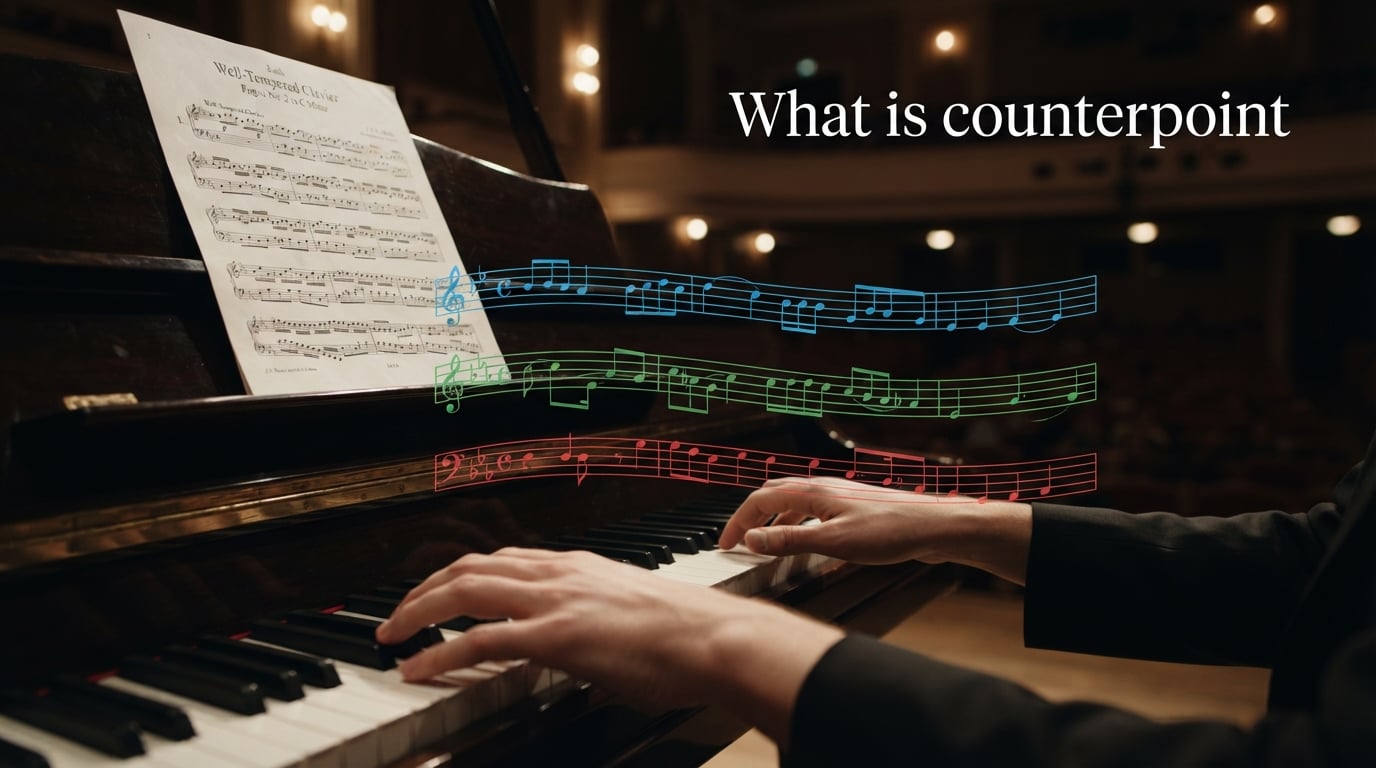
Counterpoint is the art of combining two or more independent melodic lines so they sound harmonically pleasing together, while each line keeps its own identity. The word comes from the Latin punctus contra punctum, meaning “note against note,” a term medieval musicians used to describe exactly this technique. If you have ever sung a round like “Row, Row, Row Your Boat” and noticed how the overlapping voices create unexpected harmony, you have already experienced counterpoint in action.
In this 2026 guide, I walk through what counterpoint is, where the technique came from, how it evolved through Bach’s mastery, and how it still shapes jazz, pop, and film music today. I also share beginner-friendly practice exercises so you can try contrapuntal writing yourself, whether you play piano, guitar, or sing. By the end, you will understand counterpoint well enough to recognize it the next time you hear it.
Table of Contents
What Is Counterpoint in Music?: A Clear Definition
Counterpoint, in music theory, is the relationship between two or more simultaneous musical lines (called voices or parts) that are harmonically dependent on each other yet rhythmically and melodically independent. Each line must stand on its own as a complete melody. When the lines combine, they create harmony that satisfies the ear without either voice becoming mere accompaniment.
The name itself explains the idea. Punctus contra punctum translates as “point against point,” or “note against note,” because early composers wrote each new line by placing one note against each note of an existing melody (the cantus firmus, or “fixed song”). Over centuries, that simple “one note against one note” approach expanded into five formal species and thousands of intricate works.
A useful way to picture counterpoint: imagine two dancers on stage, each performing a different routine, yet somehow moving together so the result looks intentional. Neither dancer is backing up the other; both are equally interesting on their own. That balance of independence and cooperation is the heart of contrapuntal music.
Counterpoint vs Polyphony vs Homophony
People often confuse counterpoint with polyphony, and both with homophony. The three describe different musical textures, and knowing the difference clears up a lot of confusion fast.
Polyphony means “many voices” and describes any music with multiple independent melodic lines happening at once. All counterpoint is polyphonic, but not all polyphony is contrapuntal in the strict, rule-governed sense.
Counterpoint is the specific technique of writing those independent lines so they interact harmonically, usually following a defined set of rules about intervals, motion, and voice leading.
Homophony means “same voice” and describes music where one melody dominates and the other parts provide chordal accompaniment. Think of a pop singer with a strummed guitar behind them. The guitar supports; it does not compete.
A hymn sung by a congregation is usually homophonic, because everyone moves together in block chords. A Bach fugue is contrapuntal, because every voice carries equal melodic weight. A Renaissance motet is polyphonic, with several melodic lines woven together, though whether it counts as strict counterpoint depends on how closely the composer followed the species rules.
The quick test: if you can isolate one part and it still sounds like a complete tune, you are likely hearing counterpoint. If the parts collapse without the lead melody, you are probably hearing homophony.
The 5 Species of Counterpoint Explained
Renaissance theorist Johann Joseph Fux codified the study of counterpoint into five “species” in his 1725 treatise Gradus ad Parnassum. Fux designed them as progressive exercises, each one adding a layer of rhythmic and melodic freedom. Composers from Bach to Mozart to modern film scorers trained on these species. Here is what each one does.
First Species: Note Against Note
First species is the simplest form. You write one new note for every note of the cantus firmus, so the two voices move at the same speed. The goal is to use consonant intervals (thirds, fifths, sixths, octaves) between the voices while avoiding parallel fifths and octaves, which sound hollow to Western ears. This species teaches you how to choose intervals carefully, the foundation of every later technique.
Second Species: Two Notes Against One
Second species introduces rhythmic variety. For each note of the cantus firmus, the counterpoint line uses two notes, usually in a steady pattern. The first beat tends to be consonant, while the second can pass through dissonance on its way to the next consonant note. This is where you first learn how to handle passing tones, a skill you will use in every style of music from jazz to classical.
Third Species: Four Notes Against One
Third species pushes further, placing four notes against each cantus firmus note. The faster-moving line now has more chances to use passing tones, neighbor tones, and other melodic decorations. The challenge is keeping the fast line melodically interesting without creating unwanted dissonances on strong beats. This species trains your ear to distinguish between dissonance that resolves gracefully and dissonance that just clashes.
Fourth Species: Syncopation and Suspensions
Fourth species is all about suspensions. The counterpoint line is syncopated, meaning its notes are tied across the bar line, so a note from one measure hangs over into the next. That tied note often creates a dissonance against the new cantus firmus note, then resolves downward by step to a consonance. Suspensions are some of the most emotionally expressive devices in all of music, and learning them here gives you a tool composers have used for 600 years.
Fifth Species: Florid Counterpoint
Fifth species, sometimes called florid counterpoint, combines elements of the previous four. You might use note-against-note in one measure, two-against-one in the next, then a suspension, then a florid run. This is the closest species to actual composition, because real music constantly shifts rhythmic density. By the time a student masters fifth species, they have the technical vocabulary to begin writing fugues, inventions, and free contrapuntal works.
One note from my own experience and from forums like r/musictheory: species counterpoint can feel rigid and disconnected from real music while you are studying it. That frustration is normal. The species are training wheels. Once you absorb the rules, you start noticing them everywhere, in Bach chorales, Beatles bass lines, and modern video game soundtracks.
A Brief History of Counterpoint
Counterpoint has been around for roughly a thousand years, and its history is really the history of Western art music. Knowing the timeline helps you understand why the rules exist and how composers bent or broke them over time.
Medieval origins (9th to 14th century). The earliest written counterpoint appears in 9th-century treatises like the Musica enchiriadis, where monks added a second voice a fifth or fourth below a plainchant melody. This early style, called organum, was simple and parallel, but it opened the door to true independence between voices. By the 14th century, composers like Guillaume de Machaut were writing complex polyphonic masses with several interwoven lines.
Renaissance refinement (15th to 16th century). The Renaissance is where counterpoint matured into a sophisticated art. Composers such as Josquin des Prez and Giovanni Pierluigi da Palestrina developed what we now call Renaissance polyphony, with smooth voice leading, careful treatment of dissonance, and a luminous, balanced sound. Palestrina’s style became so influential that the Catholic Church codified his rules for sacred music at the Council of Trent, and Fux later based his species system largely on Palestrina’s practice.
Baroque mastery (17th to mid-18th century). The Baroque era pushed counterpoint to its highest complexity. Composers like Johann Sebastian Bach, George Frideric Handel, and Dietrich Buxtehude wrote fugues, canons, and passacaglias that wove three, four, and five voices together with astonishing clarity. Bach’s The Art of Fugue and The Well-Tempered Clavier remain the gold standard for contrapuntal mastery in 2026 conservatories worldwide.
Classical and Romantic shifts (late 18th to 19th century). After Bach’s death in 1750, musical taste shifted toward homophonic textures with a single melody over accompaniment. Counterpoint did not disappear, but it became a seasoning rather than the main dish. Mozart and Beethoven still wrote fugues, and Beethoven’s Grosse Fuge and late string quartets show contrapuntal writing that rivals Bach’s density.
Modern and contemporary (20th century onward). Twentieth-century composers like Arnold Schoenberg, Paul Hindemith, and Dmitri Shostakovich revived contrapuntal techniques in new harmonic languages. Today, counterpoint is everywhere, from art music to film scores to video game soundtracks, because it remains one of the most effective ways to give music depth and intellectual interest.
Bach and the Mastery of Counterpoint
When people ask who mastered counterpoint, the answer is almost always Johann Sebastian Bach (1685-1750). Bach did not invent counterpoint, but he took it to a level no one has matched since, and his works are still the central textbook for contrapuntal study in 2026.
Bach’s genius was combining strict contrapuntal craft with deep emotional expression. Many composers can follow the rules; Bach made the rules sound inevitable and beautiful at the same time. He could write a four-voice fugue where every line is singable on its own, and where the four lines together create harmony so rich that listeners feel it physically.
Three Bach works stand out for any study of counterpoint:
The Well-Tempered Clavier: Two books of preludes and fugues in every major and minor key. This collection, written partly to demonstrate equal temperament, is also a compendium of every contrapuntal technique Bach knew.
The Art of Fugue: Bach’s final, unfinished masterpiece. It contains 14 fugues and 4 canons, all built from a single subject, exploring inversion, retrograde, augmentation, and stretto. The work doubles as art and as a theoretical treatise.
Mass in B minor: Bach’s monumental choral work, completed near the end of his life. Movements like the “Confiteor” and “Gratias agimus tibi” showcase choral counterpoint at its most sublime.
Bach also wrote a set of 15 two-part inventions and 15 three-part inventions (sinfonias) specifically for teaching his students how to play and think contrapuntally. If you are new to Bach and counterpoint, start with the two-part inventions. They are short, approachable, and full of the same techniques you will find in his larger works.
Fugue, Canon, and Invention: Contrapuntal Forms
Counterpoint shows up in several specific musical forms. Understanding the main ones helps you follow what composers are doing when you listen.
Fugue. A fugue is a contrapuntal form in which a single theme (the subject) is introduced by one voice, then imitated in turn by the other voices. After the opening exposition, the subject returns throughout the piece in different keys and voices, separated by freely composed episodes. Fugues can have three, four, five, or more voices, and the more voices, the harder it is to keep them all melodically satisfying. Bach’s Fugue in G Minor, BWV 578 (the “Little” Fugue) is one of the most famous and accessible examples for beginners.
Canon. A canon is a strict form where one voice leads and the other voice or voices imitate it exactly, starting later. A round like “Row, Row, Row Your Boat” or “Frere Jacques” is a simple canon. Canons can be much more intricate: Bach’s Crab Canon from The Musical Offering is palindromic, meaning it can be played forward in one direction and backward at the same time, producing the same piece.
Invention. An invention is a short contrapuntal piece, usually for keyboard, built around a single motivic idea. Bach invented the term and the form, and his 15 two-part inventions are still the standard entry point for pianists learning contrapuntal thinking. Inventions are compact, clear, and easier to analyze than fugues, which makes them perfect for studying how a single motive can generate an entire piece.
Other contrapuntal forms worth knowing include the motet (a sacred polyphonic choral piece), the mass (often polyphonic in Renaissance settings), and the passacaglia (a set of variations over a repeating bass line, which naturally creates contrapuntal textures).
Counterpoint in Jazz and Popular Music
One of the biggest misconceptions about counterpoint is that it belongs only to classical music. In reality, contrapuntal thinking runs through jazz, rock, pop, and film music, often in disguised or relaxed forms.
Jazz. Early New Orleans Dixieland jazz was built on collective improvisation, where trumpet, clarinet, and trombone wove independent lines simultaneously. That polyphonic interplay is straight-up counterpoint, just improvised rather than written out. Later jazz musicians like Bill Evans, Charles Mingus, and Brad Mehldau used contrapuntal writing in their compositions and arrangements, layering independent lines over complex harmonies. The fugue-like introductions to some of Mingus’s pieces are direct descendants of Bach’s practice.
Popular music. The Beatles used counterpoint more than most listeners realize. The bass line in “Michelle” moves independently of the vocal melody, and the layered vocals in “Because” create a kind of three-part invention. Paul McCartney’s “Blackbird” is essentially a two-part invention for guitar, with a moving bass line and an independent upper melody, a piece McCartney has said was inspired directly by Bach’s Bourree in E minor.
Film and game music. Modern film composers like John Williams, Danny Elfman, and Hans Zimmer use counterpoint to give their scores depth and to handle multiple themes at once. Video game composers working with limited resources historically leaned on contrapuntal textures to create richness with few instruments. If you listen for it, you will find contrapuntal writing in everything from The Lord of the Rings soundtracks to Final Fantasy battle themes.
This cross-genre presence is why I push back on the idea that counterpoint is a dusty academic topic. It is a living technique, and the rules Fux wrote down in 1725 still help today’s songwriters, producers, and arrangers write music that holds up under repeated listening.
How to Practice Counterpoint? (Beginner Exercises)
If you want to actually feel counterpoint rather than just read about it, here are three exercises I recommend, drawn from species counterpoint practice and from tips shared on music forums.
Exercise 1: Sing a round. Get two or three friends and sing “Row, Row, Row Your Boat” or “Frere Jacques” as a round. Pay attention to the moments where the voices create unexpected harmonies. Those moments are the whole point of counterpoint, and you will start to hear intervals and suspensions in real time.
Exercise 2: Layer two familiar melodies. Try singing one melody while playing another on your instrument. A classic experiment: play the melody of “Twinkle, Twinkle, Little Star” in your right hand on piano while improvising a simple independent line in your left. Keep both lines singable. This is harder than it sounds, and it trains exactly the independence contrapuntal writing demands.
Exercise 3: Try first species counterpoint. Take a short existing melody (a hymn tune works well) and write a new melody above or below it, one note per note, using only consonant intervals like thirds and sixths. Avoid parallel fifths and octaves. This is the same exercise Fux taught in 1725, and it remains the fastest way to build contrapuntal instincts. Work with a teacher or compare your results against examples in a counterpoint workbook if you can.
The bridge between species exercises and real composition is smaller than it looks. Once you can write a clean first-species line, you have most of the skills needed to write a simple invention or to add a countermelody to a song you are working on. Forum users who have stuck with it report that the rules start to feel natural within a few months of regular practice.
FAQs
What is an example of counterpoint?
A simple example is the round u0022Row, Row, Row Your Boat,u0022 where each singer enters at a different time and the overlapping melodies create independent lines that harmonize together. Famous composed examples include Bach’s Fugue in G Minor, BWV 578, the Canon in D by Pachelbel, and the two-part Inventions, all of which layer multiple independent melodies that weave around each other.
What is counterpoint in simple terms?
In simple terms, counterpoint is the technique of writing two or more melodies that sound good together while each melody remains complete and recognizable on its own. Think of two people singing different tunes at the same time, where the combination is pleasing rather than chaotic.
What is Bach counterpoint?
Bach counterpoint refers to the contrapuntal writing of Johann Sebastian Bach, who is widely considered the greatest master of the technique. His works such as The Well-Tempered Clavier, The Art of Fugue, and the Inventions demonstrate how multiple independent melodic lines can combine with extraordinary harmonic richness while remaining individually singable.
What is counterpoint in writing?
Outside music, a counterpoint in writing is an opposing or contrasting idea, argument, or theme set against a main point. Just as a contrapuntal melody contrasts with yet complements another melody, a written counterpoint adds depth by presenting a different perspective that interacts with the central argument rather than simply disagreeing with it.
What is the difference between counterpoint and harmony?
Harmony refers to the vertical combination of notes into chords at any given moment, while counterpoint refers to the horizontal movement of independent melodic lines over time. Counterpoint creates harmony as a byproduct of how its lines interact, but it focuses on the melodic shape and rhythm of each individual voice rather than on the chords themselves.
Is counterpoint still used in modern music?
Yes, counterpoint is widely used in modern jazz, popular music, film scores, and video game soundtracks. Examples include the Beatles’ u0022Blackbird,u0022 which is based on a Bach-influenced two-part texture, the independent bass and vocal lines in much of Paul McCartney’s writing, and the layered thematic writing in film scores by John Williams and Hans Zimmer.
Conclusion
Counterpoint is one of the most powerful tools in any composer’s or songwriter’s toolkit, and understanding what counterpoint is opens up a deeper appreciation of music from Bach fugues to Beatles songs. At its core, it is the art of writing multiple independent melodies that combine into something richer than any single line could be. The five species, codified by Fux and perfected by composers from Palestrina to Bach, give you a concrete framework for learning this art step by step.
Counterpoint is not a relic. It shows up in jazz solos, pop bass lines, film scores, and the music you stream every day. Start with the beginner exercises above, listen to Bach’s two-part inventions, and try writing your own simple countermelody. Once your ears tune in to the interplay of independent voices, you will hear counterpoint everywhere, and your own music will be richer for it.