
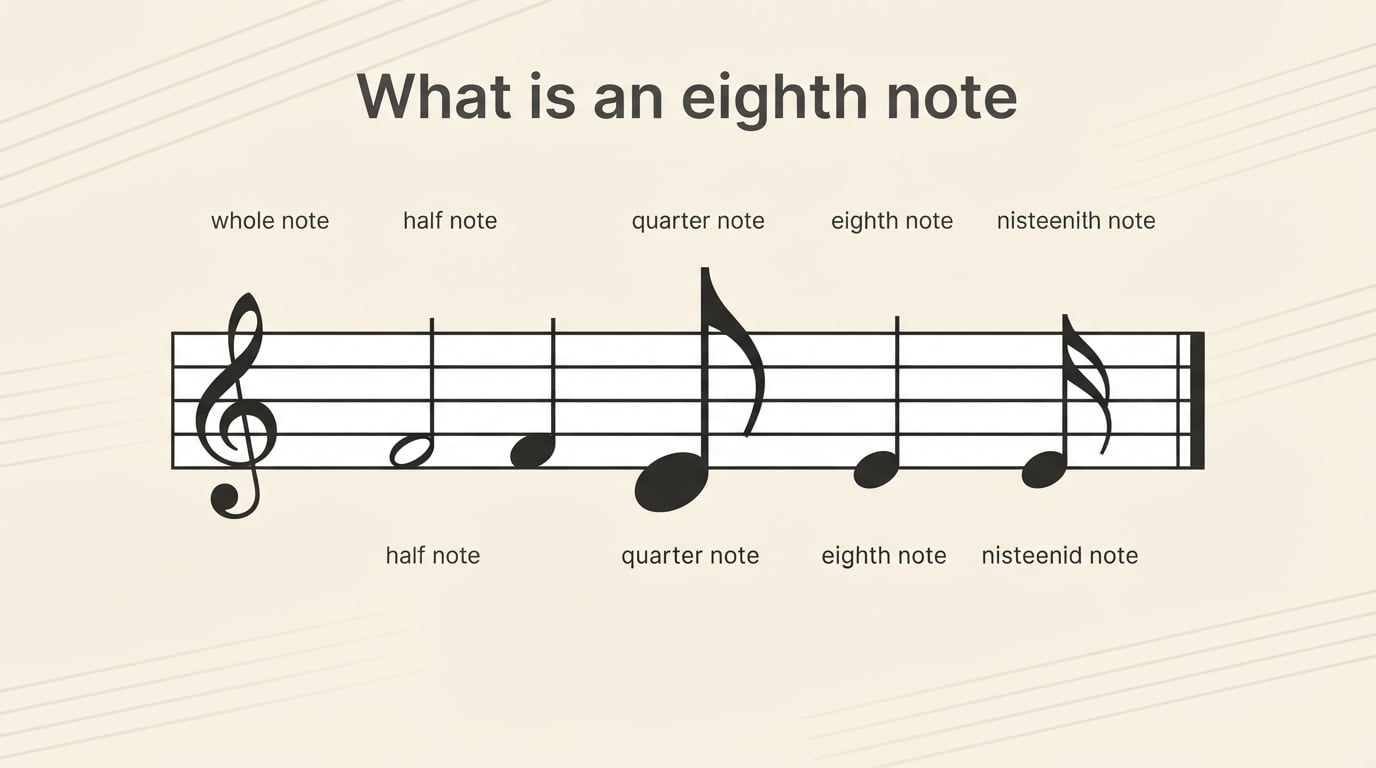
An eighth note is a musical note that lasts for half a beat in standard 4/4 time. Two eighth notes equal the duration of one quarter note, and eight eighth notes fit into a whole note, which is where the name comes from. In British English, it is also called a quaver.
I remember the first time someone told me an eighth note was “half a beat.” It sounded almost too simple to be useful. After years of playing, though, I can tell you this single idea unlocks almost every rhythm you’ll ever read on a page.
Table of Contents
Eighth Note Definition: What It Means in Music
An eighth note is a note value that represents one-eighth of the duration of a whole note. The name literally tells you how it works: you can fit eight eighth notes into one whole note.
Think of music like a clock. A whole note fills the entire face. Each time you cut it in half, you get a smaller note. Cut it four times and you arrive at the eighth note, a small but mighty building block of rhythm.
The British term for this note is “quaver.” You’ll see it in older music textbooks and in British publications. Same note, same duration, just a different name.
How Many Beats Is an Eighth Note?
An eighth note is worth half a beat in 4/4 time. That’s the most important number to remember.
In 4/4 time, each measure has four beats. A quarter note takes one full beat. An eighth note takes half of that beat, so two eighth notes fit inside the space of one quarter note.
Here’s the simple math that helped me as a beginner:
1 whole note = 4 beats = 8 eighth notes
1 half note = 2 beats = 4 eighth notes
1 quarter note = 1 beat = 2 eighth notes
1 eighth note = 1/2 beat
Time signatures change things slightly. In 6/8 time, an eighth note actually gets one full beat because the eighth note is the beat unit. This is called compound time, and it can confuse new learners, so I always tell students to check the bottom number of the time signature first.
How to Count Eighth Notes? (Downbeats and Upbeats)
To count eighth notes, you say the number on the beat and “and” halfway between each beat. For a measure of 4/4, you count: “1 and 2 and 3 and 4 and.”
The numbers are called downbeats. The “ands” are called upbeats. Each number and each “and” equals one eighth note. So a full measure of 4/4 holds exactly eight eighth notes, which matches our math from earlier.
Here’s how I teach beginners to feel it:
Clap once on each number: “1, 2, 3, 4.”
Add a clap between each number: “1 and 2 and 3 and 4 and.”
Slow it down until the “ands” feel evenly spaced between the numbers.
Speed it up to a comfortable groove.
The biggest mistake I see is rushing the “and.” People tap the number, then tap “and” almost immediately after. The trick is to keep the space between the number and “and” exactly the same as the space between “and” and the next number.
What Does an Eighth Note Look Like?
An eighth note looks like a filled-in oval with a stem and a single flag curling off the top or bottom of the stem.
Three visual parts make up the symbol:
A solid black note head (the oval)
A straight stem coming out of the head
One flag attached to the end of the stem
When two or more eighth notes sit next to each other, the flags get replaced with a beam connecting the stems. Beamed eighth notes are easier to read than separate flagged notes, which is why composers group them whenever possible.
The stem direction depends on the note’s position on the staff. Notes above the middle line usually have stems pointing down. Notes below the middle line usually have stems pointing up. This keeps the notes tidy on the page.
Eighth Notes Compared to Other Note Values
Eighth notes sit between quarter notes and sixteenth notes in the duration hierarchy. Each step down cuts the duration in half.
From longest to shortest, the common note values go: whole note, half note, quarter note, eighth note, and sixteenth note. The eighth note is right in the middle of this list, which makes it one of the most frequently used notes in modern music.
Most pop, rock, funk, and hip-hop rhythms rely heavily on eighth notes. If you can read eighth notes fluently, you can read a huge percentage of the music out there today.
What Is an Eighth Rest?
An eighth rest is the silence that lasts the same amount of time as an eighth note. It looks like a small slanted symbol with one flag.
An eighth rest counts exactly the same way as an eighth note. On the page, you would say “1 and 2 and 3 and 4 and” and place the eighth rest on whichever beat or “and” you want to remain silent.
Our team often sees beginners treat rests like pauses where they stop counting. Don’t. The beat keeps moving whether you play or rest. A well-placed eighth rest is just as rhythmic as a played eighth note.
Frequently Asked Questions
How many beats is an eighth note?
An eighth note is worth half a beat in 4/4 time. That means two eighth notes equal one full beat, and eight eighth notes equal one whole note.
How do you count a single eighth note?
Count the number on the beat (1, 2, 3, or 4) and the word u0022andu0022 halfway between beats. Each number and each u0022andu0022 represents one eighth note, so you count u00221 and 2 and 3 and 4 andu0022 for a full 4/4 measure.
What does an eighth note mean?
An eighth note is a musical note value that lasts one-eighth as long as a whole note. The name comes from the fact that eight eighth notes fit into one whole note. In British English it is called a quaver.
What are quarter notes called?
Quarter notes are also called crotchets in British English. A quarter note lasts one full beat in 4/4 time, and two eighth notes equal one quarter note.
Final Thoughts on Eighth Notes
An eighth note is half a beat in 4/4 time, and two eighth notes equal one quarter note. Once that fact clicks, every rhythm in music starts to make more sense.
Practice the “1 and 2 and” counting out loud this week. Tap your foot on every number and clap on every “and.” Within a few days, the eighth note will feel as natural as breathing, and you’ll be reading rhythms with much more confidence in 2026.