
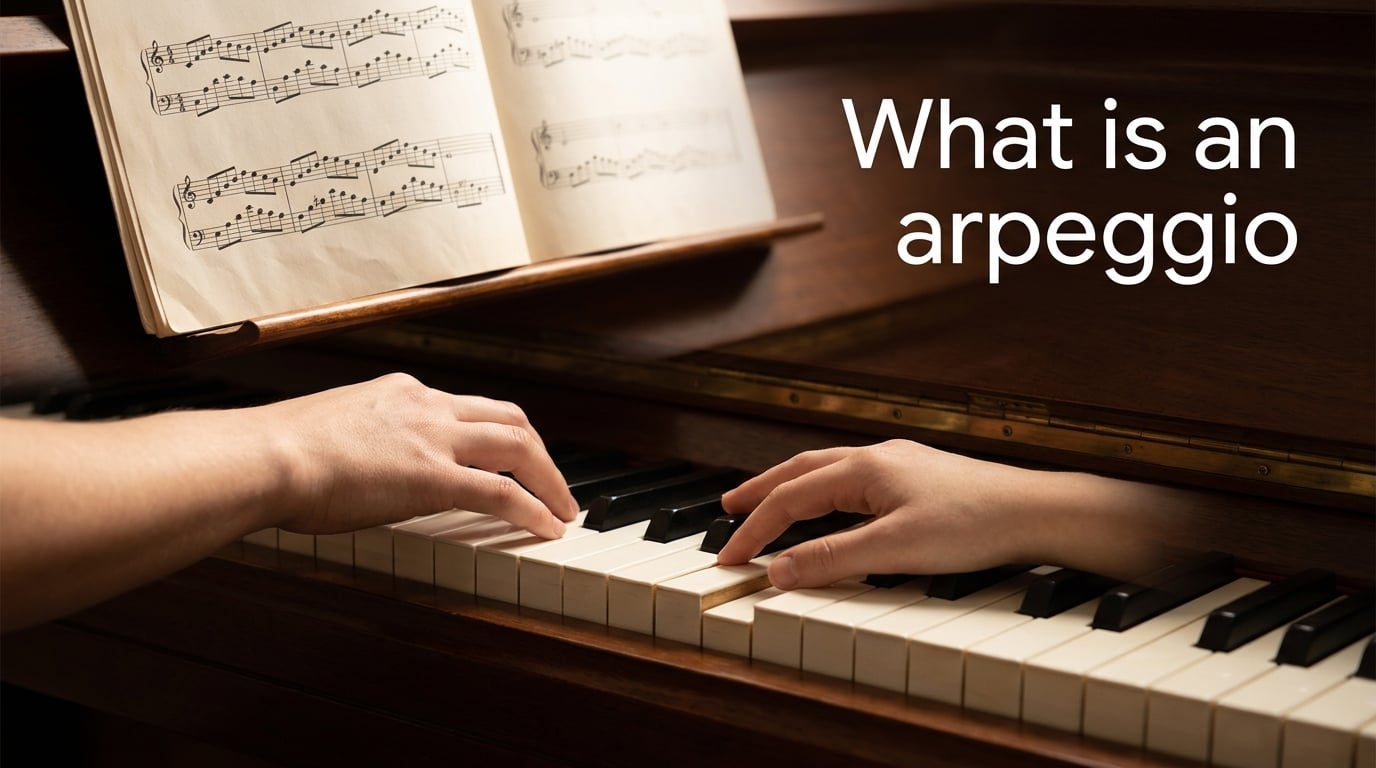
An arpeggio is a chord whose notes are played one at a time in ascending or descending order rather than together. The word comes from the Italian arpeggiare, meaning “to play on a harp,” because harps naturally sound notes in sequence as the player plucks each string. You’ll also hear arpeggios called broken chords or rolled chords, and they form one of the most useful building blocks in music theory and performance.
I first ran into the term as a teenager flipping through a guitar magazine. The writer kept saying “play the arpeggio over the changes,” and I had no idea what that meant. Once I learned that an arpeggio is simply the notes of a chord played one after another, a lot of music theory clicked into place. That same “aha” moment is what I want to recreate for you in this guide for 2026.
Table of Contents
What Is an Arpeggio? Definition and Origin
An arpeggio is the individual, successive playing of the notes that make up a chord. If a C major chord contains the notes C, E, and G, then a C major arpeggio plays C, then E, then G in sequence. You can go up (ascending), come back down (descending), or skip around in patterns.
The term traces back to Italy in the late 18th century. It derives from arpa, the Italian word for harp, and the verb arpeggiare, which means “to play on a harp.” On a harp, you naturally sound one string at a time, so the technique became associated with harp-like textures even on keyboards and fretted instruments.
Three quick facts about the term:
Synonym: A broken chord is the same thing as an arpeggio.
Verb form: The act of playing one is called arpeggiation.
Adjective form: When a chord is played note-by-note, musicians call it an arpeggiated chord.
Arpeggios are notated with a wavy vertical line next to a chord. That symbol tells you to spread the notes out instead of striking them simultaneously. On sheet music, you’ll often see it before sustained chords in piano music and across whole phrases in classical guitar pieces.
Arpeggio vs Scale: What’s the Difference?
An arpeggio and a scale are both ways to play notes in sequence, but they pull from different sources. A scale moves stepwise through every note in a key, while an arpeggio jumps through only the chord tones.
Here’s a simple comparison using the key of C major:
C major scale: C, D, E, F, G, A, B, C (seven notes plus the octave)
C major arpeggio: C, E, G, C (only the chord tones, played one at a time)
The arpeggio skips notes that the scale includes. Those skipped notes (D, F, A, B) don’t belong to the chord, so leaving them out keeps the harmony clear. Scales sound melodic and stepwise, while arpeggios sound more open and “harmonically aware.”
Guitar players often use scales for lead lines and arpeggios to outline the chords underneath. Pianists use arpeggios for flowing accompaniment patterns, while scales tend to appear in runs and exercises. Both tools matter, but they serve different musical roles.
Types of Arpeggios: Major, Minor, and Seventh
Any chord can be turned into an arpeggio. The three most common types you’ll meet as a beginner are major, minor, and seventh arpeggios.
Major Triad Arpeggios
A major triad has a root, a major third, and a perfect fifth. In the key of C, that’s C, E, and G. Playing them in order gives you a bright, cheerful sound. Major arpeggios sit at the heart of folk, country, and pop progressions, and they appear constantly in beginner piano and guitar exercises.
Minor Triad Arpeggios
A minor triad flattens the third. In A minor, the notes are A, C, and E. The minor arpeggio sounds darker and more reflective than its major cousin. Minor arpeggios drive most emotional ballads, classical themes, and a huge share of rock and jazz progressions.
Seventh Chord Arpeggios
Seventh chords add a fourth note on top of the triad. The most common are:
Dominant seventh (7): root, major third, perfect fifth, minor seventh. Example: G7 = G, B, D, F.
Major seventh (maj7): root, major third, perfect fifth, major seventh. Example: Cmaj7 = C, E, G, B.
Minor seventh (m7): root, minor third, perfect fifth, minor seventh. Example: Dm7 = D, F, A, C.
Seventh arpeggios sound richer and more colorful. You’ll find them everywhere in jazz, neo-soul, and R&B. They can also work as bass lines or as outlines for improvisation.
Inversions and Direction
You don’t have to start on the root. An inversion reorders the notes so a different chord tone is on the bottom. A C major arpeggio in first inversion would start on E (E, G, C). Going through inversions in your practice routine trains your ear to recognize chord qualities no matter which note you hear first.
You can also play arpeggios ascending, descending, or in mixed patterns. Many pianists use a “down-up-down-up” pattern across both hands to create flowing accompaniment that sounds much fuller than block chords.
How Arpeggios Work on Piano and Guitar?
On the Piano
Pianists can arpeggiate a chord in three common ways:
Rolled chord: Quick upward roll from low note to high note, almost simultaneous. This is the classical “broken” sound you hear in Beethoven or Chopin.
Broken pattern: Slow, even rhythm over several beats. Think of the left-hand patterns in pop ballads where the bass line walks up through the chord tones.
Repeated arpeggio: A short arpeggio figure that loops, like the famous Coldplay “Clocks” intro. The right hand cycles through chord tones while the left hand anchors the pulse.
Start by learning each triad in root position with your right hand. Once that’s comfortable, add the left hand an octave below, and gradually widen the gap between your hands. This trains the independence you need for richer textures.
On the Guitar
Guitarists approach arpeggios differently because the instrument lets one hand play multiple strings at once. The two most popular techniques are:
Fingerpicking: The thumb plays the bass note while the fingers pick the higher strings one at a time. This is the bread-and-butter of folk, country, and acoustic ballads.
Sweep picking: The pick travels across adjacent strings in one continuous motion, sounding each note cleanly. This is the metal and shred technique for fast arpeggio runs.
Knowing every note on the fretboard helps but isn’t strictly required to start. Many guitarists learn arpeggio “shapes” using the CAGED system, then move those shapes around the neck. With practice, you connect each shape to the chord it belongs to, and the fretboard starts to make sense.
One of my favorite breakthroughs as a guitar player was realizing that the same pattern I used for a C major arpeggio shape also worked for A minor if I shifted it two frets down. That single insight opened up the whole neck for me.
Famous Songs That Use Arpeggios
Arpeggios are everywhere once you start listening for them. A few iconic examples:
“Clocks” by Coldplay: The piano arpeggio pattern is the song’s signature hook.
“Hotel California” by the Eagles: The intro combines arpeggiated acoustic guitar chords with bass.
“Bohemian Rhapsody” by Queen: The piano intro uses arpeggios to set the dramatic mood.
Chopin’s “Prelude in E minor”: The right hand arpeggiates chord tones over a steady left-hand pulse.
“Hallelujah” by Leonard Cohen: The piano and guitar parts use repeating arpeggio figures throughout the verses.
If a song uses a lot of fingerpicking or flowing piano textures, there’s a strong chance arpeggios are doing the heavy lifting. Listening for them in music you already love is one of the best ways to build your ear for the technique.
Tips for Practicing Arpeggios as a Beginner
Arpeggios can feel awkward at first because your hand or fingers need to move in unfamiliar ways. After 20 years of playing and teaching, I can tell you the practice habits below work far better than simply running the pattern over and over.
Start With One Position
Pick a single chord, say C major, and learn its three-note arpeggio in one position only. Drill it for a full week before you move anywhere else. Beginners who try to learn every chord at once end up overwhelmed and quit. One position, one chord, one week. That’s the loop.
Use a Metronome
Set a slow tempo, around 60 beats per minute. Play one note per beat, then two notes per beat, then four. The metronome keeps you honest and shows you exactly where the rhythm breaks down.
Memorize the Pattern
Don’t read the notes off a chart forever. Practice until the pattern lives in your hands. Once your fingers know the shape without thinking about it, you can focus on the music instead of the mechanics.
Connect Arpeggios to Real Progressions
A common beginner pain point is not knowing when to use arpeggios in actual music. The trick is to match each arpeggio to the chord it belongs to. In a I-IV-V progression in C major, play C arpeggio over the C chord, F arpeggio over the F chord, and G arpeggio over the G chord. The notes will fit the harmony perfectly every time.
Watch for Wrist Tension
Forum users often complain about sore wrists during long arpeggio sessions. Relax your hand between repetitions, shake out tension, and avoid squeezing harder than you need to. Clean tone at low volume matters more than loud tone with strain.
If you keep at it for even 10 minutes a day, you’ll notice real improvement within a month. The patterns stop feeling random and start sounding like music you actually want to play.
Frequently Asked Questions About Arpeggios
What is the difference between an arpeggio and a scale?
A scale plays every note in a key in stepwise order, while an arpeggio plays only the chord tones in any order. For example, a C major scale includes C, D, E, F, G, A, B, C, but a C major arpeggio only includes C, E, and G. Scales sound melodic and flowing, while arpeggios outline harmony.
How many notes are in an arpeggio?
An arpeggio can have any number of notes, depending on the chord. A basic triad arpeggio uses three notes (root, third, fifth). A seventh chord arpeggio uses four notes. You can extend arpeggios across multiple octaves, so a two-octave major triad arpeggio would contain seven notes (C, E, G, C, E, G, C).
What is an arpeggio for guitar?
On guitar, an arpeggio is a chord whose notes are picked or plucked one at a time instead of strummed together. Guitarists commonly use fingerpicking for folk and acoustic styles, and sweep picking for fast metal and shred passages. Arpeggios help guitarists outline chord changes during solos.
Are arpeggios difficult to play?
Basic arpeggios are beginner-friendly because they only use a few notes. The challenge comes with speed, multiple octaves, and connecting arpeggios across the fretboard or keyboard. With slow, steady practice and a metronome, most players can play simple arpeggios within a few weeks.
Final Thoughts on Arpeggios
An arpeggio is simply a chord played one note at a time, also called a broken chord or rolled chord. The Italian root arpeggiare reminds us that the technique originally imitated the natural sound of a harp. Once you understand the basic definition, the rest of the topic opens up quickly.
Start with one major triad arpeggio this week. Use a metronome, keep your hand relaxed, and listen for arpeggios in songs you already love. After a few weeks of consistent practice, you’ll have a new tool for soloing, accompaniment, and understanding how harmony works. That single skill will keep paying back every time you sit down to play in 2026 and beyond.