
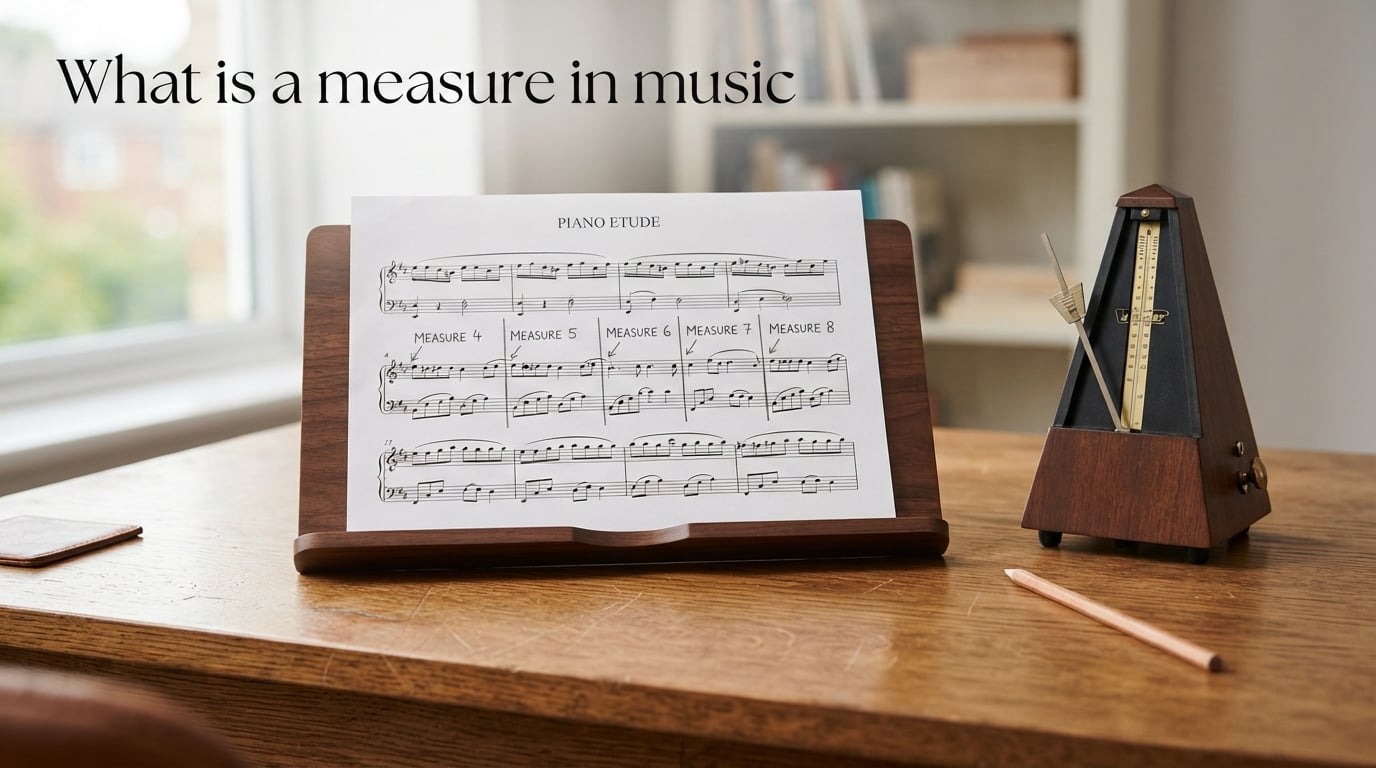
If you have ever stared at sheet music and wondered what those vertical lines are doing across the staff, you are already looking at the foundation of musical rhythm. A measure in music is a small chunk of time that holds a set number of beats, and it keeps everything organized so musicians can play together. Whether you are picking up an instrument for the first time or just want to understand how songs are built, measures are the building blocks you need to grasp.
When I first started learning music, the concept of a measure felt abstract. It only clicked when a teacher compared it to the punctuation in a sentence. Once you see measures as the commas and periods of music, everything about rhythm and timing starts to make sense. In this guide, we will break down what is a measure in music, how it connects to time signatures, and how you can start counting them like a pro.
Table of Contents
What Is a Measure in Music?
A measure in music is a segment of time defined by a specific number of beats, separated from neighboring measures by vertical lines on the staff called bar lines. Think of it as a container that holds a fixed amount of musical content, and once that container is full, you move on to the next one.
Every measure follows the rules set by the time signature at the start of the piece. The time signature tells you how many beats fit in each measure and what kind of note gets one beat. So in a 4/4 time signature, each measure holds four quarter-note beats, and in 3/4 time, each measure holds three.
The reason measures matter so much is that they give music its pulse. Without them, a piece of music would be one long, unbroken stream of notes with no sense of where the strong beats fall or when to breathe. Measures create the rhythmic structure that lets listeners tap their foot and musicians stay in sync.
Bar vs Measure: Understanding the Terminology
One of the most common sources of confusion for beginners is the difference between “bar” and “measure.” The short answer is that there is no difference in meaning. They are two words for the same thing, and which one you hear depends mostly on geography.
In American English, “measure” is the standard term used in music theory classes, method books, and most instructional content produced in the United States. When an American teacher says “start at measure 17,” they are pointing you to a specific bar in the score.
In British English and many Commonwealth countries, “bar” is the preferred term. A British musician would say “start at bar 17” instead. You will also hear “bar” used casually in many genres of popular music, including jazz, rock, and electronic production, regardless of where the speaker is from.
The term “bar line” refers specifically to the vertical line drawn on the staff that separates one measure from the next. So you could say a bar is the space between two bar lines. Some people use “bar” to mean both the dividing line and the space it creates, which adds to the confusion.
When you read instructional material or watch tutorials, just remember that bar and measure are interchangeable. If a video says “count the bars,” it is asking you to count the measures. Once you internalize that, the terminology stops being a hurdle.
How Time Signatures Determine Beats per Measure
Time signatures are the rulebook for measures. They tell you exactly how many beats belong in each measure and which note value represents one beat. Without a time signature, there is no way to know how to group notes into measures.
A time signature looks like a fraction written at the beginning of a piece of music. The top number tells you how many beats are in each measure. The bottom number tells you which note value gets one beat. So 4/4 means four beats per measure with the quarter note getting one beat.
Here is a quick reference for the most common time signatures and what they mean for your measures:
| Time Signature | Beats per Measure | Beat Unit | Feel |
|---|---|---|---|
| 4/4 | 4 beats | Quarter note | Steady, common |
| 3/4 | 3 beats | Quarter note | Waltz |
| 2/4 | 2 beats | Quarter note | March |
| 6/8 | 6 beats | Eighth note | Compound, flowing |
| 5/4 | 5 beats | Quarter note | Asymmetric |
The most common time signature by far is 4/4, often called “common time.” If you have ever clapped along to a pop song, you were probably feeling four beats per measure. The first beat, called the downbeat, is naturally the strongest, which is why you instinctively clap on it.
Compound time signatures like 6/8 work a little differently. Even though there are six eighth notes in each measure, musicians usually feel them as two groups of three. This gives 6/8 its characteristic lilting feel, common in jigs and many folk traditions.
Asymmetric time signatures like 5/4 and 7/8 break the predictable pattern and create tension. They are popular in progressive rock, jazz, and film scoring because they keep the listener slightly off balance.
Types of Bar Lines You Will See in Sheet Music
Bar lines are not all the same. Sheet music uses several types of bar lines, each with a specific meaning. Knowing what each one tells you makes reading music much easier.
Here are the main types you will encounter:
1. Single bar line. This is the basic vertical line that separates one measure from the next. It tells you the measure is over and a new one is beginning. It does not change anything about the music except where you reset your count.
2. Double bar line. Two vertical lines placed close together signal a significant change in the music. This could be a new section, a key change, or a shift in time signature. Think of it as a major paragraph break in a story.
3. Final bar line. One thin line followed by one thick line marks the end of the entire piece. When you see this, you know the music is done. It is the period at the end of the last sentence.
4. Start repeat sign. A thick vertical line followed by two dots tells you to begin repeating a section. Everything from this point forward will be played again until you reach the end repeat sign.
5. End repeat sign. Two dots followed by a thick vertical line tells you to jump back to the start repeat sign and play the section again. If there is no start repeat sign, you go back to the beginning of the piece.
Once you can identify these five bar line types, you can navigate almost any piece of sheet music. Beginners often overlook bar lines because they seem like decoration, but they carry real instructions about how the music should be performed.
Why Measures Matter in Music
Measures are not just a notation convention. They serve real musical purposes that affect how music is written, performed, and understood. If you have ever wondered why musicians bother dividing music into measures at all, the reasons come down to coordination, structure, and feel.
First, measures keep musicians synchronized. In an ensemble, every player references the same measure numbers. A conductor might say “let us pick up at measure 23,” and everyone knows exactly where to start. Without measures, rehearsing with a group would be chaos.
Second, measures make sheet music readable. Imagine trying to read a paragraph with no spaces between words. That is what music without bar lines looks like. Measures break the music into digestible chunks so your brain can process one small unit at a time.
Third, measures help listeners and performers feel the groove. The natural stress pattern within a measure, with the downbeat being strongest, gives music its pulse. Musicians on Reddit often describe measures as “sentences” that group musical ideas together, making the music easier to follow.
Fourth, measures help with memorization. When you learn a piece, you remember it in chunks, not as one endless stream. Beginners in particular find it easier to process small sections at a time, and measures provide that natural subdivision.
Fifth, measures allow for complex compositions. By providing a consistent grid of time, composers can layer rhythms and melodies that interlock precisely. Film scores, symphonies, and even pop productions rely on measures to coordinate dozens of parts.
How to Count Measures Out Loud: A Beginner’s Exercise
Counting measures is a skill every musician develops early. The idea is simple: you count the beats within each measure out loud or in your head, then reset at the next bar line. Here is a step-by-step exercise to get you started.
Step 1: Pick a 4/4 piece. Four-four time is the most common and the easiest for beginners. Find a simple song in 4/4 or use a metronome set to four beats per measure.
Step 2: Identify the downbeat. The downbeat is beat 1 of each measure. It is the strongest beat and the one you naturally emphasize. Tap your foot on the downbeat to anchor yourself.
Step 3: Count “1, 2, 3, 4” repeatedly. Say each number on the corresponding beat. When you reach 4, the next count is 1 again because a new measure has started. This constant reset is what keeps you in place.
Step 4: Track measure numbers. Once you can count beats within a measure, start counting measures themselves. Say “measure 1” during the first four beats, “measure 2” during the next four, and so on. This builds the habit musicians use to navigate scores.
Step 5: Practice with different time signatures. After you are comfortable with 4/4, try 3/4 by counting “1, 2, 3” per measure. Then move to 6/8, where you count “1, 2, 3, 4, 5, 6” but feel two main pulses. The more time signatures you practice, the more flexible your counting becomes.
Forum discussions on r/musictheory confirm that this kind of active counting is what separates beginners who struggle from those who improve quickly. The key is consistency. Count out loud at first so your brain links the numbers to the physical sensation of the beat.
Anacrusis: When the First Measure Is Incomplete
Most measures are complete, but sometimes the first measure of a piece is incomplete. This is called an anacrusis, or pickup measure. It contains fewer beats than the time signature specifies because the music starts before the downbeat.
Think of the classic “Happy Birthday” song. The words “Happy birthday to you” start on a pickup note before the first full downbeat. That opening note belongs to an anacrusis measure, and it sets up the rhythm for everything that follows.
Anacrusis measures are common in folk songs, hymns, and popular music. They create a sense of forward motion because the music starts in the middle of a beat rather than right on the downbeat. Once you know to look for them, you will spot them everywhere.
The way anacrusis measures are counted is slightly different. Instead of starting your count at 1, you start at whatever beat the music begins on. So if a piece in 4/4 starts on beat 4 of the pickup measure, you count “4” and then move directly into “1, 2, 3, 4” of the first full measure.
Most competitors gloss over the anacrusis, but it is a concept worth understanding if you want to read music accurately. Beginners who ignore pickup measures often miscount the opening of a piece and never quite sync up with the ensemble.
FAQs
How many beats is a measure?
The number of beats in a measure depends on the time signature. In 4/4 time, each measure has four beats. In 3/4, each measure has three beats. The top number of the time signature always tells you how many beats fit in one measure.
How long is one measure?
There is no fixed duration for a measure because it depends on the tempo. A measure at a fast tempo might last less than a second, while a measure at a slow tempo could last several seconds. The measure always contains the number of beats set by the time signature, but how quickly those beats pass is determined by the tempo marking.
What is an example of a measure in music?
A simple example is the first measure of ‘Twinkle, Twinkle, Little Star’ in 4/4 time. It contains the notes for ‘Twinkle, twinkle,’ which occupy four quarter-note beats. Those four beats fill one complete measure, and the next measure begins with ‘little star.’
What is the difference between a measure and a bar?
There is no difference in meaning. Measure is the term used in American English, while bar is used in British English and many popular music genres. Both words refer to the same segment of time bounded by bar lines on the staff.
Why do we use measures in music?
Measures organize music into predictable units of time, making it easier to read, perform, and coordinate with other musicians. They also give listeners a sense of pulse by grouping beats around a strong downbeat, and they let composers layer rhythms with precision.
Conclusion
Understanding what is a measure in music unlocks the foundation of rhythm and notation. A measure is simply a segment of time that holds a specific number of beats, separated by bar lines, and governed by the time signature at the start of the piece. Once you grasp that core idea, concepts like bar vs measure terminology, time signatures, bar line types, and even the anacrusis all fall into place.
Whether you are reading sheet music for the first time or trying to count along with your favorite song, measures are the framework that makes it all possible. Start by practicing your counting with a 4/4 piece, and you will build the skill that every musician relies on every single day.