
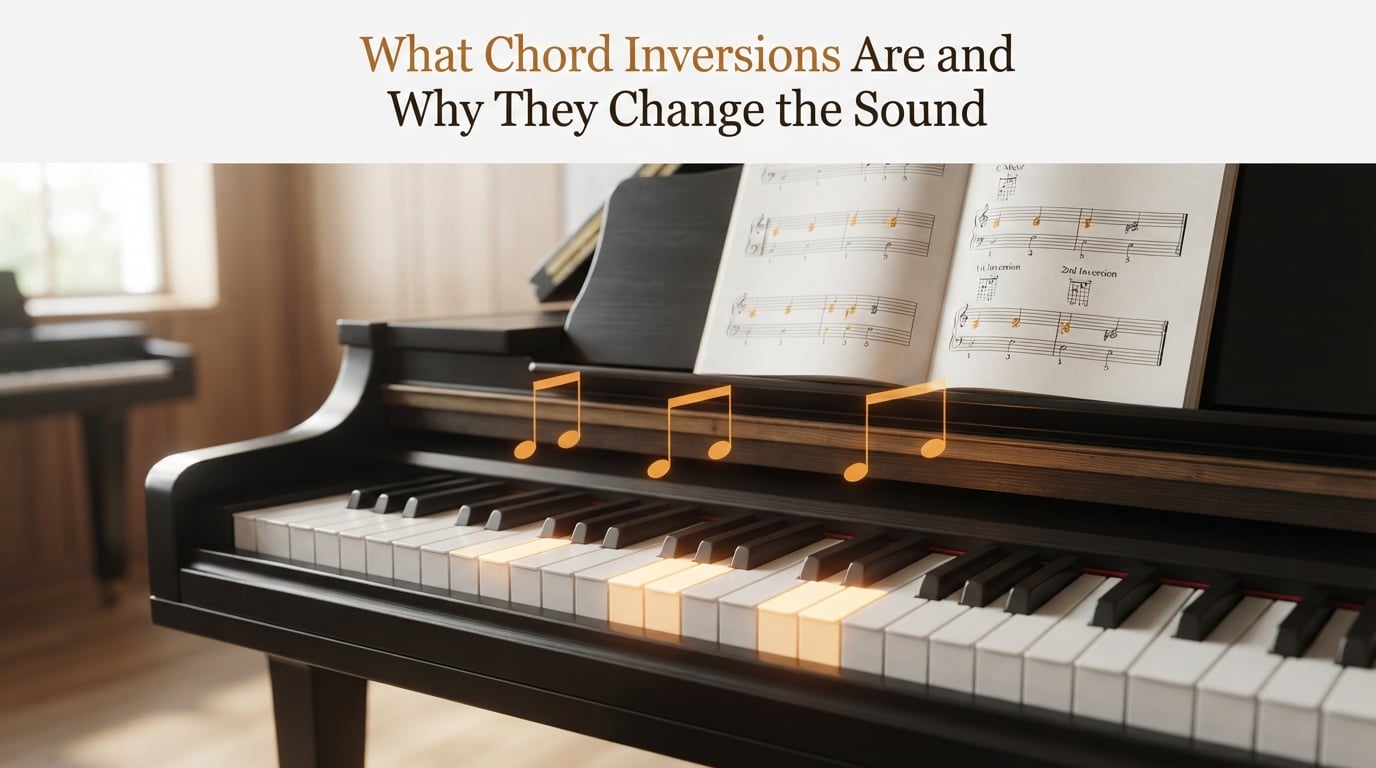
If you’ve ever played a C major chord and then shifted your fingers to play what feels like the same chord but sounds slightly different, you’ve already experienced chord inversions. These musical tools are essential for anyone who wants to move beyond basic chord progressions and create more interesting, professional-sounding music. Whether you play piano, guitar, or any harmonic instrument, understanding chord inversions opens up new possibilities for voice leading, smoother transitions, and more expressive songwriting.
A chord inversion happens when you rearrange the notes of a chord so that a note other than the root sits in the bass position. The chord itself stays the same harmonically, but the bass note changes, which alters how we perceive the sound. This concept might seem subtle at first, but it makes a significant difference in how your music flows and feels to the listener.
Our team has spent years studying music theory and applying these concepts in real songs, and we’ve found that chord inversions are one of the most practical tools for improving arrangements. In this guide, we’ll break down exactly what chord inversions are, how they work for both piano and guitar, why they change the sound of your music, and when you should use them in your own playing and songwriting.
Table of Contents
What Chord Inversions Are?: The Simple Definition
A chord inversion is a type of chord voicing where the lowest note (the bass note) is not the root of the chord. To put it another way, when you play an inverted chord, you’re still playing the same three notes of a triad, but you’ve moved them around so a different note sits at the bottom. The root, third, and fifth are all still present—you’ve just changed which one is in the bass position.
Let’s clear up a common confusion right away: an inversion is not a different chord. It’s the same chord with a different arrangement of notes. A C major chord in root position and a C major chord in first inversion are both still C major chords. They function the same way harmonically, meaning they belong to the same key and serve the same musical purpose. What changes is the voicing, or how the notes are spread out and which one your ear hears as the lowest tone.
The bass note matters because our ears tend to hear the lowest note as the foundation of the harmony. When the root is in the bass, the chord sounds stable and grounded. When the third or fifth is in the bass, the chord takes on a slightly different character—it might sound less stable, more open, or simply different in color. This doesn’t change the chord’s harmonic identity, but it does change how that identity is expressed.
Before we dive into specific inversions, let’s quickly review what a triad is, since all standard inversions work with triads. A triad is a three-note chord built by stacking two intervals of a third. In a major triad, the intervals from the root are a major third and a perfect fifth. In a minor triad, the intervals are a minor third and a perfect fifth. For example, a C major triad contains the notes C, E, and G. A C minor triad contains C, E-flat, and G. These three notes are what we’ll be rearranging in our discussion of inversions.
Root Position: Where Every Chord Begins
Root position is the default arrangement of a chord, where the root note sits in the bass position. This is the form most people learn first when they start playing chords, and it’s the reference point for understanding all other positions. In root position, the notes are stacked in their natural order from bottom to top: root, third, and fifth.
Let’s look at a concrete example. The C major triad in root position is spelled C-E-G, with C as the lowest note. On a piano, you would play this with your thumb on C, your middle finger on E, and your pinky on G. On a guitar, you might play the open C major chord, which also has C in the bass (though the exact voicing depends on which chord shape you use). In both cases, the root is the foundation, and the other notes stack above it.
Root position chords sound stable and complete. Because the root is in the bass, there’s no ambiguity about what chord you’re hearing. The harmony feels grounded, which makes root position the go-to choice when you want a clear, strong statement of a chord. Many songs begin and end with root position chords because they provide a sense of resolution and finality.
The formula for building a major triad in root position is: start on any note (the root), then go up four half steps to find the third, and go up seven half steps from the root to find the fifth. For a minor triad, the formula changes slightly: go up three half steps to the third, and seven half steps to the fifth. Once you have these three notes, you have a root position triad.
Let’s also consider a minor example. The A minor triad in root position is spelled A-C-E, with A in the bass. You can build any root position triad by following the major or minor formula starting from any root note. This is the foundation, and everything we’ll discuss about inversions starts with understanding this basic structure.
First Inversion: Putting the Third in the Bass
First inversion occurs when you take the root note of a triad and move it up an octave, leaving the third as the lowest note. In other words, the bass note becomes the third of the chord instead of the root. The chord still contains all three notes—the root, third, and fifth—but they’ve been rearranged.
Here’s how it works with our C major example. Remember that the root position is C-E-G. To create first inversion, take the C from the bottom and move it to the top. Now the chord is spelled E-G-C, with E as the lowest note. On a piano, your thumb would play E, your middle finger would play G, and your pinky would play the C an octave higher. The notes are the same, but the bass has shifted from C to E.
First inversions have a lighter, slightly less stable sound compared to root position. Because the third is in the bass, there’s a bit more tension in the harmony. This doesn’t mean the chord sounds wrong or bad—it just sounds different. Many musicians describe first inversion as having a more floating or open quality. It’s useful when you want to keep the harmony moving rather than settling into a resolved sound.
For guitar players, first inversions work a bit differently because of how the fretboard is organized. You can play a C major first inversion by finding E on the low E string (open or 12th fret), G on the A string (3rd or 15th fret), and C on the D string (2nd or 14th fret). This gives you a spread-out voicing that sounds different from a standard open C chord. Experimenting with these shapes across the fretboard will help you hear how inversions affect the guitar’s sound.
First inversions are particularly useful for smooth voice leading. When you’re moving from one chord to another, using inversions can help you minimize the distance your hand or fingers need to travel. For example, moving from C major in root position to F major in root position requires a significant shift. But if you play C major in root position (C-E-G) and then F major in first inversion (A-C-F), the transition is much smoother because some notes stay the same or move by only a small amount. This is one of the main practical benefits of using inversions in your playing.
Second Inversion: The Fifth Takes the Bass
Second inversion happens when both the root and the third are moved above the fifth, making the fifth the lowest note. You can think of it as taking the root and third from a root position triad and moving them both up an octave, leaving the fifth alone at the bottom. Alternatively, starting from first inversion, you move the third up an octave, leaving the fifth in the bass.
Using our C major example again: the root position is C-E-G, and first inversion is E-G-C. To get second inversion, we need G as the lowest note. Starting from first inversion, we move the E up an octave. This gives us G-C-E, with G in the bass position. On the piano, your thumb plays G, your middle finger plays C, and your pinky plays E. Again, the notes haven’t changed—only their arrangement has.
Second inversions sound even less stable than first inversions. The fifth in the bass creates a sense of tension that wants to resolve. This is why second inversions are often used in specific musical situations, such as cadential passages or passing harmonies. When you hear a second inversion chord, your ear often expects something to come next—a resolution or a continuation of the musical line.
One of the most common uses of second inversion is in what’s called a cadential six-four chord. In classical harmony, this is a second inversion chord that appears right before a resolution at the end of a phrase. For example, in the key of C major, you might hear a G major chord in second inversion (D-G-B) followed by a C major chord in root position. The second inversion builds tension that makes the resolution feel stronger.
For guitarists, second inversions can be found by locating the fifth on the low strings. For a C major second inversion, you’d want G as the lowest note. You could play the open G string as the bass, then add C on the B string (1st fret) and E on the high E string (open). This gives you a very different sound from your typical C chord, and it’s worth experimenting with to expand your chord vocabulary.
It’s important to note that not all second inversions are created equal. Some sound stable enough to function on their own, while others create strong tension. The context of the chord progression and the other chords around it determine how the second inversion feels and functions. As you practice, pay attention to how different inversions affect the flow of your music.
Why Chord Inversions Change the Sound?
This is one of the most common questions musicians ask: if a chord inversion uses the same notes as the original chord, why does it sound different? The answer lies in how our ears perceive harmony and how intervals work above the bass note.
The bass note serves as a reference point for our ears. When we hear a chord, we’re not just hearing a collection of notes—we’re hearing relationships between notes. The intervals formed above the bass create different colors and tensions. In root position, the intervals above the bass are a third and a fifth, which sound stable and consonant. In first inversion, the intervals above the bass are a third and a sixth. In second inversion, they’re a fourth and a sixth. These different interval combinations create different sonic textures.
The stability of a chord relates to which chord tone is in the bass. When the root is in the bass, the chord sounds most stable because the root defines the chord’s identity. When the third is in the bass (first inversion), the chord sounds slightly less stable—still consonant, but with a bit more movement. When the fifth is in the bass (second inversion), the chord sounds the least stable, with a quality of tension or suspension.
Guitar players in online discussions often describe inversions as giving a “fresh new sound” to familiar chords. Piano players emphasize how inversions reduce hand shifting effort, making transitions smoother. Jazz musicians talk about voice leading benefits, where each note moves as little as possible from one chord to the next. All of these perspectives point to the same truth: inversions change the sound in ways that are both practical and expressive.
The emotional quality of a chord also shifts with inversion. A root position chord might sound strong and final, while a first inversion of the same chord might sound more contemplative or gentle. A second inversion might create anticipation or a sense of waiting. These differences are subtle, but they add up when you’re arranging music and trying to convey specific feelings to your listener.
Practical Applications: When and How to Use Chord Inversions
Understanding chord inversions is valuable, but knowing when and how to use them is where the real musical power comes in. Let’s look at practical situations where inversions make your playing and songwriting stronger.
One of the most common uses of inversions is for smooth voice leading. Voice leading refers to how individual notes (voices) move from one chord to the next. When you use inversions, you can minimize large jumps between chords. For example, if you’re playing a progression like C to F to G to C, using all root position chords requires significant hand movement on the piano or awkward shifts on the guitar. But if you mix in inversions—say, C in root position, F in first inversion, G in root position, and C in root position—the transitions become smoother and more playable.
Inversions also help with bass line movement. If you always play root position chords, your bass line will jump around quite a bit as it follows the root of each chord. By using inversions, you can create a smoother, more melodic bass line. This is especially useful in band settings where the bass player is covering the root. If you’re playing chords on guitar or piano, you can use inversions to add harmonic interest while the bass holds down the root.
For songwriters, inversions offer a way to add variety without changing the underlying harmony. If your song uses the same four chords repeatedly, playing them all in root position can start to sound repetitive. By mixing in inversions, you add color and movement without changing the chord progression itself. This keeps the listener engaged and makes your arrangement more dynamic.
Here are some practical tips for memorizing inversions: Start by playing the root position of a chord, then physically move the bottom note up an octave to create first inversion. Then move the new bottom note up an octave to create second inversion. This physical motion helps your hands learn the shapes. Practice this process with several different chords—C major, F major, G major, and A minor are good starting points. Once you’re comfortable, try moving through chord progressions while intentionally choosing inversions that minimize hand movement.
A quick decision framework for choosing inversions in the moment: Ask yourself, “Is there an inversion that makes this transition smoother?” If the answer is yes, try it. Also consider whether you want the chord to sound stable (root position) or slightly less stable (first or second inversion). This simple approach can help you make quick decisions while playing.
Beyond Triads: A Quick Look at Seventh Chord Inversions
So far we’ve focused on triads, which have three notes and therefore three possible positions: root position, first inversion, and second inversion. But what happens when we add a fourth note to the chord, as we do with seventh chords?
Seventh chords have four notes: the root, third, fifth, and seventh. Because there are four notes, there are four possible positions. Root position has the root in the bass. First inversion has the third in the bass. Second inversion has the fifth in the bass. And third inversion has the seventh in the bass. Each of these creates a different sound and serves different musical functions.
This leads to a common question: Is there a fourth inversion? The answer depends on how you define it. With a triad, there are only three notes, so there are only three possible bass notes. Once you’ve moved through root, first, and second inversions, you’ve cycled back to root position an octave higher. With seventh chords, you have a third inversion, which is the fourth possible position. But there’s no “fourth inversion” beyond that—you’ve simply cycled through all the chord tones.
Frequently Asked Questions
Do chord inversions sound different?
Yes, chord inversions sound different even though they contain the same notes as the original chord. The bass note serves as a harmonic foundation, and changing which note is in the bass alters the intervals heard above it. First and second inversions have a lighter, less stable quality compared to root position, which sounds more grounded and final.
What is the forbidden chord in music?
The term ‘forbidden chord’ typically refers to the tritone, also known as the diminished fifth or augmented fourth. In medieval and Renaissance music theory, this interval was called ‘diabolus in musica’ (the devil in music) because of its harsh, dissonant sound. However, this concept is separate from chord inversions—modern music uses tritones freely in dominant seventh chords and other harmonies.
What are 1st, 2nd, and 3rd inversions?
First inversion places the third of the chord in the bass, moving the root up an octave. Second inversion places the fifth in the bass, moving both the root and third above it. Third inversion applies to seventh chords, placing the seventh in the bass. Each inversion changes which chord tone serves as the foundation, creating different colors and levels of stability while keeping the same harmonic identity.
Is there a fourth inversion?
No, there is no fourth inversion in standard music theory. With triads (three-note chords), you have root position, first inversion, and second inversion—three positions for three notes. With seventh chords (four-note chords), you have root position, first, second, and third inversions. Once you’ve moved through all chord tones, you cycle back to the root an octave higher, which is still root position.
Conclusion
Chord inversions are a straightforward concept with powerful applications. By moving notes around so that different chord tones sit in the bass position, you can change how your chords sound, make smoother transitions between chords, and add variety to your arrangements without changing the underlying harmony. Whether you’re playing piano, guitar, or any other harmonic instrument, inversions give you more options for expressing your musical ideas.
The key is to start practicing with a few chords and gradually expand. Pick three or four common chords, play through their root positions, first inversions, and second inversions, and notice how each one sounds. Then try connecting chords using inversions to smooth out your transitions. Over time, these shapes will become automatic, and you’ll be able to choose inversions instinctively as you play.
If you’re serious about improving your musicianship, chord inversions are a concept worth mastering. They’re practical, they’re accessible, and they make a real difference in how your music sounds. Start experimenting today, and you’ll hear the results in your playing almost immediately.