
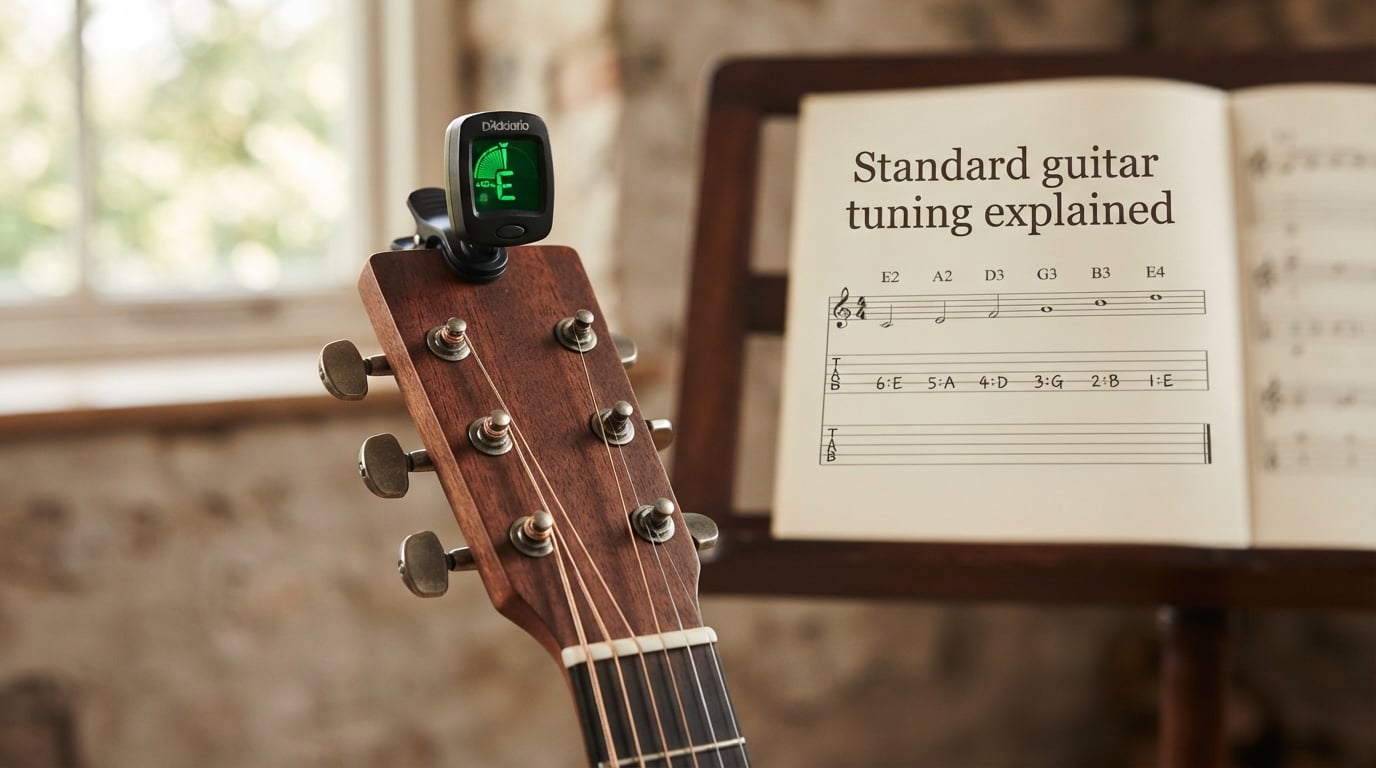
If you’ve ever picked up a six-string guitar, the strings were almost certainly tuned to E, A, D, G, B, and E from lowest to highest. That arrangement is called standard guitar tuning, and it has been the default for more than a century. Every chord chart you’ve seen, every YouTube tutorial you’ve watched, and every lesson book on the shelf assumes those six notes are sitting under your fingers.
In this guide, I’ll walk you through exactly what standard guitar tuning is, why those six specific notes were chosen over any other combination, how to tune a guitar by ear or with a tuner, how to pick strings that stay in tune longer, and what to do when your instrument refuses to hold pitch through a single song. Whether you’re picking up a guitar for the very first time or you’ve been playing for years and want to understand the theory behind the intervals, this guide will give you the full picture.
By the end, you’ll know the frequency of every open string in Hertz, the physical reason behind the famous G-B major third, three different ways to tune up, and how to keep your guitar stable through a full set at open mic night. You’ll also understand how standard tuning compares to drop D, open G, and half-step down, so you know which tuning to reach for when you want a different sound.
Table of Contents
What Is Standard Guitar Tuning (E A D G B E)?
Standard guitar tuning is the default tuning for a six-string guitar, where the open strings are tuned to the notes E, A, D, G, B, and E from lowest to highest pitch. The arrangement is also written as EADGBE, which is the acronym every teacher, tab site, tuning app, and chord chart uses.
The pattern is so universal that most players don’t even think about it. You grab a guitar, twist the pegs until the strings sound about right, and start playing. But the specific order of those six notes is the result of hundreds of years of evolution in how the instrument was built and played.
Here are the open string notes paired with their standard concert pitches in Hertz (Hz) at A440 reference, which is the modern tuning standard:
6th string (lowest, thickest): E2 at 82.41 Hz
5th string: A2 at 110.00 Hz
4th string: D3 at 146.83 Hz
3rd string: G3 at 196.00 Hz
2nd string: B3 at 246.94 Hz
1st string (highest, thinnest): E4 at 329.63 Hz
The top and bottom strings are both E notes, separated by exactly two octaves. That wide tonal range is one of the guitar’s biggest strengths. It explains why power chords (root, fifth, and octave of a single note) feel so natural under your fingers and why chord voicings can stretch from deep bass to bright treble without you ever shifting position.
Standard tuning is the language of nearly every chord chart, method book, and online lesson you’ll ever open. Every scale pattern, every open chord, every movable barre chord shape is built around EADGBE. Learn it first, and everything else in guitar becomes easier. Try to learn drop D or open G first, and you’ll find almost no instructional material to support you.
The Note Sequence and Interval Pattern Explained
The interval pattern in standard guitar tuning is five perfect fourths plus one major third, and that single exception between the G and B strings is what shapes almost every chord shape and scale pattern you play. Once you see the pattern, the entire fretboard starts to make sense.
Reading from the lowest (6th) string to the highest (1st) string, the intervals look like this:
E to A: perfect fourth (5 semitones)
A to D: perfect fourth (5 semitones)
D to G: perfect fourth (5 semitones)
G to B: major third (4 semitones)
B to E: perfect fourth (5 semitones)
Five of the six transitions are equal, which is why chord shapes repeat so predictably across the fretboard. Barre a chord shape at the 5th fret and you’ve transposed it up a perfect fourth. Barre it at the 7th and the same shape fits a different key without your fingers moving. Moveable pentatonic and major scale patterns work the same way.
If every interval were a perfect fourth, this repeatability would be even cleaner. But the major third between G and B is what gives the guitar its distinctive chord voicings and is part of why the instrument sounds like a guitar instead of a generic set of strings.
Why the G to B String Is a Major Third Instead of a Fourth
The G-B major third exists so your hand can reach chord shapes and scale patterns comfortably. If the B string were tuned up to C, the stretch between G and C would be a perfect fourth, and that small extra semitone would push fretted notes awkwardly out of position for the human hand.
Guitarist Richard Lloyd once compared this constraint to the violin, which is tuned in perfect fifths. Violins can get away with all-fifths tuning because the bow makes large interval leaps easy. The player doesn’t have to press down multiple strings at once to form chords. Guitarists need to fret notes with the fingers, and a fourth-and-a-third pattern keeps every common chord within a relaxed hand span.
This compromise is also why so many scales and chord voicings assume the major-third gap. Moveable shapes are designed around it. A G major chord played in standard tuning takes one finger on the 3rd fret of the low E string and an open G and B string to ring out cleanly. With all-fourths tuning, the same chord would need an awkward stretch or a barre.
Removing the major third would force players to relearn the entire fretboard. The current pattern is the result of centuries of instrument builders choosing what feels and sounds best in actual playing situations.
How Standard Tuning Compares to All-Fifths Tuning
Some music theorists argue that pure fifths would give the guitar cleaner resonance and stronger harmonic relationships. In theory, they’re right. Pure fifths produce stronger overtones and cleaner chord combinations. In practice, fifths tuning puts the lowest open string too low for the guitar’s scale length and forces chords into impossible stretches.
There have been experiments with all-fifths guitars. The result is an instrument that sounds interesting but is hard to play. Chords require awkward finger positions, and the lowest string can buzz or lose sustain because it’s too loose on the typical 25.4-inch scale length.
The fourths-plus-a-third pattern is a compromise between acoustic efficiency and physical playability. It won out because guitar is, first and foremost, a chord instrument played by human hands. The current arrangement is the best balance between how the guitar sounds and how the guitar feels to play.
How to Tune a Guitar to Standard Tuning?
There are three reliable ways to tune a guitar to standard tuning: a clip-on tuner, the 5th fret method, and harmonic tuning. Each works well, and most players end up using a mix of all three depending on the situation.
Whatever method you use, always tune up to pitch, never down. If you overshoot a note, loosen the string below the target pitch and bring it back up. Tuning down lets the string settle slightly flat under tension, and it will drift sharp again as soon as you start playing.
Method 1: Using a Clip-On or Chromatic Tuner
A clip-on tuner is the fastest and most accurate way to tune, especially for beginners. It reads the string’s vibration directly, so it works in noisy rooms where a microphone-based tuner struggles. Here’s the step-by-step process:
Clip the tuner onto the headstock, where it can read the string’s vibration directly.
Pluck the 6th string and watch the display.
Tighten or loosen the tuning peg until the tuner reads E. Some tuners show this as E2 for the low E.
Repeat for the 5th string (A), 4th (D), 3rd (G), 2nd (B), and 1st (E) string in order.
Pluck each string a final time and confirm the tuner shows a steady green or centered reading.
I tune with a Snark clip-on most of the time. It costs less than a coffee and gets me within a cent of concert pitch in under a minute. The main downside is that very cheap clip-on tuners can drift in cold temperatures, so if you play outdoors in winter, spend a few extra dollars on a name-brand unit.
For acoustic guitars without electronics, clip-on tuners are by far the easiest option. For electric guitars, a pedal tuner built into your signal chain gives you instant feedback on stage and is invisible to the audience.
Method 2: Tuning by Ear Using the 5th Fret Method
The 5th fret method requires no tools, which is useful when your tuner dies mid-session or you want to develop a better sense of pitch. The rule is simple: the note at the 5th fret of any string matches the open note of the next string up, except for one exception.
Tune your 6th string (low E) to a reference pitch from a piano, another guitar, or a tuning app.
Fret the 6th string at the 5th fret. The note you play is A, which should match your open 5th string.
Tune the open 5th string until it matches the fretted 6th string note.
Repeat: 5th fret of the 5th string gives D, which matches the open 4th string.
Continue up to the 3rd string (G). The 5th fret of the G string is C, but the open 2nd string is B.
Use the 4th fret of the G string instead to get B, then match it to the open 2nd string.
Finally, the 5th fret of the B string gives E, which matches the open 1st string.
Once you’ve tuned all six strings, go back to the top and check the 6th string again. Adjusting one string shifts the relative tension of the others, so a quick second pass keeps everything tight. Beginners should expect to make two or three passes before the guitar settles.
This method trains your ear better than any other because you’re constantly comparing pitches. After a few weeks of practice, you’ll be able to hear when a string sounds wrong before you even check the tuner.
Method 3: Harmonic Tuning
Harmonic tuning uses the natural overtones at the 5th, 7th, and 12th frets to compare pitches between strings. It produces cleaner results than the 5th fret method because harmonics are purer than fretted notes. Fretted notes include small amounts of fret buzz and finger pressure that can shift the pitch slightly.
Lightly touch (don’t press) the 5th string at the 7th fret and pluck. That’s an A harmonic.
Pluck the harmonic at the 5th fret of the 6th string. Both should ring the same A.
Compare the 5th fret harmonic of the 5th string (D) to the open 4th string.
Use the 7th fret harmonic of the 4th string (G) against the open 3rd string.
Continue up: 5th fret harmonic of the 3rd string (B) matches the open 2nd string at the 7th fret harmonic.
The 7th fret harmonic of the 2nd string (E) matches the open 1st string.
Harmonic tuning is a great fallback when fretted notes sound slightly off due to finger pressure or intonation issues. Many techs use harmonics for the same reason when setting up a guitar.
If you want even more precision, you can compare the 12th fret harmonic of the low E string against the open 1st string. They should both be E notes two octaves apart, and any difference between them points to an intonation problem that needs the bridge saddle adjusted.
Choosing the Right Strings for Standard Tuning
Standard tuning works with most string gauges, but choosing the right set keeps your guitar in tune longer and feels better under your fingers. Light gauge strings (.009 – .042) are the most common starting point for beginners and most rock, pop, and country players.
Here are the most common string gauges for standard tuning, along with the typical use cases for each:
Extra light: .008 – .038 (easiest to bend, common for blues lead)
Light: .009 – .042 (the standard default for most guitars)
Medium: .010 – .046 (warmer tone, more tension, harder to bend)
Heavy: .011 – .049 (jazz, blues slide, drop tunings)
Strings with a lighter gauge stay in tune a bit easier right out of the package because there’s less tension pulling the string into the nut and bridge. They also sound brighter, which suits most modern playing styles. Lighter strings are easier on your fingers, which matters when you’re building calluses during your first few months of playing.
Heavier strings produce a fuller low end and feel more substantial in the hand. If you strum a lot without bending notes, medium or heavy gauges can be a good upgrade. Jazz players, blues slide players, and rhythm guitarists who want a thick chunky tone often prefer heavier strings because they respond better to aggressive pick attack.
Most factory guitars ship with light gauges because that’s what works for the largest range of players. If you bought a guitar with light strings and the action feels good, there’s no reason to change anything. If the strings feel too soft or too hard under your fingers, experiment with the gauge above or below your current set.
Whatever gauge you choose, stretch new strings gently after installing them. Pull each string away from the fretboard, retune, and repeat two or three times. Skipping this step is the number-one reason guitars go out of tune the day after a string change.
One more thing to consider is the string material. Most acoustic guitars use bronze or phosphor bronze strings, which produce a warm, woody tone. Most electric guitars use nickel-plated steel, which produces a brighter, punchier sound. Pure nickel strings sound warmer and softer, which is why many blues players prefer them.
Alternate Tunings vs Standard Tuning Overview
Standard tuning is the baseline, but most guitarists experiment with alternate tunings at some point. Drop D, Open G, and half-step down are the most common, and each offers a specific musical advantage.
Even when you spend time in alternate tunings, you’ll likely return to standard for most of your playing. It covers the widest range of music, every instructional resource assumes it, and chord shapes stay exactly where your fingers expect them.
Drop D
Drop D lowers the 6th string from E down to D. The strings become D, A, D, G, B, E. It makes power chords a single-finger shape and gives heavy riff players a darker, thicker low end. Bands like Foo Fighters, Led Zeppelin, and Soundgarden have used Drop D for iconic songs.
The advantage of Drop D is that you can play a power chord on the lowest three strings with one finger. That makes riff-heavy music easier to play and gives you a fuller low end without needing to learn new chord shapes higher up the neck.
Open G
Open G tunes the strings to D, G, D, G, B, D. When you strum all six open strings, you get a G major chord. Keith Richards built the backbone of many Rolling Stones riffs in Open G, often with the 6th string removed for a five-string setup.
Open tunings are popular for slide guitar because you can play full major or minor chords just by sliding a single bar up and down the neck. They also make it easier to play in keys that would normally require difficult barre chord shapes.
Half-Step Down
Half-step down tuning lowers every string by one semitone: Eb, Ab, Db, Gb, Bb, Eb. It’s popular in heavier rock because the slightly slacker strings feel looser for bends, and the lower pitch gives vocals more room to sit above the guitars. Bands like AC/DC, Guns N’ Roses, and many metal acts use half-step down to give their singer more range.
Half-step down is also a quick way to play along with a track that’s tuned slightly flat, which happens more often than you’d think. If the song is a little sharp on the recording, you can tune down to match without changing your gear.
Even with all these options, most guitarists return to standard tuning for the majority of their playing. It covers the widest range of music, every instructional resource assumes it, and chord shapes stay exactly where your fingers expect them.
Tuning Stability and Troubleshooting Tips
When a guitar refuses to stay in tune, the cause is almost always one of a handful of predictable issues. Fixing them takes minutes once you know where to look, and addressing them in the right order saves a lot of frustration.
Nut Slots That Bind the String
Nut slots are the leading cause of tuning instability according to working techs and forum regulars. If a slot is too tight, the string catches as you tune up, then slips when you bend or release tension, dropping the pitch. A nut file and a few careful passes usually fix it. Lighter gauge strings also reduce binding because they need smaller slots to begin with.
You can test for nut binding by tuning up, then pulling the string sideways away from the nut as if you were bending it. If the open pitch changes when you release, the nut slot is too tight. A drop of nut lubricant can help in a pinch, but a proper file job is the long-term fix.
Strings Not Stretched After Installation
Fresh strings stretch a lot during their first few hours of play. If you tune and immediately start playing, expect the guitar to drift flat within 15 minutes. Stretch each string by hand after tuning, retune, and repeat until the string holds its pitch. This cuts the break-in period from days to hours.
The stretching process is simple. With the guitar in playing position, place your thumb under one string and pull it gently away from the fretboard. Don’t pull so hard that you feel like you’ll break it. Just enough tension to encourage the string to settle into its new length. Retune and repeat for each string.
Temperature and Humidity Swings
Wood and metal both expand and contract with temperature and humidity. A guitar stored near a heat vent, in a cold car overnight, or in a damp basement will drift more than one kept at stable room conditions. Most players see tuning stabilize when the guitar lives in its case with a small humidity pack.
Aim for a relative humidity between 40% and 50% for most acoustic guitars. Electric guitars are more forgiving but still respond to climate changes. If you live in a dry climate, a soundhole humidifier or case humidifier can save your guitar from cracks and warping.
Cheap or Worn Tuning Machines
Cheap tuning pegs with high gear ratios feel smooth but slip under string tension. Worn tuners develop backlash, which makes fine adjustments bouncy. Locking tuners solve both problems by clamping the string at the post. They’re a worthwhile upgrade on any guitar that fights you every time you tune up.
Locking tuners work especially well for guitars with tremolo systems, where string tension changes constantly as the bar is moved. Floyd Rose-style trems require locking nuts as well, but most hardtail guitars can get away with locking tuners alone.
If tuning issues persist after checking the nut, the strings, and the tuners, the bridge saddles are the next thing to inspect. Saddles that move or have worn intonation screws can pull strings out of tune as you fret higher up the neck. A setup by a qualified tech usually solves the problem in under an hour.
When to See a Professional
If you’ve tried the fixes above and your guitar still won’t hold tune, take it to a guitar tech. The issue could be a neck that needs a truss rod adjustment, a warped neck from humidity damage, or a worn bridge that needs replacement. These are all common issues with clear fixes, but they’re hard to diagnose without experience.
A basic setup costs less than a new set of strings at most shops, and it solves the kind of tuning problems that no amount of string stretching or tuner upgrading can fix. If your guitar has been fighting you for months, a setup is the smartest investment you can make.
Frequently Asked Questions
How should a standard guitar be tuned?
A standard six-string guitar should be tuned to E, A, D, G, B, E from lowest to highest string, which is written as EADGBE. In Hz, that’s 82.41, 110.00, 146.83, 196.00, 246.94, and 329.63 at A440 reference.
Why isn’t a guitar tuned to C?
A guitar tuned entirely in C would require all-fifths tuning, which is harder to chord and forces the lowest open string below the practical range of standard guitar scale length. The fourths-plus-a-third pattern of standard tuning keeps chord shapes playable and gives the instrument a usable low end.
Why does my guitar go out of tune so fast?
Most tuning instability comes from tight nut slots, fresh strings that haven’t been stretched, temperature or humidity swings, or worn tuning pegs. Locking tuners, proper string installation, and storing the guitar in a stable environment solve most cases.
What is standard tuning in Hz?
Standard tuning in Hz at A440 reference is: low E = 82.41 Hz, A = 110.00 Hz, D = 146.83 Hz, G = 196.00 Hz, B = 246.94 Hz, high E = 329.63 Hz.
Did Jimi Hendrix use standard tuning?
Yes, Jimi Hendrix played in standard tuning for most of his recorded work. Songs like Purple Haze, Voodoo Child, and Little Wing are all played in standard tuning with EADGBE.
What tuning did Kurt Cobain play in?
Kurt Cobain used several tunings, including standard tuning, drop D for songs like In Bloom, and a half-step down for live performances. The Nevermind album is mostly recorded in standard tuning.
Final Thoughts on Standard Guitar Tuning
Standard guitar tuning is EADGBE from low to high, organized as five perfect fourths and one major third. That simple pattern shapes every chord shape, scale, and riff most players ever learn. Once you understand why those intervals exist and how to keep them stable, the guitar becomes a much friendlier instrument.
Start by tuning up with a clip-on tuner to learn the feel of each pitch. Move on to the 5th fret method once you can hear when a string sounds wrong. Stretch fresh strings after every install, keep the nut slots in good shape, and store the guitar somewhere stable. Standard tuning will hold up through years of playing with that basic routine.
Once standard tuning feels automatic, explore drop D and open G to hear how a single interval change can open up a whole new style of playing. The patterns you learned in standard tuning carry over to every alternate tuning, and your ears will get sharper with every hour of practice.
Standard guitar tuning has been the foundation of guitar music for over a century, and there’s a reason it has stuck around. It’s the most practical compromise between sound and playability that any instrument maker has ever found. Learn it well, and you’ll have a solid foundation for every style of music you want to play.