
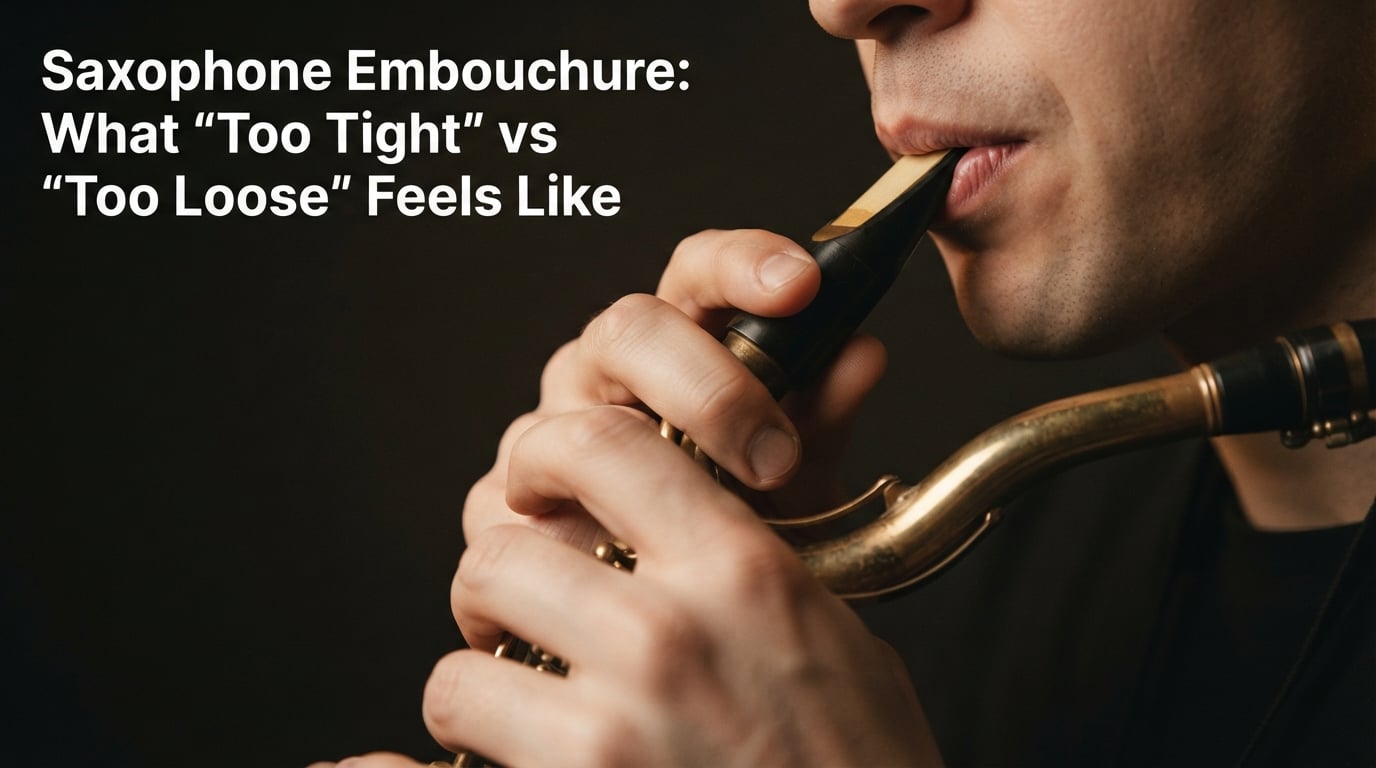
If you have ever finished a practice session with a sore jaw, a thin tone, or pitches that refuse to sit where you want them, your embouchure is almost certainly part of the problem. Most saxophone players I have worked with fall into one of two camps without realizing it. Either they clamp down on the mouthpiece like a vise, or they let everything go soft and hope the air does the work.
Understanding the difference between saxophone embouchure too tight vs too loose is the single fastest way to fix tone, intonation, and endurance. The challenge is that nobody can see inside your mouth while you play. You have to diagnose yourself by feel.
This guide breaks down exactly what each extreme feels like in your face, what it sounds like in your tone, and how to land on the balanced “Goldilocks” embouchure that lets you play longer without fatigue. I will share the sensations I look for in my own playing and the red flags I watch for when teaching others.
Table of Contents
What Saxophone Embouchure Actually Is?
Embouchure is how you shape your lips, jaw, and facial muscles around the mouthpiece and reed to create a controlled seal. That seal is what allows the reed to vibrate freely instead of choking off or flapping around.
Think of it like a drawstring bag. The corners of your mouth pull inward and upward, the chin stays flat rather than bunched, and the lower lip cushions the reed. The upper teeth rest on top of the mouthpiece. None of these elements should feel forced.
A good embouchure balances firmness with flexibility. You need enough pressure to seal the air and regulate reed vibration, but not so much that you crush the reed against the mouthpiece. Get this balance right and everything else, from tone to altissimo, becomes easier.
What a Too-Tight Embouchure Feels Like
A too-tight embouchure feels like you are biting the reed in half. Your jaw clamps upward, your bottom lip gets mashed flat against your teeth, and your chin bunches up into a walnut texture instead of staying smooth.
Here are the physical sensations that scream “you are too tight”:
Jaw pressure that builds within minutes of starting to play. If your masseter muscle, the one in your cheek near your ear, is aching after a few long tones, you are clamping. That muscle should stay relatively relaxed even during loud passages.
A dent or ridge forming in your lower lip where your bottom teeth press through. This is not normal wear. It means your lip is being crushed rather than cushioning the reed.
Tension spreading into your throat and neck. A tight embouchure tends to drag the rest of your upper body tight with it. You may feel like you are strangling your own air column.
Your embouchure feels locked in place. You cannot easily adjust for different registers or dynamic levels. Everything feels rigid and small.
The sound tells you the same story. A too-tight embouchure produces a thin, edgy, often harsh tone. The high notes may feel easy to hit but sound pinched. The low notes refuse to speak at all, or they jump up an octave unexpectedly. Pitch tends to run sharp because you are choking the reed and shortening its vibrating length.
Endurance also collapses. Instead of playing for an hour, your lip gives out in fifteen minutes because you are exhausting muscles that should barely be working.
What a Too-Loose Embouchure Feels Like
A too-loose embouchure feels like you are barely touching the mouthpiece. There is no seal, no anchor, and very little control over what the reed is doing.
The physical sensations of too loose include:
Air escaping from the corners of your mouth while you play. If you can feel little puffs of air hitting your chin or the sides of your lips, your corners are not engaged. The seal is leaking.
Your cheeks puffing outward with each breath. This is the classic sign players get warned about, and for good reason. Puffed cheeks mean your facial muscles are not supporting the air column at all.
Your lower lip feeling thick and rolled outward. Instead of cushioning the reed with the fleshy part of your lip, you end up with too much lip over the reed, which dampens vibration and kills response.
The mouthpiece sliding around as you play. A loose embouchure offers no stable anchor, so the mouthpiece wiggles, your jaw bobs, and intonation drifts.
The sound confirms the diagnosis. A too-loose embouchure gives you a woolly, unfocused tone that lacks projection. The low notes might boom out, but the high register feels airy and impossible to control. Pitch tends to run flat because the reed is vibrating too freely without enough resistance to keep it in tune.
You will also struggle with articulation. Notes feel sluggish to start, and clean tonguing becomes a fight against a reed that refuses to respond crisply.
What the “Just Right” Embouchure Feels Like
The balanced embouchure, the one players call the Goldilocks spot, feels firm but never clenched. There is clear engagement in the corners of your mouth, a flat chin, and a cushioned lower lip, all working together without strain.
Here is what to look for when your embouchure lands in the sweet spot:
Your corners feel pointed and slightly upward, like a subtle smile. They hold their shape but you can still move them to adjust pitch or dynamics.
Your chin stays flat and pointed downward, not bunched. Some teachers describe this as the chin being “pointed” or “flat like a pancake.”
Your lower lip feels like a firm cushion, not a crushed pancake and not a soft pillow. You should feel the reed against the lip without teeth poking through.
Your upper teeth rest gently on the mouthpiece with light, even pressure. They are an anchor, not a clamp.
Your jaw feels free to move slightly. You can drop it for low notes and bring it slightly forward for the upper register. Nothing locks up.
The tone tells the truth here too. A balanced embouchure gives you a full, resonant sound across the entire range. The lows are rich without being tubby, the highs are clear without being shrill, and pitch sits naturally in tune. Endurance stretches into hours because you are using small muscles efficiently rather than fighting with big ones.
This balanced feel is not a single fixed position. It shifts subtly as you move between registers, dynamic levels, and even between different mouthpieces. The skill is learning to feel when you drift too far in either direction and correct without thinking.
How to Self-Diagnose Your Embouchure Tightness?
You do not need a teacher in the room to figure out where you stand. Use these checks to read what your embouchure is actually doing.
1. Play a concert G or A on just the mouthpiece and neck. A tenor mouthpiece should produce a concert A. An alto mouthpiece should produce a concert G. Sharp means too tight. Flat means too loose. This is the classic test recommended by teachers on Sax on the Web and it works because it isolates the embouchure from the rest of the horn.
2. Watch your chin in a mirror while playing long tones. If your chin bunches into wrinkles, you are biting. If it stays flat and pointed, you are in a healthier range.
3. Check your corners for air leaks. Play a sustained note and hold a hand just below the corners of your mouth. Feel for air escaping. Any leak means your seal is loose.
4. Note how quickly your lip fatigues. If you cannot hold a tone for 30 seconds without your embouchure collapsing, tightness is burning you out.
5. Listen to your pitch across registers. If low notes are flat and lifeless but high notes are sharp and thin, you are likely too tight overall. If everything sounds woolly and the high range refuses to speak, you are too loose.
6. Record yourself and compare to a reference player. Phones make this trivial. You will hear thinness, harshness, or lack of focus far more clearly on playback than while playing.
Classical vs Jazz Embouchure Tightness
Not every style wants the same embouchure, which is why two good players can sound completely different and both be “correct.”
The classical embouchure tends to be firmer overall. The lower lip rolls slightly inward, corners pull in tightly, and the goal is a focused, centered tone with precise intonation. Think of players like Eugene Rousseau or Claude Delangle. The classical setup usually pairs with a closer tip opening mouthpiece and a harder reed, which demands more control.
The jazz embouchure is generally looser and more relaxed. The lower lip tends to rest more outward over the reed, the corners are engaged but less pinched, and the jaw drops slightly more. This allows for a bigger, darker tone with more flexibility for bends, growls, and subtone. Jazz players often use a more open mouthpiece and a softer reed, which rewards a looser approach.
If you study both styles, expect to shift between two related but distinct feels. A player who only ever practices one style often struggles to switch because their embouchure has only learned one tension level.
For most beginners, I recommend starting closer to the classical feel. Firm corners, flat chin, controlled tone. You can loosen up into jazz phrasing once your fundamentals are stable.
Quick Fixes for Each Extreme
If you have diagnosed yourself as too tight, try these corrections:
Drop your jaw slightly. Visualize space between your back teeth. This single change relieves the bite that crushes the reed.
Take in slightly more mouthpiece. Many tight players barely have any mouthpiece in their mouth, which forces them to bite for control. Slide in another quarter inch and feel the difference.
Relax the corners into a gentle smile rather than a pinch. The corners should support, not strangle.
If you are too loose, the fixes point the opposite direction:
Engage the corners firmly. Think of drawing them inward and upward toward your cheekbones.
Take slightly less mouthpiece. Too much mouthpiece in the mouth kills your ability to seal and control. Pull back until you feel a defined anchor point.
Flatten your chin deliberately. Look in the mirror and smooth out any bunching until the chin points down flat.
For both problems, the fastest path forward is long tones. Sustained notes at a comfortable volume expose every flaw in your embouchure and force you to feel what is working and what is not. Five minutes a day of focused long tones beats thirty minutes of unfocused noodling.
Exercises to Build Embouchure Strength and Control
Long-term embouchure strength comes from consistent, targeted practice, not from grinding through pain. Here are the exercises I keep coming back to.
Long tones from pianissimo to fortissimo and back. Pick one note per practice session. Sustain it for 20 seconds while holding your embouchure perfectly steady through the dynamic change. This builds control, not just strength.
Octave slurs without the octave key. Finger a low C, then pop up to the second-line C using only your embouchure and air. This trains the subtle jaw and lip adjustments needed for register changes.
Mouthpiece-only practice. Pull the neck off and buzz the mouthpiece alone, aiming for that concert G or A. Five minutes daily builds embouchure independence from the horn itself.
Lip slurs across register breaks. Move slowly between notes an octave or twelfth apart and focus on keeping the tone full through the transition. The moment your embouchure collapses will tell you exactly where your weakness lives.
Build gradually. Two weeks of daily 10-minute embouchure work beats a single marathon session every time. Muscles adapt to consistency, not intensity.
FAQs
How do I know if my saxophone embouchure is correct?
A correct embouchure feels firm but not clenched, produces a full and in-tune tone across the range, and lets you play for long stretches without lip fatigue. Test with the mouthpiece-only check: a tenor mouthpiece should sound a concert A and an alto a concert G. Sharp means too tight, flat means too loose.
Are you supposed to puff your cheeks while playing saxophone?
No. Puffed cheeks are a sign of a too-loose embouchure and weak corner engagement. The corners of your mouth should stay firm and pointed slightly upward to maintain a seal around the mouthpiece. Some players like Dizzy Gillespie made puffed cheeks work, but for the vast majority it weakens tone, intonation, and endurance.
How tight should a saxophone embouchure be?
Tight enough to seal the air around the mouthpiece and cushion the reed, but loose enough that the reed still vibrates freely. You should feel engagement in the corners and a flat chin without any clamping in your jaw or teeth pressing through your lower lip. The balance point is where your tone is full and your pitch sits naturally in tune.
What does a too-tight embouchure sound like?
A too-tight embouchure produces a thin, edgy tone that runs sharp in pitch. High notes may come easily but sound pinched, while low notes refuse to speak or jump up an octave. The overall sound lacks warmth and resonance because the reed is being choked against the mouthpiece.
How long does it take to fix a bad embouchure?
Most players notice meaningful improvement within two to three weeks of daily focused practice on long tones and mouthpiece buzzing. Building lasting strength and breaking old habits takes two to three months of consistent work. The key is short, targeted sessions every day rather than occasional long rehearsals.
Conclusion
Telling apart saxophone embouchure too tight vs too loose comes down to reading three signals: how your face feels, how your tone sounds, and how long you can play before fatigue sets in. A too-tight embouchure gives you a thin, sharp tone and a sore jaw within minutes. A too-loose embouchure gives you a woolly, flat tone with air leaking from the corners of your mouth. The balanced feel in between is where tone, intonation, and endurance all click.
Start with the mouthpiece-only pitch test to get an objective reading. Then commit to two weeks of daily long tones and watch both your sound and stamina transform. Your embouchure is something you can rebuild at any stage of your playing, no matter how many bad habits have crept in over the years.