
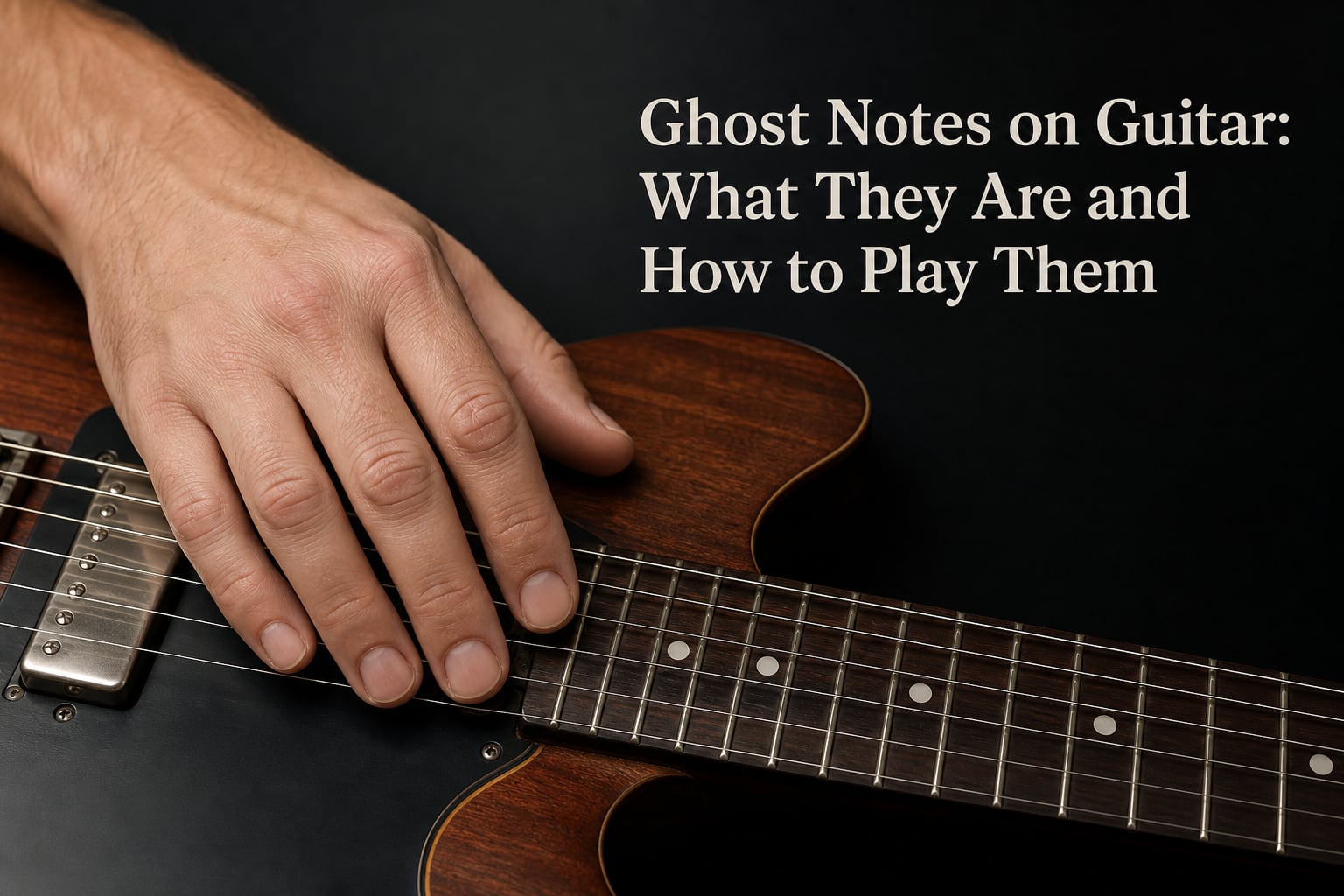
Ghost notes on guitar are muted, percussive sounds created by lightly touching the strings with your fretting hand without pressing them down to the fretboard. They are not real pitches. Instead, they add rhythm, texture, and groove to your playing. If you have ever listened to funk rhythm guitar or a tight blues shuffle and heard those subtle rhythmic clicks between the actual notes, those are ghost notes.
In this guide, I will walk you through exactly what ghost notes are, why they matter, and how to play them. We will cover the step-by-step technique, tab notation, left hand versus right hand approaches, common mistakes, genre-specific applications, and beginner exercises you can start practicing today. Whether you play funk, blues, jazz, or rock, mastering ghost notes on guitar will transform your rhythm playing from flat to infectious.
Table of Contents
What Are Ghost Notes on Guitar?
Ghost notes on guitar are muted notes that produce a percussive click or thud rather than a clear, ringing pitch. You create them by resting your fretting hand lightly on the strings so that the strings cannot vibrate freely. When you then pluck or strum those muted strings with your picking hand, you get a rhythmic sound with no defined pitch.
Think of it like this: a normal note has both rhythm and pitch. A ghost note has rhythm only. The pitch is intentionally killed so that what remains is pure percussion on the strings. This is what makes ghost notes so useful for adding groove without cluttering up the harmony.
Guitarists often describe the sound as a “chuck,” “chick,” or muted scratch. It sits underneath the real notes and fills in the rhythmic space between them. Players like Jimmy Nolen (James Brown’s guitarist), Nile Rodgers, and John Frusciante use ghost notes constantly to create that propulsive, danceable feel.
Why Ghost Notes Matter in Your Playing?
Ghost notes matter because they add groove, dynamics, and rhythmic complexity to your guitar parts. Without them, rhythm guitar can sound stiff and mechanical, like a metronome hitting one chord after another. With ghost notes, the same chord progression suddenly feels alive, syncopated, and human.
Here is what ghost notes do for your playing:
Add rhythmic texture: They fill the spaces between notes so your strumming sounds continuous and groovy rather than stop-and-go.
Improve timing: Playing ghost notes forces you to keep your picking hand moving at a steady rate, which locks in your internal clock.
Create dynamics: The contrast between loud real notes and soft ghost notes gives your playing a three-dimensional quality.
Boost expression: Subtle variations in how hard you ghost or where you place them let you shape the feel of a groove.
I remember the first time I added ghost notes to a basic funk chord vamp. It was like switching from a drum machine to a live drummer. The same E minor chord I had been playing for weeks suddenly had swagger.
Ghost Notes vs Dead Notes: What Is the Difference?
The difference between ghost notes and dead notes comes down to intent and terminology, though many guitarists use the terms interchangeably. A ghost note is a deliberately muted note played for rhythmic effect, with the goal of creating a percussive sound that supports the groove. A dead note typically refers to the same physical action but is sometimes used to describe an accidental muted note, one that was supposed to ring out but got choked by mistake.
On guitar, the technique for both is identical: you lightly touch the strings without fretting them. The distinction is purely about intention. When you mean to do it for rhythm, it is a ghost note. When it happens by accident and kills a note you wanted to hear, it is a dead note.
In some music theory contexts, the term “dead note” is also used specifically for notes shown as X marks in tablature, while “ghost note” can refer to notes in parentheses, meaning optional or very softly played notes that still have some pitch. For most guitarists playing funk, blues, and rock, the practical takeaway is this: ghost notes are your intentional rhythmic muted clicks, and that is what we are learning to play here.
How to Play Ghost Notes on Guitar? (Step by Step)
Playing ghost notes on guitar comes down to coordinating two simple actions: muting the strings with your fretting hand and keeping your strumming hand moving. Here is the step-by-step method I teach every guitarist who asks me about this technique.
Step 1: Relax your fretting hand. Take whatever chord you are playing and lift your fingers just enough that they are still touching the strings but no longer pressing them against the frets. The strings should rest against your fingertips with almost no pressure.
Step 2: Keep all strings muted. Make sure no string is free to ring out. If even one string is still pressed down or open, you will get an unwanted harmonic or pitched note instead of a clean percussive click. Lay two or more fingers across the strings to guarantee full contact.
Step 3: Strum as normal with your picking hand. Do not change your strumming motion. Pick or strum the muted strings just as you would if they were fretted. The energy from your strumming hand is what produces the percussive sound.
Step 4: Alternate between muted and fretted positions. Practice switching back and forth: press down for a real chord, then relax for a ghost note, then press again. Start slowly. Your fretting hand should barely move between the two positions.
Step 5: Gradually increase speed. Once you can cleanly alternate between a fretted chord and a ghost note at a slow tempo, speed up gradually. The goal is a seamless flow where the listener cannot tell when you are pressing and when you are muting.
Step 6: Add rhythm patterns. Now incorporate ghost notes into a strumming pattern. For example, play a downstroke on the beat with a real chord, and fill the off-beats with ghost note upstrokes. This is the foundation of funk rhythm guitar.
Reading Ghost Notes in Tab Notation
In guitar tablature, ghost notes are usually shown as X marks on the string lines. When you see an X where a fret number would normally appear, that means you should mute that string and strum it for a percussive click rather than playing a pitched note. For example, a bar of funk rhythm might show X marks on all six strings for the ghost strokes, with actual fret numbers appearing only on the beats where you play the real chord.
Some tabs also use parentheses around a fret number to indicate a ghost note. This notation means the note should be played very softly, almost inaudibly, but with some pitch remaining. The parenthesis version is more common in jazz and transcribed solos, while the X notation is standard in funk, rock, and pop rhythm charts.
When reading tabs, remember that the X is not telling you to hit a specific fret. It is telling you to mute and strike for rhythm. The string you see the X on does not matter much for pitch because there is no pitch. What matters is that your strumming hand keeps the rhythmic pattern going.
A typical funk pattern in tab might look like this conceptually: play the chord on beats 1 and 3, and fill beats 2, 4, and all the “and” off-beats with X-marked ghost notes. The visual rhythm of the tab tells you exactly where those percussive clicks belong.
Left Hand vs Right Hand Technique for Ghost Notes
Most guitarists create ghost notes with their left hand, which is the fretting hand for right-handed players. You simply relax your fretting pressure so the strings rest against your fingers without being pressed to the frets. This is the standard approach and the one I recommend starting with. It keeps your picking hand doing what it already knows how to do, which is strumming.
However, you can also produce ghost notes with your right hand, the strumming or picking hand. One method is palm muting, where you rest the edge of your palm on the strings near the bridge to deaden them while you pick. Another right-hand method is to use the side of your picking thumb to briefly touch the strings as you strum through them, choking the sound before it rings.
The left-hand approach gives you a sharper, more percussive click because all strings are muted evenly across the fretboard. The right-hand palm mute approach gives you a darker, thumpier sound that works well for blues and rock. Right-hand thumb damping gives you something in between and is popular among funk players who want to keep their fretting hand free for quick chord changes.
Which should you use? For funk rhythm with lots of fast ghost notes, the left-hand relax-and-mute method is the most efficient because your fretting hand is already on the strings. For slower blues grooves where you want a controlled muted thump under sustained notes, palm muting with the right hand works better. Try both and see which fits the style you are playing.
Common Ghost Note Mistakes and How to Fix Them
The most common mistake I see with ghost notes is ringing strings. You try to mute, but one or two strings slip free and produce a harmonic or a faint pitched note instead of a clean click. The fix is simple: use more fingers. Rest two or three fingers flat across the strings rather than relying on one finger. The more surface area you have touching the strings, the less likely any string will escape and ring out.
The second common mistake is pressing too hard. If you apply even slight fretting pressure by accident, the string will produce a muffled but still pitched note rather than a pure percussive click. Think of the touch as a feather resting on the strings. If you can feel the string against your fingertip but cannot feel the fret beneath it, you have the right pressure, which is essentially zero.
The third mistake is stopping your strumming hand. Many beginners freeze their picking hand when they switch to ghost notes, which kills the groove. Your strumming hand should never stop moving. It should maintain the same up-and-down motion whether you are playing a real chord or a ghost note. The fretting hand does all the muting work, while the picking hand keeps the rhythm flowing continuously.
The fourth mistake is inconsistent rhythm. Ghost notes are only effective if they land precisely in time. If your ghost strokes drag or rush, the groove falls apart. Practice with a metronome and focus on placing each ghost note exactly on the subdivision where it belongs. Speed comes later. Precision comes first.
Finally, some players confuse ghost notes with rest strokes or accidentally pluck the strings too hard during ghost strokes. A ghost note should be quieter than your real notes. Lighten your picking hand for ghost strokes so the dynamic contrast between real notes and ghost notes is clear. The listener should feel the ghost notes more than hear them.
Ghost Notes in Different Genres (Funk, Blues, Jazz, Rock)
Funk guitar is where ghost notes live and breathe. The entire funk rhythm style is built on the interplay between scratched ghost notes and punched chords. Players like Jimmy Nolen, Nile Rodgers, and Eddie Hazel use ghost notes on nearly every off-beat to create that relentless 16th-note groove. If you want to play funk, ghost notes on guitar are not optional. They are the foundation. Practice a single dominant chord like E9 and fill every off-beat with ghost note scratches while hitting the chord on the main beats.
Blues guitar uses ghost notes more sparingly, often as ghost bends or muted scratches between phrases in a shuffle. A blues shuffle in A can sound much tighter when you add ghost notes on the upstrokes between the main double-stop hits. The ghost notes fill the gaps and make the shuffle feel like it is rolling forward rather than plodding.
Jazz guitar employs ghost notes in two ways. First, in comping behind a soloist, where muted chord scratches add rhythmic support without adding harmonic clutter. Second, in single-line soloing, where players like Wes Montgomery and Grant Green use ghost notes between phrases to keep the swing feel continuous. Jazz ghost notes are often softer and more subtle than funk ghost notes, sitting just beneath the surface of the line.
Rock guitar uses ghost notes in rhythm parts, especially in alternative rock and punk where palm-muted ghost scratches between power chords add drive and aggression. Think of the chugging intro rhythm patterns in many rock songs: the muted scratches between the chords are ghost notes. Players like John Frusciante and Tom Morello use ghost notes to add rhythmic interest to otherwise simple chord progressions.
Reggae and ska also rely heavily on ghost notes, specifically the upstroke skank. The percussive chops on the off-beats in reggae rhythm guitar are essentially ghost notes played as quick, sharp scratches. No matter what genre you play, the technique is the same: mute with the fretting hand, keep the picking hand moving, and let the rhythm breathe.
Beginner Practice Exercises for Ghost Notes
Here is a progression of exercises I use with students to build ghost note skills from scratch. Do these with a metronome and take them slowly. Each exercise builds on the previous one.
Exercise 1: The Mute Check. Fret an E minor chord. Strum it once so it rings clearly. Now relax your fretting hand completely so the strings rest on your fingers without pressure. Strum again. You should hear a clean percussive click with no ringing. Alternate between the ringing chord and the muted click four times each. This teaches your hand the distance between fretted and muted positions, which is very small.
Exercise 2: Steady Eighth Notes. Set your metronome to 70 BPM. Play eighth notes on a single muted position: down-up-down-up with all ghost notes. Every stroke should be a clean click. Focus on keeping the volume and rhythm perfectly even. This trains your strumming hand to maintain motion while your fretting hand holds the mute.
Exercise 3: The Funk Pattern. Keep the metronome at 70 BPM. Now alternate: play a real chord on beat 1, then ghost notes for beats 1-and, 2, 2-and, 3, 3-and, 4, 4-and. Only beat 1 gets a real chord. Everything else is ghosted. This is the most basic funk pattern and it will feel awkward at first. Keep your strumming hand moving at all times.
Exercise 4: Add a Second Chord. Now play the real chord on beats 1 and 3, with ghost notes on everything else. Switch between two chords, like E9 and A9, on beats 1 and 3. The ghost notes in between give you time to change chords. This is where the magic happens. You will start to feel the groove come alive.
Exercise 5: 16th-Note Groove. Increase to 16th notes at 65 BPM. Play the real chord only on beat 1, and ghost every other 16th note. This is advanced. The constant stream of ghost notes between the single chord hit is exactly what funk rhythm sounds like. If you can do this cleanly, you can play funk guitar.
FAQs
How to play ghost notes on guitar?
To play ghost notes on guitar, lightly rest your fretting hand on the strings without pressing them to the frets, then strum as normal with your picking hand. The muted strings produce a percussive click instead of a pitched note. Keep your strumming hand moving continuously and use two or more fingers to ensure all strings are fully muted.
What is a ghost note on a guitar?
A ghost note on guitar is a muted, percussive sound created by touching the strings lightly without fretting them. It has rhythm but no defined pitch, and it is used to add groove and texture between real notes, especially in funk, blues, and jazz rhythm playing.
Are ghost notes hard to play?
Ghost notes are not hard to play once you understand the technique, but they take practice to master cleanly. The main challenge is coordinating both hands so that your fretting hand mutes the strings while your strumming hand keeps a steady rhythm. Most beginners get the hang of it within a few practice sessions.
What is the point of ghost notes?
The point of ghost notes is to add rhythmic groove, texture, and dynamics to your guitar playing. They fill the spaces between real notes with percussive clicks, making rhythm parts sound continuous and propulsive rather than stiff and stop-and-go. They are essential for authentic funk, blues, and jazz rhythm guitar.
What songs use ghost notes?
Ghost notes appear in countless songs across funk, blues, and rock. Classic examples include James Brown songs like Get Up (I Feel Like Being a) Sex Machine with Jimmy Nolen’s guitar, Nile Rodgers’ rhythm work in Chic tracks, John Frusciante’s parts in Red Hot Chili Peppers songs like Funky Monks, and most reggae and ska upstroke rhythm parts.
Conclusion
Ghost notes on guitar are one of those techniques that separate players who strum chords from players who create groove. The concept is simple: mute the strings with your fretting hand, keep your strumming hand moving, and let the percussive clicks fill the rhythmic space between your real notes. The execution takes patience, but the payoff is enormous.
We covered the definition, the difference between ghost notes and dead notes, the step-by-step technique, tab notation, left hand versus right hand approaches, the most common mistakes, genre applications, and a full progression of beginner exercises. If you work through those five exercises with a metronome, you will be playing authentic funk rhythm within a couple of weeks.
Your next step is to pick one genre, ideally funk, and spend ten minutes a day on Exercise 3 from the practice section. Lock in that steady alternation between real chords and ghost notes. Once it feels natural, move to the 16th-note exercise and watch your rhythm playing transform. Ghost notes on guitar are not a trick. They are a fundamental skill, and now you have everything you need to master them.