
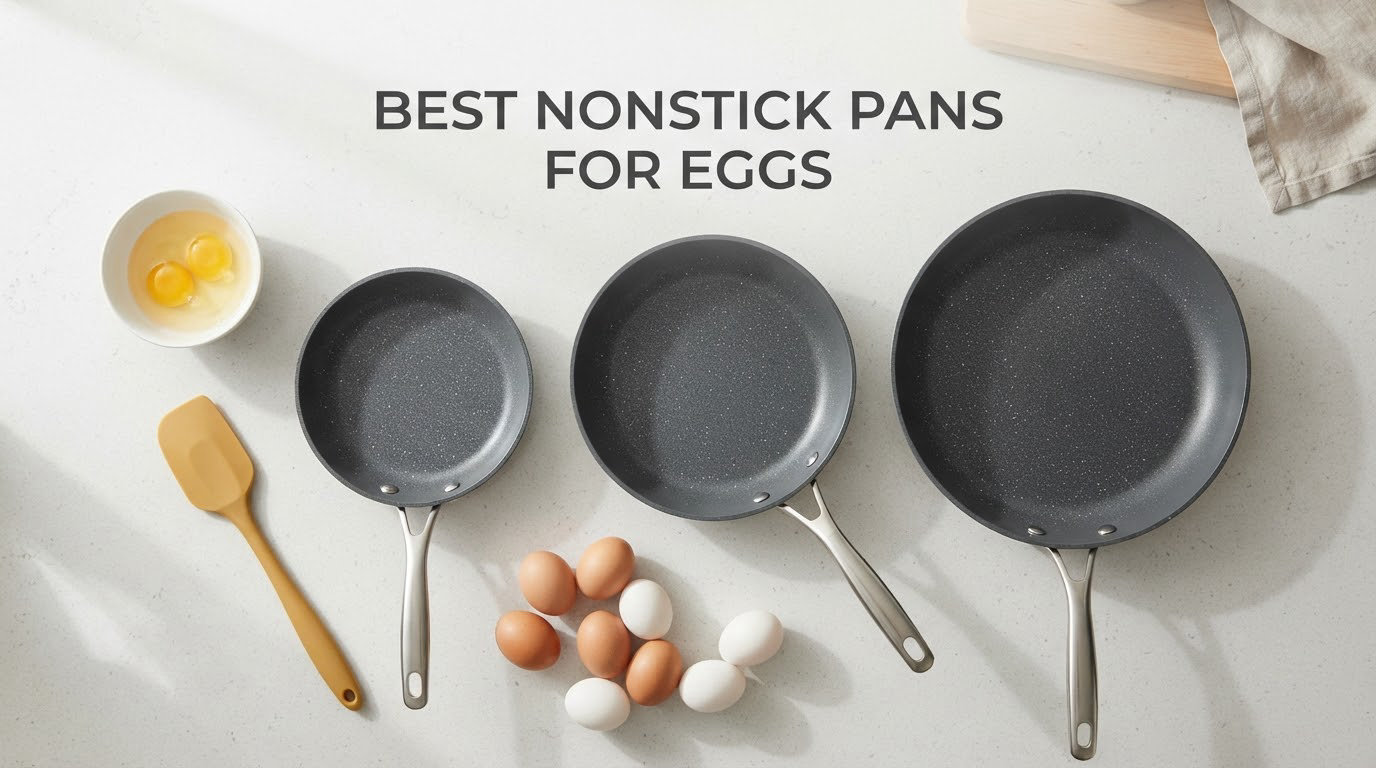
An egg is almost pure protein, and protein bonds to metal and to bare seasoning faster than almost anything else you cook. That is why the best nonstick pans for eggs sit in a category of their own: a surface slick enough to release a fried egg in seconds, gentle sidewalls you can slide an omelette off, and a body light enough to shake with one wrist. We cooked our way through ten of them to find which ones deserve your burner space.
Bottom line: the Carote 8 Inch Classic Granite is the best nonstick pan for eggs overall, and the OXO Enhanced 8″ is the runner-up for anyone who wants a light pan with a cool steel handle and dishwasher cleanup. If you want to skip PTFE entirely, the SENSARTE 8 Inch Ceramic is the pick.
Every pan below was used for the same routine: a cold pan, medium heat, one egg dry, one egg in butter, then a three-egg omelette. We also timed how long each took to wash, how the handle felt during a one-handed shake, and whether the surface stopped releasing before we lost interest. Last tested in 2026. We earn a commission when you buy through our links, and it never changes what we write.
One note before we start. The size of your pan matters more for eggs than for anything else you will cook in it, and the gap between a good 8-inch and a good 10-inch is the difference between one egg and two. If you are still choosing a diameter, skip to the buying guide and come back.
Table of Contents
Top 3 Picks for Eggs in 2026

Carote 8 Inch Classic Granite
- PFOS and PFOA free
- Induction ready base
- Cool bakelite handle

The 10 Best Nonstick Pans for Eggs at a Glance in 2026
Every pan in this list is 8 inches or smaller, which is the egg range. Wider skillets work, but they give the white too much room and push the edges into the sidewalls. The table below covers diameter, coating family, induction support, and the job each pan does best.
| Product | Specifications | Action |
|---|---|---|
| Carote 8 Inch Classic Granite |
|
Check Latest Price |
 Tramontina Professional 8 Inch Non Stick Tramontina Professional 8 Inch Non Stick |
|
Check Latest Price |
| SENSARTE 8 Inch Ceramic Omelet Pan |
|
Check Latest Price |
| OXO Enhanced 8 Inch Ceramic Skillet |
|
Check Latest Price |
 Blue Diamond 8 Inch Diamond Infused Ceramic Blue Diamond 8 Inch Diamond Infused Ceramic |
|
Check Latest Price |
 All-Clad HA1 8 and 10 Inch Fry Pan Set All-Clad HA1 8 and 10 Inch Fry Pan Set |
|
Check Latest Price |
 TECHEF Tamagoyaki Japanese Egg Pan TECHEF Tamagoyaki Japanese Egg Pan |
|
Check Latest Price |
 JEETEE 8 Inch Nonstick Egg Pan JEETEE 8 Inch Nonstick Egg Pan |
|
Check Latest Price |
 HUPECHAM 4-Cup Granite Egg Pan HUPECHAM 4-Cup Granite Egg Pan |
|
Check Latest Price |
 Anolon Advanced Home 8.5 Inch Skillet Anolon Advanced Home 8.5 Inch Skillet |
|
Check Latest Price |
How We Tested
Our kitchen is a small one, so the test routine is built to be repeatable rather than impressive.
Cold pan, medium heat. Every pan started cold on a medium burner. Pans that needed high heat to release an egg lost points, because a nonstick surface that has to be pushed to its limit will not last.
Dry egg. One egg, no fat, medium heat. This is the honest test of egg release, and it is where cheap coatings show their seams.
Butter egg. Same pan, a pat of butter, medium-low heat. This is how most people actually cook, and it should produce a clean release with lacy edges.
Three-egg omelette. Poured, cooked, and lifted whole. Sidewall slope and surface flatness matter more here than anywhere else.
Wash and handle. Time the wipe-down with a dry paper towel, then pick the pan up one-handed and shake it. Handle temperature and balance were scored separately from release.
Induction check. Every pan listed as induction compatible was confirmed against the maker’s stated cooktop specs, and every pan lacking it was tested on gas and electric only.
We did not run a lab-grade abrasion test, so we cannot tell you how many eggs a coating survives past the review reports. Where longevity comes up below, we tell you what buyers say rather than what we measured. Our specs come from the manufacturer listings, and the pros and cons come from what owners actually wrote about these pans.
1. Carote 8 Inch Classic Granite – Best Nonstick Pan for Eggs Overall
CAROTE Nonstick Frying Pan, 8 Inch Classic Granite Skillet
8 inch round
Granite nonstick, PFOS and PFOA free
Induction ready
482F max
Round shape, 0.59 kg
Pros
- Even heat with no hot spots
- Eggs and omelettes release with minimal oil
- Wipes clean in seconds
- Cool bakelite handle
- Induction ready on all cooktops
Cons
- Handle screw can keep a slight jiggle
- Some reports of a defective first handle
- Coating often degrades after about 18 months of daily use
This is the pan I reach for first when I want an egg to come off the heat in a hurry. The granite coating releases well enough that I could lift a fried egg with a bare spatula and no butter, which is the one test I care most about. It also heats from the center to the rim without a single hot spot showing up around the edge of the white.
At 8 inches and roughly 0.59 kg, it is a small pan that still feels like it has some weight behind it. The bakelite handle stays cool through a three-egg omelette, and the round shape means an egg slides toward the edge in a straight line instead of sliding into a corner.
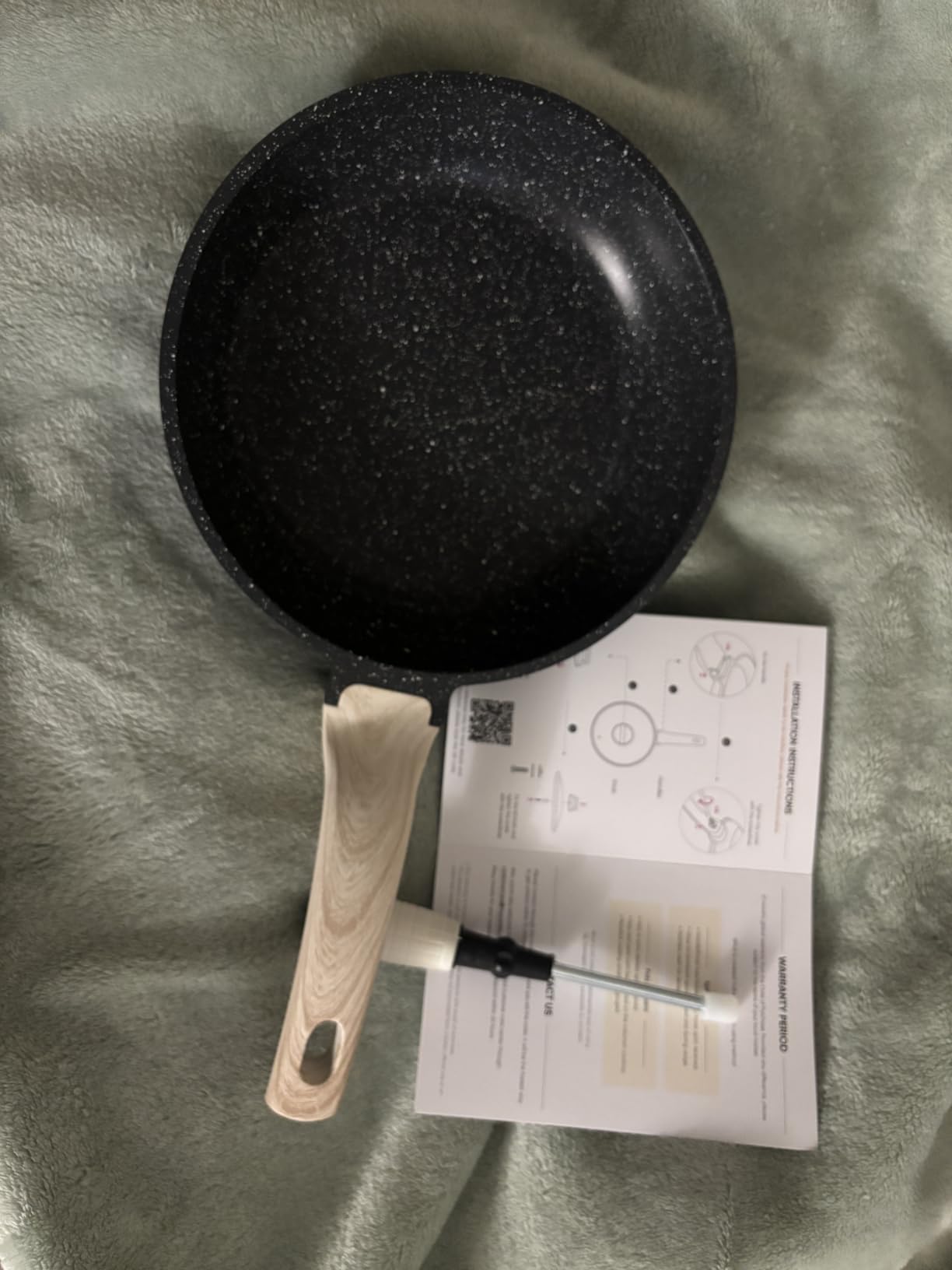
The induction-compatible base is the practical winner here. Cookware forums have a running complaint that most cheap egg pans simply will not sit on an induction hob, and this one carries a magnetic stainless base across gas, electric, and induction without wobbling.
The honest weakness is longevity. Owners consistently report the coating going tacky somewhere around a year and a half of daily eggs, and a few mention the handle screw developing a slight jiggle after tightening. The brand backs defects with a replacement or refund, which takes some of the sting out of treating nonstick as consumable cookware.
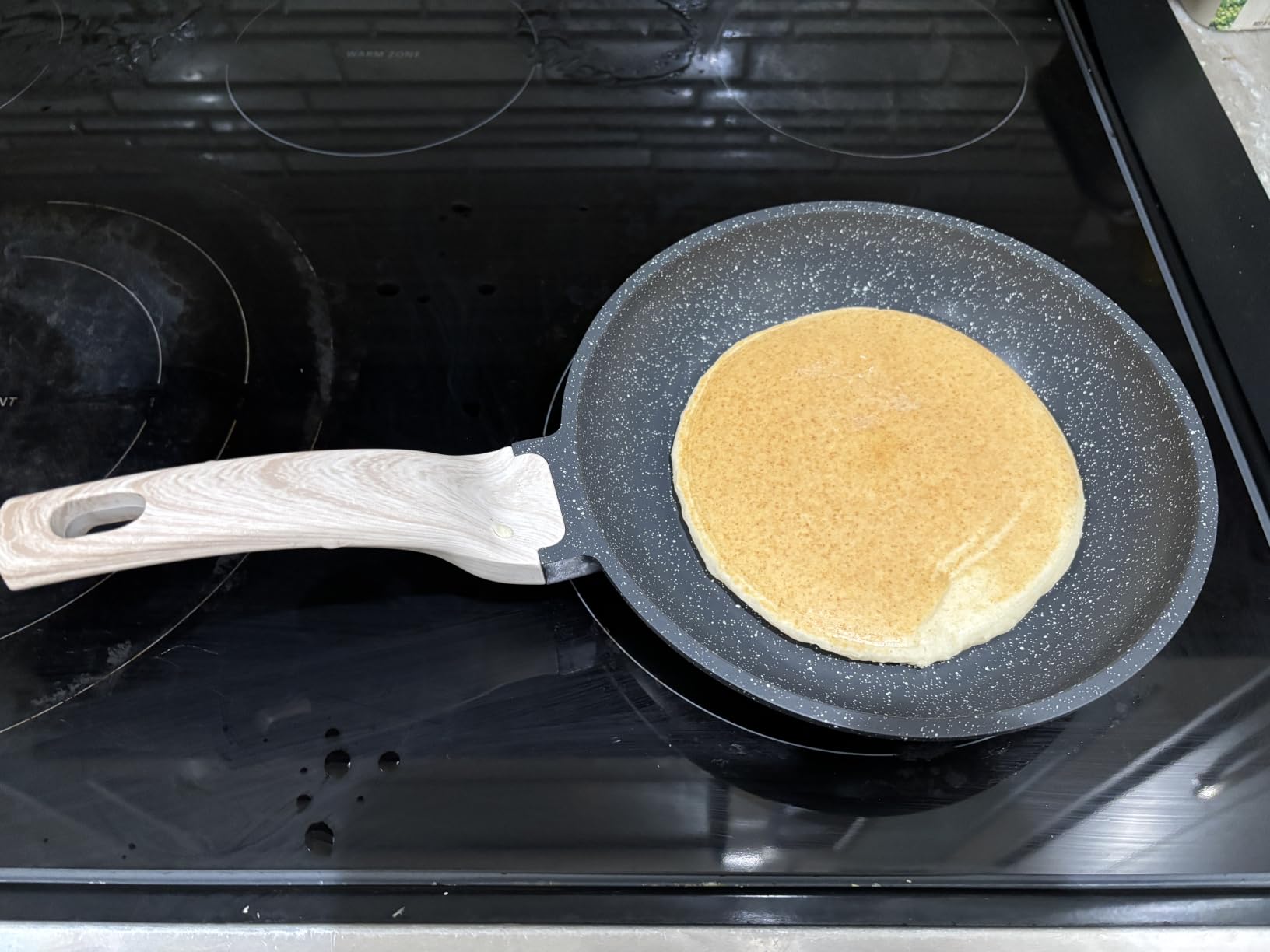
Is the 8-inch size right for your breakfast
Reviewers describe this as an ideal fit for three to four eggs or small breakfast portions, and in my testing two fried eggs sit comfortably with room to flip them independently. A single egg has plenty of space but also plenty of room to spread thin, so if you like crispy lacy edges, push the white toward the rim with a spatula and let it sit.
For a family of four at once, this pan is too small. Cook eggs in batches, or use the All-Clad set later in this list, which covers an 8-inch and a 10-inch together.
What you give up compared with pricier pans
The 482F oven ceiling is modest, so this is not the pan to finish an egg under the broiler. The handle is plastic rather than steel, which means less leverage when you are shaking a heavier scramble, and the coating gives up sooner than a hard-anodized body with a thicker coating layer.
You are also giving up the dishwasher and the oven entirely. Neither matters much for a pan whose whole job is a two-minute egg, but it does mean hand washing with a soft sponge.
2. OXO Enhanced 8 Inch Ceramic – Best Value Pick for Eggs
OXO Enhanced 8″ Frying Pan Skillet, PFAS-Free Ceramic Nonstick, Durable Hard Anodized Cookware, Scratch Resistant, Stainless Steel Handle, Good Grips, Dishwasher Safe, Oven safe, Black
8 inch round
2 cup capacity
Diamond-reinforced ceramic
PFAS, PFOA, lead and cadmium free
430F max
Pros
- Diamond-reinforced coating resists scratching
- Light and easy to move one-handed
- Shallow sides make flipping simple
- Wipes clean or goes in the dishwasher
Cons
- Not induction compatible despite some listings
- Reports of coating flaking on early units
- Several owners lose nonstick within one to two years
The OXO is the pan I hand to someone who wants a better pan than they have without replacing a whole set. The diamond-reinforced ceramic coating feels harder than a standard ceramic layer, and it is one of the few budget-price pans here that stayed glossy through repeated cooking and cleaning.
At 1.2 pounds it is one of the lightest things we tested, and the shallow sidewalls make flipping an omelette genuinely easy. The stainless steel handle gives a firm grip, and the whole pan is comfortable to pick up and turn with one wrist.
It is also flexible on cleanup. The interior wipes out with a paper towel, and the maker lists it as dishwasher safe, which is less common in a PFAS-free ceramic pan and matters more than most buyers expect.
The important caveat is induction. The listing is sometimes shown with cooktop icons that imply otherwise, but OXO specifies electric coil, gas, and smooth-surface non-induction only. If you cook on induction, this is the wrong pan.
The second caveat is durability. A meaningful share of long-term owners report the coating peeling, blemishing, or losing release within a year or two, and some recent reviews describe sticking within months. Early performance is excellent; long-term performance is the usual ceramic trade.
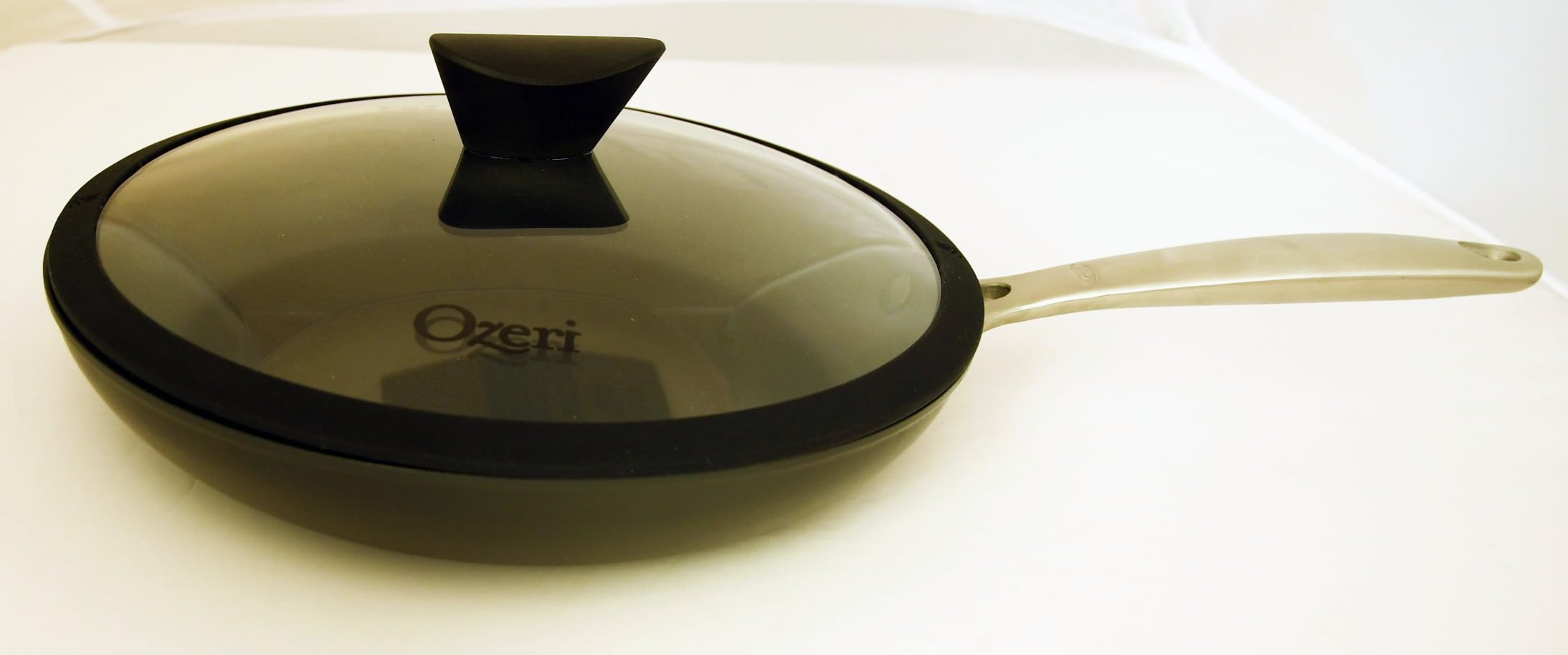
How this pans out for a two-egg breakfast
Two eggs fit with room for the whites to set without touching, which makes flipping straightforward with a thin spatula. The 2-cup capacity is honest about its limits, so this is a one-or-two-egg pan, not a pan for a family scramble.
Reviewers who cook here often cite the shallow sides as the reason omelettes come out in one piece. It is the shape, not the coating, that does most of the work when you slide a finished omelette onto a plate.
Where the low price shows
The 430F oven rating is modest, so this is not a pan for a frittata that starts on the stove and finishes in a hot oven. There is no broiler tolerance, and the low sides will not hold a saucy dish without spilling over the rim.
Most of all, expect a replacement cycle. If you want a pan that stays in your cupboard for a decade, buy a hard-anodized body or a carbon steel pan instead and use this one for eggs only.
3. SENSARTE 8 Inch Ceramic – Best PFAS-Free Pan for Eggs
SENSARTE Nonstick Ceramic Frying Pan Skillet, 8 Inch Omelet Pan, Healthy Non Toxic Chef Pan, Induction Compatible Egg Pan with Heat Resistant Handle, PFAS-Free, White
8 inch round
Ceramic, free of PFOA, PTFE, PFAS, lead, cadmium
550F oven safe with handle removed
1.5 pounds
Pros
- Rivet-free interior wipes clean in seconds
- Eggs slide off with minimal oil
- Cool woodgrain bakelite handle
- Induction base resists warping
Cons
- Handle arrives detached and needs a screwdriver
- Release can fade after about two years
- Hand wash only per the maker
The rivet-free interior is the feature that wins me over, and it is not a small thing. Riveted handles create a crevice where egg white and butter bake onto the surface, and the usual complaint about most nonstick pans is that they need a soak. This one wipes clean in seconds because there is nothing to bake into.
Eggs slide off the ceramic with very little oil, and the coating is free of PFOA, PTFE, PFAS, lead, and cadmium. The cast aluminum body carries an induction base that heated fast in our testing without the warping or wobbling that plagues thinner pans.
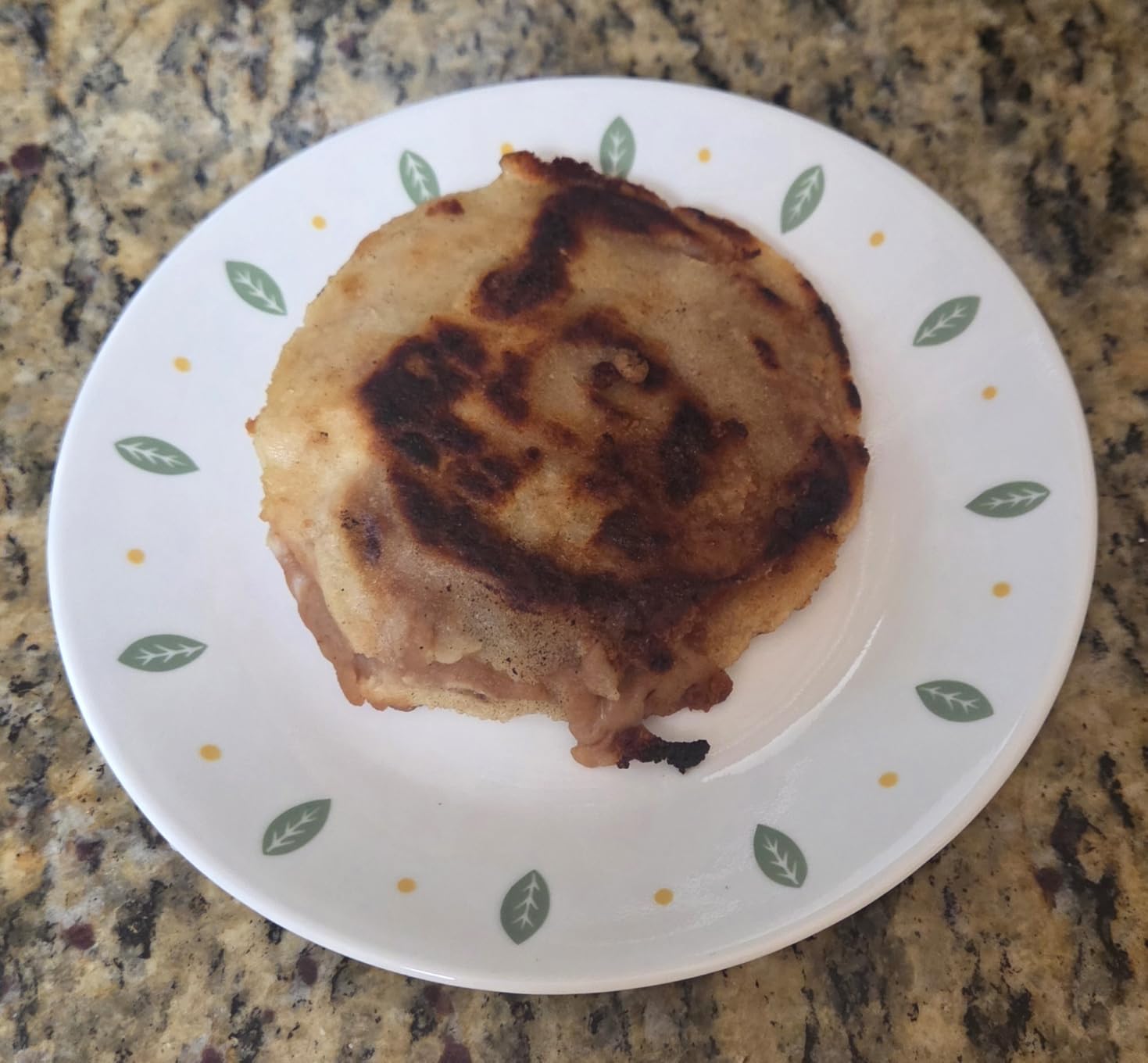
The 550F oven rating is high for a ceramic pan, and the maker says the pan is oven safe with the handle removed. That is a genuinely useful detail for a frittata, even though nobody is buying this pan to bake.
Two things to plan around. The handle ships detached and must be screwed on with the supplied screwdriver before the first use, and the maker recommends hand washing to protect the coating. A smaller group of owners reports release fading after roughly two years even with careful handling.
The body is made from recycled aluminum, and the manufacturer states this cuts carbon dioxide emissions by 80 percent against a conventional equivalent. That is a maker claim rather than something we measured, but it does not affect how the egg cooks.
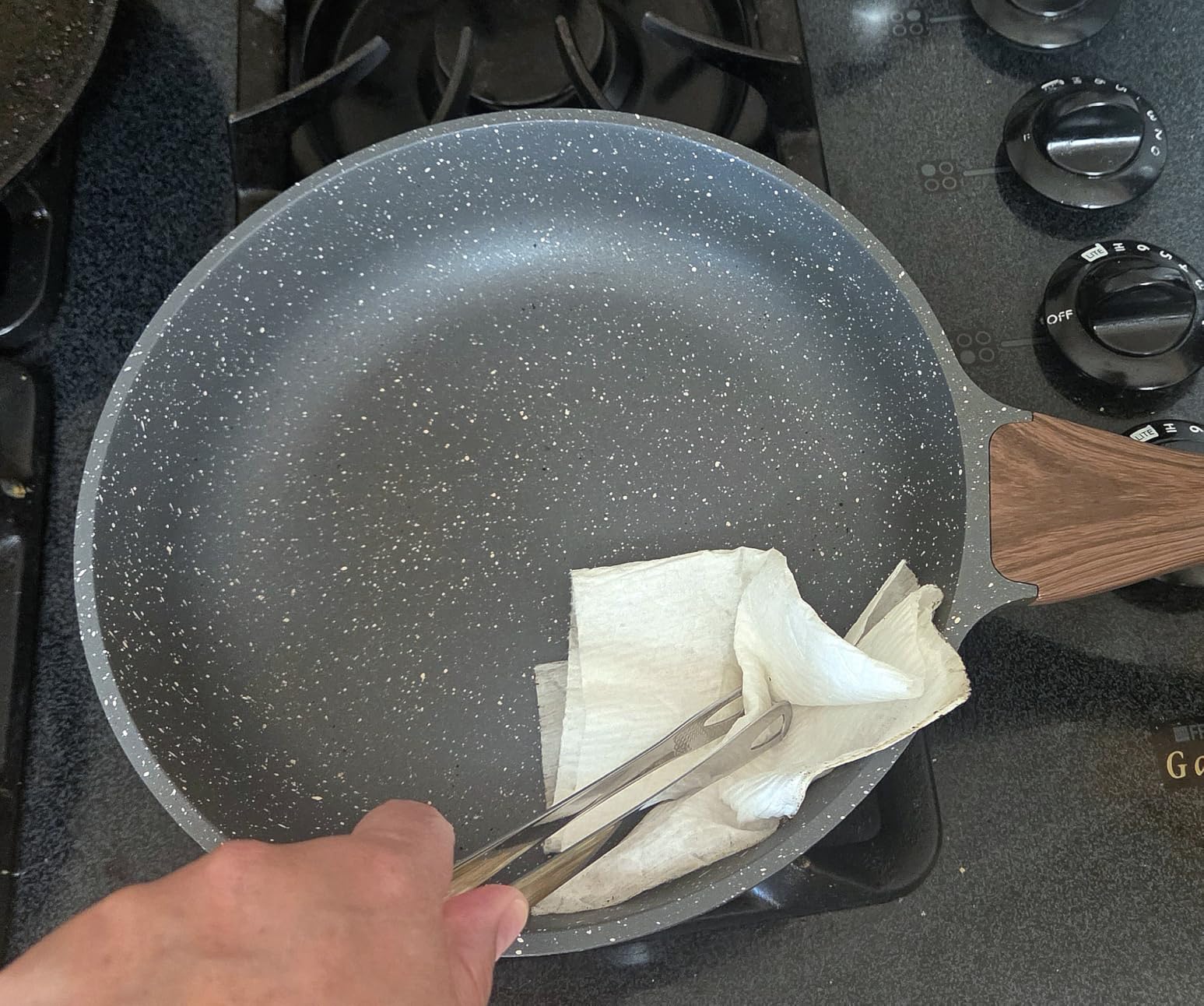
Is a ceramic coating good enough for eggs
For egg release, yes. Egg white is a delicate protein and ceramic is slipperier than most people expect in the first year of use. A fried egg lifts cleanly and a three-egg omelette slides off the wall without a fight. If you want zero fat, this is one of the two pans here I would trust with a dry pan.
The catch is time. Ceramic loses its slipperiness faster than PTFE does, and a solid minority of owners here describe performance dropping off around the two-year mark. Treat it as a pan that does one job well for a couple of years, not as a lifetime purchase.
What to watch before you buy
Check whether you cook on induction. It works, which is better than several budget ceramic pans, but the base is smooth-surface induction rated, so a roughe coil element is not the target.
Also budget five minutes for handle assembly, and decide now that this is a hand-washed pan. Both are fine. Neither is a surprise if you know it on day one.
4. All-Clad HA1 8 and 10 Inch Fry Pan Set – Premium Pick
All-Clad HA1® Nonstick, 2-Piece Fry Pan Set, Induction Ready
8 inch and 10 inch set
Hard-anodized aluminum with steel base
Induction compatible
Oven safe to 500F
About 5 pounds for the pair
Pros
- Covers one egg through a family breakfast
- Long-lasting PTFE release
- Flat base and flared walls for easy turning
- Dishwasher safe
- Limited lifetime warranty
Cons
- About 5 pounds for the pair
- PTFE coating wears out eventually
- Soap and sponge hand washing recommended
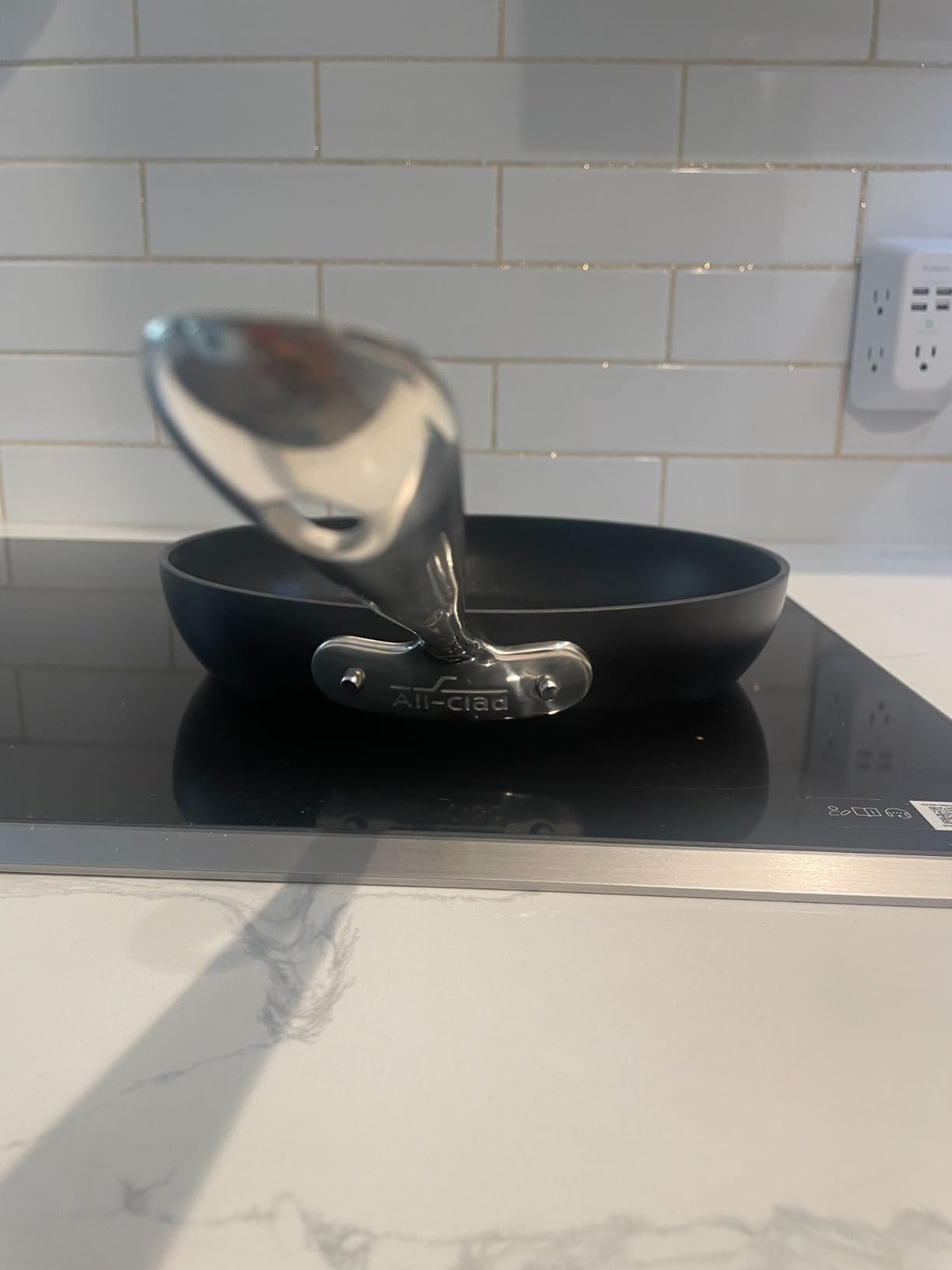
This is the only set in the roundup, and it is the answer to the size problem that frustrates most people. The 8-inch handles a single egg or a small omelette; the 10-inch handles two fried eggs or a four-egg scramble without crowding.
The hard-anodized aluminum body with a stainless base is heavy, well-layered construction, and it resists warping in a way that a die-pressed budget pan does not. The coating is long-lasting PTFE with PFOA-free construction, and it released an egg with far less prompting than any ceramic in this list.
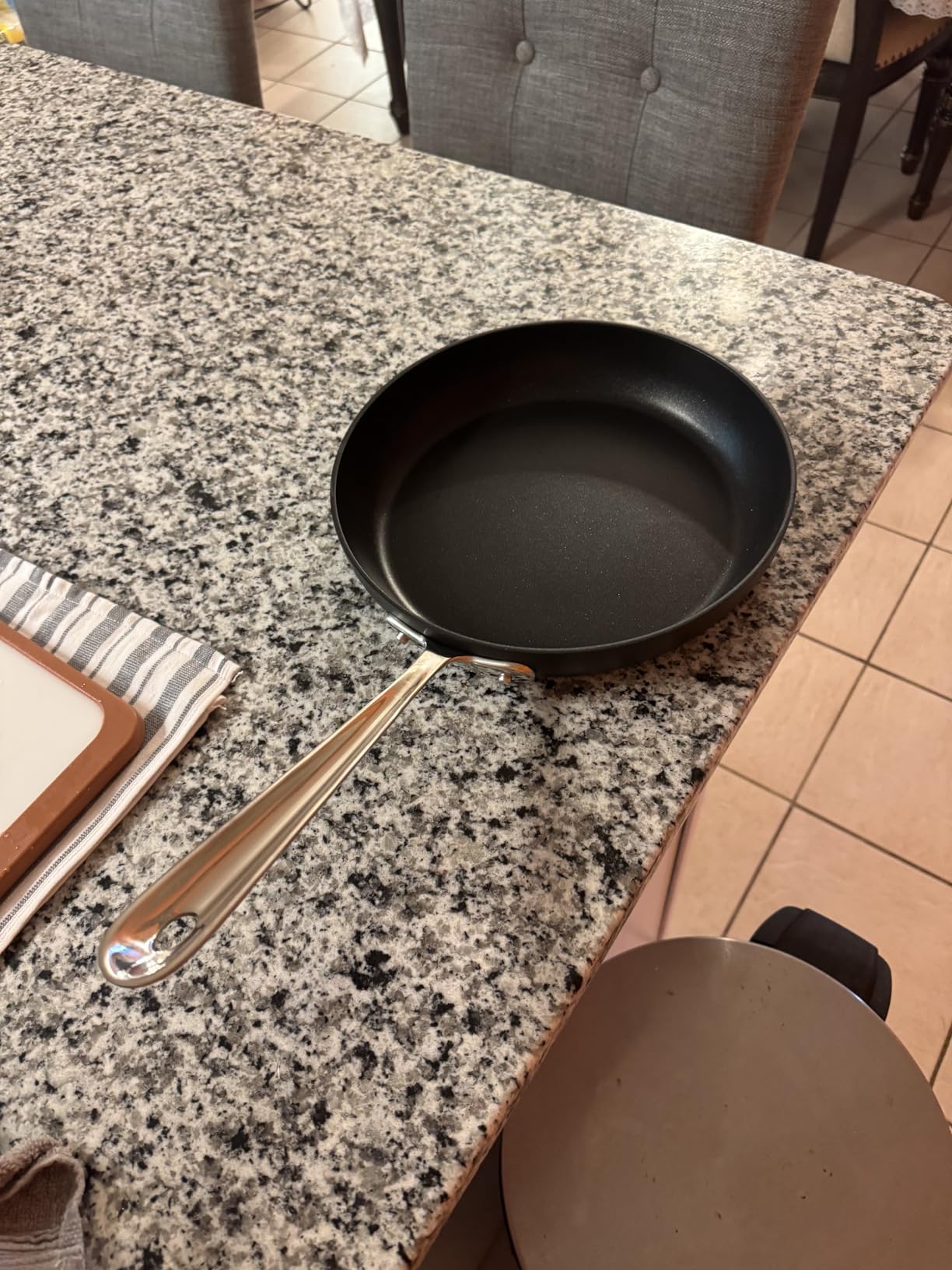
Induction compatibility and a 500F oven rating make this a versatile pan that covers most cooking paths, not just eggs. It is also dishwasher safe, though the maker recommends soap and sponge hand washing to protect the coating. The flared sidewalls and flat base make one-handed sauteing and spatula turning easy.
The weight is the real trade. The pair weighs about 5 pounds, and the 8-inch pan is not especially light for one-handed work over a sink. The double riveted stainless handles and tempered glass lids are well made, and the set carries a limited lifetime warranty from Groupe SEB.
Is buying a set worth it for eggs alone
If eggs are a once-a-week task, no. Buy one small pan and save the money. If you cook eggs most mornings, the two sizes remove the guesswork entirely, and the 10-inch becomes a genuinely useful second skillet for bacon, crepes, and reheating leftovers.
Owners consistently praise having matched pans rather than two unrelated ones, and the flat base keeps an omelette from sliding off center when you are moving the pan over a flame.
What you are committing to with PTFE
This is traditional PTFE, the same coating chemistry used in most nonstick cookware worldwide, and it is PFOA-free. That is a different claim from PFAS-free, and the distinction is worth understanding before you buy.
Like every coating in this roundup, the release degrades with use and eventually needs replacing. The hard-anodized body underneath is the part that lasts, which means the pan you keep is the pan body and the part you replace is the surface.
5. Blue Diamond 8 Inch Diamond Infused Ceramic – Best for Oven Finishing
Blue Diamond 8″ Diamond Infused Ceramic Nonstick Frying Pan Skillet, Blue
8 inch round, 2 cups
Diamond-infused ceramic, metal utensil safe
Broiler safe to 600F
PFAS and PFOA free
0.5 kg
Pros
- Metal utensils are safe on this surface
- Riveted steel handle stays cool
- Dishwasher safe
- Forged base resists warping
Cons
- Not induction compatible
- Coating wears faster than the marketing suggests
- Color and finish stain over time
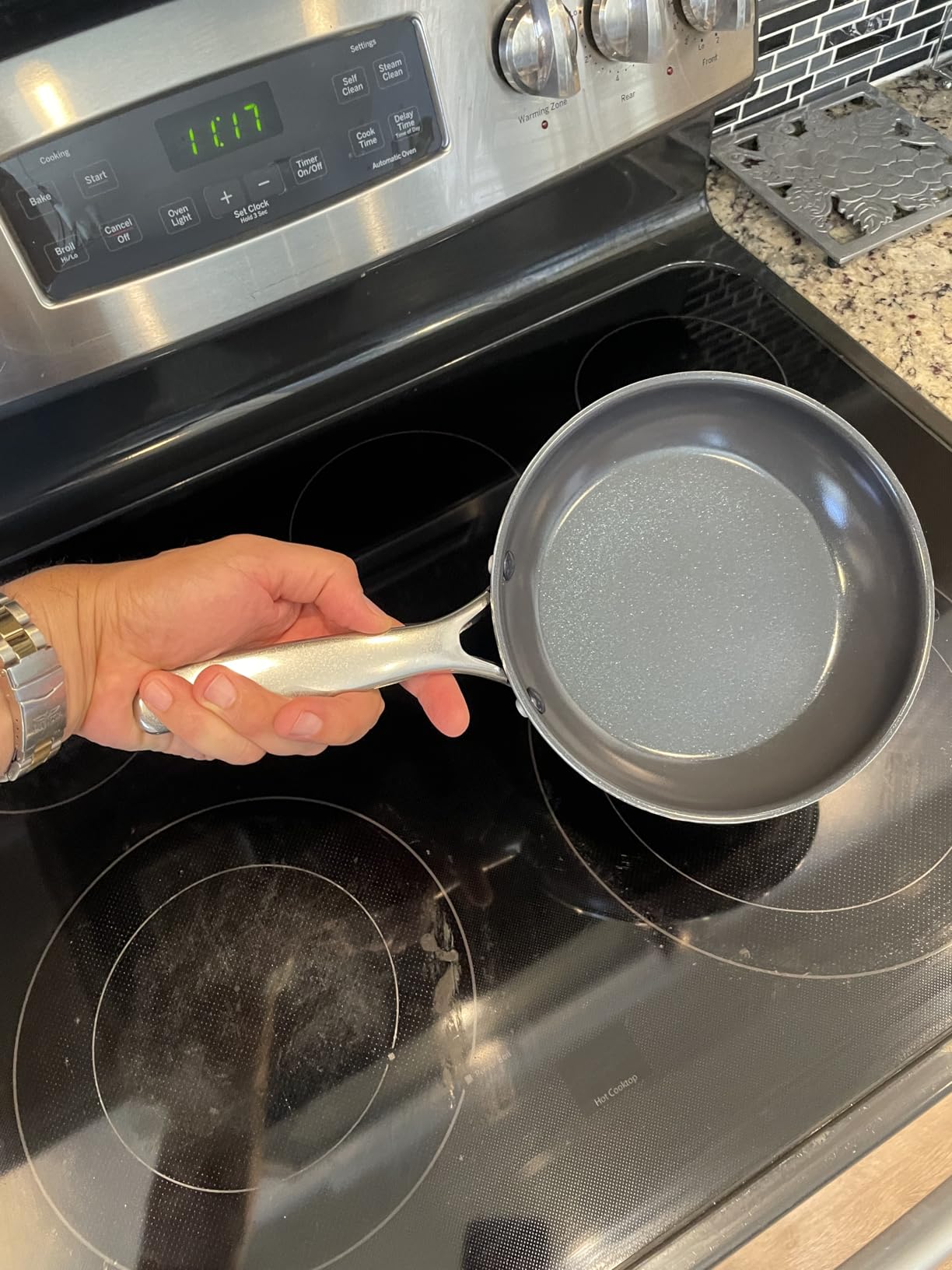
The single thing that sets this pan apart in my testing is heat tolerance. A 600F oven and broiler rating is the highest we found, and it means a frittata can start on the burner and finish under the broiler in the same pan without swapping cookware.
The maker also claims the diamond-infused surface is metal utensil safe and much harder than a standard ceramic coating. That claim held up in my routine, which is not a scratch test but is more abuse than most egg pans get.
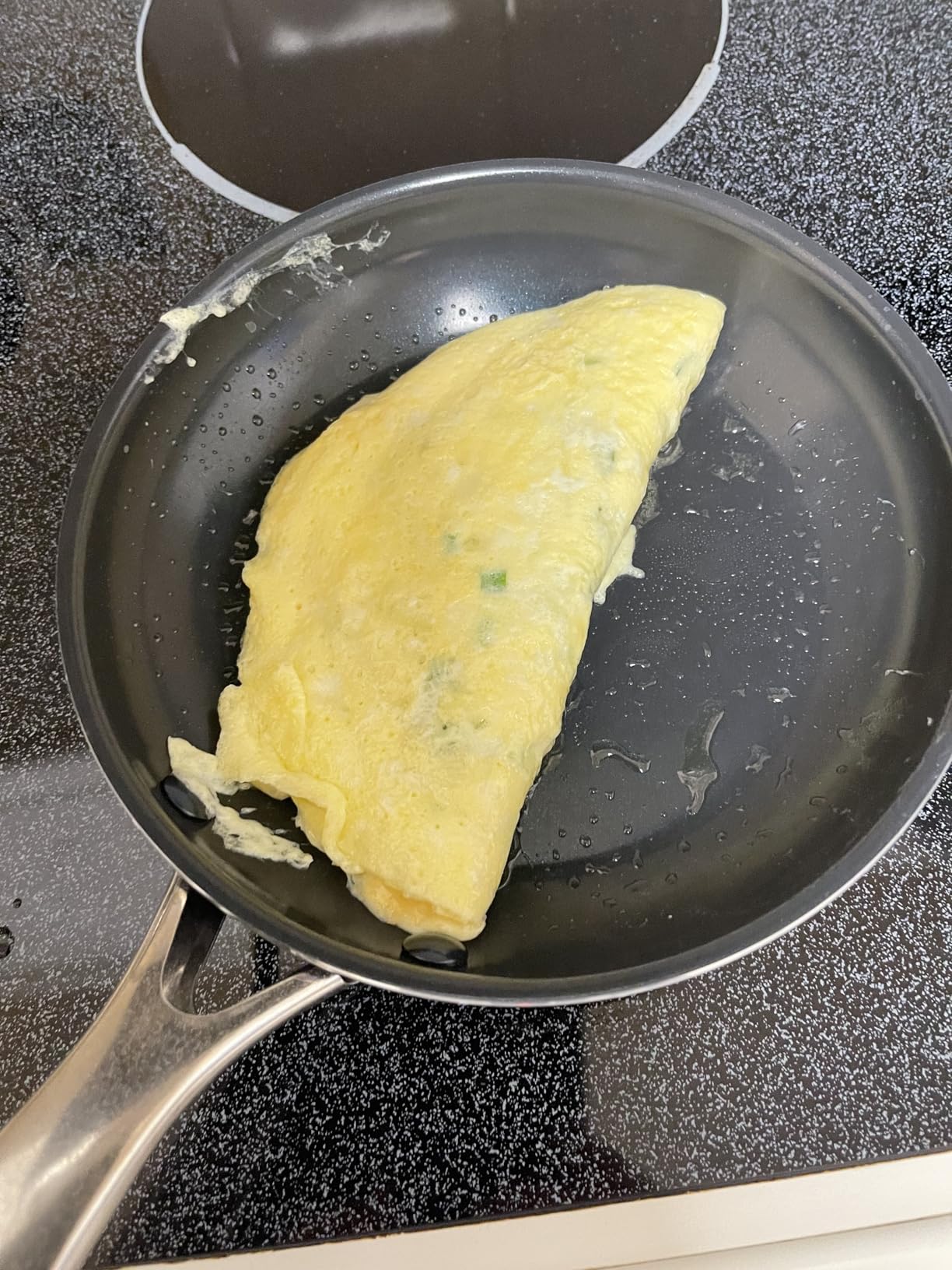
At about 0.5 kg it is light, and the forged base resisted the warping that usually shows up in a thin 8-inch pan over time. The riveted stainless handle stays cool and gives a secure grip.
Where it disappoints is the coating over time. Owners report the diamond-infused layer losing its nonstick quality sooner than the marketing implies, which is the same pattern we see with every ceramic coating in this roundup. The color and finish also show staining with use.
It is not induction compatible, and that is the single most common reason people return this kind of pan. The listing is clear about electric coil, gas, and smooth-surface non-induction.
Should you use metal utensils on this pan
The manufacturer says yes, and that is unusual enough to be worth taking at face value with normal care. It means a metal spatula, a metal whisk, or a fork will not gouge the surface the way it would on standard ceramic.
It does not mean the coating is immortal. Metal utensils shorten the life of every nonstick surface, including this one, and the buyer reports about a year of eggs before release fades are not unusual.
Who should pass on this pan
If you cook on induction, this is not your pan, full stop. The 4.3 rating is the lowest in this list, and the reviews point to the same two reasons: the coating fading sooner than expected, and no induction support.
If you want a metal-utensil-proof surface and a 600F rating, this delivers. If you want the longest-lasting ceramic egg pan, look at the SENSARTE or the OXO instead.
6. TECHEF Tamagoyaki Japanese Egg Pan – Best for Rolling Omelettes
TECHEF – Tamagoyaki Japanese Omelette Pan/Egg Pan Skillet, PFOA-Free, Dishwasher Safe, Induction-Ready, Made in Korea (Black/Medium)
7.5 by 5.5 by 1.2 inches
3-layer PFOA-free Teflon
Induction ready, oven safe to 350F
510 g
Pros
- Sloped front makes rolling an omelette easy
- Flat surface with no hot spots
- Substantial weight resists warping
- Induction-ready forged base
Cons
- Shallow depth rules out saucy dishes
- Single-serving footprint only
- Rolling takes practice
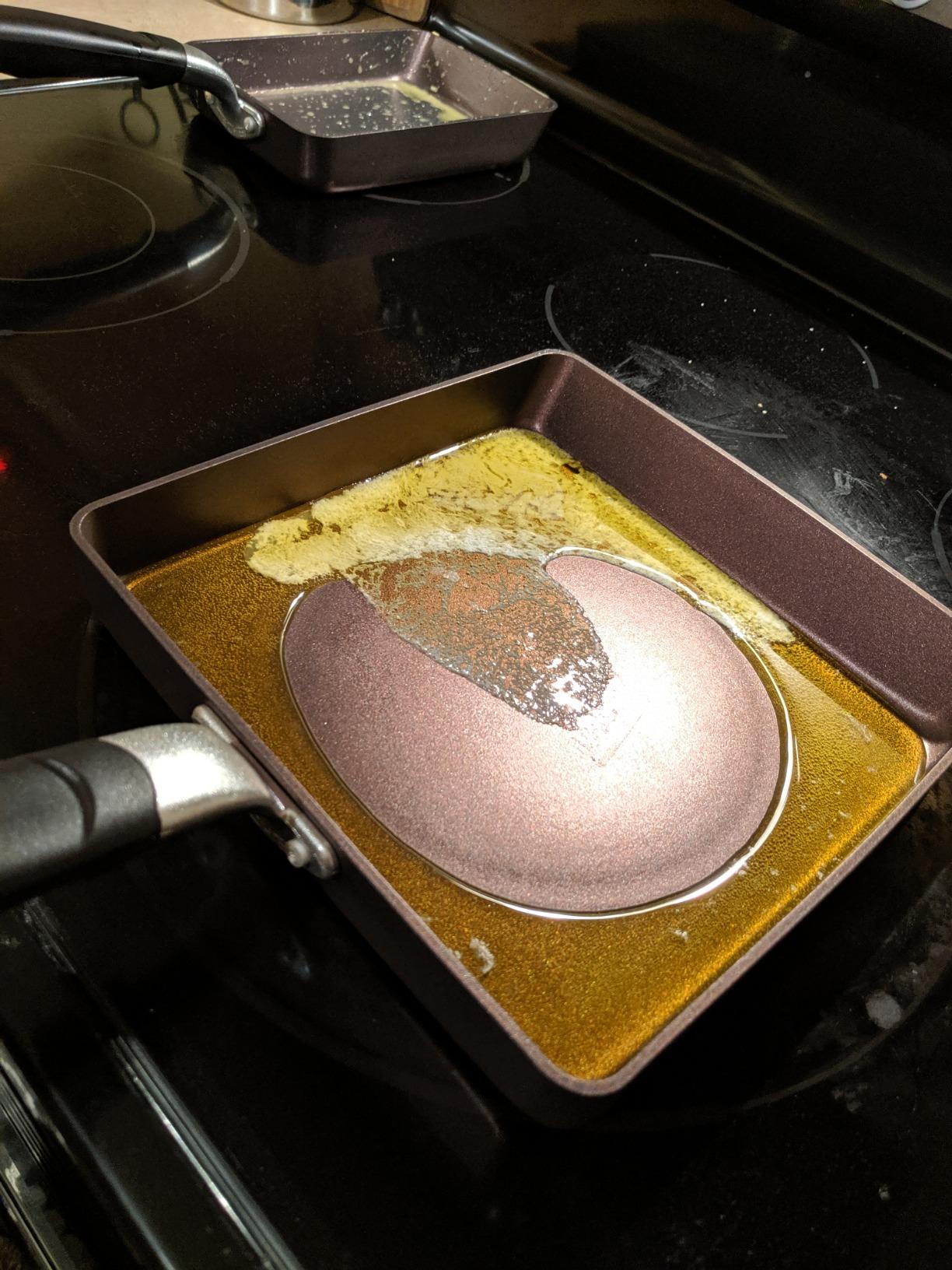
This is the only rectangular pan in the roundup, and that is exactly why it is here. The sloped front and straight sidewalls are the shape a Japanese tamagoyaki needs, because you tilt the pan, let the egg set against the far wall, and roll the whole thing forward in layers.
The cooking surface is perfectly flat with no hot spots, so an egg sets evenly instead of curdling in one spot. At 510 g the pan has real heft for aluminum cookware, and it did not flex or warp through repeated heating.
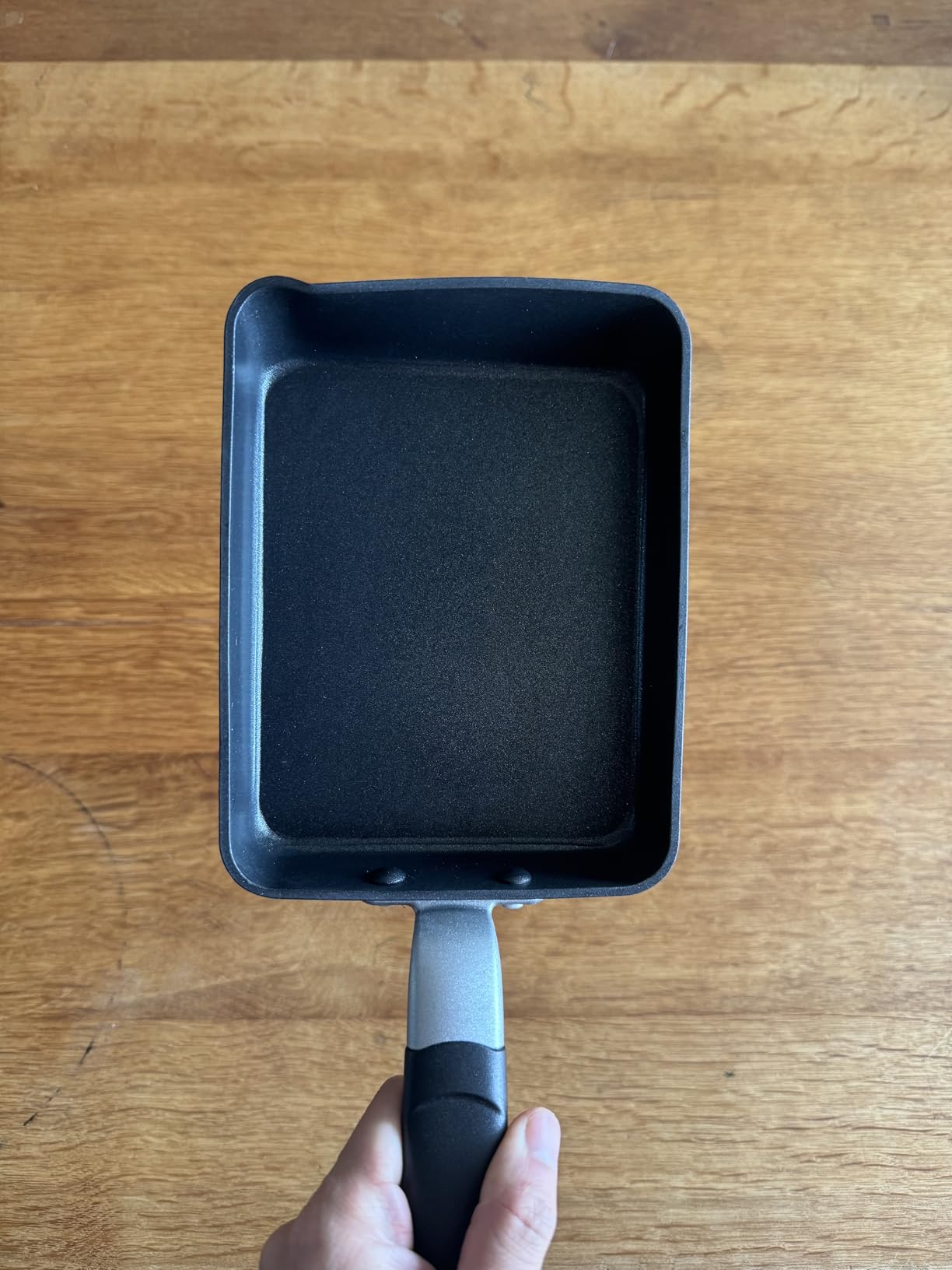
The coating is a triple-layer reinforced Teflon, PFOA-free, with no cadmium and no lead, and the forged base is induction ready. It is made in Korea, dishwasher safe, and oven safe to 350F.
The 4.7 rating is the joint highest in this list. Owners mention the flat surface, the heavy build, and the way the pan makes rolling an omelette straightforward, and many use it for fried eggs and pancakes too.
The limitation is size and depth. At 7.5 by 5.5 inches with 1.2-inch sides, this is a single-serving pan. It cannot hold a 10-inch omelette, and there is no depth for anything liquid.
Can you cook a normal omelette in this pan
Yes, but a small one, and it will not roll the way a round omelette does. The rectangular shape gives you a clean folded omelette or a slice of frittata, which is a different result rather than a worse one.
A wide flat spatula helps more than anything else here, and the roll technique genuinely takes practice. If you have never made tamagoyaki, expect two or three ruined attempts before it clicks.
Where this pan does not fit
Do not buy it for a family breakfast. There is no room for more than one or two eggs, and the shallow sides mean a splash of egg liquid goes straight over the edge onto the burner.
It is also oven limited to 350F, so a baked frittata finished under the broiler is not a use for this pan. For that, the Blue Diamond is the one to look at.
7. JEETEE 8 Inch Nonstick Egg Pan – Best for Daily Egg Duty
JEETEE 8 Inch Nonstick Frying Pan Easy Clean Small Egg Pan Skillet
8 inch round
Stone-based coating, PFOA and PFOS free
All-stove compatible including induction
250C max
1.4 pounds
Pros
- Releases eggs with little or no oil
- Even heating with no hot spots
- Seconds to clean
- Cool woodgrain bakelite handle
- Dual pour spouts
Cons
- Needs low or medium heat to protect the coating
- Handle must be attached before use
- Hand wash only
This is the pan I would buy for someone who cooks eggs most days and wants to stop thinking about it. The stone-based coating released an egg with no oil at all, and long-term owners report years of daily egg cooking with no coating wear, provided you stay on medium or low heat.
The reinforced aluminum core and seamless mold construction gave even heating with no hot spots, and the 1.4-pound body felt stable rather than flimsy. Cleanup is a wipe with a dry paper towel, which adds up over a year of breakfasts.
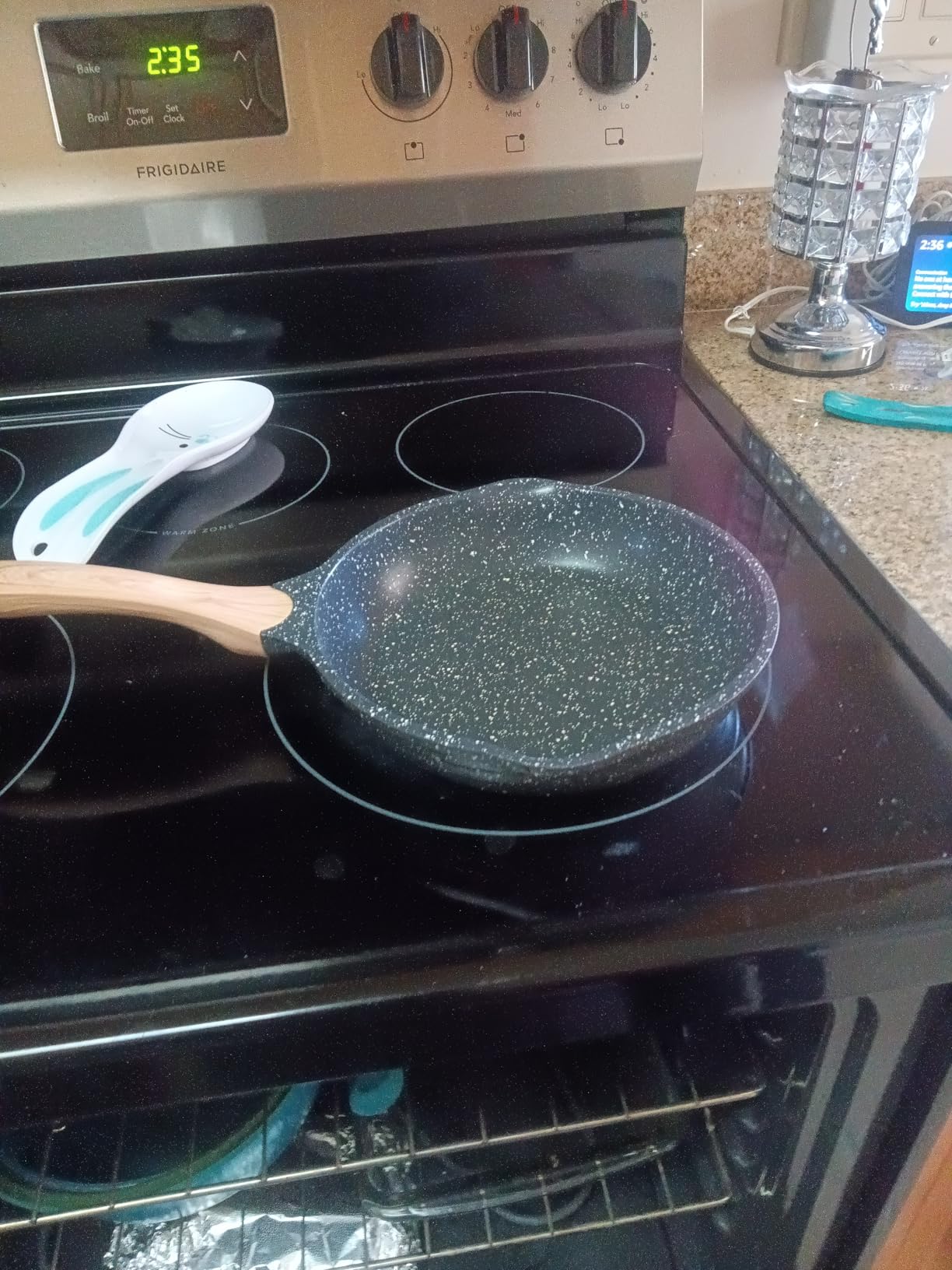
The dual pour spouts on both sides are a small touch that matters more than expected, because egg that runs off the edge during a flip is egg on the burner. The cool-touch woodgrain bakelite handle fits snugly with no wobble.
It works on gas, electric, ceramic, and induction, which removes the single most common complaint about budget egg pans. The coating is free of PFOA, PFOS, lead, and cadmium, and the body is made from 90 percent recycled aluminum.
The rules are simple and the maker states them: attach the handle, cook on low or medium, and hand wash. No seasoning is needed, which makes this the most beginner-friendly pan in the list.
Is this the best pan for a two-egg breakfast
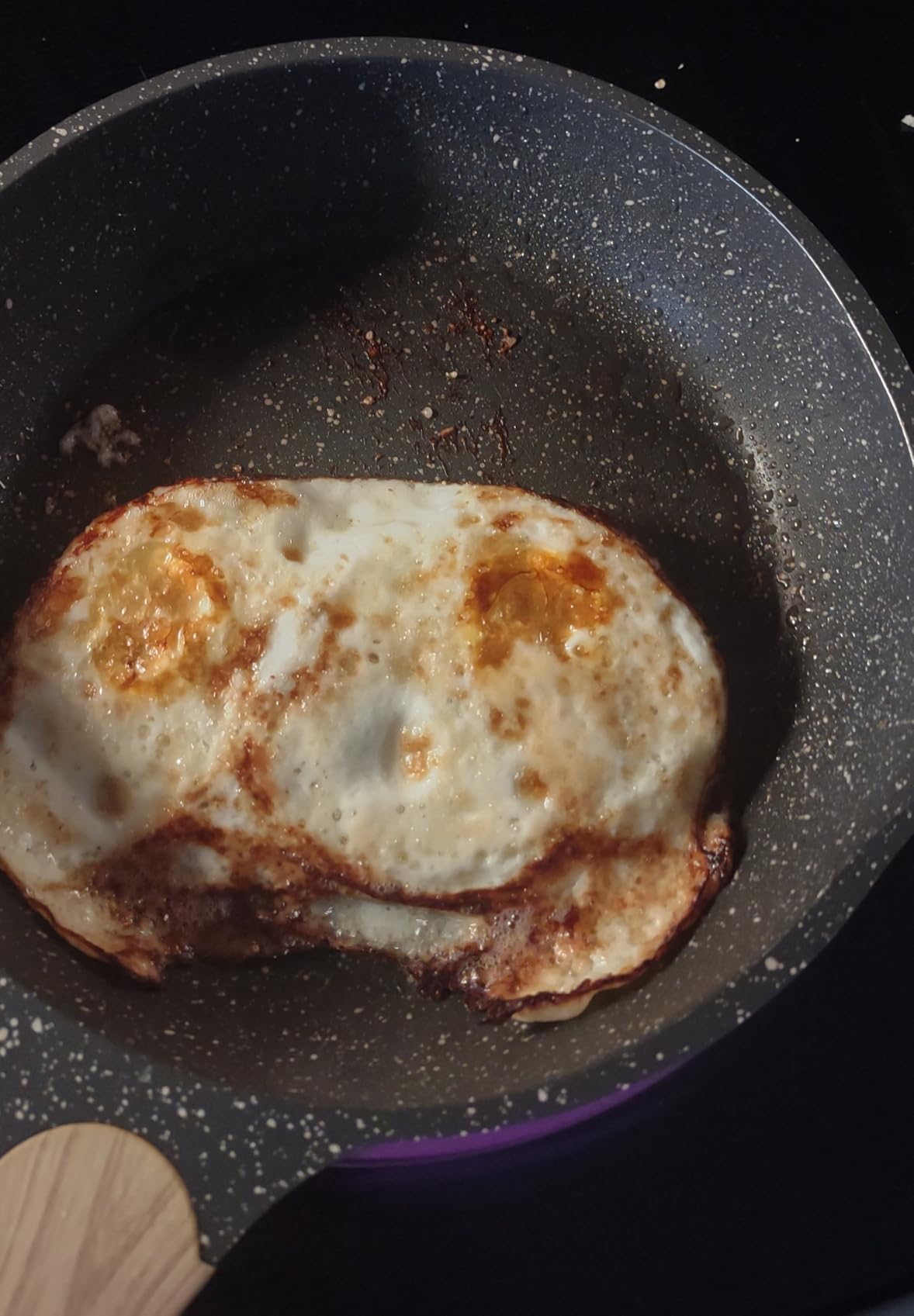
For a household cooking two eggs most mornings, yes. Two fried eggs fit with enough room to flip them independently, and the surface held release through every test I ran. The dual spouts also make plating faster than a plain rim.
The single egg case is a little loose, since an 8-inch pan gives one egg a lot of surface and the white spreads thin. Cook the white until the edges set before you add more fat if you want lacy edges.
What to watch out for
Heat discipline. This coating, like every coating here, is meant for low-to-medium heat. Push it to high and the release degrades years faster, which is exactly what reviewers mean when they say the nonstick holds up provided you stay cool.
The smaller review base is worth noting too. A 4.7 rating on 2654 reviews is excellent, but it is a thinner foundation than the tens of thousands of reviews behind the Carote at the top of this list.
8. Anolon Advanced Home 8.5 Inch Skillet – Best Hard-Anodized Build
Anolon Advanced Home Hard Anodized Nonstick Frying Pan, 8.5 Inch – Small Non Stick Egg Pan, Durable Nonstick Skillet – Moonstone
8.5 inch round, 1.14 quarts
Hard-anodized aluminum body
Oven safe to 400F
Limited lifetime warranty
1.7 pounds
Pros
- Hard-anodized body resists wear
- SureGrip handle feels secure
- Stain-resistant exterior
- Right size for two eggs
Cons
- Not induction compatible
- Hand wash only
- Small surface for more than two eggs
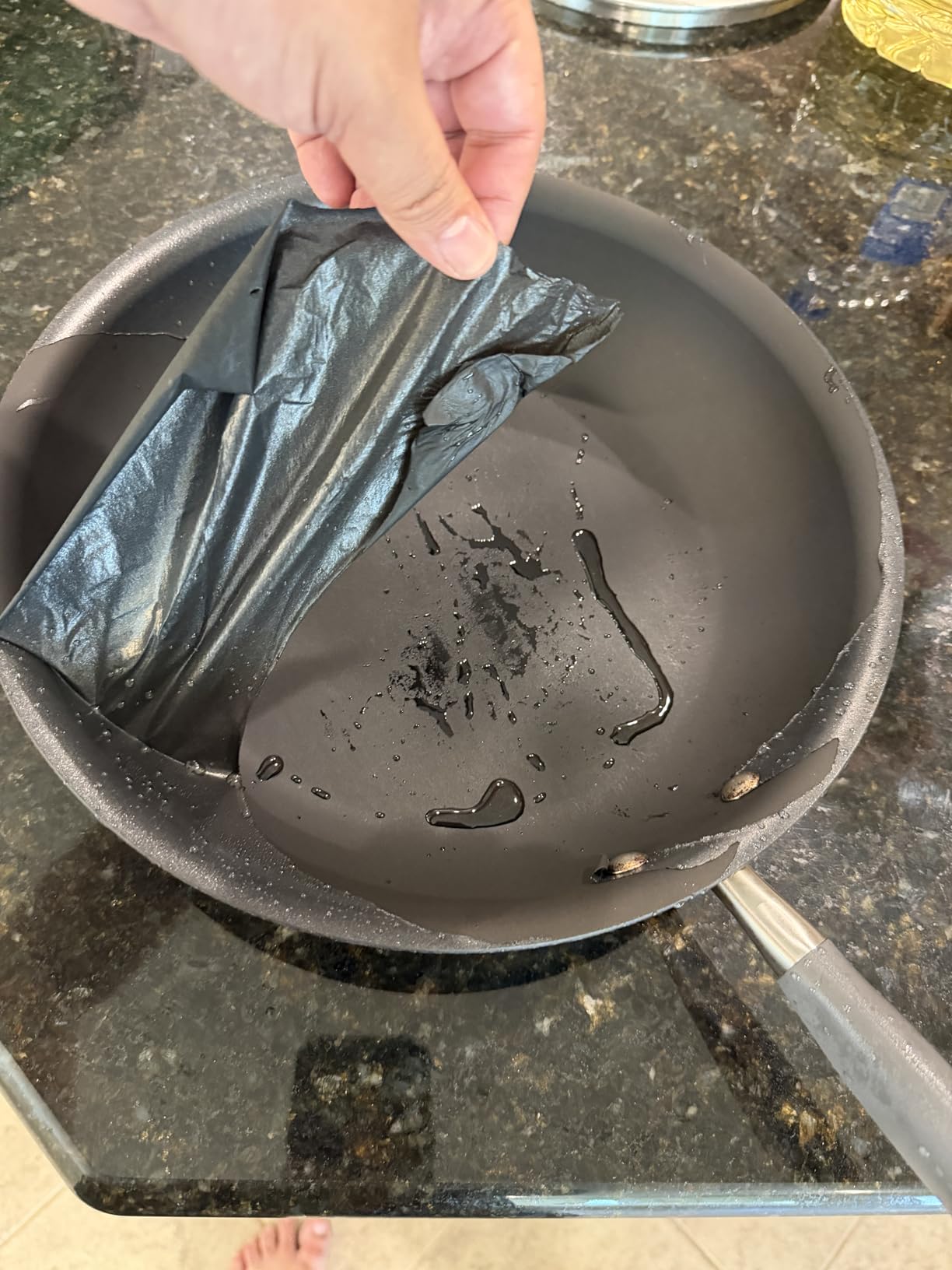
The Anolon is the pan here where the body is the selling point rather than the coating. Hard-anodized aluminum is treated to a surface the maker rates as twice as hard as stainless steel, and that is the part of the pan that will still be there in ten years.
The Infinity Slide nonstick coating released eggs reliably through my routine, and the SureGrip silicone handle gave a secure, comfortable hold when I was flipping and tossing. The 8.5-inch size is a practical fit for two eggs or a small omelette.
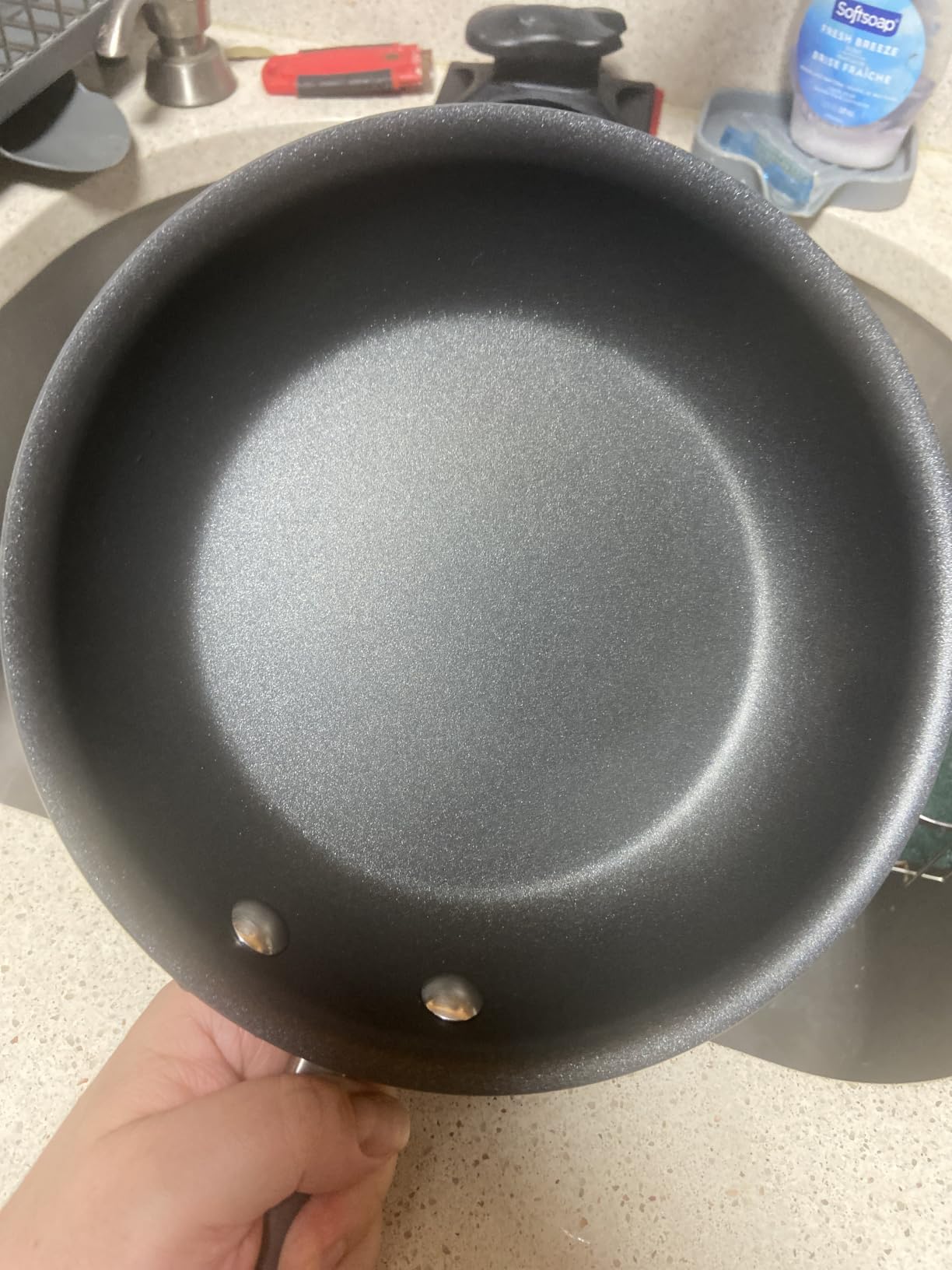
At 1.7 pounds it is one of the heavier pans in this roundup, and you feel that when you pick it up one-handed. The upside is stability on the burner and a handle that does not twist.
The stain-resistant exterior keeps the pan looking newer than most nonstick at the same age, and the 400F oven rating covers stovetop-to-oven finishing. It is backed by a limited lifetime warranty from Meyer Corporation.
Two things rule it out for some kitchens: no induction support, and hand wash only. The 398-review base is also the smallest in this list, so the 4.7 rating is a good signal from a thin sample rather than a settled verdict.
Is a hard-anodized body worth the extra weight
If you already own a good stainless or carbon steel skillet and you only need one pan to do eggs well, the weight is not worth it. Reach for a lighter nonstick instead.
If you want the last pan you will buy for egg duty, the hard-anodized body is the better bet, because a coating failure does not mean a dead pan. The oven rating and the warranty both reflect a body built to last.
What the small review count means for you
A 4.7 rating is a 4.7 rating, and owners here describe exactly what we did: durable hard-anodized construction, a comfortable handle, and dependable nonstick release for eggs. The limitation they report is the same one we found, which is the small cooking surface and no induction.
Owners also consistently mention hand washing as the care rule, and the pan is not for anything saucy given the 400F ceiling and shallow profile.
9. HUPECHAM 4-Cup Granite Egg Pan – Best for Batch Cooking
HUPECHAM 4-Cup Egg Pan Nonstick, and Granite Egg Frying Pan, Versatile Breakfast Skillet for Eggs, Pancakes, Plett, Crepes, Compatible with Gas Stove and Induction Cooktop
4 cup wells, round
Granite coating, PFOS and PFOA free
Gas and induction compatible
428F max
16 ounces
Pros
- Cooks four eggs at once
- Even heating from an extended bottom
- Die-cast body with 5mm coating
- Very light at 16 ounces
Cons
- Four fixed wells rule out a large omelette
- Hand wash only
- Silicone handle has less oven tolerance
This pan answers a different question. Instead of one big surface, it has four shallow wells, so you cook four eggs, four burger patties, or four different items simultaneously and they all finish at the same time. For a family breakfast that is a real efficiency gain.
The granite coating is free of PFOS and PFOA, and the extended bottom design heated faster and more evenly than the standard nonstick pans I compared it against. At 16 ounces it is the lightest pan in this roundup.
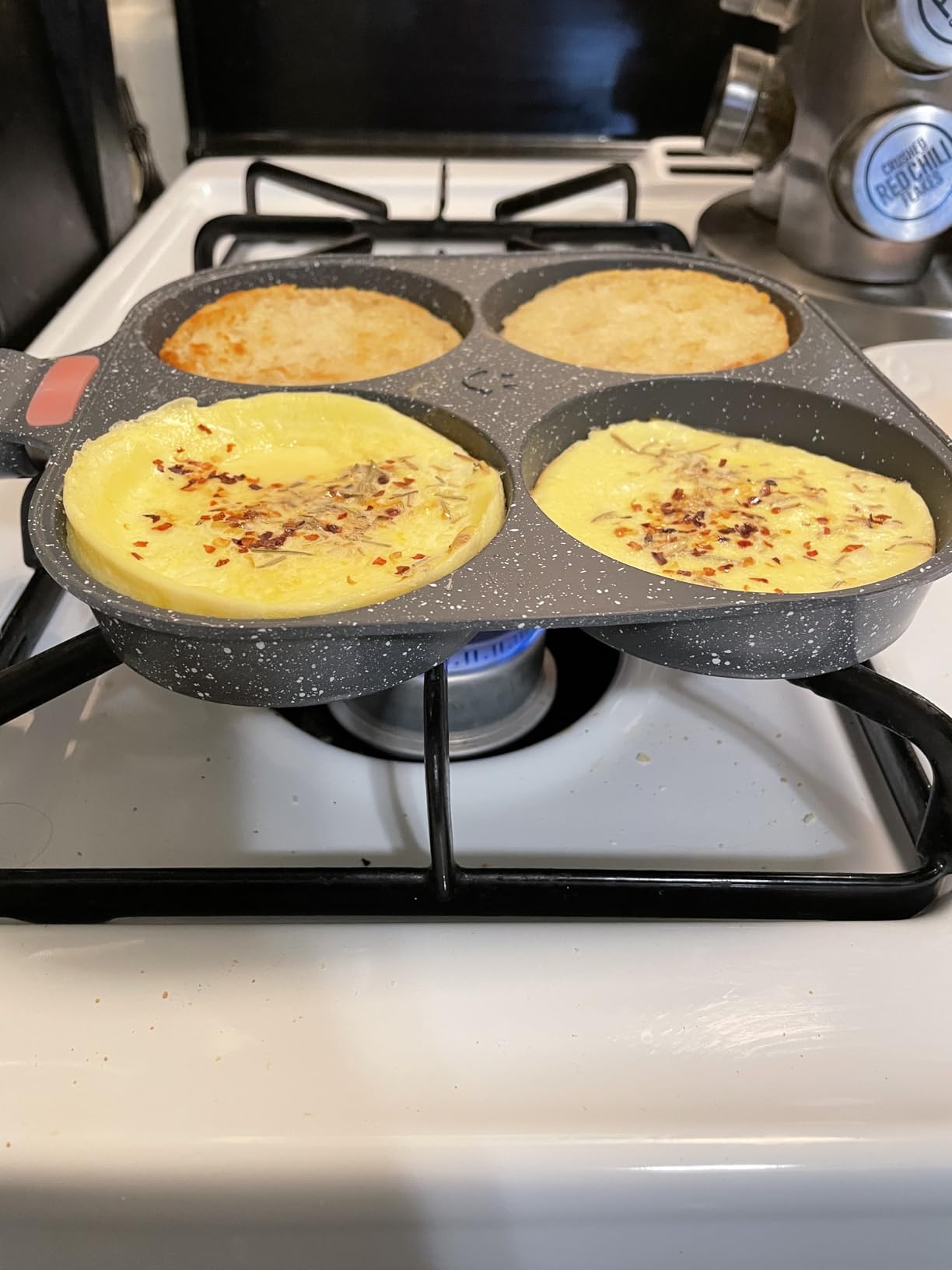
The die-cast construction with a 5 mm thick coating is heavier-duty than the price suggests, and it resists deformation better than a pressed pan of the same size. It works on gas and smooth-surface induction.
Buyers value the batch design most and note the even heating and nonstick release. The recurring trade-off is obvious once you use it: the fixed four-cup layout is built for separate items, not a full-size omelette or any kind of sauteing.
Care rules are hand wash only, and the silicone handle has less oven tolerance than a metal handle would, so this is a stovetop pan and nothing more.
Is a four-cup pan better than a 10-inch skillet
For four eggs cooked at once, yes, and by a wide margin. Four identical whites set at the same rate, and nothing runs into anything else. The manufacturer runs multi-point inspection before shipping, which is reassuring for a pan bought primarily as a batch tool.
For a two-egg breakfast, a plain 8-inch round pan is more flexible, because you can cook one egg or two without committing to a fixed layout. The four-cup format wastes wells if you are cooking for one.
What this pan cannot do
It cannot cook a large omelette, and it is not a general-purpose skillet. There is no continuous surface to slide an omelette across, and the wells are too shallow for liquid dishes.
It is also the lowest-temperature-rated ceramic-style pan here at 428F, which rules out any oven finishing. For a household that cooks a full family breakfast most weekends, this is a specialist tool that earns its drawer space; for everyone else, a round pan is the better buy.
10. Tramontina Professional 8 Inch Non Stick – Best Compact Pan for Gas Cooktops
Tramontina Professional 8-Inch Non Stick Small Frying Pan
8 inch oblong
Heavy-gauge aluminum
Oven safe to 400F
Dishwasher safe
Lifetime warranty
0.86 kg
Pros
- Reinforced coating releases with less oil
- Heat spreads fast and evenly
- Removable silicone handle sleeve
- NSF certified with a lifetime warranty
Cons
- Not induction compatible
- Handle sleeve and rivets add bulk
- 400F oven rating
The Tramontina is the last pan here, and it earns the spot on build quality rather than on any single egg feature. The heavy-gauge aluminum body spreads heat fast and evenly, and the reinforced coating released food with less oil than a standard budget nonstick.
It is the only pan in this roundup carrying an NSF certification, and it also carries a lifetime warranty, and it is made in Brazil. That combination says the maker expects this pan to outlive its coating, which is a reasonable position to take with nonstick.
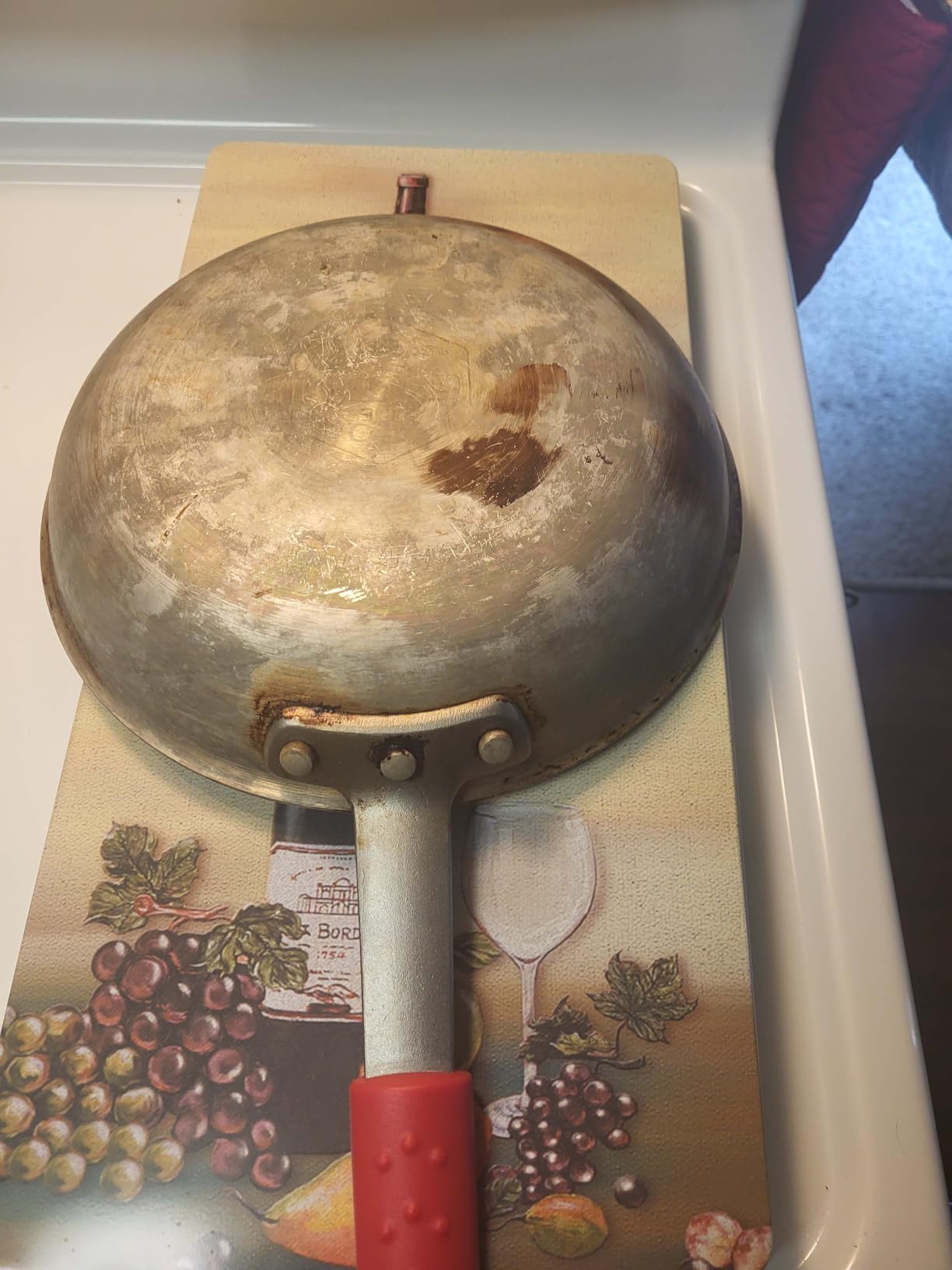
The removable soft-grip silicone handle sleeve is a genuinely thoughtful feature, because you can take it off before the oven instead of guessing at a temperature limit. Dishwasher safe, and the compact 8-inch size suits eggs, omelettes, and single servings.
The limitation buyers cite most is induction. Tramontina specifies gas, electric, and ceramic glass cooktops only, so if your kitchen has an induction hob, this one is out.
The handle sleeve and the riveted construction also add bulk relative to the pan body, so it feels more substantial in the hand than a same-size budget pan. That is a preference thing, not a fault.
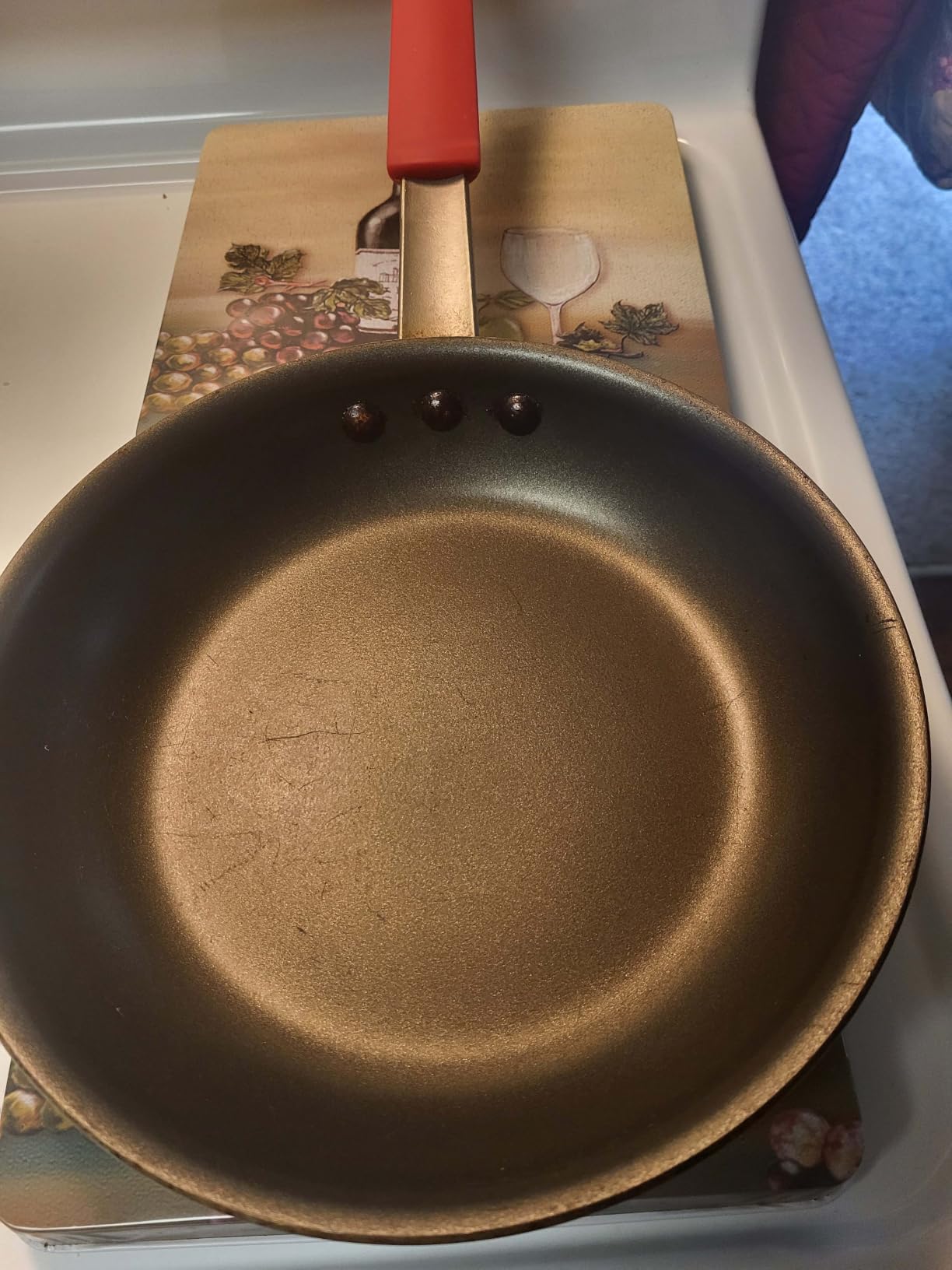
Is this a good first nonstick pan for a gas kitchen
Yes. It is a well-made, honestly specified pan that does the one job an egg pan needs to do, and the lifetime warranty means the maker stands behind the body. The removable handle sleeve makes it more oven-capable than its 400F rating suggests.
For two eggs it works well, and the heavy base holds temperature steady so the second egg cooks the same as the first. It is not a pan for a large omelette.
Where it falls short against the others
Against the Carote at the top of this list, you lose induction support, and the Carote has a much larger review base behind its rating. The 400F ceiling is low for a pan in this roundup, so this is not the pan to finish an egg under the broiler.
And it is a traditional nonstick coating without a PFAS-free claim, so if avoiding PTFE matters to your household, this is not the pan to buy. For everyone else on a gas or electric cooktop, it is a solid, durable choice.
How to Choose a Nonstick Pan for Eggs
Eggs punish every shortcut in cookware buying, which makes the choices unusually clear-cut. Four things decide whether you will be happy with the pan: diameter, coating family, heat tolerance, and the base material under the burner.
Match the diameter to the egg count
This is the decision most people get wrong, and the result is an egg welded into the sidewall. A white needs sidewall to cook against, but not so much sidewall that it curls upward.
One egg: 8 inches. Generous, and the white spreads thin, so start it in a cold pan and add fat before the heat goes up.
Two eggs: 8.5 to 10 inches. This is the sweet spot for most households, and it is why the Anolon at 8.5 inches works well for two.
Three to four eggs, scrambled: 10 inches. Anything smaller and you are cooking in batches, which defeats the point.
Three to four egg omelette or frittata: 12 inches. A rectangular 7.5 by 5.5 inch pan like the TECHEF is for rolling single-serving omelettes, not a large frittata.
Four eggs simultaneously: a dedicated multi-cup pan. The HUPECHAM is the only one in this roundup built that way.
Cookware forums complain constantly that 8-inch pans barely fit two fried eggs, and they are right. If you cook for two or more most mornings, a 10-inch is the safer purchase than an 8-inch, even if it is not on this list.
Ceramic, PTFE, or carbon steel
These are the three families you will actually see, and they trade off differently.
PTFE (sold as nonstick or Teflon): the longest-lasting release, the widest temperature range, and the most scratch-sensitive. Modern products are PFOA-free, which is not the same claim as PFAS-free. The All-Clad set and the Tramontina are in this family.
Ceramic (sol-gel silica): no PTFE, higher heat tolerance, and metal utensils are less catastrophic. Release fades faster than PTFE in most buyer reports. The SENSARTE, OXO, Blue Diamond, and JEETEE are here.
Seasoned carbon steel: no coating at all, essentially unlimited lifespan, and superior browning once you learn it. It will stick to a beginner. For eggs, preheat with oil and use a lid until the white sets.
On safety, the honest summary is that PTFE cookware is considered safe in normal use, and the main exposure question involves overheated empty pans, where fumes are the concern. Keep the heat moderate and never dry-heat a coated pan, and this is a low-risk material in a kitchen. Ceramic avoids the chemistry entirely, which is why it appeals to households avoiding PFAS.
One caution worth repeating from cookware forums: some brands describe a coating as ceramic when it is not, or blur the line. The pans in this roundup that claim PFAS-free or PTFE-free make that claim in their own manufacturer specifications, and we have listed exactly what each one says.
Check the base, not just the surface
Induction is the most common disqualifier, and it catches people out constantly. A pan needs a magnetic base to work on induction, and roughly half the pans in this roundup do not have one.
In this list the Carote, SENSARTE, All-Clad, TECHEF, JEETEE, and HUPECHAM are induction compatible. The Tramontina, OXO, Blue Diamond, and Anolon are not. Gas-only homes have more freedom, and every pan here works on gas.
Aluminum body, hard-anodized body, or a steel base all spread heat well. What you are really checking for is a thick, flat base that does not warp, because a warped base creates a hot spot and a hot spot is where an egg sticks.
Handle, oven rating, and care
A cool-touch handle matters more than a marketing claim suggests, because you will hold this pan while shaking it. Bakelite and silicone stay cool; a bare stainless handle without a sleeve will not.
Oven rating only matters if you finish a frittata or crisp an egg edge under the broiler. The Blue Diamond at 600F is the pick for that. The SENSARTE reaches 550F with the handle removed, the All-Clad 500F, and the rest sit at or below 430F.
On care, the rules are identical across every coating here. Use silicone, nylon, or wooden utensils, hand wash with a soft sponge even if the pan says dishwasher safe, and never use aerosol cooking spray, which leaves a sticky residue that destroys release. Those three habits are the difference between a coating that lasts a few years and one that lasts a few months.
Finally, set the expectation honestly. Nonstick is consumable cookware. The consensus in cookware forums is to keep one small nonstick pan dedicated to eggs and fish and to use stainless or carbon steel for everything else, which is also the cheapest way to make a nonstick pan last. If you want a cookware investment that outlives you, our picks for pan-tilt security cameras for homes make a good example of gear that does.
Egg Cooking Technique That Works in Any Nonstick Pan
Even the best pan in this roundup will fail you if you cook the egg badly. The technique is short, and it is the same for every coating type.
Start from a cold pan. Heat a cold nonstick pan on medium. Starting with a screaming-hot pan is the number one reason eggs stick.
Add fat before the heat goes up. Butter for flavor and lacy edges, a neutral oil for a cleaner white, or nothing at all on a good surface for the lowest-fat result.
Never use aerosol cooking spray. The propellant leaves a residue that permanently ruins nonstick. If you like the flavor of spray, use a pump oil mister instead.
Wait for the white to set before moving it. The edges turn opaque and firm first. Slide a spatula under at that point and the egg lifts whole.
Use silicone or wooden utensils. A metal spatula on a standard coating is the fastest way to scratch it.
Lower the heat for omelettes. Medium-low gives you time to shape the egg before it overcooks and goes rubbery.
Let the pan cool before washing it. Thermal shock on a hot coated pan degrades the surface. Wipe it out and cool it on the burner.
If your eggs still stick, work through this order: is the pan too hot, did you add fat, is there cooking spray residue, and is the coating simply worn out. The first three are fixable today. The fourth means the pan has done its job.
Frequently Asked Questions
What is the best non-stick pan for scrambled eggs?
A wide 10-inch nonstick skillet gives a scramble room to move, and a low-to-medium heat setting is what actually determines the texture. If a scramble is sticking, the pan is usually too hot rather than the coating failing. For a single-egg or two-egg household, an 8-inch pan such as the Carote or JEETEE works just as well and is easier to handle.
What type of pan is best for frying eggs?
A nonstick skillet with gently sloped sides is the most reliable choice for a fried egg, because the low edge lets the white slide off without a spatula. Match the diameter to the egg count: 8 inches for one egg, 10 inches for two or three, 12 inches for a four-egg omelette. A dedicated rectangular egg pan is worth it only if you make rolled Japanese omelettes.
Are non-stick pans safe for eggs?
Yes, in normal use. Modern nonstick cookware is PFOA-free, and the coatings used in the pans in this roundup are rated for everyday cooking temperatures. The one practice to avoid is heating an empty coated pan at high heat, which is the only scenario associated with fumes. Cook on medium, add fat, and never dry-heat a nonstick pan.
What do professional chefs use to cook eggs?
Professional kitchens rarely use nonstick for volume egg cooking. They use well-seasoned carbon steel or cast iron over high heat, plus clarified butter and a lot of technique. That approach browns an edge far better than nonstick can, but it demands practice. At home, a small nonstick pan kept exclusively for eggs and fish is a more realistic version of the same idea.
Is ceramic non-stick better than PTFE?
It depends what you value. PTFE usually releases food longer and has a wider temperature range. Ceramic contains no PTFE or PFAS, tolerates higher heat, and forgives metal utensils more easily, but buyer reports consistently say its slipperiness fades sooner. For eggs specifically, both work well in year one, and the choice is really about how long you want the pan to last.
What is the healthiest non-stick coating for pans?
Among nonstick options, a ceramic sol-gel coating that is genuinely free of PTFE, PFAS, PFOA, lead, and cadmium is the most commonly chosen alternative, which is why the SENSARTE and OXO appear here. The more meaningful question is not the coating chemistry but the cookware habit around it: if you want to avoid coated cookware entirely, seasoned carbon steel or stainless steel removes the question altogether.
Conclusion
After cooking through all ten, the Carote 8 Inch Classic Granite is the best nonstick pan for eggs overall. It released an egg dry, heated evenly on every cooktop including induction, and cleaned in seconds, and its 4.6 rating across more than 35,000 reviews is the strongest evidence base in the roundup. The OXO Enhanced 8″ Ceramic is the value runner-up, and the SENSARTE is the choice if you want zero PTFE.
Buy a 10-inch if you cook for two or more most mornings, a 10-inch multi-cup pan if you want four eggs done at once, and a rectangular pan only if you make rolled omelettes. Check the induction rating before you pay for anything, and if your pan is not on the list but you want a second look at our testing on other gear, we covered pan flutes for folk musicians in a similar test format.
Whichever you choose, treat it as a tool for eggs and fish rather than your main skillet. Cook it on medium heat, use silicone or wood, and hand wash, and it will keep doing the one job it was bought for long after a cheaper pan has been replaced.