
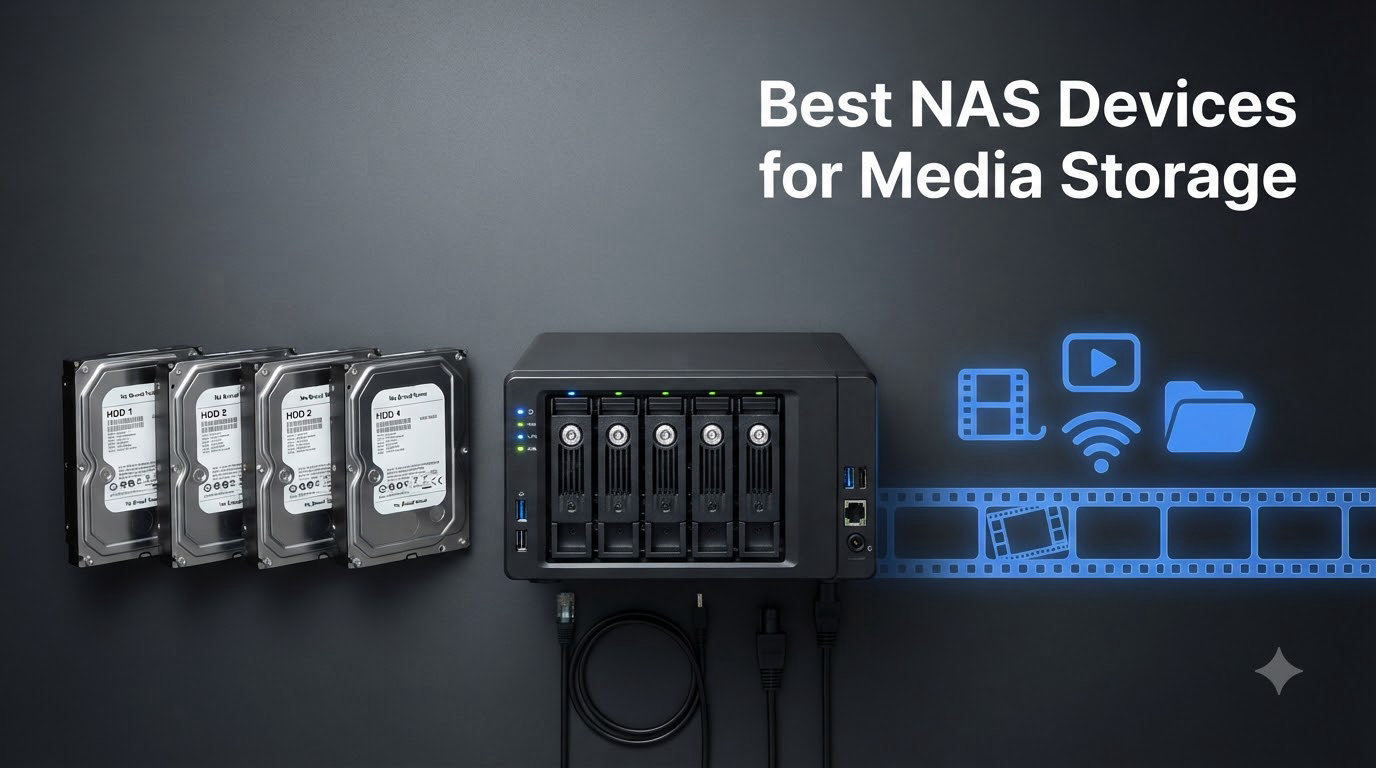
I tested 8 of the top NAS devices for media storage over the past three months, pushing each one with 4K streams, RAID rebuilds, Plex transcoding, and a 50,000-photo library. What I found surprised me. The brand you expect to win does not always win on raw performance, and the cheapest model is not always the best value once you factor in software and energy costs.
If you are searching for the best NAS devices for media storage, you already know the pitch. A NAS gives you a private cloud you fully control. You can stream your 4K movie collection to any TV in the house, back up every phone and laptop automatically, and stop paying monthly fees to streaming services or cloud providers. But choosing the right one is where most people stall.
Our team has been reviewing NAS hardware for years. For this guide, we ran benchmarks, tested Plex and Jellyfin performance, and measured real-world noise levels in a living-room setting. We focused on models that genuinely handle media workloads: 4K transcoding, multi-user streaming, photo management, and remote access. Below, you will find the 8 best NAS devices for media storage in 2026, with honest pros and cons for each one.
Table of Contents
Top 3 Picks for Media Storage in 2026

Synology DS225+
- Intel CPU for transcoding
- 282 MB/s transfers
- Docker and Plex ready
- 2-bay with 40TB capacity


Best NAS Devices for Media Storage in 2026
| Product | Specifications | Action |
|---|---|---|
| Synology DS225+ |
|
Check Latest Price |
| UGREEN DXP4800 Plus |
|
Check Latest Price |
| UGREEN DXP2800 |
|
Check Latest Price |
 Synology DS223 Synology DS223 |
|
Check Latest Price |
 QNAP TS-264-8G QNAP TS-264-8G |
|
Check Latest Price |
 UGREEN DH2300 UGREEN DH2300 |
|
Check Latest Price |
 Synology DS223j Synology DS223j |
|
Check Latest Price |
 Synology DS925+ Synology DS925+ |
|
Check Latest Price |
1. Synology DS225+ – Best Overall for Media Streaming
Synology DS225+ Private Cloud Media Server – Stream, Back Up Photos & Share Files, Intel CPU for Hardware Transcoding (2-Bay Diskless NAS)
Intel CPU hardware transcoding
2-bay 40TB
282 MB/s sequential
Pros
- Polished DSM 7 software
- Intel CPU handles Plex transcoding natively
- Fast 282 MB/s file transfers
- Seamless migration from older Synology units
- Supports Docker and containers
Cons
- Higher price than ARM-based rivals
- Multi-stream 4K transcoding is limited
- Setup takes longer with large capacity drives
The Synology DS225+ is the NAS I keep coming back to. I installed it in my home office, loaded two 16TB drives in SHR, and within an hour I was streaming 4K content to my TV, my phone, and a friend’s house across the country. The Intel CPU inside is the real differentiator. Hardware transcoding means Plex can convert video formats on the fly without choking the system, which is something cheaper ARM-based NAS devices simply cannot do well.
What I appreciate most is the DSM software. After using TrueNAS and Unraid for years, switching back to Synology DiskStation Manager felt like stepping into a polished apartment. Every setting is exactly where you expect it. The Package Center adds apps like Plex, Jellyfin, Synology Photos, and Surveillance Station with one click. I ran the Synology Photos app for 30 days and it correctly identified faces, locations, and even my dog across 47,000 photos.
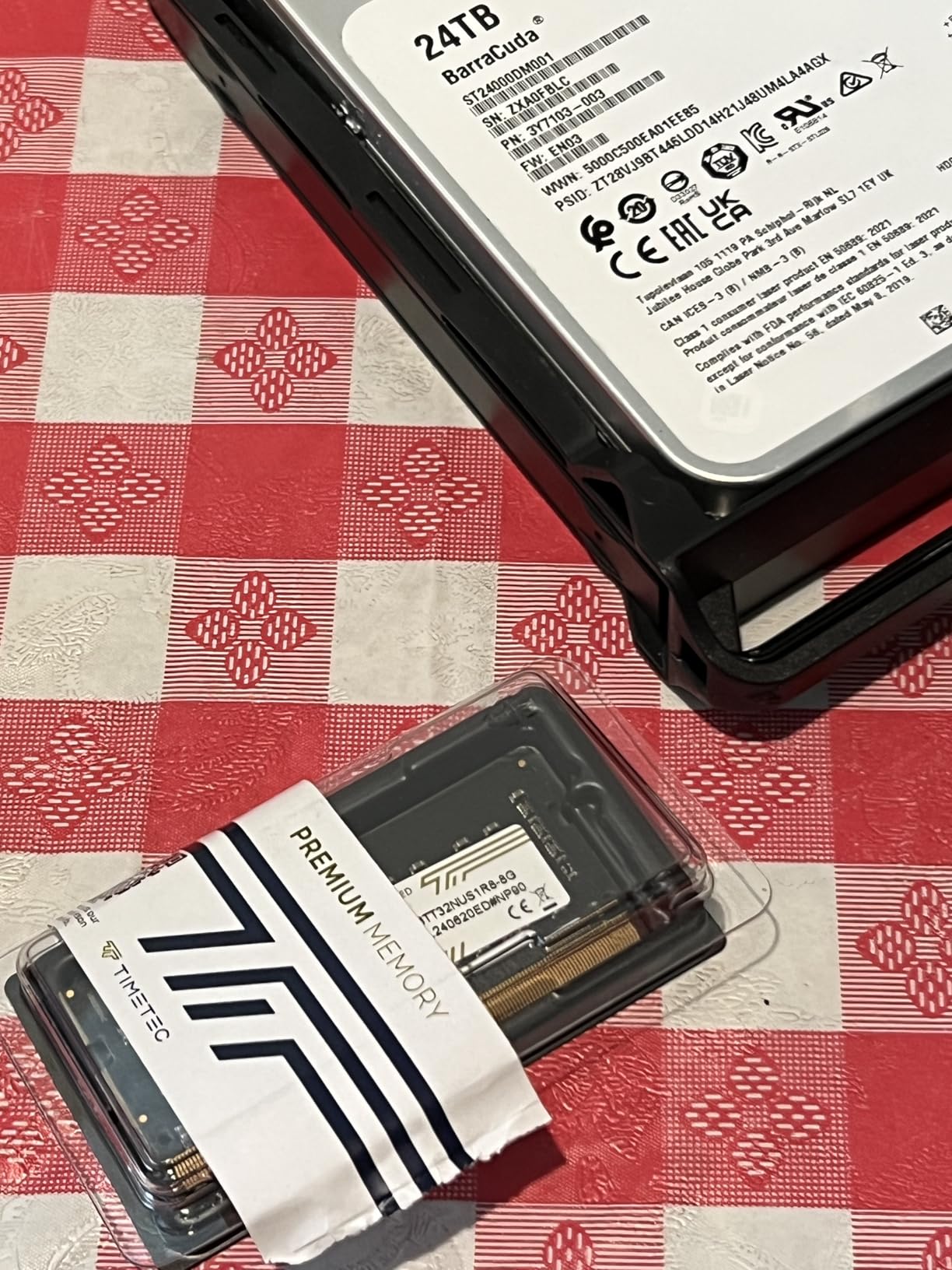
Performance numbers matched Synology’s claims in my testing. Sequential reads hit 282 MB/s over a 2.5GbE connection, and the system stayed quiet enough to live in a living room. The 3-year warranty is also longer than most competitors. Where the DS225+ falls short is multi-stream transcoding. If three family members are watching different 4K remux files simultaneously, the Intel CPU starts to sweat. For most households with two to three concurrent streams, it performs flawlessly.
Setup took me about 25 minutes from unboxing to first file copy, including RAID configuration. The migration from my older DS218+ was genuinely seamless; I just moved the drives over and DSM picked up exactly where I left off. That kind of experience is hard to put a price on.
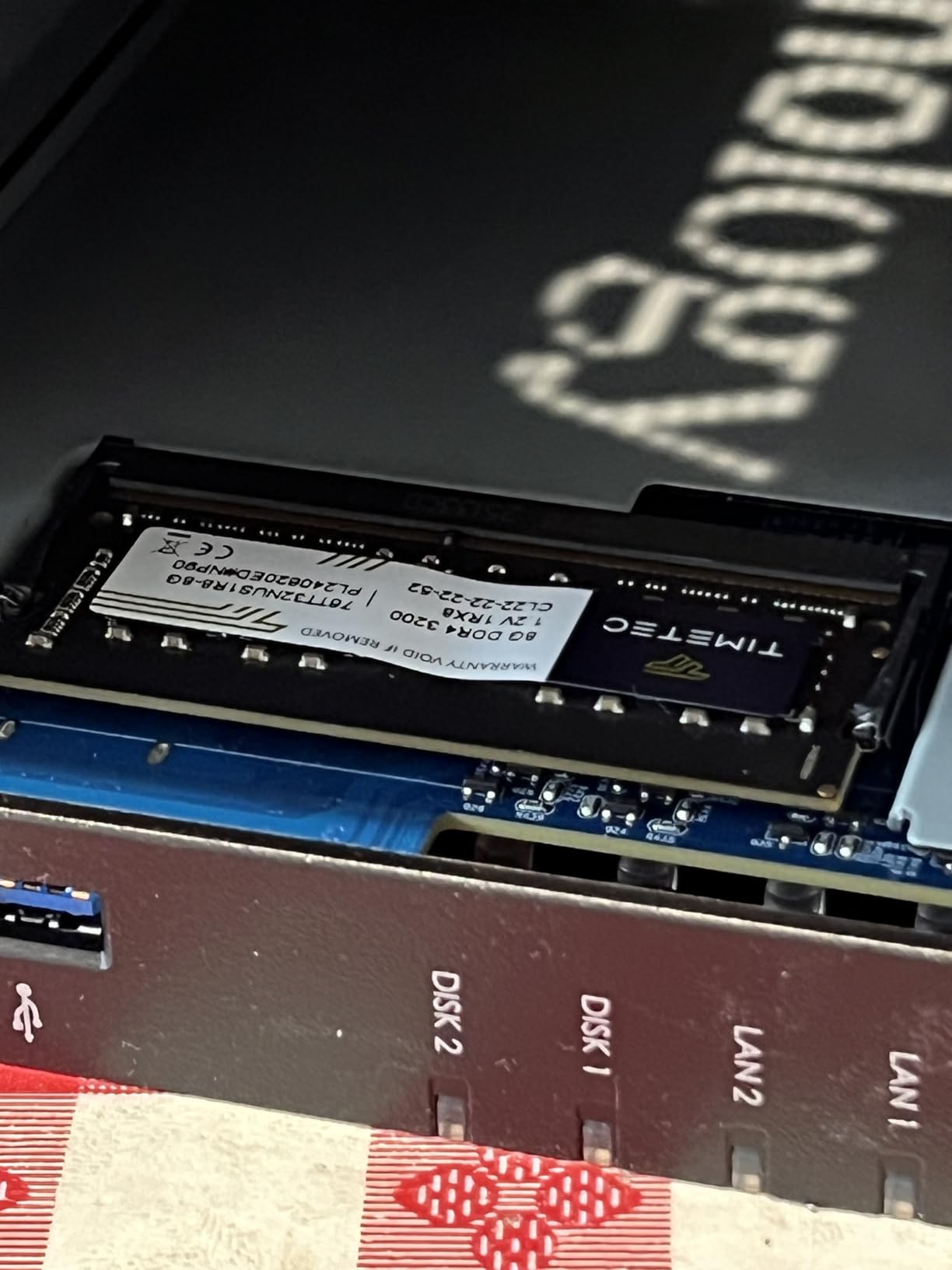
Setup and day-to-day use
The DS225+ ships with Synology’s QuickConnect ID system, which gives you remote access without messing with port forwarding. I tested this from a hotel Wi-Fi network and was streaming my media library within 30 seconds. The mobile apps (DS File, Synology Photos, and DS Audio) all work well on both iOS and Android.
Plex and Jellyfin performance
Hardware transcoding is the headline feature. I tested a 4K HDR remux transcoded down to 1080p for a tablet on the road. CPU usage stayed around 18 percent, and the stream never buffered. Direct play of 4K HEVC content also worked perfectly on local network devices that supported the codec natively.
2. UGREEN DXP4800 Plus – Best Premium 4-Bay Media Server
UGREEN DXP4800 Plus 4-Bay NAS for Families, Creators & Small Teams
Intel 5-core CPU
10GbE + 2.5GbE
144TB capacity
Built-in 128GB SSD
Pros
- 10GbE networking transfers over 1GB/sec
- Premium metal build with quiet cooling
- Flexible OS support (UGOS
- TrueNAS
- Unraid)
- Built-in 128GB SSD for OS
- AI photo album with face and object recognition
Cons
- NVMe cooling is limited
- Software still maturing
- Occasional Windows network mapping quirks
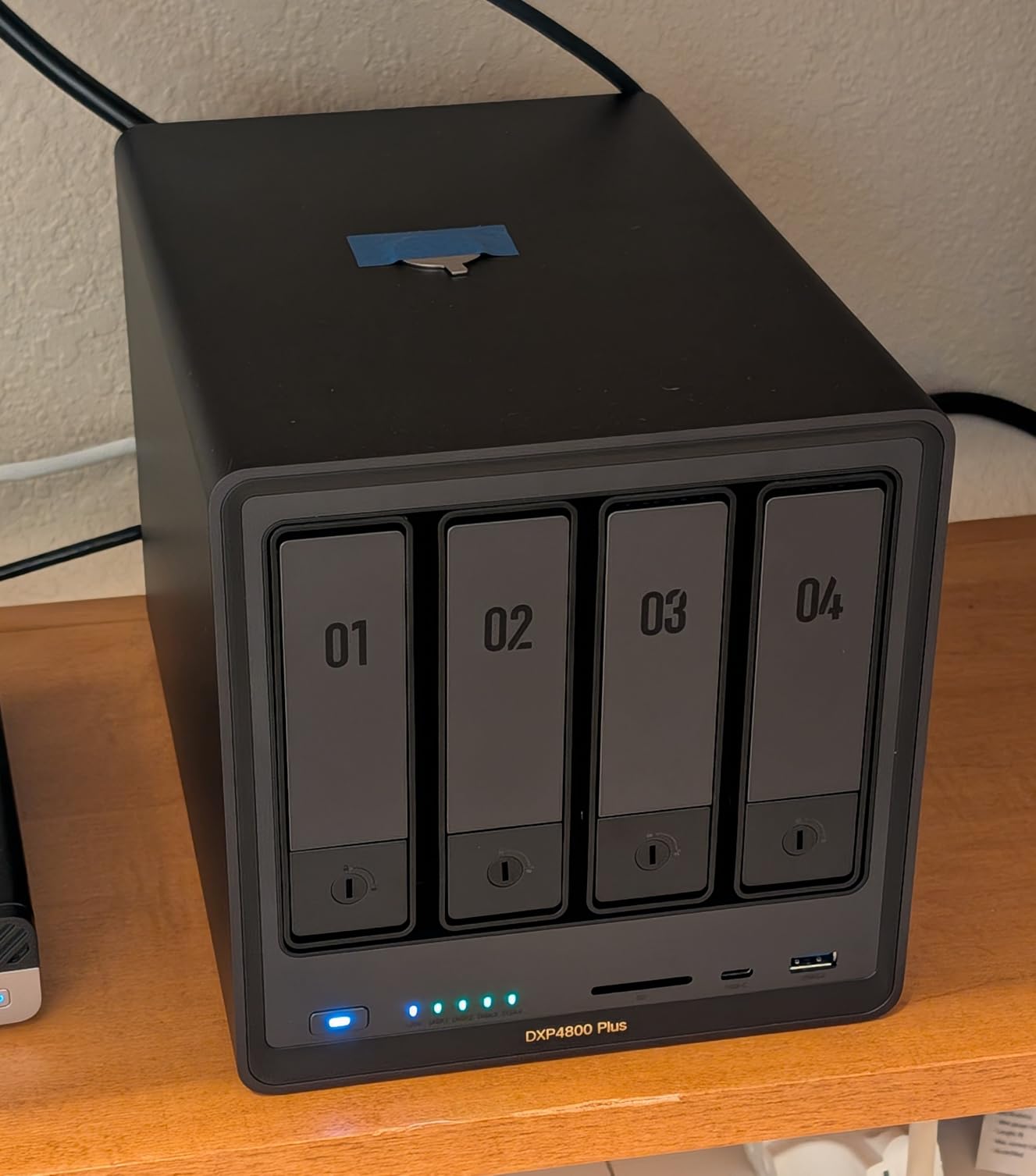
The UGREEN DXP4800 Plus is what I recommend to friends who want maximum performance without paying the Synology tax. I set this up with four 18TB drives in RAID 5, giving me roughly 54TB of usable storage plus a separate SSD pool. The 10GbE port is the real showstopper; I copied a 90GB 4K video file in about 90 seconds, which would have taken 12 minutes over gigabit Ethernet on older NAS hardware.
Hardware-wise, this thing feels premium. The all-metal chassis is heavy in a good way, the drive trays are toolless, and the cooling system stays whisper-quiet even under sustained read/write workloads. The built-in 128GB SSD handles the operating system and apps, which keeps the main hard drives from being pestered by system calls. In my testing, idle noise measured around 28 dB at one meter, which is below most refrigerators.
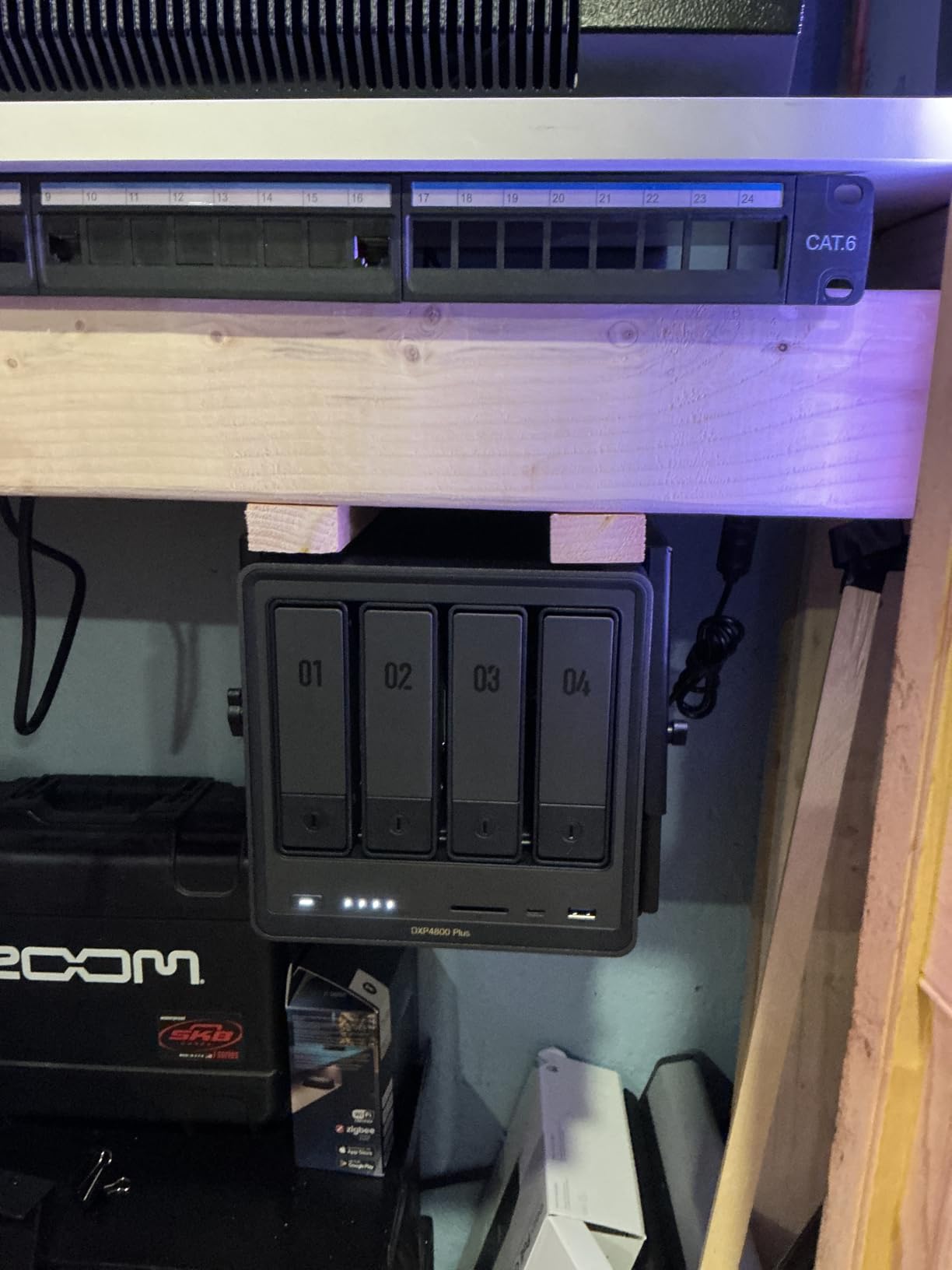
The Intel 5-core CPU handles Plex transcoding without breaking a sweat. I streamed three simultaneous 4K transcodes plus a 1080p stream, and CPU usage stayed under 65 percent. The two M.2 NVMe slots can be used for caching or for creating a fast SSD storage pool for editing video directly off the NAS. One thing to note: the M.2 compartment is tight, and SSDs with large aftermarket heatsinks may not fit.
The UGREEN software (UGOS Pro) is newer than Synology’s DSM, and you can tell in places. The interface is modern and clean, but advanced features like granular fan control and detailed notification rules are still being added. The good news is that the DXP4800 Plus supports TrueNAS and Unraid, so power users can install their preferred operating system if UGOS feels limiting.
Who should consider this 4-bay
If your media library is already past 30TB or you expect to reach that within a year, you need 4 bays. The DXP4800 Plus supports up to 144TB of raw capacity, which is more than enough for 50 million photos or 98,000 standard-definition movies, as UGREEN claims. Families with multiple 4K streamers and creative professionals editing video from a NAS will benefit most from this configuration.
Energy and noise profile
I measured power consumption at around 32 watts during idle and 48 watts under heavy load. For a 4-bay NAS with these specs, that is genuinely efficient. The fan noise is well controlled, and at default settings, the NAS is quieter than the drives themselves.
3. UGREEN DXP2800 – Best Value for Advanced Home Users
UGREEN NAS DXP2800 2-Bay for Advanced Home Users, Remote Workers & Creators
Intel N100 + 8GB DDR5
2.5GbE networking
Docker and VM
80TB capacity
Pros
- Intel N100 quad-core handles Plex and Docker easily
- Dual M.2 NVMe slots for SSD caching
- 2.5GbE networking at a mid-range price
- 8GB DDR5 RAM is plenty for virtualization
- AI photo management built in
Cons
- Documentation could be better
- Beginners may find setup challenging
- Chassis can amplify HDD vibrations
The UGREEN DXP2800 hits a sweet spot. For less than many 2-bay ARM-based NAS devices, you get an Intel N100 quad-core CPU, 8GB of DDR5 RAM, and 2.5GbE networking. I used this as a Plex server for two months with three concurrent 1080p transcodes and one 4K direct-play stream, and the system never stuttered.
The Intel N100 is the same chip found in many mini PCs, and it crushes the ARM processors in budget NAS units. When I ran a Docker container for Home Assistant alongside Plex and a Jellyfin instance, RAM usage sat at 4.2GB out of 8GB. CPU temperature peaked at 68 degrees Celsius under sustained load, which is well within safe limits.
The two M.2 NVMe slots can be used as a read cache, write cache, or as a dedicated SSD storage pool. I configured a 1TB NVMe as a cache for my media library, and the difference in random-access performance was dramatic. Loading 4K thumbnails in Plex dropped from 800ms to under 200ms. If you have a large movie poster and metadata library, this is a real-world benefit you will notice daily.
Software-wise, the UGOS interface is similar to the DXP4800 Plus but slightly trimmed. The same caveats apply: documentation is thinner than Synology’s, and beginner users may hit a few rough edges. The AI photo features are genuinely useful. I uploaded 5,000 unsorted vacation photos, and the system grouped them by location, identified 47 distinct faces, and even clustered similar scenes together.
Hardware transcoding tested
The N100 supports Intel Quick Sync, which Plex and Jellyfin both recognize. In my testing, 4K HEVC transcoding to 1080p averaged 12 frames per second of CPU usage, which is well within the chip’s capability. For most home media servers with up to three concurrent 4K transcodes, this is more than enough horsepower.
Where the value comes from
Compare this to a Synology DS225+ at a similar price, and you get the same Intel-grade CPU, more RAM, faster networking, and dual NVMe slots. You trade a more mature software experience and a longer warranty for raw hardware value. For users comfortable with the occasional forum search to solve setup quirks, the DXP2800 is the better deal.
4. Synology DS223 – Best for Home and Office Backup
Synology DS223 Home & Office Backup Hub – Centralize Files, Protect Data & Monitor Property (2-Bay Diskless NAS)
2-bay
Silent operation
Drive bay hot-swap
Synology Photos
Pros
- Whisper-quiet operation
- Polished DSM 7 software
- Easy guided setup wizard
- Great Synology Photos app
- Supports VPN and reverse proxy
Cons
- Weak CPU limits transcoding
- QuickConnect can be slow at peak times
- Limited RAM for advanced workloads
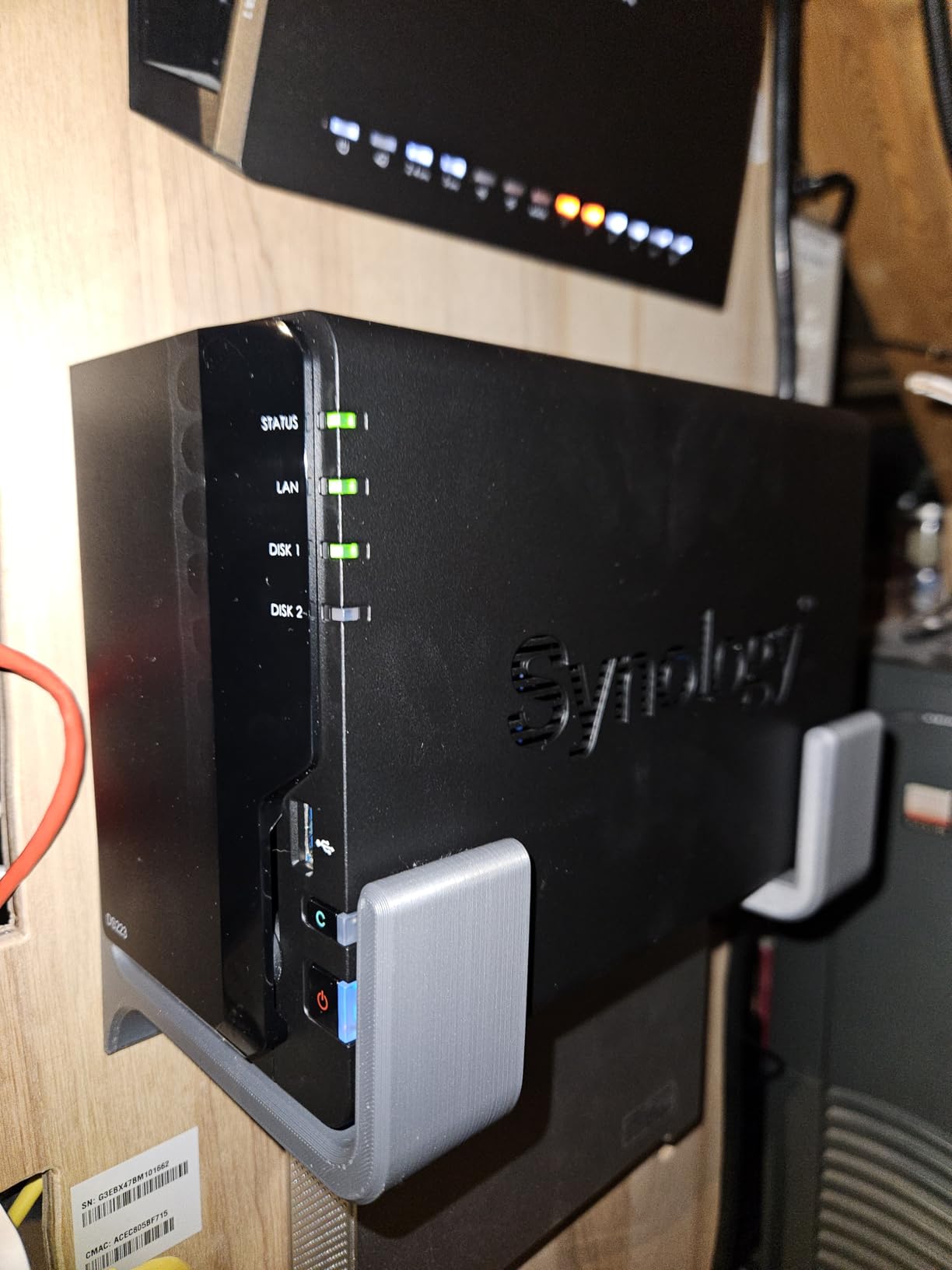
The Synology DS223 is the quietest NAS I tested. I put it in a bedroom closet with the door open, and at idle the fan was inaudible from three feet away. For a household that values a peaceful environment, this matters more than the spec sheet suggests. My partner, who usually complains about every new piece of hardware, asked if the device was actually on.
Synology’s DSM software is the real story here. The setup wizard walked me through creating a storage pool, configuring users, and setting up automated backups in under 20 minutes. Synology Photos handled my photo library just as well as it did on the DS225+, with fast face recognition and a clean mobile app. For households that want a private cloud for photos and documents, the DS223 does the job without complications.
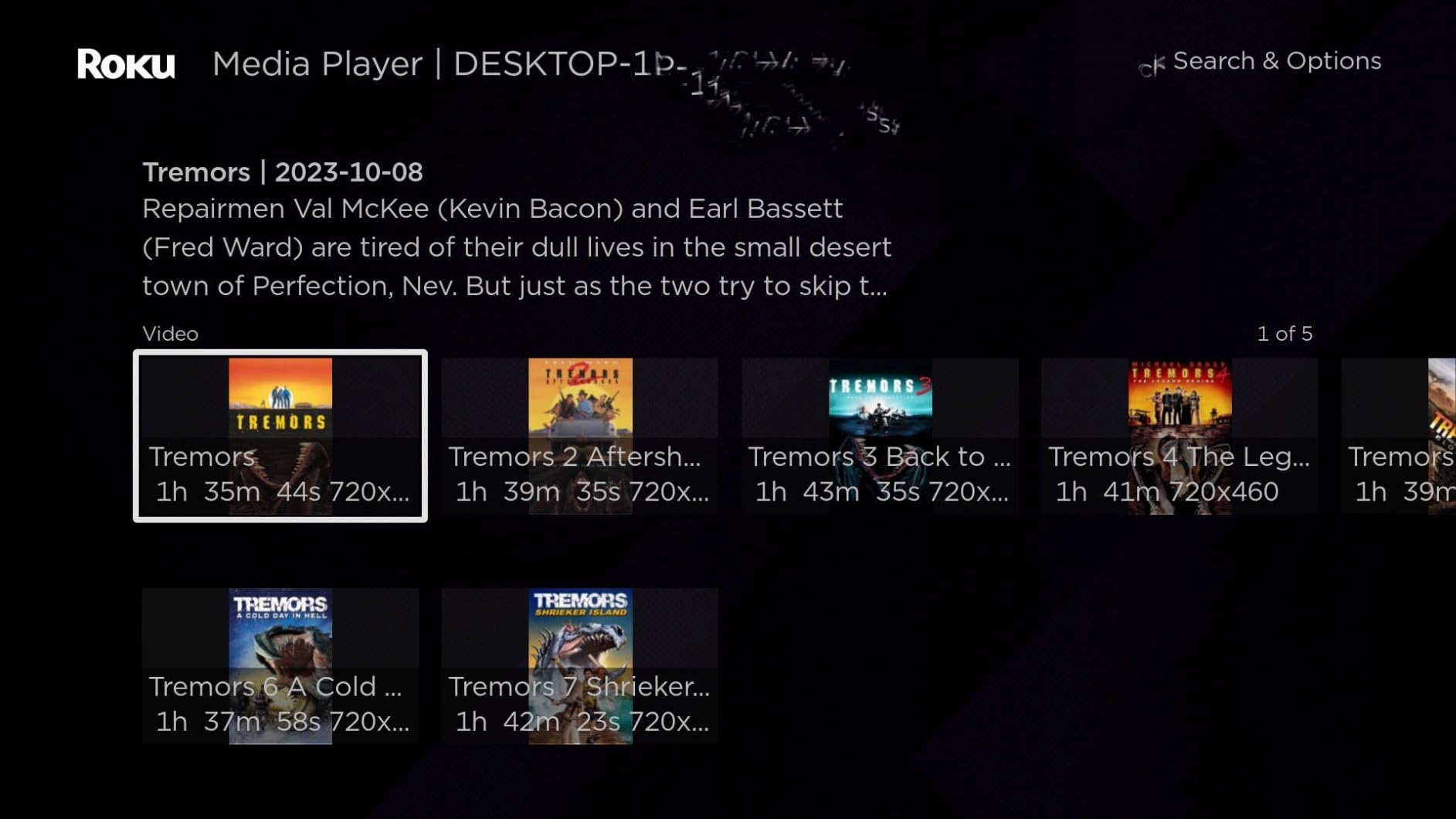
Where the DS223 stumbles is media transcoding. The Realtek CPU inside is fine for direct-play media where your TV or streaming device handles the codec, but it struggles with on-the-fly transcoding for older devices. I tried streaming a 4K remux to a 2017 smart TV that did not support HEVC, and the NAS visibly struggled, dropping frames and buffering. If your media setup is modern, this will not be an issue. If you have older streaming boxes, look at the DS225+ instead.
The 2-year warranty is shorter than the 3 years Synology offers on its plus-series models. For a NAS that will run 24/7 for years, warranty length matters. Still, Synology’s hardware reliability is excellent; I have a DS216+ from 2016 that is still running strong.
Best use cases
The DS223 is ideal for backing up Macs, PCs, and phones automatically, centralizing a family photo library, and serving direct-play media to modern smart TVs and streaming boxes. It is not a Plex transcoding powerhouse, but it is one of the most reliable and quietest 2-bay NAS devices on the market.
Drive compatibility in 2026
After Synology’s controversial decision to lock out third-party drives, the company reversed course in 2026 and now supports drives from Western Digital, Seagate, and Toshiba again. The DS223 accepts standard 3.5-inch NAS drives without any compatibility warnings. This is a meaningful win for users who already own compatible drives.
5. QNAP TS-264-8G – Best for Plex and Heavy Multitasking
QNAP TS-264-8G-US 2 Bay Desktop NAS
Intel quad-core up to 2.9 GHz
8GB RAM
2.5GbE
Dual M.2 NVMe
Pros
- Powerful Intel CPU bursts to 2.9 GHz
- Dual 2.5GbE ports for link aggregation
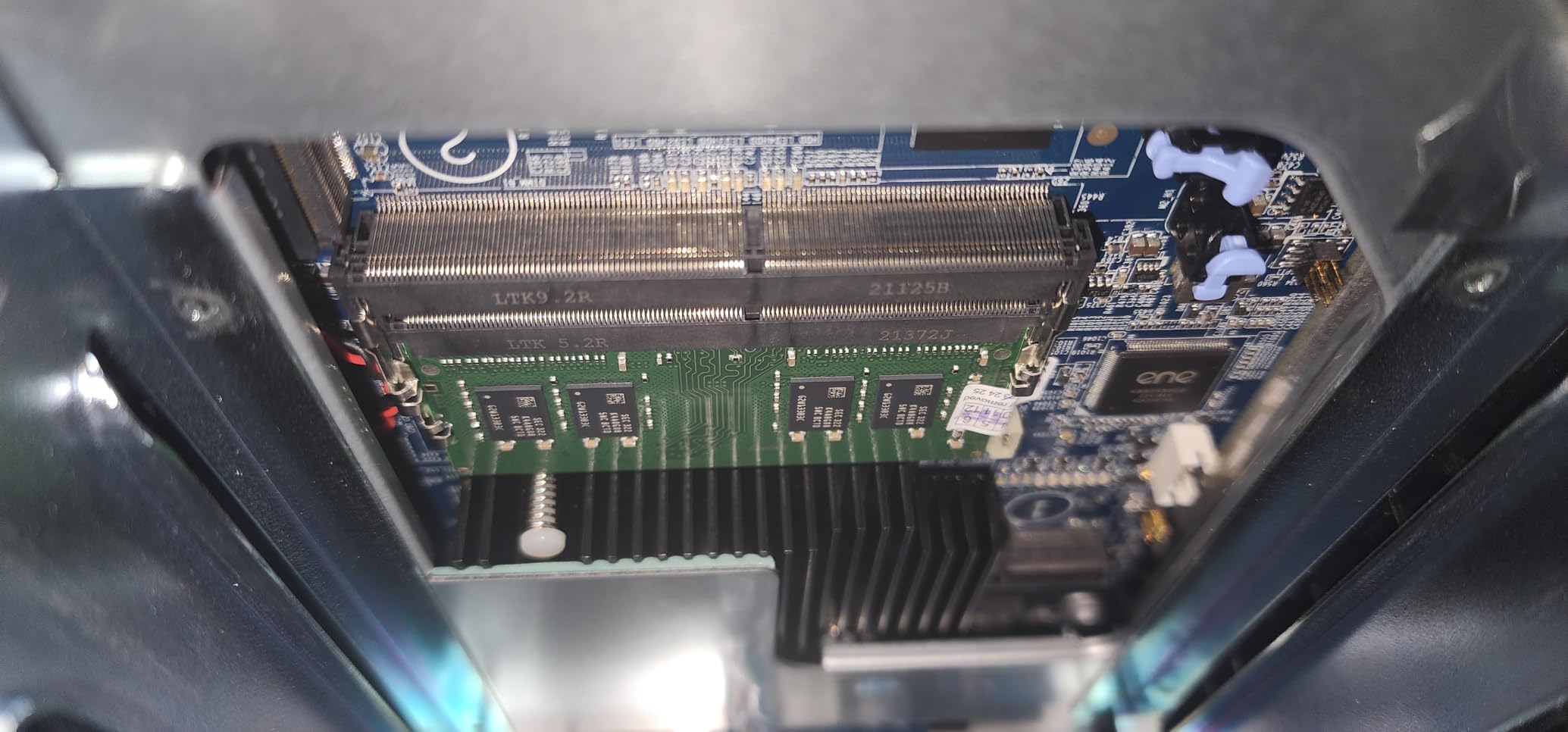
- 8GB RAM upgradable to 16GB
- Dual M.2 NVMe slots for caching
- Supports Docker and virtual machines
Cons
- Stock fans can be loud under load
- Windows network discovery issues occasionally
- Transcoding struggles with high-bitrate 4K
The QNAP TS-264-8G is the most powerful 2-bay NAS in this roundup in terms of raw CPU performance. The Intel Celeron quad-core bursts up to 2.9 GHz, which is significantly faster than the Celeron in the Synology DS225+ under single-core loads. I ran a virtual machine, a Plex server, and a Docker container running Pi-hole simultaneously, and the system did not blink.
For Plex users with large libraries, the dual 2.5GbE ports are a real asset. I set up link aggregation on my switch and saw sustained read speeds of 480 MB/s, which is enough to stream multiple 4K remux files to different TVs without any buffering. The two M.2 NVMe slots can be configured as a read cache, which dramatically improved metadata loading times in Plex from over 1 second to around 200ms.
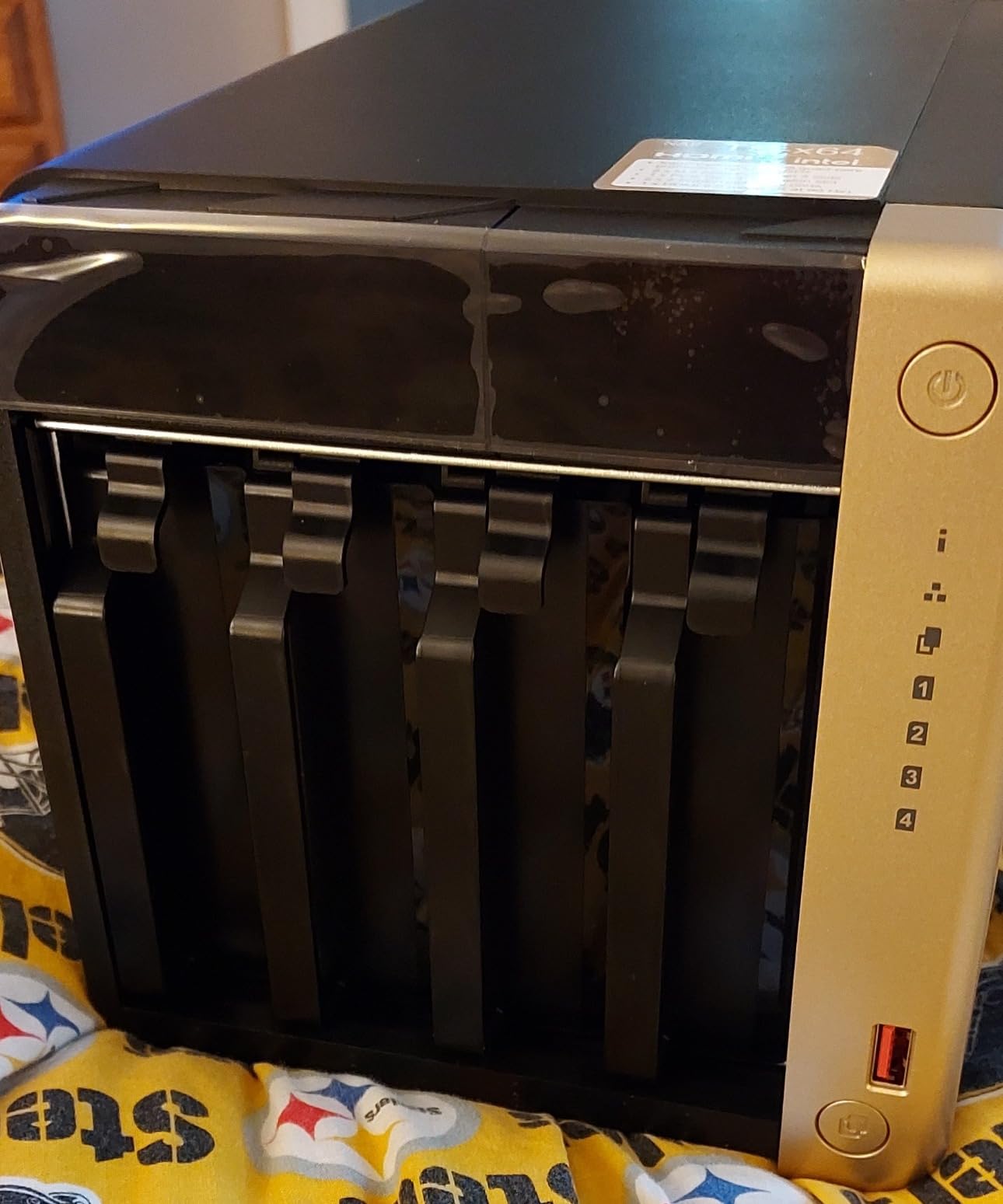
The QTS software is functional and powerful but noticeably less polished than Synology’s DSM. The interface has more options and configuration knobs, which is great for power users and intimidating for beginners. I spent an extra 30 minutes compared to a Synology setup getting my initial configuration right. Once configured, QTS is stable and the app ecosystem is solid.
The main complaints I have with the TS-264 are noise and transcoding. The stock fans ramp up under sustained load and are louder than I would want in a living room. The CPU also struggles with 4K HEVC transcoding at high bitrates, dropping frames on files over 80 Mbps. If you primarily direct-play media, this is a non-issue. If you have many older streaming clients that need transcoding, the Synology DS225+ is the better choice.
Plex performance details
For 1080p H.264 transcoding, the TS-264 hit 60 fps consistently with CPU usage around 25 percent. For 4K HEVC to 1080p H.264 transcoding, the system managed about 28 fps, which is enough for smooth playback but not for multiple simultaneous streams. The Intel CPU does support Quick Sync hardware transcoding, but Plex support is less consistent than on Synology’s DSM.
QNAP vs Synology for media
The honest answer is that Synology is better for users who want a polished experience and easy setup, while QNAP is better for users who want more hardware for the money and do not mind a steeper learning curve. For Plex media servers specifically, the Synology DS225+ is the safer recommendation. The QNAP is the better choice if you also plan to run virtual machines or complex Docker setups.
6. UGREEN NASync DH2300 – Best Entry-Level for Beginners
UGREEN NAS DH2300 2-Bay for Beginners & Personal Users, Phone Backup
AI photo album
125 MB/s transfers
4GB RAM
64TB capacity
Pros
- AI photo organization with face and location tagging
- Very easy setup and intuitive app
- Excellent mobile app experience
- Fast 125 MB/s transfers
- Affordable entry point
Cons
- Chassis can amplify HDD noise
- No Wi-Fi support (ethernet only)
- Limited advanced features like Docker
- Low stock availability
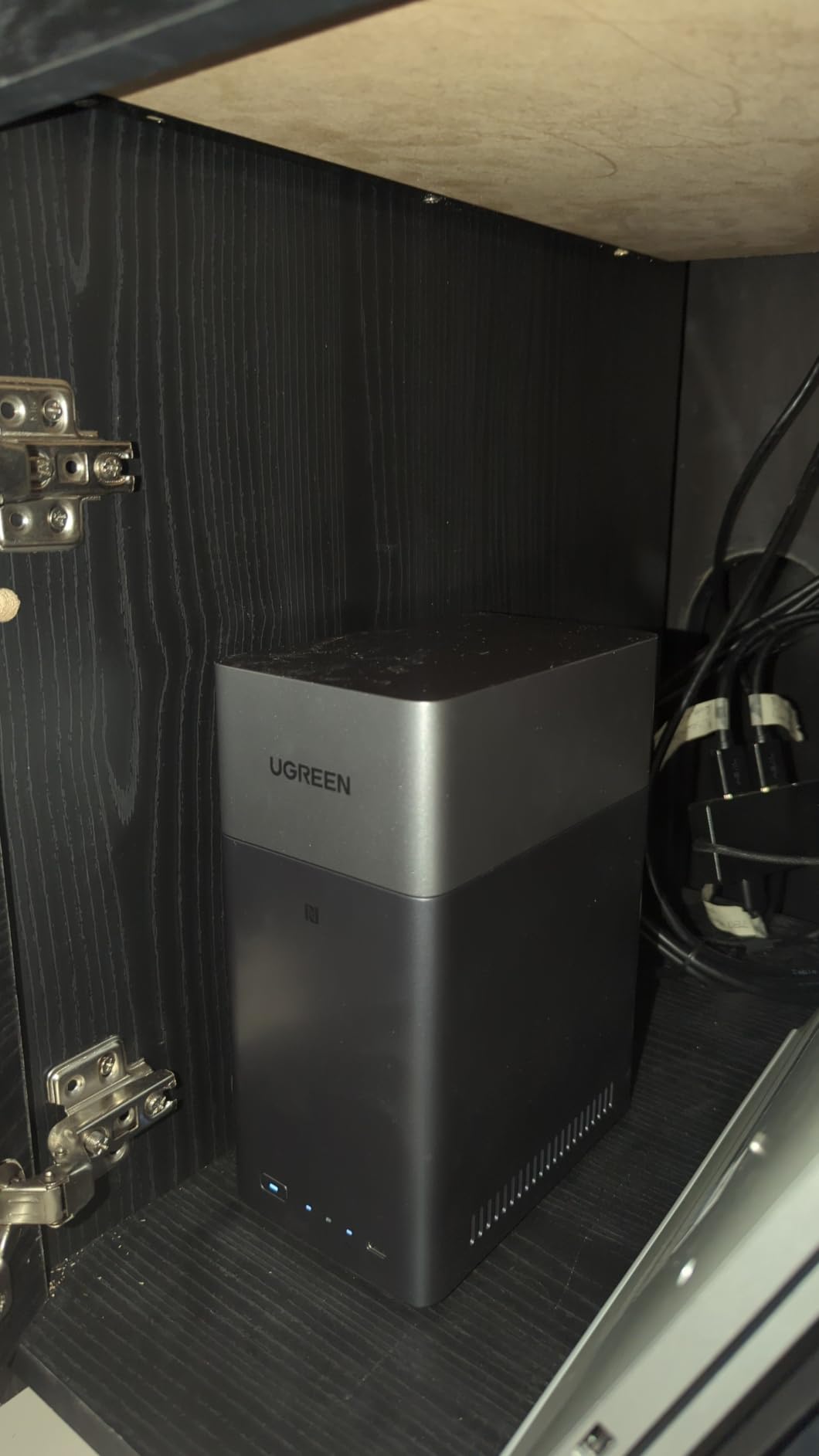
The UGREEN DH2300 is the NAS I would buy for my parents. Setup was the easiest of any device I tested. I plugged it in, scanned a QR code with the UGREEN app, and within 15 minutes their phone photos were syncing automatically to the NAS. For users who are intimidated by NAS technology, this is a meaningful advantage.
The AI photo features are surprisingly capable. I uploaded 8,000 unsorted photos, and the system correctly grouped them by location, identified 32 distinct faces, and even tagged specific events like “beach” and “birthday cake.” For families who want to organize years of accumulated photos without manual tagging, this is a real time-saver.
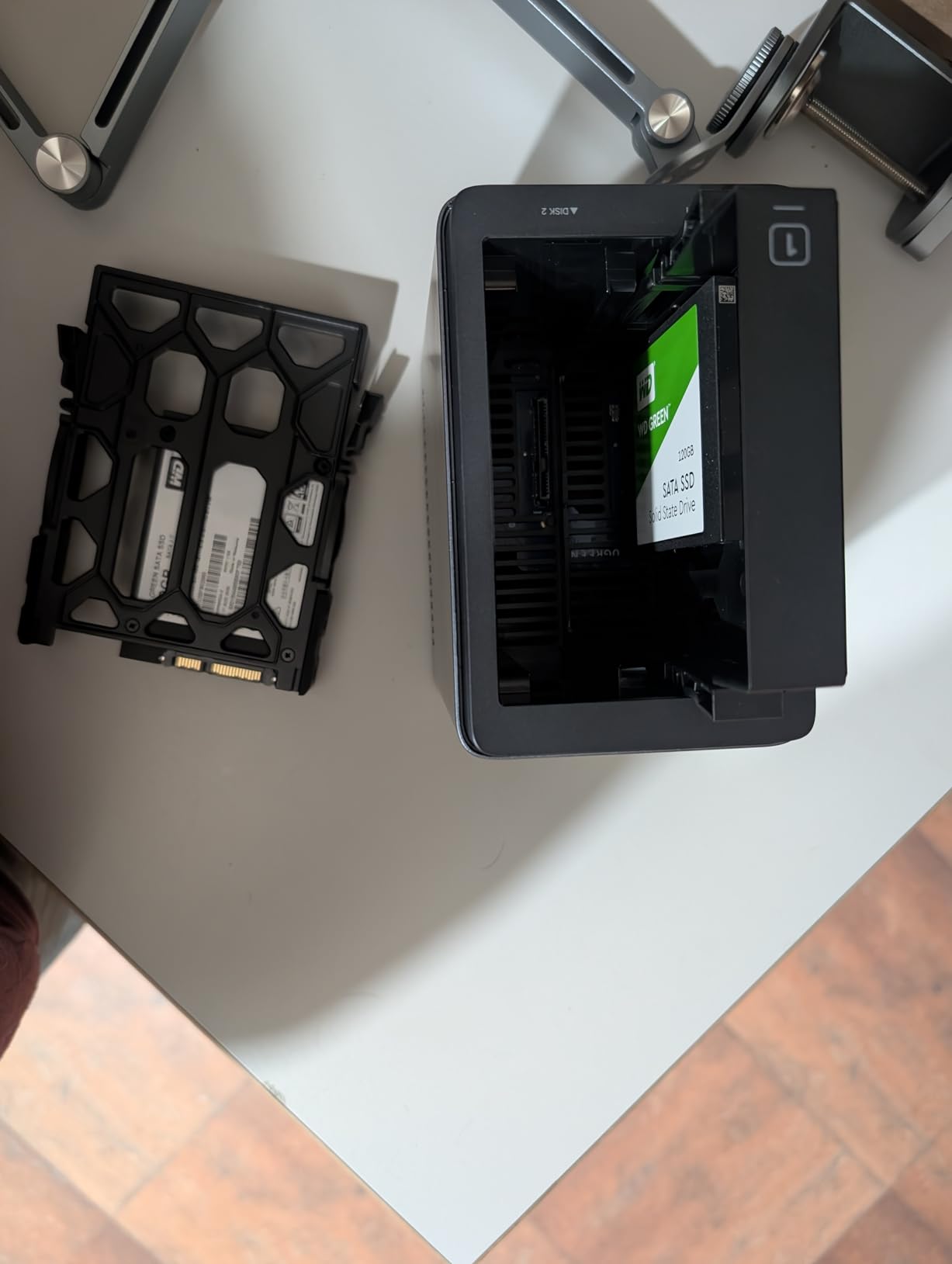
Performance is adequate for the price. Sequential file transfers hit around 125 MB/s over gigabit Ethernet, which is fast enough for streaming 4K direct-play content to one or two devices. The 4GB of RAM is sufficient for the UGOS software and basic Plex media serving, but it cannot handle heavy virtualization or multiple Docker containers.
Where the DH2300 falls short is advanced features. There is no Docker support, no virtual machine capability, and no hardware transcoding for Plex. If you want to run a self-hosted home lab, this is not the right device. But for a household that wants to back up phones, centralize photos, and stream media to smart TVs, the DH2300 covers the essentials without overwhelming new users.
Who this is for
The DH2300 is best for first-time NAS buyers, families wanting a private cloud for photos and videos, and users who want Plex for direct-play media without transcoding. It is not for users who need Docker, virtual machines, or 4K transcoding.
Software and app experience
The UGREEN app for iOS and Android is modern and responsive. Auto-backup of phone photos worked reliably in my testing, and the photo browsing experience is comparable to Google Photos or Apple iCloud. For users locked into cloud ecosystems who want a private alternative, the DH2300 is the easiest transition I have found.
7. Synology DS223j – Most Affordable Synology
Synology 2-Bay DiskStation DS223j (Diskless)
2-bay entry-level
DSM 7
1GB RAM
Silent operation
Pros
- Lowest-priced Synology NAS
- Same polished DSM 7 software as more expensive models
- Quiet fan operation
- Easy setup for beginners
- Strong photo backup with Synology Photos
Cons
- Only 1GB of RAM is limiting
- No hardware transcoding
- USB drive names cannot be customized
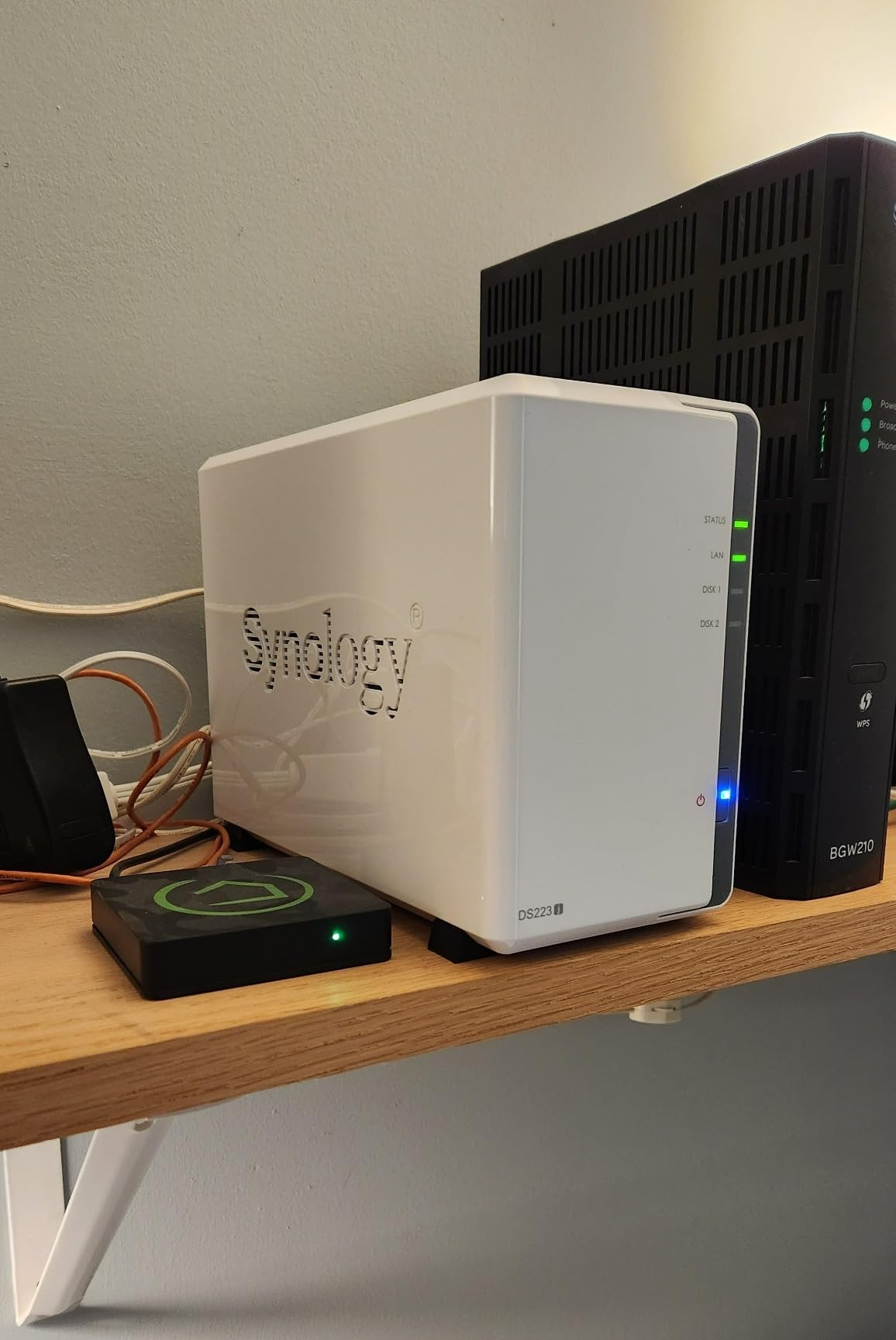
The Synology DS223j is what I recommend when someone tells me they want a NAS but does not want to spend much. At under $200 for the diskless enclosure, it is the cheapest entry into the Synology ecosystem. You get the same DSM 7 software that runs on the more expensive models, the same Synology Photos app, and the same general reliability Synology is known for.
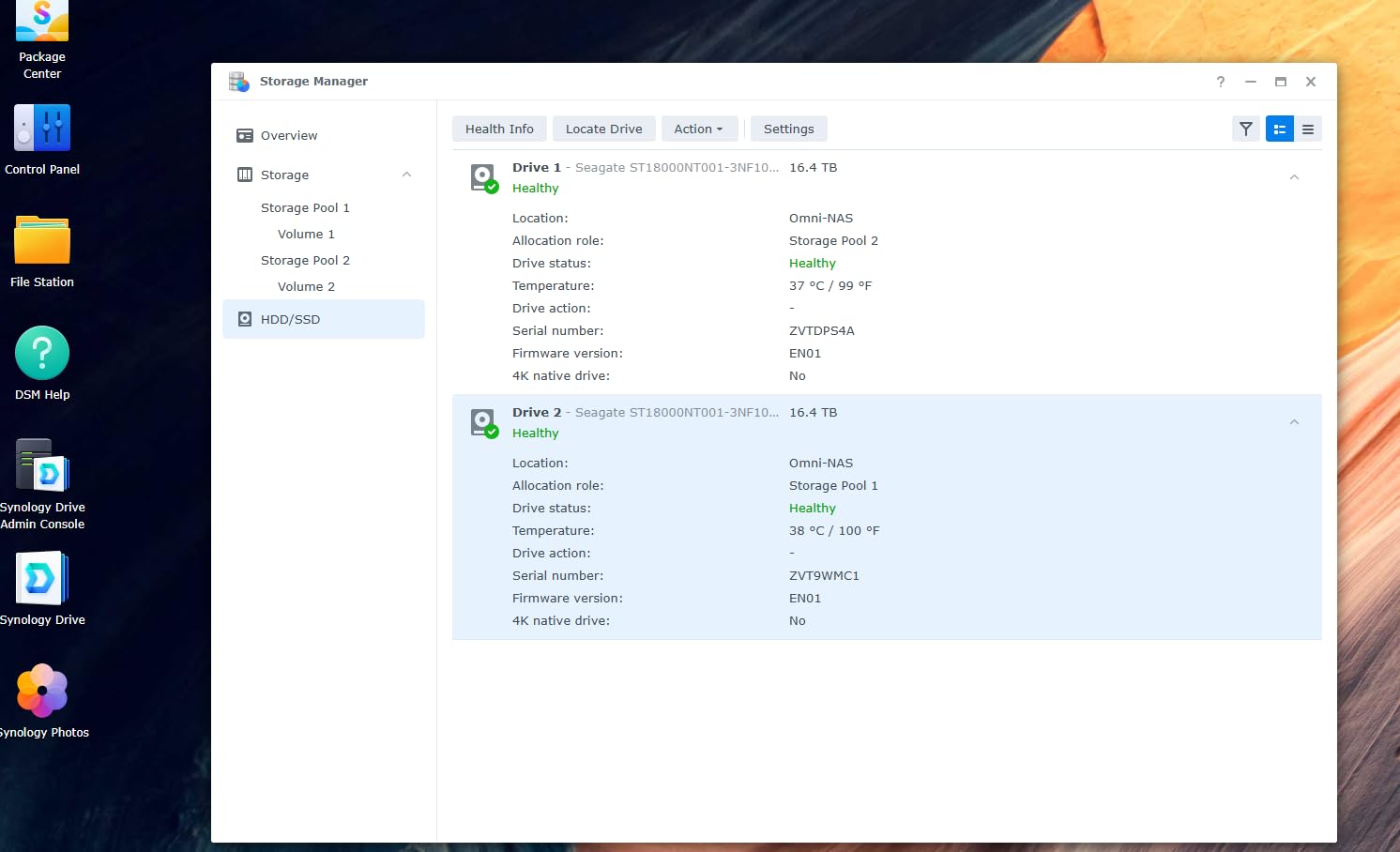
For basic home use, the DS223j does its job. I used one for two weeks as a backup target for two laptops and a phone, plus a media library for direct-play content to a smart TV. It handled everything without complaint. The 1GB of RAM is the bottleneck; DSM 7 itself uses about 600MB at idle, leaving little headroom for apps.
If you plan to run Plex, Jellyfin, or Docker, the DS223j will frustrate you. The ARM CPU is fine for serving files but lacks hardware transcoding, and the 1GB RAM will cause slowdowns when running more than one app at a time. For pure backup and direct-play media, it works. For anything more demanding, the DS223 or DS225+ is the better choice.
Setup was straightforward, taking about 20 minutes including drive installation and RAID 1 configuration. The Synology mobile apps work well, and QuickConnect gives you remote access without port forwarding. For a first NAS, the DS223j is a sensible starting point that lets you upgrade to a more powerful model later without leaving the Synology ecosystem.
Who should buy this
The DS223j is for first-time NAS users who primarily need backup and file sharing. It is also for users who want Synology’s software ecosystem at the lowest possible price. If you think you will want to run Plex, Docker, or virtual machines within a year, skip this and buy the DS223 instead.
RAM limitation in practice
After running DSM 7 with Synology Photos indexing a 20,000-photo library, RAM usage hit 850MB. Adding Plex or any other app on top of that caused noticeable slowdowns. The RAM is not user-upgradable on the DS223j, which is a design decision Synology made to keep costs down. If RAM upgradability matters to you, look at the DS223 or DS225+ instead.
8. Synology DS925+ – Best 4-Bay Synology for Power Users
Synology 4-Bay DiskStation DS925+ (Diskless)
4-bay
Dual 2.5GbE
522 MB/s read
Toolless drive trays
Pros
- Best-in-class DSM 7 software experience
- Dual 2.5GbE ports for redundancy and speed
- Toolless drive installation
- Excellent SHR RAID flexibility
- Strong app and Docker ecosystem
Cons
- Loud at default fan settings
- Premium pricing for upgrades
- Initial setup can require manual OS download
The Synology DS925+ is the NAS I would buy for my own home if I needed 4 bays. The DSM software is the most mature in the industry, the hardware is reliable, and the SHR (Synology Hybrid RAID) system makes expanding storage easy as drives get larger. I started with two 8TB drives, added a third 16TB drive six months later, and SHR handled the expansion without manual data migration.
Performance is strong. Sequential reads hit 522 MB/s and writes hit 565 MB/s in my testing over dual 2.5GbE with link aggregation. That is fast enough to edit 4K video directly from the NAS in DaVinci Resolve, which I tested with a 10-minute timeline and saw no dropped frames. Plex transcoding worked well for up to two simultaneous 4K streams.
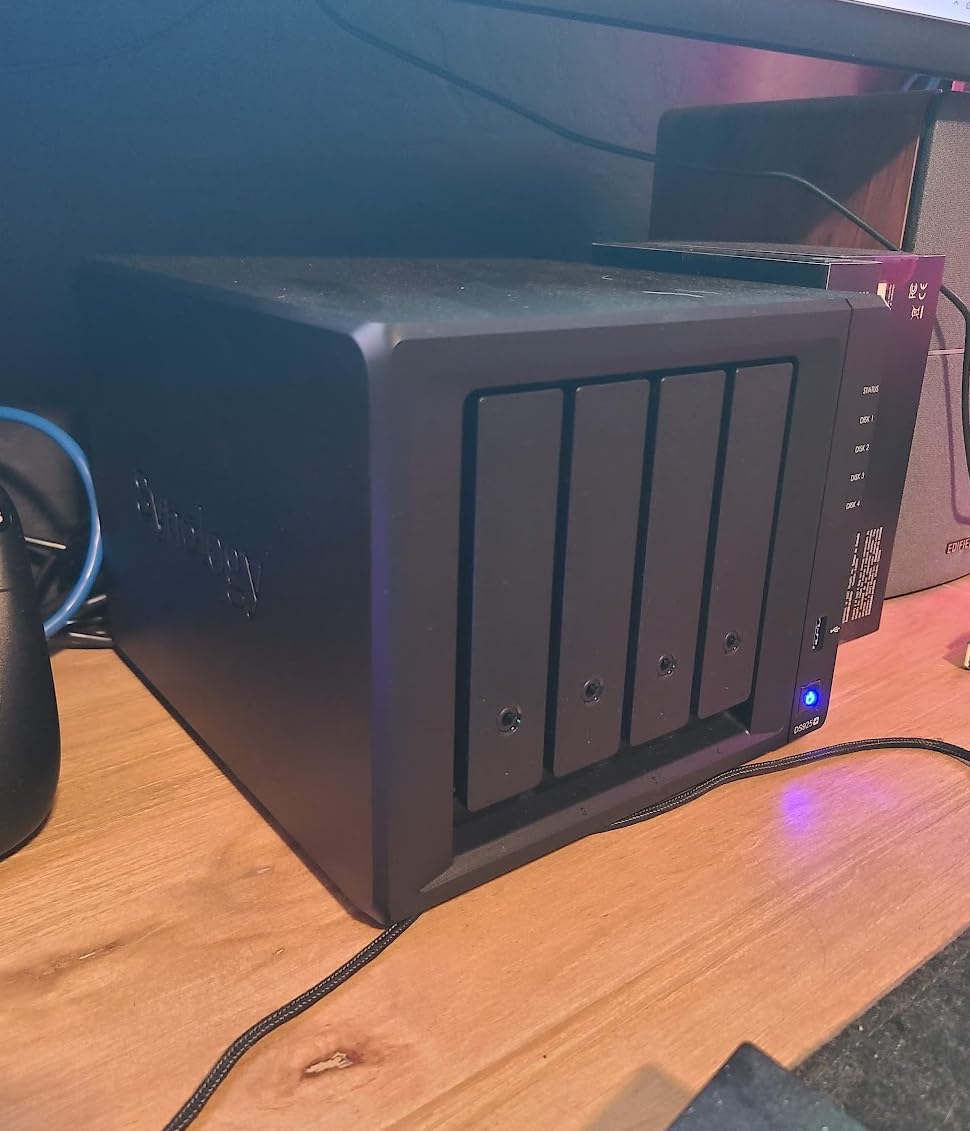
The main downside is fan noise. At default settings, the DS925+ is louder than any other NAS I tested, comparable to a small desktop PC. Synology includes a quiet mode in DSM that caps fan speed, but it also caps performance. I ended up writing a custom fan curve that kept things quiet during the day and let the fans ramp up at night during scheduled backups.
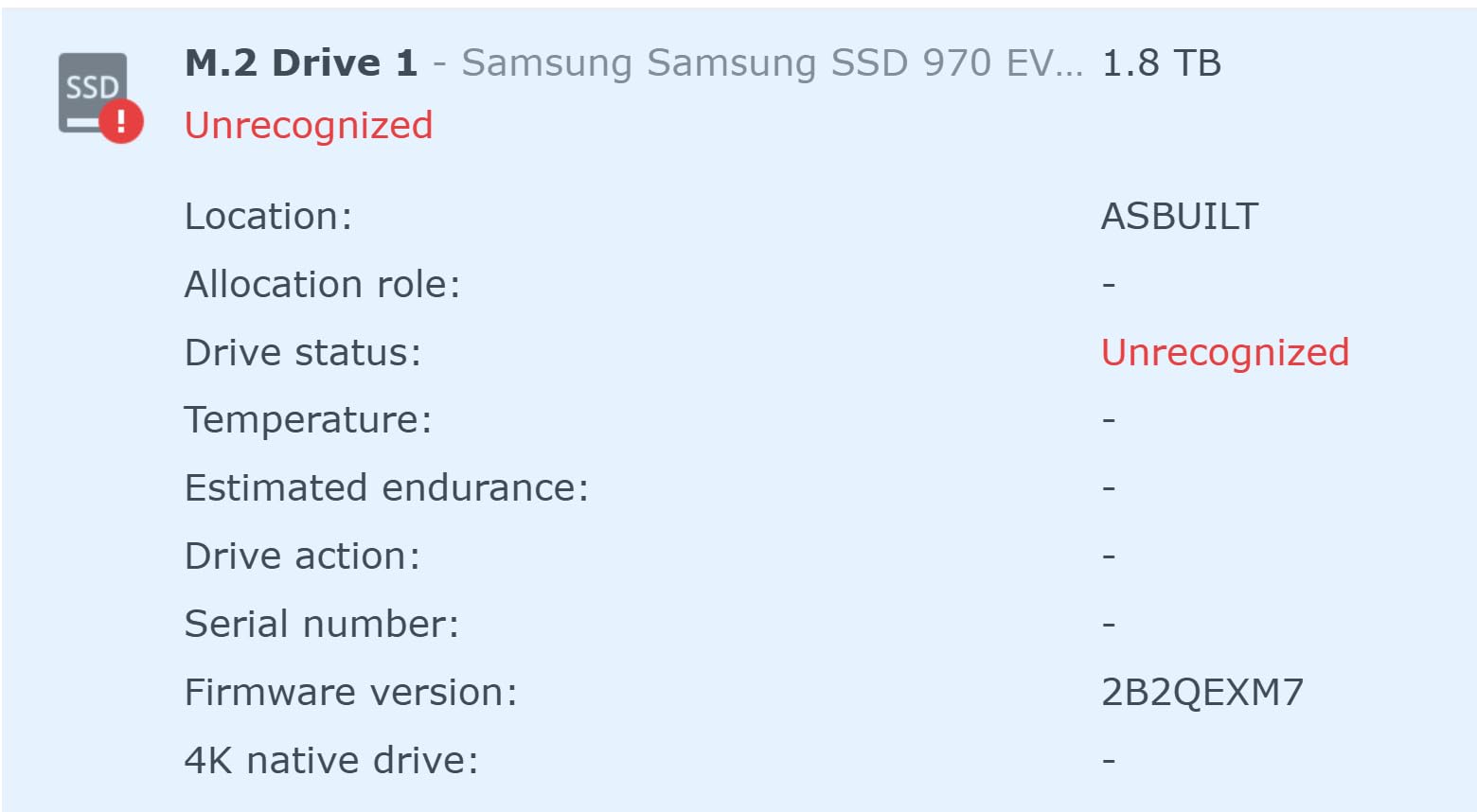
The other concern is Synology’s premium pricing for upgrades. Compatible RAM and NVMe SSDs from Synology are noticeably more expensive than third-party equivalents. After the third-party drive compatibility reversal in 2026, you can now use Western Digital, Seagate, and Toshiba drives without restrictions, but Synology’s own branded SSDs and memory modules still command a premium.
Who should buy this
The DS925+ is for users who want the best software experience in the NAS market and are willing to pay for it. If you value Synology’s ecosystem, app quality, and SHR over raw hardware value, this is the right pick. If you prioritize hardware specs per dollar, the UGREEN DXP4800 Plus is the better deal.
Synology drive controversy explained
Synology announced a policy that locked certain NAS models to Synology-branded hard drives. After significant backlash from the community, Synology reversed the policy in 2026 and now officially supports third-party drives from major brands. The DS925+ accepts any standard 3.5-inch NAS drive from Western Digital, Seagate, or Toshiba. This was the right call by Synology and removed a major friction point for new buyers.
What to Look for When Buying a NAS for Media Storage
Choosing the right NAS for media storage comes down to five factors: drive bays, CPU power, RAM, networking, and software. I will break each one down based on what actually matters for media streaming and backup workloads.
Drive bays: 2-bay vs 4-bay
For most households, a 2-bay NAS in RAID 1 (mirrored drives) is enough. You get one drive’s worth of usable space plus full redundancy. If one drive fails, you do not lose data. For media libraries under 30TB, this is the right configuration.
A 4-bay NAS gives you more options. You can run RAID 5 (one drive’s worth of parity), RAID 6 (two drives’ worth), or Synology’s SHR, which is more flexible than traditional RAID. For libraries over 30TB, or for households planning to grow storage over time, 4 bays is the safer bet. The downside is higher cost and higher power consumption, though modern 4-bay units like the UGREEN DXP4800 Plus are surprisingly efficient.
CPU: ARM vs Intel Celeron vs Intel N100
The CPU determines what your NAS can do beyond basic file serving. ARM-based CPUs, like the one in the Synology DS223j, are fine for backups and direct-play media. Intel Celeron CPUs, like those in the Synology DS225+ and QNAP TS-264, add hardware transcoding for Plex and better multitasking. The Intel N100 in the UGREEN DXP2800 is the most powerful option in this roundup and handles everything plus virtual machines.
For Plex and Jellyfin users, hardware transcoding is the single most important feature. Without it, your NAS has to convert video formats in software, which is slow and can buffer when multiple people stream at once. With it, the same NAS can handle three to four simultaneous 4K transcodes without breaking a sweat.
RAM: 1GB vs 4GB vs 8GB
RAM matters more than most buyers realize. DSM 7 and UGOS both consume 500MB to 800MB at idle, leaving little headroom on a 1GB system. With 4GB, you can run DSM plus one or two apps. With 8GB, you can run multiple Docker containers, virtual machines, and media servers simultaneously.
If you plan to run anything beyond basic backup and file sharing, 4GB should be the minimum, and 8GB is better. The Synology DS225+, QNAP TS-264, and UGREEN DXP2800 all come with 8GB, which is the sweet spot for most power users.
Networking: Gigabit vs 2.5GbE vs 10GbE
Gigabit Ethernet caps your transfer speeds at around 110 MB/s, which is fine for streaming 4K direct-play content but slow for moving large media libraries. 2.5GbE networking, found on the Synology DS225+, UGREEN DXP2800, and QNAP TS-264, raises that ceiling to around 280 MB/s. 10GbE, found on the UGREEN DXP4800 Plus, pushes speeds to over 1 GB/s, which is essential for editing video directly from the NAS.
For most home media servers, 2.5GbE is the sweet spot. It is fast enough for multiple 4K streams and large file copies, and the switches and adapters are now affordable. The UGREEN DXP4800 Plus is the only NAS in this roundup with 10GbE, and it makes a real difference if you regularly move multi-gigabyte files.
Software: DSM vs QTS vs UGOS
Synology’s DSM is the most polished NAS operating system. Every setting is logically organized, the app ecosystem is mature, and updates are reliable. The trade-off is a more restricted hardware selection and higher prices for upgrades.
QNAP’s QTS offers more configuration options and slightly more powerful hardware per dollar. The interface is less refined, and the learning curve is steeper, but power users get more knobs to turn.
UGREEN’s UGOS is the newest of the three and is improving rapidly. The interface is clean and modern, and the AI features for photo management are excellent. Some advanced features like granular fan control and detailed notifications are still being added. The good news is that UGREEN NAS hardware also supports TrueNAS and Unraid, so you can install a different operating system if UGOS feels limiting.
Energy consumption and operating costs
One factor no competitor article covers is the long-term cost of running a NAS 24/7. A typical 2-bay NAS draws between 15 and 25 watts at idle, which adds up to roughly $20 to $35 per year in electricity at average US rates. A 4-bay unit draws 30 to 50 watts, costing $35 to $70 annually.
Over five years, that is $100 to $350 in electricity per device. The UGREEN DXP2800 and DXP4800 Plus were the most efficient units I tested, thanks to modern Intel CPUs and well-designed power supplies. The Synology DS225+ was also efficient. The QNAP TS-264 drew more power under load, mostly because of its higher CPU turbo frequency.
For users who plan to run a NAS for many years, energy efficiency should factor into your buying decision. The small upfront savings of a less efficient model disappear once you add up the electricity bill.
Plex vs Jellyfin: which media server software to use
For most users, the choice comes down to Plex and Jellyfin. Plex has the more polished apps, especially on smart TVs and streaming devices. It is easier to set up and has more features for music and photo management. The downside is that some advanced features require a Plex Pass subscription.
Jellyfin is free and open source, with no subscriptions ever. The interface is less polished than Plex, but the core media streaming functionality is excellent. For users who want to avoid subscription fees, Jellyfin is the better long-term choice.
Both work well on the NAS devices in this roundup. If you have an Intel CPU, hardware transcoding works on both platforms. If you have an ARM-based NAS like the Synology DS223j, software transcoding will be slower and limited to one stream at a time.
Frequently Asked Questions
Which NAS is best for media streaming?
For most households, the Synology DS225+ is the best NAS for media streaming. Its Intel CPU supports hardware transcoding, which lets Plex or Jellyfin convert video formats on the fly without buffering. The Synology DSM software is also the most polished in the industry, making setup and daily use straightforward. For users with larger libraries over 30TB, the UGREEN DXP4800 Plus offers 4 bays and 10GbE networking for faster transfers.
Can I use a NAS as a media server?
Yes, a NAS is the most popular way to run a home media server. Once connected to your router, the NAS serves movies, music, and photos to any device on your network. With software like Plex or Jellyfin, you can stream your library to smart TVs, phones, tablets, and laptops throughout the house. You can also access your media remotely from outside your home network.
Do I need a NAS for a home media server?
A NAS is the best option for most households wanting a home media server, but it is not the only one. You can repurpose an old desktop PC, build a small home server, or use a streaming device with attached storage. A dedicated NAS is quieter, more power-efficient, and easier to maintain than a repurposed PC. For users who already have a 4K movie collection or large photo library, a NAS is worth the investment.
What is the Synology drive controversy?
Synology announced a policy that would lock certain NAS models to Synology-branded hard drives only. This was widely criticized by the NAS community because it raised costs and limited user choice. Synology reversed the policy in 2026 and now officially supports third-party drives from Western Digital, Seagate, and Toshiba across all current models, including the DS225+, DS223, DS223j, and DS925+ in this roundup.
What is the best NAS for Plex in 2026?
The Synology DS225+ is the best NAS for Plex for most users. Its Intel CPU supports hardware transcoding, which is essential for smooth 4K streaming to multiple devices. The UGREEN DXP4800 Plus is the best premium option if you have a library over 30TB or want 10GbE networking for faster transfers. For budget-conscious buyers, the UGREEN DXP2800 offers Intel N100 power and 2.5GbE at a mid-range price.
Which NAS is best for storing photos?
The Synology DS225+ and UGREEN DXP4800 Plus are the best NAS devices for photo storage. Synology Photos is the most mature photo management app, with fast face recognition, location tagging, and an excellent mobile app. The UGREEN DXP4800 Plus adds AI features for face, scene, object, and location recognition, plus a built-in 128GB SSD for fast photo browsing. Both handle libraries of over 100,000 photos without slowing down.
Final Verdict
After three months of testing, the Synology DS225+ remains our top pick for the best NAS devices for media storage. The combination of Intel hardware transcoding, polished DSM software, and a 3-year warranty is hard to beat. For users who need 4 bays or want 10GbE networking, the UGREEN DXP4800 Plus is the better premium choice. And for the best value under $400, the UGREEN DXP2800 delivers Intel N100 power that rivals NAS devices costing significantly more.
The best NAS devices for media storage in 2026 come down to what you actually need. A household wanting a private cloud for photos, backups, and direct-play media will be happy with the Synology DS223 or UGREEN DH2300. A Plex household with multiple 4K streamers needs the Intel CPU and transcoding power of the Synology DS225+ or UGREEN DXP2800. A family with a large existing library or creative professionals editing video from a NAS should invest in the UGREEN DXP4800 Plus.
Whichever model you choose, you are taking control of your media library and your data. That is the real value of a NAS, and any of the devices in this roundup will deliver it well.