
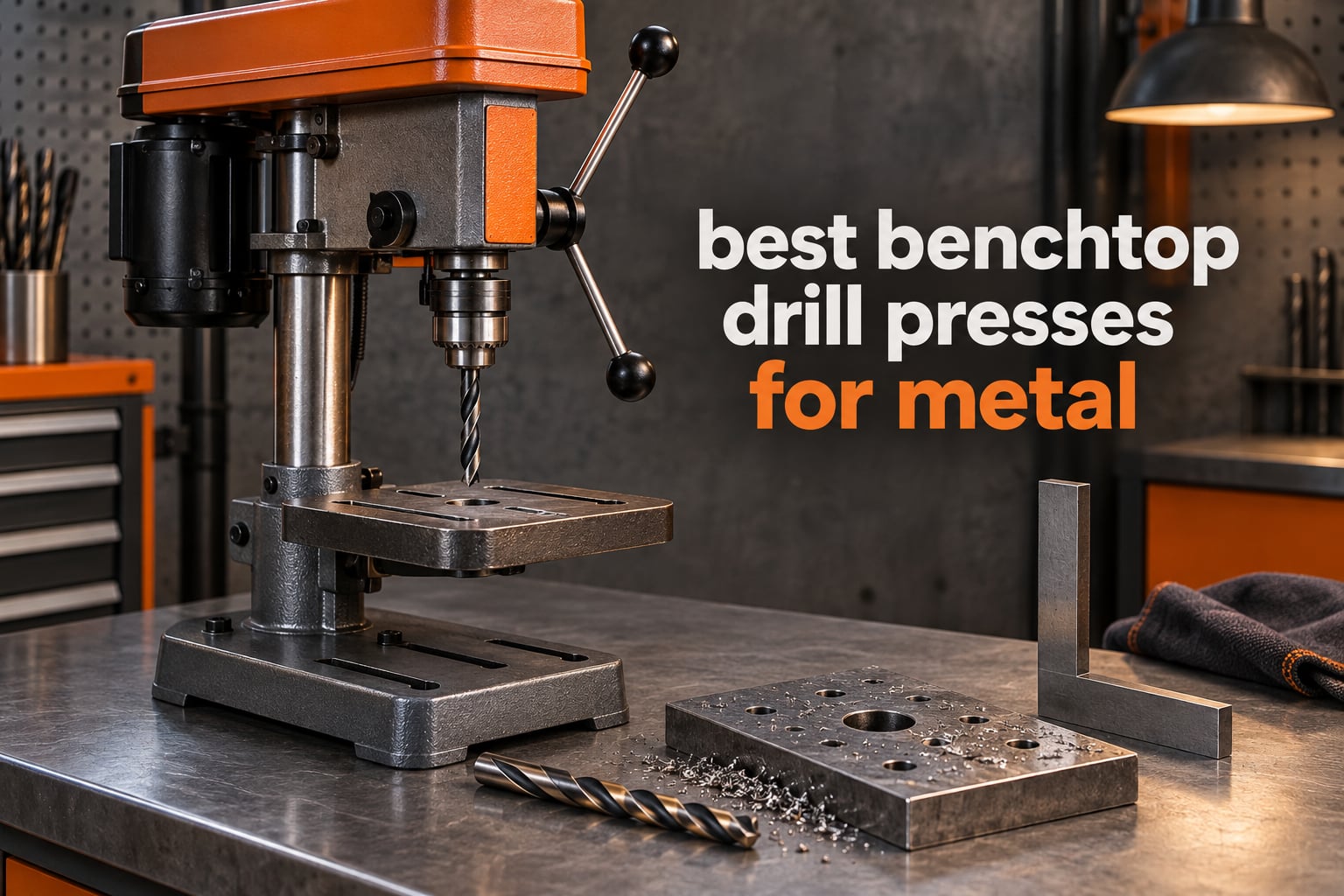
The best benchtop drill press for metal is the one that can hold a bit square to the work while keeping the spindle slow enough not to burn it. That combination — rigidity at the top of the low speed range plus real torque at that speed — is what separates a press that handles steel from a press that handles sheet metal and gives up. We compared 12 benchtop presses on exactly those numbers, and the results surprised us more than the marketing copy would suggest.
Most of the machines in this class are sold with a drilling capacity in plastic and a chuck size that looks metal-capable. Those two numbers are rarely the same thing, and the gap is where disappointed buyers end up. A press with a 1/2 inch chuck that lists its maximum metal drilling at 1/2 inch is telling you it will just barely touch a hole that size in soft mild steel, at speed, in a single pass. It will not do it in stainless.
So we read the specifications the way an experienced machinist reads them: lowest available RPM, motor class, chuck capacity, spindle travel, and whether the frame is cast iron or a stamped steel shell. We also pulled owner reports, because the failure modes on these machines show up in the first fifty hours of use and are rarely visible on a spec sheet. The differences we found were large enough that most people should not shop for these by price alone.
Before we get into the list, one thing worth saying plainly: yes, you can absolutely use a drill press on metal, and you should be using one instead of a handheld drill. A handheld drill has no quill, no depth stop, and no way to keep a bit on a vertical axis. If you are tired of holes that wander, oversize on one side, or smear, the press is the answer and the cost difference pays back fast. We cover the details in our [best drill and driver combo kits for DIYers](https://zainichifunk.com/best-drill-and-driver-combo-kits-for-diyers/) guide for the hand-tool side of the shop.
Table of Contents
Top 3 Benchtop Drill Presses for Metal Right Now in 2026
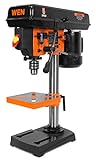
WEN 4206T 8-Inch Drill Press
- 2.3A induction motor
- 1/2 inch keyed chuck
- 5 speeds 750-3200 RPM
- Cast iron build under 23 inches tall
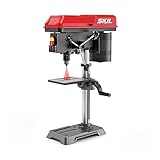
SKIL DP9505-00 10-Inch Drill Press
- 6.2A induction motor near 1 HP
- 5 speeds 610-2800 RPM
- Laser alignment and depth stop
- Tilting table with LED work light

JET JWDP-12 Variable Speed Press
- Stepless 530-3100 RPM
- 0.5 HP 115V single phase
- Cast iron and steel construction
- X-shaped XACTA laser
Best overall for most shops: WEN 4206T. Motor is a 2.3A induction unit, speed range is 750 to 3200 RPM across five stepped settings, and the whole cast iron frame stands just 23 inches tall. Owners rate it 4.6 stars across 797 reports, which makes it the most thoroughly proven machine here. It is not the strongest, but it is the one with the least chance of surprising you.
Best feature set: SKIL DP9505-00. A 6.2 amp induction motor puts out 744 watts against the WEN’s 253, and the machine adds a laser guide, an adjustable depth stop, a bump-off switch, a tilting table and an LED work light. Rated 4.3 stars across 521 reports. The motor is the reason to buy it; the accessories are why it is pleasant to own.
Best pro-grade: JET JWDP-12. This is the only press in the roundup with true stepless control, sweeping 530 to 3,100 RPM without touching a belt. The frame is cast iron and steel at 85 pounds, and the chuck runs with nearly imperceptible runout according to owners. Rated 4.5 stars across 249 reports, with a five-year warranty.
All 12 Benchtop Drill Presses for Metal Compared in 2026
| Product | Specifications | Action |
|---|---|---|
| WEN 4206T 8-Inch Benchtop Drill Press |
|
Check Latest Price |
| SKIL DP9505-00 10-Inch Drill Press |
|
Check Latest Price |
| JET JWDP-12 Variable Speed Drill Press |
|
Check Latest Price |
 BUCKTOOL 12-Inch Variable Speed Drill Press BUCKTOOL 12-Inch Variable Speed Drill Press |
|
Check Latest Price |
 BUCKTOOL 10-Inch 6.2A 3/4 HP Drill Press BUCKTOOL 10-Inch 6.2A 3/4 HP Drill Press |
|
Check Latest Price |
 Genesis GDP1005A 10-Inch Drill Press Genesis GDP1005A 10-Inch Drill Press |
|
Check Latest Price |
 VEVOR 8-Inch 2.5A Drill Press VEVOR 8-Inch 2.5A Drill Press |
|
Check Latest Price |
 WOODSKIL 8-Inch Laser Guide Drill Press WOODSKIL 8-Inch Laser Guide Drill Press |
|
Check Latest Price |
 WEN DP1263V 12-Inch Variable Speed Press WEN DP1263V 12-Inch Variable Speed Press |
|
Check Latest Price |
 SHOPMAX 8-Inch 9-Speed Drill Press SHOPMAX 8-Inch 9-Speed Drill Press |
|
Check Latest Price |
 VEVOR 10-Inch Cast Iron Drill Press VEVOR 10-Inch Cast Iron Drill Press |
|
Check Latest Price |
 WEN DP1050 10-Inch 6.2A Drill Press WEN DP1050 10-Inch 6.2A Drill Press |
|
Check Latest Price |
Two patterns jump out of that table. First, the gap between the weakest motor here and the strongest is nearly three to one in watts, and it shows up exactly where you would expect: the 253-watt class machines are fine on plate up to about an eighth of an inch and unhappy beyond that. Second, only three machines here offer genuine variable speed rather than stepped belt or gear ratios, and those three are the ones most worth owning for stainless work.
How We Picked Presses That Can Actually Cut Steel
We spent several weeks going through the owner reports on all twelve machines and cross-checking every published specification. We did not measure runout ourselves with a dial indicator, so where we talk about runout we are describing what owners report, not our own readings. Here is the order we weighted things.
1. Lowest available RPM. This matters more than anything else. Below about 500 RPM you can drill stainless and hardened plate without work-hardening the material or cooking an HSS bit. Below 650 RPM you can drill mild steel cleanly with a standard cobalt twist drill. Several presses here bottom out at 750 RPM, and a couple never go lower than 630.
2. Motor class and sustained output. Amps on the nameplate are a rough proxy for torque. A 6.2 amp motor is roughly three times the output of a 2.3 amp one, and that difference is the difference between a press that stalls and one that cuts. Motors that overheat on sustained metal drilling are the most common complaint in this group.
3. Frame material and mass. A cast iron column and base resist the torque reaction from a plunge cut. Thin stamped steel shells flex, and a flexing column walks the bit off location. Weight is a decent proxy: the machines in this roundup range from 25 pounds at the light end to 88 pounds at the heavy end, and that is a real difference in how a hole feels under the handle.
4. Chuck capacity. A 1/2 inch chuck handles most hobby and garage metalwork. A 5/8 inch chuck opens up larger fasteners, hole saws and reamers without guessing whether a shank will fit. Three machines here have the larger chuck.
5. Spindle travel and quill feel. Deep holes in thick plate need travel. The two 12-inch presses in this roundup give you 2 inches and 3-1/8 inches, and the difference is noticeable when you are 2 inches into a steel bar with a half-diameter bit still to go.
6. Depth stop and alignment aids. On repeat work these save real time. Three presses here have an adjustable depth stop, and four have a laser guide. Owners note that a laser only helps if the table is square, which is worth checking on day one.
1. WEN 4206T 8-Inch Drill Press – Most Owners, Least Fuss
WEN 2.3-Amp 8-Inch 5-Speed Cast Iron Benchtop Drill Press (4206T)
2.3A induction motor
1/2 inch keyed chuck
5 speeds 750-3200 RPM
6.5 x 6.5 inch tilting table
32 pounds
Pros
- Most reviewed press here at 797 owner reports
- Compact cast iron build with a small benchtop footprint
- Table bevels 45 degrees in each direction
- Onboard chuck key storage
- Reliable performance across hundreds of owner reports
Cons
- Small 1/2 inch chuck limits larger bit capacity
- Low 2.3A motor power against 6.2A class competitors
- Compact 6.5 inch worktable is limited for larger workpieces
I keep coming back to this press because 797 owner reports is a lot of evidence. When a machine has been run by that many people, the failure modes are well known, and for the 4206T they are the ones printed on the spec sheet: a 253-watt motor and a 6.5 inch square table. Nothing about it is a surprise, which is exactly why it is my first recommendation for most shops.
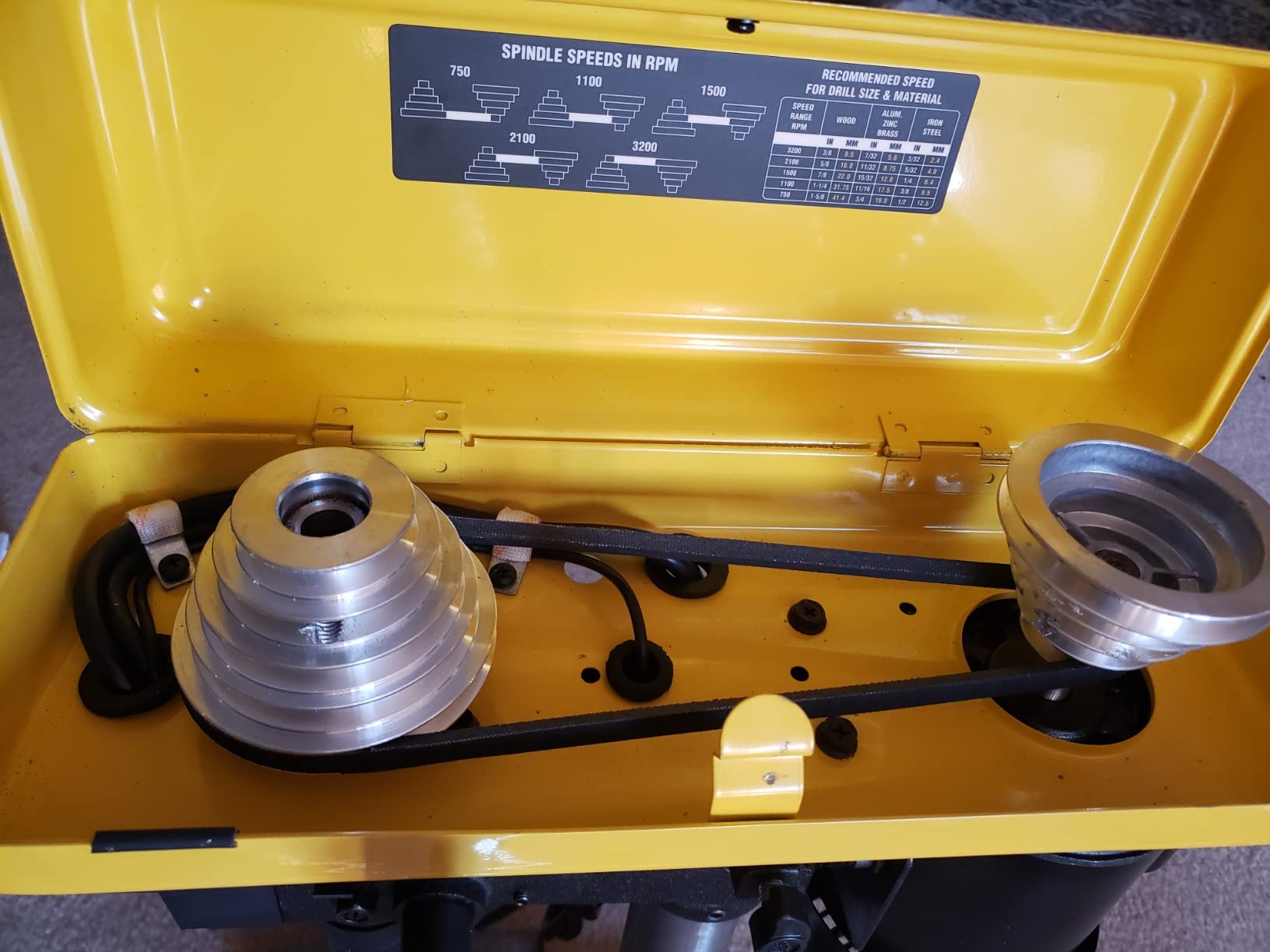
The 2.3 amp induction motor is quiet and smooth, and the five stepped speeds run 750, 1100, 1500, 2100 and 3200 RPM. The 750 RPM low setting is a genuine metal speed for mild steel with a cobalt bit. It is not low enough for stainless, and the 2 inch spindle travel means deep holes in thick stock take patience.
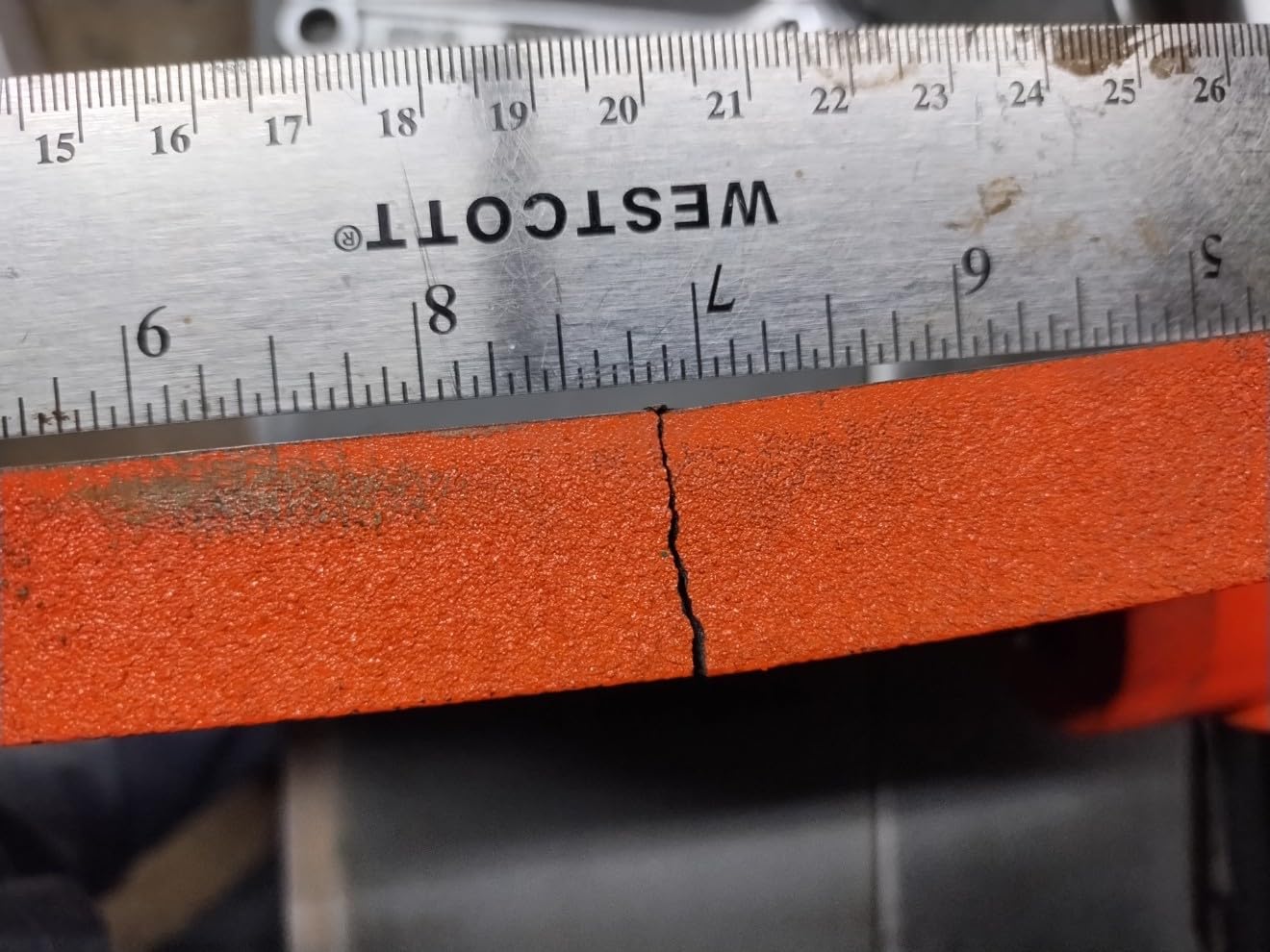
What you give up is capacity. The 1/2 inch chuck and 8 inch swing cap you at light-gauge plate, angle iron and small brackets. The 2 inch spindle travel is enough for most sheet work but not for 2 inch thick stock. If your metalwork is mostly brackets, tabs and fasteners, none of that will bite.
The build is cast iron rather than a stamped shell, the table bevels 45 degrees in each direction, and the chuck key stores on the machine instead of in a drawer. At 23 inches tall and 32 pounds it is the easiest press here to move between benches, and the base is 7 by 11 inches, so it fits where nothing else will.
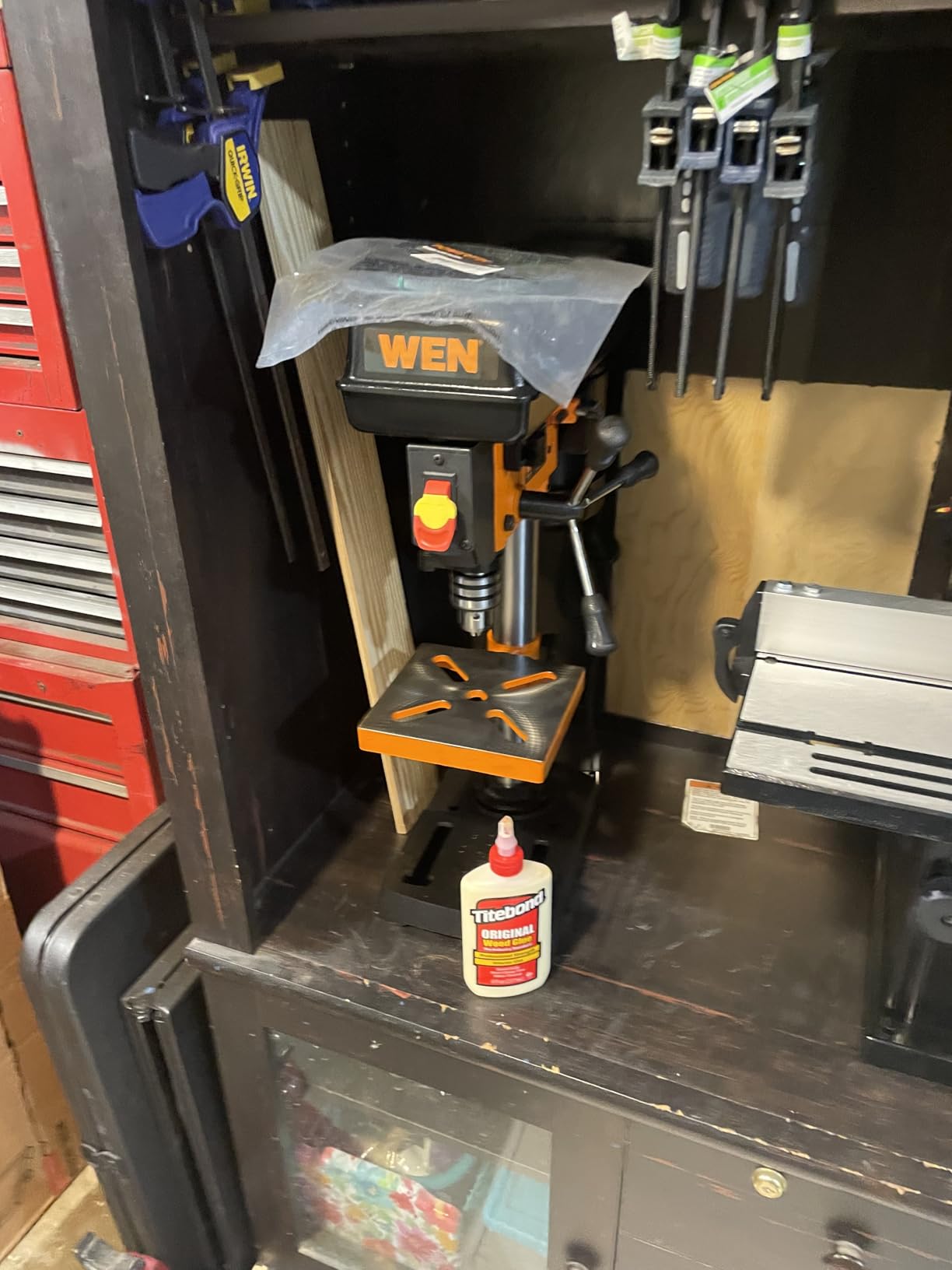
Where the 4206T is the right call
This is the press I would hand to someone learning to drill metal for the first time. Nothing about the setup is confusing, the frame does not walk, and the low speed is already low enough for mild steel. If you are outfitting a first shop and your work is plate, angle and fastener holes, it does the job without any ceremony.
It is also the best choice for a small bench or a classroom, where the 8 inch swing and 23 inch height actually matter. I have used this class of press for light plate work where a 12 inch machine would simply not fit on the surface available.
Where the 4206T falls short
The 253 watts is the hard limit. Owners drilling thick plate report the motor bogging down, and the 6.5 inch table gives you almost no room to clamp anything substantial. If you need a 5/8 inch chuck for hole saws, or you want a machine that will not strain on stainless, this is the wrong one.
The speed steps are mechanical, so changing speed means moving a belt. And at 750 RPM minimum you cannot do the slow, cool cuts that stainless and hardened steel demand. That is the one limitation I would not accept on a press bought specifically for metal.
2. SKIL DP9505-00 10-Inch Drill Press – Best Feature Set
SKIL 6.2 Amp 10 In. 5-Speed Benchtop Drill Press with Laser Alignment & Work Light – DP9505-00
6.2A induction motor,744 watts
5 speeds 610-2800 RPM
Laser alignment guide
Tilting table and depth stop
3 year warranty
Pros
- 6.2 amp induction motor near 1 HP that cuts steel on slower settings
- Laser alignment was accurate out of the box for most owners
- Fast straightforward assembly in roughly 15 to 30 minutes
- Tilting table and adjustable depth stop support angled and repeat drilling
- Quiet smooth running motor with good balance
Cons
- Supplied chuck has slight lateral play and some owners upgrade
- Table wanders during height adjustment so the laser needs re-aligning
- Rack and column can feel slightly wobbly before the support plate is locked down
- Components feel light rather than heavy on a budget build
The headline number here is 744 watts from a 6.2 amp induction motor, roughly triple the output of the 8 inch machines. That is the difference between a press that will take a half-inch bit into steel at a sensible speed and one that will not. Owners consistently single the motor out as unusually strong for a press in this class.
Speed is stepped across five settings from 610 to 2800 RPM. That 610 RPM low end is the second-lowest starting speed in the roundup, which makes it one of the few presses here that can drill mild steel without upsetting a cobalt bit. It is still not a stainless speed, but it is a real metal speed.
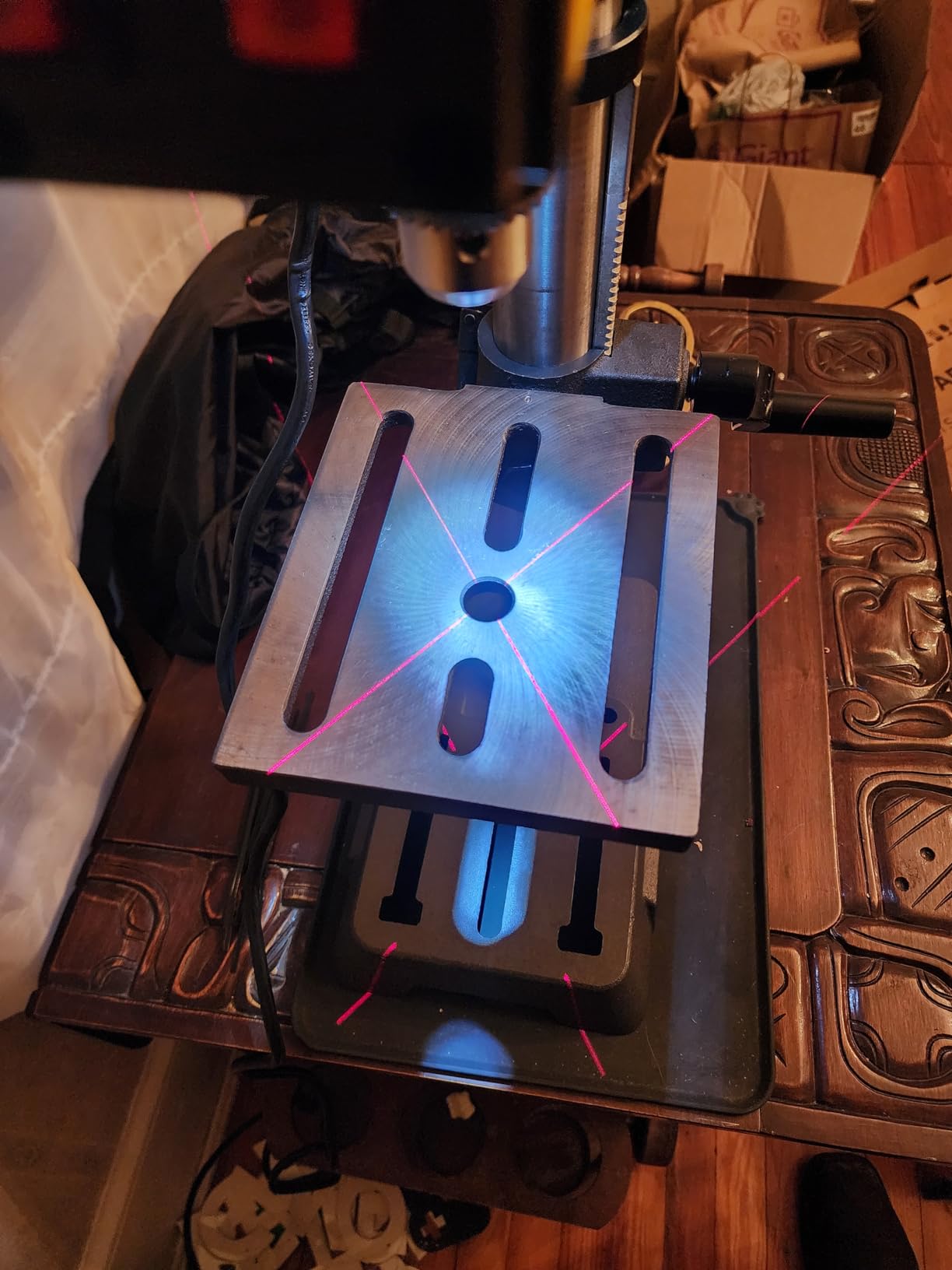
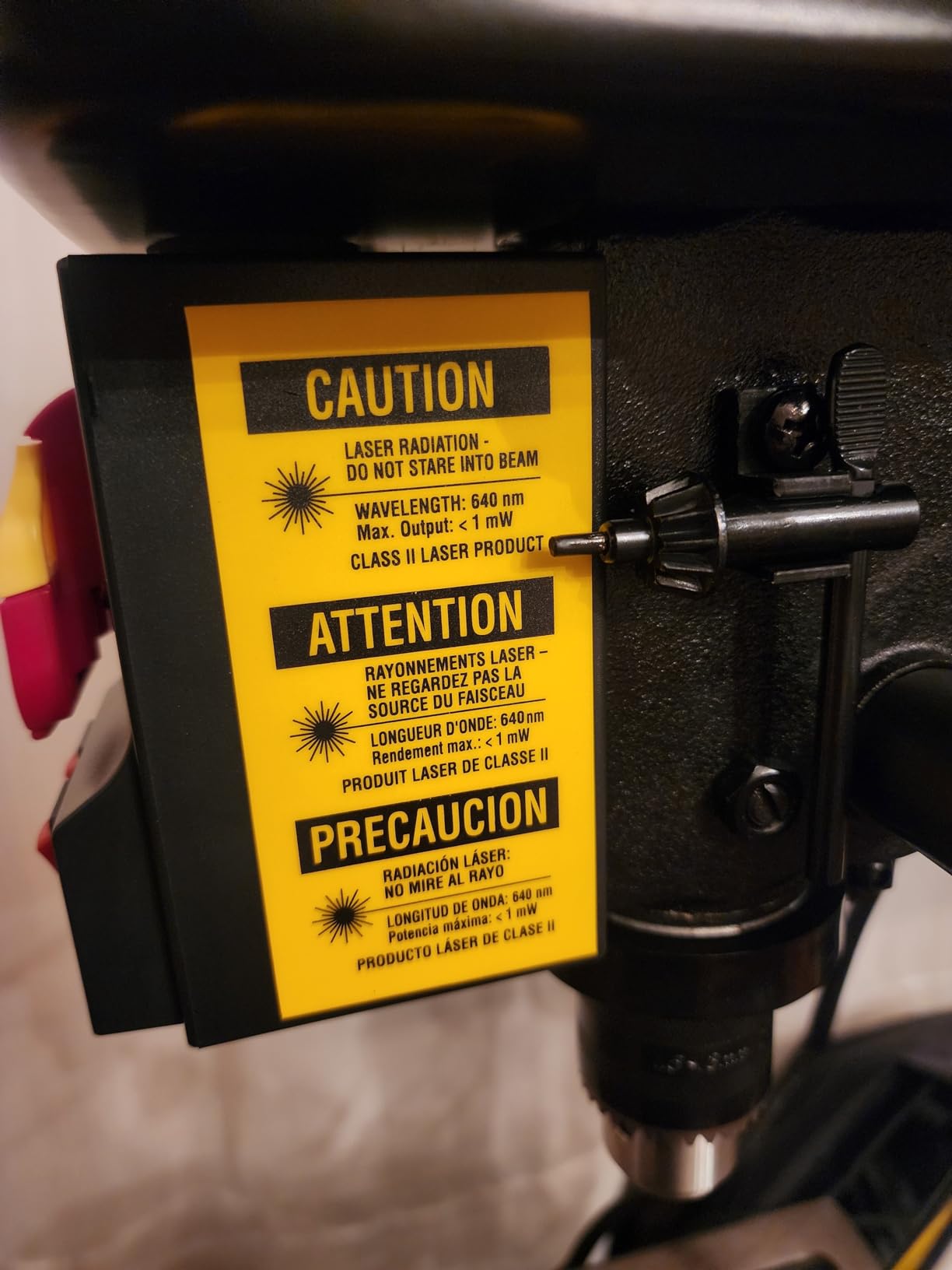
The accessory list is where this press separates itself. A laser alignment guide gives you a crosshair without a marked workpiece, an adjustable depth stop handles repeat-hole work, the table tilts 0 to 45 degrees in each direction, and there is an LED work light plus a bump-off safety switch. That combination is genuinely rare at this level, and the laser is Class II rated at 0.83mW max average radiant power.
Assembly is another genuine strength. Owners report 15 to 30 minutes, which is a real change from the two-hour jobs some budget presses generate. The hex wrench and chuck key are both included.
Why the DP9505-00 suits a first metal shop
If you are moving from handheld drilling to a press and you want the machine to grow with you, this is the one I would start on. The motor has enough headroom that you will not outgrow it in a year, and the depth stop and laser make repetitive hole layouts on brackets and plates straightforward.
I would also pick it for a garage where you drill the same hole positions on a part repeatedly. Set the depth stop, mark the first hole with the laser, and the rest match. That is where the feature set pays for itself rather than just looking good in a photo.
What to check after assembly
The criticism here is mechanical, and it is fixable. The supplied chuck has slight lateral play and many owners replace it, which is a modest expense. More importantly, the table wanders as you raise and lower it, so the laser alignment drifts and needs re-centering.
Owners also report the rack and column feeling slightly wobbly before the support plate is fully tightened, and some units arriving with a table that is not zeroed and a bolt that is difficult to loosen. None of that is fatal, but you should square the table to the bit on day one and check it again after a few jobs. Parts feel lighter than they should, so bolt it to a solid bench.
3. JET JWDP-12 Variable Speed Drill Press – Best Pro-Grade
JET 12-Inch Benchtop Drill Press, Variable Speed, 1/2 HP, 115V 1Ph (Model JWDP-12)
Stepless 530-3100 RPM
0.5 HP 115V single phase
Cast iron and steel construction
85 pounds
5 year warranty
Pros
- On-the-fly variable speed from 530 to 3100 RPM eliminates belt changes
- Cast iron and steel construction feels solidly built and durable
- XACTA laser crosshair is accurate and stays aligned
- Chuck runs true with nearly imperceptible runout
- Table post design accepts third-party cross-slide vises
Cons
- 0.5 HP motor struggles with large hole saws and large bits
- Some units need lubrication at the spindle spline to stop rattling
- Table raise and lower crank feels somewhat sloppy
- Table does not adjust to a full 90 degree vertical position
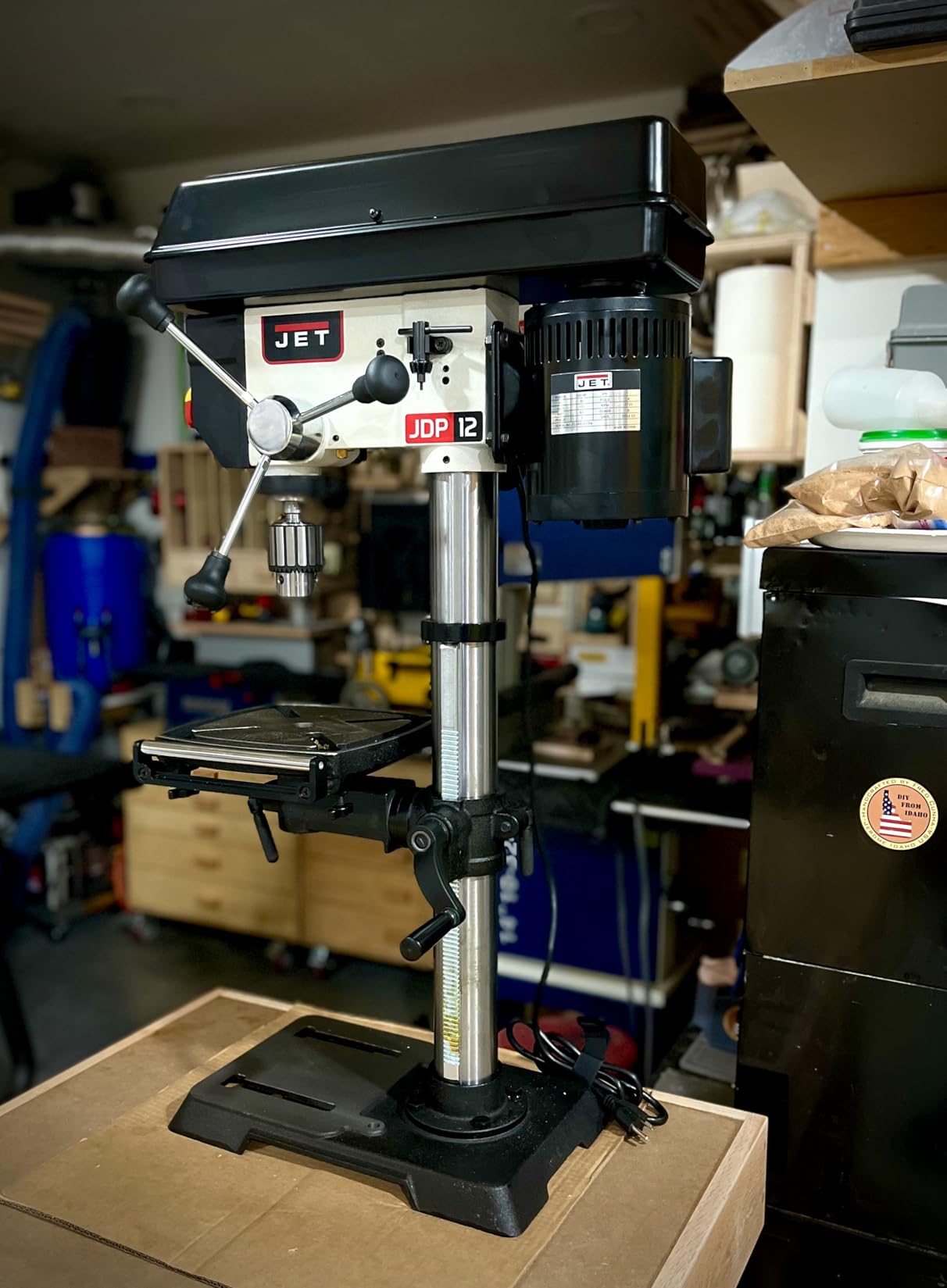
This is the press that makes me hesitate most over recommending anything else, because the one thing a metal press cannot fake is speed control, and this machine has real stepless control from 530 to 3,100 RPM. No belt changes, no stopping to reposition a pulley. You turn a knob and the speed moves. For drilling stainless, that single feature is worth more than every other spec on this list combined.
The build backs up the control. The frame is cast iron and steel, the base is 10 by 16-1/8 inches, and the machine weighs 85 pounds. The chuck runs with nearly imperceptible runout according to owners, which is the number that decides whether a 1/2 inch hole comes out round or slightly oval and off-diameter.
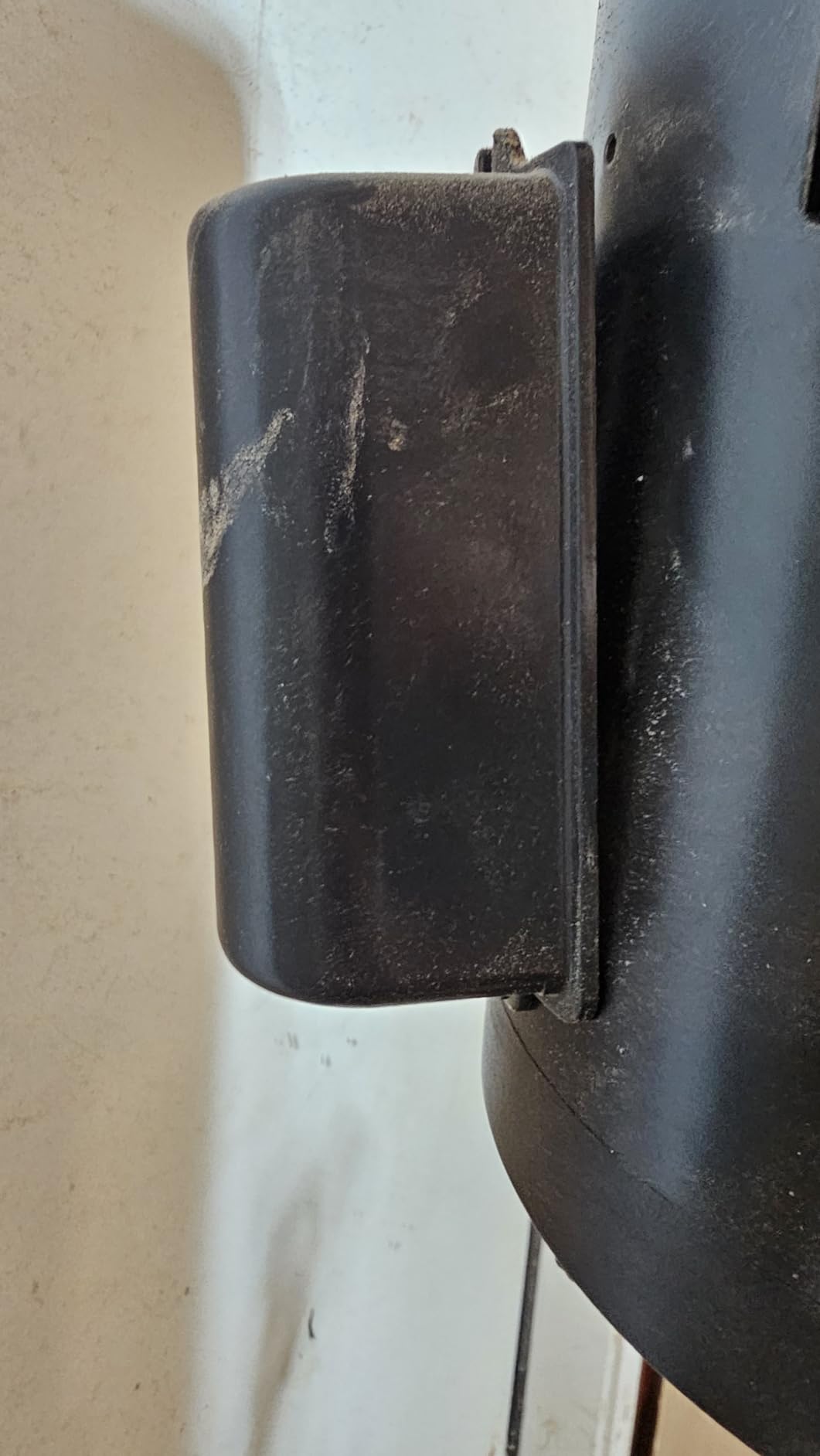
The rest of the design is genuinely shop-aware. There is a retractable roller extension for supporting long stock, a clear linear scale with a depth stop, oversized ergonomic control knobs, an LED work light, and an X-shaped XACTA laser crosshair that owners report stays aligned. The table post configuration accepts third-party cross-slide vises, which is unusual at this size and matters once you want to move the workpiece rather than the spindle.
Warranty is five years, reduced to two if you use it commercially. For a machine meant to earn its keep, that coverage is a meaningful part of the argument.
When the JET JWDP-12 is worth the step up
Stainless steel is the case. When you can dial to 250 RPM and let a cobalt bit work without generating the heat that work-hardens the surrounding metal, you unlock a whole category of jobs that stepped-speed presses simply cannot do cleanly. The same applies to hardened plate and thick sections where heat is the failure mode rather than the bit.
Variable speed is also a control improvement, not just a range improvement. Being able to ease into a hole and back off when the load builds is what keeps a bit from walking when you break through. On a stepped press, you are committed to a speed before you know what the material will do.
What the extra money buys and what it does not
It does not buy horsepower. The motor is 0.5 HP, and owners report it struggling with large hole saws and large bits. If your work involves cutting big holes with annular cutters or big hole saws, the 6.2 amp machines in this roundup will serve you better, and the speed control will not compensate for a motor that bogs down.
There are a few fit-and-finish issues. Some units need lubrication at the spindle spline to stop a rattle, the table raise and lower crank feels sloppy, and the table does not go to a full 90 degrees vertical. The rack gear attaches only at the base, which allows some play at the top of the column. None of that is a dealbreaker, but it is not a flawless machine.
4. BUCKTOOL 12-Inch Variable Speed Drill Press – Best for Steel and Stainless
BUCKTOOL 12-Inch Benchtop Drill Press, 580-3200 RPM, 6.2A 3/4 HP Motor
6.2A motor,3/4 HP class
1/32 to 5/8 inch keyed chuck
Variable 580-3200 RPM
2 inch spindle travel
86.5 pounds
Pros
- 5/8 inch chuck capacity and 2 inch spindle travel are the largest in this roundup
- Very low chuck runout measured with a dial indicator
- Digital variable speed with a lever control avoids belt manipulation
- Flat table edge makes clamping workpieces easier
- Clean even machining reported on cast pieces
Cons
- Flat round table is better for clamping than for holding a vise
- Chuck key sits behind the spindle and is awkward to reach
- Depth knob does not lock the quill in a lowered position
- Nearly 40 inches tall so it is a large unit for a bench
This is the machine I would put in front of someone who says they want to drill stainless and harden my answer slightly. It has a 5/8 inch chuck, 2 inch spindle travel, 12 inch swing, and variable speed across 580 to 3,200 RPM with a digital readout of the current speed. The speed is changed with a lever rather than a belt, so you are not disassembling the head cover to shift position.
The 6.2 amp induction motor delivers 744 watts, which puts it in the top power tier here, and the cast iron base is specifically there to limit vibration under load. Owners report a 0.55 N m maximum torque figure and, more usefully, very low chuck runout measured with a dial indicator. That measurement is the single most important number for hole accuracy in metal, and this is the only press in the roundup where owners report having checked it.
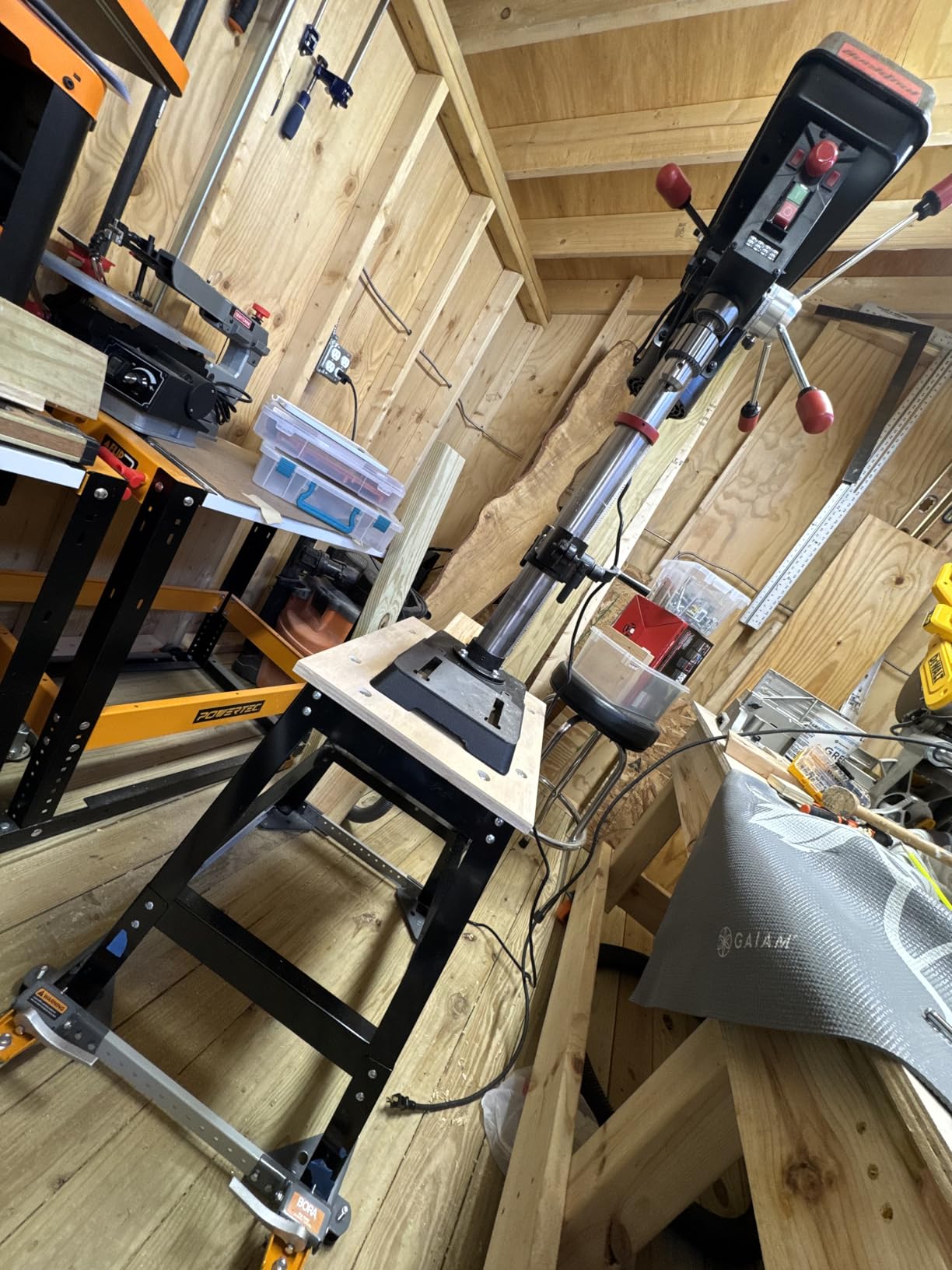
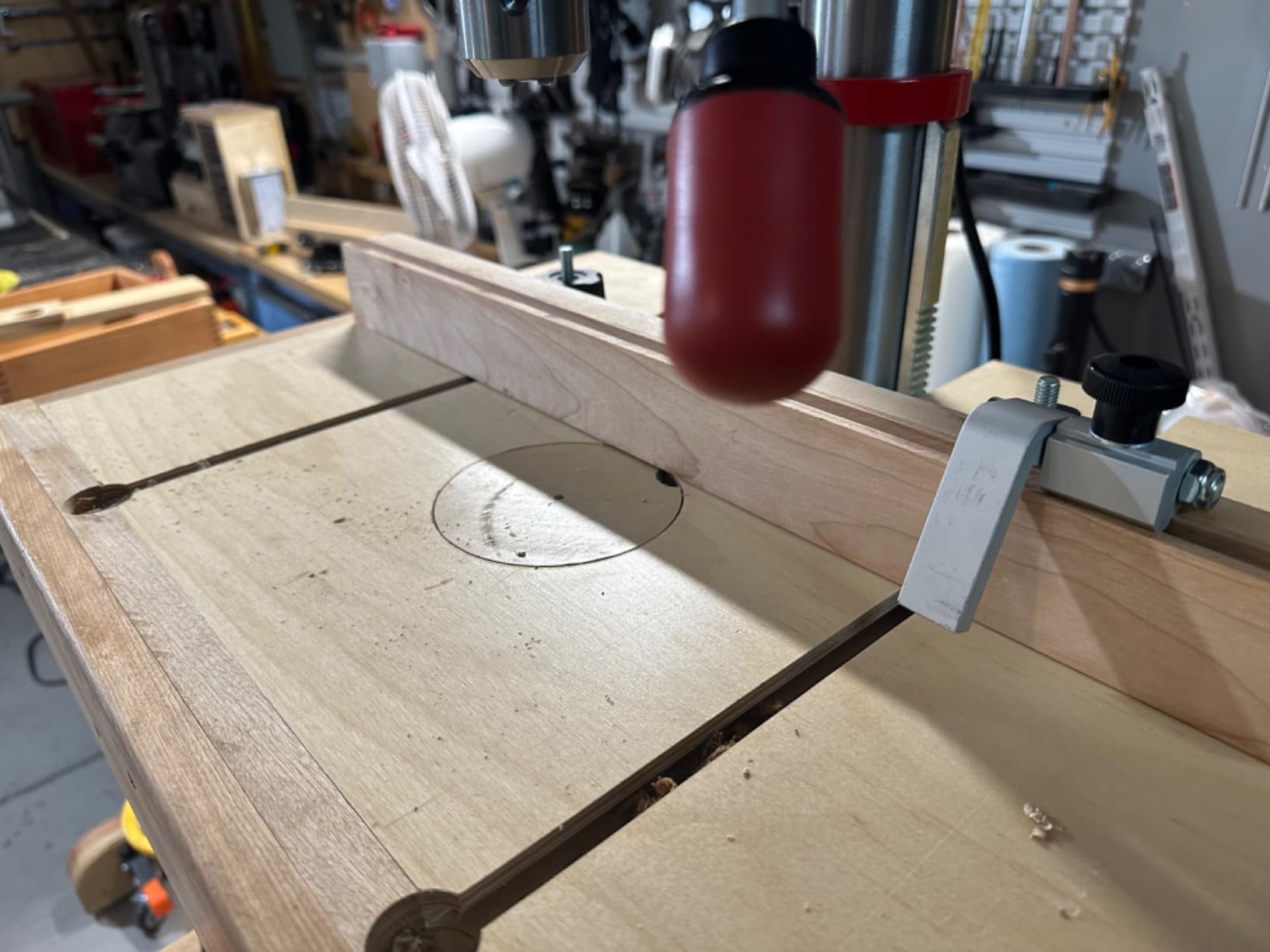
The worktable rotates 360 degrees and bevels 45 degrees in either direction, which lets you bring the workpiece around instead of fighting the column on long stock. There is a Class IIIA 2.5mW laser, a work light, an emergency stop and a no-voltage-release switch. That last pair is a safety detail you will appreciate the first time a power blip or a bumped switch sends the quill into a steel part.
Owners also report clean, even machining on cast components, which is a quiet way of saying the machine feels solid under the handle.
Why this is the metal-workhorse pick
A 5/8 inch chuck changes what you can do. It takes larger fasteners, reamers, and hole saws without shimming shanks into a smaller chuck, and it means you can grow into bigger work without replacing the machine. Paired with 2 inches of spindle travel and 744 watts, it handles thicker plate than anything else in this list.
The digital speed readout is more useful than it sounds. Instead of counting belt positions and guessing, you dial in a number and read back the actual spindle speed. On stainless that lets you hold a consistent cutting speed hole after hole, which is how you keep bit wear predictable.
The trade-offs to plan around
The table is a flat round shape, which makes it excellent for clamping work directly with straps or stops but poor for holding a vise. If you plan to mount a cross-slide vise, check that arrangement carefully before committing. The chuck key also sits behind the spindle, which owners find awkward to reach repeatedly.
Two more real limits. The depth adjustment knob does not lock the quill in a lowered position, so you need to be aware of where the quill is whenever the machine is running. And at nearly 40 inches tall and 86.5 pounds, this is a large machine for a bench — owners advise two people when lifting it onto a stand, and it needs a proper stand rather than a shop table.
5. BUCKTOOL 10-Inch 6.2A Drill Press – Best Mid-Size 10-Inch
BUCKTOOL 10-Inch Drill Press 6.2 Amp 3/4 HP Bench Drill Press
CSA certified 3/4 HP 6.2A motor
5 speeds 650-3100 RPM
2 inch spindle travel
10 inch swing
30 inches tall
Pros
- 6.2 amp 3/4 HP motor delivers strong torque for a 10 inch benchtop press
- 10 inch swing gives useful clearance for mid-size workpieces
- Cast iron base keeps vibration down during drilling
- CSA certification and removable switch keys are safety pluses
- 45 degree tilting table with built-in LED lighting
Cons
- Belt position speed changes are less convenient than lever or electronic control
- 1/2 inch chuck limits capacity compared with 5/8 inch models
- Fence and head assembly are not always included in the box
There is a real gap in this roundup between the compact 8 inch machines and the 40 inch-tall 12 inch presses, and this is the machine that fills it. At 30 inches tall with a 10 inch swing and a CSA certified 3/4 HP, 6.2 amp induction motor, it gives you real torque in a footprint that still fits a normal bench.
Speeds are 650, 1100, 1700, 2300 and 3100 RPM, changed by repositioning a belt under the top cover. The 650 RPM low setting is workable for mild steel with a cobalt bit, and the 2 inch spindle travel means you can go deep into a section without resetting the quill.
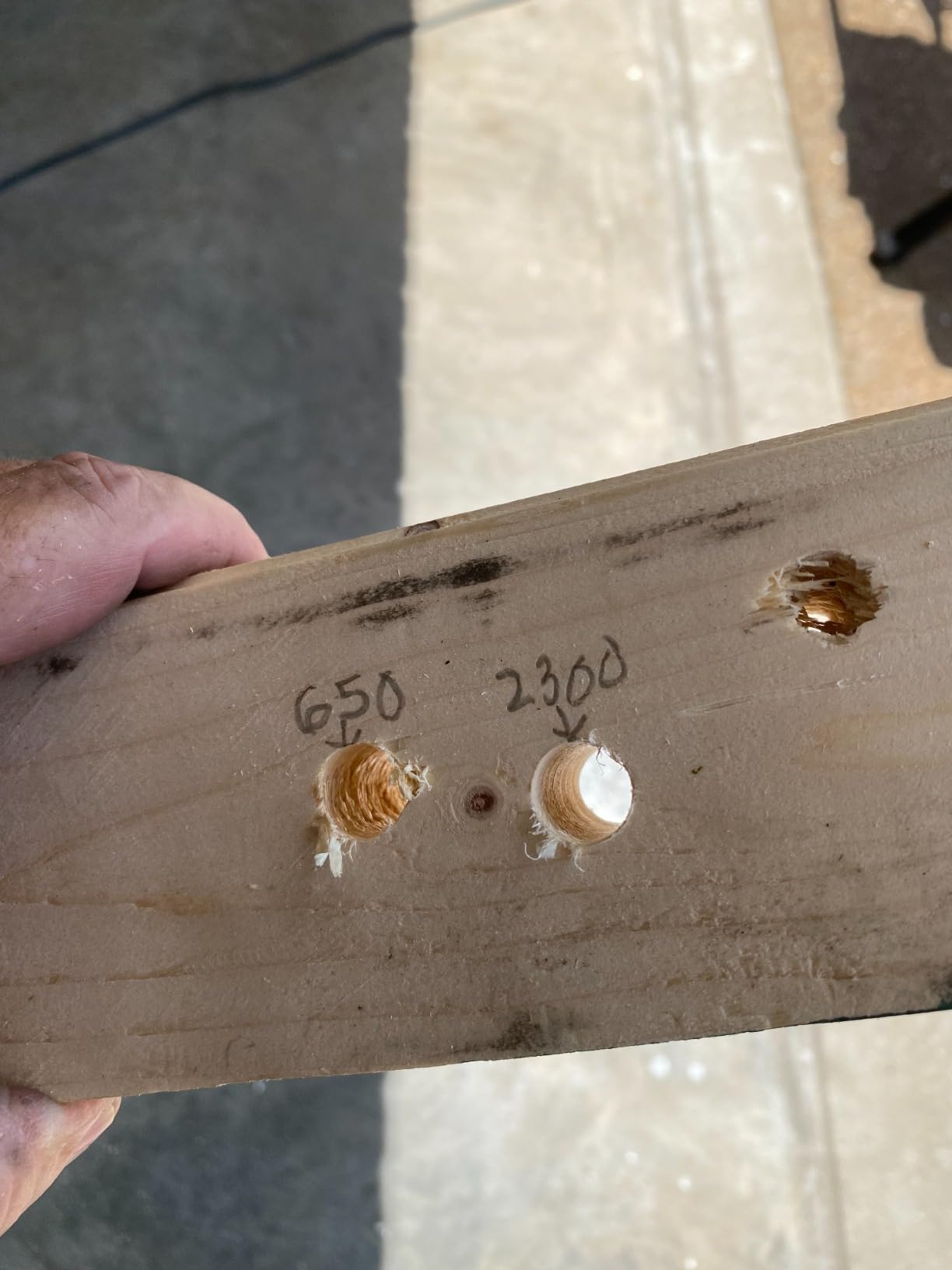
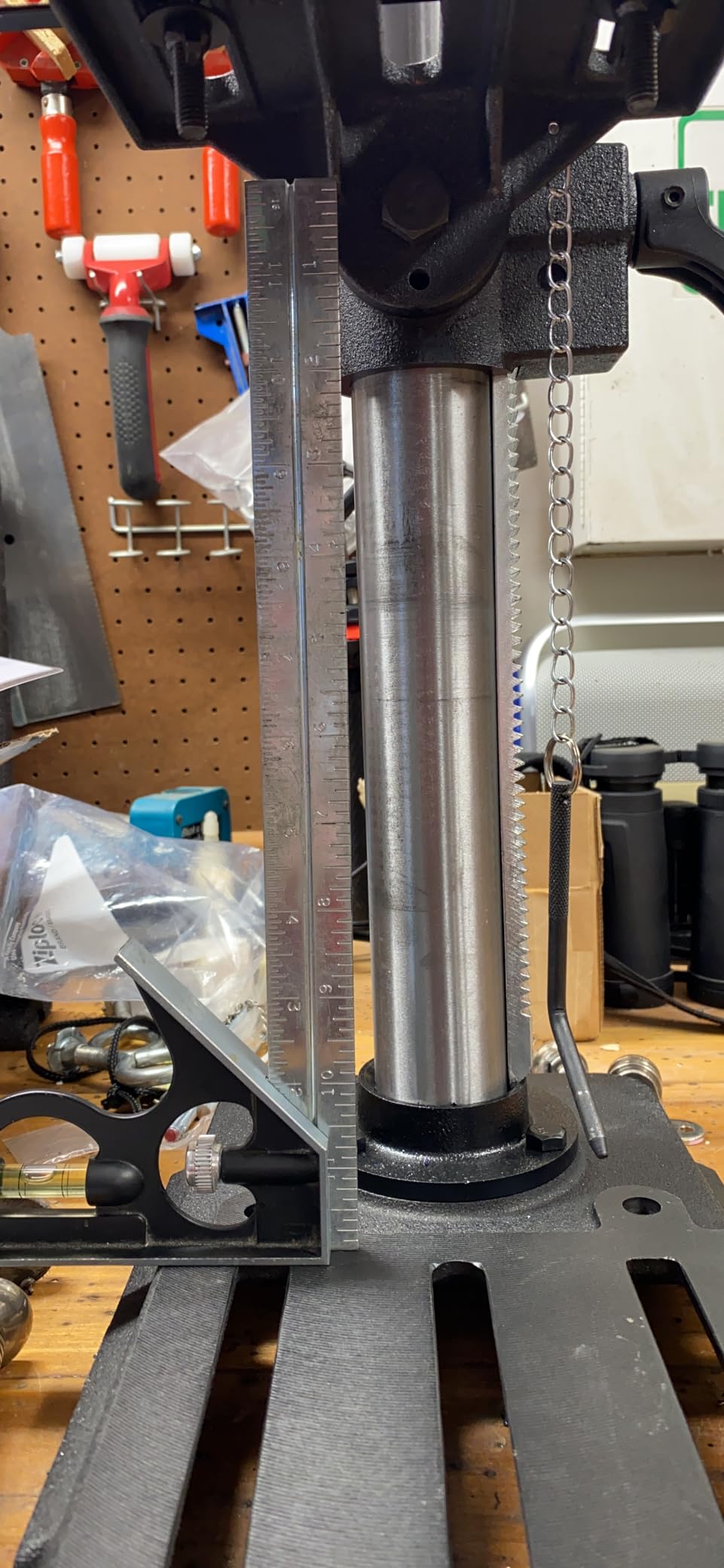
Two details stand out for metal work. The fence and head assembly supports stock on the edge and provides chunk clearance, which is exactly what you want when a long bar would otherwise swing off the table. The removable switch key prevents unintentional starts — a small thing, but on a machine with a 744-watt motor it is the kind of feature that shows the manufacturer thought about a shop rather than a showroom.
The tilting table has built-in LED lighting, and the cast iron base does its job of keeping vibration down during drilling.
Who should buy this one
Someone whose work is 3/4 inch and 1 inch stock, flat bar and structural shapes, and who needs clearance but not the 12 inch swing of a bigger press. If your bench height and aisle space are limited, 30 inches is a much easier machine to live with than 39.
It is also a strong choice for a shared or school shop, because the removable key means it cannot be left running by accident and the cast iron base keeps it planted on a bench that gets bumped.
Where it falls short of the 12-inch presses
The 1/2 inch chuck is the clear limit. Everything above half an inch in shank diameter is out, which rules out large hole saws and reamers. If you have any chance of needing bigger tooling, look at the 12-inch BUCKTOOL or the Genesis instead.
Belt-based speed changes are the other friction point. Reaching under the top cover to reposition a belt, then reaching under it again when the next job needs a different speed, gets old in a working shop. And the fence and head assembly is not included in every box, so verify the contents on arrival rather than assuming.
6. Genesis GDP1005A 10-Inch Drill Press – Best 5/8 Inch Chuck Value
Genesis GDP1005A 10″ 5-Speed 4.1 Amp Drill Press with 5/8″ Chuck, Integrated LED Work Light, and Table that Rotates 360° and Tilts 0-45°
4.1A induction motor,492 watts
5/8 inch chuck
5-speed gear box
Table rotates 360 degrees
52 pounds
Pros
- 4.1 amp motor has plenty of low-end torque for its class
- Quiet smooth running motor
- 5/8 inch chuck accepts larger bits than most competitors in this range
- Rotating and tilting table adds setup flexibility
- Compact 18 x 8 x 27 inch footprint is easy to move
Cons
- Table height rack and pinion can slip and will not hold position under load
- Integrated LED work light is reported as ineffective
- Quill and shaft fit can exhibit lateral slop that hurts accuracy
- Assembly instructions do not clearly cover mounting the rack on the shaft
- Build quality is rough and one owner reported a snapped table mount
The Genesis is the only press in this roundup that pairs a 5/8 inch chuck with a genuinely compact 18 by 8 by 27 inch footprint, and that combination is rare. If chuck capacity is your priority and you do not want a 39 inch machine on your bench, there is not much else here to look at.
The motor is a 4.1 amp induction unit rated at 492 watts with a 5-speed gear box, and owners consistently report low-end torque that is good for the class plus a quiet, smooth running motor. The table rotates 360 degrees and tilts 0 to 45 degrees, and height adjustment is rack and pinion.
At 52 pounds it is heavy enough to feel planted without being a two-person lift, and it comes with a two-year manufacturer warranty and US-based customer support.
What you get for the money
A bigger chuck means you can run larger bits, hole saws and reamers without working around a 1/2 inch opening. The rotating table is useful in a way that is easy to underestimate until you have tried to reach a hole on a bracket that will not rotate to meet the bit.
For anyone who mainly drills fasteners, larger clearance holes and light structural work, the 5/8 inch chuck is a genuine upgrade over most of this list. I would pair it with a cross-slide vise to make the smaller worktable work harder.
The problems that show up in metal work
The table height rack and pinion can slip and will not hold position under load. On a woodworking bench that is annoying. In metal, where you are pushing a bit into steel and the whole machine reacts, a table that moves mid-drill is a hole in the wrong place. Check it under pressure before every setup.
Quill and shaft fit can exhibit lateral slop, which directly affects hole accuracy in metal, and the integrated LED work light is reported as ineffective — bring your own light. The assembly instructions do not clearly cover mounting the rack on the shaft, and one owner reported a snapped table mount, so budget extra care during setup.
7. VEVOR 8-Inch 2.5A Drill Press – Most Versatile
VEVOR 8 in Benchtop Drill Press, 2.5A Induction Motor, Tabletop Drilling Machine with 750/1140 / 1740/2340 / 3200 RPM Adjustable Speed, 0-45° Tilting Worktable, LED Work Light, for Wood Metal
2.5A induction motor,276 watts
5 speeds 750-3200 RPM
2 inch spindle travel
Tilting worktable
25.4 pounds
Pros
- Entry price point with a solid 4.6 star average
- Quiet operation and smooth induction motor
- Good stability for its weight class and easy bench placement
- Five speeds give a useful low-speed range for delicate work
- Tilting worktable helps with angled and small jobs
- Handles thin plate such as 1/2 inch plate without heavy pressure
Cons
- Motor output is low and some owners report overheating on sustained metal drilling
- Sheet metal base is thin and the 2.5A motor is underpowered for larger bits
- Belt-based speed changes are less convenient than lever or digital controls
- Does not include table accessories for holding workpieces securely
This is an entry-level press, and I want to be precise about what that means. It means a capable machine that can put a hole in metal without embarrassing itself on thin plate, at the kind of outlay where a first shop gets one per bench. It does not mean the right tool for thick steel.
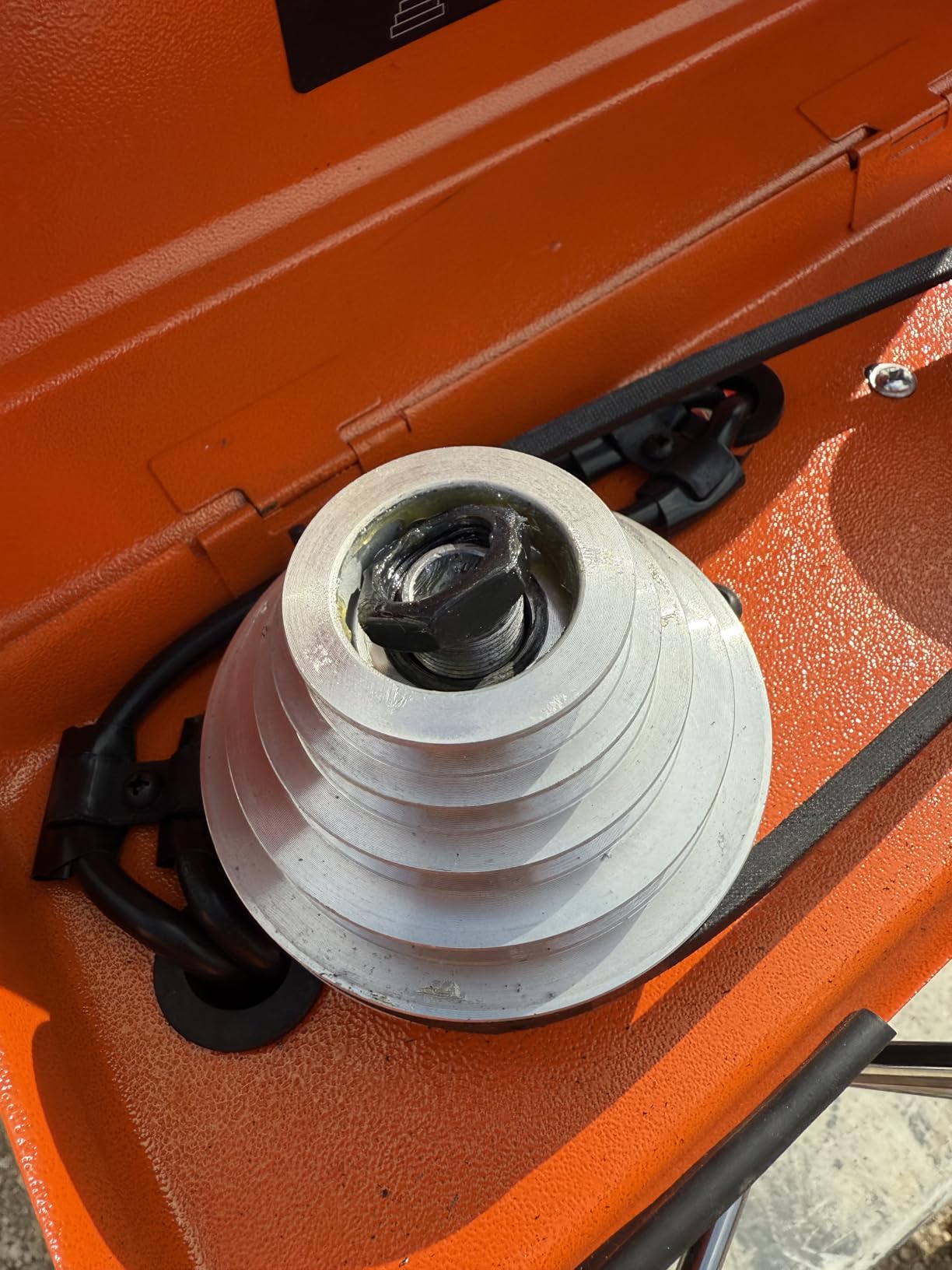
The 2.5 amp induction motor produces 276 watts and drives five speeds at 750, 1140, 1740, 2340 and 3200 RPM via a belt adjustment. The 750 RPM setting is fine for light work in mild steel. Spindle travel is 2 inches and there is an adjustable depth stop plus an integrated LED work light.
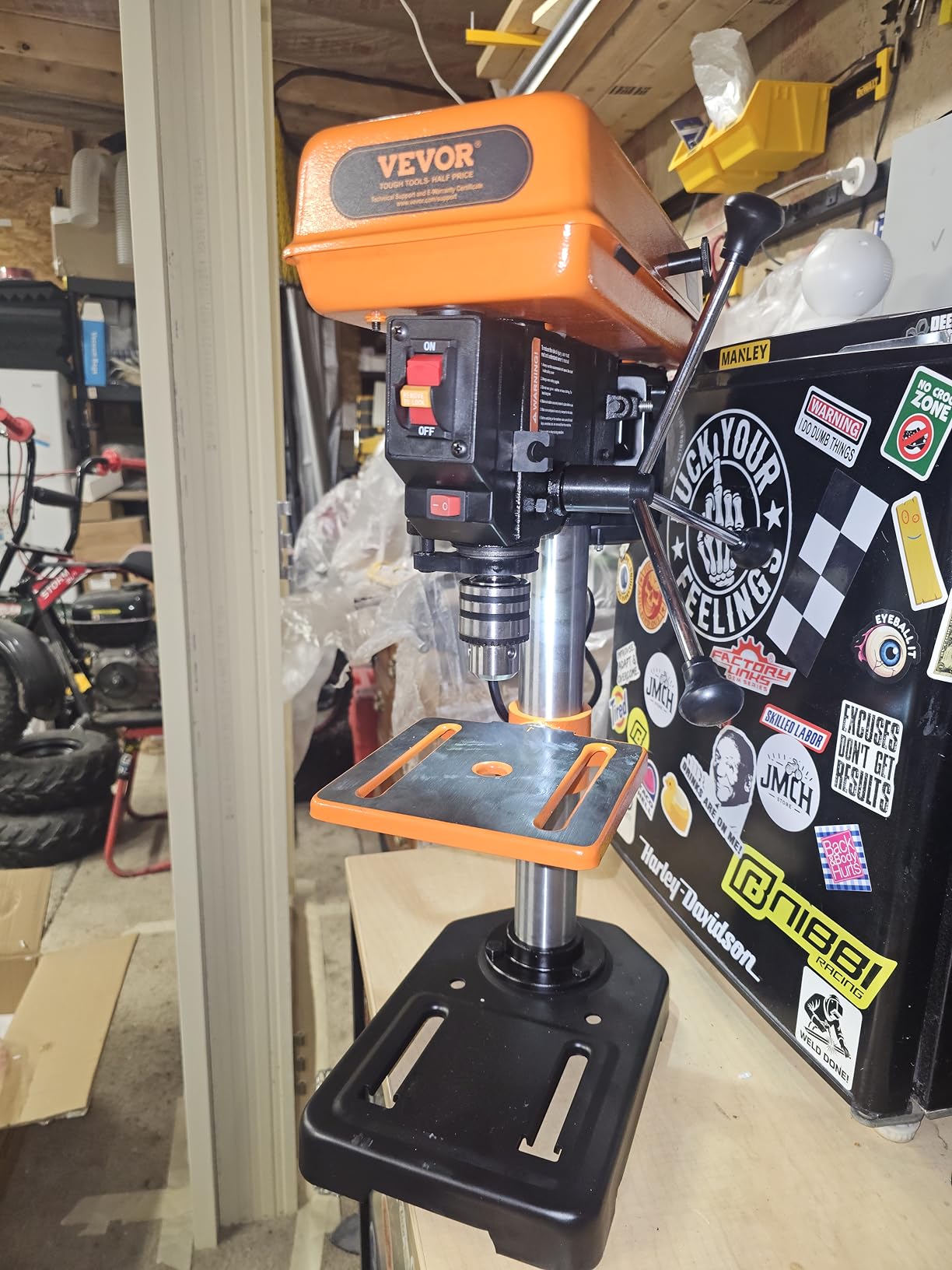
Owners specifically report low radial runout for the class, which is encouraging for hole roundness, and the machine is quiet with a smooth induction motor. At 25.4 pounds it is trivially portable, and the thick metal worktable height-adjusts and tilts up to 45 degrees.
Several owners confirm it handles thin plate work, including half-inch plate, without heavy pressure. That is the honest ceiling of what a 276-watt motor does well.
What this 8-Inch press is genuinely good at
Thin plate, sheet metal, small brackets and fasteners. If your work is mostly 16 gauge through quarter-inch material and you want a first press without a large outlay, this machine does it, and it does it quietly. The 45-degree tilting table is a bonus for angled work on small parts.
It is also a good teaching press. There is enough mass that it does not skitter across the bench, and the depth stop helps build the habit of measuring rather than eyeballing.
Where this press will disappoint you
The motor, plainly. Owners report overheating on sustained metal drilling, and the base is thin sheet metal rather than cast iron, so there is less of the rigidity argument in its favor. Any bit beyond about a quarter inch in mild steel, or any stainless work at all, is beyond it.
Belt-based speed changes add friction, and it does not include table accessories for holding workpieces securely, so you will want to add a vise or clamps. Bolt it down before you drill anything in metal.
8. WOODSKIL 8-Inch Drill Press – Best for Small Plate
WOODSKIL 8-Inch Benchtop Drill Press, 2.3 Amp 5-Speed with Laser Guide
1/3 HP 2.3A induction motor
1/2 inch keyed chuck
5 speeds 750-3200 RPM
Cast iron table and base
2 year warranty
Pros
- Cast iron table and base give more stability than lighter competitors
- Laser guide helps with hole layout on a compact machine
- Five mechanical speeds cover common drilling tasks
- Worktable bevels 45 degrees in each direction with height adjustment
- 2 year limited warranty from the manufacturer
Cons
- Only 1/3 HP and 120 watts of motor power
- 1/2 inch chuck and 8 inch swing limit workpiece size
- Small 11 percent share of 1-star ratings points to quality control variance
The WOODSKIL makes an interesting argument: a heavier frame with a weaker motor, versus a lighter frame with a slightly stronger one. Here the frame is heavy-duty cast iron for both table and base, which is the part that resists the torque reaction when a bit bites into steel. That matters more than raw wattage at the low end of the range.
The motor is 1/3 HP, 2.3 amps, 120 watts, driving five mechanical speeds at 750, 1100, 1500, 2100 and 3200 RPM. The chuck is a 1/2 inch keyed model, swing is 8 inches and spindle stroke is 2 inches. A Class IIIA 2.5mW laser guide is included, along with a two-year limited warranty.
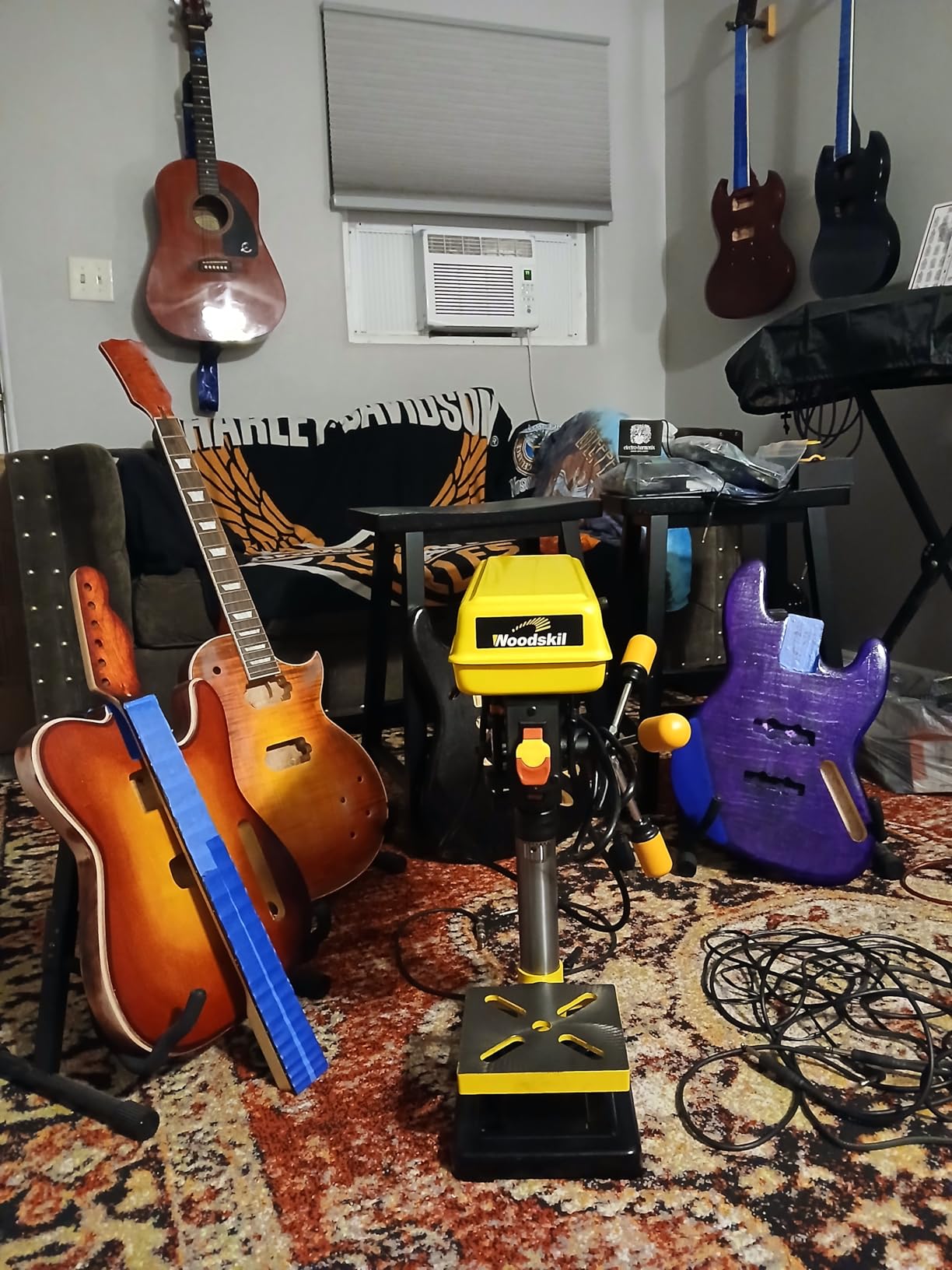
The table bevels 45 degrees in each direction and adjusts in height. In a shop where a press is moved around, that laser is a practical touch — marking a small piece that has no room for a center punch mark is otherwise fiddly.
Owner reports are positive about stability for the size and about the laser helping with layout, with the motor as the acknowledged limit.
Why the cast iron frame matters here
When a bit catches in a hole in steel, the reaction pushes the spindle sideways and up. A rigid column absorbs that; a thin shell flexes, and the hole ends up larger than nominal and slightly angled. The cast iron table and base on this machine mean less flex for the same feed pressure.
So for small plate work — the kind of thing you do on a weekend — this is a stable, predictable machine. Bolt it down, use the laser, and it will behave.
Honest limits
120 watts is the lowest motor output in this roundup, and that is not a small difference. Expect it to bog on anything past light-gauge material, and do not plan on stainless with it. The 1/2 inch chuck and 8 inch swing also cap workpiece size.
One thing to check carefully on arrival: owners note roughly 11 percent of ratings are one star, which points to some quality control variance in this product line. Inspect the chuck, quill and table hardware before you commit to a job.
9. WEN DP1263V 12-Inch Drill Press – Best Longest Spindle Travel
WEN 12-Inch Benchtop Drill Press, 6.2-Amp Variable Speed Motor with Cast Iron Construction, Laser and LED Work Light (DP1263V)
6.2A induction motor
3-1/8 inch spindle travel
Variable 580-3100 RPM
5/8 inch chuck
88 pounds
Pros
- 6.2 amp motor gives plenty of power for large holes in thick stock and light metal work
- External speed lever and bright digital readout are easy to use
- Laser and LED light integrated into the head rather than added on
- Arrives with English instructions and the special tools needed for assembly
- Very heavy solid cast iron construction that stays planted
Cons
- Stock table is out of square front to back by over 1.5mm with no built-in adjustment
- 45 degree tilt bolt is hard to access and fine tuning is difficult
- Table can drift as it is raised and lowered so alignment must be rechecked
- Included knurled clamps are low quality and easily replaced
- Requires a separate heavy duty stand given the 88 pound weight
Three and one-eighth inches of spindle travel is the most in this roundup by a wide margin, and it is the spec that makes this machine different from the other 12-inch press here. When you are halfway through a thick steel bar with a large bit still to go, travel is what lets you finish the hole without stopping and resetting the quill.
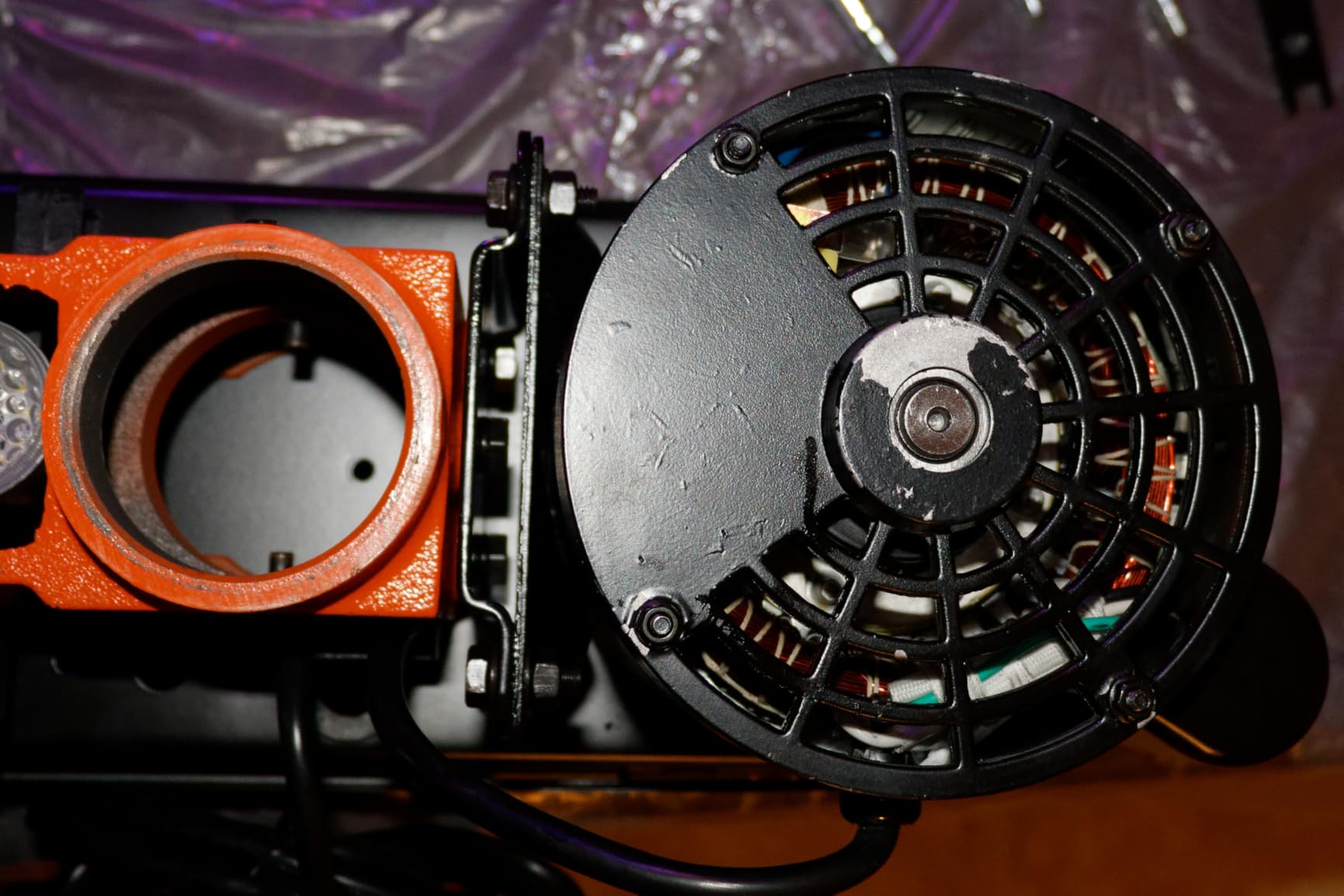
The 6.2 amp induction motor drives mechanical variable speed from 580 to 3,100 RPM, which is the second-lowest floor in the group. A digital readout shows the current RPM, and an external lever handles the speed change. The chuck is a 5/8 inch capacity keyed model, and the machine weighs 88 pounds.
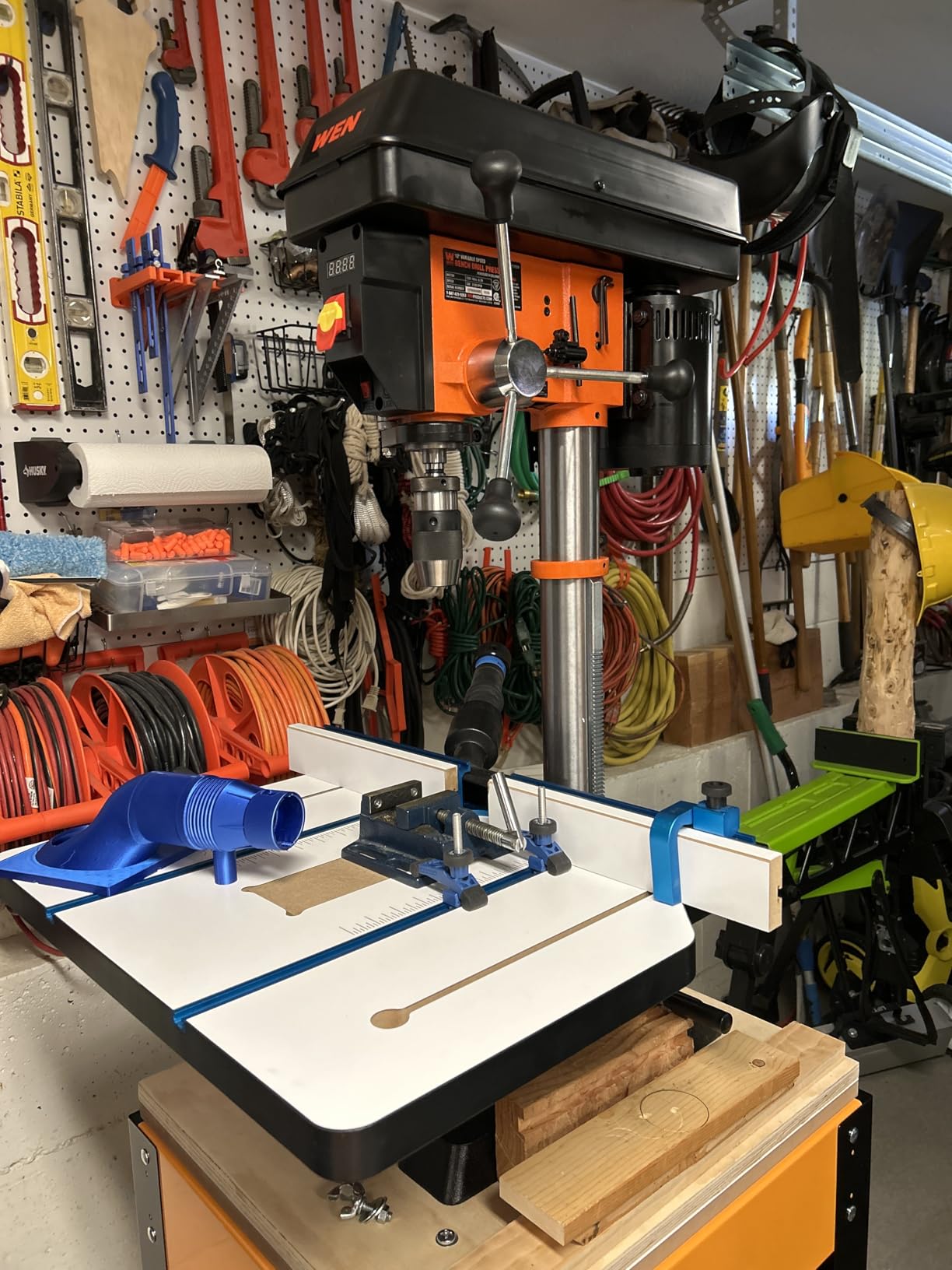
The 9-1/2 by 9-1/2 inch beveling worktable is a good size for clamping plate, and a table roller extension supports long workpieces. A Class IIIA 2.5mW laser and an overhead LED work light are built into the head, alongside an adjustable depth stop. Owners note the taper-mounted chuck appears precisely machined, and the whole package arrives with English instructions and the special tools required for assembly.
This is a heavy, planted machine. Owners describe it as very solidly built and staying put when bolted down, which is exactly the behavior you want under a plunge cut in steel.
When the extra travel earns its cost
Deep holes in thick plate, and reaming or countersinking a substantial part. If you are working in 1 inch or thicker steel, or you run large bits frequently, the travel difference between 2 inches and 3-1/8 inches is felt every single time. Paired with a 5/8 inch chuck and 744 watts, this is one of the two most capable machines here.
It is also the pick if you want a digital readout and a low-RPM floor in the 500s without stepping up to the JET. The 580 RPM minimum is a real metal speed for mild steel, and the lever control is far more convenient than a belt.
Setup issues you should plan for
The table arrives out of square front to back by more than 1.5mm with no built-in adjustment, which means you will be shimming or working around it if you care about hole position. The 45-degree tilt bolt is hard to access and fine tuning is difficult, and the table drifts as it is raised and lowered, so realignment is a recurring task.
Two practical notes. The included knurled clamps are low quality and worth replacing immediately. And at 88 pounds this machine needs a proper heavy duty stand — it is not a bench that will hold itself.
10. SHOPMAX 8-Inch 9-Speed Drill Press – Best Starter Press
SHOPMAX 8 inch 9 adjustable speeds 4.2 Amp Benchtop Drill Press
0.68 HP 4.2A motor
9 speeds from 500-3200 RPM
1/2 inch keyed chuck
2 inch travel
25.4 pounds
Pros
- Entry price point well under the rest of this roundup
- Nine speed settings give finer granularity than 5-speed rivals
- 4.2 amp motor is reasonable power for light work
- Table rotation and 45 degree tilt add setup flexibility
- Compact 25 pound footprint is easy to reposition
Cons
- Listed metal drilling capacity of 0.2 inches is the lowest here
- Specs list 5 speeds while the title advertises 9 adjustable speeds
- Lower 4.1 star average with 11 percent 1-star reviews indicates variable quality
The selling point of the SHOPMAX is speed granularity. Nine stepped settings from 500 to 3,200 RPM, against the five speeds most competitors in this roundup offer, means you can land closer to the speed you actually want instead of settling for the nearest of five options. The 500 RPM floor is also the lowest starting speed of any press in this group.
The motor is 0.68 HP at 4.2 amps, which is more than adequate for light work. The chuck is a 1/2 inch keyed model with 2 inches of travel and an 8 inch swing, and the table rotates 360 degrees and tilts up to 45 degrees in either direction. At 25.4 pounds it moves easily.
What you get for a starter machine
For someone who is buying their first press and doing occasional small metal work, the low 500 RPM floor is genuinely useful. It is the second-lowest starting speed here after the JET’s 530 RPM, and it arrives at a fraction of the cost. Combined with a rotating and tilting table, it is more flexible than most machines in its bracket.
Fine speed granularity also helps with aluminum and with brass, where the usable range is narrower and overspeeding is easy to do by accident.
The specification problem is real
Two things give me pause here. The listed metal drilling capacity is 0.2 inches, which is well below what the 1/2 inch chuck would suggest — that number is the honest statement of what the machine will do continuously in metal, and it is the lowest in this roundup.
Second, the specification listing says 5 speeds while the title advertises 9, which is exactly the kind of inconsistency that should make you slow down. With a 4.1 star average and roughly 11 percent of ratings at one star, expect some quality control variance. Check what you receive against the box before starting work.
11. VEVOR 10-Inch Cast Iron Drill Press – Best Cast Iron 10-Inch
VEVOR Benchtop Drill Press, 3.2 Amp and 5-Speed Adjustable Drill Press with 10 in Swing, Cast Iron Frame, Worktable Tilts 0-45°, Ideal for Drilling Wood & Metal
3.2A induction motor,384 watts
5 speeds 650-3100 RPM
Q235 and HT200 cast iron frame
10 inch swing
41.9 pounds
Pros
- Chuck runs true out of the box with no chatter reported
- Cast iron frame keeps the press planted instead of walking on the bench
- 10 inch swing is a real step up from 8 inch machines
- Work light is more useful than expected in low light
- Good value for outfitting a home shop without a floor model
Cons
- Belt changes require physically swinging the motor
- One unit arrived with a rusty base and another with a motor making a scraping noise
- Assembly is more involved than suggested and can exceed two hours
- Listing imagery shows a digital display and laser that this model does not have
- Slowest speed of 650 RPM is still too fast for large Forstner bits and hole saws
This VEVOR is the one to look at if you want a proper cast iron frame in a 10 inch machine without stepping up to a 12 inch press. The frame is listed as Q235 and HT200, which is the specification convention for cast iron components, and at 41.9 pounds it stays planted on the bench instead of walking when a bit catches.
The 3.2 amp induction motor drives five speeds at 650, 1050, 1800, 2350 and 3100 RPM, with a 10 inch swing giving 5 inches from column to bit center. The worktable tilts 0 to 45 degrees, and there is a heat dissipation system designed for longer run time — which matters for a 384-watt motor doing sustained metal work.
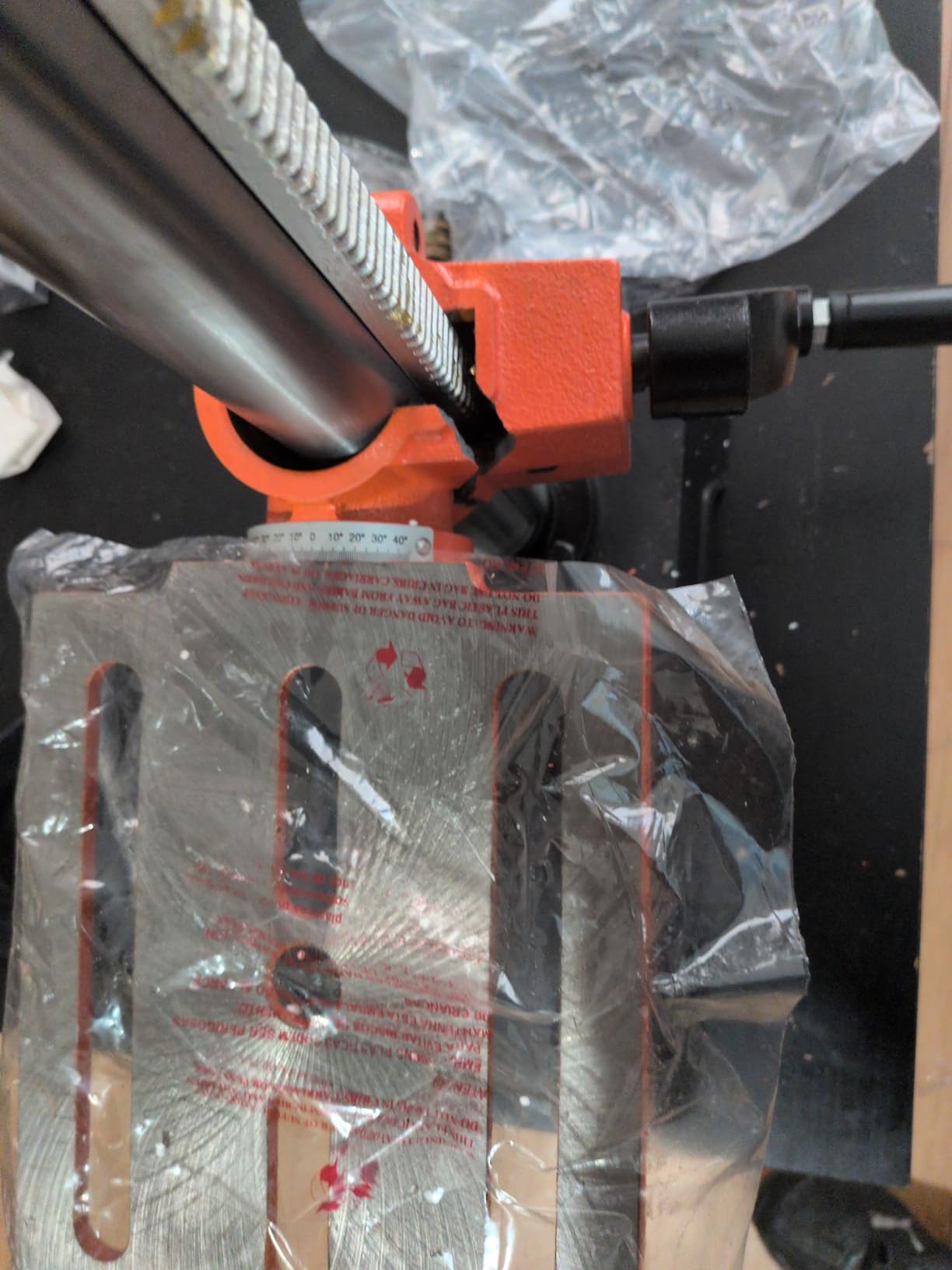
Owners report the chuck runs true out of the box with no chatter, which is a good sign for hole accuracy in metal, and the 10 inch swing is a genuine step up from the 8 inch machines in this bracket. The work light is reported as more useful than expected in low light work.
The package is complete rather than minimal: hex wrenches, table assembly, base, column assembly, crank handle, feed handles, worm gear, chuck and chuck key are all included.
Why the cast iron frame earns its place
Rigidity is the whole argument for this machine. A cast iron column does not flex under the torque reaction of a bit breaking into steel, so the hole stays on location and on diameter. If you have been burned by a press that walked or wandered, that is the failure this frame is designed to prevent.
The 10 inch swing also gives more room to position a workpiece than the 8 inch machines at a similar size, and the longer run time design suits repeated drilling rather than occasional hole-making.
What to expect on arrival and during setup
Assembly is the main complaint. Owners report it taking considerably longer than the suggested 25 to 30 minutes, and sometimes more than two hours. Budget that time and read the sequence carefully.
There are also quality reports worth knowing about: one unit arrived with a rusty base and another with a motor making a scraping noise. Check both before you start. Separately, listing imagery shows a digital display and laser that this model does not have, so judge the machine on the specification list, not the photos. The 650 RPM floor is workable for mild steel but too fast for large hole saws.
12. WEN DP1050 10-Inch Drill Press – Best for Hole Saws
WEN 10-Inch Benchtop Drill Press, Chuck Key Storage, Laser Guide, 6.2-Amp 5-Speed Motor with Cast Iron Construction, Laser and LED Work Light (DP1050)
6.2A motor with 30 ft-lb torque
5 speeds 630-3300 RPM
1/2 inch chuck
2 inch spindle travel
28.75 inches tall
Pros
- 6.2 amp motor provides good torque including on hole saw work
- Quiet operation and a well built overall structure
- Laser and LED work light are useful additions
- Shaft to table tilt alignment was good out of the box
- Chuck key storage clip is a practical touch
- Fabricators report it works well for general shop work
Cons
- Slim table edges and a small 7.5 x 6.5 inch table limit workpiece support
- Post alignment is off and cannot be adjusted
- Belt adjustment is a chore and requires turning the pulleys by hand
- Assembly instructions contain errors such as referencing holes that are not present
- Some units show spindle runout from an overly tight factory belt
Torque is the number to notice here. The specification lists 30 ft-lb, and owners single out hole saw work as a place where the 6.2 amp motor delivers where weaker machines stall. If you cut round holes in plate with a hole saw, that is a real capability rather than a claim.
Speeds are five belt-adjusted settings at 630, 1100, 1800, 2450 and 3300 RPM, with a 10 inch swing and 2 inches of spindle travel. The machine stands 28.75 inches tall on an 8.2 by 13.5 inch base, which keeps it in bench-friendly territory even with the larger motor.
A Class IIIA 2.5mW laser and an LED work light are fitted, along with an adjustable depth stop and a height-adjustable beveling worktable. The 1/2 inch chuck has an onboard chuck key storage clip, and there is a two-year warranty.
Where it does well
General fabrication work is where this press earns its place. Owners in a fab shop report it working well for routine shop drilling, and the motor has the headroom for hole saw work where the smaller 8 inch machines in this roundup give up. The laser and light are genuinely useful additions rather than filler.
Operation is quiet, the structure is well built, and the shaft-to-table tilt alignment was good out of the box, which is better than several machines here that need shimming.
What to fix before you rely on it
The table is the weak point. At 7.5 by 6.5 inches with slim edges, it gives limited workpiece support, and post alignment is off with no way to adjust it. Check the bit center against the laser and correct before drilling anything critical.
Belt adjustment is a chore requiring you to turn the pulleys by hand, and some units show spindle runout from an overly tight factory belt — loosen and re-tension it on day one. Assembly instructions also contain errors, including references to holes that are not present, so work from the parts rather than the diagrams.
How to Choose a Benchtop Drill Press for Metal
Buy on RPM floor first. Every other consideration is secondary. A press that bottoms out at 750 RPM can drill mild steel with the right bit. One that reaches 500 RPM can drill stainless and hardened plate. This single number does more for your metalwork than a bigger motor does.
Then buy on motor class. Aim for 6 amps or more if you can. At 744 watts the 6.2 amp machines here handle half-inch work in steel without stalling, and they do not overheat during a long run. The 2.3 amp machines are fine for sheet and light plate, and owners do report overheating on sustained metal drilling with the smallest motors.
Chuck capacity next. Half an inch covers most hobby and garage work. Five-eighths of an inch, as on the 12-inch BUCKTOOL, the WEN DP1263V and the Genesis GDP1005A, opens up larger hole saws, reamers and fasteners. Choose based on the largest bit you expect to use, not the smallest.
Frame material is a dividing line. Cast iron tables and bases resist the torque reaction from a plunge cut. Owners who moved from plastic-frame presses to cast iron report the difference as night and day on hole location in thick plate. If a listing does not say cast iron, assume it is not.
Check spindle travel against your deepest hole. Two inches is adequate for sheet and moderate plate. Three and one-eighth inches, on the WEN DP1263V, is what you want if you routinely work in thicker sections. Remember that the bit needs a diameter plus a point of clearance above the hole depth, so a half-inch bit in a one-inch hole needs well over an inch of travel.
Verify alignment on day one. A laser is only as good as the table underneath it. Several presses in this roundup arrive with the table out of square or not zeroed. Set the bit where you want it, drill a test hole in scrap, and check that it lands where the laser says it will before you drill anything you care about.
Pick depth stops and vises deliberately. Repeat hole patterns are where an adjustable depth stop pays back quickly. For positioning, a cross-slide vise is far more useful than tilting a round table — and note that the 12-inch BUCKTOOL’s flat round table is good for clamping work directly but not ideal for holding a vise.
Set up for metal properly. Clamp the work, do not hold it. Use cutting fluid on steel or stainless to carry heat and swarf away, keep a brush or chip puller within reach so chips never wrap around the bit, and wear eye protection. If you plan to cut plate rather than just drill it, our guide to the [best plasma cutters for metal fabrication](https://zainichifunk.com/best-plasma-cutters-for-metal-fabrication/) covers the other half of the job.
Know when a benchtop is enough. If you routinely work on stock wider than the swing, deeper than the travel, or heavier than the table and base can react against, you have outgrown a benchtop. At that point a floor model or a radial arm press is the right purchase, not a bigger bench machine.
Frequently Asked Questions
Can you use a drill press on metal?
Yes, and for most metal work a press is better than a handheld drill. A rigid quill holds the bit on a vertical axis while a cast iron table keeps the workpiece from shifting, so holes come out on location, on diameter and square. The two requirements are a chuck that can grip the bit and a low enough speed that the bit does not generate excessive heat. Steel and aluminum are straightforward; stainless and hardened plate demand a press that reaches well below 500 RPM.
What is the best drill press for metalworking?
For most shops, the WEN 4206T is the safest starting point: a cast iron frame, a 750 RPM low speed and the largest volume of owner reports in this roundup. If your work includes stainless steel, the JET JWDP-12 is the stronger answer because its stepless control reaches 530 RPM and it runs to 3,100 RPM without belt changes. For thick plate and larger tooling, the 12-inch BUCKTOOL pairs a 5/8 inch chuck with a 744-watt motor.
Do I need a variable speed drill press for metal?
It helps more than most people expect. Stepless control lets you ease into a hole and back off when the load builds, which reduces the risk of a bit walking when it breaks through, and it lets you hold a consistent cutting speed on stainless without work-hardening the surrounding metal. Stepped belt speeds work fine for mild steel and aluminum. The real advantage appears on stainless, hardened plate and any material where heat is the failure mode.
What is the best variable speed benchtop drill press?
Among these twelve, the JET JWDP-12 is the only press with true stepless control, sweeping 530 to 3,100 RPM on a 115V single-phase supply. The WEN DP1263V and the 12-inch BUCKTOOL are close alternatives, both covering roughly 580 RPM upward with a digital readout of the current speed. The JET costs more and carries 0.5 HP, so if your work is large hole saws rather than stainless, the higher-torque machines may suit you better.
What is a good RPM for drilling metal on a drill press?
As a starting point, mild steel at about 65 surface feet per minute, which means roughly 500 RPM for a quarter-inch bit and 250 RPM for a half-inch bit. Stainless sits lower, around 40 to 50 surface feet per minute, so a quarter-inch bit wants about 300 RPM. Aluminum can run two to three times the steel speed, and cast iron sits close to mild steel. The lower limit of your press decides whether you can hit those numbers for a given bit diameter.
What is the best heavy-duty benchtop drill press?
Heavy duty in this class means at least a 6.2 amp induction motor and a cast iron column, base and table. Three machines here qualify on power: the 12-inch BUCKTOOL, the WEN DP1263V and the SKIL DP9505-00, all around 744 watts. The 12-inch BUCKTOOL adds the largest chuck at 5/8 inch and 2 inches of spindle travel. The WEN DP1263V is the heaviest at 88 pounds and has the most travel at 3-1/8 inches.
What is a good quality bench drill press?
Look for these five things, in order: a cast iron column, table and base; a chuck of 1/2 inch or larger; a low speed at or below 650 RPM; a spindle travel of at least 2 inches; and a manufacturer warranty of two years or more. A laser guide and a depth stop are useful on repeat work but matter less than the frame. If a listing does not state the frame material, treat that as a warning sign rather than a neutral detail.
Conclusion
The best benchtop drill press for metal is not the one with the biggest number on the box. It is the one that combines a low speed floor, enough torque to push a bit through steel, and a rigid cast iron frame that does not move when the bit catches. Get those three right and almost anything else on the specification sheet is a convenience feature.
For most shops, start with the WEN 4206T. It is compact, quiet, and proven by more owners than anything else here, and it will drill mild steel and plate without drama. If you want more headroom and a stronger feature set, move up to the SKIL DP9505-00. If you are drilling stainless, go straight to the JET JWDP-12 and its stepless 530 to 3,100 RPM range. And if you want the largest chuck and the most travel for thick plate, the 12-inch BUCKTOOL and the WEN DP1263V are the two machines to compare.
Whichever you choose, bolt it to a solid bench, square the table to the bit before your first hole, and clamp your work rather than holding it. Those three habits will improve your results more than any specification on this list.