
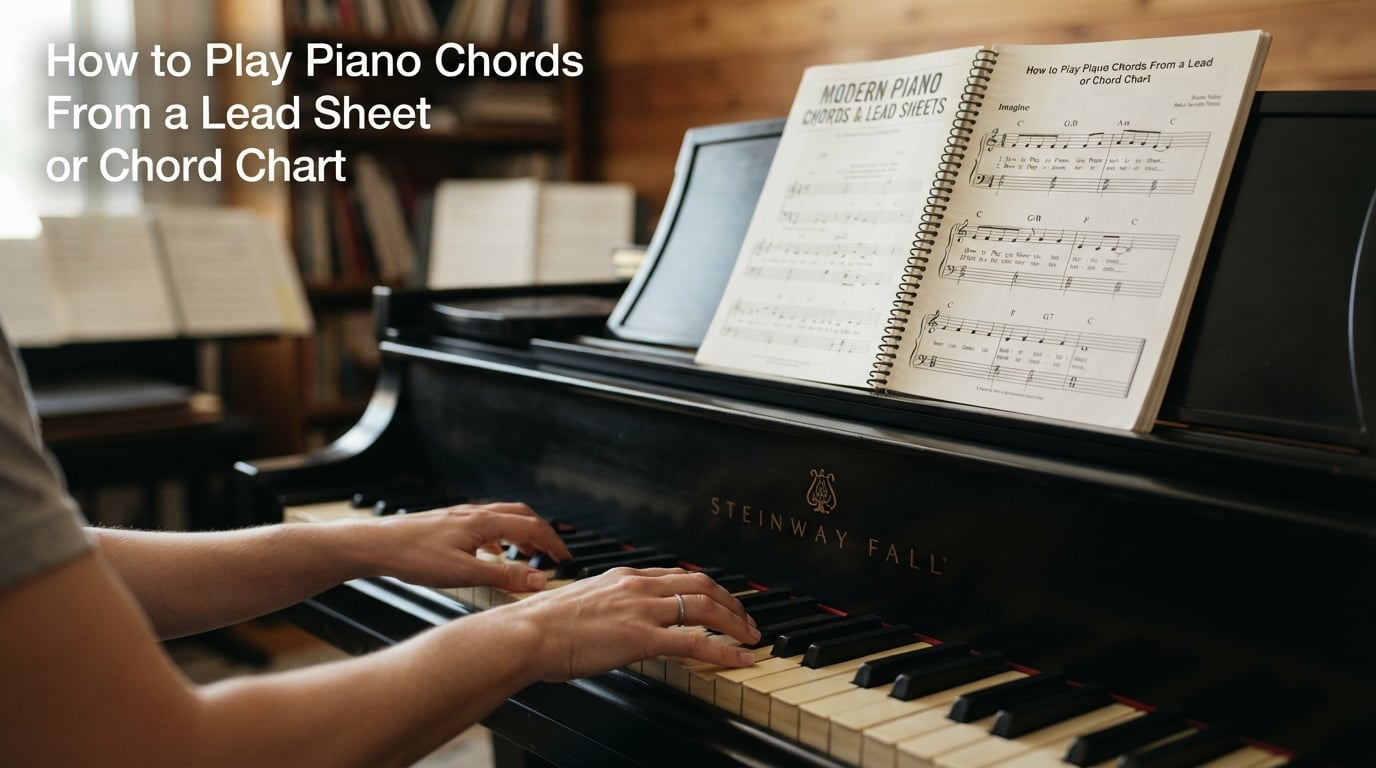
Learning how to play piano chords from a lead sheet or chord chart opens up a world of creative freedom at the keyboard. Instead of reading every single note off the page like traditional classical sheet music, you get a melody line and a set of chord symbols, then you decide how to bring the harmony to life. This skill is essential for church musicians, jazz players, pop accompanists, praise band members, and anyone who wants to pick up new songs quickly.
I have watched classically trained pianists freeze the moment they encounter their first chord chart. They could sight-read a Beethoven sonata without breaking a sweat, but staring at letters and symbols scrawled above a melody line left them completely stuck. The truth is that reading chord symbols is a fundamentally different skill from reading standard notation, and the transition can feel jarring if nobody ever showed you the bridge between the two worlds.
The good news is that anyone can learn this skill with the right step-by-step approach. In this guide, I will walk you through everything from basic chord construction to advanced left hand patterns. You will learn exactly what lead sheets and chord charts are, how to decode every type of chord symbol, and practical techniques for both hands that you can apply immediately. By the end, you will have a clear framework for turning any chord chart into full, rich piano music.
Whether you have been playing for one year or twenty, the concepts here progress from simple to advanced so you can jump in at your level. I will also address the most common beginner frustrations that come straight from real piano forums, because knowing the theory is only half the battle. Let us get started.
Table of Contents
What Is a Lead Sheet? Understanding Chord Charts and Sheet Music Freedom
A lead sheet is a form of music notation that shows the melody line in standard notation with chord symbols written above it, giving the performer freedom to interpret the accompaniment. Think of it as a musical skeleton. The melody tells you what to play with your right hand, and the chord symbols tell you what harmony supports that melody, but the specific voicing, rhythm, and texture are entirely up to you.
A chord chart is even more stripped down. It typically contains only the chord symbols and lyrics, with no notated melody at all. You might see a chord chart in a worship band setting, a rock band rehearsal, or a fake book where everyone already knows the tune. The chart simply tells you when to change chords and which chords to play, leaving all the creative decisions in your hands.
Both formats stand in sharp contrast to traditional piano sheet music, where every note, rhythm, dynamic, and articulation is spelled out for you. With standard notation, your job is to reproduce what the composer intended. With a lead sheet or chord chart, your job is to create an accompaniment that supports the melody and fits the style of the music. That freedom is what makes chord-based playing so powerful, but it is also what makes it intimidating for beginners.
Why does this matter so much? Because lead sheets and chord charts let you learn songs in minutes instead of weeks. A single chord chart can serve a pianist, a guitarist, a bassist, and a vocalist all at the same time. Once you understand how to read and interpret these symbols, you can sit in with a band, accompany a singer, play at church, or jam with friends without needing fully notated arrangements for every single song.
Many players I have worked with describe a lightbulb moment when chord symbols finally click. They realize that a chord symbol like Cmaj7 is not a mysterious code but a clear instruction telling you to play the notes C, E, G, and B together. Once that connection happens, the entire world of pop, jazz, and contemporary music opens up. That moment is what this guide is designed to get you to.
Piano Chord Basics: Types You Need to Know
Every chord you will ever encounter on a lead sheet is built from the same basic ingredients. A chord is simply three or more notes played simultaneously, and the distance between those notes, called intervals, determines the chord type. Before you can read chord symbols fluently, you need to understand how the five core chord types are constructed.
Every chord starts from a root note, which is the letter name of the chord. From that root, you stack additional notes at specific intervals to create different qualities and emotions. Let me break down each chord type with clear formulas you can apply on any key.
Major and Minor Triads
A triad is a three-note chord built by stacking two thirds on top of a root note. Triads are the foundation of all Western harmony, and every more complex chord is simply a triad with extra notes added on top. Master triads first, and everything else becomes much easier to understand.
A major triad consists of a root, a major third (4 half steps above the root), and a perfect fifth (7 half steps above the root). For example, a C major triad contains the notes C, E, and G. Major triads sound bright, happy, and stable, making them the most common chord type in pop and folk music.
A minor triad uses a root, a minor third (3 half steps above the root), and a perfect fifth. A C minor triad contains C, E-flat, and G. Minor triads sound darker, sadder, or more serious than their major counterparts. On a chord chart, a capital letter alone means major, while a lowercase m or a minus sign after the letter means minor.
Practice tip: play every major and minor triad starting on all 12 roots. This builds muscle memory so that when you see a chord symbol on a lead sheet, your hands know exactly where to go without conscious thought. This is the foundation of fluent chord-chart reading.
Seventh Chords
Seventh chords add a fourth note to the triad, creating richer and more colorful harmony. The added seventh note changes the character of the chord dramatically, which is why seventh chords are everywhere in jazz, blues, and contemporary worship music. There are four main types you need to recognize.
A dominant seventh chord, written as C7, adds a minor seventh (10 half steps above the root) to a major triad. The notes are C, E, G, and B-flat. Dominant sevenths have a bluesy, restless quality that wants to resolve to another chord. A major seventh chord, written Cmaj7, adds a major seventh (11 half steps) instead, giving you C, E, G, and B. Major sevenths sound smooth, jazzy, and lush.
A minor seventh chord, written Cm7, combines a minor triad with a minor seventh, producing C, E-flat, G, and B-flat. These sound mellow and sophisticated. A minor seventh flat five chord, also called a half-diminished seventh and written Cm7b5, lowers the fifth as well, producing C, E-flat, G-flat, and B-flat. This chord is essential for playing minor-key jazz progressions.
When you see a seventh chord on a lead sheet, you do not always have to play all four notes. In fact, many experienced players intentionally drop the fifth or even the root when playing with a bass player, keeping only the thirds and sevenths. These two notes define the chord quality and are called chord shells.
Augmented and Diminished Chords
Augmented and diminished chords are less common than major and minor, but they add dramatic tension and color to chord progressions. You will encounter them frequently in jazz standards, film music, and some pop songs, so knowing how to build and recognize them is important.
An augmented triad, written Caug or C+, stacks two major thirds on top of the root. The notes are C, E, and G-sharp. Augmented chords have an unsettled, floating quality that feels like it could resolve in several different directions. They often appear as passing chords between major chords or as dramatic color chords.
A diminished triad, written Cdim, stacks two minor thirds. The notes are C, E-flat, and G-flat. Diminished chords sound tense and dissonant, making them useful for creating forward motion in a progression. A fully diminished seventh chord, written Cdim7, adds another minor third on top, giving you C, E-flat, G-flat, and A. This symmetrical structure means every inversion sounds like another diminished seventh, which is a fascinating and useful property.
Do not stress about memorizing every diminished and augmented chord on day one. Focus on major, minor, and seventh chords first, since those cover roughly 90 percent of what you will see on typical lead sheets and chord charts. Come back to augmented and diminished chords once those basics feel automatic.
How to Read Chord Symbols on Piano?
Reading chord symbols is like learning a new alphabet. Once you know the rules, you can decode any chord chart at sight. The system is actually quite logical, and with a little practice, you will recognize patterns instantly. Let me break down the anatomy of a chord symbol and show you exactly what each part means.
The Anatomy of a Chord Symbol
Every chord symbol has two essential parts and sometimes optional additions. The first part is the root, which is always a letter name like C, F-sharp, or B-flat. The second part is the quality indicator, which tells you what type of chord to build from that root. Optional additions include extensions, alterations, and bass note specifications.
Here is the decoding key you will use constantly. A capital letter alone, such as C, means a major triad. A capital letter followed by m, min, or a dash, such as Cm or C-, means a minor triad. The number 7 after the letter, as in C7, means a dominant seventh. The abbreviation maj7 or a triangle symbol after the letter means a major seventh chord.
For diminished chords, look for the abbreviation dim or a small circle. For augmented chords, look for aug or a plus sign. The symbol sus means a suspended chord, where the third is replaced by either a second or a fourth. For example, Csus4 means play C, F, and G instead of C, E, and G, creating an open, unresolved sound.
One of the biggest sources of confusion for beginners is understanding what numbers mean in piano chords. Numbers always refer to scale degrees added to the basic triad. A 6 means add the sixth scale degree, a 9 means add the ninth (which is the same as the second, played an octave higher), and so on. Once you internalize this system, every chord symbol becomes a clear formula.
Slash Chords Explained
Slash chords look intimidating but are actually simple once you understand the convention. A slash chord is written as two parts separated by a slash, such as C over E or G over B-flat. The letter before the slash tells you what chord to play, and the letter after the slash tells you what note should be in the bass, played lowest by your left hand.
So C/E means play a C major triad but put E in the bass instead of C. G/B-flat means play a G major triad with B-flat as the lowest note. Slash chords are used for two main reasons: to create smooth bass lines that walk between chord changes, and to specify a particular inversion without using Roman numeral analysis.
Slash chords are incredibly common in pop music, worship music, and jazz. When you see a series of slash chords in a progression, the composer is usually guiding the bass line step by step. Pay attention to the bass notes because they often create a melodic line of their own underneath the chords. Your left hand should prioritize playing that specified bass note clearly and strongly.
A common mistake beginners make with slash chords is ignoring the bass note entirely and just playing the chord in root position. This defeats the entire purpose of the slash notation. Always honor the bass note specification, even if it means revoicing the rest of the chord in your right hand to accommodate it.
Chord Extensions: 9ths, 11ths, and 13ths
Extensions add notes beyond the seventh to create even richer, more colorful harmony. These appear most often in jazz lead sheets and sophisticated pop arrangements. The number tells you which scale degree to add on top of the basic seventh chord. A C9 adds a D, a C11 adds an F, and a C13 adds an A.
You rarely play every single note in an extended chord. With five, six, or even seven notes in a C13, trying to play them all would sound muddy and cluttered. Experienced pianists selectively choose which extensions to include based on context, taste, and what the melody is doing. A good starting rule is to always include the third, the seventh, and whichever extension is specified in the symbol.
Extensions can also be altered with sharps and flats. You might see C7b9, which means play a dominant seventh with a flatted ninth, or C7#11, which adds a sharped eleventh. These alterations create distinctive colors that are staples of jazz harmony. Start with plain 9ths and 11ths before exploring altered extensions, which require more theoretical context to use effectively.
Lead Sheet vs Chord Chart: What Is the Difference?
Many beginners use the terms lead sheet and chord chart interchangeably, but they refer to two different formats with different levels of detail. Understanding the distinction helps you know what to expect when someone hands you music at a rehearsal or gig. Both formats rely on chord symbols, but they serve different purposes and require slightly different skills.
A lead sheet includes the melody notated in standard notation along with chord symbols and lyrics. This gives you both the tune and the harmony, making lead sheets ideal when you need to play the melody yourself or when you are the primary instrumentalist. The Real Book, the most famous collection of jazz standards, is entirely composed of lead sheets. You will also see lead sheets in musical theater, pop collections, and many worship songbooks.
A chord chart, by contrast, contains only the chord symbols and often the lyrics, with no notated melody at all. The assumption is that you already know the tune or that someone else is singing it. Chord charts are common in band settings where multiple musicians share the same page, such as a rhythm section at church or a cover band at a gig. Nashville Number System charts are a specialized type of chord chart that uses numbers instead of letter names.
Here is a quick comparison to keep the two straight. A lead sheet gives you melody plus chords, making it self-contained and ideal for solo piano or when you need to carry the tune. A chord chart gives you only chords, relying on your ear or a vocalist to supply the melody. Lead sheets require standard notation reading skills, while chord charts require only chord symbol literacy and a good ear.
In practice, most pianists need to work with both formats. You might use a lead sheet when practicing alone at home and a chord chart when playing with a band. The chord-reading skills you develop for one transfer directly to the other, so do not worry too much about which format you start with. The key is getting comfortable with chord symbols themselves.
Left Hand Piano Techniques for Lead Sheets
Your left hand is the engine that drives the harmony when you play from a lead sheet or chord chart. While your right hand plays the melody or fills in chord tones, the left hand provides the bass, the rhythm, and the harmonic foundation. I recommend progressing through these techniques in order, mastering each one before moving to the next.
Step 1: Single Bass Note
The simplest left hand technique is playing just the root of each chord as a single bass note. When you see a C chord, play a low C. When you see an F chord, play a low F. This approach gives you basic harmonic support without overwhelming the melody, and it is the perfect starting point for absolute beginners.
Playing single bass notes lets you focus entirely on reading the chord symbols and switching keys smoothly. Practice moving between common chord progressions like C to F to G or C to Am to F to G, playing only the root in your left hand while your right hand plays the melody. Once this feels automatic, you are ready to add more complexity.
Step 2: Octaves
Playing the root in octaves, meaning the same note an octave apart, adds depth and power to your bass line without adding any new theory. Instead of playing a single C, play a low C and the C an octave above it. This fuller sound is especially useful when accompanying a singer or playing in a group where you need more presence.
Octaves also make your bass line more rhythmic. Try playing the lower octave on beat one and the higher octave on beat three, creating a steady pulse that anchors the harmony. This simple pattern works beautifully for hymns, pop ballads, and any medium-tempo song where you want a solid foundation without busy activity in the left hand.
Step 3: Blocked Triads
Blocked triads mean playing the full three-note chord in your left hand all at once. Instead of just the root, you play root, third, and fifth together. This creates a much fuller harmonic sound and is the next logical step after single bass notes and octaves. Practice playing blocked triads for every chord in a progression, keeping them in a comfortable range that does not clash with the melody.
One thing to watch out for with blocked triads is keeping them out of the muddy low register. Triads played below the C below middle C tend to sound thick and indistinct. Try to keep your left hand triads between the C below middle C and the C one octave below that for the clearest, most balanced sound.
Step 4: Chord Shells
Chord shells are two-note left hand voicings that contain only the third and the seventh of a chord. These two notes define the quality of the chord more than any others, making shells an efficient and sophisticated left hand option. For a Cmaj7 chord, the shell would be E and B. For a C7, the shell would be E and B-flat.
Chord shells are the bread and butter of jazz piano and work beautifully in any style where you want a clean, uncluttered sound. They leave plenty of sonic space for the right hand, the vocalist, or other instruments. Practice finding the third and seventh of every chord type so you can construct shells quickly when reading chord charts.
Step 5: Alberti Bass and Waltz Patterns
Alberti bass is a broken chord pattern where the notes of a triad are played in a rolling sequence, typically lowest, highest, middle, highest. For a C major chord, you would play C, G, E, G repeatedly. This pattern, named after the classical composer Domenico Alberti, creates a gentle, flowing accompaniment that works beautifully for slower songs and classical-style arrangements.
The waltz pattern is similar but adapted for songs in three-four time. You play the root on beat one, then the fifth and third together on beats two and three. This creates the familiar oom-pah-pah feel of a Viennese waltz. Both Alberti bass and waltz patterns add rhythmic interest to your left hand, moving beyond static blocked chords into something more musical and engaging.
Which technique should you use when? Match the complexity of your left hand to the style and tempo of the song. Single bass notes and octaves work for fast tempos and simple settings. Blocked triads suit medium-tempo pop and worship songs. Chord shells shine in jazz and sophisticated arrangements. Alberti bass and waltz patterns fit classical-influenced or romantic pieces. There is no single right answer, so experiment and trust your ear.
Variation Techniques: Blocked, Broken Chords, and Inversions
Once you have a solid left hand technique, the next step is learning how to vary your accompaniment so it does not sound repetitive or mechanical. Variation is what separates a robotic chord-chart reader from a musician who truly makes a song their own. Let me walk you through the most important variation techniques.
Blocked Chords vs Broken Chords
Blocked chords are played all at once, with every note striking simultaneously. Broken chords are played one note at a time in sequence, creating a flowing, arpeggiated texture. Arpeggios are a specific type of broken chord where the notes are played in order, either ascending or descending, creating a harp-like cascade of sound.
The choice between blocked and broken chords dramatically changes the character of your accompaniment. Blocked chords sound definitive and rhythmic, making them ideal for upbeat songs, rock, and driving pop music. Broken chords and arpeggios sound gentle and flowing, perfect for ballads, slow worship songs, and introspective pieces. Mixing the two within a single song creates dynamic contrast that keeps listeners engaged.
Try this exercise: take a simple four-chord progression and play it three different ways. First, play everything as blocked chords. Then switch to broken chords with the notes rolling upward. Finally, try arpeggios that span a full octave or more. Notice how the same progression takes on three completely different moods. This is the power of variation techniques.
Inversions and Voice Leading
Chord inversions rearrange the order of notes within a chord so that a note other than the root is on the bottom. First inversion puts the third in the bass, second inversion puts the fifth in the bass. Inversions matter because they create smoother transitions between chords, a concept called voice leading. Good voice leading means each note moves as little as possible from one chord to the next.
Here is a practical example. If you are moving from a C major chord to an F major chord, playing both in root position requires a large jump. But if you play the C major in second inversion (G, C, E) and the F major in root position (F, A, C), the top notes barely move. This smooth connection sounds more professional and is easier to play cleanly.
Voice leading is one of those skills that separates intermediate players from advanced ones. A technique called bass flipping involves putting different chord tones in the bass to create melodic bass lines that walk between chords. When you start thinking about voice leading consciously, your chord-chart playing will immediately sound more polished and connected.
Keyboard Style vs Trio Style
Keyboard style and trio style are the two fundamental approaches to playing lead sheets, and understanding the difference helps you choose the right strategy for any musical situation. In keyboard style, your right hand plays the melody while your left hand provides the harmony, making you a self-contained one-person band. In trio style, your right hand plays chords while your left hand plays bass, mimicking the sound of a three-piece combo.
Keyboard style is ideal for solo piano performance, accompanying yourself while singing, or playing in a setting where you are the only instrumentalist. The challenge is that your left hand must carry the full harmonic weight while your right hand focuses on the melody. This is where techniques like single bass notes, octaves, and simple chord shells shine.
Trio style works best when a singer or another instrumentalist is handling the melody, freeing both your hands to create a rich accompaniment. Your left hand plays bass lines, and your right hand plays chords, fills, and rhythmic patterns. This approach is common in jazz combos, worship bands, and any setting where you are part of a larger ensemble.
Many pianists switch between the two styles within a single song. You might play the first verse in keyboard style to establish the melody, then switch to trio style for the chorus when the band kicks in. The ability to move fluidly between these approaches is a hallmark of a versatile chord-chart player.
Common Beginner Mistakes When Reading Chord Charts
Real piano forum discussions reveal several recurring frustrations that trip up beginners learning to read chord charts. One of the most common pain points is not knowing how many times to play a chord. Unlike standard notation, a chord chart does not specify exact rhythms. The general rule is that a chord symbol stays in effect until the next symbol appears, and you play it in a rhythm that matches the style and tempo of the song.
Another frequent confusion involves strumming patterns and rhythmic interpretation. Chord tabs and charts are intentionally ambiguous about rhythm because they are designed for multiple instruments. As a pianist, you need to listen to the song or feel the groove to determine an appropriate rhythmic pattern. This ambiguity feels uncomfortable at first but becomes natural with practice.
A third major mistake is confusing melody notes with chord notes. On a lead sheet, the melody is written in standard notation and the chords are written as symbols above it. The chord tells you the underlying harmony, not necessarily the notes your right hand should play. Your right hand should prioritize the melody while your left hand and any chord tones fill in around it.
Finally, many beginners know their chord names but cannot translate that knowledge into real-time playing. Knowing that Am means A, C, and E is different from instantly finding those notes on the keyboard when you see the symbol in the middle of a song. The bridge between theory and fluency is repetition. Drill chord construction until it becomes automatic muscle memory.
How to Play Piano Chords From a Lead Sheet or Chord Chart?: Your First Song
Let me tie everything together with a practical, step-by-step walkthrough you can apply to any lead sheet or chord chart. Follow these steps in order the next time you sit down with a new piece of music, and you will have a reliable system that works regardless of the genre or difficulty level.
Step 1: Scan the entire chord chart before playing a single note. Identify the key signature, look for repeated sections, and note any chords you do not recognize. Circle unfamiliar symbols so you can look them up before you start. This 30-second preview saves you from mid-song confusion.
Step 2: Play through the chord progression with just your left hand, using single bass notes or simple octaves. Focus entirely on the harmony and making smooth transitions between chords. Do not worry about the melody yet. This step locks the harmonic roadmap into your fingers and ears.
Step 3: Add the melody with your right hand while continuing the simple left hand pattern. If you are working from a chord chart without notated melody, play or sing through the tune separately first to internalize it. The goal here is to coordinate both hands without overcomplicating either one.
Step 4: Gradually add complexity to your left hand based on the techniques we covered. Move from single bass notes to blocked triads, then to broken chords or chord shells as appropriate for the style. Add inversions for smoother voice leading. Each layer of complexity should feel comfortable before you add the next.
Step 5: Experiment with variation techniques to make the arrangement your own. Mix blocked and broken chords, add rhythmic variation, and use dynamic contrast between verses and choruses. This is where you move from merely playing the chart to making music. Remember that a chord chart is a starting point, not a rigid script. Trust your ear and your musical instincts.
FAQs
How to play piano from a chord chart?
To play piano from a chord chart, start by identifying the chord symbols and playing just the root note of each chord in your left hand. Once that feels comfortable, add full triads, then experiment with broken chords, inversions, and bass patterns. Your right hand can play the melody from memory or improvise around the chord tones. Match your rhythm and style to the feel of the song, since chord charts intentionally leave rhythmic choices up to the performer.
What is the 80/20 rule in piano?
The 80/20 rule in piano means that 80 percent of the songs you will encounter use only about 20 percent of all possible chords. By mastering the most common chords (major and minor triads in common keys, plus basic seventh chords), you can play the vast majority of pop, worship, and folk music. Focus your practice on high-frequency chords and progressions for maximum return on your practice time.
What is the forbidden chord on piano?
The forbidden chord, also known as the tritone or devil’s interval, refers to the augmented fourth interval (six half steps). In medieval church music it was avoided because of its harsh, dissonant sound. In modern piano playing, this interval is used freely in dominant seventh chords and blues progressions. The term is mostly historical, but understanding tritones helps you recognize tension and resolution in chord progressions.
How to play piano through lead sheet?
To play piano from a lead sheet, read the notated melody with your right hand while using the chord symbols above each measure to guide your left hand accompaniment. Start with simple single bass notes, then progress to blocked triads, chord shells, and more complex patterns. The lead sheet gives you the melody and harmony, but you choose the voicing, rhythm, and texture based on the style of music you want to create.
Conclusion: Start Playing From Chord Charts Today
Learning how to play piano chords from a lead sheet or chord chart is one of the most rewarding skills a pianist can develop. It transforms you from someone who can only play what is written on the page into a musician who can interpret, create, and collaborate freely. The journey starts with understanding basic triads, moves through reading chord symbols, and culminates in the creative choices you make with your left hand and your voicings.
Remember that fluency comes with repetition. Pick a simple song, work through the five-step process in this guide, and practice it daily for a week. Then move to a slightly harder song and repeat. Every chord chart you play builds your vocabulary and your confidence. Before long, you will sit down at any keyboard, see a chord chart, and make music on the spot.
Your next step is to find a lead sheet for a song you already know by ear. Apply the techniques in this guide, starting simple and adding complexity layer by layer. The freedom of chord-based piano playing is waiting for you, and now you have the tools to claim it.