
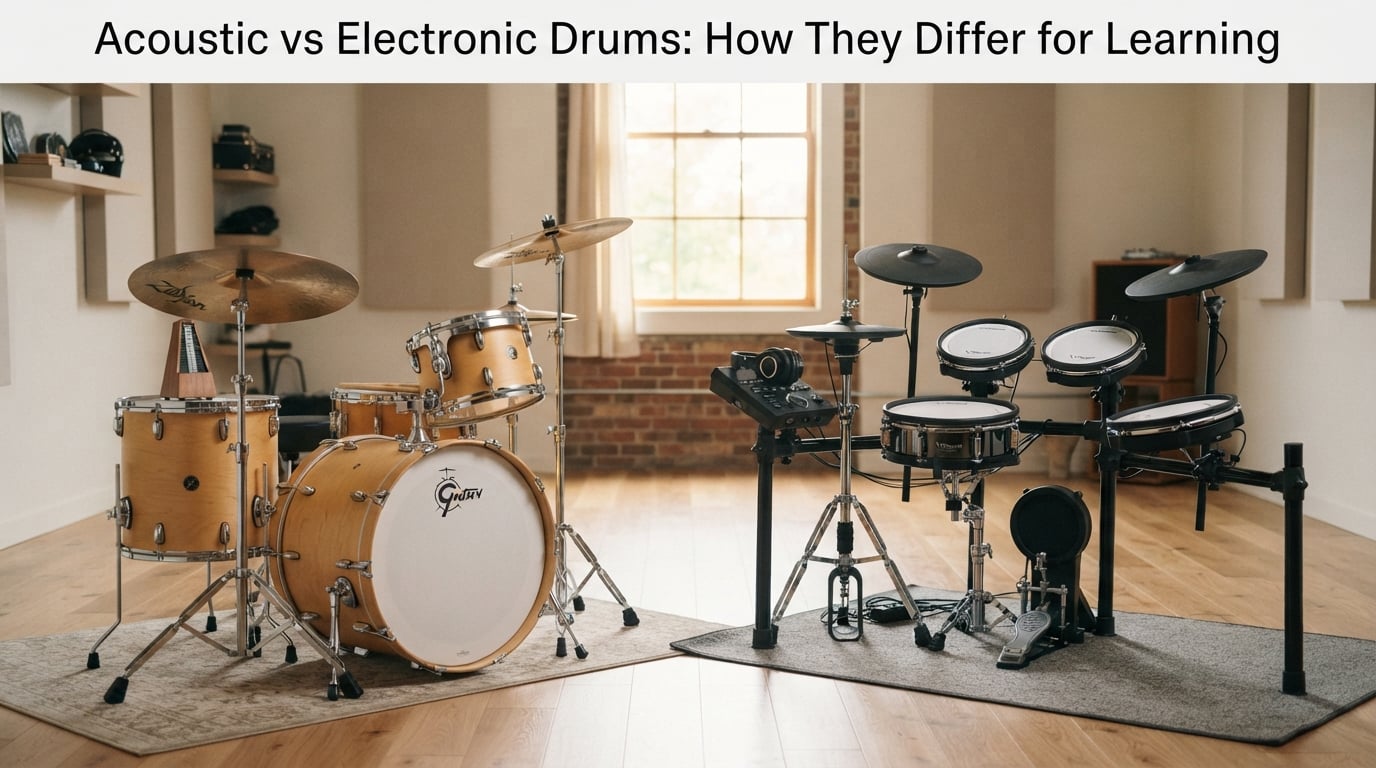
When I first sat behind a drum kit at 16, the only option was acoustic. Today, the choice between acoustic vs electronic drums is one of the first big decisions any new learner faces. I have spent the last few years testing both kinds, talking to drum teachers, and watching students progress on each. This guide breaks down exactly how the two differ and what that means for your learning curve.
The short answer: acoustic drums produce sound through physical impact on a drumhead, while electronic drums use sensors to trigger digital samples from a module. That core difference ripples out into volume, feel, cost, and how fast you improve. I will walk you through each one.
Table of Contents
How Acoustic vs Electronic Drums Actually Make Sound?
Acoustic drums are built around vibration. When a stick strikes a drumhead stretched over a wooden shell, the head vibrates, the shell resonates, and sound waves fill the room. Every part of the kit from the kick drum to the snare to the cymbals works this same way. There is no electricity, no module, no software. The drum is the speaker.
Electronic drum kits work differently. Each pad contains a trigger sensor. When you hit the pad, the sensor sends a signal to the drum module, which plays a pre-recorded sample. That sample comes out through headphones or an amp. Modern kits use mesh drum heads, which are silent until struck, so the only sound you hear is from your headphones.
Why this matters for learners: with acoustic drums, the feedback between your hands and your ears is direct and physical. With electronic drums, there is a small digital layer between your strike and the sound you hear. Both can teach you, but the feel of that feedback shapes your technique. I have noticed that beginners who learn on acoustic tend to develop cleaner dynamics because every ghost note is audible. Beginners on electronic kits sometimes overplay because the quietest hits still register.
The Role of the Drum Module in Learning
The drum module is the brain of an electronic kit. It stores the samples, controls the volume, and offers practice tools like a metronome, play-along tracks, and lesson modes. A good module can dramatically speed up learning because you get instant feedback on timing and accuracy. Acoustic kits offer none of this out of the box.
Feel and Playability Differences Between Acoustic and Electronic Drums
Acoustic drums have a natural rebound that comes from the tensioned head moving under the stick. Harder hits give more resistance. Soft taps give almost none. Real cymbals wobble and sustain. A real snare buzzes when the wires touch the bottom head. This physical response is part of why drummers fall in love with the instrument.
Electronic kits simulate that feel, but it is never identical. Mesh heads rebound more predictably and often feel bouncier than acoustic heads. Rubber pads (common on cheaper kits) feel less realistic and can fatigue your hands during long sessions. High-end electronic kits with proper mesh heads get close, but most players can still tell the difference.
For technique development, here is what I tell my own students: acoustic drums force you to learn control. You have to manage volume and dynamics physically. Electronic drums with velocity-sensitive pads also teach dynamics, but the range is often compressed and depends on the module’s settings. If you build your foundation on a quality acoustic kit, switching to electronic later is easy. If you build it on a cheap electronic kit, switching to acoustic can feel jarring.
Drum Stick Feel and Rebound
Drum stick rebound is one of the most overlooked learning factors. Acoustic heads absorb some energy and reflect some back into your stick, which over time teaches you economy of motion. Electronic mesh heads do this too, but with different resistance curves. Players used to acoustic often say electronic pads feel “too springy.” Players used to electronic say acoustic heads feel “dead.” Both are valid sensations, and either one can build solid technique if you commit.
Volume Levels: 90-120dB Acoustic vs 60-75dB Electronic
This is where acoustic vs electronic drums differ most dramatically, and it is the single biggest factor for many beginners. Acoustic drum kits produce between 90 and 120 decibels when played at full volume, depending on the kit size and how hard you hit. A full acoustic kit can hit the same volume range as a chainsaw or a jet engine at close range.
Electronic drum kits with headphones produce only 60 to 75 decibels at the pad surface, which is about the volume of normal conversation. Through speakers, you can adjust the output to whatever you want, including very low levels for late-night practice. This is why e-drums are sometimes called “quiet drums.”
For apartment dwellers, parents of young drummers, and anyone with close neighbors, this difference is decisive. I have seen talented students quit acoustic drums entirely because the noise complaints would not stop. With electronic drums and a good pair of closed-back headphones, you can practice at midnight without waking anyone. Practice frequency tends to be much higher on electronic kits for exactly this reason, and more practice means faster learning.
When Acoustic Volume Is Not a Problem
If you live in a detached house, have a soundproofed room, or play in a dedicated rehearsal space, the volume issue evaporates. Many of the best drummers I know learned on acoustic kits in basements and garages. If noise is not a constraint, acoustic offers the most natural learning environment. It also prepares you for playing with live bands, where you will eventually need real acoustic sound.
Sound Quality and Dynamic Range Compared
Acoustic drums have an essentially unlimited dynamic range. A whisper-soft press roll sounds delicate and woody. A full-throttle rimshot cuts through any mix. Every stroke has unique character based on where you hit, how the head is tuned, and the temperature of the room. That range is part of what makes acoustic drums expressive.
Electronic drums simulate this through velocity-sensitive pads and multi-layer samples. Hit softly, and you hear a soft sample. Hit hard, and you hear a louder, more aggressive sample. Modern modules are very good at this, but they still rely on a library of recorded sounds. You are playing back recordings, not creating sound. For most learners, the difference is small enough that it does not affect progress, but for tone purists, it matters.
Here is what I recommend: if you are learning to play drums primarily for fun, recording, or casual band work, electronic drums sound great. If you are training for live performance in jazz, rock, or orchestral settings where acoustic tone is the point, acoustic drums develop your ear in ways electronic cannot fully replicate.
Recording Capabilities
Electronic kits have a clear advantage for home recording. Most modules include a USB or MIDI output that connects directly to your computer and works with any DAW (digital audio workstation). You can record multitrack drums without a single microphone. Acoustic drums require multiple mics, preamps, and a quiet treated room to record well. For a beginner exploring home recording, this is a significant practical benefit.
Practice Features That Help Beginners Learn Faster
Electronic drum kits come with built-in learning tools that acoustic kits cannot match. Almost every modern module includes a metronome, play-along songs, and exercises. Many connect to apps that score your timing and track your progress. Some even have Bluetooth for streaming lessons or backing tracks from your phone.
For beginners, these features are not gimmicks. They remove the friction of setting up a practice routine. You turn on the kit, put on headphones, and the metronome is ready. No external speakers, no metronome app, no setup. Our team has watched students using built-in practice modes improve their timing in weeks, not months.
This is also where the 80/20 rule in drumming applies. The 80/20 rule states that 80% of your progress on drums comes from 20% of the techniques you practice, primarily timing, simple grooves, and consistency. Electronic kits make those high-value skills easier to drill because the metronome is built in, the tempo is adjustable, and you can hear yourself clearly through headphones. Acoustic kits require you to bring all of that yourself.
The 80/20 Rule in Practice
In practical terms, the 80/20 rule means you should spend most of your practice time on a small set of foundational skills: playing in time, basic rock beats, simple fills, and dynamic control. Fancy chops and advanced rudiments come later. Electronic kits excel at reinforcing these fundamentals because you can loop a click track at any tempo and hear every mistake clearly. Acoustic kits teach the same skills but require more discipline to self-monitor without that digital feedback.
Cost, Space, and Maintenance Considerations
Acoustic drum kits generally cost less upfront. A beginner acoustic kit can be found at a reasonable price, while a beginner electronic kit with mesh heads often costs more. Over time, acoustic kits need new heads, tuning, and occasional hardware replacement. Electronic kits have no heads to replace but may need pad or module updates over many years.
Space is another factor. A five-piece acoustic kit with cymbals takes up a lot of room. Electronic kits are more compact and often fold or break down for storage. For small bedrooms or shared spaces, electronic wins on portability.
Maintenance is where electronic kits shine. Acoustic drums need regular tuning, head changes every 6 to 12 months for active players, and occasional shell repair. Electronic pads just need a wipe-down now and then. If you want to play without thinking about upkeep, electronic is lower effort.
Frequently Asked Questions About Acoustic vs Electronic Drums
Are electric or acoustic drums better for beginners?
Both work well for beginners, and the best choice depends on your living situation. Electronic drums are better for beginners in apartments, shared housing, or late-night practice because they stay quiet with headphones. Acoustic drums are better for beginners with dedicated space who want the most authentic playing feel and dynamic training from day one. Many teachers recommend starting on acoustic if noise is not an issue, and starting on electronic if it is.
What is the 80 20 rule in drumming?
The 80/20 rule in drumming says that 80% of your progress comes from 20% of the techniques you practice, mainly timing, basic grooves, and consistency. It means beginners should focus most of their practice time on fundamentals like playing in time, simple rock beats, and dynamic control rather than advanced rudiments. Electronic kits make this easier because they have built-in metronomes and tempo control.
Are electronic drums good for learning?
Yes, electronic drums are good for learning, especially for beginners who need to practice quietly and consistently. Modern kits with mesh heads feel close to acoustic and include practice tools like metronomes, play-along songs, and app-based lessons. They are widely used by music schools and private teachers. The main trade-off is slightly less authentic feel compared to acoustic, but most learners progress just as fast on a quality electronic kit.
Is 40 too late to learn drums?
No, 40 is not too late to learn drums. Adult beginners in their 40s, 50s, and beyond make progress every day on both acoustic and electronic kits. Many drum teachers report that adult learners practice more consistently than children because they are self-motivated. The only practical consideration is choosing a kit that fits your living space and protects your hearing, which makes electronic drums a popular choice for older beginners.
Choosing the Right Drums for Your Learning Goals
The acoustic vs electronic drums decision comes down to your situation, not a universal winner. If you have the space, supportive neighbors, and want the most authentic playing experience, start with acoustic. If you need quiet practice, live in an apartment, or want built-in learning tools, start with electronic. Either path leads to real skill. I have seen students become excellent drummers on both.
Pick the kit that you will actually play every day. That is the secret. A kit that stays quiet enough for your home, or loud enough to inspire you in a dedicated room, is the one that will keep you coming back. Once you are playing daily, the rest of your progress is up to you.