
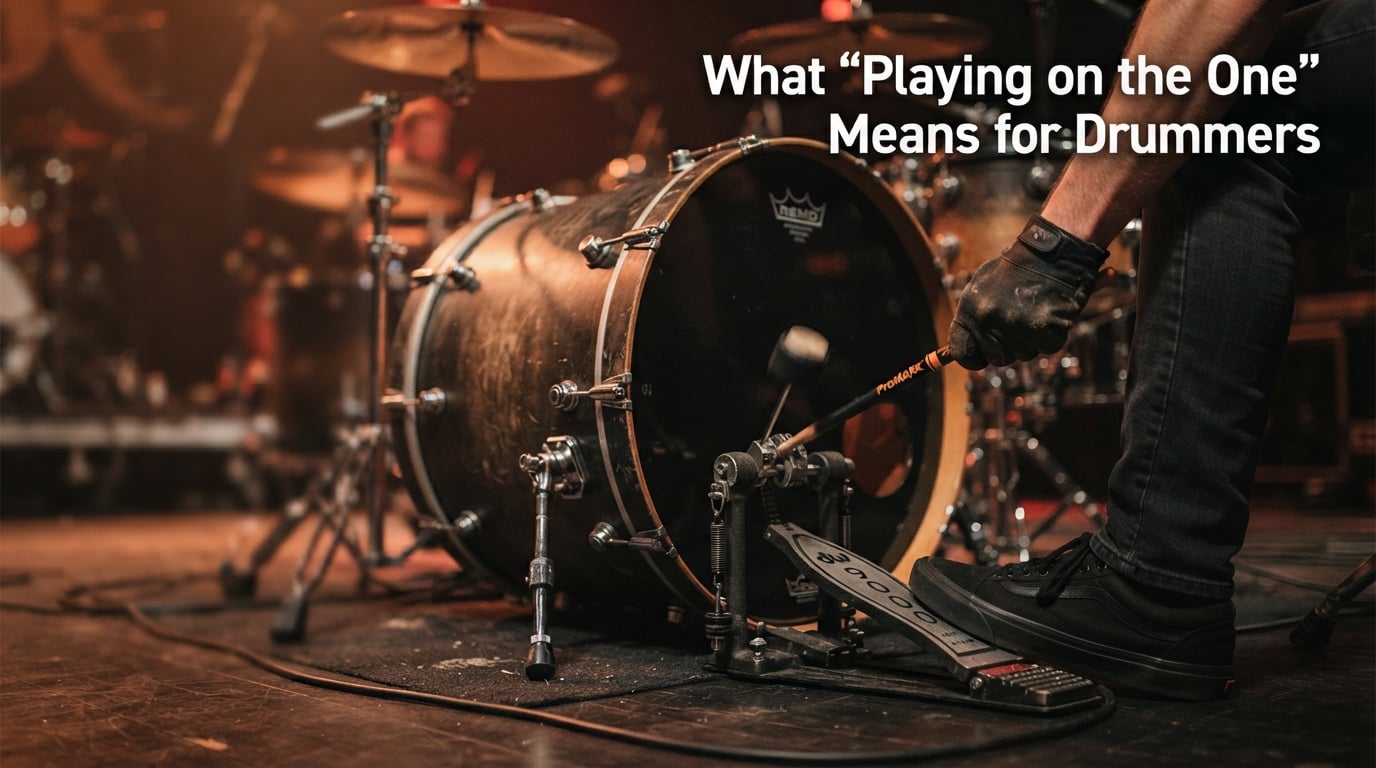
Playing on the one means putting the strongest accent of your groove on the first beat of every measure, the downbeat, so the bass drum (or another low voice) drives the song forward instead of the snare backbeat.
I learned this phrase the hard way, years into playing drums, when a funk bandleader stopped mid-song and asked, “Where is the one?” I had been counting it. I had not been playing it. Once I understood the difference, my pocket changed overnight.
If you have ever wondered what drummers mean when they say “lock in on the one,” “drop the one,” or “ride the one,” this guide will break the idea down clearly. We will look at the history, the musical effect, and a few practical exercises you can use at the kit today.
Table of Contents
What Does Playing on the One Mean for Drummers?
Playing on the one means a drummer is accenting beat 1, the downbeat, of every bar as the main pulse of the groove. Everything else (snare hits, hi-hat work, ghost notes, fills) sits on top of that pulse rather than defining it.
Think of a standard measure in 4/4. Most rock and pop drummers treat beats 2 and 4 (the snare backbeat) as the loudest moments. A funk drummer treats beat 1 as the loudest moment, usually with the bass drum, sometimes reinforced by an open hi-hat or a rim click.
The shift is small on paper and enormous in feel. When the bass drum hits on 1, your body physically leans forward into the next bar. The whole band leans with you. That is the drive funk is built on.
The One vs The And vs The Two: Quick Comparison
Playing on the one: bass drum (or another low voice) accents beat 1 of every measure. Funk, soul, hip-hop, modern R&B.
Playing on the and: emphasis lands on the “ands” between beats (the upbeats). Common in half-time shuffle feels and certain gospel grooves.
Playing on the two: the strong accent sits on beat 2 instead of beat 1. You hear this in disco, dance, and some country shuffles.
None of these is “wrong.” They are different ways of pointing the listener’s ear to a different part of the bar. Funk just happens to point hardest at the very front of the bar.
Where Did “Playing on the One” Come From?
The phrase “playing on the one” is widely credited to Clyde Stubblefield, James Brown’s drummer from 1965 to 1971. Stubblefield used it to describe how he placed his bass drum on every downbeat to push the band forward, rather than relying on snare or hi-hat to carry the feel.
James Brown’s music was a laboratory for this approach. Songs like “Cold Sweat” (1967), “Sex Machine” (1970), and especially “Funky Drummer” (1970) put Stubblefield’s downbeat bass drum pattern front and center. “Funky Drummer” has since become the most sampled drum break in music history, used by everyone from Dr. Dre and Public Enemy to N.W.A. and Prince.
Stubblefield himself summed it up in interviews: he was not counting the bar. He was counting the one, over and over, and letting everything else fall around it. That mental shift is the whole technique.
Other Drummers Who Defined the Sound
Jabo Starks – Brown’s other legendary drummer, known for a slightly heavier, more syncopated version of the same approach.
Bootsy Collins – while a bassist, his lines lock in tightly with the one and shaped how drummers think about playing with the bass.
Bernard Purdie – the Purdie Shuffle keeps the downbeat feeling strong while adding subdivisions between.
John “Jabo” Bolds and David Garibaldi – Tower of Power brought the concept into a more linear, jazz-influenced funk context.
Why Playing on the One Creates That Funk Drive
Playing on the one creates funk’s drive because the bass drum on beat 1 pulls the band physically forward into the next bar. Your ear hears a “1… 2… 3… 4” pattern, but your body feels a leaning, leaning, leaning motion toward beat 1.
This is the opposite of how most beginner drummers are taught. Drum school usually starts with the snare on 2 and 4 because the backbeat is loud and easy to feel. Funk flips that priority. The bass drum becomes the loudest voice, the snare becomes a response, and the hi-hat keeps time on top.
The Physical Sensation
When I practice this concept, I close my eyes and listen only to the bass drum. Every time it hits, I feel my shoulders drop slightly into the next measure. That tiny physical lean is what audiences respond to even if they cannot name it.
It also gives the bass player something to lock into. A great funk rhythm section is essentially a conversation between the bass drum and the bass guitar on beat 1. When those two voices agree, the rest of the band falls in line automatically.
Playing on the One vs Playing on the Two
Playing on the one accents beat 1 of every measure, while playing on the two accents beat 2 instead. Both approaches create forward motion, but they point the listener in different directions.
Playing on the one leans forward. It feels like pushing a car uphill. Playing on the two leans back. It feels like the groove is answering itself, which is why disco, Motown, and a lot of dance music use it.
Neither is more advanced than the other. They are different tools. The trick is knowing which one a song is asking for. When in doubt, listen to the bass player’s first note of the bar. If their first note lands on beat 1, you should be accenting beat 1 too.
Related Techniques That Bring Playing on the One to Life
Playing on the one is the foundation, but ghost notes, syncopation, and a tight backbeat are what make it feel human. Here are the techniques that work alongside it.
Ghost Notes
Ghost notes are very soft snare or tom hits played between the main accents. On the kit, they sit like whispers under the loud bass drum pattern. They add texture without competing with the one.
Syncopation
Syncopation means accenting unexpected subdivisions, like the “and” of 2 or the “e” of 3. Stubblefield’s groove on “Funky Drummer” is a masterclass in syncopation layered on top of a steady downbeat.
The Pocket
The pocket is the place where the drums, bass, and rhythm guitar all lock into the same groove at the same time. Playing on the one is what gets you into the pocket. Pocket is what you do once you are there.
Common Mistakes Drummers Make When Learning This
The most common mistake is treating the bass drum on beat 1 as decoration rather than the main voice of the groove. If your snare is still louder than your bass drum, you are playing on the backbeat, not on the one.
Here are the traps I see most often with students.
Counting instead of feeling. If you are saying “1, 2, 3, 4” out loud while playing, you are still in counting mode. Try counting just the one, over and over, until the rest of the bar disappears.
Letting the bass drum drag. Beat 1 should land slightly ahead of the snare backbeat, not exactly with it. This tiny push is what gives funk its urgency.
Not listening to the bass player. If your bass drum is not lining up with the bass guitar’s first note, the pocket will feel off no matter how good your hands sound.
Adding fills on top of the one. Fills should respond to the one, not interrupt it. Save the busy stuff for the end of a four-bar phrase, not the start.
Practical Exercises to Lock In Playing on the One
The fastest way to internalize playing on the one is to remove every other voice until only the bass drum on beat 1 remains. Here is the practice routine I use with my own students.
Step 1: Bass Drum Only
Set a metronome to 80 BPM. Play quarter notes on the bass drum, one hit per beat, for two minutes. Focus on even volume and even timing. This is your foundation.
Step 2: Add the Hi-Hat
Add quarter notes on the hi-hat with your right hand. Keep the bass drum strong and the hi-hat soft. You are now playing on the one with a timekeeper on top.
Step 3: Bring in the Snare on 2 and 4
Add light snare hits on beats 2 and 4. The snare should be quieter than the bass drum at first. This is the moment most students feel the shift happen.
Step 4: Play Along With Clyde Stubblefield
Put on “Funky Drummer” and try to play along, focusing only on the bass drum part. When you can match Stubblefield’s kick pattern for the full track, you have it.
I tell every student the same thing. Give this routine two weeks, ten minutes a day, and your time feel will change permanently.
An Essential Listening Guide for Playing on the One
These five tracks are the best classroom for learning what playing on the one sounds like in the wild. Put them on and focus only on the bass drum.
“Funky Drummer” – James Brown (1970). Stubblefield’s defining performance. Start here.
“Cold Sweat” – James Brown (1967). The blueprint for the entire funk drum vocabulary.
“Sex Machine” – James Brown (1970). A masterclass in locking with the bass player.
“Super Bad” – James Brown (1970). Jabo Starks shows the second version of the style.
“Chameleon” – Herbie Hancock (1973). Harvey Mason’s pocket on the one, in a jazz-funk context.
Listen once for the song. Listen again for the bass drum only. The third listen, you will hear the one before you can name it.
FAQs
What does playing on the one mean for drummers?
Playing on the one means accenting the first beat (the downbeat) of every measure with the bass drum or another low voice, so the groove leans forward into each new bar. It is the foundation of funk, soul, hip-hop, and modern Ru0026amp;B drumming.
Who started playing on the one?
Clyde Stubblefield, James Brown’s drummer from 1965 to 1971, is widely credited with popularizing the phrase and the approach. His grooves on tracks like Funky Drummer and Cold Sweat defined the sound for generations of drummers.
How is playing on the one different from playing on the backbeat?
The backbeat is the snare on beats 2 and 4. Playing on the one is the bass drum on beat 1. Most rock and pop drummers prioritize the backbeat. Funk drummers prioritize the one and treat the backbeat as a response.
How do drummers remember what to play?
Experienced drummers stop counting individual beats and focus on a single anchor point like the one. They learn patterns by feel rather than by numbers, then practice with a metronome until the patterns become automatic.
How long does it take to get good at playing on the one?
With ten minutes a day of focused practice, most drummers feel a real shift within two to four weeks. Full internalization, where the one becomes automatic in any groove, usually takes a few months of consistent playing along with records.
Final Thoughts on Playing on the One
Playing on the one is less a technique and more a way of listening. Once you hear the downbeat as the main voice of the groove instead of the snare backbeat, every funk, soul, and hip-hop record you own will sound different.
Start small. Ten minutes a day with a metronome at 80 BPM, bass drum only, will do more for your time feel than an hour of busy practice. Bring in Clyde Stubblefield’s records as a teacher. He is still the best one any of us has had.
If you are a drummer working on this in 2026, you are in good company. Players all over the world are doing the exact same routine right now, trying to put their finger on the one.