
If you’ve ever stared at one of those wheel diagrams in a music theory textbook and thought, “I know this is supposed to help me, but I have no idea how,” you’re in good company. Most Reddit threads about the circle of fifths start with someone asking what they’re actually supposed to do with it. The honest answer is: a lot more than your teacher probably explained.
The circle of fifths is the single most useful diagram in all of Western music theory. It shows how every key, scale, and chord in the 12-tone chromatic system relates to every other one. Once it clicks, you can read key signatures in seconds, predict which chords will sound good together, and move smoothly between keys mid-song.
This guide breaks down how the circle of fifths works from the ground up, then shows you exactly how to use it for chord progressions, songwriting, modulation, and real-world guitar and keyboard playing. No fluff, no jargon dumps, just the practical stuff that musicians actually need.
Table of Contents
What Is the Circle of Fifths?
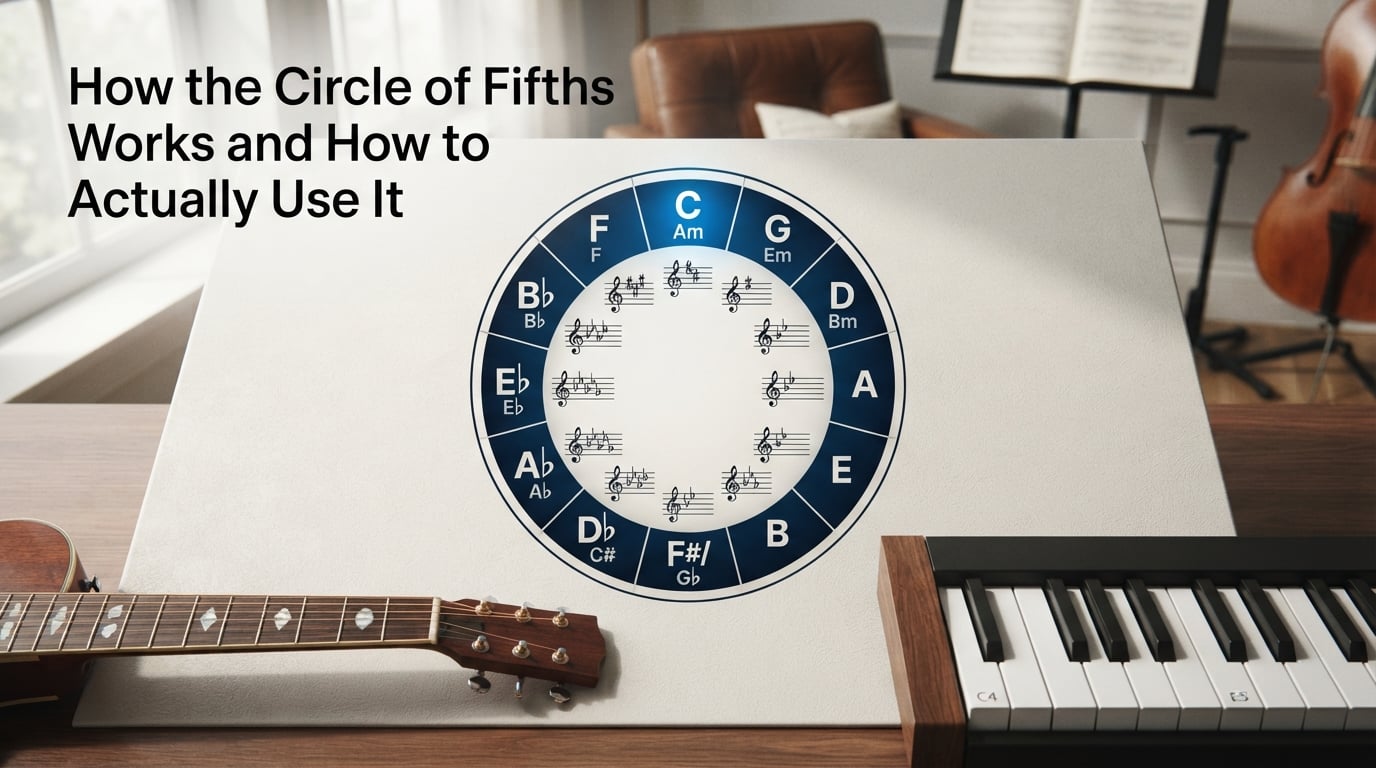
The circle of fifths is a circular diagram that arranges all 12 notes of the chromatic scale around a clock face, with each note placed a perfect fifth interval away from its neighbors. It’s a map of how keys, scales, and chords relate to each other in Western music.
Picture a clock. At the 12 o’clock position sits C. Move one step clockwise and you land on G. Another step takes you to D, then A, then E, and so on. Each clockwise step is a perfect fifth up from the previous note, which is the entire reason it’s called the “circle of fifths.”
So what’s a perfect fifth? It’s an interval spanning seven semitones, or three-and-a-half whole steps. On a piano, if you play a C and then the G directly above it, you’ve just played a perfect fifth. It’s one of the most consonant, stable-sounding intervals in music, which is why it forms the backbone of this entire system.
The diagram has been around in some form since the late 1600s, with Russian music theorist Nikolai Diletsky publishing an early version in his 1679 treatise. The basic idea hasn’t changed in over three centuries because, frankly, it works. The 12-tone system hasn’t changed either, so the math underneath hasn’t either.
Here’s the part most explanations skip: the circle isn’t just a reference chart. It’s a relationship engine. Adjacent keys on the circle share most of their notes, which means their chords naturally flow into each other.
Jump across the circle and you’ll get more dissonant, surprising key changes. The geometry of the wheel literally predicts what will sound smooth versus what will sound jarring.
How the Circle of Fifths Works: Reading the Diagram
The circle of fifths works as a two-directional map. Moving clockwise around the circle adds one sharp to each new key. Moving counter-clockwise adds one flat.
C major sits at the top with zero sharps and zero flats because it’s the neutral starting point of the system. Start at 12 o’clock on C and one step clockwise lands on G major, which has one sharp (F#). The next step lands on D major with two sharps (F# and C#), then A major with three, E major with four, B major with five.
Each clockwise step adds exactly one sharp to the key signature. This continues until you reach the bottom of the circle around F#/Gb, where the sharp side and flat side meet.
Now go the other way from C. One step counter-clockwise lands on F major, which has one flat (Bb). Another step takes you to Bb major with two flats, then Eb major with three, Ab major with four, and onward. Each counter-clockwise step adds exactly one flat.
Why do these two directions behave differently? It comes down to how the major scale is constructed. The major scale uses a specific pattern of whole and half steps: whole, whole, half, whole, whole, whole, half.
When you start that pattern on C using only the natural notes (the white keys on a piano), everything lines up perfectly with no accidentals needed. Start on G, though, and you need to raise F to F# to keep the spacing correct. Start on D and you need both F# and C#.
Every time you move a fifth up, one more note has to be sharpened to preserve the major-scale shape. Move a fifth down (the flat direction), and the opposite happens — one note has to be flattened.
The two sides eventually meet at the bottom of the circle at a region called the enharmonic zone. F# major and Gb major sound identical on a piano because they use the exact same keys — they’re just spelled differently.
Same pitches, different names. This is what theorists call enharmonic equivalence, and it’s why the circle can close back on itself with only 12 positions.
One more structural detail worth knowing: the outer ring of the traditional circle shows major keys, and an inner ring shows their relative minor keys. We’ll get into that relationship shortly, but it’s worth picturing the wheel as having two concentric layers from the start.
The Sharps and Flats Pattern (FCGDAEB Explained)
Here’s where most beginners hit a wall, then immediately get past it once they learn the trick. Sharps and flats don’t get added randomly — they always appear in the same order, and that order is the same sequence of letters going in opposite directions.
The order of sharps is: F, C, G, D, A, E, B. Memorize it once and it works forever. The first sharp in any sharp key signature is always F#. The second is C#. The third is G#, and so on.
So D major, which has two sharps, gets F# and C#. A major with three sharps gets F#, C#, and G#. The pattern never breaks.
The classic mnemonic for sharps is “Father Charles Goes Down And Ends Battle.” First letter of each word gives you F-C-G-D-A-E-B. Some people prefer “Fat Cats Go Down Alleys Eating Birds” — pick whichever sticks.
Now here’s the part that genuinely delights people when they first notice it. The order of flats is the exact same sequence backwards: B, E, A, D, G, C, F. The mnemonic flips too: “Battle Ends And Down Goes Charles’ Father.”
This isn’t a coincidence. It’s a direct consequence of how the circle works. Each step counter-clockwise from C removes the most recently added sharp and effectively replaces it with a flat on a different note. The flat side is the sharp side running in reverse — same music, viewed from the opposite direction.
Practically speaking, this means you can read any key signature by counting. Three sharps on the staff will always be F#, C#, and G#, and the key is A major (or its relative minor, F# minor).
Three flats? Always Bb, Eb, and Ab — key of Eb major (or C minor). No need to memorize every key individually.
This pattern is the single biggest time-saver for anyone reading sheet music, transposing parts, or communicating with other musicians. Learn FCGDAEB once, and you’ve effectively learned all 15 major key signatures in one go.
Relative Major and Minor Keys on the Circle
Every major key has a relative minor key that uses the exact same notes and the exact same key signature. The circle of fifths pairs them up on its two rings, and the relationship is the most useful shortcut in all of diatonic music theory.
Here’s the rule: the relative minor of any major key is the note three semitones (three half steps) below the major tonic. C major’s relative minor is A minor — count down three semitones from C and you land on A.
G major’s relative minor is E minor. D major pairs with B minor. F major pairs with D minor. The pattern is consistent everywhere on the circle.
On the circle, you’ll see this shown as an inner ring of minor keys, each sitting directly inside its relative major. A minor is inside C, E minor is inside G, B minor is inside D, and so on. The geometry lines up perfectly because the relationship is mathematical.
Why does this matter? Because if you know the chords that work in C major, those exact same chords work in A minor. Same seven notes, same seven diatonic chords — just centered around a different tonic.
You can write an entire song in A minor using nothing but the white keys on a piano, just as you can in C major. The difference isn’t the notes — it’s which note feels like “home.”
In C major, the C chord feels like the resolution. In A minor, the Am chord feels like the resolution. The same collection of pitches creates two entirely different emotional colors depending on where you place the center of gravity.
This is why minor keys often feel darker or sadder without actually using any different pitches. You’re tilting the same musical material toward a different tonic, and the emotional effect is immediate. The circle shows you exactly which minor key pairs with which major key so you can flip between the two at will.
For songwriters this is gold. You can write a verse in a major key, drop into the relative minor for the chorus, and never have to learn a new set of chords. The minor relationship is built into the same key signature, and the circle makes it visible at a glance.
Key Signatures: How Many Sharps and Flats?
The circle of fifths is essentially a counting machine for key signatures. Each position on the wheel tells you exactly how many sharps or flats a key contains, and the position itself tells you which specific accidentals they are.
Starting at C major at the top with zero accidentals, the sharp keys look like this going clockwise: G major has 1 sharp, D major has 2, A major has 3, E major has 4, B major has 5, F# major has 6. Each step adds exactly one.
On the flat side moving counter-clockwise from C: F major has 1 flat, Bb major has 2, Eb major has 3, Ab major has 4, Db major has 5, Gb major has 6. Again, each step adds exactly one flat.
That’s 13 visible positions (counting C), but the 12-tone system only has 12 notes. The overlap happens at the bottom, where F# major (6 sharps) and Gb major (6 flats) are enharmonically equivalent — same pitches, different spelling.
Some versions of the circle show 15 positions to include both spellings, but they represent the same actual music. The wheel closes because the math closes.
Minor keys follow the same pattern on the inner ring. A minor has 0 accidentals (relative to C major). E minor has 1 sharp. B minor has 2. F# minor has 3.
On the flat side: D minor has 1 flat, G minor has 2, C minor has 3, and so on. The minor ring is just the major ring rotated to show the relative-minor pairing.
Want to know what notes are in any major scale? Look at the key signature. D major has 2 sharps (F# and C#), so the D major scale is D, E, F#, G, A, B, C#, D. Ab major has 4 flats (Bb, Eb, Ab, Db), so the Ab major scale is Ab, Bb, C, Db, Eb, F, G, Ab.
The circle doesn’t just label the key — it constructs the scale for you. This is also why it’s the fastest way to memorize key signatures.
Instead of rote-learning 15 separate signatures, you learn one chain: a sequence of keys each adding one accidental in a predictable order. The circle visualizes that chain as a single continuous wheel.
For performers, this matters when sight-reading. A trumpet player handed a part in E major instantly knows there will be four sharps and what they’ll be. A guitarist wanting to play something in Bb major knows to expect two flats and can mentally prepare.
The circle collapses hours of memorization into a single visual pattern. That’s why working musicians treat it like a cheat code, not a textbook diagram.
Building Chord Progressions with the Circle of Fifths
This is the section most of you are here for, and it’s where the circle of fifths stops being abstract theory and becomes a practical songwriting tool. The circle doesn’t just show you keys — it shows you which chords inside those keys tend to lead where.
Every major key contains seven diatonic chords, one built on each note of the scale. In C major those chords are C, Dm, Em, F, G, Am, and Bdim.
By convention we number them with Roman numerals: I, ii, iii, IV, V, vi, vii°. The uppercase numerals are major chords, lowercase are minor, and the ° means diminished.
The strongest chord movements in Western music follow the circle of fifths. A V chord wants to resolve to a I chord. A ii chord wants to go to V, which then goes to I. This creates the famous ii-V-I progression that powers nearly all of jazz and shows up everywhere in pop and classical music.
Look at the circle and you’ll see why. In the key of C, the V chord is G and the ii chord is D. G sits one step clockwise from C on the circle, and D sits two steps clockwise.
So the ii-V-I progression literally walks you backward along the circle of fifths toward your tonic. The progression feels resolved because each chord move is a fifth descent — the most consonant, stable motion available.
The same logic explains the I-IV-V progression that defines blues, rock, and country. In C, that’s C-F-G. F sits one step counter-clockwise from C (the flat side), and G sits one step clockwise (the sharp side).
Your tonic sits between its two most important companions on the circle, and the progression just bounces between them. That’s why I-IV-V has been the backbone of popular music for a century.
Then there’s the four-chord progression that has powered roughly half of all pop songs since 1960: I-V-vi-IV. In C major that’s C-G-Am-F.
“Let It Be” by The Beatles uses it. “Don’t Stop Believin'” by Journey uses it. “Someone Like You” by Adele uses it. The comedy act Axis of Awesome built a whole medley around the fact that dozens of hit songs share this exact sequence.
Why does it work so well? Every move in I-V-vi-IV follows circle logic. C to G is a fifth down, and G to Am is a step that swaps the roles of tonic and dominant.
Am to F is another fifth-related move. The whole progression feels balanced because it respects the circle’s geometry, even though most songwriters who use it have never looked at the diagram.
For an example in the flat direction, look at “I Will Survive” by Gloria Gaynor. The verse moves Am-Dm-G-Cmaj7-Fmaj7-Bm7b5-E7, which is a chain of fifths walking all the way around the circle.
Each chord is a fifth away from the next, creating a sense of continuous forward motion that keeps the listener hooked. That descending-fifths sequence is one of the oldest tricks in Western music — Bach used it constantly in his bass lines.
Jazz musicians take this further with the ii-V-I in minor keys. “Autumn Leaves” cycles through E minor’s relative major and back, using ii-V-I progressions in both. The circle makes the structure visible: every modulation, every chord choice, follows the wheel.
The practical takeaway: pick any key, identify its I, IV, V, and vi chords on the circle, and you have the building blocks for thousands of songs. Pick the ii and vii° as well, and you have the full diatonic palette. The circle tells you exactly which ones tend to sound right together.
Practical Applications for Guitar and Keyboard
Guitar players often find the circle of fifths more abstract than pianists do, because the fretboard doesn’t visually mirror the wheel the way a keyboard does. But once you know what to look for, the guitar fretboard is actually built on the same fifth relationships.
Open guitar tunings follow the circle. Standard tuning is E-A-D-G-B-E, and four of the five intervals between adjacent strings are perfect fourths (the inverse of a fifth). The circle of fifths is, in a sense, hiding in plain sight every time you tune your guitar.
Barre chord shapes exploit the circle directly. When you play an E-shape barre chord and slide it up two frets, you’ve moved from E to F# — a whole step, not a fifth. To move by fifths on a single string, you move up seven frets.
The real power for guitarists comes from transposition. If you know a song uses the I-IV-V progression in G (G-C-D) and you want to play it in D instead, you don’t need to rebuild from scratch.
You’ve moved one step clockwise on the circle, so all your chords shift the same amount: D-G-A. The capo does this physically — clamp it on the second fret and your G shapes now sound in A.
For keyboard players the circle is even more visually immediate. C major uses all white keys. Move one step clockwise to G major and one black key (F#) appears. Move to D major and two black keys appear.
The number of black keys you use literally corresponds to your position on the circle. This is why so many beginner piano pieces are written in C, G, and F major — those keys sit closest to C on the circle and use the fewest accidentals.
As students progress, they venture further around the wheel into keys with more sharps or flats, gradually building comfort with the full chromatic landscape. The circle isn’t just theory on piano — it’s the actual geography of the instrument.
One pain point that comes up constantly in guitar forums: “I’ve memorized the circle but I still can’t use it.” The fix is to stop memorizing and start playing.
Pick a key, find its I, IV, V, and vi chords, and physically play a four-chord loop in that key. Then move to the next key on the circle and do it again. After two weeks of this, the circle stops being a diagram and starts being muscle memory.
Using the Circle for Modulation and Songwriting
Modulation — changing keys in the middle of a piece — is one of the most powerful moves in any songwriter’s toolkit. The circle of fifths shows you exactly which modulations will sound smooth and which will sound jarring, and why.
The smoothest modulations move to adjacent keys on the circle. If your song is in C major and you want to shift key for the final chorus, moving to G major (one step clockwise) will feel natural. C major and G major share six of their seven notes, so the transition barely registers as a key change.
This is why so many pop songs modulate up a fifth for the final chorus — it’s a guaranteed crowd-pleasing lift. The audience feels the energy rise without being confused by a sudden harmonic shift.
Modulating up a whole step (from C to D, two steps clockwise) is slightly more dramatic but still very common. It’s a favorite move in ballads and worship music, where the goal is to build intensity.
Celine Dion’s “My Heart Will Go On” and Whitney Houston’s “I Have Nothing” both use this kind of step-up modulation to push the chorus higher in the final sections. The circle explains why it works without sounding jarring.
Modulating to the opposite side of the circle is much riskier. Moving from C major to F# major means changing five of your seven scale notes, which is why it sounds exotic or disorienting. Jazz musicians use these distant modulations intentionally for color.
The safest way to modulate is through a pivot chord — a chord that exists in both your current key and your target key. The circle helps you find these. C major and G major share five chords (C, G, Am, Em, Dm if you stretch it).
Any of those can serve as a pivot. You play the pivot in the old key, then continue as if you’d been in the new key all along. The listener doesn’t notice the seam.
For songwriting more broadly, the circle helps you escape the I-IV-V rut without losing listeners. Try starting your verse in the relative minor. Use a ii chord where you’d normally use a IV. Borrow a chord from a neighboring key on the circle for a moment of surprise.
Each of these moves is a tiny modulation, and the circle shows you which ones will resolve satisfyingly. The other big songwriting application is melody writing.
If your chord progression follows the circle, your melody will naturally want to follow the chord tones, which are themselves arranged by fifth relationships. Sing the root notes of a I-V-vi-IV progression as a melody and you’ll hear a line that already sounds like a tune. The circle basically hands you melodic material for free.
How to Memorize the Circle of Fifths
You don’t need to memorize the entire circle in one sitting. In fact, trying to is one of the reasons people give up on it. Here’s the path that actually works, built around the same question-and-answer approach that musicians on Reddit recommend to each other.
Step 1: Lock in C at the top. This is your anchor. C major has no sharps and no flats, and it sits at 12 o’clock on the wheel. Everything else is measured relative to C.
Step 2: Memorize the sharp side going clockwise from C: C, G, D, A, E, B, F#. Use the mnemonic “Charlie Goes Down And Eats Biscuits Friday” or just repeat the letters until they stick. Each step adds one sharp.
Step 3: Memorize the flat side going counter-clockwise from C: C, F, Bb, Eb, Ab, Db, Gb. Each step adds one flat. Note that this is the sharp sequence in reverse, so once you know one side, the other is mostly done for you.
Step 4: Memorize the order of sharps (F-C-G-D-A-E-B) and flats (B-E-A-D-G-C-F) using the mnemonics. Once you have these two sequences, you can construct any key signature on demand.
Step 5: Add the relative minors as an inner layer. For each major key, the relative minor is three semitones down. After a few repetitions, the pairings become automatic: C-Am, G-Em, D-Bm, A-F#m, E-C#m, B-G#m, F#-D#m, and on the flat side F-Dm, Bb-Gm, Eb-Cm, Ab-Fm, Db-Bbm.
Step 6: Practice by picking random keys and naming their key signatures, scales, and the four chords (I, IV, V, vi) you’d use for a basic progression. Do this for five minutes a day and within two weeks the circle will be second nature.
The key insight from forum discussions: don’t try to memorize the circle as a picture. Memorize it as a process. Each step has a rule (add a sharp going clockwise, add a flat going counter-clockwise), and once the rule is internalized, the picture reconstructs itself.
That’s why experienced musicians can read the circle even when they’re not looking at one. They’re not visualizing a diagram — they’re running a process.
Frequently Asked Questions
What is the circle of fifths?
The circle of fifths is a circular diagram that arranges all 12 notes of the chromatic scale by perfect fifth intervals. It shows the relationships between major and minor keys, key signatures, and the chords that naturally work together within each key.
How does the circle of fifths work?
Each step clockwise around the circle adds one sharp to the key signature, starting from C major (0 sharps) at the top. Each step counter-clockwise adds one flat. Adjacent keys on the circle share most of their notes, which is why their chords flow smoothly into each other.
Why is it called the circle of fifths?
It’s called the circle of fifths because each adjacent pair of notes on the wheel is separated by a perfect fifth interval, which spans seven semitones. Moving from C to G, then G to D, then D to A, you keep jumping up a fifth until you arrive back at C after 12 steps.
How do you use the circle of fifths for chord progressions?
Identify your key’s tonic on the circle, then use the keys immediately around it. The IV chord sits one step counter-clockwise, the V chord sits one step clockwise, and the relative minor sits directly inside. These chords form the I-IV-V-vi progressions that power most popular music.
What is a perfect fifth?
A perfect fifth is a musical interval spanning seven semitones, or three and a half whole steps. It’s one of the most consonant intervals in Western music and forms the basis of the circle of fifths, the relationship between a major key and its dominant chord, and the tuning of most string instruments.
Is it worth memorizing the circle of fifths?
Yes. Memorizing the circle of fifths saves you years of trial and error when reading key signatures, transposing music, building chord progressions, and modulating between keys. Most working musicians consider it the single most valuable piece of music theory knowledge they own.
Conclusion
The circle of fifths isn’t a decoration for music theory textbooks. It’s a working tool that compresses hundreds of relationships into a single diagram you can read at a glance. Understanding how the circle of fifths works transforms it from an intimidating wheel into the most useful reference you’ll ever own as a musician.
Pick one key this week. Find its tonic on the circle, locate its relative minor, identify the I, IV, V, and vi chords, and write a four-chord loop using only those. Then do the same in the next key clockwise. Two weeks of that, and the circle stops being theory and starts being instinct.
Every chord progression you’ve ever loved, every key change that gave you chills, and every scale you’ll ever play traces back to this wheel. The math has been settled for over 300 years. Now it’s your turn to use it.