
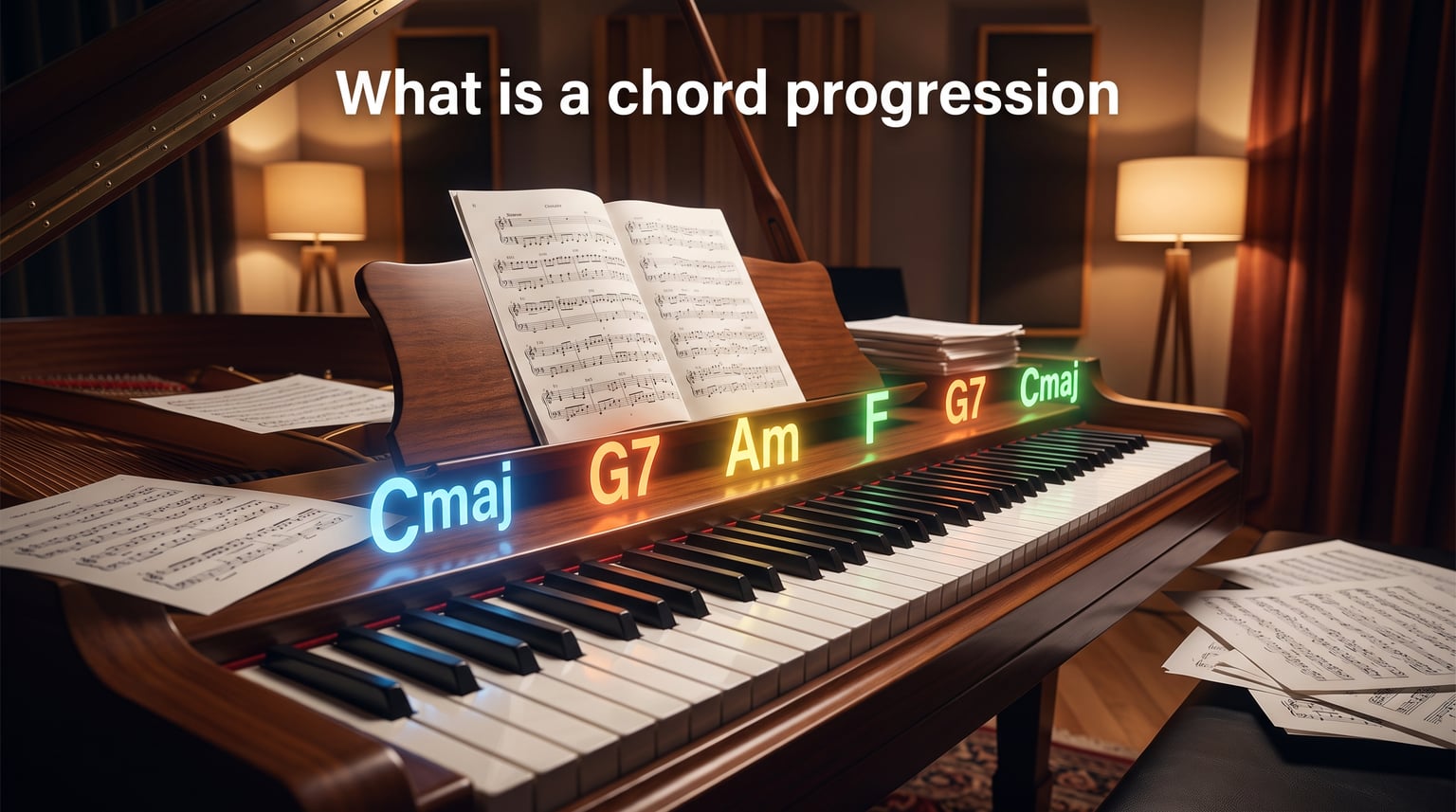
A chord progression is a sequence of chords played one after another that creates the harmonic foundation of a song. Think of chords as words and a chord progression as the sentence they form: each chord carries meaning on its own, but together they tell a story that moves through tension, release, and resolution.
After spending years writing songs and teaching music theory, I can tell you that understanding chord progressions changes how you listen to every song ever made. In this guide, I will walk you through how progressions work, the notation musicians use, and the most popular patterns you hear daily. You will also learn how to build your own progressions and use a powerful technique called modal interchange.
Table of Contents
How Chord Progressions Actually Work?
A chord progression works because chords are built from scales, and certain chords from the same scale naturally sound good together. Walk over to a piano and play a C major scale: C, D, E, F, G, A, B, C. Now stack every other note in threes. You get C major, D minor, E minor, F major, G major, A minor, and B diminished. These seven chords are called diatonic chords, and they belong to the key of C major.
Most pop, rock, folk, and country songs stick to these seven chords because they share so many notes. That shared DNA is why moving between them feels smooth to your ear. A chord progression simply picks two, three, or four of these chords and orders them so the music travels somewhere emotionally meaningful.
Why Certain Chords Sound Good Together
Two principles decide whether a chord transition sounds pleasing or jarring: shared tones and functional harmony. Chords with notes in common create smooth voice leading. Chords that satisfy the tonic dominant relationship create a sense of return. Once you grasp these two ideas, every chord progression you have ever heard starts to make sense.
Roman Numeral Notation Made Simple
Roman numeral notation is the universal language musicians use to describe chord progressions regardless of key. Instead of saying C major, F major, G major, we say I IV V. The uppercase means major, lowercase means minor, and the number describes the chord’s position in the scale.
In any major key, the I chord is the tonic, the chord built on the first note of the scale. The IV chord is the subdominant, four notes up. The V chord is the dominant, five notes up. The vi chord is the minor chord built on the sixth note. These four chords, I IV V vi, power the majority of popular music on the radio.
Quick Reference for Roman Numerals
Uppercase Roman numerals like I, IV, and V represent major chords. Lowercase like ii, iii, and vi represent minor chords. A small circle after the numeral, like V7, denotes a dominant seventh chord. A plus sign, like iii+, means an augmented chord. Once you memorize this short vocabulary, you can read any chord chart in any key.
The Most Common Chord Progressions You Hear Every Day
The most common chord progressions in popular music are I V vi IV, I IV V, ii V I, and vi IV I V. Together these four patterns account for a huge slice of the songs released in the last century. The Axis of Awesome comedy sketch famously demonstrated how dozens of hits share the same four chords.
I V vi IV: The Pop Anthem Progression
The I V vi IV progression is the backbone of countless pop songs. In C major, it plays C, G, A minor, F. You can hear it in Let It Be by The Beatles, Someone Like You by Adele, and No Woman No Cry by Bob Marley. The vi chord swaps the brightness for a touch of melancholy, and the IV chord resolves the tension by pulling back home.
I IV V: The Three Chord Rock Foundation
The I IV V progression is the workhorse of rock, blues, folk, and country. In G major, it plays G, C, D. This simple pattern drives Twist and Shout, La Bamba, and hundreds of Chuck Berry songs. Moving from I to IV creates a sense of lift, and V creates the tension that demands resolution back to I.
ii V I: The Jazz Standard Building Block
The ii V I progression is the most important pattern in jazz. In C major, it plays D minor, G7, C major. The minor ii chord sets up the dominant V7, which pulls strongly into the tonic I. This is the circle of fifths in action: each chord moves down a fifth to the next. Jazz musicians extend these basic triads into 9th, 11th, and 13th chords to add color.
vi IV I V: The Sad Pop Inversion
The vi IV I V progression is the same four chords as I V vi IV, but the order is flipped. Starting on vi gives the song an immediately wistful feel. You can hear it in Apologize by OneRepublic, Save Tonight by Eagle Eye Cherry, and many other emotional ballads. It is the same chord palette, simply rotated to change the emotional arc.
Major vs Minor Key Progressions
Major key progressions typically sound bright, happy, or triumphant, while minor key progressions sound sad, dark, or reflective. The Roman numerals stay the same, but the emotional effect is completely different. In C major, the I chord is C major, bright and resolved. In C minor, the I chord is C minor, dark and yearning.
Many songwriters use the relative minor trick to add emotional depth. The relative minor of C major is A minor, which uses the exact same seven chords. A song that begins in C major and slips into A minor feels like it has crossed into a more introspective space, even though no new chords were introduced.
The Same Progression in Two Moods
Take the I V vi IV progression in C major. The chords are C, G, A minor, F. Played with a strumming acoustic guitar and a major scale vocal melody, it sounds like a celebration. Now shift every chord to its minor counterpart: C minor, G minor, A flat major, F minor. The same four chords, the same structure, but the song suddenly feels like a funeral dirge. This is the power of major versus minor.
Tension and Release: Why Progressions Feel Good
Chord progressions feel good because they cycle through tension and release, mimicking the emotional rhythm of human experience. The V chord contains the leading tone, a note that sits a half step below the tonic. Your ear wants that note to resolve upward, and when the I chord arrives, the tension dissolves. This is resolution, and it is what makes your foot tap.
Skilled songwriters delay the resolution to build suspense. Instead of ending on I, you might extend the progression with vi IV I V, holding back the home chord for two more bars. The longer the wait, the more satisfying the return. Understanding this push and pull lets you control the listener’s emotional state.
Genre-Specific Progressions You Should Know
Different genres lean on different progressions because they prioritize different emotional outcomes. Pop, rock, jazz, and blues each have signature patterns that define their sound.
Pop Progressions
Pop music typically uses I V vi IV, vi IV I V, and I vi IV V. These progressions are simple, predictable, and singable, which is why they dominate radio play. Modern pop also borrows chords from the parallel minor, a technique I will explain in the modal interchange section below.
Rock Progressions
Rock music relies heavily on I IV V and its power chord variations. Classic rock adds the bVII chord, the flat seven, for a bluesy edge. In E minor, the progression E5, D5, A5 is the backbone of countless Led Zeppelin and AC/DC riffs. The bVII chord gives rock its distinctive swagger.
Jazz Progressions
Jazz harmony is built on ii V I extended with chromatic voice leading and substitutions. A common jazz progression is iii VI ii V I, which adds two extra chords before the resolution. Jazz musicians frequently use the tritone substitution, replacing V7 with bII7 to create a smoother descent by half step.
Blues Progressions
The 12 bar blues progression is the foundation of blues, jazz, and rock and roll. It uses I IV V in a repeating 12 bar structure, typically with all dominant 7th chords. The I7, IV7, V7 sound creates a raw, yearning quality that defines the genre. Most rock songs of the 1950s and 60s were either 12 bar blues or variants of the pattern.
How to Create Your Own Chord Progressions?
Creating original chord progressions follows a simple process: start on the tonic chord, move by step or by fifth, and resolve dominant tension back to I. Here are the practical steps I share with every songwriter I mentor.
Step 1: Choose Your Key and Starting Chord
Pick a key that feels comfortable to sing or play in. Most beginners start in C, G, D, A, or E major. Begin your progression on the I chord, the tonic. This anchors the listener and gives them a home base to return to.
Step 2: Move by Step or by Fifth
The smoothest chord transitions are steps (I to ii to iii) or fifths (I to IV to V). Moving from chord to chord by a fifth is called the circle of fifths, and it is the engine of Western harmony. Try mapping a path through the seven diatonic chords using only these two motions.
Step 3: Place Your Resolution
End phrases on the I chord for a sense of completion. End sections on V for suspense that demands the next verse. Most verses use a progression that ends on V, and choruses resolve to I. This mirrors the natural rise and fall of human emotion.
Step 4: Add a Borrowed Chord
Once you have a basic progression, try swapping one chord for its parallel mode counterpart. This is modal interchange, and it is the simplest way to make a familiar progression feel fresh. I will explain this in detail next.
Modal Interchange: The Progression Secret
Modal interchange is the technique of borrowing chords from the parallel minor or major key to add emotional color to a progression. When you are in C major, you can borrow chords from C minor to inject sadness, drama, or sophistication into an otherwise bright progression.
The most common borrowed chord is iv, the minor four. In C major, the diatonic IV is F major. Borrowing from C minor gives you F minor, which immediately sounds more emotional. The Beatles used this in many songs, and modern pop writers rely on it constantly. Another frequent borrowing is bVI, the flat six, which adds a cinematic lift.
Famous Modal Interchange Examples
Creep by Radiohead uses I III IV iv, with the minor iv borrowed from the parallel minor. The descending bass line and minor four chord create the song’s signature ache. Hopelessly Devoted to You from Grease uses a similar technique. Once you start listening for modal interchange, you will hear it everywhere in contemporary music.
Common Mistakes Beginners Make
Most beginners memorize chord progressions without understanding why the chords work together. They learn that I V vi IV is popular, play it in every song, and wonder why everything sounds the same. Understanding the underlying theory of tension, release, and function lets you modify progressions consciously rather than copying them blindly.
Skipping the Minor Keys
Many learners avoid minor keys because they feel harder or sadder. But minor progressions are just as logical and just as versatile. Every major key has a relative minor that shares the same chords, so you already know the chord vocabulary. Exploring minor keys is the fastest way to expand your songwriting range.
Ignoring Tension
Some beginners try to resolve every chord as quickly as possible, which leaves songs feeling flat. Tension is what gives music its forward motion. A song that sits on the I chord for too long feels aimless. A song that delays the I chord with sustained V or ii V tension builds anticipation that makes the resolution feel earned.
FAQs
What is a chord progression in simple terms?
A chord progression is a sequence of chords played one after another that creates the harmonic backbone of a song. Chords are like words, and a progression is like a sentence, with each chord adding meaning and movement toward a goal of tension or resolution.
What are the four progression chords?
The four most common progression chords are I, V, vi, and IV. Together they form the I V vi IV progression used in countless pop songs like Let It Be by The Beatles and Someone Like You by Adele. These four chords from any major key power the majority of popular music.
What is the most famous chord progression?
The most famous chord progression is I V vi IV, often called the four chord progression. The Axis of Awesome demonstrated that dozens of major hits share this exact pattern. It is popular because it balances stability with a touch of melancholy.
How do I figure out my chord progression?
To figure out a chord progression, listen to the bass line first to identify the root notes of each chord. Then determine the chord quality, major or minor, by listening for the third. Finally, write the chords using Roman numerals relative to the key. With practice, you can identify most progressions by ear within a few listens.
Putting It All Together
A chord progression is the harmonic engine that drives every song you have ever loved. Once you understand that chords come from scales, that Roman numerals describe function, and that tension plus resolution creates feeling, the music world opens up. Start with I IV V, learn ii V I, then explore modal interchange to make familiar progressions feel new again.
The best way to internalize chord progressions in 2026 and beyond is to play them. Pick a key, sit at a piano or grab a guitar, and try the patterns from this guide. Sing melodies over them. Notice how the same chords feel different in major versus minor. Within weeks, you will hear progressions everywhere and start inventing your own.