
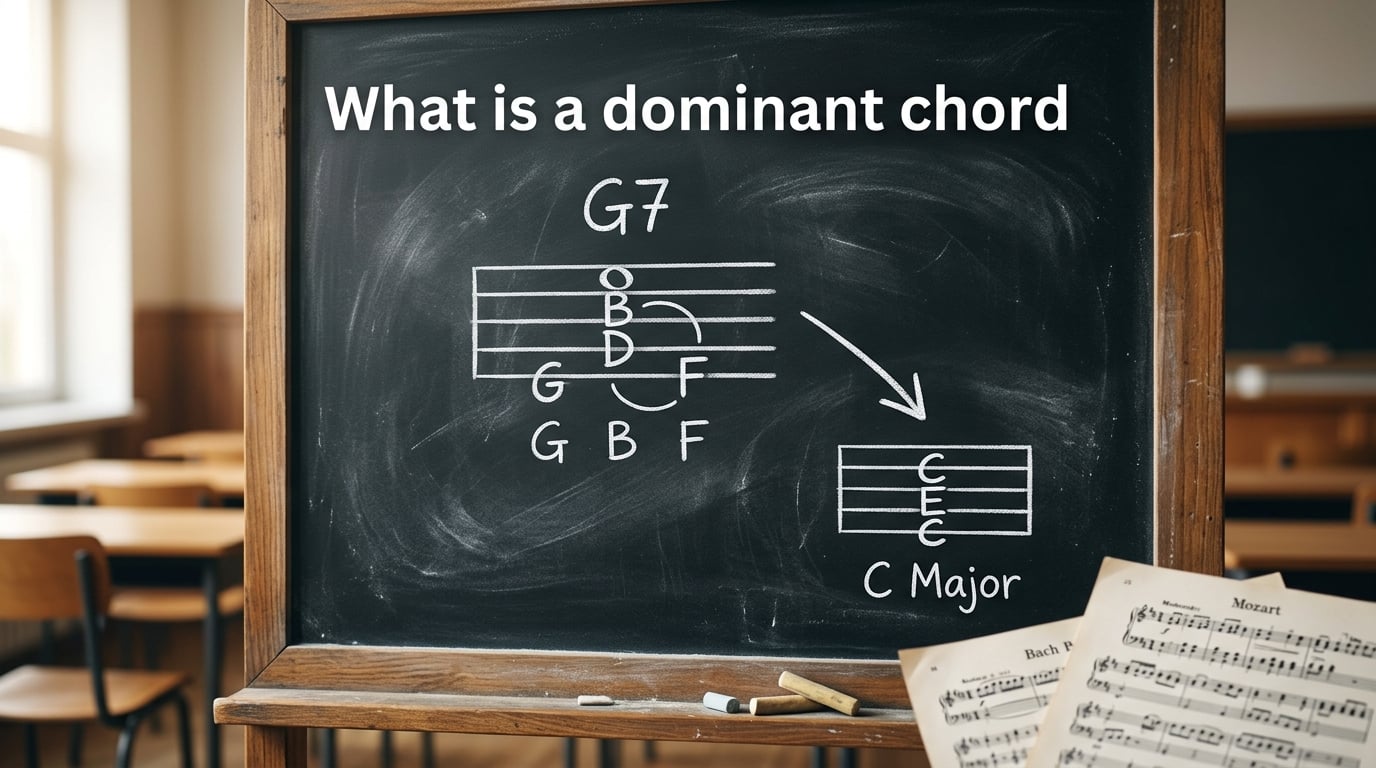
A dominant chord is a major triad built on the fifth scale degree of a key, usually with a flatted seventh added on top. This four-note structure creates the strongest pull toward the tonic chord, which is why every authentic cadence in Western music leans on a V-I resolution. In this guide I will walk you through the exact formula, the etymology behind the name, the tritone tension that drives the harmony, and the way dominant chords behave in jazz, blues, and classical music.
By the end of this article you will be able to spot, build, and resolve a dominant seventh chord in any key without hesitation. I will share the same steps I use when teaching music theory to my students, and the same tricks I lean on when writing progressions for my own songs.
Table of Contents
What Is a Dominant Chord? The Clear Definition
A dominant chord is any chord built on the fifth scale degree of a major or minor key. It functions as the chord of tension and expectation that wants to resolve back to the tonic (the first scale degree).
In its most common form, the dominant chord stacks four notes: the root, a major third, a perfect fifth, and a minor seventh. Musicians write it with the formula 1-3-5-b7, and they label it with the Roman numeral V (or V7 when the seventh is included). Every major key and every natural minor key contains exactly one diatonic dominant chord, sitting on scale degree five.
The word “dominant” comes from the Latin dominans, meaning “ruling” or “governing.” Early music theorists noticed that the fifth scale degree had the strongest gravitational pull on the ear. Once you hear a dominant chord, your brain expects resolution to the tonic. That is why composers from Bach to the Beatles rely on it for endings, transitions, and emotional weight. The chord does not just exist in the key. It directs the key.
How to Construct a Dominant Chord? (The 1-3-5-b7 Formula)
Building a dominant chord follows a predictable recipe. The formula 1-3-5-b7 works in every key once you identify the scale degrees correctly.
Here is the step-by-step construction process I teach:
Step 1: Pick the key and locate the fifth scale degree. In C major, that note is G. In G major, it is D. In F major, it is C.
Step 2: Build a major triad on that root using the intervals root, major third, and perfect fifth. From G, that gives you G, B, and D.
Step 3: Add a minor seventh on top. This is written as b7, meaning a flat seventh relative to the major scale. In C major the seventh degree is B, so the flat seventh is Bb. From G, the seventh note up is F.
Step 4: Stack all four notes to form the dominant seventh chord (V7). For G7 that gives you G, B, D, and F.
For example, in the key of C major, the dominant seventh chord is G7. Its notes are G (root), B (major third), D (perfect fifth), and F (minor seventh). The distance from G to F is a minor seventh, which is what gives the chord its characteristic bluesy, unstable flavor.
The shorthand V7 also works for minor keys. In A minor, the dominant seventh is E7, built from E, G#, B, and D. Notice that the third of the chord (G#) doubles as the leading tone of A minor, which strengthens the pull back to the tonic A minor chord.
Why Is It Called a ‘Dominant’ Chord?
The name has a clear historical reason. In the 18th and 19th centuries, music theorists noticed that the fifth scale degree behaved differently from every other note in the scale. It was the note that demanded motion, that pulled the harmony forward, that ruled the direction of a phrase.
French theorist Jean-Philippe Rameau and German theorist Hugo Riemann both wrote about the gravitational role of the fifth degree. Riemann introduced the idea of Funktionstheorie, where he labeled the three primary harmonic functions as tonic (T), subdominant (S), and dominant (D). The dominant function “dominates” the harmony because it points so strongly to the tonic.
That is also why the fifth scale degree is called the dominant note, why the fifth mode of the major scale is called the Mixolydian mode, and why any chord built on that degree inherits the label “dominant.” The term applies to the function, not just the chord quality. A dominant function chord can technically be major or minor in quality, but the classic dominant 7th is by far the most common.
I find the etymology helps students a lot. Once they understand the word means “ruling,” the behavior of the chord suddenly makes sense. The chord rules the phrase. It tells the listener where to go next.
Dominant Chord Examples in Common Keys
Once you know the formula, you can find the dominant chord in any key. The fifth scale degree of the major scale is always where you start.
Here are the dominant seventh chords in the most common major keys:
C major: G7 (G, B, D, F)
G major: D7 (D, F#, A, C)
D major: A7 (A, C#, E, G)
F major: C7 (C, E, G, Bb)
A major: E7 (E, G#, B, D)
E major: B7 (B, D#, F#, A)
Bb major: F7 (F, A, C, Eb)
Eb major: Bb7 (Bb, D, F, Ab)
Minor keys use the harmonic minor scale for the dominant, which raises the seventh degree to create a leading tone. So in A minor, the dominant is E major (E, G#, B), and as a seventh chord it becomes E7 (E, G#, B, D). That raised G# is critical because it pulls directly up to the tonic A. In D minor, the dominant is A7 (A, C#, E, G). In E minor, it is B7 (B, D#, F#, A).
One trick that helped me early on: write the scale, circle the fifth note, and build the chord upward from there. After doing it a few dozen times it becomes automatic.
Major Chord vs Dominant Chord: Key Differences
Many beginners confuse major chords with dominant chords because both use a major triad as their base. The difference lies in the seventh.
A plain major triad uses the formula 1-3-5, with no seventh at all. A dominant seventh chord uses 1-3-5-b7. That flatted seventh is what changes everything. It adds dissonance, it introduces the tritone, and it signals an imminent resolution.
Consider a C major chord (C, E, G) compared to a G7 chord (G, B, D, F). The G7 contains all three notes of C major plus the note F, which sits a half-step below G. That tension is what makes G7 sound like a question, while C major sounds like an answer. The flatted seventh is the question mark on the end of the sentence.
A major chord can sit in a progression and feel stable. A dominant seventh chord almost never feels stable by itself. It points somewhere. That directional energy is the entire reason dominant chords exist. Without them, harmony would have no motion, no tension, and no sense of arrival.
A dominant 7 is also different from a major 7 chord. Major 7 chords use 1-3-5-7, with the seventh raised a half-step from the dominant version. Cmaj7 has the notes C, E, G, B. C7 (which is itself a dominant 7) has the notes C, E, G, Bb. The Bb is what makes C7 want to resolve to F, while the B in Cmaj7 gives a settled, jazzy color.
The Tritone Interval: Why Dominant Chords Create Tension
The secret behind the dominant chord’s pull is the tritone inside it. A tritone is an interval of six half-steps, or three whole steps, that divides the octave exactly in half.
In any dominant seventh chord, the tritone lives between the major third and the minor seventh. In G7, that is between B and F. In C7, it is between E and Bb. In D7, it is between F# and C. That tritone is the engine of the chord’s instability.
This interval was once called diabolus in musica, the devil in music, because it sounded so dissonant to medieval ears. Modern ears hear it differently, but the tension remains. The tritone wants to resolve inward by half-step in both directions. B moves up to C, and F moves down to E. When that motion happens, you have arrived at a C major chord. That is the V-I resolution in its purest form.
Once you understand this, you can predict how any dominant chord will resolve. Find the tritone inside it, then move each note outward by a half-step. The resulting two notes are usually the third and seventh of the tonic chord waiting to be reached.
I use this trick all the time when improvising. If I land on an unresolved dominant 7, I mentally hear the tritone and follow it where it wants to go. The music almost plays itself once you know which notes are pulling.
How Dominant Chords Resolve to the Tonic? (V-I)
The dominant chord resolves to the tonic through a pattern called the authentic cadence. In Roman numeral analysis, this is written as V-I, and it is the strongest closing motion in Western harmony.
Three things happen in a clean V-I resolution. First, the root of the dominant moves down a perfect fifth or up a perfect fourth to the tonic root. Second, the leading tone (the third of the V chord) rises a half-step into the third of the I chord. Third, the seventh of the V chord falls a half-step into the third of the I chord. When all three voices move correctly, the resolution feels inevitable.
For example, in G7 resolving to C major: G falls to C, B rises to C, and F falls to E. The two Cs form an octave, and the chord sounds complete. That is the magic of the authentic cadence, and it has been the foundation of Western music since the Renaissance.
Not every V-I has to be this textbook clean. In jazz and pop, dominant chords often resolve deceptively to vi, or get extended with ninths, elevenths, and thirteenths. The V can also pivot to a completely different key through a technique called modulation. But the underlying tritone resolution still drives the motion. The ear hears the pull even when the harmony takes a detour.
One of my favorite sounds is the half cadence, where a phrase ends on V instead of I. It leaves the music suspended, like a sentence without a period. The next phrase almost always resolves it.
Dominant Chords Across Genres: Jazz, Blues, Classical
Different musical styles use dominant chords in distinctive ways. Understanding the genre context helps you decide when to lean on the V7 sound and when to soften it.
In jazz, dominant chords are extended and altered constantly. A jazz musician might play a G13(b9) resolving to Cmaj7, adding color tones while keeping the tritone tension intact. The ii-V-I progression is the backbone of jazz harmony for this reason. It stacks a minor second chord, a dominant seventh, and a major seventh to create smooth voice leading into the tonic. Tritone substitutions also appear here, where Db7 replaces G7 because they share the same tritone.
In blues, every chord in a twelve-bar progression is technically a dominant seventh. The I7, IV7, and V7 all contain the same flatted seventh, which gives blues its gritty, unresolved sound. The harmony deliberately avoids a clean tonic resolution, which keeps the groove cycling. Players often add the b9 or #9 on top to push the dissonance even further.
In classical music, dominant chords appear most prominently at cadences. Composers use V-I to close phrases, sections, and entire movements. Beethoven’s Fifth Symphony opens with one of the most famous dominant-tonic relationships in music history, with the short-short-short-long motif resolving from C major to G major. Bach uses V-I cadences in nearly every chorale to lock phrases together.
Pop and rock tend to use plain major chords more often than dominant sevenths, though bands like the Beatles frequently slipped V7 chords into otherwise simple progressions to add bite. The flatted seventh can make a standard I-IV-V sound instantly more interesting. Country, soul, and R&B all lean heavily on V7 chords for their emotional grit.
Secondary Dominant Chords Explained
Secondary dominants are dominant chords that point to a chord other than the tonic. They borrow the V7 sound and aim it at a different target for a brief moment of tension.
For example, in C major, the dominant of the dominant is D7, written as V/V (five of five). D7 contains the notes D, F#, A, C, and it resolves to G, which is the dominant of C. This creates a chain of pull that lands on the tonic one step later than a direct V-I.
Secondary dominants appear constantly in jazz standards, classical sonatas, and romantic-era harmony. They add chromatic color and create longer arcs of tension. The notation is always V of something. V/ii, V/iii, V/IV, and V/vi are all common secondary dominants. Each one borrows one note from outside the key, then resolves back to a diatonic chord.
If you see a chord with an accidental that does not belong to the key, it might be a secondary dominant. F# in C major, for instance, almost always signals a V/V moving toward G. C# in C major often signals V/vi moving toward A minor. Spotting these accidental notes is a fast way to identify secondary dominants on the page.
FAQs
Why are 7 chords called dominant?
A 7 chord built on the fifth scale degree is called a dominant chord because that fifth degree governs the harmonic motion of the key. Early theorists named it dominant from the Latin dominans, meaning ruling, since the V chord has the strongest pull back to the tonic. Any chord built on scale degree 5 inherits that name, including the V7.
What is the dominant chord of C major?
The dominant chord of C major is G major. As a dominant seventh it becomes G7, built from the notes G, B, D, and F. G7 resolves naturally to the tonic C major chord.
What is the difference between a major chord and a dominant chord?
A major triad uses the formula 1-3-5 with no seventh. A dominant chord uses 1-3-5-b7, adding a flatted seventh on top. That flatted seventh creates the tritone tension that makes dominant chords want to resolve to the tonic.
How do I find the dominant chord in any key?
To find the dominant chord in any key, count up five scale degrees from the tonic. That note is the root of the dominant chord. Build a major triad on it, then add a minor seventh to create the dominant seventh. In A minor the dominant is E, so the V7 is E7.
Conclusion
What is a dominant chord? It is the chord built on the fifth scale degree that creates the strongest pull back to the tonic, usually built with the 1-3-5-b7 formula. Once you understand the tritone inside it and the V-I resolution that follows, every cadence in Western music starts to make sense. Try playing a G7 and then a C major. You will hear the pull for yourself.