
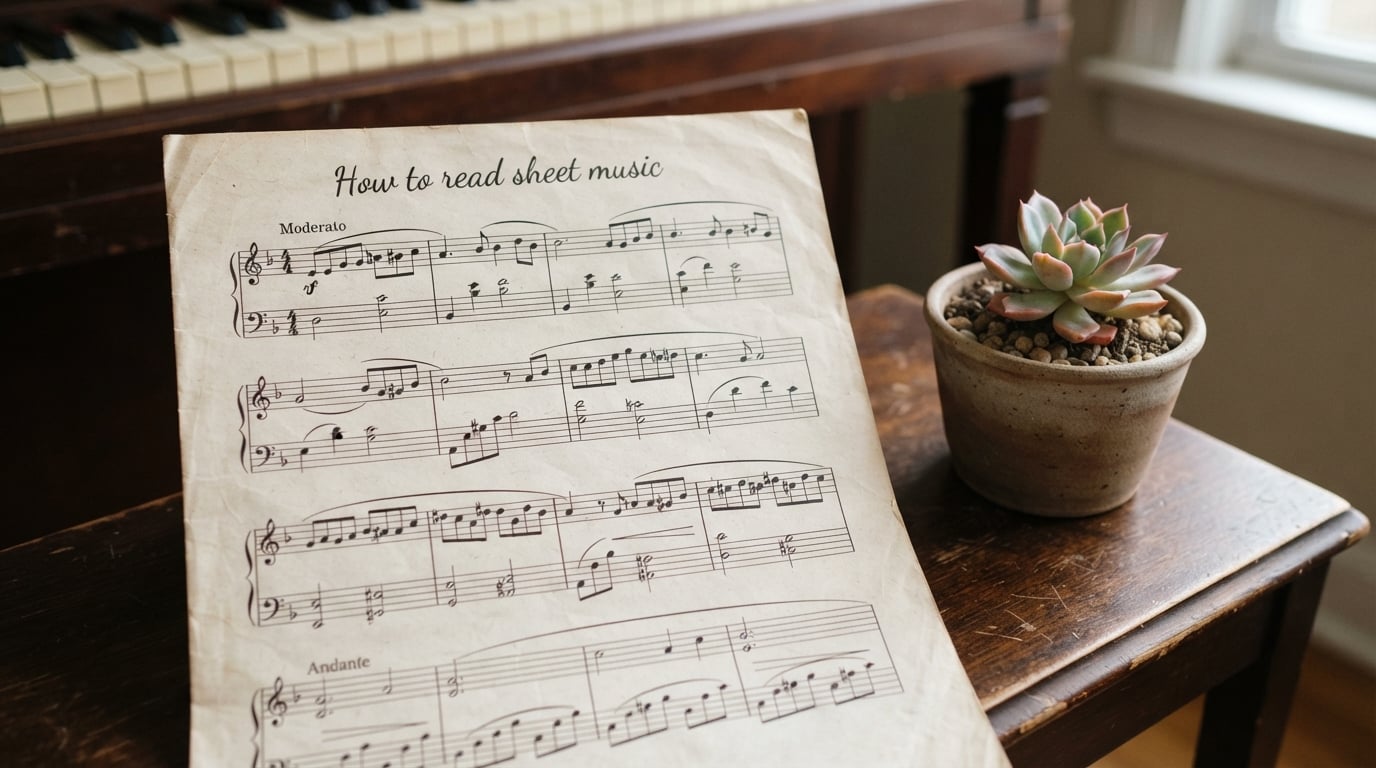
Learning how to read sheet music opens up an entirely new world of music. Instead of guessing chords from a recording, you can pick up any piece of written music and play it confidently. After teaching dozens of beginners over the past few years, I can tell you that sheet music looks far more intimidating than it actually is. Once you crack the code of a few core symbols, everything else starts to click.
In this guide, I will walk you through every symbol you need to know to read sheet music as a beginner. We will cover the staff, both clefs, note values, time signatures, and key signatures. I will also share sight-reading tips pulled from real forum discussions among self-taught musicians. By the end, you will have a complete mental map of what every symbol on the page actually means.
Table of Contents
What Is Sheet Music? A Simple Definition
Sheet music is a written language that uses symbols to tell musicians what to play, how long to play it, and how loudly or softly to play it. Each symbol on the page represents either a pitch (which note), a duration (how long), or an expression (how it should feel). When you put all three together, you get a complete recipe for performing a piece of music.
Reading sheet music works from left to right, just like reading a book. As your eyes travel across the page, you are decoding a continuous stream of musical instructions. The vertical position of a symbol tells you the pitch, and the shape of the symbol tells you the rhythm. Combined, they paint an exact picture of the music the composer wanted you to hear.
The Staff: The Foundation of Sheet Music
The staff is the set of five horizontal lines and four spaces that forms the backbone of sheet music. Every written note in standard notation sits on one of those lines or in one of those spaces. The higher a symbol appears on the staff, the higher the pitch it represents. The lower it sits, the lower the pitch.
Lines and spaces are numbered from bottom to top. The bottom line is line 1, and the top line is line 5. The same numbering applies to spaces, so space 1 sits just above line 1. Vertical bar lines cut across the staff to divide it into sections called measures (or bars), and each measure holds a fixed number of beats depending on the time signature.
If you have ever looked at sheet music and felt overwhelmed, focus only on the staff first. Get comfortable identifying the five lines and four spaces by sight. That single skill makes every other symbol easier to learn because every note, rest, and clef symbol lives somewhere on this grid.
Treble Clef Notes and How to Memorize Them
The treble clef is the curvy symbol you see at the start of most sheet music. It wraps around the second line from the bottom and marks that line as the note G (sometimes called G4). Once you know that one reference point, every other line and space on the treble staff falls into place.
Here is how the lines and spaces of the treble clef are organized, starting from the bottom:
- Lines (bottom to top): E, G, B, D, F. Mnemonic: Every Good Boy Deserves Fudge.
- Spaces (bottom to top): F, A, C, E. Mnemonic: FACE.
The line and space letters spell out the names of musical notes in the C major scale, starting from middle C just below the staff. As you move up the staff, each letter represents a higher pitch. The top line F in the treble clef, for example, is the F above middle C, which is the same F you hear at the start of the familiar warm-up “Do Re Mi.”
Most melodies for instruments like violin, flute, and right-hand piano parts use the treble clef. If you are learning an instrument that plays higher pitches, this is probably the clef you will see most often.
Bass Clef Notes and the F Line Reference
The bass clef is the symbol with two dots that looks a bit like a backward C with a colon. It marks the second line from the top as the note F (F3), which is why it is sometimes called the F clef. The bass clef handles all the lower pitches on the staff.
Here is how the bass clef breaks down, starting from the bottom:
- Lines (bottom to top): G, B, D, F, A. Mnemonic: Good Boys Do Fine Always.
- Spaces (bottom to top): A, C, E, G. Mnemonic: All Cows Eat Grass.
The bass clef is where you will find the low notes for instruments like the cello, tuba, and bass guitar, as well as the left-hand piano part. When piano music uses both clefs together, it is called the grand staff, and the treble and bass clefs share one continuous musical line.
For piano players, the single most important landmark on the bass staff is the space just above the top line. That space is E, and the line above it (one ledger line above the staff) is middle C. Knowing where middle C sits in both clefs is the bridge between treble and bass reading.
Note Values: How Long to Hold Each Note
Note values tell you how long to hold a note. The shape of a note tells you its duration, and the duration never changes based on which clef you are reading. Here are the four most common note values every beginner should recognize:
- Whole note — an open oval with no stem. Holds for 4 beats in 4/4 time.
- Half note — an open oval with a stem. Holds for 2 beats.
- Quarter note — a filled oval with a stem. Holds for 1 beat.
- Eighth note — a filled oval with a stem and one flag (or a beam connecting two of them). Holds for half a beat.
The relationship between these notes is simple to remember once you see the pattern. Each note value is half the length of the previous one. A whole note equals two half notes, four quarter notes, or eight eighth notes. When you stack the math this way, rhythm becomes much less mysterious.
Tempo markings at the top of a piece tell you how fast a beat actually moves. A piece marked “quarter note equals 120” means there are 120 quarter-note beats every minute. Pair the tempo marking with your note values and you can feel the rhythm of any piece right away.
Rest Values: The Silences Between the Notes
Rests are the silent counterparts to notes. Every note value has a matching rest that fills the same amount of time without making a sound. Reading rests correctly is just as important as reading notes, because silence is part of the music.
- Whole rest — a small rectangle hanging from the 4th line.
- Half rest — a small rectangle sitting on the 3rd line.
- Quarter rest — a squiggly symbol that looks like a zigzag.
- Eighth rest — a single flag on a small slanted line.
A common trick to tell a whole rest from a half rest is to look at which line it is touching. If the rectangle hangs below the line, it is a whole rest. If it sits on top of the line, it is a half rest. The visual difference is small, but it makes a big difference in how long you stay silent.
Time Signatures: Organizing the Beat
A time signature appears at the very beginning of a piece, right after the clef. It looks like two numbers stacked on top of each other (for example, 4/4 or 3/4). The top number tells you how many beats fit in each measure, and the bottom number tells you which note value gets one beat.
Here are the time signatures you will see most often as a beginner:
- 4/4 (common time): 4 quarter-note beats per measure. Most pop, rock, and classical music uses this.
- 3/4: 3 quarter-note beats per measure. The waltz rhythm (think “Happy Birthday”).
- 6/8: 6 eighth-note beats per measure, often grouped into two strong beats of three. Common in jigs and many folk songs.
Once you identify the time signature, you can tap your foot or count “1-2-3-4” (or “1-2-3” in 3/4) to keep a steady beat. Every note and rest you read must add up to the right number of beats inside each measure. If your count goes past the bar line, you have read the rhythm incorrectly.
Key Signatures, Sharps, and Flats
The key signature is the group of sharps or flats placed right after the clef. It tells you which notes are automatically raised or lowered for the entire piece, unless an accidental overrides it. If you see one sharp in the key signature, every F in the piece is played as F sharp until the end.
Here are the three symbols you will see most often:
- Sharp (#) — raises a note by a half step.
- Flat (b) — lowers a note by a half step.
- Natural (♮) — cancels a previous sharp or flat and returns the note to its natural pitch.
Sharps and flats that appear inside a measure but not in the key signature are called accidentals. An accidental only affects the notes in that measure. Once you reach the next bar line, the accidental is gone unless the key signature re-applies it. Many beginners forget this rule, which is one of the most common reasons sight-reading feels confusing at first.
Ledger Lines: Reading Notes Above and Below the Staff
Not every note fits on the five-line staff. When a note is higher than the top line or lower than the bottom line, the composer adds small extra lines called ledger lines. Each ledger line represents one line or space outside the regular staff.
The most famous ledger-line note is middle C. On the treble clef, middle C sits one ledger line below the staff. On the bass clef, middle C sits one ledger line above the staff. Both notes are the same pitch, but they are written differently depending on which clef is used. This is the moment where the treble and bass staves visually connect for piano players.
As notes get further away from the staff, you may see two or three ledger lines stacked. Counting the lines carefully is the safest approach. Skip counting in your head, and you are likely to misread the pitch.
Dynamics and Articulation: Adding Expression
Dynamics tell you how loud or soft to play, and articulation tells you how to shape each note. These symbols are what turn written notes into expressive music, and most beginner guides skip over them. I will give you a quick tour of the symbols you will see most often.
Common dynamic markings (ordered from softest to loudest):
- pp (pianissimo): very soft.
- p (piano): soft.
- mp (mezzo-piano): moderately soft.
- mf (mezzo-forte): moderately loud.
- f (forte): loud.
- ff (fortissimo): very loud.
Gradual changes use hairpin symbols. A crescendo (opening hairpin) gets louder over time, and a decrescendo or diminuendo (closing hairpin) gets softer.
Articulation markings tell you how to attack or release each note. A staccato dot above a note means play it short and detached. A slur over a group of notes means play them smoothly connected, also called legato. An accent (>) marks a note that should be played with extra emphasis.
Most beginner pieces include just a handful of dynamics and articulations. Reading them is not hard, but they make a huge difference in how your playing sounds. Even one well-placed crescendo can transform a boring reading into something that feels alive.
Sight-Reading Practice Tips That Actually Work
Knowing the symbols is only half the battle. The other half is building the speed and confidence to read them in real time. After looking through years of forum discussions among self-taught musicians, I have collected the practice tips that experienced players consistently recommend.
- Practice 15 minutes a day instead of 2 hours once a week. Consistency builds fluency far faster than cramming. Sight-reading is a pattern-recognition skill, and the brain needs daily repetition.
- Never play a piece more than 4 or 5 times in a row. Beyond that, you are memorizing instead of reading. Pick a fresh piece and force your eyes to stay ahead of your fingers.
- Use a metronome from day one. Even at a slow tempo, steady time prevents you from accidentally guessing through the rhythm. Start at 50% performance tempo and gradually raise it.
- Scan the piece before you play it. Look at the key signature, time signature, and any tricky rhythms. A 30-second scan prevents 5 minutes of fumbling later.
- Keep going through mistakes. Stopping on every error breaks your flow and trains your brain to react slowly. Mark tricky spots and revisit them later.
One realistic expectation: most adult learners report feeling comfortable reading simple pieces after 3 to 6 months of steady practice. It is not a fast skill, but it is one that pays off for a lifetime.
Frequently Asked Questions About Reading Sheet Music
Can I teach myself to read sheet music?
Yes, you can teach yourself to read sheet music with the right materials and consistent practice. Many adult learners use method books like Alfred’s or Faber, paired with YouTube tutorials and short daily practice sessions. The key is repetition, not talent. After 15 minutes a day for several months, most beginners can read simple pieces fluently.
Why is it so hard for me to read sheet music?
Reading sheet music feels hard because it is a brand-new visual language, and your brain is decoding multiple things at once: pitch, rhythm, key signature, and expression. Most beginners struggle because they try to learn everything at the same time. Focus on one skill at a time, like recognizing treble clef notes for a week, then add rhythm, then dynamics. Breaking it down makes it manageable.
How can I learn to read sheet music faster?
Speed comes from daily sight-reading practice, not from playing the same piece over and over. Pick material one level below your current ability and read it through once without stopping. Never play a piece more than 4 or 5 times when practicing sight-reading, because after that you are memorizing instead of reading. Use a metronome, scan the piece first, and aim for 15 minutes of focused practice every day.
How long does it take to learn to read sheet music?
Most beginners can read simple melodies within 2 to 3 months of consistent 15-minute daily practice. Reaching comfortable sight-reading speed on intermediate pieces usually takes 6 to 12 months. The timeline depends on your instrument, practice consistency, and prior musical exposure, but steady daily work always beats occasional long sessions.
What is the easiest way to read sheet music for beginners?
The easiest way to start is to learn the treble clef lines and spaces first, since most beginner music uses the treble clef. Memorize the EGBDF and FACE mnemonics, then practice identifying notes on a single staff line for a few minutes each day. Once you can name every line and space instantly, add rhythm by clapping out simple note values before you ever touch your instrument.
Final Thoughts: Building Fluency Over Time
Learning how to read sheet music is one of the most rewarding skills you can pick up as a musician. The symbols may look like a foreign language at first, but with steady practice they start to feel as natural as reading words on a page. Focus on the staff first, then add clefs, then note values, then rhythm, then expression. Build the skill in layers, and you will avoid the overwhelm that pushes many beginners to quit.
Pick one simple piece this week, identify the key signature and time signature, and try to clap the rhythm before you play a single note. That single exercise trains your brain to read sheet music the right way. In 2026, more free sheet music resources and tutorials are available online than ever before, so there is no better time to start.