
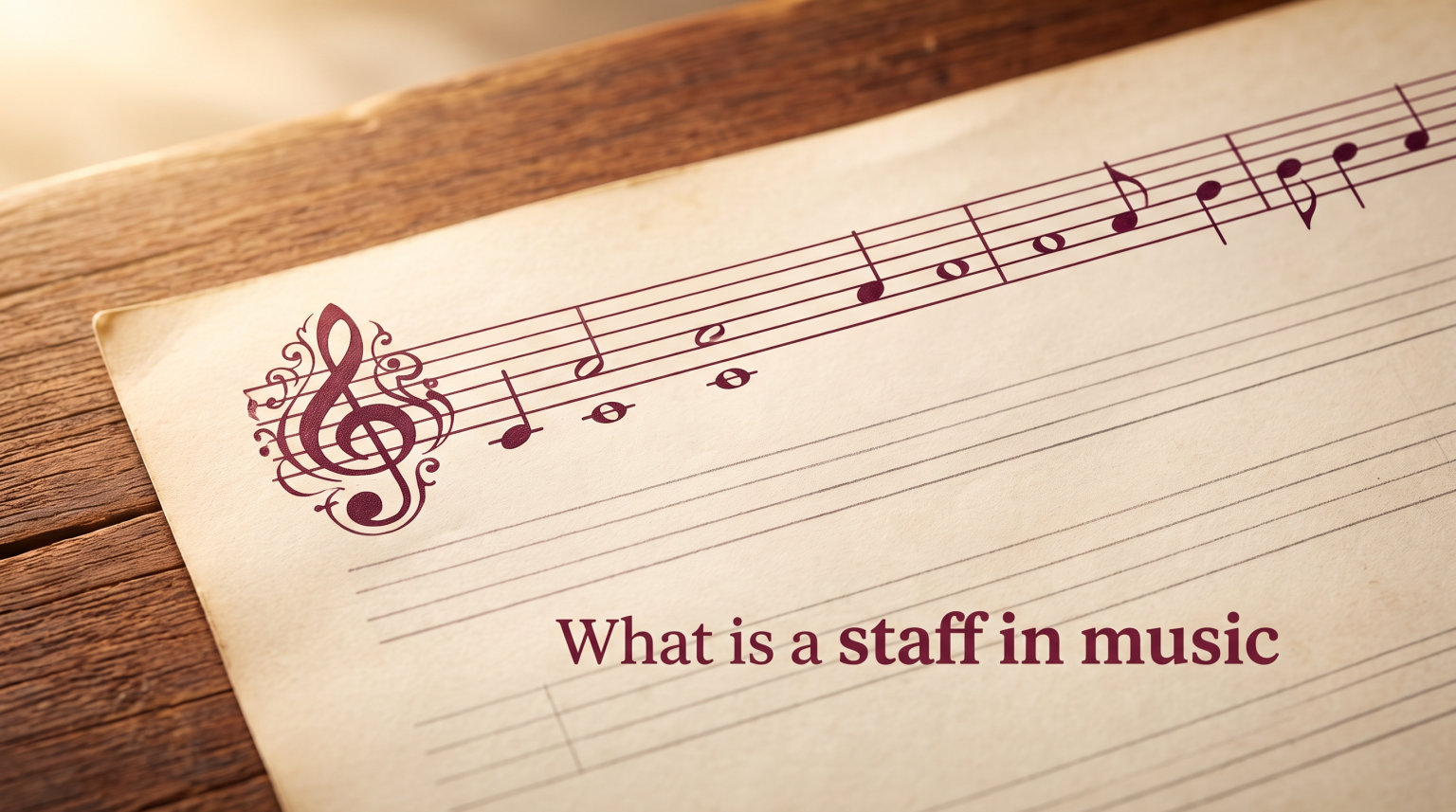
A music staff (also called a stave in British English) is a set of five horizontal lines and four spaces that each represent a different musical pitch. If you have ever looked at sheet music and wondered why those lines are there, this guide breaks the whole system down in plain language.
I have been teaching music theory for years, and the staff is always the first thing we cover. Once you understand how those five lines work, every other piece of notation falls into place. By the end of this article, you will know exactly what a staff is, how it shows pitch and time, and how to read notes on it.
Table of Contents
What Is a Staff in Music? The Basic Definition
A staff in music is the visual framework that holds every note, rest, and symbol in Western musical notation. It usually consists of five horizontal lines and the four spaces between them, running across the page from left to right.
Think of the staff as the grid on which music gets written. Each line and each space corresponds to a specific pitch. Notes placed higher on the staff sound higher; notes placed lower on the staff sound lower.
The term staff is standard in American English. In British English, the same thing is usually called a stave. Both words mean the exact same thing, and you will see both terms used interchangeably in music books and online. When you encounter “stave” in older textbooks or British scores, do not get confused. It is the staff.
Some musicians also call the staff a pentagram, a term borrowed from geometry that literally means “five lines.” You will see “pentagram” more often in European music theory texts, but it refers to the same five-line grid.
The Five Lines and Four Spaces
The standard music staff contains exactly five lines. From bottom to top, these are typically numbered line 1 through line 5. The four spaces between them are labeled space 1 through space 4, starting from the bottom.
Musicians name lines and spaces by reading them. In treble clef, for example, the lines from bottom to top spell the word “EGBDF” (Every Good Boy Does Fine), and the spaces spell “FACE.” These memory tricks help beginners locate notes quickly.
Lines and spaces are the two fundamental units of the staff. Every note you will ever read sits on either a line or in a space. There are no notes floating between them in standard notation.
How the Staff Represents Musical Pitch?
The vertical position of a note on the staff tells you the pitch. Higher positions mean higher pitches; lower positions mean lower pitches. This is why notes written near the top of the staff tend to sound bright, and notes near the bottom sound deep.
A clef at the beginning of the staff tells you exactly which pitch each line and space represents. The same five lines can refer to completely different pitches depending on which clef is placed at the start. This is a clever trick that lets one staff cover many musical ranges.
Imagine the staff as a graph. The vertical axis (up and down) handles pitch. The horizontal axis (left to right) handles time. The clef fixes the vertical reference, so when you read a note you know both its pitch and when to play it.
How the Staff Represents Time?
Music unfolds from left to right, and the staff shows this clearly. The horizontal dimension is time. Notes written further to the right are played later; notes written further to the left are played earlier.
Vertical bar lines cut across the staff to divide music into measures, also called bars. Each measure holds a specific number of beats based on the time signature at the start of the piece. Together, bar lines and time signatures turn the staff into a timeline for sound.
Without the staff’s horizontal layout, you would have no way to know the order of notes or how long each one lasts. Combined with rhythm symbols, the staff tells a performer exactly what to play, when to play it, and for how long.
Clefs and the Staff: How They Work Together
A clef is a symbol placed at the start of the staff that fixes the pitch reference for all the lines and spaces. There are four main types of clefs used in modern Western music, and each is suited for a particular range of notes.
The four main clefs are:
Treble clef (G clef) – Used for higher voices and instruments like violin, flute, and right-hand piano.
Bass clef (F clef) – Used for lower voices and instruments like cello, bass guitar, and left-hand piano.
Alto clef (C clef on the middle line) – Used for viola.
Tenor clef (C clef on the fourth line) – Used for higher cello notes and some trombone music.
The clef and the staff are not the same thing. The staff is the five-line grid. The clef is the symbol that labels what each line means. Without the clef, a staff is just lines and spaces with no pitch meaning attached.
When a player asks, “Is a treble also called a staff?” the answer is no. The treble clef is a type of clef, while a staff is the five-line system the clef sits on. They work together, but they are different elements.
Ledger Lines: Reading Notes Beyond the Staff
Sometimes a note sits higher or lower than the five lines of the staff can show. In those cases, composers add small extra lines above or below the staff called ledger lines. Each ledger line represents one additional pitch.
For example, the note middle C sits on the first ledger line below the treble staff, or on the first ledger line above the bass staff. Notes higher than the staff (such as very high violin notes) get ledger lines above. Notes lower than the staff (such as low piano notes) get ledger lines below.
Beginners often find ledger lines tricky because they interrupt the clean look of the five-line system. The trick is to count up or down from the nearest line, treating each ledger line as an extension of the staff. With practice, you read them as quickly as regular notes.
The Grand Staff in Music
The grand staff combines two staves into one system: a treble clef staff on top and a bass clef staff on the bottom. A piano, harp, or organ player reads from both staves at the same time, with the right hand on the treble and the left hand on the bass.
Middle C acts as the bridge between the two staves. It sits on a ledger line below the treble staff and on a ledger line above the bass staff. This is one of the most important visual landmarks for any keyboard player learning to read.
The grand staff covers the full range of the piano, which is wider than most single instruments. That is why piano music needs two staves joined together. A single staff simply cannot fit both very high and very low notes in one readable image.
A Brief History of the Music Staff
The five-line staff as we know it today was developed in the 11th century by Guido d’Arezzo, an Italian Benedictine monk. Before his work, singers used neumes, which showed the general shape of melodies but did not give exact pitches.
Guido introduced a four-line staff that he used to indicate pitch. Over the next few centuries, musicians added a fifth line and refined the clef system to create the modern staff. This single invention made it possible to preserve and share music accurately across Europe.
The staff you see in sheet music today is the result of nearly 1,000 years of refinement. Its core idea, using line position to mean pitch, has remained unchanged since Guido’s time.
Common Mistakes When Reading a Staff
The first mistake I see in new students is treating the staff like a picture instead of a map. Notes have specific positions for a reason, and guessing leads to wrong pitches.
Another common error is skipping ledger line practice. Many beginners learn the five-line staff well, then stall when they hit notes outside it. Drilling ledger lines from day one prevents this.
Finally, beginners often try to read staff and rhythm at the same time. I recommend learning the staff note names first, then layering rhythm on top. Trying to absorb everything at once causes confusion. Slow, focused practice wins every time.
FAQs
What is the staff used for in music?
The staff is used to write down music in a way that any trained musician can read. It shows both the pitch of each note through its vertical position and the timing of each note through its horizontal position. Without the staff, composers could not share music accurately.
Is a treble also called a staff?
No. The treble is a type of clef, not a staff. The staff is the set of five horizontal lines on which notes are written. The treble clef sits at the start of the staff and tells you that one specific line represents the note G.
What are the 4 types of clefs?
The four main types of clefs are the treble clef (G clef), the bass clef (F clef), the alto clef (C clef on the middle line), and the tenor clef (C clef on the fourth line). Each one sets a different pitch reference for the same five-line staff.
What is the difference between a clef and a staff?
The staff is the five-line grid where notes are written. The clef is the symbol at the start of the staff that names which pitch each line and space represents. The staff is the canvas. The clef is the label that gives that canvas its meaning.
Conclusion
A staff in music is the five-line, four-space framework that makes Western musical notation possible. Every pitch you see on a page of sheet music gets its meaning from the staff, and every rhythm gets its timing from how it is laid out across the page.
If you remember only three things from this guide, remember these. The staff has five lines and four spaces. The vertical position of a note tells you pitch, and the horizontal position tells you timing. The clef at the start tells you which pitch each line actually means.
From here, your next step is to practice reading simple pieces on a single staff. Start with one clef, learn the line and space names by heart, and add rhythm slowly. The staff looks intimidating at first, but it is one of the most elegant information systems ever designed, and you can read it fluently with steady practice.