
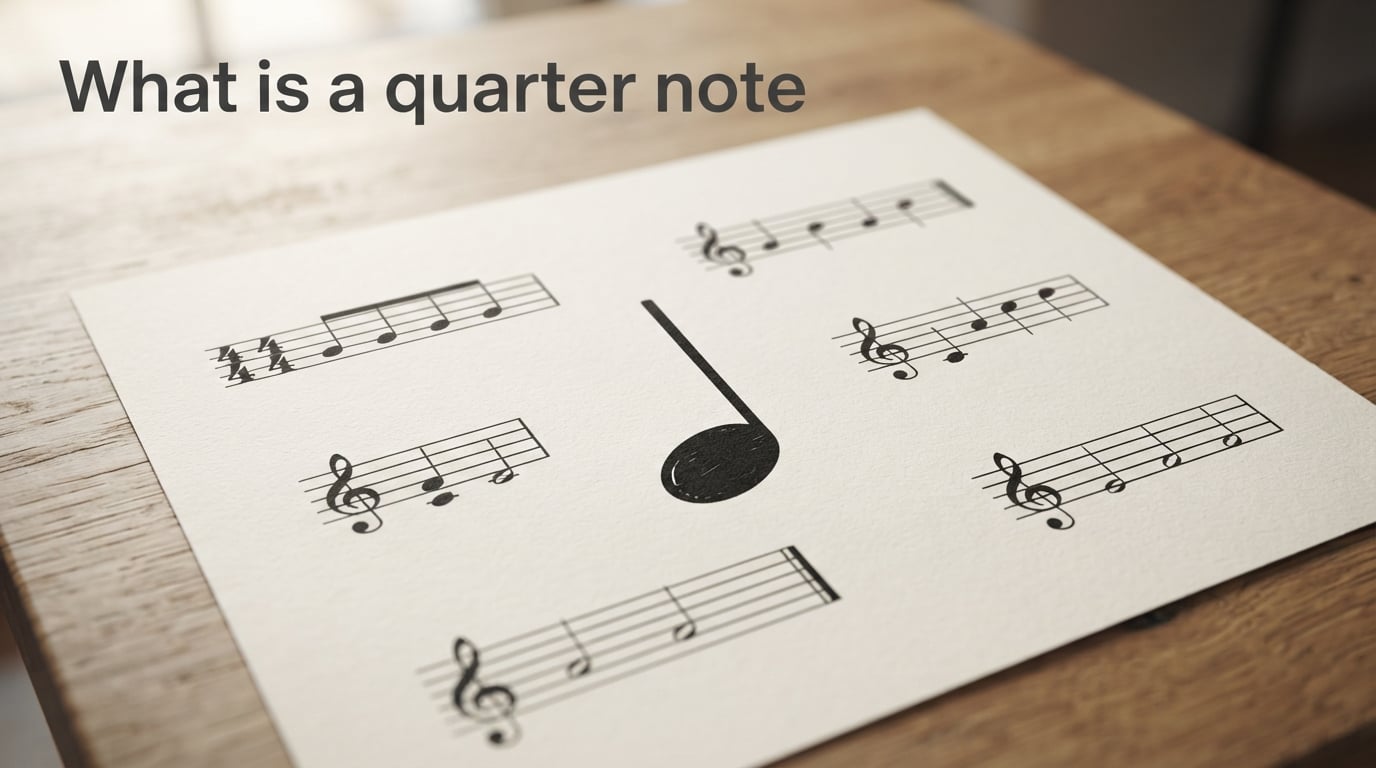
A quarter note is a musical note that lasts for one beat in 4/4 time and looks like a solid black oval with a straight stem attached to it. I remember when I first started learning music theory, this little symbol confused me more than any chord chart ever could. After years of teaching beginner musicians, I have learned that once you understand the quarter note, almost every other rhythm concept clicks into place.
In this guide, I will walk you through exactly what a quarter note is, why it carries that specific name, how long it lasts in different time signatures, and how it compares to other note values. By the end, you will be able to spot a quarter note on any staff and count it with confidence.
Table of Contents
What Is a Quarter Note in Music?
A quarter note is a note value in Western music notation that equals one quarter of a whole note. On the page, it appears as a filled-in oval note head with a vertical stem rising from the right side (when written below the middle line of the staff) or from the left side (when written above).
In British English, the quarter note is called a crotchet. You will see this term in older textbooks, UK music exams, and international theory resources. Both names refer to the exact same symbol.
Here is what makes a quarter note visually distinct:
Solid note head: The oval is completely black, unlike a whole note which has an open (hollow) center.
Single stem: One straight vertical line extends from the note head.
No flag or beam: Unlike eighth notes, a quarter note has nothing attached to the top of its stem.
Standard size: The note head sits roughly the size of the space between two staff lines.
Why Is It Called a Quarter Note?
The name comes from how note values relate to each other mathematically, not from how a single measure is divided. A whole note (also called a semibreve) was historically the longest note value used in plainchant and early Western notation. Every other common note value represents a fraction of that whole.
Here is the breakdown that gives each note its name:
Whole note (semibreve): 1 of 1 – the full value.
Half note (minim): 1 of 2 – half of a whole note.
Quarter note (crotchet): 1 of 4 – one quarter of a whole note.
Eighth note (quaver): 1 of 8 – one eighth of a whole note.
This naming system dates back centuries and explains a confusion I see all the time on music forums. Many beginners assume a quarter note must equal one quarter of a measure. That is only true in 4/4 time. In 3/4 time, a quarter note is one third of the measure. The “quarter” actually refers to its fraction of a whole note, not its fraction of a bar.
How Long Does a Quarter Note Last? Beat Duration Explained
A quarter note lasts for one beat in the most common time signatures, including 4/4 and 3/4. The top number of the time signature tells you how many beats sit in each measure, and the bottom number tells you which note value gets one beat. When you see a 4 on the bottom, the quarter note is the beat unit.
Here is how this plays out in practice:
In 4/4 time: There are 4 quarter note beats per measure. Tap your foot four times, and you have covered one full bar.
In 3/4 time: There are 3 quarter note beats per measure, which is why waltzes feel like they swing in groups of three.
In 2/4 time: There are 2 quarter note beats per measure, common in marches and polkas.
In 6/8 time: A quarter note still takes 2 beats, because the eighth note is the beat unit here.
I always tell my students: the quarter note is the most common beat unit, but it is not the only one. Once you understand that beat duration depends on the time signature, a lot of rhythm puzzles start to make sense.
Quarter Note vs Whole, Half, and Eighth Notes
The quarter note sits right in the middle of the standard note value hierarchy. It is longer than an eighth note but shorter than a half note. Four quarter notes equal one whole note in total duration.
| Note Name | British Term | Beats in 4/4 | Looks Like |
|---|---|---|---|
| Whole note | Semibreve | 4 beats | Hollow oval, no stem |
| Half note | Minim | 2 beats | Hollow oval with stem |
| Quarter note | Crotchet | 1 beat | Solid oval with stem |
| Eighth note | Quaver | 1/2 beat | Solid oval with stem and flag |
When you stack these durations, the math works out cleanly. Two eighth notes equal one quarter note. Two quarter notes equal one half note. Two half notes equal one whole note. This doubling pattern is what makes rhythm arithmetic predictable.
Stem Direction Rules for Quarter Notes
Stems on quarter notes point down when the note head sits on or above the middle line of the staff. Stems point up when the note head sits below the middle line. The middle line acts as a pivot point.
This rule exists because composers want the music to look clean and readable. If every stem pointed up, the bottom of the page would be empty. If every stem pointed down, the top would be cluttered. The middle-line rule keeps notation visually balanced.
How to Count Quarter Notes? (Practical Examples)
Counting quarter notes is simple once you pick a syllable for each beat. I teach every beginner the same counting system because it transfers directly to real playing.
For 4/4 time, count out loud:
Beat 1: Say “1” (this is the downbeat).
Beat 2: Say “2”.
Beat 3: Say “3”.
Beat 4: Say “4” (this is the upbeat before the loop restarts).
For 3/4 time, count “1, 2, 3” and repeat. For 2/4 time, count “1, 2” and repeat. Your foot should tap down on every number, and you should feel the pulse evenly spaced.
When you are ready to add subdivisions, replace each number with “1-and, 2-and, 3-and, 4-and” so you feel the two eighth notes inside every quarter note. That single change unlocks most pop, rock, and folk rhythms.
Subdividing a Quarter Note Into Smaller Values
A quarter note can be divided into two eighth notes or four sixteenth notes. This subdivision is how rhythm stays musical instead of robotic. Real songs rarely play a steady stream of identical notes, so composers break each quarter note into faster pieces to create groove and motion.
On paper, you will recognize subdivisions by what is attached to the stem. An eighth note has a single flag or a beam connecting it to a neighboring eighth note. A sixteenth note has two flags or two beams. Two beams of any kind means faster than a quarter note.
What Is a Dotted Quarter Note?
A dotted quarter note is a quarter note with a small dot placed to its right. That dot adds half the value of the original note, so a dotted quarter note equals 1.5 beats in 4/4 time. It is longer than a regular quarter note but shorter than a half note.
Dotted rhythms show up constantly in jazz, classical, and contemporary music. If you have ever heard a lopsided “long-short” pattern that swings, you were probably listening to dotted quarter notes paired with eighth notes. They are a great next step once you are comfortable with regular quarter notes.
Frequently Asked Questions
How many beats has a quarter note?
A quarter note has one beat in common time signatures such as 4/4, 3/4, and 2/4. The bottom number of the time signature tells you that the quarter note is the beat unit, so four quarter notes fill one measure of 4/4 time.
What is the difference between a quarter note and a whole note?
A whole note lasts four times as long as a quarter note. A whole note is drawn as a hollow oval with no stem and equals four beats in 4/4 time, while a quarter note is a solid oval with a stem and equals one beat.
What is a quarter note in music?
A quarter note in music is a note value that equals one quarter of a whole note. It is notated with a solid filled note head and a vertical stem, and it usually represents one beat in 4/4 and 3/4 time.
What is a half note?
A half note is a note value that lasts two beats in 4/4 time and equals half of a whole note. It looks like a hollow oval with a vertical stem and is called a minim in British English.
Final Thoughts
A quarter note is one of the most important symbols in all of music. It defines the basic beat, anchors most rhythms you will ever play, and bridges the gap between longer whole notes and faster eighth and sixteenth notes. Once you can recognize the solid oval with a stem and count it steadily, every rhythm reading skill you build from here starts on solid ground.
Practice tapping quarter notes at 60 beats per minute with a metronome, then try clapping along to a simple song in 4/4 time. You will feel the quarter note pulse faster than you expect, and that muscle memory is what turns reading into playing.