
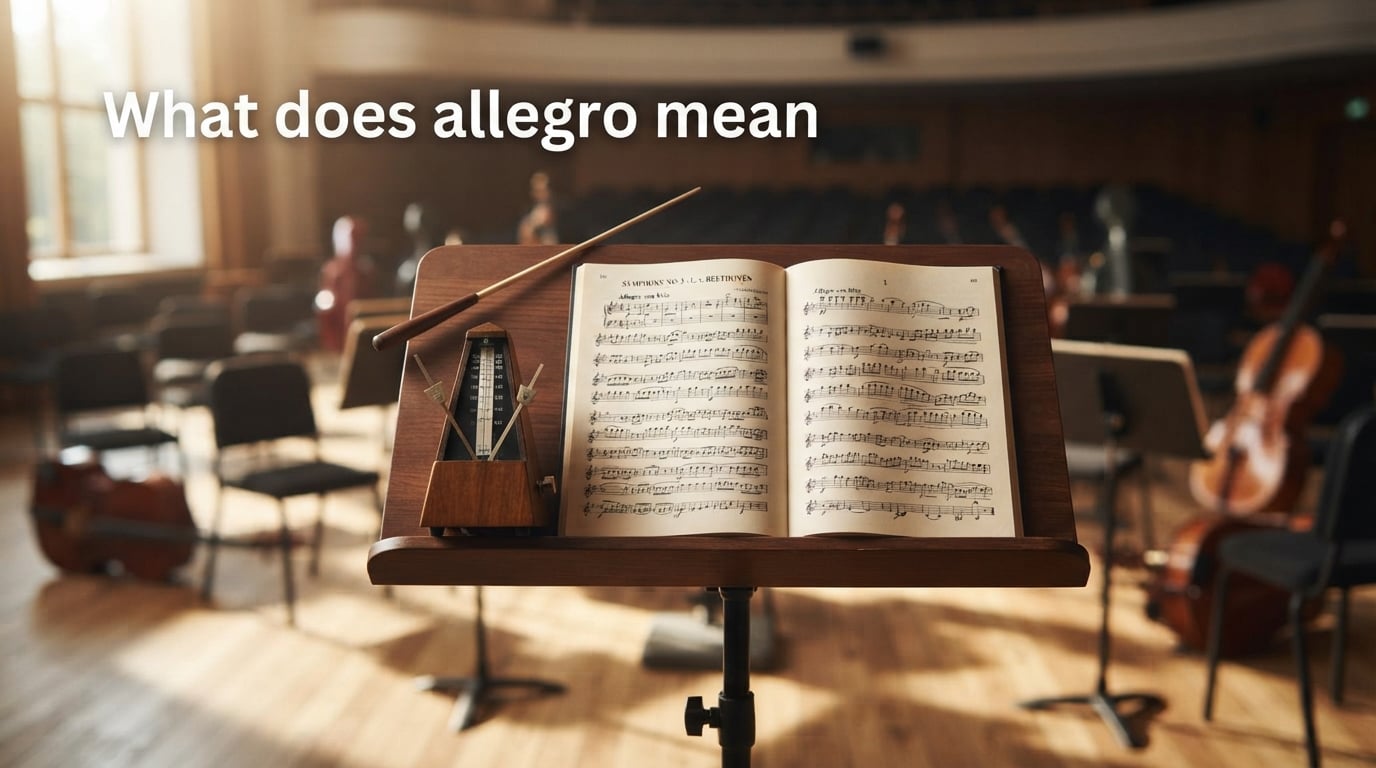
Allegro is an Italian musical term that means “lively,” “cheerful,” or “bright,” and it tells performers to play a piece at a fast, energetic tempo, typically between 120 and 168 beats per minute (BPM). When you see “allegro” written at the top of a musical score, the composer is directing the musician to perform that section quickly and with spirit. Our team has compiled this complete guide for 2026 so you can understand every layer of what allegro means in music, ballet, and everyday language.
Table of Contents
What Does Allegro Mean in Music?
In music, allegro is both a noun and an instruction. As a noun, an allegro refers to a musical composition or movement that should be played at a brisk, lively tempo. As a direction on a score, it tells musicians to play quickly and with energy. The term captures more than just speed: it also conveys mood, asking for a cheerful, bright character rather than a mechanical rush.
Allegro is one of the most common tempo markings in classical music. You will see it used for opening movements of symphonies, sonatas, and concertos, especially during the Baroque and Classical eras. Composers like Mozart, Haydn, and Beethoven used allegro frequently to draw listeners in with an immediately engaging pace.
Musicians recognize allegro through specific practical cues: a metronome range of 120–168 BPM, an upbeat character, and clear articulation. The mood is joyful, the pace is brisk, and the overall feeling should sound animated rather than rushed.
Allegro Pronunciation and Word Origin
Allegro is pronounced “uh-LAY-groh” in Italian and English musical contexts. The stress falls on the second syllable, and the final “o” is pronounced as a long “o” sound. In American English, you may also hear “AL-uh-groh,” though the Italian pronunciation remains the standard in classical music circles.
The word entered English directly from Italian in the early 1600s, during the rise of Italian opera. Italian was the dominant language of music across Europe at that time, which is why nearly all tempo markings (allegro, adagio, andante, presto) come from Italian.
The deeper root is Latin. Allegro comes from the Latin word “alacer,” meaning brisk, lively, or quick. Related English words include “alacrity,” which means cheerful willingness or speed. So when you hear allegro, you are really hearing a 2,000-year-old root word that has always carried a sense of energy and joy.
Allegro Tempo: How Fast Is It?
Allegro sits in the upper-middle range of musical tempos. Standard reference guides place allegro between 120 and 168 BPM, with 132 BPM commonly cited as a comfortable middle tempo. This is faster than a typical resting heart rate, which gives you a sense of how lively the pace should feel.
The table below shows where allegro fits among the standard Italian tempo markings, from slowest to fastest:
| Tempo | Meaning | BPM Range |
|---|---|---|
| Largo | Very slow and broad | 40–60 |
| Adagio | Slow and stately | 66–76 |
| Andante | Walking pace | 76–108 |
| Moderato | Moderate | 108–120 |
| Allegro | Fast and lively | 120–168 |
| Vivace | Lively and fast | 132–140 |
| Presto | Very fast | 168–200 |
Allegretto, often confused with allegro, sits slightly slower at 116–120 BPM and translates to “moderately fast.” Vivace is slightly faster than allegro and emphasizes a lively, vivid character. Presto means very fast and sits above allegro on the tempo scale.
Allegro vs Alegro: The Spanish Confusion
Spanish speakers sometimes ask about “alegro,” and it is easy to see why confusion happens. In Spanish, the verb “alegrar” means to cheer up, and the form “alegro” means “I cheer” or “I make happy.” So Spanish “alegro” is a conjugated verb, while Italian “allegro” is an adjective or adverb.
The two words are not the same. Italian “allegro” describes a tempo and a mood. Spanish “alegro” describes the act of cheering. They share a distant Latin root through “alacer,” but they function differently in their respective languages.
If you are reading Spanish text and see “alegro,” it usually means “I cheer” in the present tense, as in “Yo alegro a los ninos,” meaning “I cheer up the children.” If you see “allegro” in a music context written by a Spanish speaker, they are using the Italian musical term, not the Spanish verb form.
Famous Examples of Allegro in Classical Music
Allegro appears in countless famous works. Beethoven’s Symphony No. 9 opens with an allegro maestoso, setting a grand, energetic tone. Mozart’s Eine kleine Nachtmusik begins with a sparkling allegro that has become one of the most recognized openings in classical music.
Bach’s Brandenburg Concertos feature several allegro movements, and Vivaldi’s concertos often use allegro as their primary tempo. Haydn built his reputation partly on clever, witty allegros that surprised and delighted audiences of his era.
In sonata form, the first movement is almost always marked allegro, giving composers space to establish a theme, develop it, and return to it with high energy. This pattern shaped the structure of Classical-era symphonies.
What Does Allegro Mean in Ballet?
In ballet, allegro refers to fast, jumping movements performed with lightness and elevation. Dancers use the term to describe combinations, leaps, and brisk footwork, often set to allegro tempo music. A ballet teacher might say, “We will now do an allegro across the floor,” meaning a quick jumping sequence.
Ballet allegro focuses on elevation, quick footwork, and the appearance of effortlessness. The musical tempo often falls within the same 120–168 BPM range as orchestral allegro, since dancers and musicians typically move together to the same beat.
Why Allegro Matters for Musicians and Listeners
Allegro is one of the first tempo markings every musician learns because it shows up everywhere in standard repertoire. Understanding what allegro means helps performers interpret scores correctly and helps listeners recognize the energy of a Classical or Baroque era opening.
Even if you are not a musician, knowing allegro enriches how you experience classical music. When a conductor cues an allegro movement, you now know to expect a lively, bright, cheerful sound rather than a slow meditation.
FAQs
What does allegro mean in English?
In English, allegro means lively, cheerful, or fast. It is borrowed directly from Italian and used mostly in musical contexts to describe a brisk tempo.
What does allegro mean in music?
In music, allegro is a tempo marking that tells the performer to play at a fast, lively pace, typically between 120 and 168 BPM, with a cheerful character.
Is allegro Italian or Latin?
Allegro is an Italian word, but it derives from the Latin word alacer, meaning brisk or lively. Italian musical terminology spread across Europe during the 1600s and 1700s.
Does allegro mean fast?
Yes, allegro means fast, but with an emphasis on liveliness and brightness, not just raw speed. A conductor aims for energy and cheer, not a frantic pace.
What is the difference between allegro and allegretto?
Allegro means fast and lively at 120–168 BPM, while allegretto means moderately fast at 116–120 BPM. Allegretto is slightly slower and lighter than allegro.
What does allegro con brio mean?
Allegro con brio means fast and lively, with spirit or fire. The ‘con brio’ addition tells the performer to play with extra energy and boldness.
Conclusion
So what does allegro mean? It is an Italian musical term meaning lively, cheerful, and fast, typically marked at 120 to 168 BPM, and rooted in the Latin word alacer. From Beethoven’s symphonies to ballet jumps across a studio floor, allegro shapes how performers bring energy to a piece. Now that you understand the meaning, tempo range, and Italian and Spanish distinctions, the next time you see “allegro” on a score, you will know exactly what the composer wants you to feel.