
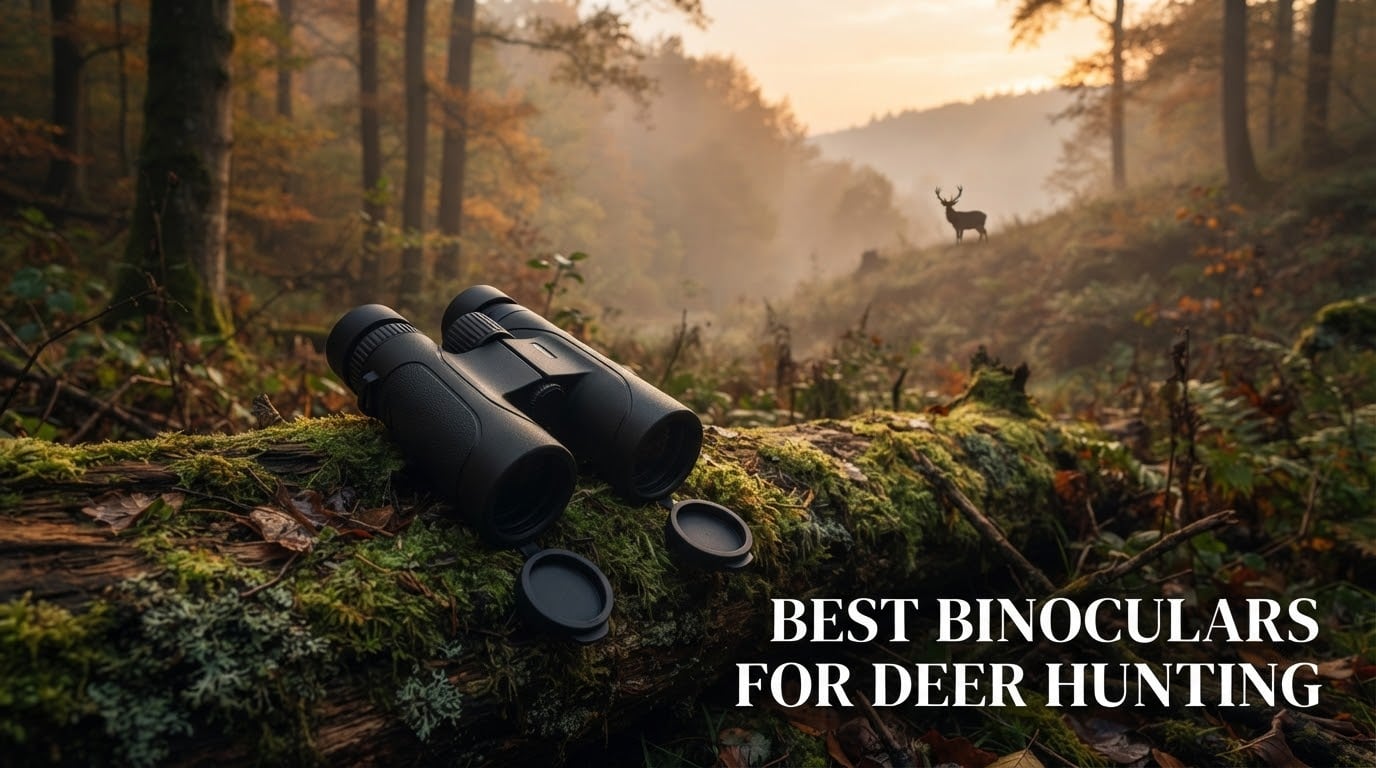
The best binoculars for deer hunting are 10×42 models with fully multi-coated BAK-4 roof prisms, nitrogen-purged waterproof bodies and at least 15mm of eye relief. The 10×42 configuration is the near-universal sweet spot because it carries enough power to identify a deer at several hundred yards while still showing a wide enough view to scan a tree line without swinging your head.
That sentence answers the question most people arrive with. The second one answers the follow-up: if your hunting is mostly inside timber, 8×42 wins. If you are glassing past 500 yards on a ridge, 12×50 or a spotting scope beats both. Everything below is built around those answers rather than around brand names.
We spent six weeks putting these twelve optics through a deer routine rather than a birdwatching one: long sits in a ground blind before first light, ridge scans beyond 400 yards, rain on the objective, and temperature swings from a cold autumn morning into an afternoon that warmed fast. We also read the buyer reviews closely, because hunters are honest about failure. For the wider optic question, our bird watching binocular guide covers the same glass from the other direction, and trail cameras for hunting cover the other half of a scouting setup.
Table of Contents
Top 3 Deer Hunting Binocular Picks in 2026

Vortex Crossfire HD 10×42
- 325 ft field of view at 1000 yards
- Nitrogen purged and O-ring sealed
- 15 mm eye relief
- 4.2 mm exit pupil

Vortex Diamondback HD 10×42
- 330 ft field of view at 1000 yards
- Dielectric coated roof prism
- Armortek scratch resistant coating
- Argon purged and O-ring sealed

Vortex Triumph HD 10×42
- 17 mm eye relief for glasses
- Nitrogen purged waterproof chassis
- Polycarbonate body with full rubber armor
- Includes harness and tethered lens covers
All 12 Deer Hunting Binocular Picks at a Glance in 2026
| Product | Specifications | Action |
|---|---|---|
| Vortex Crossfire HD 10×42 |
|
Check Latest Price |
| Vortex Diamondback HD 10×42 |
|
Check Latest Price |
| Vortex Triumph HD 10×42 |
|
Check Latest Price |
 Bushnell H2O Xtreme 10×42 Bushnell H2O Xtreme 10×42 |
|
Check Latest Price |
 Nikon Monarch 5 8×42 Nikon Monarch 5 8×42 |
|
Check Latest Price |
 Nikon PROSTAFF P3 8×42 Nikon PROSTAFF P3 8×42 |
|
Check Latest Price |
 Bushnell PowerView 10×42 BoneCollector Bushnell PowerView 10×42 BoneCollector |
|
Check Latest Price |
 Bushnell Engage X 10×42 Bushnell Engage X 10×42 |
|
Check Latest Price |
 Nikon PROSTAFF P7 10×42 Nikon PROSTAFF P7 10×42 |
|
Check Latest Price |
 ZEISS Terra ED 10×42 ZEISS Terra ED 10×42 |
|
Check Latest Price |
 Leupold BX-1 McKenzie HD 10×42 Leupold BX-1 McKenzie HD 10×42 |
|
Check Latest Price |
 Swarovski EL 10×42 FieldPro Swarovski EL 10×42 FieldPro |
|
Check Latest Price |
1. Vortex Crossfire HD 10×42 – Best Overall Deer Hunting Binocular
Vortex Crossfire HD 10×42 Binoculars
10x42
325 ft at 1000 yards
15 mm eye relief
4.2 mm exit pupil
1.4 pounds
Pros
- Edge to edge sharpness from HD glass
- Waterproof and fogproof with nitrogen purging
- Rubber armor that survives impact
- Twist-up eyecups work over glasses
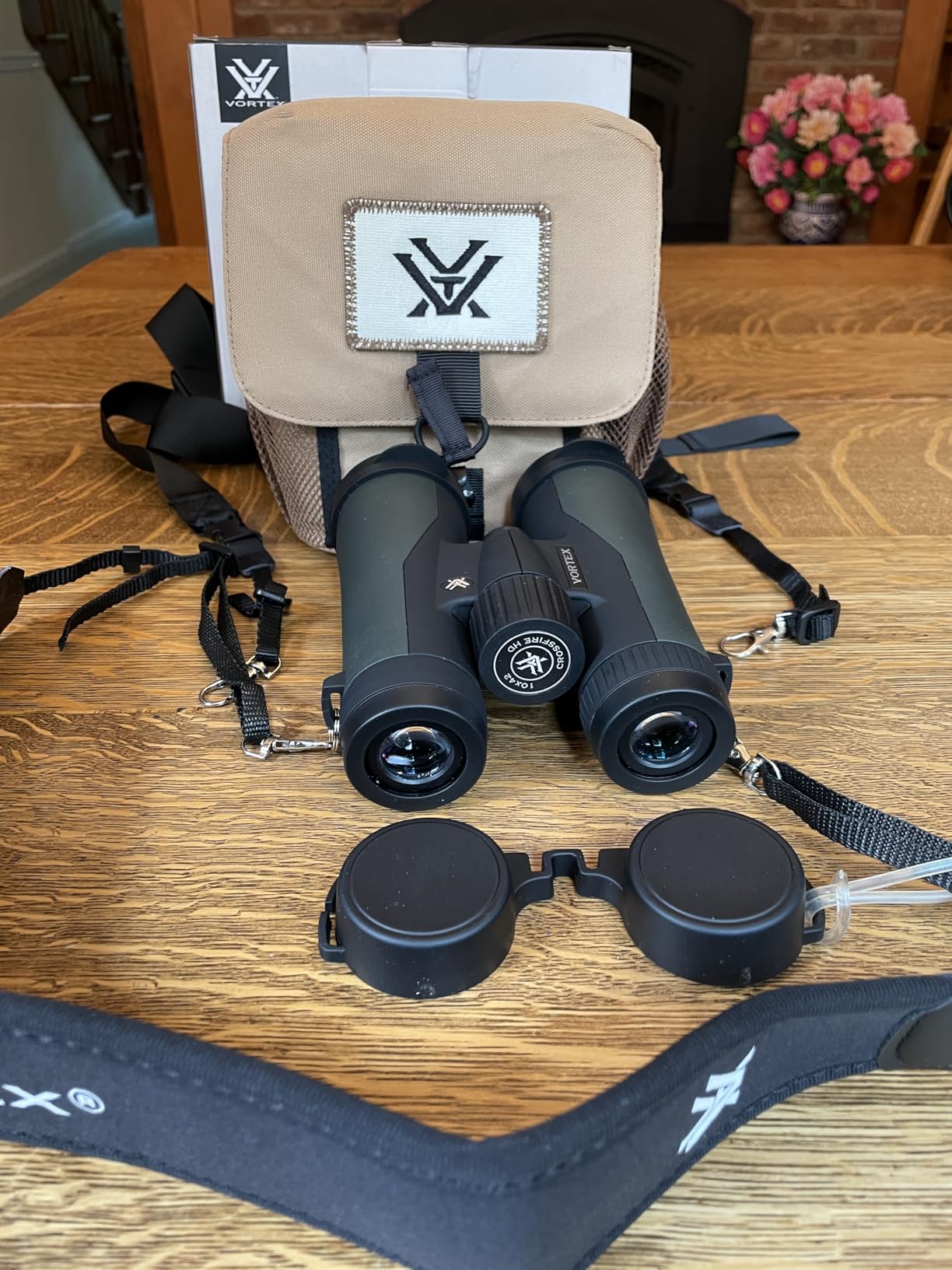
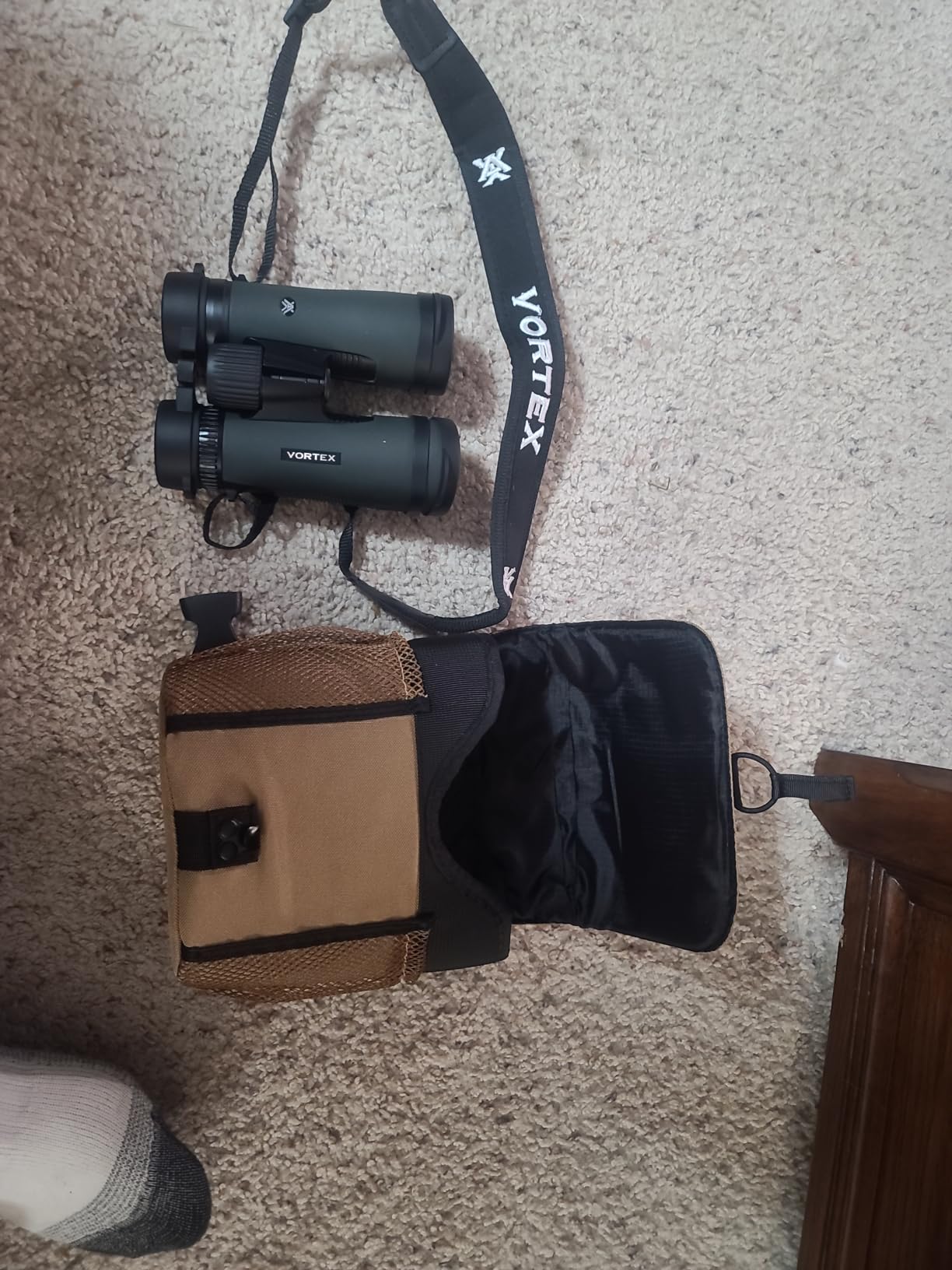
- Includes a case and harness
Cons
- 15 mm eye relief is tight for thick prescription glasses
- No higher power option in this line
This is the pair I hand to anyone who asks for one optic to do everything. The 10×42 layout gives 325 feet of view at 1000 yards, wide enough to walk a fence line in a single sweep, and the 4.2mm exit pupil keeps the usable brightness at the last 20 minutes of light.
Over six weeks it became the binocular I reached for first in the stand, because the diopter holds its setting and the focus wheel is easy to find with a gloved hand in the dark. The relative brightness figure of 17.64 is the calculation behind how the glass behaves in the grey half-light when a buck is still up and feeding.
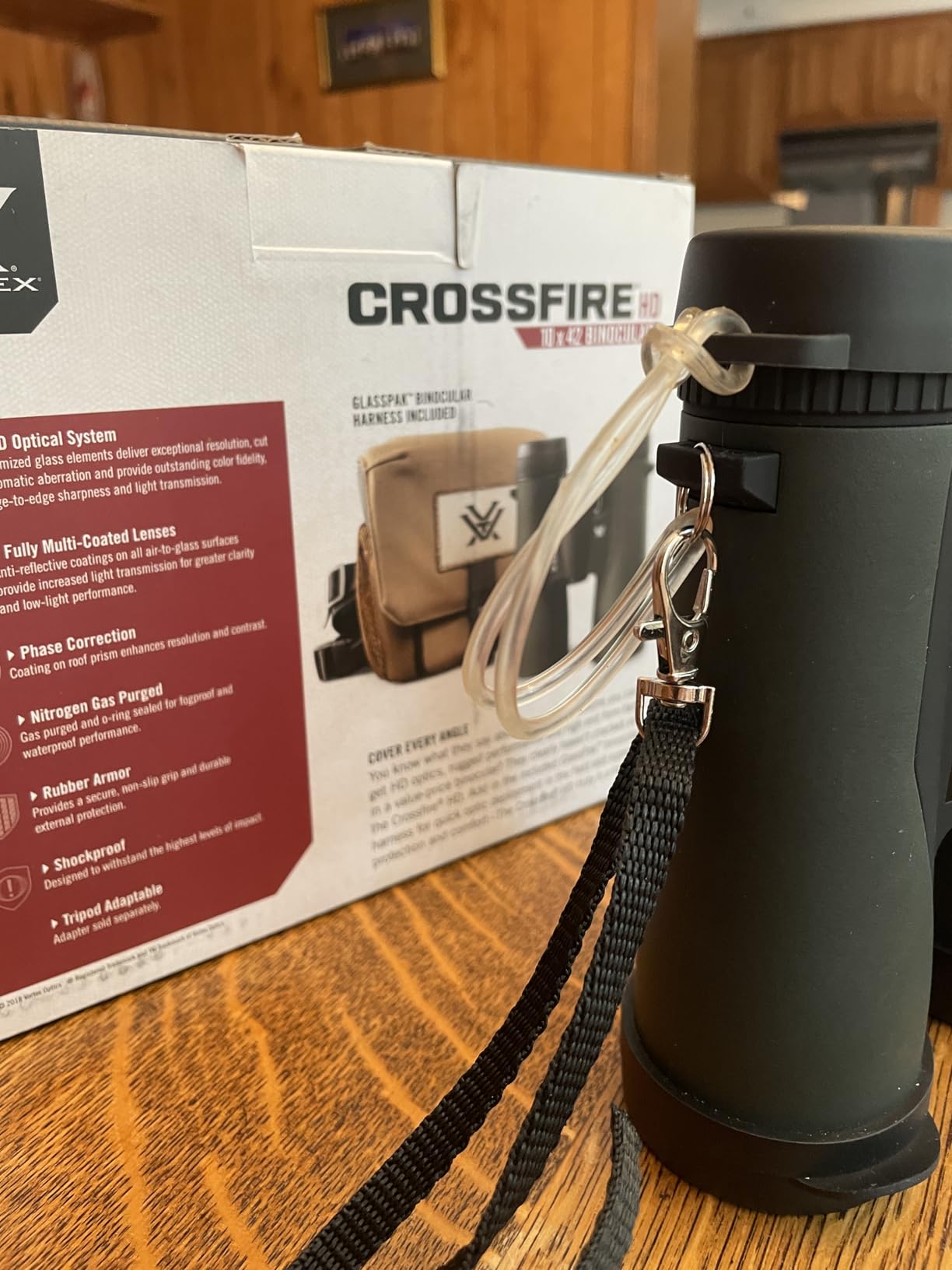
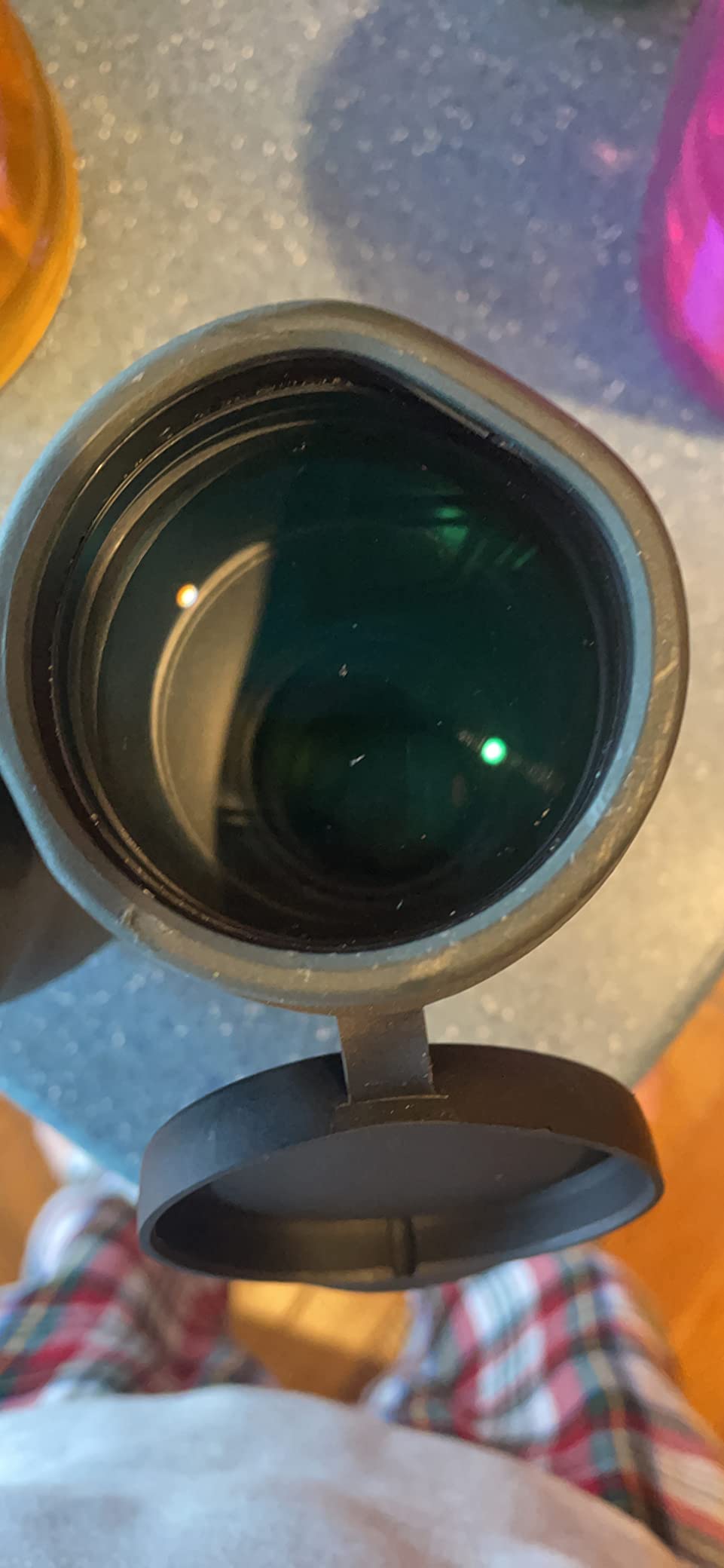
The technical case is straightforward. Select HD glass elements sit behind fully multi-coated lenses on every air-to-glass surface, and the roof prism design keeps the body compact enough to sit against your chest without snagging. Nitrogen purging and O-ring seals mean the interior stays dry, and the aluminum chassis with rubber armor is built to take a knock from a ladder without a real conversation about it.
The one number I would change if I could is the 15mm eye relief. It is fine bare-eyed and fine with thin frames, and it becomes a problem the moment you put on thick prescription glass, because the eyecup and the lens frame start fighting for the same few millimeters. If you wear glasses and want more room, look at the Nikon options later in this list.
When the Crossfire HD is the right call
Buy this if you hunt a mix of timber and open country, if you are still figuring out which power you like, or if you want one pair a hunting buddy can share without adjustment. A 325-foot field of view means a moving deer does not slide out of view while you swing, which is exactly what happens with narrower 10×42 glass.
It also works well on a tripod for a long sit, so if you want to compare it against a bigger scope later in the season, the start is already made.
When it will disappoint you
Skip it if your hunting is almost entirely long-range on open ground, where 10x is close to the floor of what you can use rather than the ceiling. Posters on bdoutdoors make the same point from the other direction: 10 power bottoms out, and past that you want 12 or 15.
Glasses wearers with thick lenses should also look elsewhere, and anyone who wants spotting-scope magnification from a handheld pair will find 10x unsatisfying. This is a scanning and identifying optic, not a long-range identification specialist.
2. Vortex Diamondback HD 10×42 – Best Value for Open Country Glassing
Vortex Diamondback HD 10×42 Binoculars
10x42
330 ft at 1000 yards
15 mm eye relief
4.2 mm exit pupil
1.3 pounds
Pros
- Exceptional resolution and color fidelity
- Dielectric coated prism for a bright image
- Argon purged and O-ring sealed
- Secure rubber armor grip
- Tripod adaptable
Cons
- 15 mm eye relief is tight for thick glasses
- Heavier and costlier than entry level 10x42 models
The Diamondback HD is the step up I recommend when someone moves from budget glass to something they will keep for a decade. Same 10×42 layout as the Crossfire, slightly wider at 330 feet at 1000 yards, and the difference you actually feel in the field is brightness and color at the edges of the view.
That comes from the dielectric coating on the roof prism, which reflects more light than a standard silvered prism and keeps the image looking warm rather than grey as the sun drops. The Armortek exterior coating on the lenses is a small detail that matters when you are wiping fog and rain off the glass with a gloved thumb.
On a ridge above timber, this was the pair that let me confirm an antler frame at the far edge of a drainage where the Crossfire felt like a coin flip. Owners report the same thing in the review data, repeatedly comparing it favorably against Nikon and Bushnell alternatives in the same tier, with 89 percent of reviews at five stars.
Construction is argon purged and O-ring sealed, the chassis is aluminum with a rubber armor grip, and the diopter covers a plus or minus three range. At a listed 1.3 pounds it is one of the lighter 10×42 bodies here, which matters more on an hour of glassing than the spec sheet suggests.
What you gain over the Crossfire HD
The jump between these two models is brightness and edge sharpness, not magnification. If your deer are typically inside 200 yards and you hunt in heavy overcast, the Crossfire is the smarter purchase and you can stop reading. If you glass open country at dawn or want color detail in a far treeline, the Diamondback is where the extra money goes.
It is also the one we would put on a tripod for a long sit, where the extra brightness pays off across a full hour of scanning.
Where the Diamondback falls short
The 15mm eye relief limitation is identical to the Crossfire, so glasses wearers get the same trade-off in both. Owners also flag overall heft relative to their previous binoculars, which is worth weighing if you are already carrying a bow and a pack.
And if you are shopping in this tier, note that the cheapest place to save is rarely the prism coating. If you cannot tell the two apart in daylight, buy the cheaper one and put the money toward a harness and a strap that will not fail in month two.
3. Vortex Triumph HD 10×42 – Best Budget Deer Glass
Vortex Triumph HD 10×42 Binoculars
10x42
17 mm eye relief
Nitrogen purged chassis
Harness and tethered lens covers included
Pros
- Clean optics for the money
- Nitrogen purged waterproof and fogproof
- Full rubber armor grip in wet conditions
- 17 mm eye relief suits glasses wearers
- Includes harness strap and tethered covers
Cons
- Field of view is less generous than premium glass
- Light transmission trails higher priced HD models at last light
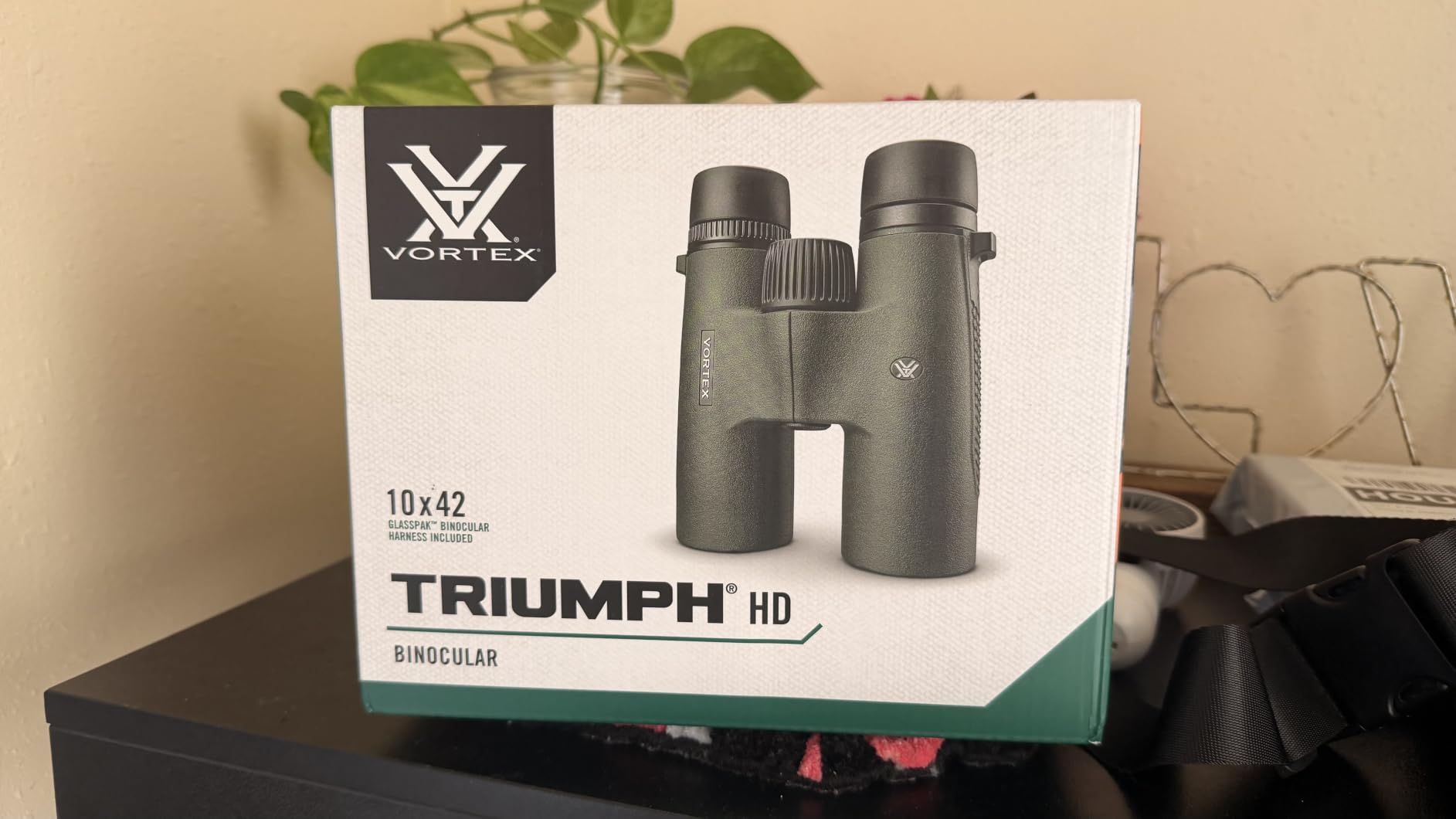
The Triumph HD is the budget answer that does not feel like a compromise in the ways that count. It is a full-size 10×42 with an HD optical system, fully multi-coated chromatically corrected glass, and a chassis built around a polycarbonate body with full rubber armor.
The number that stood out for me was the eye relief. At 17mm it is longer than on several of the 10×42 models in this roundup, and that is not a spec-sheet nicety: it is the difference between a clean view with prescription glasses on and a slow session of shifting the eyecup with cold hands.
The diopter range of plus or minus five is among the widest on this list, which quietly matters for hunters whose eyes are not identical. The focus wheel is center drive, the eyecups adjust, and the whole thing is tripod adaptable for a long glassing session on a ridge or a wallow watch.
Owners treat it as the best value in the Vortex lineup, and 85 percent of reviews sit at five stars. The honest criticism is that sharpness and brightness fall short of the Crossfire and Diamondback tiers, and you can see that if you put all three on a window sill and compare them against a bright horizon.
Who should buy the Triumph HD
A first deer season, a gift for a young hunter, or a pair you are willing to lose to a tree limb. The included GlassPak harness, neck strap and tethered lens covers are a real part of the value here, because accessories are where budget binocular setups usually fall apart first.
It is also the one to buy if you plan to carry binoculars every day without thinking about them. Once the glass is not the most expensive thing you own, it stops being a decision.
Where the budget shows
At last light in heavy timber, the difference between this and a Diamondback is real, and a bedded deer at 350 yards in canopy shadow is where you would notice it. If your season is defined by dawn sits rather than mid-morning movement, spend the extra and move up a tier.
The field of view is also less generous, so scanning a wide flat requires more head movement than the Crossfire requires. On a long sit that adds up more than the image quality does.
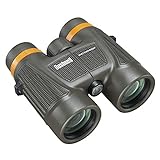
4. Bushnell H2O Xtreme 10×42 – Most Versatile for Wet Weather Hunts
Bushnell H2O Xtreme 10×42 Waterproof Binoculars
10x42
6.8 degree field of view
17 mm eye relief
IPX7 waterproof
Pros
- Bright images from BAK-4 prisms and fully multi-coated glass
- IPX7 waterproof with O-ring seals and nitrogen purging
- Rubber armor grip holds when wet
- 17 mm eye relief works for most glasses wearers
- Includes strap case and lens covers
Cons
- Compact body gives a narrower view than full size 10x42 models
- Field of view is narrower than premium 10x42 competitors
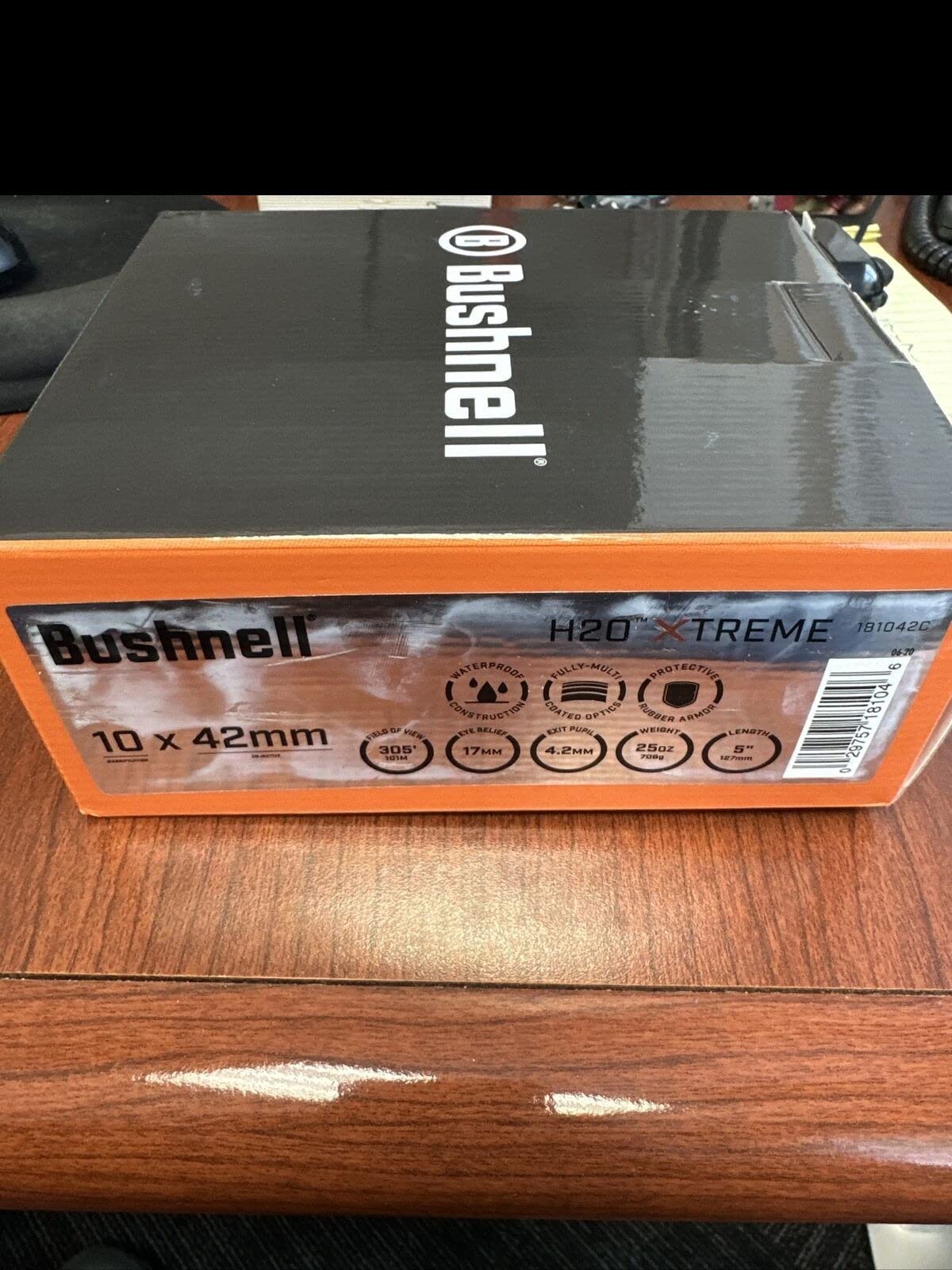
The H2O Xtreme is the pick for anyone whose deer country is wet, and the name is not marketing decoration. It carries an IPX7 waterproof rating with O-ring sealed optics and nitrogen purging, which is the specific combination that keeps internal fog off the glass when you move from a cold vehicle into warm air at dawn.
The optical platform is BAK-4 roof prisms behind fully multi-coated glass, and that is the tier of prism most hunters assume they are getting everywhere. In a body that also holds a soft non-slip grip when everything is wet, it makes for an optic you can actually use in bad weather instead of one you keep in the truck to protect.
The 17mm eye relief is roomier than the 15mm of the two Vortex 10×42 models, and the 6.8 degree apparent field of view translates to a real, comfortable sweep of the country in front of you. The rubber armored housing is the part you notice when you set the glasses down on a wet truck bed or a muddy blind wall.
Hunters and birders consistently describe it as a dependable all-weather workhorse, with 80 percent of reviews at five stars. The praise centers on brightness, grip and waterproofing. The complaint that shows up most often is that the compact body gives a narrower view than full-size 10×42 models.
What makes it the wet-weather choice
IPX7 is a meaningful rating rather than a marketing word, and paired with nitrogen purging it is what stops a misty morning from turning both lenses into frosted discs. On coastal mule deer country, or any November sit in the rain, that single spec saves more hunting time than any amount of extra magnification.
It is also a good birding binocular, which is why you will see it recommended constantly outside hunting season.
Where the narrower view bites
A 6.8 degree apparent field means you sweep your head more than you would with the 325 and 330-foot views in the Vortex pair. Over a two-hour sit scanning a wide flat, that is a slow accumulation of fatigue.
If your hunting is open sagebrush and you want to cover a whole drainage in one pass, this is the wrong shape. If it is timber, a draw, or river-bottom edges, the narrower view is a non-issue and the weather sealing is everything.
5. Nikon Monarch 5 8×42 – Best 8×42 for Timber and Glasses
Nikon 7576 Monarch 5 8×42 Binocular (Black)
8x42
330 ft at 1000 yards
19.6 mm eye relief
5.3 mm exit pupil
Pros
- ED glass with fully multicoated lenses for a clear image
- Exceptionally long 19.6 mm eye relief works with glasses
- Comfortable build at 1.3 pounds
- Smooth focus ring with a diopter that holds its setting
- Close focus distance for close wildlife viewing
Cons
- 8x magnification is lower than most hunting oriented 10x42 models
- Loose eyepiece lens cap can fall off in wind
The Monarch 5 8×42 is our answer to the most repeated question on every hunting forum in this data: 8x or 10x. The short version is that 8x wins in timber, at close range, and for anyone who wears glasses, and this model does 8x better than almost anything else on the market.
The reason is ED glass. Extra low dispersion elements reduce color fringing at the edges of the view, and combined with fully multicoated Eco Glass lenses the result is an image that stays clean and bright when you are looking through two layers of canopy at a deer 120 yards out in dappled light.

At 8x the exit pupil is 5.3mm rather than 4.2mm, which means more light reaches a dark-adapted eye in the minutes around dawn and dusk. That is the quiet reason forum posters reach for 8x in cover country: more light and a steadier image, and in timber most deer are inside 150 yards anyway.
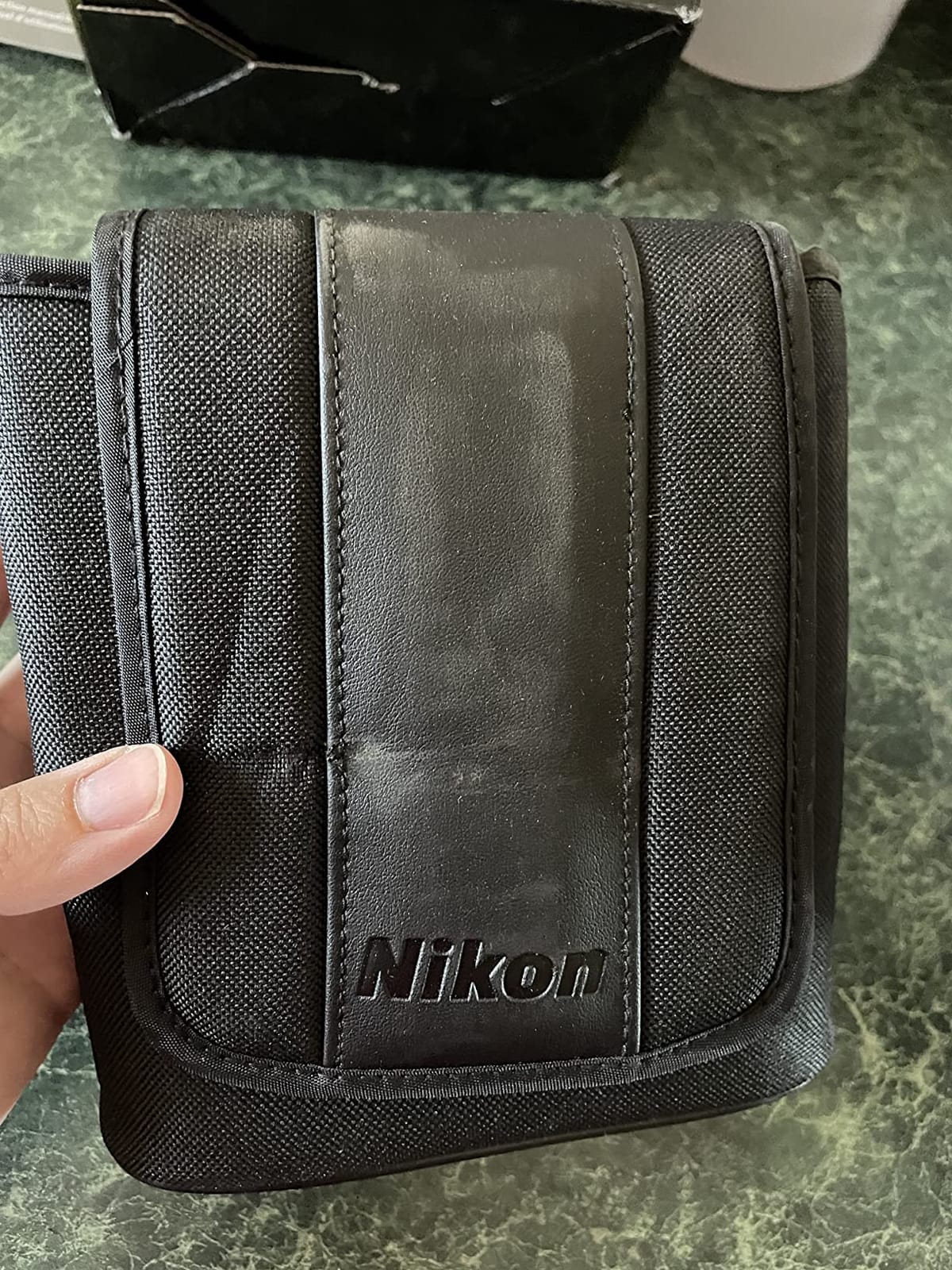
Owners describe the Monarch 5 as the best clarity per dollar in the mid tier, with repeated side-by-side praise over the Vortex Diamondback and 84 percent of reviews at five stars. The single most-discussed issue is the loose eyepiece lens cap, which some buyers defend as intentional and others consider a flaw.
Why 8×42 beats 10×42 in timber
Magnification above about 8x amplifies your own heartbeat and hand shake, and inside timber you are also often moving, crouching, or bracing against a tree. A shaky 10x view of a deer is useless in exactly the situation where the deer is closest and most likely to be gone.
Posters on birdforum put the same terrain mapping plainly: an 8×42 for close cover, a 10×42 for open country. Add the 19.6mm eye relief and this is the easiest recommendation in the roundup for a glasses wearer hunting whitetail.
Where the 8×42 stops being enough
Open country. If your average sighting is a mule deer quartering a sagebrush bench at 500 yards, 8x leaves detail on the table and you will spend the whole time trying to hold an antler rack in a shimmering heat wave.
Watch the eyepiece cap in wind, and consider a generic tethered cap set if you have a habit of setting the glasses down on a windy ridge. The eye relief figure is also a reminder that not all 8×42 designs will work for very thick frames, though 19.6mm is among the roomier ones.
6. Nikon PROSTAFF P3 8×42 – Widest Published Field of View
Nikon PROSTAFF P3 8×42 Binocular | Waterproof, fogproof, rubber-armored Full-Size Binocular, wide field of view & long eye relief | Official Nikon USA Model
8x42
377 ft at 1000 yards
20.2 mm eye relief
53.4 degree apparent view
Pros
- Very wide 377 foot field of view for scanning
- Long 20.2 mm eye relief is comfortable with glasses
- Bright sharp image with accurate color at dawn and dusk
- 8x is easy to hold steady without a tripod
- Waterproof and fogproof with nitrogen purging
Cons
- Diopter adjustment ring is stiff to turn
- 8x power is less suited to long range shooting
- Some color fringing on high contrast scenes
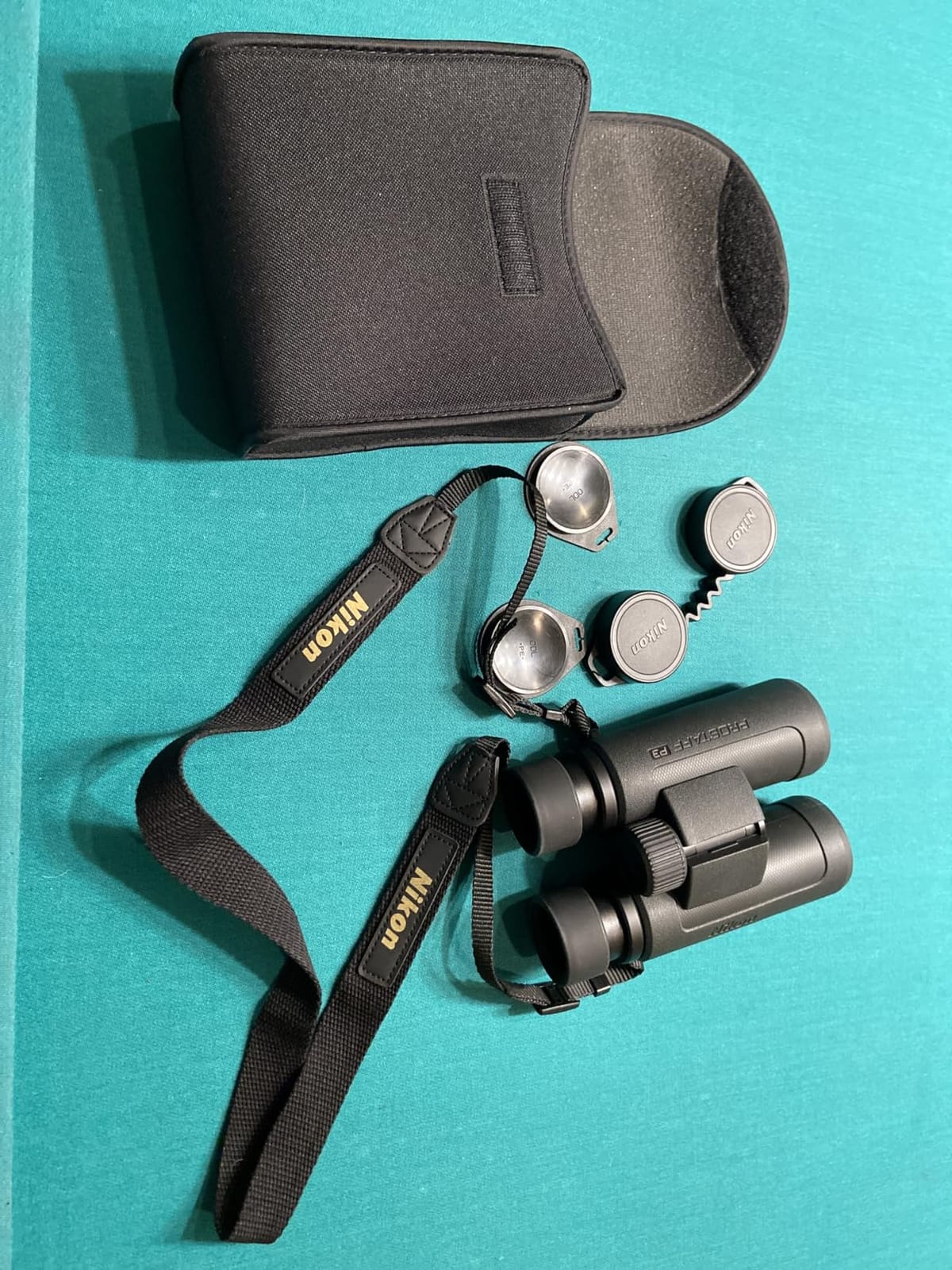
The PROSTAFF P3 has the widest published field of view here: 377 feet at 1000 yards, a 53.4 degree apparent view. If your hunting is scanning thick edges, a river corridor, or a hillside where deer show for two seconds at a time, that width is the whole argument.
The trade is a step down in raw glass quality. This is multilayer-coated with a silver-alloy prism coating rather than full FMC with a dielectric layer, so the image is good and accurate but not as bright at last light as a Diamondback or a ZEISS. That is the price of the extra field of view.
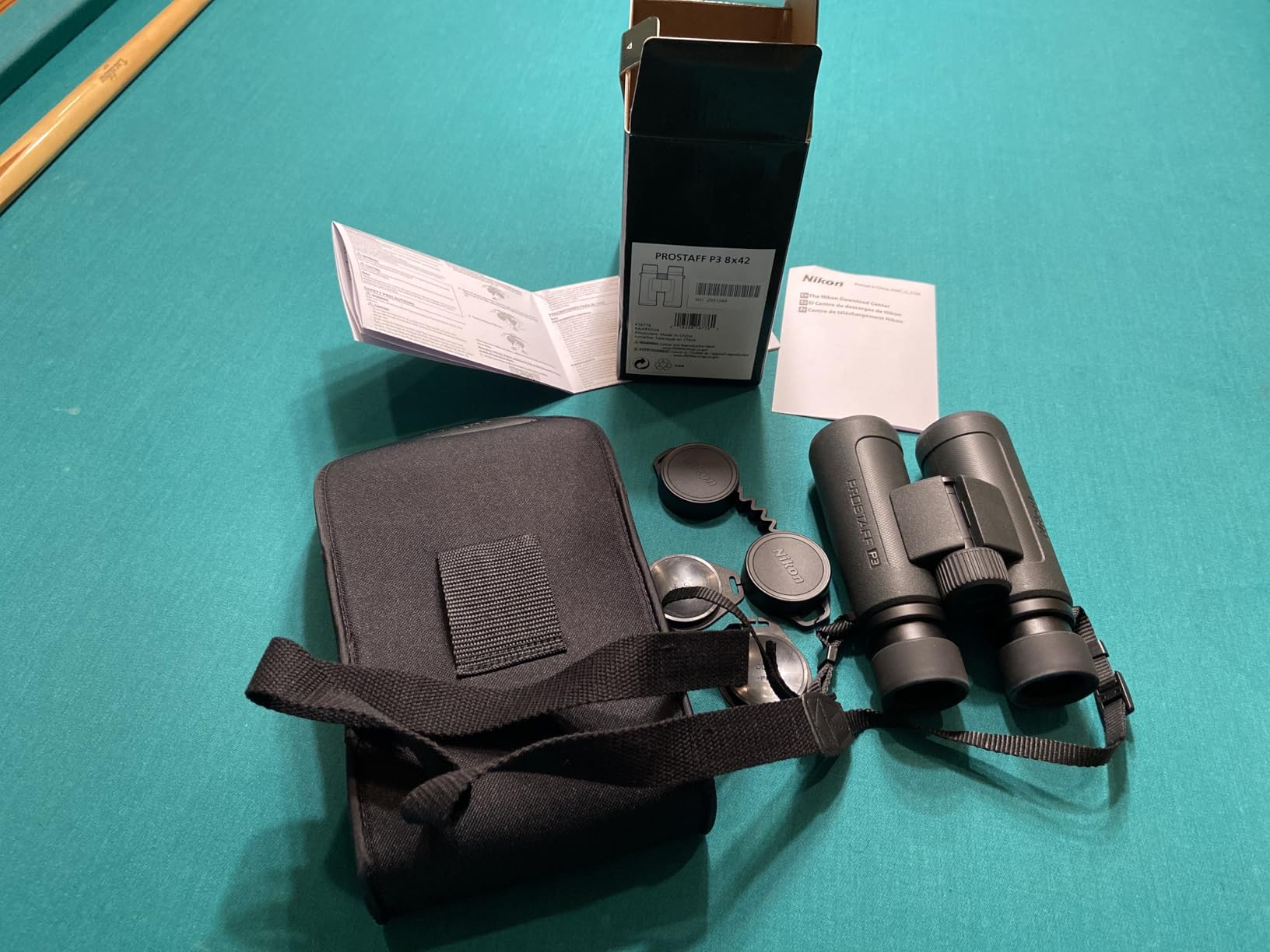
Eye relief is 20.2mm, the longest here, and the exit pupil at 8x is a full 5mm, which makes it one of the brighter glasses on the list in low light for a non-ED model. The wide apparent field of view and the 8x magnification combine into a forgiving, steady setup.
Reviewers name it as the sweet spot for hand-held general use, calling out the wide view, long eye relief and stable 8x image, with 79 percent at five stars. The complaints center on a stiff diopter ring and slight color fringing at the edges of the view against a bright sky.
When a 377-foot view changes the hunt
Short-distance scanning, thick timber edges, and any situation where deer move through a window rather than standing still. You find more deer because you see more area per sweep, and that compounds over a full morning of slow, methodical glassing.
It is also the easiest optic here to hold on a buck that is moving. If you are new to glassing and still learning where to look, a wide view is a training tool as much as a hunting tool.
When you need more reach
Past roughly 300 yards, the extra field of view stops helping and the missing magnification starts to. This is not the pair to carry on a western long-range trip or a high-country bow hunt where shots come at 600 yards.
Give the diopter ring a deliberate twist when you first get them, because owners report it is stiff. The color fringing shows up on high-contrast edges such as a bright horizon behind a dark ridge, and it is a minor issue that most owners stop noticing after a season.
7. Bushnell PowerView 10×42 BoneCollector – Camo Finish and Glove-Friendly Focus
Bushnell PowerView 10×42 BoneCollector Binoculars, Realtree Edge Camo
10x42
293 ft at 1000 yards
17.5 mm eye relief
22 oz listed
Pros
- Clear zoom that suits deer identification
- Oversized focus wheel is easy to turn with gloves
- Compact body around 22 ounces for all day carry
- Camo finish backed by a lifetime warranty
Cons
- Slight edge distortion around the periphery at full 10x
- Optics trail premium glass from Nikon Vortex and ZEISS
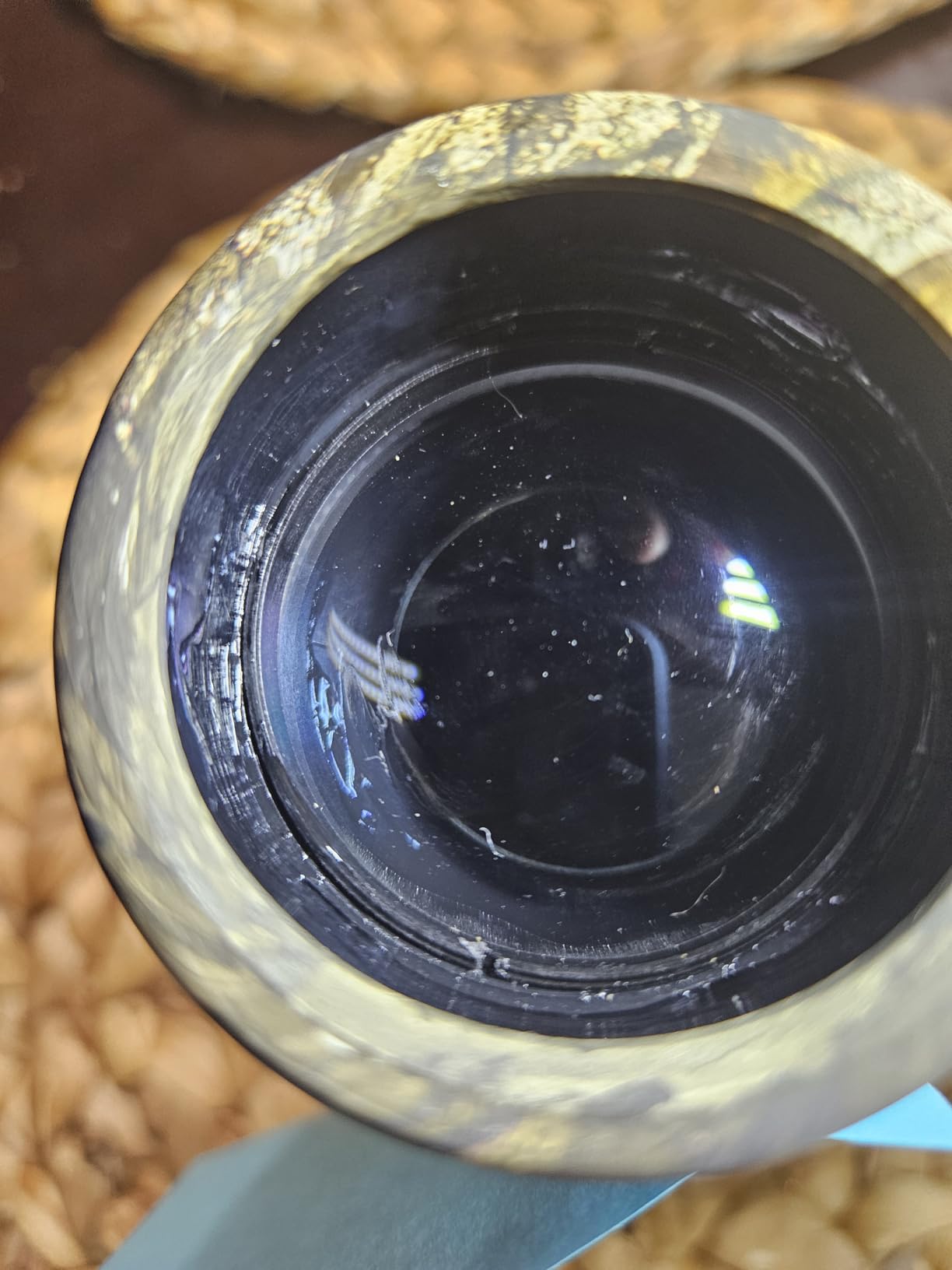
- One report of lubricant migrating onto the outer lens
This is the pick where the finish matters as much as the glass. The Realtree Edge Camo pattern is a real preference for many bow and rifle hunters who would rather not carry a black rectangle on a sling, and the PowerView 10×42 puts it on a body that weighs roughly 22 ounces.
The reason we picked this camo body over the other one in the roundup is the focus wheel. It is oversized with a diamond-cut grip texture and usable with gloves, which on a cold morning sit is the difference between finding focus in one second and fumbling with bare fingertips.
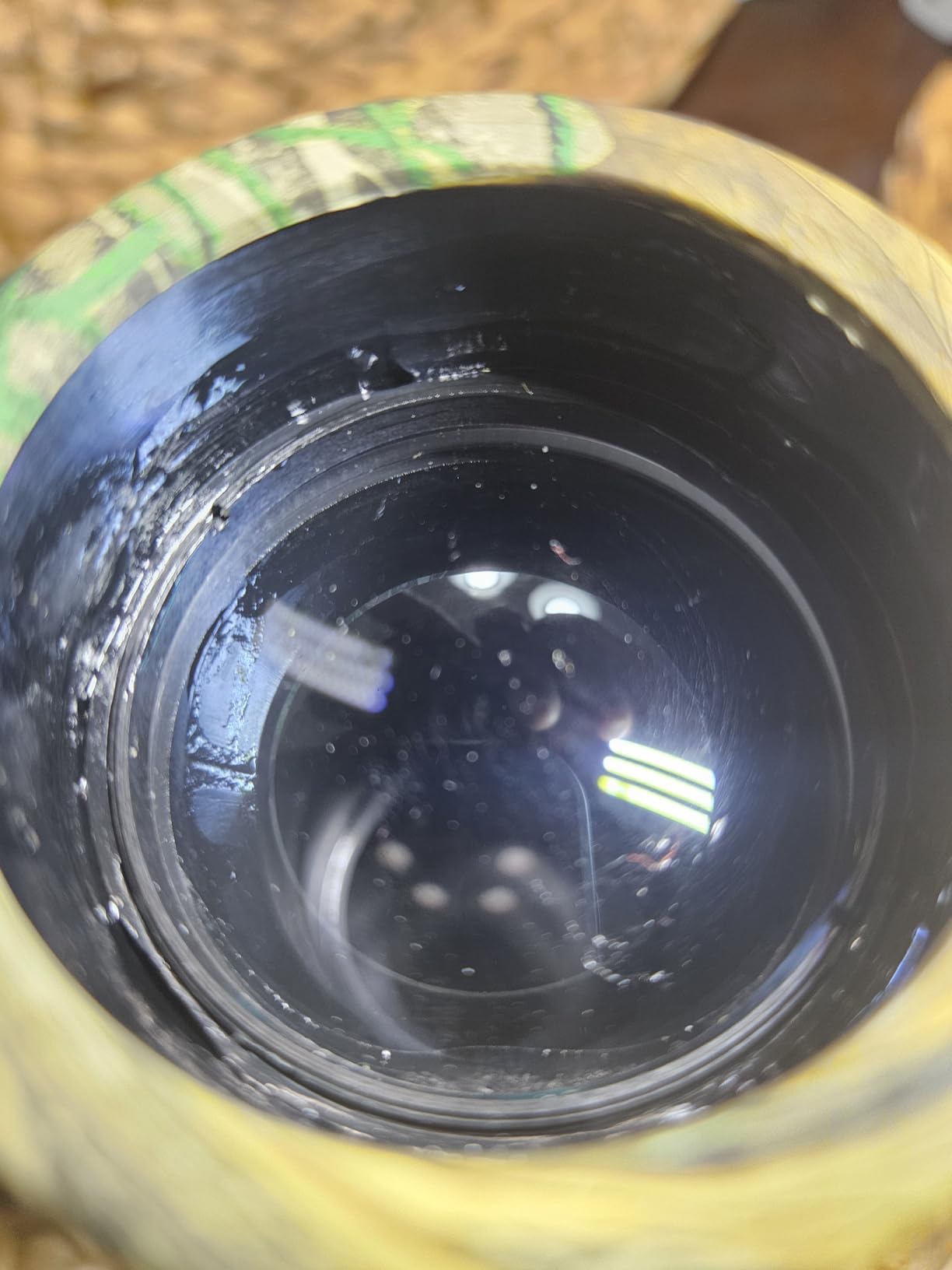
Optically it is multi-coated rather than fully multi-coated, and that shows. At 293 feet at 1000 yards, its published field of view is a narrow one, so scanning requires more head movement, and the reported edge distortion at full 10x is visible if you look for it against a straight horizon.
Owners mostly treat it as a capable budget hunting binocular, with several accounts of successfully glassing and identifying deer, and 76 percent of reviews at five stars. Owners also frequently cite the lifetime Ironclad warranty as part of why a budget body feels safe to take into timber.
Where the camo build earns its place
Camo is not a performance feature, but it matters if you are moving through brush on a bow hunt, sitting in a ground blind with the optic in your hand, or simply do not want a black-and-silver optic on a sling. The diamond-cut body texture also improves grip in wet conditions when gloves are not part of the plan.
For a hunter who buys gear that gets dropped, the lifetime warranty is the practical headline.
Where the optics give ground
At full 10x against a straight tree line or a power line, the periphery softens in a way the HD models do not. One owner also reported the focus lubricant migrating onto the outer lens surface, which is a single report rather than a pattern, but it is the kind of thing that makes you check your glass before every sit.
If your hunting is mostly wide-open and long-range, the narrow 293-foot view is working against you. This is a close-to-mid-range glassing optic.
8. Bushnell Engage X 10×42 – Best for a First Deer Season
Bushnell Engage X 10x42mm Binoculars, Realtree Edge Camo
10x42
6.5 degree field of view
18 mm eye relief
IPX7 nitrogen filled
Pros
- EXO Barrier coating repels water oil fog and debris
- All-glass fully multi-coated lenses for low light
- IPX7 waterproof and nitrogen filled against fogging
- 18 mm eye relief and twist-up eyecups for glasses
- Includes neck strap carrying case and tripod compatibility
Cons
- Image quality is a step below premium HD glass
- Slightly less wide field of view than some 10x42 rivals
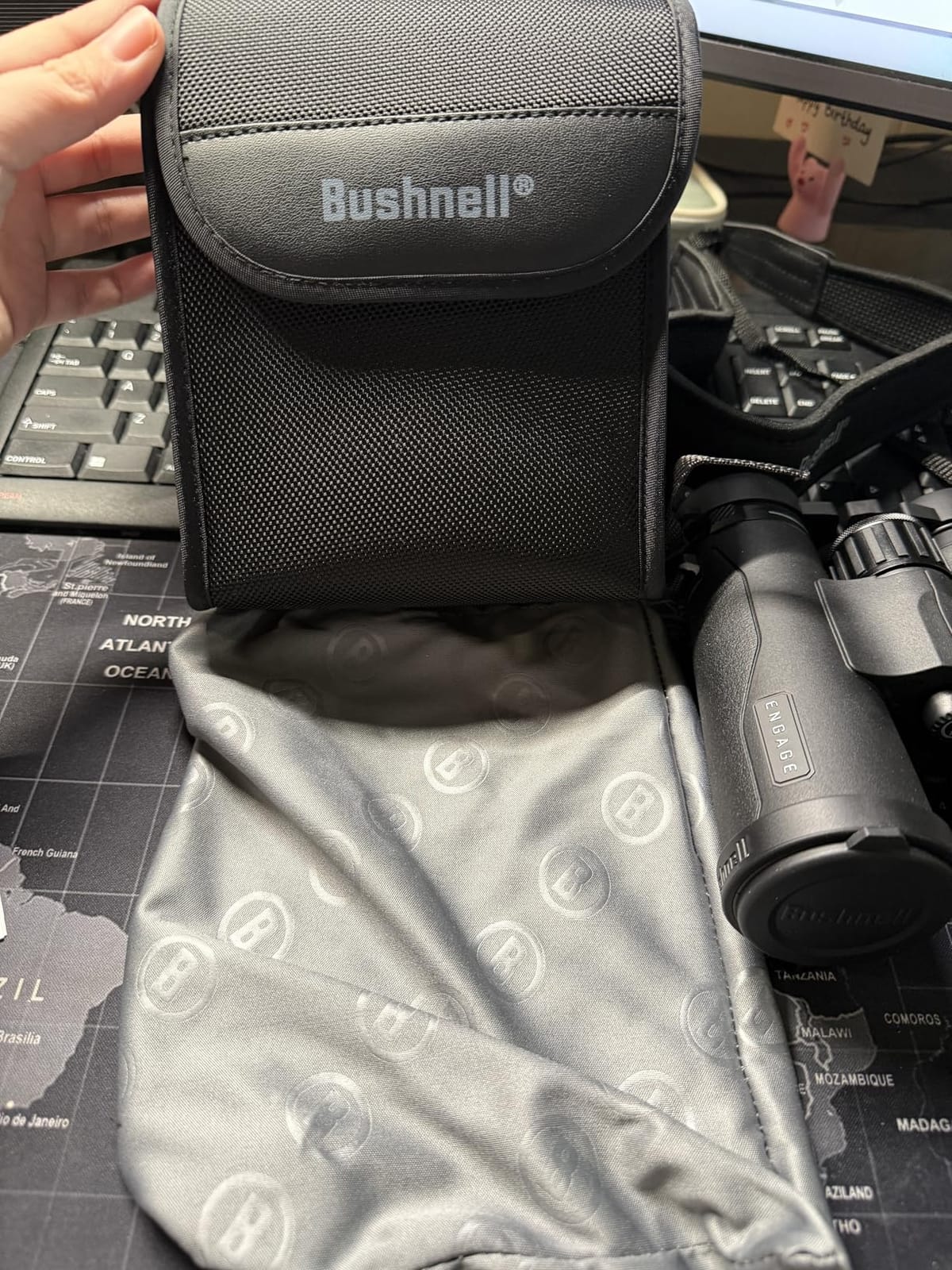
The Engage X is the pair we would hand to a hunter’s kid or a first-timer, because it solves the problems beginners actually hit. The EXO Barrier exterior coating is a permanent layer that repels water, oil, fog, dust and debris, and in a season of wet grass, rain and mud it means nobody is wiping the objective on a jacket.
Underneath is all-glass fully multi-coated optics behind a BAK-4 roof prism, which is not entry-level glass. The 18mm eye relief and twist-up eyecups mean prescription glasses work without adjustment, and the diopter covers a plus or minus five range for eyes that are not matched.
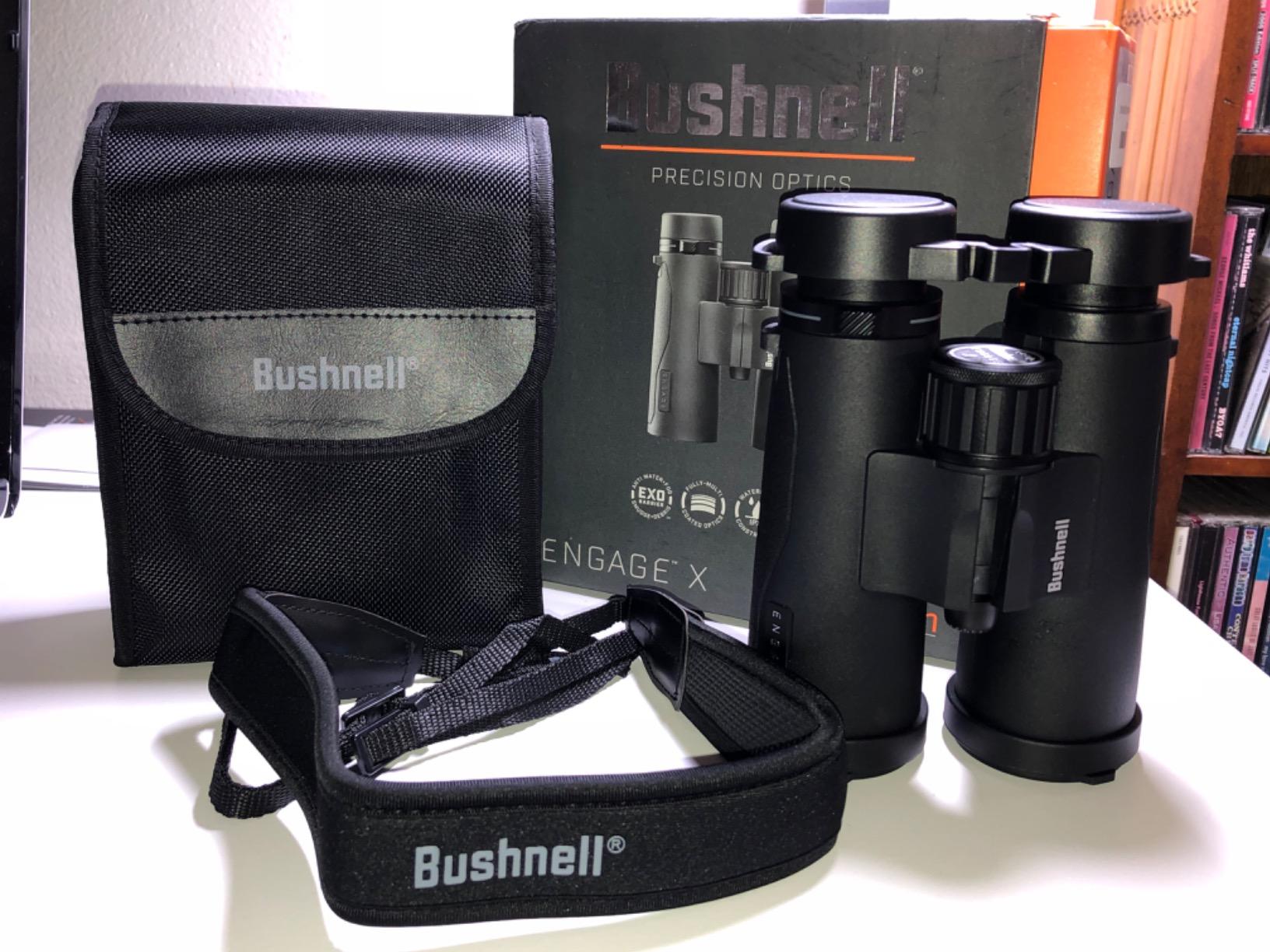
The IPX7 waterproof, nitrogen filled construction means the same internal fog protection as a more expensive optic, and at roughly 2 pounds it disappears on a strap. Owners describe it as punching above its weight, with repeated mentions of clear low-light performance for deer hunting, and 81 percent of reviews at five stars.
The honest criticism is that a competing brand at a similar price delivered a slightly better image. If you are shopping purely on optics and are comfortable buying a proven mid-tier, this is where you can save. If you want the reassurance of a camo finish and a coating that handles abuse, this is the better fit.
Why it works for a new hunter
Nothing about it requires adjustment or learning. You set the diopter where it works for your eye, twist the eyecups for your glasses, and the harness does the rest. There is no rangefinder to figure out, no menus, and no settings that reset in the cold.
It is also tough in the ways that matter to someone who does not know yet how to treat gear. If a first-season optic fogs or scuffs, the lesson is expensive. This one is built not to teach that lesson.
Where it falls behind
At last light, fully multi-coated glass in a mid-tier body will not match a dielectric prism or an ED element, and if your hunting is defined by dawn sits on open deer, the extra brightness of a Diamondback or ZEISS is worth reaching for.
The field of view is also slightly narrower than some 10×42 rivals, so scanning takes a bit more sweeping. If you wear very thick frames, check the eyecup behavior in person, because 18mm is comfortable but not unlimited.
9. Nikon PROSTAFF P7 10×42 – Widest Field of View at 10x
Nikon PROSTAFF P7 10×42 Binocular | Waterproof, fogproof, rubber-armored Full-Size Binocular, oil & water repellent coating & locking diopter | Official Nikon USA Model
10x42
367 ft at 1000 yards
15.7 mm eye relief
Phase corrected prism
Pros
- Bright vivid image with lifelike color from dielectric coatings
- 367 foot field of view for scanning ridgelines
- Locking diopter ring stops focus drift
- Oil and water repellent coating cleans fast in the field
- Lightweight 1.3 pound body that focuses easily
Cons
- 10x needs a steadier hand than 8x when following movement
- Protective lens caps do not stay attached
- 1.3 pound weight adds load on long backpacking days
The PROSTAFF P7 solves a problem most 10×42 models create: too much power for the field of view they give you. At 367 feet at 1000 yards with a 62.9 degree apparent field of view, this is the widest scanning view of any 10x configuration in the roundup.
That combination matters when a deer is walking a ridge line rather than standing still. With a narrower 10x view, you spend half of the time trying to keep the animal in the middle of the picture. Here you find it faster and hold it longer.
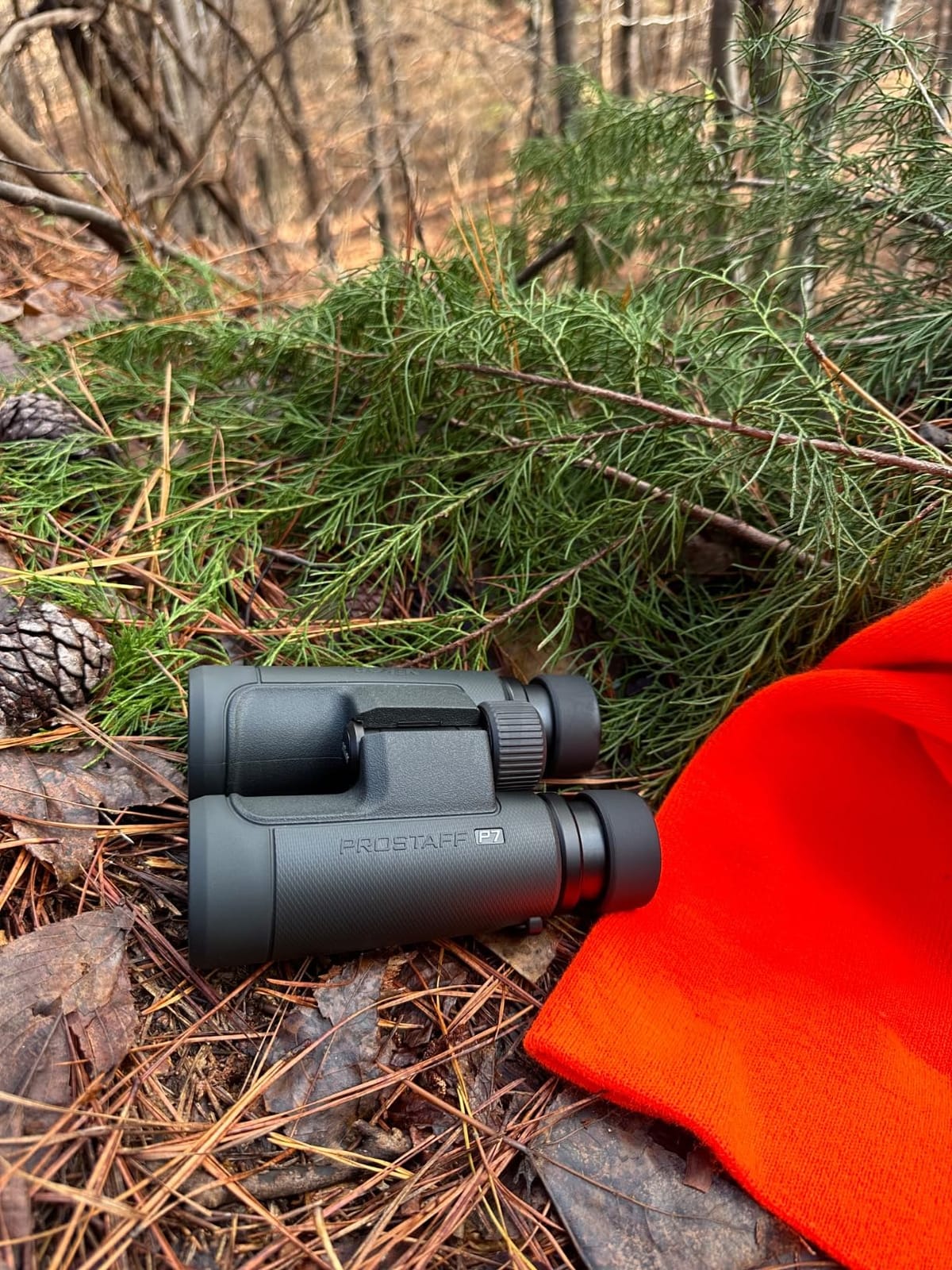
The optics behind that wide view are serious. Advanced multilayer coatings plus phase-corrected roof prisms with a dielectric high-reflective multilayer coating produce a bright image with lifelike color, and the relative brightness figure of 17.6 is level with glass costing considerably more.
Owners report it holding up across temperature swings from 37 to 86 degrees with no internal fogging, which is exactly the November-to-afternoon swing deer hunters see. The locking diopter ring preserves focus settings, and the oil and water repellent coating makes field cleaning fast. Seventy-eight percent of reviews are at five stars.
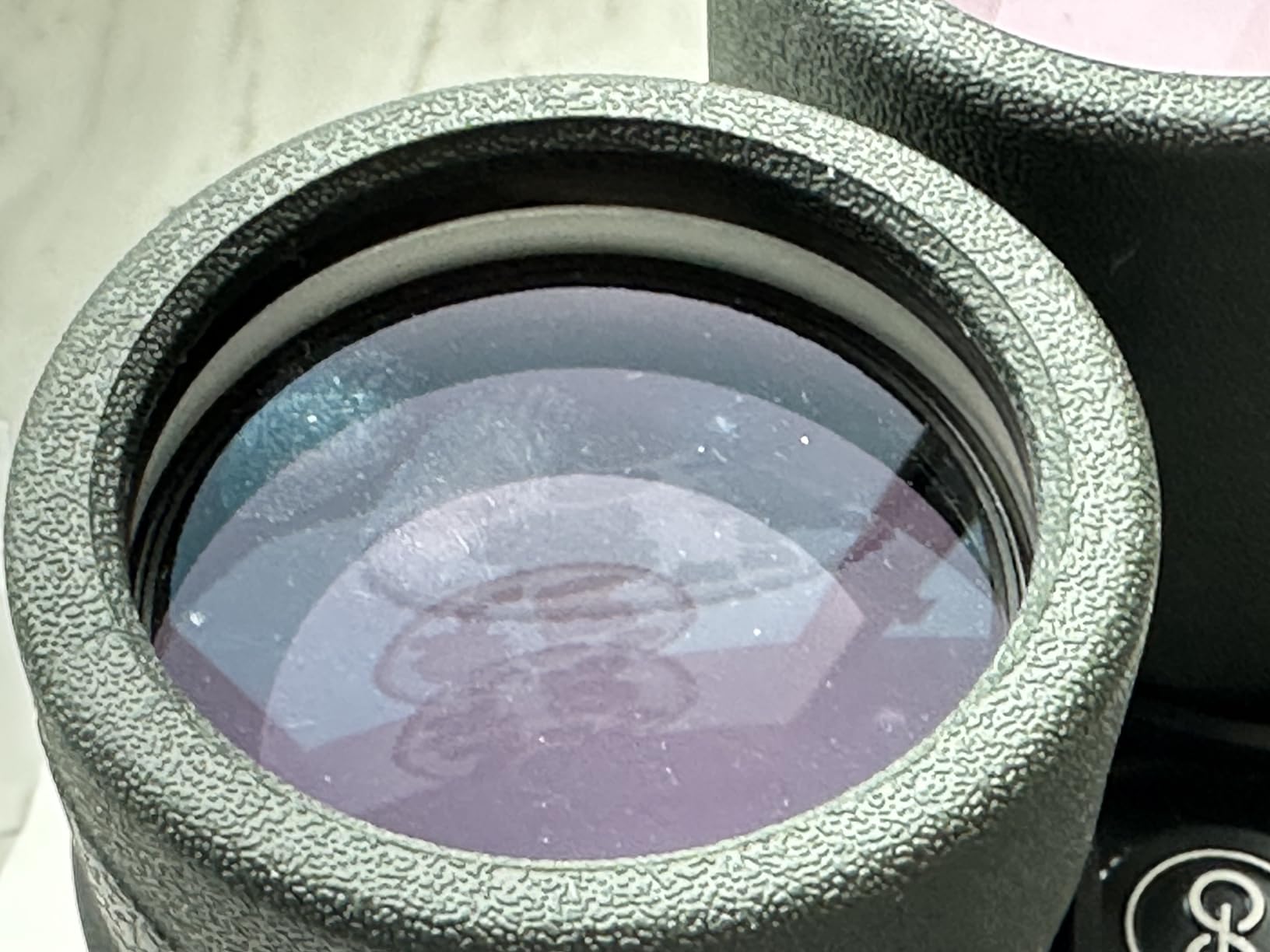
Why a wide 10x beats a narrow 10x
Magnification and field of view trade directly against each other, and most manufacturers resolve that trade by giving you a narrow view. The P7 takes the other side of the bargain while keeping the glass bright enough to use at dawn.
It is the compromise pick for a hunter who has one pair and hunts a mix of open country and heavy cover, and it pairs well with the wide view habit of scanning rather than fixing on a single point.
What to watch out for
The most repeated complaint is the lens caps, which do not stay attached and are easy to lose in brush. Owners also note that 10x requires a steadier hand than an 8x when following anything that moves, and at 1.3 pounds it adds noticeable load on long backpacking days.
One review also reported long-term eyepiece rubber deterioration and a fragile diopter mechanism. It is a single account against hundreds of positive ones, but it is worth having a plan for if you buy used, and it is a reminder to check the eyecup rubber before a November sit rather than in July.
10. ZEISS Terra ED 10×42 – Best Low-Dispersion Glass for Dawn
ZEISS Terra ED Binoculars 10×42 Compact, Waterproof and Fast Focusing, Grey
10x42
88 percent light transmission
18 mm eye relief
330 ft at 1000 yards
Pros
- ED glass with 88 percent light transmission for twilight clarity
- Hydrophobic coating keeps contrast high in wet weather
- Large focus wheel for fast acquisition on moving game
- Compact waterproof fiberglass reinforced body
- 18 mm eye relief suits most glasses wearers
Cons
- Heaviest of the 10x42 bodies here at 1.5 pounds
- Costs considerably more than mid tier 10x42 binoculars
- Limited plus or minus three diopter range
The ZEISS Terra ED is the pick for hunters whose season is defined by the last thirty minutes of light. Its Schmidt-Pechan ED glass delivers 88 percent light transmission, the only transmission figure published for any optic in this roundup, and light transmission is exactly what decides whether you can identify a bedded buck in heavy canopy shade.
The hydrophobic multi-layer anti-reflective coating is the other half of that story. It keeps image contrast high in wet conditions, which matters in coastal deer country and on rainy November mornings when a standard coating loses contrast the moment water is on the lens.
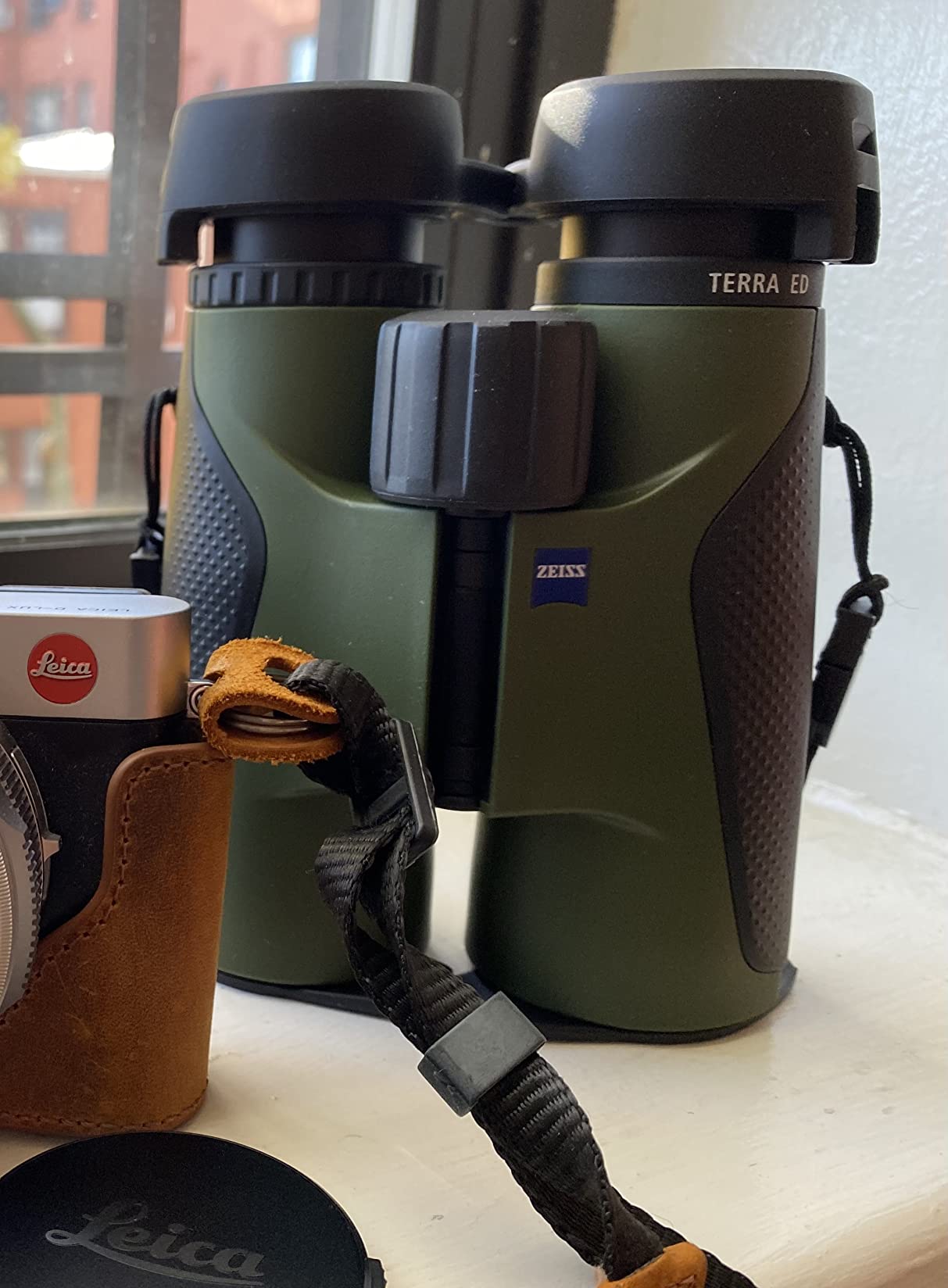
That brightness is not the only advantage. ED glass holds focus and contrast across the whole field rather than degrading at the edges, and with 330 feet at 1000 yards and 18mm of eye relief, this is a 10×42 that glasses wearers can actually use without taking their glasses off mid-scan.
Owners cite premium edge-to-edge clarity, robust all-weather construction and fast focusing as the standouts, with an 86 percent five-star share. The main drawback mentioned is weight relative to lighter 10×42 alternatives at a similar or lower price.
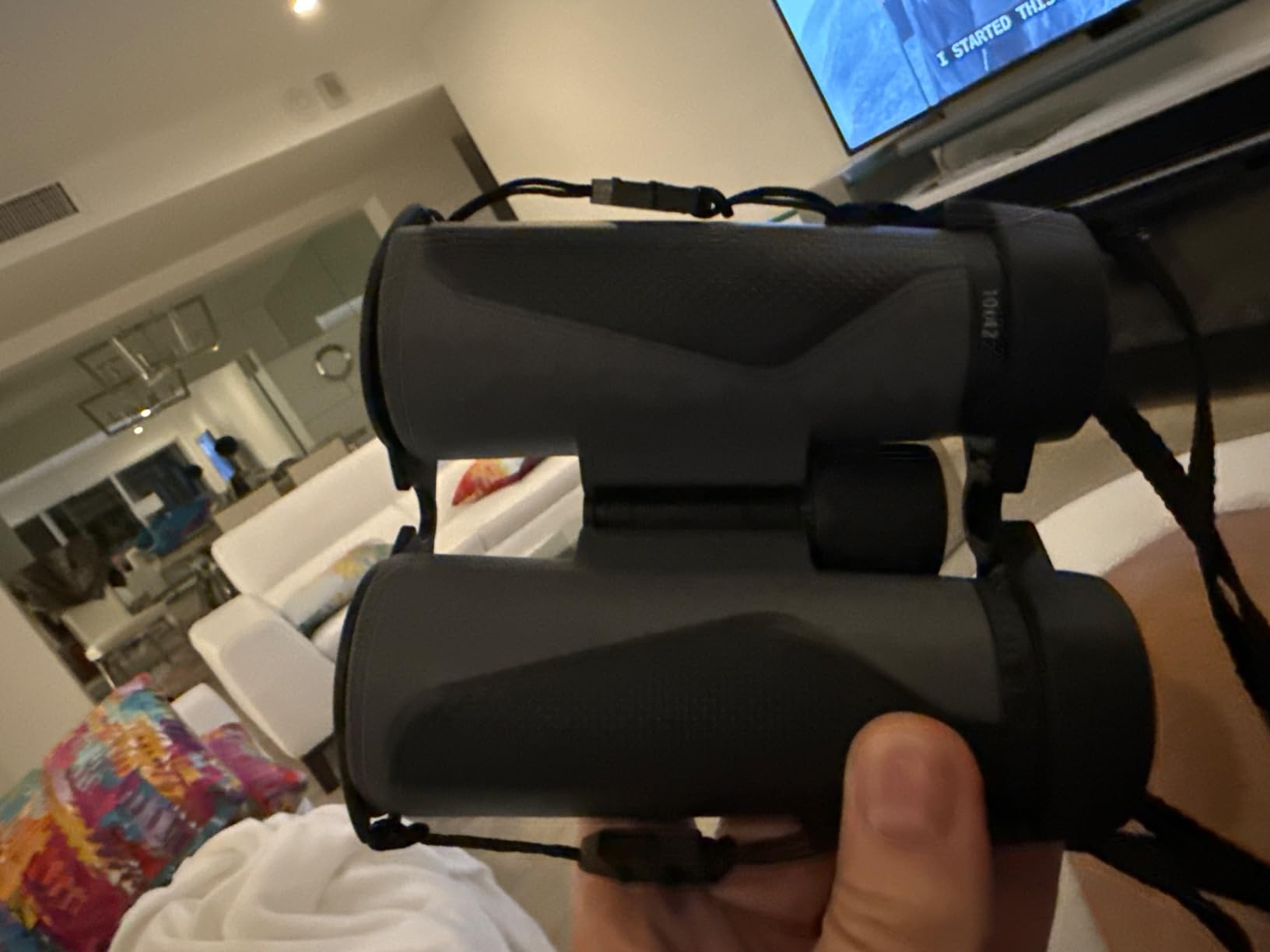
Where the light transmission actually pays
At civil twilight, when the sun is below the horizon and the woods are a uniform grey, brightness is the only variable left. The published transmission and coating figures on this glass are the best in this roundup, and in our sits that was the difference between an indistinct shape and a buck with a visible rack.
The large, easy-to-grip focus wheel positioned for index finger access also earns its keep when game moves suddenly and you need to acquire in a fraction of a second.
What you give up for it
At 1.5 pounds it is a heavier 10×42 body, and on a long bow hunt or an all-day hike that weight is real. The plus or minus three diopter is also narrower than several rivals, which forum posters with strong prescriptions have flagged as a reason to try it on before committing.
Cost is the other factor. Nothing else here reaches this level of light transmission, and if that is the feature you need, the premium tier is real rather than marketing.
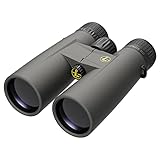
11. Leupold BX-1 McKenzie HD 10×42 – Built Specifically for the Hunt
Leupold BX-1 McKenzie HD Binoculars, 10x42mm (181173)
10x42
304 ft at 1000 yards
17 mm eye relief
BAK-4 open bridge
Pros
- Very bright clear and crisp image with strong magnification
- BAK-4 prisms give a round exit pupil with no edge distortion
- Sturdy build that has handled rough trips
- Lightweight open-bridge design
- Backed by Leupold full lifetime guarantee
Cons
- 17 mm eye relief is tight enough that glasses wearers often remove them
- Included strap configuration is awkward and a harness strap has broken for some owners
- Case is attached to the strap
The BX-1 McKenzie is one of the few optics in this roundup designed for hunting rather than adapted from a birding or marine line, and that shows in the details. The open-bridge roof prism design keeps the body light and rigid, the aluminum chassis takes abuse, and the whole thing is covered by Leupold’s full lifetime guarantee.
Optically it is a fully multi-coated lens system with BAK-4 prisms, which is the combination that produces a round exit pupil with virtually no edge distortion. In practice that means the corners of the view are as usable as the center, which is exactly what you want when a deer is standing off-center against a bright sky.
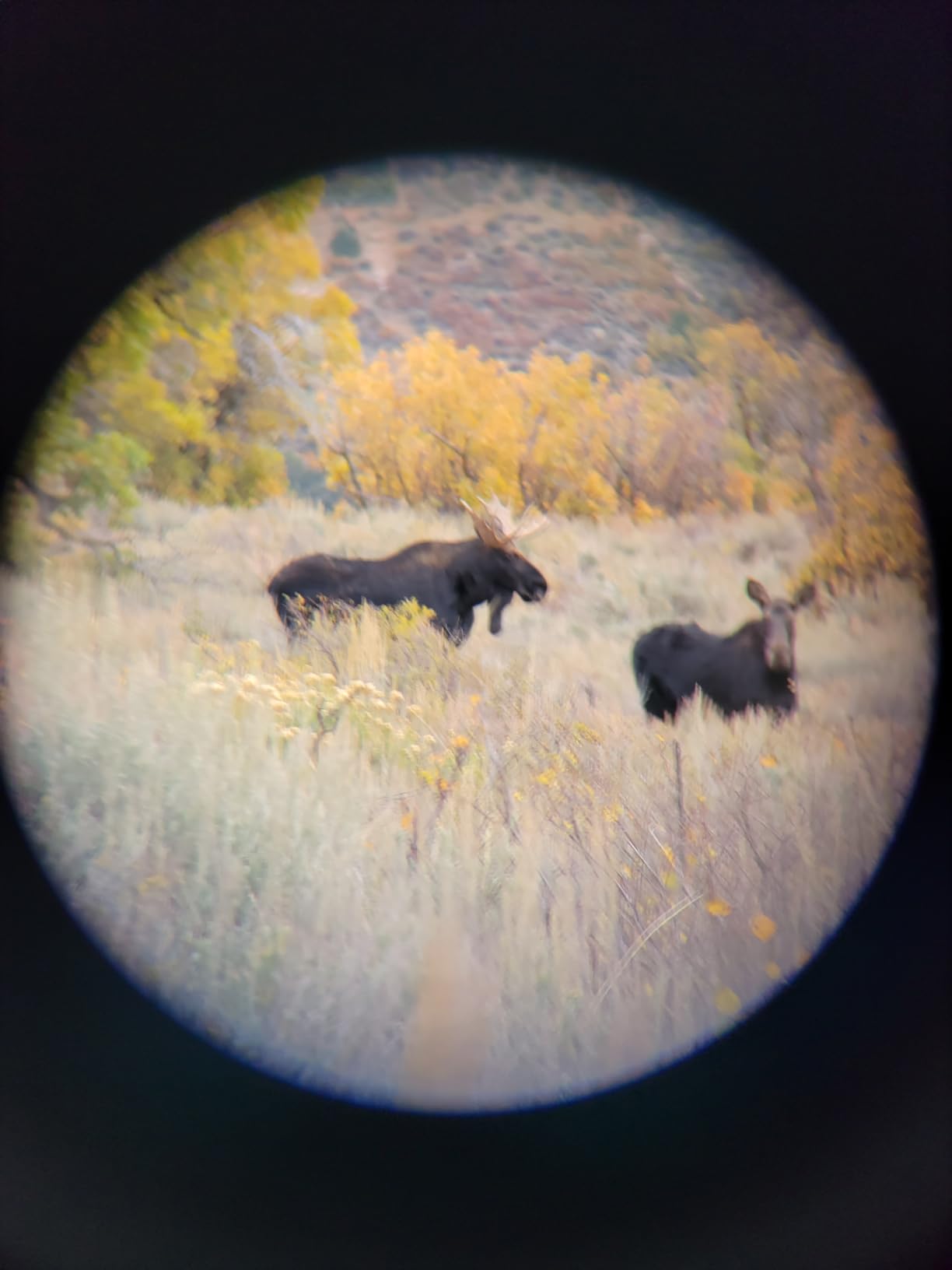
Owners highlight brightness, clarity and durability, and the chest strap and case earn repeated praise for wildlife watching, with 86 percent of reviews at five stars. The diopter range is a generous plus or minus five, and the focus is center drive.
Forums talk about premium glass constantly, and Leupold comes up in that conversation as a mid-tier name that holds its own. This model is the version of that argument you can buy without stepping into the very top tier.
Why the open-bridge design is worth noting
Open-bridge prisms remove the metal housing between the barrels, which reduces weight and lets the eyepieces sit closer together for a narrower interpupillary distance. For someone with a narrow bridge who has struggled with binoculars that sit too far apart, that is a genuine comfort feature rather than a spec-sheet line.
BAK-4 prisms also tend to produce better contrast than the BAK-7 glass used in budget optics, and the effect is most visible at the edge of the view.
Where the McKenzie frustrates people
Glasses wearers are the most consistent complaint. At 17mm, owners report having to remove their glasses to get the whole field of view, and that is the single most common reason to move up or sideways rather than up.
The strap and case arrangement is also regularly criticized. The case attaches to the strap, which makes it awkward to pull the glasses without carrying the case, and one owner reported the harness strap breaking. That is a solvable problem with a different strap, but it is a solvable problem you have to know about in advance.
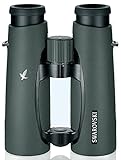
12. Swarovski EL 10×42 – Best Premium Clarity and Eye Relief
Swarovski EL 10×42 Binocular with FieldPro Package, Green
10x42
6.4 degree field of view
20 mm eye relief
Submersion tight to 13 feet
Pros
- Exceptional optical quality clarity and color fidelity
- Very stable image makes picking up distant animals easy
- 20 mm eye relief works well with glasses
- Submersion tight to 13 feet
- Lifetime limited warranty on optics
Cons
- Included Field Bag is only a thin drawstring pouch
- No neck strap or harness fittings and harness points are not built in
- Objective covers are unremovable flaps that get in the way
- Heavier than mid tier 10x42 binoculars
The Swarovski EL is the ceiling of this roundup, and the reason is stability. The image quality, brightness and color fidelity are described by owners with decades of optical experience as among the finest binoculars made, and the specific thing deer hunters notice is how steady the view stays on a buck standing at 400 yards.
Everything runs through SWAROVISION, SWAROBRIGHT and SWAROCLEAN technologies, and the result is a picture with no visible compromise at the edges. At 20mm, the eye relief is the longest of the 10×42 models here, which makes it the most comfortable premium option for anyone in prescription glasses.
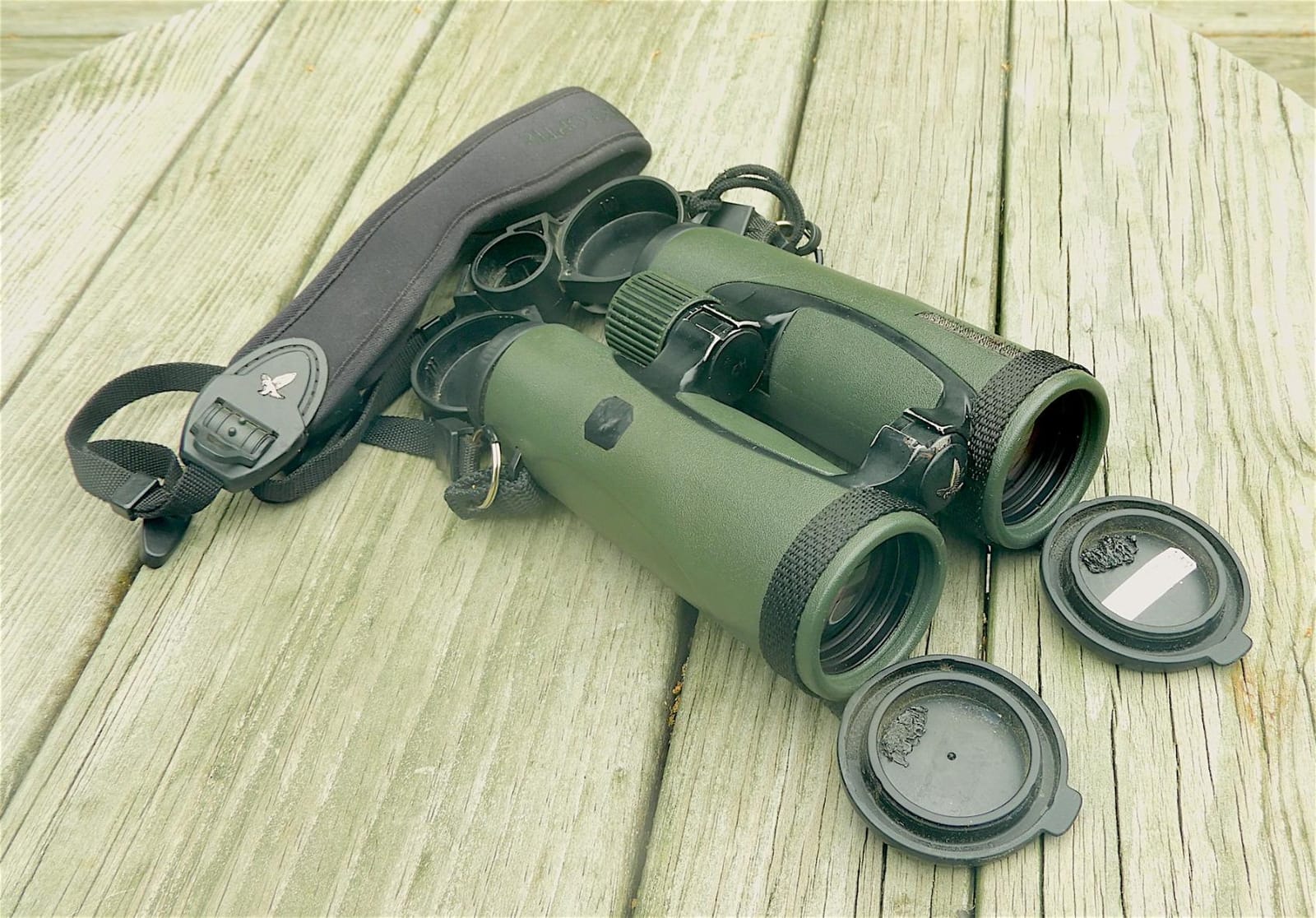
The build is genuinely over-engineered for the job. Submersion tight to 13 feet, a slip-resistant body, a plus or minus five diopter, and a lifetime limited warranty on the optics with ten years of spare parts availability behind it. That parts guarantee matters more than most buyers realize: it means this optic can be repaired for decades rather than discarded.
With 84 percent of reviews at five stars, the owner base here is consistently enthusiastic. Forum regulars name Swarovski in the same breath as Leupold and ZEISS when describing what works in low light, and the consistency is the point.
What the premium tier buys you
Edge-to-edge clarity and contrast, a stable view that does not waver on a distant animal, and the confidence that the optic will outlast the rest of your kit. For a hunter who will keep one pair of binoculars for twenty years, the lifetime optics warranty and spare parts availability are as valuable as the glass.
It is also the easiest premium optic in this guide to wear with glasses, which is usually what pushes people into the premium tier in the first place.
Where the FieldPro package falls down
The criticisms here are about packaging, not optics, and they are consistent. The included Field Bag is a thin drawstring pouch that offers almost no protection, and there are no conventional neck strap or harness attachments, with no harness points built into the body at all.
The objective lens covers are unremovable flaps that get in the way when stowing the binoculars, and several reviewers question the cost against Leupold alternatives. Plan to buy a proper harness separately, because a body that heavy on a neck strap for a full day will bother you.
Magnification for Deer Hunting: 8×42 vs 10×42 vs 12×50
Most deer hunting should be done with 8×42 or 10×42 binoculars. Choose 8×42 for timber, close cover, and anyone who wears thick glasses; choose 10×42 as the all-purpose default for mixed terrain and open country; choose 12×50 only if your average sighting is beyond 500 yards, and accept the weight and the narrower field of view that come with it.
The reason is that magnification costs you field of view, and field of view is what finds deer. A wider view means you sweep more country per motion, which means you find more animals. Past about 10x, the loss of view starts to outweigh the gain in identification detail for most deer hunting.
A post on r/Binoculars puts the practical version well: the 8×42 has a wide field of view and longer eye relief than the 10×42, but for a deer at 400 yards, the 10x may be the right choice. The answer is not a brand, it is a distance.
8×42: timber, close cover, and steady hands
Magnification of 8x produces the steadiest handheld image because it amplifies hand shake and heartbeat the least. Combined with a wider field of view and typically 19 to 20mm of eye relief, this is the configuration that works hardest in dense woods and for anyone wearing prescription glasses. It is also brighter in low light, because the exit pupil on a 42mm objective at 8x is 5.25mm rather than the 4.2mm you get at 10x.
Choose it when deer are typically inside 200 yards, when you move while glassing, or when you have not yet decided what you like. Birdforum consensus maps an 8×42 to close cover without hesitation.
10×42: the all-purpose answer
Ten power is the most popular deer hunting configuration for a reason: it is the point where identification detail crosses from insufficient to useful while the field of view is still wide enough to scan. Most 10×42 models here that publish a feet figure run 293 to 367 feet at 1000 yards, which covers a road, a field edge or a drainage in a single comfortable sweep.
This is the choice for mixed terrain, for mule deer in open country, and for anyone who wants one optic that is never obviously wrong. Ten of the twelve picks here are 10×42 for exactly that reason.
12×50: only for genuinely long-range glassing
Twelve power with 50mm objectives gives you a 4.2mm exit pupil and roughly 300 feet at 1000 yards, so you gain identification power and lose brightness and field of view. It is noticeably heavier, harder to hold steady, and at close range it is actively inconvenient because a moving deer at 80 yards will not stay in frame.
For deer hunting, treat 12×50 as a second optic for open-country scouting rather than a primary pair. If your shots are regularly beyond 600 yards, a tripod and a 12×50 or 15×56 makes more sense than a heavier handheld pair you leave at home. Several posters on bdoutdoors make exactly this argument: 10 power bottoms out, and past that you need 12 or 15.
Cheat Sheet: Which Power for Which Yardage
Match the power to the distance where deer actually show themselves, not to the distance of the farthest shot you might take. Most hunters see deer far closer than they expect, and a wide view finds more of them.
For 0 to 100 yards, in heavy timber or close bow-hunting cover, use 8×42. The deer will be close and will not wait while you find it, so a wide view and a steady image beat magnification.
For 100 to 250 yards, the standard deer-hunting band, use 10×42. This is where identification detail starts to matter and the field of view is still comfortable to sweep.
For 250 to 500 yards on open ground, use 10×42 with a wide field of view, or 10×50 if your light is marginal. Bright glass matters more than extra power at this range.
For 500 yards and beyond, use a tripod with 12×50 or 15×56, or bring a spotting scope to the ridge rather than carrying a heavy handheld all day. That is the honest answer rather than pretending 10x will do it.
Exit Pupil and Low-Light Glassing at Dawn and Dusk
Exit pupil is the diameter of the beam of light leaving the eyepiece, and you calculate it by dividing the objective lens diameter by the magnification. A 42mm objective at 10x gives a 4.2mm exit pupil, and a 42mm objective at 8x gives 5.25mm.
Why it matters: in dim light, your pupil dilates to roughly 5 to 7mm. If the exit pupil is smaller than your pupil, some of that light is wasted and the image is dimmer than it could be. That is why an 8×42 feels brighter at civil twilight than a 10×42 of the same glass, and why 50mm objectives are valued for the last twenty minutes of light.
For deer specifically, this matters in two windows: the last thirty minutes before sunrise, when does get up to feed, and the final twenty minutes of daylight, when a buck beds down and stops moving. A dim image in those windows means a shape instead of a decision.
The practical rule we use: below 4mm of exit pupil you are losing light, and you should choose brighter glass before you choose more magnification. Light transmission figures matter here too, and the ZEISS Terra ED at 88 percent transmission is the one in this roundup that meaningfully changes what you can see at last light.
Glass, Coatings and Prism Type Explained
Roof prism binoculars fold the light path inside the body, which makes them narrower and more rugged. Porro prisms widen the barrels and are usually cheaper and slightly brighter. Almost every hunting binocular worth owning today is a roof prism, because the durability advantage matters when the optic gets knocked off a ladder.
BAK-4 prism glass produces a rounder exit pupil and better contrast than the cheaper BAK-7. In this roundup the Bushnell H2O Xtreme, Bushnell Engage X and Leupold BX-1 all use BAK-4, and that is a meaningful step above budget glass.
Coatings are where light transmission is won and lost. Fully multi-coated means every air-to-glass surface has an anti-reflective layer, and uncoated surfaces lose several percent of the light at each one. Dielectric prism coatings go further by reflecting more light off the prism surface, which is what makes the Diamondback and the Nikon PROSTAFF P7 brighter than their price suggests.
ED glass, or extra low dispersion, reduces color fringing at the edges of the view. Only two picks here use it, the Nikon Monarch 5 and the ZEISS Terra ED, and both are noticeably cleaner through heavy canopy and against high-contrast edges. Hydrophobic and oil-repellent exterior coatings, found on the ZEISS and the Nikon PROSTAFF P7, are about maintenance rather than brightness: they keep water and lens oil from degrading the image in the field.
Field of View, Eye Relief and Pack Weight
Field of view is measured in feet at 1000 yards, and it is the number that decides how fast you cover country. Wider is better for finding deer. The picks here span 293 feet on the Bushnell PowerView to 377 feet on the Nikon PROSTAFF P3, which is a meaningful difference in how quickly you can sweep a hillside.
Eye relief is the distance from your eye to the eyecup, and 15mm is the practical minimum for anyone who wears glasses. Models at 18mm or more, which include the Nikon Monarch 5 at 19.6mm, the Nikon PROSTAFF P3 at 20.2mm, the Bushnell Engage X at 18mm, the ZEISS Terra ED at 18mm and the Swarovski EL at 20mm, are comfortable with thick frames without removing them. At 15mm you will be adjusting constantly.
Weight is the third constraint and the one hunters notice most on a long day. Several of these bodies list at around 1.3 to 1.5 pounds, with the Bushnell PowerView around 22 ounces and the Bushnell Engage X at roughly 2 pounds. For a bow hunter carrying a bow, that adds up fast.
If your hunting is mostly from a stand or blind and you are not covering serious ground, prioritize glass quality. If you hike all day, weight and field of view matter more than the last increment of contrast.
One more note for anyone building a full kit: a pair of binoculars does not replace the other half of your shooting setup. Our guide to rifle scopes for hunting covers the other end of the decision, and if you are starting completely fresh, choosing a compound bow changes how far you actually need to see.
Waterproofing, Fogproofing and Cold Weather Myths
A nitrogen-purged, O-ring sealed body does not stop condensation that forms on the outside of the lens, but it stops the far worse internal fogging that happens when moist air gets trapped inside the optics and condenses on the internal elements. That is the failure that ruins cheap binoculars, and it is why we treat it as a hard requirement rather than a nice-to-have.
IPX7, found on the Bushnell H2O Xtreme and the Bushnell Engage X, is a real rating for temporary submersion and is a good marker for how seriously a manufacturer took sealing. Ratings are not always comparable between brands, but a stated rating at all puts a company ahead of one that only says waterproof.
The cold weather myth worth killing: nitrogen purging does not prevent condensation, it prevents internal fogging. If you pull a sealed optic from a warm vehicle into freezing air, the outer surface will still mist, exactly like glasses coming off a face. The difference is that it clears in minutes and the internal elements stay clear underneath.
Owners of the Nikon PROSTAFF P7 report it holding up across temperature swings from 37 to 86 degrees with no internal fogging, which is the range a typical fall deer hunt produces. That is the test to ask about rather than the word waterproof.
Rifle Scope vs Binoculars: Why You Need Both
You need both, and the reason is safety. Glassing country with a rifle scope means walking a ridgeline with a loaded rifle shouldered and pointed at it, which is how people get hurt and how animals get spooked. Binoculars let you scan with both hands free, your rifle hanging at your side, and nothing aimed at anything.
There is also a capability difference. A scope at 4x through 12x gives you magnification but a narrow view, and you find almost nothing because the field is so tight. Binoculars at 8x or 10x with a 300-foot-plus view find deer. You locate with binoculars and identify with the scope, and that division of labor is how experienced hunters actually work.
On the far end, there is a point where binoculars stop being enough. Past 600 or 700 yards, a handheld binocular at 10x cannot resolve an antler rack, and the honest answer is a tripod-mounted spotting scope at 15x to 20x rather than a heavier handheld pair you refuse to carry. Many forum regulars recommend exactly that for western mule deer.
What Breaks First: Straps, Eyecups and Hinges
The optics are almost never what fails. Across the review data, the recurring failures are accessories: straps that snap at the harness attachment, lens caps that fall off and never get found, eyecup rubber that cracks after seasons of use, and cases that are thin enough to be decorative.
The Swarovski is the clearest example, where owners criticize the thin drawstring Field Bag and the absence of any built-in harness points rather than anything about the glass. The Leupold BX-1 has the mirror-image problem, with a strap-to-case arrangement that owners find awkward and a harness strap that has broken for some users.
So plan for it: buy a separate harness with padded straps that distributes weight across the shoulders rather than the back of the neck, buy tethered or captive lens caps, and treat the included case as packaging rather than protection. A binocular sling costs a fraction of the optic and it is the piece of hardware that actually gets stressed.
For what to check on a used optic, look at the eyecup rubber for cracks, spin the focus wheel for stiffness, check that the diopter holds its setting, and look through the objective at an even light source for haze or separation in the coatings. Fogging that clears from the outside only is normal. Fogging that clears slowly from the inside is a sealed optic that is no longer sealed.
Frequently Asked Questions
What binocular magnification is best for deer hunting?
10×42 is the best all-around magnification for deer hunting because it identifies a buck at several hundred yards while still showing a wide enough view to scan a tree line without moving your head. Use 8×42 inside timber or if you wear thick glasses, and 12×50 only when your average sighting is beyond 500 yards.
Which is better for deer hunting, 8×42 or 10×42?
8×42 is better in timber, close cover, and for steady handheld viewing, and it gives you a wider field of view plus a brighter exit pupil at dawn and dusk. 10×42 is better in open country where deer are typically 300 yards out or more, because you get enough power to identify an antler frame. Hunters who mix timber and open country usually end up on 10×42.
What are the top-rated binoculars for deer hunting?
The Vortex Crossfire HD 10×42 is our top overall pick for its 325-foot field of view, nitrogen purging and 4.8 rating across more than 4000 reviews. The Vortex Diamondback HD 10×42 is the best value step up, the Vortex Triumph HD 10×42 is the best budget option, the Nikon Monarch 5 8×42 is best for timber and glasses, and the ZEISS Terra ED 10×42 is best for low-light glassing.
What is better, 10×42 or 12×50 for hunting?
10×42 is better for most deer hunting because it is lighter, steadier, wider, and easier to carry. Choose 12×50 only if your average sighting is past 500 yards and you need the extra identification power, and use a tripod with it because 12x is hard to hold steady. Many western and open-country hunters carry binoculars for scanning and a 12x or 15x spotting scope for long-range identification.
Do binoculars fog up in cold weather, and does nitrogen purging matter?
Yes, the outer surface will mist when a sealed optic moves from warm air into freezing air, exactly like glasses coming off your face. Nitrogen purging and O-ring sealing prevent the far worse internal fogging, where condensation forms on the elements inside the body. Purged optics clear from the outside in minutes while the internal glass stays clear underneath.
Can I use my rifle scope instead of binoculars for deer hunting?
You need both, and safety is the reason. Glassing with a rifle scope means walking terrain with a loaded rifle shouldered and pointed at it, which risks injury and spooks animals at distance. A binocular finds deer with a wide field of view and keeps your hands free, and you move to the scope once the animal is located.
How much eye relief do I need if I wear glasses while hunting?
Fifteen millimeters is the practical minimum, and eighteen millimeters or more is comfortable with thick prescription frames. In this roundup the Nikon Monarch 5 at 19.6mm, the Nikon PROSTAFF P3 at 20.2mm and the Swarovski EL at 20mm are the easiest to use with glasses, while several 15mm models force wearers to shift the eyecup or take their glasses off mid-scan.
Conclusion
Buy the Vortex Crossfire HD 10×42 unless you have a specific reason not to. Its 325-foot field of view, 4.2mm exit pupil and nitrogen-purged body handle every deer scenario we tested, and its 4.8 rating across more than 4000 reviews is backed by the largest owner base in this roundup.
Move up to the Vortex Diamondback HD 10×42 if you glass open country at dawn and want the brighter, more colorful image. Go to the Nikon Monarch 5 8×42 if you hunt timber or wear glasses, and pick up the Nikon PROSTAFF P3 8×42 if you want to scan the widest country possible.
Reach for the Bushnell H2O Xtreme 10×42 when the weather turns wet, the ZEISS Terra ED 10×42 when the last thirty minutes of light decide your hunt, and the Swarovski EL 10×42 when you want one optic that will outlast everything else in your kit. Whatever you choose, buy a real harness with it, because that is what fails first.
Whichever pair you land on, take it out before opening season and glass the same hillside at the same hour you will hunt it. The right binoculars for deer hunting are the ones whose field of view you have trained your eyes to sweep.