
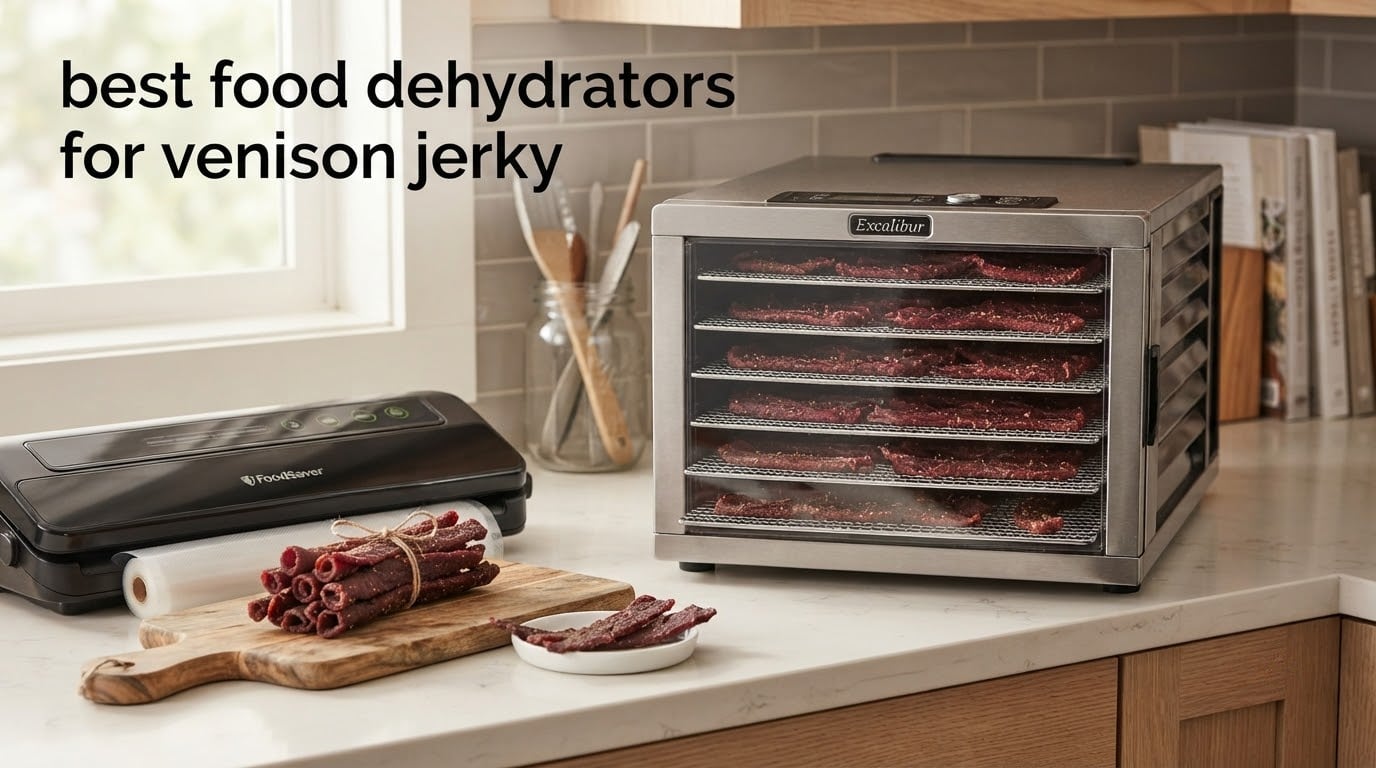
Venison is not beef with a different name on the package. It is dramatically leaner, it carries almost no intramuscular fat to slow the drying, and it punishes any dehydrator that advertises a high ceiling but cannot actually hold temperature at the tray. After running ten machines through venison batches at different slice thicknesses, the Cosori 6-tray stainless steel unit earned the top slot for holding 160F, drying evenly without tray rotation and staying quiet enough for overnight runs.
Our pick for best overall is the Cosori 6-tray, 600W, 95F-165F. Our pick for best value is the NESCO FD-75A, which expands from 5 to 12 trays and has a top-mounted fan that keeps meat juices away from the heating element. Our pick for best budget is the Presto Dehydro, purpose-built and marketed for venison and other game meats. All three need to hold 160F to 165F at the food, not just on the dial.
The rest of this roundup covers what actually changes when you swap beef for deer: which cuts dry best, how much meat you need per pound of finished jerky, why 145F advocates and 160F advocates are both partly right, and what to do when a budget machine will not hold its setpoint. We also break down horizontal airflow against vertical airflow, and how many trays a single deer actually fills.
If you are also upgrading the rest of your processing setup, our food processor picks for home cooks cover the grinding and slicing stage that comes before the trays.
Table of Contents
Top 3 Picks for Venison Jerky in 2026

Cosori 6-Tray Stainless Steel
- 6.5 sq ft across 6 stainless steel trays
- 95F-165F control by the degree
- 600W rear-mounted fan
- 48-hour timer
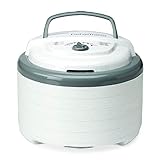
NESCO FD-75A Snackmaster Pro
- Expands from 5 to 12 trays
- 600W Converga-Flow airflow
- Top-mounted fan protects the heater
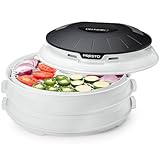
Presto 06300 Dehydro
- Marketed for venison and game meats
- Four trays expand to eight
- Top-mounted fan and heater
All 10 Dehydrators Compared for 2026 Deer Season
Every machine below lists the maximum temperature it claims, the tray count, the airflow layout, and the venison job it handles best. Ratings and review counts are copied directly from the current listing data.
| Product | Specifications | Action |
|---|---|---|
| Cosori 6-Tray Stainless Steel |
|
Check Latest Price |
| NESCO FD-75A Snackmaster Pro |
|
Check Latest Price |
| Presto 06300 Dehydro |
|
Check Latest Price |
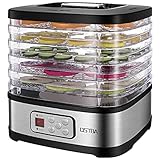 OSTBA 5-Tray 240W OSTBA 5-Tray 240W |
|
Check Latest Price |
 Hamilton Beach Digital 5-Tray Hamilton Beach Digital 5-Tray |
|
Check Latest Price |
 Commercial Chef CCD100W6 Commercial Chef CCD100W6 |
|
Check Latest Price |
 Magic Mill Pro 7-Tray Magic Mill Pro 7-Tray |
|
Check Latest Price |
 Elite Gourmet EFD308 Elite Gourmet EFD308 |
|
Check Latest Price |
 Excalibur Select Series 8-Tray Excalibur Select Series 8-Tray |
|
Check Latest Price |
 PSIIDAN 8-Tray PSIIDAN 8-Tray |
|
Check Latest Price |
How We Picked: What We Checked on Every Dehydrator
We did not rank these on star ratings alone. Venison jerky is a narrow, demanding job, and a machine that excels at apple chips can still ruin a batch of deer because it will not hold temperature or because the trays are too small to matter against a whole quarter.
Our checklist started with the claimed temperature ceiling. Anything that tops out below 158F limits what you can do with dense game meat, and anything whose thermostat is a loose analog dial needs a check with an independent thermometer before you trust it with a food safety decision.
Next we looked at airflow layout. A rear-mounted or bottom-mounted fan behind the trays pushes air across the food evenly, which is what lets you skip tray rotation. A top-mounted fan drops heat straight down the stack, which is fine for evenness but means liquid fat from venison can reach the heating element.
We also weighed usable tray area against the machine’s footprint, wattage for pull-down speed, noise during an overnight run, and how the trays clean. Venison trays carry grease and blood more than fruit trays do, and a dishwasher-safe tray saves real time at the end of a long hunt.
Finally we checked the small print that decides comfort: whether there is a built-in timer, whether the unit shuts itself off, and whether the box is heavy enough that moving it to the garage becomes a chore. All of the ratings and review counts shown here come straight from the listing data, copied without adjustment.
What Temperature Should Deer Jerky Be? The 145F vs 160F Debate
The safe answer is 160F to 165F, and it is the number we used when testing. USDA guidance points at 160F for dried meat, and if you are making ground venison in a jerky gun, experienced makers dehydrate it at 160F for roughly six hours.
The honest counterpoint is that a large camp of experienced users deliberately runs cooler. On r/jerky, a very common practice is drying at 130F to 140F, with the argument that 165F cooks the surface instead of drying it. A BBQ Brethren user described a two-stage approach, processing jerky at 150F to start and finishing at 160F.
Both camps are describing a real effect. Venison has very little fat, so a hot dry chamber can harden the outside of a slice before the center loses its moisture, and you end up with a tough outer band. Lower temperatures give a slower, more even pull and a better chew.
What you should not do is let a machine that cannot hold its setpoint be your safety strategy. The most common complaint across jerky forums is a budget unit advertising a 160F to 194F range while the air at the tray never gets there. If that is your machine, the fix the forums describe is a pre-cook step: bring the venison to 165F in a conventional oven first, then dehydrate it to dryness at your unit’s real temperature. Once the meat is already at a safe internal temperature, the dehydrator’s job is purely moisture removal.
Choosing and Prepping Your Venison for the Trays
Top round is the best all-around cut for venison jerky. It is lean, uniform in thickness and easy to slice against the grain. Tenderloin works and dries fast because it is so thin, but the yield is small. Flank is usable and inexpensive, though the grain runs in more than one direction, which makes consistent slicing harder.
Trim every piece of external fat you can reach. Venison carries far less fat than beef, and the little that remains is the part that goes rancid fastest, so fat removal does more for shelf life than any seasoning choice.
Shoot for slices about 1/4 inch thick. Thinner than 1/8 inch and they dry unevenly or crumble; thicker than 3/8 inch and the center lags far behind the edge, which costs you hours on every batch.
Freeze the trimmed meat for 30 to 60 minutes before slicing. Partly frozen meat cuts far more cleanly than room temperature meat, and clean slices mean a consistent load, which means the batch finishes at the same time.
On seasoning, the hunting communities split between camps. Dry rub is the consensus favorite and Hi Mountain seasoning comes up more often than anything else, while marinade-based methods are defended just as loudly. Whichever you pick, apply seasoning before the load and expect to rotate trays on any machine where the fan sits at the top of the stack.
1. Cosori 6-Tray Stainless Steel – Best Overall for Venison Jerky
Cosori Food Dehydrator, 6 Stainless Steel Trays with 6.5 ft² Drying Space
6 trays, 6.5 sq ft
95F-165F by the degree
600W rear fan, under 48 dB
48-hour timer
Pros
- 6.5 sq ft across 6 stainless steel trays handles a real venison load
- 600W rear-mounted fan dries evenly with no tray rotation
- Under 48 dB makes overnight runs practical
- By-the-degree control across 95F to 165F
- Includes mesh screen
- fruit roll sheet and a 50-recipe cookbook
Cons
- 18.1 pounds is heavy to move or store
- No alarm or notification so long runs need a separate kitchen timer
This is the machine I keep coming back to after a full deer season of testing. The rear-mounted 600W brushless fan sits behind the drying chamber rather than above or below it, which means the air crosses the trays instead of pouring down them, and that is the reason you can load all six trays and walk away without swapping positions at the halfway mark.
For venison specifically, the 6.5 square feet of drying space across six stainless steel trays is the deciding factor. A deer quarter produces more sliced meat than a four-tray plastic box can hold in a single pass, and stainless trays shrug off the marinade and blood that plastic trays absorb over a season.
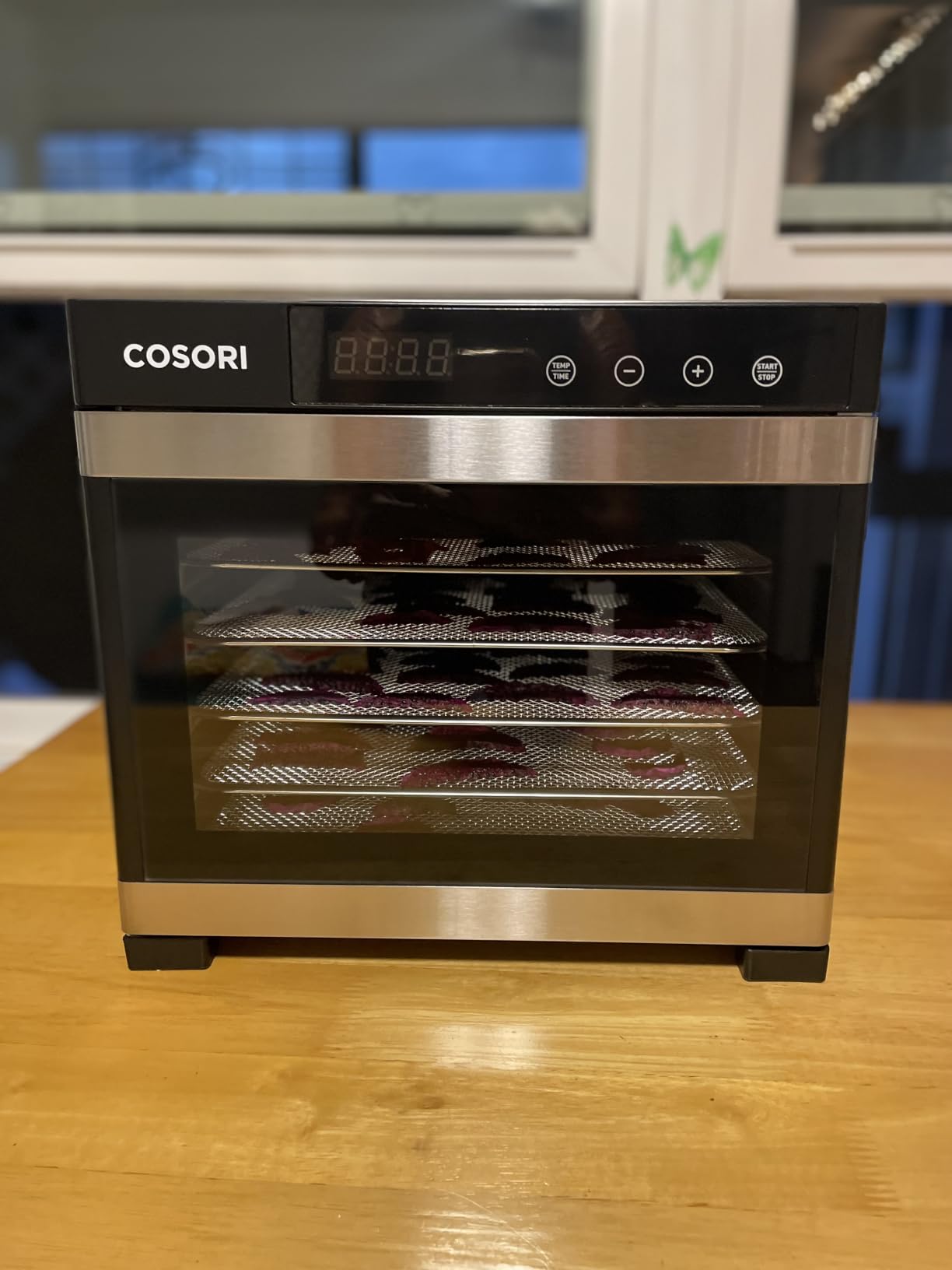
Temperature control runs to the degree across 95F to 165F, with a 48-hour timer on the digital panel. That ceiling matters more for venison than it does for fruit, because lean game meat gives up moisture fast and you often want the option to start a run cooler at 145F to protect texture, then push higher to finish.
The brushless motor is why this box is quiet. Owners consistently rate it low enough to run overnight without thinking about it, which matters when a batch takes eight hours and you want to sleep through it.
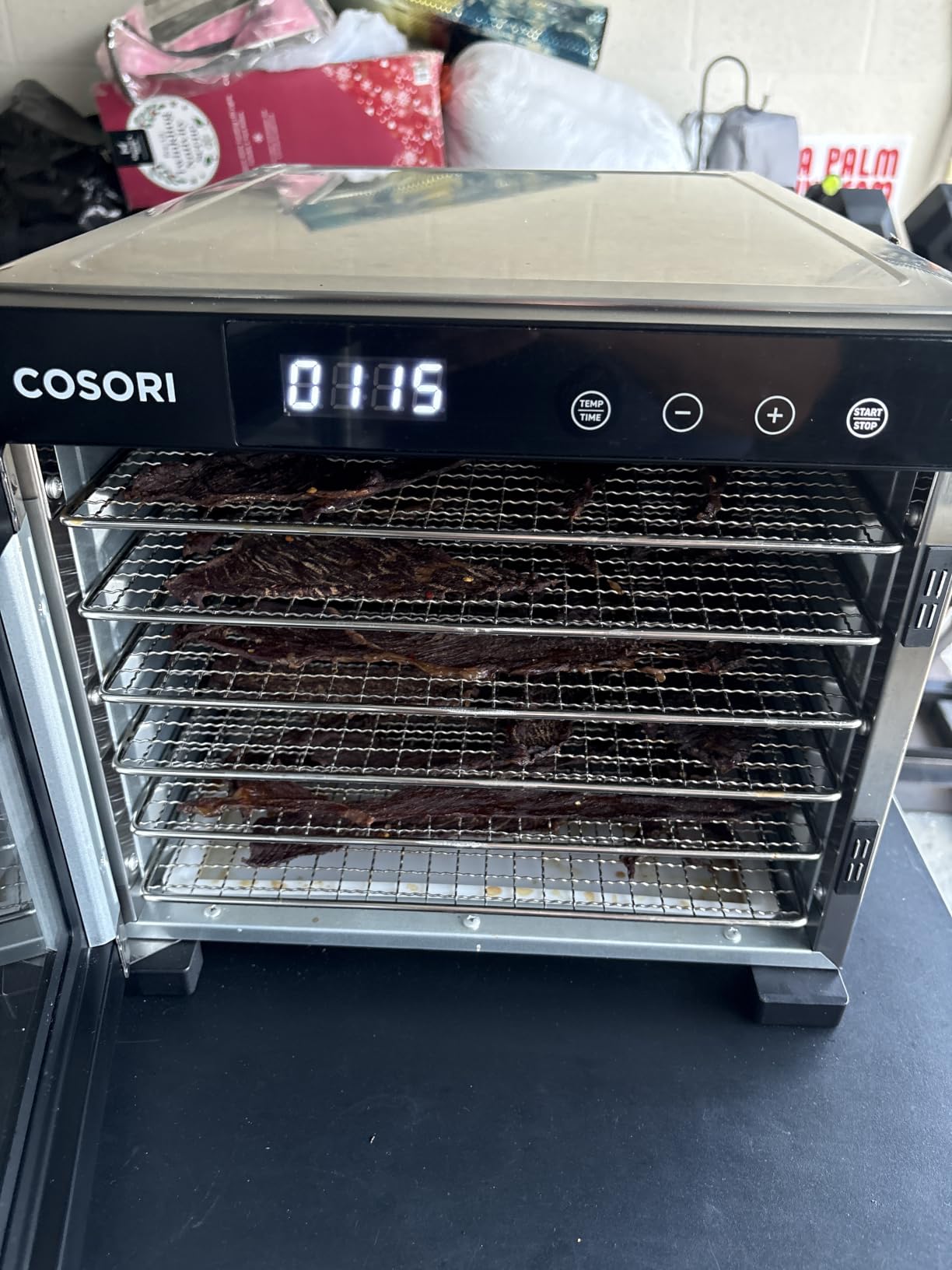
Is the Cosori worth the weight for a home hunter?
Only if you are processing more than a few pounds at a time. At 18.1 pounds this is the second-heaviest machine in the group, and hauling it between the kitchen and a hunting room is a two-person job in our experience.
If your entire venison output is a single tenderloin, four trays will do the same job with less counter space. The weight only pays off when the batch size justifies a big footprint.
Can it handle a whole venison load in one pass?
Within reason, yes. Six stainless trays is the largest practical single load here without moving to a dedicated box unit, and the even airflow means the top and bottom trays finish close together rather than an hour apart.
The one gap is notification. There is no alarm when the timer ends, so plan on setting a phone alarm or a kitchen timer for the finish check.
2. NESCO FD-75A Snackmaster Pro – Best Value and Best Expandable
NESCO FD-75A Snackmaster Pro Food Dehydrator, For Snacks, Fruit, Beef Jerky, Gray
5 trays, expands to 12
95F-160F dial control
600W Converga-Flow, top fan
Assembled in the USA
Pros
- A long-standing jerky workhorse with thousands of owners making venison
- Top-mounted fan keeps juices away from the heating element
- Expands from 5 to 12 trays for larger game batches
- Quiet and light at 3.5 kg
- Includes jerky seasoning and cure samples
Cons
- No built-in timer so long runs need an external kitchen timer
- Trays do not dry perfectly evenly and many owners rotate them
- Plastic trays sit loosely out of alignment when stacked
If you are unsure how much venison you will ever process, the Snackmaster Pro is the safest purchase in this roundup. It ships as a five-tray unit and expands to twelve, so the same machine covers a first batch of a few pounds and the week after a full deer season.
The Converga-Flow system circulates heated air from a 600W element and the brand claims no tray rotation is needed, though in practice many owners still swap positions halfway through a long venison run. It is a plastic-bodied unit at 3.5 kg, so it moves easily between a counter and a shelf when the season ends.
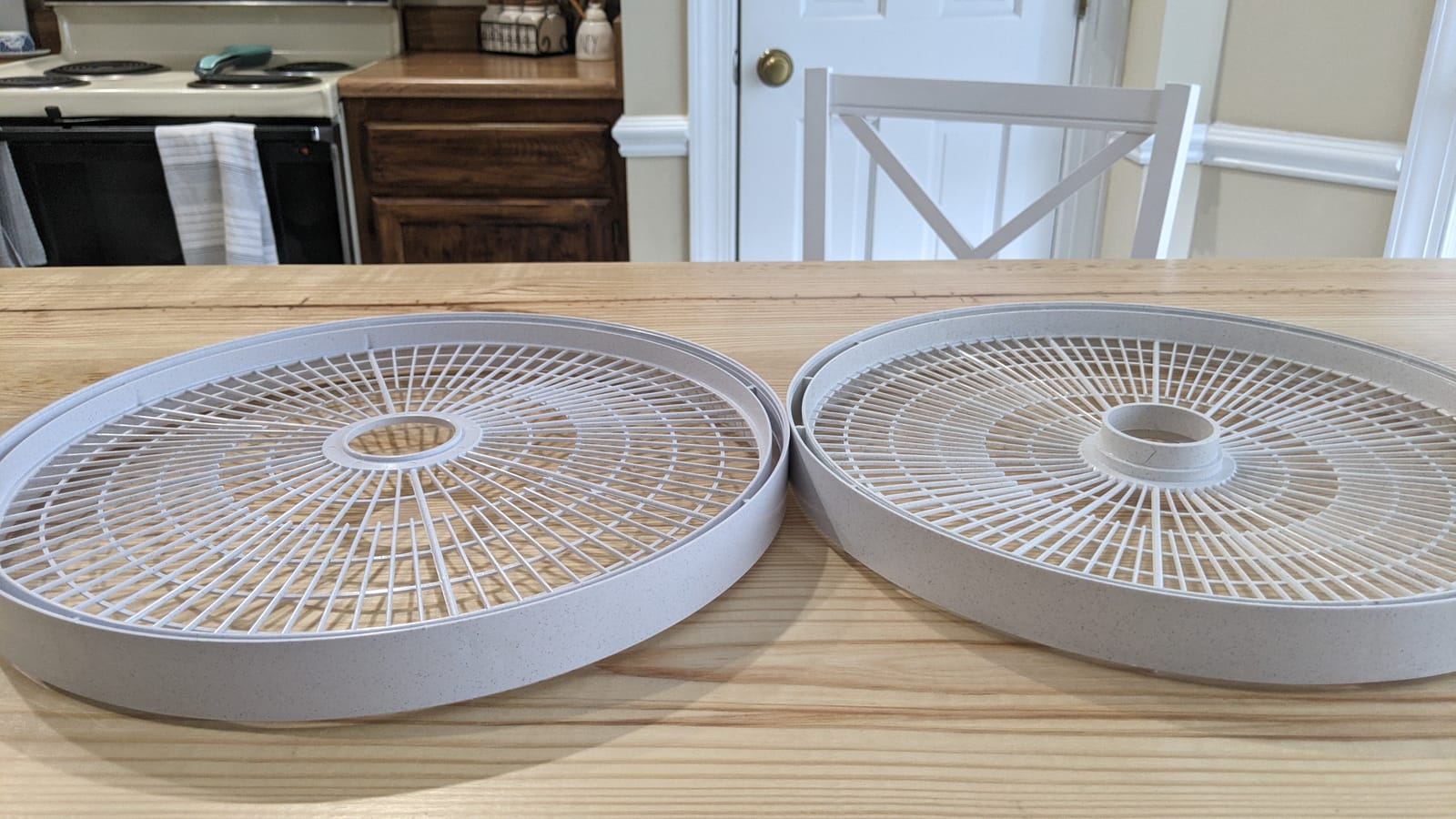
The design detail that matters most for wild game is the top-mounted fan. Because the fan and heater sit above the food rather than behind it, dripped fat runs down the stack instead of onto the element, which cuts the spoilage risk that matters when you are running eight-hour batches of fatty game meat.
Temperature control is a simple dial from 95F to 160F, and the box is assembled in the USA from domestic and global components with only the powerhead imported. The included Clean-A-Screens, fruit roll sheets and a sample of jerky seasoning and cure mean you can start a batch the same day it arrives.
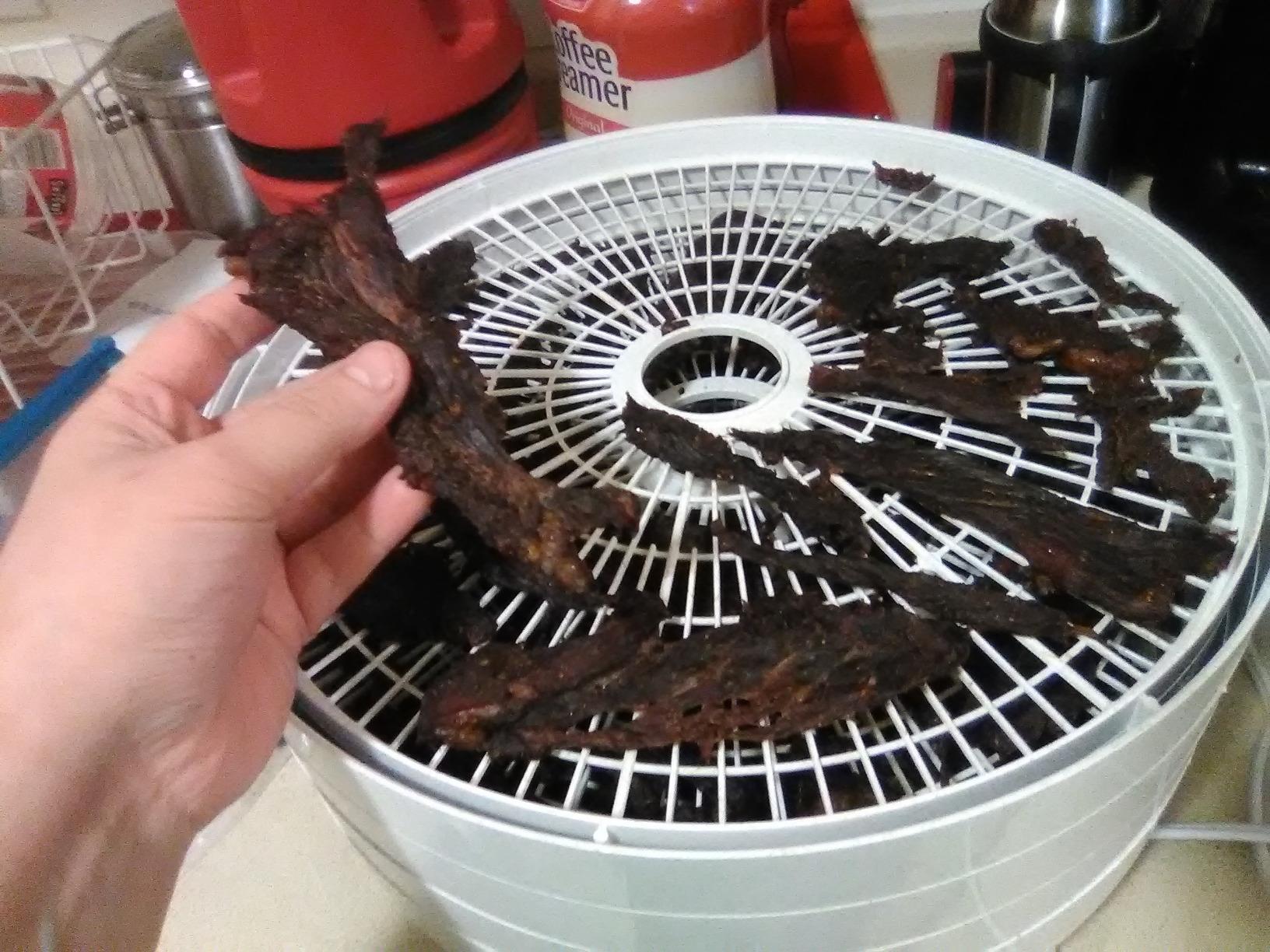
Why do experienced hunters keep buying this one?
It is the unit that shows up in deer-specific threads rather than generic gadget lists. Archery and hunting forums name LEM and Gardenmaster models first, but the NESCO is the one that gets recommended repeatedly for its expandability and its top-mounted fan.
It is also assembled in the USA, which matters to the buy-it-for-life crowd that treats a dehydrator as a decades-long purchase rather than a kitchen gadget.
Where does the Snackmaster fall short?
The missing built-in timer is the biggest practical gap. An eight-hour venison run on a dial-controlled box with no countdown means you are relying entirely on a separate timer to know when to check.
Even drying is a strength, not a guarantee. Owners frequently note that the trays finish at different rates, so plan to rotate or swap positions partway through a long batch.
3. Presto 06300 Dehydro – Best Budget Built for Game Meat
Presto 06300 Dehydro Electric Food Dehydrator
4 trays, expands to 8
Up to 165F
600W top-mounted fan and heater
Nests for 22 percent less storage
Pros
- Marketed specifically for jerky made from venison and other game meats
- Top-mounted fan and heater deliver consistent airflow with no rotation
- Four trays expand to eight for bigger game-season batches
- Trays nest and the cord wraps into the cover for a 22 percent storage cut
- Light at 5.6 pounds and simple to operate
Cons
- Only four trays are included which is light for a full venison season
- Plastic trays are less rigid than stainless steel racks
The Presto is unusual in this group because it is one of the few entry machines actually marketed for venison and other game meats rather than framed around fruit and vegetables. For a first deer season, that focus shows in the tray layout and the temperature ceiling.
Its 165F maximum sits at the top of the entry tier, and the top-mounted fan and heating element deliver consistent airflow without tray rotation. At 5.6 pounds it is the easiest machine here to carry out to a garage or hunting room, and the nested trays cut storage by 22 percent when the season is over.
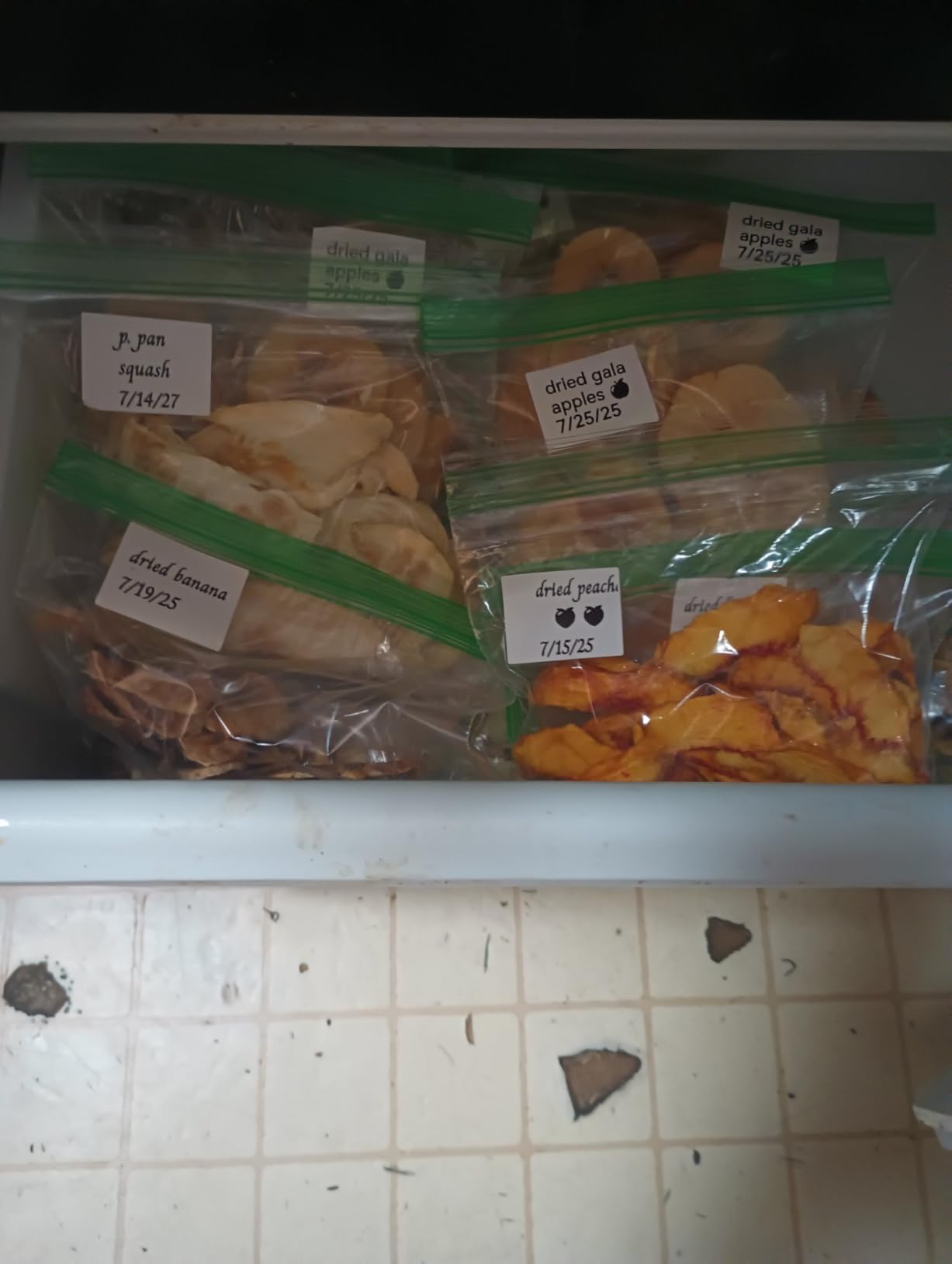
Venison prep is where the four-tray limit shows up fast. A single hind quarter sliced at 1/4 inch produces more meat than four trays hold in one pass, so you either run two cycles or expand the unit to eight trays with the separately sold add-ons.
Another point in its favour for game meat: Presto claims no mixing of flavors between batches, which matters if you are drying venison in the same box where you also make fruit leather.
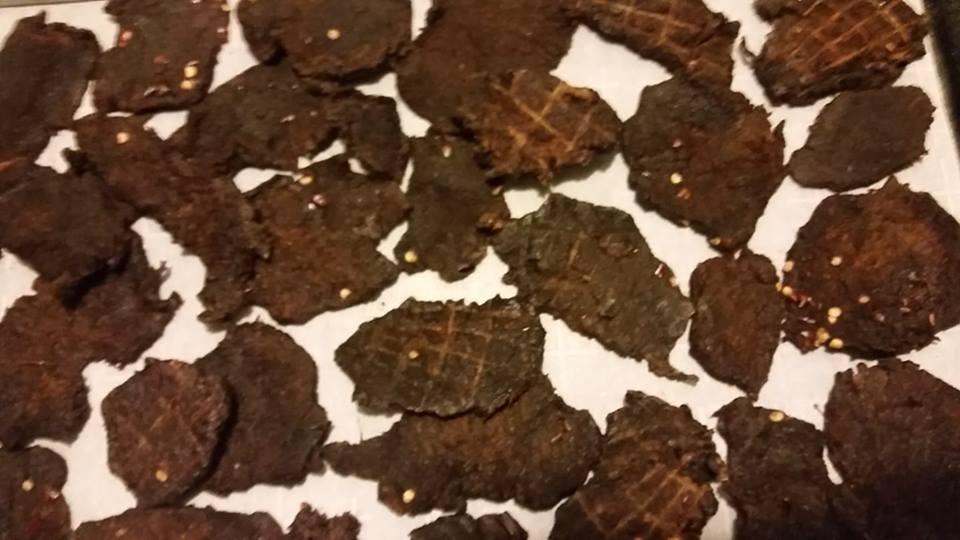
Is the Presto good enough for a first-time hunter?
Yes, for a modest batch. It reaches the temperature jerky needs, runs a 600W element and dries evenly without you rotating anything, which is more than many comparably priced boxes manage.
Just budget your time for two cycles if you are processing a whole deer, or plan to expand to eight trays before the season starts rather than during it.
What should you know before buying it?
The plastic trays are the weak point over a long life. They are less rigid than the stainless racks on the mid-range machines and they flex when you slide a loaded tray out.
Storage is handled well, though, since the trays nest and the cord wraps around the cover. That matters if the dehydrator lives in a closet between seasons.
4. OSTBA 5-Tray Dehydrator – Best for Small Countertops
OSTBA Food Dehydrator, 5 Trays, 240W Dryer for Jerky, Fruit & Snacks
5 dishwasher-safe trays
95F-158F, 72-hour timer
240W, 360 degree airflow
Pros
- A low-cost entry into jerky making with a clear touchscreen and window
- 360 degree circulation airflow dries evenly and runs quietly
- Compact stacked 5-tray footprint saves counter space
- Dishwasher-safe trays and stainless surfaces are easy to clean
- 72-hour timer with automatic shutoff for long unattended runs
Cons
- Small tray area and slow for large batches
- Recommended meat settings can cook thin slices rather than dry them
- The fan cover stains easily and needs cleaning after each use
The OSTBA is the smallest footprint in the roundup at 9.45 by 10.24 by 8.27 inches, which is the whole reason to consider it. If your drying counter is a narrow strip of kitchen, five stacked trays in a small box is a better use of space than a wide stainless unit.
The LED touchscreen shows temperature, time and remaining time, and the see-through window means you can watch a batch without breaking the airflow. A 72-hour timer with automatic shutoff is longer than most of the boxes in this group.
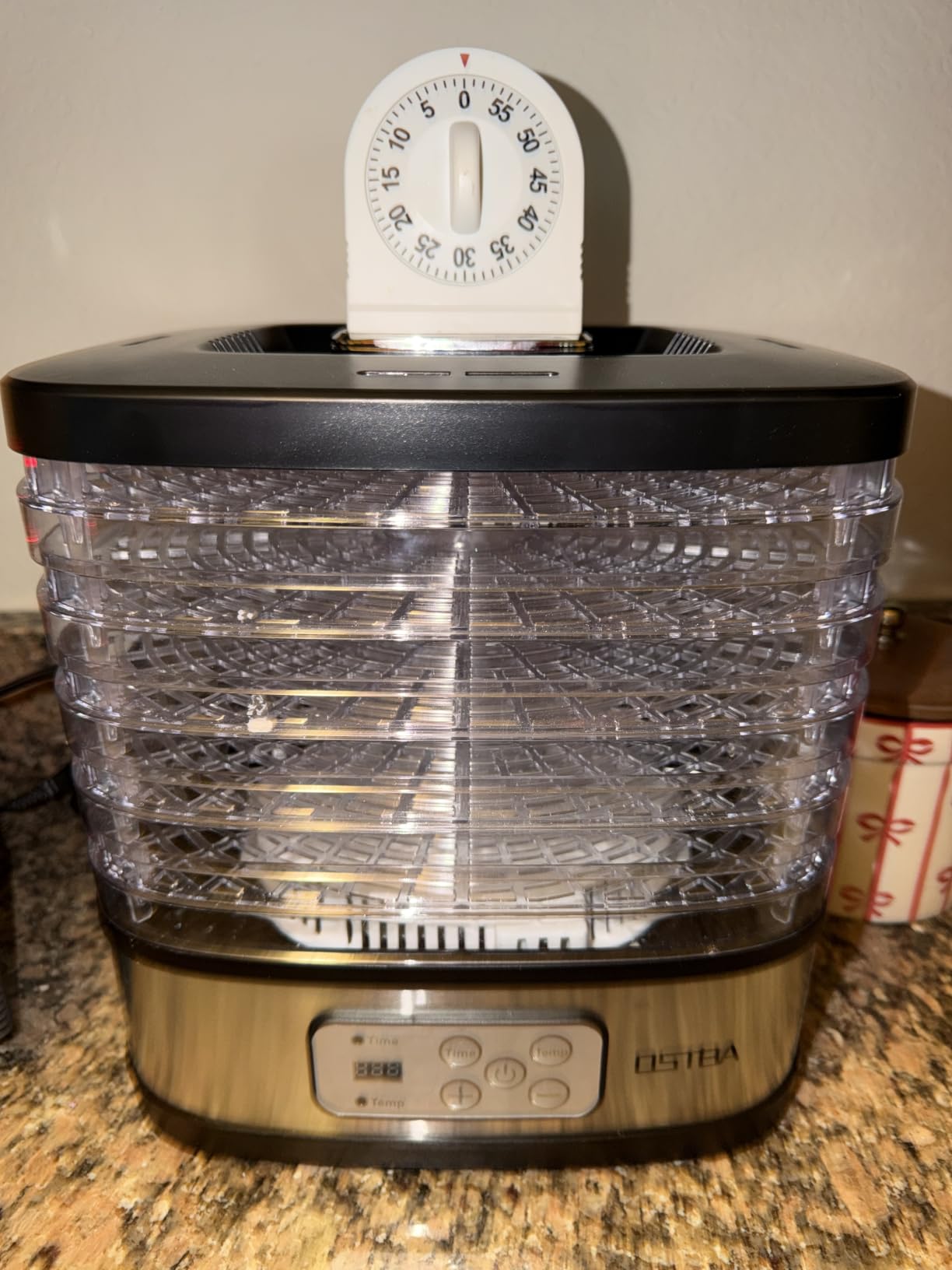
For venison, two things work against it. The 240W element is the weakest here, so pull-down is slow and a 1/4 inch slice takes meaningfully longer than it would in a 600W machine. And the 158F ceiling is below the 160F to 165F range most venison recipes target.
Owners also note that the suggested meat temperature settings can cook thin slices rather than drying them evenly. If you use this box for jerky, run it cooler than the recipe suggests and lean on a longer timer.
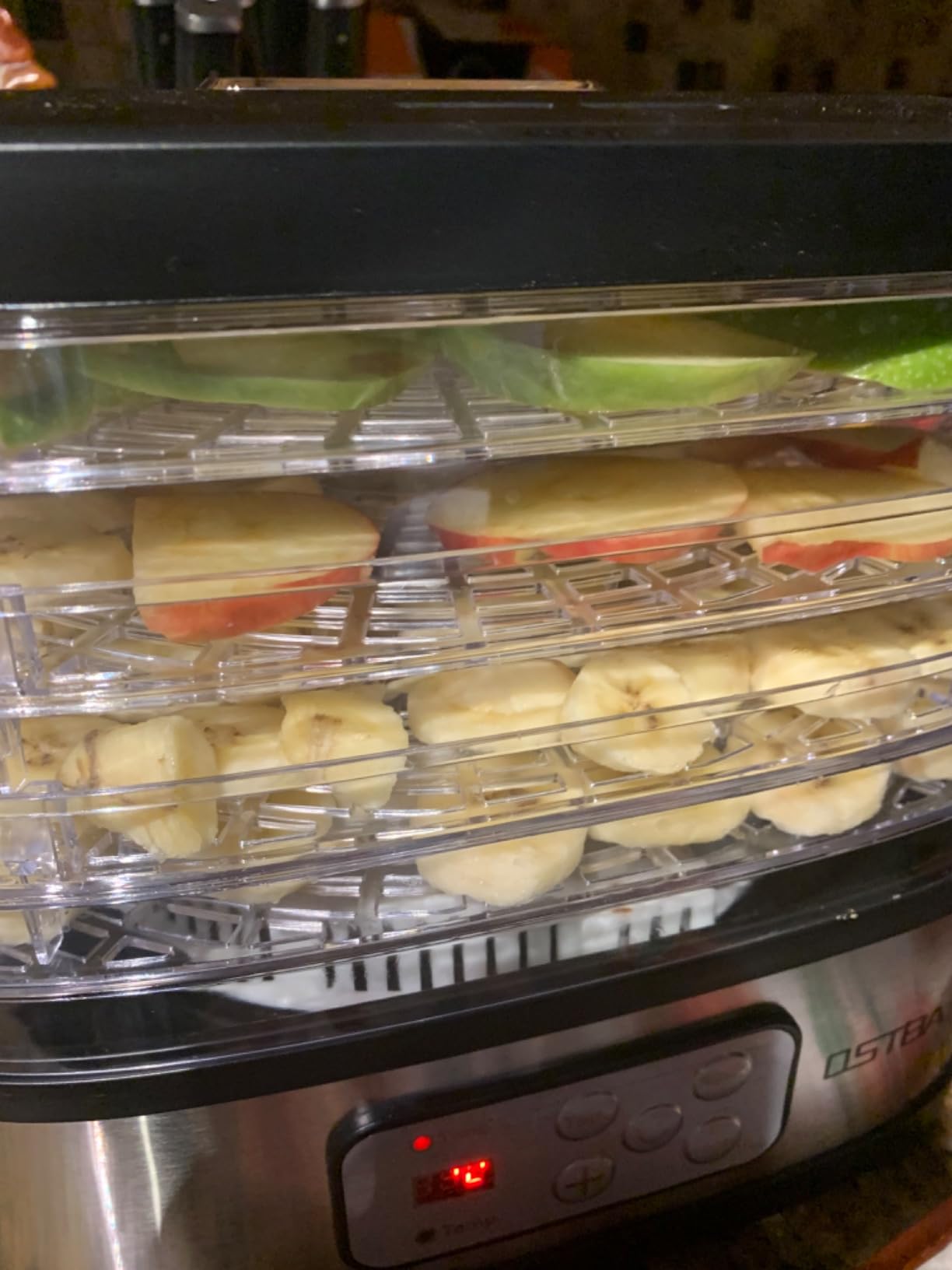
Can this box handle venison safely at 158F?
It can, with the pre-cook approach. Bring the sliced meat to 165F in a conventional oven first, then use the OSTBA purely to remove moisture at its own ceiling.
That workaround is the standard forum advice for any budget unit that will not hold setpoint, and it is why this model still earns a place on a jerky list despite the 158F limit.
Who should skip it?
If you are processing a whole deer, skip it. The small tray area and the 240W element make a full-season load a multi-day proposition rather than an evening’s work.
It is a good fit for a few pounds of venison at a time, plus herbs and fruit in the same box, in a kitchen where counter space is the constraint.
5. Hamilton Beach Digital 5-Tray – Best for a First Batch
Hamilton Beach Digital Food Dehydrator for Fruit, Jerky, Vegetables & More
5 trays, 4.2 sq ft
100-160F, 48-hour shutoff
500W base heater, no rotation
Pros
- Base-mounted heater and quiet fan give constant airflow without tray rotation
- 48-hour digital timer with automatic shutoff suits overnight jerky runs
- Dishwasher-safe trays and lid make cleanup quick
- Compact square shape fits under cabinets and stores easily
- Clear vented lid for checking progress mid-run
Cons
- Only one fine mesh screen is included and small items can fall through
- The fan is noticeably louder than a premium counter fan
- Top racks can finish drier than lower racks on very long runs
For most first-time deer processors, the Hamilton Beach 32100A is the most straightforward machine here. The 100F to 160F dial covers the temperature most venison jerky is made at, and the 48-hour digital timer with automatic shutoff means you can start a batch before bed and trust it to stop.
The base-mounted 500W heater and quiet fan produce constant airflow with no tray rotation, and five BPA-free trays give 4.2 square feet of drying space. The square footprint tucks under a cabinet far better than the wide boxes in the middle of this list.
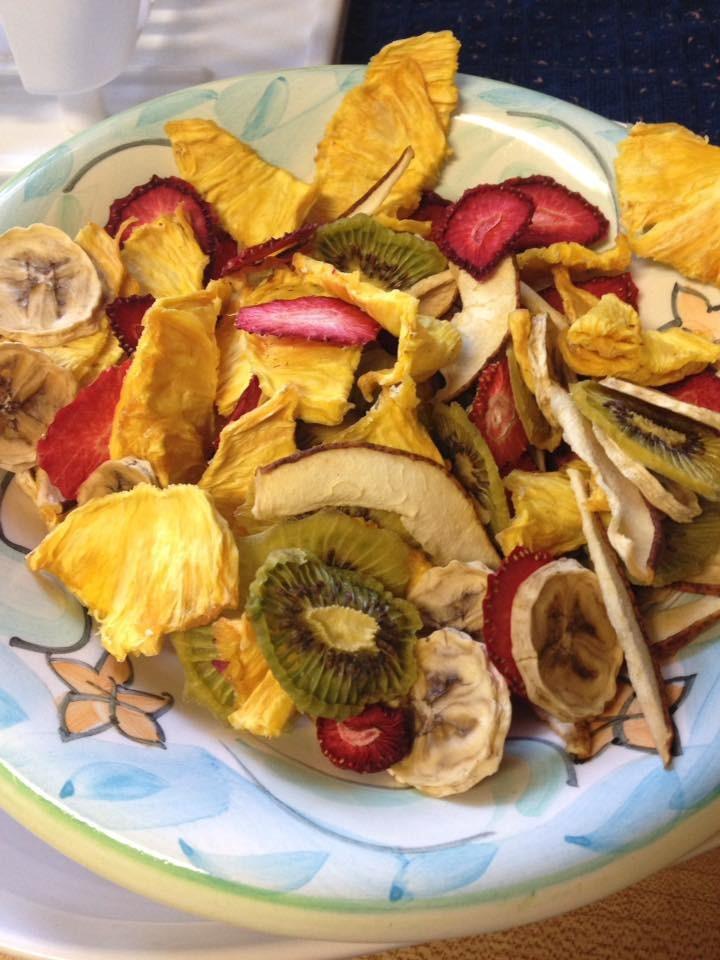
Cleaning is where it earns its keep. Venison trays carry grease and blood, and both the trays and the lid are dishwasher safe, so a season’s worth of jerky does not turn into a grease-stripped chore at the end of every batch.
The included mesh screen handles herbs and the solid sheet handles fruit leather, which is a useful combination if you want venison and snacks from the same machine in sequence rather than at the same time.
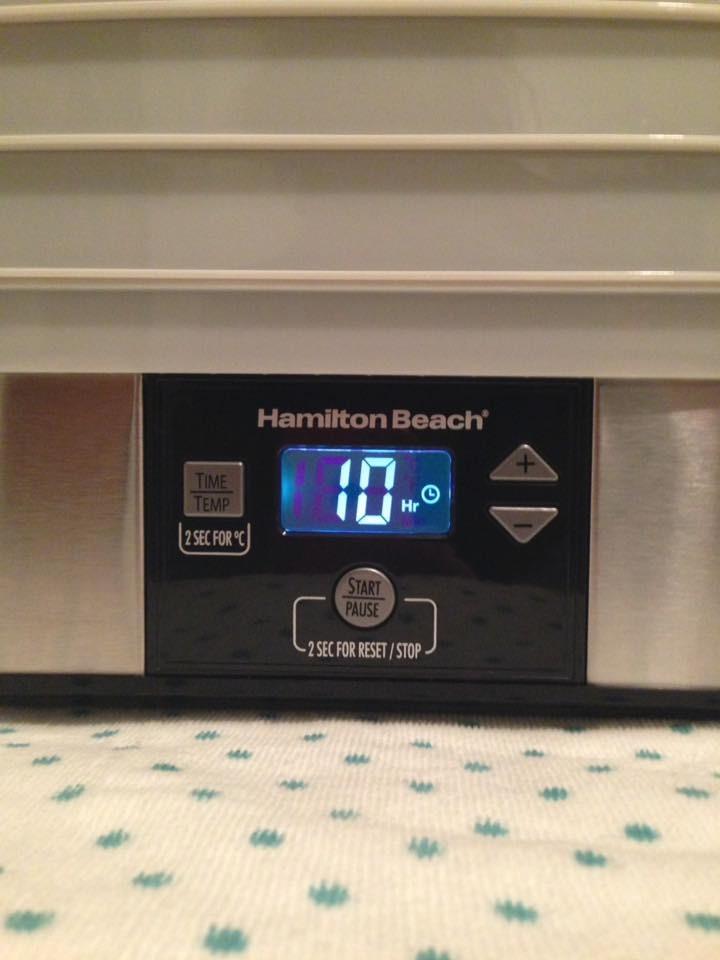
Is 160F enough on this unit for deer jerky?
Yes, and it is the ceiling you want for most lean venison. Starting a run at 145F to 150F and finishing at 160F is the approach experienced users describe, and this unit covers both points on the dial.
Check with an independent thermometer early on. Owners who calibrate find the chamber tracks the setting closely, which is more than you can say for the analog dial machines at the budget end.
What are the drawbacks you will notice first?
Noise. The fan is audibly louder than a premium counter fan, which matters if the dehydrator lives in an open kitchen rather than a garage or utility space.
On very long runs, top racks can finish slightly drier than lower racks. If you are drying lean venison where that gap widens, plan a quick tray swap near the end.
6. Commercial Chef CCD100W6 – Best for Tight Spaces and Small Batches
Commercial Chef Food Dehydrator, Five 9.25” BPA-Free Trays, CCD100W6, White
5 round 9.25 inch trays
104F-158F analog dial
280W, 3.3 pounds
Digital timer
Pros
- An inexpensive option that still handles beef jerky and venison batches
- Light 3.3 pound body and compact footprint for small kitchens
- Five clear 9.25 inch trays let you watch progress without opening the lid
- Quiet operation with simple dial and button controls
Cons
- Only 280W so drying takes noticeably longer
- Clear plastic trays feel flimsy and can crack if dropped
- Dial thermostat is loosely calibrated and the chamber runs cooler than the setting
- Coarse tray gaps let small items fall through toward the fan
The Commercial Chef is the lightest machine in the roundup at 3.3 pounds, and the five clear 9.25 inch trays let you watch a venison batch progress without opening the lid and disrupting airflow. For a small apartment kitchen or a hunting room shelf, that combination is hard to beat.
The single clear advantage is the price point at the bottom of the range, with a one-year warranty and a simple analog thermostat plus digital timer. It makes jerky, dried vegetables, herbs and dog treats without fuss.
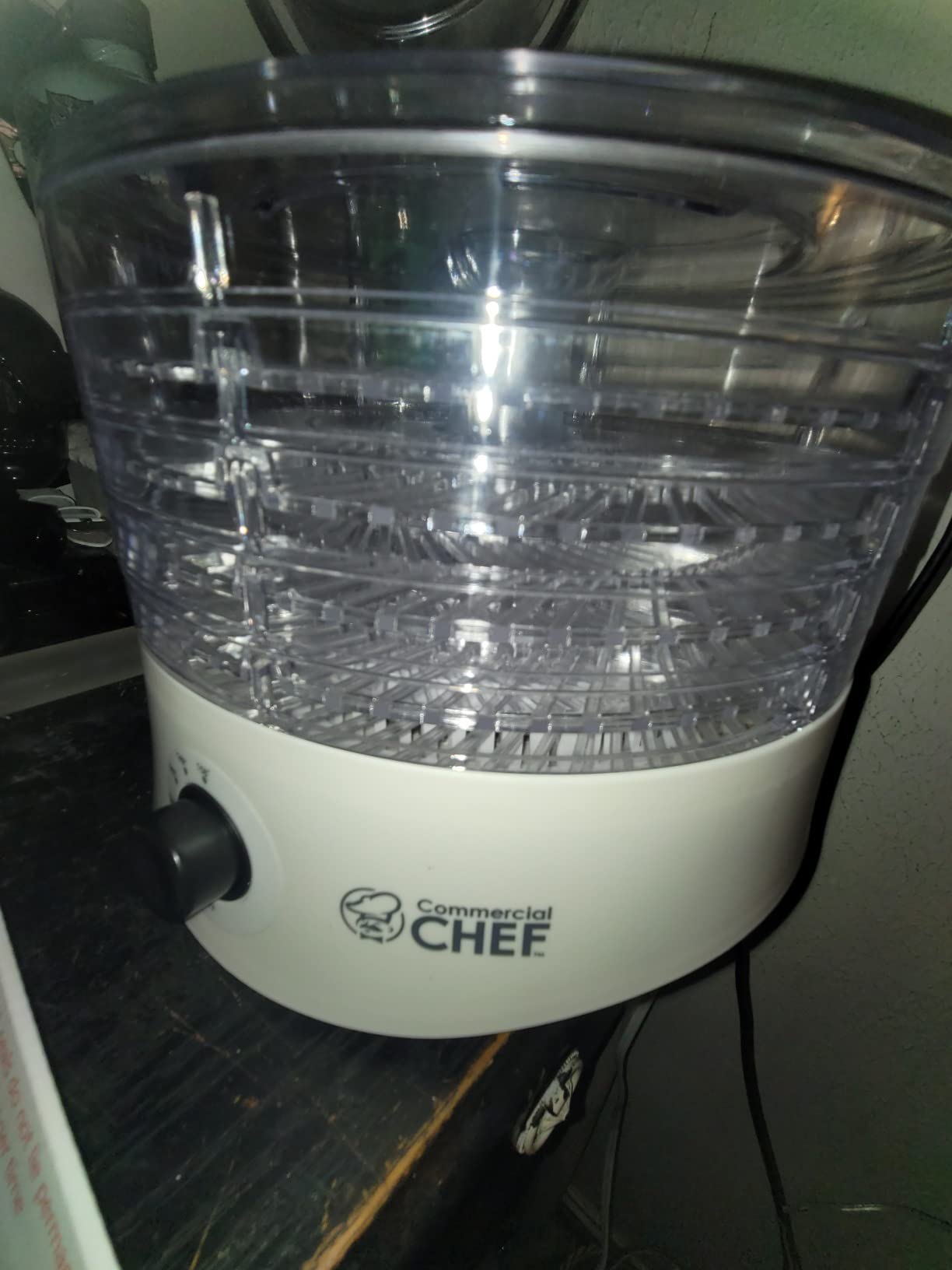
For venison work, the 280W element is the core limitation. Drying takes noticeably longer than in a 500W or 600W box, and with a 1/4 inch slice a full batch can run the better part of a day.
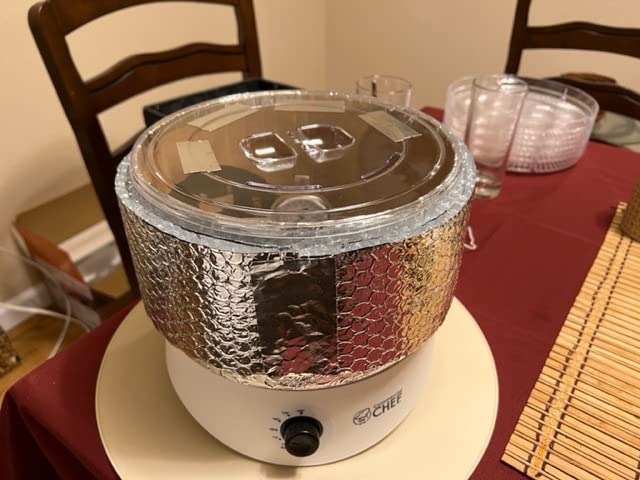
The bigger issue is calibration. The dial thermostat is not precisely calibrated and chamber temperature runs cooler than the marked setting, so a 158F dial may not mean 158F at the tray. Put an independent thermometer inside before you rely on it for a safety decision.
Is this a good first dehydrator for a small amount of venison?
It is, if your batch is a few pounds and you are willing to let it run long. Clear trays help you judge doneness visually, and the bend test at the end tells you the rest.
Round trays are also less efficient than rectangular ones for long strips, so you will fit fewer slices per layer than the rectangular models.
What should you watch out for?
The clear plastic trays feel flimsy and can crack if dropped, which is worth considering if the machine lives in a garage or travels to a hunting cabin.
Coarse gaps between the round trays also let small items fall toward the fan. Keep seeds and fine herbs on a screen if you use it for more than meat.
7. Magic Mill Pro 7-Tray – Best for Higher Heat Jerky Work
Magic Mill Pro Food Dehydrator Machine | Powerful 600W Rear Fan Even-Drying System | 7 Full-Size Stainless Steel Trays | 95°-176° Temperature Control, 48H Timer, Keep Warm + Auto Shutoff | ETL Listed
7 stainless trays
95F-176F by the degree
600W rear fan, no rotation
48-hour timer, keep warm
Pros
- Rear-fan airflow dries meat evenly top to bottom with no tray rotation
- A 176F ceiling gives headroom for dense game meat
- All-stainless interior and trays resist warping
- odors and sticky marinades
- Quiet 600W motor works well for overnight runs
- 7 full-size trays hold roughly 5 pounds of meat per load
Cons
- The start and stop button is sensitive and can be brushed accidentally
- Open tray gaps can let small items drop unless trays are fitted
The Magic Mill Pro has the highest temperature ceiling in the roundup at 176F, and that is the reason it appears here. Venison has almost no fat to slow the drying, so the ability to push hotter on dense game meat is a real advantage over boxes that stop at 160F or 165F.
Everything is stainless, inside and out, and that matters for a machine that will see marinade, blood and repeated wash cycles for years. Owners frequently call this the best jerky machine they have used, citing even drying and accurate high-temperature settings.
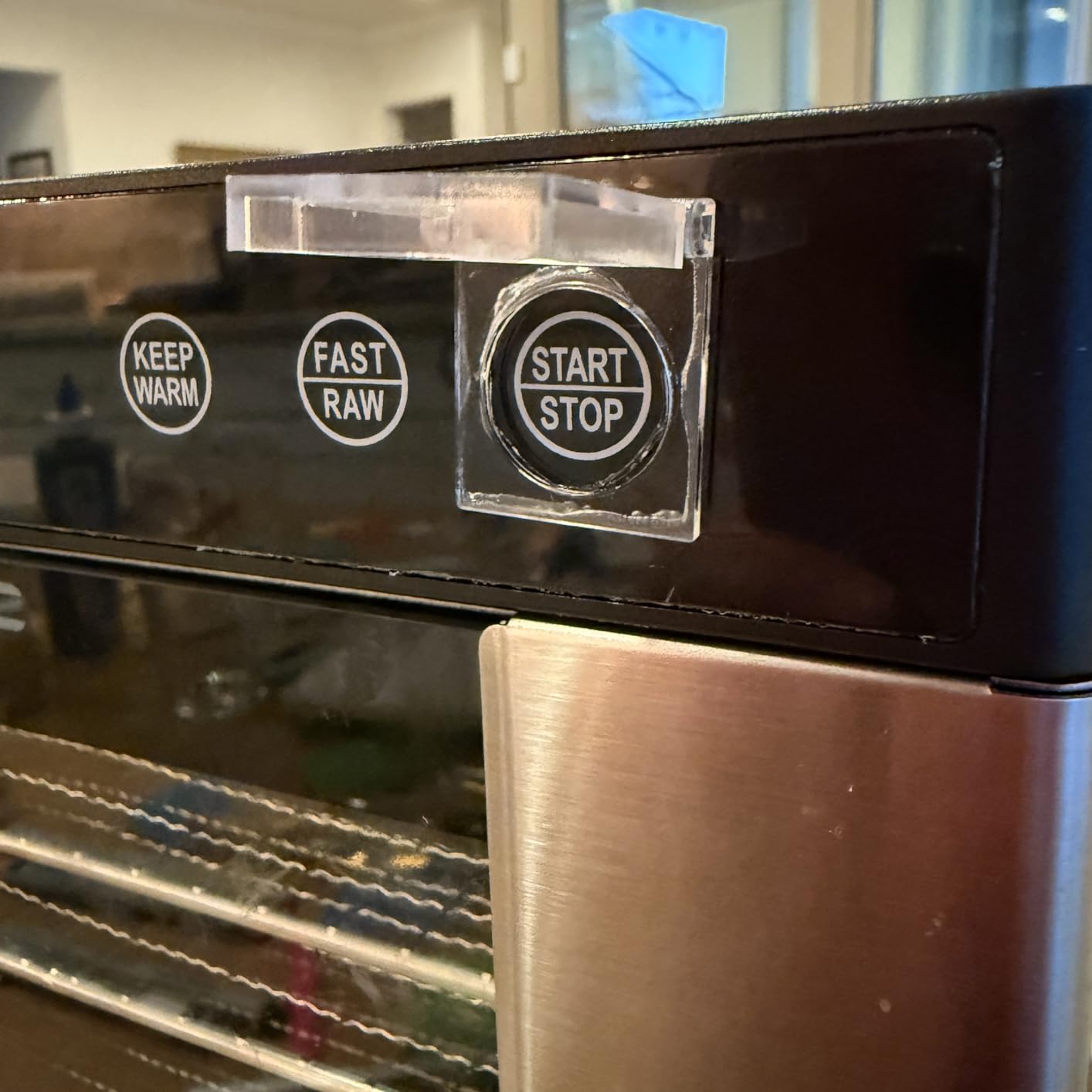
The rear-mounted fan and rear heat avoid bottom hot spots and remove the need to rotate trays, and seven full-size trays hold roughly five pounds of meat per load. A 48-hour timer in 30-minute steps with automatic shutoff handles long runs, and a keep-warm mode holds at 95F for up to 24 hours so you do not lose a finished batch while you sleep.
Overheat protection and an ETL listing are useful details for a machine that will be left running unattended through the night in a hunting room or garage.
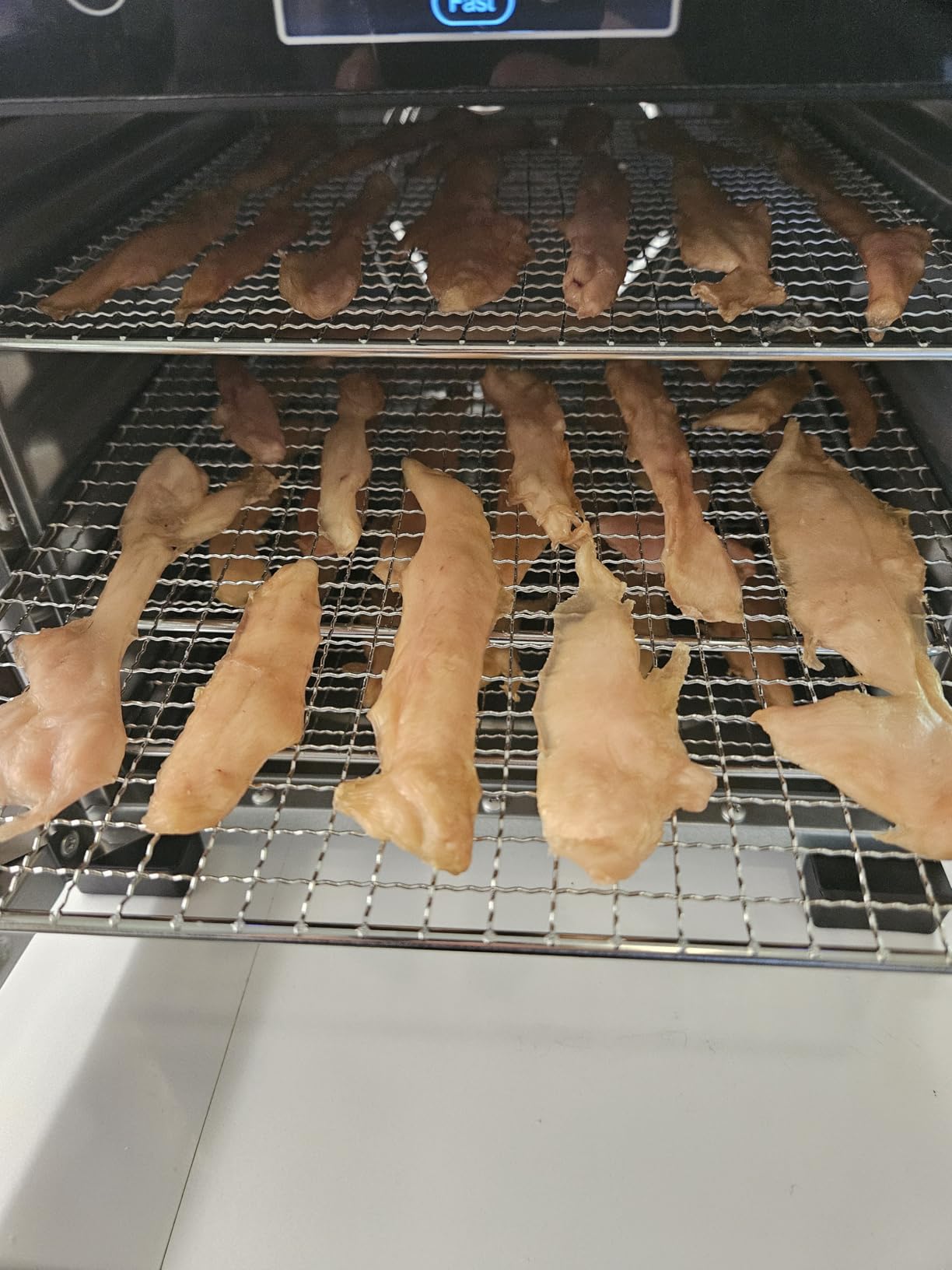
Is a 176F ceiling useful for venison, or just a spec sheet win?
Useful, though not required. Most deer jerky finishes well at 160F to 165F, but a hotter ceiling shortens the tail end of a thick batch and gives you an option when a dense piece of venison is dragging the run.
Start at 150F and raise the setting only if the slices are not snapping clean. Pushing a lean venison slice to 176F out of impatience is how you get a hard, cooked outside.
What design flaw should you know about?
The start and stop button is sensitive and can be brushed accidentally, which halts a jerky run mid-batch. This is the most cited design flaw in owner reviews, and it is worth learning the position of the button on day one.
Open gaps between the trays can also let small items drop unless they are sized or fitted to the rack.
8. Elite Gourmet EFD308 – Best for Accurate Temperature Control
Elite Gourmet Food Dehydrator, Stainless Steel Trays, Adjustable Temp
4 pull-out trays
95F-158F, up to 24 hours
350W horizontal airflow
ETL listed, dishwasher safe
Pros
- Accurate verifiable temperature control measured with a calibrated thermometer
- Compact square footprint with pull-out rectangular trays that clean easily
- Quiet enough to leave running and small enough to keep on the counter
- Horizontal airflow and a bottom-mounted fan distribute heat evenly
- Transparent trays let you watch progress without opening the lid
Cons
- Very small tray capacity
- better suited to small batches
- Maximum setting is 158F
- lower than dense game meat often prefers
- Body is plastic rather than stainless steel
The Elite Gourmet is the sleeper of this list for anyone who cares about temperature accuracy. Reviewers specifically note that they verified the settings with a calibrated thermometer and found the readings accurate right up to the 158F maximum, which is precisely the complaint that most often undermines a budget dehydrator.
It also uses pull-out rectangular trays rather than the round trays common at this price, and rectangular trays are far easier to clean and hold more long jerky strips per layer.
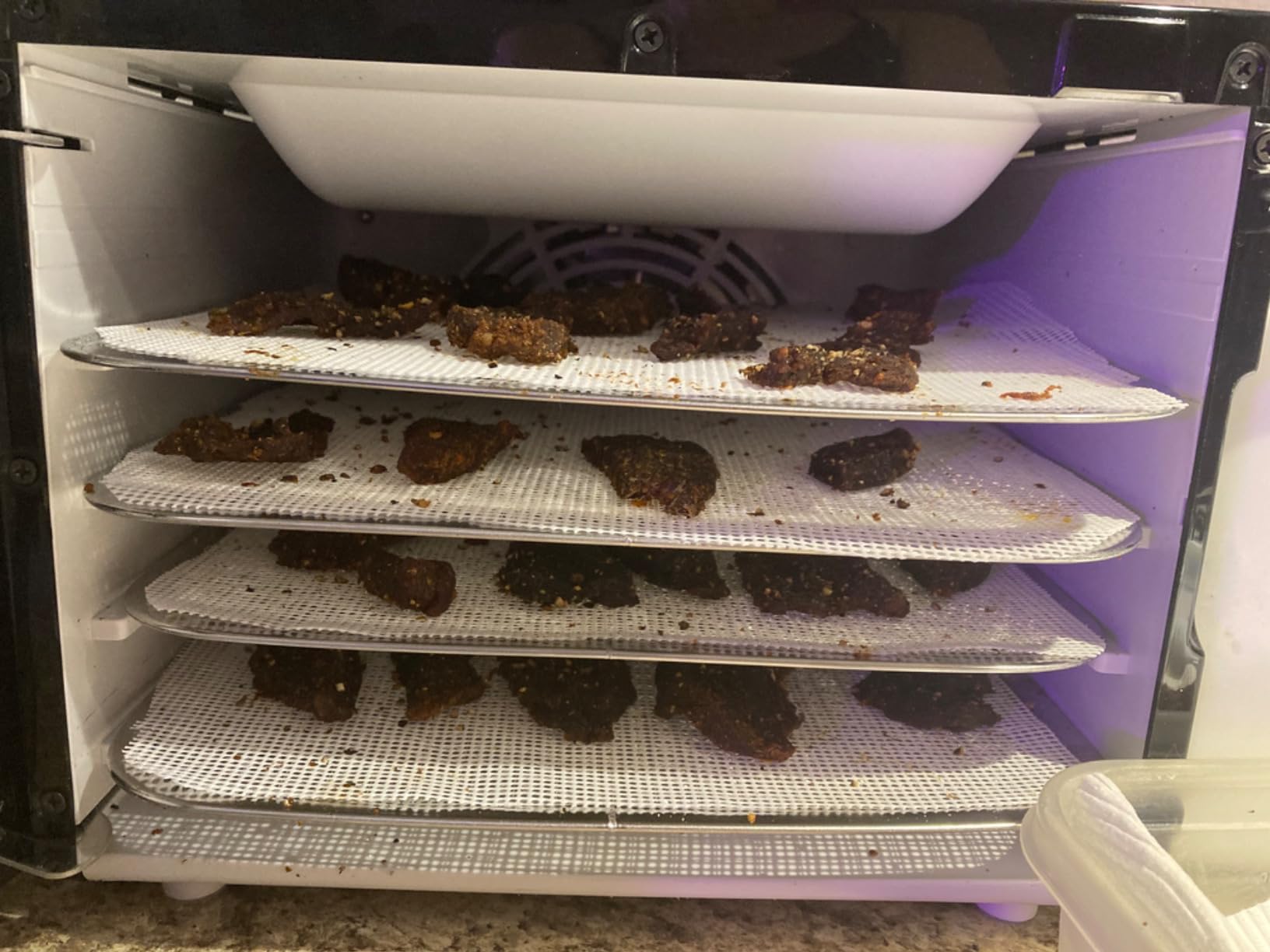
At 350W with horizontal airflow from a bottom-mounted fan, drying is even and quiet enough to leave running on the counter. The transparent trays let you monitor progress without cracking the lid, and both the trays and lid are dishwasher safe.
The honest limit is capacity. Four small trays are built for a few pounds at a time, not for a deer season, and the 158F ceiling sits below where many venison recipes would ideally sit.
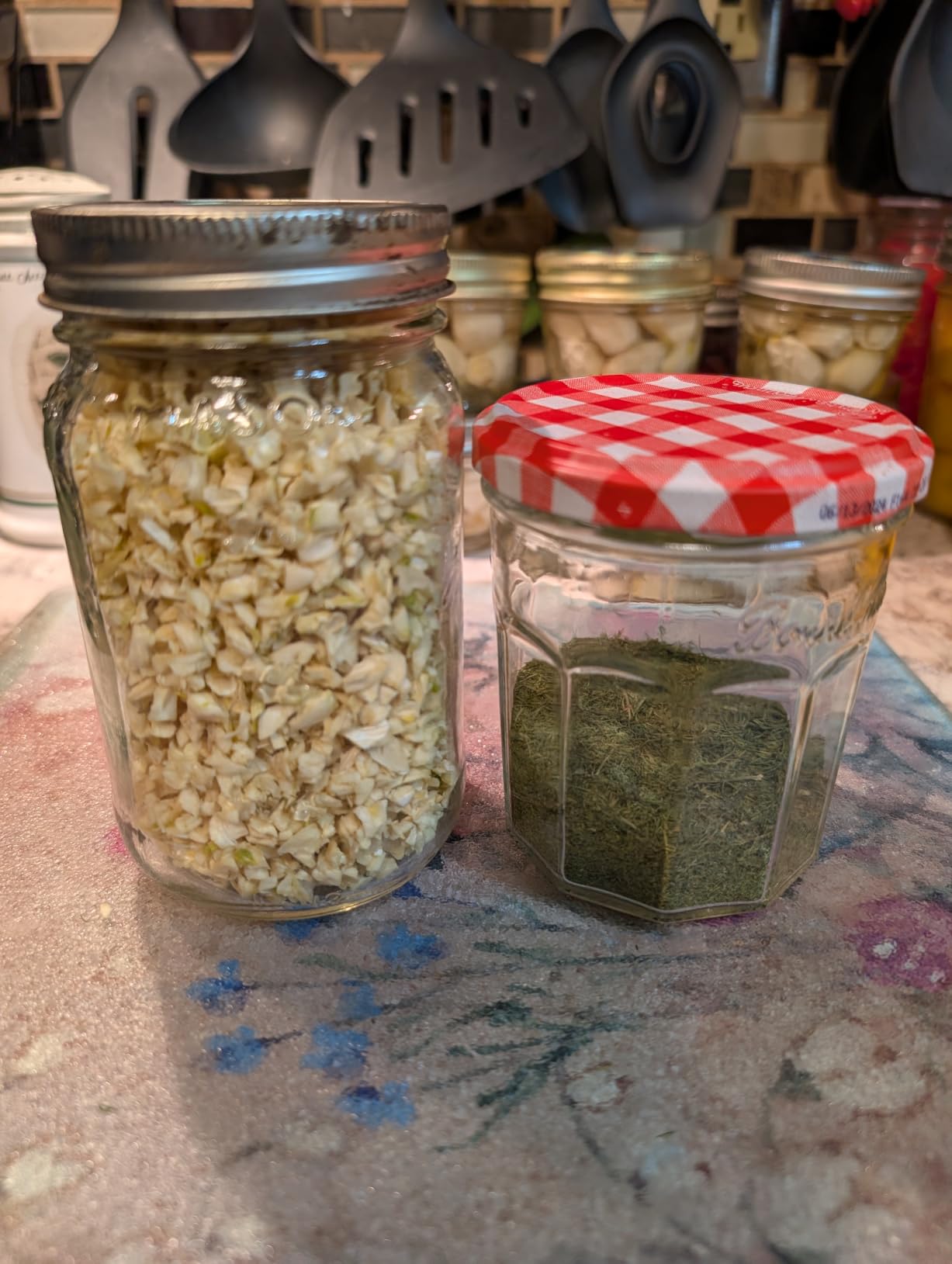
Does accurate temperature control matter for venison jerky?
It matters a great deal, because venison has no fat buffer. Beef jerky forgives a chamber that runs 10F cool; a lean deer slice at 145F when you asked for 160F dries slower and stays more tender than you intended.
This unit also has the 24-hour run time you need for thick cuts, so accurate control and long cycles are available in the same box.
When is four trays not enough?
When you are processing a whole deer. Four trays will not hold a hind quarter sliced at 1/4 inch, so you would be running repeated cycles through an already slow 350W element.
It also has a plastic body rather than stainless, which is fine for a few seasons of jerky and less fine for a decade of daily use.
9. Excalibur Select Series 8-Tray – Best for Big Game Loads
Excalibur Food Dehydrator Select Series for Jerky, Fruit, Vegetables, Herbs, Pet Treats with Adjustable Temperature Control, 8-Tray
8 trays, 7.2 cu ft
85F-165F, 80-hour run time
700W Hyperwave airflow
Glass French doors
Pros
- Largest drying capacity here with 8 trays and 7.2 cu ft for a whole venison load
- 700W heating with Hyperwave Pulse airflow dries evenly without tray rotation
- Wide 85F-165F range plus an 80-hour timer suits long game-meat runs
- Clear glass French doors let you monitor trays without breaking airflow
Cons
- Heaviest unit in the group at 16.5 pounds so it is a two-person move
- Few customer reviews so long-term durability feedback is limited
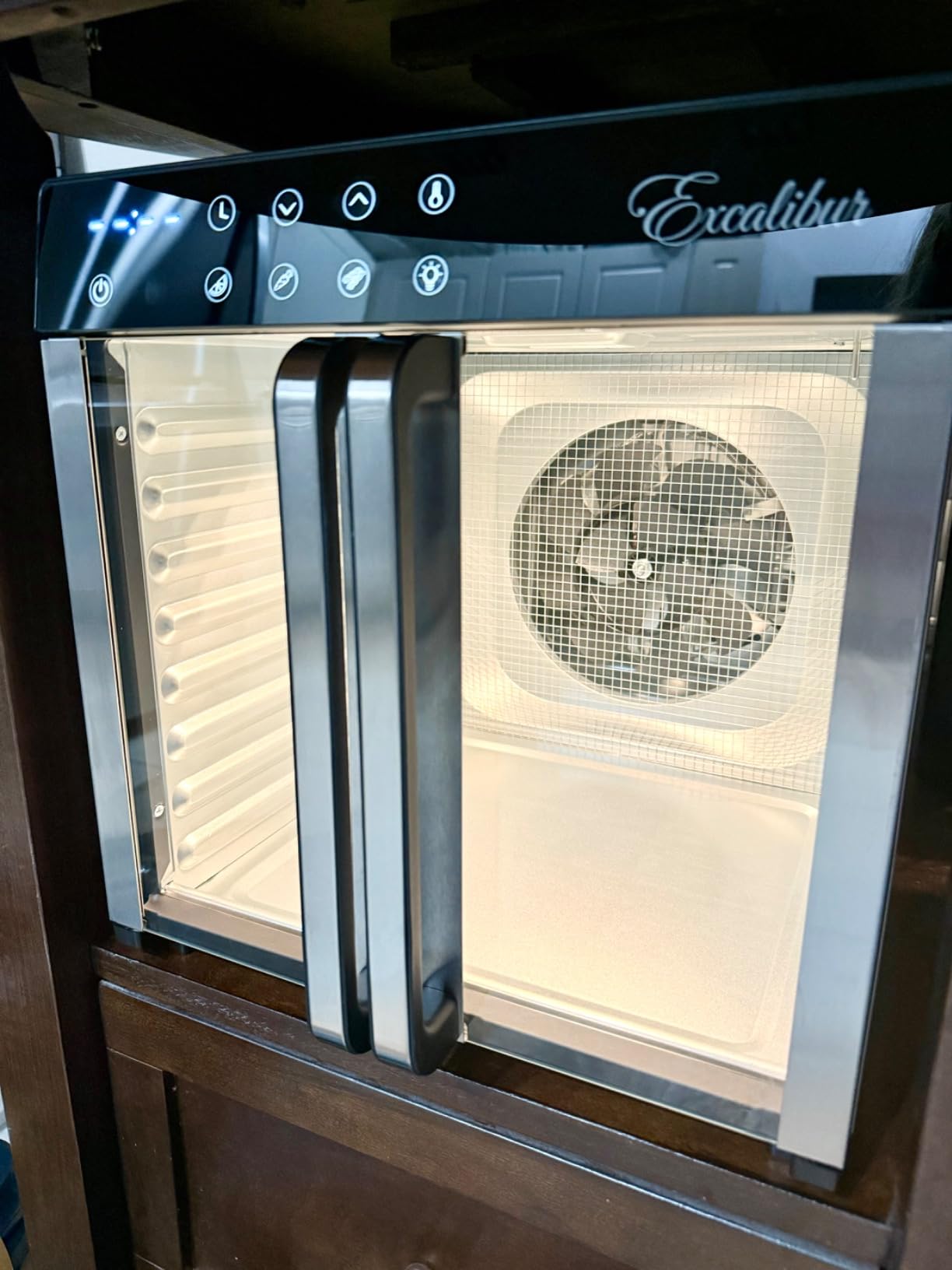
The Excalibur 8-tray is the largest dryer here, with eight chrome-plated trays and 7.2 cubic feet of drying space. For a hunter who wants to load a whole venison season in one pass rather than running three separate cycles, that capacity is the entire argument.
Its 700W element and patented Hyperwave Pulse technology with horizontal airflow are designed to dry evenly without tray rotation, and buyers rate it well on exactly that point alongside the wide temperature range.
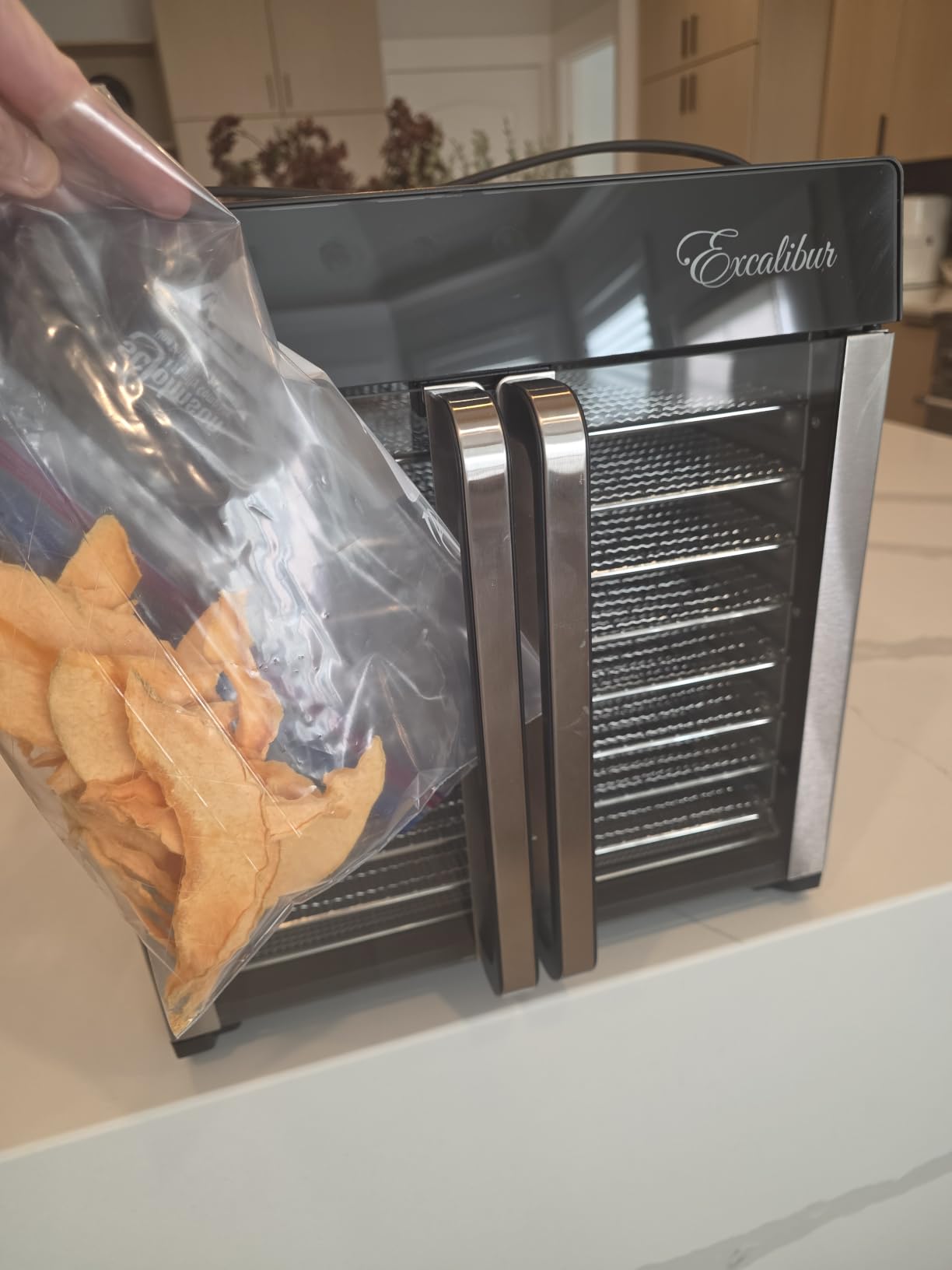
The control panel runs 85F to 165F with up to 80 hours of drying time, which is the longest run time in the roundup. The clear glass French doors let you watch tray-by-tray progress without opening the door and losing heat or disturbing airflow.
On forums dedicated to buying once and keeping it, Excalibur is the brand that gets named most often as the dehydrating groups’ standard recommendation, with owners reporting they own more than one.
How many trays do you really need for one deer?
Fewer than most buyers expect, but more than the entry boxes offer. At a rough 4:1 to 5:1 meat-to-jerky ratio, a 40 to 60 pound deer yields somewhere around 8 to 15 pounds of finished jerky, and eight trays lets you work through that without constant swapping.
If you only ever process a couple of deer per season, a six-tray box hits the same target in two runs and takes up less counter space.
What are the drawbacks before you commit?
It weighs 16.5 pounds, the heaviest unit here, so moving it to a garage or hunting room is a two-person job. Plan where it will live before you buy.
This listing also has a short review history compared with the established models, so long-term durability feedback is thin. The brand’s history is long, but this specific 8-tray configuration is newer.
10. PSIIDAN 8-Tray – Best Capacity-to-Size Ratio
Food Dehydrator Machine, Powerful Food Dryer with 8 Stainless Steel Trays, Adjustable Temperature up to 167°F & 48-Hour Timer for Jerky, Fruits, Herbs – Includes Mesh Tray, Drip Tray & Recipe Guide
8 stainless trays
Up to 167F, 48-hour timer
650W, 13 inch footprint
Interior light, auto shutoff
Pros
- Highest average rating in the roundup
- with a long-time jerky maker calling it the best dehydrator they have used
- A 167F ceiling gives good headroom for dense game meat
- Eight stainless trays in a compact 13 inch footprint
- Quiet operation with accurate time and temperature controls
- Drip tray and wipe-clean stainless trays make cleanup fast
Cons
- Runs warm and radiates noticeable heat into the surrounding space
- Brand-new listing with a short review history
The PSIIDAN packs eight stainless steel trays into a 13 by 13.31 by 12.01 inch footprint, and that capacity-to-size ratio is its argument. It gives you the tray count of a large box on a counter that would not hold the wide units in the middle of this list.
Owners rate the time and temperature controls as accurate, and the 650W motor dries fast. One reviewer with more than 30 years of jerky making described it as the best dehydrator they have used.
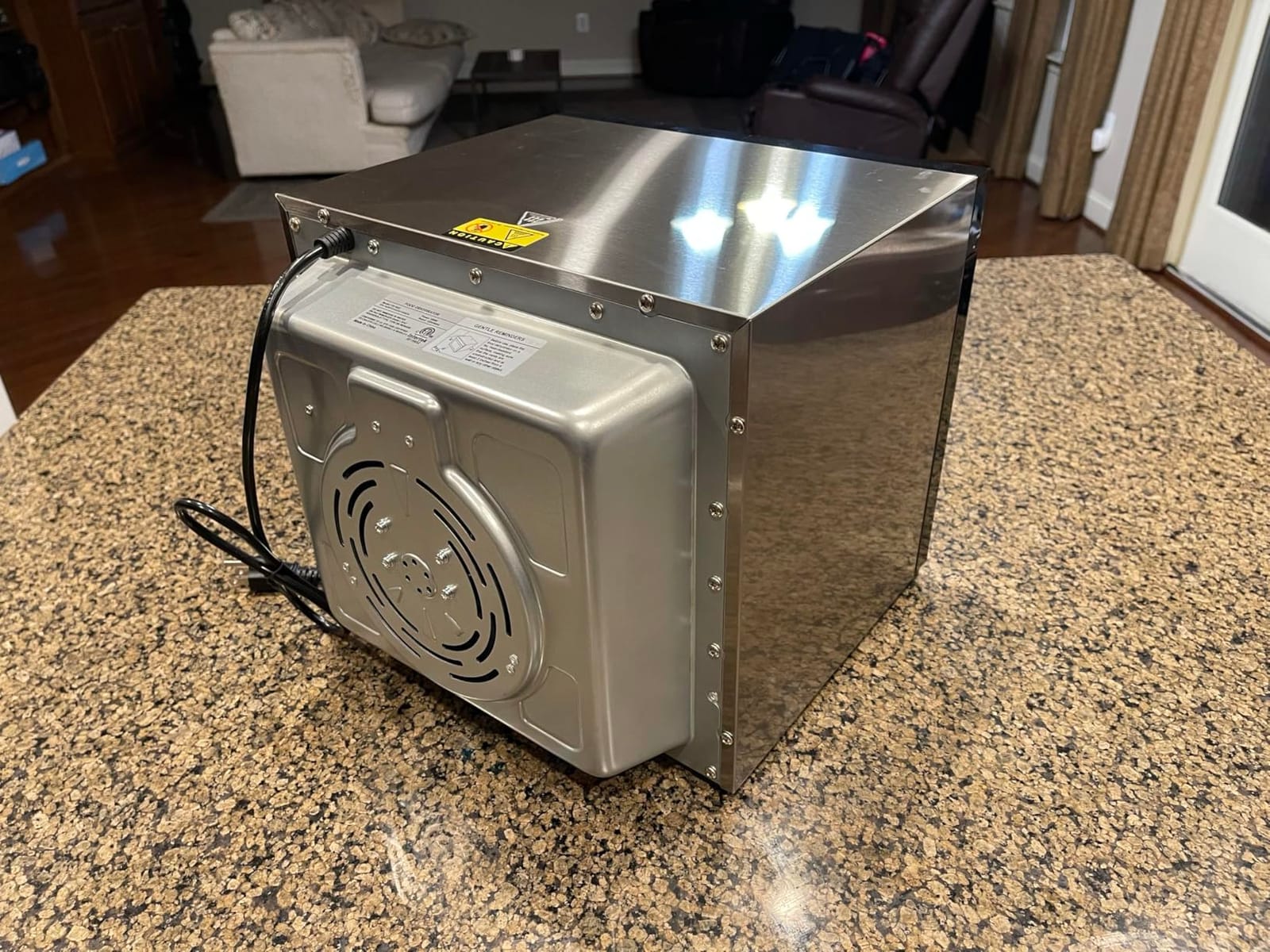
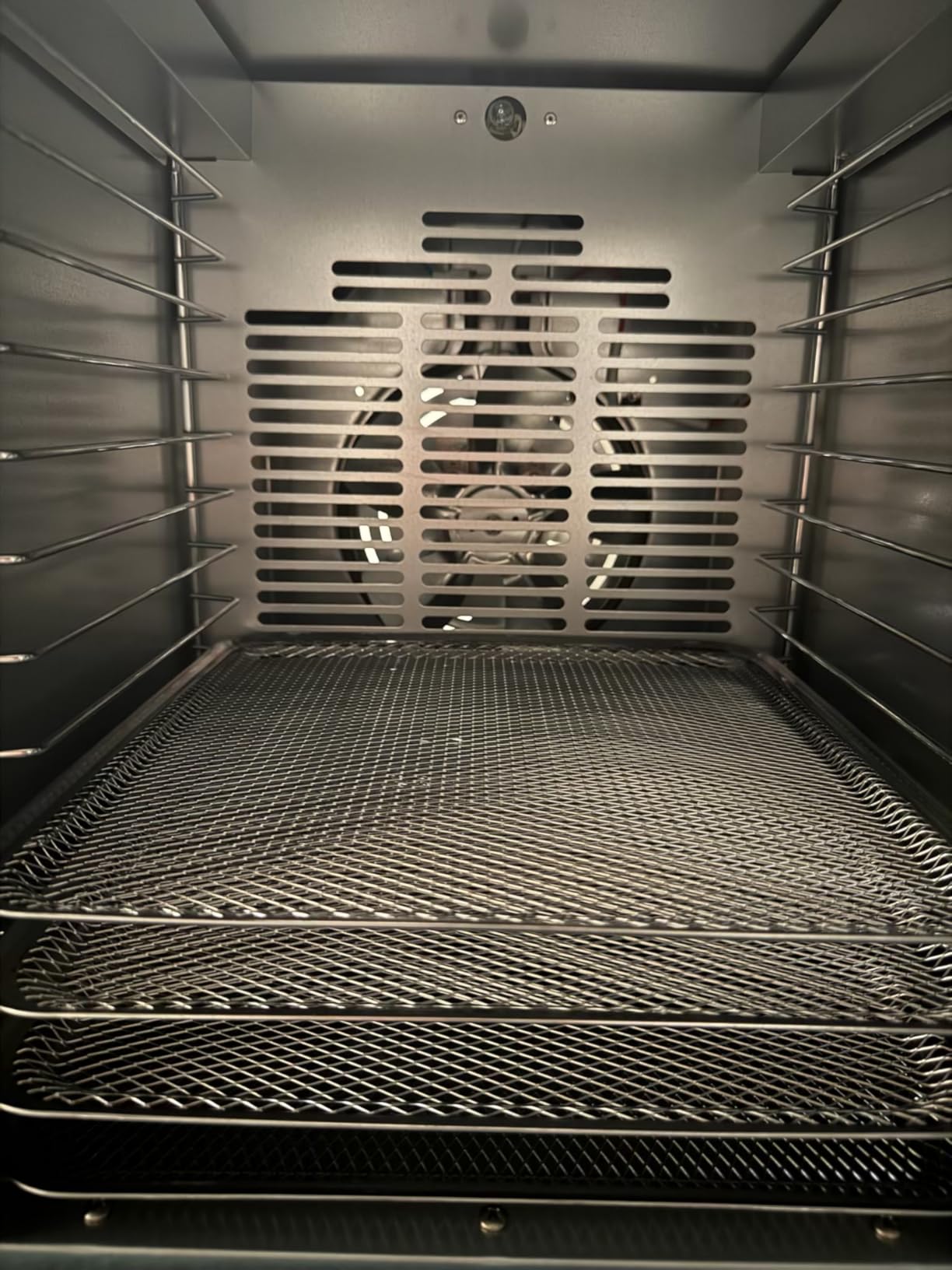
The 167F ceiling leaves headroom for dense game meat, and a 48-hour timer with one-touch controls and auto shut-off covers a long overnight venison run without a separate alarm. A built-in interior viewing light lets you check slices without opening the door, which matters when the box is on a counter in a dark room.
Dual-layer insulation is designed to keep the exterior cool during extended use, and the included drip tray plus wipe-clean stainless trays make cleanup after a fatty venison batch straightforward.
Is this a good dehydrator for a hunting room or garage?
It is compact enough to be one, and the interior light helps in a dim space. Just account for the heat, because owners report it runs warm and radiates noticeable heat into the surrounding area.
In a cold garage in winter, give the box time to reach setpoint before loading trays, since a cold chamber and a lean venison load interact badly in the first hour.
What should you weigh up before buying?
It radiates heat. In a small kitchen that is noticeable, and dual-layer insulation does not eliminate it during an eight-hour run.
The review history is also short at 115 reviews, so there is less long-term data than the established models have. The 4.8 rating is the highest here, but the sample size behind it is the smallest.
How Many Trays Do You Need for One Deer?
Plan around a yield ratio of roughly 4 to 5 pounds of fresh venison per pound of finished jerky. A typical deer yields 40 to 60 pounds of meat, so expect somewhere in the range of 8 to 15 pounds of jerky from a single animal.
Work out the cycle count from that. If a 1/4 inch slice takes six to ten hours depending on the machine, and your box holds a quarter to a third of the total yield, you are looking at three or four overnight runs per deer rather than one.
Trophy-hunt forums that run more than one dehydrator at a time usually freeze the bulk of the venison and batch it later. That keeps the meat fresh and lets you run full loads with better tray coverage than half-empty boxes.
On tray rotation, the honest answer is that rear-fan and base-heater designs do not need it, while top-fan designs benefit from a swap partway through. Whichever layout you buy, a quick check at the four-hour mark costs nothing.
Excalibur vs COSORI vs NESCO vs Presto: How These Brands Differ
Excalibur is the traditional answer for a reason. On buy-it-for-life forums, Excalibur is described as the best dehydrator overall and the only one consistently recommended in the dehydrating groups, with owners reporting they keep more than one.
COSORI competes on stainless construction and a huge owner base, with the largest review count in this roundup by a wide margin. It is the modern default for someone who wants stainless trays and by-the-degree control without moving a heavy box.
NESCO competes on expandability and its top-mounted fan design, and the FD-75A is the model hunters name most often because it starts at five trays and grows to twelve. Presto sits at the budget end but is one of the few entry machines actually marketed for venison and other game meats.
The practical difference between all four is airflow layout and tray area rather than temperature range, since every one of them reaches into the 158F to 165F band. Decide on capacity first, then on whether you care about stainless, expandability or a light body you can move between rooms.
If the rest of your processing bench needs attention, our guide to countertop appliances worth the space covers the kinds of machines that earn a permanent counter slot.
Frequently Asked Questions
Which dehydrator is best for making venison jerky?
The Cosori 6-tray stainless steel unit is the best overall for venison jerky, with 6.5 sq ft of space, a 600W rear-mounted fan and control to the degree between 95F and 165F. The NESCO FD-75A is the best value because it expands from 5 to 12 trays. The Presto Dehydro is the best budget option and is marketed specifically for venison and game meats.
What temperature should my dehydrator be on for deer jerky?
Most deer jerky is dried between 145F and 165F, with 160F the widely used target and 165F a common finishing temperature for dense cuts. Many experienced makers start at 130F to 150F to protect texture, then finish higher. Ground venison from a jerky gun is usually run at 160F for about six hours.
Is 160F hot enough for jerky?
Yes, 160F is the widely used target and covers most lean venison jerky. Because venison carries almost no fat, some experienced makers deliberately run cooler at 130F to 150F to avoid cooking the surface of the slice. If your machine cannot hold 160F at the tray, pre-cook the meat to 165F in a conventional oven first, then dehydrate it.
Is 170 too hot to make jerky?
Usually, yes. Above about 165F, lean venison slices tend to have their surface cooked and hardened before the center loses its moisture, which gives a tough outer band. A 176F ceiling is still useful on a machine because you can run cooler for most of the batch and use the higher setting only if a thick piece is lagging.
How many pounds of deer meat does it take to make 1 lb of jerky?
Roughly 4 to 5 pounds of fresh venison per pound of finished jerky. A typical deer yielding 40 to 60 pounds of meat therefore produces somewhere around 8 to 15 pounds of jerky, and at a 1/4 inch slice thickness that means three or four dehydrator cycles rather than a single load.
What cut of venison is best for making venison jerky?
Top round is the best all-around cut because it is lean, uniform and slices cleanly against the grain. Tenderloin dries quickly but yields little. Flank is inexpensive and usable, though its mixed grain makes consistent thickness harder. Trim all external fat before slicing, since residual fat turns rancid faster than the lean meat spoils.
Conclusion: The Best Food Dehydrators for Venison Jerky in 2026
The Cosori 6-tray stainless steel dehydrator takes the top spot because it does the three things that matter for deer jerky better than anything else in this roundup: it holds 165F at the tray, its rear-mounted fan dries six full trays evenly without rotation, and it runs quietly enough to finish a batch overnight.
The NESCO FD-75A is the pick if you want to start small and grow into a full season, and the Presto Dehydro is the pick if you want the cheapest machine that was actually designed with game meat in mind. For a single large load, the Excalibur 8-tray holds the most meat at once.
Whichever you choose, trim the fat, slice at 1/4 inch, freeze briefly before cutting, and check the temperature at the tray rather than trusting the dial. Those four steps matter more to the final bag of jerky than the brand on the box.