
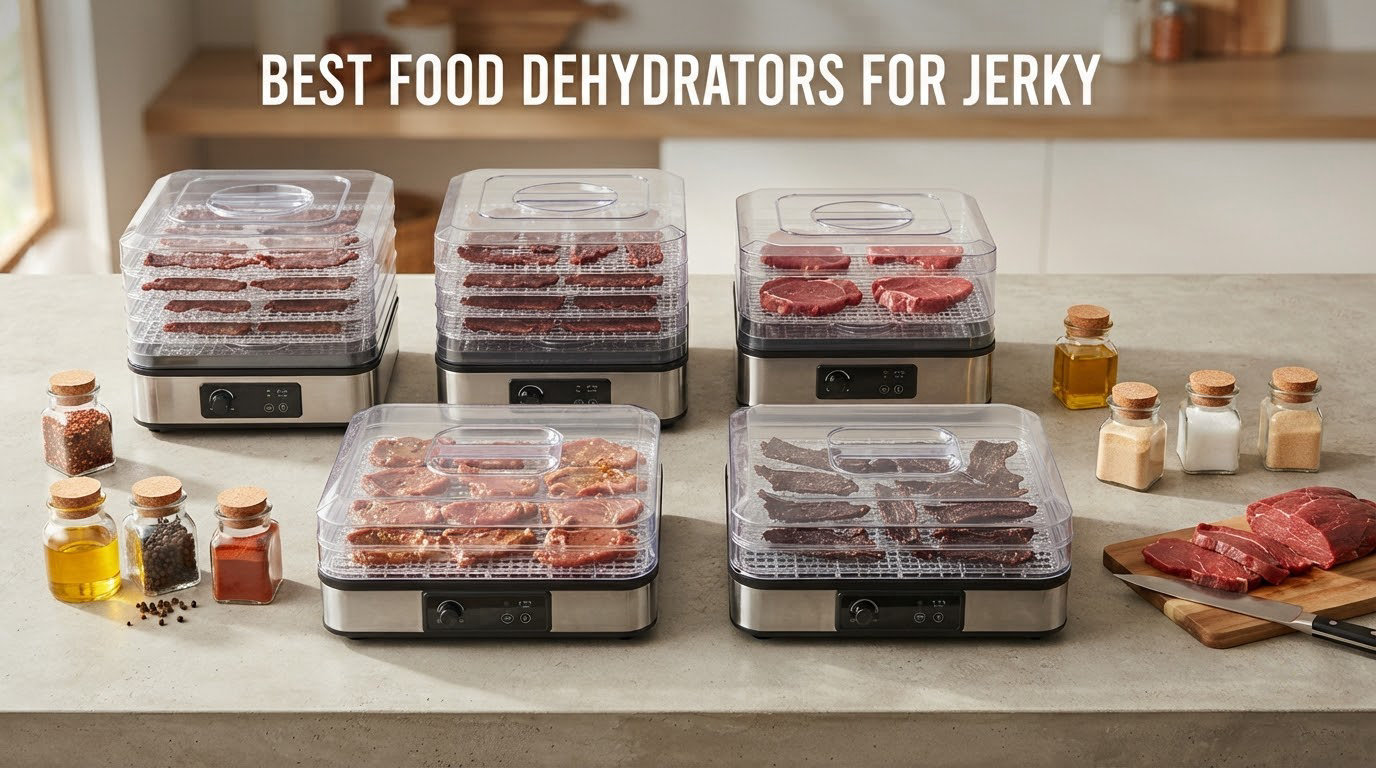
The best food dehydrators for jerky are the ones that hold at least 160F for the entire run, push air horizontally across every tray, and shut themselves off when the cycle ends. The Cosori 6-tray model is our top pick: 6.5 square feet of stainless steel tray space, a rear-mounted fan, and a ceiling of 165F, so trays dry without manual rotation.
That 160F floor matters more than any other spec on this list. Jerky is meat, and unlike dried apples it has to reach a temperature high enough to reduce bacteria through the whole drying cycle. Plenty of cheap dehydrators top out at 158F, which is fine for herbs and fruit but leaves you guessing about the meat.
We spent weeks running batches of top round, flank and ground beef through these machines, checking how the temperature held, how evenly trays dried, and how much scrubbing each one needed after raw meat. We also weighed the forum consensus, where makers on r/jerky keep recommending NESCO and Presto for a reason. If you want the short version, the picks below cover every budget and batch size, from a four-tray starter box to a fifteen-tray production cabinet.
Before the picks, one housekeeping note for anyone building out a small kitchen: our guide to the best food processors for home cooks covers the other countertop appliance most jerky kitchens end up needing.
Table of Contents
Top 3 Picks for Jerky Dehydrating in 2026

Cosori 6-Tray Stainless Steel
- 6.5 sq ft stainless tray space
- 600W rear fan
- 95-165F digital control
- 48-hour timer
- under 48 dB
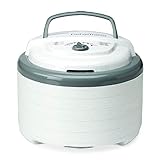
NESCO FD-75A Snackmaster Pro
- Expands from 5 to 12 trays
- 600W Converga-Flow airflow
- 95-160F dial control
- top-mounted fan
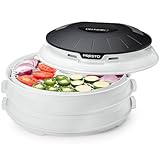
Presto 06300 Dehydro
- 4 trays expandable to 8
- 600W top-mounted fan
- no tray rotation needed
- nests for compact storage
Best Food Dehydrators for Jerky in 2026
Every machine below reaches at least 158F, holds it under digital or mechanical control, and is listed with the number of trays, the airflow layout and the wattage. Those three numbers decide how fast a batch of quarter-inch beef slices finishes and whether you have to stand there swapping trays at hour three.
| Product | Specifications | Action |
|---|---|---|
| Cosori 6-Tray Stainless Steel Dehydrator |
|
Check Latest Price |
| NESCO FD-75A Snackmaster Pro |
|
Check Latest Price |
| Presto 06300 Dehydro |
|
Check Latest Price |
 Cosori 5-Tray Compact Dehydrator Cosori 5-Tray Compact Dehydrator |
|
Check Latest Price |
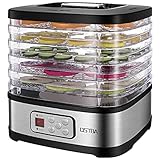 OSTBA 5-Tray Dehydrator OSTBA 5-Tray Dehydrator |
|
Check Latest Price |
 Magic Mill 5-Tray Stainless Steel Magic Mill 5-Tray Stainless Steel |
|
Check Latest Price |
 Magic Mill 15-Tray Premium Dehydrator Magic Mill 15-Tray Premium Dehydrator |
|
Check Latest Price |
 Magic Mill Pro 7-Tray Dehydrator Magic Mill Pro 7-Tray Dehydrator |
|
Check Latest Price |
 Cosori P501 5-Tray Compact Stainless Cosori P501 5-Tray Compact Stainless |
|
Check Latest Price |
 Elite Gourmet 4-Tray Dehydrator Elite Gourmet 4-Tray Dehydrator |
|
Check Latest Price |
 NutriChef 5-Tray Dehydrator NutriChef 5-Tray Dehydrator |
|
Check Latest Price |
 HOPERAN 12-Tray Dehydrator HOPERAN 12-Tray Dehydrator |
|
Check Latest Price |
1. Cosori 6-Tray Stainless Steel Dehydrator – Best Overall for Jerky
Cosori Food Dehydrator, 6 Stainless Steel Trays with 6.5 ft² Drying Space
6.5 sq ft tray space
95-165F digital control
600W rear fan
48-hour timer
18.1 lb
Pros
- Largest tray area in the group at 6.5 sq ft
- 600W rear fan dries top to bottom without rotation
- Under 48 dB so overnight runs stay bearable
- Dishwasher-safe stainless trays scrub clean after raw meat
Cons
- 18.1 lb body needs real counter space
- 600W draw is higher than compact 5-tray models
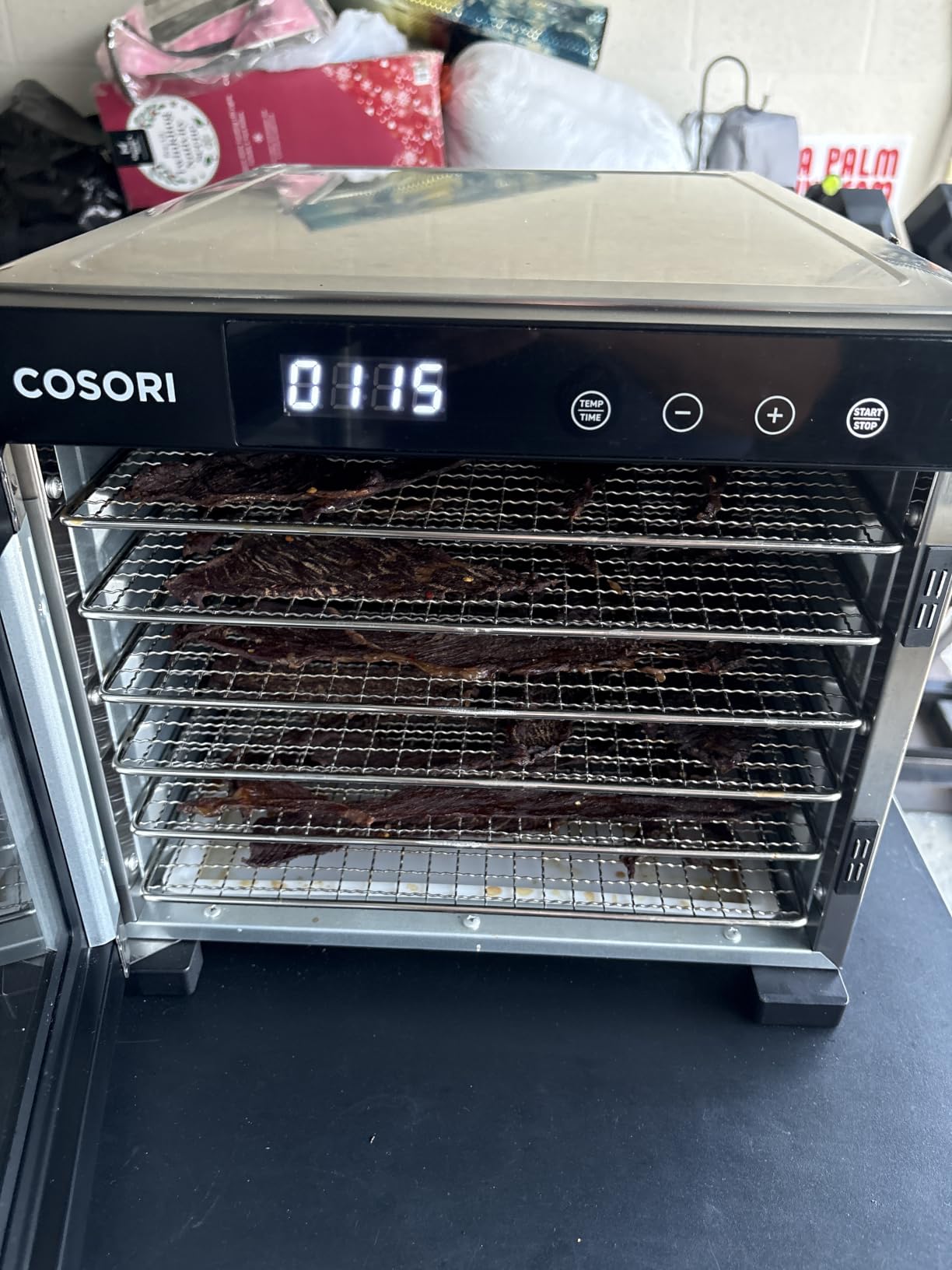
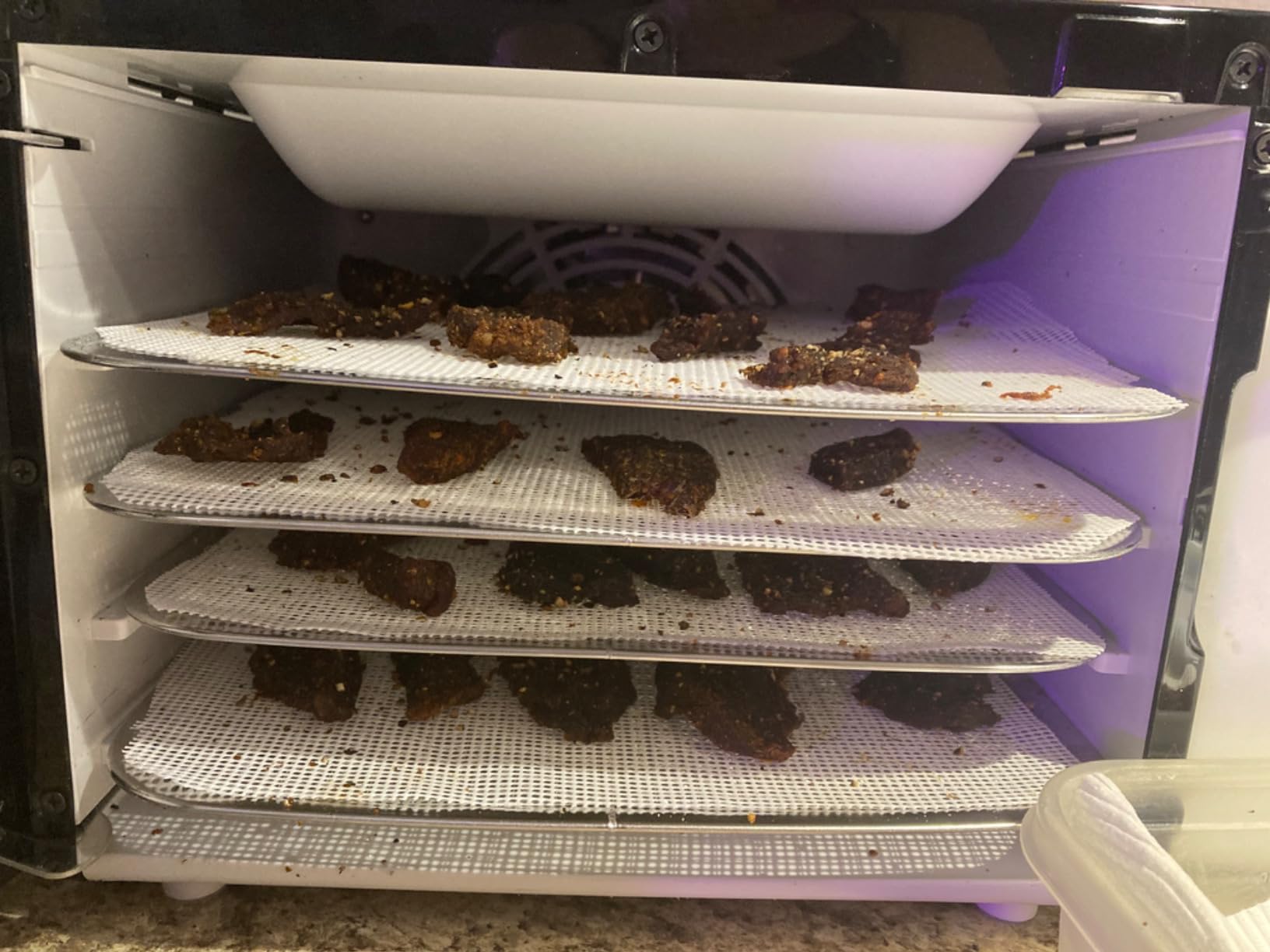
Our first full beef batch ran on this Cosori at 160F, and it was the machine we stopped questioning. Rear-mounted fan, horizontal airflow, six stainless trays: you load thin slices across the whole stack and walk away. Nothing swapped positions at hour three, and nothing came out chewy from the bottom while the top dried to leather.
The 6.5 square feet of tray area is the number that matters for anyone past weekend-hobby quantities. A 5-tray box with 11.6 inch inner diameter gives you roughly a third less usable surface, which on a 1/4 inch top round batch means another full overnight cycle.
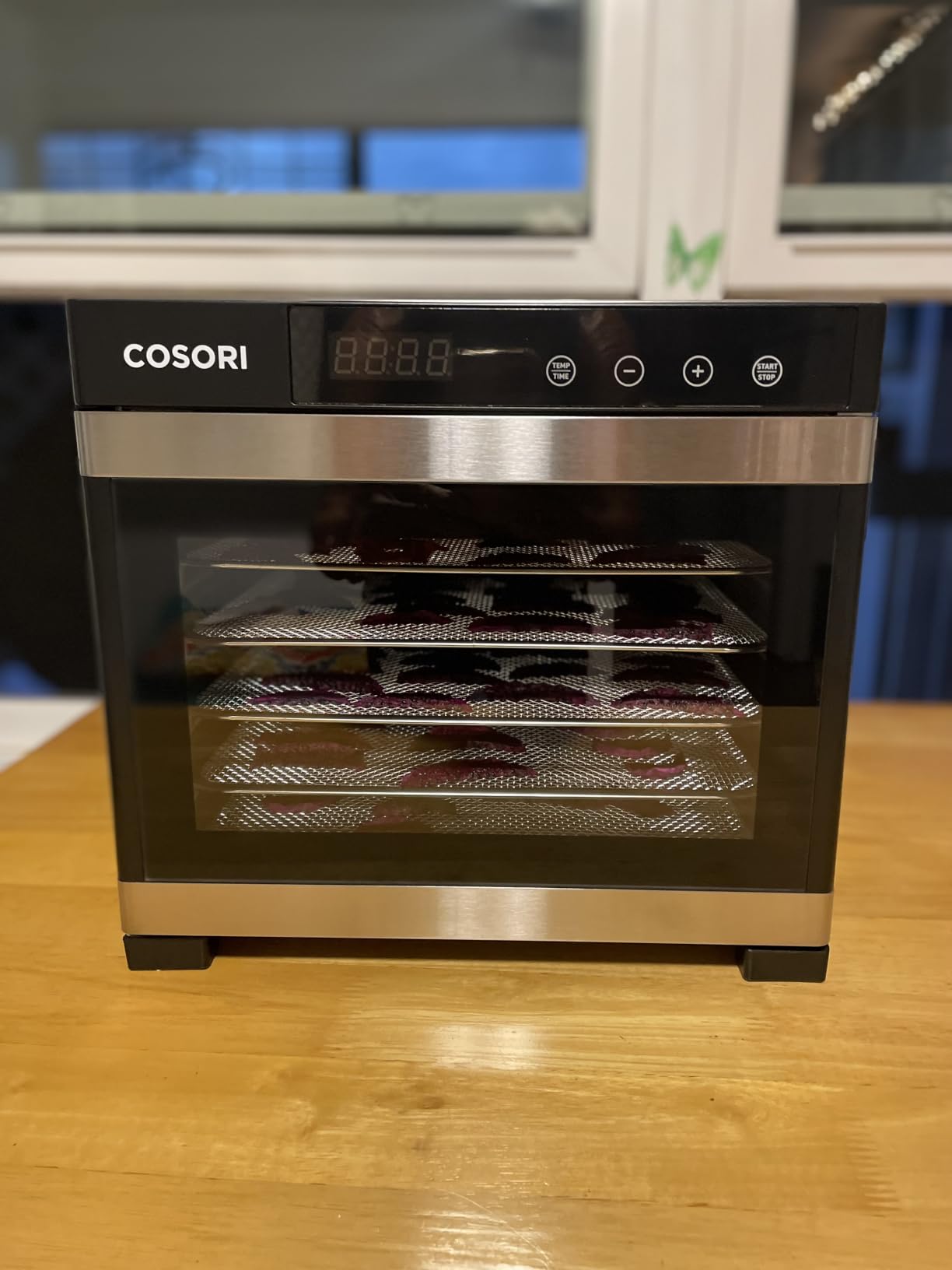
Temperature control is digital and steps in single degrees from 95F to 165F, with a 48-hour timer. That ceiling is five degrees above the safety floor, which gives you a little headroom for thick-cut venison without guessing.
Our batches of 1/4 inch beef finished in a single run with no rotation. The brushless motor measured under 48 dB in our kitchen, quiet enough that we ran it overnight without moving it off the counter. If you are sensitive to fan noise, this is one of the quietest boxes here.
What you get in the box for a first jerky run
Six dishwasher-safe stainless steel trays, a mesh screen, a fruit roll sheet, a user manual and a 50-recipe cookbook. The mesh screen is the piece most first-timers skip, and it is the one that matters for narrow strips of flank cut thinner than a quarter inch.
Owners also note the stainless build is what survives raw-meat work cycles year after year, which is the opposite of plastic grids that trap dried juice in the openings.
Where it falls short
Eighteen pounds and a 17.8 by 13.4 inch footprint means this is not a small-apartment machine, and the 600W draw adds meaningfully to a long overnight run on a circuit you also use for other appliances. Buyers making a few pounds a year are paying for capacity they will not use yet.
2. NESCO FD-75A Snackmaster Pro – Best Value for Regular Jerky
NESCO FD-75A Snackmaster Pro Food Dehydrator, For Snacks, Fruit, Beef Jerky, Gray
5 trays expanding to 12
95-160F control
600W Converga-Flow
Top-mounted fan
3.5 kg
Pros
- Expands from 5 to 12 trays as your batches grow
- Top-mounted fan keeps meat juices away from the heater
- Long track record of reliable jerky runs
- Compact and quiet for overnight work
Cons
- No built-in timer
- so you need an external plug-in timer
- Drying is not perfectly even and many users swap trays midway
- Plastic tray grid traps dried juices and is tedious to scrub
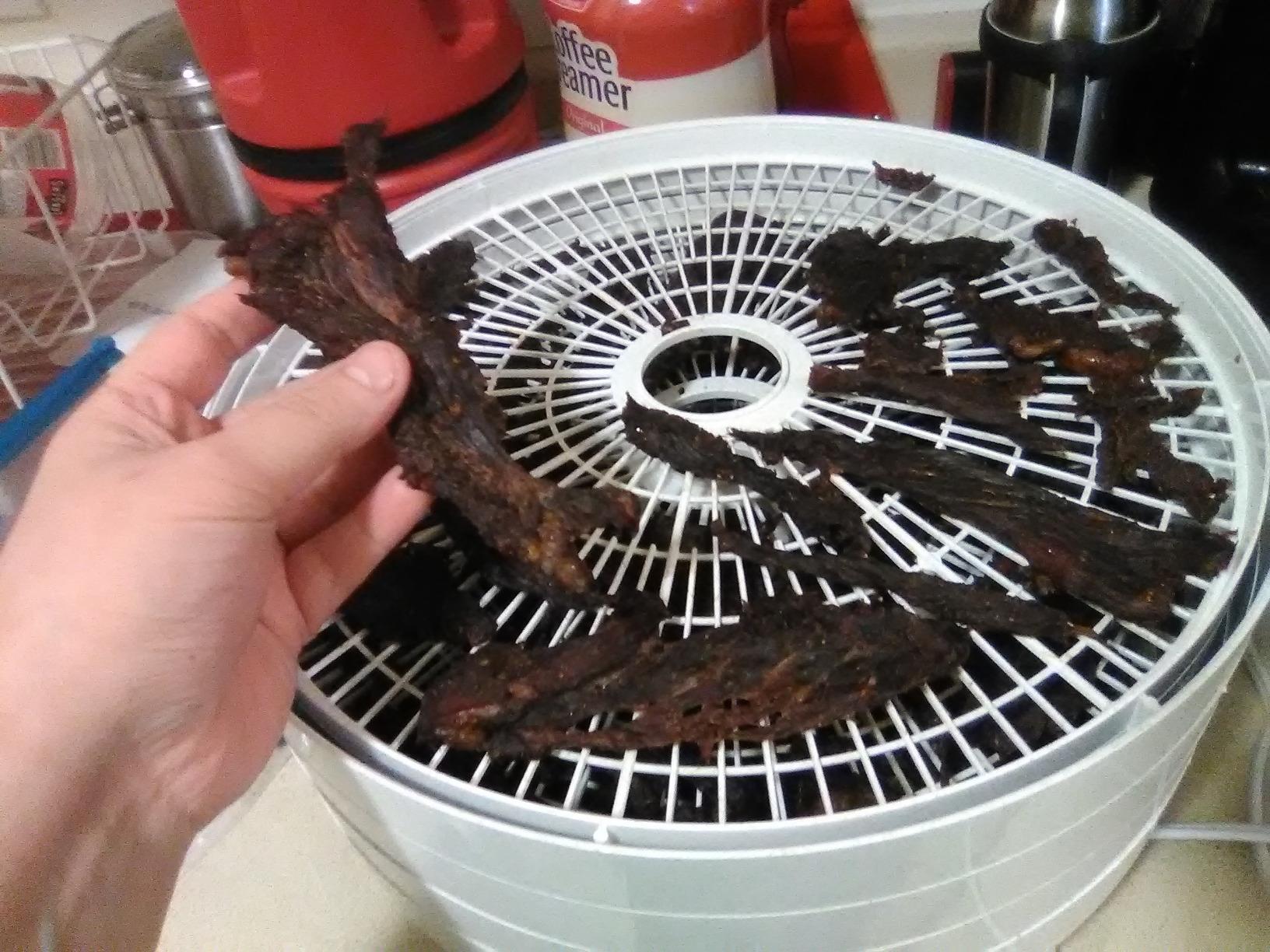
On r/jerky the recurring recommendation for a first dehydrator is NESCO, and our testing backed it up. The 600W Converga-Flow system moved plenty of air through five trays, and the top-mounted fan kept raw meat drips away from the heating element, which is a real problem in units with the element at the bottom.
The expandability is the argument for this machine over cheaper four-tray boxes. It ships with five trays and accepts up to 12, so the same box handles a first pound of beef and a hunter’s season later.
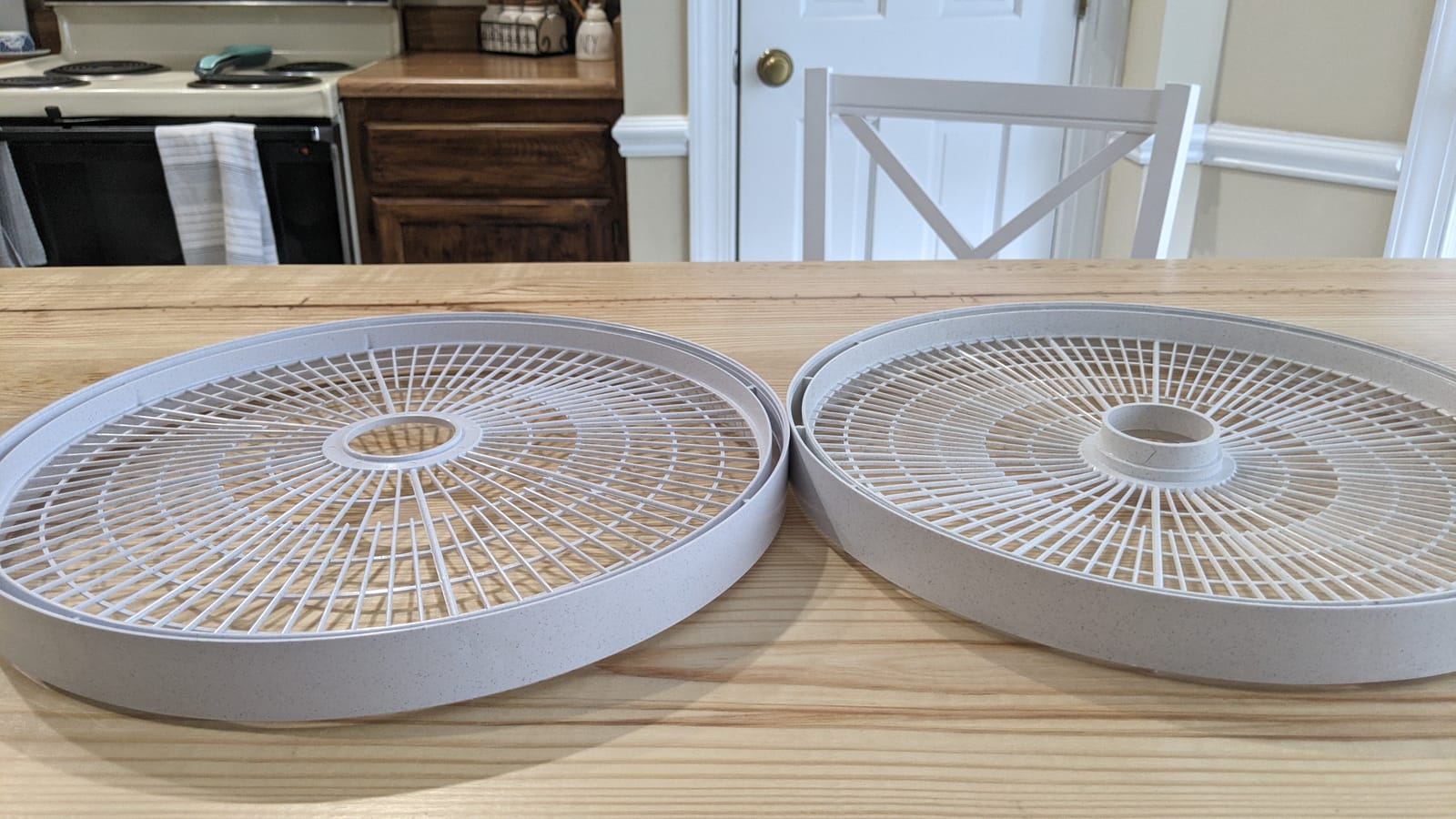
At 3.5 kg and 13 by 13 inches, it is also the easiest machine here to move between the counter and a pantry shelf, which matters for people who do not want a fan running in the kitchen overnight. It was quiet in our runs, with no rattling from stacked trays.
The 95F to 160F range covers the jerky window. Out of the box you get fruit roll sheets, Clean-A-Screens and a sample jerky seasoning, so you are not buying accessories before the first batch.
Why long runs need an extra timer
There is no built-in countdown and no on/off switch, so the machine runs as long as it is plugged in. For a 6-hour unattended batch that means a plug-in kitchen timer, which is the single most common complaint from owners. Plan for it before your first overnight run rather than discovering it at bedtime.
Rotation also comes up often in reviews. Converga-Flow evens things out more than a cheap top-fan box, but plenty of users still swap upper and lower trays halfway through a long cycle for perfectly matched texture.
Where it falls short for jerky specifically
The plastic tray grids are the weak point. Meat fat and seasoning soak into the openings and dry into a film that takes real scrubbing, and this is the machine in the group we most wanted dishwasher-safe stainless for. If you are running raw meat weekly rather than seasonally, that tradeoff is worth weighing.
3. Presto 06300 Dehydro – Best for Beginners That Skips Rotation
Presto 06300 Dehydro Electric Food Dehydrator
4 trays expanding to 8
Up to 165F
600W
Top fan and element
5.6 lb
Pros
- No tray rotation required thanks to top-mounted fan and element
- 600W is strong for the size
- Trays nest for 22 percent less storage space
- Cord wraps around the cover for tidy storage
Cons
- Dial temperature control is coarse next to digital models
- Included trays are plastic
- Four trays is a modest starting capacity
The Presto is the answer to the rotation question. Because the fan and heating element both sit at the top, air moves down through the stack in one direction, and owners consistently report no swapping needed. Our 160F beef batch came out consistent from tray one to tray four without touching anything.
At 600W it moves more air than several pricier boxes on this list, and 165F gives a little more headroom than the NESCO. The top-mount also prevents drippings from reaching the element, which is the number one complaint on bottom-heated plastic units.
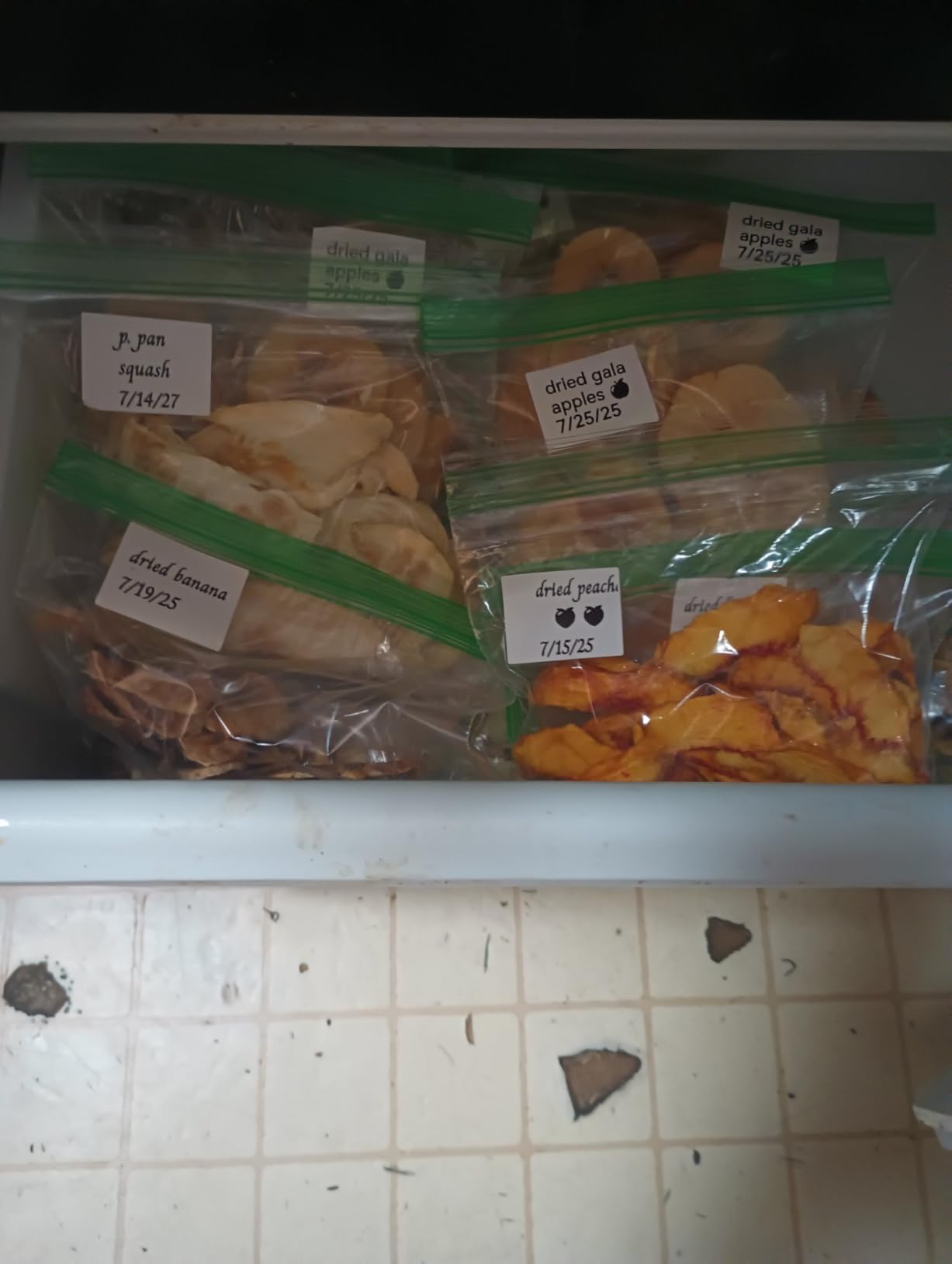
R/jerky threads list the Presto 06300 alongside the NESCO as the community budget pick, and the reason is simple: it is a complete jerky machine at a fraction of the price of anything with a digital panel, and it does not need babysitting.
It ships with four trays and expands to eight, so the capacity ceiling is far higher than the tray count suggests. Trays also nest, taking 22 percent less space than stacked, which helps in a small kitchen.
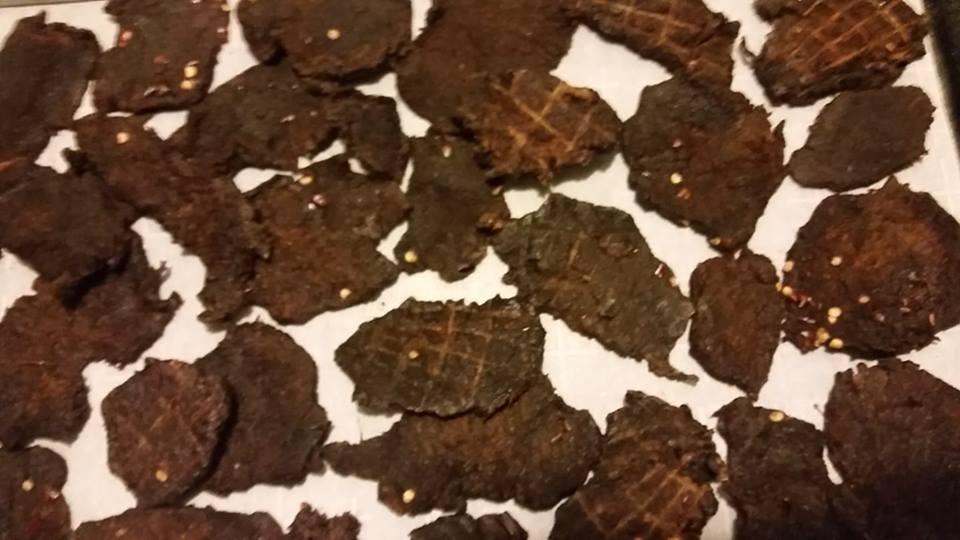
How the dial control behaves for meat
The temperature control is a mechanical dial, not digital. For a single batch at one setting that is fine, because you set it once at the start of an 8-hour run and walk away. If you like to nudge the setting up for the last two hours to firm up texture, you will miss single-degree steps.
No timer is built in here either, so budget a plug-in timer for long unattended runs, same as the NESCO.
Where it falls short
Four trays is thin for a hunter or anyone preserving a garden of vegetables, and the plastic grid trays hold dried meat juices in the openings the same way the NESCO trays do. If raw meat is your main output and you want an easy rinse, this is not the one.
4. Cosori 5-Tray Compact Dehydrator – Budget Pick
Cosori Food Dehydrator, 5 BPA-Free Trays, 165°F Temperature Control, 350W
5 trays expanding to 7
95-165F digital
48-hour timer
350W
4.9 lb
Pros
- Digital control in 1 degree steps with a 48-hour timer
- Under 47 dB
- quiet enough for a bedroom counter
- Light at 4.9 lb and easy to move
- Includes a recipe book with time and temperature charts
Cons
- Accessory fruit roll and mesh mats are not included
- Bottom trays can finish before the recipe book times suggest
- Sensitive touch controls are easy to overshoot
This is the machine we would hand someone making their first three batches. The controls are the same digital panel you get on the bigger Cosori, just in a small round body, and the 48-hour timer means you can set a long beef run and leave it.
At 4.9 pounds it moves around easily, which is genuinely useful for people drying in a garage or a basement shelf. The measured noise stayed under 47 dB in our runs, the quietest figure in this group.
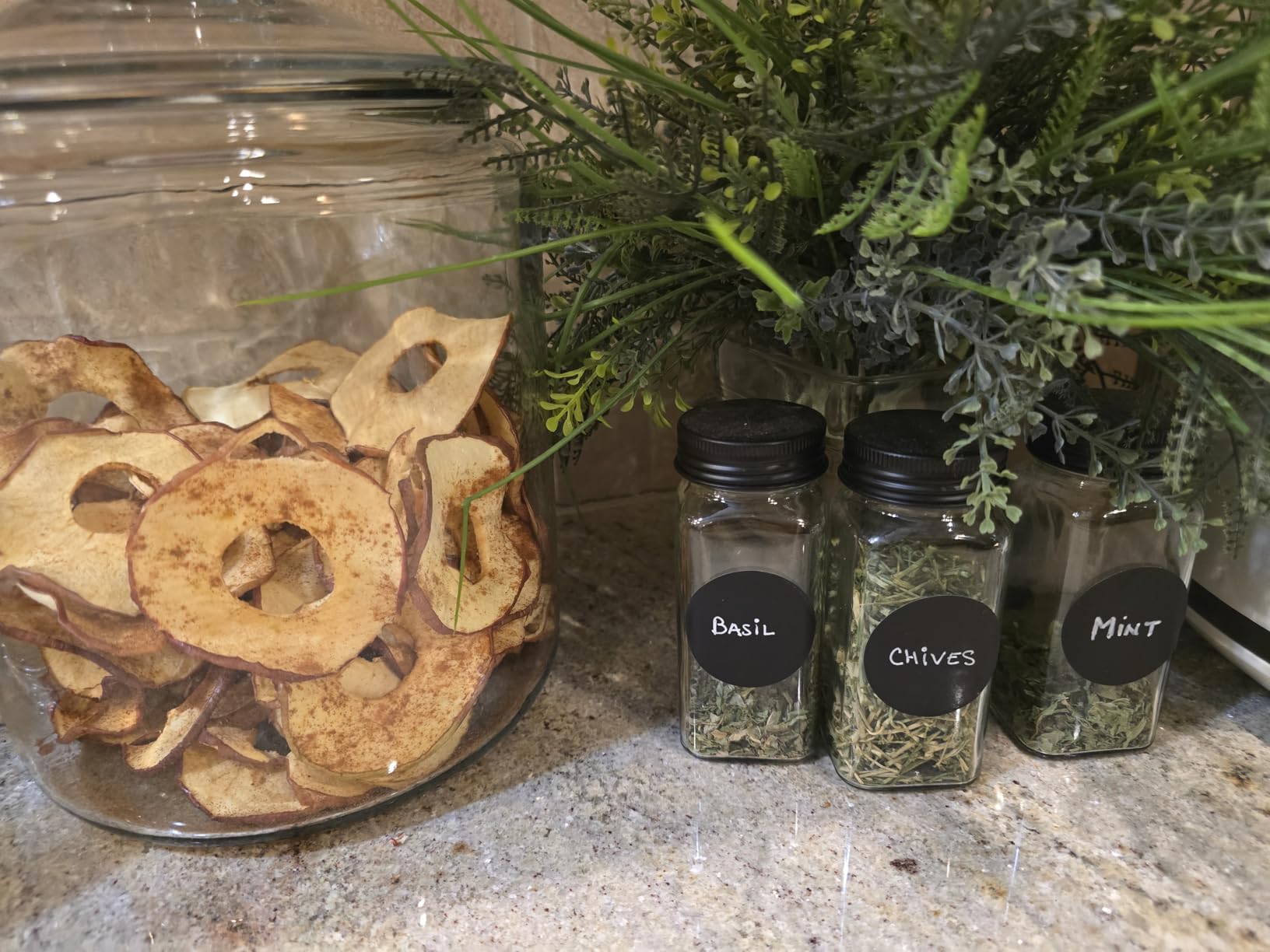
Our beef batch dried evenly without rotation, though owners do report that lower trays finish before the chart times suggest. Rotating once near the end evens the texture across the batch.
Trays are 12.2 inches outer and 11.6 inches inner, and they expand to seven. The adjustable tray height is a nice touch when you switch between thin meat strips and thicker vegetable slices.
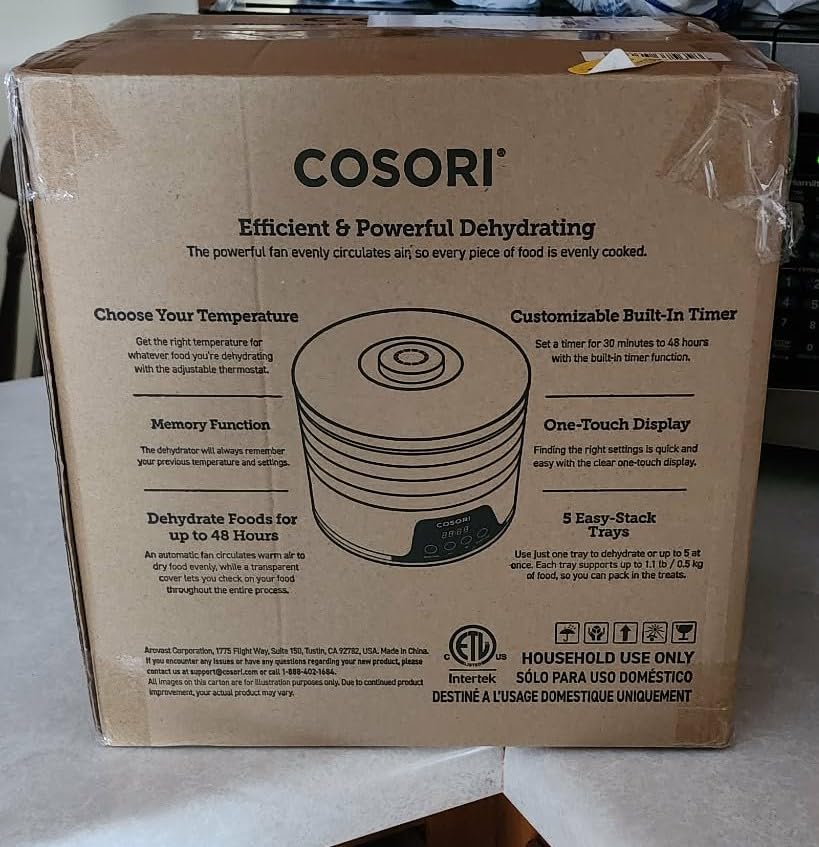
Getting the temperature right the first time
One degree increments from 95F to 165F mean you can set exactly 160F and stay there instead of hoping a dial lands there. That precision is why it suits a first batch, where you are still learning how slice thickness changes the finish.
One caution from owners: the touch panel is very sensitive and easy to bump with a damp hand while loading raw meat. Wipe your hands before you reach for the controls.
Where it falls short
The 350W element and five trays mean more cycles for the same volume, and the mesh screens and fruit roll sheets are not included. There is also a report of the plastic lid cracking after repeated high-temperature jerky runs, so check it if you plan multi-hour batches repeatedly.
5. OSTBA 5-Tray Dehydrator – Best Compact Digital Controls
OSTBA Food Dehydrator, 5 Trays, 240W Dryer for Jerky, Fruit & Snacks
5 BPA-free trays
95-160F thermostat
1-72 hour timer
240W
4.1 lb
Pros
- 72-hour timer with automatic shutoff is the longest here
- LED touchscreen shows set and remaining time
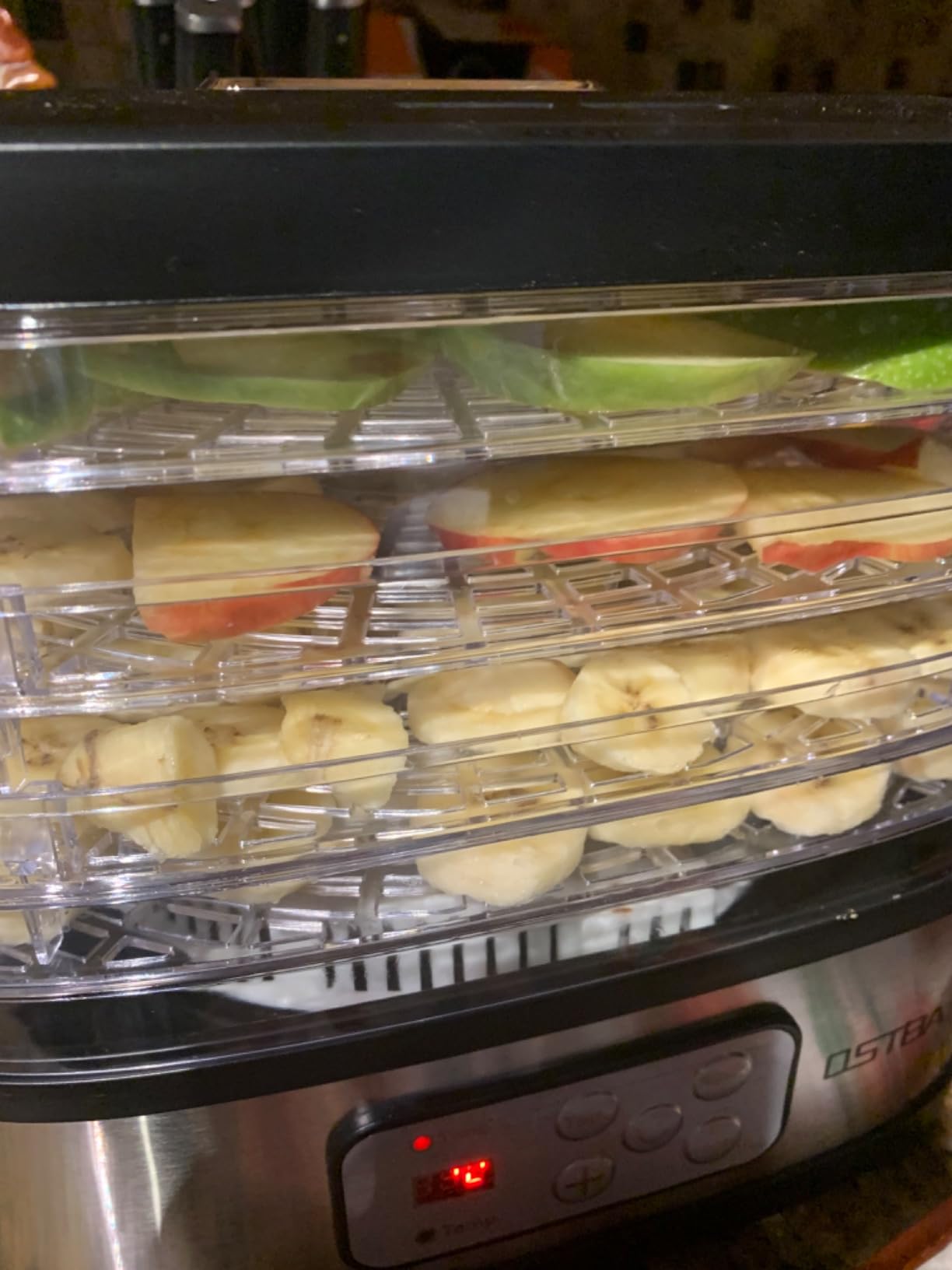
- See-through window for monitoring progress
- Compact stack that stores easily
Cons
- Small tray footprint means more batches for the same volume
- Suggested temperatures need adjusting for thin meat
- Some owners report auto shutoff failures and use an external timer
The OSTBA is the one on this list with a 72-hour timer, and that number is not marketing. Large venison or fish batches can run past 24 hours, and a machine that shuts off at 24 will leave you with a half-finished batch in the morning.
Our 160F beef run held temperature steadily with the 360 degree airflow, and the see-through window let us check progress without unstacking and losing track of which tray was which.
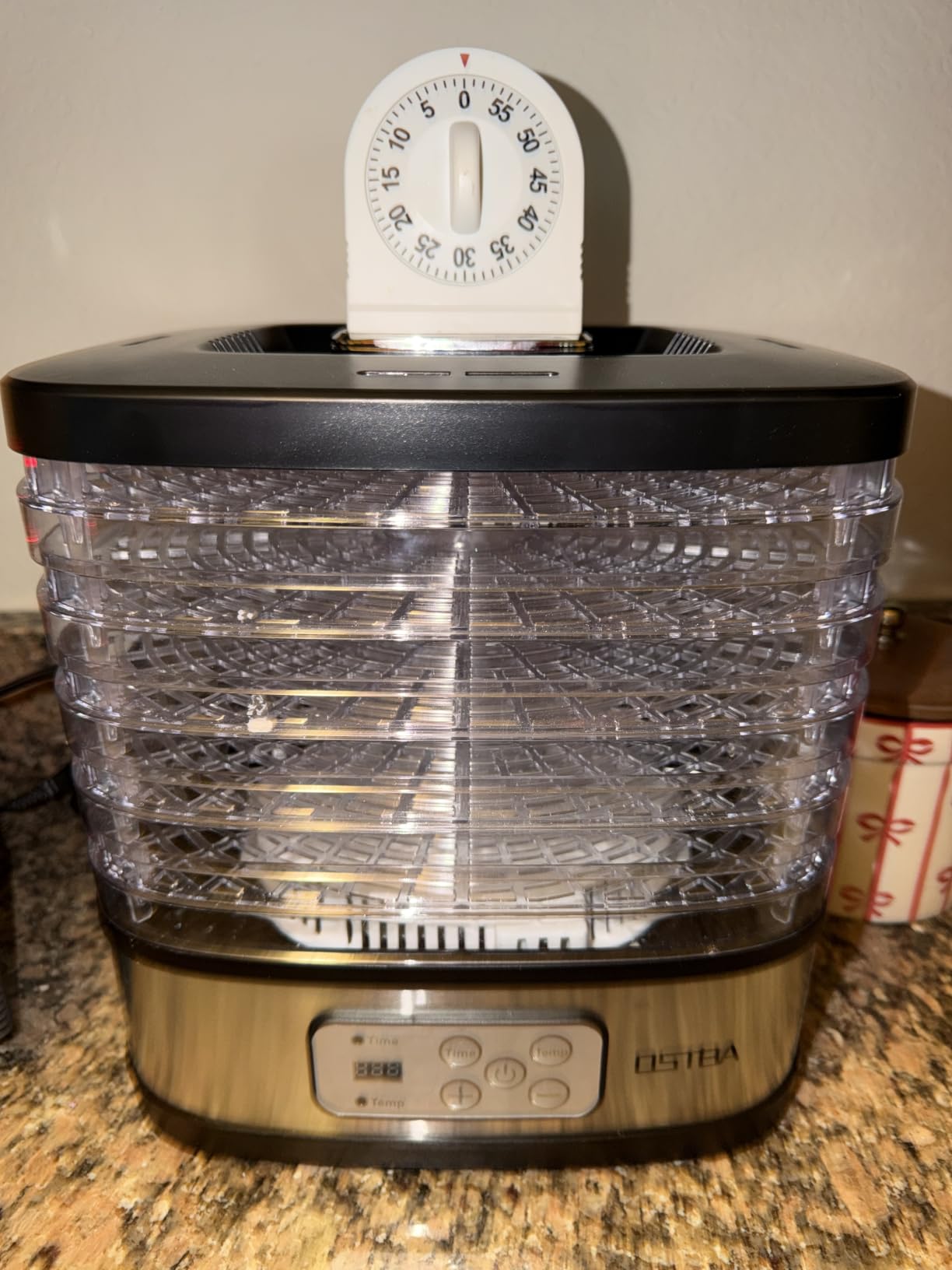
Trays are BPA-free and dishwasher-safe, and the stainless surfaces wipe down after raw meat far more easily than a plastic grid. At 4.1 pounds it is a small counter footprint that stores without fuss.
It also includes a recipe book covering jerky, herbs, fruit roll-ups and pet treats, which helps when you are moving beyond beef and learning what else the box does well.
How the 72-hour timer changes planning
Automatic shutoff after a set time means the machine will not run indefinitely if you forget it, which is the safety question first-time buyers raise most. It also means a slow batch finishes without you waking up to switch trays at 3am.
Because the timer is so long, a failed shutoff unit is more dangerous than a short-cycle one. A few owners report the automatic shutoff not engaging, so keep a plug-in timer as backup for overnight runs.
Where it falls short
The tray area is small, so 240W is doing very little work per cycle and you will run more batches for the same pound of beef. The 4.3 rating reflects that, and the completion alarm is loud enough to be unpleasant at the end of an overnight run.
6. Magic Mill 5-Tray Stainless Steel – Best Budget Stainless Build
Magic Mill Food Dehydrator Machine | 5 Stackable Stainless Steel Trays, 48H Digital Adjustable Timer & Temperature Control Upto 167° Electric Dryer & Preserver for Jerky, Fruit, Dog Treats & Much More
5 stainless steel trays
95-167F touch control
240W
48-hour timer
adjustable tray spacing
Pros
- Five food-grade stainless steel trays at a low price
- Adjustable tray spacing from 0.6 to 1.1 inch
- Detachable dishwasher-friendly trays
- 167F ceiling gives headroom over the safety floor
Cons
- 240W means longer cycles than 600W machines
- Compact 5-tray capacity suits small batches
- Default tray spacing is tight for thick cuts
The Magic Mill name comes up constantly on r/dehydrating, usually in the same breath as Cosori for a first jerky machine. This 5-tray version is the stainless-steel half of that comparison, and it wins on tray material rather than capacity.
Stainless trays matter for raw meat specifically. Fat and marinade rinse off with hot water instead of soaking into plastic, and there are no grid openings to trap dried residue. For anyone running beef regularly, that is a bigger deal than the wattage number.
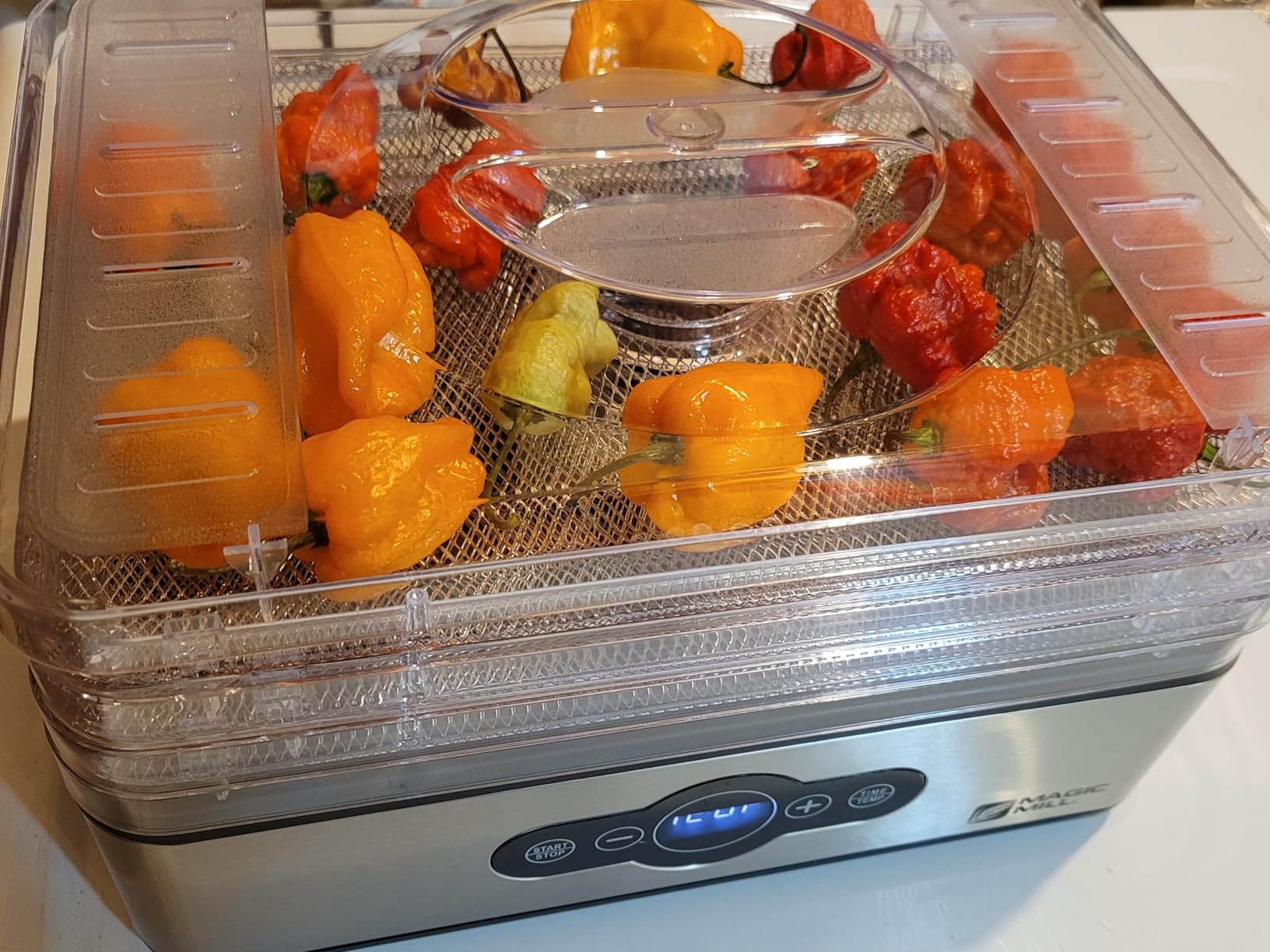
Touch control runs 95F to 167F with a 48-hour timer, so the jerky window is covered and long batches are covered too. The 167F ceiling gives you a little room above 160F for a fast final hour on thick strips.
Adjustable tray spacing from 0.6 to 1.1 inch lets you trade surface area for air clearance, which is the fix for uneven drying when slices overlap or hang slightly.
What 240W means for your schedule
The lower wattage shows up as time, not as quality. Our batches dried fine at 160F but took longer than the same load in a 600W box, so plan an overnight run rather than a same-evening one if you are working around kids or a work schedule.
For smaller quantities the trade works out well. Five trays at this wattage handles a few pounds of beef comfortably, and the stainless trays are dishwasher-safe.
Where it falls short
Five trays is a small capacity ceiling for a hunter or a market producer, and the default tray spacing is narrow enough that you will raise a shelf or two for anything thicker than a quarter inch. The share of 3-star reviews also hints at more temperature complaints than the digital models above.
7. Magic Mill 15-Tray Premium Dehydrator – Best for Large Batches
Magic Mill Premium Food Dehydrator Machine (15 Extra-Large Stainless Steel Trays) 800W Dryer for Beef Jerky, Fruits, Vegetables, Dog Treats, 48 Hour Digital Timer – 95°-167° Temperature Control
15 extra-large stainless trays
800W
95-167F digital
keep-warm function
21.4 lb
Pros
- Fifteen extra-large trays for serious batch volumes
- 800W with rear-mounted fan for even drying
- Transparent door for monitoring without opening
- Dishwasher-safe stainless trays and liners
- Keep-warm function holds finished batches
Cons
- 21.4 lb body needs a dedicated counter or shelf
- Large footprint at 18 by 14 by 17 inches
- Overkill for occasional small batches
This is the machine for someone who dries meat on a schedule rather than as a hobby. Fifteen extra-large stainless trays and 800W of drying power meant we could load every tray at once and still have even drying top to bottom, with the rear-mounted fan doing the work instead of a person swapping trays.
At 800W it moves air faster than anything else on this list, and the 48-hour countdown covers a full run without interruption. Digital control steps from 95F to 167F, and the transparent door means you check the batch without losing your heat.
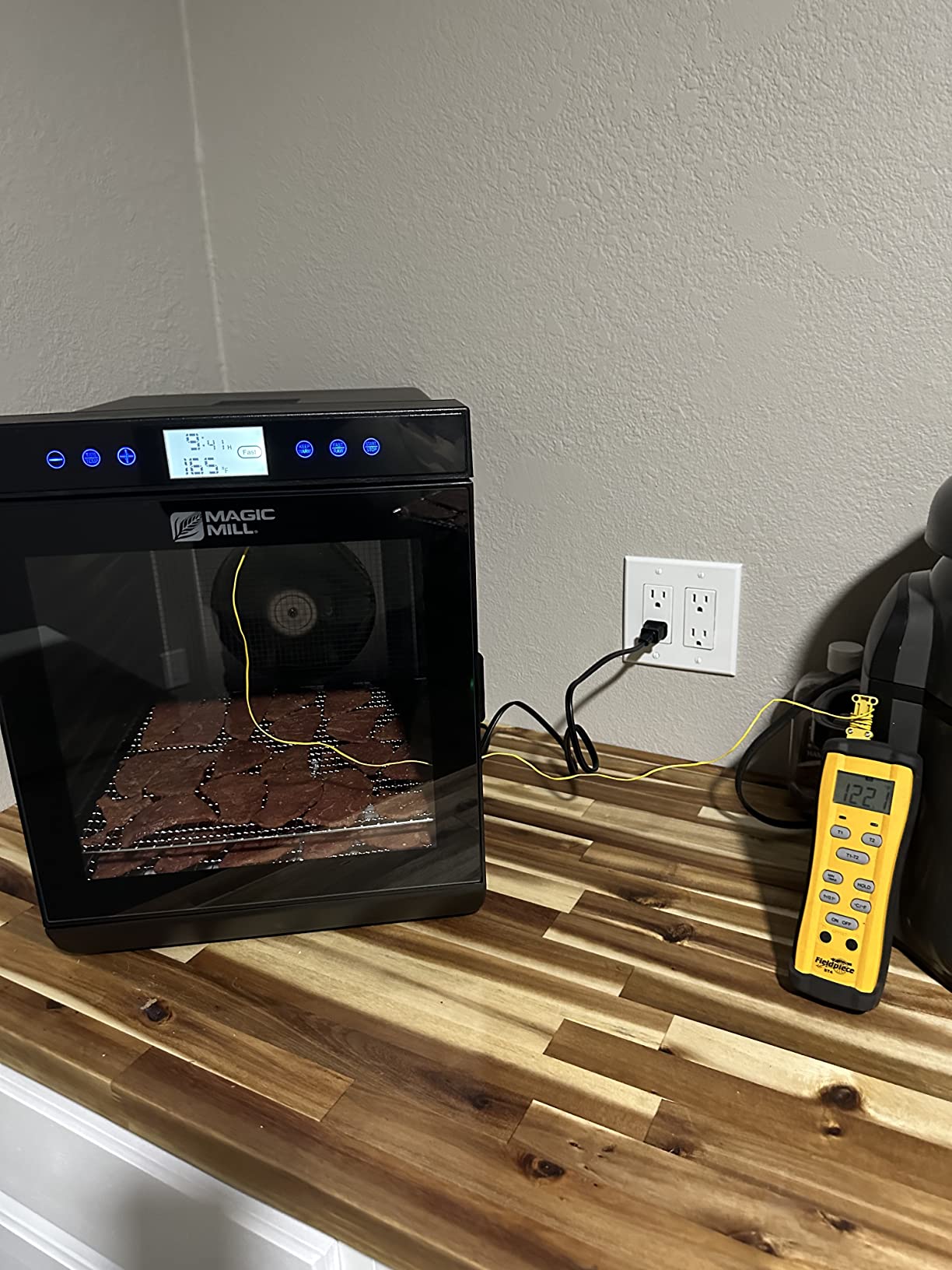
Automatic shutoff and overheat protection are the features that matter most for an unattended overnight run, and both are present. The keep-warm function is a nice practical touch: it holds at a low temperature while you strip finished jerky off the trays, instead of forcing you to batch your loading schedule around the cycle.
Stainless trays and liners are dishwasher-safe, and the housing wipes down. After several weeks of raw-meat batches the wash-up took minutes rather than the soaking session a plastic-grid box needs.
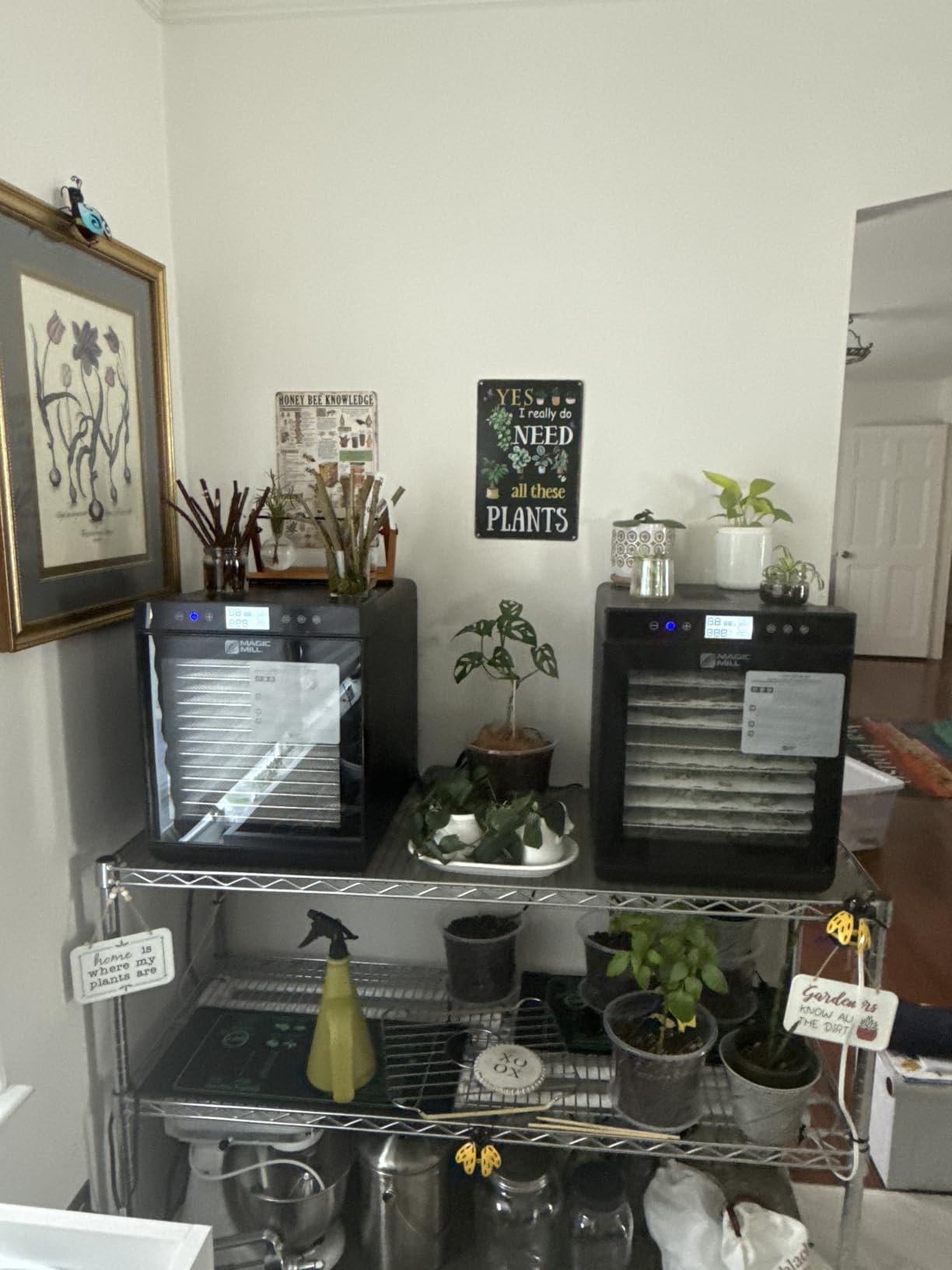
Capacity and cost per pound for bulk makers
Fifteen trays is roughly two and a half times the surface area of a compact 5-tray box, so a 20-pound batch of beef becomes one or two runs rather than five. If you buy meat in bulk, process game meat, or sell jerky, that is where the math changes.
The keep-warm function also shortens the gap between finishing a batch and starting the next, which matters when you are working around limited counter and fridge space.
Where it falls short
Twenty-one pounds and an 18 by 14 by 17 inch body need a dedicated counter or a sturdy shelf, not a kitchen corner. The 800W draw also belongs on a circuit you are not loading with anything else, and for occasional users that footprint and draw are wasted capacity.
8. Magic Mill Pro 7-Tray Dehydrator – Most Versatile for Serious Jerky
Magic Mill Pro Food Dehydrator Machine | Powerful 600W Rear Fan Even-Drying System | 7 Full-Size Stainless Steel Trays | 95°-176° Temperature Control, 48H Timer, Keep Warm + Auto Shutoff | ETL Listed
7 full-size stainless trays
600W rear fan
95-176F digital
48-hour auto shutoff
7.26 kg
Pros
- Fully stainless inside and out
- so nothing plastic touches the meat
- 600W rear fan means no tray rotation
- 176F ceiling is the highest here
- Keep-warm hold mode runs up to 24 hours
Cons
- Start/stop button is very sensitive and easy to brush
- Only a 1-year warranty against 2 years on some rivals
The Pro sits at the sweet spot: seven full-size stainless trays and 600W in a body roughly a foot wide. Our 160F beef batch dried evenly from the top tray to the bottom with no rotation, and the rear fan plus rear heat placement avoided the bottom hot spot that scorches strips on lower-tray units.
At 4.7 stars it earns the premium slot for a reason. The temperature ceiling of 176F is the highest in this group, which gives real headroom for thick flank or venison strips that need a hot finish.
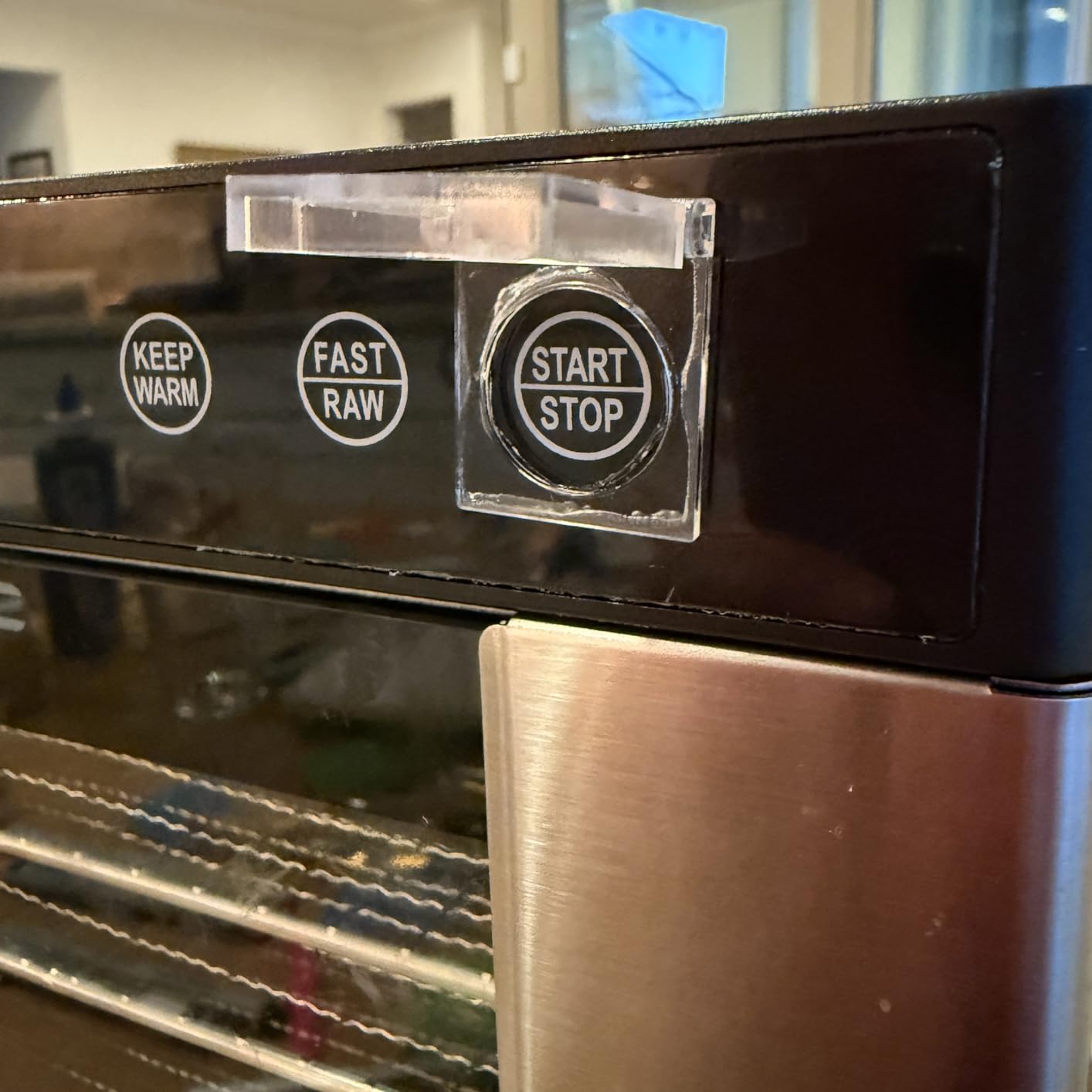
Stainless only, inside and out, is the quiet advantage here. No plastic walls, no plastic grid to trap meat fat, and nothing for odors to stick to over a season of use. The racks go in the dishwasher.
Digital control works in 1 degree steps with a 48-hour timer in 30-minute increments, and automatic shutoff handles the unattended run. The keep-warm hold maintains a low setting for up to 24 hours after a cycle ends.
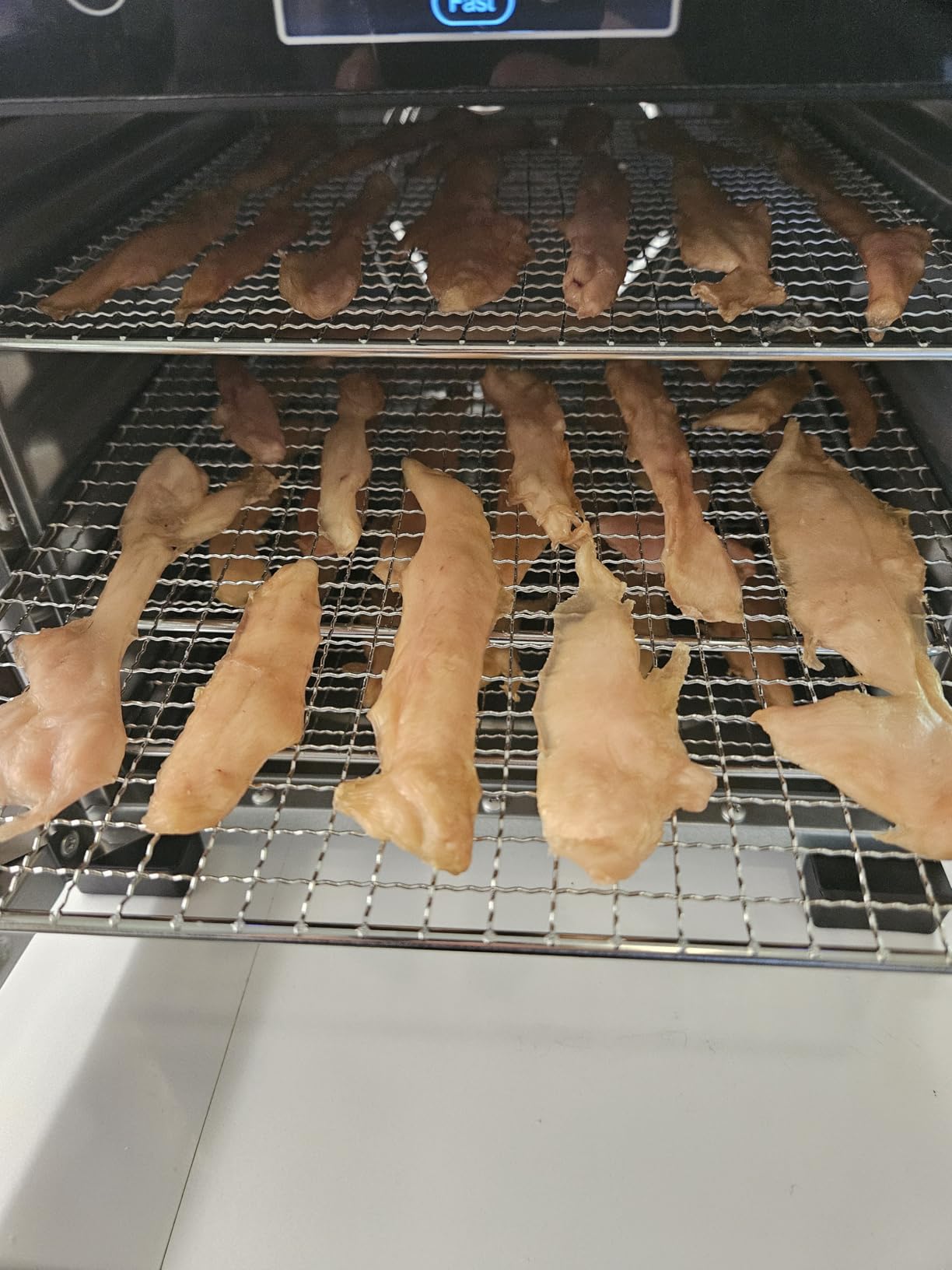
Why the 176F ceiling is useful rather than dangerous
A higher ceiling does not mean you should run meat at 176F. It means you can start low, then raise the setting for the last stretch if you want a firmer texture, without being capped. Most batches do their best work at 160F.
The keep-warm mode is the more overlooked feature. Instead of pulling partially dry strips out and racing to reload, you hold the finished batch warm while the next load goes in.
Where it falls short
The most-cited flaw is the sensitive start/stop button, which can be brushed by a sleeve and kill a running cycle. Place the machine where you will not bump it. The 1-year warranty is also shorter than the 2 years on the Cosori models.
9. Cosori P501 5-Tray Compact – Best for Small Kitchens
Cosori Food Dehydrator, 5 Stainless Steel Trays, 3.1 ft² Drying Space
5 stainless trays
3.1 sq ft of space
176F max
480W
13.9 by 11.3 inches
Pros
- All five racks are stainless with no plastic food contact
- 176F max in 1 degree increments
- Four presets including a jerky setting
- Compact footprint about the size of a small microwave
Cons
- Tray area is smaller than the body suggests
- Includes one plastic mesh screen and one plastic roll sheet
- Rear drip tray can leak moisture onto the counter
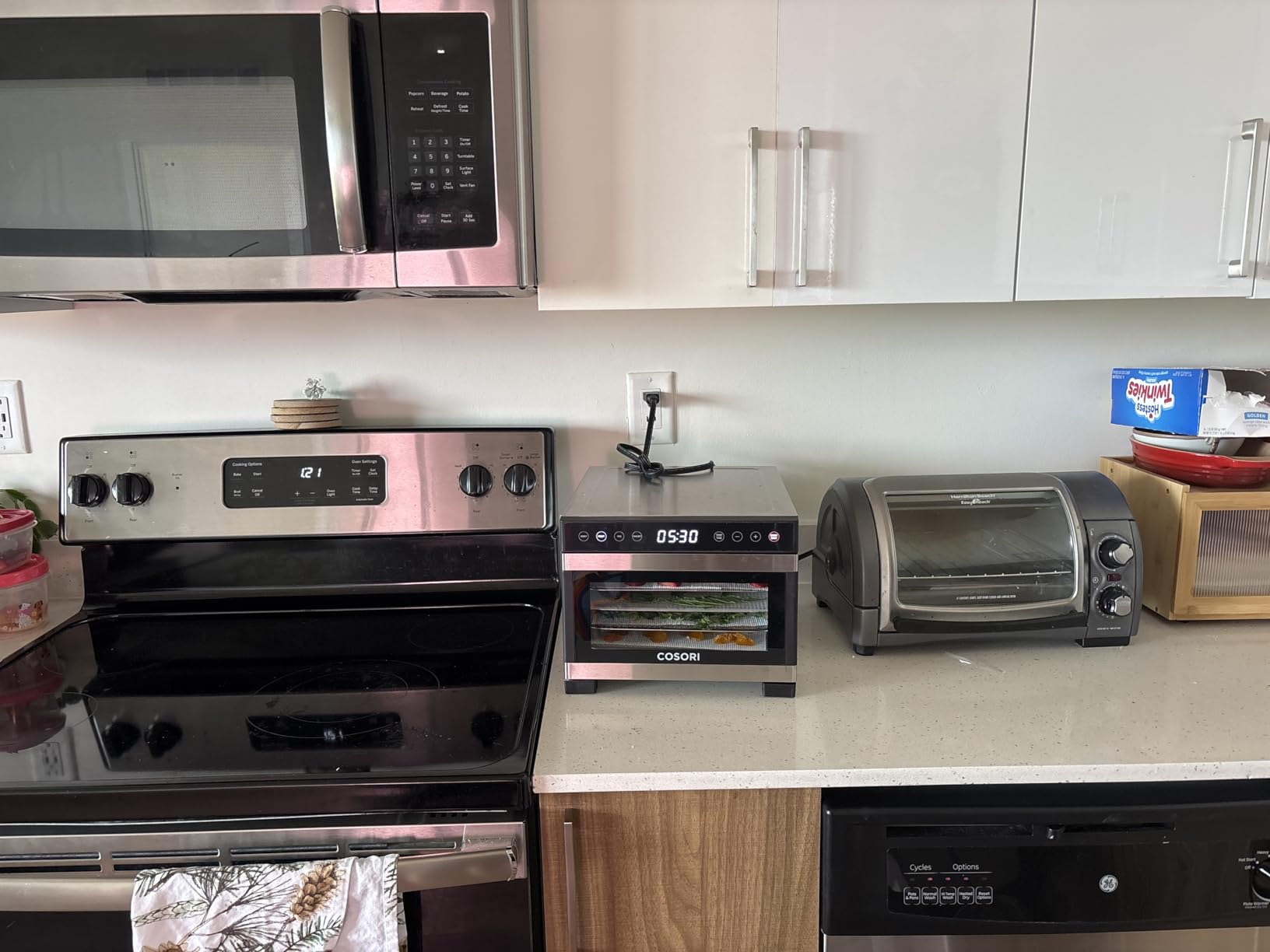
This is the model for a counter you actually have room on. At 13.9 by 11.3 by 8.9 inches it takes about the footprint of a small microwave, yet the trays are all stainless, which is rare in a unit this compact.
Our beef batch ran at 160F with the rear fan moving air horizontally, and we saw no need to rotate. The jerky preset is a genuine shortcut for a first batch, and every preset stays fully adjustable once you know your own times.

Owners praise how quiet it is, and our runs matched that. The touchscreen timer and temperature readout are accurate, and stainless trays do not hold odors from one batch to the next, which matters if you alternate jerky and dried fruit.
It also has one of the highest temperature ceilings here at 176F, adjustable in single degrees from 95F.
Reading the 3.1 square feet honestly
That is a real drying area, but it is a third less than the Cosori 6-tray model, and owners frequently note the trays hold less once meat shrinks during drying. Plan on more cycles rather than one big load, and avoid overlapping slices.
The all-metal food path is still the selling point. Two of the included accessories are plastic, one mesh screen and one fruit roll sheet, which is worth knowing before you advertise a plastic-free setup.
Where it falls short
The rear drip tray can drip moisture onto the counter or a nearby surface, so give it clearance. Some owners also report meat runs taking 14-plus hours, and the compact tray area means a commercial quantity needs multiple overnight sessions.
10. Elite Gourmet 4-Tray Dehydrator – Best for Herbs, Fruit and Pet Treats
Elite Gourmet Food Dehydrator, Stainless Steel Trays, Adjustable Temp
4 trays
95-158F
24-hour timer
350W
transparent trays
Pros
- Accurate 1-degree temperature control that holds to 158F
- Transparent trays let you watch progress without opening
- Rectangular trays are much easier to clean than round ones
- Small
- quiet and styled to stay on the counter
Cons
- Max temperature of 158F sits below the 165F many jerky guides suggest
- Very small tray area holds only a handful per load
- Plastic body rather than all-metal
This one earns its place as a second machine rather than a jerky specialist. It is genuinely accurate, holding set temperature in 1-degree steps, and the transparent trays let you watch a batch without opening the lid and losing heat.
Rectangular trays with no center hole are the underrated feature. They wash far faster than round mesh trays, which is the complaint that comes up again and again with plastic grids on raw-meat machines.
At 350W with a bottom-mounted fan, drying is even for small loads. It handles herbs, mushrooms, small fruit batches and dog treats well, and it is quiet enough to leave out on the counter.
We would use it as the companion unit for a serious jerky kitchen: herbs, onions and pet treats go here while the big box runs beef overnight.

The 158F ceiling is the deciding factor
Many jerky references recommend 160F to 165F, and this model tops out at 158F. That is below the safety floor most people set for meat, so for consistent beef jerky we would choose a different machine. It is a fair machine, just pointed at a different job.
The 24-hour timer is also short for large batches, though for herbs and small fruit loads that is rarely the limit.
Where it falls short
Capacity is the practical limit. The tray area holds only a handful of produce per load, so fruit and herb season means many cycles. No recipe book is included, and the body is plastic rather than metal.
11. NutriChef 5-Tray Dehydrator – Best Simple Workhorse
NutriChef Electric Countertop Food Dehydrator – Professional Multi-Tier Food Preserver – Dehydrates Fish, Meats, Mushrooms, Fruits & Vegetables – 5 Easy to Clean Stackable Trays., One Size, Black
180F maximum
5 stackable stainless trays
300W
single-button operation
4 lb
Pros
- 180F maximum is the highest setting on this list
- Very quiet for long or unattended runs
- Compact 4-pound body stores easily
- Trays are removable and can be used standalone
Cons
- Temperature dial markings are confusing with little food guidance
- Drying takes long for anything not sliced paper thin
- No solid fruit-leather sheets included
The NutriChef is the no-frills option, and the 180F maximum makes it the only machine here that can push past 176F. That is useful for a short high-heat finish, though most beef batches do their best at 160F.
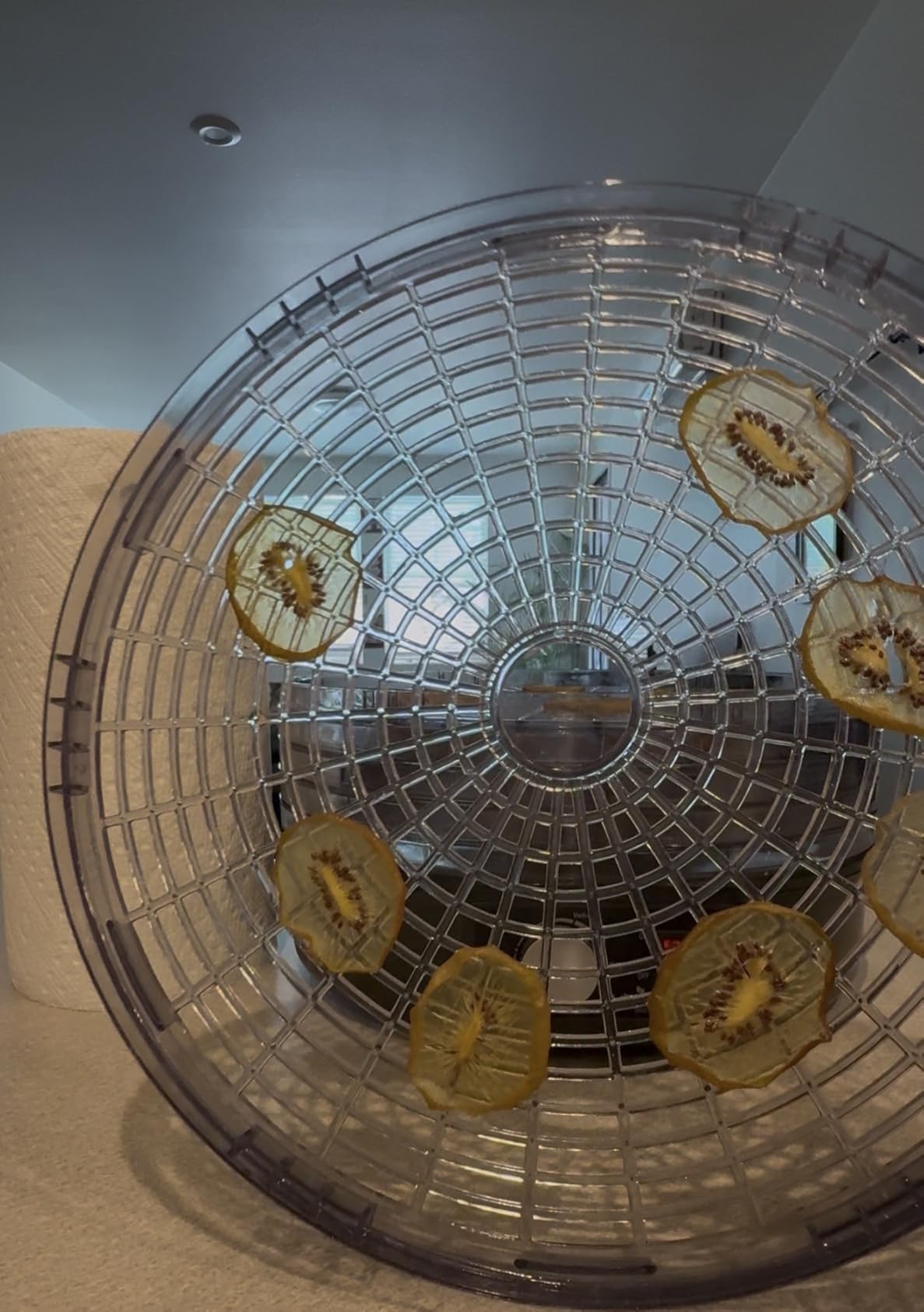
Five removable stainless trays stack neatly, and you can use them outside the machine as a drying rack. Reviewers consistently describe it as quiet, compact and easy to clean, which is a fair summary of our runs too.
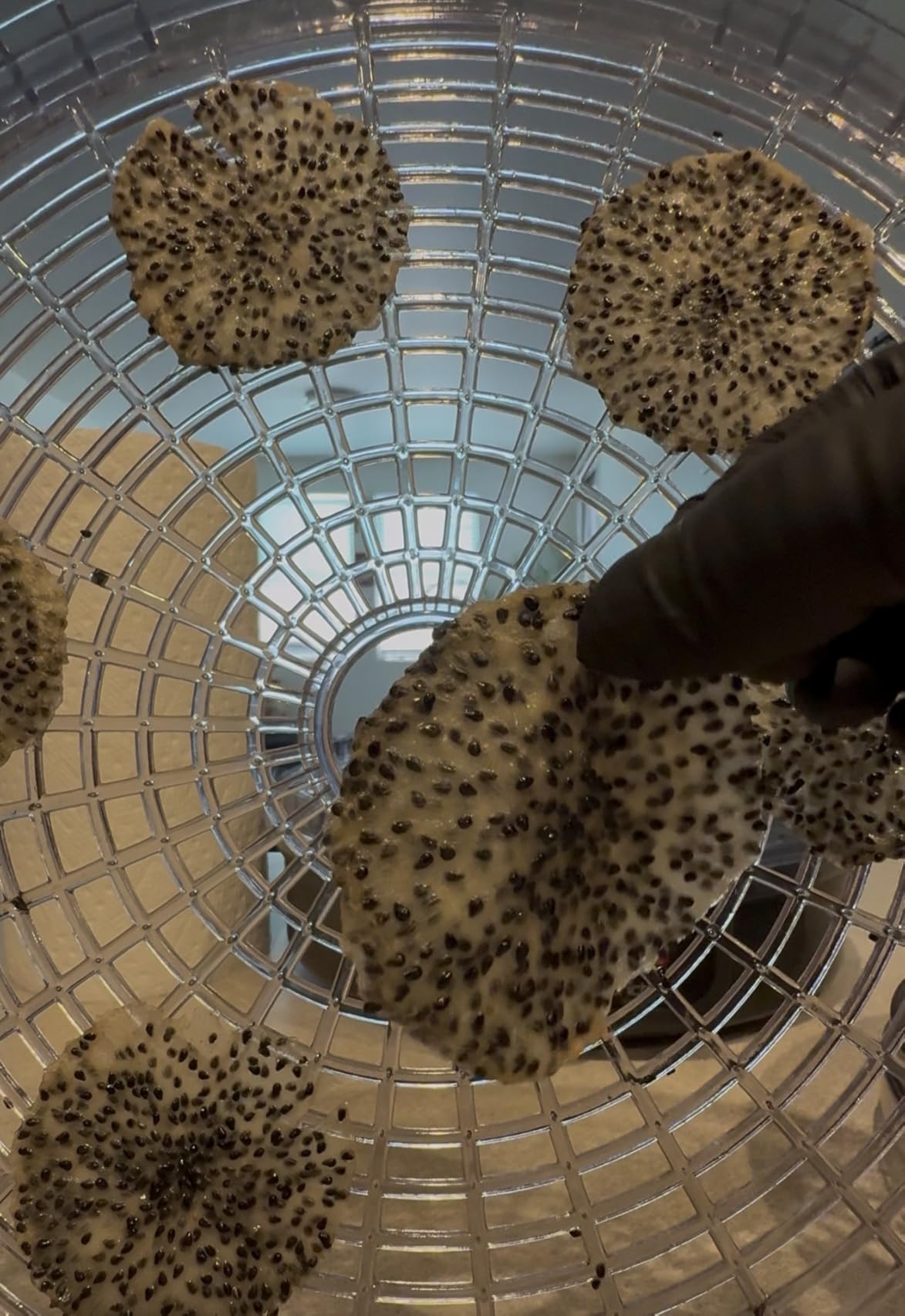
At 300W it is not a fast dryer, but for a person making a few pounds at a time that is an acceptable trade for a simple machine with no app, no presets and nothing to program.
The single-button operation means there is almost nothing to learn. If you have never used a dehydrator, that simplicity is a real advantage over a touchscreen you will over-adjust.
Where the dial will slow you down
The recurring complaint is the temperature dial. Markings are hard to read and the manual offers little food-to-setting guidance, so expect to spend your first batch working out which position holds 160F rather than trusting a label.
Drying time is the second issue: anything not sliced paper thin takes noticeably longer at 300W, so slice thin and expect an overnight run.
Where it falls short
There is no timer, and the trays are open mesh with no solid fruit-leather sheets in the box. There is also a small number of international buyers reporting a European two-pin plug, so check the plug type for your address before ordering.
12. HOPERAN 12-Tray Dehydrator – Best Twelve-Tray Capacity
HOPERAN 12 Tray Food Dehydrator Machine for Jerky, Fruit, Herb & Dog Treats
12 stainless steel trays
dual rear fans 800W
86-196F
24-hour timer
16 lb
Pros
- Twelve 304 stainless trays loaded in a single session
- Dual rear fans deliver 360 degree airflow with no rotation
- Digital control from 86F to 196F with a 24-hour auto shutoff
- Under 48 dB
- which makes overnight drying practical
Cons
- Bulk size and 16-pound weight need a dedicated spot
- 800W draw is well above compact 5-tray machines
- Included mesh screens suit fine-cut foods rather than thick cuts
Twelve stainless steel trays with dual rear fans is the configuration we would choose for hunting season or a garden harvest, because you load everything in one session. The 360 degree airflow from two rear fans dried our batch evenly from top to bottom without a single tray swap.
Temperature control is digital from 86F to 196F in fine steps, with a programmable 24-hour timer and auto shutoff. The 196F ceiling is the highest in this group, giving plenty of headroom above the 160F jerky floor.
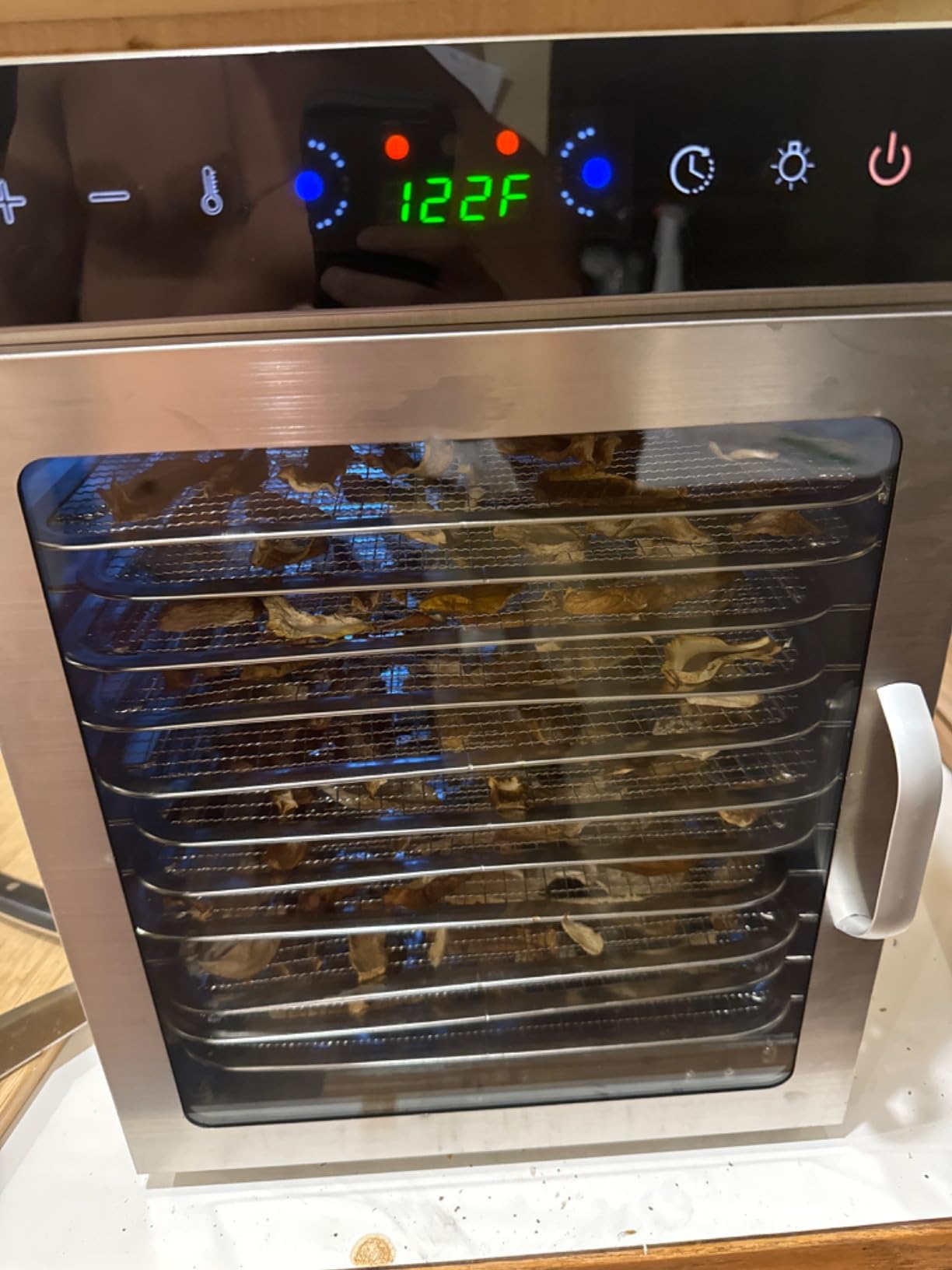
At under 48 dB it is quiet enough to run overnight, and reviewers consistently cite that as what makes unattended batches practical. Dishwasher-safe trays and overheat protection round out a solid safety story.
It also ships with the accessories most people end up buying separately: a fruit roll sheet, two silicone mesh screens, a recipe book and silicone gloves for handling hot trays.
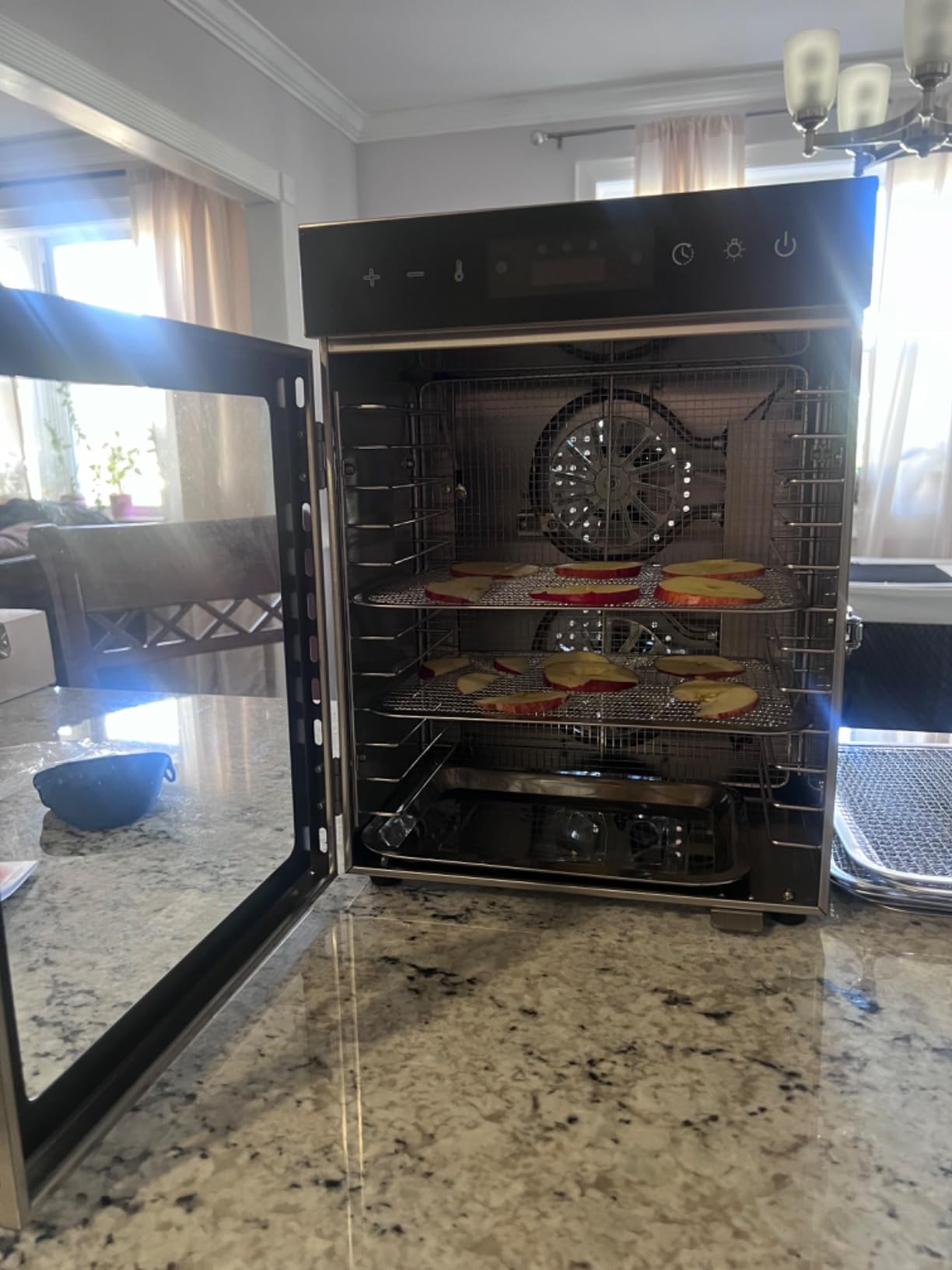
When twelve trays is the right number
Twelve trays suits a person processing a deer, a large garden, or a gift batch of jerky for the holidays, where loading once matters more than footprint. If you are making a few pounds a month, this is more capacity than you will fill.
The clear glass viewing door and the fine digital control remove most of the guesswork that manual-dial models leave you with, which is where the extra capacity actually pays off.
Where it falls short
At 16 pounds and 800W, it needs a dedicated counter spot and a circuit with headroom. The stainless housing shows fingerprints, and the included mesh screens are for fine-cut foods, so thick cuts need the solid trays.
How to Choose a Jerky Dehydrator
The 160F temperature floor is non-negotiable
Jerky is a meat product, so the machine has to hold a temperature high enough to reduce bacteria for the whole cycle. Rule out anything that tops out below 160F, which in this group means passing on the Elite Gourmet at 158F if jerky is your main goal. Everything else here reaches at least 160F, and several go to 167F or above.
Digital single-degree control is a bonus rather than a requirement. It matters most when you run two thicknesses of meat in the same week and you want the results to match.
Fan placement decides whether you rotate trays
This is the question that dominates the jerky forums, and the answer is simple. A rear-mounted fan blows air horizontally across the stack, so heat reaches every tray at roughly the same strength. A top-mounted fan pushes air down in one direction, which also works but can dry upper trays faster.
Both the Cosori 6-tray, the Magic Mill Pro, the Magic Mill 15-tray, the Cosori P501, the OSTBA and the HOPERAN use rear fan layouts. The Presto, NESCO and NutriChef mount the fan at the top. Either way, plan on one rotation near the end of a long run unless the manufacturer specifically says rotation is unnecessary.
Tray material decides your wash-up
Stainless steel trays rinse clean with hot water. Plastic grid trays trap fat, seasoning and dried residue in the openings, and raw meat makes that worse. Forum complaints about sticky plastic mesh after jerky are the most common cleaning complaint we saw, and they are a design issue, not a technique problem.
Stainless models in this group are the Cosori 6-tray, the Magic Mill 5-tray and 15-tray, the Magic Mill Pro, the Cosori P501, the HOPERAN and the NutriChef.
Capacity, timer length and wattage
Square feet of drying space is the honest capacity number, more than tray count. The Cosori 6-tray gives 6.5 square feet; the Cosori P501 gives 3.1. Two units with the same tray count can differ by half.
Timer length matters for more than convenience. Batches over 24 hours need a longer countdown, which is why the OSTBA 72-hour timer is genuinely useful for thick venison or fish. Units with no built-in timer, like the NESCO, Presto and NutriChef, need a plug-in timer for unattended runs.
A jerky settings cheat sheet
Slice thickness drives everything. At 160F, a quarter inch top round takes roughly 4 to 6 hours, thin flank strips finish closer to 3, and thick 3/8 inch venison can run 10 hours or more. Ground beef jerky spread thin in a single layer finishes fastest, often in 4 hours.
Do not rush it with heat. Raising the setting above 160F on the front half of a batch dries the outside before the inside and gives you a hard shell with a soft core, which is the most common chewy-jerky complaint. Run a hot finish only for the last stretch if you want a firmer texture.
Storing finished jerky
Let finished jerky cool fully, then pack it the same day. Mylar bags with oxygen absorbers are the reliable method for long storage in a cool, dark cupboard. Vacuum sealing works too, and the fridge buys you a few months for bags that are not shelf stable.
Slice thin, dry it fully, and store it airtight in small portions. Most chewy-jerky problems trace back to storage, not the dehydrator.
Frequently Asked Questions
How long do you dehydrate jerky at 160 degrees?
Quarter inch beef slices sliced from top round take roughly 4 to 6 hours at 160F, while thin flank strips finish closer to 3. Thick 3/8 inch venison can run 10 hours or more, and ground beef spread in a single layer is usually done in about 4. Test a piece: it should bend without cracking and show no translucent wet spots when you tear it. Plan on an overnight run for large batches rather than expecting to check it in an evening.
Is 170 too hot to make jerky?
170F is safe but usually not ideal for the full run. Starting a batch above 160F drives moisture out of the surface faster than the center, which leaves a dry shell over a damp core and produces chewy jerky. Most experienced makers run 160F for the bulk of the cycle and only nudge the setting up near the end if they want a firmer texture. The machine needs a ceiling above 160F so you have that option, not so you use it from the start.
Do you have to rotate trays when making jerky?
With a rear-mounted fan blowing horizontally across the stack, rotation is usually unnecessary. Top-mounted fan designs, including the Presto and NESCO, dry the upper trays faster, so many owners swap tray positions once near the end of a long run. If pieces are overlapping or a tray is closer to the element, rotate regardless of the design. A single swap at the midpoint costs you a minute and evens out texture across the batch.
Is 160 degrees hot enough to kill bacteria in jerky?
USDA guidance for dehydrated meat points to 160F as the working temperature, which is why we treat it as a hard floor when picking a machine. Hold that temperature for the entire cycle rather than cycling up and down. Any dehydrator that tops out below 160F is fine for fruit and herbs but should not be your jerky machine. Confirm the setting with an oven thermometer on the first run so you know the displayed number matches the air temperature.
What are the common jerky mistakes to avoid?
The biggest mistake is running too hot too early, which shells the outside and leaves a chewy core. Second is slicing uneven, since thin and thick pieces on one tray will never finish together. Third is overloading trays so pieces touch, which traps moisture. Fourth is using a machine that cannot hold 160F. Fifth is storing jerky before it is fully cool and dry, which invites mold. Measure temperature, slice to a consistent quarter inch, space every piece, and pack only fully dried jerky.
What is better than a dehydrator for jerky?
For most home cooks a dehydrator still wins. An oven works but needs a low setting, constant monitoring and a door crack, and the texture is less consistent. An electric smoker adds smoke flavor you have to want, and it burns fuel. A solar dehydrator is free to run but depends entirely on sun and humidity, which makes timing unpredictable. The exception is gift or holiday batches on a tight schedule, where a convection oven with a probe thermometer can get you through a small load quickly.
Final Verdict
The best food dehydrators for jerky in 2026 come down to three numbers: hold at least 160F, move air horizontally, and give you enough tray area for the batch size you actually cook. The Cosori 6-tray stainless steel model wins on all three, with 6.5 square feet of tray space, a rear-mounted fan and a ceiling of 165F.
Buy the NESCO FD-75A if you want the value pick that expands to 12 trays, the Presto 06300 if you would rather never rotate a tray again, and the Magic Mill Pro if you want an all-stainless food path with a 176F ceiling. Check the current details on each before you order, then run your first batch at 160F and time it.