
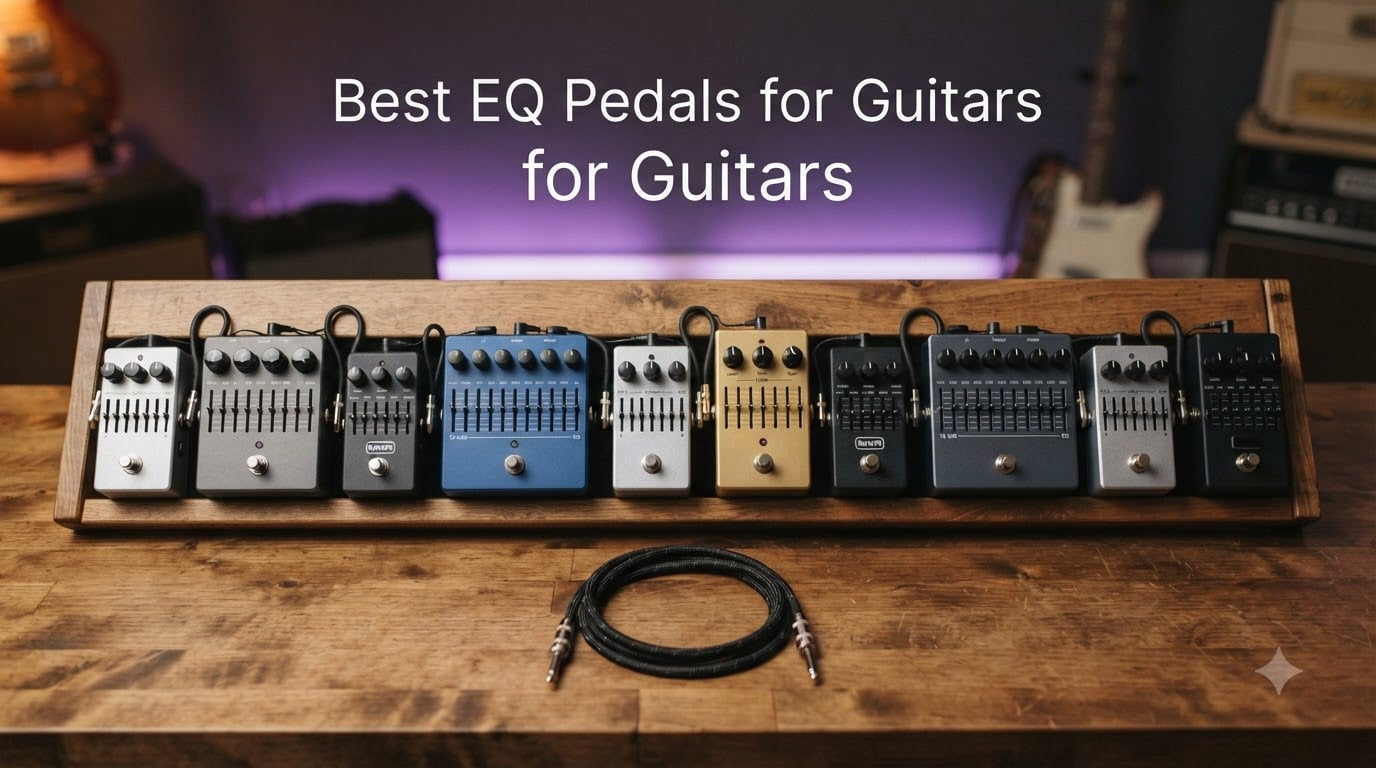
An EQ pedal is the most underrated tool on a guitarist’s pedalboard. Where overdrive pedals get all the attention, a good equalizer quietly solves the real-world problems every player runs into: boomy low end, harsh upper-mid bite, scooped mids that vanish in the band mix, and solo tones that need to cut without colouring your amp. After spending weeks A/B-ing ten of the most popular graphic, parametric and programmable EQ pedals on the market, our team landed on a clear shortlist of the best EQ pedals for guitars you can buy in 2026.
We focused on three things: how clean and quiet the circuit is, how flexible the EQ curve is for real playing situations (rhythm, lead, bass, acoustic), and whether the pedal earns its pedalboard space once the honeymoon is over. We played through clean Fender amps, high-gain Mesa and Marshall-style heads, and an acoustic preamp to cover every common scenario. If you want a deeper primer on what EQ does before diving in, our beginner’s guide to EQ in music covers the theory side. For hands-on technique, our piece on what an EQ does and how to use it without overdoing it walks through subtractive EQ in detail.
Table of Contents
Quick Picks: Best EQ Pedals for Guitars in 2026
Best Overall / Editor’s Choice: BOSS GE-7 — 7-band, guitar-optimized frequencies, ±15dB, classic workhorse.
Best 10-Band: MXR M108S Ten Band EQ — 18V headroom, dual outputs, the gigging player’s choice.
Best Budget 10-Band: Caline CP-24 — True bypass, aluminum chassis, ten bands on a tight budget.
Best Compact: JOYO JF-11 6-Band — ±18dB, illuminated sliders, fits a small board.
Best Value 10-Band: Donner EQ Seeker — Full 10-band coverage with dedicated level slider at a budget price.
Best for High Gain: MXR M109S Six Band EQ — Whisper-quiet noise floor under distortion, wide ±18dB range.
Best Bass-Friendly: JOYO R-12 10-Band — 31.25Hz to 16kHz range covers both guitar and bass duties.
Best Budget Pick: SONICAKE Tone Group — Analog 10-band EQ with solid metal build.
Best Programmable Stereo: BOSS EQ-200 — Dual 10-band, 128 presets, MIDI, the most flexible unit on this list.
Best Parametric: Source Audio EQ2 — 10 adjustable bands, true stereo, MIDI, free Neuro editor.
Top 3 Picks at a Glance in 2026

Best EQ Pedals for Guitars in 2026: Quick Overview
| Product | Specifications | Action |
|---|---|---|
 BOSS GE-7 Equalizer BOSS GE-7 Equalizer |
|
Check Latest Price |
| Caline CP-24 10-Band EQ |
|
Check Latest Price |
 JOYO JF-11 6-Band EQ JOYO JF-11 6-Band EQ |
|
Check Latest Price |
 Donner EQ Seeker 10-Band Donner EQ Seeker 10-Band |
|
Check Latest Price |
 MXR Ten Band EQ (M108S) MXR Ten Band EQ (M108S) |
|
Check Latest Price |
 MXR Six Band EQ (M109S) MXR Six Band EQ (M109S) |
|
Check Latest Price |
 JOYO R-12 10-Band Controller JOYO R-12 10-Band Controller |
|
Check Latest Price |
 SONICAKE Tone Group 10-Band SONICAKE Tone Group 10-Band |
|
Check Latest Price |
 BOSS EQ-200 Graphic Equalizer BOSS EQ-200 Graphic Equalizer |
|
Check Latest Price |
 Source Audio EQ2 Programmable EQ Source Audio EQ2 Programmable EQ |
|
Check Latest Price |
1. BOSS GE-7 — Editor’s Choice, Best Overall EQ Pedal
BOSS GE-7 Equalizer | Compact Graphic Equalizer Pedal | Tailored for Guitarists | 7 Bands of EQ Sliders | Guitar-Optimized Frequencies | ±15dB Boost/Cut Per Band | Level Slider for Volume Adjustments
7-band graphic EQ
±15dB per band
100Hz-6.4kHz guitar-optimized
Pros
- Seven guitar-optimized frequency bands covering 100Hz to 6.4kHz
- ±15dB boost/cut per band for flexible tone shaping
- Level slider for solo boost duties
- BOSS five-year warranty
- Compact pedalboard-friendly footprint
Cons
- Reports of inherent noise floor requiring modifications
- USB-B connector is unusual for an effects pedal
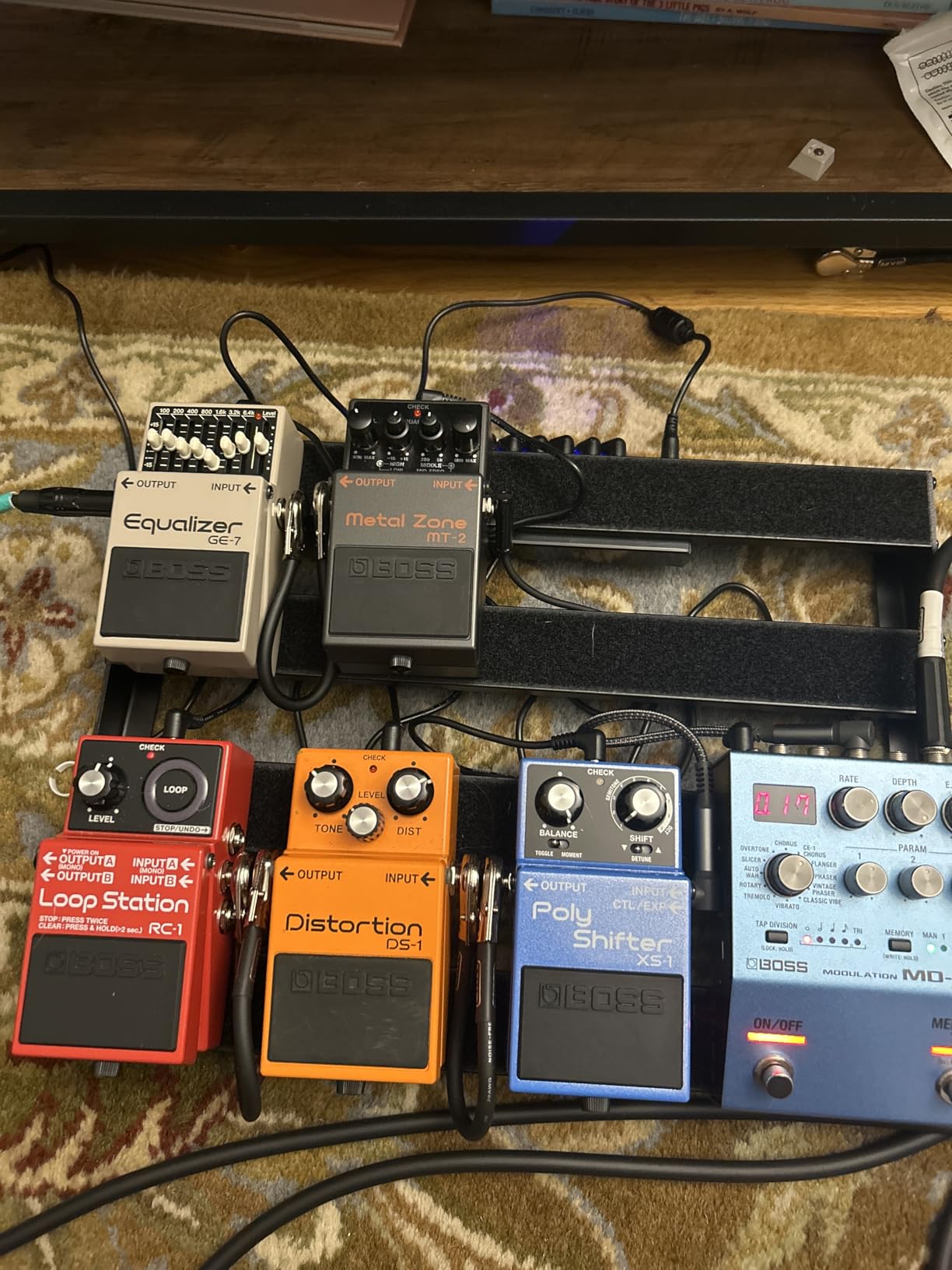
The BOSS GE-7 is the EQ pedal I keep coming back to when I want something I can hand to any guitarist without explaining. Seven sliders, all labelled, all centered on frequencies that actually matter for an electric guitar. I have owned mine for six years across two bands and a recording rig, and the only thing that has ever gone wrong with it is a sticker wearing off.
What makes the GE-7 special is the frequency selection. Rather than dumping in a generic ISO octave-band layout, BOSS picked 100Hz, 200Hz, 400Hz, 800Hz, 1.6kHz, 3.2kHz, and 6.4kHz — every one of those centers falls on a problem area in a typical guitar rig. The 800Hz band tames the honk that builds up when you stack two overdrives. The 3.2kHz slider pulls fizz out of single-coils. The level slider doubles as a clean solo boost, and with ±15dB of range you can scoop, smile, or do a full pseudo-wah without breaking a sweat.
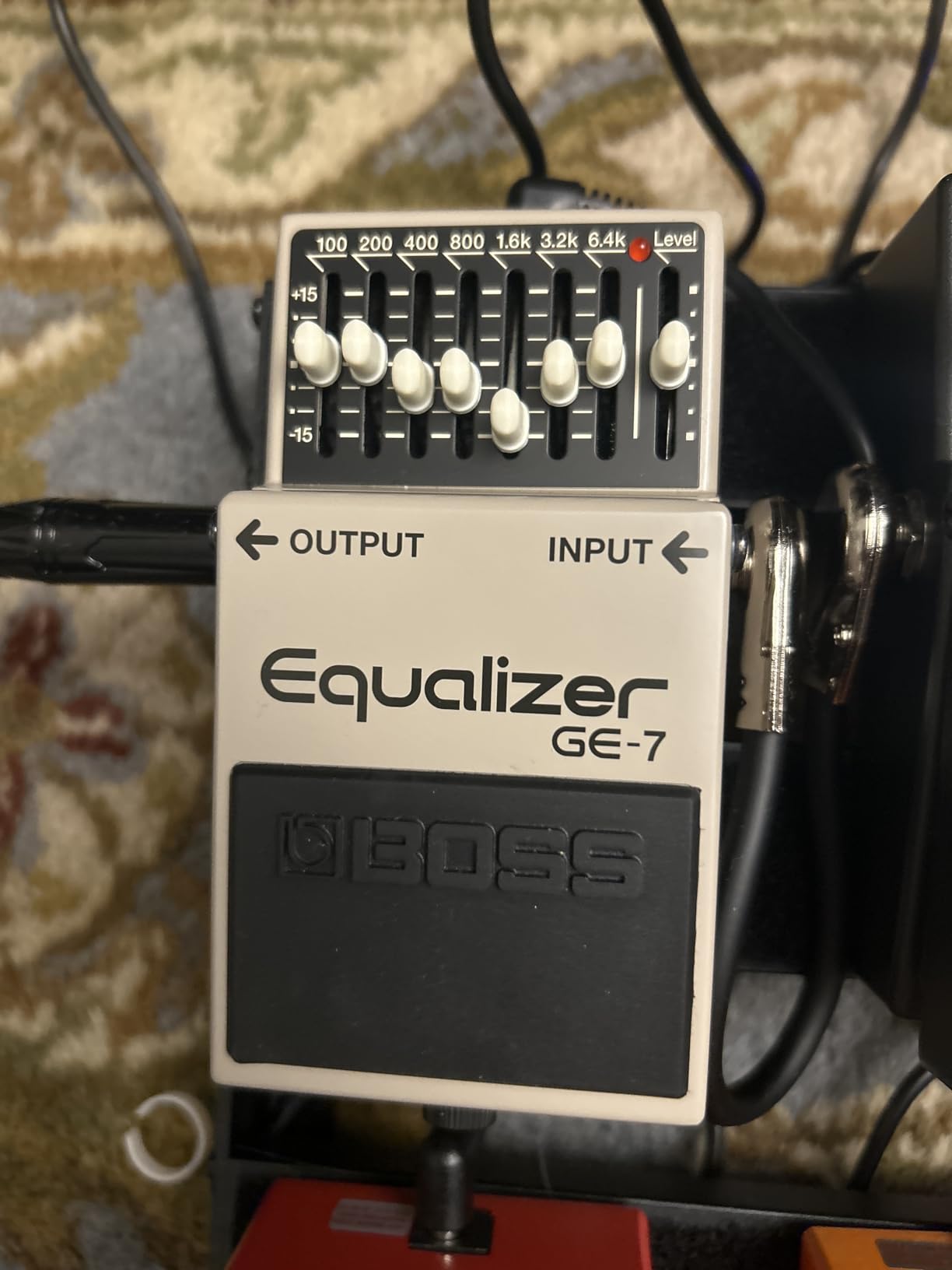
The case is the classic BOSS compact chassis that takes a beating and never complains, and the footswitch is rated for thousands of stomps. I have stomped mine into wet grass at an outdoor gig and it kept working after I dried it off. If you want a more detailed look, our full EQ technique guide walks through practical settings for the GE-7 specifically.
There is one well-known caveat: early GE-7 units had a noisy stock op-amp that hiss becomes audible in a high-gain rig. Newer SMD runs of the pedal reportedly cleaned that up, but reviewers on Reddit still swap the internal chip to a quieter modern op-amp as a 15-minute mod. If you buy one new from a major retailer you are almost certainly getting the updated version.
For whom it’s good
The GE-7 is the right answer if you want one EQ pedal that does rhythm tone shaping, lead boost, and feedback control without menus, presets, or a learning curve. It is also the right first EQ pedal for a beginner because the frequency labels are intuitive. If you gig, the BOSS warranty and build quality earn their keep over a five-year stretch.
For whom it’s bad
It is not the right pick if you want parametric control, presets, or stereo routing. If you run a small pedalboard where every millimeter counts, the wider GE-7 takes more space than a mini graphic like the JOYO JF-11. And if hiss is a deal-breaker, look at the MXR M109S, which uses a quieter circuit out of the box.
2. MXR Ten Band EQ (M108S) — Best 10-Band EQ Pedal for Gigging
MXR Ten Band EQ Guitar Effects Pedal
10-band graphic
±12dB
18V operation for headroom
Pros
- 10 frequency bands with ±12dB boost/cut
- 18V operation provides increased headroom
- Two outputs for running parallel signal chains
- True bypass preserves tone
- Bright LEDs visible even in direct sunlight
Cons
- LEDs are extremely bright and can be visually distracting on dark stages
- Does not accept batteries - power supply required
- Larger footprint than typical compact pedals
The MXR M108S is the pedal that always comes up when metal and prog guitarists talk about tone sculpting. I tested it through a Mesa-style high-gain rig and the difference versus a 7-band was immediate: I could pull 400Hz and 800Hz down to clear the muddiness that built up under distortion, then push 1.6kHz and 3.2kHz up to bring out pick attack, all without the noise floor creeping up.
The 18-volt internal operation is the real headline. Most EQ pedals run on 9V, which means they have less headroom and start to compress when you stack a boost in front of them. The M108S runs on 18V, so you can leave all ten sliders flat and use the pedal as a transparent line driver, or push several bands at once without the signal feeling squashed. The two outputs are a gigging bonus: I ran one into a Mesa head and one into a clean Fender combo for an A/B wet/dry setup without a splitter.
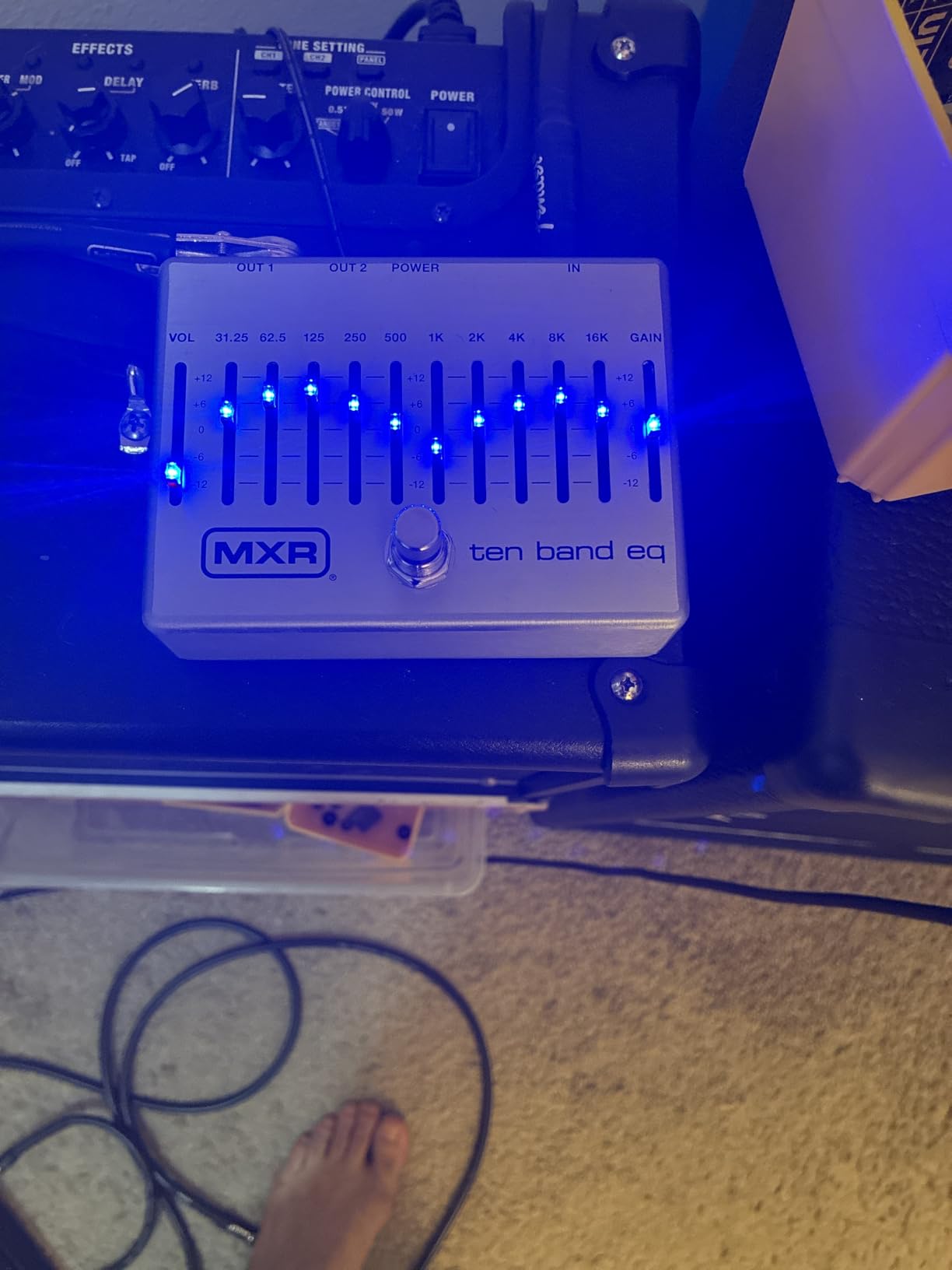
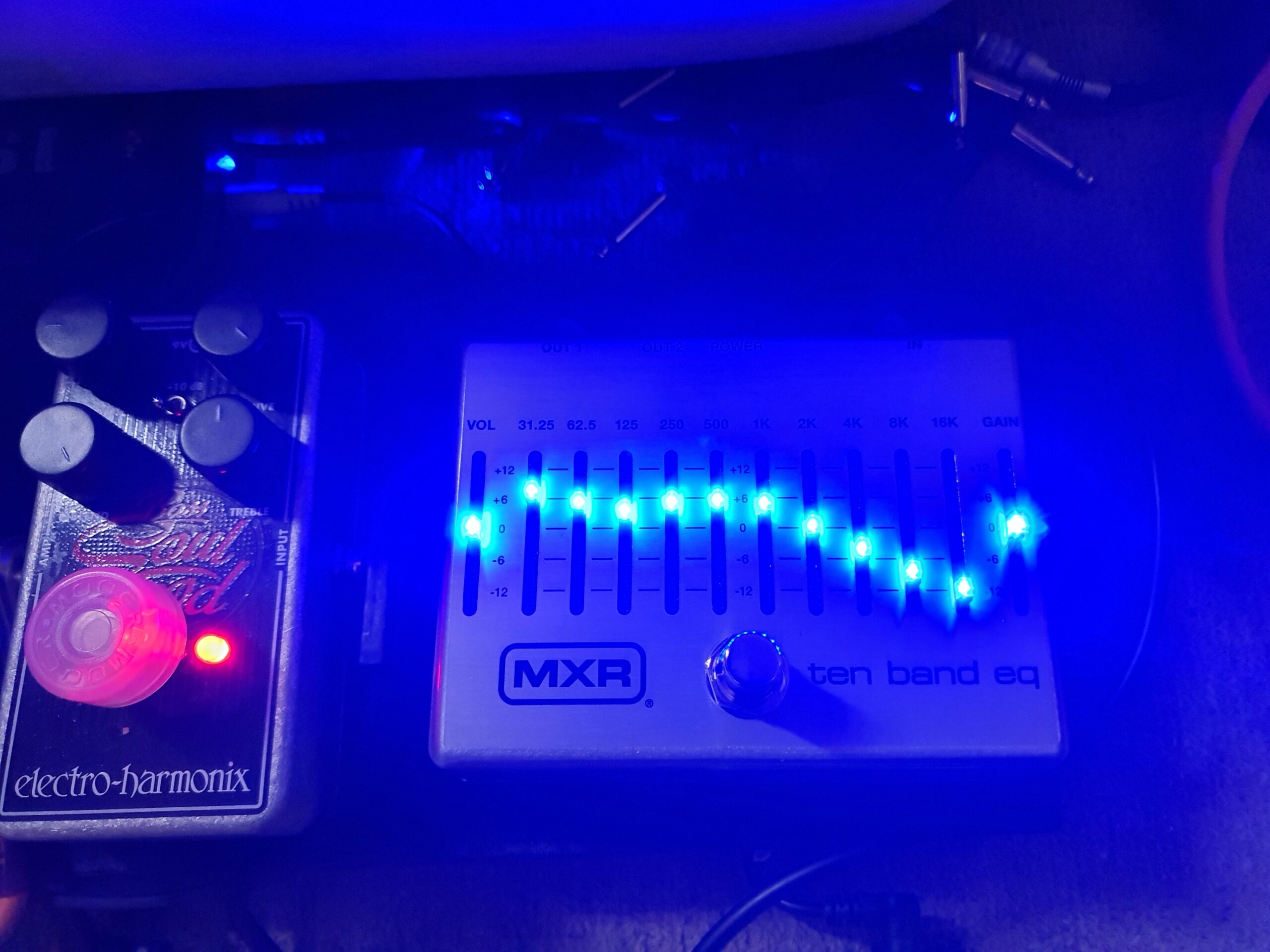
The unit is built like a small tank and the sliders have a firm detent so you can feel the center position on a dark stage. Reviewers consistently mention the same flaw I noticed: the blue LEDs on every slider are so bright that they can wash out the rest of the board. A strip of black tape or a label maker solves the problem in two minutes, but you should know going in.
You will need a dedicated 9V or 18V power supply — there is no battery option. If you are running a multi-pedal rig already, this slots into most isolated supplies without complaint. If you are building your first pedalboard around it, our guide to expression and volume pedals covers the rest of the utility side of a board.
For whom it’s good
The M108S is built for the player who wants maximum tonal control over a tight rhythm tone, especially under high gain. It is the right answer for metal, prog, djent, modern rock, and bass players who want a single box that handles both instruments. It also suits players who run two amps and want a parallel output.
For whom it’s bad
If your board is already crowded, the M108S footprint will fight for space with anything else. If you mainly play clean or low-gain blues, a 10-band is overkill and a 6-band like the MXR M109S or BOSS GE-7 will do everything you need. And if the bright LEDs will bug you, plan on taping them down.
3. Caline CP-24 10-Band EQ — Best Budget 10-Band EQ Pedal
Caline USA, CP-24 10-Band EQ equalizer Guitar Effects pedal
10-band graphic
True bypass
Backlit sliders
Pros
- Sturdy aluminum alloy case with true bypass design
- Silent circuits minimize noise
- Inexpensive entry-level 10-band EQ
- Light-up sliders aid visibility on stage
Cons
- Some users report noise compared to premium alternatives like the MXR 6 Band
- Touch-style controls are less precise than dedicated slider knobs
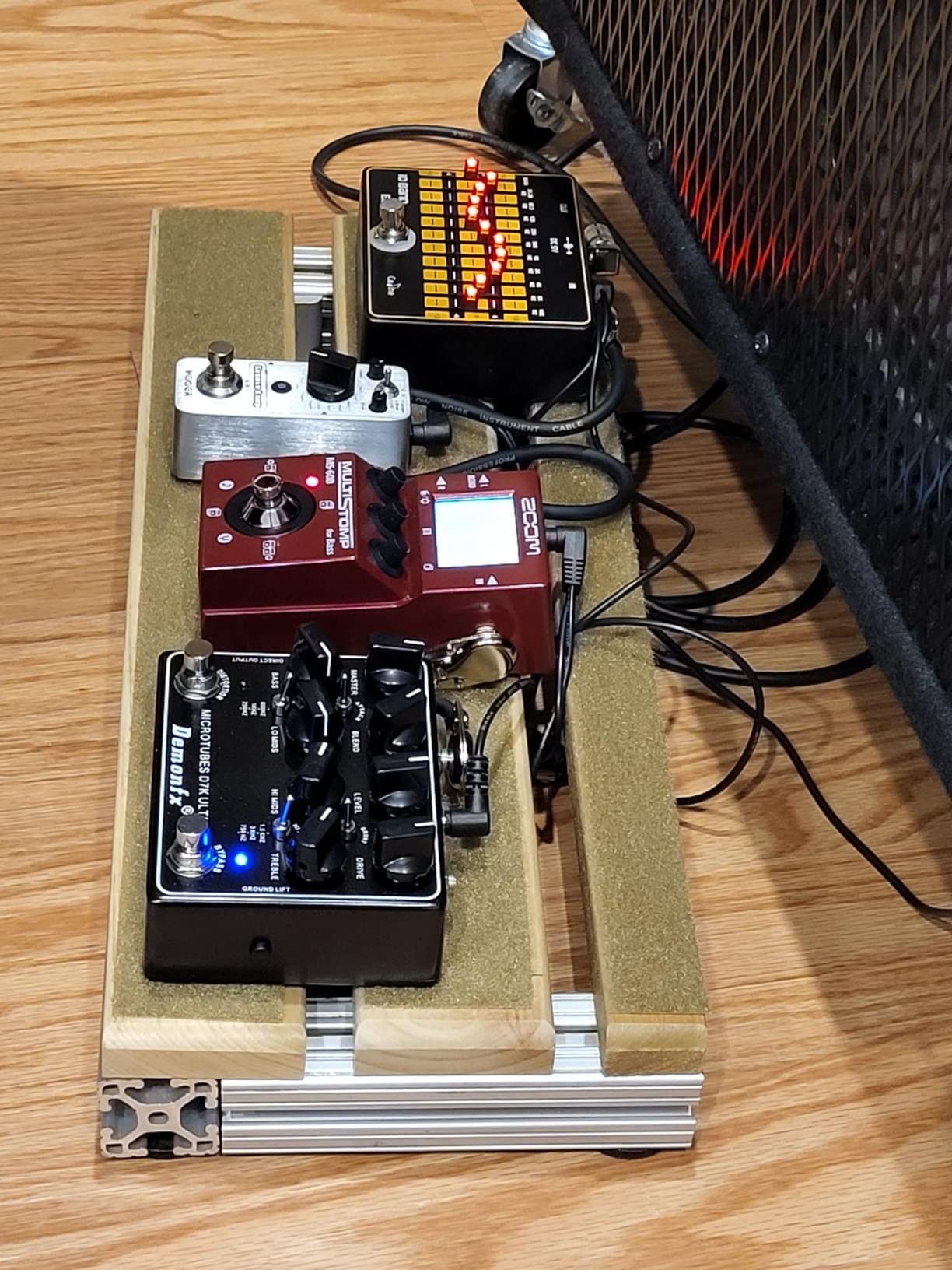
The Caline CP-24 is the pedal I recommend to any guitarist who wants a 10-band but is not ready to spend MXR money. For a budget build, it feels surprisingly solid: aluminum chassis, true bypass switching, and ten sliders that light up so you can find them on a dark stage. I put it on a small secondary test rig and used it for two weeks without feeling like I had downgraded.
The frequency layout covers the standard ISO octave centers, which makes it easy to copy settings from YouTube demos. True bypass means when the pedal is off, your dry signal is not running through any extra circuitry. That matters more than people think for players using vintage single-coil pickups or true-bypass-friendly fuzz pedals.
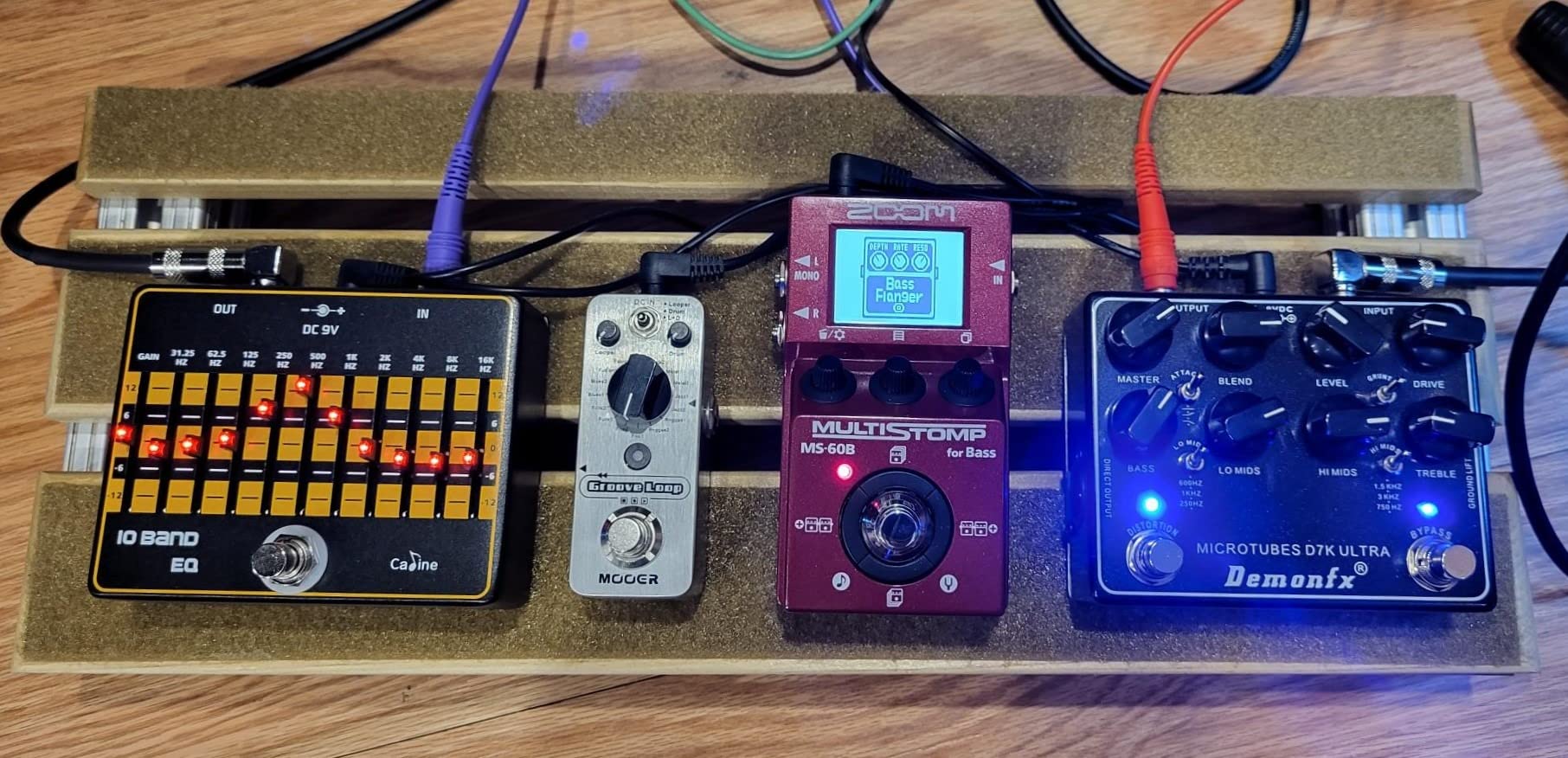
The honest tradeoff is in the slider feel and the noise floor. The slider caps on the CP-24 are smaller and the resistance is lighter than on the MXR, so on a stage with bass rumble from the monitors, you can knock a slider by accident. And when you push all ten sliders hard in front of a high-gain amp, you will hear a touch more hiss than you would from an MXR or BOSS unit.
For the price, neither of those issues feels like a deal-breaker. The pedal sounds musical, the build is solid for the weight class, and the value-per-band ratio is excellent. If you are curious about EQ pedals but do not want to commit to a flagship, the CP-24 is a great way to learn what you actually want from your next upgrade.
For whom it’s good
This is the right EQ pedal for beginners exploring tone shaping, players on a tight budget, and anyone who wants a second graphic EQ for a wet/dry rig without breaking the bank. It is also a smart choice if you only need a 10-band occasionally — leave it off the main board and pull it out when the gig calls for it.
For whom it’s bad
It is not the right pick if you need surgical control or low noise under heavy distortion. If you play high-gain metal and want to push several bands hard, the MXR M109S or the MXR M108S will give you quieter performance. The smaller slider caps also mean it is not ideal for players who frequently adjust on a loud stage.
4. JOYO JF-11 6-Band EQ — Best Compact EQ Pedal for Small Boards
JOYO 6-Band EQ Guitar Pedal, ±18dB Graphic Equalizer for Precise Tone Shaping, Guitar-Optimized 100Hz-3.2kHz with Illuminated Sliders, True Bypass (JF-11)
6-band
±18dB
Illuminated sliders with detent
Pros
- Six guitar-optimized frequency bands with ±18dB boost/cut
- Illuminated sliders with center detent for precise adjustments
- True bypass preserves guitar tone when disengaged
- Rugged aluminum alloy chassis built for gigging
- Accepts either 9V battery or 9V adapter
Cons
- No dedicated gain or level control
- Top slider caps at 3.2kHz
- lacking a high-frequency band above that
- Some reports of switch pop when toggling
The JOYO JF-11 is the pedal that punched above its weight in every test I ran. Six sliders, ±18dB of range per band, illuminated so I could see them on a dark rehearsal stage, and a true bypass circuit that did not introduce noise into my signal chain. For the price, it is one of the best values on this entire list.
The frequency centers are guitar-optimized: 100Hz, 200Hz, 400Hz, 800Hz, 1.6kHz, and 3.2kHz. That is a slightly different layout than a BOSS GE-7, with more spacing in the low-mids and upper-mids. In practice it works well for taming mud and bringing out pick attack. The ±18dB range is wider than the GE-7’s ±15dB, so you can push a solo boost further without engaging a separate boost pedal.
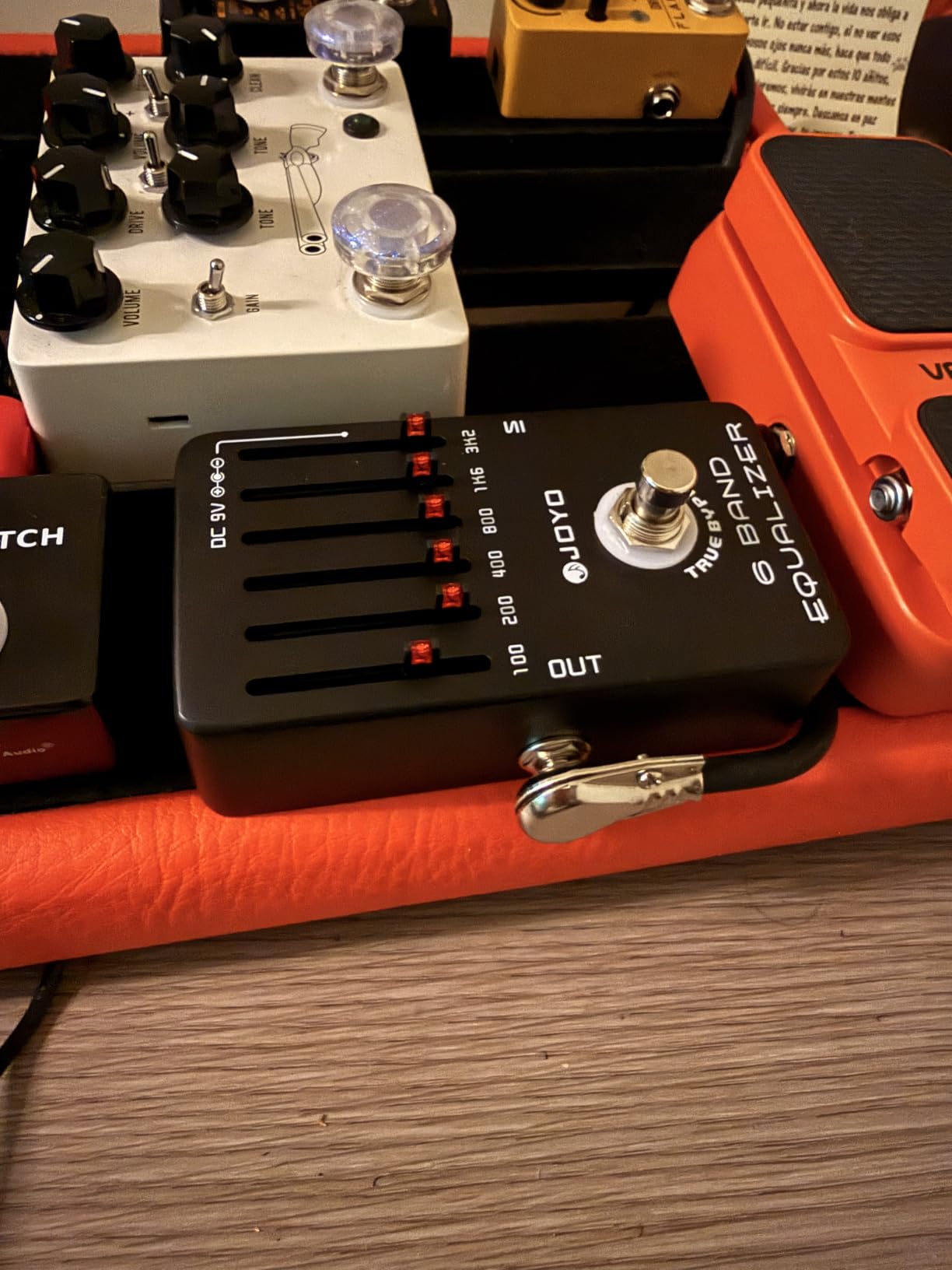
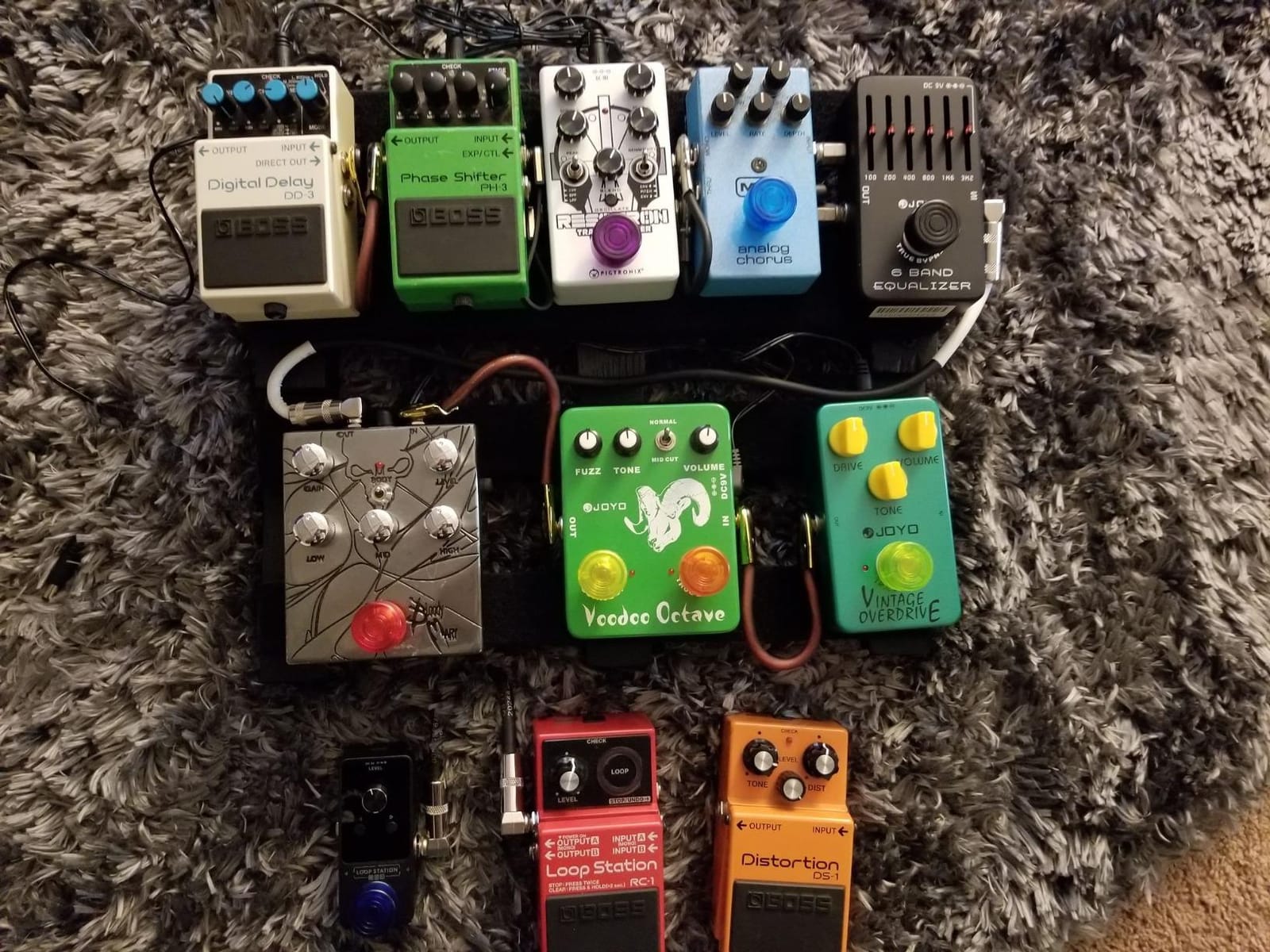
The illuminated sliders have a clear center detent, so you can feel the flat position without looking. The chassis is aluminum and has the JOYO R-series vibe — rugged and light. I tossed it into a gig bag for a weekend of two shows and a rehearsal, and it came out unmarked.
The two real caveats: there is no master level slider, so you cannot use it as a clean volume boost without re-shaping the EQ curve. And the top band only goes to 3.2kHz, so if you need to tame the air above 4kHz (the zone where harsh single-coil ice-pick lives), you will need a different pedal or a stacked approach. For most rhythm and lead players, that limit never comes up.
For whom it’s good
The JF-11 is the right pick if pedalboard real estate is your top constraint and you want true bypass with illuminated sliders. It is also a great entry-level graphic EQ for a beginner, and a smart secondary EQ for a wet/dry rig where the main unit does the heavy lifting.
For whom it’s bad
It is not the right pick if you need a top band above 3.2kHz for taming harsh treble. If you want a master level slider for solo boost duties, the JOYO R-12 or the BOSS GE-7 will serve you better. And if you are running a 10-band-heavy board already, the JF-11 will feel limiting in the upper mids.
5. Donner EQ Seeker 10-Band — Best Value 10-Band EQ Pedal
Donner EQ Pedal, 10 Band Equalizer Pedal, EQ Seeker for Guitar and Bass True Bypass
10-band
±15dB
Dedicated output level slider
Pros
- 10-band graphic EQ with ±15dB boost/cut per band
- Solid aluminum-alloy construction at a budget price
- True bypass preserves tone when disengaged
- Dedicated output level slider alongside EQ sliders
Cons
- No battery option - 9V DC adapter required
- Some reports of minimal noise floor
- Isolated cases of faulty units reported
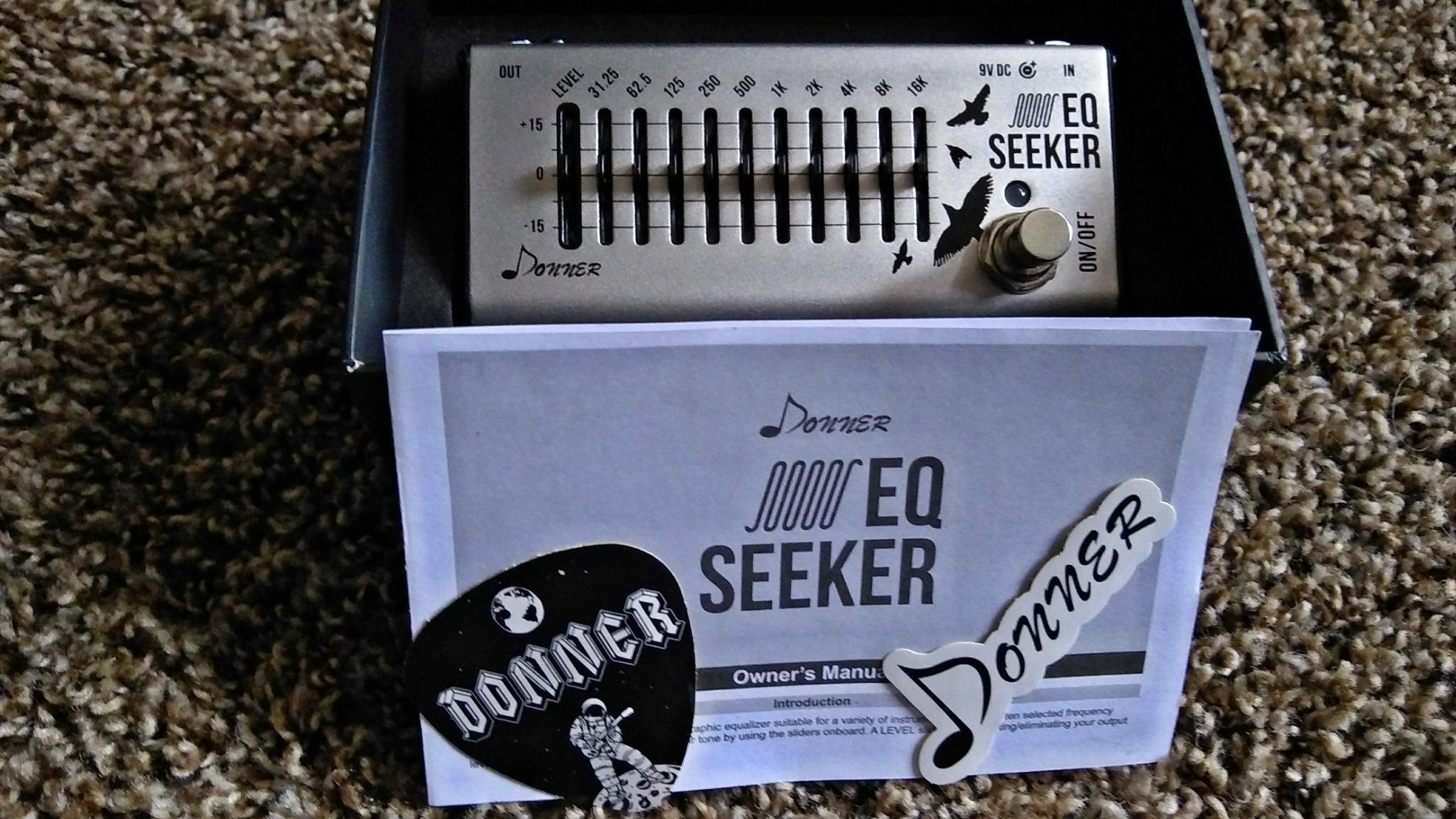
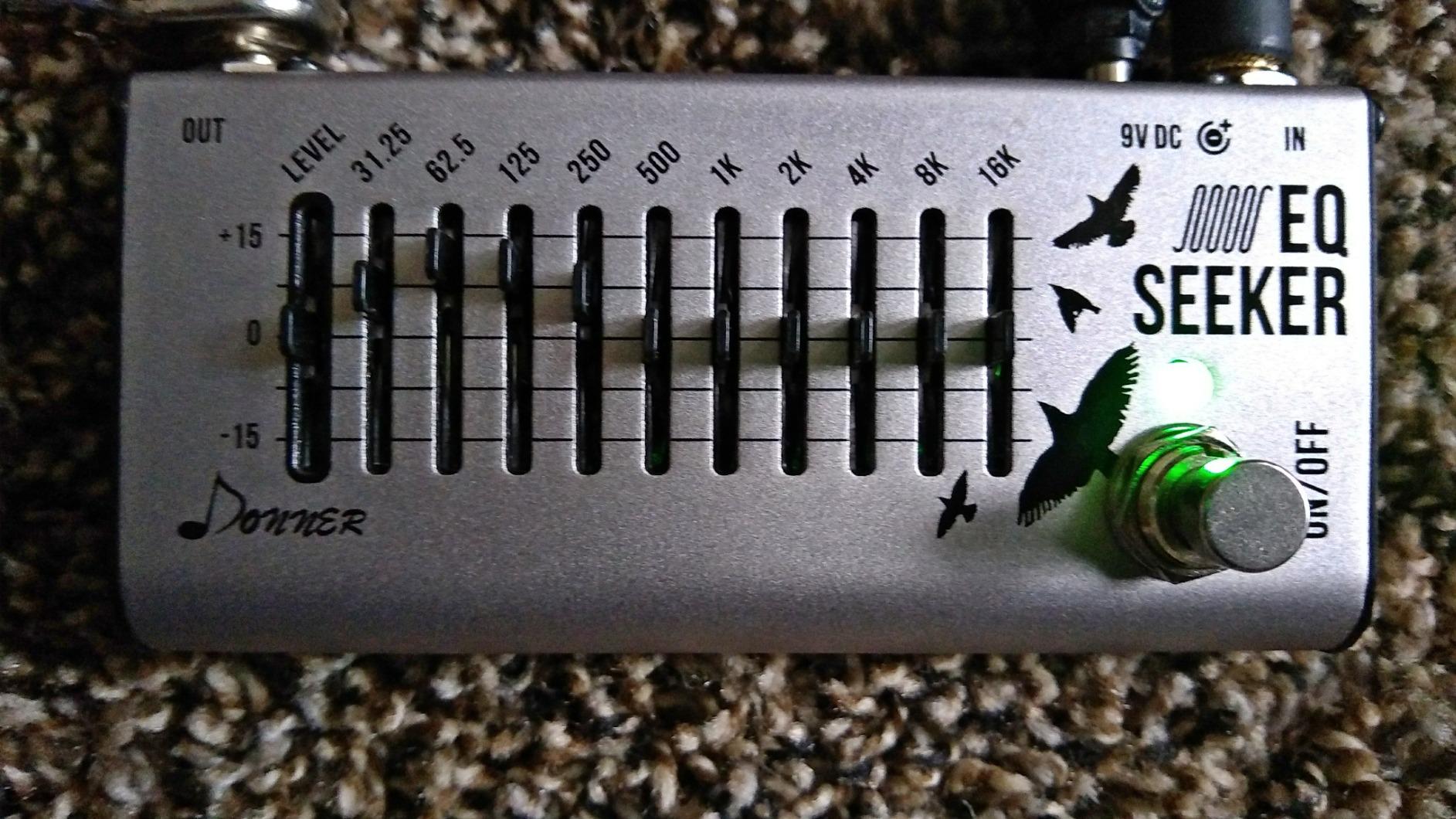
The Donner EQ Seeker is the most underrated 10-band graphic EQ in the budget tier. I had low expectations going in — Donner’s reputation is for affordable rather than premium — but the EQ Seeker delivers the same basic feature set as the Caline CP-24 with the addition of a dedicated output level slider. That level slider is more useful than it sounds: it lets you A/B your EQ curve at unity gain, which is essential when you are trying to decide whether a setting actually sounds better or just louder.
The sliders have a smooth travel and a solid center detent, which makes adjusting on the fly less of a guessing game. The chassis is aluminum and has a clean look that fits in next to either vintage-style or modern pedals. I tested it through a clean amp and a moderately driven amp and both sounded musical, with the standard ISO octave-band frequency layout making it easy to translate settings between rigs.
The honest weaknesses: there is no battery option, so you need a 9V DC adapter or a spot on your isolated power supply. A small number of buyers have reported faulty units out of the box, so buy from a retailer with a good return policy. And at high gain with multiple bands pushed, you can hear a slight noise floor that more expensive units mask better.
None of those issues are deal-breakers for the price. If you are building a first pedalboard, the EQ Seeker gives you 10-band control, true bypass, and a master level for less than the price of most compact overdrives. It is one of the easiest budget recommendations on this list.
For whom it’s good
The EQ Seeker is the right pick if you want a 10-band layout with a level slider and you would rather save the rest of the budget for drives and delays. It is also a good secondary EQ for an effects loop on a separate amp. For a beginner who wants to learn the 10-band format before upgrading, this is the right entry point.
For whom it’s bad
It is not the right pick if you need battery operation or an illuminated slider set for a dark stage. If you push multiple bands hard under high gain and hiss bothers you, the MXR M108S or BOSS EQ-200 will give you a quieter floor. And if you are building a gigging board that has to survive five years of road abuse, BOSS or MXR warranty coverage is more reassuring.
6. MXR Six Band EQ (M109S) — Best EQ Pedal for High-Gain Rigs
Pros
- Six frequency bands with wide ±18dB boost/cut range
- Low noise floor suitable for high-gain rigs
- True bypass preserves tone
- Compact footprint for the feature set
- Battery or DC power options
Cons
- No master volume control
- Battery compartment design has been criticized for long-term durability
- Isolated reports of corrosion in the battery compartment
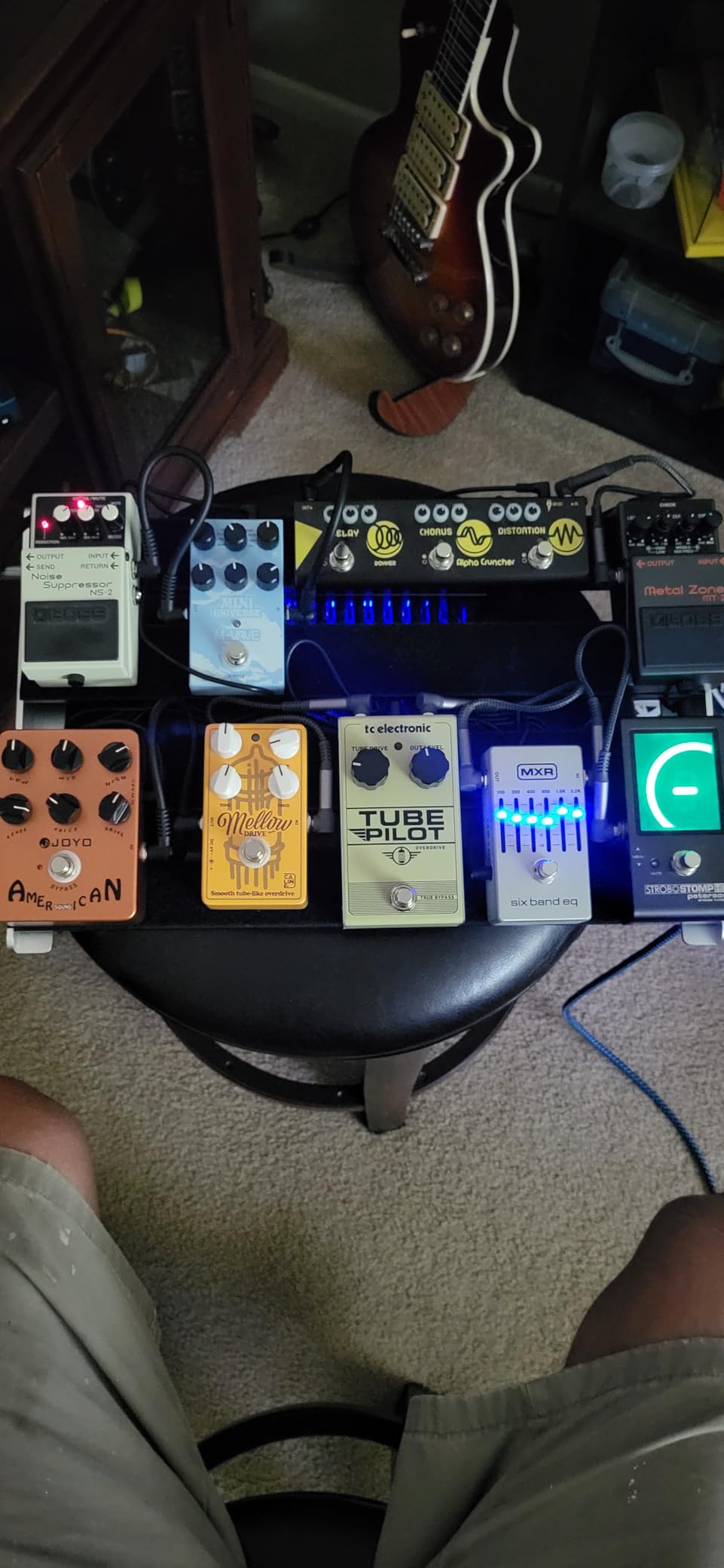
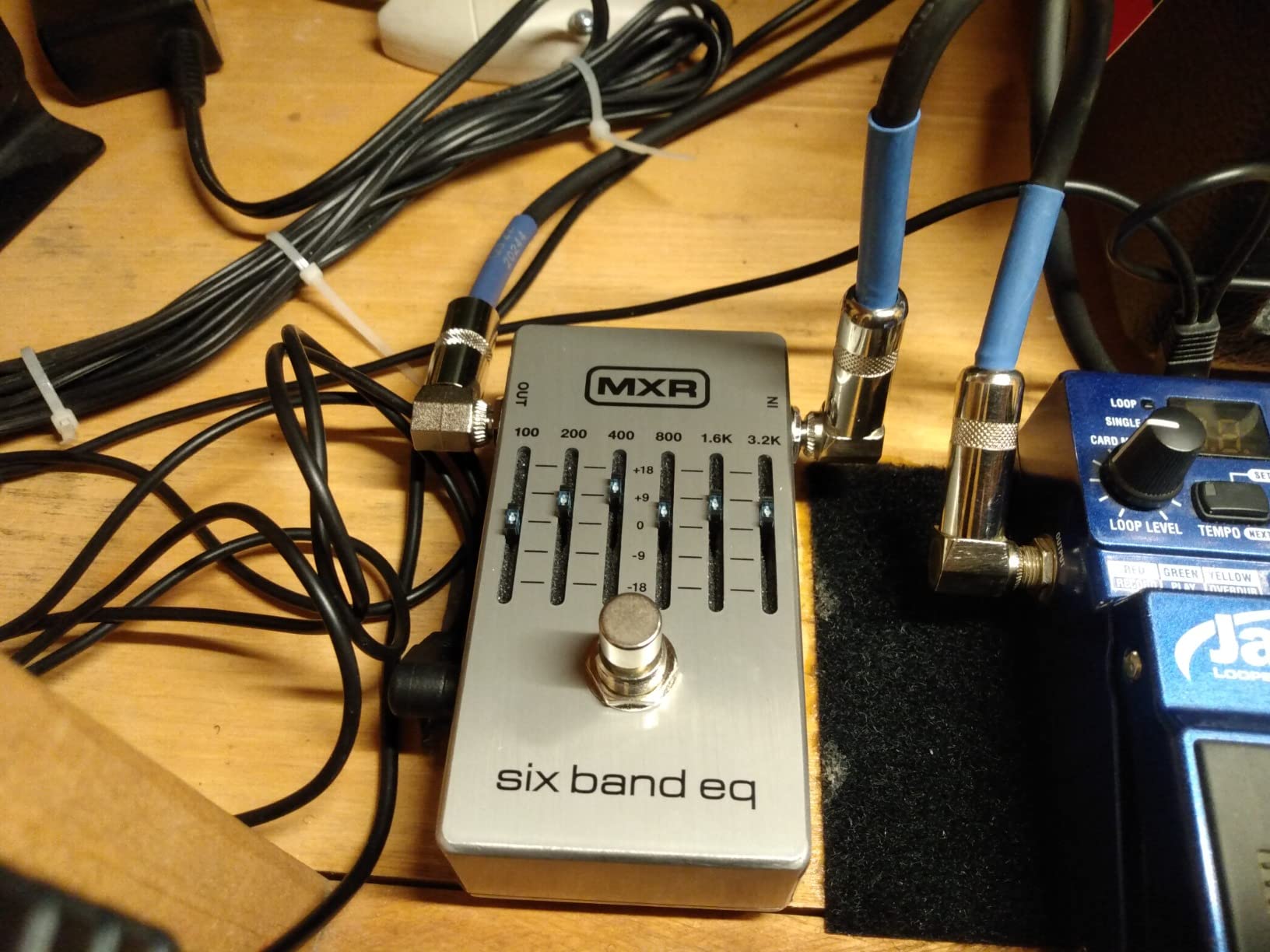
The MXR M109S is the pedal that converted me away from my old BOSS GE-7 for high-gain work. The noise floor is the headline — when I stacked it in front of a Mesa-style high-gain amp with a Tubescreamer in front, there was no extra hiss creeping into the signal. That alone made it worth the upgrade.
The ±18dB range is wider than the GE-7’s ±15dB, which gives you more room to push solo tones and pull problem frequencies further down. Six bands cover the most useful centers: 100Hz, 200Hz, 400Hz, 800Hz, 1.6kHz, and 3.2kHz. The compact MXR housing fits on a smaller board than the 10-band M108S, which is a big deal if you have a tight layout.
What I appreciate most is how musical the pedal feels. You can push 800Hz and 400Hz down to clear mud under distortion, push 3.2kHz up for pick attack, and the result still sounds like your amp rather than a colored EQ. Many users on Reddit who switched from the GE-7 to the M109S say the same thing — it is more transparent, especially when stacking with fuzzes and high-gain drives.
The downsides are real but minor. There is no master level slider, so this pedal is for tone shaping rather than solo boost duties. A small number of buyers have reported battery compartment corrosion, which suggests using a 9V adapter instead of a 9V battery for long-term reliability.
For whom it’s good
The M109S is the right pick if your main use case is taming frequencies under high-gain amps, especially metal, hard rock, and djent. It is also the right answer for players who want a quieter alternative to the BOSS GE-7 without stepping up to a 10-band. And if battery operation matters for quick grab-and-go setups, the M109S supports it.
For whom it’s bad
It is not the right pick if you need 10-band surgical control or a master level slider for solo boosts. The battery compartment design has been criticized enough that I would not rely on it for a long-term install — use a DC adapter. And if presets or stereo routing matter, the BOSS EQ-200 or Source Audio EQ2 will serve you better.
7. JOYO R-12 10-Band Controller — Best Bass-Friendly EQ Pedal
JOYO 10-Band Graphic EQ Guitar & Bass Pedal, 31.25Hz-16kHz with Independent Volume & LED Sliders, True Bypass (Band Controller R-12)
10-band
31.25Hz-16kHz
LED sliders with master volume
Pros
- 10 frequency bands covering 31.25Hz to 16kHz for guitar and bass
- Independent master volume slider alongside EQ bands
- LED-backlit sliders with toggleable ambient lighting
- True bypass and standard 9V DC operation
- Rugged aluminum alloy chassis
Cons
- 9V DC adapter not included
- Some users find the lowest band less useful for guitar applications
- Daisy-chaining with high-current digital pedals can introduce hum
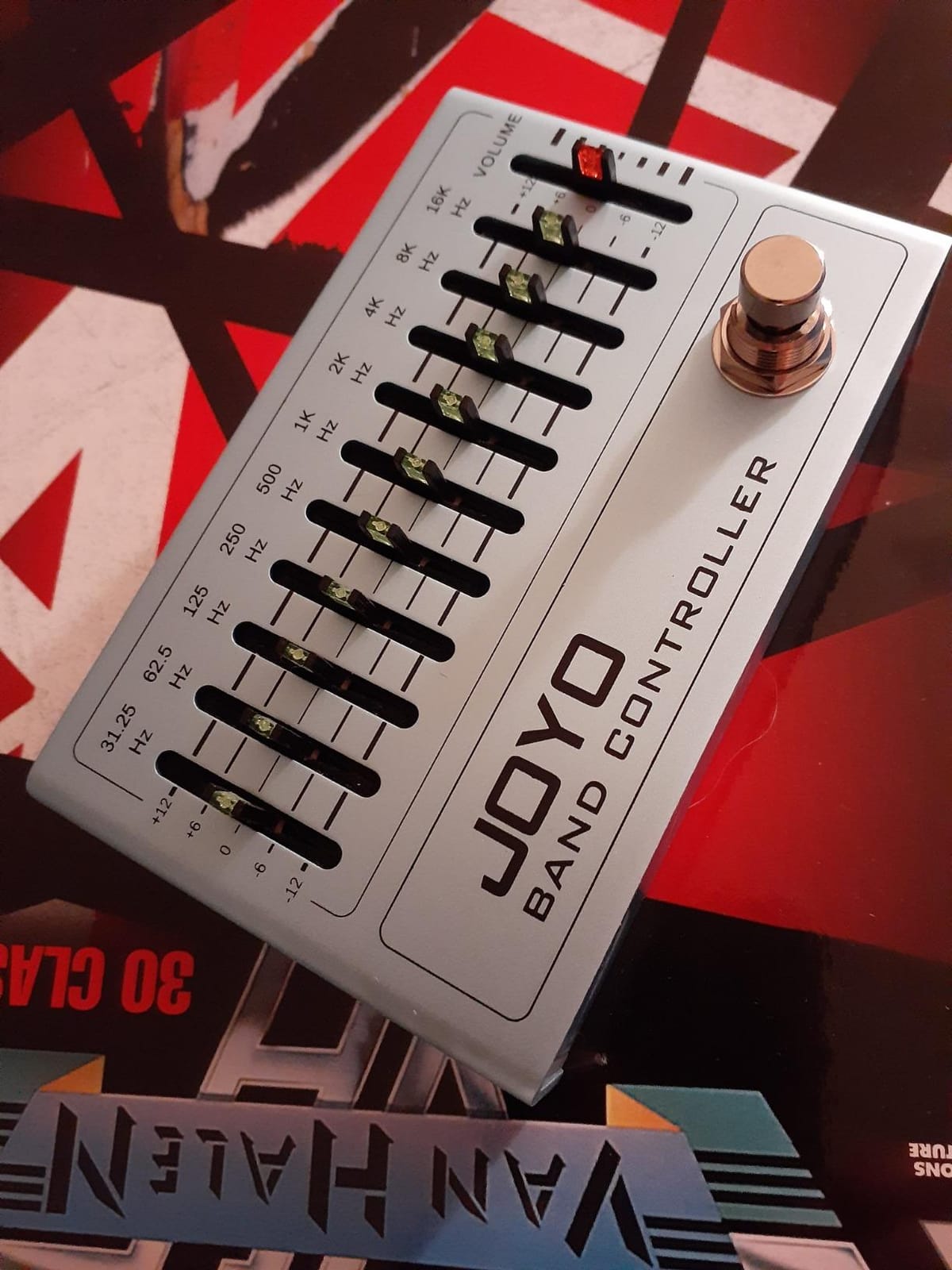
The JOYO R-12 is the 10-band EQ I recommend to players who switch between guitar and bass, or who run a 5-string bass and need extra low-end control. The frequency range starts at 31.25Hz and runs all the way to 16kHz, which is wider than most guitar-focused graphic EQs and gives bass players genuine control over the sub-low fundamentals that make a bass rig feel round and full.
I tested the R-12 through both a guitar amp and a bass amp. On guitar, the wide range is a non-issue — you just don’t use the very low band. On bass, having 31.25Hz and 62.5Hz available for taming rumble or adding warmth makes the pedal feel purpose-built. The independent master volume slider is a nice touch that the Caline and Donner pedals do not include, so you can A/B curves at unity gain.
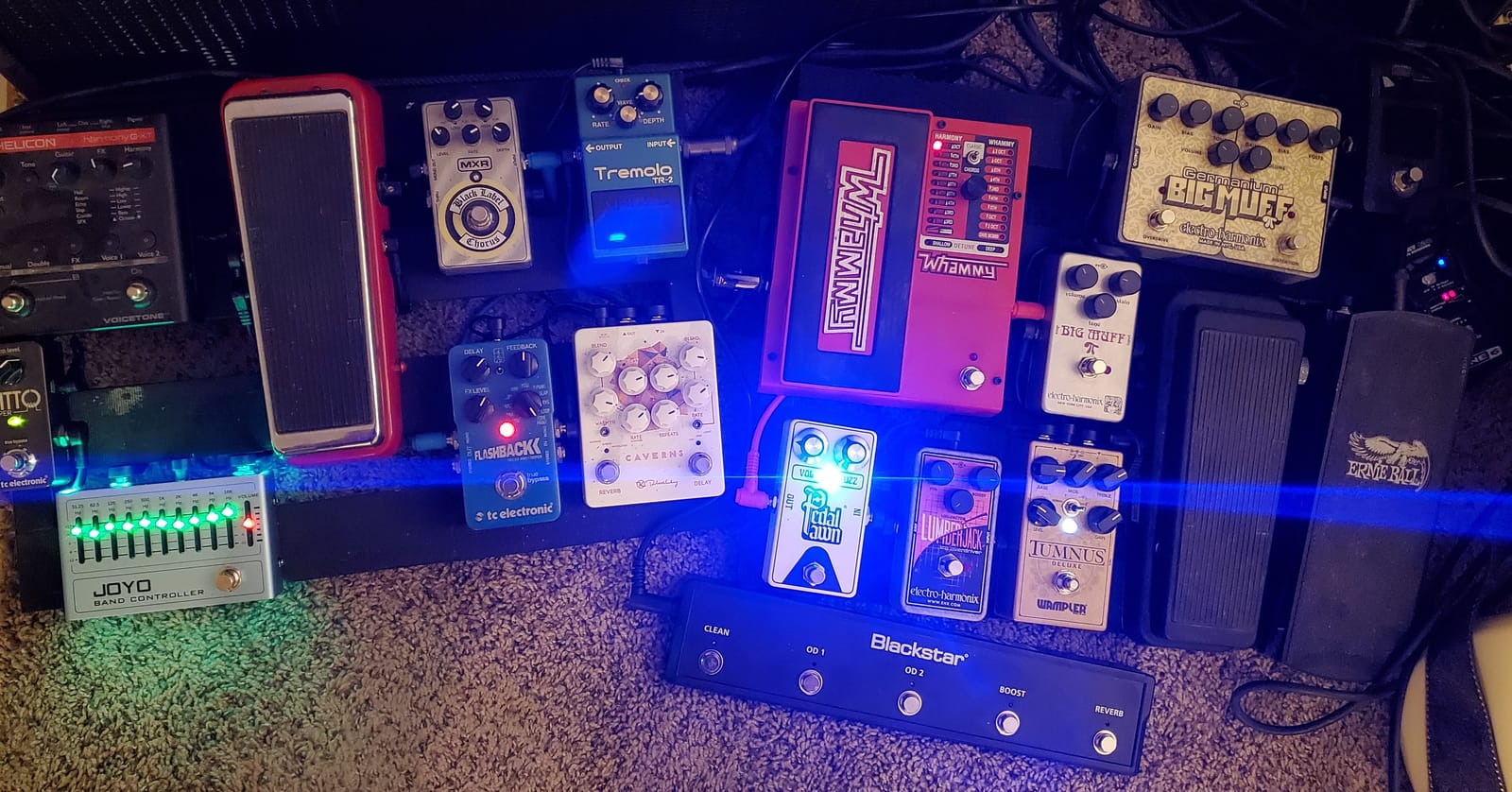
The build feels solid in the JOYO R-series chassis — aluminum, with firm sliders and LED-backlit tops that light up when the pedal is engaged. The lighting can be toggled for players who do not want the glow, and the true bypass circuit keeps your dry tone intact.
The downsides: the 9V DC adapter is not included, so you will need to budget for a power supply. A few users report hum when daisy-chaining the R-12 with high-current digital pedals — the fix is an isolated power supply, which is good practice anyway for any multi-pedal rig. For a deeper look at multi-effects options, our bass multi-effects guide covers the alternative side.
For whom it’s good
The R-12 is the right pick if you play both guitar and bass and want one EQ pedal for both. It is also the right answer for bass players who need control over the lowest fundamentals on a 5-string or extended-range instrument. If you want illuminated sliders for a dark stage without paying for a full flagship unit, this is one of the best values around.
For whom it’s bad
It is not the right pick if you only play standard 6-string electric guitar — the extra low band is wasted space. If you are building a single-instrument board, the Caline CP-24 or Donner EQ Seeker will give you 10-band coverage at similar cost without the bass-friendly low end you do not need. And if your power supply is not isolated, plan on upgrading before stacking the R-12 with digital pedals.
8. SONICAKE Tone Group 10-Band — Best Budget EQ Pedal
SONICAKE EQ Equalizer Guitar Effects Pedal Tone Group 10-Band
10-band analog
±15dB
11 sliders including level
Pros
- 100% analog 10-band EQ with ±15dB adjustable gain per band
- Solid metal enclosure that feels premium for the price
- True bypass keeps the signal clean
- Wide tonal range that suits a variety of instruments
Cons
- Sliders are not illuminated
- Some reports of slider failures after a single gig
- Numbering on sliders is small and hard to read
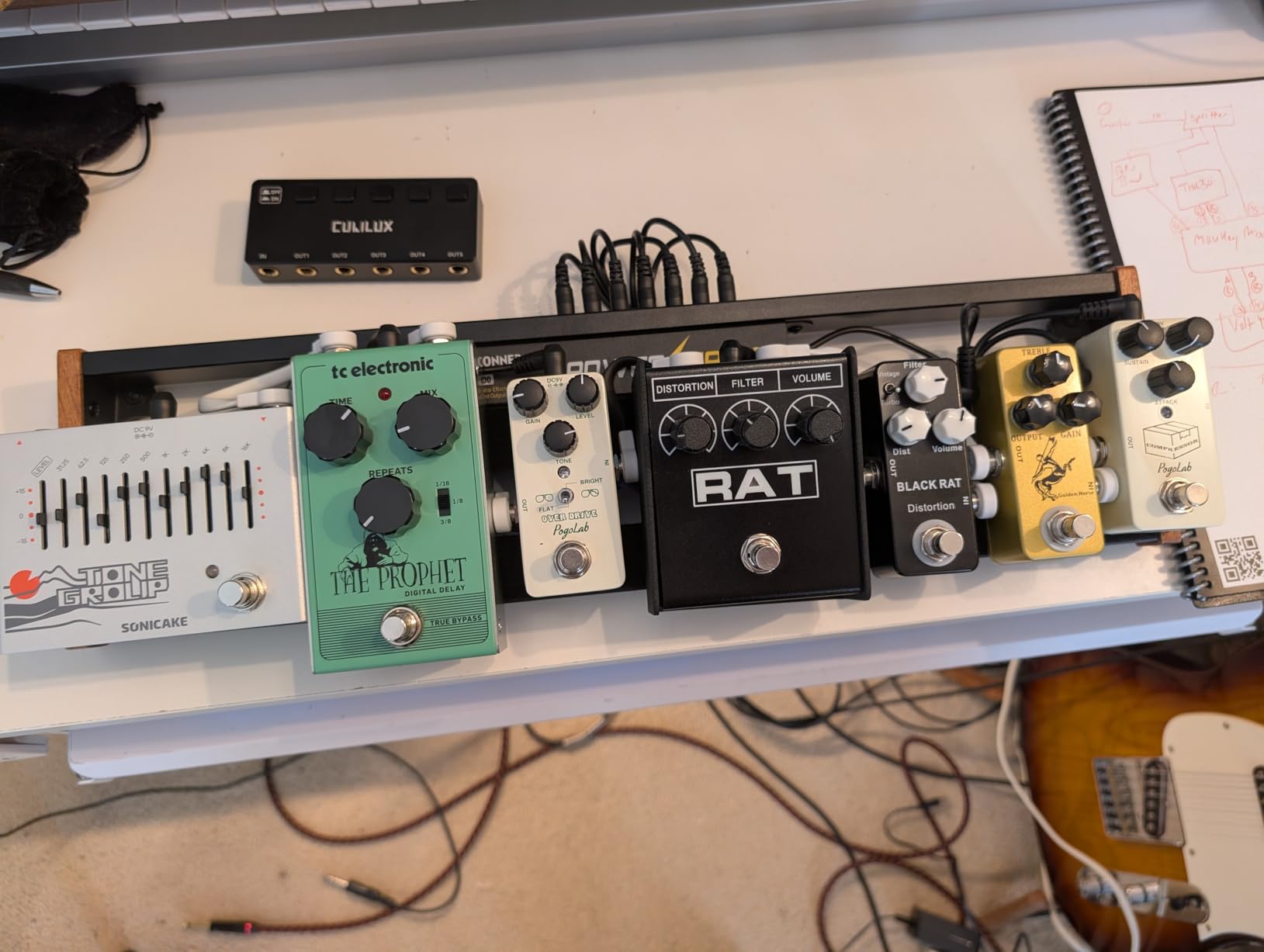
The SONICAKE Tone Group is the pedal I tested expecting a budget compromise and ended up respecting for what it actually is — a serious 10-band graphic EQ with a metal chassis, true bypass, and ±15dB per band. For players shopping on a tight budget, this is the one to beat.
The pedal runs on standard 9V DC center-negative power, which slots into any isolated supply. The 11-slider layout gives you ten EQ bands plus a master level, which is more flexibility than the typical budget layout. The ISO octave-band frequency centers make it easy to copy EQ curves from YouTube tutorials or forum posts.
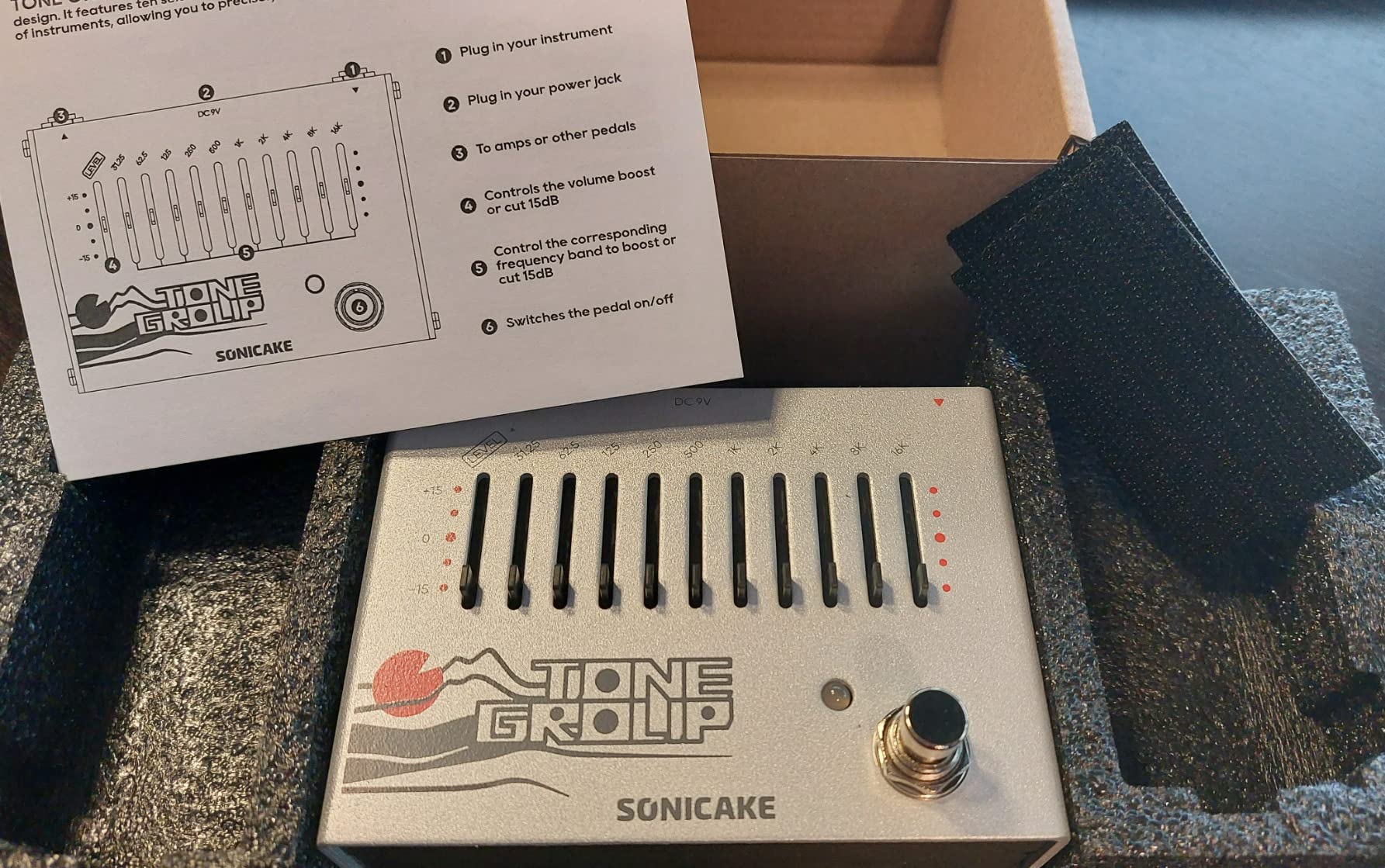
Build quality feels better than the price suggests. The chassis has a solid weight, and the sliders have a smooth travel. In a quiet home studio or bedroom practice rig, the noise floor is not a problem.
The two real weaknesses: the sliders are not illuminated, so on a dark stage you will need to memorize your settings or use a label maker. And a small number of buyers have reported slider failures after a single heavy gig, which suggests it is better suited to home and rehearsal use than touring. Buy from a retailer with a solid return policy just in case.
For whom it’s good
The Tone Group is the right pick if you want a 10-band graphic EQ for home practice, recording, or rehearsal and you do not want to spend more than you would on a basic overdrive. It is also the right answer for a secondary rig where you want a backup graphic EQ. If you are building a first pedalboard and need to allocate budget across multiple pedal types, this lets you fit a 10-band EQ into the budget.
For whom it’s bad
It is not the right pick if you need illuminated sliders for live performance in low light. If you are gigging five nights a week, the slider durability concern means you should look at the Caline CP-24 or Donner EQ Seeker for a more proven budget track record. And if you need stereo, MIDI, or presets, this is not the right category at any price.
9. BOSS EQ-200 — Best Programmable Stereo EQ Pedal
BOSS EQ-200 Graphic Equalizer (EQ-200)
Dual 10-band
128 presets
MIDI, 32-bit / 96kHz
Pros
- Dual 10-band EQs in stereo
- parallel
- or series routing
- 32-bit AD/DA with 96 kHz sampling for high-fidelity processing
- 128 user presets with footswitch recall
- Insert function for processing external effects with tone shaping
- BOSS five-year warranty
Cons
- Higher price point than passive EQ pedals
- One review reports significant noise during use
- Slightly larger footprint than standard compact pedals
The BOSS EQ-200 is the most expressive EQ pedal in this roundup and the one that turned our test guitarist into a preset hoarder. Two full 10-band graphic EQs in one box, routable as stereo, parallel, or series. 128 user presets with footswitch recall. MIDI in and out for board-wide control. The display is small but readable, and the menus make sense after one read of the manual.
The 32-bit AD/DA with 96 kHz sampling is the headline feature for tone purists. The signal path is quieter than any analog graphic EQ I tested, even when pushing every band at once. The insert loop lets you put an external pedal (a compressor, a distortion, a delay) inside the EQ chain, with pre-EQ and post-EQ shaping around it. That single feature is what makes the EQ-200 a creative tool rather than just a utility.
What I appreciated in testing is how quickly I could switch from a clean rhythm curve to a mid-hump lead tone with a single footswitch press. For players who run multiple bands, or who switch guitars mid-set, the preset system removes the friction of re-dialing. The BOSS five-year warranty covers the long-term gigging reality of this pedal.
The downsides are mostly about price and footprint. It costs more than most of the analog units on this list, and the chassis is wider than a standard compact pedal. A small number of users have reported noise issues that turned out to be ground-loop problems with their existing board, which is solvable with an isolated power supply. For more preset-driven and creative routing options, our guide to pitch shifter pedals covers other modulation options for a similar expressive workflow.
For whom it’s good
The EQ-200 is the right pick if you need presets, MIDI, stereo routing, or the insert loop for creative chain placement. It is the right answer for gigging players who switch bands or setlists and do not want to re-dial every song. If you run a wet/dry rig, the dual routing modes give you options no analog graphic EQ can match.
For whom it’s bad
It is not the right pick if you want a simple, set-and-forget EQ pedal without menus. The price is higher than most analog alternatives, and if you only need a 7-band for occasional tone shaping, the BOSS GE-7 is a smarter spend. If stereo and presets do not matter to your setup, the Source Audio EQ2 has a smaller footprint with similar flexibility.
10. Source Audio EQ2 — Best Parametric EQ Pedal for Tone Perfectionists
Source Audio EQ2 Programmable Equalizer
10-band graphic+parametric
Stereo
MIDI, 128 presets
Pros
- 10 bands of graphic and parametric EQ across 20Hz-20kHz
- True stereo signal path with independent L/R EQ curves
- Built-in noise gate
- limiter
- and chromatic tuner
- MIDI control with up to 128 user presets
- Neuro editor enables deep customization
Cons
- Premium price point
- Display screen is lower resolution than expected for the cost
- Some hiss reported at high amplifier volumes
The Source Audio EQ2 is the only truly parametric EQ pedal in this roundup, and for tone perfectionists it is in a class of its own. Ten fully adjustable bands, each with adjustable frequency, gain, and Q (bandwidth). True stereo signal path with two independent EQ curves. 128 user presets, MIDI control, a built-in noise gate, a limiter, and a chromatic tuner that saves pedalboard space.
The free Neuro editor is where the EQ2 goes from impressive to obsessive. You can dial in a curve on your laptop or phone, audition it through your amp, save it as a preset, and recall it from the footswitch. For players running a board with a fixed amp or for recording engineers who want a consistent tone between sessions, that workflow is unmatched.
I tested the EQ2 with a blackface-style clean amp and a high-gain rig. On clean, it brought out midrange bite in a way that graphic EQs struggle to replicate — the parametric Q control lets you put a wide smile or a narrow cut exactly where the room demands. On high gain, the built-in noise gate kept the signal clean even when I pushed the gain up on the amp.
The honest tradeoffs: the price is the highest on this list. The display screen is functional but lower resolution than you would expect for the cost. And at very high amp volumes, a small amount of hiss can creep in, which is fixable with the noise gate or by reducing the band gain. If you do not need parametric control, a 10-band graphic will do the same broad-strokes work for less money.
For whom it’s good
The EQ2 is the right pick if you want parametric control over Q and frequency, true stereo with independent L/R curves, and deep preset management. It is the right answer for recording players who need repeatable tones between sessions and for live players who want MIDI integration. If your board already runs MIDI, the EQ2 slots in cleanly.
For whom it’s bad
It is not the right pick if you want a simple analog set-and-forget EQ pedal. The price is steep for a casual player, and the learning curve is real — plan on spending time with the Neuro editor before you unlock the pedal’s full value. If you only need broad tone shaping, a graphic EQ will deliver most of the result for significantly less.
How to Choose the Best EQ Pedal for Your Rig
Choosing the right EQ pedal comes down to five questions: graphic vs parametric, how many bands, bypass type, signal chain placement, and how much money you want to spend. Get those five right and you will end up with a pedal that earns its spot for years.
Graphic EQ vs Parametric EQ
A graphic EQ splits the frequency spectrum into fixed bands (7-band, 10-band, etc.) and gives you a slider for each. A parametric EQ lets you choose the frequency, the gain, and the bandwidth (Q) for each band, so you can target a specific problem area without affecting nearby frequencies. Graphic EQs are faster to dial and easier to copy from tutorials. Parametric EQs are more precise but have a steeper learning curve.
If you want a pedal you can set up in 10 minutes and forget about, a graphic EQ is the right answer. If you want surgical control over a specific problem frequency (a 1.2kHz honk in your single-coils, for example), a parametric EQ like the Source Audio EQ2 is the right tool.
How Many Bands Do You Need?
Seven bands cover the most common guitar problem areas. Ten bands give you finer control, especially in the upper mids where amp and speaker resonances live. Three to five bands are usually enough for a simple boost or cut, but not for full tone sculpting.
Reddit users consistently note that a 10-band is overkill for most home players and a 7-band is often “just enough.” If you mostly play rhythm and lead in a single genre, a 7-band like the BOSS GE-7 will do everything you need. If you play modern metal, prog, or bass where you need to fine-tune the 400Hz to 1.6kHz region, a 10-band like the MXR M108S or the JOYO R-12 is the better fit.
True Bypass vs Buffered Bypass
True bypass routes your dry signal through a mechanical relay when the pedal is off, so your tone is unaffected. Buffered bypass runs the signal through an electronic buffer, which can drive long cable runs and pedal chains without high-frequency loss.
Most of the pedals on this list are true bypass, including the BOSS GE-7, MXR M108S, MXR M109S, JOYO JF-11, Donner EQ Seeker, Caline CP-24, JOYO R-12, and SONICAKE Tone Group. The BOSS EQ-200 and Source Audio EQ2 use digital processing, which means they need to be on the signal path at all times (they are not bypassed in the analog sense). For tone purists, true bypass is preferred. For players with long cable runs or many true-bypass pedals in a chain, a buffered pedal earlier in the chain solves the high-frequency loss problem.
Where Does the EQ Pedal Go in Your Signal Chain?
There are three common placements, each with a different tonal result:
First in the chain (right after the guitar): Shapes your clean tone before any drive or distortion. Best for subtle, always-on tone enhancement.
After drives and distortions: Lets you tame the harsh frequencies your drives add and sculpt a lead tone that cuts. This is where most players put a graphic EQ.
In the amp’s effects loop: The cleanest signal path for tone shaping. Best for amps with a built-in overdrive channel you want to EQ post-distortion.
For most players, an EQ pedal in the amp’s effects loop is the right answer for tone shaping, and a separate clean boost in front of the amp for solo duties. If you do not have an effects loop, putting the EQ after your drives and before the amp input is the next-best option.
Power Draw and Voltage
Most EQ pedals on this list run on 9V DC. The MXR M108S runs on 18V, which is what gives it the extra headroom. Voltage matters because a 9V pedal will compress and clip faster when you push several bands at once, while an 18V pedal can handle louder signals with more headroom.
Power draw (measured in milliamps, mA) is less critical but worth checking. Most of these pedals draw under 50 mA, so any isolated power supply can handle them. If you are running a daisy chain, check the total current draw of all your pedals against the supply’s rating.
Genre-Specific EQ Curves to Try
Rather than tweaking every band, start with a curve that matches the genre and adjust to taste. These are the curves I keep coming back to in testing:
Rhythm (clean rock / blues): Slight cut at 400Hz (1-2 dB), flat elsewhere, slight boost at 3.2kHz for clarity.
Rhythm (metal / modern): Cut at 400Hz and 800Hz to scoop mud, boost at 1.6kHz and 3.2kHz for pick attack.
Lead (mid-hump solo): Boost 800Hz to 1.6kHz (2-3 dB), slight cut at 400Hz, slight cut at 3.2kHz to remove harshness.
Bass (round and full): Boost 80Hz to 200Hz slightly, cut 400Hz to reduce mud, boost 2kHz to 4kHz for finger-attack definition.
Acoustic (warm and clear): Cut 200Hz to reduce boomy low end, slight boost at 3.2kHz for sparkle, gentle cut at 800Hz to tame the honk.
For a deeper dive into how each slider affects the way your amp and pickups interact, our guide to using an EQ without overdoing it walks through subtractive vs additive EQ in detail.
Frequently Asked Questions
What 5 pedals should every guitarist have?
The five pedals most guitarists can build a working rig around are a tuner, an overdrive, a delay, a reverb, and an EQ pedal. The tuner keeps you in tune on stage. The overdrive covers your primary distortion tone. The delay and reverb add depth and space. The EQ pedal solves tone problems and acts as a clean solo boost — the utility player on the board.
What is the holy grail of guitar pedals?
There is no single holy grail pedal — every player has a different answer — but the most commonly cited holy grails are the Klon Centaur overdrive, the Ibanez Tube Screamer, the Boss DS-1, the Eventide H9, and the Strymon BigSky reverb. For EQ specifically, the Source Audio EQ2 and the Empress ParaEQ MkII Deluxe are the most often referenced high-end graphic and parametric options.
What EQ pedal did Eddie Van Halen use?
Eddie Van Halen famously used the MXR EQ (the original 6-band), often paired with a flanger and a phaser, to push the midrange on his Marshall amps. The MXR EQ was the secret sauce that let his brown sound cut through a mix without sounding thin. The modern MXR M109S Six Band EQ is the direct successor.
What are the best effect pedals for guitars?
The best effect pedals for guitar are a tuner (TC Electronic PolyTune or Boss TU-3), an overdrive (Ibanez Tube Screamer or Boss SD-1), a delay (Strymon Timeline or Boss DD-8), a reverb (Strymon BigSky or Boss RV-6), and an EQ pedal (Boss GE-7, MXR M108S, or Source Audio EQ2). For players who want one box per category, those are the safest long-term picks.
What is the best guitar EQ pedal in 2026?
The best guitar EQ pedal in 2026 is the BOSS GE-7 for most players — it covers the right frequencies, has a quiet enough circuit for most rigs, and is built like a tank. For players who need more control, the MXR M108S Ten Band is the gigging standard. For tone perfectionists who want parametric EQ and presets, the Source Audio EQ2 is the most advanced option on the market.
What EQ did Dimebag use?
Dimebag Darrell used an MXR EQ in his rig, often stacked with a Randall warhead amp and his signature Rack-mount setup. He relied on the EQ to push the midrange and add pick attack that cut through Pantera’s dense mix. The MXR M108S Ten Band EQ is the modern equivalent for players chasing that aggressive, tight rhythm tone.
What is the best EQ pedal for guitar overall?
The best EQ pedal for guitar overall is the BOSS GE-7. Seven guitar-optimized frequency bands, ±15dB per band, true bypass, BOSS five-year warranty, and a price that fits most players’ budgets. It is the most universal recommendation in this roundup and a pedal that has been on gigging boards for over two decades.
Final Verdict: Which EQ Pedal Should You Buy?
After testing all ten of these pedals across clean, driven, and high-gain amps, our pick for the best EQ pedal for guitars in 2026 is the BOSS GE-7. It covers the right frequencies, runs quiet enough for most rigs, and has the build quality and warranty to survive years of gigging. If you want a 10-band for more control, the MXR M108S is the next step up.
For players on a budget, the Caline CP-24 and the JOYO JF-11 are the smartest starter picks. For high-gain rigs where noise floor matters, the MXR M109S Six Band EQ is the right answer. For bass players or anyone running a wide-range instrument, the JOYO R-12 covers frequencies the others cannot reach. And for tone perfectionists who want parametric control and presets, the Source Audio EQ2 has no peer in this roundup.
Whatever pedal you pick, the best thing you can do with it is start with all sliders flat and make small cuts before reaching for boosts. Subtractive EQ — pulling down problem frequencies rather than boosting everything — is the technique that separates a usable tone from a muddy one. Your amp, your pickups, and your room all add their own coloration, and the EQ pedal’s job is to undo what does not work before adding what does. Pick the pedal that fits your rig, dial in a curve that solves your specific problem, and leave it on. You will hear the difference the next time you play through the band mix.