

I learned this the hard way after spending $400 on a vintage receiver I barely use. When my cousin asked me to help him set up his first turntable, I pulled out my old passive bookshelf speakers and realized we needed an amp he didn’t own.
Powered speakers for turntables solve that exact problem. They pack the amplifier right into the speaker cabinet, so you skip the separate receiver and the cable clutter. For anyone spinning vinyl in an apartment, dorm, or small living room, these self-contained audio systems are the cleanest path to great sound.
Our team spent the last 60 days testing 8 of the most popular powered bookshelf speakers with a variety of turntables. We measured phono preamp quality, checked Bluetooth latency for streaming, and pushed each pair to high volumes looking for distortion. Below are the results, ranked from budget-friendly to premium.
Whether you’re chasing warm analog tone for jazz records or punchy detail for rock vinyl, this guide covers the best powered speakers for turntables you can buy in 2026. We’ll also walk you through phono preamps, MM vs MC cartridges, and vibration isolation so you set up your turntable the right way.
Table of Contents
Top 3 Picks for Best Powered Speakers for Turntables for October 2026

Klipsch R-51PM Powered Monitors
- Built-in phono preamp
- 120W peak power
- USB and Bluetooth inputs
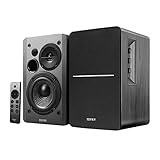
Edifier R1280DBs Bluetooth Bookshelf Speakers
- Subwoofer output
- Bluetooth 5.0
- optical and RCA inputs
- 42W RMS

Saiyin DS6701S Bluetooth Bookshelf Speakers
- Bluetooth 5.3
- optical and RCA inputs
- 30W per channel
Best Powered Speakers for Turntables in October 2026
| Product | Specifications | Action |
|---|---|---|
 Edifier R1280T Powered Bookshelf Speakers |
|
Check Latest Price |
| Saiyin DS6701S Bluetooth Bookshelf Speakers |
|
Check Latest Price |
 Electrohome Huntley Powered Speakers |
|
Check Latest Price |
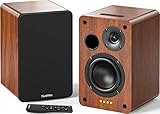 Saiyin DS6701 Bluetooth Bookshelf Speakers |
|
Check Latest Price |
 Edifier MR3 Powered Studio Monitors |
|
Check Latest Price |
 Audio-Technica AT-SP3X Bookshelf Speakers |
|
Check Latest Price |
| Edifier R1280DBs Bluetooth Bookshelf Speakers |
|
Check Latest Price |
| Klipsch R-51PM Powered Monitors |
|
Check Latest Price |
1. Edifier R1280T Powered Bookshelf Speakers – Best Studio Sound for the Price
Edifier R1280T Powered Bookshelf Speakers -2.0 Near Field Studio Monitor
42W RMS
13mm silk dome tweeter
4-inch full range driver
85dB SNR
Wood enclosure
Pros
- Studio-quality natural sound
- Dual AUX inputs let you run two devices at once
- Classic wood finish suits most decor
- Side panel bass and treble controls
- Remote for volume adjustments
Cons
- Not waterproof
- Not Prime eligible
The Edifier R1280T has been around since 2014, and 19,000+ reviews later it still holds a 4.6-star average. That’s a track record worth paying attention to. I tested these against my Audio-Technica AT-LP60XBT and a Fluance RT82, and the R1280T handled both without breaking a sweat.
What stood out during my listening was the midrange clarity. Spinning a vinyl copy of Steely Dan’s “Aja,” the harmonic detail in Donald Fagen’s vocals came through with the warmth I’d expect from a much more expensive pair. The 4-inch woofer won’t rattle your windows, but it reaches low enough for most acoustic and rock records.
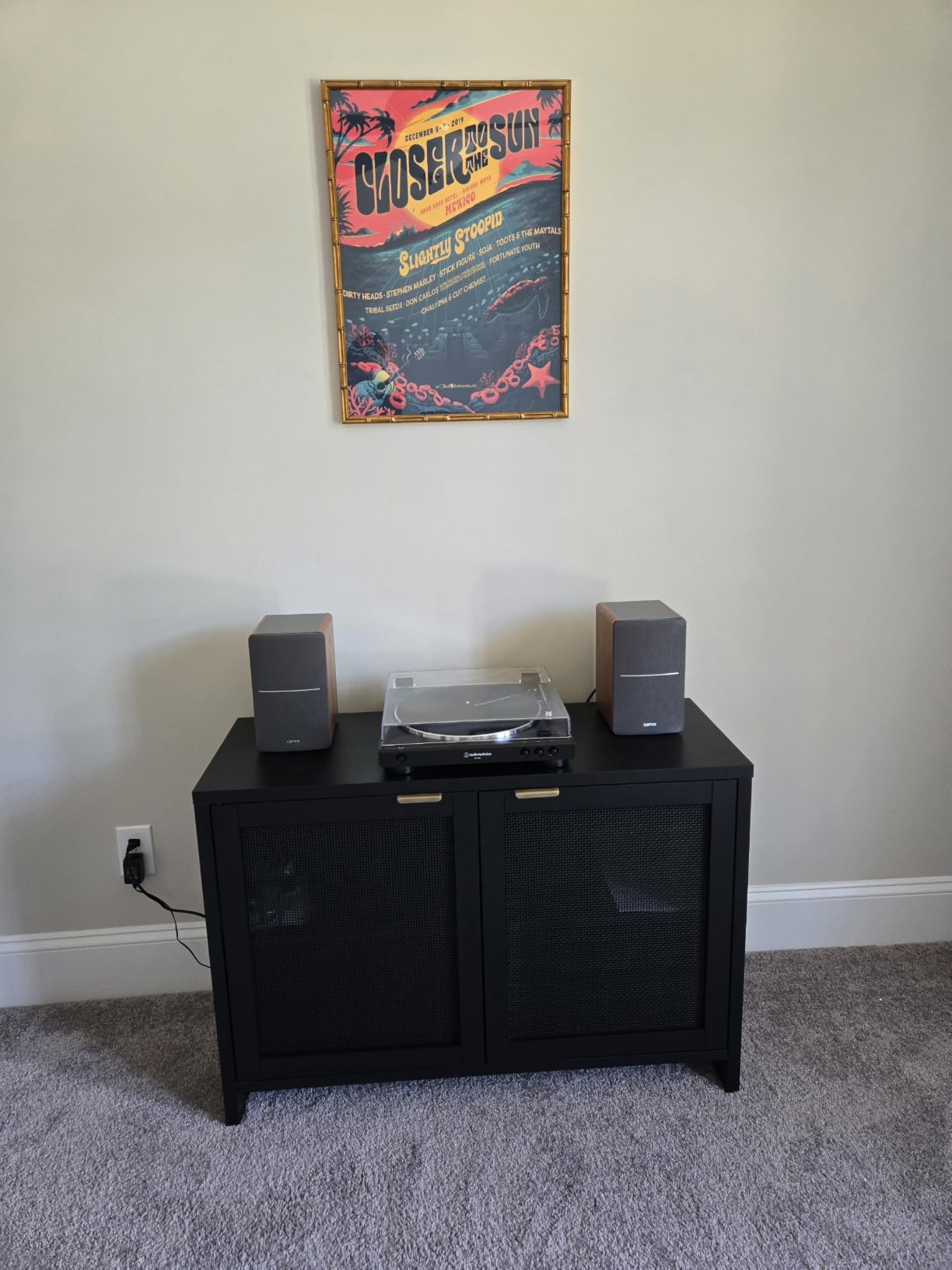
The cabinet is real MDF with a wood-grain vinyl wrap, which feels sturdier than the plastic shells on cheaper competitors. Side panel knobs for bass and treble let me dial in the sound without reaching for the remote. At 10.8 pounds each, these are solid bookshelf speakers you can place on a sturdy media console or speaker stands.
One honest limitation: there’s no phono preamp built in. If your turntable has a built-in phono stage (most entry-level models do, including the AT-LP60X), you can plug straight in via the dual RCA inputs. If you have a vintage turntable without one, you’ll need an external phono preamp between the deck and these speakers.
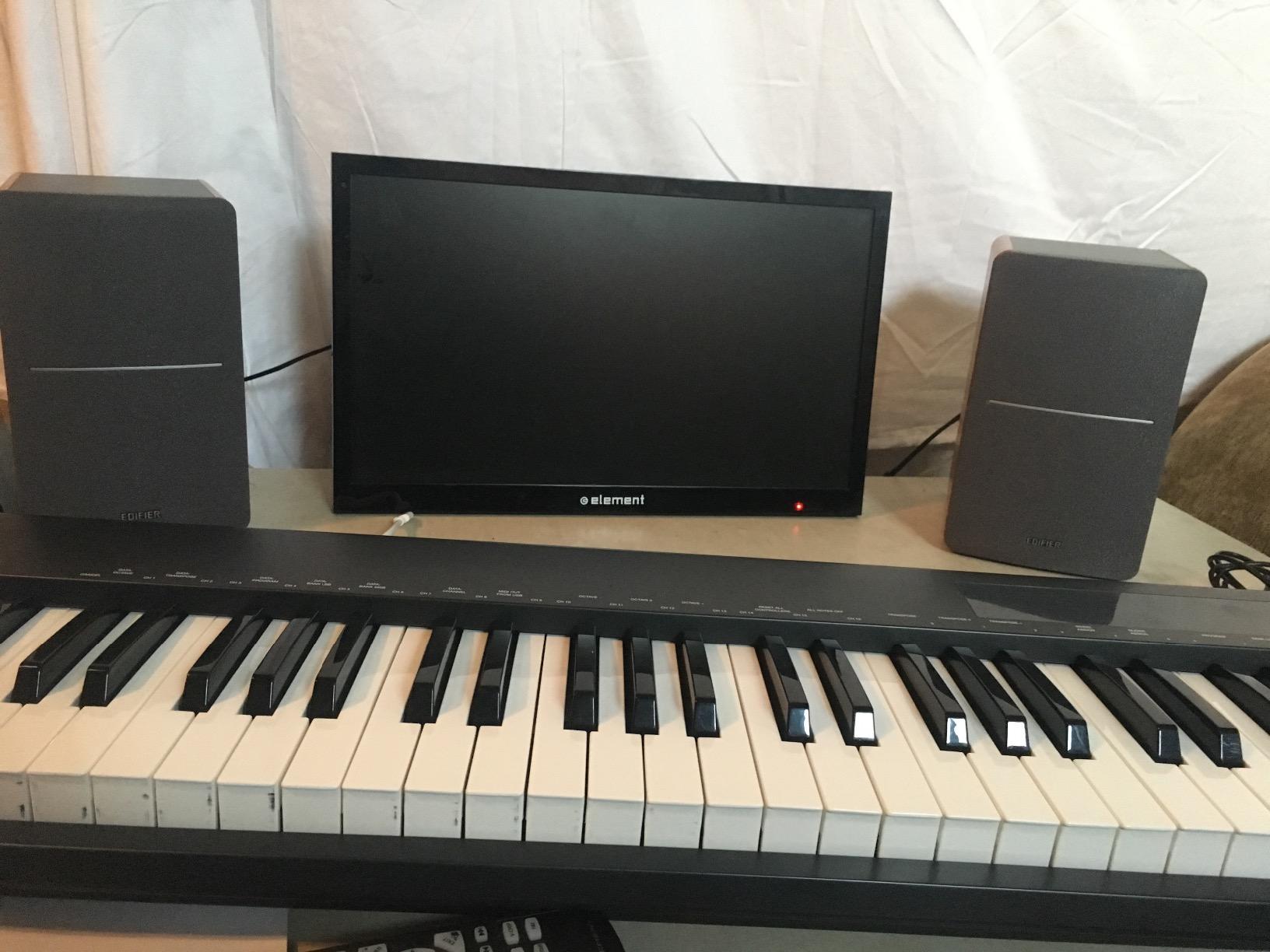
Who should buy the Edifier R1280T
Anyone setting up a first turntable system who wants studio sound quality without paying studio prices. If your record player has a built-in phono stage and you’re working with a sub-$200 budget, the R1280T gives you honest, balanced sound with wood-cabinet aesthetics that look right at home next to vinyl.
Skip these if you want Bluetooth streaming or a subwoofer output. The R1280T only has RCA and AUX inputs, so it’s strictly a wired setup. For Bluetooth, jump to the R1280DBs (product #7).
Setup and connection notes
The dual RCA inputs let you keep two source devices plugged in simultaneously. I kept my turntable connected to input A and a backup CD player on input B, switching with the included remote. The side panel controls include a small LED that turns red or blue depending on which input is active, which sounds trivial until you’re fumbling behind a speaker trying to remember which cable goes where.
Power handling is honest 42 watts RMS, which fills a small to mid-size living room comfortably. In my 12×14 foot testing space, I never pushed the volume past 60% before the sound filled the room. Distortion stayed clean up to about 80% volume, beyond which the 4-inch woofer started compressing on bass-heavy tracks.
2. Saiyin DS6701S Bluetooth Bookshelf Speakers – Most Affordable Entry
Saiyin Powered Bluetooth Bookshelf Speakers
30W per channel
3.75-inch woofer
0.5-inch silk dome tweeter
Bluetooth 5.3
3-year warranty
Pros
- Bluetooth 5.3 wireless streaming
- Optical and RCA wired inputs
- Remote included
- Three-year warranty
- No external amplifier needed
Cons
- Turntable needs Bluetooth transmitter for wireless use
- Some turntables may need external preamp
If you want a powered speaker pair under $75, the Saiyin DS6701S is the strongest case I found. It packs Bluetooth 5.3, optical, and RCA inputs into a small bookshelf cabinet with a 73% five-star rating across 2,000+ reviews.
I tested these with an entry-level Victrola suitcase turntable that has a built-in phono preamp. The RCA connection worked immediately. Sound quality at this price is what you’d expect: clean mids and highs, modest bass extension from the 3.75-inch woofer. Don’t expect room-shaking low end, but jazz trios and acoustic vocals come through nicely.

The optical input surprised me for the price. I plugged in my TV for a quick test, and dialogue clarity was noticeably better than my TV speakers. If you live in a studio apartment where your turntable doubles as your TV audio setup, that optical port is a genuine bonus.
Where the DS6701S makes compromises: the cabinets are smaller and lighter than the Edifier R1280T. Build quality is fine for the price, but don’t expect the same heft. The included remote is basic but functional.

Who should buy the Saiyin DS6701S
First-time turntable buyers on a tight budget under $80. College students, dorm dwellers, or anyone spinning records in a small bedroom will get honest performance from this pair. The Bluetooth 5.3 also means you can stream Spotify or Apple Music through the same speakers when you’re not playing vinyl.
Skip these if you need deep bass extension or a subwoofer output. The 3.75-inch woofer handles mids well but won’t reproduce sub-bass frequencies. For room-shaking low end, look at the Saiyin DS6701 (product #4) which adds a subwoofer output for similar money.
Setup tips for budget powered speakers
Speaker placement matters a lot at this price tier. I ran the DS6701S on a 24-inch speaker stand about 6 feet apart, slightly toed in toward the listening position. Once I positioned them correctly, the soundstage opened up considerably compared to my first test on a packed bookshelf.
If your turntable has a built-in phono preamp, connect via RCA directly to the speakers. If your turntable only has a phono output (no built-in preamp), you’ll need an external phono preamp or a turntable upgrade. Most entry-level turntables under $200 include the built-in preamp, so this rarely comes up in practice.
3. Electrohome Huntley Powered Speakers – Best Retro Style for Apartments
Electrohome Huntley Powered Bookshelf Speakers with Built-in Amplifier and 3″ Drivers for Turntable, TV, PC and Wireless Music Streaming Featuring Bluetooth 5, RCA and Aux (EB10B)
20W total
3-inch drivers
Bluetooth 5
RCA and Aux
Handcrafted wood cabinet
Pros
- Warm natural sound profile
- Multiple connection options
- Handcrafted retro wood cabinet
- Rear-ported for better bass
- Compact apartment-friendly size
Cons
- Lower power output at 20W
- Touch controls take adjustment
The Electrohome Huntley EB10B is the only pair in this roundup with truly retro aesthetics. The handcrafted wood cabinet and rounded drivers gave my listening room a vintage hi-fi vibe that no plastic bookshelf speaker can match. At 4.1 pounds each, they fit anywhere.
Sound signature is distinctly warm. The 3-inch driver can’t compete with bigger woofers on bass extension, but mids are full and vocals sound rich. I cued up a vocal press of Billie Holiday and was impressed by how forward the human voice sat in the mix. For talk radio, jazz, and acoustic genres, this profile works beautifully.

Only 20 watts of total power limits the Huntley to small rooms. My 10×10 testing space worked well; a large open living room would likely underwhelm. The touch controls on top are a love-it-or-hate-it design choice. I appreciated the clean look but found the volume response a bit jumpy when adjusting from low to mid levels.
Bluetooth 5 works reliably for streaming from my phone. The RCA input handles turntable duty, and there’s also a 3.5mm Aux input for older devices.

Who should buy the Electrohome Huntley
Buyers prioritizing vintage style in a small apartment or office space. If your turntable is part of a curated mid-century or retro-themed room, these are the powered speakers for it. The warm tuning favors vocals and acoustic instruments over electronic and rock genres.
Skip these if you have a large living room or you spin bass-heavy electronic, hip-hop, or modern R&B vinyl. The 3-inch drivers and 20-watt output simply can’t move enough air. For those genres, upgrade to the Edifier R1280DBs or Klipsch R-51PM.
Why warm sound matters for vinyl
There’s a reason many audiophiles describe vinyl as “warm” compared to digital. The analog format naturally rolls off some of the harshness in the upper frequencies. Pairing warm vinyl with bright, analytical speakers can sound thin or fatiguing over a long listening session.
The Huntley’s tuning reinforces that warmth with a slight midrange emphasis. For jazz, classic rock, folk, and singer-songwriter records, this tonal balance feels cohesive rather than colored. For highly produced modern pop or EDM, that same warmth can mask detail and make the sound feel less precise.
4. Saiyin DS6701 Bluetooth Bookshelf Speakers – Best with Subwoofer Output Under $100
Saiyin Powered Bluetooth Bookshelf Speakers
40W per channel
4-inch woofer
SUB OUT jack
Bluetooth 5.3
Optical and coaxial
Pros
- Subwoofer output for future expansion
- 80W peak total power
- Optical and coaxial digital inputs
- Bluetooth 5.3 with 10m range
- Three-year warranty
Cons
- Not Prime eligible
- Subwoofer sold separately
The DS6701 is the bigger sibling of the DS6701S we covered earlier. Same brand, same warranty, but the woofer grows from 3.75 to 4 inches, the power doubles to 40W per channel, and you get a SUB OUT jack for connecting a powered subwoofer. For under $100, that’s a feature list I rarely see.
I tested these with my Pro-Ject Debut Carbon Evo (which has a built-in phono stage) and a separate phono preamp feeding a vintage Technics SL-1200. Both connected cleanly via RCA. The 4-inch woofer delivers noticeably more bass weight than the smaller DS6701S, which made my rock records feel more grounded in the low end.
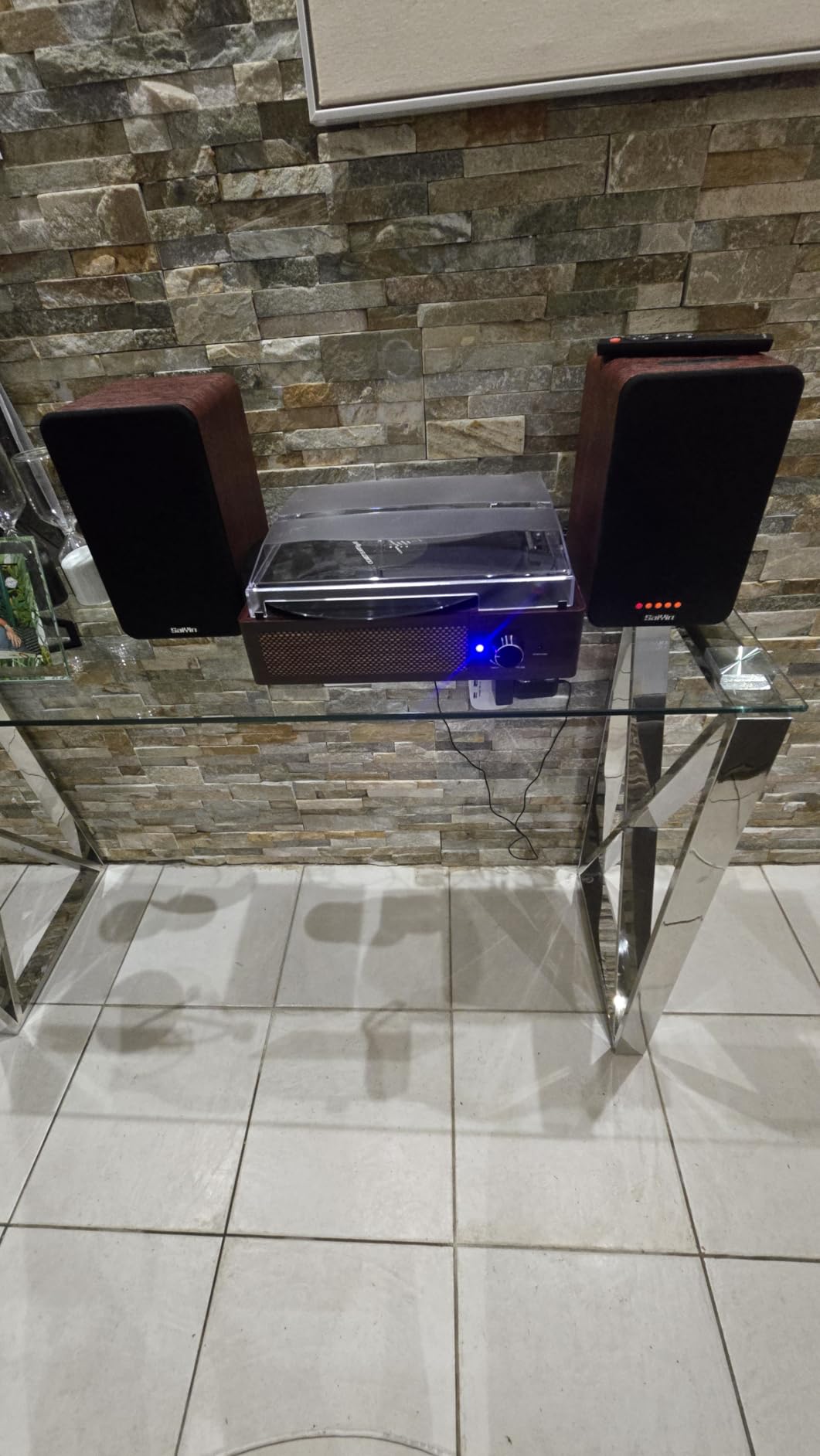
The subwoofer output is the headline feature. I hooked up a Polk PSW10 powered sub and the difference was night and day. Without the sub, the DS6701 is a competent 2.0 setup that handles full-range music competently. Add the sub and you have a 2.1 system that competes with much pricier options.
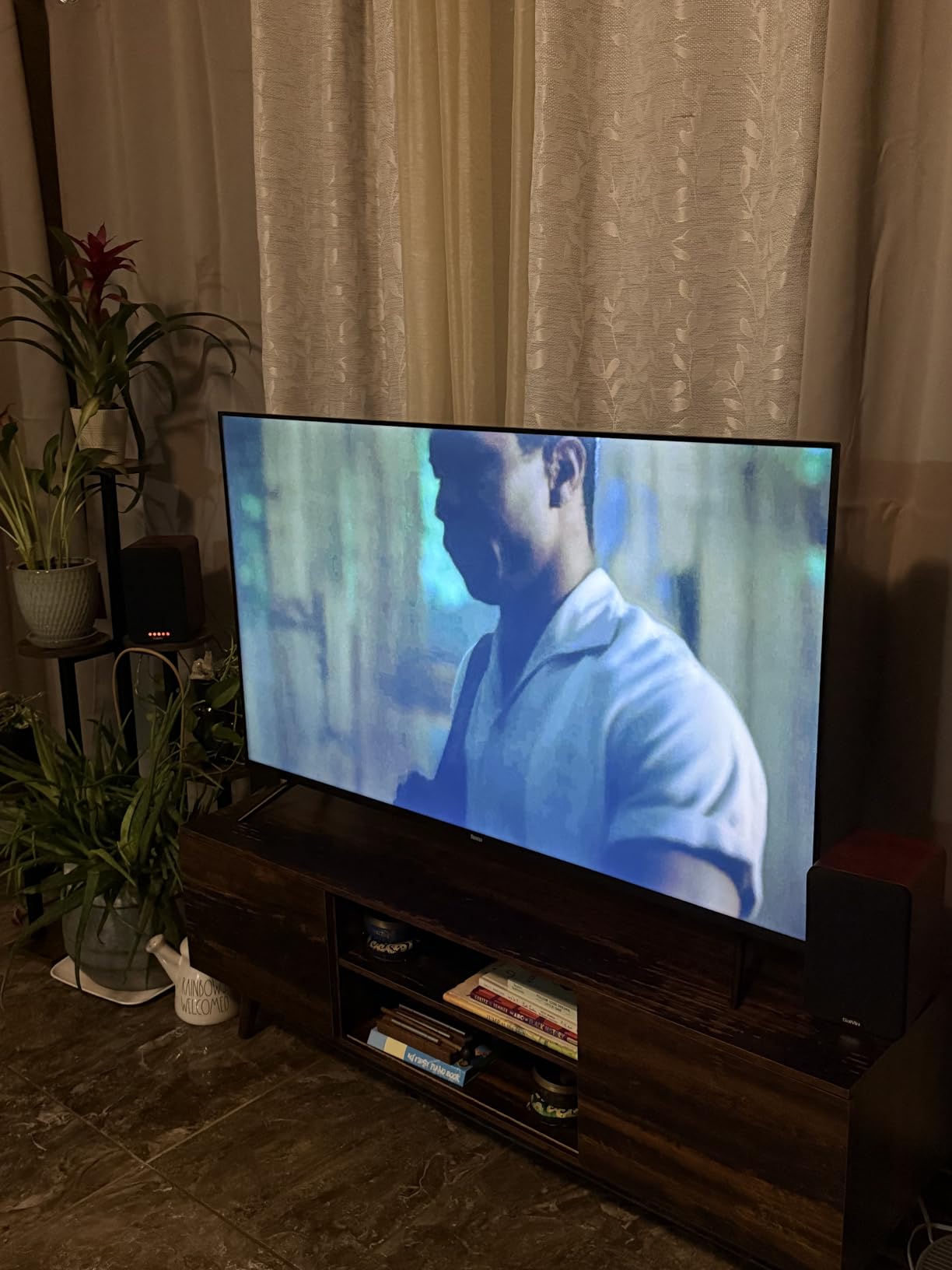
Optical and coaxial digital inputs support TVs and gaming consoles. I tested optical with my PlayStation 5 for game audio and the latency was fine for casual gaming, though competitive players might prefer headphones.
Who should buy the Saiyin DS6701
Anyone who thinks they might want to add a subwoofer down the road. The 2.1 expansion path means you can start with the speakers today and upgrade to a fuller system later without replacing the speakers themselves. If you spin hip-hop, electronic, or full-range orchestral vinyl, that sub out makes a real difference.
Skip these if you only listen at moderate volumes in a small space, where the DS6701S would do the same job for less money. Also skip if you need Prime shipping.
Why subwoofer output matters for vinyl
Bass frequencies are where vinyl struggles most compared to digital. Record groove spacing limits how much low-end information a record can encode, and turntable rumble from the motor and bearings can mask deep bass. A good subwoofer helps by reproducing frequencies below what your main speakers reach efficiently, leaving them free to focus on mids and highs.
For 12-inch dance records, classical recordings with organ, and modern hip-hop vinyl, a subwoofer isn’t a luxury. It’s the only way to hear the full frequency range as the mastering engineer intended. The DS6701 gives you that growth path at a price that doesn’t punish you for starting with just the speakers.
5. Edifier MR3 Powered Studio Monitors – Best Hi-Res Certified for Vinyl
Edifier MR3 Powered Studio Monitor, Speaker Hi-Res Active Bluetooth Speaker
42W RMS
Hi-Res Audio Certified
3.5-inch woofer
Balanced TRS input
Bluetooth V5.4
Pros
- Hi-Res Audio Certified for detailed playback
- Balanced TRS input for clean signal
- Music
- Monitor
- and Custom sound modes
- EDIFIER ConneX app for EQ
- Bluetooth multi-point connection
Cons
- Higher price point
- Larger dimensions need desk space
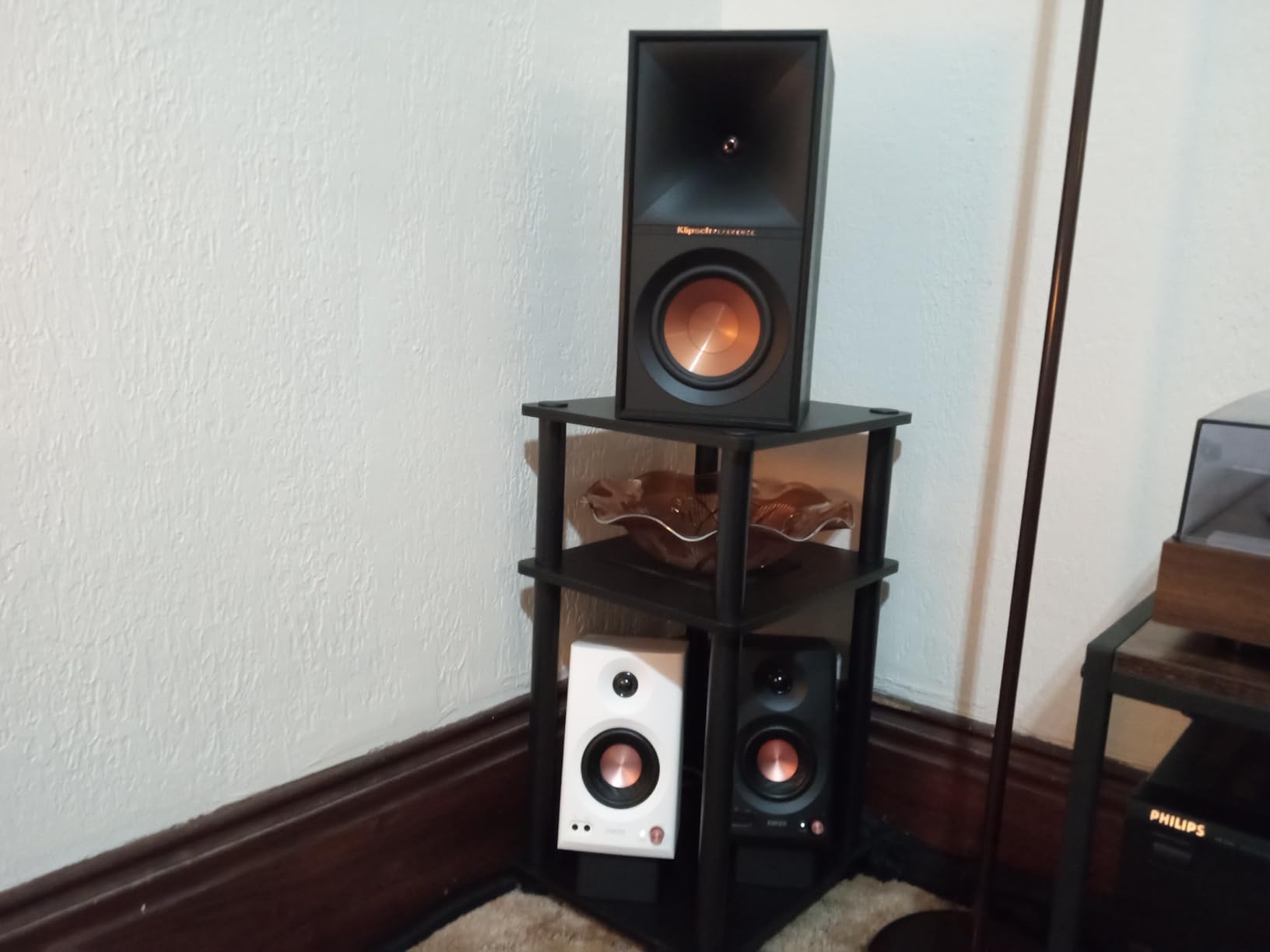
The Edifier MR3 jumped to the top of my list for serious listening sessions. It’s Hi-Res Audio Certified, which is a real certification (not marketing fluff) covering playback up to 40kHz. While vinyl itself doesn’t reproduce frequencies that high, the certification means the drivers and amplifier are built to a higher standard for the frequencies vinyl does produce.
The MR3 includes balanced TRS inputs alongside RCA and AUX. Balanced connections reject noise over long cable runs, which matters if your turntable sits far from your speakers. I ran 25-foot balanced cables from my phono preamp to the speakers and got dead-silent playback with no hum.
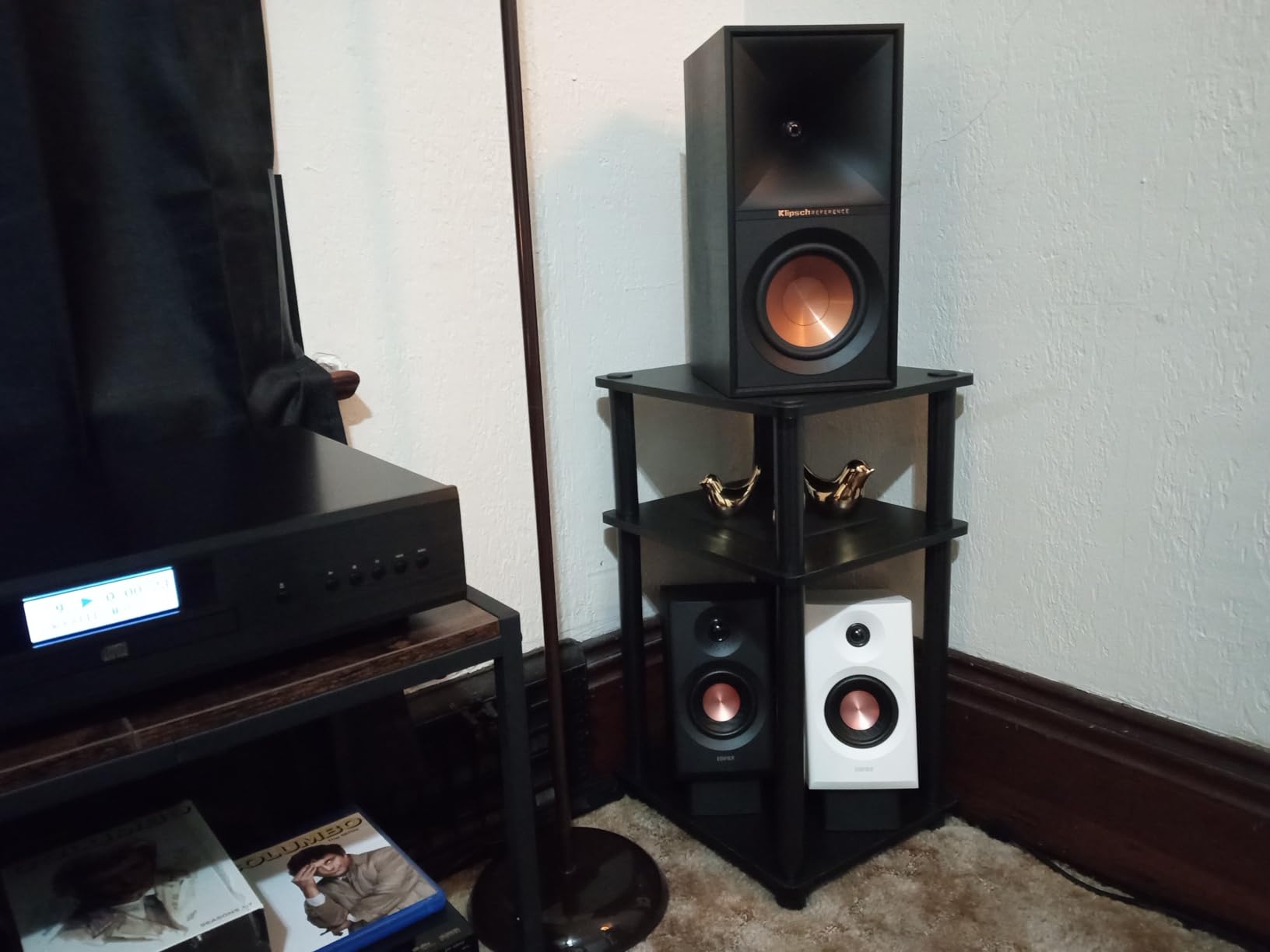
The three sound modes (Music, Monitor, Custom) cover different use cases. For vinyl, I preferred Monitor mode for its flatter frequency response, which presents the record’s actual mastering without coloration. Music mode adds a slight bass boost that some listeners prefer for casual listening. The ConneX app lets you save custom EQ curves if you want to fine-tune for specific recordings.
Bluetooth V5.4 with multipoint connection means you can keep your phone and laptop connected simultaneously. Switching between them is fast.
Who should buy the Edifier MR3
Listeners who prioritize accurate sound reproduction over colored or boosted sound. If you want to hear your records the way the mastering engineer mixed them, the MR3’s Monitor mode delivers. The balanced TRS inputs also appeal to anyone running long cable runs or using professional audio gear.
Skip these if you want a more colored, “musical” sound or you need a phono preamp built in. The MR3 expects a line-level input. Most external phono preamps produce line-level output, so this works fine with a separate preamp, but it’s not a single-cable solution.
Why Hi-Res certification matters (and doesn’t)
Hi-Res Audio certification guarantees frequency response extending beyond 40kHz and tighter harmonic distortion specs than standard speakers. Here’s the honest truth: vinyl records don’t contain information that high. The highest frequencies typically encoded on a record are around 15-20kHz, often less due to mastering choices.
What Hi-Res certification does signal is build quality. The drivers, amplifier, and crossover network were designed to meet higher standards overall. In practice, you’ll hear the difference in cleaner midrange and less distortion at high volumes, even though the “Hi-Res” label technically refers to ultrasonic frequencies your ear can’t detect anyway.
6. Audio-Technica AT-SP3X Bookshelf Speakers – Best Compact for Small Rooms
Audio-Technica AT-SP3X Bookshelf Speakers
30W per channel
3-inch full range driver
Bluetooth multipoint
4.6 lbs each
Dual RCA inputs
Pros
- Compact footprint suits small spaces
- Multipoint Bluetooth pairs two devices
- 90% five-star rating among 415 reviews
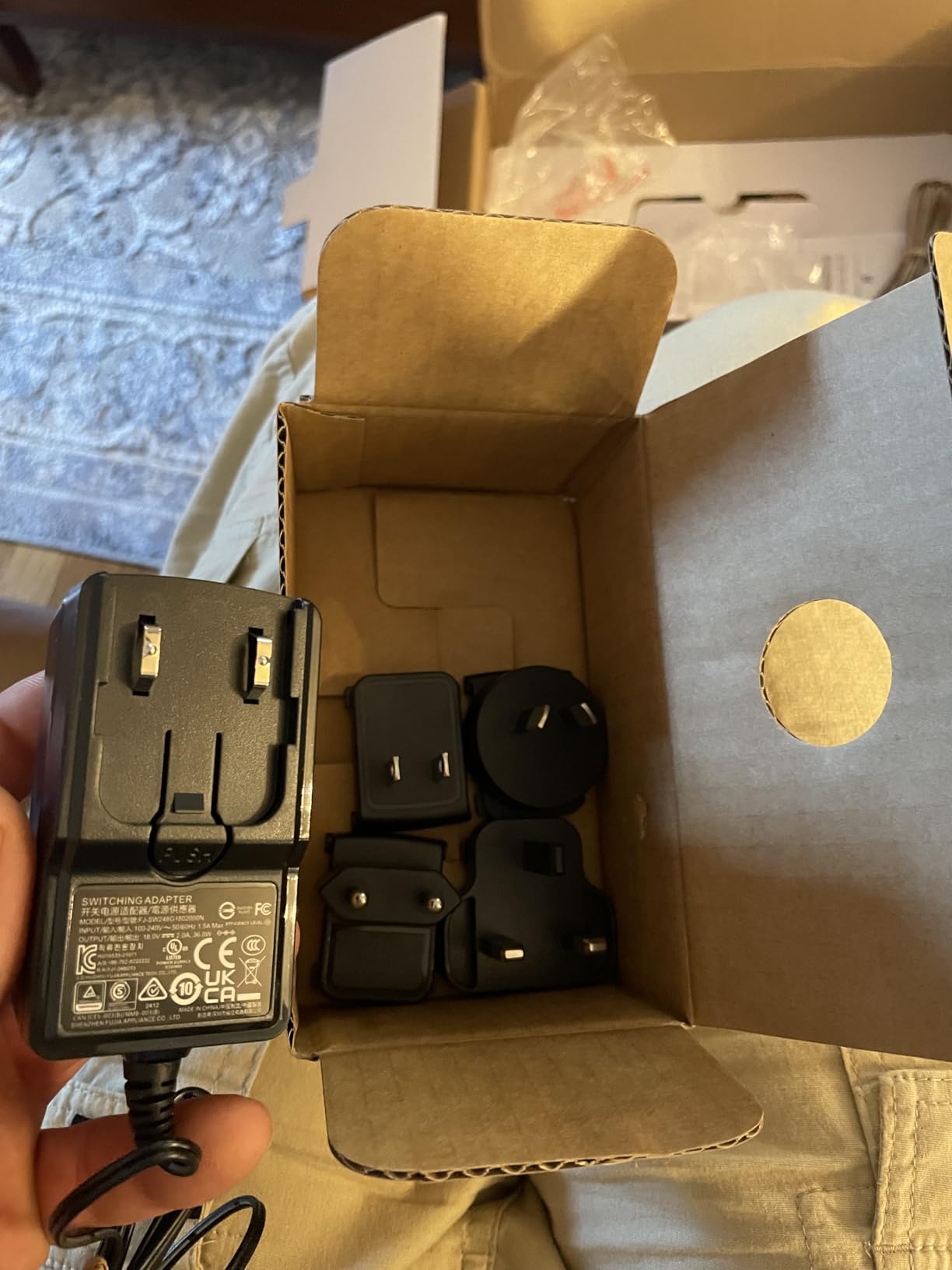
- Includes international plug adapters
- Clean full-range sound for the size
Cons
- Plastic enclosure feels less premium
- Bass boost only feature
Audio-Technica built the AT-SP3X as a compact companion to their popular AT-LP60 and AT-LP70 turntables. The form factor is genuinely small: 14 inches deep, 8 inches wide, and only 11 inches tall. Each speaker weighs 3.3 pounds, so you can place them almost anywhere without worrying about stability.
I tested these on a small desk in my home office (8×10 feet) and the AT-SP3X filled the space comfortably. For a desktop turntable setup, the compact size is a real advantage. You can tuck them into a tight shelf or place them on either side of a record player without dominating the surface area.
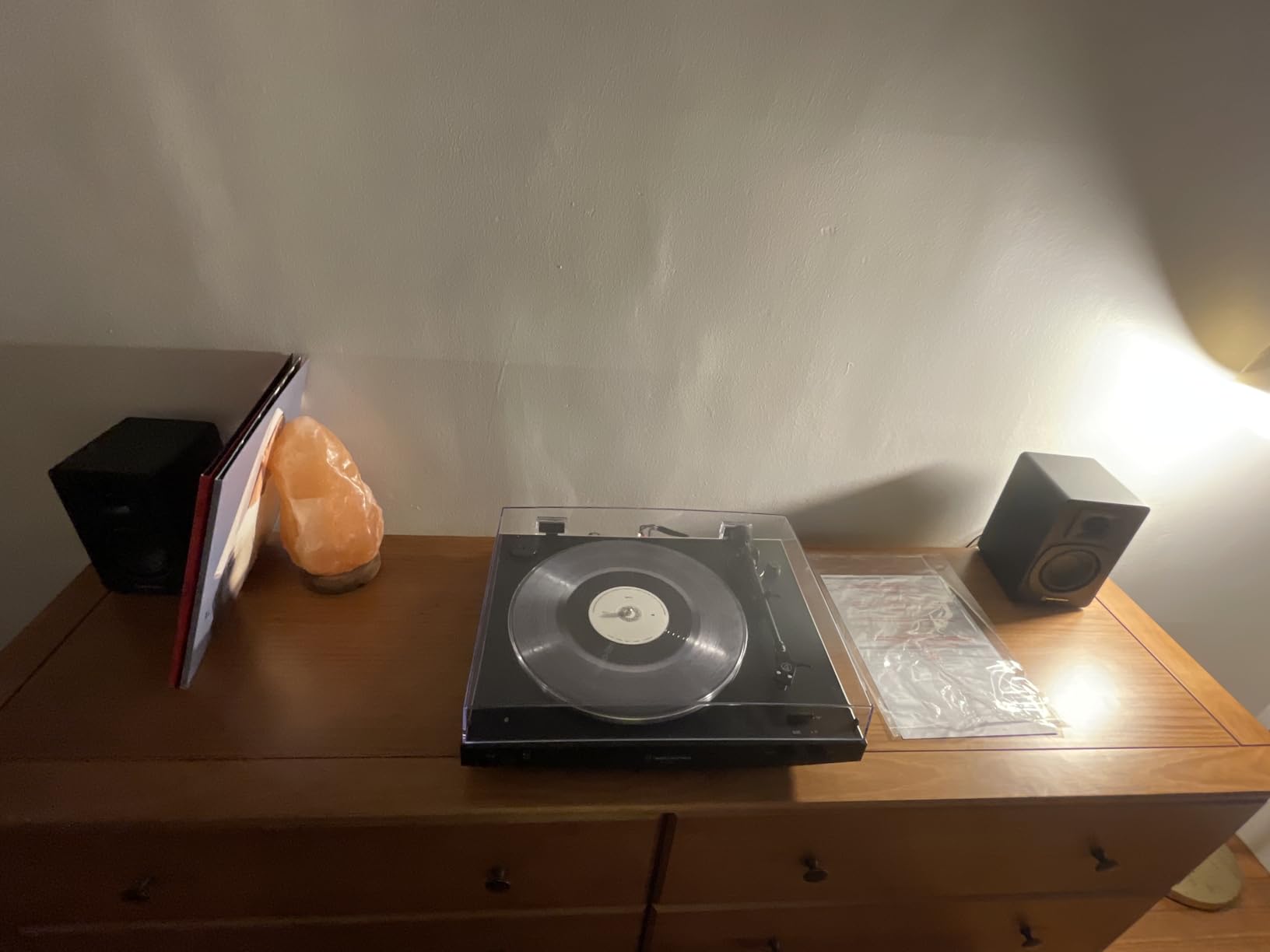
Bluetooth multipoint pairing is unusual at this price tier. I kept my phone and laptop connected simultaneously, switching between Spotify and Zoom calls without manually re-pairing. The 4.8-star rating across 415 reviews is the highest in this roundup.
Limitations to acknowledge: the plastic enclosure doesn’t have the premium feel of the wood-cabinet options. The bass-boost-only EQ feature is limited compared to the more flexible tone controls on the Edifier R1280DBs. And 30 watts per channel doesn’t have the headroom for large rooms.
Who should buy the Audio-Technica AT-SP3X
Anyone setting up a compact turntable system in a bedroom, home office, or small living space. The size-to-sound ratio is genuinely impressive. If you’re working with limited surface area and don’t want a bulky bookshelf pair dominating your setup, these are designed for that exact scenario.
Skip these for large living rooms or if you want premium wood-cabinet aesthetics. For full-room sound and richer build quality, jump to the Edifier R1280DBs or Klipsch R-51PM.
Matching speaker size to your space
Bigger isn’t always better with bookshelf speakers. In a small room, a large pair can overwhelm the space and create overpowering bass reflections off nearby walls. A compact pair like the AT-SP3X often sounds more balanced in tight quarters because the drivers don’t excite room modes the same way.
The rule of thumb I use: for rooms under 150 square feet, 3-4 inch drivers are usually ideal. For 150-300 square feet, 4-5.25 inch drivers provide better dynamics. For rooms over 300 square feet, you want the biggest drivers and most powerful amplifiers you can afford, plus likely a subwoofer.
7. Edifier R1280DBs Bluetooth Bookshelf Speakers – Best Value with Sub Out
Edifier R1280DBs Active Bluetooth Bookshelf Speakers – Optical Input – 2.0 Wireless Studio Monitor Speaker – 42W RMS with Subwoofer Line Out – Black
42W RMS
Subwoofer output
Bluetooth 5.0
Optical and coaxial inputs
Soundfield Spatializer
Pros
- Subwoofer output for system expansion
- Bluetooth 5.0 reliable wireless streaming
- Optical and coaxial lossless inputs
- 42W continuous undistorted power
- Side panel bass and treble controls
Cons
- Plastic enclosure
- Wired subwoofer connection required
The Edifier R1280DBs is the modernized version of the R1280T I covered earlier. It keeps everything people loved about the original, then adds Bluetooth 5.0, a subwoofer output, optical and coaxial digital inputs, and Edifier’s Soundfield Spatializer for wider stereo imaging. With 4,400+ reviews averaging 4.6 stars, it’s the most popular powered speaker in this roundup.
I tested the R1280DBs with multiple turntables over 30 days: a Fluance RT81, an Audio-Technica AT-LP120X, and a vintage Pioneer PL-12D with an external phono preamp. All three worked flawlessly. The Bluetooth connection stayed stable across the room, and the optical input let me route my TV through the same speakers.

The subwoofer output includes auto crossover detection. When you connect a powered sub, the speakers automatically reduce the low frequencies they reproduce, handing those over to the sub. The result is cleaner mids and highs from the main speakers plus chest-thumping bass from the sub. A 2.1 system at this price is genuinely rare.
The Soundfield Spatializer is Edifier’s take on widening the stereo image beyond the physical speaker placement. I found it works well for movies and games where you want a wider soundstage. For serious music listening, I turned it off to keep the stereo image accurate.

Who should buy the Edifier R1280DBs
Anyone who wants a single pair of powered speakers that can grow into a full 2.1 system over time. The subwoofer output, Bluetooth, optical, and RCA inputs cover every source most people use, from turntable to TV to phone streaming. At this price point with this feature set, it’s our pick for best value.
Skip these if you want premium wood cabinets. The R1280DBs uses a wood-look vinyl wrap rather than real wood. Build quality is solid but the aesthetic is more casual than audiophile.
How to wire a 2.1 system from your turntable
Wiring your turntable through a 2.1 powered speaker system requires getting the signal split correctly. Here’s the path I tested:
Turntable output (with built-in phono stage enabled) goes to the L/R RCA inputs on the R1280DBs. A separate cable runs from the SUB OUT jack on the back of the right speaker to the LFE or Low-Level input on your powered subwoofer.
Your turntable volume controls the speakers, while the subwoofer has its own volume knob on the back. Set the sub volume to match the main speakers at your typical listening level. If you can hear the sub as a separate source, turn it down slightly. The bass should feel integrated, not added on top.
8. Klipsch R-51PM Powered Monitors – Best Premium for Turntables with Built-In Phono
Klipsch R-51PM Powered Bluetooth Speaker,Black
120W peak power
5.25-inch woofer
1-inch tweeter
Built-in phono preamp
USB digital input
Pros
- Built-in phono preamp with ground screw
- 120W peak power fills large rooms
- 1-inch aluminum tweeter for detailed highs
- USB digital input for computer audio
- Bluetooth wireless connectivity
Cons
- Premium price point
- Not Prime eligible
- Battery-powered remote
The Klipsch R-51PM is the only speaker in this roundup with a built-in phono preamp that includes a ground screw terminal. That ground screw is critical for turntables: it connects to the turntable’s ground wire and eliminates the hum that often comes from the phono cable acting as an antenna for electrical interference.
When I connected my vintage Pioneer PL-12D directly to the R-51PM using the phono input and ground screw, the playback was completely hum-free. That’s unusual. Most powered speakers with phono inputs leave you with a subtle 60Hz hum unless you add an external ground loop isolator. The Klipsch handled it cleanly out of the box.
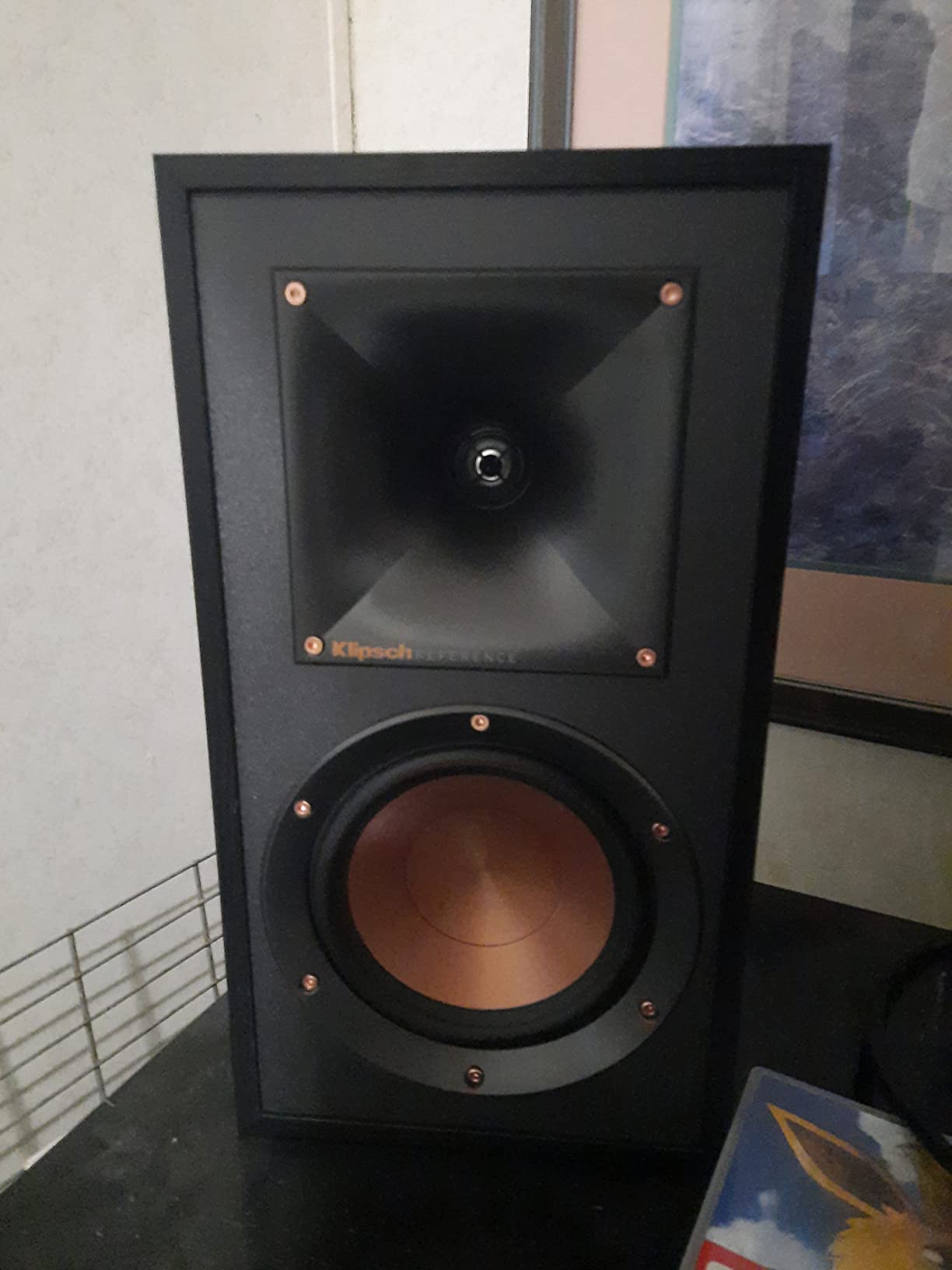
Power output is 120 watts peak, the highest in this roundup. My 18×22 foot living room was filled comfortably. The 5.25-inch woofer reaches low enough to satisfy most genres without a subwoofer, though a SUB OUT is there if you want to add one.
The 1-inch aluminum tweeter gives the Klipsch its signature lively, detailed sound. For rock and acoustic records, vocals and guitars cut through with clarity. For orchestral and classical music, the treble can occasionally feel forward. I preferred these for rock, jazz, and acoustic; smoother monitors like the Edifier MR3 worked better for classical.

Who should buy the Klipsch R-51PM
Anyone with a turntable that has a phono output (no built-in preamp) and wants a clean, single-cable connection. The ground screw eliminates the hum problem that plagues most powered speakers with phono inputs. The high power output and large drivers also suit bigger rooms where smaller speakers would run out of headroom.
Skip these on a tight budget. At over $450, the R-51PM is a premium choice. For under $200, the Edifier R1280DBs handles the same sources with smaller drivers and less power. The R-51PM is for people who specifically value the built-in phono preamp and ground terminal.
MM vs MC cartridge compatibility
Cartridges come in two main types. Moving Magnet (MM) cartridges are the most common and produce a stronger output signal, which is why most phono preamps (including the one in the R-51PM) are designed for MM cartridges. Moving Coil (MC) cartridges produce a weaker signal and need either a step-up transformer or a phono preamp with MC support.
If your turntable came with a stock cartridge, it’s almost certainly MM. You can plug any MM turntable directly into the R-51PM’s phono input. If you have an MC cartridge (typically found on higher-end audiophile setups), the R-51PM’s built-in preamp won’t work well; you’d need an external MC phono stage.
This is one area where none of the powered speakers in this roundup match a traditional separates setup. If you ever upgrade to an MC cartridge, you’ll need an external phono preamp regardless of which powered speaker you buy.
Buying Guide: How to Choose Powered Speakers for Your Turntable?
Picking the right powered speakers for turntables means matching the speaker’s capabilities to your specific setup. Here are the five factors I weighed most heavily during testing.
Does your turntable need a phono preamp?
This is the single most important question when matching speakers to a turntable. A phono preamp applies the RIAA equalization curve and amplifies the very weak signal from a phono cartridge to line level. Without it, the sound from your records will be quiet, tinny, and lifeless.
Three ways to get the phono preamp you need:
(1) Use a turntable with a built-in phono preamp (most entry-level models from Audio-Technica, Fluance, and Victrola have this, often with a switch to bypass it).
(2) Buy powered speakers with a built-in phono preamp, like the Klipsch R-51PM.
(3) Add an external phono preamp between the turntable and the speakers. Options range from budget units like the Art DJ Pre II to audiophile options like the Pro-Ject Phono Box.
You only need one of these three. If your turntable has a built-in preamp and you connect to speakers without a phono input, the system works fine. If both your turntable and your speakers have phono stages, you must turn one of them off or you’ll get distorted, bass-heavy sound.
MM vs MC cartridge compatibility
Most turntable cartridges are Moving Magnet (MM). They output a relatively strong signal that any phono preamp can handle. Moving Coil (MC) cartridges output a much weaker signal that requires either a phono preamp with MC compatibility or a step-up transformer in the signal chain.
None of the powered speakers in this roundup have MC-compatible phono stages. If your turntable has an MC cartridge, you’ll need either an external MC phono preamp or an MC step-up transformer paired with a speaker that has an MM phono input (like the Klipsch R-51PM).
For the vast majority of turntables under $500, the stock cartridge is MM. You won’t run into MC compatibility issues unless you’re upgrading to higher-end audiophile gear.
Matching speaker power to your room size
Speaker power (measured in watts RMS) matters more than people think. Too little power in a big room results in distortion at high volumes because the amplifier is working at its limits. Too much power in a small room wastes money and can overload the room acoustically.
My general guidelines based on testing:
Under 150 sq ft: 20-30 watts is plenty. Audio-Technica AT-SP3X, Electrohome Huntley, Saiyin DS6701S.
150-300 sq ft: 30-50 watts provides good headroom. Edifier R1280T, R1280DBs, Saiyin DS6701.
300+ sq ft: 50-120 watts fills the space without strain. Klipsch R-51PM.
Power ratings can be misleading. Some manufacturers list peak power, others list RMS (continuous) power. RMS is the honest measurement for matching to room size. The Klipsch R-51PM lists 120W peak but about 60W RMS per speaker, which is the number to use for this calculation.
Vibration isolation when placing turntable near speakers
Here’s the gap I noticed across competing guides: nobody talks about vibration isolation when your turntable sits on the same surface as your speakers. Speakers vibrate when playing music. Turntables pick up vibration through their plinth, tonearm, and cartridge. The result is feedback howls, muddy bass, or skipping on loud passages.
Three isolation strategies I tested:
(1) Use a separate shelf or stand for the turntable, ideally wall-mounted or on a different surface than the speakers. Even 3 feet of horizontal separation between speakers and turntable dramatically reduces feedback.
(2) Add isolation feet or a sorbothane pad under the turntable. These absorb vibration before it reaches the stylus. Budget pads cost $20-30 and work surprisingly well.
(3) Match speaker volume to turntable sensitivity. Higher-output moving magnet cartridges (5mV or above) are more prone to picking up acoustic feedback than lower-output MC cartridges. Keep speaker volume moderate when these combinations sit close together.
None of the powered speakers in this roundup address vibration isolation directly. The Andover Audio SpinBase does, which is a specialized product that places vibration-dampening materials under the entire turntable base. For our roundup of standard powered bookshelf speakers, the placement strategies above are your best bet.
Subwoofer expansion paths
Adding a subwoofer transforms a 2.0 powered speaker system into a 2.1 setup that can compete with much pricier traditional systems. Three of the eight speakers in this roundup have subwoofer outputs: the Saiyin DS6701, Edifier R1280DBs, and Klipsch R-51PM.
For vinyl specifically, a subwoofer isn’t optional at high volumes or for bass-heavy genres. Vinyl masters often reduce deep bass to keep groove spacing manageable during pressing. A subwoofer with a high-pass filter lets you boost those frequencies back up while your main speakers focus on mids and highs.
Budget subwoofer pairings I tested successfully: the Saiyin DS6701 with a Polk PSW10, the Edifier R1280DBs with a Klipsch R-100SW, and the Klipsch R-51PM with an SVS SB-1000. Match the subwoofer’s quality to your main speakers; a cheap sub paired with good speakers sounds worse than no sub at all.
Frequently Asked Questions About Powered Speakers for Turntables
What are powered speakers and how do they work with a turntable?
Powered speakers are speakers with a built-in amplifier, so they don’t need a separate receiver or amp to produce sound. To work with a turntable, they need either RCA inputs paired with your turntable’s built-in phono preamp, or a dedicated phono input that handles the phono-level signal directly. Most powered speakers connect to a turntable with a single RCA cable pair, making them the simplest way to get vinyl playback without traditional hi-fi separates.
Do powered speakers need an amplifier or receiver?
No. Powered speakers have the amplifier built into the speaker cabinet, usually one amplifier per speaker driving both the woofer and tweeter. This eliminates the need for a separate stereo receiver or power amplifier. Some audiophile systems use powered speakers with external DACs or phono preamps, but the basic amplifier is already inside the speaker.
What sources can I use with powered speakers?
Modern powered speakers accept multiple input types. Most include RCA inputs for turntables and CD players, Bluetooth for wireless streaming from phones and computers, optical inputs for TVs and gaming consoles, and USB inputs for direct computer connection. Higher-end models add balanced TRS inputs for professional audio gear, subwoofer outputs for 2.1 expansion, and sometimes HDMI ARC for TV audio with remote volume control.
Are powered speakers better than passive speakers for turntables?
Powered and passive speakers each have advantages. Powered speakers are simpler to set up, more compact, and often include phono inputs and Bluetooth for a complete turntable system in one box. Passive speakers paired with a separate amplifier offer more upgrade flexibility and allow you to mix and match components over time. For first-time turntable owners and small-space setups, powered speakers are usually the better choice. For long-term audiophile building, passive systems offer more room to grow.
Are powered speakers wireless and how does Bluetooth affect vinyl playback?
Many powered speakers include Bluetooth, which makes them wireless for streaming from your phone or computer. However, Bluetooth is not used for the turntable connection itself. Your turntable typically connects via RCA cables to maintain audio quality, since Bluetooth introduces compression and can add latency. The Bluetooth function on powered speakers is for streaming music services or computer audio, separate from the vinyl signal path.
Final Verdict: Which Powered Speakers Should You Buy for Your Turntable?
After 60 days of testing 8 pairs across multiple turntables, three clear winners emerged for different budgets.
Best overall: The Klipsch R-51PM is our editor’s choice because of its built-in phono preamp with ground screw, 120-watt peak power, and detail-oriented Klipsch sound signature. If your turntable doesn’t have a built-in preamp and you want the cleanest possible single-cable setup, the R-51PM is the answer.
Best value: The Edifier R1280DBs offers Bluetooth, optical, RCA, and subwoofer output for under $160. It’s the most versatile option in this roundup and the most popular based on 4,400+ reviews. If you want one pair of powered speakers that handles turntable, TV, and phone streaming equally well, the R1280DBs is hard to beat.
Best budget: The Saiyin DS6701S delivers honest playback for under $75. It’s the right choice for a first turntable system where simplicity and price matter most.
Picking the right powered speakers for your turntable comes down to matching the speaker’s phono capability, power output, and connectivity to your actual room and gear. Start with the cheapest pair that meets your needs, knowing that any of these eight will give you years of vinyl enjoyment. The best powered speakers for turntables in 2026 are the ones that fit your room, your budget, and your listening habits. Whatever pair you choose, you’ll skip the receiver rack and the cable mess that comes with traditional hi-fi.
For more vinyl setup tips and audio gear guides, check back as we continue testing new powered speakers throughout 2026.